Lismore Castle Arts
MarchAugust 2024
Each now, is the time, the space Leonor Antunes, Alexandre da Cunha, Rhea Dillon, Veronica Ryan Curated by Habda Rashid 23 March27 October 2024
Lismore Castle Lismore Co Waterford, P51 F859

Lismore Castle Aleana Egan Carolina Aguirre Second-hand remember member ember 23 March19 May 2024 23 March19 May 2024 St Carthage Hall The Mill Lee Mary Manning Anne Tallentire and Olga Balema Veedon Fleece Vertices, Curated by Mark O’Gorman 14 June18 August 2024 14 June18 August 2024 St Carthage Hall The Mill Veronica Ryan, ForegroundPrecarious , 2021, Locker shelves, cable ties, tea bags, fruit net, orange peel, cloves, fruit net, raffia, sculpey clay, mango stones in fabric, fishing line, 63.5 x 52 x 27 cm. BackgroundInfection I , 2021. Sculpey, found object, thread, metal locker shelf, cable ties, clay 67 x 25.5 x 44 cm. Courtesy: Alison Jacques, London © Veronica Ryan. Install view at Lismore Castle Arts. Photo: Jed Niezgoda
Exhibitions across 3 locations: St Carthage Hall Chapel Street, Lismore Co Waterford, P51 WV96 For opening times of each location www.lismorecastlearts.ie +353 (0)58 54061 The Mill Ballyin, Lismore Co Waterford, P51 A2R5


VAN The Visual Artists’ News Sheet A Visual Artists Ireland Publication Issue 3: May – June 2024
Inside This Issue BELFAST EXPOSED @ 40 REVIEW: NIAMH MCCANN PRINT NETWORK IRELAND WHEN FORMS COME ALIVE


The Visual Artists’ News Sheet
May – June 2024
On The Cover
Niamh McCann, ‘someone decides, hawk or dove’, installation view, The MAC, 8 December 2023 – 7 April 2024; photograph by Simon Mills, courtesy of the artist and The MAC.
First Pages
6. Roundup. Exhibitions and events from the past two months. 8. News. The latest developments in the arts sector.
Columns
9. Wildflowers for Breakfast. Cornelius Browne reflects on the resilience of nature and the arrival of spring. An Artist in Exile. Tuqa Al-Sarraj discusses key themes within her multidisciplinary art practice.
10. Something Found To Be Beautiful. For the third column in the series introducing KCAT studio artists, Dominic Thorpe reflects on some of the working methods of Declan Byrne. Approx 1 Second of a Sweet Kiss. Lisa Freeman discusses her new film now showing in TBG+S until 19 May.
11. Artists Know Best. Lian Bell reflects on the benefits of coaching to counterbalance powerlessness. On Rejection. Rachel Macmanus considers the impact on artists of rejected proposals.
Organisation Profile
12. Belfast Exposed @ 40. Jonathan Brennan interviews Deirdre Robb about the 40th anniversary of Belfast Exposed.
14. Surface and Inscription. Aodán McCardle outlines the evolution of Derry Print Workshop.
In Focus: Print Network Ireland
15. Etching the Digital Landscape. Ria Czerniak-LeBov, Graphic Studio Dublin
16. Screen Printing Using Analogue Positives. Emily Mc Gardle, Black Church Print Studio
17. Impressions of Place. Johnny Bugler, Cork Printmakers
18. How to Flock! Christopher Clery, Limerick Printmakers
Critique
19. Lorraine Tuck, ‘Unusual Gestures’, 2023
20. Lorraine Tuck at Roscommon Arts Centre
21. Els Dietvorst at Uillinn: West Cork Arts Centre
22. Hughie O’Donoghue at The Glucksman
23. Eddie Cahill at Limerick City Gallery of Art
24. Niamh McCann at The MAC
International
26. When Forms Come Alive. Varvara Keidan Shavrova reviews the current sculpture exhibition at Hayward Gallery in London.
28. Kafkaesque. Christa-Maria Lerm Hayes reviews an exhibition in Prague to mark the centenary of Franz Kafka’s death.
Career Development
29. Creator of Worlds. Brendan Maher interviews Breda Lynch about her recent exhibition at The Source Arts Centre in Thurles.
30. Holding Space. Ella de Búrca outlines the evolution of her practice to date.
31. Mother Myth Memory. Sean Walsh interviews artist Rita Duffy about her current exhibition at Esker Arts in Tullamore.
Public Art
32. Art Outside of the Gallery. Public art profiles by Ruth E. Lyons and Maggie Madden.
Member Profile
34. Tokyo Jazz Joints & Beyond. Belfast-born photographer Philip Arneill discusses his research and practice. The Power of Stillness. Adeline Gaudefroy reports on her residency at The Marina Abramović Institute.
Last Pages
35. Opportunities. Grants, awards, open calls, and commissions.
36. VAI Lifelong Learning. Upcoming VAI helpdesks, cafés, and webinars.


The Visual Artists’ News Sheet:
Editor: Joanne Laws
Production/Design: Thomas Pool
News/Opportunities: Thomas Pool, Mary McGrath, Francesca Saracuta
Proofreading: Paul Dunne
Visual Artists Ireland:
CEO/Director: Noel Kelly
Office Manager: Grazyna Rzanek
Advocacy & Advice: Oona Hyland
Advocacy & Advice NI: Brian Kielt
Membership & Projects: Mary McGrath
Services Design & Delivery: Emer Ferran
News Provision: Thomas Pool
Publications: Joanne Laws
Accounts: Grazyna Rzanek
Board of Directors:
Michael Corrigan (Chair), Michael Fitzpatrick, Richard Forrest, Paul Moore, Mary-Ruth Walsh, Cliodhna Ní Anluain (Secretary), Ben Readman, Gaby Smyth, Gina O’Kelly, Maeve Jennings, Deirdre O’Mahony.
Republic of Ireland Office
Visual Artists Ireland
First Floor
2 Curved Street
Temple Bar, Dublin 2
T: +353 (0)1 672 9488
E: info@visualartists.ie
W: visualartists.ie
Northern Ireland Office
Visual Artists Ireland
109 Royal Avenue
Belfast
BT1 1FF
T: +44 (0)28 958 70361
E: info@visualartists-ni.org
W: visualartists-ni.org


International Memberships Principal Funders
Page 27 Page 22 Page 24
Page 9
Safe to Create Safe to Create is a Dignity at Work programme looking to impact change on the culture and practices of the Arts and Creative sectors. If you or someone you know is facing bullying or harrasment please visit safetocreate.ie
Irish Gothic Patricia Hurl


Film still from All At Once Collapsing Together, Caoimhín Gaffney, 2024 08.06— 28.07.24 Caoimhín Gaffney All at Once Collapsing Together Evans’ Home, John’s Quay Kilkenny, R95 YX3F butlergallery.ie +353 (0)56 7761106
1 0 T H M A Y - 2 2 N D J U N E S O U T H T I P P E R A R Y A R T S C E N T R E , C L O N M E L 3 1 S T M A Y - 2 9 T H J U N E T H E S O U R C E A R T S C E N T R E , T H U R L E S SOUTHTIPPARTSCENTRE IE | @SOUTHTIPPARTS THESOURCEARTSCENTRE IE | @SOURCEARTS
Patricia Hurl, The Company Wife, 1986, Oil on canvas,124 5 x 186 cm, IMMA Collection, Purchase, 2023, Photography: Denis Mortel
Jan McCullough Night Class
13 April – 9 June
Curtin // Keating Sit Stand Smoke
25 April – 5 May
Brian Teeling and Jennie Taylor in the glow of a frozen flame
16 May
Ursula Burke
These Fragile Monuments
25 May – 21 July
Under a Vaulted Sky 11 May—6 July 2024




When the Invisible touches the Surface 11 May—6 July 2024
The Dock Arts Centre | www.thedock.ie
BUILDING AS WITNESS is kindly supported by the Department of Tourism, Culture, Arts, Gaeltacht, Sport and Media under the Decade of Centenaries Programme 2012 - 2023.
Caline Aoun
Pauline Rowan


Aiteall BA Hons Art Degree Show Wexford Arts Centre Opens 16th May 17:30 Runs to 5th June 2024 South East Technological University School of Art and Design, Wexford fine spell between two clouds TADA! An exhibition for children by children A Kids’ Own Publishing Partnership Exhibition 17 February – 25 May 2024 www.femcwilliam.com F.E. MCWILLIAM GALLERY & STUDIO Admission Free Visit
Saorchead Isteach Tabhair
ar
HILARY HERON A Retrospective Taispeántas Iardhearcach 24 May — 28 October 2024 24 Bealtaine — 28 Deireadh Fómhair 2024
imma.ie
Cuairt
imma.ie
IMAGE: Hilary Heron sitting with Crazy Jane III circa 1958. Photo courtesy Hilary Heron Estate.
Hilary Heron ag suí le ‘Crazy Jane III’ thart ar 1958. An grianghraf á úsáid le caoinchead ó
Eastát Hilary Heron
Dublin
Douglas Hyde Gallery
The Douglas Hyde Gallery presents ‘The Quickening’, a powerful new artwork by artist Deirdre O’Mahony. ‘The Quickening’ engages with the challenges confronting farming, food production, and consumption in the context of today’s ecological and climate crises. The result of over three years of dedicated research, this nationwide project launched with an exhibition (which continues at The Douglas Hyde until 23 June) and a ‘Walls & Halls Tour’ of six rural locations (between 18 April and 4 May) spanning barns, farms, and community centres. thedouglashyde.ie
National Museum of Ireland
“What does Irish Culture and identity look like one hundred years after the formation of the state?” This is the question posed by Anthony Haughey’s exhibition, ‘We Make Our Own Histories’, which continues at the National Museum of Ireland, Decorative Arts & History, Collins Barracks, until 30 June. Curated by Jonathan Cummins and Maolíosa Boyle, this exhibition marks the culmination of Haughey’s three-year residency at the museum. Haughey crafted artworks that were inspired by the museum’s collection.
museum.ie
The LAB Gallery
The LAB Gallery presented the exhibition ‘Endlessnessnessness’ which featured the work of Cecilia Bullo, Hannah Ní Mhaonaigh and Ella Bertilsson, and was curated by Julia Moustacchi. The title, which took inspiration from Joyce’s Ulysses, sets the tone for an inquiry into the concepts of the eternal and ephemeral. Throughout this exhibition the artists delved into feminine energies, symbolised by natural elements and performative moments, and inviting viewers to question collective memories and perceptions. The exhibition ran from 1 February to 23 March 2024.
dublincityartsoffice.ie
Museum of Literature Ireland
The Museum of Literature Ireland (MoLI) presents ‘Is This A Poem?’, an exhibition curated by artist Christodoulos Makris, which continues until 21 July. According to the press release, this is an exhibition about “poetry’s furthest frontiers” which encourages viewers to discover works of poetry that “exist beyond the page”: poems that are sound, sculpture, image, film, performances, software, and objects you can touch. ‘Is this a poem?’ celebrates the playful capacity of poetry to surprise, challenge and inform our view of the world.
moli.ie
RHA Ashford Gallery
Selma Mäkelä’s exhibition of new work, ‘When the birds gather, you know there is something you must do’, ran at RHA Ashford Gallery from 29 March to 28 April. Addressing themes relating to environmental and ecological concern, this exhibition featured intimate paintings inhabited by statues, birds, and figures taken from archival photographs and fleeting moments of the everyday.
Belfast
TØN Gallery
TØN Gallery hosted ‘To Never Look Away’ from 7 to 31 March 2024. Curated by Claire Halpin, this group exhibition featured Joy Gerrard, Rachel Fallon, Paul Mac Cormaic, Myra Jago, Claire Halpin and Amna Walayat, whose socially and politically engaged works assembled around themes of labour, protest, war, and the migrant crisis. Through the use of different materials, such as oil paint, ink, cast iron and gold leaf, the artists invited viewers to confront uncomfortable truths and to engage with deeper meanings behind their carefully crafted works.
tondublin.com

Catalyst Arts
‘MUSCA DEPICTA’ is a solo exhibition by Belfast-based multi-disciplinary art- ist, Éabha Campbell, currently showing at Catalyst Arts until 4 May. The artist is interested in representations of insects in seventeenth-century European painting as religiously charged symbols of the soul and ephemeral life. There are also connotations of sin, corruption, or mortality in religious texts and paintings of biblical scenes. Using painting, taxidermy, and actively decaying specimens, Campbell’s exhibited works capture ephemerality and metamorphosis. catalystarts.org.uk
Platform Arts
Platform Arts presented the exhibition ‘BLACKOUT’ by the NUA Collective from 7 to 30 March 2024. ‘BLACKOUT’ featured works from 13 artists: Josh Stein, Robert Jackson, John Murray, Carol Healey, Paul McMahon, Caoimhe Heaney, Maria Markham, Luke Hickey, Christina Geoghegan, Eamonn B. Shanahan, Saoirse O’Sullivan, and Katrīna Tračuma. Showcasing unique lino-prints and a documentary film screening, this group exhibition explored climate change through the lens of ‘anthropomorphic blackout’. platformartsbelfast.com
The MAC
‘Mother tongue’ is an exhibition presenting contemporary practices in Northern Ireland, spanning installation, painting, sculpture, audio, and film. According to the press release, “mother tongue” is a term that “evokes our relationship to language and our (dis)connection to the land, belonging, family, and our own bodies.” Curated by Alissa Kleist and Ciara Hickey, the exhibition brings together 21 artists who participated in the Freelands Artist Programme exploring modes of communication that shape personal and collective identities, from written and spoken. themaclive.com
Flax Art Studios
From 4 to 26 April, Threshold Gallery –an exhibition space on North Street run by Flax Art Studios – presented ‘This Street is a Song’ by sound and media artist Stephanie Loveless, as part of Sonorities Festival Belfast. The exhibition emerges from ongoing research exploring practices of situated listening in a vacant lot garden in Albany, New York, where the artist has lived for the past decade. It explores issues of public space, food justice, sonic territorialism, community engagement, violence, structural racism, and the environment.
flaxartstudios.org
QSS Gallery
Queen Street Studios presented ‘at a distance’, a solo exhibition by Nollaig Molloy, which ran from 7 to 28 March. Molloy presented an immersive exploration of the Cormorant, which blended mythology, cultural references, and scientific inquiry. A film of the same name forms the centrepiece of the exhibition, visually combining real-time performance with life-size collages on an island habitat, alongside interactions with specimens from a Natural History archive, and a selection of stop-motion animation using pop-up paper techniques.
queenstreetstudios.net
Vault Artist Studios
The ‘Mother’ exhibition took place at Marly Gallery & Project Space from 7 to 13 March in celebration of International Women’s Day. Vault Artist Studios previously invited submissions of work that celebrate, commemorate, and cherish mothers, including works created by mothers (or those performing mothering roles). The 70 participating artists contributed a diverse variety of artworks across a range of media including painting, sculpture, collage, photography, print, drawing, textiles, embroidery, poetry, installation, digital illustration, and moving image.
vaultartiststudios.com

Visual Artists’ News Sheet | May – June 2024 6 Exhibition Roundup
rhagallery.ie
Nollaig Molloy, at a distance 2024, film still, Natural History Archive, Dublin; image © and courtesy of the artist.
Anthony Haughey, A Flag for Ireland, 2024, ‘we make our own histories’, Museum of Ireland, Decorative Arts & History, Collins Barracks; image © and courtesy of the artist.


Regional & International
An Táin Arts Centre
Bridge Street Studios is a long-running collective of nine professional artists and makers based in Dundalk, County Louth (bridgestreetstudios.com). From 22 February to 30 March, Bridge Street Studios presented an exhibition which explored the meaning of the word ‘shed’. In response to this word, the exhibiting artists produced a variety of sculptures, ceramics, prints, paintings, textiles, and mixed media works.
‘Shed – Bridge Street Studios’ was accompanied by a free programme of talks and tours.
antain.ie
Grilse Gallery
‘Be Good If You Can’ was a solo exhibition by Kenmare-based artist, Alan Raggett, that ran at Grilse Gallery from 16 March to 21 April. The presented artworks are picturesque oil paintings of the beautiful landscapes in Kerry. The imagery is derived from vintage postcards, sent from Kerry to seven different countries worldwide, between 1898 and 1985. These postcards became a window of reference into painting the immediate landscape. The artist says that this series of oil paintings are: “About Kerry, made in Kerry, and shown in Kerry.” grilse.ie
Mermaid Arts Centre
Isadora Epstein’s exhibition, ‘Voyage’ (11 March – 27 April), drew on the mythology and history of the voyage of St Brendan from Ireland to North America. Taking inspiration from the Immrama – stories of Irish Sea journeys to the other world – ‘Voyage’ was both an event and a travel agency, welcoming passengers to other worlds, while bringing together a crew of artists on a holiday package tour that navigates the global seas in search of mythical islands. It was accompanied by a limited-edition Travel Guide of the Seven Seas. mermaidartscentre.ie
Butler Gallery
‘Finding the most forgiving element’ is an exhibition by Mayo-born artist, Helen Hughes, which features a new body of work including sculptures, print works, and two short films. Hughes inhabits the gallery with brightly coloured, glossy, ephemeral works, likened in the press release to a “perfectly created ice cream sundae dripping in delicious chocolate sauce.” In this exhibition, Hughes creates a joyous dialogue between materials, signifiers, processes, and space that resonates with power and distinction. Continues until 26 May. butlergallery.ie
Irish Cultural Centre
‘Visions of the Future: Young Women Artists of Northern Ireland’ was a group exhibition, curated by ArtisAnn Gallery in Belfast, which ran at the Irish Cultural Centre in Hammersmith, London, from St Brigid’s Day (1 February) to Good Friday (29 March). The exhibition marked a pivotal moment in the culture of Northern Ireland, as the post-conflict society slowly recovers after decades of violence, and a new generation of women artists from Ireland comes to the fore.
irishculturalcentre.co.uk
MTU Crawford
MAKE 2024 Symposium was a day-long gathering on 2 March, hosted by MTU Crawford College of Art and Design in Cork School of Music’s Curtis Auditiorium. This year’s symposium followed the theme of ‘Drawing and Materiality | The Material Line’ and featured an eminent lineup of invited speakers. This was the tenth MAKE annual event, which debuted in 2014, attracting audiences such as academics, gallery administrators, students, and makers from all over Ireland.
mtu.ie
Custom House Studios + Gallery ‘Orla Whelan: Coloured by Weather’ ran from 5 to 28 April. In addition to oil paint on linen, Whelan uses non-traditional painting materials which refer to the materiality and tropes of painting. These expanded forms include: wood veneers on panel, painted plywood wedges, modified furniture and site responsive interventions that speak to the history and architecture of particular spaces. She frequently explores the role of writing within visual art practice by creating different author identities and experimental texts. customhousestudios.ie
Lismore Castle Arts
‘Each now is the time, the space’ features sculptural works by artists Rhea Dillon, Veronica Ryan, Leonor Antunes and Alexandre da Cunha. Moments of individual practice are showcased alongside points of collective interconnection. All four artists share an interest in exploring the qualities of material, techniques of assembly, and the symbolic as well as conceptual prior lives of their found and made phenomena that are arranged into exquisite formal assemblage.
‘Each now is the time, the space’ continues at Lismore Castle Arts until 27 October. lismorecastlearts.ie
VISUAL
‘In the Roundness of Being’ by cork-based artist, Eilis O’Connell was anchored by a major new commission, Capsule for Destinies Unknown – series two (2024), for VISUAL’s main gallery. The exhibition includes new and existing work from O’Connell’s studio in a variety of media, showcasing the ranges of scale, technique, and materials the artist works with. Industrial materials and processes, such as steel and large-scale fabrication, are juxtaposed with the human scale of smaller works in natural materials, like stone or wood. visualcarlow.ie
Draíocht
NEST, Draíocht’s Multidisciplinary Festival, showed two portraiture exhibitions from 17 February – 13 April. Curated by Sharon Murphy, ‘NEST| The Portrait Project’ featured specially commissioned artworks by artists Sahoko Blake, Una Sealy, Zsolt Basti and Dorothy Smith. ‘NEST | You, Me, Us’ presented a photographic and collage installation of portraiture, drawing and testimonials made by 153 young people from Dublin 15 schools participating in NEST and investigated identity and self-representation.
draiocht.ie
Luan Gallery
‘TAKE CARE TO LEAVE A TRACE’ was a group exhibition which ran from 16 February to 18 April, examining the invisible exchanges and affectual relations between mind, body, and land. Featuring the work of selected recent graduates – Peter Bjoerk, Aoife Ní Dhuinn, Laura Grisard, Shane Malone-Murphy, Aisling McConville, and Patsy Tyrrell – the exhibition offered insights into the practice of emerging Irish artists working across mediums such as sculpture, performance, film, photography, and drawing. athloneartsandtourism.ie
Wexford Arts Centre
Curated by Kay Aplin and Joseph Young of in partnership with Irish artist Richard Carr, ‘Edges’ (20 February – 21 March) explored ceramics and sound art practice through the work of artists from three nations on the fringes of Europe – Ireland, UK, and Estonia. The launch featured live performances by Joseph Young, who utilised his custom designed Sonic Baton to conduct field recordings from his residency in Connemara; and Suzanne Walsh, who invoked the Roman god, Mithras, using audio and text from the exhibition.
wexfordartscentre.ie
Visual Artists’ News Sheet | May – June 2024 7 Exhibition Roundup
[L-R]: Eilis O’Connell, ‘In the Roundness of Being’, installation view, VISUAL; photograph by Ros Kavanagh, courtesy of the artist and VISUAL; Veronica Ryan, Infection I 2021, Sculpey, found object, thread, metal locker shelf, cable ties, clay; photograph by Jed Niezgoda, courtesy of the artist, Alison Jacques, London, and Lismore Castle Arts; Alan Raggett, Relaxing Tranquillity in Beautiful Nature – The Approach to the Gap of Dunloe, 2023, oil paint and oil bar on Belgian linen; image courtesy of the artist and Grilse Gallery; Orla Whelan, ‘Coloured Weather’, installation view, Custom House Studios + Gallery; photograph by Colin Carters, courtesy of the artist.
Ireland’s Representation at the 60th International Art Exhibition – La Biennale di Venezia – opened on Thursday 18 April. The exhibition, ‘ROMANTIC IRELAND’ by artist Eimear Walshe, is curated by Sara Greavu with Project Arts Centre. Ireland at Venice is an initiative of Culture Ireland in partnership with the Arts Council.
Director of Culture Ireland, Sharon Barry and the Director of the Arts Council, Maureen Kennelly, opened the exhibition, which presents a multi-channel video installation and an operatic soundtrack housed in an immersive earth-built sculpture. Eimear Walshe’s project explores the complex politics of collective building through the Irish tradition of the ‘meitheal’: a group of workers, neighbours, kith and kin who come togeth-
Ireland at Venice [Cont.]
Project Arts Centre previously presented Jesse Jones’s ‘Tremble Tremble’ at Venice in 2017, curated by Tessa Giblin.
Following its presentation in Venice, ‘ROMANTIC IRELAND’ will tour Ireland in 2025 supported by the Arts Council. Recreating elements of the installation in each venue, the Irish tour will enable the Irish public to experience Eimear Walshe’s work. A film documentary of the project is also being made.
miniVAN
In the latest edition of the miniVAN, Production Editor Thomas Pool interviews the renowned Choctaw artist Waylon Gary White Deer in a special profile, as well Academy Award® nominated director Nora Twomey of Cartoon Saloon and Development Director Aisling Conroy of Elk Studios about the Irish animation industry.
The miniVAN is the online magazine published by Visual Artists Ireland. Featuring fascinating interviews with avant-garde street artists, award-winning directors, pioneering tattoo artists, renowned art historians and conservators, cutting-edge animators, and unique artists with daring practices, the miniVAN explores the visual arts with an accessible view of all aspects of careers and practice that make up our visual community.
Check out these articles by visiting: visualartistsireland.com
TBG+S Graduate Residency Artist 2024 Christopher McMullan was announced as the 2024 recipient of the TBG+S Recent Graduate Residency Award. McMullan’s practice is a multi-sensory communication of the materiality of situation, often encouraging physical interaction and recalibrating the senses. Exploring the materiality of aroma, he uses distillation as an archival exercise, initially intending to familiarise himself with Ireland and vying to make new smells into familiar ones. However feeling that this archive is meant to be shared, in an image-saturated world, McMullan uses this archive to find alternatives to the banality of codified images and regimented language. He thinks of the archive as an apparatus to serve as an arbiter between material and
THE LATEST FROM THE ARTS SECTOR
er to build. The pavilion responds to the theme, Foreigners Everywhere, selected by curator of the Venice Art Biennale 2024, Adriano Pedrosa.
The video work was shot on location at the sustainable skills centre, Common Knowledge, based deep in the Burren, on Ireland’s west coast. It features a group of seven performers led by choreographer Mufutau Yusuf. The soundtrack is an opera describing the scene of an eviction, composed by Amanda Feery with a libretto by Walshe.
Ireland at Venice 2024 builds on Ireland’s strong presence at the La biennale di Venezia. In recent years, Ireland has been represented by Niamh O’Malley with TBG+S and by Eva Rothschild in an exhibition curated by Mary Cremin. [Cont. below]
perceiver which acts to diffuse, to translate, and to quantify.
TBG+S Recent Graduate Residency Award is a professional development opportunity aimed at recent graduate artists in Ireland. In 2024, the award offers a large free studio for one year, a €5,000 artist bursary, and a variety of institutional supports, to an artist who has graduated from an undergraduate degree in the past three years.
Dinnseanchas Project
The Dinnseanchas Project, which is led by the Hometree Charity, aims to support upland communities in understanding the radical role they could play in mitigating the impacts of climate change, the biodiversity crisis, and socio-economic issues such as depopulation.
In modern Irish, dinnseanchas means ‘topography’ – the arrangement of features in a landscape. However, the word has an older meaning that describes the lore of a place. It is associated with place names, traditions, events and characters of particular areas.
Hometree’s Dinnseanchas Project incorporates both of these aspects while taking a forward-looking approach in exploring the communities, landscapes, habitats, and economies of Ireland’s Atlantic uplands. The team of artists will listen to communities, facilitate conversations and workshops, engage with the difficult themes of biodiversity loss, agricultural policy and practice, and support an envisioning process that elevates the voices of the community themselves. Their creative responses will trace contours of the past, and chart new paths into the future. The artists will be mentored and guided by experienced voices from the worlds of farming, ecology, language, socially engaged artistic practice, anthropology, and culture.
Lucy Taylor from Hometree says “While it can be difficult to define exactly what ‘uplands’ are in an Irish context, the chosen communities have pre-established connections with Hometree and which fit a certain set of characteristics. It was equally difficult to select the group of artists from the pool of talented people who responded to the open call for bursaries. However, the

agonising process is now complete and the artists are ready to begin work.”
Below is a list of the selected artists and the broad regions in which they will be working.
• William Bock – Beara Peninsula
• Síomha Brock – Uíbh Ráthach / Iveragh Peninsula
• Zoë Rush – Corca Dhuibhne
• Heather Griffin and Patrick Mulvihill – Lyracrompane
• Peadar-Tom Mercier – Maam Valley
• Róisín de Buitléar – Glenveagh
The first major event of the project is a multi-day immersive residency in Glencar, County Kerry. Over four days, the project team will come together to explore the social, economic, environmental, policy, cultural, historical and climate contexts in which the relevant communities are operating. The team will not only share their own experience and expertise; they will hear from local farmers, Teagasc and NPWS staff, various ecologists, other successful projects, project mentors, and from experienced creative practitioners. There will also be ample opportunity to get out and explore the local landscapes, which are so typical of Ireland’s uplands. They will visit farms, blanket bogs, native woodland, conifer plantations, cut over bogs, and see wind farms.
After this, the artists will begin their residencies, which will run until October 2024. The artists will also all participate in Hometree’s annual Ardnaculla Summer School in both 2024 and 2025.
From Hometree’s perspective, the hope is that Dinnseanchas will give a voice to the communities of Ireland’s uplands and to the land itself that will help to inform the work of the charity and wider policies and conversations as we all face into a future that is demanding us to make collective changes.
CCI Paris Artist Residencies
CCI Paris recently announced that 44 artists, across the spectrum of artistic backgrounds, will spend at least one month in Paris to develop their proposed projects. These include experimenting with the performance of a solo dance piece surrounded by a full orchestra; developing a feature
film that looks at young Irishmen seduced by far right politics; investigating prisoner-of-war theatre productions in camps across Europe; and writing a sci-fi theatre piece for younger audiences that takes place on one of the Aran Islands.
This year sees CCI partnering with 22 organisations for its artist residencies: Department of Foreign Affairs, Music Network, Contemporary Music Centre (CMC), Irish Traditional Music Archive, Screen Composers Guild of Ireland, Cartoon Saloon, Visual Artists Ireland (VAI), Irish Architecture Foundation, Print Network Ireland, Literature Ireland, Poetry Ireland, Abbey Theatre, Draíocht, Ealaín na Gaeltachta, Meath Arts Office, Cork County Arts Office, Dún Laoghaire-Rathdown Arts Office, Leitrim County Council, Wexford Arts Centre and Wexford Arts Office, Galway County Arts Office, Olympic Federation of Ireland. The recipients for Visual Arts & Architecture are:
• Cecilia Bullo – Dún Laoghaire-Rathdown Arts Office
• Shane Hynan
• Walker & Walker – Visual Artists Ireland and Leitrim County Council
• Wendy Judge – Visual Artists Ireland
• Dean Black – Irish Architecture Foundation
• Shane O’Driscoll – Olympic Federation of Ireland
• Jonathan Lynn – Olympic Federation of Ireland
• Susan Mannion – Print Network Ireland
• Atsushi Kaga
• Sandra Johnston
• Sibyl Montague
Global Funding for Irish Arts Minister for Tourism, Culture, Arts, Gaeltacht, Sport and Media, Catherine Martin has announced funding of over €825,000 for the promotion of Irish arts globally through Culture Ireland’s Regular Grants Programme.
The funding will benefit 149 projects spread across 32 countries, covering circus, dance, film, literature, music, opera, theatre and the visual arts.
Visual Artists’ News Sheet | May – June 2024 8 News
Ireland at Venice
Eimear Walshe, ROMANTIC IRELAND, 2023; photo © Faolán Carey, courtesy of the Venice Biennale.
Plein Air Angelica Network
Wildflowers for Breakfast
CORNELIUS BROWNE REFLECTS ON THE RESILIENCE OF NATURE AND THE ARRIVAL OF SPRING.
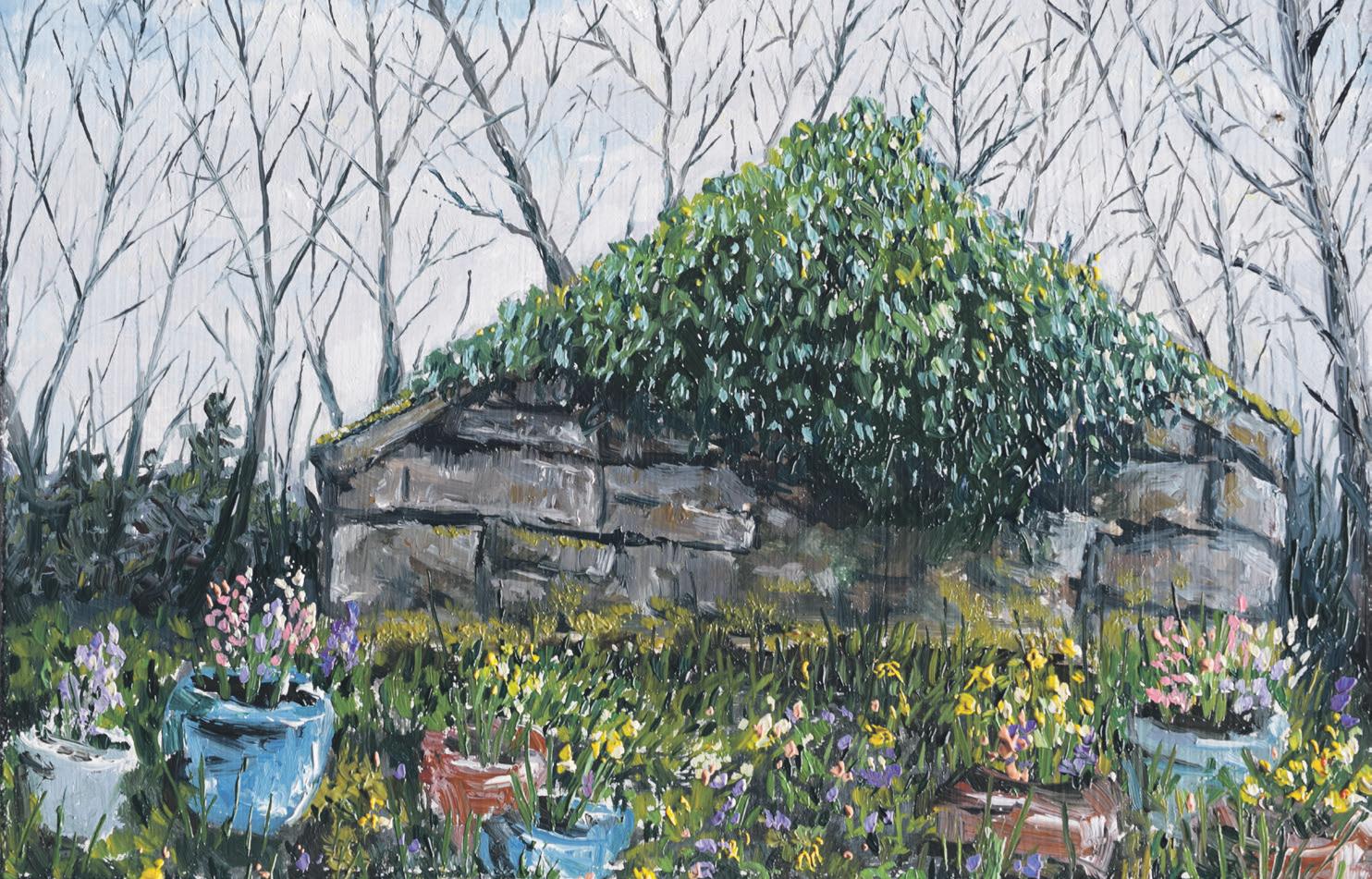
PAINTING-WISE, THIS IS the most intense year of my life. Venturing outdoors to paint every day, a task I set to with appetite on New Year’s morning, quickly grew formidable. As ice coated January, my physical health plummeted, and I was swamped by the melancholia I normally manage to hold at bay. I was feverish and quite listless; my wife Paula would set up my easel. I painted the worst days, sometimes managing only a few minutes of tiny, frail snowscapes. Storms followed, days of endless, battering rain, and for each one I have a painting to show. Not since childhood have I spent so much time outdoors. Wind-raw and hailstung, my longing for spring has taken on a primitive edge absent from past winters of relative comfort. Knowing that the little suns of wildflowers will soon be opening in the fields, I find myself dashing into the glow of sunrise with no thought of breakfast, driven by hungers that only painting can sate.
This place I paint in West Donegal, exposed to the moods of ocean and mercurial skies, provides a harsh environment for beauty to thrive. In some parts, oak trees grow like shrubs, spread prostrate across the rocks, none more than a metre in height. Wildflowers are fragile, ephemeral notes in the symphony of nature. Between October and March, they hunker down, patiently awaiting the breath of spring. Astonishment fills me over how little sustenance they need to flourish. Even outcrops presenting as solid rock during winter accrue soil and humus in the tiniest cracks. All spring to life, an annual masterclass in resilience, inspiriting my paintings.
“Mountain everlasting, lady’s mantle, meadowsweet, greater butterfly, scentless mayweed…” A quiet man indoors, on our rambles throughout the 1970s, my father became loquacious, a walking poem of
common plant names. Much to my shame, I turned my back on nature as I matured, equating rural life with the extreme poverty I grew up in and hoped to escape. Failing to comprehend that the paintings propelling me from the fringes of society to art college in Dublin grew from the meanest nourishment in miniscule cracks, and in my desire to be someone other than myself, I became an artificial painter, producing the equivalent of synthetic blossoms.
In 1840, the year he married Clara Wieck, Robert Schumann composed over 140 lieder (German for ‘song’). Blossoming brightest from this year of song is Dichterliebe (1840), setting to music Heinrich Heine’s verse, A Poet’s Love (1827). Opening (and written) in the month of May, love grows in harmony with flowers. This is my year of painting, and I paint for Paula. While I rambled, as a boy, among the wildflowers of Donegal, Paula was growing up in the city, planting thistles and ox-eye daisies in her back garden. Every windowsill we’ve shared has been stuffed with plants germinating or running riot. Paula is presently resurrecting the garden of my late father. Before we lived together, back when we were teenage art students, most mornings I’d bolt from my bedsit barely awake to see Paula. Mid-kisses, she’d scold me for skipping breakfast yet again.
Concerned about my wellbeing, as spring materialises, Paula has set pots and planted patches of colour at comfortable distances from the log cabin in which my paints and easel rest. On mornings when rainclouds billow or gales shriek, I can stand and paint within the aura of devotion, where flowers and paintings grow in harmony with love.
Cornelius Browne is an artist based in County Donegal.
An Artist in Exile
TUQA
AL-SARRAJ DISCUSSES KEY THEMES WITHIN HER MULTIDISCIPLINARY ART PRACTICE.

I AM A Palestinian visual artist who is based in Dublin. My practice is diverse; it includes working in mixed-media, photography, collage, performance, and installation. Video art is my primary medium. My work explores themes of identity, loss, displacement, memory, and socio-political realities.
Being an artist in Ramallah was life under occupation. The cultural hub of the region, the city’s art scene was often supported by foreign institutions. In 2013, I studied Contemporary Art at the International Academy of Art in Ramallah, in affiliation with KHiO (Oslo National Academy of the Arts, Norway). It was here that I was introduced to performance art, as well as the role of art in public spaces. Surrounded by well-established Palestinian artists and curators – such as Emily Jacir, Jumana Emil Abboud, and Lara Khalidi –and with access to the Academy’s resources, I developed my practice and produced my own work. As a student, I was given the opportunity to exhibit my work publicly, and to further explore art in various public contexts, such as local galleries and cultural centres. This artistic freedom – and the complex beauty and deep resilience of Ramallah’s daily heartbeat – heavily informed my work at that time.
In 2017 I relocated from Ramallah to Pickering in Celbridge. Here began a new chapter: the birth of an artist in exile. Amidst the dreamy, bucolic backdrop of green Kildare, I walked, and painted blue eggs, horses, and Islamic patterns. The major themes of my work began to emerge – identity, memory, the struggle of displacement. Of loss. These experiences connect me to exiled Palestinians across the globe and continue to inform my work.
I studied Fine Art Media at NCAD and graduated in 2021. As part of my degree show, I presented ‘Peat Show’ – a multimedia video performance piece. It incorporates a handmade structure, historically known as the ‘Box of the World’. I remember it,
from my upbringing, as a primitive form of visual storytelling. The box consists of three front-facing panels, each with a personal viewpoint, from which the viewer can peer into a miniature theatre-like domain, spying abstract, moving, panoramic paintings. The pigment used in composing the artwork was extracted from peat; essentially ground up turf. Turf is a readily available, highly exploited, non-renewable source of fuel in Ireland. The use of turf pigment represents a dual relationship between nature and technology, time and space, history and tradition. The intimate form of the vessel reflects what can be kept, seen or unseen from personal or collective memory. The piece questions whether it is possible to view something in the absence of screenbased media anymore.
I am currently working as the lead artist, in collaboration with Laragh Pittman (artist mentor and consultant) on a project funded by St. Patrick’s Cathedral. This research explores the history of the seventeenth-century Huguenot settlements in Ireland. It focuses on the influence that the skilled French refugees brought with them – an influence still felt in Ireland today –and investigates the connection between weaving and the historical Tatreez traditions (a form of Palestinian cross stitch) of ethnically cleansed Gazan weavers. This project will culminate in a multidisciplinary exhibition at the end of the year.
Reflecting on my childhood in Gaza (from the late ‘90s onward) – which includes my family archive, memories of the local cuisine, and swimming lessons in the sea – I’m working towards my first solo show next year. These pieces will continue to explore the threads of storytelling, collective memory, and displacement that inform my artistic practice.
Visual Artists’ News Sheet | May – June 2024 9 Columns
Tuqa Al-Sarraj is a Palestinian visual artist based in Dublin. tuqasarraj.com
Cornelius Browne, Spring Flowers by Ivy-clad Byre [detail view], 2024, oil on board; photograph by Paula Corcoran, courtesy of the artist.
Tuqa Al-Sarraj, Peat Show 2021; image © and courtesy of the artist.
KCAT Artists in Focus
Something Found To Be Beautiful
FOR THE THIRD IN A COLUMN SERIES INTRODUCING KCAT STUDIO ARTISTS, DOMINIC THORPE REFLECTS ON SOME OF THE WORKING METHODS OF DECLAN BYRNE.
FOR OVER TWO decades, Declan Byrne has developed and exhibited a significant body of figurative, abstract, and exquisitely colourful two-dimensional and sculptural works. I am privileged to have had the opportunity to spend time at the KCAT studio and see Declan’s organic working processes up close. Here I reflect on observing Encrusted Statue (2015) being made, a work that gave rise to exciting new sculptural directions within his practice.
Declan began to see possibility in the layers of dried acrylic hardened into the pallets and paint tubs that he and his KCAT colleagues use. Several months were subsequently dedicated to the slow and patient task of scraping, peeling and coaxing chunks and strips of dried paint free, his desk steadily filling with wonderful, large, multicoloured mounds. Many of the thicker pieces were also cut into rectangular shapes no bigger than the size of a small fingernail. These were collected in increasing numbers of containers that jostled for the little remaining desk space.
While Declan often has an eye towards a possible outcome, it is being in the moment and a total immersion in the physicality of material and process that remains paramount. His practice has always been grounded in a zone of pure play, in which the artist appears to surrender to processes and material encounters that are instinctively understood to have potential. It was compelling and inspiring to witness the engrossed depth of focus with which he was engaged in every element of the activity of reclaiming, accumulating, and shaping dried acrylic, seemingly free of any burden of worry about if and how an artwork might emerge.
Then somebody brought a broken religious statue to the KCAT studio; a 16-inch-

high representation of what looked to be a headless Joseph, holding the baby Jesus. As though he had been waiting for this decapitated figure to arrive and be tended to, Declan immediately set about sticking small pieces of colour to its surface, starting at the bottom and working upwards. The task was undertaken slowly with each piece purposefully chosen and carefully laid in place, one at a time. As weeks passed by, activity fluctuated between collecting more dried paint, sticking coloured pieces to the statue, and spending long periods gazing intently out of a window that faces the ruin of Callan Friary.
One morning I arrived in KCAT to find the work standing on a desk completely covered from top to bottom. The head was not replaced and the neck cavity remained exposed, perhaps resonating with the Japanese practice of Kintsugi, in which ceramicists repair broken pieces in ways that emphasise and honour the break rather than hide it. The suggestion of Encrusted Statue is gripping; a dedicated, rich, and playful reworking of something formerly iconic and broken, standing there in new and abstract colourful glory, as though asserting an ethical imperative to register the value of that which might otherwise be perceived as disposable. In the end, as is so frequently the case with Declan’s artwork, I settle into a deep appreciation of being with something found to be beautiful, always feeling the better for it. Among the wonderful series of sculptural works that followed is the equally captivating Encrusted Dog (2019), which is now part of the National Collection at Crawford Art Gallery in Cork.

Moving Image
Approx 1 Second of a Sweet Kiss
LISA FREEMAN DISCUSSES HER NEW FILM NOW SHOWING IN TEMPLE BAR GALLERY + STUDIOS UNTIL 19 MAY.

HAVING A BEAUTIFUL, bright, sunlit studio in the same building where my sunlit film is also currently being exhibited feels like a unique moment in time for me. My studio in Temple Bar Gallery + Studios is a retreat from the outside world, and just downstairs in the gallery, my film is open to the public, hopefully inviting people in from the rush of city life.
My new film, Approx 1 Second of a Sweet Kiss (2023-4), came about after I received an invitation from Alice Butler and Daniel Fitzpatrick (Co-directors of aemi), and Miguel Amado (Director of SIRIUS) to think about making a new film. This joint commission was presented to me as a carte blanche, so it was both daunting and exciting. It offered me the opportunity to think about some of the threads of previous work that have stayed with me, and also to take a leap into something new. I knew from the beginning that I wanted to shoot in the sun, and this guided a large part of the decision making.
I had been following the work of amazing dancers, Carminda and Maria Soares, who are based in Porto, a city in north Portugal. Miguel had some friends and colleagues working there too, that were happy to chat with me about this new work. I went there on a site visit last March to experience this luminous sun and explore the city from its many vantage points. After walking the streets and meeting with Miguel’s colleagues, Alexandra and Vera, I decided to set my film there.
I wrote a script, hired a crew and actors remotely, held script readings on Zoom (to keep within budget), and workshopped with actor Niamh McPhillips in Dublin. In June, I went back to Porto for five days. We had rehearsals, costume fittings, more location scouting, and shot the film with an incredibly talented cast and crew in a day. It was a total whirlwind and a really fun experience. I’d do it all again in a heartbeat. During post-production, I worked with some gifted collaborators and colleagues.
This included sitting with talented composer Seán Mac Erlaine, listening to him capture the feeling of the film with instruments like cymbals and synths, and observing the brilliant graphic designers, Kate and Jo, from Or Studio conveying the fleetingness and softness of the work with custom film titles and a poster.
Many things were ‘firsts’ for me on this project and I can’t wait to do many of those things again! The film was first screened at Cork International Film Festival in November to a packed-out screening. It will travel to SIRIUS next, for my solo show in June, where it will stay for four weeks.
It is a wonderful thing to reimagine the scope of your practice. The current iteration of my film at TBG+S has allowed me to think about this in a totally new way. This is thanks to a generous invitation from Michael Hill, who saw the potential to expand what I was making. The idea to show my film across multiple screens, to connect it with the busy street life outside, and to open up new ways into the work, is so exciting to me. Being given the scope to play with and reimagine existing work is a gift to an artist.
My work has led me to collaborate with some of the most wonderful people. Working with talented, open minded, kind folk is something that I hold dear to my heart. The film is about a journey and some of the strange but tender encounters that can happen when we aren’t looking for them. Maybe the work will grow legs and go on other journeys. It’s an exciting thing to imagine.
With thanks to everyone at Temple Bar Gallery + Studios, aemi, SIRIUS, and Kildare Arts Office for their continued support of this film and my wider practice.
Lisa Freeman is a visual artist and filmmaker working across moving image, scripted performance, text and installation. lisafreeman.net
Visual Artists’ News Sheet | May – June 2024 10 Columns
Dominic Thorpe is an artist and curator based in Kildare.
Declan Byrne, Encrusted Statue 2015, found object and dried acrylic, image courtesy of the artist and KCAT.
Lisa Freeman, Approx 1 Second of a Sweet Kiss 2023-4, film still; image courtesy of the artist.
Art Work Art Work
Artists Know Best
LIAN BELL REFLECTS ON THE BENEFITS OF COACHING TO COUNTERBALANCE POWERLESSNESS.
BEFORE WE START, will we take a moment to arrive? Phones off. Online notifications off. Anything that might ping and distract you. I like to turn off ‘self view’ on Zoom. Feet flat on the floor. Settle into your chair. Eyes closed. Breathe. Breathe. Breathe.
This is often how I begin a coaching session: A simple reminder to be present. A recognition of our bodies and how we hold ourselves. A calibration of energies, even while we’re in different spaces, experiencing different days, connected only by screens and our voices.
I’m interested in the idea that coaching, and a coaching approach, might help redress an imbalance of power between artists and the structures they have to operate within. I’m also growing into understanding that being an artist who supports others can be a quiet way to influence and change the world around me for the better. My slower pace, my intentions, causing a mild friction.
During lockdown, thanks to Arts Council funding, I did some coaching training with a UK company, Relational Dynamics 1st, thinking it might inform some of my work (relationaldynamics1st.co.uk).
I hadn’t planned to be a coach but, by the end of the training, I had changed my mind and immediately began to offer coaching as part of the artist support programmes I was running.
Coaching has recently seen a bit of a surge in Ireland, with more artists and arts workers undertaking training. We often need to clarify what coaching is – and what it’s not. Firstly, coaching is not mentoring; these two are easily confused. While mentorship can be very useful, there is within that dynamic an understanding that one person is more experienced and is there to support the less experienced person. The mentor can pass on their greater knowledge and insight, and the mentee can learn what may have otherwise taken them a long time to find out for themselves.
Coaching, on the other hand, is more about me helping you to help yourself. I am there to help you tap into resources, insights, wisdom, and expertise that you have within you, and within your existing networks. I help you look towards the future, articulate what you would like, and put some steps in place to move towards that. In many ways, you do all the work. I ask questions aimed at unlocking your thinking, and I reflect back to you what you’re saying, so you can hear it afresh. I also sit in silence a lot, and listen. Having the opportunity to talk through something and feel truly listened to can be a powerful experience. And it can be especially helpful when trying to get ‘unstuck’. The main reason I think coaching benefits artists in particular, is that we start from the basic understanding that the person being coached is the expert. They know their situation best; the advice they can give themselves will be more pertinent than any-
thing I can offer from my point of view. This approach meshes with what underlies the artist supports I design: artists are not children. We are skilled and smart adults, with a vast amount of knowledge and curiosity, who have managed to keep going through uncertainty, loneliness, and competition for scarce resources. We think deeply and in profoundly interesting ways. We constantly shape and re-shape our practice, responding to our own abilities and desires, as well as to external pressures and opportunities. Artists have become habituated to measuring our worth by funding applications. This is incredibly demoralising and disenfranchising. There can be a lot of shame and silence connected with the feeling that we are ‘failing’ when we struggle to get our work made or exhibited, and a powerlessness that comes from that. In a recent round of Arts Council Theatre Project funding, 29 applications were funded out of 135. That’s not because there weren’t plenty of excellent projects in there; it was simply down to how much money was available. But as an artist receiving the ‘we regret’ email, it still hurts – a festival of rejection, as a friend calls it.
I try to find ways to counter that sense of learned powerlessness, both in myself and others. Hearing so many artists talk about their practice shows me that we often struggle quietly with similar insecurities. I start to notice patterns, and can reassure people that they are not anomalies. I aspire to leave artists a bit more resilient and joyful than I found them.
Outside of formal coaching, if there’s one practical thing I can offer to help strengthen your practice, it’s the value of making time for reflection. Take time to take stock. We so often move straight onto the next thing without looking back, and I’m a believer that every project needs a funeral. However a project has gone, I try to mark, celebrate, and mourn the end of it. I now always make the time to do a project review and build that into the budget if possible. Making notes on what happened, how it went, and what I would like to do differently next time, has helped me get better at what I do. For some tips on reflection, see the blog post, ‘Making Time for Reflection’ by coach, Claire Antrobus: (claireantrobus. com).
Here are other (coaching-adjacent) resources I recommend: Making Your Life As An Artist by writer/choreographer Andrew Simonet (artistsu.org); Year Compass, a free whole-life reflection booklet (yearcompass.com); ‘A Guide To Saying No’ by coach Sarah Fox (sarahfox.co.uk); Liz Lerman’s ‘Critical Response Process’ (lizlerman.com).
Lian Bell is an artist and arts manager based in Dublin. lianbell.com
On Rejection
RACHEL MACMANUS CONSIDERS THE IMPACT ON ARTISTS OF REJECTED PROPOSALS.
THE FAMILIAR WORDS onscreen: “We acknowledge the high quality of your submission; however, we regret that on this occasion you were not selected.”
As an artist, I’ve been writing proposals for nearly ten years. I like to think I have a decent enough handle on the whole writing procedure; what to include, and what to leave out. I have attended workshops, requested feedback on unsuccessful proposals, hired others to review my efforts, and worked with other artists on draft proposals in a bid to constantly improve.
Rejected proposals are a commonality that most artists share. What’s interesting to me is how open calls are actually managed and reported on. I often notice callouts for proposals, and months later, I may see reportage on the successful recipients. What I never see is reportage on the unsuccessful applicants – the many individuals whose submissions have been rejected. I’m interested in this silent, uncelebrated majority.
It's important to recognise and validate the disappointment and disillusionment that artists feel when faced with rejection letters and emails. It’s entirely understandable that these rejections crush a little bit of an artist’s soul. How could they not, with so much time and effort having been invested? No matter how many extremely high-quality submissions there were, it signifies that our submission was not good enough. Not special enough. Not informative enough. Not track record-y enough.
With so many people going for relatively few opportunities, the stakes are high. Therefore, investing the considerable time it takes to put together a proposal is a risk for any artist, with statistically slim chances of success. Nowadays, artists must be proficient in marketing, promotion, publicising, social media, accounting, taxation, and many other requirements that surround our chosen creative discipline. Writing proposals is a risk because it takes precious time away from our practice.
However, it must be acknowledged that, regardless of outcome, there is some value to be derived from the submission process itself. Writing proposals and applications can often enhance a clarity of professional purpose – a simplifying and refining of one’s career goals. The effort of describing what drives me, why I make what I do, and what I hope to develop next, forces me to look at my work objectively, and helps to cultivate strategic vision and focus.
Sharing the proposal-writing process helps significantly. I often communicate with an artist friend on proposal feedback. She sends me her drafts; I send her mine. Late at night, when you’re wrestling to fit your professional hopes and dreams into 300 words, an objective perspective from a supportive ally is invaluable. We read and reread each other’s efforts, send queries and
suggestions back and forth, before finally submitting.
This artist friend is also the person I communicate with when the rejection comes back, because at that stage, whether they like it or not, they are invested in the outcome. My friend will commiserate and tell me not to be so hard on myself. They will remind me of other successful aspects of my work, state that the organisation in question is utterly mad not to want to work with me, and other kind utterances. My friend often has more perspective on the situation than I, the bruised and rejected applicant.
Let it also be acknowledged that the task of the people at the other end – those whose job it is to sort, read, and assess these endless proposals – is not an easy one either. Nor is the job of actually deciding whose proposal is worthy of the limited funds or opportunities being offered. When faced with hundreds of applications for one opportunity, I don’t doubt that ruthless tactics must be employed, in order to reduce the numbers. Organisations offering open calls are invariably well intentioned and doing their best within often tight budgets. However, I have experienced a disconnect between the open-call process and the artist and would like to see more attention given to this.
I would ask organisations to consider how they are constructing their opportunities and how they might best interact with all of the individuals who apply, as it can be very discouraging for artists trying to navigate these systems. In addition, organisations need to acknowledge that artists cannot improve their submission procedures without accessing feedback. Therefore, please don’t plan an open call without factoring in the necessary time for staff to send feedback to unsuccessful applicants who request it. Otherwise, you are sending a clear message that you do not value the artists who have applied and are not helping the majority of artists in any way. Please circulate the submission outcomes when you say you will or send communication if there will be a delay. Be clear and succinct in describing your evaluation process and what you are looking for in applications. That way, artists can make a more informed decision about whether to apply.
After a rejection email, life does go on, and work must be done. A wise artist once advised me: “When you get a ‘no thank you’ response, allow yourself to be disappointed, but also make a decision that day about what your next plan is.” This is great and valuable advice. I have used it and returned to it many times.
Rachel Macmanus is an artist based in County Clare. rachelmacmanus.art
Visual Artists’ News Sheet | May – June 2024 11 Columns

Jonathan Brennan: Deirdre, you’re a well-known figure in the Northern Irish arts scene, but for readers further afield, could you offer a few words of introduction?
Belfast Exposed @ 40
Deirdre Robb: I am Chief Executive Officer of Belfast Exposed, and I do a lot of the curatorial work – as well as making teas and coffees when necessary! After studying at University of Ulster, I worked in a community organisation called Arts for All in North Belfast. It was very challenging, but I really loved it. I then progressed on to Belfast City Council, then Arts Council Northern Ireland, where I worked for ten years. I loved it but always thought if there was ever an organisation I would move for, it would be Belfast Exposed, because it has always been so much more than a gallery. When the director position came up, I immediately jumped at it.
JB: How did Belfast Exposed get started?
DR: It was formed in the early 1980s by a collective of local photographers, both amateur and professional, who were sick of the world media painting a very singular and sensationalised picture of Northern Ireland at that time, and Belfast in particular. Convened by community activist, Danny Burke, they were a grassroots group, documenting the daily lives of working-class communities, who knew there was more to the city than bombs and guns. Their first exhibition was in October 1983 at Conway Mill (on the nationalist side of Belfast’s main Peace Wall) and was simply called ‘Belfast Exposed’ – a nod to the analogue photographic process, while also implying that normally unseen parts of the city would be revealed. The exhibition later travelled to Dublin, where it inspired Seamus Heaney to write them a letter, commenting on the “powerful, democratic feel running through these photographs.” Belfast
Visual Artists’ News Sheet | May – June 2024 12 Organisation Profile
JONATHAN BRENNAN INTERVIEWS DEIRDRE ROBB ABOUT THE 40TH ANNIVERSARY OF BELFAST EXPOSED.
Cathal McNaughton, ‘Ukraine – Searching for the Normal’, Belfast Exposed, 4 April to 25 May 2024; photograph © and courtesy of the artist.
Exposed later became an arts organisation, and they started running training programmes. There would have been a lot of unemployment around at the time, which aided recruitment for the paramilitary groups. Photographers like Frankie Quinn would say that if he hadn’t had photography as his channel, he probably would have ended up in one of those groups. In short, it was very much about doing a really positive thing within and across communities. In 1998, international Magnum photographer, Eve Arnold donated an exhibition (that would have cost thousands of pounds) to support their activities. It really showed the potential of the organisation and where it could go.
JB: Four decades on, how is Belfast Exposed run and funded?
DR: We currently have eight staff – soon to be nine – and we are funded by the Arts Council of Northern Ireland, Belfast City Council, and different trusts and foundations. I have been through an MBA (Master of Business Administration) which has really helped me transform the organisation. And we have affordable rent, which makes a massive difference. We’ve got two floors, which includes the main gallery downstairs, where we present international and archival exhibitions. Compiled over the last 40 years, the Belfast Exposed Archive is a substantial collection of over one million negatives and slides, from both professional and amateur photographers, which is held in trust for the community.
The second-floor gallery is a more experimental space for emerging artists and early-career artists, but also for established art-
ists wanting to try something new. We show work that can be classified as contemporary art but also documentary photography, with strong narratives that link to social issues, and themes that people can connect with. We recently celebrated Belfast punk icon, Terri Hooley, who was photographed by Stuart Bailey, with ‘Visions of Hooley’ in the Studio Gallery (4 – 27 April). Continuing downstairs in Gallery One until 25 May is the exhibition ‘Ukraine: Searching for the Normal’ by Cathal McNaughton, the only Irish Pulitzer Prize-winner. In Gallery Two, ‘Our Archive: 40 Years of Belfast Exposed’ continues until 1 June.
We’ve always had a strong community practice across Northern Ireland and beyond, working with groups like Wave Trauma that supports those who have been impacted by The Troubles. Our work in


mental health began largely with our Community Engagement Manager, Mervyn Smyth, and has been growing, especially since the pandemic. Covid affected everyone, so I feel we should incorporate mental health into everything we do; this has included, for example, our major ‘Healing Through Photography’ conference last year.
JB: Your 40th anniversary programme is already underway. Are there any forthcoming highlights you’d like to share?
DR: We are having exhibitions continually throughout the year to acknowledge current and past practitioners. One significant highlight is the forthcoming Vivian Maier exhibition, ‘The Self-portrait and its Double’, which will run from 3 October to 21 December. This will be the first of its kind in Ireland, and so is a bit of a coup. Her story is amazing, but I think she’s of specific interest because she is someone who never seemed to fit into the world but used her camera to navigate her own identity. Alongside this exhibition, there will be a public programme looking at identity and the self.
The Belfast Exposed 40th Anniversary Gala will take place at Belfast City Hall on 6 June. That will bring in as many other artforms as possible, while acknowledging and celebrating some of our founder members, like Danny Burke and Sean McKernan, female photographers including Helen Sloan, and international figures who cut their teeth here, such as Donovan Wylie. Tickets are £100 per person with a three-course meal, entertainment, drinks reception, prizes and awards to be presented on the night. Tickets are only available via gala@belfastexposed.org or by calling +442890230965.
There will be an open call for photographs of dogs! We’re going to have a boudoir where people can come in and get their dogs photographed, creating accessibility for those who’d never dream of coming into a gallery, as well as an environmental project around Lego which will be very hands on.
JB: Beyond this year – what does the future hold? Keep doing what you’re doing?
DR: Yes, but you must evolve. One of the exhibitions we’ve got planned is in partnership with Bradford 2025, the first ever City of Culture to go pan-UK. This collaboration is also going to be about working with artists to help elevate their practice with international opportunities. We will continue to work collaboratively with Source, Photo Museum Ireland, and Belfast Photo Festival, with an ongoing focus on sustainability and our work in mental health. Soon, we plan to introduce high-quality yet affordable collectible photobooks. I guess my wish is for Belfast Exposed to be seen as a centre of excellence internationally for our training programmes, and how we support and facilitate photographers. We do much of this work already, but I would like to expand to a much bigger scale.
Deirdre Robb is Chief Executive Officer of Belfast Exposed. belfastexposed.org
Jonathan Brennan is an artist based in Belfast. jonathanbrennanart.com
Visual Artists’ News Sheet | May – June 2024 13 Organisation Profile
Cathal McNaughton, ‘Ukraine – Searching for the Normal’, Belfast Exposed, 4 April to 25 May 2024; photograph © and courtesy of the artist.
Installation view, ‘Islands & Myths’, Belfast Exposed, 29 June to 18 August 2018; photograph courtesy of the artists and Belfast Exposed.
Surface and Inscription
AODÁN MCCARDLE OUTLINES THE EVOLUTION OF DERRY PRINT WORKSHOP.
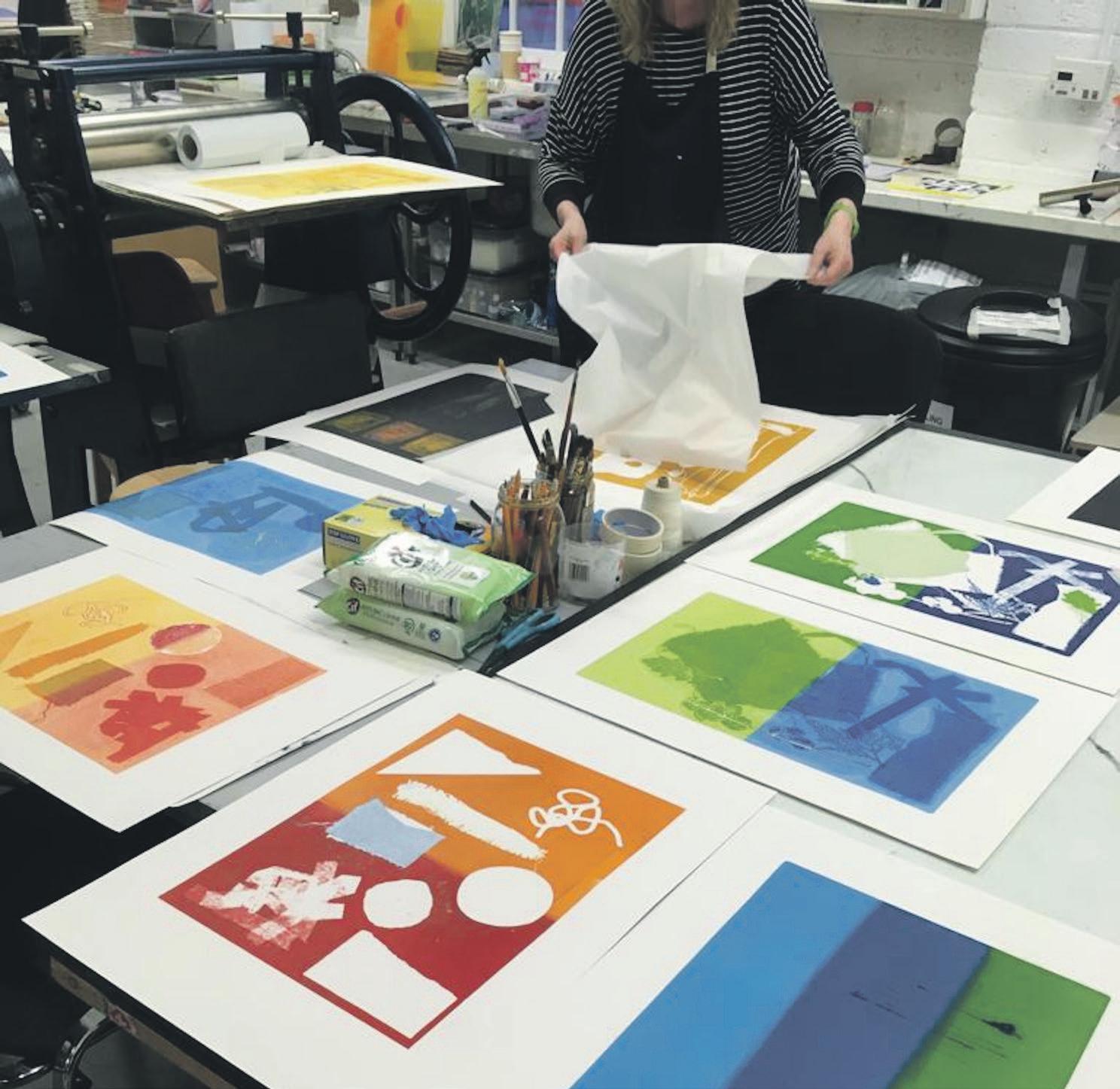
DERRY PRINT WORKSHOP (DPW) is a notfor-profit printmaking collective, providing open access studio facilities for fine art printmakers in Derry and the Northwest of Ireland. It is a recognised charity, founded to provide facilities for artists to make limited edition original fine art prints. My first contact with DPW was through CCA Derry~Londonderry’s ‘Activist Screen Print’ programme in 2016, looking at the role of screen printing in social protest. DPW is much more than a facility; more than a set of machines and tools. I’ve had personal experience of working with Paul, Cara and Sue from screen-printing through intaglio, hard and soft ground, collagraphy, and on into something more akin to improvisation. Perhaps the greatest asset DPW supplies is enthusiasm, such that you begin with one goal and by the time you’re finished, you’ve moved into areas you hadn’t considered, and encouraged to go further, to try and try again. Beckett would have loved it.
Set up in 2001 by a small group of interested artists, headed by Paul Barwise and co-director Andrew Hepburn, Derry Print Workshop was originally an etching facility with one press in a small unit. Where DPW ultimately grew to become a fine art print workshop with charitable status, the initial years were a struggle, all while trying to meet its aims of an open access studio. There was no open access fine art print studio to the west of Northern Ireland, and this was something that DPW felt needed to be addressed.
Derry / Londonderry City of Culture 2013 was the catalyst for developing the workshop into its present form, providing the funding and the vision of like-minded people, who could see the value of establishing a well-equipped fine art print studio in the city. DPW was able to access specialised equipment through funding from ILLEX and made the move to larger premises in the Inner City Trust’s Garden of Reflection in June 2013.
The print workshop aims to provide a properly staffed, well-equipped centre of excellence to promote both the appreciation and practice of printmaking, while servicing the printmaking needs of professional artists and the wider community. DPW actively encourages people from all walks of life to get involved with printmaking and is committed to developing an exciting and innovative creative hub in the centre of Derry. DPW does not, at present, have core-funding support, but has nonetheless managed to maintain a voice and position in the visual art community of Derry. This is mainly due to the voluntary work and experience of the board of trustees and members, membership contributions, and also through the acquisition of Arts Council Small Grant-funded projects.
The DPW Members Exhibition 2023 was one of those Small Grant projects, funded by the Arts Council of Northern Ireland. In addition, a series of one-day and
weekend courses will be offered in spring and autumn of this year, covering the processes of etching, screenprint, linocut, collagraph, monoprint, and risograph printing. A small exhibition of works opened in February at Echo Echo Dance Studio, in which artists Cara Donaghey, Paul Barwise, and Stephanie Gaumond exhibited works on paper, exploring the creative processes of etching.
DPW is participating in a print fair organised by Belfast Print Workshop at St Comgall’s in Belfast on Saturday 23 and Sunday 24 March. A member’s exhibition of work is planned again for December to incorporate a Christmas print fair. There is also a forthcoming postal print project, happening in collaboration between DPW members and Gran Canaria-based artist and printmaker, Palma Christian. In addition, I will be working at DPW over the next two years to realise a project bringing improvisational drawing from my 2022 ‘Emerging Forms’ exhibition at Artlink Fort Dunree through the collagraphy and etching processes and whatever other directions the work demands in the print workshop.
Aodán McCardle is an artist, performer and writer based in Donegal. aodanmccardleartwriting.com

Visual Artists’ News Sheet | May – June 2024 14 Organisation Profile
Top: Monograph Workshop lead by Paul Barwise at Derry Print Workshop 2021; photograph by Paul Barwise, courtesy Derry Print Workshop; Bottom: Cara Donaghey, Site 2022, etching, 32x48cm; photograph by Cara Donaghey, courtesy of the artist, and UV Arts Gallery.
In Focus : Print Network Ireland
Etching the Digital Landscape
Ria Czerniak-LeBov
Graphic Studio Dublin
I STUMBLED INTO etching by chance when a family friend with a small home studio prepared a copper plate for me to try. I drew a series of clocks, only to find them running backwards when I printed them. I hadn’t realised I was creating a mirror image, a stamp capable of creating hundreds upon hundreds of mechanical reproductions. I was instantly hooked and have spent nearly 15 years developing my etching practice. Initially, it was the fineness of the etched line and the velvety texture of aquatint that were aesthetically seductive. Over time my interest in printmaking has only deepened. Etching is often compared to alchemy. Try as we might to control the medium, there are parts of the process that welcome chance into my otherwise methodical practice.
For a number of years, I worked in an antique and vintage shop that sold everything from Super 8 cameras and gramophones to printers’ drawers and industrial lighting. This job further developed my lifelong love of old media, classic cinema and early photography which undoubtedly influenced my signature monochrome palette. Though my work makes visual reference to the past, its subject matter is deeply rooted in the contemporary, exploring the relationship between digital and analogue technologies, the built environment and the subjectivity of spatial memory. While much of my initial research is drawn from digital photography, my printmaking practice relies heavily on traditional techniques. Glitch, extrusion, inversion and pixelation are rendered by hand, highlighting the vulnerabilities of all modes of documentation.
Aquatint, an intaglio technique used to produce a wide range of tonal values, has become an invaluable tool with which to create mood and shadow.
Aquatint involves applying a finely ground rosin powder to a copper plate, fusing it to the surface over a heat source, and then carefully protecting and exposing parts of the plate before submerging it into a bath of ferric chloride. My etchings usually require eight different timings in the acid, resulting in a range of tones from white to black; the longer the exposure, the deeper the bite, allowing the plate to hold more ink when printing. Etching requires us to think, not only in mirror image, but from negative to positive. There is nothing as satisfying as removing the wax and bitumen from a plate, discovering the ways each process has transformed your initial drawing. My use of aquatint is not painterly or gestural. Instead, I have always used this technique to create graphic, contoured areas of pure tone. Through my mark making, I mimic elements of the mechanical, the binary and the digital, my hand becoming an instrument of reproduction. It is no longer the
urban, but the digital landscape that I draw, mindful of just how mediated our lives are by the technologies we use. Through a series of digital manipulations and handmade interventions, my initial architectural imagery is transformed into abstract geometries that take on a life of their own, no longer representational.
My practice often expands beyond the confines of traditional printmaking, pushing the limits of the medium to create large scale installations. Since its invention, mass-production has been print’s unique area of capability. In addition to creating limited editions of uniform etchings, I increasingly find myself creating multiples with which to build new composite works. These works are malleable, site-specific and evolve with each iteration, celebrating the adaptability and creative potential of the print matrix.
Ria Czerniak-LeBov is a printmaker, writer, musician and part-time lecturer at NCAD.


15
Ria Czerniak-LeBov, [Top] Crisis? What Crisis? 2022, [Bottom] Conduit, 2022, etching and aquatint; images courtesy of the artist.
Screenprinting Using Analogue Positives
Emily Mc Gardle Black Church Print Studio

I AM A printmaker from County Monaghan. My artistic practice consists primarily of screen printing and drawing. Using hand-drawn artwork I create multi-layer screen prints which combine humour, satire, and parody. I learned basic screen printing in secondary school, but it was in DIT where I fell in love with the process. After working in commercial screen printing for several years, I studied printmaking at the Royal College of Art in London.
Before printing, the artwork for a screen print is broken down into separate colour layers. Each of these layers is called a ‘positive’ which can be created using digital or analogue methods. Positives must be made using opaque materials: a good rule of thumb is to use black ink or paint. Over the past five years I have been experimenting with different analogue materials and mark-making techniques when making positives that introduces depth, texture and distortion to the flat surface of the print. The type of materials I use to create positives depends on what is best suited to each particular colour layer, although there are certain ones I use most often due to their reliability and versatility.
There is a large range of transparent acetates/films available in both rolls and sheets. Their smooth surface is perfect for achieving fine, crisp detail. Certain films can be printed onto using a standard laser printer
which gives the option of combining hand-drawn and digital imagery.
Rubylith is a type of masking film consisting of two layers: a thin red film adhered to a heavier transparent backing sheet. The red film is cut and peeled away using a scalpel blade. It was commonly used in graphic design and commercial printing but is now somewhat expensive and difficult to find. I use Rubylith for background layers of prints which have intricate cut-outs, while I use paper stencils for simple background layers.
TrueGrain is a textured polyester film that reproduces subtle halftones. It works particularly well for emulating the characteristics of lithographs when used with graphite, charcoal, litho crayons, and Indian ink/ tusche washes.
Posca markers contain opaque acrylic paint and are available in a wide range of sizes. I use Poscas mainly for lettering. A downside is that they aren’t designed to be refilled, although there are empty markers made by Montana and Molotow which allow you to use your choice of ink or paint. Black acrylic paint can be used with a dry brush to create textured, painterly marks. I use hand-carved rubber stamps and black acrylic paint to create repeat patterns.
Zig Opaque Pens contain a red alcohol-based ink, and were originally used for retouching film negatives.

There are several nib sizes available – from 0.05mm to a brush – making them useful for creating a wide variety of marks. Together, with technical drawing tools such as templates, stencils, and French curves, I use these pens to create shapes and patterns.
Making positives in this way has helped me to take incremental steps towards a more sustainable practice. When all layers of a screen print have been printed, I strip the pieces of acetate/film used to create the positives, which allows me to reuse them. Washing-up liquid, vinegar, baking soda, and water with a soft toothbrush will remove most drawing materials. I then degrease the acetate/film using vinegar. This is particularly important as any grease on the surface will repel ink/paint. It is for this reason that I often wear cotton gloves when creating positives.
Hand-drawn positives can add another element of chance into the screen printing process as there is often a pleasant surprise when a drawing transforms unexpectedly when printed.
Emily Mc Gardle lives and works in County Monaghan. She is currently preparing for a solo exhibition in Cultúrlann McAdam Ó Fiaich, Belfast in September 2024.
Visual Artists’ News Sheet | May – June 2024 16 In Focus
Emily Mc Gardle, [L] Laff ‘n’ a Half, 2022, [R] Suckz 2-B-U, 2022, 7 colour screenprint with gloss varnish overlay on paper mounted onto wooden panel; image courtesy of the artist.
Impressions of Place
Johnny Bugler Cork Printmakers
I HAVE BEEN engaged with printmaking for over 20 years as both a member and studio manager at Cork Printmakers. I make work in a variety of techniques, most recently combining work on paper with found objects and surfaces.
Travel, for me, is an experience that reshapes perceptions and ignites the imagination and so influences how I make artwork. As an artist, I am often trying to make sense of the visual world around me, and when I am somewhere new or different I find myself more actively engaged in consciously noticing. On departing from what is familiar, there is an expectation that things will be different and exciting. Similarly, my fascination with the sea and the coast is consistent with the allure of the exotic or the unknown. I have travelled widely and collected a store of photographs and visual imagery that I return to again and again. Photopolymer printmaking is my preferred technique for reproducing these images.
Photopolymer printmaking replicates the nineteenth-century photographic process of photogravure. A light sensitive polymer or plastic is adhered to a metal plate and a negative image is ‘etched’ into the plastic layer using a sodium carbonate solution after exposure to the positive image on transparent film. The plate is inked up in the intaglio manner – completely smeared with ink and then carefully wiped back off the plate leaving ink in varying degrees across the surface ready for transfer onto paper via the printing press. There are many variables in the process and attempts to achieve perfect photographic results with a wide tonal range can be daunting. I try not to dwell on this aspect of the process and instead savour its idiosyncrasies and imperfections. I will sometimes adhere the photopolymer film to the back of an old printing plate that will have incidental etched scratches and scuff marks which will print through the image and lend to it a certain atmosphere or aged quality.
Printmaking can be a laborious affair and the quality of the final image may often be unknown until the very end when the paper is pulled from the printing plate. This can be exhilarating but also very frustrating. Recently I have begun creating new work from pre-existing editions of prints to make a type of collage by fragmenting and juxtaposing with other elements. I find it a very liberating experience to be able to combine images, colours and textures in a very quick and experimental way. When I am happy that there is a certain balance and harmony in the composition, the different elements are glued flat to a wood panel using a rice starch glue. In Seascape with Green Stripes (2023) I combine three different photopolymer prints with a piece of driftwood. The plywood panel appears to have come from a boat and was washed up on a beach in West Cork with the weathering and patina of a time spent at sea. The curves of the wood panel offer a pleasing deviation from the rectangular constraints of the typical work on paper. I am drawn to old, weathered objects that exhibit a past life or the passage of time. I discovered that the Japanese have a term for this in Wabi Sabi, an aesthetic that embraces imperfection and impermanence. In Palm Tree, Blue Lines (2023) I have taken an old leather suitcase and flattened out a beautifully time-worn panel. Onto this I screen-printed an image of the idyllic exotic beach scene complete with coconut palm, a common motif in my work. I strive to achieve a balance and harmony in the compositions in the knowledge that there is no perfect place – this is something that must also be embraced.


Visual Artists’ News Sheet | May – June 2024 17 In Focus
Johnny Bugler is a multi-disciplinary artist specialising in printmaking and based in Cork City.
Top: Johnny Bugler, Still Waters Run Deep, 2023, photopolymer etching, found book jacket, 66 x 35 cm; Bottom: Johnny Bugler, Seascape with Green Stripes, 2023, photopolymer etching, found timber, 72 x 78 cm; all images courtesy of the artist.
How to Flock!
Christopher Clery Limerick Printmakers
BEFORE I WAS first introduced to printmaking in 2016, my practice primarily focused on drawing, photography and collage. I gravitated towards silkscreen and began experimenting with mixing photography and mark-making. My collages were originally traditional analogue or digital, if I needed to upscale. Incorporating silkscreen with analogue collages gave the work a texture and tonal quality that could only be achieved through this technique. It gave me more freedom to manipulate collage imagery. My process has now evolved into using collage material to create film positives for multi-layered prints by recontextualising collage imagery using various methods.
I am hoping to re-incorporate collage materials with etching using various techniques like photo-etching processes. It is important to be cautious with your screen; bitumen is an unforgiving material.
I focus my collage work on repurposed material, often books, magazines, posters and photographs to construct my imagery and composition of my prints. Using Photoshop or any other photo editing software, I begin making film positives for the light exposure unit. I scan my repurposed collage material into Photoshop and change the image to grayscale and I use basic photo techniques such as brightness, contrast levels, etc., to enhance the image for better quality positives.
From here, it’s about figuring out what adjustments work best for the image. Adjustments I frequently use are posterize and threshold which limit the tones of an image to a number of layers which are digitally printed as black individual stencils. The bitmap filter is useful for quickly changing a grayscale image into a pointillism style. The CMYK technique is a term used in printing that works with layered colours to make up an image. Cyan, magenta and yellow are separated and bitmapped to render the image, while black is the key layer that brings them all together. Not all images or photographs work with this process and it needs strong contrast of these four colours. All these techniques can be layered in one print to achieve various effects. Once the editing process is complete, I digitally print them out on clear film for better quality positives. Tracing paper can be used as a cheaper alternative.
Flocking is the process of fibres or powders applied over a base layer of adhesive. Digitally print a film positive with no details, just a black shape of the image. This positive is used to silkscreen the adhesive to the paper in the shape of the layer you are flocking. Many different brands of water based adhesive can go through a screen, but I would suggest fabric transfer glue or acrylic printing medium as an alternative. It may not work on every paper surface, but it is sticky enough to catch the powder. Once the adhesive is printed, you have a small amount of time to apply the pigment powder. The adhesive can’t be wet, but tacky for application. Pigment powder is usually mixed with paint to create a metallic effect, however here, when applying the powder straight to the surface, the pigment becomes more concentrated and vibrant. Use two makeup brushes to apply the pigment powder. Use one brush to pack on the powder and the other to brush away and catch the fallout of the pigment. Careful when working this powder, as the glittery fibres can possibly stick to areas of the print you don’t want it to. It is important to ensure the adhesive is smooth once the pigment is thoroughly applied. Once it has dried for 24 hours, you can treat it as any other layer. I particularly like incorporating a bitmap layer to my process at this stage.


Visual Artists’ News Sheet | May – June 2024 18 In Focus
Christopher Clery is a printmaker based in Limerick.
Top: Christopher Clery, Fisherian Runaway 2019, photograph; image courtesy of the artist; Bottom: Christopher Clery, A psychopomps warning 2023, monoprint/ silkscreen; image courtesy of the artist.
The Visual Artists’ News Sheet
Critique
Edition 73: May – June 2024

 Lorraine Tuck, ‘Unusual Gestures’, 2023; image © the artist, courtesy of Photo Museum Ireland.
Critique
Lorraine Tuck, ‘Unusual Gestures’
Roscommon Arts Centre
2 February – 29 March 2024
LORRAINE TUCK’S EXHIBITION ‘Unusual Gestures’ elevates the depiction of family life to an artform, and, in the process, extends the boundaries of what is made visible. A documentary photographer, Tuck photographs what surrounds her: her family, her environment, her reality.
My first encounter with ‘Unusual Gestures’ was during its premiere at Galway International Arts Festival in 2023. Recently seen again at Roscommon Arts Centre, ‘Unusual Gestures’ is still an emotive viewing experience. A highly personal body of work, it is a photographic documentary on Tuck’s family life – a life that includes intellectual disability and autism spectrum disorder. The title ‘Unusual Gestures’, derived from her younger son’s way of communicating, describes the exhibition’s essential element, that is, the everyday aspect of living with the exceptional.
Tuck has a distinctive aesthetic of vibrant colour and informal composition. She is drawn to documentary photography and studied under Paul Seawright at the University of Wales, Newport. She doesn’t apply hard and fast rules to her practice, and is no longer preoccupied with specialist photographic equipment. Many of her photographs are taken spontaneously and intuitively. She tends towards shooting multiple times, leaving her with what she describes as the cruel editing process. She rarely sets up a shot, and states that her current preference for using a 50mm digital camera allows for convenience and immediacy without sacrificing quality. These are the practical decisions of a photographer who is also the mother of four children.
Tuck acknowledges the creative potential of using film, and enjoys experimenting with it. This is seen in one photograph where she used analogue for triple exposure. The resulting grainy, soft-focus image, with a mysterious, dreamy visual effect, sits in contrast to the sharp focus of the other works in the show.
Tuck is highly attuned to colour and light and speaks about the everchanging light in the west of Ireland where she lives with her husband and children on the family farm. Tuck doesn’t see the need for a light meter, and invariably uses ambient light. A captivating photograph of her son Manus, taken at night and relying on the electric light from the nearby cowshed, renders him bathed in a burnt umber glow that gives the image an ethereal quality.
The works in ‘Unusual Gestures’ are untitled, as Tuck feels that titles may diminish the power of the image, and each one of the 68 photographs tells its own story. One photograph showing the artist embracing her son, her ‘forever baby’, as they sit by a river, is full of tenderness and is reminiscent of the Madonna and Child imagery of classical art. Another photograph with an art historical feel is the show’s centrepiece, a large-scale nine-panel ‘pastoral scene’ of the family saving hay together, with a large beech tree as the dominant feature. The image of her son and her uncle, united in a moment of connection, is another work that exemplifies the intimacy Tuck succeeds in capturing so effectively in her photographs.
As an advocate for greater visibility and
affirmation of intellectual disability, does Tuck view her photography as an advocacy tool as well as an artform? She believes in taking a gentle approach, and the photographs remain open to subjective interpretation. Her commitment to advocacy and inclusion extends to providing workshops as an adjunct to the exhibition. These workshops focus on how photography can be used to help communicate with children with autism or intellectual disability. While Tuck doesn’t name it as such, there is a participatory dimension to her artistic practice, giving rise to powerful social engagement and interaction.
‘Unusual Gestures’ was commissioned and curated by Photo Museum Ireland in 2020. Tuck is keen to acknowledge the support she has received from PMI and from Tanya Kiang, PMI curator. In 2023 Tuck was nominated by PMI for ‘Unusual Gestures’ for the tenth edition of the Prix Pictet, the international award for photography and sustainability. The Arts Council of Ireland has since acquired two of Tuck’s photographic works for its permanent collection. ‘Unusual Gestures’ is a touring exhibition which is now showing at the Regional Cultural Centre in Letterkenny until 1 June, having been officially launched by Professor Paul Seawright on 24 April.
Mary Flanagan is an art writer and researcher based in County Roscommon.


Visual Artists' News Sheet | May – June 2024
All images: Lorraine Tuck, ‘Unusual Gestures’, 2023; images © the artist, courtesy of Photo Museum Ireland.
Els Dietvorst ‘Adrift’ Uillinn: West Cork Art Centre
16 March – 11 May 2024
CURATED BY CATHERINE Bowe and Karla Sánchez Zepeda, Els Dietvorst’s ‘Adrift’ at Uillinn: West Cork Art Centre is an exhibition that reveals itself slowly. At once minimalist yet monumental, there is a sense of interconnectedness through the sea to people and places, both near and far. Natural and manmade totemic objects form a resonance that aligns with a universal, impersonal power that has become weakened and obscured in our Western society.
Dietvorst is a Belgian interdisciplinary artist who has been living in Ireland for the last 15 years. It transpires that we hail from the same city in Flanders, where the legendary giant, Druon Antigoon, cut off the right hands of mariners who refused him tribute. Steeped in history and a rich visual culture, Antwerp is a port city, and Dietvorst grew up on the banks of its tidal river. Now living on the Wexford coast, like me, she found her place here as a sheep farmer, where tough lessons are learned, and the rhythms of the natural world dictate one’s every move. For many of us, the pull of the ocean is impossible to ignore, and it permeates every aspect of this exhibition. Like a current, it carries the viewer along gently, and there is a sense of the wild, and a feeling of belonging within this sphere.
The main gallery space at Uillinn displays a collection of works emanating from the littoral zone. Stigmata (2021), three life-size wooden arms perched against the wall, are enigmatic objects. Carved and exquisitely shaped, they are marked in a way reminiscent of Polynesian tattoos. One resembles a flute, while nearby, the spinelike sculpture, Shanti, Shanti, Shanti (2021), has a talismanic presence. Off centre on the gallery floor, Windswept, is a robust treeform made from driftwood. Formerly connected and nourished by the earth, its parts stand united as a testament to terrestrial lives claimed by the sea.
A work entitled Pocket Stones (2021-4), lines the left wall of the space. A series of handmade paper ‘pockets’ each contain a painted stone, charged with the energies of their finder. A dreamlike, non-narrative poem has been typed on each envelope in succession by the artist. These minimalist yet evocative compositions speak volumes, prompting existential questions as they cast their salty spells.
The centrepiece of the exhibition, Memorandum of Humanity (2022), hangs as a testament to communal resilience amid adversity. Previously shown at CENTRALE for Contemporary Art, Brussels, in 2022, it is a residual drawing made as a result of an interaction that took place with the BARRA Movement.1 Over 1000 stones were placed on a linen sheet, symbolising both labour and collective memory. Each stone was given a unique identification number, most were traced around, and some were physically incorporated into the drawing. This work evolved from an intervention that took place during the pandemic, when Dietvorst began placing white stones on a black rock on the foreshore, as a way to connect and give hope. The formation has become what the curators aptly describe as a ‘coastal shrine’ and the process continues to this day, with spontaneous public partici-

pation, on Blackhall Beach in Wexford.
Ascending the staircase, epic blood-ink murals have been painted by Dietvorst. The main painting, Chyrsalis (2024), depicts a scene of human suffering and resilience, featuring a recurring symbol in the artist’s repertoire, a neanderthal skull.2 Another painting, Manifest for Skibbereen (2024), shows the abandoned bridge over the River Ilen. Painted for the townspeople, it captures the artist’s empathetic engagement with the local community in West Cork.
Culminating with the screening of I Watched the White Dogs of the Dawn (2018), through painterly compositions and candid interviews, real people involved in fishing share stories of their relationship with the sea. We sense that there is more to life than what is visible on the surface. Why else would they continue such an unforgiving and tough occupation? Dietvorst’s work serves as a poignant reminder that amidst the complexities of a globalised society, alternative narratives and possibilities exist. If we are indeed ‘adrift’, the sweeping beacon emitted from this film is our navigational aid, offering an alternative route. The resonance and life-force that permeates this exhibition represents the moral and epistemological power of society.
A national touring exhibition, ‘Adrift’ was previously exhibited at Highlanes Gallery (1 July – 19 Aug 2023) and will be presented in Wexford Arts Centre and Wexford County Council in October 2024.
Mieke Vanmechelen is an artist from Kerry currently resident at Fire Station Artists’ Studios, Dublin.
1 BARRA is an encounter and an invitation instigated by Els Dietvorst currently taking place in Belgium and Ireland. barramovement.com
2 Eva Wittocx, ‘The symbolic surrealism of Els Dietvorst’, ED 2010 – 2014 (Antwerp: M HKA, 2014) p. 9.


Critique Visual Artists' News Sheet | May – June 2024
Above and below: Els Dietvorst, I Saw The White Dogs Of The Dawn (Triptych Part II), 2018, Digital Film 53mins; images courtesy of the artist.
Els Dietvorst ‘Adrift’, installation view, Uillinn: West Cork Art Centre; photograph by Tomasz Madajczak, courtesy of the artist and Uillinn: West Cork Art Centre.
Critique
Hughie O’Donoghue ‘Territory’
The Glucksman
1 December 2023 – 10 March 2024


‘TERRITORY’ IS A solo exhibition of recent works by Hughie O’Donoghue at The Glucksman in Cork. This show comprises eight large-scale paintings and one sculpture. The paintings are largely oil and mixed-media works on repurposed tarpaulin and flour sacks. They depict seascapes and various scenes of the Irish countryside, often accompanied by a male figure.
I am drawn to the nuts and bolts of O’Donoghue’s paintings: the screws pierced through tarpaulin; the layered glops of resin, petrified along the edges of paintings like molluscs on rocks. In Michael Gaughan’s House (2023), we can see the supporting material’s past life, as the tarpaulin’s folds and wrinkles haunt the painting. A line runs vertically down the picture plane, indicating where two large swathes of material are fastened together. This visible trace of fabrication calls to mind John Berger’s writing on Van Gogh: “He believed that reality could best be approached through work, precisely because reality itself was a form of production.”1
Indeed, O’Donoghue’s affinity for Van Gogh can be seen in Reaper (2024) and Hammering The Earth (2019). In the for-
mer, O’Donoghue poses as one of the many agricultural labourers painted by the Dutch artist. Interestingly, in the latter painting, it is O’Donoghue’s son who poses in reference to Van Gogh’s self-portrait, The Painter on the Road to Tarascon (1888). There is a sense that O’Donoghue, as Berger framed it, is attempting to approach a reality through work. The artist is physically locating himself within the landscape of County Mayo. English-born with Irish ancestry, the artist roots himself in this geographical context through the familial lineage of his grandfather and son, and through a direct exertion upon the land. O’Donoghue evokes the words of Walter Benjamin: “He who seeks to approach his own buried past must conduct himself like a man digging.”2 This sense of excavation of an identity, a belonging or a reality, is further evoked by the artist’s prolific use of superimposed photographic images. O’Donoghue impresses himself upon the materiality of the photographic image; tracts of oil paint cut through the composition, and visual information is stained, highlighted, obscured, and otherwise produced.
In The Letter (2023), O’Donoghue con-

tinues his connection with County Mayo as an ancestral and actual home. An inscription of gold loopy handwriting obscures the imagery of the artist working the land. Typically, the tidy authoritative font of a state or institutional power accompanies our experiences of landscape, rendering places significant to suit different political narratives or agendas. Here, the landscape is indexed by the personal. The handwritten message is unclear; it signifies a bond, its content only illuminated by the accompanying gallery mediation. The text is an extract from a family letter noting that the bad weather has a more significant impact on their environs than World War I. In this way, the land shapes the personhood, just as the subjective dictates the territory.
The gallery floor is demarcated by the only large-scale sculpture exhibited here. A Distant Thunder (2016) echoes the formation of a railway track and refers to how artillery at the Battle of the Somme could be heard off the south coast of England. It is interesting to consider how British and European imperialism continues to loom large in the cultural psyche, resonating in ongoing conflicts in various ‘territories’ of
the world, including Palestine. The exhibition title bears heavily upon the work. In many ways, ‘territory’ is a word that repels, since it calls to mind cartographic injustices, power relations, borders, war, and necropolitics. According to the accompanying text, O’Donoghue asserts his interest in “how identity is formed through an understanding of our place in the world.” The artist is fundamentally interested in how personal connections to the land can create context to interpret the world at large.
Sarah Long is an artist and writer based in Cork. In 2020, she created The Paper – an online forum for discussing and responding to the Cork art scene.
@thepapercork
1 John Berger, ‘The production of the world’, The Sense of Sight: Writings by John Berger (New York: Pantheon,1985) p. 279.
2 Walter Benjamin, ‘Excavation and Memory’ in Michael W. Jennings, Howard Eiland, and Gary Smith (eds.) Selected Writings: Volume 2, Part 2, 1931–1934 (Cambridge, MA: The Belknap Press of Harvard University Press, 1999) p. 576.
Visual Artists' News Sheet | May – June 2024
All Images: Hughie O’Donoghue, ‘Territory’, installation view; photographs by Jed Niezgoda, courtesy of the artist and The Glucksman.
Eddie Cahill ‘Searching in the Dark’ Limerick City Gallery of Art 16 February – 7 April 2024

WHEN OBSERVING EDDIE Cahill’s solo exhibition at Limerick City Gallery of Art (LCGA), one enters into a continually developing personal universe, filled with stormy scenes, shadows, and abstracted figures. In the accompanying text, Cahill reflects that this exhibition is symbolic of his life’s journey; he spent time in Limerick Prison in the 1980s and has now returned to Limerick to celebrate ‘Searching in the Dark’.
The presented paintings offer personal and collective reflections on structures of power, experiences of isolation, and both the loss and reclamation of agency. They hold space for a web of narratives to unfold. Each work is a fragment of a story that chronicles the trauma of incarceration, the transformative effect of artistic practice, and the physiological impact of isolation, as experienced by billions of people across the globe during the Covid-19 pandemic.
Upstairs in LCGA, we find ourselves pressed in close to Cahill’s paintings, starting with his Pandemic series from 2020. Each painting acts almost as a diary entry. Unstretched, hanging loose on the wall, the thick cotton paper lifts up at the edges like well-worn pages from the artist’s sketchbook. The depicted figures are partially shrouded by masks or veils, with features either blurred or blank, thus obscuring any expression. This is a repeated motif across many other works. For example, The Broken Heads series (2018 – ongoing) depicts simplified figures with partially obscured expressions, blurred features, or no features at all.
The exhibition is accompanied by three texts written by an anonymous writer, who is currently incarcerated in Loughan House Open Prison, where they are studying via the Open University. The words of this anonymous narrator follow us through the space, vocalising the internal worlds of Cahill’s subjects, as well as their experiences

of isolation, oppression, confinement, and judgement.
In response to Square Brain (2012), a small painting in the Beer Matt series (1997 – ongoing), our anonymous writer asks:
“Can you see me?” This monologue narrates the internal world of this small boy, dressed in red with his head bowed down, staring into his lap. He is trapped inside a TV screen and asks: “Do you see me?” The repetition of this question throughout the text prompts viewers to consider what we see when we look at him. Do we see the many layers that make up the composite of his role in this world? Do we see any of the parts of himself that he experiences internally?
These texts give space to the emotions felt by Cahill’s subjects, as they experience grief, trauma, and loss in many forms. In addition, many of the artworks are accompanied by shorter texts, presumably written
by the artist himself, which further animate the exhibition through slivers of fiction, biography, and autobiography.
Across the presented paintings, light is handled with care, whether radiating softly across faces in Transportation (2012), or emerging from shadow, as in The Mourning After (2012). The light in the majority of the paintings comes from outside and lands directly on the figures’ faces, illuminating their features whilst the background remains dark.
Since the early 1990s, when Cahill began painting whilst incarcerated – facilitated by a NCAD Fine Art programme run by Brian Maguire in Portlaoise Prison – he has been finding the form of his own gestural language as an artist. The characters that populate the world he has created appear as symbols or archetypes: mother, father, child, brother – always nameless. Folded into the rhythm, brushstrokes, and fibres of
Cahill’s works are his own lived experience of incarceration and his belief in artistic practice and the therapeutics of creativity as a language through which to articulate and overcome trauma.
More recently, Cahill created a space for artists in custody to share their own experiences through creative expression, as curator of ‘Alternative Ways of Seeing’ at Rua Red (19 March – 27 April 2024) – an exhibition of artworks, selected and curated by Cahill, by people who are currently incarcerated across Ireland.
Theo Hynan-Ratcliffe is a writer, sculptor, and project coordinator based in the West of Ireland. She is Co-Editor of The Paper, and a studio holder at Spacecraft Artists’ Studios.
Critique Visual Artists' News Sheet | May – June 2024
All Images: Eddie Cahill, ‘Searching in the Dark’, installation view, Limerick City Gallery of Art; photograph by Roland Paschhoff, courtesy of the artist and LCGA.
Critique
Niamh McCann ‘someone decides, hawk or dove’
The MAC, Belfast 8 December 2023 – 7 April 2024

CURATED BY BELINDA Quirke, Niamh McCann’s solo exhibition ‘someone decides, hawk or dove’ fills all three galleries at the MAC, and includes sculpture, furniture, photography, and montage.
The Sunken Gallery introduces the show (and its narrator, Colin the blind dog) in the video, titled The Hairline Crack (Belfast Edit) (2023), referencing Ciaran Carson’s poem of the same name, looking at uncertainties and absurdities thrown up by ‘The Troubles’. The title of the exhibition is taken from a line in the poem: “Someone decides, hawk or dove. Ambushes are sprung. Velvet fist. Iron Glove.”
Walking through Trinity College Dublin’s Zoological Museum, Colin narrates the story of the pygmy hippo, brought from Sierra Leone to Dublin Zoo in 1873, who died soon after arriving. He decries the arrogant belief held by humans that we are central and superior, as asserted by both biblical and evolutionary texts – a principal adhered to as justification for war and genocide.
As Colin navigates the stairwell of a block of flats, he relates the failed Corbusian utopia of Frank Robertson’s Divis Flats in West Belfast, the Benthamite panopti-
con which allowed both state forces and paramilitaries to navigate unseen.
Finally, Colin walks along the mountainous ridge dividing counties Fermanagh and Cavan, including the bronze-age burial cairn found there and the nearby, but as-yet unfound, burial site of Columba McVeigh, “disappeared” by the Provisionals in 1975. Contemplating again our belief in human superiority, he concludes that the continuing existence of “things” makes them “more alive than anything” and that over time “we all mingle in the same dirt.”
The video is accompanied by a sculpture – a Dantean hybrid, with three pygmy hippo heads standing on three seagull legs, forming a weird monstrous shamrock. Along with the blind dog, the pygmy hippo and the gull appear throughout the show, in various roles.
Contextualised by the video, the Tall Gallery is certainly the show’s most important part. Two stills from the film are printed onto reflective brass, their distressing title taken from its narrative, Naming is Power, Mapping is Power, Boundaries are Power (2023). One shows Colin walking through the border woodland, and the other, the cairn with trees behind. As we stand
before the latter, our reflection places us in the spaces between the trees, moving in and out, like the equestrian in Magritte’s The Blank Signature (1965). Nearby, standing on white-painted breeze blocks, is Ambition (2022), the pygmy hippo and the gull, both painted black, with gilded details. The gull holds in its beak a chicken nugget – an appropriation of discarded fast food resulting in cannibalism.
Claddagh Ring slash Stick (2022) has the bird torn into two, its head impaled onto one end of a cane knot, its foot at its other end. Through the loop of the knot are two irregular neon lines – competing, humanmade borders, partitioning the mutilated body.
A lambeg drum, representing what McCann calls “competing tribal identity”, sits on the floor of an adjoining space, peaceful in its silence, but with sticks provided for hawkish viewers to bang, if they so desire. In addition to the pygmy hippo and the gull, it is decorated with chicken nugget motifs, along with yellow flowers, originating in the pygmy hippo’s homeland. In the same space is Confetti (2022-3), referring to another Carson poem, Belfast Confetti, and its “hyphenated line”, but here a curved
line of less-deadly house bricks, silver plated and flying in an arc, like a repeated act or a stop-frame animation. Either way, these signify an act of defiance by the powerless in the face of state aggression.
The seagull is a habitual thief, snatching food from the fingers of alfresco diners, with no sense of guilt or shame. This moral judgment is, of course, an anthropomorphic projection on our part. In this cartoon world, the gull is the powerful exploiter, while those with empathy – the pygmy hippos –will gain their peace and justice by learning to undermine and overturn the doctrines of past ages: “Naming is power, mapping is power, boundaries are power.” However, the roles of the three creature-signifiers are complex, and I found my readings of the show in continual self-contradictory flux. Such is the pleasurable/painful nature of work which throws up such dialectical procedures of looking.
fast.
Visual Artists' News Sheet | May – June 2024
All images: Niamh McCann, ‘someone decides, hawk or dove’, installation view; photographs by Simon Mills, images courtesy of the artist and The MAC.
Colin Darke is an artist based in Bel-


Critique Visual Artists' News Sheet | May – June 2024

When Forms Come Alive
VARVARA KEIDAN SHAVROVA REVIEWS THE CURRENT SCULPTURE EXHIBITION AT HAYWARD GALLERY LONDON.
CURRENTLY SHOWING AT the Hayward Gallery in London until 6 May, ‘When Forms Come Alive: Sixty Years of Restless Sculpture’, presents a substantial survey exhibition, under the curatorial direction of Ralph Rugoff, and assistant Katie Guggenheim. Presenting over 50 artworks by 21 international artists across three floors of the gallery’s brutalist interior, the exhibition features expanded sculptural works that originate in the natural world and interrogate sculpture as a methodology of transformation and change. ‘When Forms Come Alive’ addresses the instability of the modern world, in which everything changes all the time, and where nothing is safe, predictable, or static.
If you study the principle of nature, the answers are all there – Ruth Asawa1
At first glance, this seems to be an impossible task, to represent constant flux through sculptural forms that are typically made from stable materials and that may otherwise traditionally assume the authoritative stature of ‘monuments’. Yet permanence and monumentality could not be further from the preoccupations of the artists and curators of this exhibition. Rather, their interests seem to lie in exploring sculptures that respond to abstracted ideas about nature, the Anthropocene, the post-human, and existentialist uncertainties prompted by the climate emergency and escalating militarism. Through the rigours of abstraction, various sculptural identities present themselves, letting us appreciate their materiality and purposeful human creation on the one hand, whilst simultaneously exploring the whimsical, almost accidental qualities of form and juxtaposition on the other.
Visual Artists’ News Sheet | May – June 2024 26 International
Installation view, Matthew Ronay, ‘When Forms Come Alive’; photograph by Jo Underhill, courtesy of the Hayward Gallery.
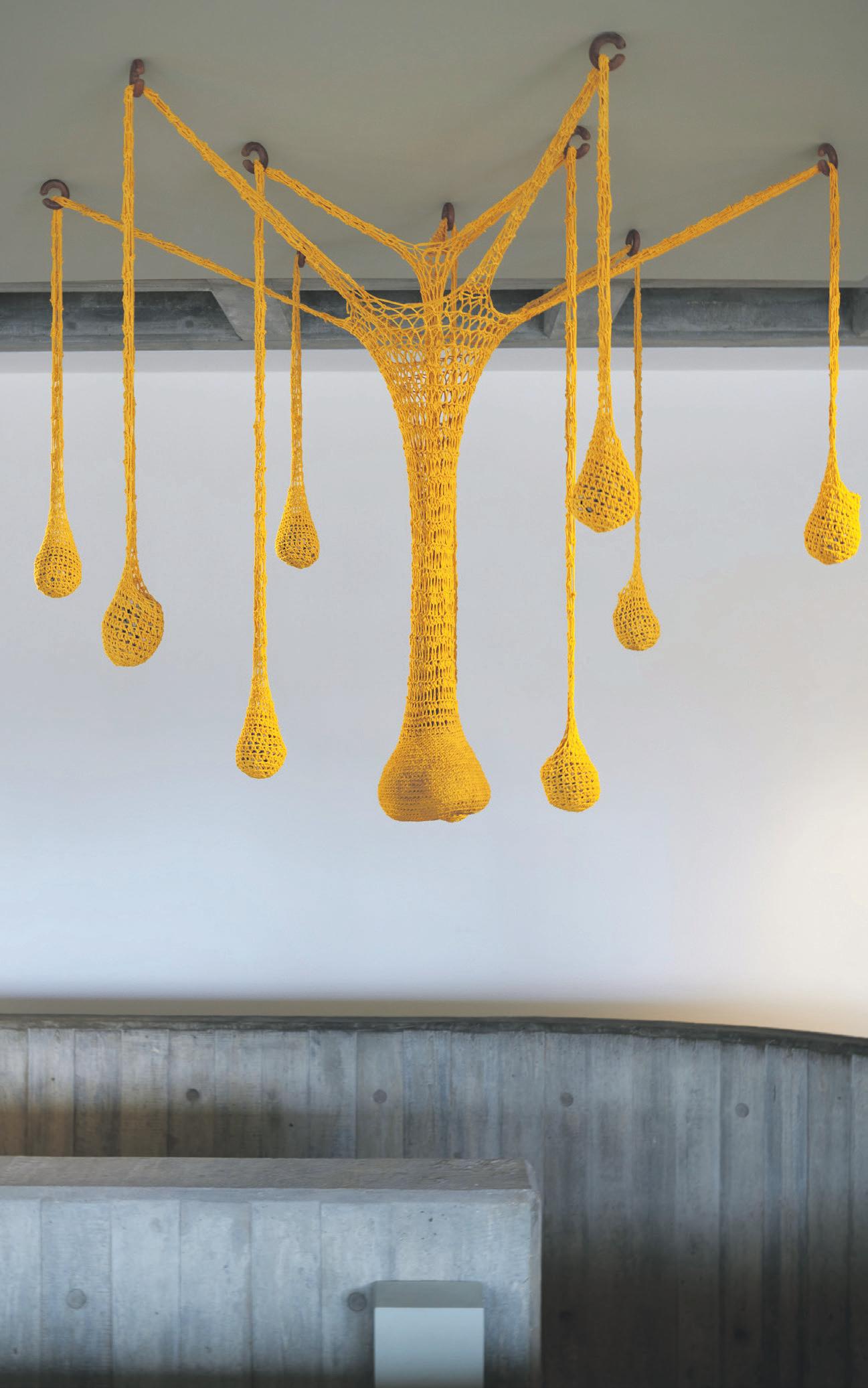
I don’t make sculptures; I make beings that are alive – Marguerite Humeau2
The curatorial approach in ‘When Forms Come Alive’ sets up a series of conversations whereby sculptures and installations with shared questions and approaches are grouped together. As a result, the exhibition flows organically, thus reinforcing the curatorial proposition that the selected sculptures draw inspiration from and reflect our relationship to the natural world.
For example, at the entrance, the viewer is confronted by two highly ambitious, yet fragile and time-based sculptural installations: Shylight (2006-14) by DRIFT and Bouquet Final (2012) by Michel Blazy. The first consists of petticoat-like forms which lower and raise, open and close like blossoming flowers in a choreographed kinetic light installation. Blazy’s artwork emanates a similar sense of ceaseless change and fragility through the constant accumulation of foam bubbles to form cloud-like waves of shivering matter that creep, glacially, from a scaffold structure, as if part of an endless production line.
Several artworks actively respond to the architectural fabric of the building itself, including its riverside location. Holly Hendry’s Slackwater (2023) is perched on a second-floor windowsill against the backdrop of the only exterior view seen from the gallery. Inspired by the abstract rhythms of the River Thames and liquid movements within the human body, the immense sculptural entanglement spreads from inside out onto the roof space, using steel ducting, foam, and marble.


Ernesto Neto’s fibre installation, Iaia Kui Dau Arã Naia (2021) is brilliantly placed above the cast concrete spiral staircase, that by contrast, accentuates its transparency, fragility, and gravitational force. Pinned to the gallery wall and spilling onto the floor, Senga Nengudi’s wonderfully whimsical compositions – R.S.V.P. Reverie (Scribe) (1977), R.S.V.P. Reverie ‘D (2014), and Water Composition I (1969-70/2019) – feature sand-filled, tension-stretched nylon tights, and vinyl structures filled with coloured water, that are both touching and humorous in their vulnerability. Reminiscent of popular culture images of nuclear disaster, Dream – Spontaneous Combustion (2008) by Olaf Brzeski is a cloud-like form in black soot, ash, and polyurethane resin that is petrified and unnerving.
It is plainly observable how matter imposes its own form upon form – Henri Focillon3
Phyllida Barlow’s untitled: girl ii (2019) presents the viewer with an arrangement of stone-like forms, reminiscent of a dolmen, a megalithic monument, or another prehistoric manmade structure. Through this powerful evocation of abstracted corporeal presence, Barlow’s sculpture thus achieves a primaeval effect; an ancient presence with tactile surfaces and curvaceous forms, seemingly imbued with timeless feminine power. One wonders whether this sculpture may always have existed since time immemorial.
Until once, in a standing circle of stones,
I felt their shadows pass Into that dark permanence of ancient forms.
– John Montague4
By avoiding representational sculpture and its idioms of frozen life, this exhibition allows the viewer to engage with the wider and deeper concepts of decay and renewal; of change and its inevitability, indeed, its necessity. The excellent curation of the show raises a host of questions and invites visitors to reflect on possible answers.
Varvara Keidan Shavrova is a visual artist, curator, writer, and PhD candidate at the Royal College of Art. She is currently conducting her 12-month AHRC-funded research placement at the Science Museum in London. As part of her research, she is also collaborating with RollsRoyce Aviation. varvarashavrova.com
1 Extract from the opening speech by Ralph Rugoff, Director of Hayward Gallery and Curator of ‘When Forms Come Alive’, 6 February 2024.
2 Ralph Rugoff, When Forms Come Alive: Sixty Years of Restless Sculpture, exhibition catalogue (London: Hayward Gallery Publishing, 2024) p 9.
3 Henri Focillon, The Life of Forms in Art, trans. George Kubler (New York: Zone Books, 1992) p 19.
4 Extract from John Montague, Like Dolmens Round my Childhood, first published in Poisoned Lands and Other Poems (London: MacGibbon & Kee, 1961).
Visual Artists’ News Sheet | May – June 2024 27 International
Installation view, Ernesto Neto, ‘When Forms Come Alive’; photograph by Jo Underhill, courtesy of the Hayward Gallery.
Top: Installation view, Franz West, ‘When Forms Come Alive’; photograph by Jo Underhill, courtesy of the Hayward Gallery; Bottom: Installation view, Tara Donovan, ‘When Forms Come Alive’; photograph by Jo Underhill, courtesy of the Hayward Gallery.
Kafkaesque
CHRISTA-MARIA LERM HAYES REVIEWS AN EXHIBITION IN PRAGUE TO MARK THE CENTENARY OF FRANZ KAFKA’S DEATH.
READING GLOBAL NEWS these days, one gets the impression that paralysis, dysfunctionality of bureaucracies, and abuses of power, all of which pervaded the Austro-Hungarian Empire that Franz Kafka experienced, have not gone away.
The centenary of Franz Kafka’s death this year is being marked with several exhibitions, not least in Kafka’s city of birth, Prague. Before taking in the major show for the occasion at DOX, I went to the Kafka Museum and also stumbled upon a private initiative opposite the writer’s birthplace that uses the cellar of an office building to show that a huge concrete pillar was cast within a Romanesque Lapidarium. The installation also features images of Russian tanks on Prague streets during the Prague Spring, and what are presumably the organisers’ own, unrelated canvasses: all evidence of said dysfunctionality, whether in planning offices, Cold War international relations, or current art world vanity – and rather Kafkaesque.
The key exhibition of celebrations, ‘Kafkaesque’ at DOX (9 February – 22 September) is not the star-studded affair at Villa Stuck in Munich but does not reduce itself to a local or thematically narrow remit either. At DOX, Kafka’s face is everywhere, even though the writer sought to elide the specifics of time and space and, most importantly, his own personality and fame. Working as an insurance clerk enabled him to avoid dependency on his authoritarian father, yet the family’s drapery business made the sensitive son self-conscious: enjoying fine clothing at times but feeling ashamed to see himself in mirrors. Such well-known facts make it somewhat counter-productive that the exhibition chooses the traditional literary exhibition method; portraiture and illustration-derived work take centre stage.
The writer, whose main concern was to grapple with shame (as the Munich exhibition text tells us), was a self-saboteur and showed advanced levels of restraint. These qualities could have been emulated at DOX, rather than feeding the Kafka brand, or showing male genitalia (in several works). Absurdity can, indeed, have a variety of different connotations (Surrealism shows a wide range of artistic conceptualisations); however, Kafka can, arguably, not be turned into a self-obsessed ‘expressionist’, whose most recognisable feature is ‘fame’. Clearly, he wrote in the same milieu as expressionists, but what does it add to the viewers’ understanding of either Kafka or our Kafkaesque world to let his minimal stick man drawings bulge into the third dimension via paper mâché (Liu Xia)?
As far as showing contemporary art that relates to literature, this is not an exhibition that innovates. At the same time, of course, ‘Kafkaesque’ can mean different things to different people.
I had hoped to see more of the global charge of the term and the opportunities

for comparison and transfer that are present in the work of the Philadelphia duo, Brothers Quay. Indebted to the Czech puppetry tradition, they present a “tyranny without a tyrant” (this key phrase is quoted in the exhibition’s wall text) by showing invisible and menacing forces through a puppet questioning what a string does. Volker März, taking a supposedly light-hearted stance, makes Kafka crop up in unexpected places, such as in the Israel of the future. As far as I could make out, this is the only way that Kafka’s Jewish background and criticism of authoritarianism appear as currently relevant in the exhibition.
Pavel Büchler, from Prague himself and once incarcerated for producing samizdat (banned publications), presents The Castle (2005). Based on Kafka’s unfinished final book, which was published posthumously against his wishes, this is an installation of many old, dented loudspeakers. These favourites of dictatorships of any flavour were once found in profusion in Prague, showing continuity of German occupiers (who would have killed Kafka, had he not prematurely succumbed to illness) or the Soviet regime. It is likely absurd, in an
unintentional kind of way, that Büchler’s ready-made, conceptual sensibility is here paired with Gottfried Helnwein’s sensationalist canvasses. The loudspeakers sound out Kafka’s words, rather than those of one authoritarian or other, in order to critique and counter the usual decibel levels that try to prevent people from thinking for themselves. If Büchler shouts anything, it is “Think!”
The Kafkaesque show in Prague luckily coincides with another one, entitled ‘Read’. Berlin-based artist duo, Elmgreen & Dragset, assembled an exciting literary art exhibition at the newly extended Kunsthalle in Prague. Here, the works are more conceptual in nature, including some samizdat, and a piece (by the curating artists themselves) where a staircase leading to a door with the label ‘Filozofie’ is broken off. The unreachability – of the law or any higher principle – for which Kafka’s work is so well known, finds beautifully restrained and non-illustrative reflection here.
There is a wall chart evidencing the profusion of public libraries in the Czech Republic (even exceeding that of Ireland per capita). The Czechs as readers and thinkers,
though, do display one of the less obvious effects of the last century’s European history: they no longer want to read Kafka in German. In the original, the absurdities creep in nearly by stealth, through conjunctions or pronouns. These humble elements (Deleuze and Guattari called Kafka ‘minor’ literature) are what teaches us that totalitarianism is achieved through nearly imperceptible, everyday rituals, such as the words we use – and that countering it will have to follow such tactics, too.
Matt Collishaw’s stag machine on mirrors, programmed to shake if some social media abuse goes viral, is another spectacular part of the ‘Kafkaesque’ exhibition. I imagine that Kafka himself would council radical restraint, viewing the DOX show as a symptom of contemporary art’s lack of distance to the powers that be. He may even advise visitors to his home city to go to the Kunsthalle instead – and read.
Christa-Maria Lerm Hayes is an art writer, researcher, and curator working at the University of Amsterdam.
Visual Artists’ News Sheet | May – June 2024 28 International
Jaroslav Róna, Kafka in Trieste 2020; image courtesy of the artist and DOX.
Creator of Worlds
BRENDAN MAHER INTERVIEWS BREDA LYNCH ABOUT HER RECENT EXHIBITION AT THE SOURCE ARTS CENTRE IN THURLES.

Brendan Maher: Your recent solo exhibition at The Source Arts Centre, ‘If You’re Not Scared, The Atomic Bomb is Not Interesting’, is part of your ongoing project, ‘Fragments of a Lost Civilisation’, that you’ve been working on since 2015. Can you tell us about the project’s gestation and how it has developed through the years?
Breda Lynch: There comes a point in every artist’s practice when one reflects on the work and its development. Sometimes one has reached the natural end of a project or a way of working and there is a necessity to purge or ‘kill one’s darlings’, as the saying goes. I think this is a crucial action towards new work and reinvention. In the summer of 2015, I was in that place and was compelled to reconsider new mediums, approaches and methodologies. Having picked up a few packs of pre-prepared A4 cyanotype paper, while in the UK, and using photocopied/digitally printed A4 acetate sheets as negatives, I set about remaking selected images from a collection of images (hardcopy and digital) that I had been hoarding over time.
These images varied; some were from popular culture, such as sci-fi, pulp fiction, occult publications or user manuals related to technology, DIY, as well as old adverts for food, technology, home improvements, domestic pursuits, clothing, and religious signage. Images featuring the atomic bomb mushroom cloud, staged images of women modelling atomic fashion, and adverts (directed towards children) for DIY atomic labs, all feature prominently. Overall, I tend to see this series as a collage project,
with fragments taken from various aspects of twentieth and twenty-first-century print media. The title became an overarching one in which clusters of images began to emerge.
BM: How does your work explore the changing nature of the image, based on varying contexts?
BL: My work primarily engages with the circulation and transformation of the image in the public domain, the juxtaposition of meaning, and its subsequent re-contextualisation. I’m interested in themes of history, identity, popular and queer culture. So, the artwork is often influenced by such topics, and the evolution of social, political, and cultural movements. The approach is cyclical; images or pictures are found or collected, copied or scanned, sometimes digitally edited, altered or cropped, then remade as cyanotypes. As the body of work has evolved, the resultant artworks have been exhibited in a variety of ways. This includes exploring scale to reflect this conceptual enquiry, such as a large vinyl I installed on the exterior of Ormston House, Limerick, in 2020, a digital print/vinyl installation at The Luan Gallery, Athlone, in 2021, and a large wall installation in Meta headquarters in Dublin in 2023. These fragments play with the ‘queered’ images, foraged from our information-saturated world. They aim to find meaning and to explore ideas of visibility, representation, and identity.
BM: Can you explain the cyanotype process in practical terms and why you chose

to work with it?
BL: I became attracted to the cyanotype process as I could explore image-making through natural sunlight, experiment at my kitchen sink, and allow the incidental aspects of the process to lead me intuitively. I don’t work with chemicals, as I use sheets of pre-treated A4 cyanotype paper. In 2015 it became the ideal medium to purge my art practice. Working with multiples, repetition, copying, and appropriation are important sensibilities of my practice. This process allowed me to re-engage with my own archive of images.
Cyanotype as a chemical process, more popularly known as Blueprint, was discovered by British polymath, Sir John Herschel, in 1842. Being interested in histories of image and photographic reproduction, I became aware of the pioneer of the cyanotype photographic process, Anna Atkins, who between 1843 and 1861 (and with the assistance of Anne Dixon) handprinted several albums of botanical and textile specimens using the process, most notably Photographs of British Algae: Cyanotype Impressions, published in 12 instalments. These were effectively the world’s first photographically illustrated books, their contents both extensive and beautiful in their execution.
BM: You recently exhibited a piece as part of the Biennale of Sydney?
BL: After the opening in Tipperary, I went to Australia. One of my pieces, Cake Bomb (2016), purchased by IMMA for the national collection in 2021, is on loan to the
Biennale of Sydney until it ends in June. The biennale theme this year is ‘Ten Thousand Suns’, presented across six venues. My work is in the Art Gallery of New South Wales in a specific show, ‘Imaginaries of the Mushroom Cloud’. Co-curator of the biennale, Inti Guerrero, notes this exhibition traces “the power of the image of the atomic mushroom, as part of our attempt to revisit the nuclear era which defined a great part of the Australian psyche and connects to political memory of the Pacific.”
Cake Bomb is also from the ‘Fragments of a Lost Civilisation’ series. The collections team at IMMA were brilliant in handling the logistics, while the Hugh Lane Gallery and Culture Ireland have also been immensely supportive. I recently had several pieces in the group exhibition ‘Burn the Witch, Still I Rise’ at GOMA Waterford (9 March – 6 April) and look forward to exhibiting as part of the Soul Noir Festival in Dublin in October.
Brendan Maher is Artistic Director of The Source Art Centre in Thurles, County Tipperary, where ‘If You’re Not Scared, The Atomic Bomb is Not Interesting’ ran from 2 March to 20 April. thesourceartscentre.ie
Breda Lynch is an artist, curator, and teacher from Kilkenny, currently living and working in Limerick. bredalynch.wordpress.com
Visual Artists’ News Sheet | May – June 2024 29 Career Development
Breda Lynch, Cake Bomb, 2016, cyanotype print, 59 x 84 cm (IMMA Collection: Purchase, 2021) ; image courtesy of the artist and The Source Arts Centre.
Breda Lynch, Pagan Summer 2019, colouring pencil on canson paper, 65 x 50 cm; image courtesy of the artist and The Source Arts Centre.
Holding Space
ELLA DE BÚRCA OUTLINES THE EVOLUTION OF HER PRACTICE TO DATE.
MY MIXED-MEDIA PRACTICE functions through modes of inquiry, working through performance, sculpture, and poetry to focus on how humans construct meaning, particularly from a female perspective. I have created site-specific installations and scripts that develop from historical events, merging, layering, and adding my own musings and fictions. My creations become hybrid entities that look towards a future of inclusivity, while envisioning an Irish society in which artists are taken seriously.
My work has been shown in many settings, from small-scale artist-run spaces (Artbox, Dublin, 2015) and large institutions (Kunstverein Stuttgart, Germany, 2017) to museums (Museum of Literature Ireland, Dublin, 2024), bars (Smoking Concert at L’Archiduc, Brussels, 2018), and biennials (Emergency Pavilion, Venice Biennale, 2013). In Ireland, my work has been supported by the Arts Council of Ireland, Fingal County Council, and Culture Ireland. Most recently, I was the recipient of a Platform 31 bursary, awarded by Laois County Council.
In 2016, I was accepted for a two-year residency at the renowned HISK institute in Ghent, Belgium, which provided me with a personal studio, access to highly skilled technicians, and monthly studio visits with European-based curators and art practitioners. Having such professionalism focused on my practice changed my outlook and my output. I went on to study for a PhD at KU Leuven, Belgium, obtaining my doctorate in 2022.
In 2018 I had a solo exhibition at The Room Gallery at The University of California, Irvine, USA. Flat As The Tongue Lies (2018) used a three-act structure to explore the formation of meaning through reading, writing, and speech. In reference to eighteenth-century closet dramas – plays written mostly by women and intended for private reading rather than public performance –my three-act play existed as a place for a disembodied voice. My performative installation enabled reflection on forms of censorship in a moment when male-dominated discourse continued to frame women’s narratives in relation to their own bodies.
In 2019, I published a book in collaboration with Jim Ricks and Michaële Cutaya, stemming from a residency in San Francisco. IRLDADA: 201916 (Black Crown Press, 2019) was launched at The Hugh Lane Gallery, and I created a site-specific performance as part of the launch. In Pirouette (2019), the main gesture of the performance doesn’t take place. A female ballerina is requested to do a single pirouette in front of the gathered audience, who circle her while I give a long contextual introduction to the history of viewing, spanning from Synge’s The Playboy of the Western World (Maunsel & Co., 1907) to Futurism.
Important to the work is the history of claquers There were claquers both for and against Pirouette Some actors, planted among the gathered audience, interrupted my long introduction with impatience, some coughing, growing more and more frustrated with my overarching phrases and grandiose statements. Finally, one cheeky plant asked: “What has this got to do with the pirouette?” Another plant retorted, and I continued on, but not for long before there was another interruption.
The Playboy of the Western World provoked audience disruption and riots during its first performance at the Abbey Theatre in 1907. Hugh Lane, after whom the gallery is named, and whose aunt was Lady Gregory (co-founder of the Abbey Theatre), was one of a group of men drafted in as claquers to cheer that 1907 perfor-
mance in the face of audience disruption. The conversation circled on but alas, the pirouette never happened.
I am currently showing a performance in the group exhibition, ‘Is This a Poem’, curated by Christodoulos Makris, which continues at the Museum of Literature Ireland (MoLI) until July. Exposing the Doubt was developed in 2019 and centres around the act of dying on stage. In a nod to Beckett’s Krapp’s Last Tape (Evergreen Review, 1958), the performance is structured as a conversation with myself, filled with bickering and self-depreciation. This self-conversation was facilitated by pre-recording one half of the conversation, in which scripted technical glitches set up the performative onstage death.
It is in this moment, when the tape stops and I ask the audience if I can start again, that I find most fascinating to perform. The people in the audience always look truly horrified to see me dying on stage, and it’s their embarrassment that invigorates this performance of female anxiety and nerves.
Going forward, I am collaborating with Glandwr on research that involves reflecting on and activating Irish female health, in particular endometriosis and maternity practices. Glandwr holds this space, as I gather a group of artists, researchers, and creators whose bodies have been medicated, spelled, and potioned, both in and out of the health system. Together we will share images, songs, and stories at roundtable discussions, the output of which will form the basis of a performative installation for a group exhibition in late 2024, supported by Fingal County Council.
Ella de Búrca is an Irish visual artist and lecturer at SETU Wexford College of Art. elladeburca.com


Visual Artists’ News Sheet | May – June 2024 30 Career Development
Ella de Búrca, Pirouette, 2019, performance at the Hugh Lane Gallery; image courtesy of the artist.
Ella de Búrca, Exposing the Doubt, 2019-24; image courtesy of the artist.
Mother Myth Memory
SEAN WALSH INTERVIEWS ARTIST RITA DUFFY ABOUT HER CURRENT EXHIBITION AT ESKER ARTS IN TULLAMORE.
Sean Walsh: Your exhibition ‘Midland: Mother Myth Memory’ has a lot of autobiographical content, including some referencing your connections to County Offaly. Would you tell us about that connection?
Rita Duffy: My mother was born in a small village called Clara in County Offaly. My father was sent from Belfast to Clara to assist Goodbody’s factory in the mechanisation of their looms, and he spotted her Irish dancing. It sounds like a John Wayne-Maureen O’Hara production but within their north-south union was a fascinating playing out of historical and political complexities. I witnessed, within my family, the lived experiences of colonialism, revolution and violence, the profound differences between rural and city life, and the catastrophic crisis after partition.
I spent time with my grandmother in Clara when I was five, the year before I went to primary school. She told me never to go near a bog hole, well before Stephen Hawking made his pronouncements. She warned: “If you fell in, you’d be falling forever, for there’s no bottom to a bog hole.” Pestering her with questions, I wanted to know what the wires running from pole to pole were for. Quick as a switch she told me that the rabbits tapped their paws on the lines in the sky and sent messages over long distance. Today, I can understand these memories as the foundations of magic realism that continues to pulse through my work.
I was born and grew up in industrial Belfast and somewhere around 12 years old, I realised I didn’t come from Offaly, such was the pull of that matriarchal lineage: “You’re Maura Mullins daughter – how long are you home for?” As The Troubles blew up around us, we retreated south for respite and normality; dressing up and going to dances with aunty Betty and playing music on the jukebox at the local chipper. It’s hard to overstate the influence those visits had on the psyche of a young woman who pitched her sights on turning all she experienced into art.
SW: In the lead-up to this exhibition, you conducted some shrine making workshops. The resulting works were displayed here in Esker Arts and were very striking. How did that idea come about?
RD: The shrine is a sacred space and, for me, has the overtone of a dollhouse. It’s a place of imagination and ritual; once you take personal ownership in the gathering and selecting, you become a curator of sorts. The creation of little worlds or windows into emotional realms is important for me, and I suspect many others. I went on a lecture tour in South America a few years back and between universities, I photographed roadside shrines. There is a universal human impulse to mark significant places. A shrine is often created on the exact location of a life going into death – it’s a visual reminder for the traveller that something significant happened here, a marker between life and
death. I’ve always been interested in ‘outsider art’ and the eccentric creations that are driven by an obsessive need to create. The process of gathering, arranging information, and trusting the ignition moment to create images is fundamental to how I make work. The shrine in Irish culture is familiar, largely female, and beyond the control of the church. Of course, this ritual is deep in my thinking; it was a perfect fusion of exploring a traditional concept and the location of Esker Arts in Offaly. I’m so inspired by the beauty and variety of what was produced. It’s seldom to encounter such enthusiasm in art workshops; we didn’t want to stop!
SW: Growing up in Belfast, I imagine that religion was a big part of personal identity. How did that affect you? And how did it impact your development as an artist?
RD: Catholic education was only part of my identity, but it did give me a way to escape; the imagery, the beauty, and ritual fed my visual intelligence. The real damage was struggling through patriarchal ideas and the misogyny I encountered layered on top of bigotry. A difficult personal journey might have been easier had I lived elsewhere but I turned the personal into a microcosm of the larger world. As I continue to work in a more international context, I realise it’s the role of art and artists to transform experiences.
SW: Your practice has encompassed drawing, painting, animation, and sculpture, but also performative and conceptual actions. How has this evolved, from your perspective?
RD: Just as soon as I left art school, I gave myself permission to explore. That permission has expanded over the years. It’s my way of throwing off the colonial legacy I grew up in that would urge me to believe that profound concepts/ideas come from elsewhere. The work itself usually dictates its form and I trust what emerges; I’ve learned so much, especially from my mistakes. The big constant in my work is drawing – everything comes from drawing – it’s my way of learning, opening out the possibilities, meditating and figuring out. It never fails.
SW: There has been a number of occasions when your work has been a direct response to changes in Irish society, such as the Souvenir Shop in 2016 and the Soft Border Project in 2019. How do you see the role of artists in relation to these kinds of events, whether commemorative or seismic societal changes?
RD: It has long been my opinion that socially engaged art is a vital force, particularly in a post-conflict society. Art may well be the only activity that will keep us from destroying our planet right now, as our world seems more intent than ever on self-destruction.

SW: Are there any projects you are working on at the moment?
RD: There are several projects at different stages and in different locations. I’m presenting The Lowell Humanities Series lecture at Boston College this autumn and continuing to develop work on the Cavan/ Fermanagh border. It has been inspirational to have a studio in no man’s land, a place of real possibility. Collaboration with Jane Ohlmeyer at Trinity College Dublin on the ERC Voices project continues with the promise of exciting results. Currently, I’m making a new animated drawing for the All of Us Festival in Cairns, Australia, exploring the potential of new technologies. I’ve just been invited to South Africa hosted by the Charlotte Maxeke-Mary Robinson Research Chair, which is held by the Centre for Humanities at the University of the Western Cape. It’s a very important time to share experiences and cast off old redundant ways of thinking. Art and artists are potential leaders in these developments. I’m hopeful and excited and remain curious about everything.
Rita Duffy is a Northern Irish artist. ritaduffystudio.com
Sean Walsh is Artistic Director of Esker Arts in Tullamore, County Offaly. Rita Duffy’s solo exhibition ‘Midland: Mother Myth Memory’ continues at Esker Arts until 25 May. eskerarts.ie
Visual Artists’ News Sheet | May – June 2024 31 Career Development
Rita Duffy, Under the Copper Beech - Aughamore, 2011, oil on linen; image courtesy of Rita Duffy and Esker Arts.
Wave Junction

Artwork Title: Wave Junction
Artist’s Name: Ruth E. Lyons
Commissioning Body: IPUT Real Estate
Date Sited: November 2023
Budget: €152,000
Commission Type: Private Commission
Project Partners: Fingal Public Art, Aisling Prior (Curator)
Wave Junction (2023) by Ruth E, Lyons is a dramatic new public artwork on two planes: a vertical timber arch and a horizontal concrete bench. The two curved black lines of the bench and arch combine into an elusive form that undulates in wavelike motions. Situated at the back of the runway at Dublin Airport, Wave Junction is also intended to be seen from the sky.
The sculpture is inspired by Quantum Mechanics and the notion that on the smallest of scales, our reality is made of up an entanglement of waves. In Quantum Distribution Park, a landscape where the mechanics of the quantum world are employed as commonplace, Wave Junction explodes this idea into an interactive sculpture, designed to be sat on, walked on, and leant on. It is a hug in an otherwise flat and featureless industrial setting.


Visual Artists’ News Sheet | May – June 2024 32 Public Art
All images: Ruth E Lyons, Wave Junction, 2023, timber, steel, concrete: photograph courtesy of the artist and IPUT Real Estate.
Gathering

Artwork Title: Gathering
Artist’s Name: Maggie Madden
Commissioning Body: Cosgrave Developments
Date Sited: 1 April 2022
Budget: €60,000
Commission Type: Local Authority
Project Partners: Fingal County Council’s Public Art Programme
Gathering (2022) is a series of four stone and marble sculptures commissioned for a new housing development in Santry, County Dublin. The work is located at the entrance to the development, adjacent to a row of protected mature oak trees, and across from the playground, a place where people meet and gather.
The sculptures allude to ancient stone circle monuments, which served many possible purposes, including ceremonial sites and gathering places. The artist designed each piece with a maximum height of 55cm and a flat level top to make them accessible for the public to use as seats. The seat shapes were derived from the 1830s Ordnance Survey map of the Santry area, showing linear boundaries of enclosed fields and woodland.
The stone and marble were sourced from different countries. These durable, natural materials, slowly formed over millions of years, have a beautiful materiality to them. The layers and veins of colour that emerge, when the stone is cut and honed, invite you to run your hand along it, connecting back to the earth and the land. Madden wanted to engage the public with a simple work that invites a physical experience; not just through looking, but to sit, pause, and connect.

Visual Artists’ News Sheet | May – June 2024 33 Public Art
All images: Maggie Madden, Gathering, 2022, stone and marble; photograph by David Monahan, courtesy of the artist and Fingal County Council.
Tokyo Jazz Joints & Beyond
BELFAST-BORN PHOTOGRAPHER PHILIP ARNEILL DISCUSSES HIS RESEARCH AND PRACTICE.
MY PHOTOGRAPHIC PRACTICE explores illusory ideas of home and culture by examining autoethnographic issues of place and identity, combining images with autofiction and nonfiction text. After obtaining a BA from Glasgow University, I left for Japan, where I lived for almost 20 years, with a brief one-year hiatus in Egypt. A passing interest in photography acquired at university followed me to Tokyo, where I began to develop my practice and explore what drew my eye visually.
I’m obsessed with music and after going to various club nights in Japan, I quickly began photographing them, specifically the unique UK Jazz Dance (‘Bebop’) scene in Tokyo’s underground clubs, brought from London by some intrepid Japanese dancers in the 1980s. The project evolved from crawling around dark dancefloors – in constant fear of having my camera kicked from my hands – to Tokyo Jazz Document, a series of candid portraits recording three generations of dancers. This project marked my transition from 35mm film to digital, with which I still shoot today. I later collected all these images together as BeBop Tokyo Inspired to study further, I gained an MA in Photojournalism and Documentary Photography from University Arts London in 2014. Through this course, I developed my interest in exploring insider-outsider dynamics and the contrast between the cultures into which we are born and those that we adopt and adapt to, returning my lens to my country of birth. Having traced my family history by photographing the Orange Order during marching season, I subsequently created Blood & Thunder Bands – a two-year project during which I embedded myself in Northern Ireland’s thriving Loyalist band scene.
In 2015, I began the Tokyo Jazz Joints project, documenting the unique, vanishing subculture of Tokyo’s jazz kissa – dedicated listening spaces for jazz. After many, many nights in over 160 cramped and smoky kissa and bars, my Tokyo Jazz Joints photographic monograph was published by Kehrer in
July 2023 to critical acclaim. The book has been featured widely in print, broadcast, and online media including The Guardian, South China Morning Post, Belfast Telegraph, Wallpaper* and BBC Radio 2. The photobook is now in its second edition print-run and has sold in over 55 countries. In collaboration with American broadcaster, James Catchpole, I also produce a successful podcast series with a global listenership, delving into the stories behind the images and placing them in a wider Japanese socio-cultural context.
Awarded the AHRC Northern Bridge Doctoral Award in 2020, I began researching my PhD at Ulster University. My project, I am where I am not, is underpinned by a quote from my musical hero, John Coltrane, who declared in an interview in 1960: “I’ve found you’ve got to look back at the old things and see them in a new light.” My research is a practice-driven, personal photographic exploration of my inherited Protestant identity through the architecture of Orange Halls in Ireland – material markers of a diminishing culture. Inspired by the work of William Christenberry and Lewis Baltz, the project will establish a typology with which these halls might be read, questioning notions of inherited cultural identity and belonging through the creation of an image and text-based archive.
This year, I received the Support for Individual Artists Award (SIAP) from Arts Council Northen Ireland to develop my Two Cranes documentary project, highlighting the largely unrecognised contribution the long-standing Chinese community has made through cuisine to the architectural and cultural heritage of Northern Ireland.
Philip Arneill is a Belfast-born photographer, writer and current AHRC Northern Bridge PhD researcher at Ulster University. philiparneill.com @philiparneill

The Power of Stillness
ADELINE GAUDEFROY REPORTS ON HER RESIDENCY AT THE MARINA ABRAMOVIĆ INSTITUTE.

‘PERMACRISIS’ HAS BECOME a global buzzword, which echoes through the collective consciousness. The weight of our unstable reality bore down on my mind, and I sought an escape from perpetual anguish about the future. I stumbled upon the ‘complain to the tree’ exercise from performance artist, Marina Abramović’s documentary, The Artist Is Present (2012). The protocol is simple – choose a tree, embrace it tightly, and vent for a minimum of 15 minutes. How many times had I yearned for the freedom to express myself without fear of judgement or repercussions? Countless occasions.
This yearning led me to Marina Abramović Institute’s website, where I registered on the waiting list to participate in the ‘Cleaning the House’ workshop. Abramović developed this workshop over the course of 40 years of teaching, in order to prepare her students for long durational performances. Led by artists trained by Abramović, the workshop aims to bring both body and mind to a state of tranquillity, employing durational exercises to enhance focus, stamina, and concentration. Two months later, an email prompted my application and a medical assessment. Despite the concerns of well-meaning friends about a workshop that involves abstaining from eating, speaking, and reading, I embraced the risk.
Landing in Athens, the prospect of entering the iconic institute felt surreal. Once a distant figure in art books, Marina Abramović gained significance when life’s trials exposed me to profound suffering. In those moments, I found a connection with her art. While the workshop was initially designed for durational performances, the diverse experiences of the eight other participants made me feel at ease, particularly given my background as an oil painter. We were led by two workshop facilitators, Paula Garcia and Billy Zhao, both performers who have collaborated with Abramović for over a decade.
The recently established institute in rural Sparti, Peloponnese, with its stone house nestled in a picturesque mountain landscape, set the stage for a unique experience. Following a briefing and the signing of our ‘contract’, we embarked on a transforma-
tive five-day journey of surrender, in which exercises were explained without specified durations. Only the ringing bell marked their completion, shaping the rhythm of our days. We were living without a clock or an agenda; activities like morning cold-water dips and qigong exercises provided relaxation.
On the second day, a long-duration exercise, blindfolded with noise-cancelling headsets, added depth to the deprivation, turning what was initially dismissed as a relaxing detox into a profound mental test. My thoughts oscillated between “don’t give up” and “why am I doing this?” until I could eventually maintain focus. The exercises compelled us to confront our thoughts and fully embrace the present moment. Throughout this immersive experience, my notebook became my best companion. Sharing a room with Ingull Jullien Jung, the executive director of Pado Gallery in Los Angeles, led to the creation of our own sign language, rendering verbal communication unnecessary.
Human adaptability turned self-inflicted deprivation into creative liberation. In the aftermath of our prolonged silence, Ingull expressed similar sentiments: “With the constraints of the protocol, my senses were maximised. Pushing the limits of personal endurance, the workshop awakened my intuition, sense and spiritual aspects of the art, the deep core of what is commonly referred to as creativity. Thoughts were clarified and filtered. Self-consciousness and preconceptions were reset.”
After five days, I felt a new surge of energy; my perception of life had altered. While not all newfound habits have persisted, the workshop proved transformative. Silent communication, sensory exercises, and the unique bonds formed with fellow participants left an indelible mark, urging us to confront our thoughts and be present in previously unimagined ways. Our journey continues; Ingull and I plan to meet in New York, this time, for a verbal conversation.
Adeline Gaudefroy is a French visual artist currently based in Dublin. adelinevisual.art
Visual Artists’ News Sheet | May – June 2024 34 Member Profile
Philip Arneill, Marshmallow, 2015, from ‘Tokyo Jazz Joints’; photograph © and courtesy of the artist.
Ingull Jullien Jung and another participant before the workshop, 2023; photograph © and courtesy of the artist.
GRANTS, AWARDS, JOBS, OPEN CALLS, COMMISSIONS
Jobs / Funding / Awards / Commissions
AIC Artist Mentoring Award 2024
The Artist Mentoring Award sits within a suite of offerings under the Artist in the Community Scheme (AIC). It aims to offer capacity building and arts practice development for collaborative socially engaged artists. Through the Artist Mentoring Award, artists from the Artist Mentor Panel will be available as mentors to emerging practitioners, artists with a strong interest in/ transitioning into collaborative socially engaged arts, artists who find themselves on the margins and feel they are underrepresented in the field of collaborative socially engaged arts, for example due to displacement or migration, and artists facing particular challenges in developing their collaborative socially engaged arts practice. There will be five artist mentors and five artist mentees.
There will be two information sessions happening online in advance of the application deadline.
Deadline Monday 13 May, 5pm
Web create-ireland.ie
Email jenniferfitzgibbon@create-ireland.ie
Individual Mobility Action 2
Culture Moves Europe’s second call for individual mobility targets artists and cultural professionals working in the following sectors: music, literature, architecture, cultural heritage, design and fashion design, visual arts and performing arts.
The Individual Mobility Action supports artists and cultural professionals to carry out a project with a partner of their choice in another Creative Europe country. The call is open to individuals and groups of up to 5 people, who wish to implement projects lasting between 7 to 60 days for individuals and 7 to 21 days for the groups. The grant contributes to travel and subsistence costs, and offers additional top-ups based on grantees’ individual situation.
Artists and cultural professionals can apply with a proposal to carry out a project with a partner of their choice in a Creative Europe country which is not their country of residence.
Festivals Investment Scheme
The Arts Council’s role is to advocate for and support the development of a diverse and varied arts-festival ecology, and to provide a suite of supports that encourage best-practice festival models that increase opportunities for public engagement and participation in the arts or develop the work of an artist/artform.
In this regard the Arts Council offers financial support to small-to-mid-scale festivals to deliver high-quality arts experiences for audiences, and prioritises programmes engaged with, and relevant to, local communities or communities of interest.
The Arts Council acknowledges the diversity of festival operating models and the rich variety of artform-practice areas presented by festivals and their critical role in broadening public access to the arts. The Council also acknowledges the valuable contribution made by voluntary committees in developing these festivals.
Deadline Thursday 30 May 5:30pm
Web artscouncil.ie
Email smallfestivals@artscouncil.ie
Markievicz Award
Up to 10 artists from all backgrounds, artform and arts practice areas will receive an award of €25,000. The award is designed to buy time and space for artists, working alone or in collaboration, to develop new work that reflects on the role of women in Ireland in the 20th century and beyond. The award is administered by the Arts Council on behalf of the Department of Tourism, Culture, Arts, Gaeltacht, Sport and Media. The Markievicz Award was originally established as a key element of the Decade of Centenaries Programme (2012–23) to honour Constance de Markievicz. Markievicz was an artist and the first woman in Ireland to be elected to Parliament and appointed to Cabinet. Given the importance of the Irish language revival movement during the revolutionary period, and the Department’s ongoing and particular responsibilities to support the Irish language and the Gaeltacht, one of the awards each year will be assigned to an artist working in the Gaeltacht and through the medium of the Irish language, subject to them achieving awardable standard.
To keep up-to-date with the latest opportunities, visit: visualartists.ie/adverts
Submissions to Linenhall Arts Centre
Submissions are now being accepted for the 2025 and 2026 gallery schedule.
The programme is developed on a bi-annual basis through an open-submissions process and is selected by a dedicated artists panel drawn from established artists and the local community.
The gallery regularly engages local schools in the community through workshops, talks and tours led by our Arts Access Officer, Deirdre Melvin and our dedicated Community Arts Team.
The Linenhall provides support for exhibiting artists as follows: an artists fee of €650 per exhibition, 1 technician and/or 1 installer for 1 day to assist with installation, insurance cover, marketing and publicity throughout the exhibition, opening reception contribution towards transport fees decided on a case-by-case basis, contribution towards accommodation costs decided on a case-by-case basis
Deadline Friday 31 May, 5pm
Web thelinenhall.com
Email director@thelinenhall.com
Easter Snow Gallery at TSEAC
The Séamus Ennis Arts Centre are inviting you to submit proposals for its 2025/2026 exhibition programme in our Easter Snow Gallery.
To apply, please email the following to info@tseac.ie:
• Artist Statement
• CV
• Exhibition Proposal
• 6 to 8 high resolution images
• Indication of price range of the artworks in proposed exhibition.
Our programme of exhibitions is an open submissions process and is selected by a dedicated panel.
Residencies
Deadline Friday 31 May, 9:59pm
Web culture.ec.europa.eu
Email culturemoveseurope@goethe.de
Deadline Thursday 6 June, 5:30pm
Web artscouncil.ie
Email muireann.walsh@artscouncil.ie
Deadline Saturday 31 August
Web tseac.ie
Email info@tseac.ie
TBG+S ISCP Residency in NYC Temple Bar Gallery + Studios invites applications from artists for the International Studio & Curatorial Program (ISCP) Residency in New York.
The ISCP Residency supports an Irish or Ireland-based visual artist to spend three months in residence at ISCP. Housed in a former factory in Brooklyn, with 35 lightfilled work studios and two galleries, ISCP is New York’s most comprehensive international visual arts residency programme.
The residency includes 24-hour access to a private furnished studio space; studio visits from visiting critics and art world professionals; field trips to museums, galleries and other cultural venues; participation in artist talks and ISCP’s Open Studios event; and supports living and materials expenses. This is an opportunity to live and work in New York City for three months where participants will have a further opportunity to network, meeting international artists and curators.
Deadline Friday 10 May, 5pm Web templebargallery.com
Email info@templebargallery.com
Designer in Residence at benchspace
The residency programme will afford the successful candidate the opportunity to create a new body of work or facilitate the exploration of innovative methodologies using benchspace’s facilities. It also provides an indepth opportunity for local professional makers and designers and the wider Cork community to learn from the Designer in Residence during workshops, lectures, and collaborations.
The 4 week residency will take place to coincide with Irish Design Week 2024, 11-15 November 2024, during which the resident will present their work to the public.
The residency also includes full access to benchspace’s professional workshops and a dedicated studio workspace.
This Residency is made possible with the support from Cork City Council Arts Service.
Deadline Friday 21 June
Web benchspacecork.ie
Email hilda@benchspacecork.ie
Visual Artists’ News Sheet | May – June 2024 35 Opportunities
Summer 2024 Lifelong Learning
In-person Events VAI Helpdesks (May)
KILDARE
HOW TO CRITIQUE MY WORK WITH LAURA MCCAFFERTY
Venue: Riverside Art Centre, Newbridge
Date: Thursday 9 May
Time: 6.00pm – 8.30pm
Places: 20
Cost: Free (County Kildare-based artists)
DUBLIN
VISUAL ARTISTS CAFÉ: BUSINESS PLANNING FOR ART PRACTICE
Venue: VAI Office, 2 Curved Street
Date: Monday 13 May
Time : 10.45am – 4pm
Places: 12
Cost: €10 (VAI members)
CORK VISUAL ARTISTS CAFÉ AND ARTIST TALKS
Venue: Cork County Council HQ
Date: Wednesday 15 May
Time: 11.00am – 1.30pm
Places: 80
Cost: Free (County Cork-based artists); €10 (Other Munster-based members)
DERRY/LONDONDERRY
VISUAL ARTISTS CAFÉ: SHOW & TELL NORTH-WEST
Venue: Waterside Theatre, Derry/ Londonderry
Date: Thursday 30 May
Time: 12 noon – 2pm
Places: 50
Cost: Free (VAI Members); €5 (General Admission)
SOUTH DUBLIN
VISUAL ARTISTS CAFÉ: ARTISTS AND CURATOR FORUM
Venue: Rua Red, Tallaght
Date: 7 June
Time: 11am – 1pm
Places: 30
Cost: Free (South Dublin-based artists)
WEXFORD VISUAL ARTIST CAFÉ: CURATOR NETWORKING
Venue: Wexford Arts Centre
Date: 27 June
Time: 11am – 1pm
Places: 30
Cost: Free (Wexford-based artists)
HELPDESK WITH BRIAN KIELT
Date: Wednesday 1 May
Time: 2pm – 4.30pm
Places: 5
Cost: Free
HELPDESK WITH BRIAN KIELT
Date: Wednesday 8 May
Time: 2pm – 4.30pm
Places: 5
Cost: Free
HELPDESK WITH OONA HYLAND
Date: Thursday 9 May
Time: 2pm – 4.30pm
Places: 5
Cost: Free
VAI Helpdesks (June)
HELPDESK WITH OONA HYLAND
Date: Tuesday 11 June
Time: 2pm – 4.30pm
Places: 5
Cost: Free
HELPDESK WITH OONA HYLAND
Date: Thursday 20 June
Time: 2pm – 4.30pm
Places: 5
Cost: Free
HELPDESK WITH OONA HYLAND
Date: Thursday 27 June
Time: 2pm – 4.30pm Places: 5
Cost: Free

HELPDESK WITH BRIAN KIELT
Date: Wednesday 15 May
Time: 2pm – 4.30pm
Places: 5
Cost: Free
HELPDESK WITH OONA HYLAND
Date: Thursday 16 May
Time: 2pm – 4.30pm
Places: 5
Cost: Free
HELPDESK WITH BRIAN KIELT
Date: Wednesday 22 May
Time: 2pm – 4.30pm
Places: 5
Cost: Free
VAI NI Helpdesks
NI HELPDESK WITH BRIAN KIELT
Date: Wednesday 5 June
Time: 2pm – 4.30pm
Places: 5
Cost: Free
NI HELPDESK WITH BRIAN KIELT
Date: Wednesday 12 June Time: 2pm – 4.30pm Places: 5 Cost: Free
NI HELPDESK WITH BRIAN KIELT
Date: Wednesday 19 June Time: 2pm – 4.30pm Places: 5 Cost: Free
NI HELPDESK WITH BRIAN KIELT
Date: Tuesday 25 June
Time: 2pm – 4.30pm Places: 5
Cost: Free
HELPDESK WITH OONA HYLAND
Date: Thursday 23 May
Time: 2pm – 4.30pm
Places: 5
Cost: Free
HELPDESK WITH BRIAN KIELT
Date: Tuesday 28 May
Time: 2pm – 4.30pm
Places: 5
Cost: Free
HELPDESK WITH OONA HYLAND
Date: Thursday 30 May
Time: 2pm – 4.30pm
Places: 5
Cost: Free
Webinars
SETTING UP STUDIO SPACE: ISOBEL EGAN AND MARIANNE O’KANE BOAL
Date: Thursday 2 May
Time: 2pm – 3.30pm
Places: Unlimited
Cost: Free (Clare, Limerick and Tipperary Artists); €5 (VAI Members); €10 (General Admission)
Information and Bookings
ROI Information and Bookings
To register a place or to find information on any of our upcoming Professional Development events in the Republic of Ireland, visit: visualartists. ie/professional-development
Fees
NI Information and Bookings
To register a place or to find information on any of our upcoming Professional Development events in Northern Ireland, visit: visualartists. org.uk/booking
VAI members receive preferential discount of 50% on fees for all VAI training and professional development events.
Bridging Perspectives:
Navigating the Interplay of Visual Artists, Curators, and Art Institutions

19November2024
10am - 6pm
The Irish Museum of Modern Art, Military Road, Kilmainham, Dublin 8
SAVE THE DATE
Keynotes Panel Discussions Artists Speak Specialist Clinics Speed Curating Café – Info Desks miniVAN Infi ltration BE A PART OF IT! PUT THE DATE INTO YOUR DIARY
2024 gettogether
#ATrustedSpace
NOW!

JAMES MCCREARY, LARS NYBERG & RICHARD LAWLOR
OF NIGHT AND LIGHT AND HALF LIGHT
02.05.2024 - 23.05.2024
2nd Floor, Powerscourt Centre, 59 South William Street, Dublin 2. 01 4721050 | 087 2549884 info@sofinearteditions.com www.sofinearteditions.com
Wexford
Arts Centre 15 June to 31 July
lucent
Charles Brady, Niamh Clarke, Hiroyuki Hamada, Vincent Hawkins, Tjibbe Hooghiemstra, Jamie Mills, Janet Mullarney, Helen O’Leary, David Quinn, Seamus Quinn, Sean Sullivan and John Van Oers
Curated by David Quinn
BEYOND THE FRAME
BA Visual Art Graduate Exhibition 2024


Sherkin Island │ 18 and 19 May
An all-island installation of artwork by the seven graduating students www.sherkinisland.ie
Skibbereen │ 25 May to 15 June
A group exhibition at Uillinn: West Cork Arts Centre www.westcorkartscentre.com
and delivered by the
Now accepting applications for the 2024/25 academic year. The programme will run subject to continued funding. For further information see TU977 on www.tudublin.ie


This exhibiiton is supported by an Arts Council / An Chomhairle Ealaíon Touring Award, initiated and developed by Uillinn: West Cork Arts Centre and touring to Highlanes Gallery Drogheda and Wexford Arts Centre in 2024 Wexford Arts Centre, Cornmarket, Wexford, Y35 X5HF Tel: +353 53 9123764 www.wexfordartscentre.ie
Tuesday to Friday 10am to 5pm, Saturday 10am to 4pm For more information contact Catherine Bowe, Curator: Visual Arts Programme at catherine@wexfordartscentre.ie
Image: Hiroyuki Hamada, #75, 2011-13, painted resin and painted plaster, image courtesy of the artist


Image: Sorcha Browning, Eden. , film production still, 2024. Duration 9min 26sec The BA Visual Art is a full-time, modular, honours degree that offers a dynamic and creative education
contemporary visual art. It is fully accredited, managed
TU Dublin
Art
Island, Co. Cork.
in
School of
and Design and is based on Sherkin


Studios in Enniskerry Village & Russborough House, Blessington info@schoolhouseforart.com +353 (0) 1 286 9594 @schoolhouseforart See schoolhouseforart.com for more information and our full curriculum THIS SUMMER – 8 SPECTACULAR MASTERCLASSES FOCUSING ON TECHNIQUES OF PORTRAIT AND FIGURATIVE ART, UNDER THE DIRECTION OF INTERNATIONALLY ACCLAIMED ARTISTS. THE FACE THE FIGURE THE FAMOUS BYRNES PATRICK SKETCHING THE PORTRAIT: 5 TECHNIQUES 5 DAY MASTERCLASS JULY TAIT REBECCA 5 DAY MASTERCLASS JUNE FULL COLOUR COSTUMED PORTRAITURE IN OIL EXPERIENCE MCGOWAN ALAN 3 DAY MASTERCLASS MAY ADVENTURES IN SHADOW & LIGHT MIANO CHARLES ROMANTIC PORTRAIT IN SANGUINE 5 DAY MASTERCLASS AUGUST ROBINSON NICHOLAS PAINTING THE PORTRAIT WITH SITTER 5 HALF DAY MASTERCLASS JULY ROBINSON NICHOLAS FUNDAMENTALS OF LIFE DRAWING 5 HALF DAY MASTERCLASS JULY DIVINE AINE WATERCOLOUR PORTRAITURE 2 X 2 DAY MASTERCLASS JULY l l MIANO CHARLES CHIAROSCURO PORTRAIT PAINTING 5 DAY MASTERCLASS AUGUST Émile Crowther Hannah Ní Mhaonaigh 11 May - 22 June Mermaid Arts Centre, Bray, Co Wicklow, A98 N5P1 Curated by Anne Mullee. Image © Émile Crowther, courtesy of the artist € 10 (STG£9) THE JOURNAL OF FINE ART, DESIGN, ARCHITECTURE, PHOTOGRAPHY, SCULPTURE, HERITAGE DECORATIVE ARTS AND CRAFTS IRISHARTSREVIEW.COM SAVE 10% OFF SUBSCRIPTION RATES TO THE IRISH ARTS REVIEW ONE-YEAR SUBSCRIPTION FOR VAI MEMBERS NOW €44! BOOK A SUBSCRIPTION TODAY Email: subscriptions@irishartsreview.com Tel: +353 1 676 6711
Are you a collaborative or socially engaged artist in need of support and mentorship?
Do you seek a critical friend or guide as you develop work?
Applications are open for the Artist in the Community Scheme Mentoring Award
Closing Date: 13th May 2024.
Read more about info sessions, supports and how to apply: www.create-ireland.ie


THE LIST AND THE LINE
NEW AND RECENT WORK BY

Alan Phelan Mark Swords

CASINO MARINO
13TH APRIL – 29TH JULY 2024
OPEN DAILY 10AM – 4PM
WWW.CASINOMARINO.IE