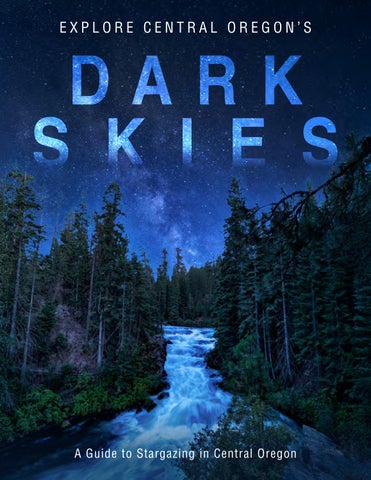
EXPLORE CENTRAL OREGON’S
DARK S K I E S
A Guide to Stargazing in Central Oregon
CENTRAL OREGON
DARK S K I E S The region is home to four DarkSky International certified areas that are part of the global Dark Sky Places Program, including Sunriver, Prineville Reservoir State Park, Sisters, and Antelope. It’s also the perfect
2
gateway to the hugely impressive Oregon Outback International Dark Sky Sanctuary – a phased designation comprising millions of acres - and the largest Dark Sky Sanctuary in the world. At a time when 80% of the country’s population can no longer view the Milky Way from their home because of light pollution, Oregon’s dark skies are appreciated as an increasingly rare natural resource. We’ve put together this useful guide to help lead you in the right direction – much like the North Star.
Photo Jeremy Likness photo by credit
Central Oregon is a vast region, with a variety of experiences in any season and for any given interest. From Sunriver to Sisters and from Prineville to Madras, and everywhere in between, there are endless opportunities to explore. But the sky that hovers above us – which also happens to be endless – is one of the constants.
4 6 12 22 26 30 32 34
photo credit
W H Y D A R K S K I E S M AT T E R O B S E R VAT O R I E S D A R K S K I E S AT A G L A N C E OREGON DARK SKY MAP O T H E R WAY S T O L E A R N FAQ LEAVE NO TRACE RESOURCES
3
WHY DARK SKIES MATTER Light pollution continues to have an increasingly unfavorable impact. Our dark skies are crucial to protect not only for the vital and proper functioning of our natural ecosystems, but also for the health and well-being of humans and the preservation of our outdoor space. Dark skies allow us to maintain a connection with the universe offering inspiration, scientific discoveries, and a sense of wonder that has long been part of human history.
Practicing the Principles of Leave No Trace (see pg. 32) will help minimize unwanted impacts. Visit Central Oregon is an Official Partner with Leave No Trace.
4
Photo by Christian Heeb
Since the electrification of homes, parks, buildings, and more, technology and a 24/7 global economy have been at conflict with the frontier of darkness. Light pollution disrupts the natural rhythms of wildlife, interfering with nocturnal behaviors such as migration, reproduction, and feeding. It affects plant growth and pollination cycles, ultimately impacting entire ecosystems. For humans, excessive artificial light can lead to health issues such as sleep disorders and increased stress.
Photo by Jarod Gatley
DID YOU KNOW Light pollution is increasing at twice the rate of population growth worldwide, and 83 percent of the global population now lives under a light-polluted sky. Typically, more and brighter LED lights are installed than necessary, and many of those are blue-white in color. Using amber or yellow light is much more night sky friendly. 5
OBSERVATORIES ROUNDUP
Photo by Grant Tandy
Central Oregon is home to several publicly accessible observatories - including the fully equipped Pine Mountain Observatory, the more rugged but equally impressive Dee Wright Observatory, and the Sunriver Nature Center & Observatory. Asterisk Observatory and Worthy’s Hopservatory are not to be missed either. The region’s famous dark skies are easily explored at any one of the mentioned venues.
6
P I N E M O U N TA I N O B S E R VAT O RY Pine Mountain Observatory is perched at an elevation of 6,300 feet (1,920 meters), 34 miles (54 kilometers) southeast of Bend. Though primarily used for advanced scientific research and other astronomical observations, the observatory is open to visitors on select weekends during the spring and summer months. Pine Mountain Observatory uses a combination of observatory staff and volunteer amateur astronomers to conduct tours. An adjacent Forest Service campground accommodates a few overnight visitors on a first come, first served basis, and a number of other selfguided activities are also available.
Left photo by John Hamilton, right by Grant Tandy
pmo.uoregon.edu
KNOW BEFORE YOU GO The last 8 miles (13 kilometers) of the road to Pine Mountain Observatory are unpaved. Visitors should depart with a full tank of gas, plenty of clothing for all conditions, and sturdy shoes. There are no services available at the observatory, and travelers should expect the drive to take approximately one hour each way. 7
D E E W R I G H T O B S E R VAT O RY Dee Wright Observatory is built entirely of lava rock and set in the middle of a sweeping lava field at an elevation of 5,187 feet (1,581 meters). At 65 square miles (168 square kilometers) in size, the surrounding lava field is so expansive and lunar-esque that in 1964, NASA conducted training with astronauts here as they prepared to travel to the moon.
Photo Richard Bacon, inset photo courtesy of OSU Special Collections & Archives Research Center Photosby Grant Tandy
fs.usda.gov/visit/destination/dee-wright-observatory
8
KNOW BEFORE YOU GO The Dee Wright Observatory is located 15 miles (24 kilometers) west of the town of Sisters up a narrow, paved road. There are no services available at the observatory, and the access road is closed to vehicles in winter approximately 7 miles (11 kilometers) west of Sisters.
9
WORTHY H O P S E R VAT O RY The Hopservatory, operated by Worthy Garden Club, can be found at Worthy Brewing Company on the east side of Bend. There, visitors can peer into a 16-inch (40 cm), research-grade telescope that shows off stars, planets, solar events, and more. Viewing is open to the public with a first come first served format. During the spring and summer seasons, private tours can be arranged for a unique and personalized experience. Days and hours vary throughout the year, so check their website for the most updated information to plan your visit. worthygardenclub.org/hopservatory
The Asterisk Observatory is situated on a property near Smith Rock, offering a unique experience for private programs. Featuring a telescope housed in a roll-off roof with 360 degree views, guests are able to marvel and discover the wonders of the night sky in a one-of-a-kind setting. For more information on booking, visit their website asteriskobservatory.org. 10
Top photo by Cody Roux Media
A S T E R I S K O B S E R VAT O RY AT T H E S P O T AT S M I T H R O C K
KNOW BEFORE YOU GO Tickets must be purchased online, in advance, through the www.snco.org website.
Photo by Jarod Gatley
S U N R I V E R N AT U R E C E N T E R & O B S E R VAT O RY As the largest publicly accessible observatory in the nation with more than 30 different telescopes for nighttime stargazing and daytime solar viewing, the Sunriver Nature Center & Observatory boasts a high elevation of 4,163 feet (1,269 meters), dark surroundings, and good air quality that combine to make it a special thrill for all ages. Located less than 2 miles (3 kilometers) from the Lodge at Sunriver Resort, and located within one of Central Oregon’s four DarkSky International-certified Dark Sky Places, the Sunriver Nature Center & Observatory also features planetarium shows, star parties, solar viewing, youth summer space camps, and more. snco.org 11
CENTRAL OREGON’S DARK SKIES
AT A GLANCE Central Oregon is one of the West’s leading areas working to protect and preserve dark skies, while educating visitors about their critical importance. There are currently four Central Oregon locations that have received DarkSky International’s Dark Sky Places certifications: Prineville Reservoir State Park, Sunriver, the City of Antelope, and the City of Sisters.
12
13
Top right photo by Austin White
OREGON OUTBACK I N T E R N AT I O N A L DARK SKY SANCTUARY CERT IF IED: March 11, 2024
DESIGNAT ION: International Dark Sky Sanctuary
The nearby 2.5 million-acre (over 1 million hectares) Oregon Outback Dark Sky Sanctuary was certified on March 11, 2024. Central Oregon is an ideal base camp or entry point for exploring what is currently the world’s largest International Dark Sky Sanctuary with potential to expand it to 11.4 million acres (4.6 million hectares) of protected dark skies. darksky.org/places/oregon-outback
P R I N E V I L L E R E S E R V O I R S TAT E PA R K C E RTI FI E D : May 7, 2021
In May of 2021, Prineville Reservoir State Park received its certification as an International Dark Sky Park, part of the International Dark Sky Places Program. The certification recognizes the exceptional quality of the park and campground’s night skies as well as the park’s efforts to install responsible lighting and educate the public about light pollution. Permits are required for stargazing and can be found at stateparks.oregon.gov 14
Top photo by Tim Lyden, bottom by Cody Roux Media
D E S I G NAT I O N : International Dark Sky Park
LODGING PRI NE V I L L E R E S E RVO I R STAT E PARK
Prineville Reservoir State Park is a dark sky lover’s dream. The park has 95 campsites available; 18 have full electrical hookups. There are also 5 deluxe cabins available to rent. Sites sit along the reservoir with full access for boating, paddle sports, and, of course, stargazing. Enjoy a guided night sky experience led by one of the rangers on site. stateparks.oregon.gov
photo Top photo credit courtesy of Brasada Ranch, bottom courtesy of Juniper Preserve
BRASADA RA N C H
Indulge in luxury at Brasada Ranch, just 35 minutes from Bend, Oregon. Enjoy one of their premier adults-only cabanas with private hot tubs and an adults-only pool. Saddle up for a guided horse ride or hit the links at their top-tier golf course. End your day with a glass of wine on your private patio while taking in the Milky Way. brasada.com JUNI P E R P R E S E RV E
Reset and recharge at Juniper Preserve, where dark sky viewing, a luxurious spa, and world-class golf collide. Take a nighttime walk through the Ghost Tree Forest and look up at the full sky of stars above you. With several on-site dining options, two golf courses, and a cave to explore, there is plenty awaiting you. juniperpreserve.com 15
LODGING SUNRI V E R R E S O RT
Sunriver is Oregon’s first designated dark sky destination, and Sunriver Resort is the perfect place to enjoy it. Stay in one of the cozy lodge rooms, with private patios, fireplaces, full kitchens, and more. Walk from the lodge along the 40 miles (64 kilometers) of paved path over to the Sunriver Nature Center & Observatory for an immersive dark sky experience led by a night sky expert. sunriverresort.com
Sitting on 1,000 acres (400 hectares) of forest, trails, and streams, Caldera Springs has everything you need to relax in luxury. With private pools for resort guests, multiple on-site dining options, and a golf course, Caldera Springs is a must-visit. Rent a canoe at the Outpost and set out on your Caldera Springs adventure. calderasprings.com VACATI O N R E N TA L S
If you’re bringing the whole crew, a vacation rental house in Sunriver or Caldera Springs is the perfect landing spot for dark sky adventures. With hundreds of homes to choose from, whether it’s a hot tub, bunk beds, or cozy living space you’re after, there is something for everyone. All you’ll need to see the stars is to step outside and look up. 16
Top photo courtesy of Sunriver Resort, bottom by Cody Roux Media photo credit
CALDE RA S P R I N G S
SUNRIVER CE RTI FI ED : August 3, 2020
DE S I G NAT I O N : Dark Sky Friendly Development of Distinction
Home to the Sunriver Nature Center & Observatory, Sunriver was the first International Dark Sky Place recognized in Oregon and one of only 142 recognized worldwide at the time of its certification. snco.org
17
ANTELOPE C E RTI FI E D : December 4, 2024
“Where you can see the Milky Way from Main Street,” Antelope, Oregon, is a historic town in north-central Oregon that proudly holds the title of the first International Dark Sky Community in the state. Known for its rich history—from its early days as a resting stop along trade routes to the gold rush and the Rajneesh Movement in the 1980s—Antelope has embraced a new chapter focused on preserving its pristine night sky. The town offers residents and visitors the rare opportunity to experience breathtaking stargazing, making it a significant destination for dark sky enthusiasts. antelopebasecamp.com 18
Photo by Michael McKeag
D E S I G NAT I O N : Dark Sky Community
LODGING ANTE LO PE BAS E CA M P
Antelope is Oregon’s first official dark sky community, and the A-Frames at Antelope Basecamp are a great home base for dark sky exploration. antelopebasecamp.com
photo Photoscredit top to bottom: Cody Roux Media, Alex Jordan, Cody Roux Media, courtesy of The Bunkhouse
SHANI KO H OT E L
Located in one of Oregon’s oldest ghost towns, the Shaniko Hotel adds a little extra suspense to your stargazing adventure. theshanikohotel.com OASIS CABINS
Charming cabins with soaking tubs, fire pits, live music, and more. Seated along the Deschutes River, Maupin is an adventurer’s dream spot. oasiscabinresort.com T HE BUNKHOUSE AT CROSS KEYS
Madras’ newest lodging, the Bunkhouse, boasts modern western elegance and is just thirty minutes from Smith Rock State Park, where dark sky adventures abound. bunkhouseatcrosskeys.com 19
LODGING BLACK BU T T E RA N C H
Just ten minutes outside of Sisters sits Black Butte Ranch, with endless views of the Three Sisters and the night sky. Black Butte boasts a variety of dining options and championship golf courses, multiple pools, and over 18 miles (29 kilometers) of paved bike paths. It is the perfect family base camp to explore all the dark sky that Sisters, Oregon has to offer. blackbutteranch.com Choose between rustic cabins or cozy lodge rooms, sip a cocktail on the porch, or take a sunset dip in the lake. The Suttle Lodge sits on the edge of Suttle Lake; the perfect place for paddle sports, swimmers, hikers, and dark sky lovers. The stars truly shine brighter along the dock of The Suttle Lake Lodge Boathouse. thesuttlelodge.com
F IVEPINE LODGE
Walkable to downtown Sisters, FivePine Lodge is a romantic getaway for any budding astronomers. Enjoy a glass of wine on your private patio and look up at the Milky Way in Oregon’s second officially-designated dark sky community. Hike along the on-site trails and end your day with a service at the spa. fivepine.com
20
Photos top to bottom: Cody Roux Media, Natalie Puls, courtesy of FivePine Lodge photo credit
THE S UTT L E LO D G E
SISTERS CE RTI FI ED : January 22, 2025
DE S I G NAT I O N : Dark Sky Community
Nestled in the heart of Central Oregon, Sisters is a charming western-inspired town known for its stunning natural beauty. Founded in 1901 and now home to approximately 3700 residents, the town offers a blend of outdoor recreation, including hiking, skiing, and fly fishing, all set against the backdrop of the Deschutes National Forest. With a strong commitment to reducing light pollution and preserving the night sky, Sisters earned its International Dark Sky Community designation in 2025, making it a premier destination for stargazing and outdoor enthusiasts alike.
Photo by Cody Roux Media
darksky.org/places/sisters-oregon
21
OREGON DARK SKY MAP
Photo Loren Elkins photo by credit
The map shows the estimated night sky brightness directly overhead (at the zenith), for the year 2024, modeled from night time satellite images that were captured by the NASA VIIRS imaging system at about 2AM local time. Night skies in the Oregon Outback are essentially pristine (black color), by comparison to areas of other colors. The dark green perimeter continued outward through the purple, gray, and black represent dark skies.
22
photo credit
TURN THE PAGE TO VIEW THE MAP 23
Portland
Black Butte Ranch
Dee Wright Observatory
Eugene
Asterisk Observatory
Worthy Hopservatory Sunriver Nature Center & Observatory
Pine Mountain Observatory
Medford
24
MAP KEY
Map and information provided by DarkSky Oregon darkskyoregon.org 25
O T H E R P L A C E S & WAY S
TO LEARN
Photo by Mitchell Griffin
Beyond the region’s four designated dark sky destinations and five observatories, there are a number of other locations, tour operators, and events that cater to stargazers. And if all else fails, just find a dark corner of the region and look up!
26
HIGH DESERT MUSEUM
Top photo by Abbott Schindler/courtesy of High Desert Museum, bottom by Mark Zealor
F O R E S T AT N I G H T E X P E R I E N C E
Forest at Night is an immersive, indoor space that gives visitors an up-close look at the nighttime activities of wildlife as well as the dark skies of the High Desert region. With projections and animations that engage all ages, Forest at Night explores the interplay of species throughout the forest, ranging from pollinators finding meadow forget-me-nots in the moonlight to a cougar tending to her kittens. Visitors will learn that, much like clean water and air, dark skies are a vital part of healthy ecosystems. highdesertmuseum.org
O R E G O N S TA R PA RT Y A fixture in Central Oregon since 1987, the Oregon Star Party is held over six days each summer around the new moon in the Ochoco National Forest east of Prineville. Oregon Star Party takes place in a primitive 40-acre (16 hectares) setting with unobstructed (and unpolluted) 360-degree views at an elevation of 5,000 feet (1,524 meters), near Indian Trail Spring. oregonstarparty.org
27
G R A N T TA N D Y SIDEWALK ASTRONOMER
Tandy is known for his public astronomy “pop-up” events, which allow the public to view celestial objects from various locations around Central Oregon. He also offers private stargazing events for groups, and leads astrophotography workshops. granttandy.com
C O V E PA L I S A D E S S TAT E PA R K At Cove Palisades State Park, the park’s setting makes for an ideal backdrop for amateur astronomers to view the night sky. The Deschutes and Crooked River canyons, the placid expanse of Lake Billy Chinook, towering rimrock cliffs, and the lack of artificial light can make it difficult to choose between gazing up at the night skies, or looking around at the surrounding landscape. Top photo by Cody Roux Media, bottom by Matt Straite
stateparks.oregon.gov
28
WANDERLUST TOURS Wanderlust Tours offers a variety of stargazing opportunities year round. Daily tours include their popular Moonlight & Starlight Snowshoe Tour in the winter and spring, as well as their Starlight & Moonlight Canoe Tour in the summer and fall. They also offer several stargazing focused special events such as their Perseids Meteor Shower Canoe Tour and Oregon Outback Stargazing Tours.
Top photo by Cody Roux Media, bottom by Loren Elkins
wanderlusttours.com
EXPEDITION C L U B & S U P P LY Located right in downtown Bend, Expedition Club & Supply is a great resource for budding astronomers. They provide gear, lessons, star maps, and throw star parties under the dark skies of Central Oregon. expeditionclub.co 29
When is the best time for stargazing in Central Oregon? With clear skies in abundance, there’s never really a bad time for a dark skies experience in Central Oregon. That being said, timing your viewing with a new moon phase often produces the darkest skies and best stargazing opportunities. Additionally, observatory access and hours of operation do vary by season, with Dee Wright Observatory and Pine Mountain Observatory being largely inaccessible during winter months. Do I need a special permit? Central Oregon’s night skies are free for all to enjoy, and the opportunities to do so are abundant in Central Oregon. Most commercial observatories either charge an admission fee or accept donations to help offset operating costs. Access to Oregon Bureau of Land Management property is generally free and does not require a pass or permit, while stargazing at Oregon State Parks facilities and on U.S. Forest Service land may require an entry fee or permit. Always be respectful of posted signs, and never trespass onto private property.
30
Photo by @nikwilliamsphoto88
FAQ
I don’t have a telescope. Can I still stargaze? The short answer is YES! After adaptation to the dark, your unaided eyes can provide an awe-inspiring experience. The skies are also viewable through specialized personal binoculars. Plus, Central Oregon’s commercial observatories boast research-grade telescopes for public viewing with commentary by our expert astronomers. Are there guided tours & trips available? Yes! Wanderlust Tours offers a variety of stargazing opportunities year-round, including their popular Moonlight & Starlight Snowshoe Tour in winter, and their Starlight & Moonlight Canoe Tour in spring, summer, and fall. Local astronomy expert Grant Tandy also leads public and private stargazing events throughout the region. Expedition Club and Supply offers a variety of different experiences from guided tours, to star parties, and more. What should I wear? Most stargazing experiences take place in an outdoor setting, and the nature of an observatory is such that even in an indoor setting, it’s likely to still be an open-air experience. As such, visitors and amateur astronomers should plan accordingly by dressing in layers, wearing sturdy shoes, bringing a flashlight or headlamp – preferably with a red lens or covered with red cellophane, and being prepared for all weather conditions regardless of season.
31
LEAVE NO TRACE
Learn more about Leave No Trace principles. 32
photo credit
As you embark on your celestial adventures, it’s essential to preserve these natural wonders. The principles of Leave No Trace provide a framework for responsible and sustainable outdoor practices. Following these guidelines will help you enjoy the night skies while minimizing your impact on the environment.
LEAVE NO TRACE PRINCIPLES Know Before You Go: Check weather conditions and moon phases to optimize stargazing experiences. Know the rules and regulations for the area you’ll visit. Ensure you have proper gear, including red/amber filtered flashlights or headlamps. Stick to Trails and Camp Overnight Right: Stick to established trails and campsites to prevent damaging the ecosystem. Avoid stepping on vegetation and disturbing wildlife habitats. Pack It Out: Remember to pack out all trash, including food scraps and small items like wrappers. Leave It as You Find It: Preserve the natural environment by not picking plants, rocks, or other natural objects. Be Fire Informed: Use a stove for cooking and enjoy a fire-free stargazing experience. Be mindful of fire regulations and restrictions. If fires are permitted, use established fire rings, keep them small, and extinguish them completely before leaving. Keep Wildlife Wild: Observe wildlife from a distance, and secure food and trash to prevent attracting animals.
photo credit
Respect Others: Maintain a quiet atmosphere, especially during dark hours. Ask yourself if light is needed. If so, use dim, red/amber lights to avoid disrupting others’ night vision.
Share the importance of Leave No Trace principles with friends and family to encourage others to practice responsible outdoor etiquette and night sky viewing. Let’s work together to protect the environment for future generations. lnt.org 33
RESOURCES Visit Central Oregon recognizes our night sky as a resource and supports its stewardship into the future. In recent years, the VCO Future Fund supported the “Got Stars, Central Oregon?” project involving nine organizations in Central Oregon, each working on a separate dark sky project. This included the creation of several public service announcements to help educate about typical outdoor lighting issues. VCO also helped fund Asterisk Astronomy Education and DarkSky Oregon: Beautiful Oregon Night Skies Educational Outreach.
Scan for additional information about the region’s dark sky opportunities, as well as some broader information about dark skies, astronomy, and more. 34
photo credit
visitcentraloregon.com/industry/future-fund darkskyoregon.org
CENTRAL OREGON DARK SKY GUIDE Editors Nani Brown Victoria Fisher Designer Alex Jordan Creative Cover Photo by Christian Heeb Special Thanks to DarkSky Oregon DVA Advertising & Public Relations High Desert Museum Wanderlust Tours Hashtag and Follow Us @visitcentraloregon @VisitCentralOR
Visitor Center 57100 Beaver Dr, Sunriver, OR 97707
photo Photo credit courtesy of Journal of Lost Time
Redmond Airport Information Desk (across from baggage claim) 2522 Jesse Butler Cir, Redmond, OR 97756 Exploring Oregon’s night skies can be an awe-inspiring experience. This guide offers an overview for stargazing in Central Oregon and beyond. When venturing out into the wilderness, expect areas with little to no cell service, so familiarize yourself with GPS navigation and bring a map/ compass just in case. Pack the proper gear, bundle up in warm clothing, and bring any necessary supplies. Grab a friend for the journey, and let someone know your plans and expected return time. Practice Leave No Trace, stay prepared, and enjoy the celestial wonders! © 2025 Dark Sky Guide
35
VISITCENTRALOREGON.COM
photo credit
Follow the QR code to learn more about our region.