
PTE Summarize Written Text Complete
Guide PDF
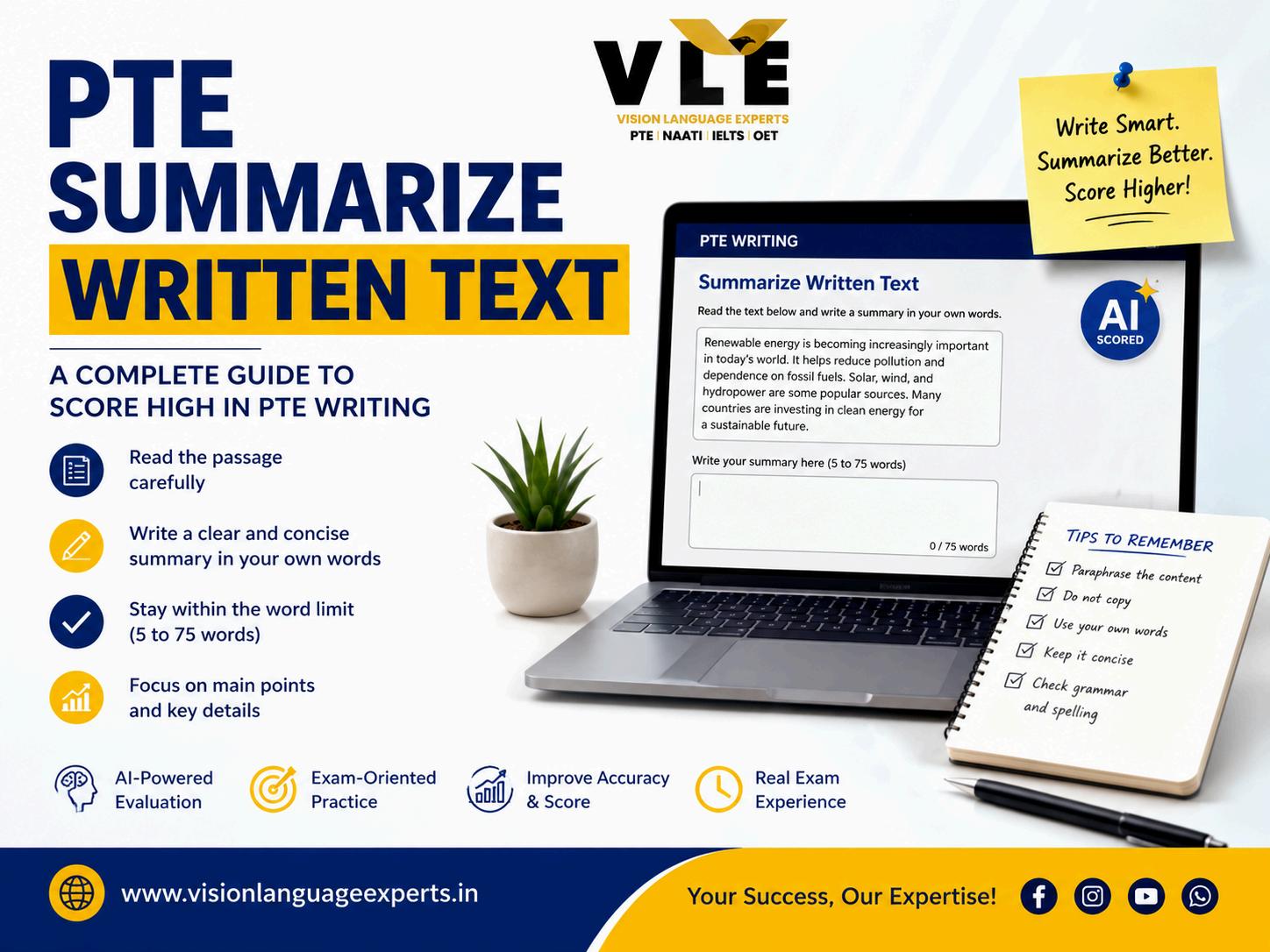
Master the PTE Summarize Written Text Task with Expert Strategies
The PTE Summarize Written Text task is one of the most important question types in the Writing section of the Pearson Test of English (PTE) Academic exam It evaluates your ability to understand a passage, identify the main idea, and write a concise summary using correct grammar, vocabulary, and sentence structure
Many candidates lose valuable marks because they either include unnecessary details, make grammatical errors, or exceed the word limit With the right approach and consistent practice, you can significantly improve your performance in this task
This complete guide explains everything you need to know about PTE Summarize Written Text, including the latest exam format, scoring criteria, writing strategy, common mistakes, and expert tips
What is PTE Summarize Written Text?
In the PTE Summarize Written Text task, you will read a passage of approximately 200–300 words and write a single sentence summarizing the main idea
Task Details
● Module: Writing
● Question Type: Summarize Written Text
● Number of Questions: 1–2
● Word Limit: 5–75 words
● Recommended Length: 30–45 words
● Time Available: 10 minutes per question
Your response must be written as one grammatically correct sentence.
Skills Assessed
This task measures several important writing skills, including:
● Reading comprehension
● Identifying key ideas
● Grammar accuracy
● Vocabulary usage
● Sentence structure
● Written discourse
● Spelling
● Coherence
A strong performance contributes positively to your overall Writing score
PTE Summarize Written Text Scoring Criteria
Your response is evaluated based on the following factors:
Content
Your sentence should accurately capture the main idea of the passage
Form
Write only one complete sentence containing between 5 and 75 words
Grammar
Use correct sentence structure with appropriate punctuation
Vocabulary
Choose precise and academic words wherever appropriate
Spelling
Ensure every word is spelled correctly
Step-by-Step Strategy
Step 1: Read the Passage Carefully
Read the entire passage to understand the author's main message. Avoid focusing on individual facts
Instead, identify:
● Main topic
● Central idea
● Supporting points
Step 2: Highlight Important Information
Underline:
● Topic sentence
● Important keywords
● Major supporting ideas
Ignore:
● Examples
● Statistics
● Minor details
Step 3: Combine Key Ideas
Merge the important points into one meaningful sentence
Use connectors like:
● while
● although ● because ● since ● whereas
● which ● that
therefore
● resulting in
Step 4: Check Grammar
Before submitting, review:
● Subject-verb agreement
● Capitalization
● Punctuation
● Word order
● Spelling
Even small grammatical mistakes can reduce your score.
Recommended Sentence Structure
A simple structure works well for most passages:
Main Idea + Supporting Idea + Result/Conclusion
Example:
The passage explains that renewable energy is becoming increasingly important because it reduces environmental pollution, supports sustainable development, and helps countries decrease their dependence on fossil fuels.
Time Management Tips
Use your 10 minutes wisely.
● Read the passage: 2–3 minutes
● Identify key ideas: 2 minutes
● Write the summary: 3 minutes
● Proofread: 2 minutes
Avoid spending too much time rewriting your sentence
Common Mistakes to Avoid
Many candidates lose marks due to avoidable errors
Writing More Than One Sentence
Always write only one sentence
Copying the Passage
Avoid copying large sections directly from the text.
Use your own sentence structure whenever possible
Including Minor Details
Focus only on the central message
Ignoring Grammar
Grammatical mistakes reduce your Writing score
Exceeding the Word Limit
Stay within the permitted word count
Expert Tips to Score High
● Practice one summary every day
● Read academic articles regularly
● Improve your vocabulary.
● Learn how to identify topic sentences quickly
● Use complex but grammatically correct sentence structures
● Revise grammar rules regularly.
● Practice under timed conditions
● Review your mistakes after every practice session.