INTERNATIONAL
OCT 2023
SCHOOL OF DAKAR
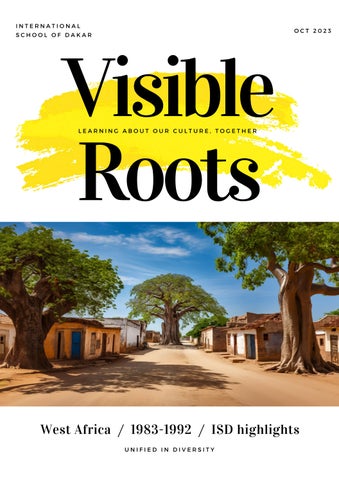
Visible Roots LEARNING ABOUT OUR CULTURE, TOGETHER
West Africa / 1983-1992 / ISD highlights UNIFIED IN DIVERSITY
Editor's Note The International School of Dakar is home to an amazing collective of 115 nationalities, each contributing to the value of our school's global culture and we take pride in our unified diversity. With "Visible Roots", together we embark on an educational journey, to explore and celebrate stories of diversity, equity, and inclusion around the world across time and space. Our mission with this e-magazine is to advance our collective understanding of global society and to highlight the incredible people and cultural symbols from all over the world which have strived to make a difference. We seek to honor the countless heroes and narratives that inspire us by sharing them with each other so all our influences become more wellknown. Each edition this year, "Visible Roots" will feature three distinct focuses. First, we journey through a specific region of the world, digging into that region’s unique contributions to the human experience. Our inaugural edition kicks off with a spotlight on our beautiful home of West Africa, shedding light on groundbreaking personalities and histories here in Senegal and elsewhere in the region.
Also, as ISD reflects on its 40th birthday this year, we look at a defining period of recent world history. In this edition, we transport back to the transformative years of 1983-1992, exploring the pivotal events, social changes, and iconic media that left a mark on our world today. Finally, each edition we showcase the highlights of our ISD community from the previous weeks that help us all gain a better understanding of how our inclusive community grows together throughout the year. Student produced podcasts, videos, newspapers, and radio programs are featured as well as educator productions such as mini lessons in Wolof and community news. "Visible Roots" isn't just a magazine; it's a celebration of how our diversity makes an impact! Join us as we learn more about our world together!
....the baobab tree is often referred to as the "upside-down tree"? Across Africa the baobab tree holds deep cultural, ecological, and economic significance. Baobabs are also called the “tree of life” and are considered sacred, featuring in myths, legends, and rituals. They originated in Madagascar where they look tall and slender. As they travelled across Africa, their shape changed and in Senegal they look broader with many hanging flower pods. They provide a nutritious fruit, referred to as “Bouye” in Wolof or “monkey bread”. Baobab trees play a vital role in local ecosystems, serving as habitats for wildlife and enriching soil quality. Below is the famous Baobab Sacré, located in Fadial, Senegal. The baobab is the logo of ISD and can be found at different locations on campus. The name Visible Roots comes from the baobab’s branches that stretch like roots in the air. It serves as a cultural link to the past and present and we see it as a symbol of reaching into the past and seeing where we come from.
6-23
WEST AFRICA
31-43 26-30
NOTE: Visible Roots is an INTERACTIVE magazine! Just click on any portrait, and you will be taken to a link that shows each person or cultural value through video.
1983-1992
Leaders Authors Athletes Scientists Artists Films Musicians Culture
The pivotal moments of the decade
ISD HIGHLIGHTS Wolof class w/Gaucher Nomad FM Radio Jaguar Jaguar Pulse ISD Film
Let’s
Celebrate!
Did you know ISD is actually one of the most diverse international schools in the world?
Is this accurate? If your family information is missing from the statistics, please email ceceo@faculty.isd.sn!
RT I MPO
AF AT
RN
CE!
RICA TH M
AD
E A DIFF
RE
NKRUMAH
A T LE DERS
IN
KWAME
AN
THOMAS
SANKARA
Kwame Nkrumah was an incredible leader, theorist, and revolutionary in West African history. He played a vital role in the Gold Coast gaining its independence from British colonial rule, becoming the nation of Ghana. Nkrumah believed in the power of unity and the idea that all Ghanaians could work together for a brighter future. He became the first Prime Minister and later the President of Ghana. Nkrumah worked tirelessly to build schools, hospitals, and infrastructure to improve the lives of the people. His government promoted female education and implemented policies to increase girls' access to schools. His government initiated various projects, including the construction of the Akosombo Dam and the establishment of the Tema industrial complex, which promoted economic growth and modernized Ghana’s scientific output. His vision was not just for Ghana but for all of Africa to come together and thrive. He used Ghana's position on the international stage to support various anti-colonial movements worldwide. Kwame Nkrumah's dedication to freedom, justice, and African unity continues to inspire us to strive for a better world where everyone can achieve their dreams.
Thomas Sankara was known for his personal modesty and his progressive policies aimed at improving the lives of people in Burkina Faso. As leader, he reduced his own salary, and eliminated the use of government chauffeur-driven MercedesBenz cars. Sankara changed the name of his country from Upper Volta to Burkina Faso, which means "Land of the Upright Man" or "Land of Honest Men." He initiated mass mobilization campaigns to involve people in public works projects such as building schools, roads, and medical centers. He often participated in these projects alongside ordinary citizens, leading by example. He appointed women to prominent positions in his government and encouraged women to participate in all aspects of public life. He also asked men to take on more responsibility in household chores and child-rearing to support gender equality. Sankara promoted sustainable agricultural practices, including reforestation and the use of manure instead of chemical fertilizers. His government launched a mass vaccination campaign to provide basic healthcare to rural populations. Sankara actively supported PanAfrican initiatives and sought to strengthen ties with other African nations where he called for debt relief for African countries and advocated for African selfsufficiency. Today he is celebrated as one of Africa’s most popular leaders, and his legacy continues to inspire people around the world to work for positive change.
Click on the portraits to learn more about these leaders!
“I think it's possible to have been a happy child, as I was, and still question and push back with regard to societal conventions.”
Chimamanda Ngozi Adichie is a Nigerian writer and feminist who has made a significant impact on literature and social issues. Her powerful novels, such as "Half of a Yellow Sun" and "Americanah," have captivated readers worldwide, shedding light on the complexities of identity, race, and gender. She is also known for her inspiring TED Talks, "We Should All Be Feminists," and “The Dangers of a Single Story” where she explains the risk of the single story, the one perspective, that it can lead us to default assumptions, conclusions and decisions that may be incomplete, and may lead to misunderstanding. Her eloquent and passionate advocacy for women's rights and social justice has inspired people of all ages to strive for a fairer and more equal world. Chimamanda Ngozi Adichie's words remind us of the importance of embracing diversity and championing equality, making her a true role model for aspiring writers and advocates of social change.
CHIMAMANDA NGOZI
ADICHIE LITERATURE TODAY Marguerite Abouet is a talented writer of bandes dessinées from Côte d’Ivoire. She is celebrated for her captivating stories, particularly the "Aya" series of graphic novels. Her writing beautifully captures the lives and adventures of young people in Abidjan, bringing to life the vibrant culture and daily experiences of her homeland. Her stories are not only entertaining but also shed light on important themes like friendship, family, and the pursuit of dreams. Marguerite Abouet's work takes pride in her cultural heritage, emerging from her desire to show Africa with a focus on issues other than war and famine. Aya has been considered a success especially for a first-time author, winning the 2006 Angoulême International Comics Festival Prize for First Comic Book and has sold nearly 1 million copies worldwide. Abouet is an inspiration to aspiring writers and storytellers, showing that their unique voices and stories can be celebrated and shared with the world.
MARGUERITE
ABOUET
Click on the portraits to read and learn more!
ISABELLE
UNIQUE ATHLETES
SAMBOU Isabelle Sambou is an incredible wrestler from Senegal who has become a role model for aspiring athletes, especially young girls in her country and beyond. Originally from Casamance, she used to be one of the few young girls to wrestle in the sand in the traditional sport of Laamb, which has always been a predominantly male sport. Despite the obstacles, she went on to win numerous medals in international wrestling competitions, becoming nine times African women's wrestling champion in the under-48 category kg, and has represented Senegal in the Olympics. Her inspiring journey reminds us that with perseverance and a strong spirit, we can break barriers and achieve our goals, no matter how challenging they may seem. She is currently the Senegalese national coach for mixed wrestling, and she continues to motivate young athletes to pursue their dreams and work hard to achieve success in sports and in life.
George Weah was a legendary football player from Liberia. During his football career, George Weah played as a striker and achieved significant success. He played for several top clubs in Europe, including AS Monaco, Paris Saint-Germain (PSG), AC Milan, Chelsea, and Manchester City. Weah won numerous individual awards, including the FIFA World Player of the Year and the Ballon d'Or in 1995, becoming the first and only African player to achieve this feat. After retiring from professional football, Weah entered politics, eventually becoming Liberia's President in 2018. George Weah's transition from a successful football career to the presidency of a nation has made him a unique and well-known figure on both the international sports and political stages.
GEORGE
WEAH Click on the portraits to learn more!
DAVIDSON
Science
NICOL
Davidson Nicol was a Sierra Leonean academic, diplomat, physician, writer and poet. He was able to secure multiple degrees in the arts, science and business and he made huge contributions to science, history, and literature. He was the first black African to graduate with first class honors from the University of Cambridge and while studying there he established an important finding. He was the first person to analyze the breakdown of insulin in the human body, a discovery which was vital in the treatment of diabetes. Nicol returned to Sierra Leone to work as a pathologist before leading several universities over the following decade. He temporarily left academia in 1968 to become the Permanent Representative of Sierra Leone to the United Nations, which he served until 1971. While he was a person of many grand achievements, his breakthrough insulin analysis greatly contributed to human medical science and this has helped millions of people battle against diabetes worldwide.
CHEIKH ANTA
DIOP
Cheikh Anta Diop was a brilliant and inspiring scholar from Senegal. He was a pioneer in the field of African history and his work in Egyptology was groundbreaking. He founded the Radiocarbon Laboratory at the University of Dakar (now Cheikh Anta Diop University, in Mermoz), which played a significant role in advancing research on African history and archaeology. There, he conducted radiocarbon dating experiments on ancient Egyptian artifacts providing scientific evidence that supported that the ancient Egyptian civilization dates back thousands of years prior to what had been believed at the time. He also published numerous influential works, including "The African Origin of Civilization: Myth or Reality" and "Precolonial Black Africa." He argued that ancient Egypt should be considered an African civilization and that ancient Egyptians were part of the broader African cultural and historical context. His passion for knowledge and his determination to correct historical misconceptions about Africa continue to inspire students and scholars around the world to learn about and appreciate the incredible achievements of African civilizations.
Click on the portraits to learn more about their discoveries!
NJIDEKA AKUNYILI CROSBY Njideka Akunyili Crosby is a Nigerian-born visual artist working in Los Angeles, California. Her artwork is celebrated for its intricate and thought-provoking compositions that combine elements of her Nigerian heritage and her experiences in America. Njideka's collage and photo transfer-based paintings expose the challenges of occupying these two worlds. Her work is a fusion of cultures, capturing the complexities of identity, belonging, and the immigrant experience. Her art has received critical acclaim and has been exhibited in prestigious museums and galleries worldwide. Njideka Akunyili Crosby's work serves to discover pieces of her past — printed fabrics, articles of furniture or fashion, family members, book titles, and architectural elements. Her work speaks a lot as a symbol of the diversity and the richness of contemporary African art.
VIBRANT Abdoulaye Konaté is a highly respected and influential artist from Mali, known for his exceptional textile and mixed-media artworks. He has gained international recognition for his intricate and vibrantly detailed large-scale textile installations which comment on his personal life and the complex history of traditional West African culture. Abdoulaye's work explores a wide range of themes, including social and political issues, as well as cultural and historical narratives. His ability to blend traditional African artistry with contemporary concerns has made him a significant figure in the art world, inspiring other artists to explore innovative ways of expressing their ideas and engaging with their cultural heritage. His work is currently on display at the Museum of Black Civilization in Dakar.
ART
ABDOULAYE KONATÉ When you've decided on your cover story, come up with a list of topics for your feature articles. This can range from interviews, product reviews, human interest pieces, and even lists.
Click on the portraits to learn more about their art!
Want to contribute to Visible Roots or learn more about amazing people and cultures around the world? Email “ceceo@faculty.isd.sn” today to get involved!
"Camp de Thiaroye" is an important Senegalese film from 1987 by the legendary filmmaker Osumane Sembene. It's based on a true story when West African soldiers, who had fought for France during World War II, returned home to Senegal but faced challenges and injustice. They were interned in a camp in Thiaroye, awaiting their demobilization and back pay. The soldiers had high expectations for their service and believed that they would be compensated for their efforts and sacrifices. Eventually they were forced to band together to demand fair treatment and respect when the French refused to pay them what they had promised. "Camp de Thiaroye" explores themes of colonialism, racism, and the mistreatment of African soldiers who had fought for a colonial power during the war. It highlights the tensions and injustices that existed during this period and sheds light on a little-known chapter in history. It teaches us the importance of standing up for what is right and fighting for justice, making it a powerful and inspiring movie for everyone to watch.
IMPORTANT FILMS "La Petite Vendeuse de Soleil", translated as “The Little Girl Who Sold the Sun” is a 1999 Senegalese film directed by Djibril Diop Mambéty. It is a touching short film, about the life of Sili, a young girl who sells newspapers on the streets of Dakar. Despite her physical challenges and being the only female seller, she is determined, resilient, and ambitious. The film is a celebration of the human spirit, emphasizing the importance of determination and perseverance in the face of adversity. Sili always stands up for what is right and this film is a metaphor for hope and optimism, offering a unique and uplifting perspective on the lives of marginalized individuals; showing that strength and resilience that can emerge from unexpected places. The film is also a hymn to Senegal and post-colonial Africa; moving forward with courage, fighting for equality and justice, while always being resourceful. It is a joyful film to watch!
Click on the portraits to watch these films!
Sona Jobarteh
DIAWARA
FATOUMATA
Fatoumata Diawara is a Malian singer-songwriter, celebrated as one of the best modern African musicians. She is known for her mesmerizing voice, creative music, and powerful performances. Her music blends traditional Wassoulou rhythms with international sounds, creating a unique and uplifting musical experience. She sings about important issues like love, peace, and the challenges faced by African women, inspiring listeners to reflect on these topics. She began her career as an actress in theatre and in film, including the film Timbuktu (2014). She later launched a career in music, and has worked courageously as a social activist, campaigning against the trafficking and sale of black migrants in Libyan slave markets and recording the song “Djonya” (it means ‘slavery’ in Bambará) in which she states that we all belong to the same human race regardless of colour, ethnicity or religion. She is a symbol of the power of music to connect people across the globe and inspire positive change.
Musical Power Sona Jobarteh is a Gambian multiinstrumentalist, singer and composer. She’s from one of the five principal kora-playing griot families of West Africa, and is the first female professional kora player to come from a griot family. She is the cousin of the celebrated kora player Toumani Diabate, and is the sister of the diaspora kora player Tunde Jegede. Sona's mastery of the kora, a beautiful West African instrument, and her soulful singing have mesmerized audiences around the world. She is not only a remarkable musician but also a strong advocate for preserving and promoting African culture and heritage through music. Sona Jobarteh's work encourages young artists to embrace their roots and traditions while pushing boundaries, demonstrating that they can achieve great success while staying true to their cultural identity. Her music resonates with people of all backgrounds, inspiring unity and appreciation for the rich musical heritage of Africa.
SONA
JOBARTEH
Click on the portraits to hear their music!
Teranga is a traditional Senegalese value that emphasizes hospitality, generosity, and kindness towards others. It is often described as a cornerstone of Senegalese culture and is deeply ingrained in the country's social fabric. Teranga is reflected in many aspects of Senegalese life, including how people treat guests in their homes, how they interact with strangers on the street, and how they participate in community events and gatherings. It is seen as a way of showing respect and care for others, regardless of their social status, background, or ethnicity. In Senegal, teranga is often expressed through sharing meals, offering a place to stay, or offering a helping hand to those in need. It is also reflected in the country's arts and music, which often celebrate themes of community, solidarity, and mutual support. Teranga has been identified as one of the key factors behind Senegal's stability and social cohesion, as well as its reputation as a welcoming and hospitable country. It has also become a source of pride for many Senegalese, who see it as a symbol of their country's unique cultural heritage.
TERANGA
Mali Empire
The Mali Empire was a magnificent and powerful civilization that thrived in West Africa from the 13th to the 16th century, founded by the legendary Sundiata Keita. It was renowned for its wealth, influence, and cultural achievements. Sundiata Keita, created one of the very first charters of human rights, the Manden Charter, also known as the Kouroukan Fouga. This was an oral, rather than written, charter, which has been passed down by generations of Malinke. The Manden Charter speaks about peace within a diverse nation, the abolition of slavery, education, and food security, among other things. At its peak, the Mali Empire was one of the largest and richest empires in the world. It was strategically located along the trade routes that connected North Africa with sub-Saharan Africa, making it a hub for commerce and cultural exchange. Present-day Dakar was a part of this legendary kingdom. Its most famous ruler, Mansa Musa, is celebrated for his grand pilgrimage to Mecca, during which he distributed vast amounts of gold, enhancing Mali's reputation as a land of riches. The empire was not only known for its prosperity but also for its contributions to art, architecture, literature, and scholarship. Timbuktu, a city within the empire, became a renowned center of learning and culture, with impressive libraries and universities. The Mali Empire's legacy includes its impressive architecture, such as the Great Mosque of Djenne, its rich oral traditions, and its enduring influence on the cultures and histories of West Africa. It serves as a testament to the achievements of African civilizations and their vital role in shaping the world's history and culture.
Click on the portrait of Mansa Musa to learn more!
CULTURAL
SYMBOLS
Adinkra symbols are visual representations of concepts or observations that originate from the Akan people of Ghana, the Ivory Coast and Togo. They are used extensively in art, textiles, pottery, and other forms of visual expression and have become popular symbols in the Pan-african movement. Two commonly recognized Adinkra symbols are "Sankofa" and "Duafe."
SANKOFA Sankofa is a symbol representing a bird looking back while carrying an egg on its back. The term "Sankofa" translates to "go back and get it." It embodies the idea that one should reflect on and learn from their past in order to make informed choices for the future, emphasizing the importance of cultural heritage and historical knowledge.
DUAFE Duafe is a symbol depicting a wooden comb. It symbolizes beauty, cleanliness, and self-care. Duafe encourages individuals to prioritize personal grooming and well-being, promoting the harmony of both outward appearance and inner character, and highlighting the significance of self-respect and pride. It is often seen as symbol of feminine beauty.
Click on the symbols at the top to learn more!
DIVERSITY, EQUITY, INCLUSION
IS THE ISD CULTURE !
DEI Parents’ Night
Talk & Trivia @
Loman Art 30th House November
TIME
7-9pm
Come to learn about and share in the many cultural values and life goals of the ISD community. The more we know, the more equitable and fair we can help our school to be. The more we share, the more we can include the things we value into our children’s education and show them the diverse paths they can take to grow into great humans. Join us as we engage in some thought activities, trivia games, and lively conversation!
ISD History The International school of Dakar opened in 1983 in a villa in Point E. In 1989, ISD relocated to its current location in Mermoz. The pictures below span from 1989-1992.
Impact of
1983-1992 WE CHANGED HOW WE COMMUNICATED AND RE-ORDERED OUR SOCIETIES
The era of technology Begins
1983 1984 1985
1986
Click on the pictures to learn more!
1988
1987 1989
Click on the pictures to learn more!
1991 1990
1992
Click on the portraits to learn more!
AugustOctober ‘23
ISD Highlights
WOLOF Mini-class Lu bes? - What’s up? Dara beesul - Nothing much Yaangi noos - Are you good? Maangi noos - I’m good Dafa táng - It’s hot Aywa nu dem - Come on/ Let’s go! Noo faanan ak jamm - Have a good night Noo yendoo ak jamm - Have a good day Ba suba - Until tomorrow / See you tomorrow
Click on the picture to learn more expressions in Wolof!
Jamaica
🇯🇲 The Kiffness x Rushawn - It's a Beautiful Day Recommended by Carl
India
🇮🇳 Arijit Singh & Jonita Gandhi- ‘What Jhumka'! Recommended by Maya
🇵🇹
Portugal Mariza - Melhor de Mim Recommended by Susanna
🇨🇴
Colombia Bomba Estéreo - Soy Yo Recommended by Aiden
🇲🇬
Madagascar Mikahely - Children’s Rights Recommended by Taj
🇫🇷
France Edith Piaf- La vie en rose Recommended by Anta Mali
🇲🇱 Amadou & Mariam - Ce N'est Pas Bon Recommended by Sage
Uruguay
🇺🇾 No Te Va Gustar- Cielo De Un Solo Color Recommended by Virginia
Click on the pictures to hear the songs! Click on the Nomad FM logo to hear them all on Spotify!
“Only” by Lee Hi from is a song from South Korea that is Korean pop. Lee Hi wrote this love song in 2021, and it was talking about how much love can make someone blind, but also to express that blinded love, would make the most immature dream come true. This song is interesting for us to look at because it is different and calming and can be the kind of music to listen to while studying. -Francesca Grade 10
🇧🇷
Brazil Doris Monteiro - É isso aí Recommended by Molly
🇬🇭
Ghana Osibisa - Welcome Home Recommended by Henry
Ukraine
🇺🇦 Dhaka Brakha- sho z-pod duba Recommended by
Nomad FM features music from all over the world that our community wants to share for the betterment of all our lives ! Want to share your music with the community? Email ceceo@faculty.isd.sn with your recommendation!
🇪🇸🇩🇪
Spain/Germany Álvaro Soler- El Mismo Sol Recommended by
🇨🇮
Côte D‘Ivoire Alpha Blondy- Jerusalem Recommended by Adama
Welcome back to Radio Jaguar for the 23/24 School year! In this podcast we’re going to be interviewing ISD Students and Staff members and asking them how they perceive Peace. Our music was sourced from: ISD Students singing Imagine by John Lennon
Tindiba- Samite (Uganda)
Boomerang - Daara J (Senegal)
Click on the pictures to listen!
Click on the screenshots to watch the student-made videos!
Coming this December ! INTERNATIONAL
DEC 2023
SCHOOL OF DAKAR
Visible Roots LEARNING ABOUT OUR CULTURE, TOGETHER
Mediterranean / 1993-2002 / ISD highlights UNIFIED IN DIVERSITY