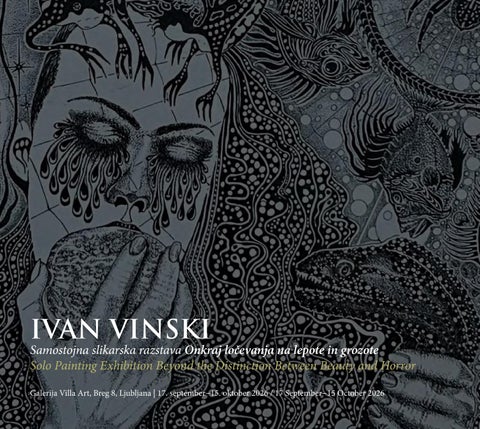
IVAN VINSKI
Samostojna slikarska razstava Onkraj ločevanja na lepote in grozote Solo Painting Exhibition Beyond the Distinction Between Beauty and Horror Galerija Villa Art, Breg 8, Ljubljana | 17. september−15. oktober 2026 / 17 September−15 October 2026
VILLA LASIS
VILLA LASIS villa-lasis.si
lipa-center.si
IVAN VINSKI
Samostojna slikarska razstava Onkraj ločevanja na lepote in grozote Solo Painting Exhibition Beyond the Distinction Between Beauty and Horror
IVAN VINSKI Samostojna slikarska razstava Onkraj ločevanja na lepote in grozote/ Solo Painting Exhibition Beyond the Distinction Between Beauty and Horror Galerija Villa Art, Breg 8, Ljubljana / Villa Art Gallery, Breg 8, Ljubljana 17. september −15. oktober 2026 / 17 September −15 October 2026 Izbor del in postavitev / Selection of works and exhibition layout: Ivan Vinski, Marjana Dolšina Delač Besedilo / Text: Marjana Dolšina Delač Koordinacija razstave / Coordinated by: Robert Hren Jezikovni pregled / Slovene language editor: Polona LEKTORIRANJE, s.p. Prevod / Translation: Jerneja Jurca s.p. Fotografije / Photography: Nik Hren Oblikovanje / Graphic design: VisArt studio, Primož Kalan, Sara Pestotnik Izdajatelj / Issued by: Villa art d.o.o. Tisk / Printed by: Demat d.o.o. Naklada / Number of copies: 100 izvodov Maloprodajna cena / Price: 10 €
CIP - Kataložni zapis o publikaciji Narodna in univerzitetna knjižnica, Ljubljana
Ivan Vinski: Onkraj ločevanja na lepote in grozote
Na list papirja postavi prvo piko … in iz globin njegove beline začnejo rasti čarobni svetovi. Tako Ivan Vinski opiše začetek ustvarjanja kot mali veliki pok, ki se iz gole energije pričakovanja materializira v filigransko izdelan motiv. Pika kot elementarno generativno izhodišče je odraz avtorjevega zanimanja za avstralsko aboriginsko umetnost, v kateri z množenjem postaja gradnik površine in ritma. V njegovem ustvarjalnem procesu se iz posamezne točke postopoma izriše podoba, vendar brez vnaprej določenega cilja: vsaka nova poteza in naslednja sveža pika usmerita tok zavesti na še neokrnjeno polje možnih asociacij. Nobena od končnih stvaritev ni manifestacija prvotne zamisli, saj ta ob iniciacijskem stiku pisala s podlago še niti ne obstaja zares, temveč je zemljevid kognitivnih poti, ki jih je prehodila avtorjeva ustvarjalna sila. Dodajanje pik učinkuje kot organsko razraščanje, v katerem se skozi dolgotrajno vizualno proliferacijo postopoma izluščijo oblike in figure, njihove medsebojne povezave pa odpirajo nove asociativne tokove in sproti usmerjajo razvoj prizora. Vinski skuša v likovno formo prevesti svoja halucinatorna doživetja in izkustva na meji med življenjem in smrtjo. Rafinirano estetizirane, na trenutke celo dekorativno izvedene intimne vsebine se s pridihom prvinsko temačnega občutenja sebstva preobražajo v anekdotične pripovedi o naših kolektivnih užitkih in strahovih, pogosto kar o obojem hkrati. Ploskovite, domala arabeskno umetelne strukture se prepletajo s poudarjeno senčenimi figuralnimi upodobitvami božanstev, ljudi in živali, ki si, ujete v zaključeno celoto, prisvajajo tudi naš pogled. Prazna polja razbremenjujejo vizualni horror vacui, ki se prenaša še na vsebinsko raven;
zaplate beline opozarjajo na začetni nič, praznino okrog singularnosti, iz katere je vzniknil likovni svet. Iz nje izrašča fin-de-sièclovska morbidnost, prežeta s postkolonialnim dojemanjem umetnosti, v katerem je prostor tudi za prakse zunaj zahodnoevropske tradicije. Ta v navezavi na klasične ikonografske teme prehaja v časovno in prostorsko neopredeljene arhetipske predstave, ki jih umetnik brez hierarhiziranja sprejema kot del lastnega bivanja. Navkljub razgibanim linijam so risbe otrple v medprostoru med ploskvijo in telesom ter učinkujejo kot prerezi starodavnih monolitov, v katerih se med kamninske strukture vrinejo fosilni zapisi oddaljene preteklosti. Arhaične ribje silhuete, režeči kuščarji, zvijajoči se črvi in amebni enoceličarji so negibne priče sveta, ki je umrl že davno pred našim časom oziroma je živel le v ustvarjalčevi domišljiji – in še to zgolj kot sekvenca posameznih vtisov, ujetih nekje med spominom, asociacijo in fantazijo. Fantastično slikarstvo Vinskega črpa iz razvejanih izročil grško-rimske antike, slovanske in krščanske tradicije, sega pa tudi v hindujsko duhovno izročilo. Odiseju na poti domov, hibridni Scili ter bojevitima Aresu in Ateni se enakovredno pridružujejo slovanski Triglav, z zimo in smrtjo povezana Morana ter Povodni mož. Posebno mesto zavzema svetopisemska Eva, prva ženska, grešnica in zvedavka, ki se v avtorjevi reinterpretaciji preobrazi v Mater Omnium: iz belih prsi napaja človeštvo, žejno pristnosti in poguma. V trenutku odločitve za izvirni greh se že zaveda usodnih posledic, zato kača ni več zapeljivka, temveč skoraj njen obrobni atribut; Eva jo suvereno obvladuje v dlani in s tem prevzema odgovornost za lastno izbiro. Ob mitskih protagonistih nastopajo
tudi prepoznavni tipi modernega imaginarija, denimo Nori znanstvenik in Tat, s čimer se nekdaj jasno zamejeni mitološki horizont razpira proti sodobnosti. Med njimi vznikajo pareidolične tvorbe, ki se spontano luščijo iz domišljijskih stratigrafij, ter obrazi z značajem obrednih mask. Njihova nedoločljivost ne govori toliko o vidnem, temveč o neštetih možnih obličjih, skritih pod površino. Nestalnost pomenov je ena ključnih značilnosti umetnikove ustvarjalne poetike. Njegovi motivi se izmikajo dokončni razlagi in hkrati brišejo jasno ločnico med privlačnim in odbijajočim, svetim in profanim, življenjem in razkrojem, prvinskim in civiliziranim. Lepota arabeske lahko nosi zametek groze, pošastno se razkrije kot zapeljivo, morbidno kot vitalno, pradavno pa nepričakovano spregovori o sedanjosti. Vinski teh nasprotij ne razrešuje, temveč jih kopiči in prepleta, dokler se njihove meje ne zabrišejo. Njegov svet se tako vzpostavlja onkraj ločevanja na lepote in grozote – v območju, kjer ene brez drugih ne morejo več obstajati in kjer pogled, tako kot pisalo ob prvi piki, nikoli vnaprej ne ve, kam ga bo podoba zapeljala. Marjana Dolšina Delač Ivan Vinski (1958), rojen na Golem Vrhu pri Karlovcu na Hrvaškem, je obiskoval osnovno šolo v Dubovcu in gimnazijo v Rakovcu. Med letoma 1978 in 1983 je študiral na Fakulteti za arhitekturo v Zagrebu, kjer se je učil risanja pod mentorstvom profesorja Josipa Vaništa. Leta 1990 se je preselil v Slovenijo in do leta 2024 deloval kot samostojni kulturni delavec, predvsem na področju oblikovanja notranje opreme in prostorov. Ob likovnem ustvarjanju je Vinski dejaven tudi kot glasbenik. Med letoma 1984 in 1988 ter ponovno od leta 2011
je kitarist avantgardne postpunkovske skupine Trobecove krušne peći, od leta 2020 pa sodeluje tudi v eksperimentalnem glasbenem projektu Kuća ekstremnog muzičkog kazališta. Svoja dela je predstavil na več samostojnih razstavah na Hrvaškem in v Sloveniji. Njegovo ustvarjanje izhaja iz psihičnega avtomatizma in intuitivnega grajenja risbe, pri katerem se iz začetne pike in postopnega množenja drobnih likovnih elementov razvijajo gosto strukturirani fantastični prizori. V njih se prepletajo mitološke, arhetipske in domišljijske podobe, ki privlačno spajajo z grozljivim in prvinsko s civiliziranim, obenem pa razkrivajo nenehno bližino življenja in razkroja.
Ivan Vinski: Beyond the Distinction Between Beauty and Horror
Place the first dot onto a piece of paper… and from the depths of its whiteness, magical worlds begin to emerge. Thus, Ivan Vinski describes the beginning of the act of creation as a tiny Big Bang that, from the bare energy of expectation, miniature into a filigree motif. The dot as an elementary generative starting point is a reflection of the author’s interest in Australian Aboriginal art, in which it becomes a building block of surface and rhythm by multiplication. In his creative process, an image is gradually drawn from an individual point, but without a predetermined goal: each new move and the next fresh dot direct the stream of consciousness to the still intact field of possible associations. None of the final creations are a manifestation of the original idea, as the former does not even exist on initial contact of pen with paper; instead it is a map of the cognitive paths traveled by the author’s creative force. The addition of dots acts as an organic growth in which shapes and figures are gradually extracted through long-term visual proliferation, and their interconnections open up new associative flows and guide the development of the scene. Vinski attempts to translate his hallucinatory experiences and experiences of the border between life and death into art. Refinedly aestheticized, at times even decoratively executed, intimate content is transformed into anecdotal narratives about our collective pleasures and fears, often about both at the same time, with a touch of the primal dark experience of the self. Flat, almost arabesque, artful structures are intertwined with accentuated shadowed figurative depictions of deities, people and animals, which, caught in a rounded out whole, also appropriate our view. Empty fields
relieve the visual horror vacui, which is transferred to the content level; patches of white point to the initial zero, the emptiness around the singularity from which the art world emerged. Out of it arises a fin-de-siècle morbidity, imbued with a postcolonial perception of art, in which there is also room for practices outside the Western European tradition. In connection with classical iconographic themes, it passes into temporally and spatially undefined archetypal representations, which the artist accepts as part of his own existence without hierarchizing. Despite the variegated lines, the drawings are frozen in the interspace between the surface and the body and act as cross-sections of ancient monoliths, in which fossil records of the distant past are inserted among the rock structures. Archaic fish silhouettes, growling lizards, twisting worms and amoebic unicellulars are still witnesses of a world that went extinct long before our time or lived only in the creator’s imagination – and even this merely as a sequence of individual impressions caught somewhere between memory, association and fantasy. The fantastic painting of Vinski draws from the diversified traditions of Greco-Roman antiquity, Slavic and Christian traditions, as well as the Hindu spiritual tradition. Ulysses on the way home, the hybrid Scylla and the belligerent Ares and Athena are joined as equals by the Slavic Triglav, the winter-related and death-related Morana and the Water Man. A special place is occupied by the biblical Eve, the first woman, a sinner and a curious one, who transforms into Mater Omnium in the author’s reinterpretation: from pale breasts she feeds humanity, thirsting for authenticity and courage. In the moment of deciding on the original sin, she is already
aware of the fatal consequences, so the snake is no longer a seducer, but almost its marginal attribute; Eve sovereignly controls it in the palm of her hand and thus takes responsibility for her own choice. In addition to the mythical protagonists, there are also recognizable types of modern imaginary, such as the mad scientist and the thief, through which the once clearly delineated mythological horizon expands towards modernity. Among them, there are pareidolistic formations that spontaneously peel off from imaginary stratigraphies, as well as faces with the character of ritual masks. Their indeterminacy speaks not so much of the visible, but of countless possible faces hidden beneath the surface. The volatility of meanings is one of the key characteristics of the artist’s creative poetics. His motives elude definitive explanation and at the same time blur the clear distinction between attractive and repulsive, sacred and profane, life and decay, primal and civilized. The beauty of the arabesque can carry a seed of horror, the monstrous is revealed as seductive, morbid as vital, and anciently speaks unexpectedly about the present. Vinski does not resolve these contradictions, but instead accumulates and intertwines them until their boundaries are blurred. His world thus establishes itself beyond the distinction between beauty and horror – in an area where one can no longer exist without the other and where the gaze, like the pen when making that first dot, never knows in advance where the image will lead it to. Marjana Dolšina Delač Ivan Vinski (1958), born in Goli Vrh near Karlovac, Croatia, attended elementary school in Dubovec and grammar school in Rakovec. From 1978 to 1983, he studied at the Faculty of Architecture in Zagreb, where he learned drawing under the mentorship of Professor Josip Vaništa. In 1990, he moved to Slovenia
and worked as an independent cultural worker until 2024, mainly in the field of interior and spatial design. In addition to his artistic creation, Vinski is also active as a musician. From 1984 to 1988, and again from 2011, he is the guitarist of the avant-garde post-punk group Trobecove krušne peći, and since 2020 he has also participated in the experimental music project Kuća ekstremnog muzičkog kazališta. He has presented his works at several solo exhibitions in Croatia and Slovenia. His creation stems from psychic automatism and intuitive construction of the drawing, in which densely structured fantastic scenes develop from the initial dot and the gradual multiplication of small artistic elements. In them, mythological, archetypal and imaginative images are intertwined, which merge the attractive with the horrific and primal with the civilized, while at the same time revealing the constant close connection between life and decay.
Kazalo 1 | Pont, sin Gaje 2 | Thief 3 | Triglav 4 | Message in a Doll 5 | Poludnica 6 | Povodni mož 7 | Morana 8 | Vodan 9 | Forbidden Fruit 10 | The Passage of Great Waters 11 | Maludhara 12 | Scylla 13 | Armageddon 14 | The Dark Rainbow 15 | The Mad Scientist 16 | The Moon Eclipse 17 | The Bedtime Story 18 | The Golden Billion 19 | The Mirror from the Future 20 | Fight Ares and Athena 21 | Tri gracije 22 | The Millenium Summit 23 | The Voodoo Doll 24 | Eva
11 12 13 14 15 16 17 18 19 20 21 22 23 24 25 26 27 28 29 30 31 32 33 34
IVAN VINSKI
Samostojna slikarska razstava Onkraj ločevanja na lepote in grozote Solo Painting Exhibition Beyond the Distinction Between Beauty and Horror
10
1 | Pont, sin Gaje
risba s tušem / ink on paper | 2016 | 20 x 20 cm 11
2 | Thief
risba s tušem / ink on paper | 2022 | 30 x 21 cm 12
3 | Triglav
risba s tušem / ink on paper | 2016 | 30 x 21 cm 13
4 | Message in a Doll
risba s tušem / ink on paper | 2015 | 30 x 21 cm 14
5 | Poludnica
risba s tušem / ink on paper | 2017 | 30 x 21 cm 15
6 | Povodni mož
risba s tušem / ink on paper | 2016 | 30 x 21 cm 16
7 | Morana
risba s tušem / ink on paper | 2016 | 30 x 21 cm 17
8 | Vodan
risba s tušem / ink on paper | 2016 | 21 x 30 cm 18
9 | Forbidden Fruit
risba s tušem / ink on paper | 2016 | 21 x 30 cm 19
10 | The Passage of Great Waters
risba s tušem / ink on paper | 2019 | 21 x 30 cm 20
11 | Maludhara
risba s tušem / ink on paper | brez datacije | 40 x 30 cm 21
12 | Scylla
risba s tušem / ink on paper | 2021 | 40 x 30 cm 22
13 | Armageddon
risba s tušem / ink on paper | 2026 | 40 x 30 cm 23
14 | The Dark Rainbow
risba s tušem / ink on paper | 2025 | 40 x 30 cm 24
15 | The Mad Scientist
risba s tušem / ink on paper | 2025 | 30 x 40 cm 25
16 | The Moon Eclipse
risba s tušem / ink on paper | 2026 | 30 x 40 cm 26
17 | The Bedtime Story
risba s tušem / ink on paper | 2025 | 30 x 40 cm 27
18 | The Golden Billion
risba s tušem / ink on paper | 2025 | 30 x 40 cm 28
19 | The Mirror from the Future
risba s tušem / ink on paper | 2024 | 30 x 40 cm 29
20 | Fight Ares and Athena
risba s tušem / ink on paper | 2025 | 30 x 40 cm 30
21 | Tri gracije
risba s tušem / ink on paper | 2025 | 30 x 40 cm 31
22 | The Millenium Summit
risba s tušem / ink on paper | 2018 | 30 x 40 cm 32
23 | The Voodoo Doll
risba s tušem / ink on paper | 2015 | 40 x 40 cm 33
24 | Eva
risba s tušem / ink on paper | 2026 | 40 x 40 cm 34
35
VILLA LASIS
VILLA LASIS
Gallery Villa ART