Zoo Review SPRING/SUMMER 2026
VIRGINIAZOO.ORG
OUR HISTORY HAS SHAPED US Learn a brief history of each Virginia Zoo trail.
PAGES 4, 5, 8, 9, 14 & 15
HOW HAS THE ZOO CHANGED?
Many things have changed at the Zoo over 125 years but we share 12.5 highlights.
PAGES 6 & 7
125 YEARS AND 365 DAYS OF CELEBRATING Discover how we are celebrating our 125th anniversary this year.
PAGE 18
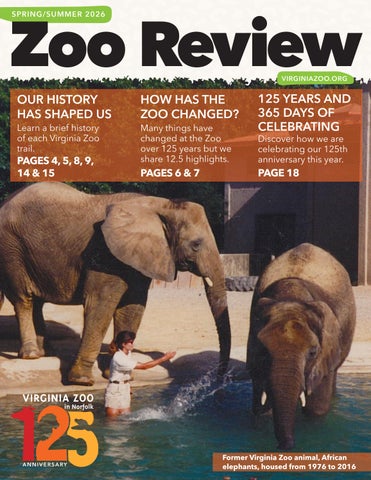
Former Virginia Zoo animal, African elephants, housed from 1976 to O2016 VIRGINIA ZOO REVIEW 1
BOARD OF DIRECTORS
FROM THE DIRECTOR
PRESIDENT Nicole Carry VICE PRESIDENT Elise Walthall & Lauren Kiger TREASURER Dick Boykin SECRETARY Jake Young DIRECTORS Nancy Bartee Patrick Kelly Reese Beeler Melissa Ramsey Lynn Cobb Dustin Rinehart Erik Cooper Sue Roady Liza Delpierre Carin Schneller-Carr Elizabeth Fraim Stephen Taylor Christina Goode Debbi Waitzer Ameet Habib Victoria Wittmann Josh Howell
PUBLICATION STAFF
CONTRIBUTING WRITERS and PHOTOGRAPHERS
Brittany Coolbaugh Hayley Fier Chris Jenkins
Debora Martin Kirstin Pendleton Emily Smicker
DID YOU KNOW?
The Virginia Zoo used to grow hundreds of tropical and awardwinning plants in a conservatory. Learn about this and more with the history of Flora Point on page 14.
3500 Granby Street, Norfolk, Virginia 23504 ZOO HOURS: Open Daily 9:30 am – 4 pm Closed New Year’s Day, Thanksgiving Day, Christmas Eve and Christmas Day PHONE: 757.441.2374 • FAX: 757.441.5408 VIRGINIAZOO.ORG
Do you have any questions or ideas for the next issue of the Virginia Zoo Review? We’d love to hear from you. Email info@virginiazoo.org.
EXECUTIVE DIRECTOR, CHRIS JENKINS, SENIOR DIRECTOR OF OPERATIONS, RICHARD PARKER, AND SUPERINTENDENT, RYAN KRANK, ON THE EDVENTURE & EXPLORATION CAMPUS CONSTRUCTION SITE
Greetings, Virginia Zoo fans and supporters! As we welcome another exciting season at the Virginia Zoo, we’re thrilled to celebrate a truly extraordinary milestone: our 125th anniversary. For more than a century, this Zoo has grown, evolved, and thrived thanks to our incredible animals, our passionate staff, and — most importantly — you, our members. This year, we are honoring our history with a full slate of special initiatives, celebrations, and opportunities to reflect on how far we’ve come and where we’re headed next. Our animals are at the heart of everything we do, and our anniversary year is just another meaningful way to celebrate them. On Giving ZooDay this December 1, we’ll be raising funds to provide 125 enrichment items for the species in our care. We’ve also unveiled special historic Zoodoptions featuring species that once called the Virginia Zoo home. Throughout the year, Virginia Zoo Trading Cards — twenty in total, including one member exclusive — will highlight both current and former residents of the Zoo. We also invite you to be part of preserving our shared story. Our Mission Engagement team has been gathering photos and facts from the Zoo’s rich past, and at major events throughout the year, Members will have the chance to add their memories to our time capsule which will be opened on the Zoo’s 150th anniversary in 2051. This capsule will be buried as part of our grand 125th Anniversary Celebration on August 29, 2026 — an allday event featuring Animal Ambassador pop-ups, keeper chats, partner activities, games, and more. As always, it will be free for members and included with regular admission. Above all, thank you. The Virginia Zoo is what it is today because of our exceptional community that has supported us for 125 years with curiosity, compassion, and enthusiasm. We can’t wait to celebrate with you throughout this remarkable year — and to raise a glass together to the next 125! Thank you for what you do for the Zoo,
Newsletter is printed on recycled paper.
Chris Jenkins, Virginia Zoo Executive Director 2
O
SPRING/SUMMER 2026
NEW AT THE ZOO A
They are so fetch! Welcome our four new slender-tailed meerkats, Cady, Regina, Gretchen, and Karen. See them now on the African Safari Trail.
B
It’s getting hog wild on the African Safari Trail! Hampton the male red river hog recently joined Mrembo and Tikiti, our female red river hogs, in their habitat.
C World of Reptiles & Friends has a new resident in town, an eastern corn snake! Ssstop in and meet them during your next visit to see our scaly friends.
D Juvenile Asian small-clawed otters Andrew, Connor, and Evan made their public debut with parents Elbe and Jilin on March 10. The family now splits time on habitat with our whitecheeked gibbons, Henley and Dexter, as we make steps towards introducing the species.
E
There’s a new gentle giant in the Eastern mountain bongo habitat and his name is Masiko! Masiko recently joined the African Safari Trail family as a Species Survival Plan recommended mate for females Charlie and Clover.
F No rush to see these new residents! We welcomed two new Aldabra tortoises, Big Lady and Little Lady, that can now be seen on habitat with our 3 other tortoises.
G
A new feathered friend is making her voice known in the World of Reptiles Conservatory. Meet our Veneuelan troupial, Sassafras!
H
Commemorate your Virginia Zoo trip with our new collectible trading cards! These mementos can be collected in many ways during your visit. Visit virginiazoo.org/ cards or read on to learn more. VIRGINIA ZOO REVIEW
O 3
History of the African Safari Trail Story by Kirstin Pendleton
On May 4, 2002, the Virginia Zoo officially opened what was then known as the Africa Okavango Delta Trail. This 10-acre trail was modeled after an inland delta at the end of the Okavango River, which travels from the highlands of Angola to the edge of the Kalahari Desert in Botswana. The Okavango Delta is one of the most biodiverse regions in the world because its wetlands flood reliably each year in the middle of the dry season, providing an oasis for wildlife.
Former Okavango Delta entrance sign next to the African Village Restaurant.
At the Virginia Zoo, the Africa Okavango Delta Trail originally represented the diverse range of species in the ecosystem including Grant’s zebras, gelada baboons, white rhinos, giraffes, red river hogs, lions, and African elephants. The trail incorporated elements of the delta’s natural environment, such as man-made kopjes (rock formations) in the lion habitat or slowmoving distributaries (streams which break off from a main river) at the edge of the giraffe and zebra habitats.
Fast forward to present day, the Zoo still houses some of the original species, but the diversified trail represents more African wildlife, including the eastern mountain bongo, Hartmann’s mountain zebra, Aldabra tortoise, yellow-backed duiker, and Egyptian spinytailed lizard. This area of the Zoo, now called the African Safari Trail to be more inclusive, maintains a special place in the hearts of all Zoo guests. Plus, at almost 25 years old, this trail is due for a refresh, so stay tuned for updates!
A voice from history:
Executive Producer at WAVY TV-10, David Craft, volunteered at the Zoo from 2010 to 2013 and helped care for animals including our elephants, tigers, and gibbons. David’s favorite memories of his time here involved watching children see animals in person for the first time and knowing they would remember that experience. Today, David continues to support the Virginia Zoo by using his current role to find new ways to spread the Zoo’s mission with WAVY’s audience such as the new weather camera stationed at our lion habitat.
Collect your southern white rhino trading card from a Zoo Keeper or Mission Engagement staff member on the African Safari Trail during your visit to the Zoo! Learn more at virginiazoo.org/cards. 4
O
SPRING/SUMMER 2026
Africa Trail opening in 2002
History of Asia: Trail of the Tiger Story by Debora Martin
In the beginning of 2011, the three-year, $18 million project that was the Asia: Trail of the Tiger opened. This trail features 45-foot-tall climbing structures for our apes, waterfalls, a viewing cave, symbols representing Central and Southeast Asia, and raised boardwalks which give guests unobstructed views of our animals from different levels. At the time, this project was the largest expansion in the Virginia Zoo’s history. The changes allowed the Zoo to introduce new species and to provide an immersive experience that inspires guests of all ages to connect with wildlife. The opening of this trail increased the number of naturalistic habitats at the Zoo which provides enrichment and room for natural behaviors in our animals. This includes features like the siamang island, the Malayan tiger pond, and mixed species habitats like the Asian small-clawed otters and white-cheeked gibbons. Asia: Trail of the Tiger remains a shining example of how modern zoos blend education, conservation, and adventure to share the wild world with visitors.
Asia: Trail of the Tiger opening celebration in 2011
Trail opening in 2011
In 2023, the trail’s boardwarlk was remodeled to provide updated walking areas and better viewing through railings. With several Association of Zoos and Aquariums (AZA) Species Survival Plan (SSP) breeding pairs on this trail including our Malayan tapirs, red pandas, and white cheeked gibbons, we are excited to see the future growth of the Asia: Trail of the Tiger and contribute to the long-term survival of the species that call this area of the Virginia Zoo home.
A voice from history:
Our Senior Director of Guest Experience, Lori Lampert, has been with the Virginia Zoo since 2005. In that time, she has seen many changes, including the Asia: Trail of the Tiger opening. As the trail was designed, Lori advocated for changes to improve guest experience, managed construction tours, coordinated the design of interpretive signage, and planned opening celebrations. When Lori began working here, the Asia: Trail of the Tiger area was completely flat and housed animals such as emu, camels, deer, and kudu. Lori is amazed by the transformation of the space into a layered, engaging trail.
Collect your Asian small-clawed otter trading card from a Zoo Keeper or Mission Engagement staff member on the Asia: Trail of the Tiger during your visit to the Zoo! Learn more at virginiazoo.org/cards. VIRGINIA ZOO REVIEW
O 5
12.5 things that have changed at the Virginia Zoo over 125 years
1. Lafayette Park to Virginia Zoo
In 1901, the area that now houses Lafayette Park and the Virginia Zoo was one space called the Lafayette Park Zoo. It wasn’t until 1985 that the Lafayette Zoological Park was renamed to Virginia Zoological Park in Norfolk.
1972
3. Zoo Logo
After being open for over 70 years, the Zoo updated its original logo from a ram’s head whose horns made the o’s of “zoo”. Within 2 years, the name and logo changed to Lafayette Zoological Park. In 1992, the logo was updated to depict southern white rhinos. The Zoo kept this design for almost 20 years until it was refreshed in 2010 to the logo we know today.
1992
2010
White Rhinos and 5. Southern Species Survival Plans
Elephants were a huge draw to zoos in the past, but as we learned more about animal wellbeing over the years, the standards for their care changed. The Virginia Zoo adapted to these changes by moving our African elephants out to welcome a new crash of southern white rhinos and contributing to their species’ growth in human care. Read more on page 16. 1985
6
2025
O
SPRING/SUMMER 2026
2.
Establishment of the Zoo’s non-profit
In 1979, interested citizens formed Friends of the Zoo as a non-stock corporation to act as an advisory, supportive society in the development of Lafayette Zoological Park. In 1989, Friends of the Zoo became the Virginia Zoological Society (VZS). Today, VZS operates as the nonprofit official support organization for the Virginia Zoological Park. VZS staff operate the Gift Shop, African Village Restaurant and other concessions, educational programs, special events, membership program, marketing, and fundraising initiatives through the private sector.
4. AZA Accreditation
In 1987, the Virginia Zoo earned national recognition with accreditation from the Association of Zoos and Aquariums (AZA) that has been maintained to this day. The AZA sets the highest standards for animal care in the country as well as supports scientific research, global conservation, and education programs throughout zoos and aquariums. Accreditation is renewed every 5 years after an in depth inspection. The Virginia Zoo recently received accreditation for the 38th consectutive time in September 2025.
6. The Zoo Train
1964
Trains have been a fixture at the Zoo for decades and brought immense joy to guests of all ages! The Little Toot was our earliest train model and debuted in the 1960s. In 2008, the dieselpowered Norfolk Southern Express train was unveiled at the Zoo. Later, in 2023, we replaced this model with our current electric Virginia Zoo Express train in efforts to 2024 increase our sustainability. Today, both our guests and the planet can enjoy our train rides!
1996
2016
7. Entry Plaza
Historically, guests entered the Virginia Zoo through Lafayette Park at our current Animal Services Building. As the Zoo grew, we needed more space for parking and administrative staff. To accommodate this need, we relocated our entrance. The entry plaza as you know it opened in 2002 and still houses the ticket booths, the Gift Shop, the Membership Office, a classroom, and staff offices.
9.
Run Wild! Nature Discovery Zone
In 2019, the Run Wild! Nature Discovery Zone opened. This one-acre natural playground featured a bamboo maze, stump jump, willow tunnel, dig boxes, balance beams, and a Conservation Cabin, and became a hub for children to learn through play. The addition of this playground marked the growth of our Flora Point section of the Zoo.
11.
Education to Mission Engagement
The mission of the Virginia Zoo is to engage our community in taking action to save the world’s wildlife and their ecosystems. In 2025, the Zoo’s Education Department was renamed to the Mission Engagement Department. This change emphasizes our Mission Engagement team’s role in implementing our mission all day every day in every interaction they have with guests.
0.5. 2006
8. Sustainability Practices
With growth in conservation work and acquiring AZA accreditation, the Virginia Zoo has committed to more sustainable practices. This has led to increased recycling efforts, conserving resources, shifting gardening habits, educating on smart shopping to protect wildlife, and more.
1983
2023
10. Turtle Oasis
The Virginia Zoo was formerly home to California sea lions periodically from the 1910s until 1992. In 1955, a new stone dwelling area and pool for sea lions opened. This stone dwelling still exists today in the Kay & Al Abiouness Turtle Oasis section of the Zoo which opened nearly 70 years later in 2023. Turtle Oasis is unique in that it houses a diverse group of rescued North American freshwater turtles, including alligator snapping, Blanding’s, wood, painted box, eastern box, and spotted turtles.
12. Zoo Volunteers
Volunteers have been pivotal in the growth of the Zoo. Over the years volunteers have helped build habitats for animals, contributed to local conservation efforts, educated guests on the Zoo and so much more. With the growth of this program, our volunteers have been involved in a variety of unique opportunities that engage our community with wildlife. This includes the addition of our Conservation Youth Team (CYT) which engages high schoolers with our mission.
COMING SOON: The Macon & Joan Brock EdVenture & Exploration Campus
The Macon & Joan Brock EdVenture & Exploration Campus broke ground in 2024. This expansion project will include two new buildings. One building will house many of our incredible Animal Ambassadors that currently live behind 2026 the scenes, and the other will serve as a home base for Mission Engagement programs and private events. We anticipate opening this exciting new addition in late 2026! VIRGINIA ZOO REVIEW
O 7
History of ZooFarm Story by Kirstin Pendleton
Barnyard animals are mainstays in the Virginia Zoo’s history. In 1948, the original barnyard was designed after a Mother Goose style exhibit from San Francisco. This barnyard was created by using a former army barrack from Riverside Park and covered roughly three-quarters of an acre at the Zoo. The barnyard was home to donkeys, fowls, lambs, and even three little pigs. A local businessman whose identity still remains undisclosed today actually donated the entire cost of stocking the yard!
Farm animals at the Zoo in the 1960s
In 1962, the Superintendent of Parks and Forestry, Fred Heutte, proposed a budget to increase the size and quality of the barn. This budget included structures that resembled natural habitats, like tree stump night houses for foxes and raccoons, and a bunny village for the rabbits. After additional renovations in 1976, the newly named Lafayette Park Zoo drew a crowd that had not been seen at the Zoo in over a decade.
In 2016, the ZooFarm as we know it today was redesigned from the original barnyard. Now, we have 6 barns which house over a dozen new animals. The Red Barn redesign included a 7,000-gallon cistern to collect rainwater to water the vegetable gardens found throughout the ZooFarm. A washing station was also installed across from the Goat Yard in the ZooFarm to clean up after giving a scratch to some of our favorite friends! Barnyard in 1984
A voice from history:
Martha Hamilton, Curator of the ZooFarm, has been working at the Zoo for 19 years and in that time she has seen tremendous growth in how we care for our animals. Martha says the increased focus on animal training and involvement in Species Surival Plans (SSPs) has been transformative for the Zoo. These changes elevate us from being just a petting zoo to being active contributers to conservation and animal care at a higher level. Martha is excited to continue expanding the ZooFarm with new animals and mixed-species habitats.
COMING SOON: Collect your cape porcupine trading card from a Zoo Keeper or Mission Engagement staff member in the ZooFarm during your visit to the Zoo! Learn more at virginiazoo.org/cards. 8
O
SPRING/SUMMER 2026
History of World of Reptiles Story by Brittany Coolbaugh and Kirstin Pendleton
The most recent update to the Virginia Zoo ocurred in June 2018 with the opening of the World of Reptiles and Friends which reimagined the previous reptile building into a more immersive experience. Now, this building is home to dozens of environmentally controlled habitats and a growing collection of species. The space was designed to deepen guests’ understanding of and connection with reptiles, amphibians, and invertebrates while offering new behind-the-scenes views into the care that supports them. The original Reptile House was built in 1974 and encompassed 1,200 square feet of the Zoo. This building was not demolished; instead, we added 3,000 square feet and replaced walls with clear windows to give guests the chance to see behind the scenes. To ensure all animals received proper care during the renovation, many were moved behind the scenes to the Animal Services Building so their keepers could continue their routines. A few individuals were relocated to other Zoos instead.
Reptile exhibits in 1995
The World of Reptiles in 2014 before renovations
The Zoo was able to fund this project through the generous support of our community including contributions from The Wells Fargo Foundation. Additionally, thanks to fundrasing efforts by Virginia Zoological Society Board Member Lynn Cobb, the Zoo earned roughly $3 million to fund the renovation. The Elizabeth River Project also partnered with the Zoo to create a habitat showcasing aquatic wildlife native to Hampton Roads. This dynamic building has allowed guests to immerse themselves in the wonderful and everchanging world of reptiles, amphibians, and invertebrates.
A voice from history:
Zoo Crew volunteer, Angie, has been spending her time at the Virginia Zoo for 18 years. In this time, Angie has tried almost every volunteer role we offer, but her favorite is animal husbandry. Angie has spent lots of time in the World of Reptiles assisting keepers in animal care and exhibit design. She says the recent updates to the World of Reptiles have made a huge impact on enhancing guest experience and the homes of our animals. These updates provide a bright and inviting atmosphere to the reptile building that didn’t exist before, and Angie says it changes how people perceive reptiles!
Collect your Siamese crocodile trading card from a Zoo Keeper or Mission Engagement staff member in the World of Reptiles during your visit to the Zoo! Learn more at virginiazoo.org/cards. VIRGINIA ZOO REVIEW
O 9
10
O
SPRING/SUMMER 2026
125 Years of the Virginia Zoo
www.virginiazoo.org VIRGINIA ZOO REVIEW
O 11
THROWBACK STAFF PHOTOS
Zoo Ambassador, Mia, visiting the Goat Yard in 2017
Gift Shop Associate, Savannah, visiting the Zoo with her family in 2014
General Curator, Jill, working with African elephant in the 1990s
Animal Wellness Campus Manager, Leah, with lion cubs in 2009
Africa keeper, Jason, teaching Zoo campers about elephants in 2014
O PHOT YOUR E! HER
12
O
SPRING/SUMMER 2026
Guest Services Manager, Brittany, and Senior Director, Lori, at a staff vs. elephants watermelon eating contest in 2014
YOUR P HOTO HERE!
Curator of ZooFarm, Martha, training a red panda in 2009
2026 Events
It wouldn’t be an anniversary year without a celebratory lineup of events! This year’s special events make history fun with throwback theming and new exclusive opportunities. It’s a year of partying that you won’t want to miss! Visit virginiazoo.org/events to see the full lineup and learn more about Member exclusive discounts.
Breakfast with the Animals - July 12
NEW THIS YEAR Breakfast with the Animals has been moved to July! This event allows you to rise, shine, and dine with your favorite Zoo residents before the heat of the summer hits. Enjoy exclusive early access to the trails, free breakfast, and a bird’s eye view of how morning meals are made on the wild side!
Member Nights - June 25 & August 13
These free, member exclusive events allow Virginia Zoo Members the opportunity to take a look behind the scenes and engage with the Zoo community after hours. Dive deeper into the 3 C’s of Conservation that make the Virginia Zoo who we are, and this year, learn more about our rich history with engaging new activities.
Zoovies - October 2
Something JURASSIC is happening at the Zoo this year with our annual Zoovies event. This movie night under the stars will feature the family favorite movie, Jurassic Park, as well as themed activities, Animal Ambassador encounters, and access to animal trails all for free to Zoo Members.
ZooBoo - October 17 & 18
Carve out some time this October to attend the pick of the patch Halloween event you won’t want to miss – ZooBoo! This family-friendly event is packed with fun for all ages including trick-ortreating, costume contests, animals enjoying pumpkin enrichment, and so much more.
ZooBoo in 1997
Zo o vie
15
s in 20
Breakfast w the Animals ith in
2003
VIRGINIA ZOO REVIEW
O 13
History of Flora Point Story by Kirstin Pendleton
Flora Point is a longstanding fixture of the Virginia Zoo. Maps dating back to the beginning of the Zoo show this area with a conservatory, as an event space for galas into the 1930s, and containing an estate that housed the superintendent of the park. Now, this section of the Zoo houses the Kay & Al Abiouness Turtle Oasis, the Run Wild! Nature Discovery Zone, and Lily the American bison’s habitat while maintaining a beautiful, natural backdrop for weddings at the Zoo. In 1906, the Conservatory spanned three acres and had a prominent central dome with two wings that accommodated over 200 tropical plants. For almost 100 years this staple of the Zoo grew award-winning plants, represented multiple animal species from different ecosystems, and hosted gardening programs. It was a focal point for community-building at the Zoo. In 2001, the Conservatory was demolished to pave the way for the Australia Walkabout Yard to open in 2014 bringing in kangaroos and wallabies that guests could walk among. However, this yard was shortlived as an infection known as toxoplasmosis began to creep into the habitat. Although common in domestic cats, these Australian natives did not have a strong immunity to the parasite, causing their trail to be closed and the animals moved out to other zoos for their best interests. The Australia Yard continued to hold emus for the next decade, and in 2025, the space became home to our herd of Huacaya alpacas. In 2019, the Zoo added the Run Wild! Nature Discovery Zone to Flora Point which integrated natural items as playground equipment allowing children to interact with the natural world. Later, in 2023, our Turtle Oasis habitat was unveiled transforming our former California sea lion pool from 1992 into several partitioned habitats which now serve as havens for endangered North American turtles. Flora Point’s rich history is integral to the identity of the Zoo, so we can’t wait to see how it continues to grow.
A voice from history:
Despite all the changes in Flora Point, one thing has stayed the same - its potential. Most of the land is largely underdeveloped, but that is not a problem for Senior Director of Operations, Richard Parker, who sees Flora Point as the Zoo’s untapped potential to get local buy-in and stakeholder input on the future developments. He sees the landscape as a place for natural beauty and he feels lucky to have this space. Parker has been associated with the Zoo for more than 20 years as a maintenance mechanic, project manager, and volunteer with our Zoo Crew. In his current role, he hopes to focus on large-scale projects and initiatives to transform the Zoo.
Collect your bison trading card from a Zoo Keeper or Mission Engagement staff member in the ZooFarm during your visit to the Zoo! Learn more at virginiazoo.org/cards. 14
O
SPRING/SUMMER 2026
Conservatory in the 1960s
History of Animal Ambassadors Story by Hayley Fier
The Association of Zoos & Aquariums (AZA) defines Animal Ambassadors as “animals that are presented by animal keepers or education staff to the public and commonly seen as part of free or paid conservation education and outreach programs.” Here at the Virginia Zoo, Animal Ambassador Keepers, Conservation Interpreters, Educators, and Volunteers share these special animals with guests! Broader definitions of the term “Animal Ambassador” encompass all animals found outside of their native habitats and in human care. At our Zoo, we believe each individual animal is a representative for their wild counterparts. By building these connections, we can use storytelling to teach visitors about each species’ unique adaptations, threats to their survival, and tangible conservation actions they can take to protect wildlife. Animal encounter in 1970
Animal Ambassador encounter in 2002
Over the years, our program has evolved to prioritize the welfare of Animal Ambassadors in all guest interactions while still providing guests with opportunities for education and connection. From two-toed sloths and three-banded armadillos to southern white rhinos and Malayan tapirs, the Virginia Zoo aims to give wildlife a voice and bring attention to their habitats around the world.
A voice from history:
Our Curator of Animal Ambassadors, Tara Baumgardner, has played a pivotal role in the Virginia Zoo’s Animal Ambassador Program since she joined the team nine years ago. Tara was the first official zookeeper in our history that was hired to care only for our Animal Ambassadors, so the growth of this program is especially meaningful to her. She shaped the foundation of the program by carefully crafting new training, enrichment, and husbandry standards for each animal in her care. Tara’s outstanding care and attention to detail have even been recognized by the Association of Zoos and Aquariums (AZA) in our last two inspections.
COMING SOON: Collect your red fox trading card from a Zoo Keeper or Mission Engagement staff member with one of our Animal Ambassadors throughout the Zoo! Learn more at virginiazoo.org/cards. VIRGINIA ZOO REVIEW
O 15
African Elephants The Virginia Zoo was formerly home to African elephants from 1976 to 2016. Here are some facts about this elephant species: •
• •
• •
•
African savanna elephants are matriarchal herd animals. Related females live together in the same herd for life and raise their offspring together. The oldest and wisest female in the group is the leader, or matriarch. Young males break off from their family group when they are approximately 1015 years old. Herd sizes vary from about three to 20 elephants. Individual African elephants may eat 300 pounds of vegetation, such as grasses, roots, bark, leaves, and fruit, and drink 30 to 50 gallons of water per day. These eating and drinking habits mean that elephants are always on the move to search for more resources! Scientific studies have shown that wild elephants walk approximately 2-7.5 miles per day on average. Male African elephants reach lengths of up to 12 feet and weigh up to 14,000 pounds, while female African elephants reach lengths of up to 9 feet and weigh up to 9,000 pounds. African elephants and Asian elephants can be distinguished in several ways. African elephants have larger ears that are often said to be shaped like the continent of Africa, and Asian elephants have smaller, rounder ears. Both male and female African elephants have tusks, while only male Asian elephants have fully developed tusks.
These facts play a role in our 2016 decision to no longer house African elephants. 4 16
O
SPRING/SUMMER 2026
Virginia Zoo African elephants in 1976
Zoo guests pose with elephant in 1985
Elephant in Africa Trail habitat in 2014
Why does the Virginia Zoo no longer have elephants? As scientists learned more about elephants over time, they found that these massive mammals require more space and socialization to stay happy and healthy than previously thought. In 1997, the Association of Zoos and Aquariums (AZA) standard required outdoor elephant habitats to have 1,800 square feet of space per individual animal with 900 square feet added for each additional animal. By the time our elephants left in 2016, the standard was for elephants to have 3,600 square feet of space. The 2023 AZA standard recommends at least 5,400 square feet of space per elephant. AZA also requires elephant herds to consist of a minimum of three females, but facilities are encouraged to house larger herds when they have the space to do so. When one of the Virginia Zoo’s three females passed away, the Zoo and AZA’s welfare experts determined that their habitat would be better suited for a crash of rhinos instead, so our two remaining females moved to another AZA-accredited facility with a larger herd. In 2017, Bora, Zina, and Sibindi, our adult Southern white rhinos were introduced to the habitat. Since then, two genetically valuable calves, Mosi and Letti, were born at the Zoo!
Collect your African elephant trading card from any Virginia Zoo staff member during your visit to the Zoo! Learn more at virginiazoo.org/cards. VIRGINIA ZOO REVIEW
O 17
How we’re celebrating 125 years 125 years of wildlife conservation work is no small accomplishment, so we are finding big ways to celebrate! Check out some highlights below or visit virginiazoo.org/125th-anniversary to learn more.
25 on the 25th
Join us every month on the 25th to take advantage of special discounts and activities. These exclusive deals include discounted admission, memberships, Virginia Zoo Express train rides, Gift Shop merch, and items in the African Village Restaurant. PLUS, Zoo Members receive a free bring-a-friend ticket automatically every month! In addition to all the amazing discounts, our Mission Engagement team will be hosting activities that highlight our history every month on the 25th.
Exclusive Merchandise & Zoodoptions Our anniversary logo is looking great on some new exclusive merchandise now available in our Gift Shop! From shirts and shot glasses to bandanas for your favorite stuffed animal, there are commemorative items for everyone to celebrate our 125th anniversary. Items are also available online at virginiazoogiftshop.com. We’re also honoring the remarkable creatures who once called the Virginia Zoo home with special Zoodoptions that highlight why each animal is no longer at the Zoo. Get yours at virginiazoo.org/ zoodoptions.
Collectible Trading Cards
This year the Virginia Zoo launched our all new collectible trading cards! These cards highlight a wide variety of animals that call the Zoo home. Interact with Virginia Zoo staff members on your next visit to collect these exclusive new trading cards. Also, join us at 25 on the 25th to trade your cards with others in order to collect them all! Learn more at virginiazoo.org/cards.
125th Anniversary Event
Celebrate the Virginia Zoo’s history with our 125th Anniversary Event on August 29 from 9:30am - 4pm! Learn more about how we have grown over 125 years with special activities and chats throughout the Zoo. Event is free with general admission or Zoo membership.
18
O
SPRING/SUMMER 2026
THANK YOU!
Join today, virginiazoo.org/leadership
LEADERSHIP SOCIETY (AS OF FEBRUARY 2026) Leadership Society members support the Zoo’s daily commitment to animal care, enrichment programming, wildlife conservation, education and research initiatives across our community and beyond. Kay Abiouness Vern & Nancy Barham Truman & Jacquelyn Baxter Boyd Family Carolyn Betz Edward & Linda Bradley Alan & Deborah Budlong Carr Family Lawlor-Caron Family Nicole Carry Lynn Cobb & Warren Richard Maria & David Cundiff Bess Decker
Liza Delpierre George Doumar Christabelle Fernandez Beth & Paul Fraim GARC design Taryn Gisbert Christina Goode Martha Goode Susan & David Goode Dick & Jane Gresham Peter & Laura Griffin Ameet Habib Sandy & Eleanor Harris
Dr. Josh & Erica Howell Kiger Family Jacqueline Limerick Jason Martens Mr.& Mrs. W Sheppard Miller III Dr. Scott & Annie Miller Ally Moore Carol & Tom Mueller Maria & Michael O’Hearn Brian Pennell Glenda & Gary Philbin Burt & Sandi Prestridge Juanita Raisor
NEW ZOOPARENTS Every animal at the Virginia Zoo is available for adoption, starting at $25. Proceeds benefit various Zoo programs, including the Act For Wildlife Fund. Visit our website for more information. AFRICAN LION Shenna & Cory Obermark Kylan ALDABRA TORTOISE Daniel Leveque Abby Lynn AMERICAN MINI PIG Tom Sanders ASIAN SMALL-CLAWED OTTER Somers Smott Kaid Fuhrman Robin Gilmore Heather Sower Henrik Ell Hess Jonathan Logan Dewhurst Family BLACK RAT SNAKE Dean Ganczarski BORNEAN ORANGUTAN Sadie & Sydney Staub Chance Swisher Krista Carmina BURMESE PYTHON Witt Bryan CAPE PORCUPINE Caroline Marso Alexander Smith CHEETAH Abby Givens River & Grandma
Bella Vermilya COMMON PEAFOWL The Horton/Labella Family
Roz Paluch Sutton Anderson Lillian Hamblin Jaden Cooper
HONEY BEE Robert Heizler
RHINO VIPER Benjamin Saunders
MALAYAN TAPIR Steward Bossert Quinn Herys Harshman
ROCK HYRAX Gabriel Nelson Frank Clay Alex Lovallo Matt Versteeg Mikolaj & Monika William Pence Marcus Ray Caroline Marso Jenna Boatman Caroline Marso
MALAYAN TIGER Fiora Pearson Lily Givens Maria Gibson MASAI GIRAFFE Nijha Jackson Jennifer Stone NIGERIAN DWARF GOAT Lillie Bohmke ORNATE UROMASTYX Ashlee Autore & Dan Phoenix PANCAKE TORTOISE The Capparelli Family RED PANDA Ms List’s 1st Grade Class Dena Yeargin Lillard Rowyn Lillian Sears Merrill Hance Benjamin Wofford Kaylee O Barnett Jayde Ngoc Huynh Joshuah Bennett
SIAMANG James Givens SLENDER-TAILED MEERKAT Noah Aruch SOUTHERN CASSOWARY Courtney Leigh Britt Worrall SOUTHERN WHITE RHINO Arthur Odean Baker IV
SPOTTED TURTLE Gloria Heizler
Melissa Ramsey Dustin Rinehart Susan Roady Conrad Shumadine Jim & Elizabeth Shumadine Holly Smith Bernard & Sharon Strohmeye Dr. Kurt Strosahl Margo Taylor Janet Thompson Goody Tyler III Barbara & Ben Unkle Bob & Angie VanDyke
Scott & Debbi Waitzer Alex Walsh Elise Walthall Christina & Lee Westnedge Natalie Whitelam Judith Williams Rolf & Beth Williams Victoria Wittmann Dr. Ann Marie Woyma & CDR Timothy Woyma Jake Young
MEET THE NEW SENIOR DIRECTOR OF ADVANCEMENT, DARCIE HOWARD
TWO-TOED SLOTH Sydney Sokol VALENTINE’S DAY ASIAN SMALL-CLAWED OTTER Jeffrey King Josephine & Eleanor Streeter Cassidy Fottrell Tyler Davis John H Naddell Toni Bailey Rector Chris Ott Giancarlo Hernandez Kendall Scott Kian George Ellis & Joseph Markwalter Tera Geoffroy Grace Gonzalez Raven Wilson VIRGINIA OPOSSUM Tony Sanders WHITE-CHEEKED GIBBON Lawson
SPECKLED RATTLESNAKE Ashlee Autore
CORPORATE PARTNERS
The Virginia Zoo’s Senior Director of Advancement is responsible for aligning the Zoo’s messaging and donor relations with our mission. Darcie joins us from Wisconsin, where she was an Executive Director for a botanical garden. She has a background in mission‑driven nonprofit leadership, with over 20 years of experience in strategic fundraising, grants management, and operational oversight, successfully building sustainable organizations through strong fiscal management, effective programs, and authentic donorfunder relationships. We look forward to all the amazing work she will do for the Zoo!
GARC
Become a Corporate Partner and reach the Zoo’s members, visitors and tourists in a way traditional advertising cannot: by incorporating your message into their lifestyle. For more information, visit virginiazoo.org/become-corporate-partner VIRGINIA ZOO REVIEW
O 19
3500 Granby Street Norfolk, VA 23504
Non-Profit Organization U.S. Postage PAID Norfolk, VA PERMIT No. 334
SHARE YOUR FAVORITE ZOO MEMORIES WITH US! Do you have photos from previous years at the Zoo? Maybe a fond memory from the past? Share them with us! We want to see your history at the Zoo and share it as part of our celebration! Scan the QR code to fill out our form and attach any historical photos that you would like to share with the Zoo for marketing purposes.