Zoo Review FALL/WINTER 2026
VIRGINIAZOO.ORG
THE HISTORY THAT SHAPED US Learn a brief history of various areas in the Virginia Zoo.
PAGES 4, 5, 8, 9, 16 & 17
WHO HAS CALLED THE ZOO HOME?
YOUR SUPPORT KEEPS US GOING
PAGES 6 & 7
PAGES 10-13
See a list of 125 species that have lived at the Virginia Zoo throughout our history.
Discover 12.5 ways you can support us in our 125th year and beyond!
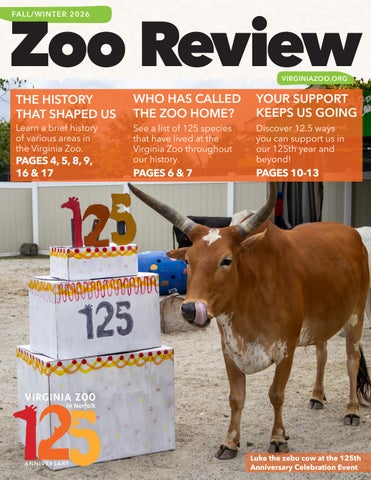
Luke the zebu cow at the 125th VIRGINIA ZOO REVIEW O 1 Anniversary Celebration Event
BOARD OF DIRECTORS PRESIDENT Nicole Carry VICE PRESIDENT Elise Walthall & Lauren Kiger TREASURER Brian Pennell SECRETARY Jake Young DIRECTORS Leigh Anne Abiouness Josh Howell Reese Beeler Patrick Kelly Richard Boykin Melissa Ramsey Lynn Cobb Dustin Rinehart Erik Cooper Sue Roady Liza Delpierre Carin Schneller-Carr Elizabeth Fraim Stephen Taylor Taryn Gisbert Debbi Waitzer Christina Goode Victoria Wittmann Ameet Habib Michael Wood
EXECUTIVE DIRECTOR, CHRIS JENKINS, AT OUR 125TH ANNIVERSARY EVENT WITH GREEN-WINGED MACAW, BIG RED
FROM THE DIRECTOR
PUBLICATION STAFF
CONTRIBUTING WRITERS and PHOTOGRAPHERS
Brittany Coolbaugh Hunter Fidler Hayley Fier Rane Fox Bailey Goebel Darcie Howard Chris Jenkins
Michelle Lewis Jennifer Madden Karsyn McCreedy Kirstin Pendleton Emily Smicker Mary Beth Waltman
DID YOU KNOW?
The Virginia Zoo was once home to chimpanzees, hippopotamuses, and leopards. Learn more about species who formerly lived at the Zoo on page 6. 3500 Granby Street, Norfolk, Virginia 23504 ZOO HOURS: Open Daily 9:30 am – 4 pm Closed New Year’s Day, Thanksgiving Day, Christmas Eve and Christmas Day PHONE: 757.441.2374 • FAX: 757.441.5408 VIRGINIAZOO.ORG
Do you have any questions or ideas for the next issue of the Virginia Zoo Review? We’d love to hear from you. Email info@virginiazoo.org.
Dear Virginia Zoo Fans, We would like to express our immense gratitude for all your support in our 125th year. Since our founding in 1901 as the Lafayette Zoological Park, the Virginia Zoo has grown to be the home of over 700 animals from more than 175 different species. We also hold the honor of being the only Association of Zoos and Aquariums (AZA) accredited Zoo in the state of Virginia, a distinction only possible due to the tireless work of our staff and volunteers, the support of our members and donors, the partnership between the City of Norfolk and the Virginia Zoological Society, and the enthusiastic patronage of millions of guests who have made their way through our gates. In the last 125 years, zoos have made tremendous progress in understanding animal care and our unique position to connect visitors to the natural world that they may not otherwise experience. Zoos were once collectors of wildlife; today, they are conservers of wildlife and protectors of wild spaces. Zoos were once focused on featuring animals as entertainment; today, the animals in our care are ambassadors for their species that provide the opportunity for education and interpretation. Zoos engage our hearts and our minds. Zoos inspire us to learn more about animals around the globe and in our own backyard. Zoos empower us to take small acts of conservation that snowball into the great work of environmental stewardship and sustainability. Zoos can – and do – change the world. It has been the honor of my career to join this team and play a part in continuing to build on the legacy of this magical place. To the animals that have called our Zoo home, to the people that have committed their lives and careers to our growth, to the supporters who have given themselves to guarantee our bright future, and to every visitor and member of our community that is proud to call the Virginia Zoo theirs, we say thank you. It is our honor to have been the temporary stewards of this very special place, and we can’t wait to see how we will continue to grow and change over our next 125 years. With gratitude,
Chris Jenkins, Virginia Zoo Executive Director 2
O
FALL/WINTER 2026
A
We welcomed several new chicks to the Virginia Zoo flock! Jalapeño the green oropendola hatched in May. Opal and Onyx the Kenya crested guineafowl keets hatched in late June and early July respectively.
B
Sassy and Pollock the African painted dogs arrived at the Virginia Zoo in May as a companion pair retired from their Species Survival Plan (SSP) breeding program.
C Three female Burmese mountain tortoises joined the Virginia Zoo family this year! These ladies now occupy the former Prairie Dog habitat, so you can enjoy seeing them upclose through the builtin viewing domes.
NEW AT THE ZOO D
We’re going absolutely nuts over our two new cheetahs, Walnut and Cashew! These threeyear old brothers joined the Zoo in July and have made the purr-fect addition to the African Safari Trail.
E
It’s axolotl fun in the World of Reptiles! Visit our seven new axolotls in the aquarium section of our World of Reptiles building.
F This fall the Zoo welcomed a female Eastern mountain bongo calf! The baby can currently be seen in the bongo habitat on the African Safari Trail with mom Clover, dad Masiko, and the other adult female in the herd, Charlie.
IMPORTANT UPDATE Starting in 2027 your visit may be impacted while the African Safari Trail undergoes a makeover. Please plan accordingly and follow along at virginiazoo.org/africa-construction for the exciting updates to come! VIRGINIA ZOO REVIEW
O 3
History of Animal Care at the Zoo Story by Hayley Fier & Brittany Coolbaugh
When zoos were first created, they were entertainment facilities showcasing a collection of wild animals. At that time, animal care was primarily focused on providing an animal’s most basic needs, like food, water, and shelter. However, wild animals have much more complex needs, like socialization, mental stimulation, and choice to engage in natural behaviors, which vary with each species. Historically, zoos did not always meet these needs. Today, the Virginia Zoo and other Association of Zoos and Aquariums (AZA) accredited facilities help the animals in their care thrive by providing frequent training and enrichment opportunities to ensure each animal’s welfare and well-being. Lion interaction in the 1970s
Before the 1940s, zoos and aquariums across the United States relied on dominance-based training methods to train animals. In the 1940s, positive reinforcement training entered the zoological field with Keller and Marian Breland’s Animal Behavior Enterprises (ABE). By the 1980s, animal care professionals could see the beneficial results of positive reinforcement and began applying this technique to a wide variety of zoo animals. Today, Virginia Zoo animals can choose to participate in their own healthcare, and it’s all because of daily training sessions with keepers!
Through continued research, we’ve learned that there are many other factors to consider for actively maintaining animal well-being. Enrichment is the process of structuring and changing an animal’s environment to encourage them to engage in natural behaviors, and it is one of our greatest tools for enhancing animal welfare. In the early 2000s, the Virginia Zoo first created a formal enrichment program to reinforce our animal care. Enrichment can range from puzzle feeders that encourage foraging to housing different species together to increase socialization. Today, every Virginia Zoo animal receives enrichment regularly to keep their minds and bodies fit!
Animals receiving enrichment in 2025
A voice from history:
Jill Strother, the Virginia Zoo’s General Curator, has been with our team since 1997. Over the last twenty-nine years, Jill cultivated lasting relationships with people and animals that have shaped her into the person she is today. Some of her fondest memories of her time at the Zoo include our former African elephants. Learning to work with elephants, building strong relationships with each individual, and introducing them to their habitat enhanced Jill’s training abilities and zookeeping skills. Jill is excited to see what our future holds as we continue to create memorable experiences for our community and further animal wellbeing. 4
O
FALL/WINTER 2026
History of Veterinary Care at the Zoo Story by Hayley Fier & Mary Beth Waltman
The Virginia Zoo is committed to excellence in animal care and welfare which includes exceptional veterinary care. Today, our attentive animal health team actively supports our animals’ health by scheduling preventative care measures, like vaccines and annual exams, and tending to medical emergencies. Furthermore, our team strives to improve diagnostics each year by adding state-of-theart equipment to our treatment rooms and attending conferences to learn from other professionals in their field. However, veterinary care has changed significantly across our 125-year history, especially as we continue to understand more about the species that call our Zoo home. For many years, veterinary care kept a low profile in Virginia Zoo history. In 1983, Zoo veterinarian, Dr. Tookie Myers, was a prominent figure in local news articles about animal care at our Zoo. But for over 30 years after, veterinary care largely occurred behind the scenes without much public recognition. In 2014, this all changed with the opening of our new Animal Wellness Center. This building features a Veterinary Hospital and Diet Kitchen that were designed with large windows to give guests a direct view inside. Veterinary care and animal nutrition, which were once tucked away from the public, became a prominent feature of daily life at the Zoo. Dr. Mary examining a sloth in 2025
Elephant exam in 1991
Veterinary care at the Virginia Zoo has continued to evolve ever since. In 2024, Dr. Mary, our double board-certified zoo veterinarian and Senior Director of Animal Health, joined the Virginia Zoo family! In addition to her certifications, she brought over 10 years of veterinary experience across several zoos in the United States and internationally. Since joining the Virginia Zoo, Dr. Mary has advocated for equipment upgrades and additional Animal Wellness positions to provide more advanced preventative care. In 2025, the Virginia Zoo raised over $13,000 in our Give Local 757 campaign to purchase new veterinary equipment. We are excited to see what developments in veterinary care will occur over the next 25 years!
Ever wondered how YOU can support animal and veterinary care at the Virginia Zoo? By supporting the Virginia Zoo’s Zoo Fund, you play an important role in the future of the care we provide. Through your generous donations, the Zoo is able to provide continued support for animal care staff, actively advance equipment for animal health at the Zoo, and increase opportunities for enriching the lives of every animal resident. Give a gift that gives back this year by becoming a donor with the Virginia Zoo! Learn more at virginiazoo.givecloud.co/ VIRGINIA ZOO REVIEW
O 5
125 animals that have called the Virginia Zoo home
1. African brush-tailed porcupine 2. African clawed frog 3. African elephant 4. African rock python 5. Agouti 6. American alligator 7. American bison 8. American bullfrog 9. Angora goat 10. Argentine black and white tegu 11. Asian fairy-bluebird 12. Baird’s tapir 13. Barbary sheep 14. Bengal tiger 15. Binturong 16. Black tufted-ear marmoset 17. Black-naped fruit dove 18. Black-tailed prairie dog 19. Blue and yellow macaw 20. Blue duiker 21. Bobcat 22. Bolivian gray titi 23. Brown-nosed coati 24. Brown pelican 25. Cane toad 26. Cantil 27. Capuchin 28. Chestnut-breasted malkoha 29. Chicken 30. Chilean rose tarantula 31. Chimpanzee 32. Colorado river toad 33. Colombian tegu 34. Copperhead 35. Crested wood partridge 36. Degu 37. Demoiselle crane 38. Desert tortoise 39. Dexter cattle 40. Domestic ferret 41. Domestic pony 42. Donkey 43. Dromedary camel 44. East African crowned crane 45. Eastern grey kangaroo 6
O
FALL/WINTER 2026
Monica, Lisa, and Cita were the last of the African elephants that called the Virginia Zoo home. They were loved by many visitors and were well known staples of the Zoo. Unfortunately, Monica passed away in 2011. In 2016, the Association of Zoos and Aquariums (AZA) standards required three elephants to be held together. This resulted in Lisa and Cita being moved to Zoo Miami where they could be with a larger herd of elephants.
Lily the American bison was born in 1998 in Pennsylvania and moved to the Virginia Zoo in 2000. She called the Zoo her home for 26 years before passing in May 2026. This made Lily one of the oldest American bison in an Association of Zoos and Aquariums (AZA) accredited facility, well exceeding the typical lifespan of bison in human care. Read more about Lily’s legacy on page 18.
Matilda the kangaroo arrived in 1964 as a gift from Australia’s Taronga Park Zoo and crossed the ocean on the USS Enterprise (CVN-65). She became the mascot for the crew on board and was welcomed to Norfolk with a full band playing Waltzing Matilda as her keeper, Chief Petty Officer Bennie Juel, walked her down the gangplank and introduced her to the city she would call home. Chuck and Judy the chimpanzees lived at the Virginia Zoo for a little over a decade. They were known by many for their general antics at the Zoo. Although Chuck and Judy were beloved by our staff and community, they were transferred to a rehabilitation center in Texas in 1986 that was better equipped to meet their space requirements and veterinary care needs for the rest of their lives.
Horatio the hippo joined the Virginia Zoo in 1970 through a stamp fundraising project. Horatio was only 2.5 years old when he arrived at the Zoo and he quickly became a staple. Five years later, another hippo named Nyla, who was originally in a Las Vegas circus company, arrived and the pair went on to have two calves of their own. Staff say that Nyla was easygoing and friendly compared to other hippos. She would let keepers open her mouth to scratch her gums and rub her teeth.
Jennell the leopard arrived at the Virginia Zoo in 1917 at just six months old. Originally, a woman in Venezuela caught Jennell on her property. The woman then gave her to a sea captain to be tossed overboard. Instead, when the captain docked in Virginia, he donated Jennell to the Virginia Pilots’ Association, and she was later donated to the Virginia Zoo.
46. Eastern kingsnake 47. Egyptian goose 48. Emu 49. Ethiopian mountain adder 50. European fallow deer 51. Fennec fox 52. Flemish giant rabbit 53. French alpine goat 54. Gelada baboon 55. Goeldi’s monkey 56. Gopher tortoise 57. Grant’s zebra 58. Gray’s monitor 59. Great horned owl 60. Greater kudu 61. Green-naped pheasant pigeon 62. Guanaco 63. Guianan squirrel monkey 64. Hamadryas baboon 65. Hippopotamus 66. Hoffmann’s two-toed sloth
67. Hog Island sheep 68. Indian star tortoise 69. Jambu fruit dove 70. Kinkajou 71. Kunekune pig 72. Leopard 73. Lilac-breasted roller 74. Llama 75. Luzon bleeding heart dove 76. Malayan sun bear 77. Mandrill 78. Mangshan pit viper 79. Meller’s chameleon 80. Milky tree frog 81. Nancy Ma’s night monkey 82. New Zealand rabbit 83. Norway brown rat 84. Ocellated lizard 85. Ornate horned frog 86. Osprey 87. Ostrich 88. Pink-necked pigeon 89. Plains zebra
90. Plumed basilisk 91. Prehensile-tailed porcupine 92. Pygmy hedgehog 93. Red-flanked duiker 94. Red ruffed lemur 95. Rhesus macaque 96. Rhinoceros ratsnake 97. Ringtail 98. San Francisco garter snake 99. Savannah monitor 100. Sea lion 101. Senegal bushbaby 102. Sitatunga 103. Slow loris 104. Solomon Island leaf frog 105. Southern screamer 106. Spider monkey 107. Spotted salamander 108. Standing’s day gecko 109. Starred agama 110. Stump-tailed macaque 111. Suffolk sheep 112. Sungazer lizard 113. Surinam toad 114. Tailless whip scorpion 115. Tamandua 116. Timneh African grey parrot 117. Turkey 118. Turkey vulture 119. Virginia opossum 120. Watusi cattle 121. Western grey kangaroo 122. White cockatoo 123. White-handed gibbon 124. White stork 125. White-throated monitor
The Virginia Zoo has been home to many animals in our 125 years, and each animal served as an ambassador that educated guests about the conservation of their species. That’s why it is so important for us to remember these animals, even if they are no longer Virginia Zoo residents! Each animal here at the Zoo strengthens our commitment to engaging our community in taking action to save the world’s wildlife and their ecosystems by diversifying our stories about conservation. VIRGINIA ZOO REVIEW
O 7
History of Habitat Design Story by Kirstin Pendleton & Brittany Coolbaugh
Habitat design is one element of the Virginia Zoo that has changed significantly from our opening in 1901 to now. In the past, animals were housed in small, cage-like enclosures, but now our animals explore spacious, naturalistic habitats designed with every individual’s needed in mind. This changed through the hard work of animal care professionals, increased scientific research, modern standards from the Association of Zoos and Aquariums (AZA), and shifts in public expectations. As zoos have learned more about animal behavior and wellbeing, we moved toward adapting habitats to support the physical and mental wellbeing of every animal. Alligator exhibit in 1938
As early as 1923, just 22 years into Virginia Zoo history, we recognized a need for change. That year, a zoo keeper and the City of Norfolk’s Superintendent of Parks visited the Baltimore Zoo (now the Maryland Zoo) to inspect their exhibits to modernize and improve our own. Following this visit, the City invested $5,000 ($95,000 in 2026) into improving animal living spaces by adding open-air runways, so animals could enjoy fresh air and more exercise. Investment in our infrastructure increased attendance which eventually allowed us to bring in new species!
Throughout the 21st century we have continued to re-evaluate our habitats regularly to ensure they meet our animals’ needs. With a better understanding of each species’ natural behaviors, social structures, and environmental needs, we designed more modern habitats throughout the Zoo. For example, on Asia: Trail of the Tiger, habitats include engaging water features and climbing structures. Additionally, the ZooFarm and World of Reptiles and Friends building were completely remodeled in 2016 and 2018, respectively, to create dynamic habitats, opportunities for exercise, and additional space for exploration all while improving guest experience and animal wellbeing. Crocodile habitat in 2026
A voice from history:
Dennis McNamara, the Virginia Zoo’s Curator of Herpetology, has played a role in animal care at the Zoo since 2000. In that time, he has seen the Zoo grow into what it is today, and he has grown professionally as well. When Dennis started working at the Zoo, we had 10 full-time keepers and three curators. Fast forward to today and we have 40 full-time keepers and eight curators with more room to grow in the future! Professionally, Dennis has played a part in how the World of Reptiles building looks today by constantly introducing new species, creating diverse exhibits with his team for each animal’s needs, and finding new ways to improve guest experience. We are excited to see what more Dennis will bring to the Zoo in years to come! 8
O
FALL/WINTER 2026
History of Horticulture Story by Kirstin Pendleton & Mary Beth Waltman
Since the beginning of Virginia Zoo history, horticulture—or the science and art of growing ornamental plants, flowers, fruits, and vegetables—has been a key component of our grounds and operations. Initially, horticulture aimed to beautify our 55-acre Zoo with ornamental plants and introduce our community to exotic flora from around the world. Over time, horticulture became a functional part of the Zoo by providing fresh fruits and vegetables to Zoo animals and restoring habitat for native wildlife. Now, the Virginia Zoo continues to find ways to not only provide for our grounds, but to also engage our community in horticulture at home. In 1906, just five years after the Virginia Zoo opened, the Conservatory opened. This building covered three acres of land and served as a central point for merging horticulture with animal care for almost 100 years. Early on, the Conservatory and its surrounding gardens housed prize-winning azaleas and thousands of roses of different varieties. After renovations in 1974, this building went on to house plants and animals representing a variety of ecosystems including tropical and desert climates. In 2001, the Conservatory closed to allow us to focus on our newest expansion, the African Safari Trail, previously called the Okavango Delta Trail. Horticulturist, Marie Bulter, in 1997
Conservatory in 1987 (photo from John Schools)
Since the Conservatory closed, the Zoo’s horticulture team focused on developing naturalistic habitats for our animals, the Animal Wellness Orchard, the ZooFarm Garden, the living wall on the Aldabra tortoise night house, and replacing non-native or invasive species with natives to restore local habitats. In fact, our horticulturists committed to planting an average of three native plants for every one non-native to reduce their water usage. Additionally, in 2025, the Zoo initiated our Habitat Heroes program which aims to engage the community in restoring and protecting native habitats to conserve of local species. This program has increased our community’s interest in horticulture and conservation right in their backyards!
A voice from history: Mark Schnieder spent 36 years watching the Virginia Zoo grow as the Head of Horticulture from 1975 to 2011. During Mark’s tenure at the Zoo, he had the opportunity to perfect his horticulture abilities while making a positive impact on others. Mark shares that the most rewarding part of his time at the Virginia Zoo was being able to create landscapes that enhanced the lives of our animal residents. He says it was both fun and challenging to think about how horticulture could contribute to the wellbeing of the animals and improve their environments. VIRGINIA ZOO REVIEW
O 9
12.5 ways you can support the Virginia Zoo in our 125th year
Have you been looking for another way to celebrate the 125th anniversary of the Virginia Zoo? Read on to learn more about how you can continue to support our mission of engaging our community in taking action to save the world’s wildlife and their ecosystems! Visit virginiazoo.org to learn more!
1. Become a Member or give the Gift of Membership!
Make your wild Zoo adventures last all year by purchasing a Virginia Zoo Membership! Membership benefits include free daily general admission year-round, free or discounted admission to Zoo events, and 50% off admission to over 150 other AZA-accredited zoos and aquariums nationwide. Best of all, a portion of your membership supports our Conservation Fund!
2. Give our animals a present from their Amazon wish list!
Enrichment is a dynamic process that structures and changes an animal’s environment to provide choices and encourage species-appropriate behaviors. This process greatly enhances animal welfare by keeping them mentally and physically fit! Our animals’ care teams compiled an Amazon wish list of enrichment items ranging from cologne for the lions to puzzle feeders for the Animal Ambassadors. Your contributions will further the exceptional care that Virginia Zoo animals receive every day. Click here for their wish list.
3. Shop the Virginia Zoo Gift Shop online or in person!
Not only does shopping at the Virginia Zoo Gift Shop support the daily operations of your Zoo, but it also supports small businesses from across Hampton Roads and beyond, like Norfolk Candle Co., Tied in Knots, or Cedar + Pearl Ornaments! This means your Gift Shop purchases really are the gifts that keep on giving back — to your loved ones, to your Zoo, and to your community. Plus, some items from the Gift Shop are now available online at virginiazoogiftshop.com, meaning shopping is more accessible than ever before in our 125-year history!
10
O
FALL/WINTER 2026
4. Meet Virginia Zoo Animals Up Close on a Behind-the-Scenes Tour! Here at the Virginia Zoo, we offer tours with Aldabra tortoises, birds of prey, an Asiatic black bear, two-toed sloths, Malayan tapirs, and more. Funds raised from these tours support our Zoo Keeper Internship Program which offers participants specialized training in animal care and applied behavioral management. Help us train the animal care professionals of tomorrow — give the gift of a Behind-the-Scenes tour today!
5. Send Your Wild Child to Safari Camp
The Virginia Zoo spells conservation with three C’s — care, community, and connection. During Safari Camp programs, your child gains a new appreciation for how we care for Zoo residents, connects with animals during exclusive behind-the-scenes experiences, and joins our community of burgeoning conservationists. We hope these programs inspire the next generation to become lifelong Virginia Zoo supporters! Camps are available spring, summer, and winter plus, members get early access!
6. Give a Zoo Trip
Give your pride the gift of visiting the Virginia Zoo! Gift tickets are available for purchase online, and they may be used up to 365 days from the date of purchase. Gift tickets can even be used to attend events that are free with general admission, like Noon Year’s Eve, Party for the Planet, or Teddy Bear Clinic! Every ticket sold includes a $2.05 Conservation & Technology Fee which supports conservation initiatives worldwide and allows us to provide a seamless reservation experience for guests.
7. Attend a Special Event or Host your own!
The Virginia Zoo hosts several fundraising events throughout the year, from Breakfast with the Animals to ZooBoo. We also offer birthday parties and venue rentals, so you can show guests a wild time while also supporting your Zoo! Proceeds from these special events go to our Zoo Fund to further our mission and daily operations.
8. Let them pick their own gift
Looking for a simple way to give the gift of the Virginia Zoo to members of your herd? Look no further than a gift card! Virginia Zoo Gift Cards support our daily operations, and they can be used in the Gift Shop, Membership Office, food service locations, or on the Virginia Zoo Express train. Plus, you can purchase a physical card in the Membership Office, or have your gift emailed directly to your recipient. General admission tickets cannot be purchased using a gift card. VIRGINIA ZOO REVIEW
O 11
12.5 ways you can support the Virginia Zoo (continued) 9. Sponsor a Virginia Zoo Species! Bring your brand to life by sponsoring a species at the Virginia Zoo! Not only will your business gain powerful marketing exposure, but you will also support conservation and education across Hampton Roads. Plus, you’ll receive unique benefits for your employees, like discounted memberships, reusable guest passes, and general admission tickets, which will strengthen your workplace culture and employee engagement. This gift gives back to the Zoo, conservation efforts, your local community, and your team!
10. Zoodopt a Virginia Zoo Animal!
Bring your favorite Virginia Zoo animal home by symbolically adopting them, digitally or physically, to learn more about their species. A portion of every Zoodoption supports the Virginia Zoo’s Conservation Fund and Keeper Fund — doubling your impact! The Conservation Fund supports efforts to save wildlife and their habitats around the world, while the Keeper Fund allows our animal care teams to provide outstanding, individualized care to every resident Zoo animal.
ZOOPARENTS OF 2026 125TH ANNIVERSARY AFRICAN ELEPHANT Diane Boyd Lilith Wood William Glover 125TH ANNIVERSARY SEA LION Diane Boyd AFRICAN LION Ryan and Chelsea White AFRICAN PAINTED DOG Christopher Moore AMERICAN BISON Chrisandra S Knight ASIATIC BLACK BEAR Colton and Jude Moriah ASIAN SMALL-CLAWED OTTER Madison Q Meier Tina Reynolds Mackenzie & Trinidad Bailey Rector Brock Bittner Cassidy Fottrell CeCe Parsons Chris Ott
12
O
FALL/WINTER 2026
Dylan Smullen Ellis & Joseph Markwalter Giancarlo Hernandez Grace Gonzalez Ivy Parsons Jeffrey King John H Naddell Josephine & Eleanor Streeter Kelsy Herschel Kendall Scott Kian George Raven Wilson Tera Geoffroy Toni Tyler Davis
HARTMANN’S MOUNTAIN ZEBRA College Park Elementary
BINTURONG Kazimir Stamenkovic Dan Phoenix
PATAGONIAN CAVY Courtney L.B. Worrall Lily Alexander
BORNEAN ORANGUTAN In Memory of Paul Blumka Brenden Dove Kylie Duffan Celia Litovsky Darrien Dove
PHILIPPINES SAILFIN LIZARD Dan Phoenix
COMMON PEAFOWL Holt Goodson GREEN OROPENDOLA Laura Fitch
MALAYAN TAPIR Rachael Pineda MALAYAN TIGER Elihani Harris Rowan & K’mora Maria Gibson MASAI GIRAFFE Chrisandra S Knight Suzanne Forster
RED PANDA Brownies & Daisies of Troop 510 College Park Elementary Jacob Cooper Anthony Gonzalez Jaden Cooper Lillian Hamblin Sutton Anderson
RHINOCEROS HORNBILL Drew Watson ROCK HYRAX Maia Arbel Theo Jacob Simonetty Rachael Pineda Gustavo Marina Sauceda Erlend Strand Osen Hannah Horvath Josie Thompson Gabrielle Ragodo Sotiria Athina Kontouli Bitania Admasu Isabella Bille Justin Teutonico Anna Krzyanowski Melissa Bauer Xavier Ryan Fleckenstein Joseph Avila Emily Funaro Katlyn Cheyenne Byrd Taylor Daugherty Jordan Shimabukuro Clam Logan McCallum Ivan Andarza Matt Edwards Marvin Fox Cayla Neu Emma Stanley
Ali Tayyari Brittany Blackman Kailey Rowley Rachel E Taraian Nicholas Casteloes Ellie Huebner Mary Lewis Siena and Angelica Gordon Jasmine Deabler Cristina Mingot Ureta Eric McDade Carter Ramsey Xander Selby-Lara & Amelia Fox Brighton Nugent Sea Castillo Gavin Perez Charlie Lucie Shelley Helina Liivak Lindsey Bray Ryan Blake Dave Carlson Trey Shock Joshua Ramirez Jacob Medrano Ben Versluis Harein Delatunda Sandra Quintin Samantha Lewis Aaron Aguila Amelia Johnson Ana Frankenfeld
Drake Goddard Anna Stelluto Brianna Yi Cole Reardon Ellabob Evan Plank Grace Williams Hyrax Hideout Jaime Gallick Katie Moody Kira Oszakiewski Macyn Bolten Madyson Soria Marcus Ray Natalia Martelino Noah Timonthy Fatzinger Preston McDaniel Ruhi Bhosale Victor Samario Wawi Zoe Garbin Seamus and Sophie SLENDER-TAILED MEERKAT Kenna Lee Robert Reardon & Nancy Bazin Elise Watz TWO-TOED SLOTH Isabella Smith
11. Bench or Brick Sponsorship Make a lasting mark on Virginia Zoo history by sponsoring a bench or brick! These enduring fixtures allow you to dedicate a piece of the Zoo to remember your loved one, celebrate a major milestone, or honor a passionate environmentalist. Contact our Development Team at giving@virginiazoo.org for more information!
12. Donate to the Zoo Fund
The Virginia Zoo Annual Fund supports the vital work of the Virginia Zoological Society, the nonprofit that helps your Zoo provide exceptional animal care and wellness, create meaningful experiences that bring families together, inspire the next generation of environmentalists through educational programs, and advance conservation efforts globally. We are so grateful for your support.
0.5. Round Up for Conservation! In Fall 2025, we initiated our Round Up Program at all registers in the Virginia Zoo Gift Shop and food service locations. Now, with every purchase made at the Zoo, YOU can support wildlife conservation by rounding up your total to the nearest dollar. Together, small donations can amplify our impact on wildlife conservation efforts locally and around the world!
The Virginia Zoo recognizes that we could not be here for 125 years without the continued support of our community. We are so grateful to our Members, donors, and volunteers for contributing to our mission in any way they can. Cheers to the next 125 years! VIRGINIA ZOO REVIEW
O 13
THROWBACK GUEST PHOTOS
Sadoni James volunteering with the Conservation Youth Team in 2017
John Schools’ photo from 1989
Siblings Ian & Grey in 2012
14
O
FALL/WINTER 2026
Denise Gruccio and her siblings in 1972
Jack Gwaltney in 1934
John Schools’ photo from a sea lion show in 1988
Ken Wiley and his father in 1955
Danielle Rickard’s family visiting in 2024
Katie Whitestone volunteering with her husband and baby in 2013
Looking to the Future
The Virginia Zoo is excited to share that the Macon and Joan Brock EdVenture & Exploration Campus is scheduled to open in spring 2027! This new campus will feature the Marian Breland Bailey Animal Ambassador Center, the EdVenture Center, an amphitheater, and a learning dock. The Marian Breland Bailey Animal Ambassador Center will provide a dedicated home for more than 70 animals while giving visitors a glimpse into the specialized care and training that make these animals such powerful ambassadors for their species. The EdVenture Center will serve as a home base for the Zoo’s Mission Engagement programs which inspire future generations to take environmental action to support wildlife and their ecosystems. In the next phase, construction will begin on a 150-seat amphitheater as well as the Learning Dock. These dynamic spaces will provide new venues for outdoor learning and guest engagement opportunities while also supporting both formal and informal learning for all ages. We are also partnering with the Elizabeth River Project to create a living shoreline around the Learning Dock. This living shoreline will restore the natural habitat adjacent to the Zoo and create a living classroom for environmental interpretation and hands-on educational activities. In addition to the EdVenture & Exploration Campus, our construction crew has started working on our Asia Trail Expansion. The Asia Trail Expansion will be located across from the red panda and rhinoceros hornbill habitats. This project will feature a new space for Przewalski’s horses, a species representing one of the most inspiring conservation success stories of the modern era, and treehouse viewing structures. These unique viewing points will create a more immersive Zoo experience for guests, as if you are stepping directly into a habitat. Przewalski’s horses are critically endangered equids native to grassland habitats across Europe and Asia. In the 1900s, these animals nearly went extinct in the wild due to harsh winter conditions, hybridization with domesticated horses, habitat loss from war, and excessive hunting. Prior to reintroduction programs, Przewalski’s horses were last seen in the wild in the 1960s in the Gobi Desert, Mongolia. Luckily, Zoos caught 14 wild Przewalski’s horses from 1910 through 1960 and developed a managed breeding program (a studbook which later evolved into a Species Survival Plan) in hopes of reintroducing this species to their native habitat. Today, over 1,000 Przewalski’s horses have been reintroduced into the wild thanks to their careful management across zoological facilities! Bringing a new species to the Zoo is no easy feat. Any time we hope to bring a new animal to the Virginia Zoo, we first have to design a safe, suitable habitat that meets their species-specific needs and can evolve over time to continue to meet the Association of Zoos and Aquariums’ (AZA) guidelines. Then, we must coordinate with the AZA and the Species Survival Plan (SSP) to identify individual animals that can be transferred to the Zoo based on a variety of factors. The AZA and SSP will consider these factors to carefully select individuals that are most suitable for the conditions at our Zoo. It can take several months for AZA and the SSP to coordinate animal transfers, so additional details and a timeline will come as this project progresses. Stay tuned for more information about the Macon and Joan Brock EdVenture & Exploration Campus and the Asia Trail Extension at virginiazoo.org or on our social media channels. Virginia Zoo Members will also receive exclusive updates in our monthly Member Update Emails and via our semi-annual Zoo Review. The next edition of Zoo Review will be released in spring 2027. VIRGINIA ZOO REVIEW
O 15
History of Ed-Zoo-cation Story by Hayley Fier & Jennifer Madden
The Virginia Zoo started in 1901 as a collection of exotic animals that the community could visit primarily for entertainment purposes. In 1987, 86 years after our founding, our purpose changed to align with our first Association of Zoos and Aquariums (AZA) accreditation. Throughout the 1970s and 1980s, AZA-accredited facilities collectively shifted their focus from entertainment to animal care expertise, conservation, and education. Today, our mission is to engage our community in taking action to save the world’s wildlife and their ecosystems, and we recognize that education is our greatest tool for engaging others with our mission. An education table in the early 2000s
One of the first documented commitments to education at the Virginia Zoo was in 2002 when our Africa — Okavango Delta, now the African Safari Trail, section and our entry plaza opened. These new additions to the Zoo included two classroom spaces, the Africa Classroom and the Administrative Building Classroom. By adding classroom spaces, we increased our capacity to host on-site classroom-based programs, like today’s Close Encounters and Zoo Labs, in addition to our pre-existing community outreach.
In 2016, when our Animal Wellness Campus and ZooLive! Stage opened, these spaces introduced new opportunities for guests to learn about veterinary procedures and animal nutrition while also providing a space for programs, like Zoo Tales. When the World of Reptiles and Friends debuted in 2018, this also introduced a classroom space, further enhancing this capacity for educational programs. We look forward to further increasing our capacity for education through the opening of the Macon and Joan Brock EdVenture & Exploration Campus in 2027.
ZooLive! Stage Show in 2017
A voice from history:
Mary Beth Waltman began working at the Virginia Zoo thirteen years ago as an Educator. She later became a full-time staff member in 2019, and today, she is our Conservation Engagement Manager. Over the past thirteen years, Mary Beth has observed the growth of our education programs firsthand. She is most excited for the future growth of our early childhood programs, Wild Babies and Wild Wheels, which aim to inspire the newest generation to love animals and their habitats through hands-on activities and nature play. 16
O
FALL/WINTER 2026
History of the Zoo’s Conservation Impact Story by Michelle Lewis, Hayley Fier, & Bailey Goebel
The Virginia Zoo’s mission is not just a statement, but an action we live every day through our conservation efforts. As an Association of Zoos and Aquariums (AZA) accredited facility, we strive to follow their recommendations, including donating a percentage of our annual operating budget to conservation. Through ticket conservation fees, round-up donations, education programs, in-kind matches, and more, we create dedicated funds to wildlife and habitat protection. While we have many international partners who support the species who call the Zoo home, we also prioritize local efforts here in Hampton Roads. These included a wetland restoration on Zoo grounds in 2008, oyster reef restoration in the Lafayette River in 2013, and the expansion of pollinator gardens and native habitats at the Zoo. We also participate in community science projects collecting data for native species research. This increased local focus has led to the creation of Habitat Heroes in 2025 and an Elizabeth River Project partnership creating a living shoreline anticipated in 2027. Oyster restoration in 2018
Lafayette River shoreline cleanup in 2020
Habitat Heroes is something you can do too! Participants replace 20 sq. ft. of lawn with native plants, provided by the Zoo through native plant giveaways and workshops, to create wildlife habitats. To date, we have distributed over 2,250 plants and seeds. These plants are partially funded by our fall Monarch Mile event, which also supports monarch conservation. This year, we raised $1,850, which will aid our goal of giving away 1,500 plants in 2027. To learn more about our conservation efforts and get involved, check out our website: virginiazoo.org/conservation/.
A voice from history:
Our Senior Director of Mission Engagement and Chair of the Virginia Zoo Conservation Committee, Michelle Lewis, has been with the Virginia Zoo since 2017. Over the last nine years, Michelle is proud of the significant growth and change in our Mission Engagement department. In 2017, they connected with over 46,270 people across Hampton Roads; so far in 2026, they’ve already reached more than 191,000! By engaging thousands of students and guests with our mission, we hope to encourage increased participation in conservation efforts, especially locally. In the future, Michelle is excited to further the Virginia Zoo’s conservation impact through continued collaboration with local partners. VIRGINIA ZOO REVIEW
O 17
Lily’s Legacy Every animal at Association of Zoos & Aquariums (AZA) accredited facilities connects millions of people with wildlife they may never otherwise encounter, inspiring passion for conservation action. But every so often, an animal leaves a mark far greater than we could imagine. This is Lily’s story. Born at Lehigh Valley Zoo in 1998, Lily came to the Virginia Zoo in 2000 and quickly became a beloved member of our American bison herd. Over time, Lily’s herd thinned, and she eventually became the Zoo’s sole bison. After careful evaluation of her advanced age, personality, and social history, it was determined that introducing new companions would not be in her best interest. Lily thrived solo in her golden years. Known for her larger-than-life personality, Lily kept her care team on their toes in all the best ways. Her favorite activities included knocking over barrels and cooling off in her mud wallow during the summer heat. In January 2025, with the soon-to-be Macon and Joan Brock EdVenture & Exploration Campus breaking ground, it was time to move Lily to a serene waterfront habitat in Flora Point. It was in this endeavor that she brought departments across the Zoo together to accomplish the not-so-easy feat of moving an 800+ pound bison across the park. The move was successful, and her care team said they often observed her peacefully watching birds flying across the water. Sadly, on May 14, 2026, at age 27 and surrounded by her devoted care team, Lily’s time with us came to an end. At the time of her passing, she was among the oldest bison living in AZA-accredited zoos, a true testament to the exceptional care she received throughout her life. Throughout the 26 years she called our Zoo home, Lily touched countless lives and served as an influential ambassador for her species. Even after her passing, she continued to bring people together. The Virginia Zoo was inspired to take this special bison’s impact a step further with a donation of $10,000 to support American bison reintroduction efforts on Tribal lands through the National Wildlife Federation, as well as a contribution to the U.S. Forest Service’s Planta-Tree Program, helping restore habitat for wildlife in Kaibab National Forest, home to one of the few unfenced wild herds of American bison in the United States. Lily was beloved by guests and staff alike. Her memory lives on not only through the lives she touched, but through the conservation actions she continues to inspire. This is Lily’s legacy. 18
O
FALL/WINTER 2026
Lily in 2009
Lily and her herd in 2002
Lily on a Behind-theScenes Tour in 2022 VIRGINIA ZOO REVIEW
O 19
INSPIRING DONOR STORIES
One Donor, Countless Memories
As we celebrate 125 years, Nancy Barham’s story captures exactly why the Zoo matters. Hear how the memories she and her late husband, Vern, created here continue to inspire her support—and our mission. Your legacy can shape the future
Legacy donors help ensure the Zoo’s mission thrives for the next 125 years and beyond. Their generosity reflects a deep love for wildlife, conservation, and our community. To learn how you can create lasting impact through legacy giving, we invite you to explore the possibilities.
GRATEFUL FOR EVERY DONOR
HONORING OUR CORPORATE COMMUNITY
We celebrate the generosity of all who support the Virginia Zoo, but especially those who have helped make our 125th year extra special. The donors listed here represent just some of the many who give to support their Zoo. Every gift, no matter the size, plays a vital role. * Leadership Society and ^ denotes funds from the Hampton Roads Community Foundation. Alan & Deborah Budlong* Darcie Howard, Alan & Carol Rosebrook Dreamvacations Alex Walsh* Debbi Waitzer* Alexandria & Christian Diane Boyd* Moore* Dustin Arrington Ameet Habib* Dustin Rinehart* Andrea Miller* Edward Bradley* Dr. Ann Marie Woyma & Edwin Kellam* LCDR Timothy Woyma* Elise Walthall* Anna Borg Elizabeth Fraim* Anne D Redding Emily & Jack Peltz Anne Stokes Faulkner Family Fund^ Ben and Barbara Unkle* George Doumar Bernard Strohmeyer* The Goode Family Bess Decker* Foundation Betty Harmon Edwards & Goody Tyler III* Ed Ladd Gray Kiger* Bob VanDyke* Great Escape Travel LLC Burt & Sandi Prestridge* Hampton Roads Capital Group Community Foundation Carin Schneller-Carr* Hercules Fence Company Carol & Tom Mueller* Holly & Samuel Smith* Carolyn Betz* Holly Remsing Dr. Chas & Julie Etheridge J. Michael & Cassandra Christina Goode* Wood* Christina Westnedge* Jacqueline Limerick* Dr. Christopher Post Jake Young* Claudia Mackintosh Janet Thompson* Conrad Shumadine* Jason Caron & Shana Cynthia Faschini & Andrew Lawlor* Wallach Jason Martens*
Jim & Elizabeth Shumadine* Joann C. Klotz John Padgett* Joshua Howell* Juanita Raisor* Judith Williams & Ellie Wilkins* Judy & Buddy Sparrow Kay Abiouness* Lauren Kiger* Leigh Anne Abiouness* Linda & Edward Lilly Lisa Chandler Liza Delpierre* Lynn Cobb & Warren Richard* Malcolm Van De Water Margo Taylor* Maria & David Cundiff* Martha Goode* Mary Cherry* McLean Gift Michael & Dr. Maria O’Hearn* Michael & Susan FondrkAustin MMC Benefits Natalie Whitelam* Nicole Carry* Paula Ticatch
Peninsula Community Foundation of Virginia Peter Griffin* Rebekah L. Huber Family Charitable Fund 3^ Ricardo Moscoso, MD & Jacqueline Salcedo, MD Richard & Jane Gresham* Richard & Karen Lombart Richard & Anna Boykin Richard & Evelyn Reynolds Rivers Portsmouth Gaming LLC Rolf & Beth Williams Ronald Brodsky Scott & Debbi Waitzer Shearwater Foundation, Inc. Susan Cervantes Susan Roady* Susan B. Donn Taryn Gisbert & Deandre Coke* Thomas Brian Pennell Tim Wheeler & Sandra King Truman & Jacquelyn Baxter* Nancy Barham* Victoria Wittmann* William Higgins Yang Tian & Suping Li*
Your support guarantees another 125 years
Donors like you keep our mission thriving. Support the Zoo in this landmark year and ensure the next generation can experience its wonder. Make your gift today. 20
O
FALL/WINTER 2026
Your partnership strengthens the Zoo’s legacy of conservation, education, and care—125 years and counting. Thank you for being part of this journey.
GARC
Business done the wild way Discover how your team can fuel conservation, education, and community impact through sponsorship or corporate membership. Click here to learn more.
CELEBRATING OUR CORPORATE CHAMPIONS
Green Clean Cares Highlighting a partner whose commitment reflects the heart of our 125‑year legacy. Green Clean Express Auto Wash has become known throughout Hampton Roads for delivering a fast, convenient, and eco-friendly car wash experience. As part of Express Wash Concepts, an awardwinning car wash company established in 2018, Green Clean combines innovative technology with a commitment to environmental responsibility and exceptional customer service. Green Clean Express Auto Wash offers a variety of wash packages designed to keep vehicles looking their best, along with complimentary vacuums and premium car care products. What truly sets the company apart, however, is its focus on sustainability. Green Clean uses biodegradable soaps and waxes and incorporates extensive water reclamation systems that help conserve resources while delivering a highquality wash. The company’s commitment extends beyond clean cars. Through its Green Clean Cares initiative, Green Clean supports hundreds of community organizations through sponsorships, fundraising programs, grants, and volunteer efforts. This dedication to strengthening local communities reflects the company’s belief that businesses can make a meaningful difference where they live and work. Since 2022, Green Clean Express Auto Wash has been a valued sponsor of the Zoo. Their commitment to environmental stewardship and community investment closely aligns with the Zoo’s mission to inspire conservation and connect people with wildlife through everyday sustainable actions. Beth Marton, Senior Marketing Executive said, “At Green Clean Express Auto Wash, our mission is to enhance people, communities and cars through the power of clean. Our partnership with the Virginia Zoo reflects that commitment and our shared passion for environmental stewardship, conservation and community engagement. We believe in supporting organizations that make a lasting difference, and we’re proud to help the Virginia Zoo inspire future generations to protect our planet and the wildlife that calls it home.” As we celebrate 125 years of conservation and community impact, partners like Green Clean help ensure that our mission continues to thrive for generations to come. We are grateful for their continued partnership and proud to spotlight an organization that helps keep both our community and environment healthy.
Enjoy a free wash on Green Clean!
Visit this link to get your free wash: go.greencleanexpress. com/zoonews. Valid through 12/31/2027. VIRGINIA ZOO REVIEW
O 21
2027 IS FULL OF ZOO FUN!
The Virginia Zoo is planning a year of excitement with our 2027 special event lineup. Check out some of our events below and learn more at virginiazoo.org/special-events. Tails & Trails
SPRING AT THE ZOO u Tails & Trails: Dog Day at the Zoo u Sensory Friendly Morning u Adult Night (21+) u Bike Night u Party for the Planet u ZooGrooves
Bike Night
Pride Night
SUMMER AT THE ZOO u Pride Night
Breakfast with the Animals
u Member Nights
u Breakfast with the
Animals u Adult Night (21+) u Teddy Bear Clinic
Fall Fest
FALL AT THE ZOO u Monarch Mile u Fall Fest u Zoovies u ZooBoo u Howl-o-ween: Dog Day at the Zoo u Sensory Friendly Morning
ZooBoo