A P U B L I C AT I O N O F T H E R O B E RT N U S B A U M C E N T E R AT B AT T E N U N I V E R S I T Y
DIVERSITY
|
DIALOGUE
|
FAITH
| FREEDOM
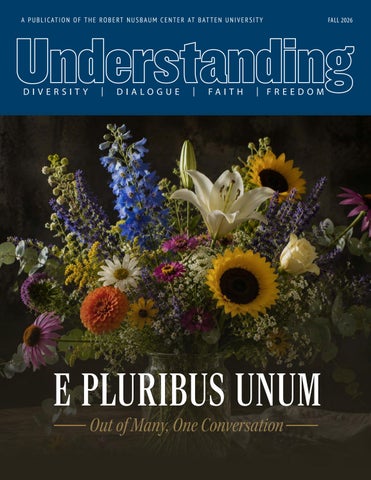
E PLURIBUS UNUM Out of Many, One Conversation
FALL 2026
1
OUT OF ONE NATION MANY ONE COMMUNITY ONE CONVERSATION This year marks the 250th anniversary of the Declaration of Independence. Last semester the Robert Nusbaum Center’s programs focused on what freedom means and why it matters. As we noted then, freedom is one of our greatest gifts. But it has a shadow side.
Communities are rarely diminished by more conversation.
Left to itself, freedom slowly becomes less about our freedom and more about mine. This fall we explore E Pluribus Unum: Out of Many, One.
Long before the university’s name changed, the Batten family devoted its life to communication: publishing newspapers, building media organizations, and co-founding The Weather Channel. At its best, communication is more than sharing information. It’s about helping people understand one another.
We often hear America described as a melting pot, a place where differences dissolve into something new. But the expression E Pluribus Unum implies something more like a florist’s bouquet, not one with 12 identical roses, but with roses, lilies, snapdragons, and a mixture of colors and textures that make it infinitely more beautiful and interesting than when the roses stand alone.
You’ll notice that many of this semester’s programs focus on neighborhoods, campuses, congregations, and local communities. That’s intentional. We live in a time when many people feel powerless. Scroll through the news for five minutes and it’s easy to conclude that the only people who matter are politicians, celebrities, influencers, and whoever happens to be yelling the loudest that day.
That’s close to the phrase’s original meaning. Before it appeared on the Great Seal of the United States, E Pluribus Unum appeared on the cover of The Gentleman’s Magazine, an English publication first printed in 1731. Every issue collected essays, poems, political reports, travel stories, scientific discoveries, letters, and humor from many different authors. One early edition of The Gentleman’s Magazine even pictured a bouquet of flowers beside the motto. Different flowers, but one bouquet. That’s a far better image than uniformity. The bouquet is beautiful because the flowers remain different.
But lasting change usually begins much closer to home: in a classroom, a congregation, or a neighborhood, even around a dinner table. Most of us won’t change the whole world. But every one of us can change someone else’s Tuesday and help shape the community we’re part of.
Three centuries later, E Pluribus Unum is still a surprisingly good description of a healthy community: different voices willing to share one conversation. This past year has reminded many of us just how difficult— and how important—that work really is. The transition from Virginia Wesleyan University to Batten University was welcomed by some and grieved by others. Whatever one’s perspective, the past year proved how deeply people care about this place and why communities should keep talking with one another, especially during seasons of change.
For nearly 30 years the Nusbaum Center has been guided by four words: Diversity. Dialogue. Faith. Freedom. They are easier to write on a brochure than to practice. We don’t always get them right. That’s why they remain worth pursuing. Listening is harder than speaking. It’s easier to be certain than it is to be curious. Communities become stronger not when they avoid difficult conversations, but when they keep having them. Maybe that’s the deepest meaning of E Pluribus Unum. A healthy community doesn’t ask everyone to tell the same story. It invites people with different stories to stay in the same conversation. We hope you join us.
Craig and Kelly
Listening is harder than speaking. It’s easier to be certain than it is to be curious.
COOKSON LECTURE
COOKSON LECTURE
Thursday, October 29
NOON – 12:50 PM | BROCK COMMONS
Jonathan C. Zur has served the Virginia Center for Inclusive Communities for 20 years, including 17 years as its President & CEO. During his tenure, the organization quadrupled its staff, tripled its budget, and dramatically expanded its impact across the Commonwealth. Zur steps down in December 2026, leaving a lasting legacy of building stronger, more inclusive communities throughout Virginia.
The Things That Actually Bring People Together (And the Things That Don’t) JONATHAN ZUR
2
After 20 years working with schools, businesses, nonprofits, and communities across Virginia, Jonathan Zur has seen thousands of attempts to create belonging. Some succeeded spectacularly. Others sadly made things worse. What actually changes people? Which conversations matter? Which trainings don’t? Why do some communities become more divided after trying so hard to unite? In one of his final public presentations as CEO of the Virginia Center for Inclusive Communities, Zur reflects on the biggest surprises of his career and what anyone trying to build healthier communities should know. The Cookson Lecture was established in honor of Catharine Cookson, PhD, who served as the first full-time director of the Robert Nusbaum Center, formerly the Center for the Study of Religious Freedom. Immediately following the program, join us for a reception with light refreshments and an opportunity to talk with Jonathan.
3
LECTURES
CONSTITUTION DAY 2026 Thursday, September 17
NOON – 12:50 PM | BROCK COMMONS
THE FOUNDERS CAN STILL HELP US FIND OUR WAY TIMOTHY G. O’ROURKE
The Declaration of Independence and the U.S. Constitution—read in their entirety and taken together—established a firm, if imperfect yet amendable, foundation for our first 250 years. They remain a dynamic covenant for meeting America’s recurrent challenges, but only to the extent that “We the People” “pledge” “our lives” and “sacred honor” to the principles that these documents embrace. “As a framework for unity,” political scholar Yuval Levin observes, “the Constitution functions as a means of rendering disagreement more constructive.” If you’ve ever wondered whether Americans can still find common ground, this conversation offers reasons for hope and practical places to begin. Timothy G. O’Rourke (PhD, Duke, Political Science) served as Vice President and Provost at VWU from 2007 to 2019. As a teacher-scholar at Campbell, UVA, Clemson, UM-St. Louis, Salisbury, and Batten, he has pioneered efforts to connect campus and community and to promote citizen engagement in the political process. He has testified on redistricting issues in federal courts and before Congress, has written on voting rights, and served as the director of the Virginia Commission on the Bicentennial of the U.S. Constitution (1985-92). Please visit the Batten University Office of Civic Engagement and Service Learning’s resource table to pick up your free pocket Constitution and voter registration materials.
Thursday, September 24 NOON – 12:50 PM | BROCK COMMONS
BEFORE YOUTUBE: WHAT GUERRILLA TELEVISION TEACHES US IN THE SOCIAL MEDIA AGE TEDDY WANSINK
Only when we understand social media’s past can we understand its future. Video platforms like TikTok and YouTube are shaping public life in unprecedented ways. While more users than ever are empowered to tell their stories, these same people often feel disconnected from their own communities. But this is not the first time we’ve been in this bind. When the portable video camera was first introduced in the 1960s, it similarly inspired waves of unbridled optimism and deep concern. Early video users were both intrigued and disturbed by seeing their own images on the television screen for the first time. The video revolution promised radical changes in politics, media, and even medicine—but the history turned out very different. In this talk, Teddy Wansink discusses the forgotten history of the Guerrilla Television movement of the 1970s, telling the story of one Washington, D.C. video center that used the video camera to fight for community justice.
Image credit: Washington Community Video Center
Teddy Wansink is a media historian based in Washington, D.C. He researches how past media forms, from early cinema to videotape, inform our understanding of modern-day video platforms like YouTube and TikTok. He has a BA in Film & Media Studies from the College of William & Mary and an MA in Communication, Culture, and Technology from Georgetown University. Wansink also produces video and leads YouTube strategy at the Brookings Institution.
RELIGION IN AMERICA
Thursday, October 1
NOON–12:50 PM | BROCK COMMONS
FROM CAESAR TO CHRISTIAN NATIONALISM: A HISTORY OF ULTIMATE ALLEGIANCE CRAIG WANSINK
Today, “Jesus is Lord” sounds like a religious statement. In the first century, when the Roman Empire already had a lord and savior, it sounded political. This talk explores how a movement whose founder and key leaders were executed by the state eventually found itself debating power, patriotism, empire, and Christian nationalism. It also examines why questions of ultimate allegiance remain central to the challenges of holding a diverse people together. Craig Wansink, PhD, the Joan P. and Macon F. Brock, Jr. Director of the Robert Nusbaum Center, completed his PhD at Yale University in Ancient Christianity and New Testament.
Thursday, November 12 NOON–12:50 PM | THE ATHENAEUM FORUM HOFHEIMER LIBRARY
THE GREAT AMERICAN EXPERIMENT IN DISAGREEMENT: ISAAC MAYER WISE, SOLOMON SCHECHTER, AND THE SEARCH FOR JEWISH UNITY IN THE UNITED STATES MICHAEL PANITZ In the 19th century, Jewish synagogue practice in America was divided between traditionalists and reformers. Two of the leading rabbinic figures of the era, Rabbis Isaac Mayer Wise and Solomon Schechter, each attempted to unify American Jewry. They disagreed about the continued applicability of Jewish ceremonial customs, but, crucially, Schechter understood that unity is not the same as uniformity. If one of the denominations were to be dominant, the other would be legitimated as “the loyal opposition.” More than a century later, Panitz notes, their question is still ours: Can people who deeply disagree remain one community? Michael Panitz, PhD, has been Rabbi at Temple Israel in Norfolk since 1992. He completed his PhD in Jewish history at Jewish Theological Seminary in 1989, and has taught as an adjunct professor at Batten for 27 years. His leadership in interfaith dialogue was instrumental in establishing the Nexus Interfaith Dialogues at Virginia Wesleyan and in his having been honored with the Humanitarian Award of the Virginia Center for Inclusive Communities.
4
5
REMEMBERING
25TH ANNIVERSARY OF 9/11 Friday, September 11
9 – 9:20 AM | PEACE GARDEN ( ADJACENT TO CLARKE HALL )
BORROWED MEMORY: WHY WE REMEMBER WHAT WE NEVER LIVED Most college students weren’t alive on September 11, 2001. For many, it’s something they’ve encountered in a history class or a documentary rather than a personal memory. So on the 25th anniversary of September 11, we ask a different question: When does someone else’s story become our story? We reflect on the tragedy itself, the remarkable ways people came together in its aftermath, and why every community depends on “borrowed memories,” stories that help shape who we are, even if we weren’t there to witness them. Join us for a brief outdoor gathering as we consider not only September 11, but the stories we borrow, remember, and carry forward together. Saturday, October 3 | HOMECOMING | 10:30 – 11:15 AM | TOUR BEGINS AT MONUMENTAL CHAPEL AND ENDS IN THE UNIVERSITY ARCHIVES (2ND FLOOR OF HOFHEIMER LIBRARY )
If This Ground Could Talk:
A Walking Tour of Unrecognized Sacred Spaces from 60 Years of Virginia Wesleyan
LINDA FERGUSON, LARRY HULTGREN, STEVE MANSFIELD What did newly freed slaves have to do with the University? What message is hidden at the John Wesley statue? Why did a grove of trees spark controversy on campus? Explore these questions and more on a walking tour of the University’s “sacred” spaces, led by professors emeriti Steve Mansfield, Larry Hultgren, and Linda Ferguson. Along the way, we visit places that invite reflection, remembrance, and inspiration before concluding in the University Archives. Linda Ferguson, PhD, Professor Emerita of Management, Business, and Economics Larry Hultgren, PhD, Professor Emeritus of Philosophy and architect of the Portfolio Program Steve Mansfield, PhD, Vice President for Academic Affairs and Kenneth R. Perry Dean of the College Emeritus and University Archivist
FAITH & UNITY Wednesday, September 9 | 6:30 – 8 PM | BROCK COMMONS
Faith That Changes Neighborhoods: Building Communities of Hope
A CONVERSATION WITH LEWIS BROGDON
In partnership with Sowers of Justice of Hampton Roads and Virginia Catholics for Racial Justice What does faith actually do? For some, faith is private belief. For others, it becomes a way of confronting injustice, caring for neighbors, and creating communities where everyone belongs. What does it look like when faith becomes a force for hope in our neighborhoods? Dr. Lewis Brogdon, Executive Director of JustFaith Ministries, helps us explore just that. JustFaith Ministries is a national nonprofit that creates transformative programs at the intersection of faith, justice, and action. Through small-group experiences and shared learning, JustFaith equips people to address the root causes of injustice while serving with love in their local communities and around the world. Drawing on decades of leadership, scholarship, and community engagement, Brogdon discusses how faith can inspire ordinary people to become agents of justice, reconciliation, and hope. Also hear from members of local JustFaith groups whose stories reveal how courageous conversations, meaningful relationships, and shared action have deepened their faith and transformed their communities. The evening concludes with an opportunity to learn about upcoming JustFaith small groups and explore how you can put faith into action alongside others in our community. Lewis Brogdon, MDiv, PhD, joined JustFaith Ministries as executive director in January 2026 following founder Jack Jezreel. A thought leader, religious scholar, and widely sought speaker, Brogdon is regarded for his work on African American religion and the legacy of Dr. Martin Luther King, Jr.
Thursday, October 8 | NOON – 12:50 PM | BROCK COMMONS
The Art of Belonging:
What the Methodist Tradition Can Teach Us About Building Community “Methodist” wasn’t originally a compliment. It was a nickname for students whose disciplined habits, shared practices, and concern for others seemed a bit excessive. Yet that small movement grew into one of the world’s largest Christian traditions. Why? John Wesley understood that communities aren’t built by good intentions alone. They are shaped by shared practices—serving together, singing together, asking hard questions together, and working toward common purposes. This conversation isn’t primarily about religion. It’s about what the Methodist tradition discovered about building neighborhoods, organizations, classrooms, and communities where people genuinely belong. Join three distinguished alumni as we explore lessons that remain surprisingly relevant today. J. Andrew Edwards ’98 is a project editor at UVA Press, where he also acquires books for Religious Freedom & Public Dialogue: A Robert Nusbaum Center Series. He earned his PhD in systematic theology from the University of St. Michael’s College, Toronto, in 2016. Rev. Chris Ross McLain ‘98, Duke Divinity (‘01), is the Director of Connectional Ministries for the Virginia Annual Conference of the United Methodist Church. Having served 25 years as a local pastor, her passions are people, human systems, and trauma-informed care. Rev. Christa Mercer Springstead ’07 is a United Methodist pastor serving Ebenezer United Methodist Church in Suffolk. A lifelong resident of Coastal Virginia, she is passionate about fostering an inclusive faith and equipping others to think critically as they explore life's deeper questions.
6 7
8 7
N U S B A U M AT N I G H T
NUSBAUM AT NIGHT FIRESIDE CHATS OVER ZOOM The Declaration of Independence isn’t the only work celebrating an anniversary this year. On select Monday evenings at 7 PM, join Batten University faculty on Zoom for lively 30- to 40-minute conversations exploring classic works celebrating milestone anniversaries. Please register for each program by noon on the day of the program, so we can email you both a Zoom link and any handouts that you might find interesting. Register with kjackson@batten.edu or 757.455.3129.
Monday, September 14 | 7 – 7:40 PM | ZOOM
The History of a Trickster Boy: The Unifying Comedy of Democratic Differences in Mark Twain’s Tom Sawyer Terry Lindvall In The Adventures of Tom Sawyer, written 150 years ago, Mark Twain tricks us into thinking about laughter as a glue to communal unity. By inviting everyone to be part of the joke, Twain shows how humility, honesty, and Horatian humor expose hypocrisy and heal differences. Terry Lindvall, PhD, is a Professor of Religious Studies and the C.S. Lewis Endowed Chair in Communication and Christian Thought at Batten University.
8 Monday, October 5 | 7 – 7:40 PM | ZOOM
Star Trek at 60: Infinite Diversity in Infinite Combinations Eric M. Mazur Sixty years after the USS Enterprise first appeared on television, Star Trek remains one of popular culture’s most hopeful visions of community. Beyond the phasers, warp drives, and unnamed ensigns in red shirts lies a deeper question: Can people with different backgrounds, beliefs, and personalities learn to work together? This program explores why Gene Roddenberry’s optimistic future still offers timely lessons about disagreement, diversity, curiosity, and finding common purpose. Eric M. Mazur, PhD, is the Gloria and David Furman Professor of Judaic Studies at Batten University and serves as the Fellow for Religion, Law, and Politics for the Robert Nusbaum Center.
Monday, November 9 | 7 – 7:40 PM | ZOOM
The Good, the Bad, and the Ugly at 60: Can We Work with People We Don’t Like? Craig Wansink Filmed in Italy, it was called a “spaghetti western,” and sometimes the blood flows as freely as marinara. But beyond the gunfights, Sergio Leone’s The Good, the Bad, and the Ugly asks an unsettling question: What if the people standing between you and your goal are also the only ones who can help you reach it? In this 60-year-old classic, Blondie, Tuco, and Angel Eyes reveal surprising lessons about rivalry, cooperation, and learning to live with people we’d never choose as companions. Craig Wansink, PhD, is the Joan P. and Macon F. Brock, Jr. Director of the Robert Nusbaum Center and Batten Professor of Religious Studies and Leadership.
9
BUILDING COMMUNITY Thursday, October 15 | NOON – 12:50 PM | THE ATHENAEUM FORUM, HOFHEIMER LIBRARY
Does Anything I Do Actually Matter? How Ordinary People Still Change History
In partnership with Batten University Office of Civic Engagement and Service Learning in recognition of Vote Early Day on October 27 It’s easy to check out when it feels like your voice doesn’t matter or that one person can’t make a difference. But history tells a different story. Again and again lasting change has begun with ordinary people who chose to show up, speak out, and work together. Voting matters, but civic engagement doesn’t end at the ballot box. Join a panel of civic leaders, educators, and community advocates for a discussion on how everyday acts of leadership, and civic engagement in all its forms, can strengthen communities and remind us that our voices still matter.
VCIC WORKSHOP
Thursday, October 22 | NOON – 12:50 PM | BROCK COMMONS
James Moskowitz, Lecturer in Political Science and Coordinator of NATO Partnership at Batten University Arin Shatto, Director of Civic Engagement and Service Learning at Batten University Kate Slayton, Executive Director of Virginia21 Rev. Donna Tucker, Pastor of Heritage United Methodist Church in Virginia Beach
Why Is Everyone Yelling? The Lost Art of Disagreeing Without Becoming Enemies Most of us have learned how to argue. Very few of us have learned how to have a real conversation. Whether the topic is politics, religion, race, AI, gender, or your roommate, disagreement doesn’t have to end relationships. In this interactive session, discover why debates usually produce more heat than light, learn how to recognize when conversations go off the rails, and practice techniques that actually help people think, not just defend themselves. The Virginia Center for Inclusive Communities (VCIC) Hampton Roads Office is located on the campus of Batten University.
DELIBERATIVE DIALOGUE Thursday, November 5 | NOON – 12:50 PM | BROCK COMMONS
Immigration and America’s Future: What Should We Do? In partnership with Batten University Office of Civic Engagement and Service Learning Few issues spark more passionate debate among Americans than immigration. Compassion or security? Opportunity or order? National identity or human dignity? What should we prioritize when important values come into conflict? Through deliberative dialogue in facilitated small-group conversations, participants explore three distinct approaches to U.S. immigration policy, listening to different perspectives while weighing the trade-offs of each. Join us for a respectful conversation marked by curiosity, thoughtful reflection, and a willingness to wrestle with difficult questions together.
Batten University Fall Theatre Produc
The Antigone Proje
tion:
ct
Thousands of years ago, Sophocles crafted a chara cter motivated by the belief th at sometimes a higher au thority calls upon us to do what is right despite what it co sts us. This unique, devised performance uses the an cient Greek play Antigone to fra me the words and actio ns of individuals facing the cu rrent immigration/ICE cri sis. Please join us in the Susa n S. Goode Fine and Performing Arts Center. Performances: Friday an d Saturday, November 13 an d 14, at 7:30 PM; Sunday, November 15, at 2:00 PM . For more information an d tickets, go to The Arts at Batten University online.
CALENDAR OF EVENTS CALENDAR PAGE 10
SEPTEMBER That Changes Neighborhoods: 9 Faith Building Communities of Hope
A Conversation with Lewis Brogdon, MDiv, PhD
16 Seeing Together:
CHRYSLER GALLERY TOUR
How Animals in Art Teach Us to Notice Difference
Wednesday, 6:30 - 8 PM | Brock Commons In partnership with Sowers of Justice of Hampton Roads and Virginia Catholics for Racial Justice ANNIVERSARY OF 9/11 11 25Borrowed Memory: Why We
Craig Wansink, PhD Friday, 11 AM – 12 PM l Chrysler Museum of Art, Norfolk Registration required by October 14. Register with kjackson@batten.edu or 757.455.3129
TH
Remember What We Never Lived Friday, 9-9:20 AM l Peace Garden
CHRYSLER GALLERY TOUR 17 Seeing Together:
How Animals in Art Teach Us to Notice Difference
14 The History of a Trickster Boy: NUSBAUM AT NIGHT
Craig Wansink, PhD Saturday, 11 AM – 12 PM l Chrysler Museum of Art, Norfolk Registration required by October 14. Register with kjackson@batten.edu or 757.455.3129
The Unifying Comedy of Democratic Differences in Mark Twain’s Tom Sawyer Terry Lindvall, PhD Monday, 7 - 7:40 PM | ZOOM Registration required by noon with kjackson@batten.edu or 757.455.3129
VCIC WORKSHOP 22 Why Is Everyone Yelling? The Lost
Art of Disagreeing Without Becoming Enemies
CONSTITUTION DAY 2026 17 The Founders Can Still Help Us Find
Our Way
Timothy G. O’Rourke, PhD Thursday, 12 - 12:50 PM | Brock Commons
24
Thursday, 12 - 12:50 PM | Brock Commons
Thursday, December 3
NOON – 1 PM ROBERT NUSBAUM CENTER, CLARKE HALL #108
E PLURIBUS UNUM: A RECEPTION AND STUDENT ART CONTEST In partnership with Batten University Assistant Professor of Digital Art Derek Eley and students in his ART 204 Digital Art and ART 208 Photography courses Join us in the Robert Nusbaum Center Office Suite as we showcase students’ art and recognize award winners who’ve considered the many ways E Pluribus Unum can be imagined, designed, and challenged.
COOKSON LECTURE 29 The Things That Actually Bring
ROBERT NUSBAUM CENTER
People Together (And the Things That Don’t)
Before YouTube: What Guerrilla Television Teaches Us in the Social Media Age Teddy Wansink, MA Thursday, 12 - 12:50 PM | Brock Commons
Jonathan C. Zur Thursday, 12 - 12:50 PM | Brock Commons Reception Immediately following the program
Craig Wansink, PhD Thursday, 12 - 12:50 PM | Brock Commons
What Should We Do?
ROBERT NUSBAUM CENTER OCTOBER NOVEMBER From Caesar to Christian Nationalism: DELIBERATIVE DIALOGUE 1 A History of Ultimate Allegiance 5 Immigration and America’s Future:
3
5
If This Ground Could Talk: A Walking Tour of Unrecognized Sacred Spaces from 60 years of Virginia Wesleyan
9
Linda Ferguson, PhD, Larry Hultgren, PhD, NUSBAUM AT NIGHT Steve Mansfield, PhD The Good, the Bad, and the Saturday, 10:30 – 11:15 AM Ugly at 60: Can We Work with ROBERT People NUSBAUM CENTER Meet in front of Monumental Chapel We Don’t Like? In partnership with Batten University Alumni Relations and Craig Wansink, PhD BATTEN UNIVERSIT Y Homecoming & Alumni Family Weekend 7 -G7:40 | ZOOM | D I A LO | FA D I V E R S I T Y Monday, U E PM ITH | FREEDOM Registration required by noon NUSBAUM AT NIGHT with kjackson@batten.edu or 757.455.3129
Star Trek at 60: Infinite Diversity in Infinite Combinations Eric M. Mazur, PhD Monday, 7 - 7:40 PM | Zoom Register required by noon with kjackson@batten.edu or 757-455-3129
8
Thursday, 12 - 12:50 PM | Brock Commons In partnership with Batten University Office of Civic Engagement & Service Learning
The Art of Belonging: What the Methodist Tradition Can Teach Us About Building Community Andy Edwards ‘98, PhD Chris Ross McLain ’98, MDiv Christa Mercer Springstead ’07, MDiv Thursday, 12 - 12:50 PM | Brock Commons
Anything I Do Actually Matter? How 15 Does Ordinary People Still Change History
James Moskowitz, MA, Arin Shatto, MA, Kate Slayton, Donna Tucker, MDiv Thursday, 12 - 12:50 PM | The Athenaeum Forum, Hofheimer Library In partnership with Batten University Office of Civic Engagement & Service Learning in recognition of Vote Early Day on October 27
Great American Experiment in 12 The Disagreement: Isaac Mayer Wise,
Solomon Schechter, and the Search for Jewish Unity in the United States Michael Panitz, PhD Thursday, 12 - 12:50 PM | The Athenaeum Forum, Hofheimer Library
DECEMBER Unum 3 EA Pluribus Reception and Student Art Contest Thursday, 12 - 1 PM Robert Nusbaum Center, Clarke Hall #108 In partnership with Batten University Digital Art and Photography courses
ROBERT NUSBAUM CENTER
BATTEN UNIVERSIT Y
D I V E R S I T Y | D I A LO G U E | FA I T H | F R E E D O M
Craig Wansink, PhD Joan P. and Macon F. Brock, Jr. Director of the Robert Nusbaum Center, Batten Professor of Religious Studies and Leadership, and Chair of Religious Studies Kelly Jackson Associate Director of the Robert Nusbaum Center Eric M. Mazur, PhD Fellow for Religion, Law, and Politics for the Robert Nusbaum Center, and the Gloria and David Furman Professor of Judaic Studies 757.455.3129 batten.edu/nusbaumcenter NusbaumCenter@batten.edu
Understanding DIVERSITY | DIALOGUE | FAITH | FREEDOM
is published twice a year by the ROBERT NUSBAUM CENTER at Batten University EDITOR Craig Wansink, PhD MANAGING EDITOR Kelly Jackson ART DIRECTOR Kayla Monroe
5817 Wesleyan Drive Virginia Beach, VA 23455
Image credit: Marx Reilich, Last Judgment, 1485-1520, at the Chrysler Museum of Art
CHRYSLER GALLERY TOUR
Registration required by October 14, or until tour is full. Register with kjackson@batten.edu or 757.455.3129.
Friday, October 16 | 11 AM - NOON | REPEATED Saturday, October 17 | 11 AM - NOON CHRYSLER MUSEUM OF ART, NORFOLK (MEET IN THE CHRYSLER MUSEUM LOBBY)
Seeing Together: How Animals in Art Teach Us to Notice Difference
CRAIG WANSINK
One of the most important skills in a divided society is simply learning to notice. Using masterpieces from the Chrysler Museum, we discover how artists such as Botticini and Bosch hid meaning in dogs, lions, monsters, and other unexpected creatures. Together we practice careful observation that moves us beyond quick judgments to deeper understanding, not just of art, but also of people and communities.