Farm Bureau News
NOVEMBER 2026
The Voice of Virginia’s Agricultural Producers
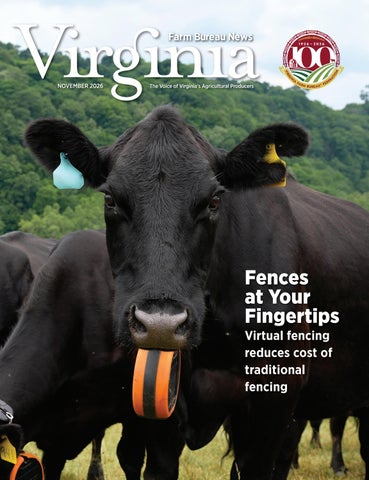
Fences at Your Fingertips Virtual fencing reduces cost of traditional fencing
Farm Bureau News
Volume 85, Number 4 November 2026
13
Features 10
13
16
22
“It's helped us be better cattle farmers.” — DEIDRE TIGUE co-owner, Blue Ridge Genetics, Carroll County
BUILDING WITH BIOCHAR
Biochar is gaining attention for reducing soil’s nutrient losses and retaining water, which can help farmers endure dry spells.
PREVENTING BARN FIRES
Portable space heaters are the leading cause of fires in homes, barns and workshops; farmers are working to prevent them.
Nicole Zema Sr. Staff Writer/Photographer Christina Amano Dolan Sr. Staff Writer/ Photographer
PUBLICATION SCHEDULE
Producer members will receive their next issue of Virginia Farm Bureau News in January. The magazine is published quarterly, and back issues can be viewed at issuu.com/ virginiafarmbureau.
Departments By the Numbers Save the Date For your Benefit Heart of the Home
All advertising is accepted subject to the publisher’s approval. Advertisers must assume liability for the content of their advertising. The publisher assumes no liability for products or services advertised. The publisher maintains the right to cancel advertising for nonpayment or reader complaints about services or products.
Kathy Dixon Assistant Director, Communications
WE’RE SOCIAL!
4 5 7 28
Members — Address change? If your address or phone number has changed, or is about to change, contact your county Farm Bureau. They will update your membership and subscription information.
EDITORIAL TEAM Asheley Jewett Chief Marketing & Communications Officer
Farmers are using virtual fencing to monitor livestock’s movements and can adjust pasture boundaries with a smartphone app. Female agricultural specialists are helping connect farmers with international markets and helping them grow their businesses.
Postmaster: Please send changes of address to, Virginia Farm Bureau Federation, Farm Bureau News, P.O. Box 27552, Richmond, VA 23261-7552; fax 804-290-1096. Editorial and business offices are located at 12580 West Creek Parkway, Richmond, VA 23238. Telephone 804-290-1000, fax 804-290-1096. Email virginiafarmbureaunews@vafb. com. Office hours are 8 a.m. to 4:30 p.m., Monday through Friday.
Member: Virginia Press Association
FENCING FOR THE FUTURE
GLOBAL LEADERSHIP
DEIDRE TIGUE
Virginia Farm Bureau News (USPS 017-763) (ISSN 1525-528X) is published four times a year. January, April, September, November. It is published by Virginia Farm Bureau Federation, 12580 West Creek Parkway, Richmond, VA 23238. Periodicals postage rate is paid at Richmond, VA and additional mailing offices. The annual Subscription Rate is $1.13 (included in membership dues).
ON THE COVER GPS collars on cattle allow farmers to rotate their animals using virtual fencing (Photo by Michael Voyack).
Kenny Kane Graphic Design Manager Eleanor Stickley Sr. Graphic Designer Alice Kemp Sr. Staff Writer/Advertising Coordinator
VIRGINIA FARM BUREAU FEDERATION
Officers Scott E. Sink, President Robert J. Mills Jr., Vice President
Board of Directors DIRECTOR
DISTRICT
Emily F. Edmondson 1 Richard L. Sutherland 2 Bruce N. Stanger 3 Jeannie L. Dudding 4 Russell L. Williams II 5 Justin Pence 6 Thomas E. Graves 7 Leigh H. Pemberton 8 Patrick Murphy 9 A. Bruce Slagle 10 Matt T. Fimon 11 J. Barry Bates 12 Gary D. Cross 13 David L. Hickman 14 A. Faye Hundley * Thomas N. Henley **
COUNTY
Tazewell Grayson Montgomery Craig Rockbridge Shenandoah Orange Hanover Prince Edward Halifax Brunswick Essex Southampton Accomack Essex Goochland
*Women's Leadership Committee Chair **Young Farmers Committee Chair
2
VIRGINIA FARM BUREAU NEWS
President's Message Dear Virginia Farm Bureau members, This year has brought both accomplishments and challenges, but one thing has remained constant: Farm Bureau’s commitment to you and your steadfast support of our shared goals. As we continue to celebrate our centennial, we’re reflecting on what that partnership has meant to our organization. Our members are the lifeblood of Virginia Farm Bureau, and a century of success is a testament to the dedication of our volunteer leaders and the enduring support of members across the commonwealth. We look forward to commemorating the past 100 years with special celebrations at our Annual Convention next month. Yet this milestone is more than an opportunity to look back. It’s also a moment to renew our commitment to the next centennial. That future begins by continuing to strengthen our grassroots foundation and expand our outreach to current and potential members. A century of success has shown that we are strongest when we are proactive. Every policy victory begins with members identifying issues at the county level, advancing them through our policy development process and voting them into final policy at our annual meeting. This year, we continued working with legislators, particularly those without an agricultural background, by expanding farm tours and roundtable discussions. Those efforts were especially important as farmers faced drought and a severe hay shortage. By helping our representatives understand the situation’s urgency, we contributed to the governor’s declaration of a state of emergency and the approval of over-width exemption waivers for carriers transporting essential hay supplies in Virginia. The waivers accelerated feed deliveries, helping farmers maintain livestock operations amid a statewide hay shortfall of approximately 1 billion pounds. That progress reflects the consistency and perseverance of our volunteer leaders. Year after year, you support county Farm Bureaus, participate in annual meetings and policy discussions, continue that work at the Resolutions Meeting and bring the process to its culmination at the annual meeting of voting delegates. This steady grassroots engagement and volunteer participation remain the foundation of our success. Your determination keeps the advocacy process moving, and our achievements would not be possible without you. As we look to the next 100 years, Virginia Farm Bureau has sharpened its focus on membership, and our directors of Field Services and Member Engagement are working to enhance the value of membership and strengthen communication with county volunteers and leaders. We also continue to create opportunities that broaden understanding of Virginia agriculture. For the first time in Virginia, our Women’s Leadership Program hosted the American Farm Bureau Women’s Leadership Committee’s quarterly business meeting. Their national representatives attended our Federation board meeting and connected with agricultural dignitaries from Canada who were visiting at the same time, extending the story of Virginia agriculture beyond our borders. Our centennial reminds us how far we have come, while the perseverance of our members gives us confidence in where we are going. Together, we will make Farm Bureau even more relevant, responsive and effective for our members and for Virginia agriculture throughout the next century. As we mark this milestone, I invite you to reflect on a simple question: How has Farm Bureau supported you and your family? Please share your story using the QR code on the right. Scott Sink, an agritourism operator and beef cattle and hay farmer in Franklin, Montgomery and Pulaski counties, is president of Virginia Farm Bureau Federation.
Top membership counties for 2026 *As of Oct. 16, 2026
County Farm Bureau
Members
Bedford
3,414
Hanover
3,365
CC-JC-NK-Y
3,262
Washington
2,886
Henrico
2,877
Chesterfield
2,853
Augusta
2,629
Franklin
2,614
Tazewell
2,556
Rockingham
2,481
County Farm Bureau
Percentage of goal
Chesterfield
109.18%
Prince William-Fairfax
109.05%
Stafford
108.29%
Fauquier
107.22%
Roanoke
106.63%
Henrico
105.73%
Caroline
104.08%
Hanover
104.02%
Fluvanna
103.87%
Mecklenburg
103.52%
County Farm Bureau
Member retention rate %
Charlotte
94.97%
Southampton
94.51%
Powhatan
94.43%
Floyd
94.36%
King William
94.28%
Dinwiddie
94.06%
Pulaski
94.06%
Louisa
93.88%
Smyth
93.86%
Shenandoah
93.55%
*Membership year ends Oct. 31, 2026.
vafb.com / NOVEMBER 2026
3
That’s how many fires are caused each year by portable space heaters, and many of them are found in barns or workshops. See related article on page 22.
Albemarle County farmers raising the ‘Cadillac of turkeys,’ on Real Virginia. Featured this month on Real Virginia, Virginia Farm Bureau’s weekly television program: • Visit an Albemarle County farm where these premium KellyBronze turkeys are raised. • Find out how agriculture is the cornerstone of Grayson County, driven heavily by cattle, sheep, goats and smallfarm production. • Learn how to make Southern succotash in this episode of Heart of the Home. Real Virginia airs nationwide at 8 a.m. on the first and third Thursdays of each month in the Voices of Agriculture program on RFD-TV on Dish Network and DirecTV, and on selected cable outlets around the state. Watch anytime at vafb.com. It airs weekly on WVVA Bluefield and WTKR Norfolk. It also airs on the first and third Sundays of each month at 7 a.m. on WHSV Harrisonburg and at 10 a.m. on WVIR Charlottesville; and on the first and third Saturdays at 5:30 a.m. on WSLS Roanoke and at 8 a.m. on WRLH Richmond.
4
VIRGINIA FARM BUREAU NEWS
Save the Date!
Celebrate VAFB’s 100th at The Homestead Virginia Farm Bureau® Federation will celebrate a century of agriculture, advocacy and service at the 2026 Annual Convention in Hot Springs. This milestone convention will bring members together to honor the people, accomplishments and legacies that have shaped VFBF over the past 100 years, while looking ahead to the future of agriculture and the organization. The event begins Dec. 1 at The Omni Homestead Resort and concludes on the evening of Dec. 2, with a full program of opportunities to connect, learn and celebrate. Convention highlights This year’s program will feature a combination of educational sessions, volunteer and member networking opportunities and the organization’s annual meeting of voting delegates. Tuesday afternoon will feature a town hall with American Farm Bureau Federation President Zippy Duvall and VFBF President Scott Sink. Convention guests are encouraged to support the Young Farmers Discussion Meet contest on Tuesday afternoon. The contest is designed to develop Young Farmers’ understanding of important agricultural issues and explore how groups can combine their knowledge to reach consensus and solve problems. Winners will be announced during the convention. Other planned events on Tuesday include a local affairs workshop, a service project hosted by the Women’s Leadership
Committee, along with an afternoon tea and meet-andgreet with the committee. Prior to dinner, a showcase reception will be hosted by the Virginia Foundation for Agriculture, Innovation and Rural Sustainability. Following Tuesday’s dinner, the VFBF Young Farmers will hold a live auction benefiting Virginia Agriculture in the Classroom, followed by a Young Farmers and Growing Leaders reception. District caucus meetings will be held at 1 p.m. on Wednesday, Dec. 2. Certified voting delegates from each county Farm Bureau will establish VFBF state and federal policies for the coming year, and vote for VFBF president, vice president, state Women’s Leadership Committee chair, state Young Farmers Committee chair, and directors representing Districts 1, 4, 7, 10 and 13. First-time voting delegates or those looking for a refresher are welcome to attend the Orientation Session on Wednesday morning. Other convention highlights include an ice cream social on Wednesday afternoon, and attendees can enjoy networking meals throughout the event, providing opportunities to mingle, build new relationships and celebrate the organization’s centennial with fellow Farm Bureau members. Centennial celebrations Throughout the convention, centennial celebrations and exhibits will highlight VFBF’s 100-year history of serving its members and advocating for the commonwealth’s farmers. The festivities will take center stage on Wednesday evening with a Centennial Celebration Dinner & Awards Recognition Program. This special dinner will honor the achievements, people and milestones that have defined Virginia Farm Bureau’s journey over the past 100 years. The evening also will recognize member achievements with the 2026 VFBF County Farm Bureau Awards of Excellence, Distinguished Service Awards, President’s Membership Award, as well as the 2026 VFBF Journalism Awards. Following the dinner and awards, celebrations will shift into high gear as the Brent Hull Band takes the stage. Attendees can raise a glass, hit the dance floor, and celebrate with an evening of music, memories and fellowship.
vafb.com / NOVEMBER 2026
5
Farm Bureau Members Receive a
$500
Exclusive Cash Reward*
on an Eligible New* Ford Truck or Ford Blue Advantage™ Certified Used* Vehicle.
The Farm Bureau Exclusive Cash Reward* is now compatible with AXZD-Plans.
Ford F-150®
*Visit FordRecognizesU.com/FarmBureau today for complete offer details!
Travel Happy Spend Less Holiday trips, up to 50% off
Get your members-only savings by logging on to MemberDealsPlus.AccessDevelopment.com
Or download the "Member Deals Plus" mobile app here:
A P P L E
6
g o o g l e p l ay
VIRGINIA FARM BUREAU NEWS
For assistance call (888) 275-9136
For Your Benefit
Improve your farm business with discounts on record-keeping, branded apparel and more! NEW!
Get Gripp: Frontline friendly software for farmers
Use Member Deals Plus® for exclusive Farm Bureau discounts
Track equipment, log issues and keep your farm team on the same page—all from your phone. Gripp Pulse is asset tracking and crew communication for farms, built around a QR code on every piece of equipment. Scan it with a phone to log a problem or look up what was done last —simple enough that 95% of a farm's crew is still using it after 90 days. Virginia Farm Bureau members now can access Gripp free for 30 days, with no credit card, no commitment, and free setup and onboarding. The mobile app allows you to see how easy it can be to track anything from fleet vehicles to implements to inventory. In two weeks, you’ll know if it works for your operation. If it doesn’t, you walk away. If it works, plans range from $8 to $549 per month. To try the platform, visit gripp.ag/farm-bureau.
Member Deals Plus® uses the nation’s largest private discount network to save you money on meals, clothing, vehicle care and other goods and services. It uses “show your phone” mobile deals that can be accessed anywhere and redeemed from a smartphone at the point of sale, or from a home computer.
Members get free shipping plus up to 20% off KEY Apparel Since 1908, KEY Apparel has crafted quality workwear at an affordable price. KEY Apparel provides comfortable office wear and rugged workwear, all shipped from its headquarters in Fort Scott, Kansas. Virginia Farm Bureau has partnered with KEY to provide members with apparel they can rely on. Virginia Farm Bureau members will receive a 10%-20% discount on all merchandise, plus free shipping on orders over $75. Members can customize garments with state or county Farm Bureau logos, or add personal graphics like sports team and organizational logos. To use this Virginia Farm Bureau benefit, visit vafb.com/ benefits, log in as a Virginia Farm Bureau member, and go to the KEY Apparel tab and follow the link to Virginia’s exclusive site.
• To register as a new user, visit vafb.com/benefits. • To save with a mobile device, download the “Member Deals Plus” app from the AppStore or Google Play. Members can enjoy discounts on amusement parks, apparel, dining, gifts, movies, museums and more! For assistance, call Member Deals Plus customer service, 888-275-9136. Member Deals plus and Member Deals Plus are registered trademarks of Virginia Farm Bureau Federation.
Save and stay at Drury Hotels, with free amenities Virginia Farm Bureau members receive a 15% discount off best available rates at Drury Hotels, where extras aren't extra. The discount is valid at more than 150 Drury Hotels locations in 26 states, including Richmond, Virginia. See a full list of locations at druryhotels.com/locations. All overnight guests will enjoy free hot breakfast; free 5:30-7 p.m. appetizers and cold beverages; free internet access; and kids stay free in their parents’ room. Members simply need to log into vafb.com/benefits and use the corporate code provided to make a reservation. *Discount subject to availability and cannot be used with other discounts, offers or promotions. Discounts cannot be used with other programs. Advance reservations are required, and blackout dates apply!
vafb.com / NOVEMBER 2026
7
A century of supporting our members
Candace Monaghan, Beaver Dam Farm Sunflowers, Botetourt County
Barry Bates, Mount View Farm, Essex County
The Moyers, Oakmulgee Dairy, Amelia County
Amanda Sweeney, Edgewood Apiary and Farm, Fluvanna County
Thank you for your membership! From family farms to hometown communities, Virginia Farm Bureau has been supporting generations of Virginians for 100 years. As a Farm Bureau member, you help advocate for farming, invest in youth, and benefit from a wide range of discounts and services.
Access your benefits at vafb.com
arm,
Virginia young farmers to compete at American Farm Bureau Federation Annual Convention ARTICLE AND PHOTOS BY CHRISTINA AMANO DOLAN
T
he extraordinary grit, dedication and ingenuity of Virginia’s rising agricultural leaders will soon claim the national stage. Some of the commonwealth’s brightest young farmers will compete for national recognition at the 2027 American Farm Bureau Annual Convention, to be held Jan. 8-13 in Charlotte, North Carolina. During the AFBF convention, Virginia Farm Bureau Federation Young Farmers will vie for honors in the AFBF Young Farmers & Ranchers Achievement Award and Excellence in Agriculture Award programs and the AFBF Discussion Meet competition. First-place winners will receive a $35,000 credit toward a new Ford vehicle; runners-up receive a $25,000 credit toward a new Case IH piece of equipment; third-place winners receive a $2,500 cash prize courtesy of AmericanAg®; and fourth place winners receive a Case IH branded picnic set. Virginia finalists for the AFBF Achievement and Excellence in Agriculture awards were determined during the 2026 VFBF Young Farmers Summer Expo in July.
and dairy farmer’s wife. Leveraging her first-hand experiences, she strives to strengthen farm safety, emergency preparedness and agricultural emergency health care through ongoing education and outreach, developing and distributing farm emergency kits, and sharing stories of farm life as “The Dairy Wife” on social media. She’s amplified her message as a workshop host and speaker at VFBF Young Farmers expos, the 2025 VFBF Women’s Leadership Conference, 2025 Ohio Women’s Agri-Intelligence Conference and 2026 Georgia Dairy Conference, and as a guest of several podcasts. Hammock also serves on the VFBF Farm Safety Advisory Committee, the Pittsylvania County Women’s Leadership Committee, and was recently named a 2026 Distinguished Farm Bureau Woman of the Year by the VFBF Women’s Leadership Committee.
Farm,
Katie Hammock of Pittsylvania County is Virginia’s competitor for the AFBF Excellence in Agriculture Award. The award recognizes involvement in agriculture, leadership ability and participation in Farm Bureau and other organizations. Hammock is an emergency room nurse, business owner and founder,
Hayley and Coty Goodwin of Orange County will compete for the AFBF Achievement Award, which recognizes young Farm Bureau members for their efforts and leadership in production agriculture. The couple co-owns and operates Coty’s multi-generational family farm alongside his brother and sister-in-law, where they grow row crops, winter cover crops and hay. They also sell direct-toconsumer beef shares, grain and hay; and serve as agricultural advocates by frequently participating in state and county Farm Bureau initiatives, sharing their farm’s story with direct-to-market
customers, and advocating for farmland preservation to local leaders. Coty returned to the family farm in 2017 and has played an integral role in helping develop a transition plan and improve the farm’s profitability. Since incorporating their own limited liability company in 2021, assuming farm ownership in 2022 and selling the family’s dairy herd in 2023, the couple has helped significantly grow the farm’s beef cattle herd, grain yields, hay production and cash flow. In addition to their farming ventures, Coty currently serves as chair of the Orange County Farm Bureau Legislative Committee and formerly served as chair of the Orange County Farm Bureau Young Farmers Committee, among other Farm Bureau leadership roles. The couple also served on the 2020 VFBF Young Farmers Winter Expo Planning Committee. The Virginia contestant for the AFBF Discussion Meet will be determined Dec. 1 during the 2026 VFBF Annual Convention in Hot Springs. The simulated committee meeting scores participants on their active participation, understanding of agriculture issues and ability to build consensus on predetermined topics.
This year’s VFBF Discussion Meet finalists are Ashley Kuhler of Shenandoah County, Dustin Francis of Halifax County, Jack Dixon of Rockingham County and Díaz Tompkins of Chesterfield County. vafb.com / NOVEMBER 2026
9
From kiln to crops: Building healthy soils with biochar ARTICLE AND PHOTOS BY ALICE KEMP
L
ong before modern agriculture, indigenous farmers in the Amazon basin enriched soils with a charcoallike substance that transformed depleted ground into fertile, long-lasting terra preta, or ‘black earth.’ Today, that material—biochar—is inspiring new approaches on farms. “People are excited about it,” said Dr. Vijay Chaganti, assistant professor at Virginia Tech’s School of Plant and Environmental Sciences. “I think it has potential to address multiple on-farm challenges at the same time.” Biochar isn’t new, but it’s gaining attention for increasing soil’s nutrient-holding capacity, water retention and carbon sequestration. Its porous structure provides habitat for beneficial microbes while slowly releasing nutrients and reducing nutrient losses. “It’s a very lightweight material so when it’s applied to dense soils it can reduce both density and soil compaction,” particularly in sandy or degraded soils, he noted. Through a Conservation Innovation Grant from the Natural Resources Conservation Service, Chaganti is studying biochar’s use in agricultural fields. His work focuses on blending biochar with compost, testing application rates and evaluating impacts on soil health and plant growth.
“It’s best if used as part of an integrated soil management system rather than a stand-alone amendment,” Chaganti explained. “It can have a compound effect.” While more expensive than traditional soil amendments, NRCS offers cost-share programs for farmers who would like to adopt biochar because of its carbon sequestration capabilities, Chaganti said. He’s also testing application strategies that balance soil benefits and crop yields with economic feasibility.
Biochar opportunity in Floyd County
On a chilly, overcast day, heat shimmers above rows of kilns at SWVA Biochar’s facility. Inside each 1.5-ton capacity unit, wood feedstock heats to a blistering 1,250 degrees, transforming waste material into potential. The wood undergoes 10 hours of pyrolysis, a hightemperature, low-oxygen process that breaks down organic material, removes contaminants and creates stable carbon compounds. “We cook everything out,” said proprietor Jeff Wade. “And then we have a completely porous material, like a sponge.” Discarded pallets, brush, telephone poles and fallen trees from residents, county cleanups and logging sites are sorted
Scrap wood is shredded then heated in a 1,250-degree kiln, which turns the wood into organic material like this handful above. The resulting biochar diverts waste from landfills and provides nutrient-holding capacity for soil. 10
VIRGINIA FARM BUREAU NEWS
ROBERT HUFF
Clockwise from upper left: Jeff Wade says the kilns cook everything out of wood waste and create an organic material that's packaged into different sizes. Floyd County farmer Robert Huff is using biochar on his soybean field. Packaged biochar waits for pick up.
and shredded before entering the kilns. Once cooled, the biochar is screened, crushed and packaged into five sizes. Wade was initially drawn to biochar because it diverts waste from landfills into a sustainable product. When business partner Jack Wall suggested producing their own, Wade built his first kiln. In 2021, they partnered with Colorado-based Biochar Now, whose patented technology enabled commercial-scale production. Today, the Floyd County operation’s 30 kilns produce 3,400 tons annually. “They use this a lot out West,” Wade remarked. Biochar’s water retention can help farmers endure dry spells, and its resistance to decay allows it to last hundreds—or even thousands—of years while storing carbon in the soil. “Every ton of biochar I make here, I sequester 3.2 tons of carbon out of the atmosphere,” he said. Not all biochar is created equal, Wade added. Temperature, feedstock and processing methods affect quality. The facility’s patented system produces low-moisture, high carbon material suited for myriad uses. Beyond soil amendments, biochar is being studied for water filtration, manure management, animal feed and more. Wade also mixes it in his sheep bedding to reduce odors.
On-farm experimentation
Floyd County farmer Robert Huff began experimenting with biochar a couple years ago. “We’re trying to build our Cation Exchange Capacity levels,” Huff said. CEC measures soil’s ability to hold and release positively charged nutrients—something biochar has shown to improve. “And I just wanted to see what would happen.” After applying biochar to 50 acres of soybeans, he saw a noticeable difference. “They yielded about 10 bushels more to the acre than the other field did.” Encouraged, he tried it on his hay field, getting three cuttings that year. Using a spreader, he periodically applies biochar, allowing it to work into the ground and provide benefits throughout dry summer months. For those considering biochar, Huff recommended starting small with test plots and understanding their soil and its needs. Applying too much at once can have an adverse effect, he cautioned, potentially “binding up nutrients until things stabilize. “A little goes a long way,” he said. But once it’s in the ground and begins “building the soil, it’s pretty much a forever thing.” vafb.com / NOVEMBER 2026
11
vafb.com / NOVEMBER 2026
13
With virtual fencing, farmers outline pasture boundaries in an app on their smartphone, tablet or computer, and GPS-enabled collars monitor livestock’s movements. Like invisible fences for dogs, an alert signals when animals approach a boundary—and emits a short electrical pulse, if needed—prompting them to turn back. The technology enables farmers to adjust boundaries anytime without the expense, labor and time of building and maintaining fences. Through grant funding, Byington and several Extension agents in Southwest Virginia are working with area livestock farmers to pilot the technology, evaluate its cost
effectiveness, and monitor how cattle adapt to the virtual boundaries. “A couple farmers are using it because they’re leasing grazing land and it wouldn’t financially make sense to put in a physical fence,” she explained. “You also have more flexibility for how you construct your fence lines and determine grazing strategies.” Customized grazing That flexibility enticed Deidre Tigue and her husband Alex, owners of Blue Ridge Genetics in Carroll County. After purchasing their farm, they faced challenges getting the most out of their land while lacking fence infrastructure.
Farmers can use an app to outline pasture boundaries, and GPS-enabled collars on livestock keep them where they're supposed to be grazing - and out of streams with this virtual fencing system.
14
VIRGINIA FARM BUREAU NEWS
Now rather than the significant undertaking of building interior fences, they create new pastures “with the click of a button. “We can sit at home on our phones and draw a paddock or fence, and say, ‘OK, you can graze here, but you can’t cross that virtual fence and graze over here,’” Deidre explained. It’s especially valuable when forage conditions shift—like during droughts— allowing them to rotate cattle between smaller grazing areas, adjust grazing schedules, and give pastures more time to recover between grazing. By monitoring herd patterns and creating heat maps of popular grazing spots, they can redraw maps “to protect areas
DEIDRE TIGUE
Cattle wear GPS collars that allow farmers to track where they are at all times. Bottom, from left, Alex Tigue uses the system for cattle on Blue Ridge Genetics farm in Carroll County. Doug Cox of Cox Cattle Co. in Grayson County said using the virtual fencing helps with his one-man operation. Alex's wife Deidre says it's easy to locate the cattle when it's time for supplemental feeding.
they’ve just hammered.” Insight, she said, that enables them to be better stewards of the land. “We can fence out sensitive areas like streams, even if there’s no physical fence in place,” she explained. “We want to protect the forests and the ground—keeping the ground covered with grass at all times.” Despite a learning curve and some training, cattle are “pretty quick about adapting and exploring the boundary,” Deidre said. It’s also another way to stay connected and respond to situations faster, like discovering when a cow separates from the herd to give birth. “It’s helped us be better cattle farmers. We can be at work or out somewhere, pull up the app and check on them. It’s allowed us to do things we could only dream about from a forage and cattle management perspective.”
Peace of mind In nearby Grayson County, when ninth-generation farmer Doug Cox got a chance to try the “portable electric fence,” he jumped at the opportunity. “If we don’t innovate, we’ll die,” said the owner of Cox Cattle Co. “And in my case as a one-man operation, I saw this as a multiplier for me as a farmer.” His farm’s terrain can make interior fencing difficult. But with virtual fences crossing hills, hollers and brush, Cox can easily subdivide larger pastures into smaller sections before cattle overgraze. “I’m able to make sure I have enough forage for my cattle,” he said. “I can control the herd as they graze, monitor the forage levels, and before it’s grazed to the point that it’s going to hurt the grass, I can migrate them to the next one.” But the biggest advantage, he said, is simply knowing where his herd is
at all times. This is something that would have been especially useful after Hurricane Helene, when he spent several stressful days recovering animals scattered by the storm. Now, when bad weather hits, he can immediately locate his cattle, thanks to their GPS collars. And while not a complete replacement for physical fences— farmers still need perimeter fencing, active management and water access— it’s another tool in the toolbox. “It’s an incredible peace of mind for me to be able to wake up in the morning, roll over and look at my phone and know that my herd is where they’re supposed to be,” Cox said. Want to learn more? Scan this QR code or visit bit.ly/46rj9Tm to watch Virginia Farm Bureau’s From the Farm episode about virtual fencing.
vafb.com / NOVEMBER 2026
15
Global Women connect farmers to international arena
GRETCHEN CLARK
VDACS International Marketing Specialist – City of Richmond BY CHRISTINA AMANO DOLAN
Gretchen Clark has always been captivated by the culinary world. Now, she helps connect the world to Virginia’s culinary possibilities. While growing up in Fluvanna County, Clark’s family adventures at local farms, farmers markets and agricultural events instilled a lasting appreciation for the industry. “I’ve been drawn to the farm since I was little,” she reflected. “And I always said I wanted to be a nutritionist, which I think came from my interest in food.” 16
VIRGINIA FARM BUREAU NEWS
Clark pursued the nutrition path while studying biology at the University of Virginia—before a marketing job at the school’s dining hall unearthed another calling. “I fell in love with marketing,” she recalled. Clark’s newfound path led to marketing positions with Whole Foods and The Peanut and Tree Nut Processors Association. Throughout her five-plus years with the association, Clark helped organize educational, networking and advocacy events for growers across the U.S.—laying the groundwork for her next journey. Clark was drawn to the Virginia Department of Agriculture and Consumer Services’ Office of International Marketing nearly three years ago by a love of success stories, and the opportunity to help shape them. The VDACS international marketing team helps Virginia agriculture businesses grow in global markets through trade shows and trade missions; market research and campaign development; match-making with vetted buyers and agents; and media outreach, training and education. “Once we’re to the point of helping them grow internationally, they’ve already made it domestically,” she marveled. “It’s so fascinating to hear
everyone’s unique success stories, and then be a part of growing them to an even higher level.” As international marketing specialist, Clark helps organize the team’s inbound and outbound trade missions—connecting international buyers with Virginia companies at home and abroad. Among Clark’s first projects was a milestone trade mission. The 2024 Vinexpo Explorer welcomed over 50 international wine and spirit buyers who toured Virginia wineries, distilleries and other agriculture operations. Clark also strives to expand global opportunities for Virginia’s animal feed companies and seafood industry, including spearheading an inbound mission connecting Canadian buyers, chefs and media with seafood producers across the state. Whether she’s organizing trade shows in Southeast Asia from Richmond or hopping on a plane to Paris, “no day looks the same.” While a turbulent tariff landscape presents new hurdles daily, Clark cherishes every opportunity to evolve alongside her team. “There’s always something new to learn, and that’s what I love about this position,” she mused. “I would love to just continue to grow and help Virginia agriculture internationally.”
l
leadership
a
KIMBERLY FOLEY
President & Owner, Foley Seed and Service Executive Director, Tobacco Associates Inc. – Hanover County BY ALICE KEMP
For Kimberly Foley, tobacco is more than a commodity. It’s a legacy tracing back to colonial America, spanning generations of farm families and crisscrossing the globe. She’s made a career preserving that legacy over the last 12 years. As executive director of Tobacco Associates Inc. and president and owner of Foley Seed and Service, she works across the tobacco supply chain—supporting farmers, forging
relationships and finding new markets for American leaf. “From seed to end product, I’m part of the whole thing,” Foley said. She grew up on a cattle farm in Mecklenburg County where her family owned a farm supply store serving tobacco growers. After earning degrees in crop and soil science and supply chain management, Foley joined a tobacco seed company before founding her own seed and advisory business with husband Ian. Her advocacy for farmers, alongside a unique understanding of the industry, led to her 2025 appointment as executive director for Tobacco Associates, an organization that serves as an ‘ambassador’ for U.S. flue-cured tobacco growers. Through creativity, diplomacy and strategy, she promotes U.S. leaf internationally, leveraging its premium quality, flavor and sustainability. “I also look at our current supply chain and address issues keeping us from being more competitive,” like production cost, labor and trade policies, she explained. “We have to find a balance where farmers can be profitable but also find new customers.” With a goal to grow U.S. tobacco to 400 million pounds, she jets across Asia, Europe, the Middle East and South America—meeting with farmers, regulators, manufacturers, buyers
and policymakers. She’s led foreign delegations, hosted international seminars, and helped support maintaining tobacco’s inclusion in the duty drawback program that opened nine new markets for U.S. tobacco. Each trip brings different markets, cultures and expectations, she said, which she navigates using soft skills, “going the extra mile,” and finding common ground. “Farming is the universal language,” she said. “We’re going to these places to identify new opportunities for farmers and connect with people on the business side of tobacco. It’s a neat thing.” And despite her busy schedule filled with meetings, the ‘travel bug’ still encourages her to explore, like on a trip to the United Arab Emirates when she watched the sunrise over expansive desert dunes before beginning her workday. “It was one of the most surreal experiences,” she said. “What other job would let me do something like this?” But what she’s most passionate about is helping tobacco farmers preserve their livelihoods for future generations. And building her own legacy for her three children—grounded in values her parents taught her: kindness, entrepreneurship and seeing “opportunities within every situation.” vafb.com / NOVEMBER 2026
17
Global leadership
BRENDA MARTINEZ
Embassy of Mexico, Senior Agricultural Specialist – Washington, D.C. BY NICOLE ZEMA
For Brenda Martinez, leadership in agriculture did not begin on a farm. It began with a willingness to enter rooms where she was not always sure she belonged. A native of Hidalgo, Mexico, Martinez serves as senior agricultural specialist in the agricultural office of the Embassy of Mexico in Washington, D.C. In that role, she works at the intersection of trade policy, market access, food safety and the 18
VIRGINIA FARM BUREAU NEWS
long-standing agricultural relationship between Mexico and the U.S. “I never saw myself as a woman leader in agriculture,” she said. But over time, Martinez found her voice by owning her story—one shaped by international education, Mexican heritage and years of professional experience in agricultural diplomacy. At 15, Martinez left Mexico to attend boarding school in England, where she studied alongside classmates from more than 40 countries. That experience, she said, helped her become “a citizen of the world” while deepening her appreciation for her own culture. Later, she studied international affairs and found her way into agriculture through tequila trade promotion before joining the Embassy of Mexico’s agricultural office. Coming from outside a farming background was intimidating, Martinez said. She sometimes questioned whether she belonged in agricultural conversations. But during the pandemic, research and policy work helped build her confidence. Now residing in Alexandria, Martinez sees leadership as something that does not require a title. “You can become a leader without the title,” she said, appearing as a featured guest during an American Farm Bureau Federation ACE Summit
Ag ConnectHER event, hosted as part of AFBF’s Women’s Leadership programming. Her own approach emphasizes authenticity, connection and the power of showing up. She encouraged women to be comfortable with themselves and embrace where they come from. “There’s no better advocate for you than yourself,” she said. She also stressed the importance of networks of women who help each other grow. Looking around the room at AFBF Women’s ACE Summit participants, Martinez told them they had “something very special” in their shared community. “Connections, connections, connections,” she said, noting that relationships are essential in Washington’s agricultural circles. Representing Mexico’s agricultural sector, Martinez said, has been an honor because agriculture reveals how much people share across borders. “Food brings us together,” she said. “No matter where you’re from, farmers are exactly the same. They rise up with the same worries. They go to bed with the same worries.” For Martinez, the future of agriculture depends on more women taking active roles in those conversations—and helping the next generation do the same.
STATE OF EMERGENCY
Drought, hay shortage test Virginia livestock farmers Farm Bureau connects farmers with hay supplies, transportation and disaster resources as state and federal leaders respond
about a third of a normal yield in Pittsylvania County. And in Halifax County, Farm Bureau President Carl Daniel said some cattle farmers were selling young calves so remaining animals would have enough pasture. The pressure continued through the season and remained especially acute for cattlemen, who were managing a tight national inventory, high input costs and volatile markets while trying to secure hay supplies. The shortage also forced farmers to search farther from home, adding trucking costs to already expensive hay purchases. “This season is a trifecta,” said VFBF President Scott Sink during a September beef roundtable with TYLER PATTERSON, OFFICE OF THE GOVERNOR
BY NICOLE ZEMA
losses reaching 70%. By early summer, some farmers had already fed hay for at least 30 of the first 90 grazingseason days because pasture growth had stalled. Augusta County sheep farmer Morgan Slaven told the story of this year’s hay season in numbers. 2024’s first cutting—305 round bales 2025’s first cutting—155 round bales July 2026—31 round bales “There are a few variables this year, like more sheep and about 10 fewer acres in hay production—mostly because it wasn’t worth the cost to run equipment over it,” Slaven said. “But to have a crop be only 10% of what it was two years ago is scary.”
Gov. Abigail Spanberger, center, met with agriculture officials and farmers to discuss solutions to the hay shortage caused by this year’s drought.
F
or many Virginia livestock farmers, this year’s drought turned an ordinary winterfeeding expectation into an urgent question: Where would the hay come from, and how much more could a farm afford? Persistent dry conditions strained pastures, reduced forage yields and forced some farmers to begin feeding winter hay months ahead of schedule. In September, Virginia Cooperative Extension estimated statewide hay yields were down 35%, with some
Drought dried up pastures, built pressure Some farmers were still feeding their hay supplies from last fall, “while not making more,” said Virginia Farm Bureau Federation state board member Bruce Slagle, who represents farmers in Southside Virginia. “Normally, you’re rolling hay now for next winter. What little hay is out there— they might be feeding it already.” VFBF Vice President Robert J. Mills Jr. said his first hay cutting in May was
Gov. Abigail Spanberger at Williamson Farms in Botetourt County. “The frost and drought that impacted hay production, and now these market conditions.”
Farm Bureau’s voices reach Richmond, Washington
Farm Bureau has worked through several channels to elevate those concerns. At an Aug. 18 roundtable at Virginia State University’s Randolph Farm, U.S. Rep. Jennifer McClellan heard from VFBF members about vafb.com / NOVEMBER 2026
19
Above, Rep. Jennifer McClellan, D-4th, left, met with beef producers to talk about the drought’s effects on their hay supply. Cattle typically forage on pasture during the summer but many farmers have had to feed supplemental hay as resources are scarce.
20
VIRGINIA FARM BUREAU NEWS
NICOLE ZEMA
NICOLE ZEMA
STATE OF EMERGENCY
possible in a timely manner to address the ongoing shortages due to severe drought conditions.”
Action-oriented advocates connect farmers with hay
While policy efforts helped reduce barriers, Farm Bureau staff and volunteer leaders also worked to connect farmers with practical resources. Stephanie Cornnell, Prince William-Fairfax County Farm Bureau president, helped coordinate an effort to match Virginia livestock farmers seeking hay with sellers who had hay available, including contacts in Mississippi, Missouri, Pennsylvania and Tennessee. She also explored transportation options, including potential rail partnerships and pickup points that could help bring hay into locations across the state. Farmers seeking or offering hay could complete Farm Bureau’s online hay coordination form and be added to the effort. “This effort is about more than moving hay,” Cornnell said. “It’s about neighbors helping neighbors and standing together to support agriculture when it needs us most.” For farmers forced to stretch feed supplies, every load mattered. And for Farm Bureau, Cornnell said, the work was rooted in a simple commitment. “Keeping Virginia agriculture moving forward,” she said. “One load at a time.” STEPHANIE CORNELL
drought, rising costs and unstable markets. Chesterfield County farmer and forester Díaz Tompkins told participants that drought had cut into hay supplies and strained beef operations, leaving some farmers feeding winter reserves or considering herd reductions. Farm Bureau leaders also communicated with Spanberger’s administration as the commonwealth considered ways to help move hay into drought-affected areas. On Sept. 16, Spanberger declared a state of emergency that granted overwidth exemption waivers for carriers transporting essential hay supplies, allowing larger loads to move more efficiently while gross and axle weight limits remained in effect. The order cited a statewide hay shortfall of 500,000 tons, or about 1 billion pounds. It also activated emergency response coordination, price-gouging protections and access to emergency funding. The overwidth waiver remained in effect through Oct. 30, giving farmers time to source hay and transportation before a federal time limit on the waiver period would begin. “We are grateful for the governor’s attention to this critical matter that is causing significant economic harm to Virginia’s farmers,” Sink said. “This waiver will be instrumental in helping producers transport as much hay as
Helpful resources for livestock farmers Virginia Farm Bureau drought resources: vafb.com/membership-at-work/ farmers-in-action/resources Hay coordination form for farmers seeking or offering hay: bit.ly/VaHay Virginia Hay Clearing House: vdacs.virginia.gov/pdf/hay.pdf Virginia Market News Service hay and feed information: vdacs.virginia.gov/markets-andfinance-market-news-hay-feed. shtml USDA Farm Service Agency disaster assistance: farmers.gov/protection-recovery/ disaster-tool
Diesel costs have skyrocketed, so Farm Bureau was working to pool hay transportation for farmers needing hay.
AgriStress Helpline: call or text 833-897-2474, available 24/7
vafb.com / NOVEMBER 2026
21
Heating the barn without fueling a fire Reduce fire hazards by choosing, maintaining and positioning utility heaters and heat lamps safely BY NICOLE ZEMA
W
ith about 120 laying hens in three small poultry houses, Hanover County Farm Bureau board member Boyd Smith consistently supplies fresh eggs to a local market, a bakery and families in two subdivisions every Friday for home delivery. “It’s more than a hobby,” he said. “But I am not a large producer either.” A career EMT, Smith has dedicated 47 years to volunteer firefighting and emergency medical response. Those experiences are an education on avoiding common fire hazards in wintertime. Each year, about 1,700 fires, 80 deaths and 160 injuries are 22
VIRGINIA FARM BUREAU NEWS
caused by portable space heaters as estimated by the U.S. Consumer Product Safety Commission. The property claims team at Virginia Farm Bureau Mutual Insurance Co. reported that space heaters are a leading cause of fires in the home, barn or workshop. “I saw one too many fires that started from heaters,” Smith said. “I remember a large commercial chicken house in Cumberland County that burned to the ground because of a heater. Whether it shorted out or ignited from dust—I don’t know.” Todd Jones, VFBMIC senior fire investigator, said space heaters are a necessity to keep animals and people warm. “But they are huge potential ignition for fires. In shops and barns,
space heaters always pose a risk due to so many combustibles in close proximity.” Dust is an especially pervasive problem in agricultural environments, Smith added. “Utility heaters need to be cleaned,” he said. “You’d be surprised how much dust gets on the elements. It’s very flammable and can set heaters on fire.” Smith previously used dairy barn heaters to prevent water systems from freezing in his poultry houses. “But my heaters were mounted to keep them stationary,” he explained. “Chickens will roost on anything and can easily knock one over.” Last year Smith converted to heater plates, he said, which are safer and more effective.
NICOLE ZEMA
Be aware of potential ignition sources Jones said VFBMIC’s claims investigators have conducted test burns with the Fire Marshal Academy to show students various conditions that can lead to fires with heating devices. Having investigated “numerous fires in colder weather due to heat lamps and heaters,” he urged property owners to observe critical safety measures as winter sets in.
Boyd Smith, a Hanover County chicken farmer and volunteer firefighter, knows firsthand the importance of preventing wintertime fire hazards. At center, heater plates safely keep his chickens’ drinking water from freezing during cold weather.
NICOLE ZEMA
Have a clear space with a minimum of 3 feet from the heat source; away from curtains, blankets and other combustibles. Plug the heating device directly into the outlet if possible. Do not use power strips or chain extension cords together. Do not put the cord under a rug or carpet. Do not alter the heater or heat lamp as it voids the manufacturer’s warranty. Look for a safety certification label UL— Underwriter Laboratories. Buy or use a model with an automatic shut off if it tips over. Unplug/turn off when you leave. To keep animals warm, secure heat lamps tightly to a fixed object in the barn, away from combustibles. Always have a fire extinguisher close by in the event of a fire. If using a heater or lamp for the first time, clean it before plugging it in.
vafb.com / NOVEMBER 2026
23
LAURIE GANNON
Protect farm structures from devastating winter weather losses
BY CHRISTINA AMANO DOLAN
Winter Storm Fern rampaged through Virginia in late January 2026—carrying heavy snow, catastrophic ice glazing and an enduring deep freeze across the commonwealth. Virginia Farm Bureau Mutual Insurance Co. received 209 property claims in the storm’s wake, with 120 claims submitted by farmowner policyholders. At press time, VFBMIC’s direct incurred property losses from the storm totaled $2.9 million. Collapsed poultry houses, barns and other farm structures were among the landslide of losses. “Virginia tends to have moderate winters, so farmers may not consider the importance of having coverage for the weight of ice, snow or sleet,” remarked Laurie Gannon, VFBMIC vice president of claims. “But when we see heavy snowfall like last winter, it comes to mind that it’s a necessary coverage.”
Fortify farm buildings The Old Farmer’s Almanac is predicting a cold, snowy winter for Virginia residents. Farmers can help protect farm structures from costly collapse due to the weight of ice, snow or sleet by: • Examining interior framing and beams for structural integrity within farm buildings several times a year. 24
VIRGINIA FARM BUREAU NEWS
• Checking for signs of distress, such as wood softness or rotting in trusses, beams and supports, or cracking and separation in supports. • Inspecting the structural condition of roofs to ensure they can withstand a load of ice and snow. Signs of structural issues include any bowing or splitting in the roof line, truss line and ridge; or walls bowing or dipping. • Trimming or removing trees and branches near buildings. • “When property is in disrepair, perform maintenance as soon as possible,” Gannon advised.
Check for needed endorsements Farmers should consult their agent about available coverage for barns and other farm structures, as well as their contents, for damages related to the weight of ice, snow or sleet. Under a farm policy, the main dwelling on the property generally has coverage for the weight of ice, snow or sleet. However, WISS is not a listed peril under Coverage E: Farm Barns, Buildings and Structures, so policyholders would need to add a specific endorsement to obtain coverage. “Your Virginia Farm Bureau agent is always happy to review your policy and discuss coverage options to ensure you are properly covered,” Gannon noted.
New field service directors to strengthen membership service
T
he Membership & Field Services Department works to strengthen county-level membership engagement and ensure valuable service across the organization. New members of the team will help carry out that mission. “I am excited about the energy, ideas, and talents that each of these individuals will bring to Virginia Farm Bureau,” said Brian Walsh, director of Field Services. “As we continue to grow and innovate, these new team members will play an integral role in strengthening relationships, supporting our county Farm Bureaus, and serving Virginia agriculture.” Dara Booher of Shenandoah County has been hired as the District 6 field services director, and will work in partnership with members in Clarke, Frederick, Loudoun, Page, Rappahannock, Shenandoah and Warren counties. She holds a bachelor’s degree in animal science from Virginia Tech and a master’s in agriculture and Extension education from Colorado State University. Booher is a former 4-H Youth Development Extension agent in Rockingham County and a former agriscience educator and FFA advisor at North Fork Middle School in Shenandoah County. In 2022 she was named Shenandoah County Division Teacher of the Year. She also has served on the Shenandoah County Farm Bureau Promotions & Education Committee. Michelle Fox of Tazewell County has been hired as the District 1 field services director, working with members in Buchanan, Dickenson, Lee, Russell, Scott, Tazewell and Wise counties. She is a former state Young Farmers chair and served a two-year term on the VFBF Board of Directors. She also is a former member of the Tazewell County Farm Bureau Board of Directors. Fox previously worked as a middle school math teacher and was a member of the Virginia Foundation for Agriculture in the Classroom. She also has served on the VFBF AgPAC Board of Trustees and on the
VFBF Member Services Advisory Committee. Sam Norman is now the District 2 field services director, based out of Wythe County, and will collaborate with members in Grayson, Smyth and Washington counties. She also will serve as policy engagement manager for the Governmental Relations Department, where she previously served as operations manager and AgPAC administrator. Norman holds a bachelor’s degree in animal and poultry sciences and a master’s in agricultural and applied economics from Virginia Tech. She recently completed the two-year VALOR program, an agricultural leadership development program. Davis Unser of King William County was hired as the District 14 field services director. He will work with members of Farm Bureaus in Accomack, Chesapeake, Isle of Wight, Nansemond, Northampton and Virginia Beach. Unser holds a bachelor’s degree in crop and soil science from Virginia Tech, where he also pursued a minor in agribusiness management and entrepreneurship. As a student, he served as vice president of planning for the agricultural Alpha Gamma Rho fraternity. He helps on his family’s multi-generational Hanovertown Farm in Hanover County. Chelsea Witz was hired as a new member engagement specialist. She holds a bachelor’s degree in business marketing management from Virginia Tech, and has served as a communications and design intern with the Virginia State Corporation Commission. While in school, she was the director of philanthropy and services for Pi Beta Phi and university affairs chair on the student marketing advisory board. vafb.com / NOVEMBER 2026
25
Young farmers learn life-saving strategies through new Virginia farm stress initiative
ARTICLE AND PHOTO BY CHRISTINA AMANO DOLAN
S
tress left unattended can manifest in devastating ways—afflicting a staggering number of people who encounter uncontrollable stressors every day. “We know that farm stress is different. There are so many things outside of people’s control, and it’s not something that just shuts off at five o’clock,” remarked clinical psychologist Dr. Caitlyn Owens during a Virginia Farm Bureau Federation Young Farmers Summer Expo workshop. Workshop participants learned the physiological effects of chronic stress, practical wellness strategies and how to navigate difficult conversations as part of Augusta County’s recently-launched AgriTHRIVE initiative. AgriTHRIVE is a community initiative dedicated to fostering the health and resilience of local farmers by cultivating community, celebrating strength and promoting sustainable wellbeing. Guided by a “think tank” of clinicians, young farmers and other community advocates, the program provides workshops and free therapeutic services for farmers, and hosts farm tours for clinicians. Owens, who trains future clinicians as a James Madison University assistant professor of graduate psychology, launched the program alongside JMU and Staunton’s ARROW Project, a community focused health and wellness nonprofit. “AgriTHRIVE exists because we are losing people,” lamented Owens. “Some studies suggest that people in the agriculture community are three times as likely to die by suicide compared to the general population.” Owens polled participants throughout the presentation, with many audience members anonymously reporting time, 26
VIRGINIA FARM BUREAU NEWS
money, family and work-life balance as primary stressors. “Constant stress leads to biological changes in the body,” she noted. “Significant levels of stress activate your fight, flight or freeze response, and when your body remains in this heightened state, we start seeing negative outcomes like high blood pressure, weakened immunity and diabetes.” Using a “tractor maintenance” metaphor, Owens highlighted basic wellness tips, including visiting a doctor annually and whenever health issues arise, incorporating healthy foods into daily diets, getting adequate sleep, making time for friends and family, staying active, “watching for warning lights,” and taking breaks. “Farmers are really good at taking care of their equipment,” she remarked. “You, as the farmer, are the most important asset on the farm, so it’s important that you take care of yourself.” Owens encouraged participants to write down their primary stressors and focus on the things they can control, practice mindfulness, take deep breaths during times of stress, seek support from trusted peers and leverage available resources. “You can’t really control how many bumps are in the road, but you can control how you react,” she noted. She also provided guidance on supporting peers through difficult times: • Take the lead. If you notice someone is struggling, ask them how they’re doing. • Listen fully. Don’t jump into “advice mode”; connect them with needed resources. • Keep showing up. Let them know you’re there for them. • Validate, don’t minimize, their struggles.
New VA FAIRS fund helps farmers overcome accessibility barriers ARTICLE AND PHOTO BY NICOLE ZEMA
V
irginia farmers facing physical challenges and accessibility needs now have a new source of financial support designed to help them continue working safely and independently. The Virginia Foundation for Agriculture, Innovation and Rural Sustainability, or VA FAIRS, launched its Agri-Ability Fund Oct. 3 during the Sale of Champions at the State Fair of Virginia. The organization presented the fund’s inaugural award of $24,480 to longtime livestock show competitor and supporter Chet Boden of Franklin County, who sustained a spinal cord injury in a 2023 motor vehicle crash. “Agriculture is not just a livelihood, it’s a way of life, and we believe that physical limitations should never stand in the way of someone who wants to continue farming and contributing to our agricultural heritage,” said Whitney Perkins, VA FAIRS director. The new annual fund will provide direct financial assistance to agricultural producers who need adaptive equipment, technology or other accessibility resources. Such support can help farmers remain active in their operations while
reducing safety risks and improving their quality of life. Boden was selected as the first recipient in recognition of his perseverance, commitment to agriculture, and longstanding participation in State Fair livestock shows. VA FAIRS announced the award to underscore the program’s connection to the people and traditions that sustain Virginia agriculture. Boden’s connection to the State Fair stretches back to childhood. He began showing livestock there at age nine and continued through his senior year, exhibiting pigs, cattle, sheep and goats. “The State Fair was always fun—to go down and exhibit animals and see all your buddies that you don’t see from all over the state,” he said. “Then you could compete and try to do your best on the state level.”
super pumped to see what it can do for me,” he said. VA FAIRS is the nonprofit affiliate of Virginia Farm Bureau Federation. Although it is best known for administering disaster relief funds that help farmers recover after unexpected losses, the organization also supports farmers, agribusinesses and rural communities through business development, grant assistance, cooperative development and educational programming. The fund complements the work of AgrAbility Virginia, which offers free services to Virginia farmers and farmworkers. The organization assists producers with a range of needs, including arthritis, spinal cord injuries, back impairments, amputations, brain injuries, visual or hearing impairments and other conditions that can make farm work
State Fair Director of Livestock Glenn Martin, left, and VA FAIRS director Whitney Perkins present the first-ever Agri-Ability Fund check to Chet Boden of Franklin County.
Today, Boden’s family raises show pigs with a herd of about 90 sows, works with show cattle and helps with his father’s commercial cattle operation. He is considering using the award for a custom lift that would help him access tractors and combines, or adaptive equipment that could help him stand while operating a tractor. “I’m super appreciative of the organization for the donation and
more difficult. By pairing services with financial assistance through the new VA FAIRS fund, the effort aims to remove barriers and strengthen the long-term sustainability of farms and rural communities. Farmers interested in applying may download an application at vafairs.com/agri-ability. Completed forms may be emailed to Perkins at whitney.perkins@vafb.com. vafb.com / NOVEMBER 2026
27
COURTESY OF EATPORK.ORG
Heart of the Home
y r o v a S d n a t e e w S s y a d i l o H a i n i g r i V
V
irginia is known for its agricultural diversity, but pork and peanuts hold a special place in the commonwealth’s farming history. Both have long been staples of Virginia agriculture, particularly in the southeastern part of the state, where they’ve helped shape farms, food traditions and local communities for generations. Their enduring place in the region’s culture is even celebrated through the Salty Southern Route, which highlights the area’s rich legacy in pork and peanut production. Not just cherished Virginia commodities, pork and peanuts also are important economic drivers. Ranked among the state’s top 20 commodities, hogs generated over $39.7 million in cash receipts, while peanuts contributed $37.4 million last year. According to the USDA Census of Agriculture, 198 farms harvested over 117.1 million pounds of peanuts across 28,300 acres. And when the holidays roll around, these iconic products can take on a delicious role. This collection of sweetand-salty treats puts a festive spin on pork and peanuts, transforming them into decadent dishes for a holiday spread.
Bacon and Peanut Butter Cookies INGREDIENTS
1 pound bacon ½ cup bacon grease 2½ cups flour ½ teaspoon baking soda ½ teaspoon baking powder 1 teaspoon salt ½ cup butter (1 stick) cubed and softened 1 cup packed brown sugar 1 cup sugar 1 cup smooth peanut butter 2 large eggs 1 tablespoon vanilla extract Bacon and Peanut Butter Cookies
28
VIRGINIA FARM BUREAU NEWS
1½ cups salted peanuts, finely ground turbinado or raw sugar
Peanut Butter Baklava ½ package phyllo dough
Allow the baklava to cool completely, uncovered, for several hours before serving. This gives the syrup time to soak into the layers and the pastry to fully set.
1 stick of butter, melted
—Recipe adapted from aboutpeanuts.com
INGREDIENTS
Peanut Butter Baklava
1 cup peanut butter
DIRECTIONS
1 cup chocolate chips
Cut the bacon in ¼” pieces. Add the bacon to a large skillet and cook until the pieces are crispy. Remove the bacon pieces and place them on a paper towellined plate to cool.
½ cup water
Pour the bacon grease into a glass or metal bowl and refrigerate until solid.
DIRECTIONS
Heat the oven to 350° and line baking sheets with parchment paper. In a mixing bowl, combine the flour, baking soda, baking powder and salt, and stir until well combined. In an electric stand mixer, add the butter and ½ cup of cooled bacon grease and beat until creamy. Add the sugars and beat until light and fluffy. Scrape the sides of the bowl with a rubber spatula. Beat in the peanut butter until thoroughly combined. Mix in the eggs and vanilla. Scrape the sides of the bowl again, and then on low speed, mix in the dry ingredients. Stir in the ground peanuts and bacon until mixed. Form the dough into golf ball-sized rounds and place them on the prepared sheet pans, spaced about two inches apart. Dip a fork in water and press the fork tines into the surface of each piece of dough two times, to slightly flatten the cookie and to form a crisscross pattern. Sprinkle the cookies with a generous amount of turbinado or raw sugar. Bake for about 10-12 minutes, rotating the pans midway through baking. The outer edges of the cookies should only just begin to turn golden while the center of the cookie will still look a bit pale. Let the cookies cool for 2-3 minutes on the sheet pan before transferring them to a wire rack to cool completely. Recipe makes 4 dozen cookies.
—Recipe adapted from eatpork.org
flows into all the cut lines.
½ cup sugar
Peanut Butter Bacon Cannoli
¼ cup honey ½ teaspoon vanilla
INGREDIENTS
1 pound bacon, about 12-14 slices ½ cup creamy peanut butter
Heat the oven to 350°. Butter an 8"-square baking pan and set it aside.
2 ounces cream cheese
Unroll the phyllo dough and cut the sheets in half so they fit the prepared pan. Cover the unused phyllo with plastic wrap and a slightly damp kitchen towel to prevent it from drying out while you work.
4 ounces whipped topping
Brush the top sheet of phyllo with melted butter. Lift that sheet together with the sheet beneath it and place both into the prepared pan, buttered side down. Repeat this process two more times until you have six layers of phyllo. Microwave the peanut butter for 30 seconds to 1 minute, or until it becomes smooth and easy to spread. Spread 2-3 tablespoons of peanut butter over the phyllo, then sprinkle with chocolate chips. Repeat this layering process four more times, building alternating layers of peanut butter and chocolate. Finish by placing the remaining phyllo sheets on top using the same buttering method. Butter the top layer generously to help it bake into a crisp, golden crust. Using a sharp knife, cut the unbaked baklava into squares, making sure to slice completely through all the layers. Bake for approximately 45 minutes, or until the pastry is golden brown and crisp. In a small saucepan, combine the water, sugar, honey and vanilla. Bring the mixture to a boil, then reduce the heat and keep it at a gentle simmer until the baklava is finished baking. Remove the baklava from the oven and immediately pour the warm honey syrup evenly over the entire pan, making sure it
¼ cup sugar 2 tablespoons peanuts, chopped DIRECTIONS
Heat the oven to 375° and line a baking sheet with aluminum foil. Wrap one slice of bacon tightly around heavy-duty foil tubes, slightly overlapping the edges so it forms a complete shell. Arrange the wrapped tubes on the prepared baking sheet and bake for about 20 minutes, or until the bacon is crisp and fully cooked. Remove the bacon from the oven and allow it to cool for about 20 minutes. Once cool enough to handle, carefully slide each bacon shell off the tube without breaking it. While the bacon shells cool, combine the cream cheese, creamy peanut butter, and powdered sugar in a mixing bowl. Beat until smooth and creamy, then gently fold in the whipped topping until fully incorporated. Transfer the peanut butter filling to a pastry bag or a zip-top bag with one corner snipped off. Pipe the filling into each cooled bacon shell, filling from both ends if needed to ensure the entire shell is filled. Sprinkle the ends or tops with chopped peanuts and serve immediately, or refrigerate until ready to serve.
—Recipe adapted from aboutpeanuts.com vafb.com / NOVEMBER 2026
29
STATEMENT OF OWNERSHIP
LEGAL NOTICE OF ANNUAL MEETING VIRGINIA FARM BUREAU® MUTUAL INSURANCE COMPANY The annual meeting of Virginia Farm Bureau Mutual Insurance Company Policyholders will be held at 4:00 p.m., Wednesday, December 2, 2026, The Omni Homestead Resort, 7696 Sam Snead Highway, Hot Springs, Virginia, 24445, for the following purposes: 1. To receive and act upon the reports of the Company officers. 2. To elect a Board of Directors, each to serve a term of one year. 3. Other business as may properly come before the meeting or any adjournments thereof. Dated this 1st day of October, 2026. Kathleen M. Early, Secretary
30
VIRGINIA FARM BUREAU NEWS
It’s time to enroll in healthcare plans for 2027 Many Virginians dropped their health insurance in 2026 once the federal government’s “Extended Subsidies” for health insurance plans ended, according to Tracy Cornatzer, director of sales for VA Health Insurance Solutions. The extended subsidies were put in place during the COVID pandemic to boost the already provided Federal Advanced Premium Tax Credits. The
Covid-era extended subsidies were never meant to be permanent and ended Dec. 31, 2025. Virginia is introducing the Virginia Premium Savings program for plan year 2027 to help some Virginians afford health insurance by providing an extra premium subsidy for their Marketplace plan. It’s applied on top of any federal premium tax credits
you may already qualify for. Your exact savings depend on your income, household size, and the plan you choose. To determine which plan is best for you, schedule an appointment with your local Farm Bureau office and talk to one of our health insurance agents. They can help you determine if you qualify for the Virginia Premium Savings program.
COVERAGE PERIOD ENROLLMENT DATE EFFECTIVE DATE
Medicare
Oct. 15 through Dec. 7, 2026
Jan. 1, 2027
Marketplace
Nov. 1 through Jan. 29, 2027
Jan. 1 or Feb. 1, 2027
vafb.com / NOVEMBER 2026
31