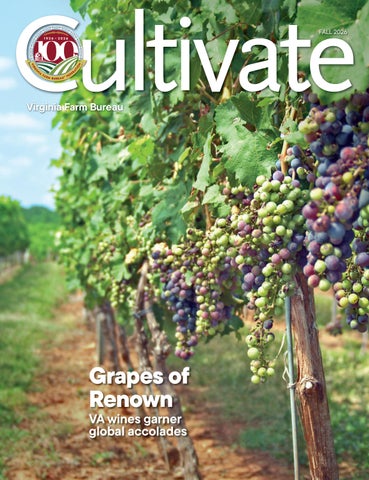
Cultivate FALL 2026
Virginia Farm Bureau
Grapes of Renown VA wines garner global accolades
Volume 19, Number 4 Fall 2026
16
Features 7
14
16
19
“Virginia wine is still evolving.” — MIZUHO NITA, Virginia Tech associate professor of grape pathology
TRUSTED AGENTS
EDITORIAL TEAM
Kathy Dixon Assistant Director, Communications
Dairy farmers are meeting growing demand for local butter by adding the creamy staple to their lineups.
Nicole Zema Sr. Staff Writer/Photographer Christina Amano Dolan Sr. Staff Writer/ Photographer
VIRGINIA VINTAGES
Kenny Kane Graphic Design Manager
Some of the commonwealth’s winemakers are garnering world renown—get your homegrown gifts today!
PUBLICATION SCHEDULE
Eleanor Stickley Sr. Graphic Designer Alice Kemp Sr. Staff Writer/Photographer/ Advertising Coordinator
Departments 3
Did you know?
4
By the numbers
5
For your benefit
28
Heart of the Home
Associate members will receive their next issue of Cultivate in February. The magazine is published quarterly, and back issues can be viewed at issuu.com/virginiafarmbureau. Loving this issue of Cultivate magazine?
Invite a friend to join Farm Bureau so they can enjoy it too!
All advertising is accepted subject to the publisher’s approval. Advertisers must assume liability for the content of their advertising. The publisher assumes no liability for products or services advertised. The publisher maintains the right to cancel advertising for nonpayment or reader complaints about services or products.
Asheley Jewett Chief Marketing & Communications Officer
COW TO CHURN
Some farmers are capitalizing on aromatherapy’s growing acceptance as a wellness practice, and growing herbs that can be transformed into healing oils.
Postmaster: Please send changes of address to, Cultivate, Virginia Farm Bureau Federation, P.O. Box 27552, Richmond, VA 23261; fax 804-290-1096. Editorial and business offices are located at 12580 West Creek Parkway, Richmond, VA 23238. Telephone 804-290-1000, fax 804-290-1096. Email address is Cultivate@vafb.com. Office hours are 8 a.m. to 4:30 p.m., Monday through Friday.
Member: Virginia Press Association
Virginia Farm Bureau insurance agents have provided trusted service to communities for 100 years.
AROMATIC HERBS
KATHY DIXON
Cultivate (USPS 025051) (ISSN 1946-8121) is published four times a year. February, May, August, October. It is published by Virginia Farm Bureau Federation, 12580 West Creek Parkway, Richmond, VA 23238. Periodicals postage rate is paid at Richmond, VA and additional mailing offices. The annual Subscription Rate is $1.13 (included in membership dues).
ON THE COVER Wine grapes take on the terroir of where they're grown (File photo).
VISIT US ONLINE vafb.com
WE’RE SOCIAL!
MEMBERS — Address change? If your address or phone number has changed, or is about to change, contact your county Farm Bureau. They will update your membership and subscription information.
Did you know? Gourds galore: Shapes, colors, uses define these fall staples
Yellow, orange, green, white and even blue. Some are striped, others are speckled, and some even come with warts. We’re talking about a fall favorite—gourds! Gourds are among the oldest cultivated plants. They were the early water bottles of the Egyptians around 2200 B.C., and were traditionally used as utensils, storage containers, and dippers by indigenous people in North America. Today, these garden novelties can be used for many reasons, from ornamental displays and Thanksgiving centerpieces to birdhouses and even luffa sponges in the bath. Gourds
also can be used as musical instruments, vases and bowls. Hundreds of species come in all sorts of unique shapes and sizes. The smallest can be the size of a marble, and the largest over 200 pounds! Gourds are in the same botanical family, Cucurbitaceae, as squash and pumpkins. But gourds usually refer to the hard-shelled, non-edible fruits suitable for décor. Squash and pumpkins can be either edible or ornamental, but they are soft-shelled and won’t last as long. Gardeners and farmers alike grow gourds across the state. At Monticello, Thomas Jefferson grew varieties of gourds, as chronicled in his Garden Book.. He even sketched a Tennessee dancing gourd in a letter to his granddaughter. At the State Fair
of Virginia each fall, some Virginia gardeners enter giant gourds into a competition. In 2019, Dustin Price of Henrico County broke a state record for his giant bushel gourd, which weighed a whopping 344 pounds. According to the Old Farmer’s Almanac Almanac, there are four main types of gourds. Ornamental gourds are small, bright colored with hard, thick skin that often feature unique bumps, stripes, or warts. These are the varieties often used for autumn décor, fall crafts and seasonal holiday displays. Bottle gourds are hard-shelled, bottle- or swan-shaped gourds that last for years. These often are dried out and crafted into birdhouses, water bottles, bowls, musical instruments and dippers. Luffa/sponge gourds are elongated green gourds that dry into fibrous bath sponges. Snake gourds are long, wriggly gourds that resemble snakes. They are used for crafts and didgeridoos.
vafb.com / FALL 2026
3
That’s how many wineries are currently thriving in Virginia, many of them producing world-renowned wines. Read more on page 16.
Farm Bureau Members Receive a
FIND SOLUTIONS. COMPARE PRODUCTS. ENJOY GREAT PRICES. You identify and fix problems to help keep your facilities running and your people safe; Grainger Choice products can help you balance quality, productivity and price. Now that’s partnership!
$500
Exclusive Cash Reward*
on an Eligible New* Ford Truck or Ford Blue Advantage™ Certified Used* Vehicle.
The Farm Bureau Exclusive Cash Reward* is now compatible with AXZD-Plans.
Get balance with Grainger Choice products. VISIT THE GRAINGER PAGE TO LEARN MORE ABOUT THE SAFETY PROGRAM
Ford F-150®
HVAC | Material Handling | Hand Tools | Safety | Electrical | Lighting | Pneumatics Cleaning Supplies & Chemicals | Motors, Pumps & Power Transmission | Fasteners
*Visit FordRecognizesU.com/FarmBureau today for complete offer details! G R AI N G ER . C O M | 1 . 8 0 0 . GR A I N GE R
4
CULTIVATE
For Your Benefit
Fall into savings with tried-and-true Farm Bureau benefits Get discounts on five different car rental brands
Use Member Deals Plus® for exclusive Farm Bureau discounts
Enterprise, National and Alamo are all part of the same family of brands. And now Virginia Farm Bureau members get exclusive savings on all three car rentals! Members will receive a discount of 5% to 20% on these brands. Each of these three rental car companies share the same mission of getting you where you want to go, with excellent customer service along the way. No matter which brand you choose, you’ll enjoy a large selection of clean, reliable rental vehicles and the convenience of more than 7,600 neighborhood and airport locations. Choose from great rates on a large selection of standard, exotic and luxury vehicles. To activate your discount, log in to vafb.com or call 844-661-7135. Save up to 30% off Avis base rates with Virginia Farm Bureau’s Avis Worldwide Discount number. In addition, enjoy additional offers like dollars off, a complimentary upgrade or a free weekend day. Call 800-331-1212 or visit avis.com/vafb to make a reservation. Save up to 35% off Budget base rates with Virginia Farm Bureau’s Budget Customer Discount number. Plus get other great offers like dollars off, a free upgrade or a free weekend day. Call 800-527-0700 or visit budget.com/vafb to make a reservation. Your Virginia Farm Bureau Avis Worldwide Discount number and Budget Customer Discount numbers are available from your county Farm Bureau and in the “Membership at Work” section of vafb.com (Register as a member on the site, and log in first).
Member Deals Plus® uses the nation’s largest private discount network to save you money on meals, clothing, vehicle care and other goods and services. It uses “show your phone” mobile deals that can be accessed anywhere and redeemed from a smartphone at the point of sale, or from a home computer.
Save and stay at Drury Hotels, with free amenities Virginia Farm Bureau members receive a 15% discount off best available rates at Drury Hotels, where extras aren't extra. The discount is valid at more than 150 Drury Hotels locations in 26 states, including Richmond, Virginia. See a full list of locations at druryhotels/locations. All overnight guests will enjoy free hot breakfast; free 5:30-7 p.m. appetizers and cold beverages; free internet access; and kids stay free in their parents’ room. Members simply need to log into vafb.com and use the corporate code provided to make a reservation.
• To register as a new user, visit vafb.com/benefits. • To save with a mobile device, download the “Member Deals Plus” app from the AppStore or Google Play.
Members can enjoy discounts on amusement parks, apparel, dining, gifts, movies, museums and more! For assistance, call Member Deals Plus customer service, 888-275-9136. Member Deals plus and Member Deals Plus are registered trademarks of Virginia Farm Bureau Federation.
Members get free shipping plus up to 20% off KEY Apparel Since 1908, KEY Apparel has crafted quality workwear at an affordable price. KEY Apparel provides comfortable office wear and rugged workwear, all shipped from its headquarters in Fort Scott, Kansas. Virginia Farm Bureau has partnered with KEY to provide members with apparel they can rely on. Virginia Farm Bureau members will receive a 10%-20% discount on all merchandise, plus free shipping on orders over $75. Members can customize garments with state or county Farm Bureau logos, or add personal graphics like sports team and organizational logos. To use this Virginia Farm Bureau benefit, visit vafb.com/benefits, log in as a Virginia Farm Bureau member, and go to the KEY Apparel tab and follow the link to Virginia’s exclusive site.
*Discount subject to availability and cannot be used with other discounts, offers or promotions. Discounts cannot be used with other programs. Advance reservations are required, and blackout dates apply!
vafb.com / FALL 2026
5
A century of supporting our members
The Moyer family, Amelia County
Thank you for your membership! From family farms to hometown communities, Virginia Farm Bureau has been supporting generations of Virginians for 100 years. As a Farm Bureau member, you help advocate for farming, invest in youth, and benefit from a wide range of discounts and services.
Access your benefits at vafb.com
Centennial Spotlight
‘I’m here as your friend’
LYNN DURHAM
CHRISTINA AMANO DOLAN
G
ail Proffitt was almost home from picking up her mother-in-law’s medication when she saw black smoke billowing from her Louisa County neighborhood. Then her son called to deliver the news. “All I could think about was grandma—she was in the house by herself,” Proffitt recalled shakily. “I flew down the road, and the house was fully engulfed.” A small house fire had reached her motherin-law’s oxygen tanks and erupted into a nightmarish blaze—incinerating 40 years of family memories, irreplaceable treasures and everything Proffitt had worked for. She’d lost her husband just two years prior. “I come from a poor family, so I was very grateful for everything I ever had,” she mourned. “When you lose a loved one, you still have physical things to bring the memories back. But when your house burns down completely, you have nothing physical to hold onto.” When reliving the most traumatic day of her life, Proffitt is moved to tears by the miracles. A divine force guided her 90-year-old mother-in-law through the heavy door, and a friend arrived just in time to carry her and the family dog to safety. Proffitt’s gratitude is deepened by memories of her community wrapped around her as she looked upon the rubble—and the moment Lynn Durham emerged from the crowd to embrace her. “She said, ‘I’m not here as your agent. I’m here as your friend,’” Proffitt recalled tearfully. “She told me, ‘I’ll be back with the check tomorrow, but right now, I’m here for you.’”
Clockwise from left: Lynn Durham with a friend at 2024 Rassawek Fall Fest; Durham attends a Rally for Riley community event to help raise funds for her disabled insured's needs; Durham shares a laugh with her insured, Gail Proffitt, in front of Proffitt’s new house after helping her recover from a devastating house fire.
A friend to call, ‘day or night’ After a grueling two-year journey, Proffitt’s new house—built on the same plot of land—has finally started to feel like home. “Farm Bureau was my security blanket,” she reflected. “I never felt neglected. I always felt so supported. And if I ever had any questions, all I had to do was call Lynn.”
CHRISTINA AMANO DOLAN
BY CHRISTINA AMANO DOLAN
PHOTOS CONTRIBUTED BY LYNN DURHAM
VFB agents drive 100 years of trust
Left, Gail Proffitt's Louisa County home before the fire, and after. Proffitt’s newly built home stands on the same plot of land. vafb.com / FALL 2026
7
PHOTOS BY NICOLE ZEMA
From left, Sue Bostic attends a Virginia Farm Bureau board meeting and she chats with Floyd County agent Debbie Shortt during the 2026 VFBMIC Sales Conference.
Striving to make the recovery process as painless as possible for Proffitt, the Goochland County Farm Bureau agent was ready “day or night” to pick up the phone, lend a helping hand and offer a shoulder. “You just think, ‘What would I want from my agent in a time like this?’” Durham reflected. Proffitt’s family members soon came to Durham “in droves,” switching over from other insurance carriers out of admiration and gratitude. “Everybody was so impressed with how the claim was handled throughout—how I was there from the start, and whoever Gail dealt with didn’t miss a beat,” Durham marveled. “I want my customers to feel like their premium dollars are worth it, and Farm Bureau got her back to a good place.” Proffitt chose Durham as her insurance agent eight years ago based on their personal connection as longtime family friends. “In this day and time, it’s hard to find trust in companies or talk to a person instead of a computer,” Proffitt mused. “But because I knew Lynn, that trust was already there—this just reinforced what my gut told me.”
8
CULTIVATE
A trust that spans generations While growing up on her Craig County farm, Sue Bostic developed a lifelong trust in the Farm Bureau name. Like her parents, her family’s assets are all insured with VFB today— from the farm to her daughter’s renter’s policy. “Billy Reynolds was my first agent with Farm Bureau, and he always took care of my family,” Bostic recalled. “I never thought to go anywhere else.” As she began phasing out of her farming career in 2022, Bostic seized the opportunity to serve Roanoke County farmers and families as a VFB insurance agent—fostering lifelong trust with her own personal touch. “As an agent, I still think Farm Bureau takes care of their people,” Bostic said. “I feel like what sets us apart is that all the employees are in Virginia—the agents know their adjusters and somebody in the claims department, so claims are taken care of in a timely manner.” In Hanover County, Toler Cross has called the same insurance agent throughout his life—from insuring his first car 31 years ago to watching his oldest child get behind the wheel today. Cross was among the first enrollees of the Smart Start Program when he began working with Chris Adams, his father’s VFB insurance agent.
“My dad would tell you the same thing—that he just trusts Chris, and that’s why we’re with Farm Bureau,” Cross said. “I’ve never really considered shopping because I’ve always thought, ‘If I’ve got an issue, I’m going to trust the man I’m dealing with.’” That trust was formed over decades of routine insurance phone calls—gradually learning about each other’s families, shared values and lives.
Chris Adams poses with two of his fellow Hanover agents, Mason Duke, left, and Robbie Sanders during the 2026 VFBMIC Sales Conference; he meets regularly with his insurance clients; he and Duke talk shop at the Ashland office; and his memorable “Flat Chris” mini figurines have become a collectible in the community.
PHOTOS BY NICOLE ZEMA
Fueled by a passion for service Now serving as Hanover County agency manager, Adams joined Farm Bureau 31 years ago to serve families in his community. He’d “never imagined” the impact those relationships would have on his career and life, or the reward of watching them grow over multiple generations. “Our clients become part of the Farm Bureau family, and in many ways, we become part of theirs,” he reflected fondly. “We get invited to sit around kitchen tables, celebrate graduations and milestones, and sometimes mourn together at funerals. We share stories, laughter, and yes—even go home with a recipe or two after a visit.” He added that it’s “the life I came here for 31 years ago, and I wouldn’t have wanted it any other way.” Durham added that it’s “a privilege and an honor to be able to serve my community.” When reflecting on Virginia Farm Bureau’s 100-year legacy, Bostic said the organization serves Virginia communities from the grassroots up—from offering student scholarships at the county level to advocating for agriculture, the state’s No. 1 industry. “Farm Bureau’s community involvement across the insurance company, federation and individual county boards has helped push us forward and maintain the company that we are,” she remarked. “We’re not just a fixture—we are the community,” Durham added.
vafb.com / FALL 2026
9
High-powered claims innovations offer AI convenience without losing the human touch BY NICOLE ZEMA
W
hile damage to a home or vehicle is never convenient, Virginia Farm Bureau Mutual Insurance Co.’s options for claims processing feel less disruptive and more responsive to members’ modern communication preferences. For customers who value personal support, adjusters are still available to guide them through a claim, answer questions and inspect damages. But for those who would rather handle the first steps from their phone, innovations in technology are creating more options. Those choices include Plnar® and Hover® for property claims, and Quick Estimate® for auto claims. “It’s all about what the customer wants,” said Anne Baskette, director of claims administration. “We still provide hands-on service. And if a customer wants self service, we have these options.” Each tool helps customers and adjusters gather accurate information and pay claims faster, especially after storms or other incidents when every hour matters. 10
CULTIVATE
Plnar app allows customers to take photos and videos of damaged areas in their homes, and AI generates a report for the adjuster so they can write an estimate remotely.
PLNAR: AI assessment of interior property damage To assess interior property damage, an adjuster traditionally had to measure walls, openings, trim and rooms in person. Now, the Plnar phone app allows customers to take photos and videos of damaged areas inside their home. AI creates measurements and sketches and generates a report which allows an adjuster to write an estimate remotely. That can be especially helpful for those who can’t meet during normal work hours, or who prefer not to have someone in their home for an inspection. “With a customer using their phone to take a few photos and videos, this application makes a diagram with all the measurements,” Baskette said. “And it saves a lot of time.”
HOVER: 3D scanning of property exteriors Hover works similarly for exterior property damage, said Matthew McFarren, property claims manager. By analyzing eight photos—four sides of the structure and four corners—the tool generates a 3D sketch with exterior measurements, including roof dimensions. Exterior structures often include edges, cutouts and overhangs that must be measured correctly so contractors receive a reliable estimate from the start, which expedites the repair phase. “The technology uses AI, common building measurements and geospatial data to extrapolate dimensions from photos,” McFarren said. “The measurements are more accurate than using a tape measure up on roofs!” Hover enables customers to photograph exterior damage and the tool generates a 3D sketch with measurements, which helps contractors give a reliable estimate.
QUICK ESTIMATE: A virtual option for vehicle inspections For auto claims, Quick Estimate is a virtual option for vehicle damage inspections. Roby Young, physical damage manager, said the process is designed for claims where the vehicle is drivable, and damage can be reviewed through photos. Customers receive a link on their smartphone—without downloading an app—that walks them through what photos are needed. It guides them around the vehicle, helps scan and decode the VIN, and submits the images directly to claims staff. “We are actually giving more control to the customer,” Young said. On average, estimates can now be initiated and completed within a business day. Baskette said the process can shorten what once took several days or longer, depending on appointments with body shops and adjusters. Non-drivable vehicles, obvious total losses or complex damage may still require a different claims path. Young emphasized that virtual options are not one-size-fits-all. “These new tools aren’t something we’re forcing on members,” he said. “We’re giving them choices.”
Virginia Farm Bureau Mutual Insurance Co. coverage options for watercraft include motor boats, pontoon boats and other Quick Estimate is a virtual option for personal watercraft devices. vehicle damage inspections.
A digital payment option helps members access funds quickly.
DIGITAL PAYMENTS: Quick and convenient A digital payment option helps members access funds quickly when they need it most. Through this feature, an adjuster can send an eligible member a text message with a secure link to review and accept a claims payment. Once accepted, the member
can choose from available payment options, including instant deposit to a debit card, direct deposit or printing a check for personal banking. In some cases, Baskette said the process can move remarkably fast—the shortest turnaround so far from the adjuster’s text to the member receiving funds on a debit card was about four minutes. “A prompt claim payment can help a member secure temporary housing after a fire or water loss, replace essential personal items after storm damage, or put money toward another vehicle after a total loss,” she said. The option is available for eligible consumer claim payments, including payments to a single named insured or, in certain situations, two-party consumer payments such as a husband and wife or parent and child. Eligibility depends on the claim and how the insureds are listed, so members should talk with their adjuster to determine whether a digital payment is available for their specific situation. Visit vafb.com/claims for more information.
vafb.com / FALL 2026
11
Domestic food depends on Foreign labor On many Virginia farms, foreign workers are not a financial shortcut or a last resort—they are trusted partners in keeping local ag products growing close to home.
ARTICLE & PHOTOS BY NICOLE ZEMA
An H-2A worker works a field of tobacco on Robert J. Mills Jr.'s farm in Pittsylvania County.
he federal H-2A guest worker program is often talked about in political terms. But on the farm, it’s personal. For growers like Dana Boyle of Garner’s Produce in Westmoreland County, H-2A workers are not nameless bodies providing labor. They are returning crew members, skilled employees and, over time, cherished like relatives. “We’re not blood kin,” Boyle said. “But on the farm, we’re all family here. They depend on us as much as we depend on them.” H-2A workers are authorized temporary agricultural workers who come to the U.S. through a legal visa program. Farmers say it’s vital the H-2A program is reliable and efficient. At stake is more than farm profitability—it’s the ability to produce a stable food supply here at home. “If foreign workers didn't produce our food, Americans would rely on food produced in foreign places,” said Pittsylvania County tobacco grower Robert Mills, vice president of Virginia Farm Bureau Federation. This year, bottlenecks in H-2A application processing delayed the arrival of essential agricultural guest workers for 72 Virginia farmers. The delays underscored how one missed planting or harvest window can mean
12
CULTIVATE
fewer agricultural products from local farms and more dependence on food grown elsewhere. ‘Trust between us’ Mills believes federal reforms are necessary not just for farmers, but for workers as well. Proposed legislation, including the Securing Agriculture’s Workforce Act, has sought to modernize parts of the H-2A system by addressing processing, flexibility, wages and access for more types of agricultural operations. “This can ensure long-term viability for my farm,” he said. “And long-term employment for my 11 workers.” Omar Avalos has returned to the farm for 14 years, where workers affectionately refer to Mills as El Patrón— Spanish for “boss.” During the holidays, Mills gets calls from Mexico just to say, “Merry Christmas, Patrón!” “You arrive as a worker, but after enough seasons you become part of each other’s lives,” Avalos said. “I knew Robert’s children when they were little. Now they’re grown. When you spend that much time working together, year after year, you become attached. There’s a lot of trust between us. It feels almost like family.”
For consumers, one meaningful way to support domestic food production is by challenging common myths about H-2A partners who help make that production possible. ‘H-2A workers take jobs from Americans’ “There's a lot of misconception around ‘taking American jobs,’” Boyle said. “No matter the dollar amount or hours offered, it's been years since I have had a domestic applicant for those positions. These jobs are hard. They're labor intensive with early mornings and late nights, which is just not attractive to people.” Farmers are legally required to first advertise H-2A jobs domestically and show there are not enough able, willing and qualified U.S. workers available before they can hire foreign workers. Only 182 domestic applications were submitted for 415,000 advertised temporary agricultural positions on U.S. farms last year, according to American Farm Bureau Federation. That’s a rate of just 0.04%. These numbers confirm what farmers already know: The work is essential, but very few local applicants are willing to do it. In 25 years of H-2A involvement, Boyle now employs six workers alongside domestic employees at her produce operation. Without foreign workers, she said, critical tasks simply would not get done. “We need a steady, consistent, dependable workforce,” she said. “Because the vegetables won't stay on hold!” ‘Guest workers are undocumented’ Seasonal workforce services guide all parties through complex federal application processes, during which they are screened by Department of Homeland Security for inadmissibility to the U.S. and interviewed by State Department officials. Guest workers enter the country for a specified period and generally must return at the end of their contracts. Fewer than 2% of workers across all visa programs—not just the H-2A program—overstay their visa, according to AFBF.
Garner’s Produce employs long-time H-2A employees who have become like family.
‘H-2A is cheap labor’ Boyle said the labor rate itself is only one part of what the program costs. Employers must meet federal hourly wage requirements currently averaging $15.96, plus cover or reimburse many costs connected to housing, transportation, recruitment, paperwork and worker travel. Mills said he spends more than $1,600 per worker by the time they fly home at season’s end, not counting hourly wages. ‘Guest workers are poorly treated’ Farmers acknowledge that while no system is immune from bad actors, the H-2A program includes contracts, wage rules, housing standards and oversight intended to protect workers. The program is regulated by the U.S. Department of Labor, which may audit employers and inspect housing or working conditions. “We have everything we need while we’re here,” said Omar Basilio, who has returned to Boyle’s farm for 13 seasons. “At home, they pay very little for this kind of work. But coming here helps support my family. We’ve been able to build a house and live a little better.” Boyle, in turn, has traveled to Mexico to visit workers’ families for weddings, baptisms and funerals. Mills said housing is inspected, vehicles are checked and workers always receive new personal protective equipment. And the team is free to run errands and dine out during downtime. Avalos plans to return in 2027 for a 15th season of farmwork. “If God permits,” he said. “And if the boss still needs me!”
vafb.com / FALL 2026
13
rs churn Virginia cream Farmers into artisan butter
A
ARTICLE & PHOTOS BY ALICE KEMP
s dairy farmers face growing markets for cheese, ice cream and yogurt, some local creameries are adding another staple to their lineup. “There’s really good demand for local butter,” said Jeremy Daubert, a Virginia Cooperative Extension dairy science agent in Rockingham County. “A lot of local restaurants like to purchase it.” And the cow matters just as much as the craft, Daubert said. Holsteins remain a favorite for their high milk production while Jerseys are a close second for their milk butterfat content. “Both of them make a really good butter,” he said. “Then there’s Brown Swiss, Ayrshires, and Guernseys.” Guernseys are known for their milk having “a bit more of a golden color” from beta carotene that carries through. Although it’s “easy to make, there are some challenges,” Daubert noted. “There’s a lot of byproduct in the skim milk,” that gets drained, he explained. “that’s one of the biggest obstacles—what to do with that skim milk.” Still, “I think we’ll see more people making butter,” he said. “It’s a great option.”
A family business At Mt. Crawford Creamery in Rockingham County, butter has been part of the Will family’s operation since it opened in 2013. “You look at your old-fashioned creameries, and they always had their milk and butter,” said Frank Will, who owns the operation with his brother, Kenneth. “It’s something we always wanted to do.” A herd of Holsteins and Jerseys provide much of the dairy’s cream, which is pasteurized and aged several days to build flavor and ease churning. It then “tumbles and spins” inside a 75-gallon barrel churn for 10-15 minutes at 65 degrees, transforming from whipped cream to curds then to thick, smooth butter. Drained of buttermilk and rinsed, it’s worked by hand before being packaged in unsalted and salted varieties. “Last year, we did around 9,000 pounds,” Will said. “Our salted butter accounts for 65-70% of sales.” The process takes under an hour for an 80-pound batch. But compared to the high-speed augers of commercial plants, the creamery’s slow-churned butter “isn’t as airy as your other butters,”
A herd of Holsteins and Jersey cows provide the cream that was made into 9,000 pounds of butter last year at Mt. Crawford Creamery.
14
CULTIVATE
Above, Frank Will’s nephew Jeremy is in charge of butter operations at Mt. Crawford Creamery in Rockingham County. Creamery employees salt a finished batch of butter before it’s packaged.
Will explained. “It’s a little denser.” The family’s rich, small-batch butter is popular among customers, but the availability of cream and labor makes increasing production difficult. As demand for whole milk increases, “cream stays in the milk,” and operations must balance milk and butter production. “We could always sell more than we make,” he said. “People keep buying it. There’s been times we’ve had to limit how much a customer can get.” Sold at the creamery store and in markets across central Virginia, customers, bakeries and restaurants buy it by the pound or in bulk 20-pound boxes. “I don’t care if it’s spread on toast or used for cooking, it’s hard to beat a good butter,” Will said.
FLEUR-DE-LIS FARM
Along with crafting artisan butter, Cappie and John host butter making workshops during the ‘slow season’ on their Fleur-de-lis Farm in Henrico County. Flavored varieties include lemon dill, brown sugar cinnamon and everything bagel seasoning.
Crafting artisan flavors For Cappie and John Montgomery of Fleur-de-lis Farms in Henrico County, crafting artisan butter evolved from a side project into a farmers market favorite. Beyond classic salted butter, the couple built a following for flavored varieties—lemon dill, brown sugar cinnamon, everything bagel seasoning and their popular seasonal garlic scape butter. “It’s just so much fun to do,” said Cappie, who manages the farm’s creamery. Their butter venture began during a cheesemaking workshop in Vermont where the couple learned other uses for cream. Sourcing highbutterfat cream from Richlands Dairy and Creamery in Dinwiddie, they make a European-style butter—slow pasteurizing cream before adding a culture to ferment. “It brings more depth of flavor, almost like a nuttiness,” Cappie described. The couple was introduced to Richlands after Cappie founded Henrico’s Dorey Park Farmers Market, where the creamery
previously sold ice cream. Alongside purchasing quality cream, they wanted a relationship with a local dairy they trust. “We know them and can visit the farm,” John said. “We’ve seen their process and how they care for their animals—that’s really important to us.” At Fleur-de-lis, a wide-paddled butter churner agitates the fermented cream into a blank canvas for Cappie’s creativity, and in true farm-to-table fashion, she’s inspired by what they cultivate. They grow and dehydrate herbs for herb-based flavors like basil butter, and jalapenos for zingy jalapeno butter. Honey from their beehives is used for their succulent orange and honey butter. “I just like to experiment,” she quipped. “We usually have two savory and two sweet at the market,” added John, the salesman of the duo. While Cappie crafts flavor, he recommends recipes to customers each Saturday morning. “We sell out every week,” John said. Once customers try it, “it sells itself, really.”
tter
de bu a m e m o H
Looking for a fun project this fall? Try your hand at homemade butter! INGREDIENTS
2 cups heavy whipping cream at room temperature ¼ teaspoon salt, optional Optional: chopped herbs, honey, lemon zest, garlic or other seasonings for flavor. DIRECTIONS
Pour the heavy cream into a food processor or blender and process on high until the butter separates from buttermilk, about 10 minutes. Strain the liquid then press the butter into a bowl with the back of a spoon to remove more liquid. Rinse and press the butter under cold water to remove excess buttermilk. Add the salt and other seasonings if using. Wrap the butter in parchment paper and refrigerate up to one week or freeze up to six months.
vafb.com / FALL 2026
15
S E G A T N VI rown
g e A m I o h , N d I e n G w o n R e I r V rldWo
V
irginia wine has carried the charm of a well-kept regional secret— beloved by locals, discovered by travelers and quietly refined by growers learning how to coax quality from humid summers, varied soils and mountain-cooled nights. Today, that secret is traveling far beyond local tasting rooms. Virginia wines are earning international medals and praise from global critics. Consumers can now find bottles that reflect the commonwealth’s diverse growing regions. Mizuho Nita, Ph.D., Virginia Tech associate professor of grape pathology, said Virginia wines have gone from promising to competitive thanks to growers’ persistence over recent decades. “Virginia wine is still evolving,” Nita said. “The history behind us is not a long history. France has had hundreds of years to figure it out.” Field-level precision is helping Virginia build a reputation not by imitating older wine regions, but by defining its own style. Cabernet franc, chambourcin, chardonnay, petit manseng, Viognier and sparkling wines have become part of a 16
CULTIVATE
broader conversation about what Virginia wine can be. “Growers take a holistic approach, making choices based on characteristics of the soil and geographical features,” Nita said. “They find what works best, which eventually becomes a region’s signature.” Recent international recognition for the Monticello American Viticultural Area, including medals at the Decanter World Wine Awards, suggests that critics are noticing that the state’s complicated climate can produce wines with freshness, structure and a clear sense of place.
Virginia’s 300 wineries have become destinations—A weekend
in Virginia wine country can include a guided library tasting, a fireside dinner, a vineyard cottage stay or a bottle shared on a terrace overlooking rows of vines. Visit virginiawine.org to map a route through Virginia’s wine regions, reserve tasting passes, find nearby wineries, read the latest news and find events near you. With over 5,000 acres of grapes statewide, Virginia is home to 10 regions
NICOLE ZEMA
s, n o i peal g p e a r l e a n b i o l w ith g tinct w s i s d e s ’ g a a i t n i n i v A irg Across V wers are crafting f place | BY NICOLE ZEM eo gro s n e s e l b istaka m n u n a and
Mizuho Nita, Ph.D., Virginia Tech associate professor of grape pathology, says Virginia wines have grown competitive.
and eight distinct American Viticultural Areas. Visit virginiawine.org/guide for guides listing wineries in each region. A Wine Region is a broad, general term for any place that makes wine, which can include an American Viticultural Area, or AVA, a whole state, county, or an informal marketing zone. Officially designated by the U.S. Alcohol and Tobacco Tax and Trade Bureau, an AVA is a named grape-growing region with specific geographic, geological or climatic features distinguishing it from surrounding regions.
NICOLE ZEMA
S
CHESAPEAKE BAY REGION
This historic, bay-influenced region offers sandy soils, a temperate climate and natural pairing opportunities with Virginia oysters. Bay moderation gives Northern Neck George Washington Birthplace AVA one of Virginia’s longest frost-free seasons, supporting cabernet franc, chardonnay, vidal and chambourcin.
EASTERN SHORE REGION
Small towns, family farms and maritime breezes define the Eastern Shore, where a long fall helps grapes ripen evenly. Virginia’s Eastern Shore AVA is lowlying, framed by the Chesapeake Bay and Atlantic Ocean, with water breezes moderating summer heat.
HAMPTON ROADS REGION
BLUE RIDGE REGION
Blue Ridge vineyards benefit from well-drained loam and gravel soils, higher elevations and cool mountain air. North Fork of Roanoke AVA’s gravelly soils and high elevations on the eastern slopes of the Allegheny Mountains favor cabernet franc, merlot, cabernet sauvignon and Bordeaux-style blends. The Rocky Knob AVA relies on well-drained soils and elevations up to 3,500 feet to reduce humidity and produce ripe, fresh wines.
Hampton Roads blends colonial history, coastal cities and year-round temperate conditions with fertile soils suited to quality wine grapes. Virginia Peninsula AVA is Virginia’s newest AVA that stretches between the James and York River estuaries, where coastal breezes, moderate temperatures and sedimentary soils shape the wines.
HEART OF APPALACHIA REGION Mountain scenery, orchards and rural
NORTHERN VIRGINIA REGION
Northern Virginia offers respected wineries, rolling hills and granite- and sandstone-derived soils with strong drainage. Middleburg Virginia AVA is framed by the Potomac River and surrounding mountains, with two dozen wineries to explore.
SHENANDOAH VALLEY REGION
Historic towns, rolling pastures and fall color make the Shenandoah Valley one of Virginia’s most scenic wine destinations. Protected by mountain ranges, Shenandoah Valley AVA’s limestonerich valley creates a rain shadow and supports grapes from Riesling and pinot noir to chardonnay and cabernet franc.
SOUTHERN VIRGINIA REGION
Southern Virginia’s warm, rural landscape supports full-ripening varieties and a growing wine scene rooted in farm country.
VIRGINIA MOUNTAINS REGION
With some of the East’s highest elevations, this mountain region is known for fresh, elegant wines from family-run wineries.
NICOLE ZEMA
Those distinctions matter as Virginia continues shaping a wine identity rooted in place, Nita said. These regional characteristics aid growers in developing region- or site-specific sustainable viticultural practices. “AVAs are set based on growing conditions,” he continued. “But in the years ahead, these unique differences in the environment and viticulture could help consumers begin to associate specific Virginia places with specific styles of wine or certain grape cultivars.”
charm define this region, where wineries produce reds, whites, rosés and fruit wines.
CENTRAL VIRGINIA REGION
Central Virginia pairs Jefferson-era wine history with granite and clay soils that lend structure and savory character. Along the eastern Blue Ridge slopes, Monticello AVA’s mountain gaps draw in cool air, extending the growing season for cabernet franc, chardonnay and Viognier.
Virginia Farm Bureau was the premier sponsor of this year’s Virginia Wine Expo, held in Richmond in early March.
vafb.com / FALL 2026
17
VIRGINIA VINTAGES
Give Virginia wine, and support Virginia vineyards Virginians can turn holiday celebrations into direct support for local vineyards, wineries and family farm businesses. Start at the source—visit a nearby winery tasting room, ask staff what bottles best suit your menu, and consider gifting a wine club membership, tasting experience or overnight wine-country getaway. Sparkling wines are festive gifts, and versatile since they match a wide variety of foods. Cabernet franc, Viognier, petit manseng and red blends are ideal for feasts. Ask for Virginia-made wines at local wine shops, specialty retailers, farm markets and restaurants. Many wineries offer gift cards and online shipping where permitted, making it simple to send a favorite bottle to loved ones.
SHENANDOAH VALLEY & VIRGINIA MOUNTAINS REGIONS
NORTHERN VIRGINIA REGION
CHESAPEAKE BAY REGION EASTERN SHORE REGION
HEART OF APPALACHIA REGION
BLUE RIDGE REGION SOUTHERN VIRGINIA REGION
18
CULTIVATE
CENTRAL VIRGINIA REGION
HAMPTON ROADS REGION
Homegrown harmony Harnessing Virginia flowers’ aromatic powers
vafb.com / FALL 2026
19
| MULTI-GENERATIONAL ORCHARDS |
ELIJAH GRILES
Homegrown harmony
H
BY CHRISTINA AMANO DOLAN
umans have long sought healing and harmony in Mother Nature’s exquisite offerings. The use of botanicals to promote spiritual, psychological and physical well-being spans human history. Ancient civilizations used fragrant plants, resins and oils for medicine, religious rituals, relaxation and personal care—setting the stage for modern aromatherapy. Aromatherapy refers to the inhalation and topical application of authentic essential oils from aromatic plants to restore or enhance health, beauty and well-being, according to the Alliance of International Aromatherapists. From helping curate calming spaces to promoting sleep, tranquility and selfcare, aromatherapy is a growing wellness practice worldwide—inspiring consumers, healthcare professionals, researchers and growers to explore the ancient art of aromatherapy.
Sowing serenity Katrina Wells began cultivating her Lunenburg County lavender paradise in 2019 as a form of self-love. While helping her mother through a difficult battle with dementia, Wells yearned for a quiet escape. Surrounded by a vast green canvas 20
CULTIVATE
on her family’s 125-acre farm, she set out to find her inner peace by pursuing lifelong passions. “Growing up on a farm, it’s in my roots to love digging in the soil, planting something and watching it grow—and I’ve always loved lavender,” she reflected. “It was therapy for me, so the more I needed, the more I planted.” She now cares for 3,000 lavender plants on her 2-acre hillside haven, welcoming visitors from all walks of life to her picturesque U-pick fields and cozy farm store—where Wells’ handcrafted lavender wellness products come in all shapes and sizes. “When COVID hit and everyone was stuck at home, I thought, ‘I’m going to take this opportunity to learn how to make soap for friends and family,’” she recalled. “It’s grown into more than I ever imagined.”
Lavender love in ‘a little bit of everything’ Retiring from a 39-year nursing career last year, Wells’ pandemic-era pastime has blossomed into a full-time gig. “I’m as busy as I want to be, and I really enjoy meeting people from all over— especially in June, when people ride out just to see the lavender fields in bloom,” she mused.
Visitors to the Lunenburg Lavender store will find Wells mingling with customers while restocking shelves, manning the register, taking café orders, or preparing lavender lattes and homemade baked goods in the kitchen. When she’s not harvesting lavender, pruning plants or drying bouquets in her spare time, she’s often in her commercial kitchen concocting “every lavender product you can imagine”—from essential oils, creams, body butters and bug spray to lotions, facial serums, soaps, candles and scent boosters. “I make a little bit of everything, and my sister sends me suggestions all the time,” she laughed. “And I’ll tell her, ‘I’m making everything I can right now!’” Wells’ lavender products are made with essential oils and floral water captured through the steam distillation process. She places her hybrid French lavender—a prolific oil producer—in a still with water. As the water boils, steam rises and releases the plants’ aromatic oils while isolating the fragrant water byproduct known as “hydrosol.” She said it takes about 35 pounds of lavender matter to produce about 35 milliliters of oil, but it doesn’t take a lot of oil to produce products.
“Lavender is such a universal product,” Wells marveled. “Most people associate it with rest and relaxation, but it’s also a kind of natural first aid.” She offers sinus relief with lavender oil, peppermint, eucalyptus, menthol and other natural ingredients. “I’ve found that a lot of people are really starting to be concerned about what they put on their body and knowing what the ingredients are,” she remarked. “It’s a wonderful thing to be able to buy and gift products that have been grown and made by hand locally, and we know exactly what’s in them.” Consumers can treat themselves and loved ones to Wells’ lavender products by visiting lunenburglavender.com, or stopping by the farm store. The store is generally open Thursdays and Fridays from 10 a.m.-4 p.m., and on some Saturdays during the holiday season.
Katrina Wells turned her pandemic hobby into a thriving aromatherapy business on her Lunenburg County lavender farm.
CHRISTINA AMANO DOLAN
Lavender aromatherapy is gaining recognition as a promising complementary wellness practice, with various studies indicating improved sleep, lowered anxiety, reduced pain and other perceived benefits in participants. “In my nursing career, it always had to be a prescription to be worth its weight, but now healthcare providers are really starting to look at what aromatherapy can do to add comfort,” Wells reflected. Research has shown that plant odors have a significant effect on human emotions and memories, as smell signals connect directly to the brain’s emotional and memory centers. Many of Wells’ customers enjoy using her magnesium lavender lotion and lavender room spray on linens to help induce restful sleep, as well as her portable lavender oil for on-the-go relaxation.
ELIJAH GRILES
A growing movement
Wells’ aromatherapy products are sold in her farm store and online.
Use with care
When trying out any aromatherapy product, Wells advises “starting small” with topical applications and understanding the products’ intended uses. While topical essential oils are generally diluted, some oils are highly potent and not appropriate for skin. “Approach each oil with safety and make sure you don’t have a sensitivity to it, because there’s always that chance with anything,” she cautioned. Other important considerations: Don’t ingest essential oils unless a product is specifically formulated and labeled for that purpose, and keep oils away from children and pets to avoid unsafe consumption. Some oils can interact with medications or be inappropriate for particular populations. Consult with a healthcare professional when in doubt. With diffusion, less is more. Avoid oversaturating a room with concentrated fragrance, especially around people with respiratory sensitivities.
vafb.com / FALL 2026
21
NICOLE ZEMA
Heroines of food security:
Women in ag address hunger across the state
Share the Spare, founder –Blacksburg BY NICOLE ZEMA
Abundance is conspicuous while food insecurity can hide in plain sight. At the weekly Blacksburg Farmers Market, Lynn Brammer witnessed two types of abundance—the agricultural bounty of the New River Valley and the affluence of local shoppers. However, the food-insecure students, single parents and aging veterans didn’t fit the stereotype of hunger in the community. This disconnect inspired Brammer to start Share the Spare in 2010. “I know they could probably afford one more tomato,” Brammer remembered thinking as she watched shoppers fill their market bags. She imagined a simple table where shoppers could donate an extra vegetable or two for neighbors in need. Brammer carried the idea back to her New River Valley Master Gardener coordinator who sanctioned the program, which led to a volunteer team 22
CULTIVATE
dedicated to carrying out the mission. Now from June through September, Brammer and other volunteers staff the farmers market table. The booth serves two missions: A plant
clinic where visitors can ask gardening questions, pick up seeds and learn from Virginia Cooperative Extension-trained experts; and a produce collection point for fresh food donations. Shoppers can PHOTO COURTESY OF BLACKSBURG FARMERS MARKET
LYNN BRAMMER
Lynn Brammer, at right, with Qing Fan
TAMMY COLE Healthy Harvest Fresh, director of operations–Warsaw BY CHRISTINA AMANO DOLAN
Tammy Cole’s love of exploration, lifelong learning and uplifting others has culminated in her greatest adventure yet—fighting hunger with innovation. Cole’s journey to cultivating a
MORGAN ROCKOVICH
buy extra items for the basket and farmers frequently donate unsold produce at the end of the day. “And we collect people’s excess backyard produce when they have an abundance,” Brammer said. “Maybe you have zucchini coming out of your ears and your neighbors have drawn their blinds and said, ‘Enough!’ Bring them to us on a Saturday and we can guarantee we’re going to get them on someone’s plate by Monday.” Once collected, the produce moves quickly. Brammer stocks the community refrigerator at Cooper House in Blacksburg, operated by the Future Economy Collective. She also delivers larger quantities to Interfaith Food Pantry, where refrigeration space makes it possible to get fresh food onto plates while it is still at its best. Share the Spare also collaborates with the New River Valley Glean Team that organizes larger garden harvesting and gleaning projects. Over the years, Brammer has learned that generosity often starts small. “A little girl once came and observed what we were doing and asked questions,” she recalled. “There was never a week that went by after that the family didn’t buy something and put it in our basket. I could cry when I think of those stories. It’s beautiful.” For Brammer, the work is as much about reducing waste as relieving hunger. Farmers once told her the peppers and greens they donated would otherwise feed pigs or return to the compost pile. Now, she sees each basket as a bridge— between local growers and local families, between plenty and need, and between people who may never meet but are connected by one spare tomato.
Tammy Cole
one-of-a-kind educational center and aquaponics production facility in Virginia began on her family’s Grayson County tobacco and livestock farm—where “trying something new” was a way of life. “My dad was my ag teacher, and we dabbled in a little bit of everything— from beef and dairy cattle to sheep and nursery stock trees,” she recalled fondly. “Thank goodness I started paying attention when I was little!” With years of hands-on learning under her belt, Cole embarked on a career of paying it forward. After teaching high school agriculture in Galax for seven years, she helped enrich statewide classrooms as a Virginia Department of Education curriculum specialist for agriculture education. “Our department head called us, ‘honey bees,’” she explained. “We took the wisdom of veteran agriculture teachers and new ideas of those just getting started, and ‘pollinated’ them across the state.” Cole later taught agriculture at Essex County High School before helping establish the Northern Neck Technical Center’s horticulture and landscaping program. Naturally, her students dabbled in everything, including aquaponics. Aquaponics combines fish culture and hydroponics in a recirculating, symbiotic
system that’s “beautiful for education.” The plants harvest the nutrients in the water provided by the fish through a multi-step filtration process. Cole’s curriculum caught the attention of Mark Kleinschmidt, her student’s father and then-president and CEO of Healthy Harvest Food Bank. He offered her the role of a lifetime: spearheading a brandnew 11,700 square-foot aquaponics production space to help nourish neighbors in need. “I’ve always felt drawn to mission work, and the man upstairs opened a window,” she reflected. “It was a really easy step to make.” Healthy Harvest Fresh has blossomed since opening in 2024. Largely run by director of operations Cole and production manager Ben Lewis, Cole’s former student, the HHF team grows premium-quality produce for the food bank’s 34 affiliate pantries and regional schools. They hope to eventually supply 140,000 pounds of protein and vegetables year-round to schools and food banks across Virginia. Cole enjoys opening up HHF’s production space and adjoining classroom to educate visitors of all ages on the importance of fresh food and sustainable agriculture. “Everything inside that greenhouse vafb.com / FALL 2026
23
Heroines of food security
KATHY DIXON
supports one another, and our community supports what we do for the community,” she remarked. “It draws a beautiful picture, and I love sharing that with people.”
FAYE HUNDLEY VFBF Women’s Leadership Committee chair–Essex County BY ALICE KEMP
During last year’s Virginia Farm Bureau Annual Convention in Williamsburg, Women’s Leadership Committee members worked shoulder to shoulder— measuring ingredients, filling bags, and packing meal kits. By the end of the two-hour service project, they’d packed 10,000 meals for area food banks and pantries to distribute to local families in need. Since 1965, the Virginia Farm Bureau Federation Women’s Leadership Committee and its network of 88 county committees have promoted agricultural education and community service. Helping families access nutritious food has become an increasingly important part of that mission. 24
CULTIVATE
“We’re the ones that grow it, and we want people to have healthy food choices,” said WLC Chair Faye Hundley, who grows small grains with her husband, Jay, in Essex County. “Our ladies help with food insecurity in so many ways. Committees donate food for school backpack programs, contribute to local pantries, and they pull sweet corn and dig potatoes for gleaning programs.” Women’s committees frequently partner with local food banks and organizations like Ronald McDonald House Charities to provide meals for families facing difficult circumstances. But as rising grocery prices stress already-strained budgets, “demand just keeps going up. “You go to the grocery store and see tons of food, but you don’t realize how many people can’t afford it,” said Hundley, who has chaired the WLC for 10 of her 17 years on the committee. The Federation of Virginia Food Banks reports one in eight Virginians struggle to afford food. Eight in 10 localities with the highest rate of food insecurity are rural, concentrated in Southwest Virginia. Women in agriculture understand firsthand where food comes from and challenges that can affect its availability and affordability, Hundley said. Through volunteer work, committee members have seen long lines at food pantries and even children saving portions of school lunches to take home. “I’ve delivered food through Meals on Wheels and had face-to-face conversations with people facing hunger,” she commented. During the COVID-19 pandemic, Hundley spearheaded a statewide peanut butter and jelly drive to provide children with a healthy source of protein when school closures cut off access to regular school meals. Collecting over 4,300 pounds in its first year, the summer drive became an annual effort replicated across the state. Hundley noted that while the work looks different across each county committee—packing meals in one, hosting food drives in the next, gleaning in another—the commitment to helping
their communities remains the same. “It has a huge impact,” Hundley said. “I’ve had people tell me, ‘If you need help or want something done, reach out to the local women’s committee and they’ll make it happen.’”
BY THE NUMBERS:
Women’s Leadership Committees are feeding communities MEAL PACKING: » Across the state, committees have spearheaded efforts to pack over 35,000 meals between 2025-2026. HIGHLIGHTS: » 5,000 meals were packed for Feed More at the Women’s Leadership Conference in Spring 2025. » 10,000 meals were packed and distributed to Williamsburg House of Mercy and Grove Christian Outreach during the 2025 Annual Convention in Williamsburg. » Russell, Tazewell, Wise-Dickenson, Washington and Smyth women’s committees spearheaded efforts to pack 15,000 meals distributed to food banks and pantries across the counties. » Orange County Women’s Committee packed 5,000 meals distributed to those in need.
PB&J DRIVE: During the COVID-19 pandemic, food banks were under strain from higher demand and many schoolchildren faced greater food insecurity, combined with seasonal impacts of students being out of school. Since 2020, Women’s Leadership Committees across the state have collected over 10,300 pounds of PB&J for food banks.
Avoid the costly surprise of Medicare’s two-year income lookback BY CHRISTINA AMANO DOLAN
M
edicare’s most overlooked rule may announce itself in a shocking premium notice—thrusting unprepared retirees into a financial nightmare. For many approaching retirement, Medicare planning revolves around the straightforward steps: enroll in Medicare; choose a plan type; then budget for premiums. But a lesser-known rule—known as the Income-Related Monthly Adjustment Amount—“blindsides countless retirees each year,” cautioned Charles Sowers, senior market account executive for VAFB Health Insurance Solutions. “Understanding how IRMAA works, what triggers it, and how to appeal it can
26
CULTIVATE
save retirees thousands of dollars and a lot of frustration,” he noted.
Understanding IRMAA IRMAA is an additional charge added to Medicare Part B and Part D premiums for higher income beneficiaries. It applies to individuals whose Modified Adjusted Gross Income exceeds certain thresholds set annually by the federal government. While most assume Medicare premiums are based on current income, Social Security uses your MAGI from two years prior to determine whether you owe IRMAA. “IRMAA is a cliff—when you fall off, you fall off,” Sowers noted. “Even one dollar over the threshold triggers the full surcharge for the entire year.”
IRMAA can catch retirees off-guard when activated by income events that feel unconventional, including: » Retirement. Your last high-earning year controls premiums two years later. » Large Roth conversions » Capital gains from selling a home, rental property or business. » Severance packages or lump-sum payouts » Required Minimum Distributions » One-time investment distributions » A spouse’s death, which changes filing status and can push income into higher brackets.
Preparation is paramount Since IRMAA uses income from two years prior, planning should
begin before the lookback window, Sowers advised.
Those approaching retirement can prepare by: » Planning the two years leading up to their retirement date. » Avoiding Roth conversions and other large taxable events during the lookback window. » Dispersing income events across multiple years. » Using qualified charitable distributions to reduce taxable income. » Coordinating required minimum distributions and investment withdrawals with a tax professional. » Consulting a fee-only financial planner specializing in retirement income; a certified public accountant familiar with MAGI and IRMAA thresholds; or a Medicare advisor who understands IRMAA brackets and appeals.
Appealing IRMAA Retirees can submit an SSA-44 form to Social Security to request a reduction or elimination of IRMAA when income drops with a qualifying life-changing event: • Retirement • Work reduction • Marriage • Divorce • Death of a spouse • Involuntary loss of income-producing property • A loss or reduction of pension income • Employer settlement due to bankruptcy SSA-44 forms can be submitted any time after the qualifying event occurs, though updated income estimates may be required if filing early in the year. Social Security requires proof of both the event and income change—like an employer letter confirming retirement or reduced hours; severance or pension
documentation; a divorce decree; death certificate; insurance or disaster documentation for loss of property; pension plan statements; tax returns or estimated MAGI worksheets. Clear documentation can result in a smoother appeal process. However, winning an appeal does not guarantee a permanent fix—IRMAA may return the following year if your income rises again. Additionally, IRMAA may apply regardless of which Medicare plan type is chosen. Many beneficiaries find themselves in the lowest income range. However, since IRMAA is reviewed annually, it’s important to understand how it works. For current IRMAA income brackets, visit Medicare. gov/publications and search 11579. Contact your local Farm Bureau office, or call 1-800-229-7779 for more information.
vafb.com / FALL 2026
27
Heart of the Home
Enjoy a Virginia-made holiday feast
Honey Orange Glazed Ham
T
he holidays are a time for gathering, sharing and savoring the foods that make the season feel special. And with a succulent ham taking center stage, locally grown sides can complete a festive meal while showcasing the bounty of Virginia farms. Sweet potatoes and winter squash add warmth and color, crisp apples and pears bring a touch of brightness, and hearty vegetables and leafy greens provide a fresh complement to the savory main dish. Whether roasted, baked or simply tossed with a few fresh ingredients, these seasonal staples offer plenty of inspiration and Virginia variety to holiday gatherings. This season, complement your ham with sides made from ingredients grown close to home, as the commonwealth’s farmers provide an abundance of fresh, flavorful foods that can make holiday traditions even more delicious. 28
CULTIVATE
Honey Orange Glazed Ham INGREDIENTS
8 pounds fully cooked boneless ham 2 tablespoons orange juice 1 cup honey ¼ teaspoon ground cinnamon ¼ teaspoon ground cloves DIRECTIONS
Heat the oven to 325°. In a small bowl, combine orange juice, honey, cinnamon, and cloves. Mix well. Place ham on a rack in a shallow roasting pan. Roast in the oven for 2 hours, about 15–18 minutes per pound of meat. Baste the ham with the honey glaze during the last 45 minutes of cooking. Pre-cooked ham is safe to eat when the internal
temperature reaches 165°.
Remove from the oven and allow the ham to rest for at least 3 minutes before slicing and serving. —Recipe courtesy of Pork.org
Garlic Brussels Sprouts with Honey INGREDIENTS
1 tablespoon honey 3 tablespoons balsamic vinegar, divided 2 pounds brussels sprouts, halved 1 tablespoon olive oil 4 slices bacon, diced 4 cloves garlic, minced salt and pepper to taste DIRECTIONS
Heat oven to 400°.
onto the baking sheet (do not use foil because they will stick) and sprinkle with salt and pepper. Roast in the hot oven until the beets are fork tender, about 15 minutes.
Garlic Brussels Sprouts with Honey
Lightly oil a baking sheet or coat with non-stick spray. In a small bowl, whisk together honey and 1 tablespoon balsamic vinegar; set aside. Place the brussels sprouts in a single layer onto the prepared baking sheet. Add the remaining 2 tablespoons balsamic vinegar, olive oil, bacon and garlic. Mix and roast for 12-14 minutes, or until tender. Stir in honey mixture. Serve immediately. —Recipe adapted from North Carolina Cooperative Extension
Roasted Beets with Apples INGREDIENTS
olive oil for drizzling 4 large beets (2½ pounds), peeled and sliced in ¼" thick rounds sea salt and ground pepper to taste ¼ cup apple cider vinegar juice of one lemon, plus zest ½ cup extra-virgin olive oil 2 tablespoons fresh mint, chopped 2 tablespoons fresh parsley, chopped ⅓ cup salted almonds 2 tablespoons toasted pumpkin seeds 1 red apple, sliced thin DIRECTIONS
Heat oven to 425° and line a baking sheet with parchment paper. In a small bowl, drizzle olive oil over the sliced beets and toss to combine. Place the sliced beets in a single layer directly
In a large bowl, whisk the vinegar with the lemon juice and zest. Whisk in the remaining ½ cup of oil until emulsified. Add the chopped mint and parsley and season with salt and pepper to taste. Toss with the beets, almonds and pumpkin seeds. Transfer the beets to a platter, top with fresh apple slices and serve.
Coarsely chop the walnuts and set aside. In a large bowl, add the squash and toss with oil, sage, salt and ground black pepper. Spread the squash evenly on a baking sheet and roast, stirring once, until tender, for about 35 minutes. In a small skillet over medium heat, melt the butter or heat the oil. Add the walnuts and cook until fragrant, about 2 minutes. Remove from the heat, and stir in cranberries and syrup.
—Recipe adapted from the New York Apple Association
Gently toss the cooked squash with cranberry mixture.
Holiday Roasted Butternut Squash
—Recipe adapted from University of Maryland Extension, Maryland WIC Cookbook
INGREDIENTS
2 pounds butternut squash 2 tablespoons canola oil 1 teaspoon dried sage ¼ teaspoon salt ¼ teaspoon ground black pepper 1 tablespoon butter or canola oil ¼ cup walnuts ¼ cup dried cranberries 1½ tablespoons maple syrup DIRECTIONS
Heat oven to 375°. Rinse and peel the squash, cut off the ends and discard. Cut squash at the neck, creating a narrow end and a round end. Cut the round end in half and scoop out the seeds with a spoon. Cut both ends into ¾" cubes. Roasted Butternut Squash
Kale, Arugula and Farro Salad INGREDIENTS
2 cups cooked farro 1 bunch kale 5-ounce package of arugula ½ cup sliced almonds, toasted 3 ounces feta cheese, crumbled FOR THE CITRUS SALAD DRESSING
3 lemons, juiced 6 tablespoons olive oil Salt and pepper to taste DIRECTIONS
In a medium saucepan, cook the farro according to package directions to yield 2 cups of cooked grain. Once cooked, transfer to a large bowl and chill the farro in the refrigerator. Wash and remove the ribs from kale and cut kale into small strips. In the bowl with the chilled farrow, add the kale and arugula and mix to combine. Dress with the citrus salad dressing and top with almonds and feta. —Recipe adapted from North Carolina Cooperative Extension vafb.com / FALL 2026
29
WE’VE GOT
Your Back
For over 100 years, we’ve been standing with farmers like you by providing reliable financial services. We know what you need, and there’s nobody better to have in your corner. Visit our website to find your local office and learn how Farm Credit can help.
farmcredit.com
Skip the wait: Save time with self service BY SAVANNAH BRAGG, SUMMER FELLOW
Virginia Farm Bureau Mutual Insurance Co. continues to put customers and their needs first. Through their online accounts, VFBMIC customers can enroll in paperless billing, download policy ID cards, request policy changes, receive current policy documents, file claims, contact local offices and make payments with ease. Virginia Farm Bureau current and prospective customers also can shop for auto quotes at vafb.com/insurance/get-quote. In addition, a comprehensive library of insurance products including auto, business, home and life is available at vafb.com/insurance to help users find insurance coverage that best fits their needs. As VAFB members, customers enjoy exclusive discounts and the option to enroll in automatic renewal. Benefits include savings on hotels, Ford, John Deere, Dollywood, and a wide range of additional offers that deliver value all year long. While these digital tools provide flexibility and ease of access, VFBMIC continues to value face-to-face interactions and personalized services. Customers who do not yet have an online account can easily register at vafb.com/register. 30
CULTIVATE
LEGAL NOTICE OF ANNUAL MEETING VIRGINIA FARM BUREAU® MUTUAL INSURANCE COMPANY The annual meeting of Virginia Farm Bureau Mutual Insurance Company Policyholders will be held at 4:00 p.m., Wednesday, December 2, 2026, The Omni Homestead Resort, 7696 Sam Snead Highway, Hot Springs, Virginia, 24445, for the following purposes: 1. To receive and act upon the reports of the Company officers. 2. To elect a Board of Directors, each to serve a term of one year. 3. Other business as may properly come before the meeting or any adjournments thereof. Dated this 1st day of October, 2026. Kathleen M. Early, Secretary
STATEMENT OF OWNERSHIP
vafb.com / FALL 2026
31