11 minute read
LIFE EDU


QUICK START
Indoor Container Garden
1. Place one to two inches of organic potting soil into your shallow container of choice with pre-drilled drainage holes. Push down and pack gently to create an even surface. The amount of soil will vary depending on your container. 2. Scatter seeds over the entire surface. 3. Cover your seeds with another inch of soil. Be gentle with the top layer of soil, and do not pack too tightly. If you are growing microgreens, the top layer of soil should be more shallow. 4. Put your container into a drip tray and give your seeds a gentle shower. 5. Move the tray to a sunny spot or under grow lights, and mist them every other day, just enough to keep the soil moist. You never want soggy soil. If water accumulates in the drip tray, promptly empty it. 6. Microgreens will grow quickly and be ready to harvest in two to three weeks. Once you harvest, give them a rinse, and enjoy.
ENJOY THE RESULTS
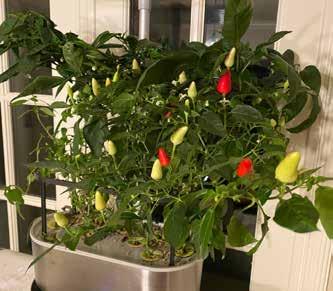
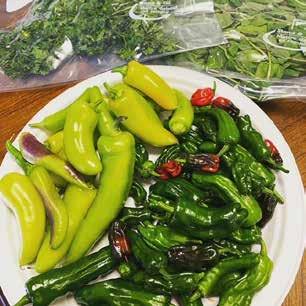
Full-size greens (varieties of lettuces and cabbages) and most herbs will be ready to harvest in under a month. Peppers take around five to eight weeks to flower, and another month after flowering to grow and harvest. Tomatoes require a bit more care (shaking the leaves to imitate pollination, for instance) and take the longest to produce, at three to four months.
Whether you choose a container, windowsill, or grow system to grow herbs, greens, and vegetables, success can be just a step away. Local nursery experts, online blogs, and forums are the best sources for advice and learning. Everyone’s garden and environment are different, so don’t get discouraged if your first garden doesn’t produce. Be patient and reap the benefits.
Virtual & In-Person Programming MAY 2022 Silver Linings
Join us every Wednesday on LIFE’s Facebook page for short segments on a variety of topics including living your best life, upcoming events, Senior Center Spotlight, and Ask SeniorLine.
“Living With Early and Mid-Stage Alzheimer’s”
Wednesday, May 4
Jacob Guinan from the Alzheimer’s Association will give us a glimpse into the May Alzheimer’s series scheduled to begin later on this date (see class information below).
“Ask SeniorLine: Food as Medicine” Wednesday, May 11
Food does much more than simply provide you with fuel. It may promote or worsen your health, depending on what you eat. A nutrient-dense diet of whole foods has been shown to prevent many chronic diseases and may help treat some conditions.
“Breaking Bad Habits and Making Better Ones”
Wednesday, May 18
Erin Powell will talk a little about the science behind how habits are formed, discuss strategies to break the cycle, and replace those bad habits with healthier ways to cope with stress and boredom.
“Developing a Healthy Relationship with Food”
Wednesday, May 25
The goal of having a good relationship with food is to have more positive experiences with food than negative ones. Erin Powell will talk about the signs of a ‘bad food relationship’ and how to increase mindful eating and work toward a good relationship with food.
Community Education
“Living with Early and Mid-Stage Alzheimer’s" Wednesdays, May 4 through May 25 • 2 – 4 p.m. LIFE Senior Services’ Central Office • 5950 E. 31st St.
Led by Jacob Guinan from the Alzheimer’s Association, this class will give you practical answers to the questions that arise in the early stages of Alzheimer’s as you learn how to cope with the changes. In the mid-stage classes, caregivers and professionals will discuss strategies for providing safe, effective, and comfortable care as they adjust to becoming more hands-on caregivers. Register online at LIFEseniorservices.org/education or by calling (918) 664-9000, ext. 1181.
“Natural Hacks to Support Memory” Tuesday, May 10 • 10 a.m. Legacy Plaza East Conference Center • 5330 E. 31st St.
Hannah Childers, nutritional health coach from Natural Grocers, will explain why age-related cognitive decline isn’t inevitable and how good nutrition and healthy habits can support your memory throughout your lifespan. Register online at LIFEseniorservices.org/education or by calling (918) 664-9000, ext. 1181.
“Basics of Medicare” Wednesday, May 18 • 10 a.m. – Noon Legacy Plaza East Conference Center • 5330 E. 31st St.
LIFE's “Basics of Medicare” seminar is designed for those newly eligible or soon-to-be eligible for Medicare. Advance reservations are required and can be made by calling LIFE’s Medicare Assistance Program at (918) 664-9000, ext. 1189.
From Bootleggers to Home Delivery
BY STEVE CLEM
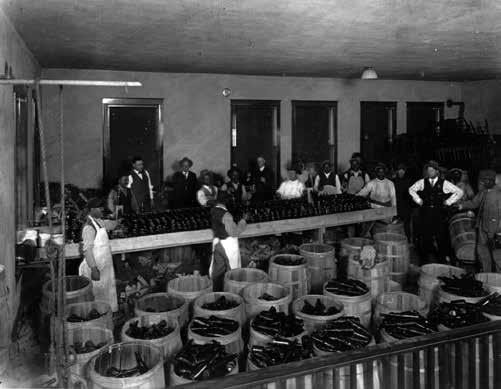
In 2020, Governor Kevin Stitt signed into law a bill that allowed curbside sales and home delivery of alcohol in Oklahoma. To some, “home delivery of alcohol” felt like a full-circle moment. It recalled the bygone era of Prohibition when Photo depicting the destruction of 40,800 bottles of bootleggers delivered door to door under the beer in Tulsa. The bottles were emptied into a trough which led into the storm sewer. This liquor was seized at Tulsa by U.S. Marshall John Moran and others. un-watchful eye of the Photo courtesy of Tulsa Historical Society & Museum law. Oklahoma held on to the prohibition of alcohol longer than almost any other state. The Sooner State’s long, dry history included bootleggers, homemade moonshine, alcohol dispensaries, speakeasies, weak beer, and “liquor by the wink.”
TEMPERANCE MOVEMENT
The two territories that, in 1907, combined to become the 46th state had a split personality on liquor consumption. Oklahoma Territory permitted alcohol sales, while in Indian Territory, federal law prohibited its sale. At the time of statehood, the population was mostly rural and Protestant. There was a strong belief that alcohol was evil. The groups promoting prohibition were well-organized, led by the Woman’s Christian Temperance Union. An early leader of that movement in Tulsa was Lilah Denton Lindsey. Early prohibitionists focused on alcohol’s effect on the family, according to J.D. Colbert, a local banker and historian who gives lectures on Oklahoma prohibition. “The male head of household at that time was laboring difficult jobs in factories and mines, and was not well paid. Far too many would head straight for the saloon and drink away the family money. Hard-drinking also led to a lot of physical abuse,” Colbert said. Influential anti-alcohol groups were able to get prohibition written into the state’s constitution.
ILLEGAL, BUT AVAILABLE
“After statehood, alcohol came up through Arkansas, Texas, and other places, and most of the bootleggers were out in the public,” said Larry O’Dell, director of Communications and Development at Oklahoma Historical Society. “They didn’t get harassed unless they did something wrong, or there was a crackdown policy by the current administration.” Those crackdowns, the busting-up of a still or seizing a shipment from another state, often occurred around election time. Homemade moonshine and bathtub gin were popular intoxicants. However, some early Oklahomans utilized the alcohol dispensary. “With a doctor’s prescription you could get medicinal alcohol at the drug store, not unlike the marijuana dispensaries of today,” Colbert said. The wave of anti-alcohol sentiment reached its zenith in 1920 when the 18th Amendment established Prohibition nationwide, making the manufacture, sale, and transportation of alcohol illegal.
THE SPEAKEASY AND ALL THAT JAZZ
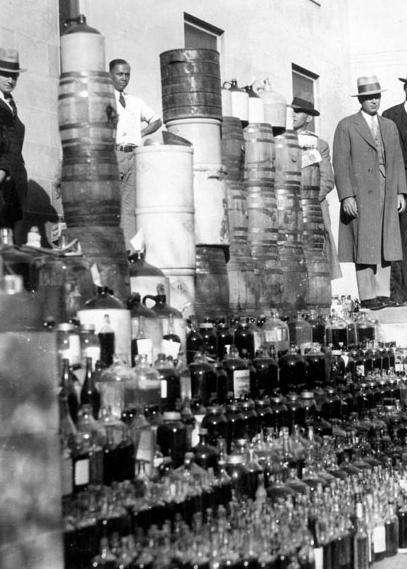
The primary way alcohol was consumed during Prohibition in the 1920s was at the speakeasy. “You’d have a code or a knock. A bouncer would open a little slit in the door to give you the onceover to make sure you weren’t law enforcement," Colbert said. The speakeasy, which often had live music, was the first time that men and women publicly drank together. “Previously, men would go off by themselves to the saloon.” In 1933, when the 21st Amendment ended the national experiment of Prohibition, Oklahoma’s prohibition remained. Sooner State citizens did, however, vote in the sale of lower-point (3.2) beer, a measure that helped to raise state revenues during the Depression.
OKLAHOMA LIQUOR LAWS
A Timeline of Alcohol Legislation 1907
Oklahoma enters the union “dry” with prohibition written into the state constitution.
1920
18th Amendment goes into effect, establishing Prohibition nationwide.
1933
18th Amendment repealed. National Prohibition era ended, but Oklahoma prohibition continued. Voters approve the sale of 3.2 beer in stores.
1959
Oklahoma voters repeal prohibition. Alcohol is sold in liquor stores, but Liquor By the Drink is prohibited.
1984
Oklahoma became the 49th state to allow Liquor By the Drink with the passage of State Question 563.
Men standing around a large pile of confiscated liquor during Prohibition in Tulsa, c. 1920. A handwritten caption in pencil on the back reads, "Destroying about 1500 gal., abt 3 mo catch, Chief Pol., Scott detective."
Photo courtesy of Tulsa Historical Society & Museum
In the 1940s and 1950s, the person to contact for quantities of illegal liquor in northeastern Oklahoma was Cleo Epps. Taking over the operation when her alcoholic husband became too ill, Epps, a former teacher who didn’t drink, ran the business from her acreage between Tulsa and Sapulpa. She earned her title, “Queen of the Bootleggers,” by supplying alcohol to restaurants, hotels, and well-heeled citizens. “It was standard to get a weekly delivery,” Colbert said of the bootlegging business. “One would typically fill out a form for next week, hand it to the bootlegger, give them their cash, and off they went on their rounds.”
LIQUOR BY THE WINK
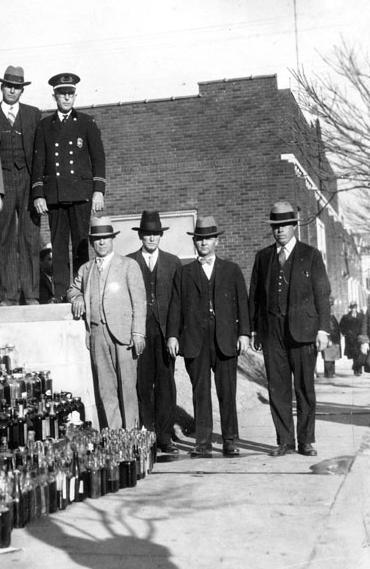
By the mid-20th Century, Oklahoma’s increased industrialism, urban growth, and changing social norms brought about a more favorable view of alcohol. Voters repealed statewide prohibition in 1959. However, there was a stipulation. Buying Liquor by the Drink in clubs and restaurants was still not allowed. “Liquor by the Wink" began. “You bought a ‘membership’ in a private club, and you would bring your own alcohol,” Colbert said. “They would put your last name on the bottle. Most anybody could show up and say, ‘I’m Taylor. That’s my bottle.’ And the bartender would wink at you and say, ‘What are you gonna have?” That era ended with the passage of Liquor by the Drink in 1984. More landmark reform occurred in 2016 when Oklahoma voters approved sales of wine and strong beer in grocery and convenience stores. This law relaxed restrictions on liquor stores. “For the first time you could buy wine and a wine bottle opener at the same store,” Colbert explained. When Colbert gives lectures on Oklahoma’s prohibition for groups like Tulsa Historical Society & Museum, he finds younger people often struggle with the concept. “How could this have happened? Why would we do such a thing?" Colbert said. Prohibition is a difficult concept for younger generations who have experienced having most everything, including liquor, delivered legally to their front door.
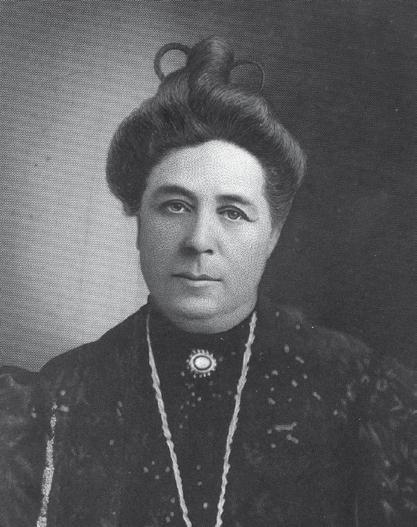
Lilah D. Lindsey was one of the first women to serve in the Oklahoma State Legislature, one of the first teachers in the Presbyterian Mission School, and leader of the temperance movement in Oklahoma.
Photo courtesy of Beryl Ford Collection/Rotary Club of Tulsa
2016
Passage of State Question 792 allows the sale of high-point beer and wine in grocery, convenience, and drug stores. Liquor outlets can stock non-liquor items.
2020
Passage of Senate Bill 1928 established curbside sales and home delivery of alcoholic beverages.
2021
The Cocktails to Go act passed, allowing single-serve wine and Cocktails to Go in sealed, tamper-proof containers.
2022
Proposed – A bill allowing Cocktails to Go to remain in their original containers is making its way through the Oklahoma legislature.
Queen of the Bootleggers
Cleo Mae Gilbert, born in 1909, came from Arkansas to Oklahoma to teach. But after her second husband Cecil Epps became ill, Cleo took over his bootlegging business. “Epps controlled the wholesale and retail moonshine traffic during the 1940s and ‘50s around Tulsa, importing truckloads of illegal booze from Missouri,” said Edwyna Synar, columnist for the Muskogee Phoenix. This earned Epps her reputation as Queen of the Bootleggers. Cleo Epps leaving the In 1970, a decade after courthouse after an arrest for manufacturing moonshine in 1966. alcohol became legal, two of Epps' criminal cronies, Photo courtsey of Johnny Walker/Tulsa World Albert McDonald, a former lover of hers, and Lester Pugh took some of the dynamite Epps kept on her farm which was located between Tulsa and Sapulpa. Epps voiced her concern to a former law officer that something bad might happen. “Pugh and McDonald had this lawyer, Charles Pope,” Synar explained. “Pope was running for district judge in Tulsa against Fred Nelson, a very popular judge. These two-bit criminals thought, OK, we’re just going to kill Nelson and then Pope will become the district judge.” Primary election morning, Judge Nelson turned the key to his station wagon and it blew up. Nelson was critically injured. “He was wearing this gigantic belt buckle, and when the explosion came the belt buckle supposedly saved his life,” Synar said. Asked to testify before a grand jury, Epps agreed only if she could wear a disguise. “Epps testifies, the grand jury does not indict those two guys, and they leave the state,” Synar said. “Three months later, they’re back and they called Cleo and said they wanted to talk about some stolen liquor. ‘Will you meet us,’ they asked?” Epps met them and vanished. Her abandoned truck was found in west Tulsa. Ninety days elapsed before her body was discovered in an abandoned septic tank, two bullet holes in her head. McDonald was convicted of his former lover’s murder, while Pugh, who had pulled the trigger, was convicted of a separate murder. Around 150 people attended Epps’ 1971 funeral, including legislators, a judge, and many members of law enforcement. The Queen of the Bootleggers was eulogized as being generous and well-liked – someone who cared about people.