VOL. 33, NO.3
2005
CONTENTS 1
Straight and Level
2
VAA News Mail Reminiscing with Big Nick
4
5
My 35-Year Love Affair (Part 1)
by Nick Rezich
8
The Vintage Instructor
Patterns in the sky
by Doug Stewart
10
Factorv Falco Plywood butterfly reborn
by Budd Davisson
14
by Bob Gehring and Steve Krog
24 26
BACK COVER: John Sarsfield, Longmont, Colorado, is an EM Master Artist , and he recently painted the Reginald Mitchell designed Supermarine 55. A pair of 55's won both first and second place in the 1927 Schneider Cup trophy races in Venice, Italy. Flight lieutenant S.N. Webster and O.F. Worsley flew the pair, with Webster coming out on top with an average speed over the course of 453.282 km/h (281.656 mph). Our thanks to John for shar足 ing his acrylic painting.
S TA F F
Monday morning quarterbacking by Buck Hilbert
Publisher Editor足 in-Chief Executive Director/Editor Adm inistrative Assistant Managing Editor News Editor Photography
Vintage Books Mystery Plane
Production Manager Advertising Sales
Arriving in Style Taking a classIc ride to Tullahoma's Beech Party by Amy Laboda
22
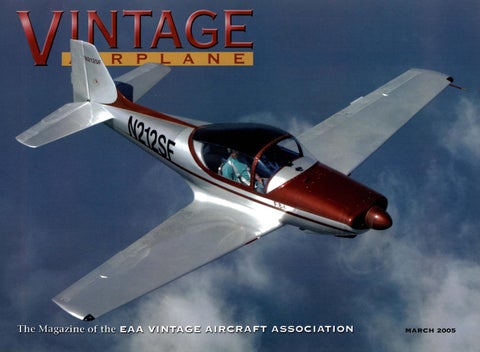
factory-built Falco is the sole example with an FM certificate of registration in the Utility category. The sleek all-metal Italian speedster was restored by Marc Stamsta and was the Most Unique trophy winner in the Contemporary category at EM AirVenture Oshkosh 2004. EM photo using Canon digital photographic equipment by Jim Koepnick. EM photo plane flown by Bruce Moore.
Type Club Notes Removing and installing a prop on a Continental tapered-shaft engine, from the Luscombe and Cub Club newsletters
18
COVERS
FRONT COVER: The only one of it"s kind; this
Pass It To Buck
by H.G. Frautschy 28 30
Calendar Classified Ads
Classified Ad Manager Copy Editor Graphic Design
Tom Poberezny Scott Spangler H.G. Frautschy Theresa Books Kath leen Witman Ric Reynolds Jim Koepnick Bonnie Bartel Julie Russo Loy Hickman 913-268-6646 Isabelle Wiske Colleen Walsh Olivia Phillip
GEOFF ROBISON PRESIDENT, VINTAGE AIRCRAFT ASSOCIATION
"Working" at the Airport
f late it seems that I hear more and more folks talking about the age-old question of "why we fly. " A Vintage member recently reminded me of yet another personal perk that aviation provides him and others who fly. Even though this member mentioned the various successes he has experienced in lithe business of aviation, he put much greater value in having the opportunity to "go to work at the airport" each and every day. I had never really thought much about that as a concept. Although I am fortunate to have a job I like (most of the time), I am now forever envious of those who go to work at the airport every day of the week. You really have to stop and think about it. I know clearly what "being at the airport" does for my emotional state. Other than my family, there is little in my life that gives me greater pleasure than hanging around at the airport with my aviation friends. You know how that works! You go out to the hangar to work on your trav eling machine or your current project, and suddenly there are a couple of people hanging around. If you're lucky, at least one of them is helping you do what you intended to accomplish on this particular day. But most of the time the conversations evolve, and suddenly there's more hangar flying going on than anything else. So then, you really have no choice but to come back the next day and try again, right? One just naturally desires to be a part of what goes on there. It is absolutely a great en vironment to exist in, and I learn some thing new about aviation on nearly every trip there. Aviation people are a big part of this "airport experience" I speak of. It goes hand in hand with the statements one
O
II
hears when people talk about the "Osh kosh" experience. It's the airplanes that get you to come to AirVenture, but as most of you readers already know, it's mostly about the friendships made in Oshkosh that get you to want to come back to the world's greatest aviation event year after year. Speaking of great aviation events, by the time you receive this edition of Vin tage Airplane, the Sun 'n Fun Fly-In will be just a month away. The 31st Annual Spring Celebration of Flight in Lakeland, Florida, is scheduled for April 12-18, 200S. This spring aviation ritual is always an excellent way to launch into the new flying season. I hope to see you there. Over the past few years a portion of the Vintage parking area at AirVenture has hosted a wonderful collection of specially parked aircraft types. This all started when VAA Director Roger Gomoll decided that type-club parking seemed to require a "secret encoder ring" to get a spot. That wasn't our intention at all, so Roger, who had become the chair man of the type-club tent during that same period, decided to demystify the process and announce a unique oppor tunity to all the type clubs. Each club could have their day in the limelight at VAA AirVenture. We now invite them to participate in this truly wonderful op portunity that allows them to park their aircraft types together at AirVenture in the Vintage area. Roger's efforts have continued to payoff for the member ship and for the everyday EAA AirVen ture Oshkosh attendee who now has the unique opportunity to see a truly wonderful collection of different aircraft types, all parked together in a specific area. It's become so popular with the clubs, that for the past two years this deSignated area has been fully commit
ted by the middle of January. For those type clubs who have partici pated in this unique opportunity, please understand that we can accommodate only a specific number of aircraft in this deSignated area, so it has now become necessary to limit the number of type clubs we can accommodate each year. We also ask each of the type clubs to recognize that it is important to share the wealth with this popular program, and each club will take turns organiz ing a group for display. Please be sure to contact us at our main e-mail address: vintageaircraft@eaa .org with any ques tions you may have. To date we have pledged type-club parking space for the 200S event to the International Cessna 170 Association, the Swift Foundation, the Taylorcraft Foundation, and the Bellanca-Cham pion Club. Be sure to come join us for all the fun . Just a reminder, the "Friends of the Red Barn" fund-raising campaign is now in full swing. This campaign directly finances all the various events and ex hibits provided to the membership in the Vintage area during AirVenture each year. Please be sure to review the pro gram benefits in the February edition of the Vintage Airplane magazine or on the Web at www.vintageaircraft.org, and give serious consideration to donating to your organization. Also, our sincere thanks to all those members who have already made their pledges. Your assis tance is greatly appreciated. Let's all pull in the same direction for the good of aviation . Remember, we are better together. Join us and have it all.
VINTAGE AIRPLANE
Vintage E-Mail Address
AirVenture: Need to Know
Because of the incredibly high volume of junk e-mail being received at the vintage@eaa.org e足 mail address, as of April 1, 2005, that address will be shut down and replaced with a new e-mail address, vintageaircraft@eaa.org. Please make a note of it in your contacts list.
Admission Prices:
VAA Articles
Price is the same as last year. EAA members receive significantly reduced admission. Visit www.airventure.org/200S/planning/admission.html.
One of the highlights of membership in the VAA is the ability to share information with one another. We do it during meetings and fly-ins, at EAA AirVenture Oshkosh, and here in the pages of Vintage Airplane. If you have something you think would be of interest to your fellow members, why not turn it into an article? We need technical articles and are interested in historical articles as well. We don't need "How I flew from the state of XYZ to XGX airport" articles, nor is there much interest in non-Vintage足 related materials . If you're not sure if there would be interest, drop us an e-mail at vintageaircraft@eaa. org or call us at 920-426-4825. Let us know what you'd like to write about, and we'll see if it matches our needs. Become famous-help a fellow member-become a writer for Vintage Airplane!
Pitcairn Miss Champion to Join EAA Museum at AirVenture When Stephen Pitcairn decided it was time to select a permanent home for his rare Pitcairn PCA-2 autogiro Miss Champion, he turned to EAA AirVenture Museum's Pioneer Airport. It will be in good company. Over the years, he's donated a Pitcairn PA-39, a Mailwing, and the structure in which they reside-the Pioneer's Pitcairn Aviation Hangar. Pitcairn will fly the aircraft, whose flight characteristics were once described as "hopping off the ground like a giant grasshopper," to Oshkosh 2
MARCH 2005
Gates: Open at 8 a.m. Monday-Thursday Open at 7 a.m. Friday-Sunday
Buildings and Exhibits: Open at 9 a.m.
200fjf OSHKO
S
H
~TM
Where Can I Stay? Showpl ane camping, genera l aircraft camp in g, campgrounds, dormitories, h otels, and more. Visit www.airventure.org/200S/planning/where_to_stay.html.
Air Shows: Daily air shows begin at 3:30 p.m. Monday-Saturday; 2 p.m . on Sunday For all this and more, visit the EM AirVenture website, www.airventure.org.
Camp Scholler Opens June 24 Instead of its traditiona l openi ng on Ju ly 1, starting th is yea r Camp Scho ller wi ll open and be ready to we lcome EAAe rs 31 days before t he st art of EAA AirVentu re Oshkosh. That means campers who like to get in early can move in on June 24. The new schedu le sh ould help members make their AirVenture plan s because the campground wi ll always open on a Frid ay. Camp Scholler is open to all EAA mem bers. As in t he past, t ho se who esta bl is h campsi t es on June 2 4 pay t hrough the end of EAA AirVe nture , an d receive refunds if t hey depart bef ore t he fi nal day. For more information, visit www.airventure.org.
at the first good weather opportunity, in plenty of time for EM AirVenture Oshkosh, July 25-31. It will take about three days to cover the 660 miles from Trenton-Robbinsville Airport, New Jersey, to Oshkosh. Miss Champion made its first visit to Oshkosh in 1986, right after being restored to its original condition. PartiCipants at AirVenture 2005 will see the PCA-2 in flight during the week. The first of 20 PCA-2s flew in 1930, and it was the first commercially licensed autogiro in the United States. "This will be a fantastic enhancement to our collection," said EAA AirVenture Museum Director Adam Smith. "We feel fortunate and grateful that Steve considers our facilities
an appropriate final destination for this important aviation artifact." The Champion Spark Plug Co. purchased Miss Champion new in 1931, and it led that year's Ford National Air Tour. Soon after setting an altitude record of 21,500 feet in September 1932, the aircraft "retired" to the Chicago Museum of Science and Industry. Just after World War II it was sold to a private New Jersey museum, and Pitcairn acquired it in the early 1980s. "Because of my association with the EAA, with the Pitcairn Hangar and theMailwing.as well as another autogiro (the world's only remaining example of a PA-39), I decided to donate it to EAA," he said. "It seemed to be the logical place for Miss Champion to go." ......
NOMINATING SOMEONE FOR THE
EAA
VINTAGE HALL OF FAME:
Note: To be considered for induction into the VAA Hall ofFame during the next calendar year, petitions MUST be received by September 30th of the current year. If you wish to nominate an individual who you believe has made a significant contribution to the advancement of aviation between 1950 and the present day, please make a copy of the form below, fill it out, add supporting material, and send it to: Charles W. Harris, VAA Hall of Fame, P.O. Box 470350, Tulsa, OK 74147-0350 Be as thorough and objective as possible. Attach copies of materials you deem appropriate and helpful to the committee. The person you nominate can be a citizen of any country and may be living or deceased . Their contri足 bution could be in the areas of flying, design, mechanical or aerodynamic developments, administration, writing, or some other vital, relevant field; or any combination of fields that support aviation.
EAA VINTAGE AIRCRAFT ASSOCIATION HALL OF FAME NOMINATING PETITION Person nominated for induction into the VAA Hall of Fame:
Name: _________________________________________________________________________
Street: Phone Number: _________________________ City: State: _ _ _ _ _ Zip :_ _ ___ Date of Birth: If Deceased, Date of Death: _ _ _ _ _ _ _ _ _ __ Name and relationship of closest living relative._ _ _ _ _ _ _ _ _ _ _ _ _ _ _ __ __ _ __
Address: Phone: ______________
Time span (dates) of the nominee's contributions to aviation:
(Must be between 1950 to present day.) _ _ _ _ _ _ _ _ _ _ _ _ _ _ _ _ _ _ _ _ _ _ _ _ __
Area(s) of contributions to aviation:
Describe the event(s) or nature of activities the nominee has undertaken in aviation to be worthy of induction into the VAA Hall of Fame: _ _ _ _ _ _ _ _ _ _ _ _ __ _ _ _ _ _ _ _ _ _ __
Describe other achievements the nominee has made in other related fields in aviation:
Has the nominee already been honored for his/her involvement in aviation and/or the contribution you are stating in this petition? (Circle one) Yes No If yes, please explain the nature of the honor and/or award the nominee has received:
Additional Information: Person submitting this petition:_____ __ __ _ __ _ _ _ _ _ _ _ _ _ _ _ _ _ _ __
Street: _ _ _ _ _ _ _ _ _ _ _ __ _ _ _ _ _ _ __ _ Phone: _____________
City: _ __ _ _ __ _ _ _ _ _ _ _ _ _ __ State: _________ Zip: ________
Please attach any supporting material with your petition for the committee's review. VINTAGE AIRPLANE
3
PIPER WITH A PIPER
Here's a picture of our son, Shawn Piper. He soloed in our 1942 J-3 Piper Cub on his 16th birthday, August 6, 2004. A 62-year-old Piper flown by a 16-year-old Piper. David Piper St. Illinois THE CASE FOR FRANKLIN
FLEETWINGS SEABIRD ADDENDUM
I always enjoy receiving my copy of Vintage Airplane, as I have done so since 1973. I feel compelled to answer a state ment attributed to Butch Walsh in Budd Davisson's article on Walsh's Stinson (page 14, November 2004). "The 108 and 108-1 us ed the ea rlier lS0-hp light-case engine, which is more prone to problems than the later 16S-hp version used in the 108-2 and -3." First of all, there was no such thing as a lS0-hp light case. The 150 Franklin didn ' t have any cracking problems-the earlier 16Ss did! I refer interested read ers to Aircooled Motors SB NOlO, dated 12-21-50, revised 6-3-52. All serial number engines No. 33046 and above and/or having casting numbers 18905/18906 are con si dered to be "improved" crank cases. Many earlier "light case" 165 engines (by SN) had their cases replaced with the "improved" ver sion at th e factory or in service centers. The light-case engine can be operated to this day-subject to periodic inspection. Interestingly enough, when Aircooled Motors introduced the 16S-hp engine, the 150 hp was pro duced side by side until production wound down at the start of the Ko rean War. Aircooled Motors contin ued to support these earlier engines with parts and overhaul until the bankruptcy of 1976. Dan Cullman Kent, Washington
Zachary Baugnman's (Vintage Air plane, August 2004) downplay of Jim Reddig's contributions to the beauti ful Fleetwings Seabird may be off the mark. While it is true Fleetwings had a project going prior to Jim's arrival there in 1934, it was not the Seabird, according to company founder Carl DeGanohl himself. This earlier air plane may have actually been built, according to author Frank Clifford (FAA Aviation News, January 1970). Jim Reddig, in correspondence SO years ago to longtime Seabird owner Bud Oliver, sta ted that when he ca me on board, Fleetwi n gs aban doned their project and started again using his experience with Loening. It should be pointed out that although the Seabird resembles the Loaning commuter line, it is a radically differ ent engineered airframe. Fleetwings had to design a production airplane that could be assembled using their welded stainless methods. Further, it was Fleetwings (with Reddig) that did the wind tunnel and water tank testing of the Seabird design. Reddig always gave credit to Loening, but insisted that h e never actually di rectly contributed to the Fleetwings amphibian. It is also very easy to see Loening's influence in the early Grumman airplanes-Grumman and some of his early team also worked at Loening, and it clearly shows in the airframes they produced. To me, the bigger question is the actual engineering that went into the Seabird. Spot welding an entire airplane togeth er required a pro
4
MARCH 2005
gressive assembly process that left little room for error. Nobody knew this better than Channing Clark. Clark's airplane was a wreck when he acquired it, and his amazing res toration is a tribute to his skill and knowledge of the engineering devel oped in the 1930s by Fleetwings (or the Budd Co.). Jim Redding and ev erybody I have found associated with Fleetwings truly believed that is was Carl DeGanohl who was responsible for the engineering innovations and that the Budd Co. was the enemy, having stolen their work. A patent search seems to show just the opposite. The Budd Co. was a major industrial engineering force in the world at the time. Now known as a manufacturer of rail cars, they were then heavily into the auto and trucks parts supply business. Budd is credited with the first all-steel automobile bodies, and what we now call spot weld ing is a process that Budd helped develop. The patents of the '20s and '30s that apply to stainless steel fabrication were primarily awarded to the Budd engineering staff. Th is includes many directly related to the manufacture of air craft components during the very period of time when the Seabird was being developed. The fact that Edward Budd himself was guest of honor at the christening of the first Seabird seems to indicate a more than casual connection to this truly innovative creation. Marc Pierce Colts Neck, New Jersey
REMINISCING WITH BIG NICK
My 3S-YEAR LOVE AFFAIR
(PART 1)
Reprinted from Vintage Airplane September 19 74 Nick Rezich All Photos Courtesy the Nick Rezich Collection
Before I get carried away with my love affair, I would like to take this opportunity to thank you all for the treasures of mail that have reached me since the publication of the "Howard" story. The following letter is most pre cious, and I felt it should be shared with everyone: Los Angeles, California August 22, 1974 Dear Nick, Thank you for sending me a copy of the story-article-about us and our aeroplanes. You told it like it was-and made it very interesting. I will not argue with you about the Howards being one of the great est! Do you know that there are sev eral of them out here still flying? As a matter of fact, at one time there was a Howard Club-all members owned and flew the Howard.
Again, thank you very much for everything you wrote and feel. Best personal regards, (Signed) Mike Howard (Mrs. Ben O. Howard) As soon as the "boss" allows me a stamp fund, I'll try to answer every body. Many letters contain correc tions of names, photos, etc. Let me explain some of these mis takes. First, Jack Cox should receive a medal of the highest order for his ability and patience in transform ing my hieroglyphics into readable material. (Nick is too modest . . . his material is a pleasure for me to work with.-JBC) His lovely wife, Golda, has come up with the Rezich alpha bet, which helps somewhat, but it still takes her two weeks to unscram ble the "i's," lie's," liS'S," etc. I love writing to doctors-it's my only chance to get even with them.
Maybe by now you all will under stand why some misspelled names sneak in! This past June I made a five-day whirlwind tour of California visiting some old Howard Aircraft buddies and family friends . My first stop was the most significant and the highlight of my trip. Sunday morning, June 9, dawned sunny and warm in San Fran cisco, where I picked up a rental car for my tour to Los Angeles. An hour and a half out of Frisco I pulled into the Palo Alto Airport, where I met Larry Low, a gung-ho EAAer and antiquer, whom I had never met before, but knew well from our letter exchanges. Standing in front of his hangar, we exchanged family introductions-all but one, the one behind the hangar doors. I was really getting antsy, and it showed as I kept pushing on the locked doors. Larry finally got the message, and we opened the doors. V IN TAGE AIRP LANE
5
There she stood, my love-a majestic lady in all her pomp and glory. The last time I touched her was almost 30 years ago to the day. With moist eyes, I walked up and laid a gentle hand on the door latch and introduced my wife of 23 years and mother of three to my first love affair, a Culver Ca det that I bought new 34 years ago, NC20926, serial number 106. Larry Low had her dressed up in the latest fashion: urethane paint, tinted one-piece windshield, carpet ing, starter, generator, nav/comm, ELT, chrome gear, landing, nav and strobe lights, plus one hell of a lot of tender loving care. After 34 years I could not find a wrinkle in her skin anywhere. I thought I had a showstopper when I owned it, but you should see it now! This fellow, Larry, has put much ef fort, time, and money into this price less jewel. Oh, sure, I made him an offer-but he quickly informed me of others that are available ... but not my love-at any price! This whole affair started back in 1939 when the aviation industry was still reeling from the blow of the De pression. The surviving companies and some new ones were all pushing new models. The route to recovery was paved with many new designs. The OX-5 powered machines had all been turned out to pasture for a grace ful and well-earned retirement. The machines of '39 all sported round engines or the new flat, op posed 4s, all air-cooled. Prices ranged from $990 for the Cub to $52,000 for the executive Lockheed 12. The most advanced airplane was on the draw6
MARCH 2005
ing boards in a small plant located in Columbus, Ohio. The genius behind the slide rule was Al Mooney, who was known to many in the industry as a bright, in geniOUS engineer.
THERE SHE SAT IN FRONT OF THE HANGAR LIKE A THOMPSON RACER WAITING FOR THE STARTER'S FLAG TO DROP! When Al Mooney announced he was building a two-place airplane with retractable gear that would cruise at 120 mph with a top of 140 mph, have a service ceiling of 17,000 feet, and have a cruising range of 1,050 miles with a IS-gallon auxiliary tank .. .and all this while powered by only 75 hp and sell ing for less than $3,000, he lifted many eyebrows-including mine! I anxiously waited to see what this new design of Mooney's would look like. I went to the Columbus, Ohio, plant on the pretense of buying a Dart, hoping to get a glimpse of the new Culver. It didn't work. After two days all I got was a lot of rumors and
no peekaboo. Before I left, I made a deal with a friend of mine to send me a snapshot of the prototype as soon as it was rolled out of assembly. With the coming of fall and win ter came my photo ... wow! When I saw what that little jewel looked like, I made up my mind right then and there-I had to have one! I ordered one without even having a ride in one. The price was $2,475 . I received the sixth one built, serial number 106, NC20926. A blue and silver paint job was stock. The late Art Carnahan of Mono coach fame was the area dealer, and he delivered my new Culver as far as Joliet, IllinOis, where the snow stopped him. I drove in a snowstorm to Joliet to pick up Art and view my new jewel. There she sat in front of the hangar like a Thompson racer waiting for the starter's flag to drop! I don't think I knew what the word thrilled meant until that cold evening in Joliet when I opened the cabin door and tried that Culver on for size. Art gave me a fast cockpit check, and then we hopped in the car and headed for my home back in Chicago. Dur ing the drive Art explained the gear details and the flight characteristics. By the time we reached home I was ready for the races! To knock off the chill of the drive, my mother poured us some of our best homemade wine, which was fol lowed by a fiesta supper. After supper and a gallon of wine later, I stuffed Art's pockets with $2,000 in fives, tens, and twenties and put him on a train for the trip back to Blooming
Nick and a friend indulging in a little clowning for the photographer. The insignia is that of the Illinois State Militia. Nick once flew missions for the Militia into flood-ravaged downstate Illinois, landing on roads to deliver blood to hospitals.
ton, Illinois, his hometown. My first flight in the new Cadet was two weeks later, when the weather cleared. Up to that time, I had been flying Travel Airs, Pitcairns, a Laird, Bellancas, Stinsons, Porterfields, Rear wins, Cubs, and Howards, and from what Art told me none of the above flew like the Cadet. My brother helped me roll it out of the hangar, preflight it, and cranked me. As I taxied out, I tried to remem ber everything Art had told me about the Cadet's handling. If felt good and solid while taxiing, and when I got to the runway, I was ready. I set the tab at zero and poured the coal on. The takeoff was smooth and straight. I left the pattern and started to climb to altitude for some turns and stalls. In the next 20 seconds I learned all about the Culver's sensitive flip pers. I reached up to trim it for climb so I could concentrate on the gear re traction. Well! When I gave the trim handle the usual husky crank, all hell broke loose. The nose shot up .. .I pushed forward on the stick and went up against the roof...l pulled back, and I was pushed a foot down into the cushion! Another push forward ...back on the roof! I finally got the message and stabilized and started flying it. I left the gear down and climbed to 3,000 feet where I practiced medium and steep turns, slow flight, and some stalls. The more I flew it, the better I liked it. Now, I trimmed it for hands off and cycled the gear a few times. All went well, so I headed for Willie
Howell's airport on the south side of Chicago, where I was to keep it. As the airport came into sight, I dropped the nose and let it boil. I went over the office, indicating 170 mph, and this brought everyone out, so I did it again, followed by a steep, climbing turn. I was really getting my jollies! I dropped the gear, checked the lock, and started in to land on the 1,800 feet of solid runway the Cubs were using. With that gang out there watching, I couldn't afford to goof the first landing. I dragged it in and put it on three points, using about 1,200 feet. The roll-out was like a Cub. I tax ied in, shut down, and stepped out .. . the hero of the airport! I had the fast est, newest, cleanest, most advanced airplane on the airport. I flew that little airplane all over the country until I went into the ser vice in June 1944. My biggest mainte nance bill was for wax. I would wax it every weekend before flying it. I had no intention of selling the Cadet when I went into service. I checked Willie Howell out in it and told him to give rides in it until I re turned. I was home on furlough after completing my basic training when I received a phone call from a fe l low from Wellington, Kansas. He in formed me he was in town to buy my Cadet. I laughed and told him " no way"-not for sale, and that ended that . . . I thought. The following Sunday, I was out at the airport flying the bird when this same fellow from Kansas arrived in
a cab and announced he's come to pick up the Cadet. We went through the whole scene again, only this time he added the green: He started peel ing off the big ones, and when he had $3,500 lying there, I changed my mind and said, "Okay, it's yours!" He still had a fist full left and was willing to part with it. I asked him if he wanted to go th rough the logbooks and look the plane over. He answered, "Hell, I know this airplane as well as you do!" I had raced this airplane and never los t to anyone, thanks to the help of "Sludge" Doyle and his "Offy" factory. I had a real hot rod-I was putting out 90 hp with a super thin Freedman-Burnham prop. That is why this fellow knew all about my Cadet-he had kept track of it and wanted it for the speed. He turned to Willie and said, "Fill it up." He paid the gas bill, threw his bag in the back, and said, "Give me a crank." I cranked him up and went to the cockpit to shake his hand and say goodbye. As I reached in he handed me a twenty and told me to go have a drink. He took off to the west, and that was the last I saw of NC20926 untUJune 1974. After I returned from the California visit I bragged so much about myoid Cadet that my son, Jim, sold his beau tiful J-3 Cub that he soloed in and bought a Culver Cadet. Now it will be a battle around our house trying to keep the 0 1' man out of the kid's airplane . . . oh, well, that's love!"""" VI NTA GE AI RPLANE
7
DOUG STEWART
Patterns in the sky
I was flying some pattern work the other day in my Super Cruiser. Sharing the pattern with me was another pilot in an Aeronca Champ. The airport was a mid size, nontowered county airport, serving a large variety of aircraft. In the pattern at this airport, it is not uncommon to find small tailwheel aircraft, as well as many of your typical general aviation (GA) training aircraft, an assort ment of corporate and air-taxi air craft ranging from light twins up through King Airs, to a handful of G4s and their brethren, all burn ing kerosene and missing propel lers. Added to the traffic mix is an occasional helicopter. Because this airport has some of the lowest 100LL fuel prices for miles around, it is not unusual to have numerous aircraft approach ing from all corners of the com pass. If ever there were a place in the airspace for proper proce dures, this airport, particularly on a good weather type of day, is it! Please do not misconstrue what I have said about proper procedure and think I believe it is impor tant in the pattern. Proper pro cedures are required regardless of the type of airspace in which we fly. It is just that at those airports that serve many aircraft, having a vast dichotomy of aircraft perfor mance, as this airport does, if we don't all adhere to a standard set of procedures, the stage is set for 8
MARCH 2005
chaos to rule. And it would seem that many pilots are oblivious to what those procedures are. This particular day was one of those. Let me share with you an experi ence I had that day. To begin with, I heard the fol lowing announcement on the CTAF (common traffic advisory frequency). "Columbia County traffic, N12345" (I'll use fictitious tail numbers for this article), "is on a 4-mile final for Runway 3. Any other traffi c, please advise ."
Well my immediate thoughts were for the safety of the pilot in the Champ. He was in a NaRDO (no radio) airplane. Not only was he unaware of the aircraft out there on the straight-in final, but he also was certainly unable to advise the pilot of the inbound aircraft. So here were two pilotsoblivious of each other. I really wasn't too worried about the pilot of the Champ. He has been flying his airplane for many more years than I have been fly ing. And in all those many years of operation, he has never had a radio installed in his airplane. What keeps him safe is his excel lent vision and his reliance on the best piece of collision avoidance equipment to ever be installed in the cockpit of every single airplane out there flying: his two eyes. Be cause of the proper use of that equipment, he has never, ever had a near miss.
However, the other pilot in bound on the straight-in final was certainly ignorant of that rather slow airplane in front of me in the pattern. By the time the Champ was about to make the base-to-fi nal turn, the other aircraft might be about to share that exact same piece of airspace real estate. After all, I didn't know what kind of aircraft was out there on the "4 mile final." Because the pilot an nounced only his tail number, I had no clue as to whether he was one of those sleek Gulfstreams fly ing a final at 120 knots, a Bonanza coming at us a little more slowly, or perhaps even one of the many new light-sport aircraft arriving at something more akin to the Champ's approach speed. I couldn't just fly along keeping silent on my own radio. I felt I had a responsibility here. This person who was arriving straight in might not be using the same kind of col lision avoidance equipment as in stalled in the Champ. He might be charging on down final, blissfully unaware of the Champ, relying on his newly installed Skywatch or similar traffic information service (TIS) system to warn him of any impending collision. If he were looking out the win dow for any lights (I was hoping he had turned on his own lights, which would aid the pilot in the Champ with the operation of his system), he certainly wouldn't see
any lights on the old Aeronca. For not only did that airplane not have a radio, but it also had no equip ment whatsoever installed that re lied on electricity, other than the synapses going on in the brain of the pilot in command of that won derful classic airplane. It didn't have a radio, it didn't have lights, and it didn't have a transponder. For the brand spankin' new col lision avoidance equipment in stalled in the inbound aircraft to work, it required a transpon der signal from the conflict ing "traffic." No signal ... no warning. And with no warning, would our arriving pilot, who was counting on his state-of the-art equipment to keep him safe, be aware that he was about to mate with another aircraft of much older vintage? It is one thing for Eagles or Hawks to have mid-air entanglements for the purpose of procreating their species, but when two air craft have a mid-air meeting, it is likely that the only prolifera tion will be of airplane pieces and parts across the ground. Because the only thing I wanted to see on the ground, extending out on the final approach path, were the sequenced flashing lights of the approach light system, and not a mix of Ceconite, spruce, aluminum, and body parts, my thumb quickly pushed the push to-talk switch on my stick, and I announced: "Columbia County traffic, red and cream tail dragger is on the left downwind for 3 ... and aircraft on the straight-in final, be aware that there is a yellow and or ange Champ on the base leg, about set to turn final. He has no radiO, so keep your eyes open." There were a few moments of si lence on the frequency. Then: "Uh .. . 345 is looking for the Champ ... not in sight ... uh, oh there he is. 345 is going around." From my vantage point on the downwind, I could see a Malibu rolling to the right to avoid hitting the Champ as the faster airplane overtook the
slower one. The difference in final approach airspeeds between these two aircraft was about 35 knots. From my position I could not tell whether or not the MaJibu had any lights on. Had I not made my announcement, would the pilot of the Malibu have seen the Champ? Who knows? Perhaps not, and two fine aircraft might have been de stroyed, not to mention the pilots and passengers on board.
Perhaps the
other pilot might
be relying more
on his ears than
his eyes for
collision
avoidance.
Let's look at the several lessons to be learned from this incident. To begin with, we have to be aware that despite incredible strides in technology, the greatest device for detecting other airplanes, particu larly in the traffic pattern, is our own two eyes. I will not deny that radios and the various TIS systems can assist our scan. In fact, in this incident it might very well have been my CTAF announcement that made the Malibu pilot aware of the Champ. However, to announce "all other aircraft please advise" on the CTAF, expecting any and all aircraft to reply, does not mean that every one will or, in this case, can advise. Personally, whenever I hear a pi lot make that announcement I in tensify my scan, with the thought that perhaps the other pilot might be relying more on his ears than his eyes for collision avoidance. Another thing to be aware of is that tail numbers do not mean much in the nontowered environ
ment of Class E and G airspace. If I am close enough to another air plane to read its tail number, I will be way too close, at least for my own personal comfort. In radio commu nication with air traffic control, tail numbers are essential. But in the traffic patterns of our nontowered airports, knowing what type of air craft is making a position report makes the visual identification of that aircraft much easier. When I hear "yellow Sky hawk on downwind," I know what to look for. When I hear "N12345," I haven't a clue what I am looking for. And be aware that "Cessna 12345" doesn't re ally help me much more. Is that Cessna a "120" or a Citation? Just slight differences in perfor mance I would say. If a Cessna 120 is "10 to the east, inbound for landing," I could probably fly at least three patterns before having to start looking for it. On the other hand, if it's a Cita tion that is "10 out, inbound," I might want to hold short. As for the Malibu flying a straight-in, 4-mile final, I won't necessarily say that it was im proper procedure. It is permissible per the regulations. And there are certainly times when it can be, and is, a safe way to approach a non towered airport. But if we are fly ing a long, straight-in approach, we are definitely increasing the risk factors not only for ourselves, but also for every other airplane that might be sharing the pattern. Sometimes that awareness alone will keep us from doing it. Next month I would like to take a look at some of the other proce dures that we have to be aware of as we fly the traffic pattern. I am sure that we are all aware that the vast majority of mid-air collisions occur in or near the traffic pattern. Awareness of proper procedures in the pattern could go a long way toward minimizing and managing that risk. It would be great if you would join me in attempting to re duce that risk. ~ VINTAGE AIRPLANE
9
ometimes it's difficult to de cide which is most interesting: an airplane's erratic passage through history, the passion that an airplane engenders in an indi vidual, a blow-by-blow accounting of a problematic restoration, or the thrill of slaying a paperwork dragon to get the airplane certificated. In the case of the Stamsta family Falco, the tales are so closely interwoven that the telling of one tale absolutely requires telling the others. Marc Stamsta is the quintessential craftsman in that, without saying so in so many words, he feels his days are best invested when they end with something he has crafted with his own hands. His life story leads up to the restoration of one of only two fac tory-built Falcos on American shores and the only one that isn't in the ex perimental category. But we're getting ahead of ourselves. Marc was born in Milwaukee and now lives on acreage behind the
S
10
MARCH 2005
two-room 1890 schoolhouse his parents converted to a house where he was raised. Right from the begin ning it was obvious he'd look at life a little differently. "My mother," he said, "is a fiber artist who works in weaving and pa per. She even makes her own paper, and it's not unusual to see her wading around in vats of paper pulp. I guess that kind of hands-on creative think ing was part of my upbringing." When Marc graduated from high school, he went to a technical college for two years for industrial engineer ing, but almost as soon as he gradu ated, he went his own way. "I started making harnesses for car riages," he laughs. "In fact, we made a lot of very high-end rigs for people like the Rockefellers and the Queen of England. I did that for 14 years." While he was working leather, some part of his brain was becoming infected with the concept of flight. "I don't know exactly when or
why I decided I wanted to fly. it's just always been there. In fact, al most as soon as I started getting into aviation I discovered the Falco, and that's the first true airplane I ever actually wanted." The Falco was, and is, a legend ary design by Italian designer Stelio Frati. Stelio is renown for his ability to design aircraft that are works of art and that fly even better than they look, and they look great. The 150 hp, all-wood Falco has made inroads in the homebuilt market because of the efforts of Virginian Alfred Scott, whose SeqUOia Aircraft Corp. re worked, with Stelio's blessings, the plans for the Falco. Sequoia Aircraft now produces kits and drawings. (While Alfred did the actual pen-and ink draWings from the Stelio-sup plied copies, he'll be the first to tell you that well-known aeronautical engineer Dave Thurston is the man responsible for the actual redesign work on the Sequoia Falco series.)
At the time Marc discovered the 12 years old now and calls herself my Falco, he was just dipping his toes into 'pilot girl.' My other daughter, Tobie, aviation by starting out in ultralights. likes horses and spends more time "Since I was 19 I had been build with her mom and the horses, but ing wooden canoes and kayaks and Maya and I fly a lot. We love taking had worked a lot in fiberglass. This our little Cessna 120 out camping." morphed into a side business build Having a family and all the associ ing dune buggies, and I traded a dune ated medical expenses caused Marc to buggy for a weight-shift Quicksilver reprioritize life. ultralight. I didn't know how to fly, "I couldn't do this loose craftsman but little by little I taught myself the thing any more. I had to find a regu basics and pretty soon was flying it lar job that had medical insurance, quite a bit. so I started working with a CNC op "In 1982 I decided to go for my eration. I did that for six years and private pilot license, so I did a bunch learned a lot that helped me in later of self-studying and - ......-:-...,.----, passed the written first time around. Then I went to Texas and in 14 days flew 40 hours and passed my checkride." While Marc was courting aviation he was also courting and even tuall y marrying his wife, Gail, and life began to change. "We had two daugh years with airplanes." His wife, Gail, has always been his ters, Maya and Tobie, and almost immediately we got a rude intro strongest supporter, and when she duction into parenthood." got a solid job teaching school with Most people go through life taking all the benefits, Marc was instantly an enormous amount for granted and back making things with his hands. never truly get a handle on who they "I sought out Bill Scheunemann at are or what they place value on. Marc Scheunemann Aviation Products in and Gail, however, learned that early. Juneau, Wisconsin (www.woodwings. "Maya was a baby, and they dis com). He builds wood wings, specifi covered she had a brain tumor and cally wing kits for the One Design and wasn't likely to live. When someone Pitts Model 12. I guess because I knew tells you your daughter won't live an what a gusset was, he hired me," Marc other hour, instantly everything you laughed. "Also, I knew how to run his had placed value on before dwindles three-axis CNC machines, so it was a to nothing. In a matter of seconds good combination. your priorities are totally rearranged. "Even better, I found that Bill Believe me, if your kids are healthy, not only loved the Falco, but actu you don't have any problems. ally had a set of plans. We thought, "When you're waiting around ICU '¥eah, why not build one .' So, he with parents who have been told their started putting the plans into CAD, children are likely to die, and you're and we actually had started making one of them, your life gets very sim up fuselage jigs when he got a call ple. ¥ou want her to live and nothing from Gar Williams." else matters. Gar Williams needs no introduction "Maya lived past that hour. And in these pages other than to say he's the next one, and the next. She some highly revered as a restorer of some ex how hung on and survived the sur otic antique airplanes as well having gery that gave her a normal life. She's interests in all fields of aviation.
"Gar said to Bill, 'I hear you have someone up there who would like to have a Falco; if you aren't too far along building yours, stop right now!' He was talking about me." It turned out that Gar had the damaged airframe of a factory-built Falco, only the second one to be im ported into the country in addition to the one Alfred Scott at Sequoia had. Gar was the latest in a long string of owners. "This airplane is serial number 212, although there were only 75 built," said Marc, "and the Europeans really don't like to see them leave the country. They stopped building them in 1960, and there are seven flying over there and eight in museums. They consider them na tional treasures. "The original buyer of the airplane was an ex-Luftwaffe pilot who really loved the airplane and flew it 800 hours. I have some of his old tires, however, and he wore them right down to the cords before replacing them , and I think that's what caused his accident. "In 1974 he landed and had a flat tire. The airplane has only one brake pedal that actuates both brakes at the same time. So, when he lost the tire, the airplane got sideways. The nose gear folded, which crushed the bot tom of the cowling, and one of the mains punched a hole in the wing." The airplane was definitely repair able, but apparently the German pilot didn't want to go that route. "He disassembled the airplane and put it in a barn, but bought another Falco almost immediately." The airplane sat in the barn for a decade before an American Falco en thusiast started tracking down the whereabouts of every singl'e Falco man ufactured. He found that the German airplane had been taken off the records and called the owner, who was per fectly willing to sell it. Unfortunately, while the airplane was en route to the United States, it was heavily damaged VINTAGE AIRPLANE
11
Marc Stamsta
when other cargo crushed its relatively fragile fuselage structure. According to a note from previous owner Charlie Yates, who sold the airframe, the next owner had some bad luck-the truck ing company ran a forklift through the crate holding the aluminum control surfaces, practically destroying the parts inside. "When Gar got the airplane, he did a terrific job of rebuilding all the con trol surfaces and the gear doors, but he put the project on a shelf and let it sit for a while because of paperwork problems. Then he called me." liThe truth is I couldn't even begin 12
MARCH 2005
to afford this airplane. I could barely afford my little Cessna 120. By this time I was managing a ski slope during the winter and do ing stained glass and helping Bill Scheunemann during the sum mer, and the Falco was worth far more than I could come up with. Besides, I knew Gar had a check from a European for $60,000 just the way it was." What Marc didn't know was that Gar really wanted to see the airplane fly again and wanted to see Marc Stamsta get it. lilt turned out that the other buyer was planning on parting the airplane out in Europe where he would make far more than the $60,000 he paid, and this re ally bothered Gar. He knew how badly I wanted the airplane, but I told him I'd never be able to af ford it. Then he did something I couldn't believe. "He knew how important it was for me to fly. I have to fly; it's as simple as that, and I had the 120 at the time. Gar said, 'If you sell your air plane you'll have the down payment, and I'll set up a payment schedule for the rest. Since I know how badly you want to fly, you'll have to finish the airplane to keep flying, and that's my guarantee that you'll finish it.' I abso lutely couldn't believe Gar would do that for me, and I was very flattered that someone of his stature put that much stock in me." Marc trucked the remains home and began doing an inventory of the damage and missing parts. liThe good news was that there was
no rot," Marc said. liThe airplane had been in dry storage all its life, but be sides the original accident damage and shipping damage, a lot of stuff was gone or destroyed. Many parts of the airplane, like the dorsal fin and the fairings, are pretty fragile. They are made of laminated 1/32-inch veneer, so it can't survive rough handling, and I had to make entirely new ones. "Most of the major structure, like the fuselage longerons and wing spars, were in great shape, but the skins in many areas were split or bro ken. The bottom of the cowl and the nosebowl were badly crunched, and the windshield was broken, although the canopy itself was still usable, al though it was crazed in the comers. liThe interior was in shreds, and much of it was missing. The interior of a Falco is actually glued to the ul tra-thin 1/32 plywood that is glued to the inside of the fuselage as part of the structure, and most of that ply wood was missing. The seat frames were there, and fortunately the rear seat and single belt were also there. Only a few Falcos were built with the child seat in the back that would ac commodate a 66-pound child." Marc's background in building ca noes and kayaks became directly ap plicable in restoring the Falco. "Many pieces, like the wing root fairings, were made the same way we'd make boats. You take 2-inch wide strips of 1/32-inch veneer and glue them edge-to-edge at an angle over a form. Then, you glue another layer at an angle to the first layer. With that method you can make a plywood part of any shape and thickness. It sounds tedious but re ally isn't. When I was doing the wing fairings, I even scabbed in some of the original fairings in an effort at
keeping the airplane original. "I'm much more comfortable with wood than I am with metal, but this airplane forced me to learn a lot of new skills. The cowling, for instance, had me using a shot bag and English wheel, but I was able to save it all without using Bondo. "I'd never worked Plexiglas, and the windshield turned out to be dif ferent than Alfred's airplane in that it wasn't a flatwrap. It had a slight com pound curve to it, so we made up a mold and heat-formed the Plexiglas over it. I had to do the same thing for the nav light lenses in the wingtips." From the time when Marc first started speaking with Gar about the airplane, FAA paperwork was a major part of every conversation. The Falco, although theoretically certificated in the United States, was a victim of a classic Catch-22 situation. "Part of the type certificate said the airplane had to be inspected by a representative of the FAA during con struction to ensure that it conformed to the TC for it to be granted a stan dard airworthiness certificate in the U.S. The catch was that the type cer tificate wasn't issued until 1961, and the airplanes went out of production in 1960, so there was no way that re quirement could be met. "Alfred Scott had run up against this with his airplane, and after fight ing the Feds for a long time, gave up and put the airplane in Experimen tal-Exhibition, Group 1 category. Gar was convinced I could get it into standard category, and that became one of my goals; I wanted to have the only Falco in history with a standard U.S. airworthiness certificate. "In a lot of ways I was tremendously lucky to be doing this where I was, be cause some key FAA people were lo cated in my area. One of them worked for the local FSDO and was part of my ski patrol on the ski slopes I was man aging. I was talking about my airplane problem with him, and he said, 'You need to be talking with Bill Copper noll. I'll mention it to him.' "One of the problems in taking this kind of project to the FAA," Marc said,
"is that there is no real reason for them to want to help you with it. The at titude in some places, especially after 9/11, is that the world really doesn't need a certified, 240-mph, Italian two place airplane, and to a certain extent, you can see their logic. "I called Bill Coppernoll in the Milwaukee FSDO, and he was already familiar with my problem because of my ski patrol contact. Fortunately, Bill's primary FAA job is certifying foreign aircraft that come into the U.S. for commercial purposes. For instance, he's worked on aircraft like the Short Skyvan. So, we were talking about an area with which he was re ally familiar." It's seldom a private airplane owner with a severe certification problem like Marc's who stumbles on the right person at the FAA at the right time, but this was clearly the case with Bill Coppernoll. "He came up to look at the airplane, and as he walked past it, he reached out and petted it. It was at that exact moment that I knew I stood a chance of making this work. He looked at me and said, 'Why isn't this a certified airplane?' and I explained the prob lem. He then said, 'This is why you pay your taxes, to get guys like me to work these things out.' "Bill said there had been a subtle change in the foreign type certifica tion process, and in the case of the Falco, if I could prove beyond a shadow of a doubt that the airplane conformed exactly to the type cer tificate, as it was originally issued in 1961, then he'd be able to certify it in Utility category." Marc smiled as he remembered, "Bill got this serious look on his face and said, 'If you do exactly as I say, it'll work out, but if you give up and try to go experimental, I'll fight you every inch of the way. You just have to be patient.' He wanted this to work as much as I did." Marc's challenge at that point was to come up with the proper Italian paperwork that documented his air plane's construction and the type cer tificate to which it was certified.
"I had to find the operations and maintenance manual and have it translated, but when I tried that, it turned out that the translators didn't know anything about technical stuff and wouldn't certify that it was cor rect, so I had to find an engineer, who translated it and notarized it as being correct. Then I had to do the same thing with the pilot's operating hand book, only it was in German. Then I had to find paperwork that tracked the airplane's exportation to Germany and then from Germany to here. "Bill's attitude was, 'If the airplane was being built today, I'd be the FAA rep inspecting it for the type certifi cate, and all I would be asking was whether it conformed to everything mentioned in the type certificate.' "As it happens, my airplane was custom built for the German owner with a fixed-pitch prop, while the type certificate calls for a Hartzell constant speed prop mounted on a [Lycoming] 0-320-A1A, so I had to modify my airplane to that configuration." "While I was going through this, I had any number of experienced peo ple tell me it couldn't be done, but because of Bill Coppernoll's direction and the help of a lot of other people, we made it work. Along the way I met some really interesting people, and it was exciting to be talking to Italy one day, Germany the next, and working with the translators. "Along the way I came to really appreciate our own government. We may complain about how slowly they handle paperwork, but compared to many foreign governments, they are extremely efficient and lightning quick. Gar had tackled part of this be fore I got the airplane, and he actually had to go to Europe to get some of the documents because the people over there just weren't helping." It would be logical to ask why Marc was willing to invest nearly a year of his time on the paperwork alone, when putting it in Air Show, Exhi bition category would have been so much easier and would not have af fected his flying one bit. continued on page 29 VINTAGE AIRPLANE
13
TYPE CLUB NOTES Removing and installing a prop on a Continental tapered-shaft engine, from the Luscombe and Cub Club newsletters Bob Gehring and Steve Krog
Vintage Editor's Note: Bob Gehring and Steve Krog have done the vintage community a great service by carefully put ting these procedures together in an easy-to-understand man ner. Let there be no more damaged prop hubsf-HGF Have you ever rummaged through the many piles of used parts at a typical fly market and spotted a prop hub for a tapered-shaft Continental engine? For those of you with a tapered-shaft engine, you may think you've just found a jewel among the junk and can't wait to begin bartering for the hub. But upon closer inspection, the hub appeared to have been used as a battering ram at some point in its long life. The prop hub nut is beaten and battered, and if you had a straight edge in your pocket, you'd probably find that neither the inner nor the outer face plates of the prop hub would be flat. The prop hub nut is probably unusab le. And these hubs are get ting hard to find! Especially at a reasonable price. All of this battering or hammering was unnecessary, had the previous owner used the correct procedures for removing or installing the hub in the first place. The following information and photos will explain how to properly remove and install a tapered-shaft prop hub without doing damage to it. Those of you with a lot of experience in hub removal and replace ment may have other procedures that you follow. And, if so, we'd like to hear from you.
After removing the skullcap spinner, remove the spinner mounting bracket. Then remove the AN3 safety-lock bolt.
This is usua lly an AN3 bolt held in place with an elastic stop nut. Now, insert a S/8-inch by 4-inch Grade 8 bolt (or a high-strength steel rod of the approximate same dimen sions) through the large round locking nut on the hub. We like to use a bolt because the bolt head helps prevent slipping when applying pressure to the locking nut. Slide a 30- to 36-inch piece of 3/4 inch pipe over the length of the exposed bolt.
Prop Hub Removal Before beginning the process, safety first. Make sure the magneto switch and the fue l valve are in the "OFF" position and the airplane is firmly chocked. Then discon nect all of the spark plug leads from the spark plugs. Re member, you may be rotating or rocking the prop, which could lead to the engine firing if safety procedures are not followed. The first step is to remove the skullcap-style spinner if you have one installed on your airplane. The two prop bolt nuts holding the spinner-mounting bracket will also have to be removed for complete access to the prop hub. Next, remove the safety-locking bolt from the hub. 14
MARCH 2005
A SIS-inch by 4-inch Grade S bolt is inserted through the prop hub locking nut. Note that the spinner-mounting bracket has been removed for complete access to the hub.
You're now ready to do a little grunting. If the prop hub locking nut has been installed correctly, it will have approXimately 200-225 foot-pounds of torque tha t has to be broken or loosened. While having some one hold the prop firmly in place, apply pressure to the
The Grade 8 boH has been inserted from the lower right to the upper left position in the hub nut, and a 30-inch length of %-inch pipe has been slipped over the extended portion of the boH. This position is used for ease in applying down ward pressure on the pipe to loosen the hub nut.
pipe to break the nut loose} turning the nut no more than about one-quarter to one-half turn. As you face the prop hub} turn the locking nut counterclockwise. Before proceeding further} look directly into the prop hub and locate the large retaining snap ring. It should be about 1,4 inch inside of the outer hub ring. Insert a snap ring retention device (see retention de vice description below) into the open gap of the snap ring. This is important. If you do not do this} the pres sure that will be applied to loosen the locking nut will force the snap ring to pop free. Should this happen} stop. Pop the snap ring back into place before proceed ing any further. The snap ring must remain in place during prop hub removal to help pop the hub free of the crankshaft. If you do not do this} the hub nut sim ply turns free and can be removed from the prop hub} leaving the hub firmly attached to the crankshaft. We use a small homemade tool to keep the snap ring in place. It was made from a scrap piece of .090-inch chromoly steel approXimately 3 inches long} tapered and slightly bent into an arc to fit in the snap ring slot. With the snap ring reten tion tool in place} proceed with rotating the pipe exten sion handle counterclock wise} which was slid over the 4-inch steel bolt inserted in the prop hub locking nut. As you rotate the pipe extension
handle through approximately two to two-and-a-half turns} you should feel the prop hub pop. It is now free of the tapered shaft and can easily be slid off of the crankshaft when the prop hub locking nut is turned all the way out to the end of the threads. NOTE: If you do not feel the prop hub pop free after two to two-and-a-half turns} STOP. It will be necessary to tap on the hub to help break it free. To break the prop hub free without doing any dam age to the prop hub locking nut (remember the hub you spotted at the fly market and how it was bat tered and bent on the end)} insert a length of solid steel shaft inside the prop hub locking nut. The steel shaft we used was machined from a piece of 1-3;4-inch stock approximately 4 inches long . About .600 inch of one end was machined down to approximately l.SS-inch diameter to fit snugly inside the prop hub nut. It should slide into the hub nut} with the shoul der of the 4-inch steel shaft mating flush with the flat surface of the hub nut and should not bottom out against the crankshaft end.
The snap ring retention tool has been inserted into the snap ring opening, and the pipe exten sion is in place. The prop hub nut is now ready to be rotated counterclockwise approximately two to two-and-a-half turns.
BEND THISPORTION IN ARC TO MATCH
3 1N.
x, IN.
NOTTOSCALE
The snap ring insert we used is made of a scrap piece of .090-inch chromoly steel 3 inches long and about 1 inch wide at the widest end. It is tapered and bent slightly in an arc equal to the arc of the prop locking nut. Grind or file the end of the tool to fit snugly into the snap ring gap.
We made this tool for helping to remove the prop hub whenever a bit of persua sion was needed to pop the hub free from the tapered shaft. We started with a piece of 1-3/4-inch solid steel rod approximately 4 inches long. One end was machined or necked down to ap proximately 1.55 inches in diameter so it fit snugly inside the prop hub nut. The machined portion should be no longer than approximately .600 inch so it does not touch or bottom out against the threaded end of the crankshaft.
This photo clearly shows the snap ring tool in place and the steel rod inserted into the lock ing hub nut. Note how the outer diameter of the steel rod rests finnly against the outer flat surface of the hub nut. VINTAGE AIRPLANE
15
the threads on the crankshaft, and with a firm grip on the prop, gently guide the prop and prop hub off the tapered shaft. You've now removed the prop hub without doing any damage.
Prop Hub Installation While applying light pressure to the back side of the prop, in· sert the steel shaft into the hub nut and tap lightly with either a rubber mallet or lead hammer. The light pressure prevents the crankshaft journals from banging against the engine case when applying the light tapping to the inserted steel shaft.
Once the hub has popped free and the hub nut turned counterclockwise until free of the crankshaft threads, the prop can be guided off the shaft.
The exposed tapered crankshaft should be inspected for corrosion, then thoroughly cleaned and lightly lubricated for prop installation.
While applying light pressure or tension to the back side of the prop, insert the 4-inch steel rod into the locking nut. Tap lightly on the steel rod using either a rubber mallet or a lead hammer to break it loose. One or two light taps is all that should be needed. Once the prop hub has popped free, turn the lock ing nut the remainder of the way out until it is free of 16
MARCH 2005
Before installing the prop and prop hub on the tapered crankshaft, inspect the crankshaft and the prop hub for dirt and corrosion. Old grease, dirt, etc., can easily be re moved using a good cleaning agent such as lacquer thin ner or mineral spirits; a 3M cleaning pad; and a good . clean cotton rag. Caution: If using lacquer thinner, be careful to not splash it on the nosebowl, the outer surfaces of the prop hub, or the prop itself, for it will also remove paint and varnish, allowing a place for corrosion or wood rot to start. Once the tapered crankshaft and the inner prop hub have been thoroughly inspected and cleaned, use a light lubricant, such as 3-in-l oil, to completely lubricate the entire surface of each. Do not use an excess of the light lubricant. More is not better in this case, as any excess will be slung out, causing unsightly streaks on the back and front hub plates. With both surfaces cleaned and lightly lubricated, you can now start the installation process. Begin by first locating the locking keyway on the tapered shaft. With a firm grip on the prop, locate the mating keyway slot on the hub and position the prop in front of the shaft, align ing the hub keyway with the shaft keyway. Slide the aligned prop and prop hub onto the shaft. Don't force it. It should slide freely onto the shaft. Then start the prop hub locking nut and finger-tighten it. Snug down the locking nut using the 4-inch long Grade 8 bolt used to loosen the prop hub nut and the 30- to 36-inch length of pipe. Do not overtighten at this point; just snug it firmly. Now it is time to properly tighten the hub locking nut to the correct 200 to 225 foot-pounds of torque pressure. This is the one step that is most often done incorrectly when installing a tapered shaft prop hub, as most people don't have the correct tools for executing. Rather, they'll guesstimate the torque by literally hanging on the pipe extension or by getting a longer extension to make sure it's good and tight. Over the years we've found this to be the case when trying to break loose a prop nut. It was so overtorqued, it was nearly impossible to break loose. This causes undue stress loads on the hub and shaft, creating a situation for cracking and rendering the hub useless. Using the special socket described (above right), insert the socket into the hub locking nut. Align the holes with the holes in the locking nut and insert the 4-inch Grade 8 bolt through the nut and socket. You now have an easy-to-use socket for correctly torquing the locking nut. Using a torque wrench, begin tightening the locking nut, beginning at about 150 foot-pounds, and work your way up to the desired 200 to 225 foot-pounds.
The installation of the prop h ub is now complete, and torque values are accu rate, assuring long life for that valuable tapered sh aft prop h ub. However, the job We use another homemade is not yet finished. Now is also a good time tool for correctly torqu to check and re-torque th e ing the prop hub nut, as it prop bolts. Remember, with does require 200 to 225 the seasonal changes in tem foot-pounds of torque for peratures and humidity, that proper installation. This beautiful (and expensive) tool is made using a 112 wooden prop shrinks and inch drive 1-1I16-inch swells accordingly, requiring socket. Aflat washer, used re-torquing of the prop bolts. for rigidity, is welded over Remove all cotter pins the open socket end. Then from the six prop bolts (two a 5/S-inch diameter hole is were already removed when drilled completely through the skullcap spinner and spin the socket. ner-mounting bracket were removed), and loosen all nuts. Install the spinner bracket, and snug the nuts, holding it in place to finger-tight.
The special socket is in place, and correct torque values are now applied to the hub nut. This is an over head view of the four special tools we made and use when removing and installing prop hubs on tapered shaft Continental engines. • The item at left is the 4-inch by I 314-inch solid steel rod with one end machined down to I I12-inch. Machine down approxi mately 314-inch of the end of the rod. This is the portion that will be inserted into the hub nut and should not bottom out against the end of the crankshaft. • The second item is the SIS-inch by 4-inch Grade S bolt. • The third item is the special tool made from .Ogo-inch chro moly stock inserted into the snap ring gap. • The final item is the 1I2-inch drive I 1I16-inch socket with a flat washer welded over 'one end. A SIS-inch hole is drilled through
the socket.
.......
The specially designed hub socket has been inserted into the hub locking nut and the Grade S bolt inserted through the nut and socket. This setup allows for properly torquing the hub nut using a torque wrench.
Using the proper method for re-torquing the prop bolts, begin torquing the bolts to the desired 16 to 19 foot-pounds. Again, use the step-up method, beginning at approXimately 10 to 12 foot-pounds, and work your way up to the desired 16 to 19 foot-pounds. (We use 18 foot-pounds on our wooden props.) After torquing to proper values, allow the prop and hub to sit for 10 to 15 minutes and then re-torque again. Now, check the propeller for proper tracking. See the September/October Cub Clues No. 124, page 10, for step-by step details. (Vintage Editor's Note: These instructions will also be published in the April 2005 issue of Vintage Airplane.) The final step is then to install the cotter pins and skullcap spinner. NOTE: Sensenich recommends that its wooden props should have its torque values checked periodically, espe cially if the aircraft is kept in a climate that experiences significant seasonal changes.
Just like in the Good Old Days AD the Randolph products, aD the Randolph colors, all the Randolph quality. An aviation icon is back on the market again... to stay. 800-362-3490~ Or e-mail us at info@ randolphaircraft.com
~'" ~~
VINTA G E AIRPLA NE
17
AMY LABODA
nce upon a time, round radial engines were kings. They spun mas sive props that chewed through the skies, pulling aircraft on a mission. By anyone's defini tion they were big airplanes, and their pilots needed a certain com bination of muscle and finesse to steer them through the air. Flying these aircraft was a luxury for those whose time meant something. One of these magnificent air planes is N5959F, a Twin Beech Su per H18 that is on only its fourth owner in more than 9,000 hours of flying, with Graham Manufacturing Co. of Batavia, New York, being its caretaker of longest tenure, 28 years. The flags of many nations adorn its hull and clamshell door, and its logs tell of at least two trips to Eu rope. It's equipped for wet and cold weather with windshield wipers, de icing boots, alcohol de-icing for the windscreen, and pads for electrically warming the props in flight.
O
18
MARCH 2005
Beech Aircraft (Beech craft in the days when N5959F was manufac tured) was and still is considered to be one of the premier providers of ex ecutive transportation in the world. Standing tall on factory-installed tri cycle gear, N5959F was one of the last 37 Beech Super H18s off the as sembly line at the factory in Wichita, Kansas, and one of only 20 built in 1965. Climbing aboard the airplane is to travel back to the era of the airplane's birth. Original sumptuous white leather with blue and green madras plaid wool inserts brightens the seating for five. Mahogany tables are recessed into slots on each side of the fuselage, and on the partition that divides the cockpit from the cabin is a classic flight phone, ready for use. With a useful load of more than 2,900 pounds, the Beech weighs roughly 7,000 pounds when empty, heavier than the book values of its time, according to Robert K. Par merter, author of The Beech 18, pub
lished by the Twin Beech 18 Soci ety, a division of the Staggerwing Museum Foundation Inc., located in Tullahoma, Tennessee. The win terization kit, integral oxygen, and air conditioning account for the ad ditional weight. With the Pratt & Whitney Wasp Junior R-985 engines drinking from 318 gallons of usable avgas at 42 gph, at 65 percent power it'll cruise at 190 mph for more than 1,000 miles with IFR reserves. Equipped for all-weather flight with a Century III autopilot and industrial strength remote mounted avionics that were state of the art in their time, as this workhorse aged its owners installed an Argus 5000 moving map display, a King KLN90 GPS, and radar. Today, the Twin Beech flies for pleasure, not business, and this flight's destination is a home coming trip to the annual Beech Party, an outgrowth of the Beech 17 Staggerwing Reunion that has been held for more than 30 years in
Left: From the Travel Air to the Staggerwing and beyond, to the Twin Beech 18 and now the Bonanza and Baron, the Staggerwing Foundation's home in Tullahoma has grown to become a must visit aviation destination.
Tullahoma, Tennessee. We roared down the narrow airpark's 3,200 foot runway and lifted off with room to spare, even though the Beech was loaded with four adults, two English bulldogs, and food and clothing for the weekend. Climbing through a low overcast to its cruis ing altitude of 6,000 feet in just a few minutes, the airplane settled in for the long haul. But there wasn't much settling to do. The plush leather seats begged sitting in, and the five-place layout left plenty of stretch-out room to get comfort able for the 4.S-hour journey from Right: One of the manyTwin Beech 18s that come to the annual "family" gathering in Tullahoma, Tennessee.
South Florida to Tennessee. An intercom aids communica tion between those in front and in back, so those behind don't need to unbuckle and lean forward . Not that you could not do so, just to stretch your legs . The cabin height is adequate (and positively spacious for someone of my build-I could
stand up straight from mid-cabin to the cockpit). With standard head sets, the noise was nominal in back and a bit higher in the cockpit, which is perfectly aligned with the three-blade props. It's easy to see why owners Chris and Lisa Kelley, of Fort Myers, Florida, chose the Beech Super HI8 over a late-model
Like the new Bonanza-Baron hangar, the Twin Beech 18 Owner's Society hangar is an integral part of the Staggerwing Museum complex in Tullahoma, Tennessee. During the annual get-together, the hangar floor doubled as a banquet facility.
AMY LABODA PHOTOS
Cessna 210 when they were shop ping for a cruiser in 2002. N5959F is the kind of airplane in which a couple of couples could travel cross-country without worry ing about overgrossing the airframe or missing creature comforts. Our progress was piston-engine slow, but the sky was such a joy to be hold through the nearly panoramic windows that we hardly noticed the time. And soon enough we were de scending through the overcast to a gentle landing at Tullahoma, Ten 20
MARCH 2005
nessee, just south of Nashville. The low weather kept many at bay on the opening day of the 2004 Beech Party, but that was all the better for those enterprising instrument-rated pilots who made the trip. We had the run of the mu seum and its facilities, and the Stag gerwing Museum has a collection of Beech 18s that are to die for (oh, yes, and their Staggerwings are re ally nice, too! But I'll get to that). Of the 149 Twin Beech Super H18s, only 100 live on the registries
today. N5959F is one of few that are, to date, unrestored and the only unrestored Super H18 to at tend the 2004 Beech Party reunion on the Tullahoma Regional Airport. Starting with the Beech airplane it was named for, the Staggerwing Museum has grown in the past 30 years to encompass hangars dedi cated to the Beech 18, Travel Air, and Bonanza-Baron. "This museum grew out of the hopes and dreams of a small group of people who all shared a passion for the Staggerwing," said Lorraine Carter, the museum's executive di rector. "For 27 of its 31 years, the museum, which now encompasses three hangars, the original cabin, and the Olive Ann Beech Chapel, was run completely by volunteers, and just look what they accom plished," she said, sweeping her arm out to pOint across the room at the vast array of aircraft on perma nent display. Carter's favorite part of the mu seum houses no aircraft at all. The Louise Thadden Library occupies the cabin that was the entirety of the original museum, Carter ex plained as we step through a low doorway and into a theatrically lit room full of trophies, newspaper clippings, pictures, plaques, and thick scrapbooks. Pointing to a picture of Thad den leaning against the wing of a Staggerwing at the 1973 gathering at Tullahoma, Carter said, "Louise strongly encouraged the group to build this Staggerwing Museum." Thadden had been a saleswoman and test pilot for Beech in its early days and was deeply committed to the company. Her flying suit, Ben dix trophy, and other memorabilia rest with the museum now, but not her Travel Air. "That belongs to the
Our beautiful magic carpet from the GuH Coast to Tullahoma was this Twin Beech Super H18 owned and flown by Chris and Lisa Kelley. The unrestored tri gear Beech was the only model H present at this year's convention.
Ninety-Nines," said Carter. "But we sure wish they'd loan it to us so we could show it off with our Travel Air collection," she said. Harold Bost is president of the Bonanza-Baron Museum Founda tion, and he led me down a narrow concrete path to its spacious, newly opened 9,OOO-square-foot hangar. "This museum was always on the long-term planning of B.J. McCla nahan, the founder of the American Bonanza Society (ABS)," said Bost. "John Parrish, one of the founders of the Staggerwing Museum, spoke to me about Tullahoma, but I wasn't sure because I thought, who will come here? When I learned about the ... Staggerwings and Beech 18s already in this great facility, then I knew that Tullahoma was the right place to bring this museum. Now Tullahoma is quickly becoming the Beech museum. And best of all, if you are a member of the Stagger wing Museum Foundation, admis sion to all the hangars is free. For others the admission is still only $5 for access to all the museum's facili ties. That's a good deal." In the Bonanza-Baron hangar Bost points to a polished alumi num 1947 Bonanza with red strip ing, serial number 18, a rare Super Bonanza, one of only 16 twin-engine V-tails made. On the wall are at least five more aircraft promised to the museum, and more are being found every day, Bost said. It won't be long before the foundation breaks
ground on another 9,OOO-square foot hangar to house its growing collection. Barons and Bonanzas have been coming to the Beech Party for a de cade or two, as have members of the Twin Beech 18 Society. All three organizations hold their meetings along with the Staggerwing Own ers Society meetings in the muse um's Olive Ann Beech Chapel dur ing the three-day Beech Party. The meetings are informative gather ings, where owners swap stories, mechanical heartaches, and, of course, solutions. Twin Beech 18 Society President Ron Hyde said the challenge is col lecting original manufacturing data on all the Beech 18s from the salt mines outside of Wichita, where Beech stores them. The group is also compiling a complete record of every STC approved for the Beech 18, and it has more than 50 in its possession to date. Members such as Robert K. Parmerter, the author of Beech 18, A Civilian and Military History, spend copious amounts of time researching the whereabouts and ownership of the STCs. "All of this will someday reside here at the museum in Tullahoma for reference," Hyde said. Other tasks include lobbying for less oner ous airworthiness directive (AD) compliance, particularly regarding an AD that deals with cracks that have been detected in some Beech 18 wing spars, which has challenged
Twin Beech 18 Society
President Ron Hyde.
owners for years. Late-model Beech 18s, such as N5959F, are less suscep tible to the wing spar deterioration and cracking because those models wear an improved wing spar cap. With the arrival of the sun on the second day, more aircraft from across the nation arrived for the Beech Party. N5959F stood proud at the head of the line of Beech 18s that spanned decades of produc tion-a run that produced nearly 9,000 aircraft before the King Air 90 took its place on the sales floor in the 1960s. In his book, Parmerter deftly tells how Olive Ann Beech always insisted on flying in a Twin Beech 18, until the day the factory test pilot convinced her to take a ride in the new, turbine-powered, pres surized King Air. She sat in the back and silently soaked in the smoothness and performance of the newer airplane. When they landed Mrs. Beech went to her production manager and said she would take the next King Air off the line as her own. Not long after that, Beech workers put the fin ishing touches on the last Twin Beech, one of a large group that went to Japan Airlines. Today aircraft as pristine as N5959F, still sporting the original interior and instrumentation, are rare indeed. When you spot one, be prepared to do a little time travel ing of your own. Believe me, the escape is pure pleasure. ....... VINTAGE AIRPLANE
21
E.E. "BUCK" HILBERT
Monday morning quarterbacking
I've said many times, pilots and aviation don't need enemies; there are always other pilots! Just let another pilot stub his toe, like bend a wingtip or maybe have something happen that looks bad, and then listen to the comments from other pi lots. You'll hear 13 different the ories on what should have been done, and most of them will be far less than complimentary. We need to take a page from the American Medical Associa tion "handbook." Pilots should stick together. We should defend one another, rather than criti cize and condemn. I know pilots are an indepen dent group, self-confident and at times aggressive. We're built that way. It takes a certain atti tude like that to be able to fly. We all feel we're the best, that we can handle any situation, and the thought of someone do ing something dumb invokes im mediate comment. I found years ago that when it comes to aviation incidents and accidents, I could get some real bruises by jumping to con clusions. It's easy to be a check pilot; your eyes can pick up things you feel the other guy missed. Since you aren't bur dened with the routine opera tion, you are about 10 seconds ahead of the guy and you are apt to jump the gun. 22
MARCH 2005
When there is an incident or an accident, the media solicits comments from anyone who will make them. This is where you can head off a condemna tion or make it worse. Better one
Except for the time warp and maybe a streak of luck, it could have been you! should keep his or her cool and say something like, "The NTSB will make an investigation," or "The FAA will be here." Let them ask the accident investigators. Meanwhile, defend the pi lot, and don't emphasize the negative. What did the pilot do right? Don't compare your theoretical action with what that pilot did; give him or her a break. Except for the time warp
and maybe a streak of luck, it could have been you! Maybe some of you saw the pictures and read the news item about my number three son, Lee, putting our Champ into the water, without floats of course. In any event, the media went wild. There was coverage from local and distant TV, radio, and the press-some factual, some wildly imagina tive, and some critical. There are no aviation editors working in the general mass media these days. The cub re porter is often the one sent to the scene. It's our job to educate them, tell it like it is, and disarm what the public thinks is an elec trifying bit of news. A routine operation to the uninitiated can be spectacular when the media gets through with it. In my son's case the engine quit, and he ex ecuted a safe forced landing on the ice in a fairly restricted area. Nearby was a narrow channel with open water in the middle and piers jutting out from the shores on either side. The forced landing was suc cessful right up to the edge of the open water. After he exited, the ice gave way and the Champ sank. No damage to the pilot or property. The media went berserk! News helicopters and reporters were at the scene, plus there were many
VAA LOGO
BLANKETS
subsequent phone ca ll s from Du ri ng the winter months the press and TV people. They wr ap your sel f in th i s called every listed surname in sweatshi rt-soft blanket the books, looking for spectacu that sports our VAA logo. lar information. It was a crash to Ta ke it along on trips for them; whereas to a pilot, it was the added comfort. Comes a successful forced landing. in th ree great colors. The news was out, and then the fun began. Many of our Hunter Green V02213 friends and relatives, Young Ea Gold VOO933 gles, and others who had been Royal Blue V02213 given rides in the airplane all began to ca ll. Some were un believing, some thought it was good for a laugh, while others ~~~~~~~~~~~~~~~~~~~~~~~~~~~~~~_ were sympathetic and offered to help. As one person said, "a cast of thousands" descended on the scene . Okay, maybe not thou sands, but there was no short age of spectators or stories, to be sure. The local, co u nty, and state police; the DNR; the FAA; and the N TSB were all there. The unofficial conclusion was it was an "incident." Unfortunately, it concluded by the aircraft sink ing through the ice. The interesting part is that in this Chain of Lakes area, there are several cases of automobiles, snowmobiles, and ATVs going through the ice every year. Un less there is a fatality, they se l dom even get noticed by anyone but the Department of Natural Resources. The gist of this story: Defend your fellow pilot from unfair criticism. Don't let yourself get trapped into making statements The legendary sounds and senses of fl ight from days gone by or giving out information that live again in the Legend Cub! This great aircraft blends the best aggravates the Situation, es of fun, affordable flying with modern parts and materials to pecially in the case of the un give you a ready-to-fly certified light sport aircraft. Call today. educated public. It's not that they're dumb; they just haven't Start living the legend. been taught. Help them learn by keeping your thoughts positive . Let the NTSB or the FAA conclu sion be the official one. And with that, it 's over to you!
$27.95
THE LEGEnD CUB
... the Legend Lives!
AMERICAN LEGEND AIRCRAFT COMPANY P.O. Box 1220 • 1810 Piper Lane, Sulphur Springs, TX 75483 • 903.885.7000 Fax: 903.438.9933 www.legendaircraftcompany.com VINTAGE AIRP L ANE
23
On Patrol, True Adventures of an Alaska Game Warden, by Ray Tremblay I'll admit it; I'm always a sucker for books on aviation in the 49th state, Alaska. A number of Alaska related aviation books have been published in the last year, and they're all fascinating reading. The first one of the pair that will be mentioned here is On Pa trol, True Adventures of an Alaska Game Warden, by Ray Tremblay. It's a great folksy account of wild life management aviation during the days just prior to Alaskan state hood and the subsequent changes that followed after 1959. Tremblay neatly keeps the larger issues af fecting the Alaska territory and his personal experiences in covering vast regions of the state interwo ven in his narrative, and the indis pensable use of aircraft to oversee the area is made clear in On Patrol. My only disappointment related to the book was to learn of the passing of Ray Tremblay only a month prior to the book's release. He would have been an interest ing fellow to meet in person, but after reading his account of flying in Alaska, I almost feel I did. On Patrol (ISBN 0-88240-573-X) is published in softbound volumes by Alaska Northwest Books and re tails for $14.95. 24
MARCH 2005
Mercy Pilot, The foe Crosson StOlY, by Dirk Tordoff Pioneer Alaskan aviator Joe Crosson has always been an in teresting subject for me; he origi nally came to my attention as the big brother of Marvel Crosson, a promising and accomplished pilot (she held the women's altitude re cord of 23,996 feet in May of 1929) whose death in the 1929 Women's Air Derby marred an otherwise outstanding event. Joe Crosson was a pioneer in every sense of the word. From his days as the first chief pilot of Alaska Airways, to his harrowing flights to rescue other flyers or recover the bod ies of those lost in the forbidding Artic lands, this biography, while needing the touch of a talented copy editor, nonetheless does a fascinating job of letting us meet Joe and his family while filling in many details surrounding many of early aviation's most newswor thy events. Crosson was a friend of Wiley Post, and it was he who was first to arrive on the scene of the Post/Rogers crash in Barrow and to bring the remains of the fa mous pair back to civilization. I'm pleased to see that Joe Crosson's short but accomplished life has been so clearly documented. 254 pages, with over 150 photos, Mercy Pilot, The foe Crosson Story (ISBN 0 9708493-7-0) is published by Epi center Press and retails for $17.95.
The Barnstormers, Pioneers of the Sky DVD It's been a few years since a video has given us a good look at avia tion history, and to their credit, the producers of The Barnstormers did their best to find at least one living 1920s era barnstormer to in terview. After an overview of the history of barnstorming, which features a fair amount of period film footage, the DVD sets out to profile a number of modern day barnstormers. I felt, however, the definition of barnstormer was loosened up a bit when the sub jects included a number of excel lent performers who do not travel about the land offering rides, but whose primary involvement is fly ing for air shows. Admittedly, in this day and age there are few who are able to make a living by flying from town to town, and the Lock family's barnstorming business us ing a pair of beautifully restored New Standard biplanes is a nota ble exception. The Lock family's operations are highlighted in the modern day barnstorming section, showing how they expose the public to a form of aviation many thought was long gone. Excellent air-to-air footage is used to illustrate the modern day performers. The Barnstormers, pro duced by Up In The Air Pictures, is a fun 54-minute DVD (no VHS available) that most vintage en thusiasts will enjoy. It's priced at $20.00 and is available from most aviation booksellers.
WW I AERO AND S K YWAY S
In addition to the wide variety of books and videos seen over the past few months, some publications are welcome, regular visitors to our desk. Two of the most interesting periodicals are WW I Aero, Th e Journa l of the Early Aeroplane and Skyways, The Journal of the Airplane 1920-1940, both painstakingly published by Leonard E. "LEO" Op dycke. Leo has been compiling the most fascinating and rare minutia concerning pioneer aircraft since 1961, nearly half a century, and his equally dedicated gang of contrib utors reads like a "who's who" of aviation historians: Carroll F. Gray, whose books and articles have helped set the modern day stan dard for well-researched and writ ten historical pieces on early avia tion, and Robert Gordon, whose continuing series on the Gallaudet story has been absolutely amaz ing. There are plenty of others who contribute from U.S. shores and far afield, and their subjects range from one-of-a-kind airplanes built just after the turn of the 20th cen tury through World War 1. Modern replicas and reproductions (and the differences between them) are dis-
cussed, along with drawing reproductions and a generous help ing of vintage photographs, often published for the very first time. Skyways, edited by David Os trowski, is equally interesting, and both magazines threaten to domi nate hours of leisure time each quarter they arrive. The July 2004 issue, for instance, features a biog raphy of Korvin-Kroukovsky, EDO aircraft's chief engineer, written by Dan Pattarini, who worked with the talented Russian immigrant. There's even a photo of the Maiolo, an amphibian that was never put into production, but is strikingly similar in layout to some of the modern day lightplane amphibi ous aircraft now being produced. Skyways also has a feature familiar to VAA members-a mystery plane column called ID UNK. The July is sue highlighted the Hawke Duster, a one-off design that saw three air planes in service, the last one being withdrawn after 15 years of dusting crops in Arizona and California. In cluded with the photos is an excel lent pair of drawings by Lawrence Beidleman of the Hawke. It would be disingenuous to think of WW I Aero and Skyways as simply magazine subscriptions. In particular, Opdycke and his
nonprofit World War I Aeroplanes organization has served the WW I community with information, drawings, and expertise since the start of the 1960s, and many, in cluding this reviewer, credit much of that era's preserved historical in formation to his relentless activity. He finds himself now at the crossroads many of us are ponder ing. Where will all this knowledge go? Who will follow to maintain what we've collected and add to it, if possible? Many organizations are seeing declining membership num bers and a membership base that continues to age as fewer young people become involved in this level of aviation history and activ ity. What can be done to expose aviation to the masses in a positive light and invite them to our table of plenty? These are all questions without simple answers, ones that we all must address if our activity is to remain viable. Each journal is priced at $42 per year in the U.S. and both are pub lished four times a year. For more information, please contact th e folks at World War 1 Aeroplanes at 15 Crescent Road, Poughkeep sie, New York, 12601, phone 845 473-3679. .... VINTAGE AIRPLANE
2S
BY
H.G. FRAUTSCHY
THIS MONTH'S MYSTERY PLANE COMES TO US FROM A GROUP OF PHOTOS
SENT TO US MANY YEARS AGO BY LONGTIME MEMBER TED BUSINGER .
Unfortunately, when first submitted, it was unusable, but through the wonders of modem technology, we've been able to clean up the image so it is reproducible. No changes were made in any way to the image ofthe aircraft; only the sky needed alterations in this particular photo. Whenever a Mystery Plane is reproduced for your pleasure, at times we may remove the registration number and/or any other obviously identifying marks, but to keep it fair and accurate, no other changes are made to our original document.
Send your answer to EAA, Vintage Airplane, P.O. Box 3086, Oshkosh, WI 54903-3086. Your answer needs to be in no later than April 10 for inclusion in the June 2005 issue of Vintage Airplane. You can also send your response via e-mail. Send your answer to mysteryplane@eaa.org. Be sure to include your name, city, and state in the body of your note, and put I/(Month) Mystery Plane" in the subject line.
DECEMBER ' S MY ST ER Y
ANSWER
ur December Mystery Plane was foreign to the shores of the United States, and that usually means the number of answers is pretty limited. It does give our vin-
O
26
MARCH 2005
tage enthusiasts from overseas an opportunity to weigh in with their observations. Here's our first letter about the December Mystery Plane: It is an Avro 503 (originally
dubbed Type H). It was first flown from the river Adur, next to Shoreham Harbour on the south coast of England on May 28, 1913, by AVRO's test pilot EP. Raynham and carrying as a pas足
senger John Alcock-later to fly the Atlantic in 1919 in a Vickers Vimy, along with Arthur Whitten-Brown. On June 5 the 503 proved to be a success, climbing to 1,300 feet in 5 minutes on its 100-hp Gnome ro tary engine. Before the end of June the machine was purchased by the German government, and on Sep tember 3, 1913, it became the first aircraft to cross the North Sea from Wilhelmshaven to Heligoland, a 40-mile trip. A sister aircraft was ordered by the Peruvian govern ment, but before it could be deliv ered to them, it was handed to the British Admiralty on the outbreak of the First World War. Three fur ther 503s were built for the Royal Naval Air Service, numbered 51, 52, and 53. 53 remained in service until January 1916. David Cooper-Maguire St. George's Wood Cottage, Has lemere, Surrey, United Kingdom Another correct answer was re ceived from Princeton, Minnesota, where Thomas Lymburn writes: The December 2004 Mystery Plane is the Avro 503 Type H sea plane . Based on the earlier Avro 501, but with increased wingspan, the first 503 was flown at Shore ham by Fred Raynham on 28 May 1913, powered by a 100-hp Gnome engine. John Alcock, of Alcock and Brown fame, then an instructor at the Avro School, was the passenger. The Avro 503 attracted the in terest of the German Naval Air Service, and the prototype (No 12) was purchased and shipped to Germany in June 1913. Under a li
cense agreement, Gotha built 503s as the WD.1 with Gnome engines from April 1914. These served on coastal patrol in the early days of World War I. Five later Gotha-built aircraft, delivered between Febru ary and April 1915, were powered by the 100-hp Mercedes 0 I. The Roya l Naval Air Service pur chased at least three 503s, one of which (No. 16) was converted in August 1913 as a landplane, serv ing at Eastchurch Naval Air Station as a trainer. As a landplane, the 503
Flight Control Cables Custom Manufactured!
proved capable of 65 mph, while the twin float version clocked out at 50 mph. Wingspan was 50 feet, length was 33 feet 6 inches, and the loaded weight was 2,200 pounds. The final development of the 503 was the Avro 510, five of which served from 1914 with the RNAS as coastal patrol seaplanes. This model was powered by a 150-hp Sunbeam engine. A photo very similar to yours of the 503 appears in Donald Hanna's Avro (Key Publishing, 1983). Harry Holmes' Avro: The History of an Air craft Company (Airlife, 1994) tells the story of German naval interest. Also answering correctly were Russ Brown of Lyndhurst, Ohio, and Craig Ryan of Corona Del Mar, ...... California .
ELECTRICAL
CONDUIT
ASSEMBLIES
• MIL SPEC and RFI SHIELDING CONDUIT ASSEMBLIES custom made per your specifications
Each Cable is Proof Load Tested and Prestretched for Stability
*Quick Delivery *Reasonable Prices *Certification to MIL-T-6117 & MIL-C-5688A *1 / 16" to 1/ 4" *Certified Bulk Cable and Fittings are Available
"""'-McFarlane
• Original equipment style Braided Conduits in Aluminum, Brass or Stainless Steel • We carry a complete line of AN - MS Electrical Fittings, Backshell Adapters and Specialty Fittings • We also have full machine shop capabilities for any custom applications you may require. • Rebuild yourWarbird back to Original!
Aviat ion Products
McFarlane Aviation, Inc. 696 E. 1700 Road Baldwin City, KS 66006
800-544 -8594
Fax 785-594-3922
www.mcfarlane-aviatio n.co m
sales@mcfarlane-aviation .co m
' . -:-:-1~
~·~,""'I
AIR/FLEX INDUSTRIES 2538 SUPPLY STREET, POMONA , CA 91767
Tel. 909-392-8474
AI RFLEXI NOUSTRIES. CO M
VINTAGE AIRPLANE
27
JULY SolO-Alliance, OH-Barber Airport (201) 33rd Annual Fly-In and Reunion sponsored by Taylorcraft Foundation, Owner's Club, and Factory Old-Timer's . Breakfast served Sat & Sun by EAA Ch. 82. Info: www.taylorcraft.orgor 330-823 1168. JULY IO-IS-Dearborn, MI-Grosse lie Municipal Airport. Int'l Cessna 170 37th Annual Convention. Info: 936-369-4362 or
www.cessna170.org. ...
J
<r .
~~'==~~~~~~~~ ' WM~W~
The following list of coming events is furnished to our readers as a matter of information only and does not constitute ap proval, sponsorsh ip, involvement, contro l or direction of any event (fly-in, seminars, fly market, etc.) listed. To submit an event, send the information via mail to: Vintage Airplane, P.O. Box 3086, Oshkosh, WI 54903-3086. Or e-mail the information to: vintageaircra{t@eaa.org. Information should be received four months prior to the event date. APRIL 24-Half Moon Bay, CA-15th Annual Pacific Coast Dream Machines Show. 10 am - 4 pm. Hundreds of avia tion wonders will be on display. Fly-ins welcome. Spectator admission: Adults $15; 5-14 yrs and 65+ $5; Kids 4 and under free. Info: 650-726-2328 or www.miramarevents.com. APRIL 30-MAY I-Oshkosh , WI-Pioneer Field. Ercoupes, Cubs, and Aeroncas Fly-In. Special permission is required to land. Contact Syd Cohen for required documents and more info, 715-842-7814 or sydlois@charter.net. Cost $50 per person for food and lodging. MAY 6-8-Burlington, NC-A1amance County Airport (BUY). Carolinas-Virginia VAA Chapter 3 Spring Fly-In. BBQ at the field Friday Evening, judging in all classes Saturday. Awards Banquet Sat. Night. Everyone welcome. Info: 843-753-7138 or
eiwilson@homexpressway.net. MAY 7-Meridian, MS-Topton Air Estates, EAA Ch. 986 Annual Fly-In. Free BBQ lunch to all who fly in. Everyone welcome. Info: 601-693-1858 or (iddleross@msn.com. MAY 13-IS-Kewanee, IL-Municipal Airport (EZI). 3rd Annual Midwest Aeronca Festival. Flying events, food, seminars. Breakfast 14th & 15th. On field camping or motels. Info: Jody, 309-853-8141 or jodydeb@earthlink.netor
www.angel(ire.com/stars4/aeroncafest.
MAY IS-Romeoville, IL-Lewis Lockport Airport (LOT). EAA Ch. 15 Fly-In Breakfast. 7am-Noon. Info: 630-243-8213. MAY IS-Warwick, NY-Warwick Aerodrome (N72). EAA Ch. 501 Annual Fly-In. lOam-4pm. Unicom advisory frequency 123.0. Food available, trophies for various classes. Registration for judging closes at 1pm. Info: 973-492-9025 or
donprov@optonline.net. MAY IS-IS-Tallahassee, FL-Air Fest. All vintage owners, pilots, and enthusiasts are welcome. Info: Pete, 850-656-2197 or
JULY 11-14-McCall, ID-McCall Airport. Cessna 180/185 Int'l Convention. Many fun things planned. Call for hotel and other info: 530-622-8816 or ml.ll/ettj@cwnet.com. JULY 22-2S-Waupaca, WI-Waupaca Airport (PCZ). 2005 An nual Cessna and Piper Owner Convention & Fly-In. Info: 888-692-3776 ext. 118 or www.cessnaowner.org or
www.pipero wner.org. AUGUST 6-7-Santa Paula, CA-(SZP) Santa Paula 75th An niversary Air Fair. Exhibits, vintage and experimental aircraft displays, flybys, hangar displays, vendor booths, dinner-dance, and other community activities. Info: 805 642-3315. AUGUST 7-Queen City, MO-Applegate Airport 18th Annual Watermelon Fly-In. 2 PM 'til dark. Info: 660-766-2644. SEPTEMBER 3-Marion, IN-(MZZ) Fly/ln Cruise/In. Info:
www.FlylnCflliseln.com. SEPTEMBER 16-17-Bartlesville, OK-Frank Phillips Field (BVO).
49th Annual Tulsa Regional Fly-In. Info: www.tulsaf/yin.com or Charlie Harris at 918-622-8400.
REGIONAL FLY-IN SCHEDULE Sun 'n Fun Fly-In April 12-18, 2005 Lakeland, FL (LAL) www.sun-n-fun.org EAA Southwest Regional Fly-In The EAA TEXAS Fly-In May 13-15,2005 NEW LOCATION! Hondo, TX (HDO) www.swrfi.org Golden West EAA Regional Fly-In June 3-5, 2005 Marysville, CA (MYV) www.goldenwestflyin.org
f/yn(isi1@l.Inr.net. MAY 21-Middletown, OH-Middletown Municipal Airport (MWO). "Chris Cakes" Pancake Breakfast Fly-In, 7am-11am. Sponsored by the Middletown Aviation Club. Info: Bill, 513 423-1386, Bob, f/yboybob@core.com. MAY 28-30-Welland, Ontario, Canada-Beside Niagara Falls, New York. USA-Canadian Stinson Fly-In. 37 Stinsons coming so far, trying to get at least SO Stinsons. All welcome. Niagara Falls tour. BBQs. Camp on airport, or hotel. Info: Roger, 416 919-3810 or rogemoke@sympatico.ca. JUNE 3-4-Bartlesville, OK-Frank Phillips Field (BVO). 19th Annual Biplane Expo. Info: www.biplaneexpo.com or Charlie Harris 918-622-8400. JUNE S-DeKalb, IL-DeKalb-Taylor Municipal Airport (DKB). EAA Ch. 241, 41st Annual Fly-In Breakfast. 7am-Noon. Info: 847-888-2719. 28
MARCH 2005
Rocky Mountain EAA Regional Fly-In June 25-26, 2005 Watkins, CO (FTG) www.rmrfi.org Northwest EAA Fly-In July 6-10, 2005 Arlington, WA (AWO) www.nweaa.org
EAA AirVenture Oshkosh 2005 July 25-31, 2005 Oshkosh, WI (OSH) www.airventure.org EAA Mid-Eastern Fly-In August 26-28, 2005 Marion, OH (MNN) Virginia State EAA Fly-In September 17-18,2005 Petersburg, VA (PTB) www.vaeaa.org EAA Southeast Regional Fly-In October 7-9, 2004 Evergreen, AL (GZH) www.serfi.org Copperstate Regional EAA Fly-In October 6-9, 2005 Phoenix, AZ (A39) www.copperstate.org
Falco
continued from page 13
He said, "It was a challenge. Here we were working on a one-of-a-kind project, and how often do you get a chance to be involved in something like that?" Of course, the fact that it was a one-of-a-kind certified airplane caused other problems. "When I needed an lA to do the fi nal inspection, I had a little difficulty because whom do you ask to inspect an airplane when they've never seen one like it before? Again, I was lucky because Pau l Anderson, a local lA, had worked with Bill Coppernoll on some foreign certifications and knew exactly what he'd be looking for. Be sides, it's a simple airplane." So now that it's flying, what are his thoughts? "First, I can't believe I actually own this airplane. It's a Ferrari. It... handles like a dream. But, with the flaps down it could be a 150 on landing, and it's so smooth in the air. There is simply nothing like it. "A side thought on this is that fly ing a Falco was always a dream of my CFI, Caris Fryatt, who is extremely sick right now, so in some ways, we've accomplished his dream as well as mine, and that makes me feel good. "Unfortunately, I've priced myself out of the Falco market. I'm flying an airplane that is worth so much that it is no longer carefree aviating because I have to think about what it is worth. The responsible thing to do for my family is to sell it, and I probably will, but I love this airplane so much. I can just sit and look at it, and it's almost as much fun as actually flying it. "One side benefit of getting the air plane certified is that now it will last forever regardless of what happens to it. As long as that data plate exists, the airplane exists. What has been built once can be built again, but without that certified datap late you have no starting point." Like we said, the story of any air plane restoration always has its per sonal side, but this one is a little more personal than most. ....
TAKE SOME OF THE EXPERIMENTING
OUT OF HOMEBUILDING
Mar. 20 - 21
Watsonville, CA
• Introduction
to Aircraft Building • Sheet Metal Basics
• Composite Construction. Fabric Covering
April 3 - 4
Calgary, Canada
• Sheet Metal Basics
April 23 - 25
Corona, CA
• RV Assembly
May 14-16
Oshkosh, WI
• RV Assembly
May 14-16
Griffin, GA
• TIC Welding
May15-16
Griffin, GA
• Finishing and Spray Painting
May 22-23
Frederick, MD
• Sheet Metal Basics • Fabric Covering • Composite Construction • Cas Welding • Electrical Systems and Avionics
June 4 - 6
Corona,CA
• RV Assembly
June 11-13
Denver,CO
• RV Assembly
1-800-WORKSHOP 1-800-967-5746 YOU CAN BUILD IT! LET EAA TEACH YOU HOW. VINTA G E AIRP L AN E
29
Something to
buy,
sell
or trade?
Classified Word Ads: $5.50 per 10 words, 180 words maximum, with boldface lead-in on first line. Classified Display Ads: One column wide (2.167 inches) by 1, 2, or 3 inches high at $20 per inch. Black and white only, and no frequency discounts. Advertising Closing Dates: 10th of second month prior to desired issue date (Le., January 10 is the closing date for the March issue). VAA reserves the right to reject any advertising in conflict with its policies. Rates cover one insertion per issue. Classified ads are not accepted via phone. Payment must accompany order. Word ads may be sent via fax (920-426-4828) or e-mail (classads@eaa. org) using credit card payment (all cards accepted). Include name on card, complete address, type of card, card number, and expiration date. Make checks payable to EM. Address advertising correspondence to EM Publications Classified Ad Manager, P.O. Box 3086, Oshkosh, WI 54903-3086 BABBITT BEARING SERVICE - rod bearings, main bearings, bushings , master rods, valves, piston rings. ' Call us Toll Free 1-800-233-6934, e-mail ramremfg@aol.com Website www.ramengine.com VINTAGE ENGINE MACHINE WORKS, N. 604 FREYA ST. , SPOKANE, WA 99202
Warner engines. Two 165s, one fresh O.H. , one low time on Fairchild 24 mount with all accessories . Also Helton Lark and Aeronca C-3 project. Find my name and address in the Officers and Directors listing and call evenings. E. E. "Buck" Hilbert.
THERE'S JUST NOTHING LIKE IT ON THE WEB!! www.aviation-giftshop.com A Website with the Pilot in Mind (and those who love airplanes)
Flying wires available. 1994 pricing. Visit www.flyingwires.com or call 800-517-9278.
AERO CLASSIC "COLLECTOR SERIES"
Vintage Tires New USA Production Show off your pride and joy with a fresh set of Vintage Rubber. These newly minted tires are FAA-TSO'd and speed rated to 120 MPH. Some things are better left the way they were, and in the 40's and 50's, these tires were perfectly in tune to the exciting times in aviation. Not only do these tires set your vintage plane apart from the rest, but also look exceptional on all General Aviation aircraft. Deep 8/32nd tread depth offers above average tread life and UV treated rubber resists aging. First impressions last a lifetime, so put these bring back the good times ..... New General Aviation Sizes Available:
500 x 5, 600 x 6, 700 x 8
Desser has the largest stock and selection of Vintage and Warbird tires in the world. Contact us with
DESSER
TIRE &. RUBBER COMPANY Of Aviation Since 1920. ...
30
MARCH 2005
~
lfi
,
TelePhone : 800-247-8473 or 323-721 -4900 FAX: 323-721-7888 6900 Acco St. , Montebello, CA 90640 3400 Chelsea Ave, Memphis, TN 38106
www.desser.com
For Sale - 1939 Spartan Executive, 3500TT, 10 SMOH. 214-354-6418, www.ipjetservices.com Airplane T-Shirts
150 Different Airplanes Available
WE PROBABLY HAVE
YOUR AIRPLANE!
www.airpianetshirts.com 1-800-645-7739 A&P tA.: Annual, 100 hr. inspections. Wayne Forshey 614-476-9150 Ohio - statewide.
Philip Ruley Marion, IN
In troduced to aviation by father who owned a 1946 Taylorcraft BO-12 Currently working towards instrument ticket Owns an Aeronca l1 AC Chief
" I appreciate AUA's partnership and interest in vintage aviation . Thank you for helpi ng keep the classic fleet ai rborne."
- Philip Ruley
AUA's Exclusive EAA Vintage Aircraft Association Insurance Program Lower liability amd hull premiums Medical payments included
Fleet discounts for multiple aircraft carrying all risk coverages
No compo(ler)t parts endorsements
No hand-propping exclusion
Discounts for claim-free renewals carrying all risk coverages
The best is affordable. Give AUA a call - it's FREE!
800-727-3823 www.ouaonline.com
VINTAGE
AIRCRAFT
ASSOCIATION
OFFICERS President Geoff Ro bison 1521 E. MacG regor Dr. New Haven, IN 46774 260-493-4724 chie(7025@aoi .colII
Vice·P resident George Daubner 2448 Lough Lane Hartford, WI 53027 262-673-5885
vaaf1yboy@msll.com
Secretary
Treasurer
Steve Nesse
Cha rl es W. Harris 7215 East 46th St.
Tul sa, OK 74147
918-622-8400
cwh@hvsu.com
2009 Highland Ave. Albert Lea, MN 56007 507-373-16 74 stnes@deskmedia .com
DIRECTORS Steve Bender 85 Brush Hill Road Sherborn, M A 01770 508-653-7557
sstlO@comcast.net
Da le A. Gustafson 7724 Sh ady Hills Dr. Indianapolis, IN 46278 317-293-4430 dalefaye@ms'l .com
a"tiqller@itJreac/z. (o m
Jea nni e Hill P.O. Box 328 Harvard, IL 60033-0328 815-943-7205 di"glmo@olYc.net
John Berendt 7645 Ech o Point Rd. Cannon Falls, MN 55009 507-263-24 14 mjb(chld@rcollnect.com
Espie "Butch" Joyce 704 N . Regional Rd. Gree nsboro, NC 27409 336-668-3650 windsock@aol.com
Robert C. " Bob" Brauer 9345 S. Hoyne Chicago, IL 60620 773-779-2105
photopilot@aol.com
Steve Krog 1002 Hea th er Ln. Hartford, WI 53027 262-966-7627 sskrog@aol. com
Dave Clark 635 Vestal Lane Plainfield, IN 46168 317-839-4500 davecpd@iquest .net
Robert D. " Bob" Lumley 1265 South 124 th St. Brookfield, W I 53005 262-782-2633 J/lmper@execpc.com
John S. Copeland lA Deacon Street Northborough, MA 01532 508-393-4 775 copeland l @juno,com
Gene Morris 5936 Steve Court Roanoke, TX 76262 817-4 9 1-9110 genemorris@el' l .fI et
Phil Cou lson 284 15 Springbrook Dr. Lawton, MI 49065 269·624-6490 rCQUIS011516@Cs.com
Dean Richardso n 1429 Kings Lyn n Rd Stoughton, WI 53589 608-877 -8485 da r@aprilaire.com
Roger Gomoll 8891 Airport Rd, Box C2 Blaine, MN 55449 763-786-3342 piedgedrive@ms'lcom
S. H. " Wes" Schmid 2359 Lefeber Ave nue Wauwatosa, WI 53213 414-771-1545 shsc11mid@milwpc.com
David Benne tt P.O. Box 1188 Rosevi lle, CA 95678 916-645-8370
DIRECTORS
EMERITUS
Gene Chase 2159 Carlton Rd. Oshkosh, WI 54904 920-231-5002 GRCHA@charter.llet
E.E. " Buck" Hilbert P.O. Box 424 Union, IL 60 180 815-923-4591 b7ac@mc. lJet
Ronald C. Frit z 15401 Sparta Ave. Kent City, MI 49330 616-678-50 12 rFritz@pathwaynet. com
Membershi:R Services Directory
ENJOY THE MANY BENEFITS OF EAA AND THE EAA V INTAGE AIRCRAFT ASSOCIATION
~
EAA Aviation Center, PO Box 3086, Oshkosh WI 54903-3086 Phone (920) 426-4800
Fax (920) 426-4873
Web Site: www.vintageaircraft.org and www.airventure.org EAA and Divisio n Membersh ip Services 800-843-3612 ., . ..... FAX 920-426-6761 Monday-Friday CST) (8:00 AM-7:00 PM - New/renew memberships: EAA, Divi sions (Vintage Aircraft Association, lAC, Warbirds), National Association of Flight Instructors (NAFI)
- Address changes
- Merchandise sales
- Gift memberships
Progra m s and Activit ies EAA AirVenture Fax-On-Demand Directory .... ... .. ...... ......... 732-885-6711 Auto Fuel STCs ....... .. ... 920-426-4843 Build/ restore information ... 920-426-4821 Chapters: locating/organizing920-426-4876 Education ........... ... .. 888-322-3229 - EAA Air Academy
- EAA Scholarships
E-Mail: vintageaircraft@eaa.org
Flight Advisors informatio n .. Flight Instructor information Flying Start Program ....... Library Services/Research .... Medical Questions , .. . . ... . Technical Counselors ....... Young Eagles .... ..... . . ..
920-426-6864 920-426-6801 920-426-6847 920-426-4848 920-426-6112 920-426-6864 877-806-8902
Benefits AUA Vintage Insurance Plan. 800-727-3823 EAA Aircraft Insurance Plan . 866-647-4322 Term Life and Accidental. ... 800-241-6103 Death Insurance (Harvey Watt & Company) Editorial . ..... ........... 920-426-4825 Vintage ..... ......... FAX 920-426-6865 - Submitting article/photo - Advertising information EAA Aviation Foundation Artifact Donations ... . . ... 920-426-4877 Financial Support. ... . ..... 800-236-1025
MEMBERSHIP INFORMATION EAA
lAC
Membership in the Experimental Aircraft ASSOciation, Inc. is $40 for one year, includ ing 12 issues of SPORT AVIATION. Family membership is an additional $10 annuaUy. Junior Membership (under 19 years of age) is available at $23 annually_All major credit cards accepted for membership. (Add $16 fo r Foreign Postage.)
Cu rrent EAA members may join the In ternational Aerobatic Club, Inc. Divi sion and receive SPOR T AER OB ATICS magazine for an additional $45 per year. EAA Membership, SPOR T AER OBAT ICS magaZine and one year membership in the lAC Division is available for $55 per year (SPORT AVIATION magaZine not included) _ (Add $15 for Foreig n Postage.)
EAA SPORT PILOT Curre n t EAA members may add EAA SPORT PILOT magazine for an additional $20 per year. EAA Membership and EAA SP OR T PILOT magazine is available for $40 per year (SPORT AVIATION magazine not in cluded) . (A dd $16 for Foreign Postage.)
VINTAGE AIRCRAFT ASSOCIATION Current EAA members may join the Vintage Aircraft Association and receive VINTA GE AIRPLANE magazine for an ad ditional $36 per year, EAA Membership, VINTAGE AIRPLANE magazine and one year membership in the EAA Vintage Aircraft Association is available for $46 per yea r (SPORT AVIATION magaZine not in d uded). (Add $7 for Foreign Postage.)
WARBIRDS Current EAA members may join the EAA Warbirds of America Division and receive WARBIRDS magazine for an additional $40 per year. EAA Membership, WARBIRDS maga zine and one year membership in the Warbirds Division is available for $50 per year (SPOR T AVIATION magaZine not in cluded). (Add $7 for Foreign Postage.)
FOREIGN MEMBERSHIPS Please submit your remittance with a check or draft drawn on a United States bank payable in United States dollars. Add required Foreign Postage amount for each membership.
Membership dues to EAA and its divisions are not tax deductible as charitable contributions Copyright mOO5 by the EM Vintage Aircraft Association All rights reserved . VINTAGE AIRPLANE (USPS 062-750; ISSN 0091-6943) is published and owned exclusively by the EM Vintage Aircraft Association of the Expelimental Aircraft Association and is published monthly at EM Aviation Cooler, 3000 Poberezny Rd., PO Box 3086, Oshkosh, WISConsin 54903-3088, e-mail: vintageaircraft@eaa.org. Periodicals Postage paid at Oshkosh, Wisconsin 54901 and at add"ional mailing offices. POST MASTER: Send address changes to Vintage Airplane, PO Box 3086, Oshkosh, WI 54903-3086. PM 40064547 Return undeliverable Canadian addresses to World Distribution Services, Station A, PO Box 54, Windsor. ON N9A 6J5, e-mail: cpcretums@Wdsmaif.com. FOREIGN AND APO ADDRESSES - Please allow at least !wo months for delivery of VINTAGE AIRPLANE to foreign and APO addresses via suTiace mail. ADVERTIS ING - Vintage Aircraft Association does not guarantee or endorse any product offered through the advertiSing. We invite constructive criticism and welcome any report of inferior merchandise obtained through our advertising so that corrective measures can be taken. EDITORIAL POUCY: Readers are encouraged to submit stories and photographs. Policy opinions expressed in articles are solely those of the authors. Responsibility for accuracy in reporting rests entirely with the contribut",. No remuneration is made. Material should be sent 10: Edit"" VINTAGE AIRPLANE, PO Box 3088, Oshkosh, WI 54903-3086. Phone 920-426-4800. EM® and EM SPORT AVIATlON®, the EM Logo® and Aeronautica™are registered trademarks, trademarks, and service marks of the Expelimental Aircraft Association, Inc. The use of these trademarks and service marks without the permission of the Experimental Aircraft Association, Inc. is strictly prohibited.
32
M AR C H 200 5
EAA Members your next vehicle purchase Great Program! bought a Ford It a great price, 10
sales games.
EAA 2005 Lincoln LS
partner . recognition 'EHICLE PURCHASE PLAN
VOLVO
8 mazca
~
LINCOLN
e
MERCURY
JAGUAR