EDITORIAL STAFF Publisher
Tom Poberezny
Vol. 26, No.2
February 1998
Editor-in-Chief
Jack Cox
Editor
CONTENTS
Henry G . Frautschy
Manoglng Editor
Golda Cox
1 Straight & LevellEspie "Butch" Joyce
Art Director
2 AlC News
Mike Drucks
3 Aeromail
Nancy Hanson Olivia L. Phillip
Pierre Kotze
Computer Graphic Specialists
4 3 On A TrimotorlPenn Storr
ASSOCiate Editor
Norm Petersen
6 The Pride Of Tatums/David Welch
Staff Photographers
Jim Kaepnick LeeAnn Abrams
Ken Lichtenberg
7 Danish Cubs/J0rgen Helme
Advertising/Editorial Assistant
10 Bald Eagle AviationlJohn Gaertner
Isabelle Wiske
12 Type Club NoteslNorm Peterson
EAA ANTIQUE/ CLASSIC DIVISION, INC. OFFICERS
13 Stinson HW-7SIH.G. Frautschy
President Espie 'Butch' Joyce P.O. Box 35584 Greensboro. NC 27425 910/393.Q344 Secretory Steve Nesse 2009 Highland Ave. Albert Lea. MN 56007 507/ 373-1674
18 Taylorcraft BC-12DINorm Peterson 21 WW I Night FlyingIWalt Kessler 23 Pass It To Buck/Buck Hilbert 24 What Our Members Are Restoring/Norm Petersen
VICe-President Gecrge Daubner 2448 Lough Lone Hortiord. WI53Cf27
414/673-5885
Treasurer
C ha~es HorTis
7215 East 46th St.
Tuisa. OK 74145
918/622-8400
DIRECTORS
26 Mystery PlanelH.G. Frautschy 29 Welcome New Members 30 Membership Information/ Calendar Page 26
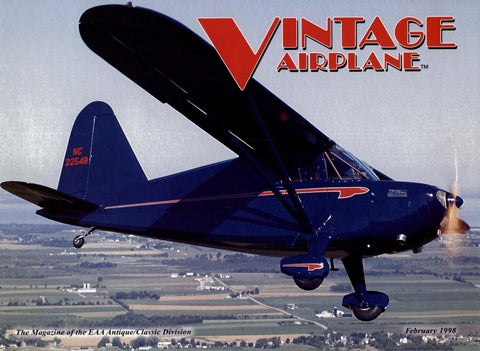
FRONT COVER ...The Stinson HW-75 was the early version of the Stinson 105 Voy ager. This stunning eample was restored over a lO·year period by Tim Talen of the " Ragwoo d Refactory· in Springfield. OR. Tim and his family were tickled to be awarded the Antique Bronze Age Champion trophy during EAA OSHKOSH '97 for their three-place Stinson. EAA photo by Ken Uchtenberg. shot with a Canon EOS- 1n equipped with an 80 -200 mm lens. 1/250 sec. @ f9 on 100 ASA slide film. EAA Wag Aero Spart Trainer photo plane flown by EAA volunteer pilot Ed Lachendro.
BACK COVER ....A Sunny Day· is the title of artist Lee Budahl's oil and acrylic paint ing that garnered an Honorable Mention ribbon in the 1997 Spart Aviation Art Com petition . From an unusual perspective we see the top wing of a Fokker Triplane be fore ~ slashes downward to ruin the day of the unsuspecting pilot of a British SE-5A. For more information on this artwork. please see A/C News on page 2.
Copyright © 1998 by the EAA Antique/Classic Division Inc. All rights reserved. VINTAGE AIRPlANE (ISSN 0091-6943) is published and owned exclusively by the EM Antique/Classic Division. Inc. of the Experimental Aircraft Association and is published monthly at EM Aviation Center, 3000 Poberezny Rd., P.O. 80x 3086, Oshkosh, Wosconsin 54903-3086. Periodicals Postage paid at Oshkosh, Wosconsin 54901 and at add~iona/ mailing offices. The membership rate for EM Antique/Classic Division, Inc. is $27.00 for CUfTent EM members for 12 month period of which $18.00 is for the publication of VINTAGE AIRPLANE. Membelship is open to all who are interested in aviation. POSTMASTER: Send address changes to EM Antique/Classic Division, Inc., P.O. 80x 3086, Oshkosh, WI 54903-3086. FOREIGN AND APO ADDRESSES - Please allow at least two months for delivery of VINTAGE AIRPlANE to foreig1 and APO addresses via st.riace mail. ADVERTISING - Antique/Classic Division does not guarantee or endorse any product oftered through the advertising. We ioWe constructive criticism and WilIcome any report of infelior merchandise obtained through 00' advertising so that conective measures can be taken. EDITORIAl POlICY: Readers are encouraged to subm~ stories and photographs. Policy opinions expressed in articles are solely those of the authors. Responsibil~ for accuracy in reporting rests entirely ~ the contributor. No rentmeralion is made. Material should be sent to: Ed~or, VINTAGE AIRPlANE, P.O. 80x 3086, Oshkosh, WI 54903-3086. Phone 9201426-4800. The words EAA, UlTRAUGHT, flY WITH lHE ARST TEAM, SPORT AVIATION, FOR lHE lOVE OF flYING and the logos of EAA, EAA INTERNATIONAl CONVENTION, EAA ANTIQUE/CLASSIC DIVISION, INTERNATIONAl AEROBATlC ClUB, WARBIRDS OF AMERICA are ® registered trademarks. lHE EAA SKY SHOPPE and logos of the EAAAVlATION FOUNDATION and EAA UlTRAUGHT CONVENTION are trademarks of the above associations and their use by any person other than the above association is strictly prohi~ed.
John Berendt 7645 Echo Point Rd. Cannon Falls. MN 55009 507/263-2414 Phil Coulson 28415 Springbrook Dr. Lawton. MI 49065 616/624-6490
5936 Steve Court Roanoke. TX 76262 817/491-9110 Robert C. ' Bob' Brauer 9345 S. Hoyne Chicago. IL 60620 312/779-2105
Joe Dickey 55 Oakey Av. Lawrenceburg. IN 47025
812/537-9354
John S. Copeland
1A Deacon Street
Northborough, MA 01 532 508/393-4775
Dole A. Gustafson 7724 Shady Hill Dr.
Indianapolis. IN 46278 317/293-4430 Robert Ucktelg 1708 Bay Oaks Dr. Albert Lea, MN 56007 507/373-2922
StonGomoiI
104290th Lone, NE Minneapolis, MN 55434 61 2/784-1172 Jeannie Hili
P.O. Box 328
Harvord, IL 60033
815/943-7205 Robert D. ' Bob' Lumley 1265 South 124th st. Brookfield. WI 53005 414/782-2633
Dean RIchardson
6701 Colony Dr. Madison. WI 53717 608/833- 1291
S.H. 'Wes' Schmid
2359 Lefeber Avenue Wauwatosa, WI 53213 414/771-1545
Gene Morris
GeoIf Robison 1521 E. MacGregor Dr. New Haven. IN 46774 219/493-4724
George York
181 Sloboda Av.
Mansfield. OH 44906
419/529-4378
DIRECTORS EMERITUS Gene Chose 2159 Carlton Rd. Oshkosh. WI 54904 920/231-5002
E.E. ' Buck· Hilbert P.O. Box 424 Union, lL 60180 815/923-4591
ADVISORS Sieve Krog 1002 Heather In. Hartiord. WI 53Cf27 414/966-7627
Roger Gomoll 321-1/2 S. Broadway Apt. 3 Rochester. MN 55904 507288-2810
Dovtd Bennett
403 Tanner Ct.
Roseville. CA 95678
916-782-7025
STRAIGHT &. LEVEL
by ESPIE "BUTCH" JOYCE
t's really funny the places that I end up writing this Straight & Level column for VINTAGE AIRPLANE. This one is being written while sitting on a 737 that will be departing Louisville, Kentucky at about 6:30 p.m. for Char lotte, North Carolina. Then a lift from Charlotte to Greensboro will allow me to be home by (if all goes well) 11 :30 p.m. That's not too bad considering I got up this same day at 4:00 a.m. to make my 6:30 departure for my day's trip to Louisville, KY, where I had a lunch plus a four hour meeting with a company. This is but an hour and a half trip in my Beech Baron each way, but the forecast of freezing rain and the ab solute need to be at this meeting required me to go by airline. Please do not take this to mean I am upset with the system of airline travel-after all, it's an II hour drive each way! I am grateful to be able to leave home in the morning and return the same day. But it certainly highlights the remarkable abil ity we have to control our own schedule using our own aircraft. The weather does limit its utility just a bit, even with an instrument rating, but if the weather forecast were not for freezing rain, I could have cut my trip's time require ment by over half. On this trip I carried a publication that included a short article written by EAA Founder and Chairman of the Board, Paul Poberezny. In it, Paul spoke about the inconveniences that we as pi lots and aircraft owners put up with in order to own or fly aircraft. What Paul said is true, but as a long-time aviation buff I had come to be accustomed to the inconveniences that I go through and have expected these things as the norn1. I've been in aviation a long time and perhaps that's the secret. Many of these restrictions have been put on us one at a time, I have not really stood back and looked at what we have to go
I
through to get my aircraft into the sys tem and fly it from here to there. Thank goodness for those of you who can still keep your aircraft on a private airport. While sitting at the gate in Louisville, I kept hearing different announce ments, most of them dealing with weather related delays: "Because of the weather at Chicago, Illinois, we cannot depart this flight on time; therefore we are trying to arrange a different flight for those of you who have a connection." Ninety-five percent of those flying into Chicago were af fected . On a day like this, you ' ll probably see the same sign I saw on the ticket counter: "This flight is over booked; if you volunteer for a later flight we will give you a round-trip ticket (free of charge) to any point that we fly to , in the next year." Thanks, but no thanks; I just want to get home to the couch and fire . Even the pros are affected - a UPS captain was waiting for the same flight as me . He was worried that he might not get on the flight because it was overbooked (he did make it; I was pulling for him) . Once he got to Charlotte he had to start all over with his quest to get home. In Chicago it is another madhouse of can celled flights and people trying to make connections. You can see that weather or many of the same factors that affect us can make aviation travel an inconvenience to all who try to fly through this vast ocean of air. It is not only limited to pi lots and aircraft owners, but being an aircraft owner or a pilot has its own unique disadvantages and highlights. As I write this, it is the second day after the 21 st of January, which is the equinox, and we now start gaining nearly an additional three minutes of daylight each day. I can hardly wait for the Sun 'n Fun Fly-in in April. Before I talk to you about that event, I would like to pass along some exciting news about EAA AirVenture '98. One of the major themes this year at Oshkosh is a
cooperative effort between EAA, the EAA Antique/Classic Division and the NBAA. We will be recognizing the role that corporate aviation has played in the history of aviation, by helping cre ate the display of Antique, Classic and Contemporary aircraft that represent the contributions they have played in business aviation. In our workshop tent, we also plan to have several of the most talented metal working individuals. Each day you can see demonstrations of this skill, and the proper use of metalworking tools. This effort is being headed up by your A/C Director Steve Nesse. We will have ad ditional information about this program in future issues of VINTAGE AIRPLANE. Should you have any questions about this metal working shop, contact Steve at 507/373-1674. EAA AirVenture '98 is shaping up to be one of the greatest Conventions we will ever have! The Antique/Classic 10nl campaign is still going great; the report that I received just last week showed us to be on the positive side. Let's keep it going, and continue to recruit new members! Your continued support of the Antique/Classic Division has made this group one of the strongest groups of the EAA. I again call on your sup port to ask new people to join up with us so they too can enjoy all of the Antique/ Classic benefits as well as your great magazine. This past January, we have had an other hand propping accident. I can only say that you and I need to do what ever is necessary to prevent these accidents from occurring in the future We all need to look after each other and prevent these reoccurring accidents. Well, we have landed in Greens boro; we are late - it is now II :30 p.m. I guess I'll need to walk out to the parking lot and beat the ice off of my truck so I can go home. Let's all pull in the same direction for the good of avi ation . Remember we are better together! Join us and have it all! ... VINTAGE AIRPLANE
1
A/C NEWS
compiled by H.G. Frautschy ASUNNYDAY Our back cover features another of the paint ings which won an award in the annual EAA Sport Aviation Competition. Lee Budahl, the artist who entered the painting wrote: "I have been teaching art for 30 years, and have been drawing for twice 30 years. Some of my earli est memories are ofdrawing pictures ofairplanes ... 'A Sunny Day' takes place in France, Spring 1918; the last year of World War I. A British SE 5A flies over fields which have escaped bombardment and which are beginning to turn green. For a precious moment or two the pilot looks out at the ground beneath him. He does not see the German Fokker DR.! diving out of the sun toward him . In seconds the Fokker's pilot will rake the SE-5A with machine gun fire. The Fokker's wings are red - this may be the Baron's plane. We watch this frozen moment of time from somewhere outside both cockpits; far from the SE 5A , and a little above the Fokker. From our viewpoint the red wing makes a dramatic, diago nal plunge into this sunny day, reminding us that the war is not yet over." You can reach Lee at 300 N Country Club Rd., Cullowhee, NC 28723. AERONCA SPAR AD EAA and the Antique/Classic Division recently commented on an ill-advised proposed Airworthiness Directive Docket No. 97-CE-79-AD. Affecting American Champion Corporation 7, 8, and 11 Series airplanes, it would require the own ers of Aeronca 7AC through the 7EC and Bellanca's 7ACA, or the IIAC and IIBC (as well as Champion aircraft models built before the acquisition of the line by Bellanca) to add multiple inspection holes in the bottom of the wings of their airplanes, and a larger plate in the top surface of the wing near the spar/wing strut attact fitting. The following is a synopsis of EAA comments to the FAA regarding this proposed AD. The stated purpose of this AD is to ensure the detection of spar cracks that could result in an in flight wing failure. Therefore, for aircraft that have never suffered wing damage, the inspection should not be necessary. The result of the aircraft modifica tions proposed in the NPRM would result in a costly change to the aircraft that would not prevent the type of failures that have occurred and actually could cause additional failures due to moisture damage. The proposed AD does little to enhance an in spection. The proposed inspection plates leave just barely enough room to insert a mirror, and not enough to do any feeling for anomalies by touch. (The supposition that spar damage could be felt by fingers requires the damage be quite severe, i.e. a spar fracture due to wing contact with the ground.) These little curved holes are so small that it almost requires a borescope to see over and under the spar when looking through these holes. There are also aerodynamic concerns to be considered with the addition of 22 inspection holes in the bottom sur face of the wings. The holes proposed for the top of the wing are very well located for inducing wing rot. They are 2 FEBRUARY 1998
centered over the juncture of the plywood dou blers in the area of the wing strut attach point on the spars. As currently constructed, the wing is a closed structure with carefully controlled ventila tion. The addition of the rectangular panel on the top of the wing, as proposed by this NPRM, will result in moisture infiltration into the wing struc ture. When sitting outside, moisture, combined with the sun's heat creates an ideal fungi incuba tor. Mold and rot thrive in such a warm, moist atmosphere. The doublers will delaminate. Rot will form unseen behind the doublers. The FAA is proposing to swap the problem of a unsubstanti ated "cracked spar" problem with another real problem. Why puncture the "umbrella" of the top covering to let in water? The inclusion of aircraft of the low powered Aeronca 11 and 7 series and the Bellanca 7ACA cannot be sustained by using the statistical data presented in the NPRM. The AD's statistics shows that no 11 series airplane has shown any spar problems related to this type of damage. The "compression failure" type of crack is the stated reason for the NPRM. But FAA statistics quoted in the NPRM show the low powered 7 series to be comparatively free of compression cracks as well. Of the eight accidents cited in the NPRM, seven of the eight are high powered models. It may be appropriate to review the history of this wing design at this time. The same spar cited in the proposed AD is used in the Aeronca models which type certificates are not presently owned by American Champion Aircraft Company. These are the prewar Chief, the Defender, the K-series, the CA65, and the L-3 wartime model. These all have the same wood spar design, and Iike their younger relatives, they have not, over a 60 year period, shown any evidence of a structural spar problem. This would seem to lend credence to the conclu sion that only the higher weight, higher powered aircraft which have been overstressed at some point in the past may have structural problems. It is also true that these higher horsepower, higher gross weight aircraft are being flown in much dif ferent ways than the original wing design was intended to handle, i.e., aerobatics flown by less experienced aerobatic pilots. During the recent past, a new, higher strength, STC'd wing strut fit ting for attac hing the strut to the spar has been created. The revised fitting was produced after the failure of the wing strut fitting on a higher horse power, higher gross weight Decathlon airplane. The FAA cited an 8GCBC accident after ini tial inspection several years earlier as justification for the proposed AD. From the Type Certificate Data Sheets one can see the vastly different load ing conditions of the different aircraft cited in the proposed AD. The 8GC BC Scout has a gross weig ht of 2,540 lb . and a 180 HP engine. The 8KCAB has a gross weight of 1,800 lb. and an en gine of 150 HP. The 7ECA has a gross weight of 1,650 and a 150 HP engine, the 7AC has a gross weight of 1,120 and a 65 HP engine. To compare these aircraft as having similar loading on the spars is unreasonable. We also understand there are differing opinions regarding the exact nature of this wing failure between the investigating par ties. Before it can be used as justification for this proposed AD, it seems appropriate to review the investigation of this particular failure. Only three of the eight airplane failures cited
by the FAA were due to undetected and unin spected damage to the spar or improper wood slope which would be detectable under the present fac tory inspection holes if an inspection was properly accomplished leaving only two undetectable in spection accidents out of 5541 airplanes cited, plus the 961 IIAC Chiefs covered... that's 6,502 planes and two out of that is a .0003075% failure rate. If we are to make the FAA assumption that the fail ures are under reported, we can then increase the failure rate. While we don't agree that the failures are not reported routinely by mechanics, for the sake of argument, we'll assume the failures were under reported by 300% in the field, requiring the failure rate to be multiplied by 3 times. That gives a fai lure rate of .0009225%, still less than one ten thousandth of one percent of the fleet! These sta tistics would indicate that there is no real problem that requires the need for a mandatory AD on all aircraft. This information does indicate that the FAA and other aviation organizations such as EAA should better educate the owners of these aircraft of the importance of a good annual inspec tion of the spars and a detailed, thorough inspection of the wing spar prior to recovering an aircraft, or specifically after a wing strike. The FAA stated in the AD that "The FAA be lieves that many cracked/damaged spars are not reported because general aviation operators (oper ating in accordance with Part 91 of the Federal Aviation Regulations [14 CFR part 91]) are not re quired to submit service difficulty reports." EAA does not agree with this statement. EAA believes that most mechanics are safety conscious, and when they see something that they believe is a de sign or service problem they submit a report because they care for the lives of the pilots who fly these aircraft. As you read the service difficulty re ports, it impresses you with the small details that get reported. A loose screw here, an enlarged fit ting here... EAA does not believe that something as major as a wing spar with damage would go un der reported. The FAA has cast moral and ethical clouds over the inspectors they license. Every annual inspection of a wood spar air craft should include a detailed inspection of the spar using the existing inspection holes. This method has worked well for over 50 years. If the lighter airplanes had a structural flaw related to the use of wood spars, would it not be reasonable to expect the problem to exist over the service life of the aircraft? The data collected over the past 31 years (the length of time used to collect the data cited in the NPRM) does not justify the inclusion of the Aeronca 7 and II series airplanes, nor the Bellanca 7ACA. No data at all was submitted on the 11 series aircraft and they should not be in cluded in any proposed action. The application of this NPRM to the higher horsepower, higher gross weight aircraft should be carefully weighed against the possibility that the failures of the wings on these airplanes could be the result of another failure mode involving the spar/wing strut fittings. In conclusion, the proposed action of adding in spection holes on the top of the wing would cause addition corrosion and moisture problems, offsetting any improved inspection abilities and insufficient support is given for the need of any additional in spection requirements for any of the effected aircraft. This proposed AD should be withdrawn. We'll keep you posted on any further develop ments regarding this proposed AD. ...
VINTAGE
AeroMaiI
PARKS HELP Dear H.G.,
I am writing a book about the early days of Parks Air College, spanning from its founding in 1927 though the mid 1930's. I am interested in corresponding with anyone who might allow me to pho tocopy information they might have about Parks. I'm looking for photographs, sales brochures, correspondence, anyone who flew or worked on the Parks-built P-l P 2, P-2A, P-3, P-4 airplanes, information on the 1929 Women 's Air Derby, Gard ner Cup Race and Cord Cup Race, copies of "Parks Air News," "Happy Landings," "Skyward Ho" and "The Man Who Tunes The Plane." I would like to speak with any former students from that era as well as any pilots or mechanics who visited Parks during that time. You may write or call me collect at the following address: John L. Lewis 60 Robert Leather Rd Bethlehem, CT 06751 203-266-5787
named as Walter Lees in the photos on page 18. About "Cap" Wool son, I'm not sure. I enclose two copies of Walter Lees, both from the book Pioneer Pilot, edited by Lees' daughter Jo Cooper. The photos are consistent with others in the book. Lees was bald at an early age, and he had a Charlie Chaplin mustache. You might be interested in the discus sion of the Buh} Sport Airsedan that was at Monmouth, IL airport for awhile in 1935. You will find a discussion on it in Flying Field, page 66. It had an engine that was once on the Spirit of St. Louis. No kidding! Best Regards, Jim Haynes Bushnell, IL AlC 12099
BUHL AlRSEDAN NOTES
Jim is right, and his nifty history ofthe Monmouth airport in "Flying Field" is a great story. For more information on the book, drop an SASE in the mail to Jim at Robin 's Nest Co., 21 Sunset Ln., Bushnell, IL 61422. Jim's suspicion is confirmed in this next note from none other than John Underwood:
DearH.G., I enjoyed the article on the Buhl on the December issue. It's always good to learn more about an antique airplane. However, I question the identification of the person
The two gents in front of the Packard Buhl are Fred Brossy (left) and -Continued on page 27
Yo,H.G.!
The talents of our members seems to have no end! Jim Neu man, Hobart, IN, (Ale 23168) sent us this postcard regarding the Fw-44 shown in Members Projects in the November '97 issue of Vintage Airplane:
~
~~~} ITS SAD 'TO SEE CLASSICS
e=r
The beautifully restored Fw44 Stieglitz before It was severely damaged.
The sad remains of the Stieglitz in a Germany field.
So Norm replied: Sometimes I tink I should retire Und schmoke cigars, und stoke der fire, Perhaps ve tink ve are so schmardt To place der horse before der cart, Und name der plane vitoudt much tinking Dat Herr Newman would be tin king, Mine veak brain vaves, like der steeple Jias knockedfor loop, like many people, Yah, das ist ein Steiglitz -for sure Der Stosser been ein FW-56 - so pure Yah, ich been ein stupid Dane Das ist hard to live in pain!
TO KITS
BlIT ytIJR. CAPTION IS A LOSS, nR 81-11/1/.165, A FUSE.LAGE. AIJD BI=.... . MAKE A STIE.GU"'~ -Hor A STO:sSIOR.
' ~ AI,}
"Bitte Schoen" Norm Petersen VINTAGE AIRPLANE 3
THIRD ON THE
TRIMOTOR
Three-engine airplanes aren't all that rare today. But 70 years ago when fly ing machines themselves were still a novelty, the advent of a sleek, silvery airliner woke the world to the potential of travel by air. The Ford Trimotor, with its two pilot crew, 12 seats, flight attendant and richly paneled interior, brought the comfort of the drawing room with a magnificent view to a realm formerly dominated by risk takers. The first quarter century of powered flight had indeed been sustained through the dreams and daring of pilots at war, pilots carrying mail, pilots storming barns, and pilots perishing while they furthered aviation knowledge. What an opportunity it must have been, three generations ago, to board a glistening silver bird with one enor mous wing and its nose pointed rakishly toward the sky. Sitting back in a com fortable seat with a view of one of the huge radial engines sent a thrill of antic ipation through many a previously earthbound traveler. Fingers would clasp tightly as the roar of each of the three engines starting brought more life to the eager bird. A short drive to the runway and then, a few yards later, airborne! One wonders how many land lubbers got their first taste of aviation on a Ford. How many future engineers, pilots and Yankee businessmen had their eyes opened to the potential of mass air travel while gazing at the cities and pastures below through the clear
4 FEBRUARY 199B
panes of a Trimotor. Now, three generations have passed since the heyday of that magnificent airliner. Only a half dozen of the birds have survived the passage of time intact. The proved to be workhorses, even after the development of faster, larger, more comfortable passenger ships. Trimotors labored on, their huge, square cabins with a low loading door ideal for carry ing high priority cargo. The Trimotor's short field capability made it a mainstay of the cargo, fire fighting and air-delivery world ofthe developing west. The moun tain country that the Trimotor helped develop was the spawning ground of magnificent pilots, too. These were pilots who knew the earth as well from the air as their fathers had known it from horse back. And these men maneuvered their steeds through the clouded, snowy mountain passes as easily as if they were still on the ground. One pioneer pilot was recently in ducted into the Idaho Aviation Hall of Fame. Penn Stohr spent his life honing his flying skills navigating the mountains and valleys of the northwest and bring ing a service to the rugged region that insured its development. Stohr was born in Clarence, Missouri in 190 I and spent much of his career flying single engine wheel and skiplanes throughout the mountains and valleys of Montana and Idaho. His exploits, the reliability of his service, and his intimate knowledge of the terrain helped make him a legend even before the rescue. During WW II, a bomber crew crash landed on a frozen lake during a training mission and a great search ensued. After ten days, it was Penn Stohr who noticed a disturbance in the snow and discov ered the crew still at Loon Lake. Using his single-engine ski plane, he lifted the crew to safety and earned a citation from the War Department. Stohr continued to fly into the pages of aviation history, joining with Bob
(Above and upper right) Penn R. Stohr, Jr., presents his twins, daughter Leisel, son Josh (far right), with their EAA Young Eagle certificates after their flights in the Ford.
Johnson to develop Johnson Flying Service into the premier air carrier in the region . It was with Johnson that Penn Stohr began flying the rugged, aging Ford Trimotors. The talents of the great pilot, the toughness of the bird, and the demands of mountain air service made the combination of the three a sure winner. Johnson Fly ing Service flourished and grew with the territory. As the great silver bird entered her second generation, Penn R. Stohr, Penn's son, and the second generation of western pilots took the controls. Although he was but a teenager in 1957 when his father lost his life at the controls of a Trimotor on a spray ing mission, Penn had already flown many of the planes his father had in troduced to the area. Penn, the son, flew easily into the contrails left by his departed father. When in 1975 Johnson Flying
Service was bought by another great aviation pioneer, Del Smith of Ever green Helicopters, Penn joined the new endeavor, Evergreen International Air lines. He became Chief Pilot and is now Senior Vice President of Flight Opera tions . The airline has grown over the years as well, now boasting a fleet of 38 jets, including DC-9s, B-727s, DC-8s and B-747s . And, of course, there's a Ford Trimotor, now in her third genera tion of service and restored flawlessly to full operating condition. As the Evergreen International Tri motor climbs gracefully away from its home at Oregon's Troutdale Airport, the sun flashes brilliantly from the windswept surface of the Co lumbia River. Boaters and wind surfers on the river, hearing the unmistakable roar of radial engines, glance up to see the re flected sunlight beamed back from the huge span of the Ford's wing. Through the cockpit door, the plane's passengers, surrounded by leather, mahogany and glass, can see the shoulders of the two pilots, father and son, as they steer the craft up the river. Penn Stohr and his twin children Josh and Liesel, now ten years old, are establishing the third gen eration of Trimotor drivers just as the silver airliner reaches her third generation of service. Josh and Liesel are two of over 360,000 Young Eagles. Sponsored by the nonprofit Experimental Aircraft Association, Young Eagles is a project dedicated to making the experience of flight available to as many young peo
pie, age 8 to 17, as possible, with a goal of one million youngsters by the end of 2003. Penn Stohr is an EAA member whose life and experience make him a natural aviation role model. But being an airline vice president is not a require ment. More information on the program can be obtained by writing or calling the Young Eagles Office, EAA A via tion Foundation, P. O . Box 2683 , Oshkosh, WI 54903-2683, telephone 920/426-4831. The world of flying , having been tamed by aviation pioneers like Penn Stohr, Sr., was transformed from a risky adventure into a service that helped to build a country. His son Penn is chan neling that service into a multi-billion dollar industry that circles the globe every hour of every day. Fleets of winged behemoths, each carrying more technology than fictional spaceships, ply the skies across the oceans and con tinents of the planet. At the helms of these craft are professionals, trained for years to become a functional part of the computers, pumps, video screens and thrusting engines. This is the latest pe riod in the evolution of aviation , the world that Penn is unveiling for his Young Eagles in the Ford's cockpit. Just as the beginning and end of their grandfather'S aviation career were a stark contrast between what was only dreamed and what could actually be done, so it will be again. As Liesel and Josh Stohr and thousands of their young aviation pioneers move into the cockpits, simulators and engineering laboratories,
aviation nears the end of its frrst century. What will Josh, Liesel and their com rades conjure up over the next quarter century? Look back 25, then 50 years. Would you be so bold as to forecast what the future pioneers, the great grandchildren of Penn Stohr, Sr., will strap on when they strut onto the tarmac of the future? There are a few certainties worth mentioning. First, the generation in the seat has the stick in its hand. What we've done with what we were given is ex actly what our chi ldren have to build upon. Aviation, being such a young endeavor, illustrates this principle so dramatically. Second, the legends left by the successes of each generation es tablish challenges for the next. Records, Douglas Smuln, Shirley Martin and Penn R. Stohr, Jr. pause In front of the Evergreen International Ford Trlmotor. especially flying records, were made to be beaten. And finally, it is only through preserving the thrill of aerial mastery and accomplishment that fu ture generations will be persuaded to take up the challenge. But without the opportunity to sample aviation first-hand through projects like Young Eagles, our next generation may never feel that thrill. As Josh sits at the controls of the 65-year-old airliner, the Columbia winds ahead to the east. Filling the windscreen is the majestic, snow mantled bulk of Mount Hood. The wild slopes are a swirl with white, just as they were when aviators were the first humans to make the moun tains seem small. Just as the efforts of today's aviation pros work tire lessly to keep this priceless silver artifact in the air, so they work to launch the careers of the next genera tion of her pilots. ... VINTAGE AIRPLANE
5
THE PRIDE OF TATUMS
by DAVID WELCH
I
've named my 1946 Cessna 140 "THE
PRIDE OF TATUMS." I had a fancy let tering job done that adorns each side just behind the "D" window. It's red, white and blue with a few stars for effect. An awful lot of times someone had come up to me and asked if my name were Tatums. Often the person is a Tatums himself, or has a friend, a cousin, an in-law, a neighbor, etc. I usually just answer "nope." I can be pretty reticent, and Rebecca hates it when I am. I just want people to ask the right question and I'll open up and tell the whole story. "How did you come by that name for your airplane, Dave?" I bought my Cessna in 1988. I had looked at a few airplanes after figuring out my bud get. For a reason I don't fully understand, I was pretty sure I wanted a Cessna 140. I learned to fly in 1969 in an assortment of rented 150s and I wanted something that would capture that nostalgia trip and more. The 140s were a few years older than any thing I had eve r flown and they were taildraggers. I had never been in one, in fact I had never even looked closely at one, but I was pretty sure I wanted one. I sent for the owners manual even before I started seri ously looking. I picked out an advertisement in Aero Trader and made the call. The seller sounded like someone whom I could trust and we set up a meeting. We would get together at Mid Florida Airport in Eustis. He flew the airplane down from Jacksonville and I drove up from Venice. (If he was willing to fly the airplane that far, it had to be in pretty good shape.) I liked it when I saw it, although I couldn't tell you why. It is white with red and blue stripes along the side and blue nose and wingtips. It flew well and we made a deal. He would take it home and annual it and we'd meet the next week in St. Augustine. I booked a one-way car rental and drove the four hours. We agreed to exchange papers and money, and then drop off the seller at a small grass strip just south of the JAX area. From there I'd solo in my first airplane for the two hour trip home. It is a taildragger. I had read lots of stories
.....DI....;.J_ _ __
6 FEBRUARY 1998
---'
1113081
over the years about taildraggers, but I had a pocket full of ratings and an attitude to boot. I am a CFI! We know everything and can teach it too. What trouble can a small, low and slow airplane be? Well, everything you've read about tail draggers is true. I needed to top off the tanks and elected to stop just a few miles south at Keystone Airpark. One of the factors in my decision was the choice of six directions in which to land. Fortunately for me, the wind dictated that I touch down far away from any eyes that may be watching. By the time I got to the gas pumps, I had had a lot of experience taxiing and making "s" turns. When I got out, my knees were made of rubber. My ankles and arms ached from all the control movements I had been making, both on the ground and aloft. I had been in the air less than 20 minutes. I made it home and taught myself to fly a taildragger. (The mandatory sign-off had not yet been implemented.) I did it with hours and hours of stop and go landings. First I did them on a mile of concrete at Venice; then when I felt confident, I went to Englewood where we have about 2,500 feet of grass and enough trees to command your attention. I got all my pictures developed, took them to work and started to brag. My co-workers have enough aeronautical sophistication to distinguish a light airplane from a blimp, but like most everyone else, they are all "Piper Cubs," aren't they? I work for the US Postal Service as a Let ter Carrier. I deliver the mail for a living. What my co-workers were able to point out to me, though, was that my new airplane was painted just like a mail truck. It is white with red and blue stripes along the side. It was ob David Welch and his Cessna 140, "The Pride of Tatums." As a US Postal Service Lette r Ca rrier, Dave had fun with his N number. Read the text for the reasons behind the name of his airplane.
vious as the sunrise, but I had never seen it. Was that why I wanted this airplane? The people at work are boat people. A few of them asked if I was going to name it. "No," I said, "boat people name their boats. Airplane people don't name their airplanes." These people watch too much TV. Probably the only pilot they are able to name is Lind bergh. Just because he named his doesn't mean all these "Piper Cubs" have names. Now I have two significant but as yet un connected things rattling around in my subconscious. First, it looks like a mail truck. Second, maybe it should have a name. During a very dull meeting at work one morning, I happened to be sitting by the Zip Code book. My mind, unrelated to anything on the conscious level, just wanted to know if anyplace had the Zip Code of my N number, 73087. Well, it was a small town in Okla homa by the name of Tatums. It's mail came out of Oklahoma City and I knew it was pretty small because one Zip covered it all. I looked it up on a road map when I got home and there it was. I went to a Sectional Chart and it's a real small point about 20 miles southwest of Pauls Valley. Pauls Valley- isn't that where the Cessna 120/140 Association is holding its miliual convention this year (1989)? At this point this is all just input going into my brain; I haven't mashed the sort button yet. I had a problem with my airplane and drove to the convention in Oklahoma. I took a side trip to Tatums. It has no airport nearby. - Continued on page 3J
CubAircraft Co. Ltd.
in Lundtofte, Denmark (Part Two) -continued from the January 1998 issuevia NORM PETERSEN As stated last month, this story, which is presented in two parts, is extracted from the book entitled "75 AR TIL LANDS & I LUFTEN" (75 Years on Land and In the Air), the 75-year history ofthe auto and airplane firm ofChristian Bohnstedt-Petersen, AlSfrom 1911 to 1986. The book was written by noted author, JfJrgen Helme, ofEs pergaerde, Denmark. The translation/rom Danish to English was done by Knud Thaarup (EAA 280077) 0/ Frederiksberg (Copenhagen), Denmark. We are indebted to JfJrgen Helme/or permission to reprint this historical account o/the Cub Aircraft Co. Ltd.from late 1937 to April 9, 1940, when Germany occupied Denmark.
O
n the other side of the 0resund (between Denmark and Sweden) the subsidiary in Malmo, Autoropa Ltd. , held the Swedish Piper Cub Agency. Here the former Swedish Air Force pilot, Eric Bjurhovd, was the leader of the company's aviation activities which were operated out of Bulltofta. Cub Aircraft Co. Ltd's Norwegian dealer was Wessel's Aviation Company Ltd at Fomebu Airport near Oslo. This company represented Piper Cub only and had, by mid-1938, sold eight airplanes of this manu facture. The Norwegian aviation enterprise, which simultaneously operated a flight school, was a subsidiary of Witt & Wessel AlS-the DKW importer for Norway. In the spring of 1938, Autoropa Ltd had ordered a Piper Cub hydroplane; i.e.-a 50 hp J-3S Cub on Edo 54-1140 floats. The purpose was to look into the possibilities of selling airplanes on floats to countries with many lakes such as Finland and Swe-
den . One day in August, Hedegaard flew the Cub on floats from Sweden to Den mark, landing in the lake called Furesoen, where Bohnstedt-Petersen had a summer cottage on Fureso road with direct access to the lake. During the stay of the Cub on floats over the next month, Prins, as well as Svensson and the instructor of the Flying Club Active, Lt. K. E. Simonsen, had the opportunity to fly the floatplane. After wards, they declared unanimously that it had been a great experience. However, the demand for land planes was much greater, so when the American registered Cub (NC215 l 7, SIN 2371) was returned to Malmo, Sweden, the wheels replaced the floats and the Cub was accepted on the Swedish Aircraft Register as SE-AMP. At Autoropa Ltd in Bulltofte, Bohnstedt had an airplane of French origin. It was a Caudron C 510 Phalene with room for four persons in a comfortable cabin. The airplane was registered SE-AGN and was flown by Lieutenant Eric Bjurhoved.
The old Rohrbach hangar at Kastrup Airport that was purchased by Bohnstedt-Petersen for 5,000 Danish Kroner (very cheap) and rebuilt at his home estate called "Hegnsholt" in 1938.
The Swedish Crown Prince, his majesty Gustaf Adolf the VI of Sweden, visits with Algot Thulin (holding his hat) of Autoropa AB, Malmo, Sweden, at an avia tion gathering at the Bulltofta Airport near Malmo.
In the spring of 1939, Bohnstedt decided to use the Caudron airplane himself and made provisions for transferring it to Lundtofte and having it registered in Den mark as OY-DIU. The following summer, the Caudron was frequently used by Bohn stedt as a corporate aircraft with Prins as chief pilot as he had added the type to his pilot's rating card. During June, the plane was flown to the island of Fano a couple of times where the Bohnstedt-Petersen family spent the holidays at the KUT Hotel. In Au gust, Prins flew the fami ly to Hollufgaard. During the stay on Fano, director Oeser of Daimler-Benz, came in his Mercedes 540K to visit. On this occasion, a speed contest between automobile and airplane took place. It showed that the 540K could easily keep up with the Caudron. The outbreak of World War II and the German occupation of Denmark (April 9, 1940) caused an abrupt end of the Lundtofte enterprises' aviation activities, which had presented itself as a very promising oppor tunity by the end of the 1930s. The very last delivery before the occupation took place was as late as April 3, 1940, when Lieu tenant Jacobsen of the Free Military Service in Norway took delivery ofLN-HAB, the last airplane of an order of three of the entirely new type, the Piper J-4A Cub Coupe with side-by-side seating. VINTAGE AIRPLANE
7
Piper Cub Airplanes sold by Cub Aircraft Ltd. during the years 1937-40
Date of Manufacture
Danish FactoryS/N
Type
SIN
Registered
Customer
7-10-37 5-28-38 5-28-38 6-16-38 7路8-38 7-15-38 7-25-38
73 80 81 82 84 86 88
Taylor Cub J2C-40 Piper Cub J3C-40 Piper Cub J3C-40 Piper Cub J2C-40 Piper Cub J2C-40 Piper Cub J2C-40 Piper Cub J2C-40
339 1164 1163 1158 1161 1162 1155
OY-DUL OY-DOM OY-DUM SE-AGZ OH-SNA OY-DEO OY-DAO
8-10-38 8-13-38 8-24-38 11-29-38
89 90 91 97
1156 1160 1157 1316 1159 1318 1996 2492 2503 2505 2532 2533 2371 2534 1317 2480 1998 1995 2535 2481 2482 2479 2485 2486 1319 1997 2504 4-565 4-600 4-568 4-567 2475
OY-DYN OY-DUO OH-SNB OY-DEP
Cub Aircraft Co. Ltd. Sportsflyveklubben K"benhaven Magnus Christiansen, Aalborg Aeroklubben, Malmo OY S. & N., Helsingfors O. Poulsen De Bademaker, Gent Flyveklubben -Activ' (anvendt af Luftwaffe u/ krigen) H_LM_ Jensen, Kastrup Aage Heidemann, Aarhus OY S. & N_, Helsingfors Cub Aircraft Coo, Ltd.
OY-FAB
2-14-39 2-14-39
102 103
2-25-39 4-5-39 4-18-39 4-24-39 4-25-39 5-8-39 5-12-39 5-13-39 5-26-39 6-6-39 7-1-39 8-29-39 9-13-39 9-13-39 9-30-39 1-23-40 3-27-40 4-3-40 11-17-48
104 105 107 108 109 112 113 114 117 118 122 124 126 127 128 130 131 133 297
Piper Cub J2C-40 Piper Cub J2C-40 Piper Cub J2C-40 Piper Cub J2C-40 Piper Cub J2C-40 Piper Cub J2C-40 Piper Cub J3C-40 Piper Cub J3C-50 Piper Cub J3C-50 Piper Cub J3C-50 Piper Cub J3C-50 Piper Cub J3C-50 Piper Cub J3C-50 5 Piper Cub J3C-50 Piper Cub J2C-40 Piper Cub J3C-50 Piper Cub J3C-40 Piper Cub J3C-40 Piper Cub J3C-50 Piper Cub J3C-50 Piper Cub J3C-50 Piper Cub J3C-50 Piper Cub J3C-50 Piper Cub J3C-50 Piper Cub J2C-40 Piper Cub J3C-50 Piper Cub J3C-50 Piper Cub J4AC-65 Piper Cub J4AC-65 Piper Cub J4AC-65 Piper Cub J4AC-65 Piper Cub J3F-50
6-11-1957
391
Piper Cub J3C-50
2491
Piper Cub J4AC-65 Piper Cub J4AC-65 Piper Cub J4AC-65 Piper Cub J4AC-65
4-566 4-597 4-598 4-599
During the summer of 1938, this U. S. registered Piper J3C-SOS, NC21517, SI N 2371, was flown on a set of Edo 54-1140 floats from a lake called Furesllen in Denmark. All the pilots who flew the Cub on floats enjoyed it, but the decision was made to concentrate on land planes. The Cub was then allocated the regis颅 tration SE-AHP in Sweden and put back on wheels. The writing on the picture says, "With Greetings, C. ~~.''''-'''\4 Bohnstedt-Petersen. " (Editors Note: in June, 1994, while attending the Danish KZ Antique Fly-In at Stauning, Denmark, a gentleman told me that he had a set of Edo 1140 floats from 1938 that were still in the original factory cartons! I strongiy suspect these are the very same floats pictured on NC21517.)
8 FEBRUARY 1998
Burned and dismantled airplanesparts then rebuilt in 1948 and 1949 with serial numbers: SI N 2475, OY-ABT og SI N 2491, OY-FAB
OY-DOR OY-DUR SE-AHP OY-DYR OY-DIP OY-DYT OY-DAT OY-DIT OY-DEs OY-DOT SE-AIB OY-DIS OY-DUT SE-AIC OY-DUP SE-AIS sE-AID OY-DAV LN-FAR LN-HAD LN-HAB OY-ABT
skandinavisk Motor Co. A/s, Odense C_ Bohnstedt-Petersen, Hegnsholt Autoropa, Maim", EX NC 21517 Magnus Christiansen, Aalborg Viggo Fehr & Co., Odense Godsejer P. Darel, Dueholm Cub Aircraft Co., Ltd. Cub Aircraft Co. Ltd. P. Perch & J. 0stergaard Veivad Skandinavisk Motor Co. A/ S, Odense Autoropa, Malmo Kaptajn Viuff Magnus Christiansen, Hobro Per Hallin, Lund J. Sejer Dybro, Siageise Autoropa, Maim" (21.5.49: OY-AIS) Autoropa, Maim" (efter 45: OY-AID) C. Bohnstedt-Petersen, Hegnsholt Den frie Militcertjen, Norge Den frie Militcertjen, Norge Den frie Militcertjen, Norge Bertil Kring, Risskov Genopbygget efter krigen Genopb. eft./krigen EX ()'EHES B-P Flyveklub.-totalhav. Sabotaged and burned by the Danish underground to prevent use by Gennan Occupying Forces.
A representative set of pictures of Piper Cub airplanes built and sold by the Cub Aircraft Ltd. in Denmark during the years 1937 to 1940 The country registrations are OY-Denmark, OH-Finland, SE-Sweden and LN-Norway.
SIN 339
SIN 2504
SIN 1158
SIN 2479
SIN 1157
SIN 2535
SIN 2532
SIN 2481
SIN 2480
SIN 4 -568 VINTAGE AIRPlANE 9
Bald Eagle Aviation
A Home For All Types of Aircraft Article and photos by JOHN GAERTNER
Bob Buck's pet project is a Beech Located only an hour's drive west of the nation's capital, you will find a workshop Staggerwing F-170 he acquired abo ut full of interesting aircraft under construc two years ago after it was involved in a tion. Bald Eagle Aviation is located on the rollover accident. The aircraft was origi farm of EAA member Bob Buck outside nally purchased from Beechcraft by the of Lovettsville, VA and is operated by Ou Pont fami ly and then later sold to the accomplished aircraft restorer, Andrew Bowers Battery Co. of Reading, PA. It King. In side you will find one Stagger was utilized by the Bowers Co. for several wing Beech, two Travel Airs, a Ryan years until WW II when it was pressed M-I , and a Nieuport 28 replica, all being into military service by the US Govern worked on at one time. Andrew King has ment. Fo llowing the war it was so ld as been a long-time antique aircraft builder surplus. Bob has been ca refull y going and restorer, growi ng up at Cole Palen's through the entire plane, replacing all of Old Rhinebeck Aerodrome, and havi ng the damaged components and rebuilding worked for the likes of Kermit Weeks in the wings. It wi ll be powered by a 330 hp Jacobs engine and will sport a beautifully Florida and Ken Hyde in Virginia. In September of this year a Travel Air 4000, belonging to AI Kelch of Jim Beville, Andrew King and Bob Buck pause from Mequon, WI, arri ve d at Bald Eag le Staggerwing project. Aviation. AI had been working on this project for a number of years and asked Andrew to assist in completing it. The wings were already nearly done, so Andrew has been spending hi s time worki ng on the plane's fuse lage and sheet metal work This Travel Air 4000 was previously owned by the Robert son Aircraft Corp. and operated as an airmail carrier. It is believed that Charles Lindbergh flew this same aircraft prior to his famous 1927 transatlantic flight. Three years ago thi s April Andrew began a personal project, building a Ryan M-I. Borrowing an original Ryan fuselage to go by, Andrew was able to weld up his fuselage as well as another example for his landlord Bob Buck . Working steadily on hi s project, the wings and tail feather components have all been completed and Andrew is ready to sandblast and paint the fuse lage for final assembly. Andrew's Ryan M-I wi ll be powered by a Lycom ing R680 radi al engine and painted in the livery of the Pacific Air Transport Air craft Co. when it is fmished. 10 FEBRUARY 1998
formed Jim Younkin aluminum engine cowl. Pictured here is a 160 hp Gnome ro tary engine above its original, 1918 crate, the fin and rudder of the Nieuport, An drew 's Ryan M-l fuselage and Bob Buck's Staggerwing. The massive wooden spars resting on the sawhorses belong to Andrew's Ryan project. The newest project to take form in An drew's shop is a Nieuport 28 replica that he and his father are building in partner ship. Andrew has considerable experience with rotary engined aircraft and has al ways planned on building a Nieuport. Recently a pristine 160 hp. Gnome rotary became avai lable from Johrmy Thomson their restoration work for a moment near Bob's
(Above and right) It's not quite as tight as the camera would lead you to believe, but there Is plenty going on In Bald Eagle's shop. These two shots detail Andrew's Ryan M路1 project, including the massive wing spars. Author John Gaertner, EAA's Air Adventure Museum Curator, is on the left.
of Ellington, FL. Andrew convinced his father that it was time they started on his planned Nieuport. Jim Beville, assistant in Andrew's shop, has been working on welding up the necessary components and the plane has begun to take shape. Once completed it is Andrew's plan to display and fly his newest creation at the Golden Age Air Museum in Grimes, PA. ...
(Below) AI Kelch is having Andrew finish up the Travel Air 4000 project he has worked on for a number of years. This particular Travel Air was owned by Robertson Aircraft in St. louis, and was most likely flown by Charles Lindbergh during his time at Robertson before heading off across the Atlantic.
( Below) Jim Beville hold s up the rudder fo r the Nieuport 24 replica being constructed by Andrew, Jim and Andrew's father, Bill. The pristine 160 hp Gnome, stili in Its original packing crate, is to the left.
VINTAGE A IRPLANE
11
Type Club
NOTES by NORM PETERSEN
Compiled from various type club publications & newsletters Stinson Plane Talk published by the National Stinson Club Bill & Debbie Snavely-editors 941-465-6101 Parts Washer- A parts washer that makes the garage or hangar-bound restoration easier. The parts washer consists of a 2-112 gallon plastic solvent tank and a 13"x7"x3" built in parts-washing basin, a small parts dunking basket and a pump style solvent from the container. There is even a 12"x7" molded in section on top of the container for holding parts af ter they have been cleaned. It is shaped so solvent drains off the parts and runs back into the basin. To use: simply remove a drain plug, lay it horizontal and the basin fills with solvent. Next, spray the grungy parts with solvent, brush away the grime and leave them to dry. When finished, tip the washer up to drain the solvent back into the tank and replace the plug. This way the unit can be stored or trans ported when not in use. Two biodegradable solvents are available through Finish Line; the stronger of the two is Citrus, it smells great, but it's too strong for some rubber and plastic pieces. The other, EcoTech, has less cleaning power but is safe to use on many plastics. Both solvents can either be used maximum strength or diluted with water. Citrus and EcoTech are available in 16 oz. bottles for $8.95 and the parts washer retails for $29.95. A test was run on a nasty, oily engine cleaning job. The Citrus was mixed as directed : one pint to 2-1/4 gallons of water. After working on the solvent 12 FEBRUARY 1998
tank for more than three hours, the pile of parts was clean and grease free. When the solvent turns black, simply stand the parts washer back up and drain the degreaser back into the tank. After the basin is clean, the parts washer can be tilted back horizontally to fill the basin with fresher solution. On particularly dirty parts, I used the EcoTech degreaser mixed 1: 1 with water. It worked well as advertised, and plastic parts were unaffected by the solvent. Other First Line products: Castro Super Clean, another biodegradable solvent. Mixed 1: 1 with water, it worked about as well as EcoTech at the same strength. It would burn if there was a cut on the hands. According to the Material Safety Data Sheet (MSDS) supplied by the cleaners, both Citrus and EcoTech are "not con sidered a hazard under normal operating conditions, for both skin contact and inhalation. Goggles and gloves are the only safety equipment recommended." When used in strong enough solu tions, the Finish Line degreasers will clean nearly anything. The cleaning power is less than that of gasoline or acetone, but the Finish Line products are much more user-friendly. The parts washer and the solvents are available from: Eastwood Company, P.O. Box 3014, Malvern, PA 19355 0714.1-800/345-1178. International Cessna 120/140 Association Box 830092, Richardson, TX 75083-0092 Joy Warren, editor, 1009 Port Rd,. White Lake, MI 48383
A FAMILY TAlL. .. DRAGGER, THATISf by John Nielsen January, 1980 After 22 years of rebuilding and restoration, my grandfather, Edward 1. Chermack, showed me how to get into the seat ofN4159N and buckle up. This was my first flight in a small aircraft. With skis attached, we taxied onto his private strip and took to the skies. It is a day I remember like yesterday. The winter sky was clear and bright. Fresh snow blanketed the ground and there was not a ripple of wind or turbulence. Grandpa didn't fly that often, but when he did, I remember he did so with care and precision. His pride in his ability to own and pilot his own airplane at the age of 83 was his link to a more youth fullife. When he lost his medical, he stopped flying. Not that he lost the skills, but because it would be against the rules. August, 1994 I earned my private pilot endorse ment. As I progressed through the training, grandpa and I often discussed the joys of flying and learning some thing new with each flight. We looked forward to the day we could hop in the 140 and take a few laps around the patch. I worked towards my tail wheel endorsement so he could once again fly the 140 while I was on board. We went to Oshkosh and picked up infor mation on the 120/140 Club. He continued to annual the airplane and run the engine weekly even though it never left the hangar.
-Continuedwpage28
TIM TALfN ' S STINSON NW·75 by H.G. FRAUTSCHY Tenacious would have to be used to describe Antique/Classic member Tim Talen (A/C 1616). His restora tion ofa rare Stinson HW-75 took him over 10 years, a decade filled with parts chasing and pinning down all the myriad details that seem to jump up and block the way as a restoration is done. At first glance, the HW -75 looks just like a Stinson 10 or lOA. It' s close, but that's not what it is! The very first model of the Voyager series, the HW -75 was quite a change for the Stinson Company. Named the " I 05" in promotional materials, since that was the speed it was supposed to at
tain in cruise flight, the HW -75 was a big departure for a company known for its larger, cabin class products. Work started in 1938 on the pro ject, and the design and layout for the airplane was not done in the Stinson factory . Bill Mara, now running things since Eddie Stinson's untimely passing in January of 1932, suggested the project , but the actual design work was done at the University of Detroit under the guidance of Lewis E. Reisner, of Krieder-Reisner divi sion of Fairchild Aircraft fame. Lewis worked with Prof. Peter Altman of the University, along with engineer Maurice A. Mills on the project, VINTAGE AIRPLANE
13
which was wind tunnel tested at the school. The new, still in the develop ment stage 75 hp geared Lycoming engine was picked as the powerplant, but the engineers at Lycoming still had a lot of work ahead of them, and the "littlest" Stinson's airframe development quickly outpaced the engine's pro gram. In the beginning, the failure of the Lycoming engine availability would put the HW-75 at a disadvantage. By the time early February of 1939 rolled around , Stinson had to have a 50 hp Lycoming installed just to keep the air frame testing program on track. The lack of horsepower didn't seem to bother the airplane too much, and test pilot AI Schramm took it up for the first time on February 3,1939. A quick takeoff in a little less than 500 feet was follow ed by a test flight that was a non-event as far as surprises were con cerned. It was a nice handling airplane with no vices, and true to its design, it proved to be unspinnable when loaded within the proper C.G . range. A big help were the leading edge wing slots which helped maintain the HW-75's roll control even when the wing was stalled. In those days , certification pro grams moved ahead with amazing rapidity, and a month later, a decision had to be made regarding an engine for production. The geared Lycoming still wasn't available (a pre-production en gine would come apart o n a Model lOB in July of 1939- it was back to the workbench and drawing board for the Lycoming folks) so the 75 hp Con-
One of t he early production HW-75s, with a cabin Waco and a Stearman-Hammond in t he background.
tinental was picked as the powerplant. That decision must have stung at Ly coming, who had long enjoyed a relationship with Stinson since E .L. Cord had enjoyed a controlling interest in both companies since the production of the Stinson Junior. Still, the Continental made a better airplane of the HW-75, now referred to in promotional material as the Model 105, a reference to the cruising speed of the airplane. Introduced at the 1939 World's Fair as the Stinson 105, it soon gained a legion of followers, many of them rather famous - Edgar Bergen and Charlie McCarthy had one (Edgar got the parachute, Charlie had an um brella tucked under his wooden arm) and Major AI Williams bought one
painted in the same orange and with blue trim Grumman Gulfhawk colors. He dubbed the Stinson 105 "Gulfhawk Jr." and used it to fly Gulf customers around. Williams managed Gulf Oil's A via tion department , and flew the Grumman in air shows across the coun try. Roscoe Turner had one, and so did Jimmy Stewart, who flew his home to Los Angeles from Kansas City in the middle of winter. Howard Hughes bought one too. The early HW-75's could be had for $2,995, and later, as the design evolved into the model lOA pow ered with the 90 hp Franklin 4AC-199, it sold for $3,355. A final push was made to install the relatively bug-free Lycoming GO-145 C, but the more powerful Franklin had The interior of Ti m' s 1939 Sti nson reflects the effort the people at Stinson put into making the airplane have a strong "car-like" feel. The text details the problems Tim had In matching the wrinkle finish on the compass fairing, just one example of the patience he exhibited while working for 10 years to restore this particular airplane.
14 FEBRUARY 1998
The bright work on this model can keep you busy polishing for days. Tim had to completely duplicate the carb air Inlet grill. Stinson and the engineers at the University of DetroH paid considerable attention to st reamlining the first "small Stinson,' as evidenced by the smooth contours of the tall fairing (right).
hit the nail on the head as far as the cus tomers were concerned, and the Model lOB died in the sales department, never to be sold to the public. It really was a case being simply too late-the geared Lycoming had a lot of promise, but it just couldn't compete when it was finally ready for the Stinson product. Look closely at the humble little HW-75, and you'll see a number of characteristics from later models, in cluding the Stinson L-5 Sentinel, and the very popular Stinson 108 series of 4-place airplanes. The little "baby" Stinson even went to war, earning its stripes as a stateside utility airplane. But its biggest contribution to the war effort would come by way of the fledg ling Civil Air Patrol. Well over half of the missions flown by the C.A.P. were done in the "littlest" Stinsons, some of them even equipped with a bomb rack! Overall, 1,020 of the HW -7 5/Model 10 series were built, but less than 100 remain on the reg ister. One of those now flying took a while to get back in the air, but now that it is flying, just look at it! Tim Talen is one of the many tal ented people around the country who have taken on a project and stuck with it for years, unable to
turn their backs on it because they were enjoying themselves too much. Tim has actually owned the Stinson HW-75, SIN 7131 for over 18 years. At the now long gone Springfield, OR airport, the Stinson sat in a hangar, a project in waiting. In a neat arrangement, Tim wound up with the airframe for the Stinson by fin ishing the restoration of a Cub, a net outflow of zero dollars. The airframe was pretty complete, and the more Tim looked at it, he realized that he really liked the little Stinson, and couldn't see doing anything less than a total restora tion from the frame up. If it was bolted, glued or riveted, it came apart and was restored. Very early on in the process, it became obvious that this airplane was the product of a company used to building larger airplanes - the empty weight from the factory is listed as 925 lbs, with a gross weight of 1,580. Why? As Tim points out, "Stinson stayed with their big stuff, and so when they got to this little light plane, I don't think they really knew how to build a light airplane. They really didn't have a lot of experience in that area .So it was built stout, good and strong Stin son solid stuff! I have found in looking through the frame that the tabs that are
welded on this fuselage for attaching points were various items that are the same size, shape, thickness and hole diameter as in the Stinson SR-5 I'm fa miliar with." Inevitably the airplane grew heavy with the addition of special trim and fairings, and even before it went into production, you can see it went on a diet after the prototype was just too heavy to carry a reasonable payload, particularly with three people. Happily, the aerodynamic features built into the airframe, including the flaps and lead ing edge slots, enhanced the handling qualities of the airplane, and it was able to exhibit excellent performance considering its limited horsepower. The airframe is a true mix of old and "new" methods of airplane con struction. This particular HW -75 still VINTAGE AIRPLANE
15
had some areas faired with balsa wood under the fabric, and the cantilever hor izontal stabilizer and elevator are built completely out of wood. The vertical fin is steel tube, as is the fuselage and the ailerons and flaps . The wings are also a combination of wood and alu minum, and while the tip bows did have to be rebuilt, the spars were still fine, and were used in the rebuilt wings. The fuselage is a cabinet maker's dream, with many stringers and window frame piecework that had to be rebuilt. Ken Lichtenberg
As you can see in the photos, there was enough bright work on the air frame to keep the most diligent polisher busy for days. A snazzy po lished alu minum fairing is in place over the exhaust stack, and each of the engine cooling air inlets is covered by a grill, as is the carburetor air inlet. The carb air inlet posed a special problem, since the original was missing. It got to the point where Tim simply had to make a decision and get to work making a new one. He carved an original mold out of
balsa, then made a sand casting of it and then cast a new inlet grill out of aluminum. The electrical system is a bit odd to comprehend in this day and age. While it is one thing to have a hand held radio today that you can take home and charge, with this Stinson, since the A-75 Continental didn't have a generator, the 6 volt battery simply drained down to nothing, leaving you without lights , and without a fuel gauge reading, since the fuel gauge system is electric! The interior is also a tribute to Tim's patience and ingenuity. When he was faced with restoring the instrument panel, a big challenge was restoring the original wrinkle finish paint, which was a blue color. Try as he could, there just was no match for the color in a wrinkle finish, but he was able to get a great match of the blue in a lac quer. But there were a lot of questions in his mind be fore he attempted to repaint the existing wrinkle finish, which was in good shape, but badly faded. Would it melt the old paint and reduce the wrin kles to a flat mess? Or would the new paint build up too much, and ruin the wrinkle look? Tim bit his lip and closed his eyes as he lightly dusted a coat of blue lacquer over the old panel. It was okay! No runs, no drips, and the wrinkles still looked like the face of one of those Chinese Shar-Pei dogs. A few more very light, dusted on coats of color finished it off, and another check mark was put in the completed column. Even more wood work had to be done on the interior, in cluding the door and side panels, which all are finished in clear varnish, just as the later Stinson 108 Station Wagon was done. It's a very classy interior, and certainly in keeping with the efforts of the airplane manufacturers to make their interiors as "car like" as possible. We ' ve just begun to hint at
Tim Talen, Springfield, OR and his 1939 Stinson HW-75, winner of the Antique Bronze Age Champion trophy at EAA Oshkosh '97.
the amount of work and dedication it takes to make a restoration like this possible . Tim Talen and his friends, people like Murray Olson and Jane
Phillips, contributed to the final product, and Tim ' s wife Marian has been a sup porter of her husband's penchant for restoring old airplanes during their mar ried life, which includes living and working in the old Springfield airport hangar, which they bought and moved to their property. Tim and Marian's daughter , Ariel, literally grew up with the project, as anyone who looks at his restoration photo album can see. Little Ariel is seen sitting in the bare bones fuselage frame, and then later, she appears in an occa sional photo helping out when needed, even if it's just to provide a smile. This was certainly not the first pro ject Tim has tackled, since he makes his living now as a vintage airplane re storer. He's done three Interstate Cadets, a Piper J-5 and a Fleet as well as a Piper J-2. Just as the Stinson was a
sideline personal project, Tim has an other rare airplane being restored a General Skyfarer, another of the two-axis control airplanes built under license from Erco, Fred Wieck's com pany that held the patent rights for the Ercoupe. Tim's a history major, in fact his college degree is a Masters in Social Science History, which he earned after returning from Vietnam. But with few jobs in his field available, he found he was pretty good at fabric and sheet metal work, and so he hung up his own shingle after a while and has been at it ever since. We're glad he did, for it means that a number of neat restora tions will be seen coming from his talented shop. Are you ready for the Skyfarer? How about a Porterfield Collegiate? Or the last Kari Keen Coupe in the U .S.? Whichever one gets done first, you ' ll want to be sure and hunt it down at a fly-in. It's sure to be a gem. ~ ,\"e end! Stinson drawing above is from " Airplanes of the World" book.
ViNTAGE AIRPLANE
17
Jim Zangger's
by NORM PETERSEN Perhaps the familiar saying, "Like fa ther, like son," would apply in the case of this beautiful Taylorcraft BC-12D, NC94953, SIN 9353, which ran off with the Best Of Class award at Oshkosh '97 for its owner and restorer, James "Jim" Zangger (EAA 476891, NC 23221) of Cedar Rapids, IA. Let me explain. Jim's father, Russell Zangger, of Larchwood, Iowa, has run his own airport and flying service for approxi mately 50 years - with always at least one Taylorcraft on hand for instruc tion. Russell feels the Taylorcraft is a better teacher than most other air planes, and besides, it develops better pilots! Into this environment, a young Jim Zangger was born on July 18, 1949, at Larchwood, lA, in the far northwestern corner of the state, and grew up with Taylorcrafts flying over the house on an everyday basis. He began taking lessons from his father at an early age and on his 16th birthday, made his solo flight in a Taylorcraft BC-12D. At the time, he had 64 hours in his logbook and two days later, because the Lyon County courthouse was open, he obtained his Iowa Drivers License! At the present time, Jim Zangger has over 17,000 hours in his logbook and is a full time corporate pilot for North American Rockwell at Cedar Rapids, IA. In 1991, Jim had built a large garage with the idea of rebuilding an airplane preferably a Taylorcraft. His father knew of one that was sitting in a hangar near Ellsworth, MN, about 25 miles from Larchwood. Russell had taught the owner how to fly many years ago. In 1993, Jim and his father drove out to visit the owner and look at the Tay lorcraft. The tires were flat, the fabric was original (from 1946) on the wings and fuselage and was cracking and The classic lines of the BC-12D are accentuated by the original paint job in black and red. The lifting handle on the rear fuselage Is handy for moving the airplane on the ground.
18 FEBRUARY 1998
starting to fall off the sides. The T-Craft had failed the Annual Inspection in 1972 and hadn't flown in 21 years. It needed a great deal of work! The owner, a very pleasant gentle man named Emerson Huisman, was reluctant to sell the airplane which he had owned for so many, many years, however, negotiations continued and
by 1994 a deal had been struck and Jim dismantled the BC-12D and hauled the pieces to his shop in Cedar Rapids. The fun began. It was way back on August 17, 1946 that 01' NC94953 made its first flight at the factory in Alliance, Ohio. It was sold into southeastern Minnesota to Melvin Truehouse at Spring Grove,
as per original, but the cost and avail ability puts it way out in left field. The end result using Ceconite is quite outstanding and the workman ship caught the judge's eye on the first pass. Jim obviously knows how to do excellent fabric work. The Continental A65-8 engine had been topped at one time, but a close inspection revealed it was time to go through the engine and bring it up to proper limits. The crankshaft was sent to Aircraft Specialties where it was ground "ten under" and new bearings were fitted . The cylin ders cleaned up at 15 over, so they were ground and then chromed back to standard size. New pistons, new (Above) Jim I~ys the T-Craft over to the right in a rings new valves and all as sorted sharp turn, giving us a good look at the 3S-foot ' . . . long NACA 23012 wing. C. G. Taylor's design parts and pIeces were Installed to bnng the four-banger to near new condition. shows its classic lines in fine style. In addition, a new stainless steel ex haust system was installed. Since MN who managed to flip the T-Craft on its back when he hit a completion, the A65 hasn't missed a badger hole. The airplane was re beat and the Taylorcraft cruises along built by none other than Bernard at 95 mph with the metal prop turning Pietenpol of nearby Cherry at 2150 rpm. The interior was completely redone Grove, MN. During the next 40+ years, the Taylorcraft resided including a new headliner and replace along the Minnesota-Iowa line, ment of all glass. The result is a very moving west until it landed at pleasant, original looking Taylorcraft Ellsworth, MN near the South cabin that moves you back to 1946 the Dakota border, where Jim Zang instant you sit in the seats. To increase their knowledge of Tay ger caught up with it. When purchased in 1994, the logs lorcraft airplanes, Jim and his wife, showed 1,312 hours on airframe Cecelia, traveled to Dayton, Ohio, to visit with Bob Taylor, son of C. G. Tay and engine. Off loaded and carefully lor, designer of the Taylorcraft. Bob moved into Jim's shop, the Taylor carefully explained his extensive col craft was taken down to bare lection of memorabilia and albums to bones and inspected, one piece at a (Below) The Iowa delegation - Russell Zangger time. The fuselage was in remarkable and his wife, Dolly, Jim's wife, Cecelia and Jim shape and required only sandblasting Zangger line up by the award-winning BC-12D and corrosion proofing. The rest of the Taylorcraft. This is a Taylorcraft family from t he metal parts were also in fme shape with no welding required. The wings needed some help in that the wood spars had to be varnished and one wing tip had to be smoothed over where the mice had been having lunch on the edges. Other than that, it was pretty much clean up and get ready for covering. Not only is Jim Zangger an experi enced pilot, he is al so an A & P mechanic, which he earned at Parks College in Cahokia, just south of East St. Louis, IL. While the instruments were sent out for overhaul, the airplane was covered with Ceconite 102 and finished off with Randolph butyrate dope . Jim would have preferred Grade A cotton
The empennage of NC94953 is a perfect example of Jim Zangger's beautiful workmanship including inspection covers and rudder trim tab. Tail wheel is a soft rubber Maule using cont rol springs in tension.
the Zanggers, which left them visibly impressed. In addition, they stopped at Alliance, OH, and visited with Forrest Barber, long-time Taylorcraft afi cionado and expert on the marque. All in all, it was quite a trip. At Oshkosh '97, the Zanggers were quite surprised at all the peop le who Uke father, like son. Russell Zangger, an instruc tor and Taylorcraft booster for over 50 years proudly stands by his son, Jim, a pilot wit h over 1 7,000 hours and a Taylorcraft aficionado and restorer with his award-winning BC-12D.
ViNTAGE AIRPLANE
19
(Above) Nicely done landing gear features 6:00 X 6 tires and Shinn mechanical brakes. The red wheel hubcaps are original with three Indented screws holding them to the wheel, and you can appreciate the clean work on the landing gear fairings.
(Above) Head-on view of the T-Craft shows McCauley 74x45 metal prop and spinner and neat aluminum grills on the two cowl openings. Note the clean design with absence of drag producing bumps and Inter sections-the reason the T-Craft Is so fast with only 65 horsepower.
admired the Taylorcraft during the con vention and especially all the questions that were asked! The pretty black and red T -Craft was easy to spot in the mul titude of aircraft and apparently there are many folks who have a soft spot in their heart for the speedy little two placer. In the latter part of the week, Jim's parents, Russell and Dolly Zang ger, of Larchwood, lA, joined them and
the entire crew was on hand for the Monday night Awards Program at the Theater-in-the-woods. All of the sweat, toil, tears and efforts were worth it when NC94953 was called out for the Best of Class award in the Taylorcraft section. May we add our "Congratulations" to Jim and Cecelia Zangger for an out standing job of restoration. We know that C. G. Taylor is smiling. .....
(Below) Jim Zangger pulls In close with the BC·12D. You can clearly see the fuel gauge wire In front of the windshield Indicating a nearly full nose tank. Two additional wing tanks of six gallons each give a total of 24 gallons for a range of nearly five hours.
20 FEBRUARY 1998
(Above) Interior photo of Jim Zangger's BC-12D reveals heel brakes on the pilot's side only, dual glove compartment doors on the Instrument panel and tr1m crank In the ceiling. Note original Shakespeare frictlorHock throttle with Caro Heat control third knob to the left. The first knob left of the throttle Is the Fuel Shutoff control-where the Carb Heat Is normally located! This arrangement has caused a number of accidents and requires a red Interference clamp to restrict accidental usage.
I)IJllINC. "T"T I
by WALT KESSLER
!l
ack during the Big War, night fly ing was dramatically increased ecause of several reasons . Practically all offensive air work had to be done under cover of darkness. Also, Zeppelin raids frn-ced night airplane flying on a larger scale. Public opinion demanded night airplane patrols. Most seemed to think that a few aircraft in the sky would stop the Zeppelins from carrying out their work of destruction. The problems encountered were enor mous. How was the pilot to see at night? How would he spot the other aircraft, or fly straight and level. How about land ing at night and into the wind? Most long distance bombing raids
their aerodrome, they were stunned to find the Germans had bombed their fa cility! Both forces had planned surprise raids on each other's aerodromes, at the same time. The amazing thing is that they passed but didn't see each other. In each case, officers in charge of the Aerodrome lit up their own fields upon hearing airplane engines, thinking it was their own aircraft returning from the raid. Lighting the aerodrome was the only way the returning aircraft were able to land. Back in those days, each machine was fitted with an altimeter, an inclinometer for indicating the airplane's inclination and position lights showing the trans-
were conducted at night and the anti aircraft guns firing at them were not very effective. You can' t hit what you don't see. With few exceptions, most raids were carried out after it got dark. Most airplanes could not be seen and it was most difficult for search lights to pick them up. Dirigibles could be picked up with comparative ease. One night, an Alli ed squadron started out with the intent of bombing the Turkish-German positions. On arriv ing they were shocked to see the German Aerodrome all lit up . The Allies took advantage of the situation and bombed the hangars and others buildings. When the Allied squadron returned to
-= \\
~\\
Sight Lines -
,
, , , , , , .... , , , , , , .... , .... , , , , , .... , .... .... ,, ,, , , , .... , , , ....
,,
,
,
,
"
9
[Horizon Line]
llz: lb~d@$ifi3W1~ ~ ~
' , I \,
','..\ ,
'
0:-__ --_--_-- -- -- -- -- -- -- -- -- -- -- -- -- -- -- -- -- -- -- -- -- --
-- - ::--- - -
II\\
II \ \
II \\
II \ \
I I \ \
\ I I \ I \ \ I \ \ I I \ I I \ \ I I \ \ .... I I \ \ ........ I \
',I'
~
\
I........
\
\
\., \
«- ----- ---~, -- -\~ .. ~\ "
,,
,,
,
VINTAGE AIRPLANE
21
verse position of the wings. Wing tip lights were colored blue so as not to blind the pilot nor re veal his presence to the enemy. Instrument panels were also lighted blue. Some aircraft even had a search light which was primarily used for emergency landings. Lighting the aerodromes was always a prob lem. Lights had to be used so as not to blind the pilot upon landing. This method was used exten sively but was dangerous and expensive. Electric lights afforded the greatest efficiency as they could be turned on and off very easily. When lit, some formed a wide arrow which pointed into the wind . The pilots would land in the wide part of the arrow heading for the point. He would know that he was also heading into the wind . The French had a unique way of landing at night. Barring unfortunate contingencies, French machines were not permitted to land until the got an "ALL CLEAR" signal from below. When arriving, the French aviator would circle around sending his own special letter by Morse code. British squadrons used a different method. When a pilot approached an aerodrome and wished to descend, he would fire one of the Very lights. The predetermined signal would be answered from the ground. If the signals agreed, the pilot would know he was over his own field and landed accordingly. If the signals did not agree, he would recognize from the color of the signal the aerodrome he was over. All pilots had to memorize the signals of adjacent aerodromes. Night flying was dependent largely of the weather. It was broken down to several cate gories , moonlit nights and otherwise . When conditions were good and the moon bright, ob servation could be taken easily up to a height of 9,000 feet. Landing fields and aerodromes could be spotted at this height. Some airplane searchlights, mounted on early biplanes, delivered 500 watts of power (about the same as a handheld halogen searchlight you might plug into your car cigarette lighter socket). They were operated by "wind-wheels," wind-dli ven generators that had no connection with the engine. They were used as signal lights and to aid in making a landing at night. Instruments used by aviators in night flying had the indicators and di als painted with luminous compounds which eliminated the blinding glare offlash lamps. With no moon, at 5,000 feet it is not possible to see railways, roads or rivers . On moonlit nights, unlighted objects would not be seen with any certainty on the roads below. Pilots destined for night flying duties were in structed to practice on the same machines with which they were to fly at night. They were in structed to practice flying by instruments only, without using the horizon as a guide. Also, to
22 FEBRUARY 1998
g lide slowly and make small side slips and quick recoveries. They were instructed to check the speed of their machine and identifying the speed with the sound of the wires under certain conditions. Turning, using instruments alone and landing slowly were all part of their practice routine. A patented device by the German architect, Edgar Honig, was quite unique. The "Honig Circles" consisted of two concentric circles or rings of incandescent lamps standing on edge a few feet above the ground. The smaller circle was placed at a distance of several yards behind the larger one, which stood back of the landing area. The theory was that a circle appears as an ellipse as soon as the eye ceases to be directly opposite the center. To be used as a landing aid, two circles of light arranged as in Figure 1 (page 21) must be perceived as two upright or slanting ellipses which either intersect each other or have the smaller circle contained in the larger until the eye of the pilot is directly in line with the axis passing through the middle point of the two circles. This occurs when the pilot is from two to three feet above the ground, depending on the aircraft involved. The circles stood about 13 feet above ground. Figure 2 shows how the circles appear to a pilot at a great height above the circles as he flies directly down the center axis of the circles. As he heads downward and nears the ground, the rings begin to intersect as in Figure 3 . The position of the light-circles tells the pilot he has approached the ground but also that he is not lined up and had diverged from the direction of the middle axis. He must bank his machine to the right in order to line up again. All this time, he is still descending. When he sees the light signals as in Figure 4, he knows he has approached the level of the ground. When the circles are centered, as in Figure 5, he lands! Believe it or not, they used this method also for water landings. Electric lighting equipment on many British planes were powered by dry storage batteries with a life span of 4-1 /2 hours. Weight was about 21 pounds. Unfortunately, the life span of many aviators during WW I was sholt. Training accidents and being shot at, and shot down, took its toll. Night flying, still in its primitive state, only added to to the dilemma. Today, you depart for an evening moonlit flight without too much hassle. You dial in your GPS or Loran, and your trusty bird takes you where you want to go . Remember those who were before you the next time you watch your moving map move. It wasn't always this easy! The night hasn ' t changed, but our knowledge and equipment sure has! ...
.. ....-... •.-. ...... .•
,
I I
,"
,_
,
I
,,"
... -....-.
''
'
.....-
....
. I II
·-.•............. .',•
I' I
,
•
"
"
Figure 2
.........
··." .....•.. ' , .. ,-,. ,, I
•
I
•
•
fI"
•
..
,
..
-.
I '
•••••••
II I I
.
t,
I
•
•I I I
·.•
II
•I
''' ,,'•
",
-'"
........,, Figure 3
,,'"
,
.,-
• ••• ••
..........•
-.-.. .........-...
•• • • •• •• •• •• -.,'. ..... " ,.
••
••• •
··... . ·-.
.
-. ........,".' ' Figure 4
,,'"
·.:,
...........-.
-.,.
.'. . .' . . ' .' .' .' . ' . ' . · . ......... .':.
.'_.-.'. "
.'
"
· .............. . ' "
,
Figure 5
PaSSitto
Buel<
by E.E. "Buck" Hilbert
EM #21 Ale #5 P.O. Box 424, Union, IL 60180 Here's a little more history to fill in the cracks on my newest little Aeronca , NC13000: I read your article on 13000. I sold 13000 to Ted Kapsas and Martha Baird in 1956. It was disassembled for rebuild. I knew Martha from the '40s when she dated my brother. I know Ted fro the early 1950's when I was working at Austintown airport. Ted and Martha were forming an air show act when they bought the C-3. The needed the engine for a C-3 they already had. They also had a Meyers OTW and a [Fairchild] KR-22. Ifmy memory is correct, they got the OTW and KR-22 at the Linesville, PA airport. I thought the Fairchild had a Cirrus engine in it. I never heard ifthey got the air show off the ground or not. I li ved in Chardon , OH when I pur chased 13000 from someone in Angola, IN. It was disassembled at the time. Before I could rebuild it, a job change re quired a move, so I sold it. It was complete at the time. I paid $125.00 for it and sold it for the same. Wow!! Hope this little bit of info will help. Bill Trimm Cape Coral, FL EAA 908 AJC24168 On Another Old Subject . .. I just got a call that pushed my curious button. In the words of the King of Siam, "It is a puzzlement!" It goes like this: When I was a line boy/apprentice me chanic at the Harbican Air College at Elmhurst Airport here in Illinois back before the earth cooled, World War II broke. Restrictions on private flying im mediately went into effect in a typical
American knee jerk reaction that all but precluded any small airplane flying . Oh yeah, I understand the circum stances now, but at the time they seemed ridiculous . How could a Cub or Porter field or Aeronca be misconstrued as to be a threat to national security? Well, now that I've had more than 50 years to think about it, I guess it could have been. In those no RADAR days, and with the populace being very naive about what air plane was what and how, the push began to train Observers and Air Raid Wardens and volunteer sky watchers who volunteered to stand watch in defense of our country. Why, I don't know. I can ' t recall ever seeing an anti-aircraft battery emplace ment anywhere in Northern Illinois. We were also lacking in interceptor aircraft and pilots. Look at the record and remem ber it took us a couple of years of intensive War effort to begin producing the air planes and the pilots and the people to "Keep ' em Flying." Harbincan Air College almost ceased to exist. Our fleet of airplanes just sat. We had a Travelair 4000, a Stearman C-3, a Ryan Brougham a couple of Porterfield CPs, pre war Chief and a Defender, along with a J-3. The Travelair and Stearman were dusters, and so was the Ryan, but we had robbed the 1-5 Wright Whirlwind off of it to keep the Stearman going. Now that I think of it, the boss must have been deeply in debt, because the P-fie lds, Aeroncas and the Cub were all part of the school and I know they weren ' t paid for. As a matter of fact, he gave me the Brougham for back pay! That was the highlight of my youthful dreams. The United States Navy, in a rush to train mechanics and other maintenance technicians, opened a school at Chicago ' s famous Navy Pier. They drafted instructor personnel from Chicago's Vocational schools like Lane Tech, and Chicago Voca tional, and staffed the pier with Navy and Civilian administrative and teaching people. Now all they needed were training aids. Guess what? Since they had recruited locals, someone or all ofthem knew where all the corpses were hidden. They knew there were airplanes stashed all around the
local area. Some defunct, some viable, but a perfect source of training materials was out there just waiting to be utilized. Procurement was simple. "It's for the war effort" was the buzz word, and so we let them have our Travelair, Stearman, my (sob) Ryan Brougham sans J-5 engine, with the promise that if they became sur plus to the government need we could have first buy-back refusal. We weren't alone. The Rezich brothers, remember them? They gave up a Travelair too, and there were others who were patriotic and did the same thing. Mr. Dwyer, who had been one of the aviation instructors at my high school, told me there were fourteen airplanes in that fleet of training aids. Nobody complained, after all, we had a war to win and this was one of the many sacrifices that would be made . My boss disbanded the air college. The Porter fields, Aeroncas and J-3 went to people who needed them for War training schools, and hired on with Chicago & Southern Airlines as a co-pilot on DC-3s. He later became part of ATC, Air Trans port Command. Our chief mechanic went to work in a defense plant, and our chief instructor was recalled to active duty in the Navy. I enlisted in the Air Corps. WW II homogenized the world, espe cially the aviation world. No way could things ever be the same. The people were spread to the four corners of the globe . The returning servicemen from every branch of the service came home and found their little niche in society. They raised families and worked to get this na tion back to a peace time economy and NO ONE thought too much about those fourteen airplanes. They just disappeared! What became of them, and were did they go after they did their part. Are there any of them left? Can anyone tell us what their u ltimate fate was? I know Mike Rezich complained bitterly that they deep sixed his Travelair in Lake Michigan. Fact or fiction ? Can someone or any of our readers come up with any rumor or fact on this situation? Hey, its Over to you,
VINTAGE A IRPLANE
23
WHAT OUR MEMBERS ARE RESTORING
- - - - - - - - - - - - - - - - - - - - - - - - - - - - - by Norm Petersen
Spotless new Scott tailwheel attached to new compression springs.
Here is John Ficklen standing by his handiwork足 one beautiful Champ.
Starting with a rather bent up Aeronca Champ, John Ficklen (EAA 512084 , AIC 25525) of St. George Island, FL, has put his best efforts into the restoration of Aeronca 7AC, NC84522, SIN 7AC-3221. After rebuilding the airframe and installing new spars in the wings, the entire aircraft was readied for covering with the Poly Fiber process. The final original colors of Champion Yellow and International Orange were carefully done in Polytone finish . Final assembly included all new bolts, nuts and screws along with many, many new parts. The Continental A75-8 engine was majored to new specs and new Slick mags and harness were bolted on. Once the engine was installed in the airframe, new stainless exhaust stacks and mufflers were installed and the necessary hook-ups attached. To add the finishing touch, new cowlings along with a new wood Sensenjch W70DK-42 prop was installed with a proper crush plate and spinner. Under the tail, a brand new (old stock) Scott tailwheel with a "Made for Aeronca" tag on it was installed with a set of compression springs for better directional control. The result is an Aeronca Champ that looks for all the world like a new airplane. Our congratulations to John Ficklen on a great rebuild job. This is the "can be seen only at night" Champ that John Ficklen had to start with. It looks suspiciously like it has been on its back!
24
FEBRUARY 1998
Felix Quast's Funk B85-C on skis Here is a picture not often seen! Felix Quast (EAA308779,AlC 18555) of Winsted, MN, and his son, Scott, are pictured with his Funk B85-C, N77740, SIN 370, mounted on a set of Federal A-1500 skis on an ice fishing expedition. Felix says the Funk is a dandy two-place skiplane with its 85 Continental engine - complete with elec
tric starter. Felix also flies a Cessna 170
on Federal A-2500 skis.
"IIII!!!••"--~~
~~~~~~~~~~~~,~a:::;~~~t.i:~~
David Carlson's Aeronca Super Chief
lIiiIj_rII
With the C-85 ticking over, Dave Carlson (EAA 506518, AlC 25093) of Hay Springs, NE, gets ready to go flying in his newly restored 1947 Aeronca II CC Super Chief, NC4245E, SIN II CC-131. Purchased as a basket case in 1994 after it had resided in a garage in California for 30 years, the Super Chief was re stored in Ceconite and finished in Tennessee Red and Diana Cream, a very close match for one of the factory color schemes. This is Dave's first experience in
E~~~~~=~~h~="':""':"'~;;&:::==~~:::'':::'':::':'~~;......;.J
aircraft rebuilding and the results show remarkable workmanship. Dave is now learning how to fly in the bird and reports 20 hours in the logbook to date. He can't wait to take his lovely wife, Phyllis, for a ride in the pretty two-seater. Congratulations on a beautiful piece of work.
Robert Sagers' G-18S Twin Beech This photo of a very nice looking G 18S Twin Beech, N9604R, SIN 8A-464, was sent in by owner, Robert Sagers (EAA 524974) of Toledo, WA. Powered with a pair of P& W R-985 engines of 450 hp, the Twin Beech can cruise in the 200 mph range with room for the entire family and then some. Built in 1959, the contemporary G model is a dandy machine with 79 of them listed on the current FAA register. Capt. Sagers is a 747-400 Captain for United Air lines when he is not flying the Beechcraft.
Golden Oldie-Don Macor's 1940 Piper J-4A on floats This 1963 photo of a Piper J-4A Cub Coupe, N29097, mounted on a set ofEdo 1320 floats was contributed by Don Macor of Duluth, MN. This J-4 was one of the first seaplanes owned by the Forest Service at Ely, MN. They donated it to the Ely Public School System, who put it up for bids in 1962. Don put in a bid of$1225 and got the ..........--- airplane. He recovered the J-4 and installed a C-85 engine, making it one of the best per forming two-place seaplanes in the area. Don sold it into Canada and later, an outfit ter by the name of Tony Massaro was flying ...~-.. it on wheels, looking for moose, when it crashed, killing the three men on board! VINTAGE AIRPLANE
25
This month's Mystery Plane isn't the best photo, but it sure is intrigu ing. Phil Michmerhuizen, of Holland, MI has long been an expert on the much maligned Szekely engine, and
February Mystery Plane
a friend of his, Dr. James Vader of Long Beach, CA sent him the photo. Other than the opinion that it was built in 1928, we have no other information on the airplane. Since it
November Mystery Plane The November Mystery Plane was no stumper - Iots of fellows were able to identify it. Phil Taylor, Seattle, WA wrote us with this reply: "1 just opened my November '97 Vin tage Airplane, and was happy to see an 'old friend' as your Mystery Plane. "This is the LWF Model V-I of 1917, with the Sturtevant V8 engine of 140 hp. It was used for military training and recon naissance. A Model V-3 was also built with the 210 hp Sturtevant; and earlier Model V used the Thomas V8 of 135 hp, which, according to the factory brochure was the fastest two-man plane in America in 1916. The V-I and V-3 models held several speed and endurance records in 1918. The Model V-2 had an in-line 6 Hall-Scott of 150 hp. "The Model F was a special variation of this same design that was the first plane to fly with the Liberty motor. This was the Liberty 8 of 235 hp, and the flight oc curred on August 21, 1917. "The monocoque fuselage was several layers thick of spruce and muslin, laid up to about 114" thickness, and had superior strength when tested by the military.
is so obscure, I've left all markings in the picture, so have at it! Answers needs to be in no later than March 25, 1998 for inclusion in the May issue of Vintage Airplane.
by H.G. Frautschy "1 call this an 'old friend' as I acquired a set of wings years ago, which, after a lot of digging and head scratching turned out to be for a Model V-3, or even for the Model F. (As far as I can tell, the wings are the same except for extra ribs in the upper wing behind the prop for the higher hp engines. Close-ups of the Sturtevant models don't show these extra ribs, but they could have been added later. It's also possible these were part of the variation for
LWF Model V-I
the Model F. All the pictures I've seen of the Model F are distant enough that this de tail can't be checked.) The radiator for the Model F was hung from the upper wing. The V series radiators were in the nose. One of my 'retirement projects' is to build one of these planes. Right now I'm working on a basket case Travel Air 6000. 1 fly a Travel Air 4000 and an Aeronca 7 AC . Oh to be retired with time and money on your hands! You've picked a good 'Mystery Plane.' As you probably know, the only remain ing example is a 1916 Model V in the National Technical Museum, Prague, Czechoslovakia. How it got there is an other 'mystery!' I enjoy your articles- keep 'em up!" Sincerely, Phil Taylor T. Sean Tavares, of Andover, MA also noted in his letter the long distance flight of an LWF Model V-3 in 1917. A flight from Rantoul, IL to San Antonio, IX covering 1,184 miles in two fuel stops and requiring 9 hours, 48 minutes was made with a pilot and Army officer comprising the pilot and passenger. The average speed of the trip was 138.4 mph. - Continued on page 29
26
FEBRUARY 1998
AeroMail - Continued From page 3 John "Jack" O'Brien, who took it on a 12,000 mile tour just before it was sold to the Argentine buyer. They are shown at BUR (Burbank , CA) in early '31. Both Lees and Woolson were older, bald headed guys. Woolson had in fact been dead for nearly a year at that point. Incidentally, he was killed in the Packard Diesel-powered Verville, but the exact cause was uncertain . It was likely weather related. O'Brien was a local character of renown , having been a test pilot for Lockheed and Menasco. He was some how involved in smuggling Chinese and went to Mexico to fly for the Esco bar rebels early in '29. He later flew for several short-lived airlines, includ ing Varney , before getting on with United and led a more or less prosaic life after that. The seven Monarchs enumerated by Lennart Johnnson were no kin to the works of the brothers Schmuck, Ed and Chuck. They were built near Rock ford, IL by Monarch Aircraft Industries, Inc., whose designer was Art Rosa. The missing prototype was X4987 . Art was an old timer who built a number of homebuilts before and after the Monarch venture. I think he was an early EAAer, too. Anyway, I met him at one of the Rockford fly-ins. The Schmuck brothers only built two biplanes at Monarch Airport , which became L.A. Eastside. 932 was # 1 and 510, built late in 1928, was the other. It somehow found its way to Peoria and quite possibly fraternized with Rockford Monarchs!
able career of Walter Lees . In the There is one little detail which is not book, Lees tells of the accident that visible in the pictures, and I wonder if took the life ofone ofaviation's most the Wagner boys are aware of it. The promising engine designers on April skylight on Harry's Cub was made of 23,1930 on aflightfrom Detroit to green pryalin, so it might be safe to as New York City. The airplane Woolson sume the other two airplanes also had and others were flying was a Packard that feature. For the sake of accuracy it Diesel engine powered Verville Air might be nice to duplicate that one lit Sedan . Lees wrote: " ... the pilot had tle detail, if it has not been done. run into a snow squall soon after pass Regardless - the Cub looks great, a ing Buffalo and decided to turn back. thing of beauty, and I look forward to He hooked the right wing on the side of seeing it at Oshkosh '98. I'm in hopes a hill, the plane skidded into a ditch of being able to come up with a picture about 3 feet wide and 3 feet deep and of Harry's Cub; I think a friend of mine rolled the plane into a ball. All were has one. At least I'll be able to find out killed instantly. " the registration number. The loss of Woolson meant the guid Keep up the good work, and have a ing force within the Packard great 1998. organization was gone, and the diesel Very truly yours, engine's fate was sealed. It was Edward Beatty dropped from the company plans, and Ruskin, FL only recently have serious efforts been AlC 6448 made to produce a general aviation diesel engine. - HGF CONTACT! BRONZE CUB
DearH.G.,
For years I have been telling friends about the first time I saw a Cub. It was in the Spring or summer of 1936, and I was eight years old; the Cub was painted bronze and trimmed in metal lic green. Imagine the joy I felt when I came to page 20 of the December Vin tage Airplane . Each time I told this story about the bronze Cub, there would be a lot of skeptical looks cast in my direction; but no one ever actually called me a liar.
The airplane belonged to a pilot by the name of Harry Foust who lived on a farm a few miles northwest of Hunt ington, IN. Prior to his acquiring the Cheers! Cub he had owned a Ryan Brougham John Underwood of which I have several pictures. Glendale, CA According to an article printed in Air AlC 1653 Trails magazine sometime in the late '40s, Harry was visited late one sum mer evening by a pilot who was The book mentioned by Jim Haynes, running out of daylight, who chose to Pioneer Pilot, was published in 1993 land on Harry's farm. They spent the by Converse Publishing, P. O. Box evening talking about airplanes and 80766, San Marino, CA 91118-8766. It Harry got interested, and the next day is a fascinating book on the day to day he bought the airplane, and thus began life ofan early pilot, and the remark his aviation career.
Switch O/pContact May I carry the exchange of letters on this subject a bit farther? It is diffi cult to instill this call on new pilots with their "make it hot!," "O.K., On" or just plain "OFF." In addition to a definite sound dif ferentiation with "Switch Off' and "Contact" there is an exact sequence to follow with the switch itself. When you call "Switch Off," you FIRST turn it off, then call "Switch Off' and reverse the procedure on "Contact." You first call "Contact," then tum it on. As Charlie Hayes points out in his letter how this procedure was used on the "old ships," it is still a sequence of events to be followed even today. Sam Burgess San Antonio, TX AlC 1369
Write to Vintage AeroMaii at: Vintage Airplane
EAA
P.O. Box 3086 Oshkosh,VVI54903-3086
~
VINTAGE AIRPLANE
27
Type Club Notes - Continued from page 12 May, 1996 I showed grandpa a 1201140 Club newsletter. He looked it over, smiled and said, "You need to own a 140 to belong to that, don't you?" I told him the club even welcomed those of us who even dream of owning a 140. He replied, "Stop on by next week and we will talk about a 140 for sale." He had a value in mind for the plane and he gave me the first chance at the offer. It was a very fair one. I bought it. May, 1997 After hours and hours of polishing with Rolite and a buffer, the 1947 Cessna 140 shined as brightly as it did 50 years earlier when it left the factory in Wichita. I have now had the plane painted with the exact original Cessna green striping with which it left the plant. Wheel pants are on; the dash in cludes all original instruments with the exception of a radio and transponder. The upholstery has only a few hundred hours and the engine was replaced with a low time C85-12F from another 140 grandpa bought for salvage in 1960. Although a stroke has made him unable to get into the plane, he still gets a chance to see it on occasion as he maintains his small runway so I can pop in for coffee every now and then. There are few things in life that make me feel as good as seeing his smile re flecting in the polished body of his Cessna 140.
About the author: John Nielsen holds a private pilot li cense with 250 hours of total time including 150 in N4159N since May of 1996. He lives in Bloomer, WI , and owns a Ford dealership there with his dad and brother. About the plane: N4159N is a 1947 Cessna 140 with 3,700 TTAF and 370 SMOH. It is equipped with cowl flaps, Ceconite covered wings, original instruments, wheel pants and skis. John's Grandfa ther was the fifth owner since new. Original airframe logbooks trace flights from coast to coast and border to border with nearly 3,300 hours flown in the plane from '49 to '58 by Donald J. Burch of Denver, CO. (Any 28
FEBRUARY 1998
VINTAGE TRADER
Something to buy,
sell or trade?
An inexpensive ad in the Vintage Trader may be just the answer to obtaining that elusive part..50¢ per word, $8.00 minimum charge. Send your ad and payment to: Vintage Trader, EAA Aviation Center, P.O. Box 3086, Oshkosh, WI 54903-3086, or fax your ad and your credit card number to 920/426-4828. Ads must be received by the 20th ofthe month for insertion in the issue the second month following (e.g., October 20th for the December issue.) MISCELLANEOUS
SUPER CUB PA-18 FUSELAGES - New manufacture, STC-PMA-d, 4130 chromoly tubing throughout, also complete fuselage repair. ROCKY MOUNTAIN AIRFRAME INC. (J. Soares, Pres.), 7093 Dry Creek Road, Belgrade, Montana 59714, 406/388-6069, FAX 406/388-0170. Repair station No.QK5R148N.~27~
FREE CATALOG-Aviation books and videos. How to, building and restoration tips, historic, flying and entertainment titles. Call for a free catalog. EAA, 1-800-843-3612. BABBITT BEARING SERVICE- rod bearings, main bearings, camshaft bearings, master rods, valves. Call us Toll Free 1/800/233-6934. e-mail: ramremfg@aol.com http://members.aol.com/ramremfg/Home/sales.html VINTAGE ENGINE MACHINE WORKS, N. 604 FREYA ST., SPOKANE, WA 99202. (1440) 1948 C195 3845TT-275 hp, 244 hrs., Cleveland wheels/brakes, heavy gear, new panel, interior, fresh prop, Loran, ADF, Nav/Com, ModiC encoder, ELT, excellent condition, always hangared, many extras. $76,000. 403/282-6253. (1479) information on this owner would be welcomed by the author.) The plane is hangared at a private grass strip 23 miles north of Eau Claire, (EAU) WI, Recently purchased by avid flying enthusiast Don Zank, the airport (Gateway on the Green Bay sectional) is buzzing with ac tivity seven days a week. Stop in and say hi! Courtesy car, auto gas, food and fun available year 'round. Phone 715-568-2244. John A. Nielsen Nielsen Ford Mercury P. O. Box4
Bloomer, WI 54724
• AVIATION INSURANCE·
All aviation insurance
poliCies are not created equal. Call AVEMCO about Direct Approach i8 2000. the new standaIli in aircraft insurance.*
US and Canada call
800-276-5207 Notavallablo In Quebec
.~.
....
CAViMco·
INSURANCE COMPANY
Mystery Plane - Continuedfrom page 26 Bob Nelson, Bismarck, ND noted an arti cle published in the May 1968 issue of Air Progress. Written by John Caler, with photos by Josef Krybus, it details a visit to the the Technical Museum in Prague, Czechoslova kia (now the Czech Republic). A wide variety of aircraft are displayed, including an LWF, the only one that remains in all the world! Ac cording to the museum, the LWF was built in College Point, NY in 1916, and is serial No. 4. The engine is a 135 hp Thomas. The bi plane was originally imported by the Czarist government prior to 1917, and then made its way to Prague. Exactly how it served and its connection with the Czech government is un clear based on the information in the article. A more recent photo of the LWF in the mu seum was published in the November 1996 issue, No. 154 ofW W I Aero, and it was also pictured in the Summer 1969 issue of the AAHS Journal, as pointed out by Lennart Johnsson ofEldsberga, Sweden. The LWF V-3 also had the distinction of being the first production airplane equipped with a Liberty engine. To quote from the letter sent by Wayne Van Valken burgh, Jasper, GA: "The LWF had a 200 hp Sturtevant en gine. The company was formed in 1915 and built aircraft at least through 1918. The com pany apparently disappeared in 1923 as that was the last year they advertised the com pany. There was a Model V-I, V-2, V-3 and a special V-2 called a Model F used to test the original 8 cylinder Liberty engine. I would assume the V-3 was built in 1918, possibly 1917. LWF also had a model G which used the 12 cylinder Liberty engine. "There were no planes suitable for the 235 hp 8 cylinder Liberty engine and no manufacturer with the exception of LWF would guarantee a suitable plane in less than sixty days. LWF agreed to adapt a plane for this engine in ten days after re ceiving the engine. They actually delivered the plane in nine days. The company had a formal contract to build the plane and their compensation was $1 .00. This was the Model F and it was first flown on the 21 st of August 1917." LWF's name, by the way, came about from the first letter ofthe frrm's three founders: Joseph Loewe, Charles F. Willard and Robert G. Fowler. Later, Loewe forced Willard and Fowler out of the company. Henceforth, Loewe cleverly decided that LWF would stand for "Laminated Wood Fuselage." Other correct answers were received from: Ralph K. Roberts, Saginaw, MI; Herb deBruyn, Bellevue, WA; Arnol Sell ars, Tulsa, OK; James Borden; Menahga, MN. And a few more were even able to tell
Neal Anders ..... . . . ..... Goshen, NY C. Kevin Baker . . ..... Morgantown, IN John R. Bayer ... . ...... Kirkland, WA Larry D. Belton ........ Greenville, SC Fergus M. Black ... ANACORTES, WA H. E. Brodnax ......... . .. Monroe, LA Ruel Burkholder ..... Harrisonburg, VA Robert C. Butler . .... . .... Houma, LA Ian H. Byers . . ....... Southlakes Western, Australia Tina Cade . .. ..... . ... . Bryceville, FL Daniel O. Cathey .. .. Cottage Grove, OR Calvin W. Clark ... Browns Summit, NC Jerry R. Cobb . ..... Peachtree City, GA Jeffrey M. Collins . .. ... Hackensack, NJ Gene Coulter... .... ... Brentwood, CA Tim Davis . .. ..... .. ... . . Dalzell, SC Richard L. DeLhomme . . New Iberia, LA Jose A. Dominguez.. . .. . Greenfield, IN Kenneth Domke ... .. .. ... Solotna, AK Raymond E. Donlon ..... .. .... . Washington Township, NJ Myron W. Eckel ... .. . Eagle Bend, MN Pawel Egorov ... . . St Petersburg, Russia Barton George .. ... Mountain View, OK John R. Gibbons . ... . . Sooke, British Columbia, Canada Doug Gibbs . ..... . ... .. Blacklick, OH Donald W. Gilbert.... .. .. Midland, TX Larry F. Graham . . . ..... . .. Perry, GA Vernon Gregory .... . .... Swansea, SC Renato Grob . ....... Olten, Switzerland Mike Gugeler.. . ........ Thornton, CO David A. Habecker .. .. .. Tecumseh, Ml Ken Horowitz ..... . .. . . . Vashon, WA Galen W. Hutcheson .... . Harrison, AR Joseph Hyler ..... . ... Los Angeles, CA Frank A. Jacob .. . .. .... . Lafayette, LA Frank D. Johnson ..... Paso Robles, CA JeffR. Johnson ........ . ... Naples, FL Billy D. Johnson ..... Montgomery, AL
Adam Keller · . . ....... Hillsburgh, Ontario, Canada John A. Kerr . . ..... . ...... Logan, UT Paul Kneblik .. . ..... W. Richland, WA Larry J. Krutsch ............ Tulsa, OK Charles H. Lott . . .. .. Bayonet Point, FL Todd Low . ..... . ...... Rock Hill, SC James H. Malloy, Jr. ... . . Glassboro, NJ Thad D. Mancil, Jr.. . . Abita Springs, LA Richard O. Martinson . ... Mt. Horeb, WI Dennis E. McAlee ..... . . Defiance, MO Norman McHenry ....... Bozeman, MT John C. Mercer. ...... West Milton, OH John D. Mezera . . ..... . . St. Cloud, MN Michael J. Miller.. . . .... . . Tucson, AZ Richard Neufeld ......... Lompoc, CA Kenneth Oder .... .. .. Taylorsville, KY Carol Ann Paffen . .. .. New Orleans, LA Richard H. Parshall .... Bloomfield, NY Andrew W. Porter · . ........... Spring Lake Heights, NJ Michael Roberts ... Winston-Salem, NC Tom G. Robinson . . ..... Arlington, TX Bill T. Salisbury......... Bumpass, VA Robert E. Schrier . . . .... . Munford, AL Mark Schultze . . .... .. Cross Plains, WI Ney Senandes . ... . Porto Alegre, Brazil Michael Sheehan ..... . .. Riverside, CA Carl G. Smedal. .. .. . Ft. Lauderdale, FL Charles Lindberg Stanton · ....... ...... .. ... Bennettsville, SC John H. Stone . . ......... . Burien, WA Warren Stratford . . ... . Carmichael, CA Leonard Suchock . .... Loxahatchee, FL David A. Thompson ..... Buchanan, MI Mark E. Tomes .. . .. .. . ... . . Novi, Ml Steve C. Turner. New Smyrna Beach, FL Steve Verberne ... .. ... . . . Bacliff, TX John H. Verfuerth ...... Marshfield, WI Howard A. Weimer, Jr ... Riverside, CA Rudy Wohn.. .. ........... Easley, SC
me the name of the "much revered journal" I referred to in the column in November. It was National Geographic magazine - the LWF was the subject of a full page ad placed by the company on the inside back cover of the January 1918 issue of the jour nal, and it touted the fact the biplane had just set new speed and distance records. For correctly identifying the magazine and the
airplane, kudos to Peter Truesdall, Glen wood Landing, NY; Ralph Nortell, Spokane, WA; Charlie Gokey, Louisville, KY and Chas Smith, Plainfield, IL. Send your Mystery Plane correspondence to: Vintage Mystery Plane EAA Po. Box 3086 Oshkosh, WI 54903-3086 .... VINTAGE AIRPLANE
29
Membershi~ Services Directo!y
Enjoy the many benefits ofBAA and the
BAA Antique/Classic Division
Fly-In Calendar
EAAAviation Center, PO Box 3086, Oshkosh WI 54903-3086 Phone (920) 426-4800 Fax (920) 426-4873
Web Site: http://.eaa.org and http://www.flyin.org E-Mail: Vintage @eaa.org
EAA and Division Membership Services 800-843-3612 •..•• • ••• • • • • FAX 920-426-676 1
(8:00 AM -7:00 PM Monday- Friday CST) • New/renew memberships: EAA, Divisions (Antique/Classic. lAC, Warbirds), National Association of Flight Instructors (NAFI) • Address changes • Merchandise sales • Gift memberships
Programs and Activities Aircraft (General Questions) .... 920-426-4821 Auto Fuel STCs ......... . . . . . .. 920-426-4843 Build/restore information . . . . .. 920-426-4821 Chapters: locating/organizing .. 920-426-4876 Education ............. . .... . .. 920-426-6815 • EAA Air Academy • EAA Scholarsh ips • EAA Young Eagles Camps
Flight Advisors information ..... 920-426-6522 Flight Instructor information ... 920-426-6801 Flying Start Program •• . •. •. . .. • 920-426-4876 Library Services/ Research ...... 920-426-4848 Medical Questions ............. 920-426-4821 Technical Counselors .. . .. . . . .. 920-426-4821 Young Eagles .... . .... . .. . . . . . . 920-426-4831 Benefits
Aircraft Financing (Green Tree) .. 800-851-1367
AVEMCO ............ . ........ 800-638-8440
AUA ......................... 800-727-3823
Editorial
Submitting article/photo; advertising infonnation
920-426-4825 •••• • •• • . • . •• FAX 920-426-4828
EAAAviation Foundation Artifact Donations ............. 920-426-4877 Financial Suppo rt . ............ 800-236-1025
MEMBERSHIP INFORMATION
EAA Membership in the Experimental Aircraft Associ ation , Inc . is $40 for one year , including 12 issues of SPORT AVIATION. Fam ily member ship is available for an additional $10 annually. Ju ni or Mem bersh ip (under 19 y ears of age) is ava il abl e at $23 annually. All major cred it cards accepted for membership. (Add $16 for Foreign Postage.)
ANTIQUE/CLASSIC Curre nt EAA members may join the Antique/ Cl ass ic Division and receive VINTAGE AIR PLANE magazine for an additional $27 per year. EM Membership, VINTAGE AIRPLANE mag azine and one year membership in the EAA Antique/Classic Division is available for $37 per year (SPORT AVIATION magazine not included). (Add $7 for Foreign Postage.)
Division is available for $50 per year (SPORT AVIATION magazine not included). (Add $10 for Foreign Postage.)
WARBIRDS Current EM members may join the EM War birds of America Division and receive WARBIRDS magazine for an additional $30 per year. EM Membership, WARBIRDS magazine and one year membership in the Warbirds Division is available for $40 per year (SPORT AEROBATICS magazine not included). (A dd $ 7 for Foreign Postage.)
EAA EXPERIMENTER
lAC
Current EAA mem bers may receive EAA EXPERIMENTER magazine fo r an additional $18 per year. EM Membership and EAA EXPERIMENTER magazine is available for $28 per year (SPORT AVIATION magazine not included). (Add $8 fo r Foreign Postage.)
Current EM members may join the International Aerobatic Club, Inc. Division and receive SPORT AEROBATICS magazine for an add itional $40 per year. EM Membership, SPORT AEROBATICS maga zine and one year membersh ip in the lAC
Please submit your remittance with a check or draft drawn on a United States bank payable in United States dollars. Ad d requi red Foreig n Postage amount for each membership.
FOREIGN MEMBERSHIPS
Membership dues to EAA and it s divisions are not tax deductible as charitable contributions.
30 FEBRUARY 1998
Th e fo llowing list of coming events is fur nished to our readers as a matter of information only and does not constitute approval, sponsorship, involvement, control or direction ofany event (fly-in, seminars, fly market, etc.) listed. Please send the info rmation to EAA, Au: Golda Cox, P.O. Box 3086, Oshkosh, WI 54903-3086. Infor mation shou ld be received four months prior to the event date. FEBRUARY 6-8-MlNNEAPOLIS, MN-MN Sport
Aviation Conference/Flight Expo. 612/296-9853. 6-8 - NEW ZEALAND - Sport Aviation Expo. Matamata Airfield. 092669221 FEBRUARY 7-8 - GR IFF IN, GA- EAA SportAir Workshop. 800/967-5746. FEBRUARY 21-22 -PUYALLU P, WA - 15th Annual Aviation Conference/Trade Show. 253/588-6098. FEBR UARY 21-22 - CH INO, CA- EAA SportAir Workshop. 800/967-5746. FEBRUARY 21-22-RIVERSIDE, CA- EAA Chapter I Open House/Fly-In. 909/686-1318. FEBR UARY
FE BRUARY 2S-26-EDWARDSV ILLE, IL- 24th
Annual Aviation Maintenance/Exhibit Seminar. 618/536-3371. FEBRUARY 26-28- BILLfNGS, MT-Montana Avi ation Conference - Holiday Inn. Workshops, seminars, nanonally recognized speakers, trade show. Info: Montana Aeronautics Division, P.O. Box 5178, Helena, MY 59604. Phone: 406/444-2506. MARCH 6-8 - CASA GRANDE, AZ- Casa Grande Airport. 40th Annual Cactus F(v-In, Arizona AAA. Contact: John Engle 602/891-6012 (days only). MARCH 2l-22 - DENTON, TX - EAA Sport Air Workshop. 800/967-5746. AP RI L 4-S- MINNEAPOLI S, MN - EAA SportAir Workshop. 800/967-5746. APRIL 19-2S - LAKELAND, FL- 24thAnnual Sun 'n Fun EAA Fly-Inand Convennoll. 941/644-2431. MAY 1-3 - CLEVELAND, OH - 14th Annual Air Racing History Symposium. 216/255-8/00. MAY 3-DAYTON, OH- Moraine Air Park. EAA Chapter 48 35th annual Fly-In breakfast. Lots of antiques on the field, flea market, awards, dis plays. 937/878-9832. JUNE 12-14- MATTOON, IL- Coles County Memo rial Airport (MTO). Luscombe Fly-ln. For infor call 217/234-7120. JUNE 20-21 - RUTLAN D, VT- Rutland State Air port, EAA Chapter 968 Taildragger Rendezvous pancake brea~fast on Fathers Day weekend. For info call Tom Lloyd, 802/492-3647. J uly 29-August 4- 0 SHKOSH, WI-46th Anllllal EAA Fly-III alld Sport Aviation COll vention. Wittmall Regional Airport Contact John Bur ta ll, EAA , P.O. Box 3086, Oshkosh, WI 54903-3086. 9201426-4800_
The Pride ofTatums - Continuedfrompage 6 As a matter of fact, I think that Pauls Valley is the closest at 20 miles as the crow or Cessna fl ies. The population has to be about 100 or so. The road at one time went through town, but it's bypassed now. The one center point oftown is the combination grocery store and post office. A few blocks closer to the highway is a convenience store that sells gas. I fi lled up and charged it just to get "Tatums" on my credit card statement. It was probably here that I mashed the sort button and decided that I would name the airplane "Tatums Something" or "Something Tatums." If the Zip Code had been from downtown Hartford or a section of Staten Island, it would have held no charm, but a small town in the mid dle of nowhere - I like that! (My serial number, 10303, is a Zip Code on Staten Island.) I decided on "THE PRIDE OF TATUMS." I wanted something a lit tle more flashy than plain block letters on the side of the cowling. I wanted it to look perhaps like something that P. T. Barnum would have on one of his banners at a side show. With the help of a local sign shop, I picked the right lettering from a computerized font. We styled it in a sweeping curve that would fit nicely behind the side windows. The folks there whipped up some vinyl lettering for both sides. It went on easy, and has made a good story ever since. I often carry around a numerical list of Zip Codes and look up num bers for friends who haven't even asked me to. I have a special feeling in my heart for the town of Tatums, Okla homa. There is nothing that binds me except for an essentially random matching of numbers. It was really a fluke that I was able to drive through the little town very close to the time that I was thinking about all of this. A lot of things just fell into place for me. They might fall into place for you, too. Give it some thought. If you have five numbers (no letters) in your N number, and are in terested, call your local Post Office and tell them you want to know the location of Zip Code XXXXX. If the person who answers the phone can't figure out how to do that, tell him that there is a numerical listing at the end of the directory. If you want to make an interesting flight (al most a pilgrimage), go and visit your N number. ....
THE NEW CITATION HVlP
COMBO SYSTEM WAS A BIG HIT AT
OSHKOSH!! If you happened to stop by the Antique/Classic Builders Workshop at the convention you probably saw our new respirator/paint sprayer system at work. Many of you stopped by the Fastech booth to get a closer look at this unique system.
Because of the tremendous interest in the product we have decided to extend the show price for a limited time. If you didn't get a chance to see it, the CITATION system combines a fresh air respirator and HVLP paint sprayer in one cabinet to offer the utmost in safety, convenience and spraying technology at a very competitive price! Total system priced at just $799.00 (for a limited time only)
CALL FASTECH CORPORATION AT 1·800·462·2471
Spiral-BolUld Classroont. Our new manual isn't just a reference - it's a covering co urse in a book. It's the clearest, most thorou gh, and most fun-to-read step-by-step book of its kind . It w ill gu ide you all the way through the enti re Po ly-Fiber process in plain easy language and w ith a deli ghtfu l sense of humor.
Fly high with a
quality Classic interior
Complete interior assemblies for do-it· yourself installa tion .
Custom quality at economical prices.
• Cushion upholstery sets • Wall panel sets • Headliners • Carpet sets • Baggage compartment sets • Firewall covers • Seat slings • Recover envelopes and dopes Free catalog of complete product line.
Order Yours!Just $10.00!
Fabric Selection Guide showing actual sample colors and styles of materials: $3.00.
Plus SblppJng & Handllng
1..--.. : ail1:ex!;RODUCTS, INC. 259 Lower Morrisville Rd ., Dept. VA
Fallsington , PA 19054 (215) 295-4115
i
It' ll
show
you
just
how easy it is to
cover an airplane
w ith Poly-Fiber,
and how much
fun it can be. It
incl udes ou r entire
cata log of tools,
products, and other
goodies, too. All you
need to make it happen
is our new man ual. ..
and a dream .
I
~
-
Air c r a ft
808-362-3490 ~.po~be&coIn E-mail: lnf"o@polyfiber.com Coa tings
FAX: 909-684-0518 VI NTAGE AIRPLANE
31
Terence A. Dolan
Twin Falls ID
Commercial cerlificate Single-engine and single engine seaplane ratings 1624 total hours
Member: Twin Falls Flyers flying club and Snake River Brush pilots Association
AUAis
''The cost of insuring my L-6 through AUA is the lowest anywhere. It's great to find
AUA~
Exclusive EAA Antique & Classic Division Insurance Program
insurance people who understand
EAA Antique &
Classic Division
Member call 800·843·3612
antique, warbird, conventional gear and
Lower liability and hull premiums
tube and fabric. I didn't even have to
Medical payments included
explain why the aircraft registration num
Fleet discounts for multiple aircraft carrying all risk coverages
ber begins with "NC." My claims experi
No hand-propping exclusion
ence with AUA has been unbeatable.
No age penalty
They were with me the whole way.
No component parts endorsements
Thanks, AUA, for keeping me flying!"
Dis<counts for claim-free renewals carrying all risk coverages
- Terrence Dolan The best is affordable.
Give AUA a call- it's FREE!
Remember,
We're Better Together!
800 -727-3823
Fly with the pros... fly with AUA Inc.
AVIATION UNUMITED AGENCY
The EAA 4ntiquejClassic Dhlision Needs Your Help!
Share the Excitement ofEANs Antique/Classic Division with a Friend If you love the airplanes ofyesteryear, chances are you know other people who love them too. Help the Antique/Classic Division grow by recruiting new members. The EAAAntique/Classic Division is a person's best resource for information and stories about Antique, Classic and Contemporary aircraft and the people who fly them.
As a member, you already know what being an Antique/Classic member is all about, or do you? As a member, you receive:
• 12 color-filled issues of VINTAGE AIRPlANE, the official magazine of the Antique/ Classic Division. • The exclusive "members only" Antique/Classic aircraft insurance program administered by AUA,Inc. • During EAA OSHKOSH, educational work shops and seminars offered by fellow mem bers who are experts in their field. • The opportunity to network with other mem bers with similar interests through the various Type Clubs in the Antique/Classic community.
Recruit New Members and Win Some Great Prizes • Recruit just one new member and receive a stylish cap featuring the Antique/Classic Division logo. • Recruit two new members - in addition to the cap, get anNC jacket patch and a free video tape.
Use the new member application form enclosed within this issue of VINTAGEAIRPIANEto sign up your new member. Don't miss this chance to enroll a friend!
• Sign up three new members and you'll also receive a FREE one year NC Division member ship renewal.
NEW MEMBER CAMPAIGN HELP
YOUR
DIVISION
GROW!
1)1 Sunny Day"