N. 15 / 2025
HARVE ST SP E C I AL I SS UE PERSPECTIVE AND CALM Richi Arambarri reflects on one of the most delicate harvests in recent decades, on the value of time and the importance of looking after our vines. A reminder that wine is born from patience, history and the long view.
A LOOK AT THE VINEYARD
Our winemakers share how the 2025 vintage unfolded across our regions: Rioja, Ribera del Duero, Toro, Navarra, Galicia and Formentera. A journey through climate, landscapes and the character that each year imprints on the vineyard.
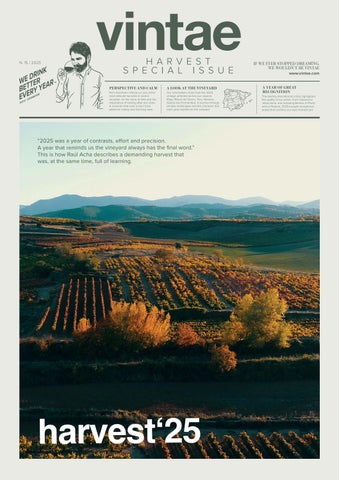
“2025 was a year of contrasts, effort and precision. A year that reminds us the vineyard always has the final word.” This is how Raúl Acha describes a demanding harvest that was, at the same time, full of learning.
harvest‘25
IF WE EVER STOPPED DREAMING, WE WOULDN’T BE VINTAE www.vintae.com
A YEAR OF GREAT RECOGNITION
The leading international critics highlighted the quality of our wines. From Classica to Jesús Acha, and including Bardos, El Pacto and Le Naturel, 2025 brought exceptional praise that confirms our best moment yet.
E
very harvest comes with its own lesson, but 2025 has brought us an especially forceful reminder. This year the sector was particularly worried. We were coming from intense debates about the future of the vineyard: uprooting or not, subsidising the green harvest… And suddenly, a historically scarce vintage reminded us that nature does not follow our plans. We can discuss, project and anticipate, but if spring goes awry, if mildew tightens its grip, or if the vine decides to slow down, our room for manoeuvre is small. In Rioja, slightly more than 226 million kilos of grapes were harvested —the smallest crop in the last 35 years. To find a similar figure we must go back to 1990, when comparable volumes were picked… with one enormous difference: back then there were 43,000 hectares in production. Today we exceed 66,000. We are talking, technically, about one of the smallest harvests in the modern history of the region. Smaller even than years marked by historic frosts, such as 2017, when 349 million kilos were harvested. And despite everything, the vineyard has rewarded us with extraordinary quality. We had to fight for every bunch, yes, but what reached the winery shows a purity, concentration and balance that promise a great vintage. That is the paradox of wine. This has also been a year of alarmism: falling consumption, commercial uncertainty, regulatory changes… And I understand the concern, but this is where perspective changes everything.
Time for calm and perspective
Today, too, we must distinguish between what is short-term noise and what truly matters. The short term fills headlines: tariffs in the United States, tax increases in the United Kingdom… the uncertainty brought by political shifts and changes of power. What is structural, however, is what truly deserves our energy: defending the culture of wine against speeches that seek to equate it with drugs such as tobacco; explaining that our product is part of people’s identity and of the Mediterranean diet (which helps us live longer and better), part of the landscape, and of a way of living and relating that we did not invent —we inherited it. And although less wine is consumed today than decades ago, there is something we should not lose sight of: people are drinking better than ever. There is greater interest in quality, origin and authenticity. And this trend is fully aligned with our path: creating wines that move people, that speak of their land, and demanding the very best of ourselves to make better wines. 2025 has been a reality check, but also a reaffirmation: that this sector requires patience, and that the vineyard is wiser than all of us together. And that even in difficult years, there is beauty in every cycle and every harvest. Because wine connects us with those who came before and with those who will come after. Because, whatever happens, this will always be the best job in the world.
Because the history of wine is full of upheavals: phylloxera, which emptied entire villages in a massive migration to the Americas; Prohibition in the United States; scandals, market collapses and other consumption crises. And after each one of them, wine lived through new stages of splendour.
EVEN IN DIFFICULT YEARS, THERE IS BEAUTY IN EVERY CYCLE AND EVERY HARVEST
Richi Arambarri CEO and Founder of Vintae
2025: the year that challenged the vineyard
Raúl Acha Winegrower and Technical Director at Vintae
2025 will be remembered as one of the toughest and most demanding years in recent decades. Rain, mildew and drought put many growers to the test and drastically reduced yields, although the grapes that reached the winery showed exceptional quality. For Raúl Acha, Vintae’s winegrower and technical director, it was a vintage of effort and learning, and a key year for Bardos in Ribera del Duero.
Raúl, how would you describe the vine’s vegetative cycle in 2025 across the different areas where Vintae works? What defined the year from a climatic and agricultural perspective? This year was a real rollercoaster. Winter finally brought abundant rainfall to almost all regions —except Formentera, where rain didn’t arrive until after the harvest— which helped recharge the soils and gave the vineyard some relief. March kept that wintry character, with cold temperatures that delayed budbreak and spared us the fear of spring frosts. Spring, however, came with an excess of water. April and May were rainy and cool, and what initially felt like welcome relief soon turned into concern. In June, the perfect conditions for mildew appeared, making it the major protagonist of the year. Pressure from the fungus was very strong, especially in the more humid areas of Rioja or Navarra, but also in places where it is not usually an issue, such as Ribera del Duero or Rueda. In organic vineyards the situation worsened, and the differences between those who managed to keep it under control and those who couldn’t were enormous. After that complicated spring, summer flipped the script. We went from waterlogged soils to extreme drought, with more than 60 days without rain in some areas. Although August was very warm, the vines held up better than expected and didn’t collapse. Finally, September brought stability: dry days, moderate temperatures and a calm, unhurried harvest. Grapes could be picked with peace of mind, in excellent health and balance. In short, it was a year of contrasts. Some areas suffered greatly, while others enjoyed a short crop but with remarkable quality. It was undeniably a “patchwork” harvest, but from a technical and qualitative standpoint, the result was far better than we could have expected in spring. What would you say were the main challenges or technical decisions that shaped the season? It was a year of intense work in the vineyard. In spring, the excess moisture made everything harder: it was impossible to get into the fields to plough and control weeds, and mildew treatments had to be applied almost daily. A single day of delay could turn a healthy vineyard into a severely affected one. It was a campaign that required constant vigilance — literally living in the vineyard, checking every plot, every vine. Viticulture was extremely demanding, requiring us to be on the ground day and night for many weeks. And just when it seemed we had overcome the toughest part, the dry summer arrived and forced us to completely rethink our strategy. After so much rain, we had to react
quickly to remove competition in the soil and prevent weeds from consuming the available water. Nobody expected such a prolonged period without precipitation, but from July onwards we had nearly two months without a drop, and the priority became helping the vine endure without stress. In the end, it was a season that forced us to adapt constantly, shifting from managing excess moisture to coping with extreme drought in just a matter of weeks.
This year was also a real turning point for Bardos. On one hand, our youngest vineyards —planted with material selected from old vines— began to show tremendous potential, on par with the century-old vineyards of Soria. And on the other hand, we inaugurated the new winery, which allowed us to vinify with greater precision and care. The new OVIS tanks, which move by gravity and eliminate pumping, gave us enormous flexibility to vinify each plot separately, with an even more delicate handling of the fruit.
Looking at the harvest as a whole, what was the balance in terms of quantity and quality?
That’s why I say that 2025 will mark a before and after for Bardos. We have reached a level of balance and terroir expression we have been pursuing for years. Some plots, honestly, performed at an outstanding level.
It was a harvest marked by strong contrasts between regions. In the extremes of the country, both Galicia and Catalonia enjoyed more favourable conditions and even higher yields than in previous years — something increasingly rare. However, in the major valleys where many of our projects are focused —the Duero and the Ebro— the situation was very different. In the Duero, things went well overall: in both Toro and Ribera del Duero we had good yields and excellent grape quality, although in Rueda volumes dropped significantly. In contrast, in the Ebro valley —especially in Rioja and Navarra— the reduction was dramatic: we picked less than half of a normal crop. In Formentera, the persistent drought of recent years again defined the cycle, resulting in a very small harvest. From a qualitative perspective, the assessment is far more consistent. Practically all regions delivered a highly qualitative vintage, with balanced and healthy grapes. Galicia, Catalonia and the Duero show excellent quality, and in Rioja and Navarra we are likely facing one of the most outstanding harvests of recent years: wines with structure, freshness and great potential. Focusing specifically on Ribera del Duero, it seems this harvest was especially meaningful for Bardos. What would you highlight about this vintage in the region? It was truly an idyllic year in Ribera del Duero, one of those seasons when you feel like going to the vineyard every day, morning or evening, just to enjoy watching it. Although spring brought its complications —high humidity, mildew pressure and difficulties working the soil organically— the absence of frost made all the difference. After several years of tough springs and reduced harvests, 2025 rewarded us with a balanced vintage, with good yields and spectacular quality. Summer was long, stable and dry, allowing for complete and even ripening, unhurried and with an excellent final result.
What style do you expect from the wines of this vintage? I believe we are looking at a truly exceptional vintage. The first thing that stands out is the health of the grapes: I honestly don’t remember ever seeing a harvest as clean, with no trace of botrytis in any of the areas where we work. That purity of fruit shaped the entire winemaking process and allows us to anticipate very balanced and expressive wines. Fermentations progressed smoothly, and the first wines already show extraordinary harmony: moderate alcohol levels, full phenolic ripeness, good acidity and remarkable aromatic definition. There are no excesses, only balance. Overall, it is shaping up to be a historic vintage, both for its quality and for its consistency across regions.
If you had to define this harvest with one word or image, what would it be? I would describe it as a bittersweet harvest. I am personally very pleased with the final result, but I have also witnessed the effort and fatigue of many growers who faced an extremely tough year. It was a season of contrasts: excellent outcomes in some areas and frustration in others, where mildew or storms left little margin. I’d say it was a harvest of restrained joy: pride in what we achieved, but also empathy for those who had a harder time. As a grower told me the other day, “it was a year to forget,” and yet one of those years that teaches you a lot and leaves a mark.
LA RIOJA points and a polyphenol index of 86, it showed an extraordinary structure. In sensory terms, it produced wines with a lively structure, freshness and very well-defined tannins.
María Quintana Winemaker at Viñedos El Pacto
What profile do you expect from the wines of this vintage? They are very fresh wines, with good acidity and great structure, ideal for ageing. Their aromatic definition is exceptional: fine fruit, floral notes and depth. They are wines that show the freshness of the vintage but with the backbone needed for long ageing. In short: finesse, structure and aromatic complexity.
AN UNUSUAL YEAR THAT REMINDS US THAT THE VINEYARD ALWAYS HAS THE FINAL SAY
What lessons does this vintage leave for the future? This vintage showed us once again the importance of preserving old vineyards in the region, especially in areas with steep slopes and pronounced temperature swings. They allow us to conserve the character and typicity of our wines. It also confirmed that in years with balanced conditions, the vineyards express their full potential and deliver wines with great depth and clear identity. If you had to define this harvest with one word or image, what would it be? Climatic balance. It has been a vintage in which the climate determined everything.
In the Sonsierra and the Alto Najerilla Valley, the 2025 harvest will be remembered for its low yields and for the excellent quality of the grapes that reached the winery. Octavio Madurga, winemaker at Hacienda López de Haro, analyses an extreme vintage in which the balance between ripeness and freshness points to wines with great ageing potential. How would you describe the vine’s vegetative cycle this year in Sonsierra and Alto Najerilla? It was an exceptionally favourable year for the vine’s development. The mild, dry winter prevented any significant fungal pressure. Spring arrived with moderate rain and mild temperatures, allowing for a balanced cycle in terms of water availability. Summer was warm but not excessively dry, and the final stretch of the cycle showed a perfect combination of ripeness and freshness that set the stage for an excellent harvest. What challenges or technical decisions defined this vintage? It was a year that required careful monitoring of the vineyard and choosing the right moment to harvest. We had plots with very balanced fruit, and our priority was to find the exact degree of ripeness that would allow us to produce expressive wines, with fine aromas and just the right alcohol. Each vineyard demanded its own approach. The old vines on the slopes, with shallow soils and low water retention, needed close monitoring. The younger plots behaved differently, requiring a slightly later harvest. In general, it was a vintage that forced us to pay close attention to each moment of the cycle and to manage each plot with precision. Has any plot, variety or area surprised you this year? Yes, the Orzales plot stood out especially for its balance of sugars, acidity and phenolic compounds. With 26 colour
Octavio Madurga Winemaker at Hacienda López de Haro
THE SHORTEST OF THE CENTURY, BUT OF EXCEPTIONAL QUALITY
Pedro Balda R&D Director at Vintae
The highest-altitude vineyards of La Rioja were the great winners of 2025. In the Pandemonium project, Pedro Balda celebrates an exceptional harvest in terms of health, freshness and balance, confirming the potential of Alto Najerilla for producing long-aged sparkling wines. How was the vine’s vegetative cycle this year in your area? The cycle began very calmly, with April and May cooler than the previous year, which delayed budbreak and allowed the vineyard to develop slowly and positively thanks to the abundant rainfall concentrated between April and mid-May. Unlike other parts of La Rioja, from mid-May onwards it hardly rained at all, which ensured perfect fruit set and prevented the fungal issues seen in other areas. From June onwards the trend shifted and temperatures began to rise, with August marked by several heatwaves. What challenges or technical decisions defined the season? We brought the harvest slightly forward to preserve the freshness we seek in our sparkling wines and to prevent the grapes from accumulating too much thermal load during the warmest weeks. It proved to be the right decision: we were able to bring the grapes into the winery before the late-September heatwave, thus maintaining the purity and balance we needed for the base wines.
harvest‘25 María Quintana, winemaker at Viñedos El Pacto, describes the 2025 harvest as an exercise in patience and humility. A year spent in the vineyard, marked by extreme contrasts and scarce clusters, but one that delivered outstanding quality and promises intense, fresh wines full of character. How would you describe the vine’s vegetative cycle this year in your area? It was a long and unusual season. Until June, the vines grew with great balance thanks to the moisture retained in the soil. But from the onset of summer, everything changed: the extreme heat accelerated ripening and brought a level of stress we had not seen for several years. The plants coped well, but they responded by producing smaller berries and fewer clusters. In September, mild temperatures and dry weather allowed the vines to finish ripening slowly and evenly. In the end, yields were very low, but the fruit arrived in perfect health, displaying exceptional concentration and expression. Sometimes, the vineyard decides to give fewer grapes… but better ones. What challenges or technical decisions defined this campaign? Being present in the vineyard. The season forced us to monitor each plot constantly. Heatwaves were very intense and required us to react quickly to avoid excessive stress in the vines. We adjusted leaf work to protect the clusters and tailored the harvest dates plot by plot, seeking balance between freshness and ripeness. In dry-farmed vineyards, decisions had to be especially precise, as the vines are more sensitive to sudden changes in temperature. It was a harvest that required intuition, experience and a great deal of attention.
How would you summarise this harvest in terms of quantity and quality? Very short, very selective and very demanding. Old vines work with very low yields, and this year they produced even less, but the berries were small, firm and full of flavour. The vineyard showed extraordinary resilience and managed to ripen at its own pace. We harvested slowly, without rushing, always in search of maximum expression. Although there were fewer clusters, the quality was excellent: vibrant acidity, deep aromas and remarkable concentration in both reds and whites. Has any plot, variety or area surprised you this year? Each plot has had its own personality this year. I’d say the old Tempranillo bush vines were essential to understanding the vintage. They offered tiny but incredibly aromatic berries, with a beautiful balance between freshness and depth. The white varieties also performed remarkably well, especially in the higher-altitude vineyards, where acidity remained firm until the final stages of ripening. In short, the vineyards that impressed us most were those that responded with humility and effort, delivering a very honest expression of the year.
Victoria García Winemaker at Maetierra Calahorra, La Rioja
If you had to define this harvest with one word or image, what would it be? The vintage of the high-altitude vineyard. This year showed that altitude not only brings quality, but also balanced and consistent yields that until now were associated only with the valley.
THE VINTAGE THAT CONFIRMS THE GREATNESS OF HIGH-ALTITUDE VINEYARDS
What lessons does this vintage leave for the future? This vintage reminds us once again that the vineyard teaches us everything. You must keep your eyes open and your feet firmly on the ground. Each year invites us to forget what we think we know and to observe the vineyard closely, understanding that nature’s timing is not negotiable. Climate change continues to shape each cycle, and we must adapt without losing the essence of our vineyards. It was a year that reinforced the value of working with old vines, respecting the soil, and embracing patience. Humility will always be the best companion. If you had to define this harvest with one word or image, what would it be? Memorable.
in volume compared to previous years, mainly due to a hailstorm that hit the centre of several of our plots the month before harvest. Even so, the grapes that came in were perfect: fresh, balanced and exceptionally healthy — exactly what we were aiming for in Libalis wines. What was the most demanding or challenging part of the season? Without a doubt, the fieldwork. We had to search for and select clusters throughout each plot, which made the days longer and more demanding. But that effort showed in the result: the fruit arrived at the winery in impeccable condition. How would you evaluate the harvest in terms of quantity and quality? Sampling already indicated that production would be lower than in previous years, and that proved true. Only a few varieties, such as Riesling, surprised us with slightly higher yields. Overall, it was one of the shortest harvests in recent years, but with very high quality and grapes showing extraordinary freshness and balance.
How would you assess the harvest in terms of quantity and quality? It was an exceptional harvest: this was the year of the high-altitude areas of La Rioja. The brief “kit-kat” of rainfall between May and June, together with the extra freshness provided by altitude, were decisive, making the vineyards destined for our sparkling wines shine in both quality and quantity. What profile do you expect from the base wines for sparkling wines? It will be a great vintage for ageing because it has been one of the healthiest harvests on record. Botrytis didn’t even appear, and this is reflected in the musts and wines, with clarity and purity both aromatically and on the palate. The entire very high Alto Najerilla area performed brilliantly.
What do you expect from the wines of this vintage? Intense wines, but not heavy. Wines with tension, character and vivid freshness, along with deeply expressive aromas. The concentration is striking, but so is the balance. We expect wines with great ageing potential, but also with a purity that makes them very enjoyable even in their youth. Overall, it is a vintage marked by contrast: powerful yet fresh, expressive yet refined.
Was there anything that particularly defined the start of the harvest? Yes! We had been coming from very warm —if not outright hot— nights, but just the week we began, temperatures dropped. Raúl —who is always keeping an eye on the weather— chose the perfect day to start. That allowed us to pick the grapes under ideal conditions, preserving all their aromatic freshness.
The 2025 harvest at Maetierra was marked by a reduction in production due to hail just before picking, but also by grapes of remarkable quality and freshness. Victoria García, winemaker behind the Libalis wines, looks back on an intense campaign, with extensive fieldwork and the perfect balance between grape health and aromatic expression. How was this year’s harvest at Maetierra? Everything went perfectly… except for the noticeable drop
If you had to describe this harvest with one word or image, what would it be? I’d say it was a “short but happy” harvest. A lot of work, yes, but with an impeccable result. The grapes arrived fresh, balanced and full of life — just like the wines we’re going to craft from them.
A SHORT HARVEST, BUT WITH FRESH AND BALANCED GRAPES: EXACTLY WHAT WE WERE LOOKING FOR
FORMENTERA José Abalde Winemaker at Terramoll Formentera
How was the vine’s vegetative cycle this year on the island? It was a very dry autumn, winter and spring, although not as extreme as the previous season. Even so, the vineyard had to endure significant water stress throughout the entire cycle. These plants are highly adapted to such extreme conditions, but this second consecutive year of scarce rainfall has taken its toll, especially on more sensitive varieties such as Merlot, which was the one that suffered the most from the drought. What challenges or technical decisions defined this first campaign at Terramoll? The main challenge was protecting the grapes from birds, especially the latest-ripening red varieties that were harvested without protective nets. Losses caused by wood pigeons or wild pigeons can be considerable, so we decided to bring the harvest forward a few days to minimise the risk and preserve fruit quality.
Vintae’s first harvest in Formentera was defined by drought, bird pressure and excellent grape health. José Abalde, winemaker at Terramoll, looks back on a short but promising campaign that confirms the island’s potential to produce fresh, balanced wines full of identity.
How would you assess the harvest in terms of quantity and quality? Overall, it was a short year, but within expectations after two consecutive seasons of drought. Considering how little rain we had, the volume was not bad, especially in the white varieties, where the crop was good. In the reds, however, production was considerably more limited. In terms of quality, it was exceptional. During ripening we had no ambient humidity and no rainfall, which meant the grapes arrived at the winery in perfect sanitary condition, with very balanced clusters and great purity. Was there any variety or plot that particularly surprised you? The white varieties surprised us across the board due to the quantity of grapes they produced. All the plots are dry-farmed, and even so—despite the lack of rain this year and the previous one—the number of clusters was very good. It is a clear sign of how well-adapted Formentera’s vineyards are to such extreme climatic conditions.
Iñaki Olaberri Winemaker at Le Naturel
5
What profile do you expect from the wines of this first Vintae vintage in Formentera? They will be fresh wines, as we brought the harvest forward considerably to preserve acidity. Even so, they will also have good structure, typical of the latitude we are working in. Aromatically, they will be intense, with strong fruit expression and very balanced acidity. Both reds and whites will have ageing potential. What learnings does this harvest leave in Formentera? The main learning has been the need to protect the vineyard from birds, especially wood pigeons, which are one of the biggest threats to viticulture on the island. This year we tested different prevention methods and learned a great deal about how to place the nets and how to combine them with other deterrents, such as visual signals or scare devices. Looking ahead, we will continue to explore complementary solutions that help us better protect the crop and minimise losses without disrupting the natural balance of the environment. If you had to define this harvest with one word or image, what would it be? From a viticultural perspective, it was a fast, very agile harvest. It didn’t have the staggered rhythm of previous years; once we began, we progressed steadily, picking the different plots and varieties almost without interruption. From an oenological perspective, the word would be change. Vintae’s arrival brought new ways of working and a different winemaking vision, making this first harvest especially meaningful.
A FIRST HARVEST MARKED BY CHANGE AND ADAPTATION
NAVARRA
2
A YEAR OF TENSION AND REWARD: LOWER YIELDS, BUT VERY BALANCED WINES How was the year in the Le Naturel vineyards? It was a year of considerable tension in the vineyard, especially during spring due to mildew pressure. However, in our area in northern Navarra the incidence was lower than in other regions, and we were able to manage it well. Summer was relatively stable, and we entered a dry, warm autumn — something we hadn’t seen in the past two years — which made perfect ripening possible and allowed us to reach harvest with very balanced grapes.
The 2025 harvest at Le Naturel was not free from mildew pressure, although its impact was lower than in other areas. There were a few setbacks, such as the severe hailstorm in mid-July that reduced yields, but the dry, warm autumn allowed for excellent ripening.
How would you assess the harvest in terms of quantity and quality? Yields were slightly lower than in previous years, mainly due to a severe hailstorm in July that significantly affected production. Even so, the overall balance is positive. Conditions at the end of the cycle were perfect for achieving excellent ripeness and grapes of outstanding quality. What profile do you expect from the wines of this vintage? The 2025 wines will be well-structured, very expressive and balanced. The dry autumn favoured full ripening, and that shows clearly in the fruit and in the overall harmony of the wines.
harvest‘25
4
4
GALICIA Iria Otero, responsible for Vintae’s Atlantis projects in Galicia, looks back on a campaign defined by strong contrasts. In Rías Baixas, drought and unusually high temperatures put the resilience of Albariño to the test. In Valdeorras, wildfires shaped a year that, despite everything, has delivered balanced, healthy wines full of Atlantic character. Iria, this year you experienced two very different realities in Galicia, between Rías Baixas and Valdeorras. What was the vegetative cycle like in each area? In both appellations, rainfall was abundant between budbreak and the first weeks of May, which required good
Iria Otero Mazoy Winemaker at Atlantis. Do Rías Baixas y Do Valdeorras
vineyard management to keep fungal pressure under control. In Rías Baixas, the rest of the season was very dry, which encouraged slow, steady ripening. Rain returned during the last week of August, and although it was scarce, it helped refresh the vines and reach the optimal point of maturity. In Valdeorras, rainfall was also concentrated at the beginning of the cycle, and from then on the weather remained dry, but with enough moisture for ripening to progress. Moderate temperatures helped prevent sunburn, to which Godello is especially sensitive. However, the wildfires that devastated the region in August completely defined the harvest. What would you say were the main technical challenges in each area? In Rías Baixas, the main challenge was drought — something quite unusual in the region. In Valdeorras, the fires burned part of the vineyards and raised concerns about potential smoke influence. Our priority was to analyse the wines to ensure there were no traces of smoke taint, and so far the results are positive. How would you assess the harvest in terms of quantity and quality? In Rías Baixas, water stress reduced yields, but the quality has been very good. In Valdeorras, the harvest was also short, but quality is excellent, with firm acidity and balanced alcohol levels. For now, analyses show no presence of smoke compounds, although we will continue monitoring to avoid any potential issues. Was there any plot or variety that particularly surprised you? In Rías Baixas, Albariño once again proved its resilience. The pergola-trained vines protected the clusters from excessive heat and sun exposure. In Valdeorras, the plots in Rubiá were the most affected by the fire, although most vineyards escaped damage.
TORO
4
What profile do you expect from the wines of this vintage? In Rías Baixas, the wines will have good body, slightly lower acidity than usual, and moderate alcohol levels, with a very clean, fruity, citrus-driven profile. In Valdeorras, the Godellos will show abundant fruit and intense aromas, with a balanced relationship between acidity and alcohol. What learnings does this campaign leave for the future? In Rías Baixas, irrigation is becoming a crucial issue to guarantee balance in the training systems and preserve grape quality. Acidity levels — so characteristic of Albariño — are decreasing, and all signs suggest that this will be the trend in the coming years. In Valdeorras, the key learning is that wildfires are something wineries cannot control, and that prevention in the vineyard will be essential to protect future harvests. If you had to define this harvest with one word or image, what would it be? Two words: fire and drought. Two opposite but equally challenging harvests that reflect the diversity of Galicia’s climate and the resilience of its vineyards.
TWO OPPOSITE HARVESTS, BUT EQUALLY CHALLENGING: FIRE IN VALDEORRAS AND WATER SCARCITY IN RÍAS BAIXAS
Martín Padín Winemaker at Bodega Matsu Do Toro
AN ANTAGONISTIC YEAR OF EXTREME CONTRASTS AND IMPECCABLE FRUIT Martín Padín, winemaker at Matsu, describes the 2025 harvest as a year defined by contrasts: an extremely rainy winter, a spring with a few isolated frosts, and a very warm summer that accelerated ripening. Despite the pressure of mildew and powdery mildew in other parts of Castilla y León, in Toro the grapes arrived at the winery in exceptional health and with very balanced ripeness.
2
5
5 1. D.O.Ca. Rioja 2. D.O. Navarra 3. D.O. Rías Baixas y D.O. Valdeorras 4. D.O. Toro 5. Formentera
What was the vine’s vegetative cycle like this year in Toro? The 2024–2025 winter was one of the rainiest of the past 30 years, which left the vineyard with very high water reserves for the rest of the cycle. In spring we had a few isolated frosts (March–April) that mainly affected the Malvasía vineyards, which were more advanced. Summer, however, was very warm, with higher-than-usual night-time minimum temperatures. That lack of contrast between day and night accelerated ripening, bringing the harvest forward by 5 to 6 days compared to previous vintages. Even so, thanks to the abundant soil moisture, acidity remained balanced and ripening was very even. What would you say have been the main technical challenges this year? The greatest challenge was managing such an irregular cycle: an extremely wet winter, an isolated frost, and a summer so warm that it shortened the ripening period. It was a year that required interpreting timing very carefully, because the vineyard did not follow its usual patterns of evolution. How would you assess the harvest in terms of quantity and quality? Overall, it was an excellent harvest in terms of ripeness and fruit health.
Although neighbouring winegrowing areas saw strong pressure from mildew and powdery mildew, our vineyards delivered grapes in impeccable sanitary condition. The fermenting wines show very clean, fruity profiles, with body and structure, in line with previous vintages. What profile do you expect from the wines of this vintage? These are wines with structure, body and intensity, and we believe they will age very well in barrel. The combination of rapid but balanced ripening and perfect grape health has resulted in wines with lots of fruit, concentration and smoothness on the palate. What learnings does this harvest leave? We are seeing increasingly stark contrasts between very rainy winters and very hot summers. These extremes are bringing the harvest date forward a little more each year, and that forces us to adjust our decisions to produce fresher wines, with lower alcohol and greater smoothness — which is what the market is demanding today. If you had to define this year with one word, what would it be? An antagonistic year.
Classica, iconic wines
VINTAE MEDAL TABLE 2025
One of the strongest sets of awards in our history
Classica’s Gran Reservas —both the white and the rosé— deliver yet another historic year. These are wines shaped by time and by the purest classicism, and they now stand among the most awarded on the international stage. An undeniable benchmark for those seeking the historical essence of Rioja.
A year defined by demanding conditions in the vineyard has nevertheless delivered one of the strongest medal tallies in our recent history. 2025 confirms that patience, authenticity and a commitment to origin are always rewarded: our projects have received unanimous recognition from the world’s leading wine critics. Here we bring together the most outstanding wines of the year.
Classica Gran Reserva Blanco 2014 DWWA - Decanter World Wine Awards. 97 points Platinum Medal Tim Atkin MW. 94 points
Hacienda López de Haro Reserva Blanco 2018
-
Classica Gran Reserva Rosado 2013 -
Hacienda López de Haro Reserva Blanco 2018
Hacienda López de Haro Blanco de Badarán 2023
-
Hacienda López de Haro San Vicente de la Sonsierra 2023
-
-
Pandemonium Blanco de Blancas 2020
-
Pandemonium Blanco de Tintas 2020
-
DWWA - Decanter World Wine Awards. 93 points. Silver Medal
James Suckling. 91 points DWWA - Decanter World Wine Awards. 92 points. Silver Medal
Tim Atkin MW. 92 points Miquel Hudin. 93 points
Decanter Magazine. 90 points
Tim Atkin MW. 94 points. Sparkling Wine Discovery of the Year. Guía Peñín. 92 points
Tim Atkin MW. 93 points. Guía Peñín. 93 points
Riojanda Viñedo Singular 2021
Valdechuecas Viñedo Singular 2021
El Pacto de Cárdenas Ojo Gallo 2022
El Pacto del Alto Najerilla 2023
El Recio 2022
El Viejo 2021
Tim Atkin MW. 94 points Decanter Magazine. 97 points: Best of the year selection.
Jesús Acha An exceptional debut The Jesús Acha wines were created as a tribute to the viticulturist they are named after, and they debut this year with some of the highest scores in the national scene. Very old vineyards and precise winemaking define a first release that confirms their unique character.
-
Decanter Magazine. 95 points. Puntuación Tim Atkin. 93 points (2022 vintage). Guía Peñín. 96 points
-
-
Decanter Magazine. 96 points. Tim Atkin MW. 95 points. Viñedo Singular of the year(2022 vintage)
Decanter Magazine. 96 points. Tim Atkin MW. 95 points. Reds of the year. Guía Peñín. 93 points
Bardos Viñedos de Altura 2022
Le Naturel Lakar 2023
-
Tim Atkin MW. 94 points. James Suckling. 92 points. Guía Peñín. 93 points
-
-
DWWA - Decanter World Wine Awards. 90 points. Silver Medal. Vinous. 93 points
Decanter Magazine. 93 points. Vinous. 94 points
Jesus Acha Blanco 2018 Decanter Magazine. 97 points. Tim Atkin MW. 95 points. Whites of the year.
Bardos Villálvaro 2022
-
Jesus Acha Tinto 2019 -
Tim Atkin MW. 94 points. Vinous. 94 points. Guía Peñín. 92 points
-
Tim Atkin MW. 92 points. Vinous. 92 points. Guía Peñín. 91 points
-
Tim Atkin MW. 95 points
Decanter Magazine. 95 points.
Le Naturel Tinto 2024
-
Tim Atkin MW. 94 points. Value Red of the year
Le Naturel Pet Nat 2022
-
Tim Atkin MW. 94 points.
Le Naturel Blanco 2024
-
Tim Atkin MW. 93 points.
La Jefa 2022
-
DWWA - Decanter World Wine Awards. 91 points. Silver Medal. Vinous. 92 points
VISIT US:
Guía Peñín. 95 points.
@vintae
@haciendalopezdeharo
@bardos.wines
@matsuwines
@vinedoselpacto
@lenaturelwines
@libaliswine