www.vinegarhillmagazine.com | 1
2|
INSIDE This Issue 06
A Love Letter
To Black Charlottesville
17
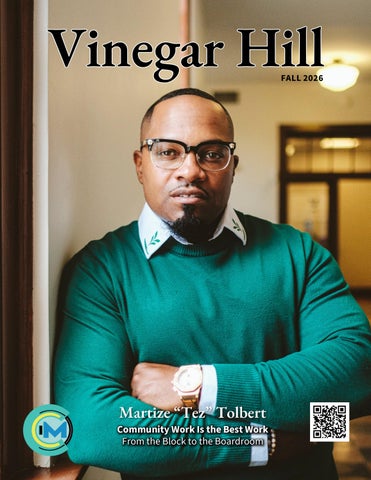
Community Work Is The Best Work
From The Block To The Boardroom
27
Covesville History Day
Preserves Village’s Black History One Memory At A Time
34
Crowned In Faith
A Conversation With Master Cosmetologist Tiffany Thames
38
Heart & Hustle
Continuing A Legacy Of Stewardship And Servant Leadership
www.vinegarhillmagazine.com | 3
WHAT WE
CARRY FORWARD Dear Family, Every issue of this magazine starts with a question about who we are. As we put this one together, a different question kept rising to the top: what are we leaving behind, and who will pick it up? You will find that question in every story on these pages. You will find it in Martize “Tez” Tolbert, who walked into the Fountain Fund carrying debt, doubt and three prison bids, and now sits on the other side of the desk, filling yellow legal pads with plans for people who are not ready yet but will be. Tolbert reminds us that a fifth chance is still a chance, and that the people closest to the problem are often the ones best equipped to solve it. You will find it in Covesville, a village you can drive through in less than a minute, where Devon Williams and her neighbors are 4|
making sure the stories outlast the buildings. Their work is a lesson for all of us: places do not always remain, but memory can, if we gather while our elders are still here to tell it. You will find it in Kimberly Sheffield who carries her mother’s heart and her father’s grind into the Jefferson School as that historic building marks its first hundred years. You will also find it in Tiffany Thames who turned doing hair for her Charlottesville neighbors into championship titles without ever forgetting where home is. And you will find it in Soul Of Cville, where a week of runways, karaoke, brunch and a tornado warning that could not keep us inside proved what we already knew. We are not just inheriting a legacy. We are building one, right now, while we are living it. This issue also holds a personal thread. Our founder, the late
Eddie Harris, appears in these pages more than once: in the words he spoke to a young man on the block, “Take healthy risks,” and in the son who now helps style the next chapter of Black excellence in this city. Eddie believed that mentorship is the bridge between potential and opportunity. Everything we publish is our attempt to keep walking across that bridge and to bring others with us. So read these stories as an invitation. Call your elders. Write down the recipe. Show up for the person who is not ready yet. Support the business down the street. The future will remember what we chose to carry. —Sarad Davenport, Chief Operating Officer
www.vinegarhillmagazine.com | 5
ATO BLACK LOVECHARLOTTESVILLE LETTER We Are The Ancestors. And Baby, We Were Outside. by Khalilah Jones Photography Credit: Brian Dunn, Ellie Dunn & Corrine Ice (promo photos, Best In Black Cville and Soul of Cville Saturday) Kingdom LLC. (Legacy Lounge: A Sophisticated Harlem Renaissance Affair) Blue Period Media (Best In Black Cville Black Professional Network VIP Reception)
T
here are some festival themes that look super cute on a T-shirt. Like, OKAY theme! And then there are themes that follow you around all week, show up in unexpected places, and make you look at your mama, your child, your mentor, your business, your community and yourself a little differently. Future Heirlooms: We Are The Ancestors was the latter. From August 10–16, 2026, Soul Of Cville brought a week of Black culture, creativity, entrepreneurship, music, fashion, history, community and unapologetic joy to Charlottesville. Whew! That’s a heavy lift! But underneath every event was one question:
6|
And if you were paying attention, Charlottesville got a whole lot of receipts. Monday: Start With the Torch Soul Of Cville opened at the Jefferson School African American Heritage Center with the Jefferson School 100-Year Celebration and Prolyfyck Legacy Run/Walk. There was something beautifully full-circle about beginning a festival centered on future generations by honoring a place that has already carried a century of Black history, education and community. Approximately 250 alumni, runners, walkers, families and community members gathered to celebrate the school’s 100 years while literally and symbolically passing the torch forward. Like a legit torch, ya’ll. And we have to give a huge Soul Of Cville shoutout to Prolyfyck Run Creww.
What are we creating today that somebody else will inherit tomorrow? That question wasn’t just the theme. It was the blueprint. The torch. The camera. The phone. The runway.
The business. The song. The recipe. The story. All of it pointed back to one idea: we are not simply carrying what was handed to us. We are creating what someone else will one day carry.
Earlier this summer, Prolyfyck selected Soul Of Cville as one of the beneficiaries of its Vinegar Hill Endurance Challenge, a 52-hour endurance fundraiser in which participants ran or walked approximately 4.5 miles every four hours through historically Black communities in Charlottesville. That’s about 63 miles if you completed the whole thing, because apparently regular running wasn’t sufficiently ambitious. But that support meant so much more than a check. www.vinegarhillmagazine.com | 7
Those funds helped us continue offering programming while keeping as much of it as possible free or low-cost for our community. That kind of investment is what it looks like when people aren’t just talking about community. They’re putting their resources behind it. Wednesday: Legacy Got Dressed Up Then came one of the most intentional additions to Soul Of Cville 2026: Legacy Lounge: A Sophisticated Harlem Renaissance Garden Affair at the Fralin Museum. And listen. We were not playing with the ambience. The scene was set with meaningful Harlem Renaissanceinspired garden decor which included art pieces from Jacob Lawrence. Though his career followed the Harlem Renaissance, Jacob Lawrence’s vivid depictions of Black history, resilience and everyday life echoed its spirit, reminding us that telling our stories and preserving our experiences is an essential part of shaping what future generations inherit. Decor, provided by Blooming Diamonds, created a space that felt elegant, intentional and very much like somebody’s rich Auntie had been given a budget and told, “Make it gorgeous.” Guests enjoyed heavy hors d’oeuvres provided by The Pie 8|
Guy (mini curry chicken and sweet potato pie? Yes, please!), desserts and signature drinks from Krissy Cakes, including The Ancestor cocktail and The Heir mocktail, while live music from Jen Tal Band set the mood. And because apparently we cannot gather Black people anywhere without somebody saying, “Wait, let me get a picture,” the everpopular 360 booth from No Shade and Kingdom LLC. was there to document the evening. But the beauty wasn’t the point. The connection was. Approximately 60 guests gathered across generations: grandparents, mothers and daughters, mentors and mentees, preteens and young professionals for an intimate kee-kee. The goal wasn’t simply to put generations in the same atmosphere. It was to get them engaged and talking. And then there was the phone. A vintage telephone became a time machine of sorts, allowing guests to leave messages for their future selves, their younger selves and generations still to come.
Sometimes it’s the “I wish somebody had told me this sooner.”
And sometimes it’s a message from an elder that a child will carry for the rest of their life. It is not a coincidence that this event fell on August 12th, a date that holds significance for Charlottesville. It was important that we reclaim this day and change the narrative and messaging for future generations.
Sometimes it’s the reminder that you are doing better than you think.
Thursday: Somebody Has to Keep Singing It
Sometimes what we pass forward isn’t something you can put in a box. Sometimes it’s advice.
Soul Karaoke, hosted in partnership with the Black Professional Network at Mejicali, took another route to preserving culture. Classic R&B. Hip-hop. Gospel. Big voices. Questionable song choices. Excellent memories. Music has always been more than entertainment in Black culture. It has been our celebration, our
comfort, our storytelling and, when necessary, our resistance. From spirituals and freedom songs that carried hope through oppression to anthems like “We Shall Overcome” and James Brown’s “Say It Loud, I’m Black and I’m Proud,” music has given us a way to speak truth to power, demand change and affirm our humanity when the world tried to silence us. And just as importantly, it has given us permission to
laugh, dance, love and find joy in the midst of it all. Our music has always known how to hold both the struggle and the celebration. Know this, culture doesn’t only survive in museums. It survives because somebody still knows every word to Sam Cooke’s “A Change Gonna Come.” It survives because somebody’s www.vinegarhillmagazine.com | 9 www.vinegarhillmagazine.com
Cville recognition. While Chic and Classy Image Consulting produced the Best In Black Cville awards ceremony. This partnership with Soul Of Cville is one of those full-circle moments that deserves to be acknowledged.
mama introduced them to Stevie Wonder. It survives because Beyoncé, Frankie Beverly & Maze, Kendrick Lamar and Luther Vandross can somehow end up living in the same cultural ecosystem. And yes, some of us were singing like we had high expectations of being discovered that night on Main Street of Charlottesville, Virginia…mind your business. Soul Karaoke reminded us that sometimes the simplest way to pass a heirloom forward is to keep participating in it and encouraging Black Joy, like it’s your job! Somebody has to keep singing! Friday: Best In Black Cville, Where We Give Folks Their Flowers While They Can Still Smell ’Em Friday brought Best In Black Cville, the premier recognition program presented by Vinegar Hill Magazine, the organization that created the Best In Black 10 |
Soul Of Cville has always been about creating space for Black stories, Black excellence and Black joy. That desire to uplift and amplify our community naturally grew into our partnership with Vinegar Hill Magazine and the evolution of Best In Black Cville into a fuller celebration of the people building Charlottesville’s Black community. The numbers: this year, approximately 200 people gathered on three floors of Live Arts Theater, with 60 VIP guests, 20+ legacy pop-up branding photoshoots by Kreative Kulture and more than 30 community recognitions. The event was presented with
support from United Way and the VIP reception was hosted by the Black Professional Network. And then there was the weather. Apparently we weren’t allowed to have an event without a little plot development. The proverbial uno reverse on an event. There was a tornado warning that evening. A tornado supercell hit Charlottesville around 5:30 pm on that Friday. Winds came through the east side of town and brought down large trees and knocked out power. 2.2” hail was reported as well. A legit tornado warning. On the night we were supposed to put Black excellence in its finest clothes and celebrate. And yet people came. People drove through that weather. They showed up. They took their seats. They walked that black carpet. They celebrated.
They stayed. To every single person who risked life and limb to come celebrate with us, thank you. Seriously. We know what that meant. And look at God. The storm passed, the celebration went on, and somehow we managed to have an absolutely incredible night with folks still safely in the building. Sometimes the ancestors really do be working overtime. The Blueprint & The Becoming Best In Black Cville also featured a multigenerational conversation with five Black business owners (Dr. Richard Johnson, Hit The Deck Entertainment, James Dowell, Prolyfyck Run Creww, Kevin and Mislie Clarke, Nothing Bundt Cakes and Brittany Johnson, Around The Way Girl Nails Academy) about building businesses, careers and futures outside of traditional pathways. The message? You don’t have to inherit the blueprint. Sometimes you build one. That sentiment ran through the entire evening. The Miss Cville Juneteenth Royal Court helped present awards. Mr. Charles Alexander, representative of the Charlottesville 12,
presented the Let’s Intentionally Thrive ( L.I.T.) Legacy Award. Adult and youth models shared the runway. The future wasn’t waiting backstage.
Because if we’re talking about where we’ve been and where we’re going, you can’t just talk. Sometimes you need a beat. And a runway.
The past wasn’t sitting quietly in the audience.
And somebody who knows how to hit the pose.
They were onstage together.
Some Legacies Have Names
And that was exactly the point.
The evening also honored the late Eddie Harris, founder of Vinegar Hill Magazine, and a foundational figure connected to Best In Black Cville.
A Runway Full of Receipts The fashion show during Best In Black Cville was choreographed and coached by Runway Collective by Micah, bringing movement, style and storytelling together under the Future Heirlooms theme. The soundtrack did its own historical heavy lifting, with songs from artists including Teena Marie, The Delfonics, Missy Elliott, the Fugees, Otis Redding, Jay-Z and Kanye helping tell the story through music.
His son, Rico Harris, continued that creative legacy as a contributing stylist for the Saturday fashion show. That story became even more poignant during the Soul Of Cville promotional photography. The festival’s promotional imagery intentionally centered intergenerational relationships. We photographed a grandmother www.vinegarhillmagazine.com | 11
and granddaughter, a father and his two children and other family connections that embodied the idea without needing a single word printed across the image. We also included Rico, representing his late father, Eddie Harris. A father documented Black excellence. A son helped style its next chapter. That is Future Heirlooms. The festival photography itself was supported by a fatherdaughter photography duo, creating another beautiful layer of the story we were trying to tell. And that was intentional. The camera became one of the ways we preserved the moment.
evening beyond recognition into connection, celebration and continued economic activity. Saturday: Soul Of Cville Takes Over IX Art Park Soul Of Cville Saturday at IX Art Park brought together Blackowned businesses, artists, performers, fashion, food, music, art and community. Approximately 45 Black-owned businesses and Black-led organizations participated, along with 35 Black artists and creative performers. The fashion show drew approximately 180 attendees, while outdoor participation was estimated at roughly 2,000 people based on sustained foot traffic and event documentation. It felt like everybody was there. The aunties.
Because what we document becomes part of what future generations know about us.
The babies.
Then We Celebrated. Because Of Course We Did.
The creatives.
Black folks will absolutely say, “Congratulations, queen/bro,” and then immediately ask, “So what you about to do?”
The entrepreneurs.
The people who came “just to look around” and somehow left with three bags. The people who knew everybody.
Immediately following Best In Black Cville, the celebration continued at Mejicali for the Best In Black After Party, hosted by Dream Clothing.
The people who became somebody’s new connection.
Approximately 250 people kept the energy going, extending the
That is Soul Of Cville.
12 |
The people who came for the music and stayed for the culture.
Saturday was the big family reunion. You know the kind. The one where the music is already playing before you find a parking spot, somebody’s auntie is dressed like she has somewhere important to be after this and the smell of fried fish and mile high pound cake is floating through the air, competing with the sounds of laughter, live music and somebody hollering across the crowd to get somebody else’s attention. There are hugs that last a little longer, children darting between grown folks, old classmates reconnecting, elders holding court and at least three conversations happening at once. Somebody is taking pictures, somebody is making introductions, somebody is shopping and somebody you haven’t seen in years is already asking why you haven’t called and everybody is (still) trying to learn Tamia’s line dance. It’s hot, it’s loud, it’s familiar, it’s a little chaotic in the most loving way and everybody is welcome. That was the spirit of Soul Of Cville Saturday. Fashion, Family and the Next Chapter The Saturday fashion show was choreographed and coached by Avis Fields, with the runway becoming another expression of the Future Heirlooms theme. Makeup for the models was provided by Dream Deluxe Beauty, adding another local creative to the production team. The show also featured a special tribute connected to Eddie Harris and his creative work, with Rico
history. But baby, we are here for a good time, not a long time! Joy was part of the programming. Not a side dish. Not an afterthought. Part of the experience. And Then We Did What We Do: Kept the Party Going
helping carry that story forward. And then came the music. The runway moved through the generations through sound and models. The show featured the Miss Cville Juneteenth royalty, a multigenerational scene from Chic by Khalilah and of course Greedy American by Style University curated by designer Rico Harris. And Then 100 Proof Took the Stage Soul Of Cville Saturday’s headlining band was 100 Proof, bringing the live music energy that turned the festival from an event you attend into an event you experience. Yes, we were there to support Black businesses. Yes, we were there to celebrate community. Yes, we were there to honor
After Soul Of Cville Saturday wrapped at IX Art Park, the official Soul Of Cville After Party moved to event venue Phoenix VA, presented by 101 Jamz. The afterparty gave the community another opportunity to dance, connect and celebrate the week while continuing to support the local cultural and economic ecosystem. Sunday: Pull Up a Chair Soul Of Cville closed with Soul Brunch a partnership with the Thomas Jefferson Monticello Foundation, connecting food, history and community highlighting the Feast of Reason, at Order Up! and Royalty Eats. The brunch honored Edith Hern Fossett, an enslaved, Frenchtrained chef whose culinary expertise helped shape the dining experience at Monticello and the President’s House in Washington, D.C. After returning to Monticello in 1809, she served as head cook, blending French culinary techniques with Virginia traditions. Her story is one of
extraordinary skill, creativity and perseverance, but also a reminder of the countless contributions of enslaved Black people whose talents shaped American culture without receiving the recognition they deserved. Her son, Peter Fossett, would go on to become a prominent caterer in Cincinnati after gaining his freedom, carrying his family’s culinary knowledge into another generation. Honoring Edith through food was a way of recognizing that the recipes, techniques and traditions we enjoy today are often rooted in the brilliance and labor of people whose names history too often left out. And what better way to celebrate her than by gathering around a meal, sharing stories and making sure her name continues to be spoken? And there was something deeply appropriate about ending the week around food. Because Black history has always been passed down around tables. Through recipes. Through stories. Through arguments about who makes the best macaroni and cheese. Through somebody saying, “Don’t touch that yet. It’s for company.” Through somebody’s grandmother refusing to measure anything because, “I just know.” Food carries memory. www.vinegarhillmagazine.com | 13
Thank you to the City of Charlottesville, Albemarle County, and UVA for investing in the work that allows us to keep programming accessible. Thank you to United Way for supporting Best In Black Cville and helping us celebrate the people building Charlottesville’s Black community. Thank you to Nothing Bundt Cakes for the generous and incredibly kind donation that helped us sweeten Best In Black Cville for our guests. Thank you to the Eta Phi Omega Chapter of Alpha Kappa Alpha Sorority, Incorporated, particularly through the Uplift Our Local Community and Building Our Economic Wealth committees, for continuing to invest in the community and in the economic wellbeing of the people who call Charlottesville home.
Food carries culture. Food carries people. And sometimes, food carries the entire family reunion. A Whole Lot of Gratitude None of this happens because one person has a really cute idea and a Canva subscription. Trust me. I have tried. Like an embarrassing amount of times. 14 |
Soul Of Cville happens because community partners, sponsors, funders, businesses, artists, volunteers and supporters continue to believe that Black culture, creativity, entrepreneurship and joy deserve investment. A very special thank you goes to the Charlottesville Area Community Foundation, Discover Black Cville and Virginia Humanities for their support.
Thank you to Santanna, Greedy American by Style University, Runway Collective by Micah, Avis Fields and all of the amazingly fearless models for bringing the fashion shows to life. Thank you to Blooming Diamonds, The Pie Guy, Jen Tal Band, Griffield Printing, No Shade 360, Dream Deluxe Beauty, Ahmad Hawkins, Jen Solomon,100 Proof, Dream Clothing, Kingdom LLC, Corine Ice, Brian and Ellie Dunne, 101 Jamz, Beyond Fitness with Sabrina, IX Art Park and the countless other creatives and businesses who helped us turn concepts into actual experiences.
Thank you to the vendors, performers, stylists, choreographers, coaches, venues, volunteers, partners and behindthe-scenes folks who handled approximately 4,782 things that nobody in the audience will ever know happened. And thank you to Vinegar Hill Magazine for continuing to provide a platform for documenting, celebrating and amplifying Black life, culture and excellence in Charlottesville. The relationship between Vinegar Hill Magazine, Best In Black Cville and Soul Of Cville is itself something worth building on. We are creating something together that we hope people will still be talking about years from now. Now It’s Your Turn And to the Charlottesville community, thank you for giving us so much to celebrate, so much to be proud of, and so many reasons to keep showing up. Soul Of Cville exists because of the people who make this community what it is: the entrepreneurs who take a chance on their dreams, the artists who tell our stories, the elders who preserve our history, the young people who are already shaping our future, and the countless individuals who pour their time, talent and resources into making Charlottesville a place we can all be proud to call home. You have given us the inspiration, the purpose and the reason to create a platform where Black culture, creativity, excellence
and joy can be seen, celebrated and experienced. Soul Of Cville is a reflection of you, and we are grateful to have the honor and esteemed privilege of celebrating what makes this community so special.
Every child we encourage.
Now, here’s something we’re doing differently this year. We want you in the planning conversation for Soul Of Cville 2027.
Every elder we listen to.
What should next year’s theme be? What event do you want to see come back? What have we never done that you think would be perfect for Soul Of Cville? What conversation needs to happen?
Every story we preserve. Every song we teach. Every photograph we take.
Every young person we pour into. Every Black-owned business we support. Every space we create where our people can gather, laugh, dance, learn, spend money, dream and simply be. That is the inheritance. That is the work. That is the joy.
What activity would make you grab your mama, your cousin, your best friend, your kids, your auntie and that one friend who takes 45 minutes to get dressed and say:
And that is the responsibility.
“Come on. We going.”
And preferably something our descendants will brag about.
Send your ideas, suggestions and dreams for Soul Of Cville 2027 to: soulofcville@gmail.com Future Heirlooms wasn’t about sitting around waiting for the future to tell us what mattered. It was about recognizing that we are already making history while we’re living it. Every business we build.
We are the ancestors. So let’s leave something beautiful behind.
Because baby…we have an heirloom to make. If you want to find your black carpet or 360 photo from the week or weren’t able to make Soul of Cville 2026, please visit the Soul of Cville Facebook page to catch up. And please, for the love of all things Black Cville…don’t get caught slipping next year! See you there! www.vinegarhillmagazine.com | 15
COMMUNITY WORK IS THE BEST WORK: FROM THE BLOCK TO THE BOARDROOM
How One Man’s Journey From Prison to Purpose Is Rewriting the Rules of Re-Entry by Marquan E. Jones
T
Photography Credit: Eze Amos
he yellow legal pads are stacked in neat columns on Martize “Tez” Tolbert’s desk at the Fountain Fund offices in Charlottesville. Each one represents a person. A story. A second chance — or a third, or a fifth. Names fill the pages, along with development plans Tez has crafted to help formerly incarcerated people navigate their way back to society. Not just to survive, but to thrive. “We don’t say no to people,” Tez explains, running his hand over one of the notepads. “We just say, ‘You’re not ready yet. But here’s the steps it takes to get ready.’ Then we give them the support they need so when they do come back, they’re blown ready.” 16 |
It’s a philosophy born from lived experience. Tez knows what it’s like to need that fifth chance because he was the one who needed it himself. Take Healthy Risks Detroit to Charlottesville. Three prison bids totaling ten years. A mother lost. A family exhausted by broken promises. By the time Tez walked
through the doors of the Fountain Fund in the early 2010s, he was drowning in debt, behind on rent, an absent father, and carrying the weight of a community that had given up on him — and rightfully so. “I created that false sense of hope,” he says now, his voice steady but reflective. “My family, my friends — they loved me, but when it came time for me to be serious, they really had doubts. Because I created that. The first two times I went to prison, I said, ‘I’m gonna get it right this time.’ And they were like, ‘What happened the last two times?’” What happened was Eddie Harris. Harris, the late founder of Vinegar Hill Magazine and a pillar of the Charlottesville community, had been watching Tez for years. He’d show up on the block where Tez was hustling, never judging, never pushing. Just present. “Whenever you’re ready,” he’d say. “I got the tools whenever you’re ready.” Eddie was the only person Tez and his crew had ever seen navigate himself out of similar circumstances. He’d been through the same hardships so they wouldn’t have to, but they were too young, too trapped in the survival mentality of the late ’90s and early 2000s to understand what Eddie was offering. Then Tez’s mother died. His heartbeat. His first love. His doctor, his lawyer. The one constant that had kept him tethered to something better.
Martez and Eddie Harris. Photo provided by Martez.
“I knew I didn’t want to return back to the streets,” Tez recalls. “I knew the streets were done for me. And I didn’t want her to look down on me still doing the same effed up stuff that I was doing when she was here.” So he walked into the Fountain Fund. It was Black History Month. And for the first time in his life, someone outside of his family and neighborhood believed in him enough to shake his hand and hand him a check to pay his fines and fees. www.vinegarhillmagazine.com | 17
“Tez, you take a lot of risks. You took a lot of risks in your life. I’m asking you now to take more healthier risks.” Eddie Harris said those words to Tez that day, and they’ve lived with him ever since. In fact, Tez says if he ever gets a tattoo — and he has none — it would be those three words: “Take healthy risks.” “I didn’t know nothing about no Fountain Fund. I didn’t know nothing about repaying a loan. I didn’t know nothing about interest rates,” Tez says. “Eddie just said, ‘That’s all gonna come in time. Just let them people support you.’” And it changed his life. The U-Haul Conversation That Started It All The story of the Fountain Fund itself is almost too cinematic to believe. Tim Heaphy, a former federal prosecutor, walked into a U-Haul rental shop on Rell Road in Charlottesville one day. Behind the counter was a man named Walt. They locked eyes, and there was a moment of recognition. “You don’t remember me, do you?” Walt asked. Heaphy did remember. He had prosecuted Walt on a RICO charge years earlier and sent him to prison. Tez always asks Tim the same question about that moment: “Was you scared? Was you nervous?” 18 |
Tim’s answer: “Yeah.”
licenses back.
But what happened next changed both men’s perspectives forever. They ended up in the cab of that U-Haul truck, having a conversation about how they could invest in each other. Tim asked Walt a simple question: “If there’s one thing right now that could support you and help you through all these barriers, what would it be?”
The irony isn’t lost on Tez. The man who founded the organization that would eventually employ him as national director had prosecuted his own brother. Some of the men Tez grew up with in the Charlottesville projects, guys he sold drugs alongside, were sent away by Tim Heaphy. Now they’re clients of the Fountain Fund.
Walt’s answer was immediate: “To be honest with you, get my driver’s license back.
“Tim is a hell of a white man,” Tez says with a laugh, then catches himself. “I mean, the dude is… Bro. But it’s not just the way he thinks — it’s the way he puts it into action.”
Because if I got my driver’s license back, I could do more things. I could be more mobile instead of driving around without a license, risking my freedom.” Heaphy, a University of Virginia graduate and attorney, went back to the university’s law school. He researched the barriers facing formerly incarcerated people. And in 2017, the Fountain Fund was born — initially focused solely on helping people get their driver’s
More Than Loans: A Bank With a Heart Today, the Fountain Fund has expanded far beyond driver’s licenses. They provide loans for housing, transportation, entrepreneurship, fines and fees — whatever their “client partners” (never just “clients”) need to build stable, self-sufficient lives.
The model is deceptively simple but revolutionary in its execution. When a client partner receives a loan, the repayment amount is determined not by some arbitrary formula but by what they can actually afford after paying their monthly bills. The Fountain Fund is the only micro-lender in the country doing this. “We’re not just making up random numbers,” Tez explains. “We go through a thorough budgeting worksheet — this is what you make a month, this is your bills for the month, and what’s left over is a fraction of what your repayment’s gonna be. And we let them know, whatever that payment is, it goes into a loan fund that helps the next person get the loan. And we’re gonna report to all three credit bureaus.” It’s a self-sustaining cycle of mutual investment. Each one, teach one. Each one, support one. Peer-to-peer. Since 2017, the Fountain Fund has disbursed $5.5 million in loans, with $2.5 million already recycled back into the fund. Nearly 1,000 loans have been distributed across five markets: Charlottesville, Richmond, New Orleans, Philadelphia, and Boston. But the numbers that truly matter to Tez are these: Ninety-seven percent of client partners weren’t incarcerated in 2024. Ninety-five percent say their experience transformed their entire life for the better. Ninety-seven percent feel supported by the staff. “It’s not about the interest rates,
it’s not about the loans, it’s not about the repayment. It’s about building somebody else up and building them back better.”
letting us know what their selfdetermined goals are. We’re here to match that energy and walk them through the whole journey.”
“We’re like a bank with a heart,” Tez says. “It’s not all transactional. It’s relationship-based.”
It’s the opposite of the traditional nonprofit model, where organizations decide what people need. At the Fountain Fund, the client partners are in the driver’s seat. The staff is there to remove barriers and open doors.
Self-Determined Goals: Meeting People Where They Are On the morning of our interview, Tez had already conducted three intakes. Three different people with three different dreams. One man wanted to expand his event space business. The Fountain Fund helped him access capital to grow what he’d already built. Another man, a registered sex offender, needed to pay court fines to get his license so he could work toward getting his commercial driver’s license (CDL) and earn a raise at his job. The Fountain Fund partnered with Network to Work to create a pathway: they’d help him get his license, and their community partner would provide free CDL classes. A young woman with a newborn baby had mold in her apartment. She wanted to move across the street to a better, bigger unit for just $150 more per month. The Fountain Fund helped make that elevation possible. “These are all folks coming in with their own self-determined goals,” Tez says. “We don’t set terms of what the loan looks like or what they’re coming for. They come in
“We wanted to dignify people,” Tez explains. “One of our missions is to treat people with honesty, dignity and respect. Calling them ‘client partners’ instead of participants or clients or job seekers — it reminds everyone that they’re investing in us as much as we’re investing in them. It’s like, ‘I got your back, bro or sis. And I want you to bring some skin in the game, and we’ll match that same energy to get you to that finish line.’” The Warm Handoff: Wraparound Support That Works What sets the Fountain Fund apart isn’t just the loans — it’s the holistic, wraparound support that comes with them. Tez calls it “the warm handoff.” “We don’t just say, ‘Go to the DMV,’” he explains. “We call it a warm handoff. We say, ‘Hey, go check out my guy Brandon at the DMV. He knows about the Fountain Fund. He’s our point person there. He can get you squared away. Just let him know you’re a client partner of the Fountain Fund.’ That’s letting that person know we are walking alongside you with this.” www.vinegarhillmagazine.com | 19
The Fountain Fund has built relationships with community partners across every sector: mental health services, healthcare providers, employment programs, apprenticeships, legal aid. If a client partner needs help restoring their voting rights, connecting with a therapist, finding better employment, or learning to be a better parent, the Fountain Fund knows exactly who to call. “Sometimes I become… I have a kinship with our client partners,” Tez says. “They’ll tell me, ‘Look, Tez, I wanna be a better dad. How can I be a better dad, man?’ That’s got nothing to do with the loan. But we provide those services through our partnerships and through my own personal lived experience, because that was a journey I was once on.” And if someone isn’t ready for a loan yet? They’re not turned away. “We don’t say no to them. We just say, ‘You’re not ready. But these are the steps it takes to get ready. Go see one of my community partners. They’ll set you up with employment or better employment. They’ll set you up with housing. And then once you’re ready, they’ll boomerang you back to us.’ That’s what we call a warm handoff. We’re not telling them no. We’re just telling them not right now.” Those yellow legal pads on Tez’s desk? They’re full of development plans for people who aren’t ready yet. He works with them, builds them up, prepares them. “If you 20 |
do one, two, and three,” he tells them, “we can help you with five, six, and seven on the back end.” Rico’s Story: From Client Partner to Community Champion Rico Hearns embodies what’s possible when the Fountain Fund model works as intended. Tez and Rico have known each other since 2015, first as friends, then as professional colleagues. When Tez joined the Fountain Fund, Rico was one of his first client partners. He came in for housing assistance. Paid the loan off. Came back for transportation. Paid that off. Came back for fines and fees. Paid that off. By now, Rico is on his fifth loan with the Fountain Fund — covering everything from better employment to an improved housing situation. But here’s what matters most: Rico saw his credit score climb with each loan. Instead of going elsewhere for help, he stuck with the people who stuck with him. He saw the benefit of the relationship, the credit building, the wraparound services that connected him to resources across the community. Now, Rico is one of the Fountain Fund’s biggest volunteers and community advocates. He tells everyone he works with — guys on the street, people in the re-entry system — about what the Fountain Fund did for him and what it can do for them. He’s referred dozens of people to the organization. “He knows everything about
what the Fountain Fund does, how we support, how we show up for our client partners,” Tez says with obvious pride. “So he tells everybody what the Fountain Fund had done for him and what they can do for you.” It’s the virtuous cycle the Fountain Fund was designed to create: transformed lives creating more transformed lives. The One Stop Shop: A Mall for Re-Entry Four years ago, Tez created something that had never existed in Charlottesville: the One Stop Shop. It’s a bi-monthly gathering at the Carver Recreation Center that brings together every reentry and community resource in the area under one roof. DMV representatives. Apprenticeship programs. Job training. Mental health services. Rights restoration. All with a caterer (shout-out to Chef G) and a DJ (Nicholas Feggans, aka DJ Runaway) to create a welcoming atmosphere. “We call it a mall of re-entry,” Tez explains. “Everybody’s been to a mall — Sears, JC Penney’s, Foot Locker. Why not have the same setup for folks returning home to our communities? They can get connected to the same things like you can get connected to when you go shopping. Everything will be right then and there.” The One Stop Shop is free and open to the entire community, not just the re-entry population. Because as Tez points out, “We’re only in a community of 50,000.
My brothers and sisters are your brothers and sisters. It’s not just the re-entry population. It’s not just the unhoused population. It’s not the mental health population. We all one population.” The Block Party That Changed Everything Four years ago, Tom Tom Festival founder Paul Byers reached out
to Tez. He’d heard about the work happening at the Fountain Fund and wanted to diversify the festival, which had historically catered to a predominantly white, affluent crowd. But Byers was smart enough to know what he didn’t know — and smart enough to bring in people who did.
community, but he didn’t know our community like the leaders in our community do,” Tez says. “So he’s smart enough to know what he know, and he’s smart enough to know what he don’t know. And he’s smart enough to get the people that do know to come on in.”
“He wanted to face more into our
Together, they created the Tom Tom Block Party — an event that has become one of the most successful examples of true community integration in Charlottesville’s recent history. “People look at that as a convergence from all walks of life,” Tez says. “Black, Brown, white, Middle Eastern — it doesn’t matter. From eight to 80. You see people dancing, laughing, congregating, having a good time for two days in a row on the Downtown Mall. That’s something people have told me they have never seen — that many waves of people in Charlottesville, ever, on the Downtown Mall.” And perhaps most remarkably: “Nothing happened at that block party. Nothing happened. Four years going and running, nothing, ever nothing.” It’s a point Tez emphasizes because he knows what people assume when they hear about a block party in a diverse urban setting. But the Tom Tom Block Party has proven that when you center community voices in the planning, when you treat people with dignity and create space for authentic joy, magic happens. Now, the Block Party has grown www.vinegarhillmagazine.com | 21
beyond Tez. He’s brought in local DJs — Flatline and DJ Double U (Reggie and Devin) — to lead the way. “It’s not about me no more,” he says. “It’s about we. Now it’s a collaborative, supportive group effort because those guys know best. Those are local DJs, local young guys in our community. It’s about giving them the opportunity to bring in their expertise. That’s how we grow and go.” The Second Sentence: Barriers Beyond Bars
model of long-term, relationshipbased support is so crucial. One loan isn’t enough. One intervention isn’t enough. People need consistent presence, patient guidance, and someone who believes in them even when they stumble. “I wouldn’t be sitting in front of you if somebody didn’t give me that fifth chance. That’s when somebody really believed in me, that fifth time around when I didn’t even believe in myself.”
Five million formerly incarcerated people live in the United States. Most people understand they face challenges finding employment and housing. But the barriers go far deeper than that.
Recidivism Is Nonlinear
“We call them a second sentence and invisible cuffs,” Tez explains. “Even though they’re returning to the community, they still have challenges, barriers, and things that are holding them like shackles that they might not even know they have to overcome.”
“Recidivism is a hard one to talk about because they still can’t calculate what causes people this. Everybody’s got speculations. But from my experience, it’s nonlinear. It’s like climbing a ladder. Sometimes when you climb that ladder, it might be sunny outside and you’re getting good momentum. Then sometimes it could be raining and storming where you might slip and fall down three rungs on that ladder.”
Court debt accumulation. Suspended licenses. Lack of access to capital. And perhaps most painful of all: rebuilding trust with family and community. “I did collectively 10 years, but I did three different bids,” Tez says. “So my community, my family, my friends — they all were like, ‘Man, when you gonna get it?’ They loved me, but when it came time to me being serious, they really had doubts. Because I created that.” This is why the Fountain Fund’s 22 |
When asked about the Fountain Fund’s remarkable 97% nonincarceration rate, Tez pushes back gently on the question itself.
“One thing about the Fountain Fund is we are that ladder. We’re not going nowhere. We’re gonna be a constant. So our client partners, sometimes they’re very successful, sometimes they’re not. They go through ups and downs. We’re here to be that support whenever they do stumble, but not fall.”
It’s this philosophy — staying with people, never giving up, offering second and third and fifth chances — that accounts for the success rate. Not because the Fountain Fund has figured out some magic formula, but because they’ve committed to treating people like human beings who deserve dignity and support through the messy, nonlinear process of rebuilding a life. “We have an open and honest communication with them, but also that skin in the game,” Tez says. “Letting them know we’re gonna be right there with you through the good, the bad, or the ugly.” Lived Experience in Leadership Every market leader at the Fountain Fund has been behind that wall at some point in their life. Every member of the Loan Review Committee includes formerly incarcerated individuals alongside bankers, nonprofit leaders and community stakeholders. Even the underwriting team has lived experience. This isn’t tokenism. It’s intentional design. “Who else better can help shape these problems and challenges than the folks that were in close proximity to this?” Tez asks. “The ones that navigated their way out? I feel like it’s a must that we put more folks with lived experience in leadership and positions of power so we could be the ones to kind of shape and help folks. Meeting them where they’re at because we’ve been there.”
When Tez’s executive director came on board years ago, she made it a priority to have the Loan Review Committee and board reflect the population they serve. “I will say today, 2026, she’s done that and more,” Tez says. “Now, every part, every stage and process through the Fountain Fund, from doing an intake to doing a closing, would all be somebody of some type of lived experience.” This matters in tangible ways. When a client partner walks through the door, they’re not just seen — they’re understood. The person across the desk has been where they are. They know the invisible cuffs. They know what it’s like to have a community doubt you. They know the weight of that fifth chance. Policy Change From the Ground Up Tez has been instrumental in shaping Virginia policy around fines and fees. He helped inspire Virginia HB 1895, which eliminates fees and interest accumulation during incarceration. But he’s not done. Not even close. “I would love to be at a table with other leaders in our communities, as well as leaders of DOC, just so we can come together to talk about what change looks like,” he says. “Hearing from all different accounts and having that qualitative data from folks that lived that and now are working in that space to try to give them ways to support that population.” His vision is for a comprehensive
12-month re-entry program that begins before people are released. “Their last 12 months, they know what’s coming. They have people come in to let them know and help them shape and build out a home plan, an action plan. It’s very interactive. Very hands-on.” He wants people to leave prison with all their documents — birth certificates, social security cards, resource lists for whatever area they’re going home to. He wants simulations and scenarios that prepare them for the realities they’ll face. “The most important time of a newly released individual is that first 72 hours to that first year,” Tez explains. “They’re gonna need that walking alongside them. They’re gonna need that guidance. If that’s not in place, recidivism is gonna remain high, and folks will remain hopeless, without resources, without that connectivity.”
And he wants policymakers to understand something crucial: “The most motivated, the most ready-to-go, that’s plug-and-play, is individuals that’s coming home. Because they know they have lost a lot of time from their family, friends, and they’re ready to get to it. They just need that support to get them there.” Scaling With Integrity The Fountain Fund is fielding calls monthly from different cities asking why they’re not in their area or how they can come. The model is proven. The need is everywhere. And the organization knows it’s scalable. But they’re being intentional about expansion. “For one, it’s gonna take a need,” Tez explains. “Two, we’re gonna have to be invited into that area. It’s not about us just slamming down an office or the Fountain Fund in somebody’s community. www.vinegarhillmagazine.com | 23
It’s about building a relationship. The same way we do with our client partners, we do the same with our community partners. So there’s gotta be a need. There’s gotta be a buy-in. And then it has to come with funding.” Tim Heaphy, the chairman, has a vision: he wants the Fountain Fund on every corner like the Boys & Girls Club. “He sees the need just like folks see the need in having a Boys & Girls Club,” Tez says. But they’re not rushing. “We wanna pause and do it the right way,” Tez says. “We wanna do it methodically. We wanna do it impactfully. And we wanna do it with the support of that community.” In five years, Tez has a personal dream: to bring the Fountain Fund to his hometown of Detroit, Michigan, and lead that site himself. “I know the need there,” he says simply. What Keeps Him Going On hard days — and there are hard days — Tez thinks about loan closings. “When we have clients come in to do their closing, and they’re bringing in their kids, or they’re bringing in their dad, and they’re smiling for the first time because it wasn’t like that when we did the intake,” he says. “Either they were in crisis or looking for stabilization or going through some barriers. But at loan closings, you can see the shoulders are kind of now going down. Smiles are brought back on their faces. And they’re 24 |
bringing other people around them that they love to this closing.” He thinks about those impact survey numbers in the highest 90th percentile year after year. “The guy who does that says that’s almost next to impossible,” Tez notes. “But somehow we reach that number every year because we bring that human element back. We bring that dignified folks back. And we wanted to show them something differently that somebody didn’t show them earlier.” He thinks about Eddie Harris, who passed away recently but whose lessons live on through every person Tez mentors, every life he touches, every chance he gives. “To keep what I have, I gotta give it away every day. That’s how I keep it. By walking alongside others and sharing lessons and guiding them.” More Than Loans If there’s one thing Tez wants people to understand about the Fountain Fund, it’s this: “It’s more than just loans. The Fountain Fund is about giving hope and opportunity and trust. From the gate, they already know it’s an investment. We’re investing in people, not just paperwork.” He quotes Eddie Harris one more time, a lesson that’s become his north star: “Mentorship is the bridge between potential and opportunity.” The yellow legal pads on his desk will continue to fill with names. Development plans. Dreams
deferred and then realized. People who walked in believing they were broken and walked out knowing they were just human. That’s what healthy risks look like. That’s what dignity sounds like. That’s what transformation feels like when someone finally, finally believes you’re worth the investment. BY THE NUMBERS ● $6.4 million in loans disbursed since 2017 ● $3.2 million recycled back into the fund ● 1,200+ active client partners, ● 97% of client partners were not incarcerated in 2024 ● 95% say their experience transformed their life for the better ● 97% feel supported by staff GET INVOLVED The Fountain Fund: Visit fountainfund.org to learn more about becoming a client partner or supporting the organization’s work.
ANNUAL MEMBERSHIP
Purchasing an Annual Content Membership gives those folks who have or want to become a part of the Vinegar Hill community quarterly print issues of the magazine. It also, ensures that you are the first informed about new stories, content, and events being sponsored by Vinegar Hill. It is more than a subscription. It is an invitation to participate in community and collectively authoring a more inclusive social narrative. ($9.99 Monthly) Package Includes 4 Issues + Special Editions Discounted Merchandise Exclusive and Early-Access Content IMPORTANT: We publish in print quarterly in March, July, October, and December + occasional special editions. Your print copies will begin arriving in the quarter immediately after your order.
www.vinegarhillmagazine.com
www.vinegarhillmagazine.com | 25
come + enjoy REFRAMING AGING SINCE 1960
Meet people. Try a dance or exercise class. Join a band. Enjoy live music or a cup of coffee. Volunteer. You’ll find 150+ programs six days a week! Healthy aging opportunities for all adults age 50 and better.
540 Belvedere Blvd. | C’ville | 974.7756 | thecentercville.org Monday & Friday 8:30 am–4:30 pm | Tuesday–Thursday 8:30 am–8:00 pm | Saturday 8:30 am–2:00 pm
We help you grow your brand exponentially.
#growyourbrand
—STEPPEMEDIA
SteppeMedia locally owned and operated, was launched to assist small business owners to expand and make the best use of their digital presence. We use our corporate advertising experience to your benefit while you focus on running your business.
• SEO • SOCIAL MEDIA MANAGEMENT • MARKETING STRATEGY • WEB DEVELOPMENT • WCAG 2.0 COMPLIANCE • GRAPHIC DESIGN
steppemedia.com
26 |
(434) 290-1270
info@steppemedia.com
COVESVILLE
HISTORY DAY
PRESERVES VILLAGE’S BLACK HISTORY ONE MEMORY AT A TIME Instead of preserving structures, this annual event prioritizes capturing community stories while elders are still here to share them. by Tiana Woodard COVESVILLE — As Devon Williams cut a path in the grass towards the dilapidated property, the magnitude of the task she took on — restoring her dear greatgrandmother Virginia Ann Williams’s country house — sank in. Uncut grass towered over the space, shrouding the structure that represented the best of Williams’s childhood memories. Litter from squatters dotted the interior and exterior. It would take countless years, dollars and sweat equity to restore this centuriesold home. Covesville History Day 2025 attendees at DEC tables provided by Jessica Harris www.vinegarhillmagazine.com | 27
Covesville Apple Industry Marker
In this moment of uncertainty, Williams said, she was hit with a poignant call to action. “As I was standing there, the ancestors were like, ‘Don’t worry about the house,’” Williams said. “Just worry about keeping the legacy and memories. Keep that alive.” This one-on-one moment with her ancestors, Williams said, spawned Covesville History Day. The second annual event, which takes place this year on Saturday, Aug. 22, at the Faber Volunteer Fire Department headquarters, convenes attendees to learn about the rich Black history of this 145-person village nestled between the Blue Ridge Mountains. Covesville History Day is one offering from The Country House Project, Williams’s nonprofit focused 28 |
on mobilizing descendants to preserve and protect the spaces their African American ancestors once called home. This year’s Covesville History Day, themed “Kinnection,” will include history presentations, archiving resources, and a performance from Charlottesville’s 100 Proof Gogo Band. But above all, the daylong function will give Covesvillians of all ages an opportunity to reconnect with their ancestral homelands and walk away with new memories, kinfolks, and community knowledge. “You have to celebrate this history while you still can,” Williams, founder of The Country House Project, said. For many African Americans from Covesville, their
memories. Many times, her family would drive from her native Washington, D.C. to see her greatgrandmother Virginia, or as she called her, Virgie. Even in her 90s, you could find Virgie chopping wood, firing up the rustic wood stove, and serving spiced, cooked apples with almost every meal. “That memory pulsates in me today,” Williams said.
Devon Williams speaking at the first Covesville History Day
hometown is only a memory. Something intangible and out-of-reach, stored safely in the receptacles of their mind. Covesville History Day offers a unique solution to a challenge experienced by many African Americans from rural towns. It creates a physical space for memory and connections in a place many of them were forced to leave behind.
a unique historical gem located along U.S. Route 29.
“Sometimes, places don’t remain, but the stories must,” said Terésa Dowell-Vest, a Covesville native and author of the 1999 play “Vinegar Hill.” “If we’re not around those who remember those stories best, where their stories thrive, where these stories reside, you will lose them.”
Formed in the mid-18th century, Covesville started as a small settlement of Scots-Irish and German immigrants on what had been ancestral Monacan land for millenia. It grew exponentially after the construction of the Orange and Alexandria Railroad expanded into Charlottesville, and a Covesville stop was added in 1864. Its lucrative apple orchards, fueled by the labor of new freedmen and their descendants, put the village on the global map.
On Wednesday, Aug. 19, the Albemarle County Board of Supervisors will vote on a resolution to recognize the fourth Saturday in August as Covesville History Day, Williams said. If passed, the day would celebrate
“Covesville is such a small area that you can drive through it in less than a minute,” said Lucille Stout Smith, a local historian and decades-long member of the First Baptist Church of Covesville. But those ten square miles, Stout Smith said, pack a ton of interesting history.
For Williams, Covesville is the space that holds idyllic weekend
Dowell-Vest, who spent her childhood in the village, proudly says she grew up in a town of 821 people. She cherishes rooting for the Covesville baseball teams during their home games. She remembered when Sam The Beast From The East performed in their town. And she gathered with dozens of Black families for First Baptist’s Family Day. In her hometown, “your summers were filled with community, baseball, good times and cousins fighting,” Dowell-Vest said. “My life growing up in Covesville would be the things of a great movie.” However, the Covesville of their childhoods is long gone. Baseball games are long over, summer apple picking is seldom. Many Black Covesville natives, DowellVest said, were tasked with achieving more than their parents and parents’ parents did. Go to college, get a good job — things that meant moving away. “We kept our promise, but that promise took us away from Covesville,” Dowell-Vest, who now lives in Houston, said. “This is the juxtaposition of what it means to grow up as a country kid.” www.vinegarhillmagazine.com | 29
For Charlottesville resident Sheila Dudley, the inaugural gathering was a reunion. She ran into several old acquaintances, ones she remembered hanging out on the porch or attending school with. After looking at a family tree at the event, Dudley said, “it turns out they were related to us.” Among the tabling groups was the Descendants of Enslaved Communities at the University of Virginia, or DEC, which preserves the legacies of free and enslaved people connected to the institution. Photo of Devon’s great-grandparents William H. Williams and Virginia Williams
With a fraction of town residents remaining and few historic preservation restrictions in place, Black Covesville’s origin story is at stake. Andrea Roberts, founder and director of the Out(sider) Preservation Initiative at the University of Virginia, said supporting initiatives such as Covesville History Day is crucial. She said it centers a remarkable enclave in southern Albemarle County which might not receive the same attention or resources as other historic or presidential sites in the region.
around 75 attendees and several organizations committed to preserving local Black history. Lucille Stout Smith, the local historian, presented a “pictorial overview” of the village with several images of Covesville residents who made a difference in the community. Williams built a large family tree that drew connections between the village’s small Black enclave.
DEC President Jessica Harris is an Albemarle County native, and grew up with vague knowledge of the village’s apples, baseball and close-knit nature. As attendees visited the organization’s table and spotted pictures of their ancestors in the coveted Holsinger Studio Collection, Harris said, the reality sank in that Covesville wasn’t this faraway settlement down U.S. Route 29, but instead a piece of a larger Black Albemarle tapestry.
Covesville’s Black community “is a worthwhile community worth preserving,” Roberts said. “Covesville History Day is a means to make that happen.” Last year, the inaugural Covesville History Day drew 30 |
Attendees from last year’s Covesville History Day provided by Jessica Harris
Covesville History Day attendees at DEC table by Jessica Harris
“Events like this remind us that we’re a part of this larger narrative, this larger history,” Harris said. “It’s critical we have these spaces for engagement because that’s how we really ensure these legacies advance.” www.vinegarhillmagazine.com | 31
32 |
PACKAGES Full-Page Annual Package -4 Print full-page ad (full color) -Online banner ads (see sizes on page 4) full color- these rotate online and can be switched out throughout the month. -4 printed magazine copies
-Total cost for the year $908.00 Half-Page Annual Package -4 Print half-page ad (full color) -Online banner ads (see sizes on page 4) full color - these rotate online and can be switched out throughout the month. -4 printed magazine copies
-Total cost for the year $628.00 1/4 Page Annual Package -4 Print 1/4 page ad (full color) -Online banner ads (see sizes on page 4) full color- these rotate online and can be switched out throughout the month. -4 printed magazine copies
-Total cost for the year $508.00 DIGITAL ADS -Sponsorship Section $5,000.00 (annual) -Home page pop-up $1,000.00 (monthly) -Video News Post (appears in line with articles) $150.00 (monthly) -Social Media (FaceBook, Instagram, & Twitter) $75.00 (monthly) -Newsletter/Email Campaign (1-3 weekly) $75.00 (monthly) -YouTube Page $75.00 (monthly) -Online Banners $150.00 (monthly)
Ad Designs Print and online banner ad designs are $325.00 A la carte $150.00 2 Mock ups 2 Revisions
www.vinegarhillmagazine.com | 33
Vinegar Hill Magazine | www.vinegarhillmagazine.com | (434) 201-6499
CROWNED IN
FAITH
A CONVERSATION WITH MASTER COSMETOLOGIST TIFFANY THAMES ON PRECISION, PURPOSE AND STAYING IN YOUR LANE by Sarad Davenport
G
reatness rarely happens by accident. It is forged in quiet moments of discipline, passed down through family roots and sharpened by an unwavering faith. For master cosmetologist Tiffany Thames, the path from styling hair as a young girl in Charlottesville to standing on major stages as a decorated champion is a testament to what happens when natural talent meets relentless and uncompromising drive. As the owner and operator of Main Attraction Hair Studio in Kernersville, North Carolina, Thames has built a reputation for extraordinary precision, 34 |
over-polished detail work and transformational beauty. Beyond her multiple Bronner Brothers International titles, her true motivation remains the intimate, uplifting connection she builds with every person who sits in her styling chair. Vinegar Hill Magazine sat down with Tiffany to discuss her journey from local neighborhood stylist to world-class hair artist, the lessons hidden in losing and her enduring love for her hometown of Charlottesville. Vinegar Hill: To start us off, introduce yourself to our readers. Who are you at your core?
Tiffany Thames: I am Tiffany Allen Thames, wife of DJuan Thames, mother of Avani Thames, owner and operator of Main Attraction Hair Studio in Kernersville, North Carolina, graduate of Dudley Cosmetology University, and an entrepreneur that’s walking by faith in every step that I take. VH: Looking back, when did you first start doing hair, and when did you realize this was more than just a hobby? TT: I started around eighth grade playing around with my sister and my cousin Marquita’s hair. By my freshman year in high school, I was doing my friends’ hair, and
Tiffany’s work featured in Elle Magazine www.vinegarhillmagazine.com | 35
then it became an open door where I started doing neighbors and people from all over the city in Charlottesville. Honestly, I didn’t know I had anything in the bag until I moved down to North Carolina to go to school at Dudley’s. I just thought that I was a little girl trying stuff. But when the administrators saw my portfolio, they saw something in me that I didn’t see in myself. VH: Where do you think that unique, out-of-the-box creativity comes from? TT: I believe my creativity came as a gift from God. My dad is also extremely creative with his hands, and I believe the apple doesn’t fall too far from the tree when it comes to being great with your hands. I love being creative, and behind the chair, I especially love fantasy work. VH: You’ve competed on massive national stages like Bronner Brothers in Atlanta. What did those early competition days teach you about resilience? TT: Everybody looks at me now and says, “Wow, she’s won a lot,” but I lost a lot first. I lost about four or five shows before I won my first one. Losing teaches you lessons. You have to sit back, listen to where you went wrong, and let it build your character and strength. My first major win came in 2013 for Most Creative Total Look. The key was learning to never look at someone else’s path or get distracted by their gift, because while you’re busy looking at theirs, you have a gift too. 36 |
VH: Your father played a big role in keeping you grounded during those high-stakes competitions. How did he influence your work ethic? TT: My dad is like a football coach. During the 2014 Bronner Brothers show, where I ended up winning two categories in one weekend and filming for a documentary, my dad was out in the crowd. He always kept me focused, telling me, “Everybody you have to be around puts one leg in a pants leg just like you. Don’t be worried about the glitz and the glam, just do what you’re supposed to do.”
always tell people I have gems and VH there. From the neighborhoods of Charlottesville to the spotlight of national hair shows, Tiffany Thames’s story serves as a powerful blueprint for the modern creative. By pairing inherited hustle with unyielding faith, she continues to prove that honoring your roots while honing your craft can turn a local gift into an enduring legacy.
VH: How would you describe your signature style behind the chair today? TT: I am an over-polished person. I love a clean, polished look, and my clients know I’m never going to leave a piece of hair out of place! But the heart of it for me is making women feel beautiful and confident. You never know what someone is walking through; sometimes your hairstyle might be the medicine to make that person feel better for the day. VH: What is your message to young women back home in Charlottesville who look up to your journey? TT: My message for young women in Charlottesville is that you can do and accomplish anything that you want to do. Stay focused in your lane and don’t get blinded by others’ shining lights, because there’s room for all of us and there’s room for you. Charlottesville is my heart. I
Courtesy of Tiffany Allen Thames
www.vinegarhillmagazine.com | 37
HEART & HUSTLE:
CONTINUING A LEGACY OF STEWARDSHIP AND SERVANT LEADERSHIP by Sarad Davenport | Photos by Rebecca George
S
ervice isn’t just something Kimberly Sheffield does — it’s woven into her very DNA. Raised in rural Madison County, Virginia, Sheffield grew up steeped in a tradition of quiet, tireless community leadership. Her mother, a minister, modeled a profound level of selflessness, fostering between 20 and 25 children over the years and adopting several directly into their home. Meanwhile, her father provided the blueprint for 38 |
her entrepreneurial grit, landing high-level commercial cleaning contracts decades ago that brought in unheard-of financial security for a Black family in the region at the time. “I was born and raised in the boonies,” Sheffield recalls with a laugh. “I come from a very religious background… community service and being a servant leader was something that I saw a lot of.” Looking back at her upbringing,
Sheffield recognizes the two pillars that shaped her path and gave her a clear direction early on. “I think I got the best of both of them while I got my heart from my mom, my grind came from my dad,” she reflects. Her father was the epitome of an entrepreneur, operating at a level that set a lasting example for what dedicated hard work could achieve. “My dad was doing big things 30, 40 years ago… this man could do anything and he didn’t
Photo of Kimberly as a child with her parents. Submitted by Kimberly.
do it low level, he did everything at a very high level.” Watching her parents navigate their respective callings taught her early on what it truly meant to show up for others. “I saw a lot of folks giving of their time, talent, and treasure, and yeah, so I think that it was
inevitable for me to pick up the torch and be a servant leader in my own career.” For 17 years, Sheffield channeled that inherited drive into corporate America as an insurance specialist. Her focus was deliberate:
educating Black and Brown families on asset protection, homeownership, and building generational wealth. Yet, beneath that professional fulfillment lay a heavy emotional toll as she found herself battling vicarious trauma and anxiety at times while www.vinegarhillmagazine.com | 39
She needed a shift to clear her head and restore her well-being. What began as a short-term, sixmonth contract to help oversee administrative operations at the Jefferson School Foundation turned out to be a life-altering turning point. Stepping through those doors reignited a spark that corporate sales had slowly dimmed, reconnecting her to a deeper sense of community. “I think coming to Jefferson School saved my life in more ways than one because I was in a very dark place,” Sheffield shares. “I had forgotten what fueled me, and people and community is what fueled me — this place really reignited that fire in me.”
Photo of Kimberly and her father. Contributed by Kimberly.
guiding families through grief, death claims, and unexpected loss. Sitting with a family after a sudden loss meant walking through the full cycle of grieving alongside them, and looking at countless death certificates made her realize how fragile life is. “I spent 17 years in the insurance industry and I was burnt out,” she admits. “My niche was Black and Brown folks and educating them on insurance… but I always wanted more, I always wanted to be more involved in the community.” 40 |
Today, as executive director of the foundation, Sheffield stands as one of the stewards of that historic legacy. This summer, the foundation marks a momentous century celebration for the 1926 building that houses the Jefferson School African American Heritage Center. The milestone is designed as a living bridge between historic memory and future generations, featuring an alumni reception where elders and descendants can reconnect over shared stories, followed by a community-wide Legacy Run, live performances from Hip-Hop scholar A.D. Carson, interactive art, and a time capsule project. “This place means a lot to a lot of people,” Sheffield explains. “I hear the stories and feel the stories and they make me want to work harder here in preserving this space because it’s not just a building.” Her dedication to uplifting others doesn’t stop at the historic
www.vinegarhillmagazine.com | 41
building’s doors. Through Kenley’s Mission — an organization named after her daughter — she quietly supports families navigating sudden economic crises through bill assistance, backpack drives and holiday meals. She also coaches youth travel cheer as commissioner of the Pom Squad, leads local blood donation drives for sickle cell awareness with the American Red Cross, and chairs the Charlottesville Minority Business Alliance. “I currently serve as the commissioner and coach for Madison County Youth Cheerleading. I truly believe in elevating and activating the young people,” Sheffield says, summing up her broad approach to community work. “I’m an all-serving leader… here to serve.” Through every effort, she continues to honor the heart and hustle passed down to her, ensuring that space, resources, and legacy remain preserved for generations to come.
42 |
Being there is all it takes to be a real friend.
Learn how to check in on a friend’s mental health at SeizeTheAwkward.org
www.vinegarhillmagazine.com | 43
IT’S TIME FOR BUSINESS.
You created the perfect business cards and you have more orders than you can handle, so what’s next? As your business banking partner, we’re here to find solutions that will work for you. Business Banking Business Loans | Free Business Checking* | Remote Deposit Capture Treasury Management | Credit Cards
*$100 to open | No minimum balance requirement. No monthly maintenance fee, but other fees can apply. Please refer to the Fee Schedule.
44 |