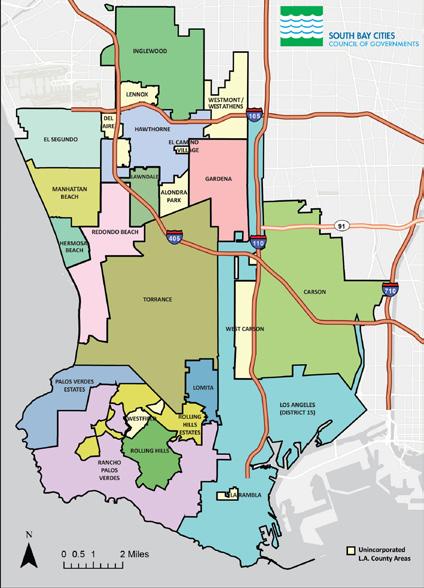
The South Bay Cities Council of Governments (SBCCOG) is a joint powers authority of 16 cities and Los Angeles County, which share the goal of maximizing the quality of life and productivity of the South Bay subregion of Los Angeles.
South Bay cities and the county maintain the qualities and characteristics that make them unique and independent, while coming together collectively to address issues of common interest for a greater good. Our members are motivated by the collective vision of what the SBCCOG can do for our communities through cooperation, collaboration and innovation.
Working with South Bay cities to foster cooperation, collaboration and innovation.
Photographer Giancarlo Guerra’s image depicting Hawthorne’s Pizza Show took home first place in the SBCCOG’s South Bay 90s Rewind photo contest. Attendees of the SBCCOG’s 25th General Assembly were invited to select the winner among five finalists through an online vote. For more information and to view the other finalists, visit bit.ly/90srewindwinner.
Governance
Overseen by a board of directors of elected officials, the SBCCOG conducts business through committees and working groups made up of city and county elected officials, city and county staff, government partners and members of the community. These groups focus on issues that fall under our five programs:
1. South Bay Sustainable Strategy
2. South Bay Environmental Services Center
3. Technology
4. Social Welfare, Equity & Access
5. Advocacy
1. SOUTH BAY SUSTAINABLE STRATEGY
Based on years of studying land use and transportation patterns, the South Bay Sustainable Strategy (SBSS) provides guidance to improve land use and transportation performance in the South Bay based on its physically varied, geographically dispersed and transit-poor neighborhoods. It focuses on neighborhood-oriented development and alternative mobility options—both public and private.
The SBCCOG staff prepared the SBSS using grant funding provided by LA Metro, which was then adopted by the SBCCOG board of directors. The SBSS provides a sustainability guide for South Bay cities to inform the redevelopment of their communities.
One such proposed alternative is the promotion of micromobility and the use of electric-powered, low-speed, zero-emission travel modes. These include neighborhood electric vehicles (NEVs), e-bikes, pedal bikes, e-scooters and other devices that operate at 25 mph and below. The SBCCOG’s research found that 70% of subregional trips are 3 miles or less, so it makes dollars and sense to consider “right-sizing your ride” to such vehicles for local trips.
SAY HELLO TO THE “ROLLING TURTLE”
An element of the SBSS strategy is being implemented as El Segundo executes the South Bay Local Travel Network (LTN) in its city to support the growing use of micromobility for local trips. The LTN is designed to safely direct slow-speed vehicles onto low-speed streets and protected crossings. Streets are marked by “rolling turtle” and wayfinding signs that inform users that they are using the network.
The LTN will be implemented in Redondo Beach in 2026. The City of Lomita is also actively designing final plans and will soon implement the network, followed by Carson and Lawndale. The LTN is made possible through Measure M subregional transportation funding.
TRANSPORTATION & LAND USE
AREAS OF FOCUS
1. Electric Vehicle Adoption
2. Goods Movement
3. Housing
4. Local Travel Network
5. Measures R & M
6. Sustainable Neighborhood Strategy
7. Transportation Demand Management & Telework
SOUTH BAY MEASURE R HIGHWAY PROGRAM AND MEASURE M SUBREGIONAL PROGRAMS
In partnership with LA Metro, Caltrans and South Bay jurisdictions, the SBCCOG continues to manage the expenditure of more than $906 million in funding available from Measure R and more than $1.9 billion from Measure M over the next 40 years for transportation projects in the South Bay. Since the inception of this program in 2008, we have provided our member agencies more than $830 million in Measure R funds and more than $396 million in Measure M funds for their transportation improvement projects.
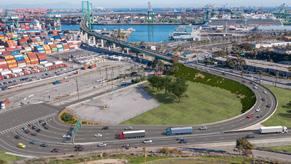
The SBCCOG contributed $49.3 million to the Port of Los Angeles from Measure R funds to reconfigure a major interchange at State Route 47/Vincent Thomas Bridge and Front Street/Harbor Boulevard in San Pedro. This interchange connects to I-110, provides access to San Pedro, Wilmington and Terminal Island, and services the West Basin Container Terminal. The reconfiguration will reduce travel times, alleviate congestion and improve motorist and pedestrian safety.
CLIMATE ACTION & ADAPTATION
We have obtained more than $1.5 million in grant funding to assist cities in developing local and subregional climate action plans with carbon emission inventories and reduction strategies focused on transportation, land use, energy efficiency, urban greening/ biodiversity, solid waste and energy generation/storage.
The SBCCOG’s staff also helped cities assess progress toward their sustainability goals, working with CivicSpark fellows and volunteers to calculate greenhouse gas inventories.
The SBCCOG has also developed a South Bay Climate Adaptation Plan with a subregional vulnerability assessment.
AREAS OF FOCUS
1. Adaptation
2. Climate Action Planning
3. Greenhouse Gas Inventories
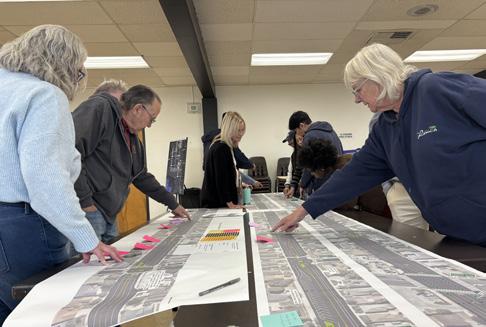
Residents of Lomita preview proposed traffic-calming improvements along proposed routes of the Local Travel Network at a public workshop in January 2026.
2. ENVIRONMENTAL SERVICES CENTER
The SBCCOG’s South Bay Environmental Services Center operates with the SBCCOG’s current partners—City of Los Angeles Department of Water and Power, LA Metro, Los Angeles County Sanitation Districts, SoCalGas, Southern California Regional Energy Network (SoCalREN), Water Replenishment District and West Basin Municipal Water District—to provide energy efficiency, water conservation, waste mitigation, shared mobility options (e.g., van pool and carpool), telecommute and traveler information, and recycling resources to cities, school districts, businesses and residents.
AREAS OF FOCUS
1. Energy Efficiency
2. Environmentally Friendly Landscaping, Gardening and Pest Control
3. Green Business Assist Program
4. Renewables
5. Waste
6. Water Conservation
With Metro Measure M Subregional South Bay funds, the SBCCOG has created a gigabyte municipal fiber optic network to serve the internet and broadband needs of SBCCOG city members and other participating public agencies. For city governments, the South Bay Fiber Network (SBFN) provides high-speed, lowcost, secure and resilient broadband--a critical technology tool that has led to faster, more affordable internet for the day-to-day operations at city halls, but also to “smart cities” applications that will unlock economic development and innovations for the South Bay cities:
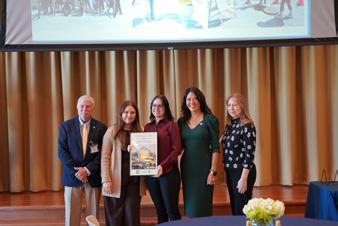
The SBCCOG honors cities for their sustainability-related efforts through the South Bay Energy and Climate Recognition Program. While all cities earned recognition, in 2025 Carson, Gardena, Manhattan Beach (pictured) and Torrance rose to the newly created platinum level.
• In the last five years, helped cities and schools save 244,269 kilowatt-hours of electricity and 162,792 gas therms, avoiding 984 metric tons of carbon dioxide emissions.
• Implemented SoCalREN’s Commercial Energy Efficiency Programs serving 24 businesses with $450,000 in energyefficient upgrades in 2025.
• Provided information to the public at more than 100 community, employee and business events and presentations annually.
• Involved the community and extended our reach with SBCCOG volunteers.
• Facilitated trainings and workshops that assist cities in the adoption of energy- and water-efficient policies and practices.
The SBFN is the 21st-century infrastructure that will support these opportunities. Network service began in August 2020 and continues to grow.
THE NEXT CHAPTER
In 2024 the SBCCOG completed a $499,000 California Public Utilities Commission grant to study and analyze the digital divide that exists in the South Bay. The study, called the “Digital Equity Project,” focused on small businesses and community-based organizations located in areas underserved by the broadband market. The SBFN is a unique public/ private asset that is intended to play an important role in addressing digital inequities in the South Bay. Through the project a “shovel-ready” plan was produced for expanding parts of the SBFN in communities where need has been identified. In 2026, our SBFN partner is expected to change. Working with the SBCCOG, the new owner will look for opportunities to expand the network and seek further funding.
SOUTH BAY FIBER NETWORK
3. TECHNOLOGY
4. SOCIAL WELFARE, EQUITY & ACCESS
HOMELESSNESS
The SBCCOG has a unique and important role in facilitating a regional approach with its member cities to address homelessness and affordable housing. The SBCCOG engages cities through co-investment opportunities, while leveraging cities’ unique positions to improve housing access.
The SBCCOG utilizes public (Measure A) and private funding to establish programs in partnership with our cities. Successful interventions include 1) Client Aid justin-time funding for security deposits and other financial assistance, including application fees, rent and other housing expenses; 2) case management services to guide participants through the rehousing process; 3) SHARE!™ housing and employment assistance; and 4) increased interim bed capacity through investements in shelters, single-room occupancy homes and motel beds.
The SBCCOG also offers a Functional Zero Street Homelessness Program to help our cities track and ensure their progress toward ending homelessness.
SOUTH BAY REGIONAL HOUSING TRUST
In early 2026 the SBCCOG worked with its member cities to establish the South Bay Housing Trust, which will receive funding for housing production, preservation and programs such as first-time buyer assistance. The trust is a new joint powers authority organization and will formally begin operations in April 2026.
Tatsuya Kataoka (left), 80, was placed at SagePoint Apartments, a Wilmington complex for older adults experiencing homelessness, through the help of Redondo Beach homeless housing navigator Lila Omura (right) and security deposit financial assistance provided through SBCCOG Client Aid funds.
SENIOR SERVICES
The SBCCOG supports awareness and shares best practices among cities of various programs that serve the community’s older adults and promote an age-friendly South Bay. Specifically, these include identifying mobility, wellness and housing strategies to improve the quality of life for senior adults.
5. ADVOCACY
The SBCCOG monitors and coordinates responses and positions on legislation and regional plans that affect the South Bay, and sponsors legislation when required. The SBCCOG also prepares and distributes white papers with more detailed explanations of our advocacy positions. We facilitate meetings with our legislators and other state agencies as needed.
Become an SBCCOG volunteer. Learn more at southbaycities.org/volunteer
To learn more about our programs visit southbaycities.org
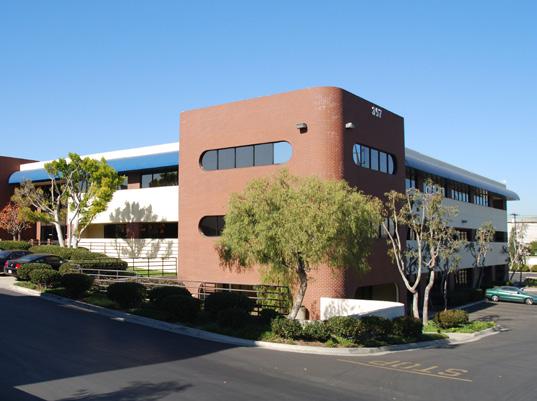
Visit our office at 357 Van Ness Way, #110 Torrance, CA, 90501 Call us at 310-371-7222