SOUTH BAY Winter 2022
SOUTH BAY CITIES COUNCIL OF GOVERNMENTS
WATCH
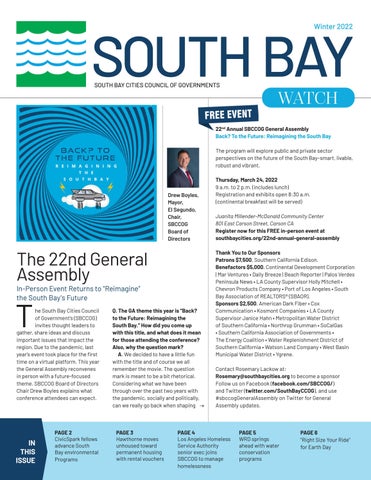
22nd Annual SBCCOG General Assembly Back? To the Future: Reimagining the South Bay The program will explore public and private sector perspectives on the future of the South Bay–smart, livable, robust and vibrant.
Drew Boyles, Mayor, El Segundo, Chair, SBCCOG Board of Directors
The 22nd General Assembly In-Person Event Returns to "Reimagine" the South Bay's Future
T
he South Bay Cities Council of Government’s (SBCCOG) invites thought leaders to gather, share ideas and discuss important issues that impact the region. Due to the pandemic, last year’s event took place for the first time on a virtual platform. This year the General Assembly reconvenes in person with a future-focused theme. SBCCOG Board of Directors Chair Drew Boyles explains what conference attendees can expect.
IN THIS ISSUE
PAGE 2 CivicSpark fellows advance South Bay environmental Programs
Q. The GA theme this year is “Back? to the Future: Reimagining the South Bay.” How did you come up with this title, and what does it mean for those attending the conference? Also, why the question mark? A. We decided to have a little fun with the title and of course we all remember the movie. The question mark is meant to be a bit rhetorical. Considering what we have been through over the past two years with the pandemic, socially and politically, can we really go back when shaping →
PAGE 3 Hawthorne moves unhoused toward permanent housing with rental vouchers
Thursday, March 24, 2022 9 a.m. to 2 p.m. (includes lunch) Registration and exhibits open 8:30 a.m. (continental breakfast will be served) Juanita Millender-McDonald Community Center 801 East Carson Street, Carson CA Register now for this FREE in-person event at southbaycities.org/22nd-annual-general-assembly Thank You to Our Sponsors Patrons $7,500, Southern California Edison. Benefactors $5,000, Continental Development Corporation | Mar Ventures • Daily Breeze | Beach Reporter | Palos Verdes Peninsula News • LA County Supervisor Holly Mitchell • Chevron Products Company • Port of Los Angeles • South Bay Association of REALTORS® (SBAOR). Sponsors $2,500, American Dark Fiber • Cox Communication • Kosmont Companies • LA County Supervisor Janice Hahn • Metropolitan Water District of Southern California • Northrop Grumman • SoCalGas • Southern California Association of Governments • The Energy Coalition • Water Replenishment District of Southern California • Watson Land Company • West Basin Municipal Water District • Ygrene. Contact Rosemary Lackow at: Rosemary@southbaycities.org to become a sponsor Follow us on Facebook (facebook.com/SBCCOG/) and Twitter (twitter.com/SouthBayCCOG), and use #sbccogGeneralAssembly on Twitter for General Assembly updates.
PAGE 4 Los Angeles Homeless Service Authority senior exec joins SBCCOG to manage homelessness
PAGE 5 WRD springs ahead with water conservation programs
PAGE 6 "Right Size Your Ride" for Earth Day
2
COVER STORY the future? The answer is no. There is no going back. Let’s take this teachable moment to ponder what we have learned, and also to consider what we want the future to look like for the South Bay. Abraham Lincoln expressed it well with this quote: “The best way to predict the future is to create it.” We hope to inspire this active and empowering mindset. Q. Last year the event brought together representatives from the private and public sector to discuss how they could intersect to shape the future. What will be different this year? A. Two panels—“Community and Innovation” and “Aerospace & Defense: Federal/Local Intersection”—will feature local champions of innovation introducing bold topics, such as manufacturing in space and new ways to take advantage of a multi-dimensional world for providing faster, cleaner and more efficient services. Entrepreneurs and investors will also introduce big ideas, dissect how they will
impact society and government, and share insights on where they are targeting future investment in the South Bay. Q. The SBCCOG has been doing this event for 22 years. How will this event be different from years past? A.This year the event is more focused on understanding what private industry is anticipating and planning for by way of investments of time, energy and money, and also how our cities and the region can benefit from these future plans. Q. In the spirit of the movie, can we expect the DeLorean to make an appearance? A. You won’t see the DeLorean, but one thing you will get a glimpse of is the possible future of South Bay transportation through the “Local Travel Network Experience.” In our exhibit hall area, we plan to showcase the concept of micromobility, i.e., zeroemission slow speed vehicles (neighborhood
electric vehicles [NEVs – think souped up golf carts], scooters and electric bikes) that operate at 25 mph or less, for attendees to interact with. Through a GIS story map, you will learn about the SBCCOG’s game-changing strategy to move local trips off of arterials, thus reducing traffic, eliminating potential safety conflicts, and providing safer paths on which zero emission vehicle drivers can more safely complete their journeys. (Read more about the Local Travel Network on page 6) Q. Who should attend this event? A. The event is designed with elected officials, city staff, city commissioners, residents and local businesses in mind. We should all be actively engaged in the future of our region, so I believe anyone who attends will get something valuable out of it. Thanks to the generosity of our sponsors we can offer this event free to our community. •
Making Every Day Earth Day CivicSpark Fellows Help Advance South Bay Environmental Programs
C
ivicSpark, a program of the Local Government Commission, is dedicated to assisting local public agencies in addressing issues such as climate change. Each year, CivicSpark recruits Fellows to augment public agency staff for 11 months. During their service year, the Fellows implement a needed sustainability and resilience project for a public agency. Shawn Fujioka is a recent graduate from UCLA with a B.S. in environmental science and minors in geographic information systems and technology (GIS&T) and geography/environmental studies. Prior to becoming a CivicSpark Fellow, Fujioka was
Shawn Fujioka is helping SBCCOG member cities and agencies implement energy efficiency measures through the SoCalREN Public Agency program.
a Climate Action Corps Fellow at TreePeople where she assisted with habitat restoration efforts in the Santa Monica Mountains and Angeles National Forest. During her SBCCOG Fellowship, Fujioka is working on the SoCalREN Public Agency program to help regional cities, school districts and water districts save energy and money through energy efficiency projects. Fujioka has expressed her excitement “to connect with other individuals in the environmental field and create real-world change.” “Most of my time at UCLA was spent gaining background knowledge about environmental issues and how to address them, but I am now thrilled to apply this knowledge towards creating climate solutions in my local community,” Fujioka said. Anne Youngdahl will be emphasizing capacity building for the SBCCOG in support of its goals and climate action planning for member cities. During her fellowship, she is updating cities’ greenhouse gas (GHG) emissions inventories for 2019 and 2020 across the energy, transportation, waste and
Anne Youngdahl is helping SBCCOG member cities progress their sustainability goals by working with them to update their Climate Action Plans. water sectors. She is excited to help cities assess their progress toward climate and sustainability goals from previously-adopted climate action plans. Youngdahl received a B.A. from the University of California, Los Angeles (UCLA). Prior to joining the SBCCOG as a CivicSpark Fellow, she worked with the UCLA Sustainable L.A. Grand Challenge on its Environmental Report Cards for Los Angeles County. Her work focused on evaluating sustainability metrics across topic areas for the greater Los Angeles area. She is interested in interdisciplinary approaches to sustainability challenges and data-driven policy development. •
CITY SHOWCASE
3
The Path to Permanent Housing
Dulce Medina, Hawthorne homeless services coordinator (right), client/tenant (left) and property owner (center) discuss a home being rented through before the EHV program.
Hawthorne Uses Federal Emergency Housing Vouchers to Help Homeless Residents
I
n late January 2022 Hawthorne Homeless Services Coordinator Dulce Medina met her client at the front door of a modest, well-kept cottage, and welcomed him to his new home. Inside, Medina directed the young man to the kitchen where he met the property owner, who showed him around. Then the two took pen in hand and signed lease documents. It was the final action needed to bring a person experiencing homelessness into permanent housing. “I am so happy and grateful for this home and now I will be able to just ride my bike to the train [light-rail] station to go to a job,” the tenant said upon receiving the keys. The January signing used the first of 67 rent vouchers awarded to Hawthorne through a federal housing program known as “Emergency Housing Vouchers” (EHV). The program received significant funding in March, 2021 through the American Rescue Plan Act (ARPA) by providing 70,000 housing choice vouchers to local Public Housing Authorities (PHAs) nationwide. The purpose is to assist individuals and families who are homeless, or at-risk of becoming homeless, are fleeing, or attempting to flee, domestic violence, dating violence, sexual assault, stalking, or human trafficking, or who were recently homeless or have a high risk of housing instability.
“The ultimate goal is to help another human—who happens to be experiencing homelessness—get off the streets. With consistent case management and a listening ear, all is possible.”
Dulce Medina, homeless services coordinator and CES (Coordinated Entry Services) case manager for the city of Hawthorne, is a passionate foot soldier in the local fight against homelessness. “My goal is to advocate for my clients, to motivate them and help them visualize a better future for themselves,” Medina explained. Through hard work, Medina has brought three clients into permanent housing since the vouchers were allocated last June. Within the next several months, she expects 14 more will sign leases. It is a long, 12-step that typically takes six months for each case. It starts when Medina submits paperwork known as a housing voucher interest assessment. First the client must be matched to a housing authority, and then the wait begins for a Section-8 voucher to be awarded. The remaining steps involve informational briefings with the client and finding an available and appropriate housing unit and willing property owner/landlord. One of the most challenging hurdles for clients is a credit check. However even if this fails, Medina will continue working with each client to find housing. The process enters the home stretch after a unit is found and the client passes property owner protocols. A Request for Tenancy (RTA) packet is signed by both the landlord and tenant and submitted to the housing authority for unit inspection and approval. Once the housing authority approves the housing unit, a lease date is set and the lease is signed, the client receives the keys and moves in. While EHVs pay a portion of the rent, they do not pay the security deposit. This can be a huge barrier for participants, according to Ronson Chu, senior manager, South Bay Cities Council of Governments (SBCCOG) Homeless and Senior Services. If no other funding can
be found, the SBCCOG, through its Client Aid program, can assist EHV holders with not only the security deposit, but also the application and document process fees. Follow-up case management is usually done for up to six months. Medina will link the client to other services and programs as needed to ensure the client thrives in the new environment. The Hawthorne Housing Emergency Voucher Program is a community partnership. The city has a contract with St. Margaret’s Center, operated by Catholic Charities, to provide homeless services, case management and coordination. Training and funding for client aid is provided by Los Angeles Homeless Services Authority (LAHSA), which also requires the city to use the Homeless Management Information System (HMIS), a secure online database that provides access to resources and housing and tracks case management activities. While there are three main components needed to transition a person from unhoused to housed (client, a landlord and a home), a major ingredient is compassion on the part of all. While some housing authorities provide lease signing bonuses to property owners, the Hawthorne program does not. The primary motivating factor is knowledge of helping someone turn their life around and get back on their feet. “The ultimate goal is to help another human—who happens to be experiencing homelessness—get off the streets. With consistent case management and a listening ear, all is possible,” Medina said. • For more information regarding the city of Hawthorne EHV and other housing programs, visit https://www.cityofhawthorne.org/ departments/housing.
SBCCOG NEWS
Los Angeles Homeless Service Authority Senior Executive Joins SBCCOG to Manage Homelessness and Senior Programs
T
he South Bay Cities Council of Governments (SBCCOG), recently welcomed Ronson Chu to lead its Homelessness and Senior Services programs. Chu brings financial, administrative and managerial experience to the organization after working in various roles for the Los Angeles Homeless Services Authority (LAHSA) and Homeless Court, and as co-founder of Weekend to End Homelessness, an event and campaign to connect neighbors with volunteer opportunities in their local communities. At the SBCCOG Chu works to develop strategies and processes for implementation of South Bay programs, activities and events related to homelessness and senior services. These include Home Share South Bay. The program, in partnership with Silvernest, is an online service that matches homeowners who have rooms for rent with tenants seeking housing. It was created through Measure H Innovation Funds, which take aim at homelessness in Los Angeles County. In late 2021, Chu worked to prioritize $3.7 million in proposed projects for the South Bay Cities for the $1.9 million in Measure H funding, which has been allocated to the South Bay cities through the SBCCOG for innovative programs. “There is a lot going on in our community to address homelessness. Our role at the South Bay Cities Council of Governments is to make life easier for our outreach workers and the people who get people housed—to help grease the wheels to get people into permanent housing,” Chu, senior manager, Homelessness and Senior Services, SBCCOG said. Prior to joining the SBCCOG, Chu managed LAHSA’s $100 million internal budget, a role which helped him to develop in-depth knowledge of various federal, state and local funding sources available to combat homelessness, particularly during the COVID-19 pandemic. LAHSA was created in 1993 by the Los Angeles County Board of Supervisors and the Los Angeles mayor and city council as the lead agency in the Los Angeles Continuum of Care. It is the lead regional planning body that coordinates housing and services for homeless families and individuals in Los Angeles County. Prior to that role Chu served as an administrative coordinator for Homeless Court. In 2018, Chu also co-founded and now volunteers for Weekend to End Homelessness, a non-profit event that connects hundreds of neighborhood volunteers with more than 25 organizations including Hope of the Valley, The Salvation Army and Inner City Law Center. •
SBCCOG PARTNERS WITH SECURIAN FINANCIAL AND HOMEFUL.LA TO PROVIDE HYGIENE KITS TO LOCAL UNHOUSED The South Bay Cities Council of Governments (SBCCOG) recently worked with Securian Financial and Homeful.LA, an Inner City Law Center Initiative, to assemble and deliver 3,000 personal hygiene kits to agencies that service the unhoused in the South Bay. Agencies included Harbor Interfaith Services, People Assisting the Homeless (PATH), St. Margaret’s Center, and Homeless Outreach Program Integrated Care System (HOPICS).
PHOTO COURTESY OF SECURIAN FINANCIAL
Faces of The SBCCOG
4
Two-hundred and fifty volunteer employees from Securian Financial used their corporate conference at Terranea Resort in Rancho Palos Verdes as an opportunity to assemble the kits for delivery. Each kit included a toothbrush, toothpaste, deodorant, shampoo and conditioner, and other hygiene essentials. The contents are useful for those accessing interim shelters or mobile showers. More importantly, they help those experiencing homelessness to feel fresh, clean and ready to tackle their day’s challenges. They also give outreach workers the opportunity to build trust with homeless neighbors as the kits are distributed. According to the Los Angeles Homeless Service Authority, (LAHSA) more than 66,436 people are experiencing homelessness in Los Angeles County, including 4,560 in the South Bay. While a lot of work is being done to house people in LA County, for every 207 people housed, per day in Los Angeles County, another 222 are falling into homelessness daily. •
Each hygiene kit included a handwritten “cheer message” expressing encouraging sentiments, such as “You matter,” and “Every day is a second chance.”
5
and fix water leaks, which will help conserve thousands of gallons of water per year. • Tues, April 5 | 6 p.m. to 7 p.m. | DroughtTolerant Plants; Planting a drought-tolerant garden can alleviate the high demand on our precious water resources while saving you money. • Thurs, April 7 | 6 p.m. to 7 p.m. | Irrigation Basics; Learn how to get the most out of your irrigation system so that we can conserve water and live more sustainably.
PHOTO COURTESY OF WRD
WRD Springs Ahead with Water Conservation Programs
Eco Gardener instructor shows participants drought-tolerant landscaping options and drip irrigation at the WRD Albert Robles Center.
I
t’s possible to have a garden that is the envy of the neighbors, while simultaneously saving water and creating a productive backyard ecosystem. The Lillian Kawasaki Eco Gardener Program, offered through the Water Replenishment District (WRD), teaches homeowners about the multiple benefits of planting a sustainable garden through a series of in-person classes. The program is offered to WRD’s 43 cities, including the entire South Bay. It’s one of many programs offered to help residents save water and money, as well as to improve their health through instruction on how to grow home or community garden fruits and vegetables. Attendees walk away with knowledge about sustainable garden design concepts as well as plant and material selections to create an attractive, water-efficient garden. All classes are free. The Eco Gardener program educates residents on four popular topics: 1) sustainable landscape design, 2) droughttolerant plants, 3) edible gardening, and 4) irrigation basics. This spring, it will also feature new classes on composting, lawn conversion, and leak detection. (Check the
website for the most up to date schedule of classes.) UPCOMING CLASSES To protect public health during the pandemic, WRD has postponed in-person Eco-Gardener Classes until further notice. However, it is offering live virtual classes and on-demand classes. On-demand classes are accessible anytime using a link received after clicking through to RSVP on the WRD website (see ‘more information’ section). The live webinar classes have a set date and time. They are led by an instructor who can answer questions in real-time. The following classes are currently available: • Thurs, March 10 | 6 p.m. to 7 p.m. | NEW! Composting for a Healthy Garden; Learn how to recycle your indoor and outdoor green “organic” waste and turn it into a rich, high-nutrient soil amendment. Composting returns nutrients back in the soil, improving its structure and moisture retention, and increasing beneficial organisms. • Tues, March 15 | 6 p.m. to 7 p.m. | Leak Detection Class; Learn how to isolate
ON-DEMAND CLASSES Three virtual, on-demand classes, “Sustainable Landscape Design,” “Edible Gardening,” “Irrigation Basics” will teach audiences about sustainable gardening. Sign up today through the WRD website to receive a class link to be viewed any time from the comfort of home (see ‘more information’ below). WRD DROUGHT TOOLKIT Water conservation can take place both inside and outside the home. WRD has put together the Drought Toolkit resource page where you’ll find information on understanding your water footprint, installing water saving devices, and applying for rebates. Please visit www.wrd.org/DroughtToolkit. MORE INFORMATION AND CLASS REGISTRATION Visit www.wrd.org/EcoGardener to see descriptions of classes, register for a webinar, view a tutorial, or subscribe to a mailing list. When visiting the site or the QR code below, click the "sign up" button to stay informed of future classes or to inquire about hosting a community workshop. •
For more tips and resources regarding sustainable landscapes and gardening, such as best management practices for using pesticides and fertilizers, visit the SBCCOG website at: https://southbaycities. org/programs/environmentally-friendlylandscaping-gardening-and-pest-control/.
6
PERSPECTIVE
“Right-Sizing Your Ride” this Earth Day
Published March 9, 2022 by the South Bay Cities Council of Governments A quarterly bulletin to inform local leaders of subregional progress and alert them to emerging issues
Micromobility Lane Networks Are Appropriate Local Step Toward Global Environmental Change
Governing Board:
By Drew Boyles, Mayor of El Segundo, SBCCOG Board of Directors Chair
O
n December 13, 2021, in his Los Angeles Times op-ed “L.A. can no longer afford to push bikes and buses aside,” Michael Schneider accurately describes the challenges Los Angeles and other cities have faced in fully embracing electric vehicle conversion and creation of a bike-friendly infrastructure. To address these challenges, the time is ripe to consider another idea to advance these goals. Let’s give our cities the proper means to effectively “right-size their rides” with a slow speed network on which to travel. The South Bay, with its lack of robust transit, is promoting wide-spread adoption of micromobility to encourage zero-emission local trips. Micromobility is defined as small, lightweight vehicles that operate at speeds of 25-mph or less. Such vehicles include traditional pedal bikes, but also electric bikes, scooters and neighborhood electric vehicles (NEVs), which are similar to golf carts. Under this next-level concept, these vehicles would be owned, not rented. In 2013, with a grant from the AQMD, the South Bay Cities Council of Governments (SBCCOG) gave a group of residents NEVs to drive for three months as part of a study called the Local Use Vehicle (LUV) Project. It revealed 70% of car trips in the South Bay were 3 miles or less. It also found that 285,000 South Bay residents owned a second, third or fourth vehicle. The SBCCOG is not suggesting that residents give up a car for longer trips, but that they examine driving habits to determine if an NEV or other slow speed vehicle might make sense for local trips. Advocating slow speed vehicles for personal use poses the question of where to safely drive them since they are not designated for main arterials with speed limits above 35 mph. Like many cities, the South Bay’s existing network of bike lanes were built in small segments. But bike lanes are only safe and effective as a network. Through a grant from Caltrans, the
Chair Drew Boyles, El Segundo 1st Vice Chair John Cruikshank, Rancho Palos Verdes
The SBCCOG study proposes development of a 243-mile route—overlayed onto the South Bay’s 2,000 miles of existing streets— dedicated to zero-emission, slow-speed vehicles.
2nd Vice Chair Cedric Hicks, Carson
SBCCOG has developed the concept, now in the implementation phase, called The South Bay Local Travel Network (LTN). Through a route refinement study, it mapped out a complete network of existing slow speed neighborhood streets, where implementation of low-cost infrastructure and street treatments would successfully support micromobility vehicles. To ensure safety across the network’s continuum, it connects neighborhood-to-neighborhoodto-destinations by always using controlled intersections (lights or four-way stop signs) to cross busy and fast-moving roads. The study proposes development of a 243-mile route—overlayed onto the South Bay’s 2,000 miles of existing streets—dedicated to such vehicles. The network would be constructed as a “sharrow system,” of street markings with wayfinding signage to inform riders and drivers they are using the LTN. Signage would alert motorists of slow-moving, lightweight vehicles in the vicinity, to make sharing the neighborhood streets safer for all travelers. Last May, the SBCCOG board of directors passed a resolution supporting implementation of the network, indicating the subregion is ready to work with local jurisdictions to implement the LTN. A known standard is that 80% of traffic moves on 20% of the streets. The SBCCOG’s gamechanging strategy would move these local trips off of arterials, thus reducing traffic, eliminating potential safety conflicts, and providing safer paths on which zero emission vehicle drivers can more safely complete their journeys. Learn more/ take our survey: southbaycities.org/a-localtravel-network-for-the-south-bay/. •
Members: Carson , County of LA, El Segundo, Gardena, Hawthorne, Hermosa Beach, Inglewood, Lawndale, Lomita, Los Angeles, Manhattan Beach, Palos Verdes Estates, Rancho Palos Verdes, Redondo Beach, Rolling Hills, Rolling Hills Estates, Torrance
Immediate Past Chair Olivia Valentine, Hawthorne
SBCCOG Executive Director Jacki Bacharach Legal Counsel Michael Jenkins, Best Best & Krieger LLP Treasurer Joseph Lillio, Director of Finance City of El Segundo
To subscribe to SBCCOG newsletters or view past editions, visit southbaycities.org/newsletter. To view a schedule of SBCCOG meetings, visit southbaycities.org/calendar. Website: southbaycities.org
Like us: facebook.com/SBCCOG facebook.com/SBESC Follow us: @SouthBayCCOG @SBESC