Summer 2026
WORKING WITH SOUTH BAY CITIES TO FOSTER COOPERATION, COLLABORATION, AND INNOVATION
SOUTH BAY SOUTH BAY CITIES COUNCIL OF GOVERNMENTS
WATCH
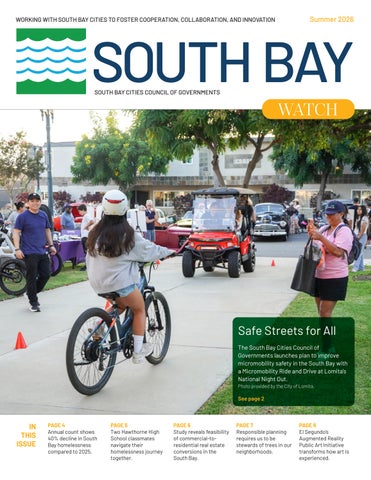
Safe Streets for All The South Bay Cities Council of Governments launches plan to improve micromobility safety in the South Bay with a Micromobility Ride and Drive at Lomita’s National Night Out. Photo provided by the City of Lomita.
See page 2
IN THIS ISSUE
PAGE 4 Annual count shows 40% decline in South Bay homelessness compared to 2025.
PAGE 5 Two Hawthorne High School classmates navigate their homelessness journey together.
PAGE 6 Study reveals feasibility of commercial-toresidential real estate conversions in the South Bay.
PAGE 7 Responsible planning requires us to be stewards of trees in our neighborhoods.
PAGE 6 El Segundo’s Augmented Reality Public Art Initiative transforms how art is experienced.
COVER STORY
Safe Streets for All The South Bay Cities Council of Governments Rolls Out Micromobility Safety Plan for the South Bay
P
edal bikes, e-bikes, street-legal golf carts, scooters and other forms of low-speed vehicles classified as micromobility are rapidly growing in popularity in the South Bay and across the nation. While zipping around in a zero-emission micro vehicle is environmentally sustainable, it’s not without its risks. An analysis using the Berkeley Transportation Injury Mapping System (TIMS) developed at UC Berkeley found that more than 250 fatal or serious micromobility accidents occur per year in the South Bay. The TIMS analysis revealed that when micromobility drivers are at fault for accidents, most violations are associated with hazardous riding: 28% for riding on the wrong side of the street, 26% for ignoring a signal or stop sign and 18% for traveling at an unsafe speed. In 2023, the Southern California Association of Governments (SCAG) received $12 million to develop a Regional Safety Action Plan backed by a U.S. Department of Transportation Safe Streets and Roads for All (SS4A) grant. The plan’s objectives include improving roadway safety and helping local jurisdictions reduce or eliminate serious injuries and fatalities. To enhance SCAG’s plan, being implemented this year, and address safety concerns in the South Bay subregion, the South Bay Cities Council of Governments (SBCCOG) is implementing the South Bay Micromobility Safety Action Plan (MSAP), also funded through an SS4A grant. The MSAP aims to reduce roadway fatalities and serious injuries. COMMUNITY MICROMOBILITY SHOWCASES Through the MSAP, the SBCCOG will organize and host interactive events in communities especially impacted by traffic injuries and fatalities. The goal is to educate the public about micromobility safety and regulation by connecting the community and riders with micromobility vendors and local experts in micromobility safety. Participants can get behind the wheel of a neighborhood electric vehicle and hop on an e-bike for a guided test ride. At its first such event in August, the SBCCOG hosted a Micromobility Ride and Drive at Lomita’s National Night Out in partnership with micromobility vendors ALSO., E3 Vehicles and Upway, and other groups concerned with micromobility safety: Beach Cities Health District, E-Bike Sense, HarborUCLA Medical Center and the South Bay Bicycle Coalition. “We want participants first and foremost to have experience with micromobility vehicles, while learning how to 2 | South Bay Watch
Anne Tsai, senior project coordinator for SBCCOG Transportation programs, discusses e-bike safety with attendees of the recent Micromobility Ride and Drive at Lomita’s National Night Out.
operate them safely and gaining awareness of what to think about when purchasing a bike, such as the importance of wearing a helmet,” said Anne Tsai, senior project coordinator for transportation programs at the SBCCOG. The SBCCOG is promoting this form of transportation because its own research found that 70% of trips in the South Bay are 3 miles or less. “We see micromobility as a missing middle mode that can accomplish most of people’s daily travel for commutes, errands, grocery runs, school drop-off and pick up, and it’s zero-emission,” Tsai added. In addition, according to the American Automobile Association 2024 cost summary, the cost of owning and operating a new car is estimated to be more than $12,000 per year, so it makes sense to consider “right-sizing your ride” to such vehicles for local trips. The SBCCOG’s research on South Bay travel patterns led to the development and implementation of the South Bay Local Travel Network (LTN), a proposed route of existing low-speed streets throughout the South Bay that will support the use of micromobility and allow users to navigate throughout the area more easily.
HOW THE LOCAL TRAVEL NETWORK WORKS—LOOK FOR THE TURTLE! Users of the LTN traveling on their micromobility vehicles from their home or starting origin will find their way to an LTN “trailhead” marked by turtle signs. From there, they navigate onto LTN routes to destinations within the South Bay, indicated by branded wayfinding signage and sharrow markings on the road. The LTN directs users to four-way stop signs or signalized travel intersections to ensure safe crossings.
To date the LTN has been successfully implemented in El Segundo. It is now launching Redondo Beach, with Lomita to follow in 2027. Carson and Lawndale will join soon after. SCHOOL STICKER PROGRAMS The SBCCOG’s outreach efforts in South Bay communities have revealed that young students constitute a major subsection of micromobility riders, many of whom exhibit unsafe riding behaviors. California Assembly Bill 1569, signed in late August by Governor Gavin Newsom, will require the California Department of Education, in consultation with the Department of California Highway Patrol, to develop a standardized electric bicycle safety and training program for students in grades seven through 12. Through the SS4A program, the SBCCOG will meet with school districts, police departments, PTAs and local e-bike safety programs to coordinate the development of a regional micromobility safety sticker program. School safety sticker programs require students to attend a certified safety course to be eligible for parking their bicycles and
scooters at school. The materials developed will also be used to enhance existing school safety initiatives and “fast-track” new safety programs in schools where none exist today. The materials created will be available for schools to use in their localized efforts by fall 2027. INTERSECTION ANALYSIS Through the SS4A grant and South Bay Measure M funds, the SBCCOG will conduct a safety intersection analysis in the South Bay to evaluate high-injury street corridors to inform the SCAG’s regional comprehensive safety action plan. Through this review, a catalog of recommended safety improvements will be made available to cities, with conceptual designs developed for safety improvements in highrisk intersections. NEXT STEPS The SBCCOG will host the next Ride and Drive event on October 6 at California State University, Dominguez Hills. Visit the SBCCOG calendar for more details closer to the event at southbaycities.org/ calendar •
In August, the SBCCOG hosted a Micromobility Ride and Drive at Lomita’s National Night Out that provided attendees the opportunity to learn about micromobility safety. Photo provided by the City of Lomita.
Summer 2026 | 3
SBCCOG NEWS
Annual Count Shows 40% Decrease in South Bay Homelessness
I
n late July, the Los Angeles Homeless Services Authority (LAHSA) released the results of its 2026 Homeless Count, indicating a 40% decrease in South Bay unsheltered homelessness compared to 2023. At the time of the count, 725—a 20% decline of individuals compared to 2025—remained unsheltered within the 15 South Bay cities of the South Bay Cities Council of Government (SBCCOG). These include Carson, El Segundo, Gardena, Hawthorne, Hermosa Beach, Inglewood, Lawndale, Lomita, Manhattan Beach, Palos Verdes Estates, Rancho Palos Verdes, Redondo Beach, Rolling Hills, Rolling Hills Estates and Torrance. Meanwhile, in Los Angeles County as a whole, homelessness increased by 1.2% year-over-year, with 74,040 individuals counted as unhoused, excluding Long Beach, Pasadena and Glendale, which conduct their own surveys. This is up slightly from 72,195 in 2025. The data collected from the LAHSA 2026 Greater Los Angeles Point-in-Time Count estimates the number and demographic characteristics of the homeless population on a single night in January. “Although the count reflects just one night, we’re encouraged by what appears to be a positive downward trend in our unsheltered population,” said Addy Ajijolaiya, manager of Housing and Homeless Services at the SBCCOG. “We have been working closely with our cities toward the goal of Functional Zero for our entire subregion. This shows that our By-Name List data approach, combined with individualized services and strong coordination, is successfully moving the dial toward getting and keeping people off of the streets.” To achieve Functional Zero, outflow (the number of individuals placed in interim or permanent housing) must exceed inflow (the number of individuals who become homeless) over a six-month period, and the homeless population, as a whole, must have a median duration on the streets of less than 90 days. Year over year, LAHSA’s microdata indicates homelessness increases within certain populations in Los Angeles County with similar trends in the South Bay. Transitional age youth (ages 18 to 25) saw a 22.1% increase, and the homeless older adult population (age 55 or older) grew by 13.5%. 4 | South Bay Watch
MISSION PREVENTION The SBCCOG has been working with its cities through a regional approach to address homelessness and advance affordable housing opportunities. With a focus on prevention, the SBCCOG administers a variety of homeless programs funded through Measure A. This includes Local Solutions Fund programs that support regional homeless services and homelessness response efforts, as well as the Renter Protection and Homeless Prevention Assistance Program, funded by the Los Angeles County Affordable Housing Solutions Agency, which provides homelessness prevention services to households at imminent risk of homelessness. • Further information can be found at bit.ly/LAhomelesscount2026
Former Hawthorne High School Classmates Lean on Each Other Through Homeless Journey
J
ana Jenkins and Danna Mayfield have been friends for 40 years. They met as teenagers at Hawthorne High School, grew up together in the South Bay and have experienced many challenges side by side. Health problems left Jenkins unable to work, so in 2019, Mayfield opened her home to her friend. Not long after, Mayfield also faced health challenges. Because they were unable to earn income and had no financial assistance, they faced eviction. From May 2023 to November 2024, the two moved from place to place, including a relative’s backyard, Alondra Park and other public spaces across the South Bay—all while caring for their five support animals: four cats and one dog. They faced challenges with community outreach programs that wouldn’t accommodate their pets. “We kept getting the runaround, and nobody was helping us,” Mayfield said. That changed when they met Marlen Pomposo and Madeline deVillers, case managers from St. Margaret’s Center (SMC), a social service center operated by Catholic Charities of Los Angeles. SMC is one of the SBCCOG’s regional housing-focused case management partners that serves the northern South Bay through Measure A funding. It engages individuals experiencing homelessness directly to connect them with housing and supportive services. Help includes street outreach and engagement, case management, interim and permanent housing navigation, and benefits assistance. Pomposo and deVillers began checking in regularly, bringing bag lunches for them and their pets. “ [Marlen and Madeline] genuinely seem to care, and that was so huge for us,” Jenkins said. With SMC’s help, Jenkins and Mayfield moved into the Salvation Army’s Tiny Homes Village in November 2024— one of the few placements that could accommodate their support animals. They stayed there for close to two years. In March 2026 they moved again, this time to Step Up on Western, an interim housing complex with supportive services in the City of Los Angeles. The transition was made possible in part by the SBCCOG’s Client Aid program, funded through Measure A, which covered their security deposit and provided a moving truck to carry their belongings from the shelter to their new home. “For individuals and families experiencing homelessness, the path to securing stable housing can be blocked by high, upfront costs such as security deposits and moving expenses not covered by other funding sources,” said Addy Ajijolaiya, manager of the SBCCOG Homeless Services program. “Our Client Aid program is specifically designed
After many years of experiencing homelessness, best friends Jana Jenkins (left) and Dana Mayfield finally found stable housing that would accommodate their beloved pets, including Baxter (above), at Step Up on Western, a converted apartment complex that is now an interim housing complex with supportive services.
to provide more flexible financial assistance to bridge those financial gaps that can be barriers to obtaining or maintaining housing.” Jenkins and Mayfield now receive permanent disability benefits and put 30% of their income toward rent. They are working toward Section 8 housing, also known as the Housing Choice Voucher Program, which is a federal program that provides rental assistance to low-income families and individuals with disabilities. They also hope to achieve the long-term stability that has eluded them for years. They have finally found a place to call home. • Summer 2026 | 5
SBCCOG NEWS KEY STUDY TAKEAWAYS: 1. Housing redevelopment follows market strength. Upzoning the site alone will not guarantee housing. Projects still need rents or sales value high enough to support land and construction costs and make the project feasible. 2. Some commercial site types are more viable than others for conversion. Large sites with consolidated ownership and excess parking were deemed to perform better than smaller, fragmented strip retail sites or big-box centers that still have economic utility.
Underutilized parking lots were among the properties evaluated in the “South Bay Cities Restock: Sustainable Pathways to Housing” study aimed at identifying properties that could be repurposed as new housing.
Property Pivot
Study Reveals Feasibility of Commercialto-Residential Conversions in the South Bay
T
o help South Bay cities meet their state-established housing targets in a largely built-out subregion, the South Bay Cities Council of Governments (SBCCOG) has concluded a study that aimed to help cities identify and reimagine underutilized commercial properties that could be candidates for new housing. Carson, Hawthorne and Torrance participated in the “South Bay Cities Restock: Sustainable Pathways to Housing” study. Two sites per city were identified, such as the Roadium Open Air Market located along Redondo Beach Boulevard in Torrance. Seven additional sites were identified across the broader South Bay. Examined properties included commercial corridors and shopping centers that are underperforming, over-parked or no longer functioning at their highest value within the South Bay’s urban profile. Land configurations, site size and community characteristics were evaluated at parcels such as strip arterials, parking lots, regional malls, office buildings and industrial parks. The study’s final report contains key findings. It was completed by the SBCCOG and consulting partners Studio One Eleven and Kosmont Companies. Funding was provided by the state’s Regional Early Action Planning (REAP) 2.0 program, through the Southern California Association of Governments (SCAG). REAP was established with the goal of advancing regional sustainability, housing production and affordability goals across the region. •
6 | South Bay Watch
3. Feasibility depends on housing type and parking, not just density. Lower to mid-density housing, like townhomes, financially outperformed higher-density projects in South Bay markets. 4. Quality of place and design can expand suitability and feasibility. Sites with walkable amenities, near neighborhood businesses and close to existing mobility infrastructure are seen as more attractive for housing and more likely to gain community support for housing. 5. Affordable housing requires public intervention and subsidy. Projects that have layered public financing are more likely to produce affordable housing due to the South Bay’s high land and construction costs. . 6. Regulatory certainty and process shape outcomes. Unpredictable timelines and discretionary approvals can kill projects that would otherwise be viable. To view the complete report, visit southbaycities.org/housing
PERSPECTIVE
Cooling Neighborhoods with Trees
Responsible Planning Requires Us to Be Stewards of Trees in Our Communities Written by Rebecca Ferdman, Sustainability Policy Director, Los Angeles County
P
eople across Los Angeles County are feeling the heat this summer. With the impacts of climate change, hotter summers are part of our new normal. That’s why making more space for trees in our communities needs to be a part of the new normal here in L.A. Trees shade and cool the outdoors, making walking to school or waiting at the bus stop more comfortable. Trees can shade homes and buildings, reducing the need for mechanical cooling and lowering utility bills. Trees also have many other benefits, from providing habitat and managing stormwater to calming traffic and improving mental health. But maximizing the benefits of trees requires thoughtful choices and careful planning. It requires all of us to play a role as stewards of the trees in our communities. The most valuable trees are the trees we already have. Large, mature trees provide the most shade and have deep root systems that make them more resilient to both drought and flooding. That’s why caring for and preserving existing trees is one of the most important actions we can take to maintain our community forest. For people who manage trees on private property, this can include selecting certified arborists to care for trees and avoiding practices such as tree topping, which can be harmful to tree health. Planting new trees for the future is also important. New trees can be strategically placed and selected to minimize conflicts and maximize benefits. For example, trees can be planted on the west side of homes to take advantage of shade during the hottest part of the day. Different trees can provide different kinds of benefits. For example, native tree species such as oaks and sycamores are the
most effective for promoting biodiversity, while fruit trees can provide food and cultural connection. Unfortunately, growing our community forest isn’t as simple as protecting the trees we have and planting new ones. Many communities with very little tree canopy coverage, such as Athens Westmont, also have an overabundance of pavement. Seventy percent of Athens Westmont is covered by impervious surfaces, including areas such as roads and buildings, while only 9% is covered by tree canopy. More impervious areas mean less space for planting muchneeded trees. To make space for trees in such communities, we will need to reimagine our urban spaces, including considering opportunities for removing excess pavement and replacing it with trees and other green infrastructure. Like our power lines or transportation systems, the trees in our community forest are public infrastructure. Trees provide benefits that communities rely on. Maintaining this green infrastructure and investing in its resilience requires thoughtful planning. That’s why the county created the Room to Grow Community Forest Management Plan (CFMP), a long-term strategy for managing trees in the county. The CFMP sets a goal of 15% tree canopy coverage for each L.A. County unincorporated community. This year, to help achieve that goal, the county is using federal grant funding to plant 1,600 trees, including 386 trees in South Bay communities such as Athens Westmont, Lennox and West Carson. We still have a long way to go to achieve canopy equity in Los Angeles County, but investments like these will continue to create benefits for years to come. •
Los Angeles County Parks and Recreation staff member Chris Rivera plants donated trees at Deane Dana Friendship Park and Nature Center in Rancho Palos Verdes in 2022. Photo by Mayra Beltran Vasquez, Los Angeles County.
Summer 2026 | 7
CITY SHOWCASE
Photo by Christian Enriquez.
Planets appear to orbit the city’s Masonic Lodge and rocket ships blast off into the sky through the El Segundo Augmented Reality experience.
South Bay Watch is a quarterly bulletin by the South Bay Cities Council of Governments to inform local leaders of subregional progress and alert them to emerging issues.
Augmented Reality Initiative Transforms El Segundo’s Public Art Experience
I
n El Segundo, it’s becoming a common occurrence to see visitors to the city’s public murals smiling and transfixed on their phones while standing in front of the display. That’s because in addition to the static mural, they are very likely also seeing moving images of rockets launching, butterflies taking flight or characters moving beyond the painted surface—thanks to the city’s Augmented Reality (AR) Public Arts Initiative. The experiences merge physical murals with digital animation, sound and interactive storytelling. Originally introduced during the El Segundo Art Walk three years ago, the initiative brought together local artists, technologists and community partners to create a unified, interactive way to explore the city’s public art. “El Segundo has always been a place where creativity and innovation intersect, and our AR Public Art Initiative is a perfect example of that spirit in action,” said Chris Pimentel, mayor of El Segundo. “By blending technology with the incredible talent of our local artists, we’re making public art more accessible, more interactive and more inspiring for everyone who lives, works or visits here.” Since launching the El Segundo AR Map in 2023, the program has recently surpassed 3.15 million views, 3.10 million plays and more than 7,000 shares across its interactive AR experiences. Today, the El Segundo AR Map highlights nine AR-enhanced murals and installations, each accessible through Snap’s Lens technology and viewable on Snapchat by searching @ElSegundoAR. The city and El Segundo Art Walk Foundation plan to expand the AR program through the integration of the AR Map into official city websites, the introduction of new AR concepts and continued partnerships with local artists, schools and businesses. • To experience El Segundo’s AR Public Arts Initiative, download the El Segundo AR Map at elsegundoartwalk.com/map, visit one of the listed sites and open the smartphone photo app. 8 | South Bay Watch
Governing Board: Chair Bill Uphoff, Lomita 1st Vice Chair Alex Monteiro, Hawthorne 2nd Vice Chair Nina Tarnay, Manhattan Beach Immediate Past Chair Bernadette Suarez, Lawndale Members: Carson, El Segundo, Gardena, Hawthorne, Hermosa Beach, Inglewood, Lawndale, Lomita, Los Angeles, Los Angeles County, Manhattan Beach, Palos Verdes Estates, Rancho Palos Verdes, Redondo Beach, Rolling Hills, Rolling Hills Estates, Torrance SBCCOG Executive Director Jacki Bacharach Legal Counsel Michael Jenkins, Best Best & Krieger LLP Treasurer Jasmine Allen Editor Colleen Farrell, Senior Project Manager, Communications Contributors Moana Franco, SBCCOG CivicSpark Fellow Rosemary Lackow, Administrative Assistant Design Vincent Rios Creative, Inc.
To subscribe to SBCCOG newsletters or view past editions, visit southbaycities.org/newsletter To view a schedule of SBCCOG meetings, visit southbaycities.org/calendar
Follow us: facebook.com/SBCCOG facebook.com/SBESC @SouthBayCCOG @SBESC @southbayccog