6 minute read
Torrance Memorial and Cedars-Sinai Mark Four Years of Affiliation

Torrance Memorial and Cedars-Sinai Mark Four Years of Affiliation
Heart, stroke and cancer patients discuss how the unique collaboration fostered healing.
Written by Christina Elston
February 1 marked the four-year anniversary of a strategic alliance between Torrance Memorial and Cedars-Sinai, a partnership forged to provide coordination of leading-edge healthcare and services throughout greater Los Angeles. The two organizations joined forces in 2018 with very big goals to create new opportunities to enhance medical care in the South Bay.
“Our strategic partnership has been instrumental in bringing the resources and expertise of Cedars- Sinai to Torrance Memorial,” says Torrance Memorial CEO and president Craig Leach. “The collective effort from both institutions has absolutely enhanced healthcare in the South Bay and continues to expand on clinical talent and expertise, built on a foundation that was already strong.”
Here, patients and physicians comment on how this partnership is leading the way in exceptional care.
Jessie Savolt
Jessie Savolt will celebrate her seventh year with a new heart because the partnership between the Torrance Memorial Lundquist Lurie Cardiovascular Institute and the Smidt Heart Institute at Cedars- Sinai, which was in place before the affiliation, made a transplant possible.
“I've been very fortunate between the two hospitals, with the different doctors who took care of me,” says Savolt. “I'm here because of all of them—all their hard work.”
Savolt spent decades battling debilitating fatigue and shortness of breath. She was on the transplant waiting list at another institution for two years.
Then in 2015, Torrance Memorial cardiologist Mark Lurie, MD, director of the Lundquist Lurie
Cardiovascular Institute, contacted Jon Kobashigawa, MD, director of the Heart Transplant Program at Cedars-Sinai. He was willing to take her on right away in conjunction with colleagues at Torrance Memorial. Within three weeks, Savolt had a heart.
“The teamwork of our integrated heart failure programs, employing ever-evolving medical advances, managed her condition,” says Dr. Lurie. “While heart failure patients are living longer, the time had come to find another option for Jessie.”
Danny Ramzy, MD, vice chair of innovation and director of robotic and minimally invasive cardiac surgery in the Smidt Heart Institute and assistant professor of surgery at Cedars Sinai, performed

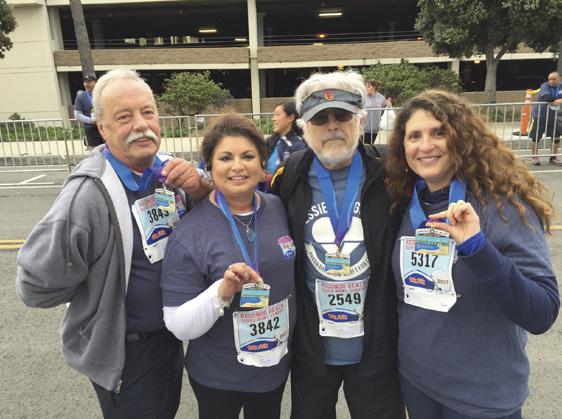
Terry Savolt, Jessie Savolt, Mark Lurie, MD, and heart failure clinical nurse Roxanna Balter show their medals after the 2017 Redondo Beach Super Bowl 10K race.
Savolt’s transplant. He says her case was too highrisk for many other medical centers.
“She had two previous heart operations and other issues,” Dr. Ramzy says. “At Cedars-Sinai, we have some of the best cardiologists, cardiothoracic surgeons and ICU doctors in the world, and we have an intensive care unit specifically trained for post-transplant management. This allows us to take on these higher-risk patients.”
The affiliation with Torrance Memorial brings these capabilities to patients in and around the South Bay area, he says.

Torrance Memorial Medical Center is proud to recognize its four-year anniversary and strategic alliance with Cedars-Sinai.
Kristen Enomoto
Kristen Enomoto is celebrating her defeat of stage 3 breast cancer with the help of a Cedars- Sinai cancer clinical trial combined with treatment at the Torrance Memorial Hunt Cancer Institute.
A year ago, an ultrasound follow-up to a routine mammogram detected two noncancerous cysts in Enomoto’s left breast. Fortunately, Enomoto had been experiencing discomfort under her left arm and asked the technician to check that area as well.
The ultrasound and a biopsy confirmed Enomoto had HER2-positive breast cancer that had spread to multiple lymph nodes. HER2, or human epidermal growth factor receptor 2, is a protein that promotes the growth of cancer cells.
Enomoto was facing 5½ months of chemotherapy, but Torrance Memorial breast cancer specialist
David Chan, MD, suggested Enomoto enroll in a Cedars-Sinai clinical trial that let her complete chemotherapy in just three months.
In the study, Reva Basho, MD, co-director of the Women’s Cancer Program and assistant professor of medicine at Cedars-Sinai, is testing a treatment plan that increases the body's immune response against HER2-positive breast cancer with the addition of a checkpoint inhibitor.
“The goal is to engage the immune system to allow us to de-escalate the amount of chemotherapy that needs to be given to patients with curable cancers while improving their long-term outcomes,” Dr. Basho said.
After 12 weeks of treatment, Enomoto had a mastectomy, and test results showed no active cancer remaining.
“We couldn’t prescribe this therapy outside of a clinical trial,” says Dr. Chan. “But our partnership with Cedars-Sinai gives our patients the opportunity to participate in studies for potential new treatments-they wouldn’t be able to access otherwise.”
Without Torrance Memorial’s physicians alerting her to Basho’s study, Enomoto says she wouldn’t have known about the opportunity. Being able to have her treatment take place close to home in Torrance was a big convenience at a difficult time.
“My result was excellent,” she says. “The treatment essentially killed all the cancer, and without this partnership, I might not have received it.”

Torrance Memorial affiliate Cedars-Sinai Medical Center is located on Beverly Boulevard and serves Greater Los Angeles. Photo courtesy of Cedars-Sinai.
Susan Sestich
Today Susan Sestich is happily planning her daughter’s August wedding. But nearly two years ago, she suffered a massive stroke that almost ended her life.
When Sestich collapsed at home and couldn’t move, her husband called 911 and insisted paramedics transport her to Torrance Memorial, a Comprehensive Stroke Center that partners with a telestroke team at Cedars-Sinai.
“If a clinician at Torrance Memorial believes one of their patients might be having an acute stroke, they activate their emergency stroke system,” says Konrad Schlick, MD, assistant professor of neurology and director of the Vascular Neurology Fellowship Program at Cedars-Sinai. “We jump on camera to see the patient and rapidly make an assessment.”
Dr. Schlick, who was on call when Sestich was brought in, saw that there was no blood flow on one side of her brain and that she needed immediate treatment. He contacted George So, MD, an interventional radiologist at Torrance Memorial. “Her kind of stroke is the worst type that we treat,” Dr. So says, “but our team is prepared for this kind of patient.” Sestich was given medication to dissolve the blood clots in her brain, and Dr. So used a tiny catheter guided through an artery in Sestich’s groin to remove those that remained. Three days later, she was discharged from the hospital with very few after-effects.
“I can drive. I can ride a roller coaster. I was in Hawaii with my daughter and my son-in-law-to-be when he proposed,” says Sestich. “I get to live my life fully, and I’m so lucky to do it.” •

Susan Sestich and her husband, Mike, enjoy a walk with their dog, Rosie. Walking is high on Susan's list for keeping healthy post-stroke.
Photography by Michael Neveux
Learn more on the Cedars-Sinai blog: "Video Allows Neurologists to See Stroke Patients ASAP"cedars-sinai.org/blog/telestroke.html
