



Travel
WRITTEN BY LAURA ROE STEVENS
Traveling in your golden years can be one of the most rewarding ways to spend your time. Planning ahead can keep things smooth, comfortable and enjoyable. Here are some practical, experience-tested tips to make summer travel easier and safer.
Cheaper isn’t always better, especially with international flights or to destinations that require multiple legs. Experts advise prioritizing:
• Direct flights (whenever possible).
• Packing light. Try to pack only one bag. Americans tend to overpack and end up schlepping heavy bags in the heat. Aim to pack two to three wrinkle-free outfits that dry easily, keep you cool and wash well. Bring one pair of comfy shoes.
• Comfortable seating (extra legroom can make a big difference).
• Airport assistance (if needed). Some airports may have limited accessibility transport vehicles, which may cause long wait times that can be frustrating when needing to catch another flight. Also, consider that some airports require long walks and terminal train rides to reach customs or baggage claim. When booking, ask the attendant about the distance from your terminal to the exit, and if you can prebook an accessibility vehicle if necessary.
• Hotels with elevators, air-conditioning, Wi-Fi, backup generators and in central locations. Keep in mind that centrally located hotels in some European cities, such as Rome, Athens, Barcelona or Prague, may be on winding cobblestone streets or in alleyways that lead to steep stairs to get to the main thoroughfares. If balance is an issue for you, stay with a large American chain hotel that may be on the outskirts of town but offers free, air-conditioned shuttle service to all city sights. It pays to research your destination by going to travel review sites like Tripadvisor and logging on to the senior forum.
• Pack more medication than you need (delays happen).
• Bring copies of prescriptions and a list of medical conditions.
• Strongly consider travel insurance.
• If traveling internationally, check if any vaccines or precautions are recommended.
• If traveling internationally and you need to charge medical devices (think sleep apnea or a bi-pap), bring multiple adapters and a backup battery in case the electrical grid fails, which happens periodically during the summer.
• If traveling to third-world countries, be sure to only drink bottled water with sealed caps. Also, eat only cooked vegetables and not salad that may have been washed with tap water. This can save you from stomach upset!
Summer travel can be draining.
• Schedule outdoor activities early in the morning or evening.
• Stay hydrated—carry a reusable water bottle and bring electrolyte powder.
• Stay in hotels with accessible pools and showers so you can cool off mid-day.
Keep
Avoid burnout and exhaustion by incorporating:
• Rest days.
• Shorter excursions.
• Backup indoor options (museums, cafés).
• Walk-in showers instead of tubs.
• 24-hour front desk.
• Proximity to medical facilities.
• Pre-book airport transfers or rideshare services.
• Check if public transportation is seniorfriendly.
• Consider guided tours; they remove a lot of logistical stress.
• Google Maps for directions.
• Google Translate for language barriers.
• TripIt to organize itineraries.
• Airline apps for real-time updates.
Have both physical and digital copies of:
• Passport / ID.
• Travel insurance.
• Emergency contacts.
The goal isn’t to travel like you did in college; it’s to travel smarter. A slower pace, better planning and a focus on comfort can make summer trips more enjoyable.
Travel medical insurance is highly recommended by experts for American travelers going abroad. It provides essential coverage for medical emergencies, evacuation and other health-related issues that might arise during travel. This coverage can prevent significant financial losses and ensure access to necessary medical services, making it a worthwhile investment for peace of mind and safety.
Many U.S. health insurance plans, including Medicare, do not provide coverage outside the United States. Travelers often need to pay out-of-pocket for medical services in foreign countries. However, some Medicare Supplement and Medicare Advantage plans may include limited worldwide emergency coverage. Travelers should confirm coverage details with their insurance agent or health plan before traveling abroad.
If you’re participating in activities like scuba diving, skiing or hiking, travel insurance can cover injuries related to these high-risk activities, which are often excluded from regular health insurance.










WRITTEN BY LISA BUFFINGTON
When it comes to health care, early treatment—or better yet, preventive treatment—is always the best medicine.
For older adults, senior health screenings are crucial to identify early signs of cancer, cardiovascular disease and other conditions when they are in their most treatable stages.
“We have made tremendous progress in the development of screening tests and effective early treatment for many conditions,” says Brian Stone, MD, a board-certi-
fied family medicine physician at Torrance Memorial Physician Network. “If we can use screenings to catch health problems early, before they become severe, we can often offer patients an easier course of treatment or more treatment options, which results in better outcomes and quality of life.”
Dr. Stone says some health conditions don’t cause noticeable symptoms. Without screening, many patients may not be aware they have a problem until it causes extensive damage.

“Without screening tests, you could feel healthy and still be living with high blood sugar or cholesterol for decades. This exposure over time could lead to irreversible organ damage and serious problems such as kidney failure or a heart attack,” he says. “Routine screenings allow us to start treatment early, so we can prevent damage from happening in the first place and reduce the risk of disability or death.”
Although most older adults recognize the benefits of screening, confusion about which screenings to have and when can lead them
to miss necessary tests. In other cases, fear of an unfavorable test result could cause some to postpone screening.
But according to Dr. Stone, being proactive about your health through routine screenings is an investment that pays dividends well into older age.
“Routine screenings put you in the best possible position to manage your long-term health and reduce associated risks,” says Dr. Stone. “During your annual physical, your primary care provider can work with you to reinforce the importance of screenings, address any concerns and help you stay on track with your health.” •
We have made tremendous progress in the development of screening tests and effective early treatment for many conditions.
Your primary care provider can help you determine which screenings are right for you and when you should have them. Screenings for older adults may include:
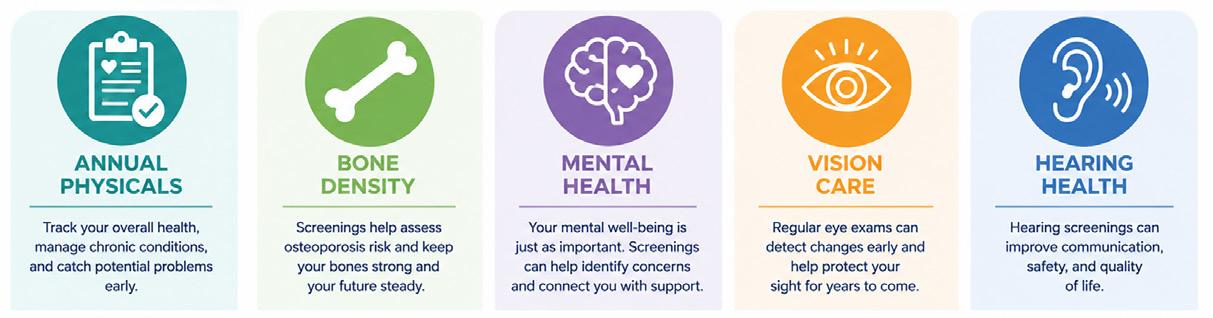
Annual physical — Starting by age 50, an annual physical should include checking cholesterol, blood pressure, blood glucose, heart rhythm and blood counts.
Abdominal aortic aneurysm — One-time ultrasound screenings are recommended for men ages 65 to 75 who are current or former smokers.
Bone density — DEXA scans are recommended for women at age 65 and men at age 70 to look for signs of osteoporosis.
Cognitive and mental health — Performed during annual physical exams to look for signs of dementia, anxiety, depression and other concerns.
Colorectal cancer — Colonoscopies are recommended starting at age 45 or earlier if there is a family history.
Stone,
at Torrance
He can be reached at 310-517-4692.
Gynecologic cancer — Pap tests are recommended every five years for women up to age 65.
Lung cancer — Low-dose lung CT scans are recommended for current and former smokers ages 50 to 80.
Mammogram — Breast cancer screening is recommended every one to two years for women up to age 74.
Prostate cancer — A prostate-specific antigen (PSA) blood test may be recommended for men at age 50, depending on risk factors.
Vision and hearing — Eye exams are recommended every one to two years, and hearing screenings are recommended based on symptoms.
A life fueled by curiosity and connection
WRITTEN BY LAURA ROE STEVENS
Americans are living longer than ever before. This column shines a light on those who live vibrantly throughout their golden years.
A healthy brain is key to a life well lived. Research shows that if you speak another language, your risk for dementia decreases. And if you travel and explore new environments and cultures and make global friends, it ignites neural pathways that strengthen brain health and aid in resiliency, confidence and a sense of wonder, curiosity and adventure.
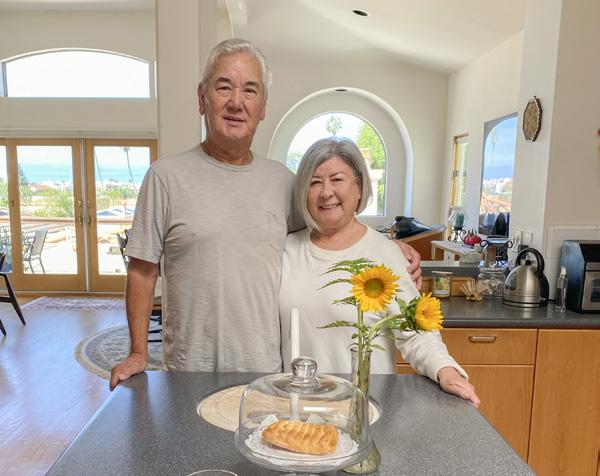
Boyd Roper, 74, of Redondo Beach is an entrepreneur and an avid traveler. Raised in Yokohama by a Japanese mother and an American father, Boyd was born into a bilingual, bicultural family (as was his wife of 47 years, Mieko).
The two moved to California at age 18 to attend college. They married and raised their son, Jon Boyd, in Redondo Beach. Global adventures with dear friends are a yearly treat. The couple will be in Peru this summer. Some travel highlights from the past 10 years include a cruise to Eastern European capitals;
Boyd and Mieko
Roper in their Redondo Beach kitchen, where good food, global adventures and 47 years together nourish their vibrant lifestyle.
trips to Portugal, Malta, Morocco and Greece; and a Mediterranean cruise.
“We love to explore new places and cultures. Our favorite trip was to Egypt and Petra (Jordan) a few years ago. It was so fascinating!” says Roper.
Health is Wealth
Mental and physical health are linked. Studies show daily exercise (even low-impact walking) increases blood flow and oxygen to the brain and bolsters balance, mood and memory. When exercise is combined with friends, it’s a social outlet that fosters connection and an overall sense of well-being.
Roper’s favorite exercise is playing golf with lifelong friends, which he’s done for 45 years. His diet reflects his multicultural upbringing as he loves pasta but also fish with veggies. Gut health is important to Roper, who enjoys a daily probiotic drink.
“I admit that I like my carbs,” he laughs, “but I never eat bread with dinner and eat healthy for the most part because of Mieko. She’s a great cook!”
Often seen in a T-shirt, jeans and flip-flops, Roper appears 10 years younger and has great balance navigating the many stairs in his home. The laid-back family man is soft-spoken and at ease. It’s hard to imagine him getting anxious, which is great for heart health and getting a good night’s sleep. To relax, Roper gardens, reads, walks and “sometimes” does yoga with Mieko.
His life incorporates fun and adventurous endeavors with relaxing activities—boosting mental and physical health. •
Weekly Movement:
• Golf with friends.
• Bike rides from Redondo to El Porto.
• Muscle-strengthening class.
• Daily stairs at home.
• Gardening.
• Walking to the Hermosa Pier and back.
Typical Menu:
Breakfast: Fruit (cantaloupe, mango, strawberries, blueberries and banana), yogurt, a scone and a cup of coffee.
Lunch: A sandwich such as ham, avocado and cheese; a cup of Japanese noodles; or a burrito.
Dinner: Salmon, veggies and noodles or rice.
Snack: Yakult probiotic drink.
Favorite meal: Curry rice—a stew made with pork or chicken, carrots and potatoes over rice.

Lifestyle, diet and exercise can contribute to the health of this important muscle group.
WRITTEN BY MELISSA BEAN
elvic floor dysfunction (PFD) is a common, but not commonly discussed, issue affecting older adults. PFD can cause symptoms such as bladder leakage or urinary urgency and even lead to pelvic organ prolapse. For women over age 60, approximately 50% to 70% have incontinence issues. Elaine Deemer, DO, a Torrance Memorial Physician Network geriatrician, encourages any individual experiencing pelvic floor issues to see their doctor.
What is the pelvic floor?
The pelvic floor is a group of muscles that spans from the pubic bone to the tailbone. These muscles give structural support to the organs in the pelvis—the bladder, urethra, uterus, rectum and anus—and they contribute to urinary and bowel continence.
What causes conditions related to pelvic floor dysfunction, such as incontinence and organ prolapse?
These conditions can be related to abnormal contraction and relaxation of muscles, loss of pelvic support, or a combination of both. For example, many women, particularly those who have had vaginal deliveries, suffer from urinary stress incontinence. In previous decades, postpartum education on PFD was nonexistent or barely emerging, so many women did not know they needed pelvic floor therapy.
What are some early symptoms?
Early signs of PFD can include leakage with coughing or laughing, urinary urgency and frequency, pelvic pressure or heaviness, pelvic pain or pain during sexual intercourse. Consult your doctor if you are experiencing any of these symptoms.
What types of treatments are available for PFD?
Treatment plans are tailored to each patient’s specific needs. As a geriatrician, I review medications first because some can contribute to incontinence, and adjusting prescriptions is an easy first step. A multimodal approach is most
beneficial, starting with lifestyle modification and conservative (nonsurgical) management. In certain cases, further diagnostic testing and treatments, or even surgery, are necessary.
What are nonsurgical options for treatment?
Nonsurgical options consist of lifestyle improvements such as losing weight if needed, drinking water in smaller volumes, treating constipation, limiting the consumption of caffeine, alcohol and sugar, and avoiding tobacco-containing products. If the patient is experiencing persistent symptoms and it is appropriate for the patient, I usually refer to physical therapy for pelvic floor muscle training.
What is a simple exercise people can do to support their pelvic floor health?
Pelvic floor exercises, often called Kegels, are a great way to support your pelvic floor health. You can do a Kegel by imagining you are trying to stop the flow of urine or hold in gas. You should feel a “lift and squeeze” sensation around your bottom. Hold the squeeze for a few seconds, then relax fully. It is recommended you follow a daily Kegel regimen, which consists of three sets of at least eight squeezes.
Torrance Memorial’s pelvic floor program is a nonsurgical answer to pelvic pain and pelvic floor disorders. Physical therapy treatment includes manual therapy techniques to facilitate muscle contraction and/or techniques for relaxation of the muscles. Our therapists will evaluate and provide a personalized treatment plan offering to strengthen the pelvic floor through exercise, biofeedback and other modalities to decrease pain and improve bladder control. A doctor’s referral is required. Many insurance carriers require pre-authorization for outpatient physical therapy. •
Torrance Memorial Rehabilitation, is located at 23560 Crenshaw Blvd., Suite 103, in Torrance. Call 310-784-2366 for more information. Elaine Deemer, DO, practices at Torrance Memorial Physician Network, 3400 Lomita Blvd., Suite 104, in Torrance. She can be reached at 310-784-8000.

Memorial
IPA’s Medicare 101
a
Do you have Medicare?
Are you turning 65 or on a retiree plan? Attend Torrance Memorial IPA’s no-cost, no-obligation Medicare 101 educational program to learn about Medicare and the different types of insurance plans available to you including Medicare HMO and PPO, supplements (or Medigap) and Part D prescription plans.
Dates:
July 22 / August 26 / September 23
Time: 6:30 to 8 p.m.
For more information, visit TorranceMemorialIPA.org/ Medicare101 or call 310-257-7239
Zoom Only
No registration required. For additional Medicare related meetings, visit TorranceMemorial.org/meetings.
WHEN TO GO TO THE URGENT
Sore throats, fevers, cuts and sprains are ailments that frequently occur when your primary care doctor’s office is closed but require medical treatment from a qualified physician. We are uniquely positioned to be the link between you and your primary physician for your unexpected medical needs.
We provide compassionate medical care for families and individuals of all ages. Our urgent care offices are conveniently located to serve all of the South Bay communities.
Most of our physicians are either board-certified or residency-trained in emergency medicine, giving them the skills necessary to handle any urgent care medical problem. Many of our physicians have more than 10 years of experience working in the emergency department at Torrance Memorial Medical Center.
TREATMENT & SERVICES AVAILABLE FOR:
• Respiratory infections
• Lacerations
• Fever
• Minor burns
• Urinary tract infection
• Eye problems
• Diarrhea
• Sprains and fractures
• Sports physical exams
• X-ray on-site
• Lab results available in minutes
We offer fast, affordable and high quality medical care and will fax a record of your visit to your physician for continuity of care if you so desire. No appointment is ever necessary. We strive to ensure that there are minimum wait times for our patients. We accept most major health insurance plans and welcome Torrance Memorial IPA members. For details visit TorranceMemorial.org/UrgentCare.
If you do not have a primary care doctor, we can refer you to one. Please call 310-891-6717 (8 a.m. to 5 p.m.) or visit TorranceMemorial.org/urgentcare.

2900 Lomita Blvd. Torrance, CA 90505
Phone: 310-784-3740
Fax: 310-375-1392
Open 7 days a week/ 365 days a year.
Monday–Friday: 9 a.m. to 8 p.m.
Saturday–Sunday: 8 a.m. to 6 p.m.
855 Manhattan Beach Blvd., Suite 101 Manhattan Beach, CA 90266
Phone: 310-939-7873
Fax: 310-939-7856
Open 7 days a week/ 365 days a year.
Monday–Friday: 4 p.m. to 9 p.m.
Saturday–Sunday: 8 a.m. to 5 p.m.
2110 E. El Segundo Blvd., Suite 100
El Segundo, CA 90245
Phone: 310-517-7010
Fax: 310-893-0426
Open 7 days a week/ 365 days a year.
Monday–Friday: 9 a.m. to 8 p.m.
Saturday–Sunday: 8 a.m. to 6 p.m.
Help is always just one call away!
Torrance Memorial IPA Member Services representatives are dedicated to helping members with customer service needs. You’ll get personal attention— whether you need help finding a doctor, paying a bill or verifying eligibility/ co-payment. Having a single point of contact system and

When you call Member Services at the number below, our representatives can assist you with the following health plans:
• Aetna
• Anthem Blue Cross
• Blue Shield of California
• Cigna

310-257-7250, option #1 | TTY: 711
• Wellcare by Health Net
• Humana
• SCAN
• United Healthcare
Monday–Friday, 8:30 a.m. to 5 p.m. | TorranceMemorialIPA.org
Torrance Memorial IPA’s integrated care team includes nurses, social workers and coordinators who help our members understand their medical conditions, work with their health plan benefits, and identify community resources to help them manage and improve their health. They coordinate care with the member’s doctors while focusing on each person’s complex health challenges so they stay healthy and independent as long as possible.
• Do you see more than one doctor?
• Do you take more than three different medications and aren’t sure you are taking them correctly?
• Could you use assistance from community resources to better navigate your health care benefits?
• Do you need support at home?
If you answered yes to any of these questions, please call us. Our integrated care team can assist you with these concerns and much more.
Case Management
310-257-7282 | TTY: 711
Monday–Friday, 8:30 a.m. to 5 p.m.
TorranceMemorialIPA.org/your-care/case-management
We can assist you through our Senior Health Insurance Resource Center.
Learn about the different Medicare plans from licensed agents who partner with Torrance Memorial IPA at no cost to you.
These agents are dedicated to providing objective Medicare information and recommendations to help you make the right choice. They can discuss topics that include:


Information about Medicare and Covered California
Medicare Advantage, Part D drug and Med Supp Plans
Ensuring that your plan covers your medications at the lowest cost
Assistance with applying for Social Security and Low-Income Subsidy
Call today to speak with a licensed local agent!
800-858-7618 | TTY 711
Monday–Friday, 8:30 a.m. to 5 p.m. medicareinfocenter.org
We Want To Hear From You!
Please share your feedback at TorranceMemorialIPA.org/contact-us
For a change of address or to unsubscribe, call 310-257-7239.
Like us on Facebook facebook.com/TorranceMemorial
WRITTEN BY DIANE KRIEGER
Last November, I became a new grandmother. I felt so ready. I’d been lobbying my son, Adam, for a grandbaby since his wedding day. He and my daughter-in-law, Sarah Leah, live in New Orleans, so our family flew out from Los Angeles to meet the newborn. Baby Noam was perfect, and I was ecstatic.
A couple of months passed. Then, as Sarah Leah was transitioning back to work from maternity leave, they asked me to come help out for a few weeks. I gleefully accepted, little realizing what I had signed up for.
Acute back pain, that’s what. Within a few days, I’d strained my intercostal (rib) muscles so badly, I was seeing stars when I rolled out of bed.
“What the heck is this?” I wondered.
Noam, then about 10 weeks old, weighed only 14 pounds. I’m no athlete, but I’d describe myself as a 64-year-old woman in good health. In hindsight, my back injury was so predictable.
I threw myself into grandmothering as if 30 years hadn’t passed. Too late, it dawned on me that serious baby care, like running a marathon, requires physical training. Only a fool would go in cold.
Turns out sprains like mine are common among new grandparents, according to Torrance Memorial occupational therapist John Resurreccion. “You don’t go in thinking about your body and your positioning. You just want to get the job done,” he says.
To get ahead of bad outcomes, Resurreccion recommends scheduling a preventive health session with a qualified exercise science professional—it could be an occupational therapist, physical therapist, chiropractor
or fitness trainer. They can assess your overall physical condition, pin down your grandparenting goals and educate you in the proper body mechanics needed to move safely with a baby.
While there’s no one-size-fits-all exercise routine for expectant grandparents, Resurreccion advises as a general rule of thumb to focus on overall flexibility in the shoulders, hips, trunk and back, and build up core stability and strength. If you don’t have a gym membership, sign up for senior workouts at your local rec center. Torrance Memorial offers its own fitness and exercise classes at TorranceMemorial.org/classes (see pages 12–14). And there’s a whole sub-genre of grandma workouts on YouTube.
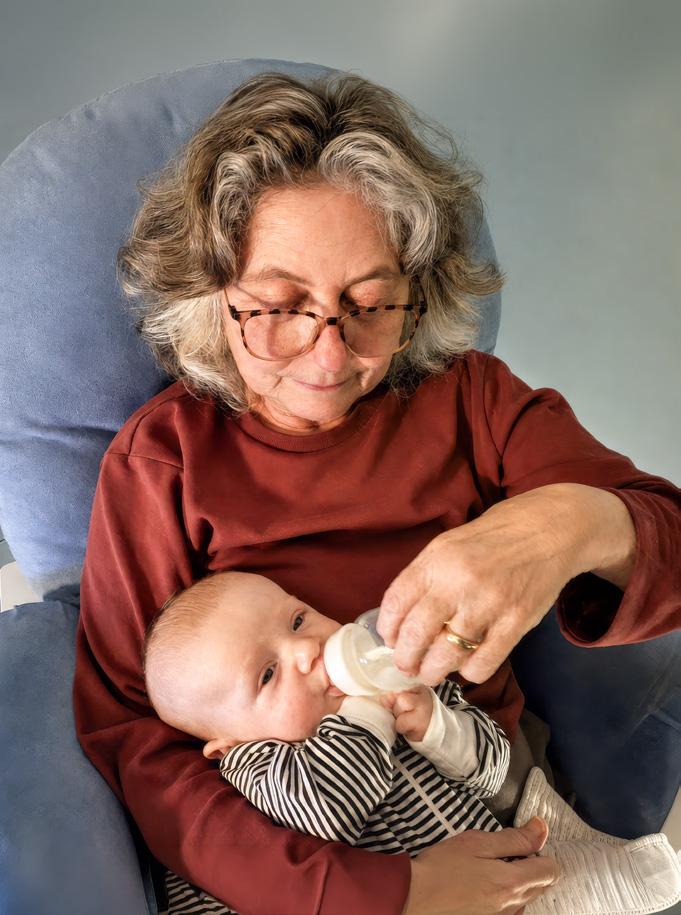
Diane Krieger shares a joyful moment with her grandson, Noam, whose arrival inspired a heartfelt journey into the unexpected physical and emotional realities of first-time grandparenthood.
In my case, the damage was done. Forklifting Noam onto the diaper table and into the bassinet, lowering him into the infant seat, hoisting the clunky carrier onto the stroller and angling it to lock in the car seat safety base—all these actions involved twists, winches and holds I hadn’t trained for. Heck, I didn’t even bother with stretches or warm-up exercises.
Pain aside, I was deeply frustrated by my back injury and disappointed in myself. I’d promised my services for a full month, and here I was, sidelined after a few days. Still, I refused to throw in the towel.
Resurreccion recommends that when new grandparents find they’ve bitten off more than they can chew, they should have “an honest talk with your kids.” Negotiate a lighter workload, suggest ergonomic adjustments to the nursery set-up and ask for back-saving tweaks in the baby-care routine. I dialed back my cooking and housekeeping ambitions and delegated most of the heavy lifting to my kids. When the baby got fussy, I got creative. Pacing the floor was hard on my aching back. Even dandling Noam on my knee wasn’t pain-free.
I discovered a wonderful alternative in lullabies. My voice is nothing special, but Noam was mesmerized by my impromptu performances. It turns out recorded music doesn’t hold a candle to the multisensory experience of watching grandma’s bizarre facial expressions while rhyming, melodic verse pours from her mouth.
So I brushed up old classics like “Golden Slumbers” with YouTube karaoke videos. I can now sing “Frère Jacques” in three languages. I memorized the lyrics of quirky favorites like “Good Morning, Starshine” and the Italian pop tune “Volare.” In a hat-tip to Noam’s birthplace, I added “House of the Rising Sun” to my vocal repertoire.
Back sprains can take up to 12 weeks to fully heal. Two months in, my intercostal muscles are still achy, but I no longer take pain relievers and rarely need my back brace. It’s too soon to hit the gym. Resurreccion suggests I start slowly with abdominal bracing. This isometric core stabilization technique involves the contraction of abs, obliques and lower back muscles to create a stiff “corset-like” feeling in the spine and ribcage. I can do this exercise either standing or sitting as I go about my day. In line at the supermarket or watching TV, I’ll just tighten my abdominal muscles as if I’m bracing for a gut punch and hold for a few seconds while maintaining breathing.
The good news is my kids have invited me back to New Orleans in September for three weeks of intensive babysitting duty. This time I’ll be ready. •
Much of what new grandmothers remember from their own maternities has changed. Take breast pumps. My daughter-in-law, Sarah Leah, pumps while she drives. She pumps as she does housework. She pumps as she makes her hospital rounds (she’s a pediatric resident).
Quiet, cordless, hands-free, fully wearable double-breast pumps emerged in the mid-2010s. Hundreds of ingenious gadgets now flood the maternity market. There’s a phone app that monitors fetal heart rate and a “baby fruit feeder pacifier” that safely microdoses pureed solids while doubling as a frozen teether.
I asked Raquel Fernandez, MD, a pediatrician at Torrance Memorial Physician Network, to spotlight some differences.
Back sleeping for newborns is in, she says. Stomach sleeping is out. Parental co-sleeping is a hard no, and minimalism is now the preferred nursery decor. To protect against SIDS, Dr. Fernandez says, “We want the bare minimum in the crib. No rail bumpers, pillows or blankets.”
To inoculate against pet allergies, parents are now encouraged to introduce even newborns to dogs and cats—provided that furry friend is closely supervised and reliably baby-friendly. Dr. Fernandez recommends exposing babies to “top allergens as early as 4 months, especially if there’s a family history of eczema, asthma or food allergies.”
She instructs parents to mix powdered versions of common allergens into purees and cereals once baby is ready for solids. Traces of shellfish and peanuts can be added at 6 months, and eggs and milk products like yogurt and cheese can be offered at 9 months.
Given how much has changed, Dr. Fernandez counsels new grandparents to listen and learn from their kids, and go easy on volunteering unsolicited advice.
“The internet makes new parents anxious,” she says. “There’s so much information out there, and grandparents can be a really good sounding board. But don’t be overly pushy. Respect the way your kids want to do things with their baby.”
To register, call 310-517-4711.
8-week class: $80 (ADVANTAGE members $72) 4-week class: $40 (ADVANTAGE members $36) For more information, call 310-517-4666 or visit TorranceMemorial.org/classes.
ALL CLASSES ARE HYBRID (INPERSON OR ZOOM) UNLESS OTHERWISE NOTED
Brain Games and More (In-person only)
July 7–August 4
Wednesday, 1:30 to 3 p.m.
Learn new information and hacks to stay mentally fit, such as brain games, in this interactive setting.
$55; ADVANTAGE members $50
Bones for Life with Joy (In-person only)
July 13–August 31
September 14–November 2
Monday, 12:30 to 1:30 p.m.
These Feldenkrais exercises help support bones through gentle, weight-bearing exercises that require no strain or pain. Improve posture and bone health.
Chair Yoga for Bone Health with Debi
July 15–September 2
September 16–November 4
Wednesday, 11:15 a.m. to 12:15 p.m.
For those with osteopenia or osteoporosis; strengthen muscles and bones, improve posture and balance, fall prevention and breath work. All levels welcome.
Chair Yoga for Strength and Balance with Sharmone (In-person only)
July 13–August 3 (4 weeks only)
September 14-November 2
Monday, 2 to 3 p.m.
July 16-August 6 (4 weeks only)
September 17–November 5
Thursday, 2 to 3 p.m.
Use a chair in seated and standing poses to improve strength and balance.
Essentrics Full-Body Stretch with Ai (In-person only)
July 13–August 31
September 14–November 2
July 17–September 4
September 18–November 6
Monday or Friday, 11 to 11:50 a.m.
A gentle, full-body stretch to activate muscles, free joints and increase mobility. Bring a yoga mat.

Integrated Yoga with Robin
July 15–September 2
September 16–November 4
Wednesday, 7 to 8 p.m.
Breath work, postures and meditation, such as yoga nidra.
Line Dancing Beyond “Country” with Sharon
July 15–August 5 (4 weeks only)
September 16–November 4
Wednesday, 4:30 to 5:30 p.m.
Learn Country Western favorites, cha-cha, mambo, tango and samba in line dancing style. No partner needed.
Line Dancing: The Next Step with Sharon (In-person only)
July 15–August 5 (4 weeks only)
September 16–November 4
Wednesday, 3:15 to 4:15 p.m.
Cutting-edge high beginner and improver line dances, plus more complex dance steps. Line dancing experience required.
Mat/Floor Pilates with Karen (In-person only)
July 14–September 1
September 15–November 3
Tuesday, 4 to 4:50 p.m.
All-levels class strengthens core muscles to improve balance. Moderate fitness level needed. Bring a mat.
Muscle Strengthening: Beginning & Intermediate with Randy (Zoom only)
July 14–September 1
September 15–November 3
Tuesday, 11 to 11:50 a.m.
July 17–September 4
September 18–November 6
Friday, 11 to 11:50 a.m.
Strengthen your upper and lower body using flexible exercise bands.
Stretching for Better Balance with Randy (Zoom only)
July 14–September 1
September 15–November 3
Tuesday, 10 to 10:45 a.m.
July 17–September 4
September 18–November 6
Friday, 10 to 10:45 a.m.
Increase flexibility and mobility to help prevent injuries.
Beginning Tai Chi with Richard (Zoom only)
July 14–September 1
September 15–November 3
Tuesday, 2 to 3 p.m.
An introduction to the form of this Chinese exercise that inspires well-being.
Intermediate Tai Chi with Richard (Zoom only)
July 15–September 2
September 16–November 4
Wednesday, 2 to 3 p.m.
Learn how to complete the form.
Advanced Tai Chi with Richard (Zoom only)
July 15–September 2
September 16–November 4
Wednesday, 3:15 to 4:15 p.m.
Go deeper into refining movement, leading to improved health and mental focus.
Yoga Basics with Laura (Zoom only)
July 13–August 31
September 14–November 2
Monday, 4 to 5 p.m.
Gentle yoga poses on the floor and standing; breath work and meditation.
Yoga Therapy for Osteoporosis with Debi
July 14–September 1
September 15–November 3
Tuesday, 11 a.m. to 12:15 p.m.
Use poses and breath work to stimulate bone growth, increase strength, range of motion in joints, posture and balance. Floor, chair and standing poses. Bring a mat.
Yoga for Wellness with Debi
July 15–September 2
September 16–November 4
Wednesday, 9:30 to 10:45 a.m.
Correct posture alignment and increase strength, flexibility and range of motion.
Qi Gong with Gayla (Zoom only)
September 17–November 5
Thursday, 9 to 10:15 a.m.
Powerful, gentle movement and meditation to strengthen and relax.

Join us at 6:30 p.m. in person or via Zoom for Torrance Memorial Medical Center’s popular health lecture series. Hoffman Health Conference Center, 3315 Medical Center Drive, Torrance. Visit TorranceMemorial.org/mol for details.
July 15 Skin Health
August 19
Movement Matters
September 16
Prescription Drugs
Past lectures include cancer prevention; sports injury prevention and other orthopedic issues; heart disease, complications with diabetes and stroke, valve disease and peripheral artery disease; and a variety of psychological topics such as depression, anxiety, substance abuse, eating disorders and violence. Videos are available on demand at TorranceMemorial.org/mol.
To register, call 310-517-4711. All classes are in-person only.
8-week class: $80 (ADVANTAGE members $72) 4-week class: $40 (ADVANTAGE members $36) For more information, call 310-517-4666 or visit TorranceMemorial.org/classes.
ALL CLASSES AT THIS LOCATION ARE IN-PERSON ONLY
Align the Spine with Joy
July 13–August 31
September 14–November 2
Monday, 9 to 10 a.m.
These Feldenkrais Method lessons help restore or avoid deterioration of your posture without pain or strain. Bring an exercise mat and hand and bath towel.
Bones for Life with Joy
July 13–August 31
September 14–November 2
Monday, 3:30 to 4:30 p.m.
These Feldenkrais exercises help support bones through gentle, weight-bearing exercises that require no strain or pain. Improve posture and bone health.
Exercise to the Oldies with Pam
July 14–September 1
September 15–November 3
Tuesday, 9:30 to 10:30 a.m.
Promote endurance and flexibility with standing and floor exercises. Bring a mat, light hand weights and a can-do attitude!
Essentrics® Strength: Full-Body Stretch
July 12–August 30
September 13–November 1
Sunday, 9 to 9:50 a.m.
Essentrics® Strength combines strengthening and stretching to develop the toned, pain-free body. Includes exercise on the floor. Bring yoga mat.
Essentrics® Full-Body Stretch with Ai
July 15–September 2
September 16–November 4
Wednesday, 11 to 11:50 a.m.
A gentle, full-body stretch to activate muscles, free joints and increase mobility. Bring yoga mat.
YoQi® Qigong Flow and Sound Bath
July 12–August 30
September 13–November 1
Sunday, 10:30 to 11:40 a.m.
YoQi® Qigong Flow is motion meditation. Gentle, slow movements, breath work, self-massage and sound bath meditation. All levels welcome. Bring yoga mat. Blanket/pillow and eye pillow optional.
Muscle Strengthening: Beginning & Intermediate with Randy
July 13–August 31
September 14–November 2
Monday, 11:30 a.m. to 12:15 p.m.
Learn correct, safe techniques for strengthening your upper and lower body using a chair and flexible exercise bands.
Muscle Strengthening:
Intermediate with Randy
July 16–September 3
September 17–November 5
Thursday, 11:30 a.m. to 12:15 p.m.
Learn correct, safe techniques for strengthening your upper and lower body using a chair, flexible exercise bands and hand weights.
Stretch & Sound Bath
Meditation with Ai
July 15–September 2
September 16–November 4
Wednesday, 9:30 to 10:20 a.m.
Gentle stretch and breath work; various sounds and vibrations from sound bath instruments. Bring a yoga mat, blanket and pillow.
Stretching For Better
Balance with Randy
July 13–August 31
September 14–November 2
Monday, 10:30 to 11:15 a.m.
July 16–September 3
September 17–November 5
Thursday, 10:30 to 11:15 a.m.
Fun chair workout designed to help increase flexibility to prevent injuries.
Yoga for Stress Reduction with Debi
July 18–September 5
September 19–November 7
Saturday, 9:30 to 10:45 a.m.
Gentle yoga poses on the floor, seated and standing to increase flexibility, strengthen the body and improve balance. Breath work and meditation reduce stress.
Don’t see what you’re looking for?
Check TorranceMemorial.org/classes for more information or call 310-517-4666.
Bereavement Support Group
Meet in a caring and safe environment with other people experiencing grief or loss. Groups consist of eight to 10 members and meet once weekly for six to eight weeks, for 90 minutes. To participate or for more information, contact Olivia Licea at 310-703-3352.
Cancer & Nutrition via Zoom
Whether you are currently going through cancer treatment, have had cancer in the past or are simply looking for general nutrition guidelines to help prevent the development of cancer, this class is for you! We focus on the role good nutrition plays in cancer prevention, treatment and survivorship. Every second Thursday, 5 to 6 p.m. Call 310-517-4711 for information.
Caregivers Support Group
Are you providing care for someone else? Our support group offers valuable information and nurturing support for caregivers of all types. Join us to connect with others who understand your experiences and gain insights from those in similar situations. To receive the caregiver packet, email torrancememorialhealtheducation@ tmmc.com. For meeting dates and times, call 310-517-4711.
Depression and Bipolar Support Alliance via Zoom and In-Person
This peer-based support group is for those dealing with mood disorders. Group meets at Torrance Memorial on the second and fourth Saturdays of the month, 10 a.m. to noon, and the first and third Thursdays of the month via Zoom, 6:30 to 8:30 p.m. Contact Scott Wood at 310-497-8801 or woodscott516@yahoo.com, or Peggy at 310-548-3457.
Diabetes Support Group
Join us to share with others who understand what it is like to live with diabetes. Meets on fourth Fridays, 1 to 2:30 p.m., at the Lundquist Lurie Cardiovascular Center, 2841 Lomita Blvd., Suite 335. Registration is not required. For questions, call 310-517-4711.
Ostomy Support Group
This support group provides a welcoming and safe space to connect with one another and learn how to live an active, happy and healthy life with an ostomy bag. Next meeting is Thursday, July 16, 3 to 4:30 p.m., at the Torrance Memorial West Tower, Room C. Call 310-517-4711 with questions.
Stroke Support Group
Building a community of support for stroke survivors and their caregivers. Meets every second Friday, 10 to 11 a.m., at the Hoffman Health Conference Center, Room 3. For questions call 310-517-4725, ext. 20640 for Maria or ext. 20822 for Tami.
Join Torrance Memorial’s Professional Advisory Council for its series on a variety of financial topics to help you take care of your financial health. Seminars are strictly educational and will be held on select Saturdays, 9 to 11 a.m., in the Torrance Memorial Hoffman Health Conference Center, 3315 Medical Center Drive, Torrance.
September 12
Investing For and During a Successful Retirement
Overview on how to define and plan your dream retirement, including investment essentials for each phase of retirement; the pros and cons of common retirement investments; and six costly retirement investing mistakes and how to avoid them.
RSVP to Stephanie Mancia at 310-517-4728 or foundation@ tmmc.com. You may also visit TorrranceMemorial.org/events/ financial_health_seminars. aspx for online registration and up-to-date information on topics and schedules.

Torrance Memorial Medical Center
310-325-9110
TorranceMemorial.org
ADVANTAGE Program Information
310-517-4666
Monday through Friday, 9 a.m. to 4:15 p.m.
Torrance Memorial IPA
Learn More: 310-257-7239 TorranceMemorialIPA.org
Members: Toll-Free: 866-568-4472 TTY/TDD: 711
Monday through Friday, 8:30 a.m. to 5 p.m.
Torrance Memorial Physician Network
310-891-6717 TMPhysicianNetwork.org
Monday through Friday, 7:30 a.m. to 4 p.m.

If you do not wish to receive future issues of this publication, please email publications@tmmc.com with your name and complete address as it appears on the mailing panel.
3330 Lomita Boulevard, Torrance, CA 90505-5073
Emergencies happen. Don’t delay care for heart attacks, strokes, falls or other urgent health situations. Torrance Memorial’s Emergency Department is safe, ready and open. If you think you are having a heart attack or stroke, call 911 or go to the nearest Emergency Department if you are experiencing symptoms.
Comprehensive Stroke Center – Torrance Memorial emergency care staff are trained to identify the signs of stroke early and deliver early intervention care that limits damaging effects.
Emergency Department Approved for Pediatric Patients –Torrance Memorial is a designated Emergency Department Approved for Pediatrics by L.A. County Department of Health Services.
L.A. County Paramedic Base Station – Torrance Memorial’s 24hour Emergency Department serves as a paramedic base station.
STEMI (Heart Attack) Receiving Center – Torrance Memorial is a STEMI-receiving hospital, and has the equipment, expertise and facilities to administer percutaneous coronary intervention, a mechanical means of treating heart attack patients.
