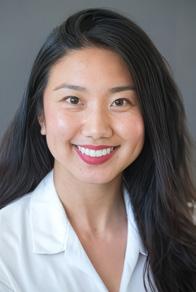
Lana (Meng) Shi, MD, practices at Torrance Memorial Physician Network, 2841 Lomita Blvd., Suite 315, Torrance. She can be reached at 310-257-5730.
To inquire about the wide range of nutritional services and programs at Torrance Memorial, please call 310-891-6707 or visit TorranceMemorial.org/ nutrition.
Key Nutritional Requirements for Healthy Aging
With proper nutrition, aging adults can lead healthier, more vibrant lives.
WRITTEN BY LAURA ROE STEVENS
Nutritional needs change with the stages of life. It’s important to understand this, as diet is key to healthy and independent aging. If you want to garner more strength, vibrancy and clarity and experience less inflammation, it’s time to assess your eating (and drinking) habits.
While online influencers promote bizarre diet trends— and many health experts offer intricate menu plans requiring multiple shopping trips and long prep, cook and cleanup time—meeting your dietary needs as you age is not that complicated. In fact, much of what you require for optimal health may already be in your weekly diet. It’s a matter of understanding the nutritional value of your
habitual foods and whether your current choices garner the biggest health benefit as you age.
First, there is no one-size-fits-all mentality when it comes to nutritional requirements for all adults. What an active 55-year-old needs in terms of protein, calcium, minerals, vitamins and antioxidants will be different from what a 75-year-old who is moderately active requires. With that said, physicians and dietitians note trends and have created standard dietary requirements as general goals for older adults to aim for.
For instance, experts recommend (in general) 1,200 mg of calcium and 800 IU of vitamin D a day for older adults. It is suggested adults ages 55+ should aim for 0.54 to 0.72 grams of protein per pound of body weight per day to help preserve muscle mass. Since seniors experience sarcopenia, a natural decline in muscle mass and strength, protein is best distributed evenly across meals throughout the day.
“What we eat and how much water we drink can make a significant difference in our health,” explains Rebecca Tran, MS, RDN, a clinical dietitian with Torrance Memorial Health. “Optimal nutrition for aging adults can sustain muscle mass, strengthen bones, support mental clarity, and reduce the risk of heart disease, stroke, high blood pressure, diabetes, cancer and autoimmune disease.”
To help you focus on what your body needs most, here are some expert tips for older adults:
Hydrate
Did you know that up to 60% of the adult human body consists of water? Your brain and heart are about 73% water, your lungs are 83% and your bones 32%. So when you are dehydrated, it’s easier to get confused, think erratically and experience drops in blood pressure, which affects balance and circulation—making you prone to accidents. In severe cases, kidney fail-
ure can occur. Many aging adults also live with chronic digestive issues and constipation due to not getting enough water.
“Dehydration is a major concern for older adults,” says Lana (Meng) Shi, MD, a family medicine physician with Torrance Memorial Physician Network, who explains that many patients don’t drink enough water because they claim to not be thirsty. “The thirst sensation, or area of the brain that triggers a need for water, becomes less active as we age.”
If drinking more water is challenging or your mobility is compromised, Dr. Shi recommends buying a large water bottle with markings on it to note how much is being consumed each day. Try to drink more water earlier in the day and taper off in the evening to reduce nighttime urgency.
Other tips: Keep water bottles in your car and by your bed. Drink more when it’s hot and after any exercise. Consider adding electrolyte powder to your water. Most importantly, drink before you notice thirst to prevent dehydration.
Embrace Whole Foods
“The biggest issue I see with seniors is that their appetite diminishes, and over time they lose out on all the rich micronutrients you get when eating a well-balanced, whole food diet,” says Dr. Shi.
If your appetite is low and it’s hard to eat full meals, focus on incorporating foods with vitamin D (fatty fish, egg yolks, fortified milk and orange juice), iron/folate (spinach, dark leafy greens, red meat), calcium (dairy products) and protein (meat, fish, eggs, tofu, tempeh, nuts/seeds, beans, quinoa). Boosting your intake of nutrient-dense whole foods within smaller, well-balanced meals can be easier than trying to eat three full meals per day. Aim to have protein, fruit, fiber, dairy, carbs and dark leafy greens throughout your day. Limit fried, frozen and processed foods like granola bars, fast food
and chips containing seed oil, trans fats and preservatives (linked to high cholesterol and cancer).
For instance, a leafy green salad with a protein source (like wild salmon, tuna, baked chicken breast or boiled egg), a few small potatoes, a half-cup of cottage cheese, sliced red peppers, cucumber slices, fresh herbs, and olive oil and vinegar dressing can provide many healthy nutrients you need and can be prepared ahead of time and chilled in the refrigerator. Another mini meal you can make ahead of time is a bowl of Greek yogurt with blueberries, blackberries and chia seeds.
Incorporate Healthy Snack Breaks
When your appetite and thirst are low, aim for hydrating snacks full of fiber, vitamins and antioxidants, which can boost calcium and protein. Some examples:
• Apple slices dipped in peanut butter
• Carrot, celery and cucumber sticks dipped in hummus or cottage cheese
• Dates dipped in almond butter
• High-grain toast with hummus, cottage cheese or almond butter and a cup of mint tea
• An organic acai bowl
• A smoothie with mango, spinach, Greek yogurt, almond milk and blueberries
It’s easy to get confused by changing dietary advice, so keep it simple. Aim to enhance the nutrients you need with foods you love. Remember to hydrate throughout the day and incorporate protein, calcium and fiber to take care of your mind and body. If you skip the processed foods and add delicious fruits and vegetables as snacks, you may be surprised to find your mind clearer and more positive, your muscles feeling stronger, less inflammation and higher energy levels.
Here’s to vitality in your golden years! •
Managing Chronic Conditions Without Compromising Quality of Life
With support, encouragement and an investment in your health, living well with chronic conditions is possible.
WRITTEN BY LISA BUFFINGTON
Living with a chronic condition such as high blood pressure, diabetes, arthritis, heart disease or depression comes with unique challenges. But whether you have been managing a chronic condition for years or have been recently diagnosed, you can
live well—maintaining your independence, joy and vitality at every age and stage of your life.
According to Lorena Layrisse Landaeta, MD, a primary care provider at Torrance Memorial Physician Network, the key is investing in your health.
Torrance Memorial Physician Network primary care provider Lorena Layrisse Landaeta, MD, is double board-certified in internal and geriatric medicine.
Small, consistent steps such as taking medications as prescribed, staying active and nurturing connections can help older adults manage chronic conditions while protecting their independence and quality of life.
“I tell my patients that if they want to be independent, there are things they need to do to achieve that goal— including taking medications, making lifestyle changes, socializing and protecting their mental health,” says Dr. Landaeta, who is double board-certified in internal medicine and geriatric medicine. “I work closely with my patients to develop a personalized care plan. Together, we focus on making small changes that have a big impact.”
Dr. Landaeta says two small changes that can significantly improve the quality of life for her patients are incorporating movement and socialization into their daily routine.
“Regular movement and exercise can help improve overall health, cognitive function and mood,” she says. “Similarly, socialization and connection with others can provide the stimulation older adults need to stay cognitively and mentally healthy. Joining a club or visiting a senior center can be an affordable option allowing older adults to meet others of similar ages and interests.”
Although Dr. Landaeta says a healthy lifestyle is the foundation for living well as an older adult, medications also play a crucial role in controlling chronic conditions.
“Some patients are reluctant to start medications because they are worried about side effects,” she says. “However, starting at a low dose can reduce the risk of problems while providing symptom relief. And following their prescribed medication regimen helps patients feel better, move more and achieve improved mental health and quality of life.”
The doctor says that after a diagnosis of a chronic condition, it is common for older adults to feel overwhelmed and lose confidence in their ability to manage their health.
“Many people develop chronic conditions as they age, but that doesn’t have to control your life. With support, encouragement and a strong partnership with your health care team, it is possible to live well while managing a chronic condition.” •
Finding Extra Support for Chronic Conditions
Torrance Memorial is committed to helping older adults take the best care of their health. If you are managing or have been newly diagnosed with a chronic condition and feel overwhelmed, our experts are here to help. Signs that you may need extra support in managing your physical, mental or cognitive health may include:
• Frequent falls, injuries or hospitalizations.
• Loved ones who express concern about your health.
• Changes in mood or personality.
• Missed doctor’s appointments.
• Problems taking medications as directed.
• Problems paying bills or managing finances.
• Sudden changes in physical or cognitive functioning.
• Unexplained weight loss or gain.
• Unkempt appearance or poor hygiene.
• Signs of increased anxiety or depression.
• Loss of interest in socializing or participating in enjoyable activities.
If you or a loved one are having trouble coping with a chronic condition, a Torrance Memorial primary care provider can connect you with resources to help.
Lorena Layrisse Landaeta, MD, practices at Torrance Memorial Physician Network Palos Verdes, 602 Deep Valley Dr., Suite 300, Rolling Hills Estates. She can be reached at 310-517-4692.
Medicare Wellness Visit vs. Annual Physicals: What’s the Difference?
Older adults enrolled in Medicare Part B are eligible for an annual wellness visit. However, older adults may also qualify for an annual physical exam. Learn about the similarities and differences between Medicare wellness visits and physical exams.
WRITTEN BY LISA BUFFINGTON
Medicare Wellness Visits
Are for people who receive Medicare Part B.
Focus on health maintenance and updating your personalized preventive care plan.
Provide you with a preventive screening schedule.
Assess your ability to perform activities of daily living, such as driving and caring for yourself at home.
Include an assessment for memory loss, dementia or frailty.
May include an assessment of your social needs, including transportation, food assistance, financial assistance and more.
Annual Physical Exams
Are for everyone at any age.
May be covered by insurance.
Original Medicare does not cover routine annual physical exams.
Assess symptoms of physical, cognitive and mental health conditions.
Include an assessment of your risks for chronic and preventable health conditions.
Include hands-on, physical examinations of your lungs, head, neck, abdomen, heart, eyes, ears, nose, throat, reflexes, vital signs and neurological status.
Include lab tests to identify signs of disease.
Medicare Wellness Visits and Annual Physical Exams
Occur once every 12 months.
Include a review of your personal and family medical history and current prescription medications.
Update height, weight and blood pressure measurements.
Simple strategies for managing multiple medications can reduce the risk of complications.
How to Manage Multiple Medications: Safe Strategies for Seniors
WRITTEN BY LISA BUFFINGTON
If you’ve ever wondered whether you took your multivitamin or forgot the last dose of your antibiotic, you can understand how easy it is to make a medication mistake. But for older adults who are taking multiple medications for different health issues, it can be even more challenging to keep track of medications. And mistakes can have serious consequences. Julia Rutkouskaya, a geriatric care pharmacist at Torrance Memorial Health, highlighted a few common issues in managing multiple medications and provided strategies to reduce the risk of complications.
Question: How can I avoid missing medication doses or double-dosing?
Answer: Using a pillbox with daily morning, noon and night compartments can help you avoid double-dosing. However, it is possible to use a pillbox and still forget to take your medication. I recommend tying your medication regimen to your daily routine, such as taking morning pills with breakfast or taking evening pills after you brush your teeth. You can also set an alarm on your phone to remind you to take medications.
Q: How can I manage medication side effects?
A: It’s important to understand what medication you’re taking, why you’re taking it and what interactions or side effects could be a cause for concern. Do not skip the consultation with your pharmacist when picking up your medication. Take a few minutes to learn about the most common side effects, what to expect when starting the medication and when you should contact your doctor.
Q: What can I do to avoid drug or food interactions?
A: Most medication bottles come with stickers that tell patients whether they should take medications with or without food, or if they should avoid consuming certain items such as grapefruit or dairy. To reduce the risk of interactions with other medications, keep a list
of medications to share with each of your doctors— including specialists, dentists and other health care providers—and fill all prescriptions at the same pharmacy, if possible. Ask your doctor when you should take each of your pills, and use a pillbox and alarm to ensure that you take medications at the proper time to optimize safety and effectiveness.
Q: How should I store and dispose of medication?
A: Medications should be stored in a cool, dry place that is out of reach of children and pets. If you stop taking a medication, store it separately so you do not take it by mistake. Medications that are expired or no longer needed should be disposed of at an official drug take-back event. The next National Prescription Drug Take Back Day, sponsored by the Torrance Police Department, will be held April 25 at Sam’s Club, 2601 Skypark Drive in Torrance, from 10 a.m. to 2 p.m.
Only certain medications that are commonly misused or abused should be flushed if a take-back option is not readily available, according to the U.S. Food and Drug Administration. Examples include fentanyl, morphine and oxycodone. For most other medications, flushing is not recommended unless the label or pharmacist specifically instructs you to do so.
Q: What are some medication red flags that warrant a call to my doctor?
A: Any new symptoms that appear after starting or changing a medication—including fainting, mood changes, breathing problems, nausea, vomiting or dizziness—should be reported to your doctor. You should also contact your doctor if you take a double dose of medication. •
The Torrance Memorial Outpatient Pharmacy is located at 3330 Lomita Blvd., Torrance. They can be reached at 310-517-4799.
Torrance Memorial IPA’s
Medicare 101
a Do you have Medicare?
Are you turning 65 or on a retiree plan? Attend Torrance Memorial IPA’s no-cost, no-obligation Medicare 101 educational program to learn about Medicare and the different types of insurance plans available to you including Medicare HMO and PPO, supplements (or Medigap) and Part D prescription plans.
Dates: April 22 / May 27 / June 24
For additional Medicare-related meetings, visit TorranceMemorial.org/ meetings
Time: 6:30 to 8 p.m.
No registration required.
For more information, visit TorranceMemorialIPA.org/Medicare101 or call 310-257-7239
The Torrance Memorial IPA Difference: Convenient Access!
Torrance Memorial IPA is the ONLY medical group in the South Bay offering our unique member self-referral to select specialties. There’s no need for a referral from your primary care physician to access one of these specialties:
• Behavioral Health
• Cardiology
• Dermatology
• Gastroenterology
• OB-GYN
• Podiatry
• Pulmonology
• Urology
Members with chronic health conditions can also self-refer to our Torrance Memorial IPA Integrated Care Team at 310-257-7282 / TTY:711.
This is not a complete list of our specialties in the Torrance Memorial IPA network— only those in our self-referral program. Torrance Memorial IPA has a network of more than 500 primary care and specialty doctors.
FOR A COMPLETE LIST OF OUR PHYSICIANS:
Visit TorranceMemorialIPA.org/find-a-doctor or call 310-257-7239.
Member Resources
Torrance Memorial IPA’s integrated care team includes nurses, social workers and coordinators who help our members understand their medical conditions, work with their health plan benefits, and identify community resources to help them manage and improve their health. They coordinate care with the member’s doctors while focusing on their complex health challenges so they stay healthy and independent as long as possible.
• Do you see more than one doctor?
• Do you take more than three different medications and aren’t sure you are taking them correctly?
• Could you use assistance from community resources to better navigate your health care benefits?
• Do you need support at home?
If you answered yes to any of these questions, please call us. Our integrated care team can assist you with these concerns and much more.
Case Management
310-257-7282 | TTY: 711
Monday–Friday, 8:30 a.m. to 5 p.m.
TorranceMemorialIPA.org/your-care/case-management
representatives can assist you with the following health plans:
• Aetna
• Anthem Blue Cross
• Blue Shield of California
• Cigna
• Wellcare by Health Net
• Humana
• SCAN
• United Healthcare
Torrance Memorial IPA Member Services
310-257-7250, option #1 | TTY: 711
Monday–Friday, 8:30 a.m. to 5 p.m.
TorranceMemorialIPA.org
Questions about your referral authorization?
Some services require prior authorization. The Torrance Memorial IPA Utilization Management department, in working with your provider, applies the industry standard guidelines and clinical criteria to make decisions to authorize care in accordance with your health benefits.
Questions? Call Member Services: 310-257-7250 | TTY: 711
Monday–Friday, 8:30 a.m. to 5 p.m.
When To Contact Your Health Plan
• You would like switch to Torrance Memorial IPA
• Your address changes
• Your phone number changes
• You change your primary care physician
Subscription? For a change of address or to unsubscribe, call 310-257-7239.
Have MEDICARE Questions?
We can assist you through our Senior Health Insurance Resource Center.
Learn about the different Medicare plan choices from licensed agents that partner with Torrance Memorial IPA at no cost to you.
These licensed agents are dedicated to providing objective Medicare information and recommendations to help you make the right choice. They can discuss topics that include:
Information about Medicare and Covered California
Medicare Advantage, Part D drug and Med Supp Plans
Assuring that your plan covers your medications at the lowest cost
Assistance with applying for Social Security and Low-Income Subsidy
Call today to speak with a licensed local agent!
800-858-7618 | TTY 711
Monday–Friday, 8:30 a.m. to 5 p.m. medicareinfocenter.org
We Want To Hear From You!
Please share your feedback at TorranceMemorialIPA.org/contact-us
Like us on Facebook facebook.com/TorranceMemorial
LIVING PROOF
Carollee Williams-Schuegraf:
Artistic Vision & Vitality
WRITTEN BY LAURA ROE STEVENS
Professional artists are unique individuals. I’ve never met an artist who didn’t march to the beat of his or her own drum, have you?
Not many of us can spend hours and days at a time passionately focused on color combinations, light, shading, patterns or shaping forms. The effect on viewers can range significantly as an artist’s inspiration can touch us in varying ways—from subtle to off-putting or deeply meaningful.
Art can cause us to consider new ideas, viewpoints or ways of thinking. If you’ve ever been to an art gallery or museum and felt something deeply while taking in an exhibit, you know exactly what I mean. Through the medium of their art, which is their passion, an artist can inspire us to view the world (or even a flower garden) differently.
The benefit a provocative artist provides to the world is immeasurable. And we now know that the health advantages for artists are equally incredible. Recent university studies show that full-time artists live longer—with less inflammation and remarkably sharper brains—than any other segment of the American population.
But I wasn’t surprised by those findings. Why? Because I know Carollee Williams-Schuegraf, an 81-year-old, award-winning artist and quilter who lives in Palos Verdes.
When I met Carollee 11 years ago, I noticed her balance, style, sharp mind and witty, sarcastic sense of humor. When she asked me to give her a private yoga session, I was amazed that she had no signs of inflammation or arthritis and no neck, shoulder, wrist or low-back issues. (This was odd, as she must use her hands and look down as she creates.)
Looking around her house, swaths of color and cloth were everywhere. She tends to work on multiple projects at a time—painting, taking pottery classes, sketching, creating unique cards, gardening and baking works of art for nearly all holidays.
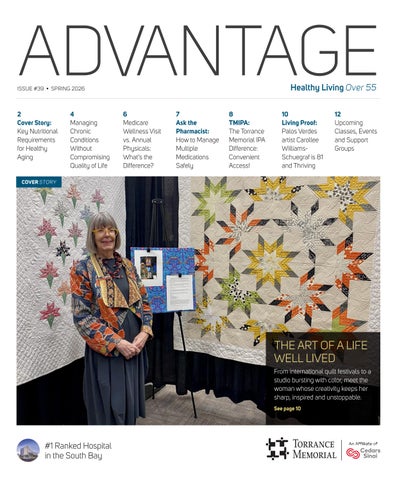
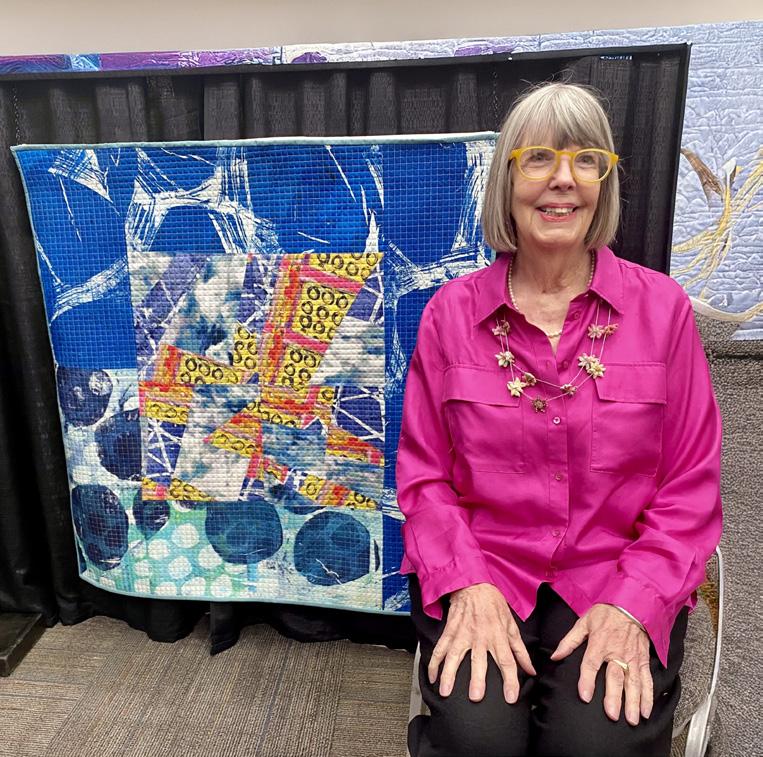
81, award-winning quilter
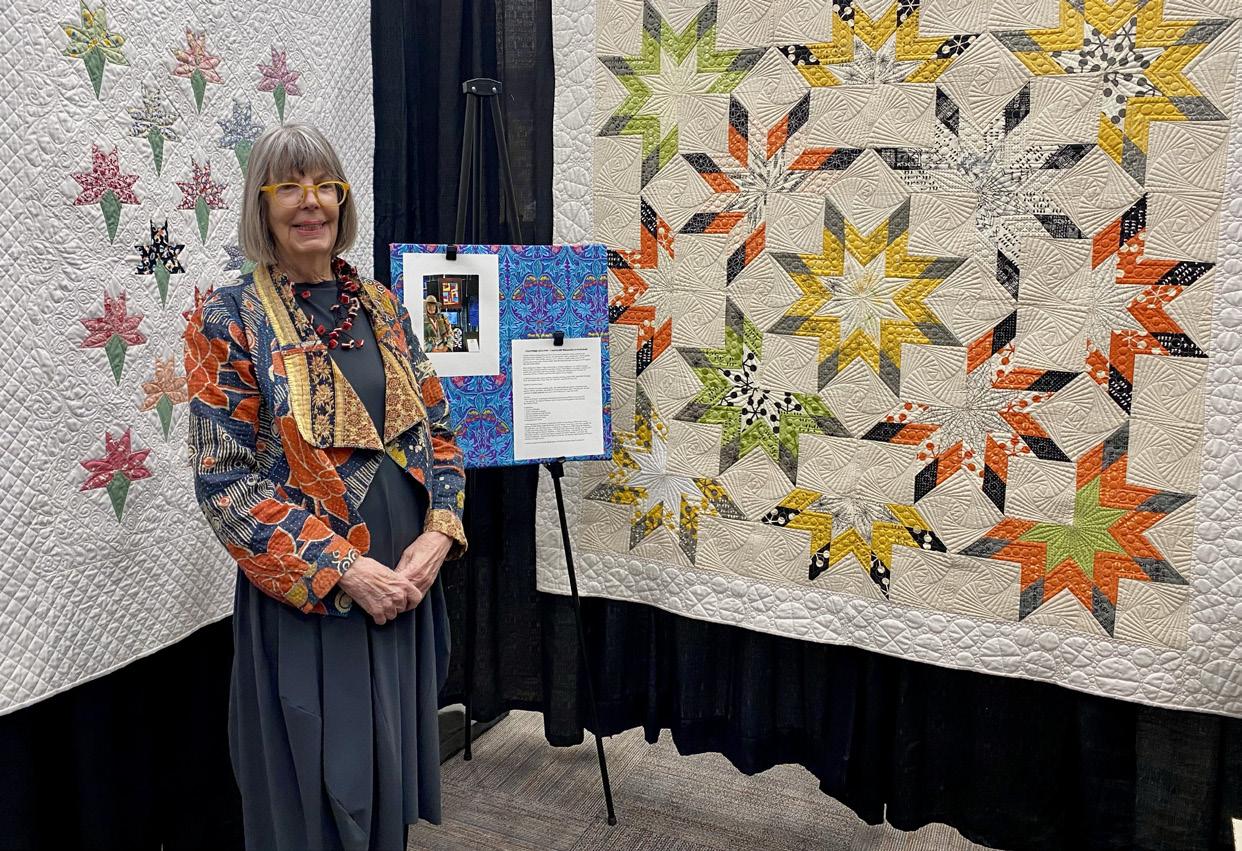
proudly before one of her vibrant creations. Each design is inspired by varying artistic genres, styles, architecture and her travels.
At
Carollee WilliamsSchuegraf sits
She doesn’t watch TV but listens to music. On the occasions we have gone to the symphony, she usually drives. If I do, she often corrects me on the right way, or the fastest way, to get to Downtown Los Angeles and has the best parking lots and restaurants all mapped out.
If you’re wondering, she is not a typical quilter. In fact, she often travels and goes to art or architecture exhibits to garner more inspiration. Every month she drives herself to Palo Alto, where she was raised, to see friends and attend exhibits at Stanford or in San Francisco. Over the past five years, she has taken multiple trips with friends, including travels to Germany, Indonesia, Arizona, Texas and Idaho. Her quilts are inspired by varying artistic genres, styles, architecture and her travels. They have provocative patterns made with exotic materials and contrasting
colors. For the past 10 years she has won awards at various shows (see sidebar), including the South Bay Quilters Guild, where she has been a member since 2000 and was selected as a Featured Quilter for 2025.
Carollee is not going to slow down anytime soon, as the view from her studio with her many projects shows. She says she’s “just getting started.”
“I love to create, and I’m excited to help inspire others to create art!” says Carollee, who has studied with more than 20 teachers. “It’s been my passion since a little girl when I began sewing quilts with my mother.”
Her advice to others who would like to try an artistic endeavor? “Take a class and explore every aspect you enjoy. Don’t worry about what others are doing; focus on what sparks your interest.” •
Intricate patterns, bold contrasts and unexpected textures— close-up details reveal the imagination and craftsmanship that define Carollee’s distinctive quilting style.
Quilt Awards
Best Use of Color
Pacific International Quilt Festival, 2022 and 2023
Top Quilt
California quilt contest by the Daughters of the American Revolution
Featured Quilter South Bay Quilters Guild, 2025 Exhibitions
Road to California Quilters Showcase
American Quilter’s Society QuiltWeek, Paducah, Kentucky
Pacific International Quilt Festival
Mid-Atlantic Quilt Festival
The Great Wisconsin Quilt Show
International Quilt Festival, Houston
Wellness Classes
3105 Lomita Blvd., Torrance
To register, call 310-517-4711.
8-week class: $80 (ADVANTAGE members $72) 4-week class: $40 (ADVANTAGE members $36) For more information, call 310-517-4666 or visit TorranceMemorial.org/classes.
ALL CLASSES ARE HYBRID (IN-PERSON OR ZOOM) UNLESS OTHERWISE NOTED
Bones for Life with Joy (In-person only)
May 11–June 29
Monday, 12:30 to 1:30 p.m.
These Feldenkrais exercises help support bones through gentle, weight-bearing exercises that require no strain or pain. Improve posture and bone health.
Chair Yoga for Bone Health with Debi Xxxx
Wednesday, 11:15 a.m. to 12:15 p.m.
Designed for those with osteopenia or osteoporosis; strengthen muscles and bones, improve posture and balance, fall prevention and breath work. All levels.
Chair Yoga for Strength and Balance with Sharmone
(In-person only)
May 11–June 29
May 14–July 2
Monday or Thursday, 2 to 3 p.m.
Use a chair in seated and standing poses to improve strength and balance.
Essentrics Full-Body Stretch with Ai (In-person only)
May 11–June 29
May 15–July 3
Monday or Friday, 11 to 11:50 a.m.
A gentle, full-body stretch to activate muscles, free joints and increase mobility. Bring a yoga mat.
Integrated Yoga with Robin
May 13–July 1
Wednesday, 7 to 8 p.m.
Breath work, postures and meditation, such as yoga nidra.
Line Dancing Beyond “Country” with Sharon
May 13–July 1
Wednesday, 4:30 to 5:30 p.m.
Learn Country Western favorites, cha-cha, mambo, tango, and samba in line dancing style. No partner needed.
Line Dancing: The Next Step with Sharon (In-person only)
May 13–July 1
Wednesday, 3:15 to 4:15 p.m.
Learn cutting-edge high beginner and improver line dances, plus more complex line dance steps. Previous line dancing experience required.
Mat/Floor Pilates with Karen (In-person only)
May 12–June 30
Tuesday, 4 to 4:50 p.m.
All-levels class strengthens core muscles to improve balance. Moderate fitness level needed. Bring a mat.
Muscle Strengthening: Beginning & Intermediate with Randy (Zoom only)
May 12–June 30
May 15–July 3
Tuesday or Friday, 11 to 11:50 a.m.
Strengthen your upper and lower body using flexible exercise bands.
Qi Gong with Gayla (Zoom only)
May 14–July 2
Thursday, 9 to 10:15 a.m.
Powerful but gentle movement and meditation to rejuvenate, strengthen and relax.
Stretching for Better Balance with Randy (Zoom only)
May 12–June 30
May 15–July 3
Tuesday or Friday, 10 to 10:45 a.m. Increase flexibility and mobility to help prevent injuries.
Beginning Tai Chi with Richard (Zoom only)
May 12–June 30
Tuesday, 2 to 3 p.m.
An introduction to the form of this Chinese exercise that inspires well-being.
Intermediate Tai Chi with Richard (Zoom only)
May 13–July 1
Wednesday, 2 to 3 p.m.
Learn how to complete the form.
Advanced Tai Chi with Richard (Zoom only)
May 13–July 1
Wednesday, 3:15 to 4:15 p.m.
Go deeper into refining movement, leading to improved health and mental focus.
Yoga Basics with Laura (Zoom only)
May 11–June 29
Monday, 4 to 5 p.m.
Gentle yoga poses on the floor and standing; breath work and meditation.
Yoga Therapy for Osteoporosis with Debi
May 12–June 30
Tuesday, 11 a.m. to 12:15 p.m.
Use poses and breath work to stimulate bone growth and increase strength, range of motion in joints, posture and balance. Floor, chair and standing poses. Bring a mat.
Yoga for Wellness with Debi
May 13–July 1
Wednesday, 9:30 to 10:45 a.m.
Correct posture alignment and increase strength, flexibility and range of motion.
Financial Health Checkup
Join Torrance Memorial’s Professional Advisory Council for its series on a variety of financial topics to help you take care of your financial health. Seminars are strictly educational and will be held on select Saturdays, 9 to 11 a.m. Our next lecture will be in the West Tower Auditorium, 3325 Medical Center Dr., 2nd Floor, Torrance.
May 9
Estate Planning Basics
Learn more about estate planning and conservatorships basics.
RSVP to Stephanie Mancia at 310-517-4728 or foundation@ tmmc.com. You may also visit TorrranceMemorial.org/events/ financial_health_seminars.aspx for online registration and up-todate information on topics and schedules.
Miracle of Living
Join us at 6:30 p.m. in person or via Zoom for Torrance Memorial Medical Center’s popular health lecture series. West Tower Auditorium, 3325 Medical Center Dr., 2nd Floor, Torrance. Visit TorranceMemorial.org/mol for details.
March 18
Diabetes – Know Your Numbers
April 15
Thyroid Health
May 20
Stroke – Know the Signs
Past lectures include cancer prevention; sports injury prevention and other orthopedic issues; heart disease, complications with diabetes and stroke, valve disease and peripheral artery disease; and a variety of psychological topics such as depression, anxiety, substance abuse, eating disorders and violence. Videos are available on demand at TorranceMemorial.org/mol.
*Topics are subject to change
Wellness Classes
Malaga Cove - 2550 Via Tejon, Palos Verdes Estates
To register, call 310-517-4711. All clases are in-person only.
8-week class: $80 (ADVANTAGE members $72) 4-week class: $40 (ADVANTAGE members $36) For more information, call 310-517-4666 or visit TorranceMemorial.org/classes.
ALL CLASSES AT THIS LOCATION ARE IN-PERSON ONLY
Align the Spine with Joy
May 11–June 29
Monday, 9 to 10 a.m.
These Feldenkrais Method lessons help restore or avoid deterioration of your posture without pain or strain. Bring an exercise mat, hand towel and bath towel.
Bones for Life with Joy
May 11–June 29
Monday, 3:30 to 4:30 p.m.
These Feldenkrais exercises help support bones through gentle, weight-bearing exercises that require no strain or pain. Improve posture and bone health.
Chair Exercise: Beginning & Intermediate with Pam
May 12–June 30
Tuesday, 9 to 10 a.m.
Improve strength and balance using a chair. Bring an exercise band and light hand weights (optional).
Exercise to the Oldies with Pam
May 12–June 30
Tuesday, 10:15 to 11:15 a.m.
Promote endurance and flexibility with standing and floor exercises. Bring a mat, light hand weights and a “can-do” attitude!
Essentrics® Strength: Full-Body Stretch
May 10–June 28
Sunday, 9 to 9:50 a.m.
Combines strengthening and stretching to develop a toned, pain-free body. Includes exercise on the floor. Bring yoga mat.
Essentrics® Full–Body Stretch with Ai
May 13–July 1
Wednesday, 11 to 11:50 a.m.
A gentle, full-body stretch to activate muscles, free joints and increase mobility. Bring a yoga mat.
Let’s move “Qi”, YoQi® Qigong Flow and Sound Bath
May 10–June 28
Sunday, 10:30 to 11:40 a.m.
Motion meditation. Gentle, slow movements, breath work, self-massage and sound bath meditation. All levels welcome. Bring yoga mat. Blanket/pillow and eye pillow optional.
Muscle Strengthening: Beginning & Intermediate with Randy
May 11–June 29
Monday, 11:30 a.m. to 12:15 p.m.
Learn correct, safe techniques for strengthening your upper and lower body using a chair and flexible exercise bands.
Muscle Strengthening: Intermediate with Randy
May 14–July 2
Thursday, 11:30 a.m. to 12:15 p.m.
Learn correct, safe techniques for strengthening your upper and lower body using a chair, flexible exercise bands and hand weights.
Stretch & Sound Bath Meditation with Ai
May 13–July 1
Wednesday, 9:30 to 10:20 a.m.
Gentle stretch and breath work, and sounds and vibrations from various sound bath instruments. Bring a yoga mat, blanket and pillow.
Stretching For Better Balance with Randy
May 11–June 29
May 14–July 2
Monday or Thursday, 10:30 to 11:15 a.m. This fun workout in a chair is designed to help increase flexibility to prevent injuries.
Yoga for Stress Reduction with Debi
May 16–July 4
Saturday, 9:30 to 10:45 a.m.
Gentle yoga poses on the floor, seated and standing to increase flexibility, strengthen the body, and improve balance. Breath work and meditation reduce stress.
Don’t see what you’re looking for?
Check TorranceMemorial.org/classes for more information or call 310-517-4666.
Advantage Support Groups
Bereavement Support Group
Meet in a caring and safe environment with other people experiencing grief or loss. Groups consist of eight to 10 members and meet once weekly for six to eight weeks, for 90 minutes. To participate or for more information, contact Olivia Licea at 310-703-3352.
Between Starving & Stuffed
This is an interactive virtual program that teaches life skills for a healthy weight and other goals. Every second and third Thursday via Zoom. For more information, contact Community Health Education at 310-517-4711.
Cancer & Nutrition
Whether you are currently going through cancer treatment, have had cancer in the past or are simply looking for general nutrition guidelines to help prevent the development of cancer, this class is for you! We focus on the role good nutrition plays in cancer prevention, treatment and survivorship. Every second Thursday, 5 to 6 p.m. via Zoom. For more information call 310-517-4711.
Caregivers Support Group
Are you providing care for someone else? Our support group offers valuable information and nurturing support for caregivers of all types. Join us to connect with others who understand your experiences
and gain insights from those in similar situations. To receive the Caregiver Packet, email torrancememorialhealtheducation@ tmmc.com. For meeting dates and times, call 310-517-4711.
Depression and Bipolar Support Alliance
This peer-based support group is for those dealing with mood disorders (dbsasouthbay.org). Group meets at Torrance Memorial on the second and fourth Saturdays, 10 a.m. to noon, and the first and third Thursdays via Zoom, 6:30 to 8:30 p.m. Contact Scott Wood at 310-4978801 or woodscott516@yahoo.com, or Peggy at 310-548-3457.
Diabetes Support Group
Join us to share with others who understand what it is like to live with diabetes. Meets on fourth Fridays, 1 to 2:30 p.m., at the Lundquist Lurie Cardiovascular Center, 2841 Lomita Blvd., Suite 335. Registration is not required. For questions, call 310-517-4711.
Men’s Cancer Support Group: Finding Strength Together
Join us for a supportive gathering for men navigating cancer diagnosis, treatment and recovery. Individuals are encouraged to ask questions, express concerns and share their experiences with fellow cancer fighters. Every first and third
Wednesday via Zoom. For more information, contact Rev. Jan Arthur Lee at 310891-6694 or jan.lee@tmmc.com.
Ostomy Support Group
This support group provides a welcoming and safe space to connect with one another and learn how to live an active, happy and healthy life with an ostomy bag. Next meeting is Thursday, October 17, 3 to 4:30 p.m. For questions, call 310517-4711.
Stroke Support Group
Building a community of support for stroke survivors and their caregivers. Meets every second Tuesday, 10 to 11 a.m., at the Hoffman Health Conference Center, Room 4. For questions, call 310517-4735, extension 20640 for Maria or extension 20822 for Tami.
WE CAN: Women Empowered Cancer Support Group
For nearly 20 years, this group of women has journeyed through their experiences of cancer and beyond, empowering women to face their diagnosis, recurrence or experience as a cancer survivor with resilience and support. Meets second and fourth Tuesdays, Hoffman Health Conference Center (Zoom option available), 10 to 11:30 a.m. Register by calling Anne Milliken at 310-517-1115 or emailing anne.milliken@tmmc.com.
3330 Lomita Boulevard, Torrance, CA 90505-5073
Torrance Memorial Medical Center
310-325-9110
TorranceMemorial.org
ADVANTAGE Program Information
310-517-4666
Monday through Friday, 9 a.m. to 4:15 p.m.
Torrance Memorial IPA
Learn More: 310-257-7239 TorranceMemorialIPA.org
Members: Toll-Free: 866-568-4472 TTY/TDD: 711
Monday through Friday, 8:30 a.m. to 5 p.m.
Torrance Memorial Physician Network
310-891-6717 TMPhysicianNetwork.org
Monday through Friday, 7:30 a.m. to 4 p.m.
YOU NEED EXPERT CARE, TORRANCE MEMORIAL IS HERE FOR YOU.
Emergencies happen. Don’t delay care for heart attacks, strokes, falls or other urgent health situations. Torrance Memorial’s emergency department is safe, ready and open. If you think you are having a heart attack or stroke, call 911 or go to the nearest emergency department if you are experiencing symptoms.
Comprehensive Stroke Center – Torrance Memorial emergency care staff are trained to identify the signs of stroke early and deliver early intervention care that limits damaging effects.
Emergency Department Approved for Pediatric Patients –Torrance Memorial is a designated Emergency Department Approved for Pediatrics by L.A. County Department of Health Services.
L.A. County Paramedic Base Station – Torrance Memorial’s 24hour emergency department serves as a paramedic base station.
STEMI (Heart Attack) Receiving Center – Torrance Memorial is a STEMI-receiving hospital, and has the equipment, expertise and facilities to administer percutaneous coronary intervention, a mechanical means of treating heart attack patients.
If you do not wish to receive future issues of this publication, please email publications@tmmc.com with your name and complete address as it appears on the mailing panel.