Fall Issue 2026 Vol. 58, No. 1
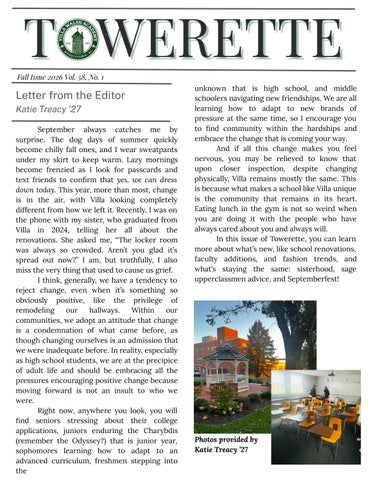
Letter from the Editor Katie Treacy ’27 September always catches me by surprise. The dog days of summer quickly become chilly fall ones, and I wear sweatpants under my skirt to keep warm. Lazy mornings become frenzied as I look for passcards and text friends to confirm that yes, we can dress down today. This year, more than most, change is in the air, with Villa looking completely different from how we left it. Recently, I was on the phone with my sister, who graduated from Villa in 2024, telling her all about the renovations. She asked me, “The locker room was always so crowded. Aren’t you glad it’s spread out now?” I am, but truthfully, I also miss the very thing that used to cause us grief. I think, generally, we have a tendency to reject change, even when it’s something so obviously positive, like the privilege of remodeling our hallways. Within our communities, we adopt an attitude that change is a condemnation of what came before, as though changing ourselves is an admission that we were inadequate before. In reality, especially as high school students, we are at the precipice of adult life and should be embracing all the pressures encouraging positive change because moving forward is not an insult to who we were. Right now, anywhere you look, you will find seniors stressing about their college applications, juniors enduring the Charybdis (remember the Odyssey?) that is junior year, sophomores learning how to adapt to an advanced curriculum, freshmen stepping into the
unknown that is high school, and middle schoolers navigating new friendships. We are all learning how to adapt to new brands of pressure at the same time, so I encourage you to find community within the hardships and embrace the change that is coming your way. And if all this change makes you feel nervous, you may be relieved to know that upon closer inspection, despite changing physically, Villa remains mostly the same. This is because what makes a school like Villa unique is the community that remains in its heart. Eating lunch in the gym is not so weird when you are doing it with the people who have always cared about you and always will. In this issue of Towerette, you can learn more about what’s new, like school renovations, faculty additions, and fashion trends, and what’s staying the same: sisterhood, sage upperclassmen advice, and Septemberfest!
Photos provided by Katie Treacy ’27
Scents of the Season Sarah Shalhoub ’28 You swiftly reach to pull back the tab on the cup as the warmth of the drink sends a prickling feeling down your fingertips. Immediately, steam escapes from the whipped cream on top, carrying a rich flavor: pumpkin spice. The scent travels up to your nose as you smell notes of dark espresso, cinnamon, nutmeg, and even a pinch of ginger! Suddenly, as the aroma fills the room, the sight of your bed and nightstand fades, now replaced by picturesque fall trees. You are no longer in your bedroom trying the Starbucks fall menu for the first time this year, but walking through Central Park with your friends, each carrying pumpkin spice lattes of their own. This sudden revisit to a pleasant memory is not just a unique side effect of a seasonal drink, but also a demonstration of how our sense of smell is connected to the human brain. When an individual smells something like candles or a burning fire during the winter, the odorants enter the back of their nose, where they latch onto smell receptors. This connection causes neurons, or nerve cells, to carry electrical and chemical signals to the brain. These nerve signals head directly to the olfactory bulb, located on the bottom of the brain’s frontal lobe. There, the olfactory bulb decodes the nerve signals, identifies the smell, such as pumpkin spice, and sends the signals to the amygdala and hippocampus. The amygdala is where strong emotions like anger or nostalgia are managed, whereas the hippocampus stores memories that are retrieved if the smell is linked to them. Therefore, a single smell can take someone back anywhere in time, whether it's to their 16th birthday, when they received daisies from their parents or to the beach in Bermuda
where they last spent their spring break. So, I asked students here at Villa Walsh Academy about their favorite fall scents that remind them of a certain memory or place. For Hannah Warjanka ’28, the fruity smell of apple cider transports her back to last fall when she went apple picking with her sisters at Wightman Farms. She remembers the farm grounds being filled with many different autumn colors such as deep red and orange, and the homemade donuts she enjoyed with her drink. Lucy Smart ’29 shares that the aroma of pumpkin spice reminds her of Thanksgiving with her family. Similarly, Abby Wright ’28 also recalls that the sweet smell of vanilla reminds her of a past Thanksgiving spent baking treats for the evening feast! So, whether it's a cup of apple cider or a pumpkin spice latte, the smells of fall signify not just the changing of seasons, but also the feelings and memories they evoke.
Pumpkin Spice Lattes from Starbucks Photo provided by Sarah Shalhoub ’28
Septemberfest Photo Collage + Four-Legged Fans Isabella Propper Stuehr ’27 Photos provided by Isabella Propper Stuehr
Septemberfest Photo Collage + Four-Legged Fans Isabella Propper Stuehr ’27
Four-Legged Fans!
A New Prime Addition! Cristianne Perez ’29 Mrs. Barnes so warmly chose to join our community this school year, bringing an inspiring wealth of experience and enthusiasm. A few days ago, she and I had the chance to sit down and talk about her journey before coming to Villa. She grew up nearby in Mendham as a triplet. She was very active, practicing karate for 13 years starting at only 6 years old, as well as playing volleyball throughout high school and on a club team in college. For her higher education, Mrs. Barnes attended Bucknell University for her undergraduate degrees in mathematics and studio art, earned a master’s degree in mathematics from New York University, and completed doctoral credits at Rutgers University. After exploring different paths, she ultimately decided to become a teacher because she wanted to witness student growth and help reshape the negative reputation math often has nationwide.
Mrs. Barnes and Her Family Photo provided by Mrs. Barnes
Mrs. Barnes has taught at various schools, including Morristown Beard School, Academy of Saint Elizabeth, Morristown High School, and Delbarton from 2020 to 2024. Before joining Villa, she stepped out of her comfort zone to teach math to gifted 2ndthrough 8th-grade students at Mendham Country Day School. Now, Mrs. Barnes is thrilled to be back teaching high school to empower teenage girls. For this mother of three children under six, the best part of the day is building trust and meaningful connections with students. Villa is so lucky to have Mrs. Barnes as part of the faculty!
Fall-ing Into Season Hannah Warjanka ’28 Fall is finally here, which means pumpkin spice latte season has begun! If you're looking for something new and trendy, a popular place with the perfect fall ambiance is The Porch in Basking Ridge. The Porch’s cozy atmosphere and lounge area make studying for the SAT much more aesthetic. It offers a unique selection of matchas and lattes alongside the new seasonal drinks. The pumpkin spice latte with maple cold foam is by far the best and is the perfect way to start the fall season. The seasonal pumpkin pie matcha is also a hit and is great for matcha lovers. If you're looking for a sweet treat, they have top-notch pumpkin bread and maple loaves that pair perfectly with a latte.
Photos provided by Hannah Warjanka ’28
Fighting the Clock: Why Your Brain Doesn’t Want You to Sleep Sarah Shalhoub ’28 A fresh school year doesn’t just mean new classes, but also a new sleep schedule! For most high schoolers, especially at Villa Walsh, their schedules are packed from after-school practice to late-night study sessions. Balancing these countless activities can often put sleep at the bottom of their to-do list. Though it's advised by doctors that teens get 8 to 10 hours of sleep every night, many of us show up to school running on 5 hours of sleep with a strong energy drink in hand. While we can often blame ourselves for this constant exhaustion, our brains play a bigger role than we think! Our sleep-wake schedule is controlled by our circadian rhythm, also called our body’s internal 24-hour clock. During adolescence, the body’s internal clock shifts to a later time, resulting in a biological phenomenon called phase delay. This means that for adolescents, their bodies delay the release of melatonin, a natural hormone that signals when it is time to sleep, by close to two hours. Therefore, adolescents are more likely to fall asleep or feel the need to go to bed at a much later time than they used to in middle school. This natural shift creates a direct conflict with early-morning school times. Our brains may be wired to stay up until almost 11 o'clock at night despite our alarm clocks going off at 6:45 AM. Although this phenomenon may be unavoidable, ignoring it comes at a steep cost. Going through the day without enough sleep can make it hard to remember information, weaken our immune system, and cause brain fogginess when making decisions.
To combat these risks, I asked students here at Villa Walsh Academy for their best advice on managing time and getting to bed early. Mary Cafasso ’28 explains that to get enough sleep for school, she often sets a strict cutoff time for homework at around 10 PM. This gives her time to unwind before bed instead of wasting time doomscrolling on her phone. While this cutoff time may work for some students, others emphasize the importance of using daytime hours to prevent stressing about schoolwork late at night. With a busier schedule than ever, Satine Nader ’28 urges her fellow Villa Walsh students to make the most of their free periods during the school day, whether to do homework or meet with a teacher to study before an exam the next day. Drawing on her own experience, she believes that if a student uses that free time wisely, they can significantly reduce their nightly workload. So, before you drink that next energy drink, consider using these strategies to achieve the hours of rest you need for a productive day. Your circadian rhythm will thank you!
Photo provided by Cristianne Perez ’29
Summer Erasing Kendall Kiraly ’28 “I’m gonna wake up 30 minutes early each day. I'm not gonna procrastinate. Every night, I’ll be in bed by 9. I’m gonna be so put together this year.” This is the narrative so many of us tell ourselves in the weeks before school starts—a checklist of promises to make this the year we finally get ourselves together. Yet, as soon as that third Monday of September hits, it's an 11:58 submission for an 11:59 deadline, messy buns, dark circles, and a locker full of empty Starbucks drinks. It's not that we don’t try—well, maybe in part it is—but it’s often that in the midst of slow summer mornings, sleeping in, relaxing beach days, and a schedule with nothing on it, we simply forget what the routine of school actually demands of us. For Emma Gubernat ’29, it’s the early mornings that are most difficult. As soon as that 6:30 alarm rings after four snoozes, a sound we spent almost all summer trying to forget becomes, in just one day, our morning greeting for the next nine months. From 1:00 a.m. nights to 10:00 a.m. wake-ups, many of us forgot how hard it actually is to get out of bed on command. Three months of freedom can make a 6:30 a.m. alarm feel less like a wake-up call and more like a personal attack. In addition to early mornings, Ella Allocca ’28 commented that she had forgotten how heavy her backpack gets. From 400-page textbooks and multi-subject notebooks to the trademark blue freshman Biology binder, it is no secret that our shoulders are sore by the end of the day. Yet, that doesn't even include the sports backpack on our chest, gym bag in one hand, lunch box in the other, and the newest Starbucks drink somehow squeezed in somewhere. Despite forgetting about early
wake-ups and heavy backpacks, somehow none of us forget how to carry four bags and two drinks all at once. And it’s not just our backs and sleep schedules that suffer. We forget how fast we have to walk from gym to theology, how long 42 minutes can feel, and how quickly a “free afternoon” disappears. One minute it's 2:35 p.m. and we’re walking out of school, and the next it's 9:03 p.m. We just got home from a game or rehearsal, we have to eat, shower, and finish all our homework, and we have absolutely no idea where the last seven hours went. After three months of having nowhere to be, it is a little jarring to suddenly have somewhere to be every five minutes. But maybe we also forget some of the good things. Elizabeth Cullen ’29 takes a different perspective, remarking how she forgot “how nice it is to talk to my friends before class starts in the morning or have someone waiting for me to walk to lunch.” She explains how the simple conversations while packing up or the shared worry when studying for a big test actually make a random Wednesday feel a little more meaningful.
Photo provided by Samantha Innella ’28
Summer Erasing (cont.) Kendall Kiraly ’28 By the third Monday of September, we’re probably not waking up 30 minutes early, we’re probably still procrastinating, and we’re definitely not getting into bed by 9. But somehow, we’re getting used to it again. We forgot how exhausting school is, but we also forgot how much we actually missed our lives and the people in them. So, in a Villa full of new renovations and new routines, maybe the point isn’t to become the perfectly put-together person we promised ourselves we’d be in August; maybe it's just to remember that, even when we complain about it, there are so many things in school we forgot about that actually feel so good to have back.
Photo provided by Kendall Kiraly ’28
The Hunt: NJ’s Fashion Show Chloe Scheuerman ’28 As we enter the new season of fall, one event in northern New Jersey starts to arise. The Hunt, which takes place October 17th this year, is not only a thrilling horse race, but also a day that brings out some of the season’s
biggest fashion trends. Each year, teens and adults arrive at the Hunt in outfits that capture the overall aesthetic of fall. As Leah Bourdain ’28 said, “Most people take the Hunt as New Jersey’s ‘fashion show.’” The outfits are a perfect balance between cozy fall classics and chic outerwear, ensuring a stylish look at the event. Sofia Marcello ’28, an attendee at last year’s Hunt, recalled, “A lot of it was plaid dresses, brown/whites, and boots.” She also spotted some surprising accessory choices: “In pictures posted online, a lot of people wore sunglasses on their head, despite the cloudy weather.”
Photo provided by Sarah Shalhoub ’28 This year, most of the trends are expected to be very similar to those of previous years. Alexandra Welsh ’30 said that she expects to see “jean skirts, cowboy boots, mini dresses, jean jackets.” Other popular trends that may make an appearance this year include oversized sweaters, UGG boots, and statement accessories. Many people mix old trends with upcoming ones, creating new outfits that are both familiar and unique. Whether you are sticking to classic boots or debuting a new standout look, NJ’s Hunt remains the ultimate runway for fall fashion!
Sustaining Sisterhood Kendall Kiraly ’28 While we were spending our summers lying on the beach, catching a tan, and frantically rushing to finish the last chapter of our summer reading books, Villa was going through a summer glow-up of its own. Spaces were cleared out, walls were painted, and hallways we could walk through blindfolded were turning into something completely new. On the first day back, it wasn’t just the freshmen asking for directions around the school; the upperclassmen, too, were getting confused about which way led to which classroom and which staircase we were supposed to take. A summer can change a lot, and suddenly, even those of us who knew every little shortcut were forced to stop and look around. And as strange as it was to see familiar spaces suddenly look so different, there was something mysterious and exciting about it—a hope that something new would take place, that something was about to begin. Yet, all the changes got me thinking: when everything around you is changing, what do you hope stays the same? I was lucky enough to sit down with Sr. Marianne, the driving force behind all these changes, to find out. For Sr. Marianne, moving forward means keeping up with the world around us. Between AI, new technology, and the fact that everything becomes outdated within two months of buying it, even a perfectly functional classroom may eventually need some attention. Maybe that’s part of what Villa is always trying to do: keep changing and growing so that we can keep becoming the girls we’re meant to be, even when the world around us is changing, too. Yet, when I asked Sr. Marianne what she hoped a Villa girl who graduated 30 years ago
would recognize today, she didn't mention the classrooms or the lockers. She said, “sisterhood.” She hopes alumnae will walk down the hallways in Regina Pactis, admire the new photos of their old classmates, and remember the people, faith, and experiences that made Villa home for them. Still, even with the renovations, she also hopes they’ll be surprised by what they see–the new spaces and new rooms–proof that Villa didn’t stop growing when they left. “We came here and it continues,” she said.
Photo provided by Katie Treacy ’27
Photo provided by Kendall Kiraly ’28 And perhaps nowhere is that continuation more meaningful than the chapel. For Sr. Marianne, it’s a place where students attach memories to their faith, but faith doesn’t stay inside those four walls. Faith, as Sr. Marianne describes it, follows us into service, friendships, prayer, and eventually, wherever we go next. For generations to come, Sr. Marianne hopes that Villa girls will carry that
Sustaining Sisterhood (cont.)
What Do Teachers Really Do Over the Summer?
Kendall Kiraly ’28
Emily O’Malley ’29
faith with them and, wherever they end up, remember where it started. She hopes that maybe even years after leaving the campus, they’ll still know that the good they do and the people they become are connected in some way to the place that helped shape them. As she described it, “It starts in the chapel, but you just don't stay in the chapel.” But Villa’s growth isn’t only about preserving what has always made it special. It’s also about preparing students for a world that is becoming increasingly connected. Many of us have stopped by and wondered about the large screen in the Assembly Hall classroom. This new space will allow students to connect with people around the world during class. From speaking with students in Mexico to learning about communities in Africa, being part of the world means actually getting to learn from the people who live in it, not just reading about them in a textbook. With this international classroom, we will get the chance to do just that–a little taste of the larger world we will soon experience outside of Morristown, New Jersey. “It’s a small world,” Sr. Marianne said. “You have to make sure [Villa] is part of that small world.” So maybe, years from now, when we come back and inevitably get lost trying to find the cafeteria, we’ll laugh about how much Villa has changed. Maybe the hallways will look wider, maybe the classrooms will seem different, and maybe there will be some new space we can’t even imagine right now. But hopefully, somewhere between trying to remember where we used to go and figuring out where we’re going next, we’ll still recognize the same thing Sr. Marianne hopes we always will: Villa.
In the middle of summer break, there eventually comes a time when we have to force ourselves to sit down, read, and plod through some assignments for next year’s classes. In the midst of this stress, you can’t help but envy the teachers. With no long books or assignments due, they must have so much more freedom to relax, right? Well, according to Mrs. Harper, the history and English teacher for 7th and 8th grades, students’ and teachers’ summers may be more similar than we think. This past summer, Mrs. Harper spent time vacationing in Florida and Las Vegas and at the Jersey Shore. She visited friends, spent more time with her kids, and had fun boogie-boarding in the ocean. However, Mrs. Harper also had to balance the many obligations a teacher has over the summer. “I think people assume that teachers just completely detach from school all summer, but sometimes that’s not possible. You spend time planning your lessons for the next year,
Photo provided by Mrs. Harper
What Do Teachers Really Do Over the Summer? (cont.) Emily O’Malley ’29 cleaning out paperwork, reading books to help with teaching, sometimes going to conferences to learn new strategies for teaching, and many teachers come in a few weeks before school starts to get ready for the year!” she explains. Like many of us, Mrs. Harper also tends to put off school-related work until the last month of summer after giving herself two months to relax. “In June and July I don’t really do any school work, but in August I start really focusing on school. I try to read at least one teaching-related book over the summer. When I leave here in June, I decide to just shut it down and give myself a break.” If you feel guilty for putting off work until the last few weeks of summer, your teacher probably totally understands. A lot of work goes into planning a year's worth of teaching and making sure that all students receive a quality education. So next time we find ourselves complaining about how much summer work we are assigned, let’s remember that our teachers are in the same boat as us.
and fitness. Mrs. Soder grew up in Bergen County, NJ, and was inspired by a childhood math teacher to pursue a career in education. She actually started her career as a teacher! After a short while in the classroom, she felt a calling to counseling and went to graduate school to pursue her master's degree because it felt like a true match for her! For Mrs. Soder, being a counselor is about more than helping students through difficult situations. She wants you to know that if you ever need advice, someone to talk to, or help managing your goals, her door is always open. In her free time, Mrs. Soder enjoys staying active and participating in sporting events. Just this year, she has completed 2 Spartan races and a Hyrox! She also cherishes her family and loves spending time with her 2 adult kids and husband, as well as boating with them! Next time you are near her office, stop in to see her board of hobbies!
From Classroom to Counseling: Meet Mrs. Soder! Elodie Tuck ’29 This year, Villa has welcomed a new guidance counselor, Mrs. Soder! Mrs. Soder brings over three decades of experience, including 25 years as a guidance counselor at Chatham High School. In addition to her important role at Villa, she is a health and wellness coach and has a passion for nutrition
Photo provided by Mrs. Soder
Back to School: What’s New in the Art Room Annie Rionda ’27 With the start of the new school year, Mrs. Cheifer’s art classes have been busy during the first few weeks of school. The AP and Honors art classes brought in their summer artwork, which will soon be available for viewing in the library. Now, the AP and Honors students are working independently on their portfolios. Honors students formulate a guiding question that will lead them through their portfolios for the entire school year. Horseback rider Nicole Aragon ’28 has chosen a guiding question centered around her relationship with
her horse, Cookie: “The relationship between a horse and a human and how they communicate,” including mentally, verbally, and physically. The Fine Art classes are working on Chinese ink painting, using sumi and hake brushes with India ink on various papers. The Art and Design students are working on personal collages featuring unique color palettes inspired by their clothing and personal interests. Additionally, to expand on these collages, the students are carving custom logos and refining their printmaking skills. Finally, the freshman art classes are using watercolors to paint their most memorable place, experience, or person from the summer.
Sibylla Ramos ’28
Sophia Dannenmann ’28
Back to School: What’s New in the Art Room (cont.) Annie Rionda ’27 Photos provided by Annie Rionda Nikki Aragon ’28
Naomi Scotto ’29
Tessa Arturi ’29
Sibylla Ramos ’28
Summer Break on Canvas Elyse DeLuca ’29 Photos provided by Elyse DeLuca ’29 For Mrs. Lagana’s first art project of the new school year, students created pieces inspired by their favorite summer activities, with many capturing the serenity of the beach. Utilizing exclusively watercolor paints and watercolor pencils, the students thoughtfully incorporated the elements of art while identifying and focusing on specific techniques in their work. Additionally, students completed a secondary, smaller study, choosing between shells and spoonbills as their subject matter. With an ocean-inspired theme setting the tone for the year, Mrs. Lagana’s art classes promise to showcase exceptional creativity and talent.
Luciana Suzuki-Scotti ’30
Lydia Kahng ’30
Avery Breslauer ’30
Back to School: What’s New in the Art Room Elyse DeLuca ’29 Photos provided by Elyse DeLuca
Emma Terrone ’30
Madelyn Mulhearn ’30
Caitlin Manley ’30
Sophia Billones ’30
The Summer of 2026: What We’ll Remember Annie Rionda ’27 Photos provided by Annie Rionda As students return to Villa, it is hard to believe that our carefree days of movies with friends and sweet summer treats are officially over. But while it is time to reset our priorities and make the shift to the school year, it is important to note that the biggest cultural shift of the season didn't happen in the classroom—it happened on the big screen. From book to movie, the classic Odyssey written by Homer took to the big screen. The Odyssey follows Odysseus as he navigates the treacherous seas in an attempt to return home to his wife Penelope and son Telemachus. If you attended Villa prior to this year, you know this story! The movie has topped the charts and has an amazing 94% on Rotten Tomatoes and has become the “highest-grossing R-rated movie of all time at the global box office,” with “$1.352 billion.”
Odysseus wasn’t the only one fighting to return to the woman he loves; Peter Parker in Spider-Man: Brand New Day struggles to adjust to life in a world where everyone has forgotten who he was, including MJ, the girl that he loves. Spider-Man faces a new challenge as a villain with mind-control powers causes havoc within New York City. Another item topping the charts in the summer of ’26 was the dot cake. These TikTok sensations quickly reached viral levels. A dot cake consists of a small circular cup filled with layers of cake and icing and topped with hundreds of crunchy rainbow dot sprinkles. If you missed them, these tasty treats can be purchased at Swiss Chalet Bakery in Morristown. Magnum croissants became another TikTok sensation and went viral on social media. The premise of this creation is a warm, buttery croissant that is hollowed out in the middle to make room for a chocolate-covered Magnum ice cream bar. This dessert is the perfect combination of pastry and ice cream for those hot summer days. In the end, the favorite things of summer aren’t complicated. They’re the sounds, tastes, and feelings that make us pause and smile.
Advice From Upperclassmen Ava Van Etten ‘29 As Villa Walsh enters a new school year, fresh, friendly faces arrive on our lovely campus. Underclassmen, especially, are still getting the hang of high school. Understandably, both new students and those who have been here since seventh grade are adjusting in their own ways, but ultimately, they all face the typical hurdles of high school. Luckily, Villa Walsh provides a wonderful network of support from peers, classmates, staff members, coaches, and parents. To better understand how students navigate this transition, I asked upperclassmen for their input and words of advice. To get some perspective, I spoke with junior Samantha Innella ’28 about how she got involved during her freshman year: “Villa offers a variety of fun, exciting after-school activities that are an excellent way to find what you’re passionate about, meet others, and become a part of a welcoming community. This can range from basketball to robotics to Villa Serves; seek out what truly interests you.” Piggybacking off of Samantha, Vivi Loughran ’27 notes: “Make sure to pick clubs that actually stand out and are meaningful to you; don’t join more clubs than you can actually handle. Signing up for clubs just for the appeal is unnecessary.” This is a great point, considering underclassmen can easily get swept up at the club fair, sign up for everything, and end up bombarded with emails for meetings they don't actually want to attend. This isn’t meant to discourage you from getting involved, but rather to remind you not to sign up for something simply for the sake of it.
Additionally, I spoke with Lexi Stappas ’27, who offered practical feedback:“Have good time management, especially if you have after-school sports or clubs; make sure to utilize your time and studies wisely.” From my perspective, this advice from Lexi applies to everyone at Villa and is crucial, as time management is essential for maintaining academic success. Sarah Carvalheiro-Santos ’28 added words of advice that tie right into what Lexi said: “Be on top of your assignments, be orderly, and know what you need for each class. Having a planner or agenda can be incredibly helpful and will allow you to be more organized.” Lastly, I spoke to Lyndsay Sheaffer ’28 for her input: “Establish relationships with your classmates, teachers, and your peers from other grades. Being open to having conversations with others and making yourself known is a strong quality to have.” Relationships are just as important as academics in shaping your high school experience! Together, these perspectives highlight that getting involved in the VWA community, managing your time well, and building strong relationships will help shape your Villa experience and allow you to thrive.
Photo provided by Sarah Shalhoub ‘28
Not Quite My Tempo: The Mood Benefits of Listening to House Music
Frankie Knuckles DJing in Ibiza
Katie Treacy ’27 Last year, when school began and the inevitable change of the seasons did too, I was determined to keep the good summer vibes going. Around June 21st every year, the Northern Hemisphere experiences a summer solstice that marks the longest day of the year. From then, our hours of sunshine dwindle until late December, at which point the day feels impossibly short due to the end of daylight saving time setting our clocks back an hour in November. This presents a problem: when the winter months reduce our sun exposure, which triggers serotonin and endorphin release as sunshine meets our skin and retinas, we experience lower levels of these “feel-good” hormones and can feel a little blue. This phenomenon is actually so common that it has a name: S.A.D., or seasonal affective disorder. After learning this, I wondered: is there a way to combat the chemical changes in the brain caused by our Northeastern autumn and winter climates? Further research on the issue showed one of the best ways to fight S.A.D. was with more chemistry. There had to be a way to restore the serotonin we had stopped getting from the sun, and at first this inspired a commitment to “happy” music all winter long. Music with positive lyricism improves mood for obvious reasons, and I was happy to say this regimen did exactly what it promised. However, the search continued for another way to develop this treatment, and that’s when I stumbled upon a genre called house music.
House music is a subgenre of electronic dance music (EDM), invented by Chicago DJs during the 1970s. The genre gets its name from its birthplace, the Warehouse club in Chicago, where DJ Frankie Knuckles would skillfully mix tunes into the exciting house music we know today. House music is characterized by a tempo of 118–130 beats per minute and “four-to-the-floor” beats, or a 4/4 time signature created with a kick drum that gives the music a heartbeat-like rhythm. Research shows fast music tempos increase perceived feelings of excitement and decrease feelings of sadness, suggesting that fast-paced music has, generally, positive effects on mood. Many EDM subgenres feature uptempo music, but house music’s signature beat drops are what make house music even more beneficial for the psyche. A study at the University of Agder found that the anticipation leading up to a beat drop can trigger dopamine production, another feel-good hormone like serotonin. This fall and winter, I plan on continuing my musical experiment, but this time with house music. As talented as Gracie Abrams, Phoebe Bridgers, and Noah Kahan are, sometimes it’s better to put down the slow, “in my feelings” music when you want to start the day off right. So, if you hear Disclosure blasting in the senior parking lot this year, feel free to enjoy the complimentary serotonin boost.
Katie is excited to finish her college applications!
Sarah is excited for her AP Research project!
Annie is excited for the winter swim season!
Cristianne is excited to join as many clubs as possible!
Kendall is excited for new opportunities!
Towerette is moderated by Ms. DiMarzio.