Helpston Parish Council – Councillor Induction Pack
Helpston Parish Council | 2026

This document forms part of the council’s governance framework and supports councillor induction and ongoing good governance.
(Adoption status and version control appear at the end of this document.)
This induction pack is intended as a practical guide for councillors. It does not replace the Council’s Standing Orders, Financial Regulations, Code of Conduct or other adopted policies, which remain the council’s governing documents.

This induction pack is designed to support councillors in understanding their roles, responsibilities, and how Helpston Parish Council operates in practice.
It is structured to be read sequentially by new councillors and referred to as a working guide by serving councillors. Councillors are not expected to memorise this document; they are expected to understand the principles it sets out, act in accordance with its guidance, and seek advice from the Clerk where unsure.
The Clerk is available to provide clarification or advice at any time.
1. Welcome to Helpston Parish Council Purpose, principles, and collective responsibility
2. The Role of a Parish Councillor What the role is — and what it isn’t
3. Meetings: How the Council Works From agenda to action
4. Interests, Bias & Declarations Protecting councillors and the council
5. Parish Council Finance What councillors must know (without being accountants)
6.
7. Digital Working & Transparency Modern communication, done properly
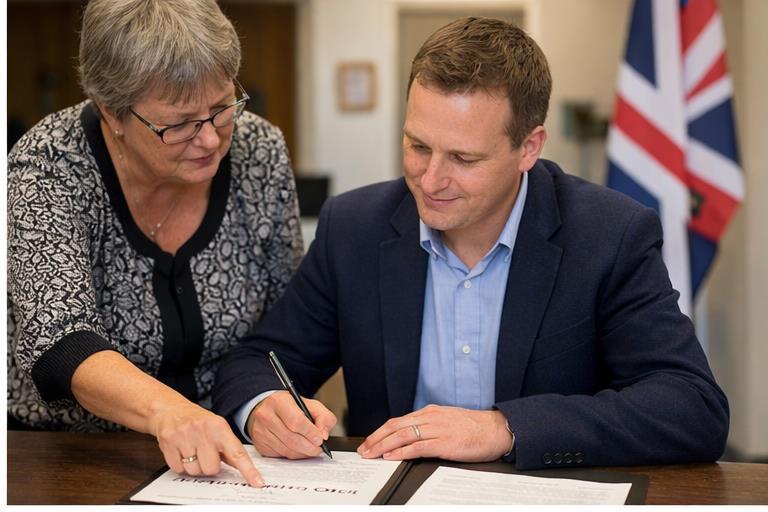
Welcome, and thank you for stepping forward to serve your community.
Being a parish councillor is a public office. It is voluntary, but it carries real responsibility. Parish councils exist to make decisions on behalf of the whole community, not to advance individual causes or personal views.
Helpston Parish Council operates as a corporate body. This means:
• Decisions are made collectively
• Individual councillors have no authority to act alone
• Once a decision is made lawfully, all councillors are expected to support it even if they voted against it
This induction pack is designed to help you:
• Understand your role clearly
• Participate confidently in meetings
• Stay within the law and code of conduct
• Contribute positively to a well-run council
It is not intended to overwhelm you with legislation or policies. Instead, it explains how the council works in practice and where to find further details when needed.
If you ever feel unsure, the Clerk is there to advise you.
2.1
As a parish councillor, you are:
• An elected or co-opted member of a local authority
• Subject to the Code of Conduct
• Personally responsible for acting lawfully, ethically, and respectfully
All councillors have equal status and equal voting rights, including the Chair.
You do not:
• Direct staff
• Make decisions outside meetings
• Represent the council unless authorised to do so
2.2 Collective Responsibility
The council can only act through formal resolutions passed at properly convened meetings.
This means:
• Individual councillors cannot commit the council to actions or spending
• Decisions are owned collectively, not personally
• Public disagreement is normal public undermining of decisions is not
2.3
The Chair presides over meetings, ensures fair debate, and maintains order and focus.
The Chair does not command councillors, override decisions, or act unilaterally except where explicitly authorised.
2.4
A councillor vacancy does not always arise at election time. If a councillor resigns, dies, becomes disqualified, or fails to attend meetings for six consecutive months without approval of the council, a casual vacancy arises.
When a casual vacancy occurs, the council must publish a formal notice of vacancy. Electors in the parish may then request that the vacancy be filled by election. If ten electors request this within the statutory notice period, a by-election must be held.
If no request for an election is received, the council may fill the vacancy by co-option. A councillor appointed by co-option has exactly the same legal powers, duties and responsibilities as a councillor elected at the ballot box.
The Clerk is the council’s Proper Officer and provides independent professional advice. The Clerk advises; councillors decide.
Councillors should respect professional boundaries, use the Clerk as a resource, and raise concerns through proper channels rather than resorting to email disputes.
• You represent the whole parish, not just those who agree with you
• Influence comes from persuasion, not volume
• Good governance is often quiet and unglamorous
• Respectful behaviour protects the council and yourself

3. Meetings: How Things Actually Work
3.1 Types of Meetings
Helpston Parish Council holds Full Council meetings (scheduled) and extraordinary meetings (when urgent matters arise). Only matters on the agenda can be decided.
The Annual Parish Meeting (APM) is not a meeting of the Parish Council. It is a meeting of the local government electors of the parish and must be held between 1 March and 1 June each year.
The meeting provides an opportunity for residents to discuss matters affecting the parish and hear reports about local activities.
Although councillors normally attend and may present reports, the meeting itself cannot make binding decisions on behalf of the Parish Council.
3.2 Agendas and Papers
Agendas are set by the Clerk in consultation with the Chair and published in advance to comply with legal requirements.
Councillors should read papers before meetings, raise clarification questions through the Clerk where possible, and avoid ambushing meetings with undeclared issues. Late items can usually only be noted not decided.
3.3 Motions, Proposals, and Resolutions
For a decision to be made:
1. A motion must be proposed
2. It must be seconded
3. It must be voted on
4. The result must be recorded
3.4 Quorum
For a council meeting to be legally held, a minimum number of councillors must be present. This minimum number is known as the quorum and is defined in the council’s Standing Orders.
If the meeting becomes inquorate (for example, if councillors leave the room due to declarations of interest), the meeting cannot continue and must be adjourned.
3.5 Voting
Council decisions are normally made by a simple majority of councillors present and voting. If the number of votes for and against a motion are equal, the Chair of the meeting has a second or casting vote which may be used to determine the outcome.
3.6 Public Participation
Members of the public have a right to attend meetings and to speak during the designated public participation period. They do not take part in debates, interrupt proceedings, or direct councillors. Councillors should listen respectfully, but remember: listening does not equal agreement.
During the public participation period members of the public may ask questions or make statements on matters relating to the agenda. The Chair controls the conduct of the meeting, including time limits for speakers.
Councillors are not required to respond immediately to matters raised during public participation. Issues may instead be noted and considered under the relevant agenda item or at a later meeting.
Councillors must declare Disclosable Pecuniary Interests (DPIs) and other interests where relevant. If in doubt: declare and seek advice. Failure to manage interests properly is one of the most common sources of council difficulty.
• Re-opening settled decisions without new information
• Speaking over the Chair
• Turning debate into an argument
• Treating meetings as campaigning platforms
• Conducting council business by email
Effective meetings are focused, respectful, and decision-led.
Once a resolution is passed, actions are recorded, responsibility is clear, and progress is monitored through agendas and minutes. Councillors should avoid parallel decisionmaking, issuing informal instructions to staff, and publicly contradicting council decisions.

Interests and bias are not unusual in parish council work councillors live in the community and care about local outcomes. The purpose of declaring interests is to protect the public, protect the council, and protect individual councillors.
Managing interests well strengthens trust. Managing them poorly is one of the quickest routes to complaints, reputational damage, and avoidable conflict.
4.1 Key Principle
If something could reasonably be seen to affect your judgement, declare it and seek advice. Declaring is protective, not an admission of wrongdoing.
4.2 Types of Interest
Councillors may have:
• Disclosable Pecuniary Interests (DPIs) financial or property-related interests that must be declared and may require withdrawal from discussion and voting.
• Other interests (sometimes called non-pecuniary interests) relationships, roles, affiliations or circumstances that could reasonably be perceived to influence judgement.
4.3 Predisposition vs Predetermination
It is normal to be predisposed to have an initial view. Predetermination is different: it is when a councillor’s mind is closed, and no evidence could change their position.
Councillors should avoid statements or online posts that suggest the outcome is predetermined before the council has properly considered the information.
4.4
All councillors must complete a Register of Members’ Interests within 28 days of election or co-option
This register records certain financial and personal interests and is maintained by the Monitoring Officer at Peterborough City Council, who is responsible for the standards framework for parish councils in the area.
4.5 What to Do in Practice
Before the meeting: if you believe an interest may arise, tell the Clerk early and ask for guidance.
At the meeting, declare the interest when the agenda item is reached. The minutes must record the declaration and what action you took (stayed, spoke, withdrew, did not vote).
After the meeting, do not seek to influence the outcome informally if you have withdrawn due to a conflict of interest.
4.6 Common Pitfalls
• Assuming ‘everyone knows’ your connection, so you don’t need to declare it
• Staying in discussion ‘just to answer a few questions’ when you should withdraw
• Using social media or email to campaign on a matter you are meant to judge fairly
• Trying to ‘balance’ an interest by voting the opposite way interests are managed by transparency, not by counter-voting
Default to declaring and asking for advice. The cost of over-declaring is small; the cost of under-declaring can be serious.
Where necessary, the Clerk can seek further advice through appropriate channels.
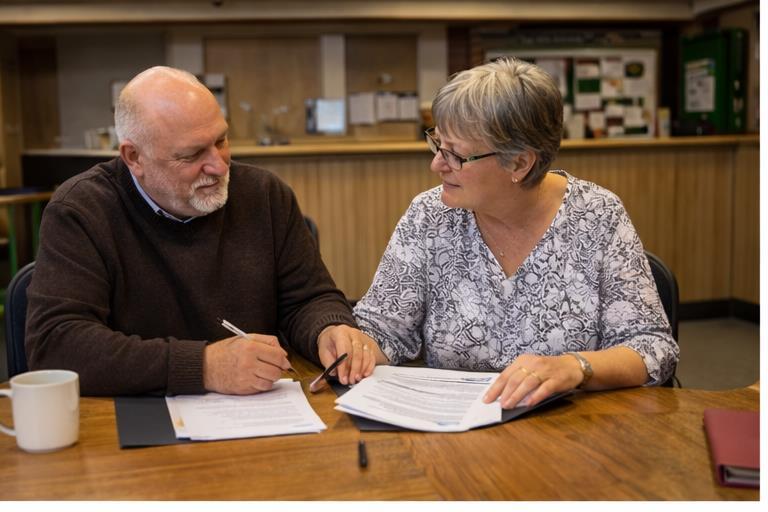
Parish council finance does not require councillors to be accountants. It does require councillors to understand what they are approving, what they are overseeing, and where responsibility lies.
This section explains parish council finance at the level required for good governance, confidence, and compliance.
The Council (collectively) sets the annual budget, agrees the precept, approves spending, monitors financial performance, and ensures public money is used lawfully and wisely.
The Clerk & Responsible Financial Officer (RFO) manages day-to-day finances, maintains records, ensures internal controls, prepares budgets and reports, and advises councillors on risk and legality.
Councillors decide what to do. The RFO advises how and whether it can be done lawfully.
The precept is the parish council’s share of Council Tax. Each year, the council sets a budget, considers reserves, agrees on the amount required, and requests it from the billing authority.
Important points: the precept is public money; changes must be justified; stability matters to residents. The precept is not a target to be spent in full and is not a guarantee of future income.
The budget estimates income and expenditure for the year ahead. Councillors should understand the big picture, question unusual changes, and focus on sustainability. Councillors should not rebuild the budget line by line or demand certainty where estimates are reasonable.
A good budget is a planning tool, not a prediction of exact outcomes.
5.4
Reserves are the council’s financial safety net. General reserves cover unexpected costs and provide stability. Earmarked reserves are set aside for known future projects.
Holding reserves is good practice, not hoarding.
When approving payments, councillors confirm that expenditure has been properly authorised, is reasonable and lawful, and that the correct process has been followed. Councillors are not checking invoice arithmetic or managing supplier relationships.
Reports help councillors see spend vs budget, emerging pressures, use of reserves, and cash position. Focus on significant variances, trends, risks, and upcoming commitments.
Internal controls are checks and balances that prevent error and fraud and provide assurance (e.g., separation of duties, authorisation procedures, bank reconciliations, independent checks).
5.8 Audit and Accountability (AGAR Explained Simply)
Each year, the council completes the Annual Governance and Accountability Return (AGAR) process, including internal audit and public inspection. Councillors approve governance assertions and accounting statements.
Box 9 records the total asset value. Asset registers and regular review matter because changes must be explainable.
Helpful questions: Is this within budget? What are the risks? How does this affect reserves? Is this one-off or recurring? Unhelpful behaviours: re-checking officer work, re-authorising agreed spend, moving decisions into email trails, treating finance as adversarial.
Trust is not blind it is supported by systems.
5.11
You are responsible for oversight, not bookkeeping. Finance works best when calm and transparent. Asking questions is healthy; mistrust is corrosive. Good financial governance protects everyone.
Planning is one of the most visible and emotionally charged areas of parish council work. It is also one of the areas most frequently misunderstood.
This section explains what role the parish council actually has, where influence is real, and how councillors protect themselves and the council.
Parish councils are statutory consultees. The council can comment and make representations. It does not grant or refuse permission.
Influence is strongest when comments are focused, clear, and policy-based, using material considerations and a consistent council voice. Influence is weakest when comments are emotional, repetitive, popularity-based, or when the council appears divided or campaign-led.
6.3 Material vs Non-Material Considerations
Material considerations include design, highways, amenity, flood risk, ecology, heritage, and Local Plan compliance. Non-material considerations include loss of view, property values, personal disputes, general opposition, and speculation about occupants.
6.4 Speaking as a Council vs Speaking as an Individual
Councillors may campaign personally but must not present personal views as council decisions or use council resources for campaigning. Council positions exist only through formal resolutions.
6.5 Predisposition, Predetermination & Bias
Having a view is normal; a closed mind is not. Avoid statements suggesting no evidence could change your position. Seek advice from the Clerk if unsure.
6.6 Interests and Planning Applications
Declare interests; perception matters. Declaring protects the councillor and the council.
6.7 Local Plans, Major Development & Reality
Strategic influence happens early at the Local Plan and evidence stages. Applicationstage objections cannot reopen settled policy.
6.8 Legal Action, Solicitors & Costs
Legal escalation should be a last resort, with formal approval and realistic prospects of success. Threats are not tactics.
6.9 Managing Public Pressure
Listen respectfully and explain the council’s role honestly. Do not promise outcomes that cannot be delivered.
6.10 Good Planning Behaviour
Effective councils focus on policy, keep comments proportionate, and respect professional advice. Ineffective councils re-litigate decisions, personalise debate, and blur roles.
6.11 Key Takeaways
The parish council influences planning — it does not control it. Policy beats passion. Declaring interests protects you. Credibility is your strongest tool.
Helpston Parish Council conducts much of its work digitally. Used well, this improves efficiency, transparency, and record-keeping. Used badly, it creates risk, confusion, and unnecessary conflict.
All council business must be conducted using councillor .gov.uk email addresses. This supports transparency, record-keeping, FOI compliance, and data protection.
Councillors should use the council email for council correspondence and assume emails may be disclosable. Councillors should not conduct council business via personal email, WhatsApp, or social media, nor forward council emails to personal accounts.
As part of the induction process, the Clerk will arrange the creation of each councillor’s official Parish Council email account and provide guidance on how to access and use it.
Email is not a decision-making forum. Keep messages focused and necessary. Avoid ‘reply all’ unless appropriate. Use meetings for decisions and avoid serial questioning or re-litigating decisions by email.
7.3 Shared Documents & Digital Files
Treat shared documents as the single source of truth. Respect version control and avoid parallel copies.
7.4 Transparency & Publication
Transparency is a legal duty. Publication protects the council and builds trust. Do not edit or remove published information without proper process.
7.5 Social Media & Public Comment
Councillors may use social media personally but must not present personal views as council decisions and must comply with the Code of Conduct.
7.6 Data Protection The Essentials
Only access and share personal data where necessary and through proper processes. Detailed procedures sit in the council’s policies.
7.7 Freedom of Information (FOI) What to Know
Pass FOI requests immediately to the Clerk. Do not respond individually. Preserve relevant information.
7.8 Common Digital Pitfalls
Running decisions through WhatsApp, using personal email, parallel documents, informal instructions to staff, and deleting emails that may be records.
7.9 Key Takeaways
Council business stays on council systems. Email supports decisions it does not replace meetings. Transparency is protection. When unsure, ask the Clerk.

Data protection is about respecting people, protecting the council, and working responsibly. It is not intended to prevent the council from functioning.
8.1 Personal Responsibility
Councillors may come into contact with personal information about residents, employees, contractors, or complainants. You are personally responsible for handling it appropriately.
8.2
Personal data includes names, contact details, complaints, correspondence, opinions about identifiable individuals, and information about health, finances, or employment.
8.3
Only access and use personal data where necessary for council business, and only for the purpose it was provided. Curiosity is not a lawful reason.
8.4 Storage, Devices & Security
Use council systems where provided, protect devices, and take care with printed documents. Do not store council data permanently on personal devices or use shared family computers for council business.
8.5 Emails, Messages & Records
Emails and messages relating to council business may be disclosable. Keep tone factual and proportionate. Assume permanence.
8.6 Confidentiality & Closed Sessions
Some matters must be discussed in private (staffing, contracts, complaints, legal advice). Respect confidentiality and do not disclose exempt information.
8.7 Data Breaches What to Do
If a breach occurs: do not panic; inform the Clerk immediately; do not attempt to fix it alone. Early reporting reduces risk and harm.
8.8 Freedom of Information vs Data Protection
FOI concerns access to information; data protection concerns personal data. Pass requests to the Clerk and preserve records.
8.9 Common Misunderstandings
GDPR does not mean ‘we can’t say anything’. Emails can be official records. Personal devices do not remove responsibility.
8.10 Key Takeaways
Treat personal data with respect. Use council systems. Ask before acting if unsure. Report issues early.
Parish councils are required to adopt and maintain a range of policies. These protect the council, guide behaviour, and demonstrate good governance.
9.1 Why Policies Exist
Policies set expectations, demonstrate compliance, provide consistency and fairness, and protect councillors, staff, and the council. A policy that is adopted applies to everyone.
9.2 Types of Policies
Mandatory policies (e.g., Standing Orders, Code of Conduct, Financial Regulations, Complaints, Data Protection/GDPR, FOI, Publication Scheme, Risk Management). Governance/operational policies (e.g., Scheme of Delegation, Asset Management, Internal Control, Training, Digital). Local/discretionary policies (e.g., grants, community engagement, cemetery regulations).
9.3 What Councillors Are Expected to Know
Councillors are not expected to memorise every policy but are expected to understand the purpose of key policies, know where they are held, act in accordance with them, and ask when unsure. Council policies are available:
• on the council website
• via the shared council document system
• or on request from the Clerk.
9.4 Policy Ownership & Review
Policies are drafted/updated by the Clerk, reviewed by councillors, and adopted by resolution. Changes must be agreed collectively through a proper process.
9.5 Using Policies in Practice
Policies should support decisions, resolve uncertainty, provide consistency, and deescalate conflict. They should not be used to target individuals or delay decisions unnecessarily.
9.6 When Things Go Wrong
If a policy is outdated or unworkable, raise it with the Clerk and propose review. Do not ignore it.
9.7 Clerk & Councillor Roles
The Clerk advises on compliance and maintains the master set; councillors set direction and approve adoption and review.
9.8 Common Policy Pitfalls
Treating guidance as optional, using draft policies as if adopted, selective application, informal workarounds, ignoring policies between reviews.
9.9 The Policy Map (At a Glance)
The council maintains a master policy list, review dates, version control, and public access via the website.
9.10 Key Takeaways
Policies protect and enable. You do not need to memorise them. Once adopted, they apply to everyone. Change happens through process, not exception.

Effective parish councils are defined by the quality of their decisions, the respect they show, the trust they build with residents, and the way they treat their Clerk and staff.
10.1 The Councillor Mindset
Act in the long-term interest of the parish, balance individual views with collective responsibility, and recognise that compromise is not weakness.
10.2 The Seven Principles of Public Life
Parish councillors are holders of public office and are expected to observe the Seven Principles of Public Life, often referred to as the Nolan Principles.
These principles are:
• Selflessness
• Integrity
• Objectivity
• Accountability
• Openness
• Honesty
• Leadership
These principles underpin the councillor Code of Conduct and guide the behaviour expected of those serving in public office.
10.3 Respecting the Role of the Clerk
The Clerk is the council’s Proper Officer, professional adviser, and guardian of procedure and legality. Councillors should treat the Clerk professionally, respect boundaries, and avoid undermining or managing by email.
10.4 Disagreement Without Dysfunction
Challenge ideas, not people. Accept lawful outcomes once decided. Move forward constructively.
10.5 Email Discipline & Behaviour
Email is a communication tool, not a decision-making forum. If an email chain is growing, the process has failed.
10.6 Managing Single-Issue Focus
Passion can be valuable; fixation can be destructive. The council must balance all parish business.
10.7 Conduct in Public & Online
Maintain courtesy, separate personal opinion from council position, and avoid online arguments about live matters.
10.8 When Things Become Difficult
Use policies and procedures, seek advice early, and escalate calmly and proportionately. Problems ignored do not resolve themselves.
10.9 Accountability & Self-Reflection
Ask yourself: Am I helping the council move forward? Am I respecting roles and boundaries? Would I be comfortable reading this email aloud in a meeting?
10.10 Supporting a Healthy Council Culture
Strong councils value professionalism, protect officers and volunteers, handle conflict fairly, and focus on outcomes, not ego.
Complaints that a councillor has breached the Code of Conduct are not investigated by the Parish Council itself. Complaints must be submitted to the Monitoring Officer at Peterborough City Council, who will determine whether the matter should be investigated under the authority’s standards procedures.
Effectiveness is about behaviour as much as it is about knowledge. Respect protects everyone. Email discipline matters. Disagreement is healthy hostility is not. Good culture is everyone’s responsibility.
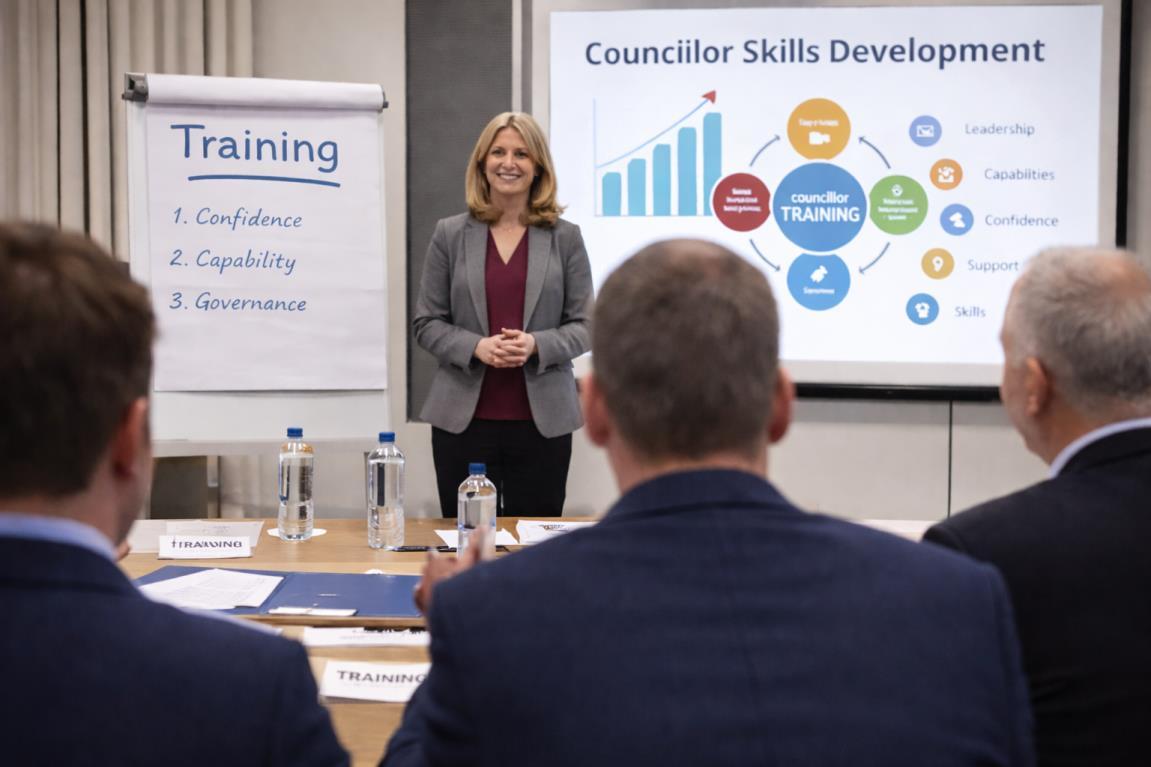
Training is a normal and expected part of being an effective parish councillor. Helpston Parish Council is committed to supporting councillors through appropriate training and development.
11.1
Training helps councillors understand responsibilities, participate confidently, make informed decisions, avoid common pitfalls, and work effectively with the Clerk and colleagues. Councillors wishing to attend training should contact the Clerk, who will identify appropriate courses (typically through CAPALC or the SLCC) and arrange booking where approved within the council’s training budget.
The council expects all councillors with less than three years’ service to complete basic councillor training within 12 months of appointment.
11.3 Chair & Vice Chair Training
The council expects the Chair to undertake Chair-specific training and supports the Vice Chair to do the same where possible.
11.4 Ongoing Development
Covers optional areas such as planning, finance, facilitation, community engagement, and digital working. Training is encouraged and proportionate.
11.5 Training Providers & Support
The council primarily uses training from CAPALC and SLCC (and other reputable sector providers as appropriate).
11.6 Costs & Approval
Training costs must be approved in advance and are recorded transparently.
11.7 Recording & Monitoring
The Clerk maintains a record of councillor training (course titles and dates) to support transparency and continuity.
11.8 Induction, Refreshers & Change
Training needs change over time; refreshers may be appropriate for longer-serving councillors.
11.9 Personal Responsibility
Councillors are expected to engage positively with training and apply learning constructively.
11.10 Key Takeaways
Training is normal and expected. New councillors should complete core training. Chairs have additional responsibilities. Learning strengthens the whole council.
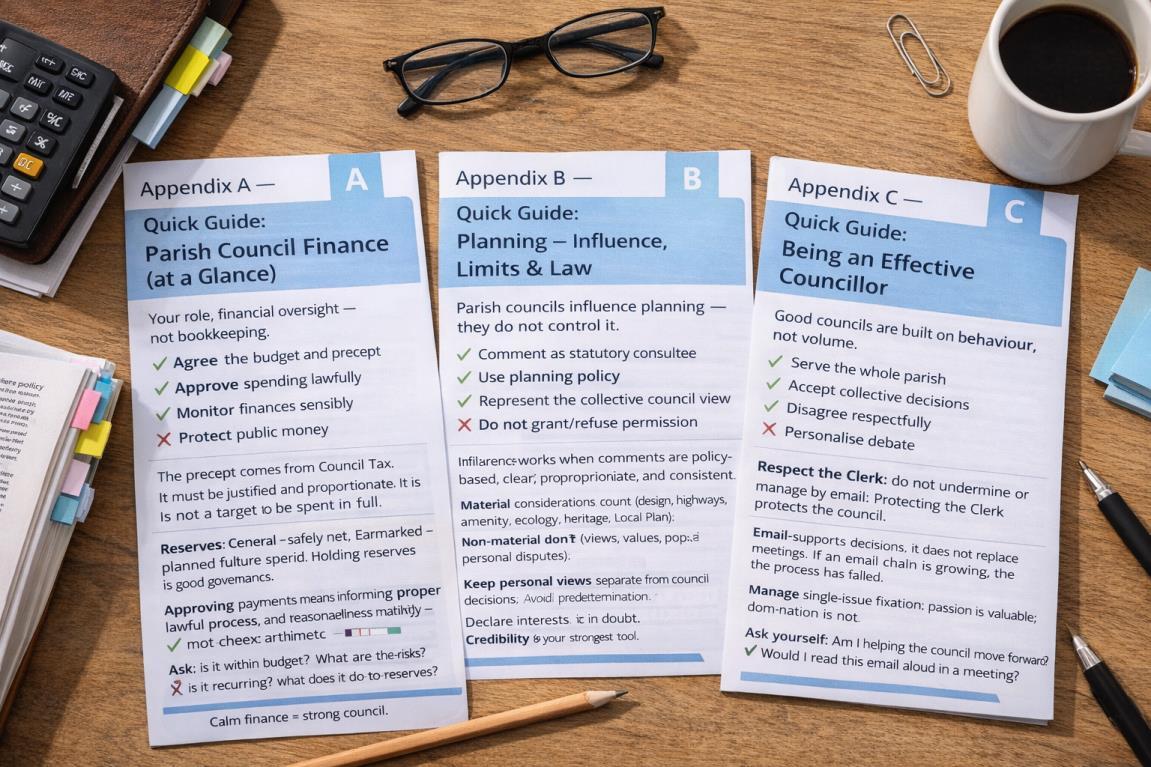
The following Quick Reference Guides are provided as practical, one-page summaries of key areas covered in this induction pack. They support councillors in real situations and reinforce good governance and behaviour. They do not replace the full induction pack or adopted policies.
Your role: financial oversight not bookkeeping.
✔ Agree the budget and precept | ✔ Approve spending lawfully | ✔ Monitor finances sensibly | ✔ Protect public money
✖ Do not manage day-to-day finance | ✖ Do not recheck officer work | ✖ Do not authorise spending informally
The precept comes from Council Tax. It must be justified and proportionate. It is not a target to be spent in full.
Reserves: General = safety net; Earmarked = planned future spend. Holding reserves is good governance.
Approving payments means confirming proper authority, lawful process, and reasonableness not checking arithmetic.
Ask: Is it within budget? What are the risks? Is it recurring? What does it do to reserves?
Avoid: micromanagement, email-based finance debates, re-authorising approved spend, adversarial tone.
Calm finance = strong council.
Parish councils influence planning they do not control it.
✔ Comment as statutory consultee | ✔ Use planning policy | ✔ Represent the collective council view
✖ Do not grant/refuse permission | ✖ Do not campaign using council resources | ✖ Do not promise outcomes
Influence works when comments are policy-based, clear, proportionate, and consistent.
Material considerations count (design, highways, amenity, ecology, heritage, Local Plan).
Non-material don’t (views, values, popularity, personal disputes).
Keep personal views separate from council decisions. Avoid predetermination.
Declare interests if in doubt. Credibility is your strongest tool.
Good councils are built on behaviour, not volume.
✔ Serve the whole parish | ✔ Accept collective decisions | ✔ Disagree respectfully
✖ Personalise debate | ✖ Re-argue settled decisions | ✖ Treat council as a platform
Respect the Clerk: do not undermine or manage by email. Protecting the Clerk protects the council.
Email supports decisions; it does not replace meetings. If an email chain is growing, the process has failed.
Manage single-issue fixation: passion is valuable; domination is not.
Be courteous in public and online; separate personal opinion from council position.
Ask yourself: Am I helping the council move forward? Would I read this email aloud in a meeting?
I confirm that I have received, read, and understood the Helpston Parish Council –Councillor Induction Pack, including the Quick Reference Guides attached.
I understand that this induction pack is intended to support lawful, effective, and respectful decision-making and forms part of the council’s governance framework and expectations.
I acknowledge that the council acts as a collective body and individual councillors do not act alone. Where I am unsure, I will seek advice from the Clerk at an early stage.
Name (print): ___________________________________________
Signature: ______________________________________________
Date: _________________________________________________
The signed acknowledgement will be retained by the Clerk as part of the council’s governance records.
Document Title: Helpston Parish Council – Councillor Induction Pack
Version: 1.0
Adopted by Council: [date]
Minute Reference: [minute number]
Review Cycle: Annual or as required
Next Review Due: [date]