Administrative & Standard Procedures


A. Travel and Training ……………………………………………….……. p. 4
B. Short Term Disability…………….……………………………….………. p. 22
C. Criminal History …………………...…………………………...…....…… p. 25
D. Staff Participation in Fire/Rescue ……………………………….………. p. 28
E. Annual Driver’s License Checks ……………………………….…………p. 30
F. Drug Free Workplace ………………………………………….………… p. 32
G. Hiring …….………………………………………………………………. p. 36
H. H.S.A. Contribution [Suspended]………….……………………………... p. 38
I. Tuition Reimbursement Procedures and Application …………….………. p. 39
J. Performance Evaluation Program ……………………….………………... p.43
K. Rescission – Addendum K: Sleep Policy.………………………………. p.
L. Last Check.………………………………………………………………. p. 52
M. Rescinded, effective Jan. 8, 2014 ...……………………………………. p. 53
N. Approval of Outside Employment.………………………………………. p. 54
O. Public Communication, Social Media & Technology……………………. p. 56
P. Public Safety Holdover and Extra Shift Pay ……………………………. p. 65
Q. Emergency or Disaster Compensation……………………………………. p. 66
R. Workplace Injuries and Workman’s Compensation ……………….…..…. p.74
S. Light Duty ………………………………………………………….………p.76
Effective July 1, 2008
Revised January 1, 2011
Revised February 7, 2024
PURPOSE:
To establish a uniform procedure for authorizing and reimbursing reasonable travel and other related costs and expenses incurred by Village employees or elected officials in conducting business on behalf of the Village. This Policy is designed to comply with applicable state and federal law, while promoting efficiency of operations and allowing flexibility when any Village employee or elected official is authorized to travel on Village business
OVERVIEW:
When it is necessary or desirable for a Village employee to travel to participate in a meeting, conference, workshop, seminar or to otherwise conduct Village business, the Village will bear necessary and reasonable expenses relating to these activities.
SCOPE:
I. The Village will pay all registration costs, including charges for any meals that are included as part of a registration fee for a meeting, conference, workshop, or seminar.
II. The Village will pay round trip public transportation to destination and transportation costs between airports, hotels, and activity sites. The use of economy-priced rental cars may be allowed by the department head when cost effective.
III. The Village will pay employees mileage for the use of their private auto, should travel by private vehicle be determined the most efficient transportation method. The Village allowance is based on current IRS regulations and will be reviewed annually each calendar year. Parking fees will be reimbursed. However, parking and or moving violation ticket received due to violation while on Village business are the responsibility of the employee.
IV. The Village will pay the actual cost of moderately priced out-of-town lodging, including gratuities, for the employee only. If an activity is being held at a hotel, the employee may select that hotel for lodging.
V. The Village will pay per diem for meal expenses.
VI. The Village will pay expenses for extended overnight stay when significant savings may be realized. Such extended stay must be specifically approved by the department head.
AUTHORITIES:
VII. The department head shall approve, in advance, all requests to travel on Village business made by those in his or her department and all expenses to be incurred and/or incurred relative to this trip. Because of his or her familiarity with the purpose of the trip and the personnel involved, the department head shall closely monitor expenses and question any unreasonable charges incurred.

VIII. The Finance Department shall also review all travel-related transactions and advise the department head of any apparent deviations from these procedures.
The Village Manager’s office shall rule on any differences of opinion in the interpretation of the terms of this procedure that cannot be resolved to the mutual satisfaction of the department head and the Finance Department.
The Finance Department is responsible for the management and oversight of this Policy.
Appropriation: Each Department shall include in its annual budget request the estimated travel and other related costs and expenses its employees will incur in conducting business on behalf of the Village. The Village Manager shall include an annual budget request for the estimated travel and other related costs and expenses other Village employees or elected officials will incur in conducting business on behalf of the Village.
Each Department Head shall be responsible for reviewing, approving, and managing budget appropriations for travel and other related costs and expenses incurred by their employees, and the Village Manager shall be responsible for reviewing, approving, and managing budget appropriations for travel and other related costs and expenses incurred by other Village employees or elected officials, in conducting business on behalf of the Village.
2. Approval Authority: Ongoing approval responsibility for specific travel, and for payments and reimbursements for related costs and expenses, shall be made according to this Policy and normal purchase procedures duly verified by the claimant, and submitted for final approval as noted below, unless otherwise provided:
a. If claimant is a member of the Village Council or other Village commission or board, approval will be determined by the Mayor.
b.If claimant is the Mayor, approval will be determined by the Mayor Pro Tempore.
c. If claimant is the Village Manager, approval will be determined by the Mayor or, if the Mayor is not available, the Mayor Pro Tempore.
d. If the claimant is a Department Head, approval will be determined by the Village Manager.
e. If the claimant is any Village employee other than (A) through (D) above, approval will be determined by the respective Department Head, or, if none, the Village Manager.
f. The approving individual is responsible for ensuring that the costs and expenses for which reimbursement or payment is sought are legitimate, reasonable, properly documented, and in conformance with this Policy.
3. Request for Travel Authorization (and Cash Advance): Prior to incurring any travel or other related costs and expenses for business on behalf of the Village and for which a Village employee or elected official seeks reimbursement or payment, the Village employee or elected official shall first obtain approval, as follows:
4.A Request for Travel Authorization (and Cash Advance) form, attached hereto as
Appendix A (“Authorization Form”), must be submitted to the Finance Department and the Village Manager (and to the respective individual’s authorized approver, as identified in Section 2.II above) whenever the travel and other related costs and expenses (including for conferences, meetings, seminars, trainings, and workshops) are (or are estimated to be) $500 or more, whenever travel is to take place out of state, and whenever a cash advance is requested. A Purchase Order number must be obtained.
5. Whenever the travel and other related costs and expenses (included for conferences, meetings, seminars, trainings, and workshops) are (or are estimated to be) less than $500, travel, if any, is to take place in state, and a cash advance is not requested, the prior approval of the respective individual’s authorized approver, as identified in Section 2.II above, is required. This approval process is informal, but any approval should be in written format, [preferably email].
6. Whenever the travel and other related costs and expenses (included for conferences, meetings, seminars, trainings, and workshops) are (or are estimated to) exceed the total amount budgeted for such costs and expenses in any Department or by the Village Manager, where applicable, the additional approval of the Village Manager or the Finance Director is required.
7. Grant-Funded Travel: If a Village employee or elected official plans to seek reimbursement or payment from state or federal grant funds for travel or other related costs and expenses for business on behalf of the Village, the employee or elected official must first consult the grant terms and conditions with regard to such costs and expenses, which may be more restrictive than this Policy, and then consult with the grantor(s) if the terms and conditions are unclear. Certain grants, for example, require the use of a reduced mileage rate if a personal vehicle is used when a Village vehicle is available. In addition, certain grants may have different meal per-diems than this Policy, and/or hotel rate maximum rates may be enforced.
I. The General Services Administration (“GSA”) issues Federal Travel Regulations (“FTRs”). The codified FTRs are contained in 41 CFR, chapters 300-304. Any Village employee or elected official that plans to seek reimbursement or payment from state or federal grant funds must consult with the applicable grantor(s) for guidance as relates to the FTRs to ensure that eligible costs and expenses are properly charged.
8.Transportation. Ordinarily, the most economical and expeditious form of transportation should be used by Village employees and elected officials.
I. Air Travel: Only economy class air travel will be reimbursed or paid for by the Village, unless economy class is unavailable. The selection of higher fares (and manipulation of travel route for purposes of obtaining credit card points or other remuneration) by Village employees or elected officials is prohibited. If a Village employee or elected official chooses to fly first class or business class, the employee or official will pay the cost difference. Documentation of the airline ticket must be attached to the Expense-Reimbursement Form attached hereto as Appendix B (“Reimbursement Form”).
i. All airline tickets should be purchased at least twenty-one (21) days before the departure date, if possible, to get a discounted price. Airlines
may also offer substantial discounts if the trip includes a Friday or Saturday night stay. Travelers may leave early or extend a business trip into a weekend to take advantage of a substantial discount. The Village will reimburse costs and expenses for additional weekend night(s) on an extended business trip if the costs and expenses, with the additional night(s), are less than what they would have been without the additional night(s). Documentation of such savings must be attached to the Reimbursement Form, lest the reimbursement may not be made.
ii. Village employees and elected officials should be flexible as to the time of day, carrier, and routing to obtain an economical fare; provided, however, that employees and officials will not be required to travel before 7:00 am or after 9:00 pm but may choose to do so, if convenient to them.
iii. The Village will cover the costs and expenses associated with one checked bag. If a Village employee or official is required to take additional business materials while traveling, a second checked bag for this purpose must be documented and approved by the Village Manager, the respective individual’s Department Head, or the Finance Director.
iv. Village employees and officials must review cancellation policies and other terms and conditions when booking travel indirectly through thirdparty websites such as Expedia, Travelocity, Hotwire, Priceline, and others. Third-party websites may have more stringent cancellation policies than booking directly and can come with additional financial risk.
II. Village Vehicle: Only Village employees (and not elected officials) are authorized to drive a Village vehicle; employees must have a valid Driver’s License. Village employees must receive authorization from their respective Department Head to be permitted to travel in Village vehicles; provided, however, that the Village Manager or designee must approve travel by Village vehicle outside of North Carolina
i. Subject to approval as set forth herein, payment or reimbursement for gasoline, oil, parking, repairs, storage, tolls, and other reasonable costs and expenses will be made when a Village vehicle is used for business on behalf of the Village. Paid, itemized receipts or other documentation supporting any such payment or reimbursement request (except for tolls) must be attached to the Reimbursement Form. The Village employee must also provide the fleet superintendent, or equivalent position, with a record of any costs and expenses incurred with respect to the Village vehicle.
III. Private Vehicle. Reimbursement for a Village employee or elected official’s personal vehicle is at the standard mileage rate allowable by the Internal Revenue Service at the time of travel and is to be reimbursed directly to the employee or official. No reimbursement will be made for expenses incurred for fuel, insurance maintenance, repairs, towing, or other expenses with respect to a personal vehicle; provided, however, that the employee or official will be reimbursed for parking fees (but not fines) and tolls, if any are levied in the course of business on behalf of the Village. The insurance policy of the
Village employee or elected official driving the vehicle will cover any accidental damage to the vehicle.
i. Employees or officials traveling to the same event are encouraged to carpool. A Village vehicle, if available, may not be used for travel if an employee is accompanied by family members or others who are not involved in the Village’s business purpose of the trip.
ii. Mileage will be calculated to include the miles traveled: (i) on a roundtrip basis, from the starting point of travel, as identified by the employee or elected official or, if not so identified, the respective individual’s authorized approver, to the destination and back; and (ii), if applicable, to and from their hotel and the event location and to and from their hotel and any restaurant(s) for meals. Mileage will not be calculated to include any miles traveled for sightseeing or other personal, non-Village-businessrelated matters. Documentation of such mileage (such as in the form of a map or mileage printout) must be attached to the Reimbursement Form, lest the reimbursement may not be made.
IV Rental Vehicle: The Village will only cover a rental vehicle if the employee or official can demonstrate a business need for the vehicle during the business trip and it is economically feasible. Employees and officials must select the insurance policy covering any accidental damage to the rental vehicle with the rental contract. Employees and officials must rent a vehicle from the economy, compact, intermediate, standard, or full-size vehicle class (car/sedan) unless the number of travelers (Village employees or officials) is greater than four (4). Unauthorized parties are not allowed in rental cars paid for or reimbursed by the Village. If the NC State Contract Rate (“Contract # 975B – Vehicle Rental Services”) is available and provides savings as compared to the regular rate, the NC State Contract Rate should be utilized. Documentation of a vehicle rental (such as in the form of a paid invoice) must be attached to the Reimbursement Form, lest the reimbursement not be made.
i. Village employees and officials must review cancellation policies and other terms and conditions when booking rental vehicles indirectly through third-party websites such as Expedia, Travelocity, Hotwire, Priceline, and others. Third-party websites may have more stringent cancellation policies than booking directly, and can come with additional financial risk.
V. Other Transportation (i.e., Taxi, Ride Share, Uber, Lyft, Car Service, Train, Mass Transit): The Village will reimburse reasonable costs and expenses associated with ride-sharing services, such as Lyft, Uber, or another service, for transportation to and from a Village employee or elected official’s hotel and the event location and to and from their hotel and any restaurant(s) for meals. When selecting a ride-share service, employees or elected officials should use one of the standard tiers as opposed to upgrading to premium-tier vehicles. Tip amounts should be reasonable and should not exceed twenty percent (20%). If requesting reimbursement for these additional costs and expenses, receipts must be obtained and submitted with the Reimbursement
I. Overnight Trips: For approved overnight trips, the Village will provide a perdiem reimbursement for meals and incidentals at the rates published by the U.S. General Services Administration (“GSA”) and in effect at the time the Reimbursement Form is submitted: https://www.gsa.gov/travel/plan-book/perdiem-rates.
i. The rates are based on the federal fiscal year, which begins on October 1st annually. For example, selecting FY24 on the GSA website will show rates in effect from October 1, 2023, through September 30, 2024.
ii. The rates vary by location, but the applicable rate will be based on the destination of travel. If the destination is not specifically listed, the GSA website will display the standard rate that must be reported. The GSA website also reflects a reduced amount for the first and last day of travel. The employee or elected official must show the partial rate for the first and last day, regardless of the time of day departing and returning. Employees or elected officials must include a printout of the meals and incidentals rate breakdown from the GSA website with the Reimbursement Form. Itemized receipts are not required for meals on overnight trips
iii. The Village will not reimburse for meals that are included in event registration fees unless otherwise allowed by this Policy. Any meals paid by the Village as part of the event registration should be noted as “prepaid” in the meals section of the Reimbursement Form. On the first and last day, meals there were provided will be deducted from the reduced rate at the full meal amount. The per-diem amount will never be reduced below the full daily amount for incidentals. An employee or elected official will not be reimbursed for breakfast if the lodging establishment or event host or sponsor offers a free breakfast.
iv. If an employee or elected official has special dietary needs, they must notify the lodging establishment or event host or sponsor for accommodation. If the establishment, host, or sponsor is unable to accommodate the dietary needs of the employee or elected official, the employee or elected official may receive the per diem meal amount in lieu of any meals covered by the event registration by attaching a statement requesting the same to the Reimbursement Form. A copy of the agenda providing details of meals and scheduled events should be submitted with the Reimbursement Form.
v.The GSA rates include a set per diem amount for incidentals, which employees or elected officials will receive as part of the overall per-diem reimbursement (which includes meals and incidentals). The GSA incidentals amount is meant to cover laundry costs and fees and tips given to porters, baggage carriers, bellhops, and hotel housekeepers. Receipts
should not be submitted for these items with the Reimbursement Form, as these items are covered in the per-diem for meals and incidentals.
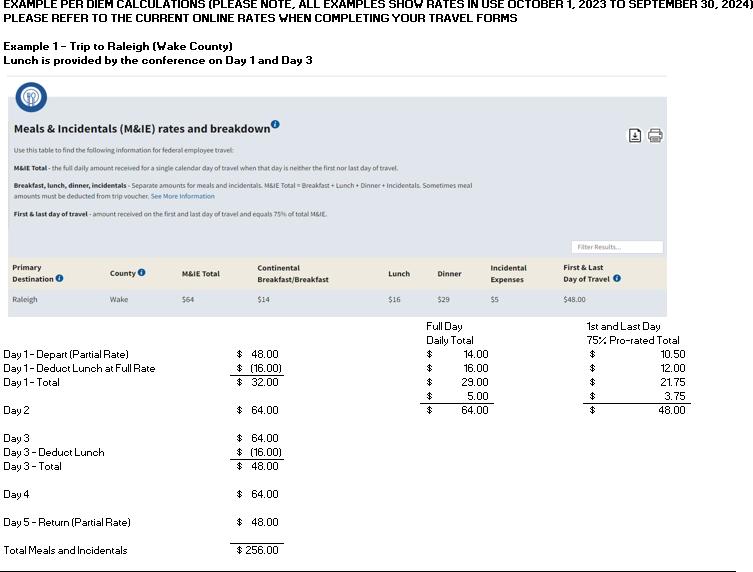
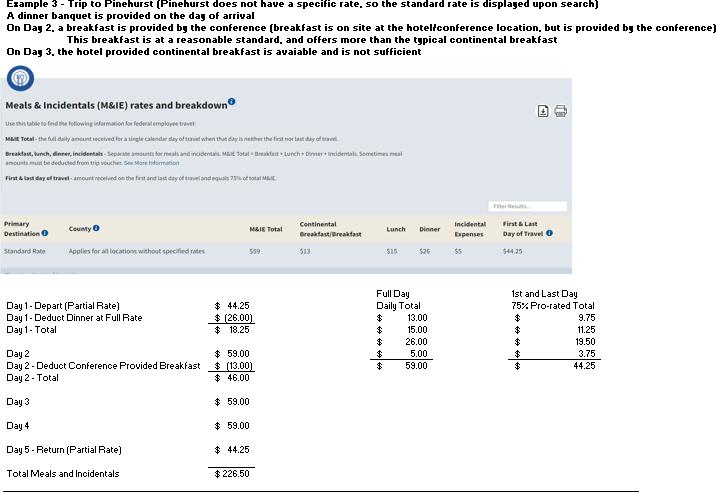
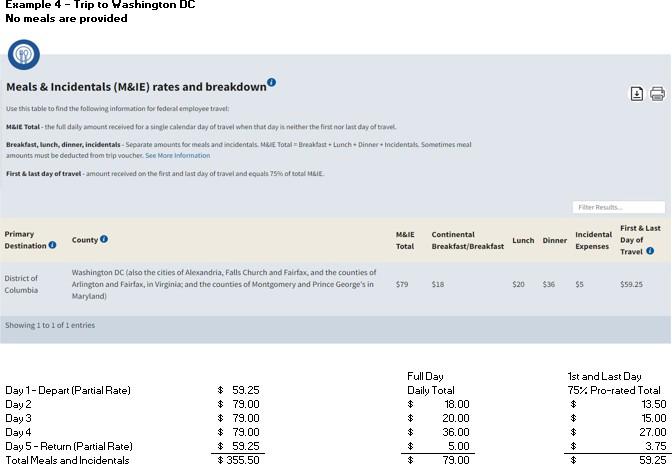
vi Please see Appendix C for example calculations.
II. Business Meals: The Mayor, Village Council members, Village Manager, Assistant Village Manager, and Department Heads may have occasion to provide business meals for a meeting. Meals will be covered when the meeting is to transact Village business. These meals may be procured with the Village’s credit card, or payment or reimbursement may be requested in accordance with this Policy. Supporting documentation for such costs and expenses must include receipts and must list the date, description of business discussed, and names and company or organizational affiliations of persons attending.
III. Same-Day Trips or Commuting to Multi-Day Events: No per diem meal expenses will be allowed if the event and associated travel, if applicable, do not require an overnight stay. An exception to this rule may be allowed by the Village Manager or Finance Director when an early departure or late return is an alternative to an overnight stay.
10.Lodging: The Village does not use GSA rates for lodging. The Village will pay the actual cost of reasonably priced out-of-town lodging, including gratuities, for the employee or elected official only. If an event is being held at a hotel, the employee or elected official should select that hotel for lodging. Another hotel may be selected if the hotel at which the event is taking place is booked up.
I. If a discounted hotel rate is offered for an event, the employee or elected official must effort to obtain the discounted rate. The discounted rate may sell out quickly, in which case other reasonable lodging rates will be paid or reimbursed by the Village, if approved in accordance with this Policy
II. If the rate for an employee’s or elected official’s selected hotel is unreasonably high, as determined by the respective individual’s authorized approver, the authorized approver will need to provide an explanation, or the employee or elected official may be required to cover the difference between the selected hotel rate and the average hotel room rate for the time period and locale in question.
III. The employee or elected official is responsible for canceling reservations and must pay cancellation or no-show fees, unless the respective individual’s authorized approver finds that an emergency or other approved business reason caused the cancellation. The employee or elected official should always obtain a cancellation number from the designated hotel to protect against no-show billings.
IV Reimbursement will not be made for in-room charges, such as charges associated with movies, mini-bars, laundry, snacks, or other non-essential needs.
V. Meals should not be charged to the room, as this is covered under the perdiem reimbursement for meals. Employees or elected officials must request that meal charges are removed from the hotel bill. If a meal is inadvertently charged to the room and not removed from the bill, it must be deducted and must not be included with the lodging charges on the Reimbursement Form. It is the employee or elected official’s responsibility to review the hotel bill before departing to ensure there are no unauthorized charges.
VI. Village employees and officials must review cancellation policies and other terms and conditions when booking travel indirectly through third-party websites such as Expedia, Travelocity, Hotwire, Priceline, and others. Thirdparty websites may have more stringent cancellation policies than booking directly and can come with additional financial risk.
11. Office Expenses: Subject to approval as provided for herein, the Village will reimburse reasonable costs and expenses associated with postage, phone calls, photocopies, internet service, miscellaneous supplies, and other office products or services during a business trip, if supporting documentation therefor is provided with the Reimbursement Form. If an employee or elected official has a Village-issued cell phone, they should use the cell phone for business calls as opposed to using the hotel phone and requesting payment or reimbursement therefor.
12. Travel with Family: Family members may accompany the employee or elected official on business trips. However, upon approval as provided for herein, the Village will only pay or reimburse the reasonable costs and expenses incurred by the employee and for which payment or reimbursement may be made herein, as if traveling alone.
14. Authorization: An Authorization Form is to be completed by the employee or elected official, and submitted to the Finance Department, Village Manager, and the respective individual’s authorized approver, for travel or other related costs and expenses for business on behalf of the Village and for which the respective individual seeks reimbursement or payment, whenever the travel and other related costs and expenses (including for conferences, meetings, seminars, trainings, and workshops) are (or are estimated to be) $500 or more, whenever travel is to take place out of state, and whenever a cash advance is requested. A Purchase Order number must be obtained.
I. The Authorization Form is not required where the travel and other related costs and expenses (including conferences, meetings, seminars, trainings, and workshops) are (or are estimated to be) less than $500, travel, if any, is to take place in state, and a cash advance is not requested. Here, the prior approval of the respective individual’s authorized approver is required.
II. The Authorization form, when required, must show all actual or estimated costs and expenses to be incurred by the employee or elected official (including supporting documentation, as set forth by way of example herein) and be submitted to the appropriate party or parties for approval
III. In most cases, these costs can be put on the Village’s credit card. A temporary credit card increase may be requested if needed. A Purchase Order number
should also be obtained and entered on all documents for expenses paid with the Village’s credit card.
15. Cash Advances: For travel less than seven (7) days, subject to approval as provided for herein, reasonable travel and other related costs and expenses will be reimbursed after the travel is completed.
I. For travel that lasts seven (7) days or more, the Finance Department, Village Manager, and the respective individual’s authorized approver may approve a cash advance, as set forth above, if requested by the employee or elected official. A cash advance may be requested based on the per diem rate for meals and incidentals, but a cash advance may not be requested for mileage. Subject to approval as provided for herein, mileage will be reimbursed upon return from travel via the Reimbursement Form.
II. In cases when the travel and other related costs and expenses for business on behalf of the Village would create a financial hardship for the employee or elected official, the employee or elected official may request a cash advance (regardless of the length of the trip), as long as the advance is no more than $150.00 or does not exceed the total per diem amount for meals, whichever is less.
III. To obtain a cash advance, the employee or elected official shall submit the Authorization Form to Accounts Payable at least ten (10) days before the travel or event date. Because it can take a week or more for the Authorization Form to go through approval, it is advisable for the employee or elected official to begin the process fourteen (14) to twenty-one (21) days before the travel or event date. Cash advance requests received by Accounts Payable less than ten (10) days before the travel or event date will not be processed, and the employee or elected official will be asked instead to submit a Reimbursement Form upon return from travel or conclusion of the event.
IV If an employee or elected official’s trip is canceled for any reason after receiving a cash advance, the employee or elected official will reimburse the Village within seven (7) days of the first day of travel or the first day of the event, whichever is earlier. If the employee or elected official does not reimburse the Village within seven (7) days, the amount of the advance may be withheld from the employee’s or elected official’s paycheck.
16.Payment Procedures:
I. Credit Card: Village employees and elected officials should use a Village credit card for travel and other related costs and expenses for business on behalf of the Village, whenever feasible. The Village does not receive a sales tax reimbursement when an employee or elected official is reimbursed for such costs and expenses.
i. Appropriate expenditure codes, as set forth in Section 4 below, should be used on any such costs and expenses paid for by credit card.
ii. If an employee or elected official does not have a Village credit card, the Finance Department staff may book transportation, registration, and lodging for the employee or elected official, or the employee or elected official may follow established guidelines for obtaining a credit card from the Finance Department. To book a hotel for an employee or elected official who will not have a credit card at check-in, the Finance Department staff must call the hotel to complete a pre-authorization form, which the Finance Department signs to authorize the hotel to use the applicable card for the stay, including incidentals). On the preauthorization form, incidentals must be allowed because the hotel must have a card to hold for such charges. Employees or elected officials must not charge personal incidentals to their room.
iii. The credit card must not be used for the purchase of meals when traveling for business on behalf of the Village, as this is handled through payment or reimbursement of the per-diem rates for meals. Business meals at meetings to transact Village business, and not requiring travel, may be purchased using the credit card or paid or reimbursed in accordance with this Policy.
17. Expense Codes: When the forms provided for herein are prepared, the following object codes should be used along with the proper fund and department codes:
I. Expenditure Code 1200 – Travel: The cost of attending conferences, seminars, classes, trainings, conventions, or other meetings of professional associations (national, state, or local meetings) including transportation, meals, lodging, vehicles (including mileage) and other similar items.
II. Expenditure Code 3500 – Training and Certification: Required cost for registration or fees for attending various national, state, and regional conventions and conferences, as well as enrollment fees for various special training seminars. Also, include required costs for registration or fees for training that provide credit towards professional or trade certifications. This code is also used when there is a cost to apply for or renew certifications. Use 3500 for registration and fees associated with required professional certifications, such as CDL, licenses, and notary certifications.
18. Reimbursement Form: Within ten (10) days after returning from travel or the event, if travel is not required, the employee or elected official must complete the Reimbursement Form and submit it for approval by the respective individual’s authorized approver identified in Section II.2 above. The Reimbursement Form shall have the same Purchase Order number as on the Authorization Form, if required.
I. Receipts: Itemized receipts supporting the following costs and expenses must be attached:
i. Event (i.e., conference, meeting, seminar, training, workshop, etc.) registration fees;
ii. Lodging (as set forth in Section II.7 hereof);
iii. Transportation (as set forth in Section II.5 hereof);
iv.Meals and Incidentals (as set forth in Section II.6 hereof);
v.Village Vehicles, Rental Vehicles (as set forth in Sections II.5(B) and (D) hereof);
vi. Mileage for use of Private Vehicle (as set forth in Section II.5(C) hereof);
vii. Other Transportation (as set forth in Section II.5(E) hereof); and
viii. Office Expenses (as set forth in Section II.8 hereof)
ix. NOTE: Any costs and expenses made by credit card should be noted on the Reimbursement Form, and copies of receipts should be attached.
II. Amount Due the Employee. Subject to approval as set forth herein, the employee or elected official will be reimbursed for any allowable costs and expenses set forth herein. The employee or elected official is responsible for paying charges made on personal credit cards with the reimbursement received from the Village.
III. Expenses Not Reimbursed: The Village will not reimburse the following and the Village employees or elected officials will be held responsible for all, personal costs and expenses and all unreasonable costs and expenses, as determined by the respective individual’s authorized approver identified in Section II.2 above, paid while traveling on Village business. The following costs and expenses are not reimbursable and should not be included on a Reimbursement Form:
i. fees associated with any personal charges or personal credit cards, including late fees, and finance charges;
ii. air travel insurance or other personal travel insurance;
iii. first class or business class travel;
iv. barber, manicurist, beautician, etc.;
v. athletic, social, or country club fees;
vi. newspapers, magazines, toiletries, cigarettes, candy, snacks, sunscreens, etc.;
vii. dependent care, elder care, pet care, home sitting, etc.;
viii. medical expenses, prescriptions, and over-the-counter medications;
ix. personal articles, clothing, luggage, and/or briefcases damaged or lost during travel;
x. baggage overweight fees;
xi. personal entertainment, such as in-room movies and mini-bars;
xii. parking, traffic, or towing fines or tickets;
xiii. valet parking, unless mandatory;
xiv. airline club fees and memberships;
xv. avoidable cancellation charges;
xvi. rental car and airline upgrades;
xvii. repairs due to vehicle accidents;
xviii. TSA pre-check application fee; and
xix.any other cost or expense for which payment or reimbursement is not expressly permitted by this Policy
IV. Amount Due Village: If a cash advance was made to an employee or elected official and the amount exceeds the actual travel and other related costs and expenses, the employee or elected official must submit a check or money order for the amount due to the Village within seven (7) days after returning
from travel or the conclusion of the event, if travel was not required. An image of the receipt must be attached to the Reimbursement form. Reimbursements received from outside agencies, and cash advance repayments, must all be sent to Accounts Payable to ensure that credit is applied to the Purchase Order.
V. Pre-Audit: In addition to the review of the authorized approvers as set forth and required herein, before making any payments or reimbursements, Accounts Payable shall pre-audit any Authorization Form and Reimbursement Form for compliance with N.C. Gen. Stat. §159-28(b), ensuring that the amount payable therein is determinable and that the Village’s budget ordinance or applicable project ordinance in effect for the current fiscal year includes an appropriation authorizing the expenditure and an unencumbered balance remains in the appropriation sufficient to reimburse the claimant. All Authorization Forms and Reimbursement Forms shall include a certificate signed by an employee or officer of Accounts Payable and stating, in substantially the same form, that “this instrument has been pre-audited in the manner required by the Local Government Budget and Fiscal Control Act.” If an Authorization Form or Reimbursement Form is in order as determined by the authorized approvers set forth and required herein and Accounts Payable, the Village employee or elected official will be paid or reimbursed. If there are questions on any item, Accounts Payable will consult with the authorized approvers as set forth and required herein and the claimant(s) in order to resolve such questions.
I. Disregard for this Policy may result in disciplinary action and criminal prosecution. Willful intent to alter receipts and submission of falsified forms will result in disciplinary action, up to and including termination. Pursuant to N.C. Gen. Stat. §159-18(a), any employee or officer of a local government or public authority who submits a written claim or approves a claim for funds that they know to be false is guilty of a misdemeanor
II. Any records of Village employees maintained as a result of this Policy are subject to inspection and disclosure as provided in N.C. Gen. Stat. §160A168. Any records of Village elected officials maintained as a result of this Policy are subject to the North Carolina public records law, as contained in Chapter 132 of the N.C. General Statutes
III. Village employees and officers absent from the Village on official business therefor will be covered by workers’ compensation insurance in accordance with the North Carolina Workers’ Compensation Act, as contained in Chapter 97 of the N.C. General Statutes. The determination of hours works for time spent in travel and training shall be computed in accordance with the provisions of the Fair Labor Standards Act, 29 U.S.C. §201 et seq.
I. This Policy may be amended as needed by the Finance Director to ensure that the Village remains compliant with any action or instruction as given by the Village Council as well as any applicable state or federal laws and, as the need arises, with approval by the Village Manager and notice given to the Village Council.
Adopted and Approved by the Village Council of the Village of Bald Head Island, this the 7th day of February 2024.
Peter Quinn, Mayor
SEAL Darcy Sperry, Village Clerk
ATTEST:
This is the authorization form to be completed by the employee or elected official prior to incurring any travel or other related costs and expenses for business on behalf of the Village and for which the employee or elected official seeks reimbursement or payment. This form must be completed whenever the travel and other related costs and expenses (including conferences, meetings, seminars, training, and workshops) are (or are estimated to be) $500 or more, whenever travel is to take place out of state, and whenever a cash advance is requested. A Purchase Order must be included, and the form must list all estimated (or actual) costs and expenses whether the employee or elected official is requesting a cash advance or not. This form may be amended, as needed, by the Finance Director, or their designee, as they see fit.
This is the final report to be completed by an employee or elected official within ten (10)days after returning from travel or the conclusion of the event, as a record of all reimbursable costs and expenses incurred by the employee or elected official for business on behalf of the Village. The form must have the same Purchase Order number as was listed on the Request for Travel Authorization (and Cash Advance) form. The form must be completed, showing a recap of all costs and expenses, even if no reimbursement is needed. This form may be amended, as needed, by the Finance Director, or their designee, as they see fit.
APPENDIX C:
Per-Diem Example
Calculations:

January 1, 2011
Effective Date
Revised January 1, 2025
I. Purpose
Effective: January 25, 2008
To provide income for employees who are temporarily disabled due to a non-work-related accident or illness.
II.Coverage & Policy
Amount of Benefit:
60% of Basic Weekly Salary
Benefit Begins: 8th day of a Disability due to an Accident or Sickness
Maximum Payment Period: 26 weeks
*Only employees working 30 hours or more per week are eligible for this benefit.
If a Participant while covered under this Plan for short term disability benefits, shall become wholly and continuously disabled so as to be actually prevented from the performance of every duty of his or her occupation or employment for salary or wages, due to bodily injury or sickness, the MITNC will pay benefits to such Participant according to the Schedule of Benefits.
Employees must be active at work on the effective date of the short-term disability benefit plan to be eligible for benefits. If the employee is not active at work, short-term disability benefits will be postponed until the employee returns to work for at least five consecutive workdays. For the purpose of this plan, actively at work shall mean the active expenditure of time and energy in the service of the governmental unit, except that a Participant shall be deemed actively at work on each day of a regular paid vacation, or on a regular non-working day, on which he or she is not disabled, provided he or she was actively at work on the last preceding regular working day.
Successive periods of disability shall be considered as one continuous period of disability unless: (1)the subsequent disability is due to causes entirely unrelated to the causes of the previous disability: or (2) they are separated by a continuous period of at least two weeks during which the Participant is not absent from active work on a full-time basis. Changes in the amount of benefit due to change in occupation, position, salary, or wage will become effective on the first day of the month following the date of change, except if the Participant is away from work due to disability on the date an increase in the amount of benefit would become effective, it will be postponed until the Participant returns to active full-time work.
WAR: You are not covered for Disabilities caused or contributed to by war or any act of War. War means declared or undeclared War, whether civil or international, and any substantial armed conflict between organized forces of a military nature.
INTENTIONALLY SELF-INFLICTED INJURY: You are not covered for Disabilities caused or contributed to by an intentionally self-inflicted injury, while sane or insane.
EMPLOYMENT: You are not covered for Disabilities arising out of or in the course of any employment for wage or profit.
Addendum B: Short Term Disability
OCCUPATIONAL BENEFITS: Employees’ are not eligible for benefits during any period you are receiving or are eligible to receive benefits under a Workers’ Compensation law or similar law. If your claims for these benefits are accepted, compromised, or settled, you must repay us for the full amount of any payments we make to you while your claims for occupational benefits were pending.
LONG TERM DISABILITY: You are not eligible for STD benefits during any period you are receiving or are eligible to receive LTD benefits under any policy.
BENEFIT OFFSETS mean the following:
1.Sick pay or salary continuation from the Employer; and
2.Any amount you receive or are eligible to receive because of your Disability under any state disability income benefit law or similar law.
The following procedure should be followed for eligible employees to receive short-term disability pay.
1.Employees shall notify Human Resources when they are going to be out of work due to the disability of this standard procedure and the STD policy (take note of exclusions listed above), and of the need to provide ongoing doctor's documentation to receive disability payments. A schedule of documentation will be established on a case-by-case basis as warranted by disability.
2.Employees shall submit to the Human Resources Department a statement of disability/illness provided by the Physician. It is the employee's responsibility to provide enough documentation from a qualified physician that substantiates the employee's inability to work during the period of disability. Failure to provide this documentation will result in the discontinuation of short-term disability pay. The documentation must be submitted to the Human Resource Director showing the doctor's documentation on the disabled employee prior to the employee receiving short term disability pay
3.If a scheduled holiday falls during a pay period and the employee is using sick leave before and after the holiday, the employee shall be credited with 8 hours of holiday leave per day of the scheduled holiday.
4. The employee will continue to receive health, life, and dental insurance coverage from the Village, and deductions for dependent coverage (if applicable) will continue. Should the employee decide not to return to work or is dismissed for failing to comply with a rehabilitation plan or any other agreement resulting from a positive substance abuse test, they are required to reimburse the Village for insurance premiums paid on their behalf for the period they received Short Term Disability pay.
5.For each pay period of short-term disability pay, an employee will normally cease to accrue vacation or sick leave.
6. The employee's review date may be delayed one month for each calendar month the employee receives Short Term Disability pay for more than half of the scheduled hours during that month.
Addendum B: Short Term Disability
7. When the employee returns to work, the department must submit a Physicians Note to the Human Resource Director with the effective date of return to work.
Approved by: Calvin, R. Peck, Jr. Village Manager
January 25, 2008
Effective Date Revised July 1, 2012
Effective: January 25, 2008
I. Purpose
The purpose of this policy is to facilitate the Village’s commitment to provide for a safe and secure employment environment.
II. Definitions/Designees
North Carolina State Agencies-
• AOC: Administrative Office of the Clerk
• ATAC: Assistant Terminal Agency Coordinator
• DCI: Division of Criminal Investigation
• SBI: State Bureau of Investigation
• TAC: Terminal Agency Coordinator
Authorized Personnel
• DCI Terminal Agency Coordinator
• DCI Assistant Terminal Agency Coordinator
• Director of Human Resources
• Village Manager
III. Policy Statement
It shall be the policy of the Village of Bald Head Island to require criminal history checks on all selected candidates for employment, volunteers, and interns. The checks shall be made solely for the purpose of determining a candidate’s ability to carry out assigned duties.
Conditional Employment: while a candidate may be offered employment, no candidate will be allowed to begin such employment until a Criminal History Check is performed.
The following is in accordance with SBI regulations - The only personnel authorized to request and receive criminal history data from the DCI TAC Coordinator and DCI Assistant TAC Coordinator is the Village Manager and the Director of Human Resources as named and approved by the SBI. The DCI TAC Coordinator and DCI Assistant TAC Coordinator are the only authorized personnel to run criminal history checks through the DCI system.
All information retrieved from these checks is considered confidential records to be known only by the Village Manager and/or the Director of Human Resources and the DCI TAC Coordinator and/or DCI Assistant TAC Coordinator and will be kept for one (1) year from the date of receipt. Department Heads seeking the candidate will be notified by the Village Manager or Director of Human Resources as to whether the candidate may begin employment-information received from DCI will not be released to any personnel other than those listed above. Addendum C: Criminal History
IV.Standard Procedures
1. Upon selecting and contacting candidates for hire, determining salary, and starting date, the department head is responsible for relaying the Village Policy Statement on Criminal History Checks to the candidate for conditional hire.
2. The Department Head will require that conditional hires provide them with a valid Driver’s License number, full name, date of birth, and social security number. This information is required by DCI in order to initialize the check. (Not the process anymore)
3 The Department Head will forward a request for the criminal history check with the conditional hire’s complete information either electronically or in writing to the Director of Human Resources or if in absence of, to the Village Manager. (Not the process anymore)
4.The Director of Human Resources or Village Manager will submit a request for criminal history to the DCI TAC Coordinator or DCI Assistant TAC Coordinator either electronically or by writing
5 The DCI TAC Coordinator or DCI Assistant TAC Coordinator will transmit to DCI the conditional hire’s information and will retrieve such results. Results will be attached to the electronic/written request submitted by the Director of Human Resources or Village Manager and kept secure in the office of the DCI TAC Coordinator for a period of one (1) year.
6.Copies of AOC results negative in nature will be delivered by the DCI TAC Coordinator or DCI Assistant TAC Coordinator to the Director of Human Resources or if in absence of to the Village Manager
7.Upon determination of results positive in nature or reasonable as determined by the Village Manager, the Director of Human Resources will contact the Department Head and approve the start date of the new hire. If upon determination the results are negative in nature to the position or Village standards, the Village Manager will contact the Department Head to deny the candidate employment with the Village.
8. If results are found negative in nature and the candidate expresses unknown relativity to the convictions indicated in the AOC result then fingerprints will be processed by the Department of Public Safety of the Village of Bald Head Island. Any sworn officer of the Village Department of Public Safety may process fingerprints. Once prints are completed, the Village Department of Public Safety will be responsible for obtaining processing fees from the Finance Director and submission to the SBI along with requesting that those results be forwarded to the Director of Public Safety.
9.Once prints are completed; the Village Department of Public Safety will be responsible for obtaining processing fees from the Finance Director and submission to the SBI along with requesting that results be forwarded to the Director of Public Safety. Upon determination that the conditional hire’s prints match the conviction record on file the conditional hire may be denied employment with the Village.
As a general guideline, employment with the Village may be prohibited for new hires and rehires with the following conviction records (not inclusive). The Village Manager in conjunction with the Department Head has the authority to make a hiring decision based on the evidence in the conviction record:
1.Any criminal conviction directly related to the duties of the position since the 18th birthday of the applicant.
2.Any conviction of crimes involving drugs or alcoholic beverages including driving under the influence.
3.Any conviction related to theft of money, securities, or property.
4.Any conviction related to the duties of the position, for which the applicant is on probation or parole.
5.Convictions for crimes that are violent in nature
Approved by: Chris McCall Village Manager
December 6, 2010
Effective Date
Revised July 1, 2012
Revised September 1, 2022
Addendum D: Staff Participation in Fire/Rescue
Effective: January 25, 2008
Initial Requirements:
1. Must have approval from their Department Head. Then the employee, their Department Head and the Director of Public Safety shall meet to discuss the program requirements.
2. Must successfully complete the Public Safety Department’s Physical Agility course.
3. Must pass an OSHA approved firefighter physical. The Director of Public Safety, or designee, must approve the physical prior to the employee scheduling the physical.
5. Must obtain North Carolina Firefighter Level I Certification and Hazardous Operations Certifications and complete the Public Safety Department’s orientation packet for Village firefighters.
On-Going Requirements:
Must complete a total of 36 hours of annual training to comply with NC State Fireman’s Association Must maintain current North Carolina Firefighter Level I Certification and Hazardous Operations certifications.
Incentives
1. Up to a 5% increase in annual salary, once successful completion of Initial Requirements. This salary increase would be in effect so long as the employee continues to meet the On-Going Requirements and maintains a professional and teamwork-oriented attitude.
2 This criterion would be evaluated on a quarterly basis by the Director of Public Safety, or designee. In the event the employee failed to meet any of the On-Going Requirements they would lose the 5% salary increase until such time as they were following the standards, and their Department Head and Director of Public Safety recommends the salary increase be reinstated.
3 Qualified staff would become members of the NC State Fireman’s Association and be entitled to the benefits of that organization.
4. Staff would be paid for their training hours while complying with the On-Going Requirements and for the hours spent responding to a fire call.
Initial Requirements:
1.Must have approval from their Department Head and then the employee, their Department Head and the Director of Public Safety shall meet to discuss the program requirements.
2. Must successfully complete the Fire-Rescue Department’s Physical Agility course.
3. Must pass a OSHA approved firefighter physical. The Director of Public Safety, or designee, must approve the physical prior to the employee scheduling the physical.
4. Must complete the following courses:
i. North Carolina Firefighter Certification Course: Safety and Orientation.
ii. North Carolina Firefighter Certification Course: SCBA.
iii. North Carolina Firefighter Certification Course: Fire Behavior.
iv. North Carolina Firefighter Certification Course: Fire Control.
v. North Carolina Driver Operator Course: Introduction to Pumps.
5.Must obtain North Carolina Firefighter and Hazardous Operations Certifications and complete the Public Safety Department orientation packet for Village firefighters.
On-Going Requirements:
3 Must pass an NFPA/OSHA approved firefighter physical annually.
4 Must complete a total of 36 hours of annual training to comply with NC State Fireman’s Association.
5 Must maintain current North Carolina Firefighter Hazardous Operations certifications.
Approved by:
Kevin C McCall Village Manager
January 25, 2008
Effective Date
Revised July 1, 2012
Revised September 1, 2022
Addendum E: Driver’s License Checks
Driver’s License Checks
Effective: September 1, 2011
I. Purpose
The purpose of this procedure is to outline drivers’ license history checks in order to ensure all employees have current and valid driver’s licenses as required for driving equipment and golf carts.
II. Designees
Organizations Affected:
• All Village Departments
Individuals Affected:
• Full Time Employees
• Part Time Employees
• Volunteers
• Interns (paid or non-paid)
• Contracted employees - Contracted to perform work for the village. Contracted employees who are required to drive golf carts and/or internal combustion vehicles owned by the Village.
III. Policy Statement
The Village of Bald Head Island strives to provide a safe work environment for employees and for the public. It shall be the policy of the Village of Bald Head Island to check history on drivers’ licenses annually for the designees affected.
IV.Standard Procedures
1. Full/Part Time Employees:
A copy of each employee’s current driver’s license will be retained by the Director of Human Resources. When an employee’s driver’s license expires a new copy must be submitted by the employee to the Human Resources Department.
2.Volunteers and Interns:
A copy of each volunteer’s current driver’s license will be retained by the Director of Human Resources. When a volunteer’s driver’s license expires a new copy must be submitted by the Department Head. An annual driver’s license check will be performed on each volunteer in January.
3.Contractors:
The Village will require drivers’ license checks on companies contracted to perform work for the Village before they drive the Village’s vehicles on an as necessary basis as determined by the Department Head and/or Village Manager. Companies that are required to have a driver’s license check, the Department Head shall submit current valid copies of driver’s licenses to the Director of Human Resources.
4. The Director of Human Resources will submit all driver license information to the DCI TAC Coordinator pursuant to the standard procedures as set out in Addendum C-Criminal History.
5. The Director of Human Resources will review the results and upon determination of clean or reasonable results will contact the Department Head. If upon determination the results are negative in nature, the Village Manager will review and make an assessment based on the results.
Addendum E: Annual Driver’s License Checks
V. General Guideline
As a general guideline, employment with the Village may be suspended and /or terminated based on the following conviction records (not inclusive) that occur during employment:
A. STATUTORY VIOLATIONS reflect moral hazards and are generally licensing or registration offenses:
1. Operating an unregistered vehicle.
2. Using a false registration or license.
3.Driving while license is under suspension.
B. MAJOR VIOLATIONS are serious convictions that indicate a disregard for public safety:
1.Repeated speeding (an accumulation of 8 points during a three year period).
2. Repeated traffic control violations.
3. Driving while intoxicated.
4. Reckless driving resulting in bodily injury or property damage
5. Hit and run.
6. Negligent homicide.
_________________________ Approved by: Chris
McCall
Village Manager
September 1, 2010 Effective Date Revised July 1, 2012 Revised September 1, 2022
Effective: January 25, 2008
The Village of Bald Head Island is committed to the goal of an alcohol and drug free workplace. This commitment is based on the belief that it is the Village’s responsibility to maintain a safe and healthy working environment for employees and a productive, effective workforce for the citizens of Bald Head Island.
This policy covers regular full-time and part-time employees, volunteers, interns, contractors, and temporary employees.
The Village of Bald Head Island strives to provide a safe work environment for employees and for the public. It shall be the policy to require pre-employment drug testing before employment and may perform reasonable suspicion drug testing for reasons of job changes, return to work and follow up, accidents involving substantial damage to Village property or injury to an individual.
The Village contracts with an independent company for the testing of the samples. This company also facilities the initial and refreshed training for acquiring the samples from employees/potential employees and for the “reasonable suspicion” criteria to test an employee that is thought to be under the influence of a prohibited substance.
This policy provides for:
• Assistance in treatment and rehabilitation for employees who notify an appropriate authority in their department or in Human Resources of an abuse problem prior to being discovered. In such cases, accrued leaves may be approved for both inpatient and outpatient treatment and rehabilitation purposes. Employees seeking medical coverage for treatment of substance abuse should review the Village’s current medical benefits package or seek assistance from the department of Human Resources.
• Training and guidelines for employees and supervisors.
• Drug and alcohol abuse testing: pre-placement screening; post-accident; reasonable suspicion; random; and return-to-duty and follow-up.
• Accountability for violations or enforcement failures through appropriate disciplinary actions.
This policy prohibits:
• The unauthorized use, consumption, possession or storage, manufacture, distribution, dispensation or sale of alcohol, controlled substances, illegal drugs or drug paraphernalia on Village premises or any Village work area, in Village vehicles, or while on Village business.
• Reporting to work or working while under the influence of illegal drugs, non-prescribed drugs or alcohol, on Village premises or any Village work area, in Village vehicles, or while on Village business.
• The use or possession of alcohol or illegal drugs off Village premises and while not on duty where such conduct could likely have a direct and material adverse impact on the Village’s interests, including public image.
• Conviction of selling illegal drugs or of possession with intent to sell illegal drugs at any time or place. Conviction of any criminal drug or alcohol statute at any time or place will be evaluated on a per case basis.
• Failure to notify the Village of any arrest or conviction under any criminal drug or alcohol statute by the next workday following the arrest or conviction.
• Failure to notify the employee’s supervisor, before beginning to work, that the employee is taking prescription or over-the-counter drugs which may interfere with the safe and effective performance of duties.
• Refusal to immediately submit to an alcohol and drug test when requested by a supervisor, in accordance with this policy.
• Failure to adhere to the requirements of any drug or alcohol treatment program in which the employee is enrolled as a condition of continued employment.
• Tampering with or obstruction of a drug or alcohol test being administered by or for the Village.
The Director of Human Resources is responsible for administering this policy and ensuring that employees are informed of this policy during the new employee orientation. The Village Manager, along with the Department Head and Director of Human Resources will approve and be the focal points for the selection of new employees and for disciplinary measures to be taken with current employees based on guidelines described in this policy. Any confidential information on substance abuse may be communicated by the Director of Human Resources to the proper authority on a need-to-know basis.
The Director of Public Safety will be responsible for reporting tests results as required to the North Carolina Criminal Justice and Training Standards Commission on employees holding certification from that Commission.
Department heads & supervisors shall be responsible for identifying abuse related behavioral and performance problems, following the proper referral for testing, and taking appropriate disciplinary measures. Failure to take action when the department head and/or supervisor have reasonable cause to believe an employee is impaired while at work may result in disciplinary action being taken against the department head and/or supervisor. If in doubt about what action to take, the supervisor should consult with the Village Manager or Director of Human Resources. It is also the department head and/or supervisor’s responsibility to protect the privacy, confidentiality, and dignity of employees by minimizing the number of employees who learn of suspicions involving a co-worker’s possible substance abuse or actions taken against that employee. As a condition of employment, all employees are responsible for knowing and following the requirements of this policy. Employees are expected to report for work and perform their jobs in a sober condition, free of any illegal drugs or alcohol, or abuse of any legal prescribed or over-the-counter drugs. Employees shall inform their supervisor if they are taking or intending to take any prescribed or over-the-counter drugs or other substance which might impair their ability to perform their job satisfactorily and safely. They need not give the supervisor specific medical information, but rather simply inform the supervisor of the impact on job performance to allow the supervisor to evaluate and determine the appropriate course of action.
An employee who voluntarily reveals a substance abuse problem to a supervisor before being notified to be tested, before testing positive for substance abuse and before other discovery of a substance abuse problem, may voluntarily enroll in a drug or alcohol rehabilitation program.
An employee who voluntarily notifies his supervisor of a dependency may be granted medical leave in accordance with Village policy on leaves of absence to undergo an agreed-to certified rehabilitation program which requires the employee to be absent from his duties. Return to work will be authorized upon certification to the Director of Human Resources of successful completion of the program and a negative test result. Return to work will be conditional upon employee consent for follow-up testing for a period of two (2) years. Positive results on a test may result in immediate dismissal with no opportunity for reemployment.
To enforce this policy, drug/alcohol tests may be administered as follows:
Pre-employment: Applicants accepting a conditional offer of employment in any position will be required to submit to a test before being hired. Failure to submit to a test or a positive test will exclude an applicant from being hired with the Village The Director of Human Resources receives the results and notifies the hiring department
Reasonable Suspicion: All employees, volunteers, and interns may be required to submit to a test if reasonable suspicion of illegal drug use or drug/alcohol use/abuse exists. “Reasonable suspicion” is a belief based on objective facts sufficient to lead a reasonable person to suspect that the person is impaired and incapable of satisfactorily and safely performing assigned duties and responsibilities. It is a quantity of proof or evidence that is more than just intuition or strong feeling; it must be based on facts. Facts supporting a reasonable suspicion determination include, but are not limited to, any one or more of the following: direct observation of prohibited drug or alcohol use; slurred speech; irregular or unusual speech patterns; impaired judgment; marijuana or alcohol odor; uncoordinated walking or movement; unusual or irregular behavior such as inattentiveness, listlessness, hyperactivity, hostility or aggressiveness; a pattern of excessive absenteeism, tardiness or deterioration in work performance; a pattern of unexplained preventable accidents or information based on specific, objective facts the person has caused or contributed to an accident at work while under the influence of alcohol or drugs; a report of alcohol or drug use while at work by a credible source; possession of alcohol or drugs; evidence involved in the unauthorized possession, sale, solicitation or transfer of alcohol or drugs while working or while on the Village’s premises or operating a Village vehicle, machinery or equipment; arrests, citations and deferred prosecutions associated with drugs or alcohol.
When there is reasonable suspicion, the supervisor shall:
• Arrange for the Village Manager or Director of Human Resources to verify reasonable suspicion, if possible.
• Confront the person privately about the performance/behavioral issues, stating suspicions, and allow the employee to state a reasonable explanation. A second party, preferably the Village Manager or Director of Human Resources, should be present.
• The supervisor will explain that a reasonable suspicion test is an obligation and refusal to submit to it may result in termination. The employee may be suspended with pay and will be notified to the procedures and circumstances s/he will be allowed to return. The supervisor will provide transportation to the appropriate testing facility. The sample should be taken as soon as is
practicable, but no later than two (2)hours following the determination of reasonable suspicion
o If the test is not administered within two (2) hours, the supervisor must document the reason(s) that the test was not properly administered. If the testing is not done within two (2)hours due to some reason other than refusal to test, the following should occur: The individual shall not be allowed to remain on duty until negative test result is obtained or
Twenty-four hours have elapsed following the determination of reasonable suspicion.
• If an employee is observed using a suspected substance, the supervisor may demand that he/she surrender the item and related paraphernalia
• Anyone who is unable to drive safely or needs medical assistance will be transported by a supervisor to a medical facility or to his/her home, as appropriate. If he/she refuses, local law enforcement authorities will be notified.
• If the employee refuses to take the test, s/he will be suspended without pay and scheduled for a predismissal hearing with the department director.
Post-Accident: Employees may be tested following an on-the-job accident or other occurrence that involves one or more of the following events: a fatality, a serious injury to an employee or other individual, damage to vehicles or other property, if the employee receives a citation under state or local law for a moving traffic violation arising from the accident, or there is reasonable suspicion. Following an accident, the employee must immediately notify the supervisor and must submit to a test as soon as is practicable.
Return-to-duty and follow-up: Employees who have voluntarily removed themselves from their job duties and have voluntarily undergone and successfully completed treatment for drug or alcohol abuse must submit to and furnish a negative test result prior to returning to duties. The return-to-duty test may involve both drug and alcohol tests.
Approved by: Chris McCall Village Manager
January 25, 2008
Effective Date
Revised July 1, 2012
Revised September 1, 2022
Effective: January 25, 2008
I.Purpose
The purpose of this policy is to administer guidelines that are consistent with federal and state regulations regarding equal employment opportunities as well as to help the hiring departments for the recruitment and employment of employees for all vacant positions with the Village of Bald Head Island.
II.Policy Statement
The Village of Bald Head Island believes that hiring qualified individuals to fill vacant positions contributes to the overall strategic success of the Village and the citizens. It shall become the policy of the Village that all hiring departments follow the same hiring procedures.
III.Procedures
1. The Department Head of the hiring department will contact the Human Resource department when a position becomes vacant and establish a reasonable closing date.
2. The Human Resources Department will review and update as necessary the supporting position classification and position salary grade and rate and draft an advertisement for employment.
3. The Human Resources department, in accordance with the personnel policy on recruitment may post the vacant position to the following locations:
a. All position will be posted on NEO GOV, an on-line recruitment company
b.As Public Notice within Bald Head Island
c. Internally within each Village department
d. Publicly in local newspaper(s) or professional journals
e. The Employment Security Commission
f. Any other source that may be needed in order draw qualified/diversified applicants such as the North Carolina League of Municipalities, web-based classifieds and University listings.
4.Applications, resumes, and letters of interest will be directed to the Human Resources department. The Human Resources department will notify interested candidates who did not provide a Village application. No candidate will be selected for the interview process without a completed Village application.
5. The Human Resources department will review all applications to verify qualifications for position vacancies
6. The Human Resources department will maintain a log of all applications referred to departments for further review.
7. The Department Head will review and schedule interviews with at least three qualified applicants. If the Village does not receive at least three qualified applicants, the Department may request the position be readvertised.
8. The Human Resources department will assist the department in developing interview questions and setting up an interview panel. The interview panel should include two to three Village personnel including a team member from the Human Resources department.
9. Prior to a Conditional Offer being made to the selected candidate, approval must be obtained from the Village Manager or his designee. The HR Department will draft the conditional offer letter and email to the candidate. Once HR receives a signed copy of the acceptance for employment, HR will arrange for the background check and pre-employment drug screening. The following information will be required: date of birth, NC Driver’s license, Social Security information
10. If results are positive in nature, then the conditional offer of employment becomes an official offer of employment, and the new employee may begin employment under probationary status. The HR Department will schedule orientation and new hire paperwork within the first couple of days of employment.
11. If the results prove negative in nature and the Village Manager does not approve the hire, the Department Head or Human Resources will notify the candidate they are not cleared for hire. The hiring department has the option of making an offer to another candidate, interview additional candidates or readvertise the position.
12. As soon as a candidate has an official offer of employment, the Human Resources department shall notify all other applicants.
13. Applications not chosen for hire as well as all contact and interview materials shall be kept in the office of the Director of Human Resources for a period no less than two years.
Approved by:
Chris McCall
Village Manager
January 25, 2008 Effective Date Revised July 1, 2012 Revised December 31, 2024
Addendum H: HSA Contribution
I.Purpose
Amended Effective: July 1, 2012
Suspended: January 1, 2020
The purpose of this policy is to administer guidelines for employee elected contributions as well as Village contributions to the HSA (Health Savings Account) in accordance with the Blue Cross Blue Shield medical insurance policy effective July 1, 2012.
II.Policy Statement
The Village of Bald Head Island believes that adding the HSA to the high deductible medical insurance is viable and beneficial to all full time Village employees while remaining fiscally responsible for the Village. The policy is intended to educate employees on the rising cost of health care and encourages employees to act fiscally responsible in choosing the type and amount of healthcare services they receive. Contributions are intended to reduce the financial burden employees may incur for medical care or in the event of a catastrophic medical event. The health savings account also provides a savings vehicle for future qualified medical expenses.
III.Procedures
1. The coverage period is for each fiscal year – July 1 through June 30.
2. The Village of Bald Head Island has agreed to deposit $300 (three hundred dollars) per quarter into the HSA accounts for all full-time employees who elect medical coverage. New full-time employees enrolled in the medical coverage will receive a prorated amount equal to 1/3 (one third) of $300 (three hundred dollars) for each month they are eligible to receive benefits.
3. Quarterly deposits of $300 (three hundred dollars) will occur during the first payroll of July, October, January and April.
4. The Village is encouraging employees to enter into an automatic payroll deduction that will be directly deposited into each HSA account. If the employee so elects, the Village of Bald Head Island has agreed to match the deduction, the match will be deposited simultaneously with each biweekly payroll. The schedule is as follows: Employee Only: $10.00 Employee w/Dependents: $24.00
5. Employees may elect to contribute additional payroll funds to the HSA account as long as it does not exceed the annual maximum IRS allowable contribution Individuals age 55 and older can also make additional “catch-up” contributions of $1,000.
6. Employees who terminate employment with the Village of Bald Head Island retain the balance in their HSA Accounts.
Approved by: Chris McCall. Village Manager
July 1, 2010
Effective Date
Revised July 1, 2012
Suspended January 2020
Amended Effective: July 1, 2009
Updated: December 31, 2024
I.Purpose
This standard procedure is implemented in Article VI, Section 10 of the Personnel Policy whereby the Village helps tuition costs for employees who wish to improve job skills and performance or prepare for promotional opportunities within the Village of Bald Head Island.
II.Policy Statement
The Village of Bald Head Island believes that more highly educated employees will improve the service to the Village of Bald Head Island and its citizens by promoting enhanced knowledge in addition to enhancing morale of the employee seeking higher education. Employees must be in good standing and cannot have received any written warnings to be eligible to receive educational assistance.
III.Definitions
1. Eligible Employees - All full-time employees who have completed initial probation will be eligible to apply for financial assistance under this program.
2. Eligible Courses - An eligible course is one which will either improve the employee's ability to perform his/her present job or will help prepare the employee to advance.
3. Eligible Expenses - Tuition, registration fees, laboratory fees, books, and student fees are the eligible reimbursement items. Apart from repayment loans, the Village will not duplicate funding for employees who are receiving educational financial assistance from another governmental source, e.g., Veteran Administration benefits
4. Reimbursement Limitations - Employees may be reimbursed 50% of the eligible expenses to be set at the beginning of each fiscal year beginning July 1 of one year through June 30 of the following year.
5. Successful Course Completion - Successful course completion will be a grade of "C" or better when grade letters are given. Otherwise, as in the case of Pass/Fail courses, or in courses when no grade is given, a written statement of successful completion from the instructor will document successful completion of a course.
IV.Procedures
1.Application Procedure
a)Prior to registering, interested employees must obtain and complete Tuition Reimbursement Application.
b)The employee must submit the application to his/her Department Head for approval.
c) If approved, the Department Director will then submit the application to the Human Resources Officer for approval and funding. If the Department Head does not approve an application, the employee may request the reasons in writing for the disapproval from that Department Head.
e) Upon final approval, the employee and department head will receive a copy of the signed application.
a)The employee should retain all copies of receipts and invoices.
b) After successful course completion, the employee will provide HR with a copy of their final grades along with the invoice for course and material costs.
c)Human Resources will approve eligible costs and submit payment to be reimbursed to the employee.
The employee agrees to devote his/her time fully to his/her employment by the Village and in his/her further training and education; employee further agrees to perform all assignments and duties of his/her employment in a manner satisfactory to the Village, and to successfully complete all courses in which employee shall enroll; employee agrees to remain employed with the Village of Bald Head Island for a period of two years following reimbursement of tuition; employee understands that failure to complete the required employment period will result in repayment of any and all funds paid by the Village.
In the event the employee resigns employment with the Village before he/she completes all course work or within twenty-four (24) months after completion of said course work, the employee may be required to reimburse the General Fund of the Village the amount expended by the Village for such training, schooling or course work as damages for breach of the agreement.
No damages will be payable to the Village in the event the employee is discharged by the Village during or subsequent to his/her training, schooling, or course work, or is separated due to a disabling illness or injury; provided that this exception should not apply in the event there is substantial reason to believe that the employee misrepresented, in writing or orally, his/her qualifications for employment, or caused his/her dismissal, failure, illness or injury in an attempt to avoid paying damages under the terms of this agreement.
Approved by:
Kevin C McCall Village Manager
July 1, 2009
Effective Date
Suspended July 1, 2011
Reinstated March 15, 2019
Revised December 31, 2024
Addendum I: Tuition Assistance
Requests for tuition assistance shall be submitted to the Human Resources Department prior to course registration and are subject to the review and approval of Department Head and Village Manager, subject to availability of funds.
Personal Information:
Name____________________________________________________________________________ Last First Middle Initial
Dept/title: ________________________________________________ Hire Date___________________
Proposed Enrollment:
Graduate Course? □ Yes □ No
I am working towards: □ Certificate □ Degree □ Credit Only
Name of certificate or degree: ____________________________________________________________ State briefly why you believe this course will help you in your present job or prepare you for career advancement with the Village.
Expenses (Including all eligible costs)
I understand that if my application is approved, the Village of Bald Head Island will refund 50% of the costs of tuition, registration, fees, laboratory fees, books, and student fees, not to exceed $3,000 in any one (1) fiscal year (unless I receive prior written approval from the Village Manager), upon my completion of the course and certification that my grade(s) meet the standards of the program. Except for repayment loans, the Village of Bald Head Island will NOT duplicate any funding. I understand assistance is limited to two courses per session, semester or quarter. I agree to remain employed with the Village for a period of two (2) years following date of reimbursement of Village funds. During this period of two (2) years, I also understand that should I leave the Village's employment of my own accord, I must repay the Village General Fund the amount of this reimbursement. By my signature below, I authorize payroll deduction should this happen.
APPLICANT'S SIGNATURE: ___________________________________DATE: __________
Addendum I: Tuition Assistance
APPROVED: Department Director: _________________________________________________ DATE: __________________
NOT APPROVED: Department Director: ____________________________________________ DATE: __________________
APPROVED: Human Resources Director: ____________________________________________ DATE: __________________
NOT APPROVED: Human Resources Director: ________________________________________ DATE: __________________
APPROVED: Finance Director: _____________________________________________________ DATE: __________________
NOT APPROVED: Finance Director: _________________________________________________ DATE: __________________
APPROVED: Village Manager: _____________________________________________________ DATE: __________________
NOT APPROVED: Village Manager: _ DATE: __________________
Full-time employees who have completed initial probation may apply for tuition reimbursement for courses taken on their own time or during approved educational leave which will improve their skills for their current job or prepare them for promotional opportunities with the Village. Tuition, registration, fees, laboratory fees, books, and student fees are eligible expenses. Employees may be reimbursed for eligible expenses up to 50% of eligible costs. Satisfactory completion of the courses with at least a C in graded courses will be required for reimbursement. Requests for tuition assistance shall be submitted to the Human Resources Department prior to course registration and are subject to the review and approval of Department Head and Village Manager, subject to availability of funds. The Department Head of Human Resources shall request funding for this program as part of the budget process if not in the departmental budgets.
Addendum J: Performance Evaluation Program
I.Purpose
To establish and maintain a performance evaluation system that focuses on continuous improvement and recognition of the performance levels of all employees of the Village.
II.Objectives
1. Communications: To create and promote an atmosphere for open and direct two-way communication between supervisors and employees concerning job performance and expectations; to ensure performance and expectations are discussed on a regular, on-going basis. There are no surprises in the annual performance review. To build a partnership based on mutual respect and increase trust in the relationship between employees and supervisors. To provide a format for supervisors, when they choose, to request and receive feedback from employees. To enable employees to establish clear, challenging and achievable goals in consultation with their supervisors. To ensure that employees know how their jobs and their goals fit into overall organizational and departmental mission, vision, and goals.
2. Continuous Performance Improvement: To regularly discuss the performance of all Village employees based on job-related criteria; to provide performance coaching, encouragement, and exploration of optional approaches where needed; to identify during discussions both accomplishments and areas for performance development for each employee; to discuss specific plans to bring about continuous improvement for each employee and the organization as a whole.
3. Employee Development: To develop information which can be used jointly by supervisors and employees to determine appropriate training needs and resources including on-the-job training. To discuss and identify how employees can prepare for potential advancement opportunities where appropriate.
4.Motivation: To hold performance review meetings that develop encouragement, a sense of purpose in the job, and help employees increase their motivation to achieve important results for the Village.
5. Personnel Actions: To provide background information and documentation for consideration in conjunction with any personnel actions that may occur, including performance pay and promotions.
6.Recognition: To establish a system of on-going feedback whereby employees receive recognition and appreciation for their good performance, accomplishments and achievements and feel affirmed for the contributions they make to the organization.
Performance standards will be used for all positions. The forms cover all employees of the Village. Performance standards are based on the following criteria:
a.Clearly job-related
b.Stated in terms of behavior that can be observed
c.Specific and descriptive behavior
d.Focused on results/outputs, not inputs, effort, etc.
e.Measurable when possible and feasible
Supervisory Supplement. A supplemental form is available to help focus on the supervisory aspects of an employee's job. Where employees have significant responsibility for supervising other employees (including conducting performance evaluations), this form should be used along with the appropriate occupational forms.
Each person has a very important role to play in the Performance evaluation Program to ensure the overall system's success. Because this program has a significant interdependence component, the effectiveness of each person in performing each aspect of his/her role may substantially affect the overall effectiveness of the program for the Village.
1. Department Heads. The responsibilities of department heads include:
a) Ensuring that standards of performance are maintained and applied consistently within the department.
b)Helping develop and communicate organizational goals and objectives to their employees.
c) Educating, promoting, and involving employees in program development, implementation, use, monitoring, and ensuring that new employees are on-boarded
d)Providing on-going feedback to their employees, including identifying specific ways employees can improve performance.
e) Identifying employee development and advancement needs and interests and recommending appropriate training opportunities.
f) Supporting the training activities of the program.
g)Ensuring that Performance evaluation conferences are conducted in a timely fashion.
h)Ensuring that interim performance reviews are completed when supervision changes occur.
i) Keeping management informed on the effectiveness of the system.
j) Monitoring the performance ratings in their departments for logical documentation and consistency among divisions, sections, and different supervisors to ensure departmental fairness.
k)Conducting performance evaluation conferences with employees answering directly to the department head; and
l) Conducting any employee appeals fairly and objectively and making decisions based on valid performance ratings.
Department heads review, approve and are accountable for the quality and effectiveness of the program in their departments.
2.Supervisors. The responsibilities of supervisors are:
a. Communicating department goals and expectations regularly, as well as the benefits of the performance review system.
b.Clarifying specific job expectations, communicating them to employees, and providing ongoing performance feedback to their employees including identifying specific employees can improve their performance and what they do well so there are no surprises at performance review time.
c. Conducting thorough Performance evaluation conferences in a timely fashion, including making performance rating recommendations.
d.Keeping department heads informed on the effectiveness of the system including the contents of the performance review forms and recommending changes necessary to maintain an accurate and fair system following the chain of command.
e. Following the policies and procedures established for the system and applying them fairly and consistently.
f. Identifying employee development and advancement needs and interests and recommending appropriate training opportunities.
g.Fairly and objectively considering all performance rating appeals; and
h.Training new employees in the performance evaluation program purpose, objectives, procedures and expectations of employees as well as reviewing forms and performance standards and relating them specifically to the job and setting weights as appropriate.
Supervisors are accountable for the Performance evaluation forms they complete and the recommendations regarding employee performance that they make.
Employees. Each employee is responsible for:
a. Working with his/her supervisor on a mutual understanding of work expectations.
b.Providing input and feedback into the Performance evaluation conference including identifying accomplishments and areas for improvement.
c. Following the policies and procedures established for the program.
d.Following the chain of command to express concerns and make appeals.
e. Providing candid open feedback to supervisors concerning their satisfaction with the performance review program; and
f. Making suggestions regarding any changes needed in the performance dimensions related to their jobs.
4. Human Resources Department. The Human Resources Department is responsible for:
a. Monitoring departmental actions for consistency with policies, legality, timeliness, and consistency within and across departments and for overall effectiveness.
b.Collecting data and providing feedback on effective uses of the system including percentages and amounts of pay increases
c. Providing internal consultation for management and employees in the use of the system.
d.Provide training resources to support the system.
e. Including information about the system in new employee orientation programs.
f. Providing mediation, guidance, information and tracking of employee appeals; and
g.Monitoring the progress and success of the implementation and administration of the program.
V.Performance Categories
The overall performance of all employees will be rated in one of the following categories:
Important Note: The purpose of the Performance evaluation form is not to dictate a performance rating to the supervisor, but rather to help the supervisor
1)focus on job-related criteria.
2)review the whole period (six months, or a year), not just most recent months.
3)give feedback on relevant aspects of the employees’ performance.
4)help document performance,
5)think through a logical decision on the overall performance rating.
The numerical summary at the end of the form is not necessarily the only indication of performance; some categories or standards are more important than others; other important aspects for consideration, such as disciplinary actions, may only be found in the summary comments. The supervisor is expected to use reasoned logic and good judgment in determining the overall rating of performance. Employees should be rated against performance expectations, not against each other.
Exceeds Expectations. Fully meets all major job requirements identified for the position. In addition, performance frequently exceeds job requirements in several important areas. Work is
performed at a level that provides a role model for other employees. Supervision is required only for special or unusual assignments or problems.
Meets. Fully meets all major job requirements in a competent manner. The employee may occasionally exceed some job requirements. Accomplishes duties in a reasonable and consistent manner demonstrating full proficiency in the job. If there are occasional lapses in performance, they do not create any substantial problems for the organization, nor have any major impact on service delivery. Normal supervision is required.
Needs Improvement. Performance is inconsistent and one or more major job requirements are not met. Work tasks are not performed or must be repeated due to low quality. Remedial attention and close supervision are required. Failure to correct performance deficiencies in an appropriate amount of time may result in suspension, demotion, or dismissal.
1. Performance evaluation Conferences. Performance evaluation conferences with all Village employees will be conducted within 30 days of the completion of the self and supervisor evaluations. Performance evaluation conferences will be conducted by the employees’ supervisor who may also be accompanied by the next level of supervision. The conference will encompass performance over the prior calendar year. Informal interim Performance evaluation conferences may be conducted when needed or according to departmental policies.
2. Annual Goals and Objectives. Employees will draft personal goals and objectives to attain for the year and submit them to the Supervisor. By April 30th, Supervisors will meet with each employee to discuss and ratify the Goals and Objectives for the current year.
3. Mid-Year Discussion. Supervisors should meet with each employee for a mid-year discussion regarding performance to date and progress on goals and objectives.
4. Performance Coaching. (A No Surprises Approach to performance is integral part of the performance evaluation system is on-going performance feedback and coaching. Whenever a supervisor observes good performance or performance needing improvement, the supervisor should provide specific, timely feedback to the employee. Performance improvement feedback should be designed to help the employee become more successful. Other coaching activities include helping employees identify optional approaches and develop problem-solving skills, planning projects, providing encouragement for difficult tasks, identifying training and resource possibilities, and general problem-solving discussions designed to help employees learn, develop their capacities, and develop their careers. The No Surprises Approach also includes keeping documentation on both positive and improvement feedback provided to employees throughout the year to ensure accurate details at performance review time.
5. Probationary Performance evaluation Conferences. Probationary Performance evaluation conferences with new or promoted employees will be conducted two weeks before the end of the probationary period. For department heads and law enforcement staff serving a twelve-month probationary period, probationary review conferences will be conducted at six months as an interim measure, and again at the end of twelve months to make a final determination. Additional conferences may be held at the employee's or supervisor's request. An employee must receive a rating of no less than "Meets Standards" to move from probationary to regular status and receive the 5% pay increase. An employee whose performance fails to meet expectations but shows clear promise of successful performance may have the probationary period and pay increase extended to a maximum of an additional six months. This provision in no way restricts the Village from dismissing an employee whose performance or conduct is considered unsatisfactory at any point in the probationary period.
6. Performance Evaluation Criteria. Departments may update and revise performance evaluation forms as needed to maintain current and accurate performance criteria. The supervisor shall be responsible for notifying the department head through appropriate channels when updates are needed. Department heads are responsible for initiating changes due to changes in position classifications. All revisions must be reviewed and approved by the Director of Human Resources or the Village Manager. Revisions will be reviewed to the degree to which they are objective, observable, and job-related performance criteria.
7. Changes in Supervision. Upon the decision of the Village Manager or department head, when a change in supervisor is eminent due to promotion, transfer or other action involving the employee or supervisor, the current supervisor should conduct an interim Performance evaluation conference including meeting with the employee and completing all necessary forms. The interim performance evaluation information should be considered by the new supervisor, along with performance observed and documented by the new supervisor in determining the employee's overall rating for the performance period. In addition, when there is a change in supervision, the new supervisor and employee should jointly review the employee's performance standards, discuss meanings of words and expectations, and set weights.
8. Appeals. Any employee who believes that his or her performance rating is unfair or inaccurate may make a formal appeal by writing the specific disagreement(s) and filing it with the evaluating supervisor. The Village grievance procedure will be used to guide the processing of appeals. Department heads and/or the Village Manager may request mediation when appropriate for a department head’s performance review appeal. Mediation is the use of a neutral third party who is mutually agreeable to both the Manager and Department Head who works collaboratively with both parties to find a mutually agreeable solution. A mediator does not impose a decision. The Village Manager will make the final decision if appeals go that far.
9.Training. Department heads are responsible for identifying training needs of supervisors and ensuring that these are met to ensure Performance evaluation conferences are conducted effectively. New supervisors will participate in some form of training in the Village’s policies and procedures as well as effective techniques for conducting performance and development conferences prior to performing them. The Human Resources Department will coordinate this training.
The purposes of the Performance Pay Program are:
1. To provide a systematic program to reward employees based on job performance, accomplishments, and contributions to the organization.
2.To provide recognition and demonstrate appreciation for job performance; and
3. To provide incentive for improved performance and productivity and to maintain a high level of employee performance and morale.
Performance pay will only be offered when funding is allocated. As part of the annual budget process the Village will determine whether funding will be allocated for this benefit. Please check with your supervisor or Human Resources to determine current funding levels.
An employee whose performance fails to meet expectations will have the performance review scheduled again in three months. If the employee’s performance is rated Fails to Meet Expectations again, coaching will continue with more frequent one-on-one meetings between the supervisor and employee. Employees may be placed on a disciplinary process if there is no sustained improvement in performance. Employees who are in a disciplinary process are not eligible for a merit increase.
1. Outline: This policy outlines how merit increases are administered for all new full-time employees, including probationary increases and the transition to the standard merit schedule aligned with the Village’s fiscal year.
2. Anniversary/Merit Date for New Hires: The employees hire date will serve as their anniversary and merit date for their first year of employment.
3. Probationary Period Increase: After completing their six-month probationary period (12 months for Department Heads), the employee may be eligible for a probationary increase based on performance, budget, and supervisor evaluation. Unless stated differently in the conditional offer letter.
4. First Annual Evaluation: The New hires first annual performance evaluation will occur one year from their hire date.
o Example: If Date of Hire is September 1, 2025, the employee’s first annual evaluation will be on September 1, 2026.
5. Transition to Standard Merit Schedule: After the first annual evaluation, the next annual evaluation will follow the fiscal year: July 1 – June 30.
6. Prorated Merit Increases: The next merit increase after first annual evaluation will be prorated based on the number of months between your first annual evaluation and the start of the next fiscal merit cycle.
Example:
o Hire Date: September 1, 2025
o First Annual Evaluation: September 1, 2026
o Next Merit Cycle: July 1, 2027
o Proration: 10 months of service in the merit cycle
o Merit increase will be prorated accordingly to reflect 10 months out of 12 months of the full merit amount.
7. Ongoing Merit Evaluations: After the prorated cycle, the employee will be fully aligned with the Village’s fiscal merit schedule, with evaluations and merit increases occurring annually on or around July 1.
III. Performance Pay Bonus. Employees who are at the top step of the salary range for their position classification are eligible to be considered for a Performance Pay Bonus. These bonuses shall be awarded based upon the performance of the employee as described in the Performance evaluation forms.
In some cases, an employee may be near the top of the range that only a portion of the base pay increase can be made without the employee exceeding the maximum of the pay range. In these cases, the excess amount of the increase that would exceed the maximum of the pay range shall be made in a lump sum amount.
1. Village Manager. The Village Manager will recommend to the Mayor and Council sufficient funding ensuring an effective Performance Pay program. The Village Manager may overturn the decision of department managers to award performance pay increases where inconsistencies, failure to follow established policies and procedures, funding availability, or other circumstances dictate.
2. Department Heads. Department heads will make performance pay decisions in the department, subject to the review and approval of the Village Manager based on completing and/or reviewing the Performance Appraisal and Development forms completed by immediate supervisors and upon any other information that is needed. Department Heads will make performance pay decisions regarding increases for their direct subordinates. They will communicate their recommendations to employees, explaining that the recommendation is subject to the review and approval of the Village Manager. Department Heads are accountable to the Village Manager for the pay decisions they make
3. Human Resources Department. The Human Resources Department will monitor the Performance Pay Program in the organization for consistency, fairness, adherence to policies, and accurate and complete information.
Procedure
1. Performance Pay Eligibility Dates. New employees will be considered for a performance pay increase on their anniversary date. Thereafter performance reviews are done annually during May and June with increases effective the first two-week payroll in July of the new budget year. Performance pay begins on the first day of the payroll period immediately following the review date. See section II for proration policy.
2. Documentation. All Performance evaluation forms will be signed by the employee, supervisor and department head. The department head shall give a copy of the forms and documents to the employee and then forward all originals to the Personnel Department with any accompanying memoranda or other documentation for review and filing.
3. Appeals. Any employee who believes that his or her performance pay decision is unfair or inaccurate may make a formal appeal by following the grievance procedure in the Personnel Policy.
Approved by:
Chris McCall Village Manager
July 1, 2010
Effective Date
Revised July 1, 2012
Revised December 31, 2024
Effective: December 15, 2010
The purpose of this procedure is to give the Village of Bald Head Island the ability to regain possession of property owned by the Village from employees leaving employment of the Village for any reason. This property includes, but is not limited to, ferry cards, parking passes, keys, phones, pagers, and departmental equipment. In addition to Village owned property the Village will withhold any monies owed for overpayments of any medical coverage costs.
The Village of Bald Head Island may hold the last payroll, vacation payout, and/or expense check of any employee leaving the employment of the Village if the employee has not returned all property owned by the Village to the appropriate person. The Department Director will notify Human Resources when all department equipment is returned. Upon return of all Village property, the employee’s last payroll check will be processed with the next regular payroll. If applicable, an expense check will be processed with the next accounts payable check run.
Approved By:
Chris McCall Village Manager
December 15, 2010
Effective Date
Revised: January 1, 2025
Addendum M: Exempt Pay for Holidays Worked
Exempt Pay for Holidays Worked
Effective: January 8, 2014
RESCINDED
Approved By: Calvin R. Peck, Jr. Village Manager
January 8, 2014 Effective Date
Effective April 9, 2012
Purpose
The purpose of this procedure is to provide guidance to Supervisors and ensure consistency in the application of the Village Policy pertaining to outside employment (Article V, Section 3).
Procedure
1.Each employee will contact her/his supervisor prior to accepting any work outside the Village and provide the position, employer, name of supervisor, and hours to be worked.
2. The supervisor will review the information to identify any possible conflicts of interest or other circumstances that might interfere with the employee’s ability to work for the Village
3. Examples of potential conflict of interest:
a. An employee wants to work for a subcontractor often used by his department
b. An employee works for an organization that provides services to the Village that are part of the employee’s normal job duties
c. An employee with supervisory responsibilities holds a position that places him/her in a dual role relationship with other Village employees
d.An employee requests to work part-time for an employer known to be disreputable
4.Other conditions when outside employment MAY not be approved:
a. The outside employment is for more than 20 hours per work week
b.The employee is on probation
c. The employee has had recent disciplinary actions which may be exacerbated by outside employment
d. The employee’s performance is less than satisfactory
5. Once the review is complete, the supervisor will make a recommendation to the Department Head and subsequently to the Village Manager for approval
6. Once the Village Manager has approved the Supervisor will issue a memo to the employee, with copy to Human Resources for the employee’s personnel file which includes the following:
a. Employee name and position title
b.Name of outside employer approved for work
i. Name of Supervisor
ii.Position title
c. Any restrictions or exceptions such as
i. Limits on hours worked
ii. Limits on scope of work
iii. Limits on type of work
7. In no case will outside employment be approved when an employee has an active worker’s compensation case or is on a light duty assignment with the Village, when the employee is on probation for disciplinary reasons, when the employee is on notice for poor conduct or unsatisfactory performance, or when the supervisor feels the outside employment may hinder the employee’s ability to perform their duties with the Village.
8. In all cases, employees should not wear any Village issued clothing while working for other employers nor use any Village tools or equipment.
9. Once approved, the terms of the outside employment must be reviewed as part of the annual performance appraisal and documented therein.
Approved
by:
Chris McCall
Village Manager
April 9, 2012
Effective date
Suspended September 1, 2022
Communication Effective April 9, 2012
The purpose of this procedure is to ensure consistent, accurate public communications on behalf of the Village of Bald Head Island.
Policy Statement
1.Only the Village Manager, Public Information Officer, Director of Public Safety are authorized to act as the official spokesperson(s) for the Village, especially in cases involving the media.
2. When the Village Manager or Public Information Officer, Director of Communications indicates, employees may be asked to refrain from making public comments on a particular topic to aid the Village in managing messages around sensitive topics.
3. Employees are expected to exercise the highest levels of decorum in their conduct, including their communications. Aggressive communications, bullying or intimidating behaviors towards employees or the public are unprofessional and are grounds for disciplinary conduct.
Handling General Requests:
1. Employees are valued as ambassadors for the Village and are encouraged to share relevant information with the public
2. All employees are responsible for communicating basic and routine information to the public in relation to their specific job duties
3. Employees are expected to share factual information and not represent personal opinions as the views of the Village.
Handling Media Inquiries:
1. Employees are free to speak with the media on their own time in accordance with First Amendments Rights.
2. Other than the Public Information Officer, no employee should contact any media representative in any fashion on behalf of the Village.
3. If contacted by the media, employees are required to refer all media questions about the Village to the Village Manager and/or the Public Information Officer.
4.If contacted by the media, employees should
a. Immediately direct the media representative to contact the Public Information Officer by providing the contact information (name, telephone number, email address, etc.).
b.Do not answer any other questions or provide any other information.
c. Record the media contact’s name, affiliation and contact information.
d. Contact the Public Information Officer immediately and provide the information gathered.
5.Unauthorized contact with the media shall be grounds for immediate disciplinary action.
Addendum O: Communication
Communication Examples
Acceptable Public Communications
• Report on the status of a project
• Indicating the location of a fire or accident
• Repeating information already publicly available
• Information about upcoming events
• Technical information included as part of a training program to Volunteers
• Information shared while functioning as a liaison or part of a Village Committee
Unacceptable Public Communications
• Any unapproved contact with the media
• Any personnel-related information or any information protected by law (e.g., health related information)
• Personal opinions about Village leadership or Village elected officials shared while on-duty
• Communications that may be viewed as unprofessional, divisive or otherwise not in the best interests of the Village
• Using one’s official position with the Village to advance a personal agenda or for personal gain _________________________
Approved
by:
Calvin R. Peck, Jr. Village Manager
April 9, 2012 Effective date Revised September 1, 2022
Effective: March 15, 2019
All communication tools need to be used in ways that maximize transparency, maintain the security of the network, and are appropriately professional. Social media is no exception. The application of social media within the village of Bald Head Island must be done following the same guidelines and policies with the Personnel Policy Manual. All communications are considered public records and consequently must be kept for a certain period of time in compliance with the public records law. These guidelines are intended to ensure that outlining “best practices” for the use of technology/social media in the Village of Bald Head Island and provide consistency across departments.
Current social media security risks include third-party spear phishing, social engineering, spoofing and web applet attacks. Due to the relative vulnerability of social media sites these security exploits, it is important to be cautious when using such sites. To prevent potential harm, employees should minimize the amount of information an attacker is likely to gain. Do not duplicate user ID’ s and passwords across multiple sites.
All communications through all means including; texting and email is considered a public record under NCGS, Chapter 132 and will be managed as such. All comments or posts made to a Village account or on a Village device are public and not private.
Employees may not use the Village of Bald Head Island resources to commercialize or publish a work without written approval or consent from the Village of Bald Head Island Manager.
All Village communications including those utilizing any technology outlets or devices should remain professional in nature and should always be conducted in accordance with all of the Village’s policies. Employees must not use any VBHI technology outlet or device for political purposes, to conduct private commercial transactions or to engage in private business activities. Communicating anything that is protected by law and potentially discriminatory, is prohibited. Any inappropriate usage can be grounds for disciplinary action.
The email system is intended for official Village business. Employees may use the email system occasionally for personal messages, exercising discretion with the number of times and content of message sent. Personal use must not interfere with the performance of job duties. Email messages, including attachments sent and received on Village equipment are the property of the Village. The Village has the right to access, monitor and read or copy all said messages. Employees should not expect privacy for any email, text sent using VBHI equipment. Abuse of this privilege may be subject to discipline. Use of email must comply with all Village of Bald Head Island policies and procedures. Any illegal use is prohibited.
Retaining and Deleting Electronic Messages
All electronic messages are considered records and as such must be retained for compliance purposes. Department Heads are responsible for the record keeping policy for the records of that department. The Village discourages employees from storing large numbers of email messages that are not subject to the record keeping policy. Employees should make a regular practice of deleting email messages once they are read and/or responded to. To save a message, print a paper copy, archive the email or save to the computer hard drive.
Enforcement
It is the responsibility of each Village employee to follow this policy and for each Department Head to properly and equitably enforce for each employee. The Village reserves the right to monitor employee use of the internet or other Village device at any time. Employees should not expect that their use and communications will be private.
Employees are required to sign a written acknowledgement that they have received, read, understand, and agree to comply with the Village of Bald Head Island Technology/Social Media Policy.
Approved
By:
Chris McCall. Village Manager
March 15, 2019 Effective Date
Addendum Q: Flexible Work Arrangements
Effective: March 15, 2019
The Village of Bald Head Island is committed to helping employees face the demands of work, family, and life-related issues by offering several possible flexible work arrangements. The Village supports Village departments in exploring flexible work arrangements, where possible, with their employees.
Purpose
Although we hold different roles in the organization, we all work toward the common goal of serving the Village and the Village’s residents and customers. Having Equitable workplace flexibility supports Teamwork and Professionalism. An Equitable approach to flexible work arrangements:
1.Improves employee morale, retention, and loyalty.
2.Improves the Village’s recruiting efforts.
3. Increases options for service delivery.
Implementation
A flexible work arrangement is a schedule or work location change to meet a departmental, employee and/or team interest.
Some examples of flexible work arrangements are
1. Remote Work: in which an employee works at a location other than their office. Example: Working from home or a public location.
2. Compressed Schedule: a schedule in which an employee works their base hours in fewer days than their position traditionally works
Example: A 40 hour per week employee whose position normally works 8 hours per day, 5 days per week might compress their work schedule into:
• Four 9-hour days and one 4-hour day
• Four 10-hour days
3. Alternate Schedule: a schedule in which an employee starts and ends their workdays at nontraditional times for their position, but traditionally work their scheduled workdays.
Example: An employee normally working 7:30am – 4:00pm five days weekly might change their schedule to a 7:00am – 3:30pm or 8:00am – 4:30pm workday.
A copy of the Flexible Work Agreement form must be signed by and returned to the Human Resources Department to be place in the employee’s personnel file.
Employees may have a formal or informal flexible work arrangement, or both
Formal flexible work arrangements are typically long term and ongoing. These arrangements typically represent a structural change to operations. Therefore, employees and supervisors should document a formal flexible work arrangement with a written agreement that clarifies the understanding between the parties. See guidance on creating a written agreement.
Example: Working a compressed schedule with Mondays off every week.
Informal flexible work arrangements are occasional, infrequent, or short term. Supervisors and employees can work out these types of arrangements without a written agreement.
Examples:
• Working from home during adverse weather events
• Emergency situations
• Last minute childcare issues
• Providing flexibility for caretaker needs or for an employee’s own health needs
• Helping with a department’s short term business needs
Any employee may request a flexible work arrangement by asking a supervisor. Departments will have their own internal processes to review requests.
The following resources are available from the HR Department to help the employee and supervisor determine whether a flexible work arrangement is suitable:
1. Flexible Work Arrangement Planning Guide – helps a supervisor evaluate whether a position is suitable for a flexible work arrangement
2. Flexible Work Schedule Written Agreement – can be used as a template to spell out expectations of all parties
3. Flexible Work Arrangement Supervisor’s Checklist – a quick reference list of things to remember when implementing a flexible work arrangement
After review, the department may determine that the request cannot be granted. The department’s decision is not grounds for grievance.
Responsibilities
All Employees are expected to:
• Work collaboratively with their supervisor when requesting a flexible work arrangement
• Understand that some positions do not lend themselves to flexible work arrangements
• Follow guidelines of a flexible work arrangement
• Understand that a flexible work arrangement might be modified or canceled if necessary
• Report their time accurately
All Supervisors/Managers are expected to:
• Fairly evaluate requests for flexible work arrangements
• Communicate promptly with employees about the status of their flexible work arrangement request
• Follow their department’s processes
• Request assistance from Human Resource Director if they need help All Department Heads are expected to:
• Support an open dialogue about flexible work arrangements
• Develop and communicate departmental processes to receive and evaluate requests for flexible work arrangements.
These questions are intended to guide you in thinking through advantages and disadvantages of a formal flexible work arrangement. There may be other factors unique to an employee’s request not covered below that should be considered.
When an employee requests a flexible work arrangement, you can use these questions to understand the employee’s basic interests and begin considering options.
1. What type of flexible work arrangement is the employee(s) requesting (remote work, alternative schedule, compressed schedule, other)?
2.How would this flexible work arrangement change the employee’s current schedule?
3. What is the employee’s interest in working a flexible work arrangement? Does a formal flexible work arrangement meet their interest or work informal, occasional flexibility or another solution better meet their interests?
4.What period does the flexible work arrangement request cover?
5. Is the employee’s position exempt or non-exempt? The issue of overtime arises in certain flexible work arrangements involving non-exempt employees. Thus, to avoid overtime spending, nonexempt employees are more limited in the types of arrangements for which they may be eligible. HRD is available to discuss any challenges such employees may face. In any event, supervisors are encouraged to consider what other flexible work arrangements may be made, without running afoul to the overtime provisions.
Now that you have understood the employee’s basic request and interest, take the time to consider the following questions about how their request might affect business operations or service delivery.
1. Are there aspects of the employee’s job that make it necessary to be physically present at their regular work site? What are they and when do they occur?
2. Are there core hours/days that employees must be present regardless of their flexible work arrangement? (Consider things like regularly scheduled meetings, peak service demand times of day, weeks, months, seasons, etc.)
3. How might external and internal customers be affected? Are services enhanced or maintained at current levels? Would service levels decrease?
4. Are there any benefits to operations or customer service that this flexible work arrangement would support?
5.Will any partners or stakeholders be affected significantly, and should they be consulted?
6. If the request would negatively impact operations, are there other ways to help the employee have a flexible work arrangement that would meet their interests?
7. What kind of situation would require an employee to abandon their flexible work arrangement temporarily? (Consider emergencies/inclement weather, certain seasonal work or deadlines, etc.)
1. How will this flexible work arrangement affect the supervision of this employee? What do the employee and supervisor need to maintain a strong work relationship?
2.Will this flexible work arrangement affect others in the supervisory chain for the department?
3. Does this employee supervise anyone, and if so, how will the supervisory relationship be affected by the flexible work arrangement?
4. Does the employees’ team need to be considered as part of this conversation? Should we consider a flexible work arrangement for the whole team or multiple team members simultaneously?
Managing Risk and Safety
1. How does the flexible work arrangement affect the safety and security of the employee, staff and/or others, as well as Village facilities and property? If there are concerns, are there reasonable ways to address them?
2. Does the employee have the necessary equipment and connectivity available for flexible work arrangement? If the employee will be working in a Village facility, is it heated and cooled properly? Is the building safe and secure? Can the employee access the building? Is the parking lot well lit? Is the ferry schedule coinciding with the request?
Implementation
Now that you and your employee have agreed that a flexible work arrangement is the right fit, the following steps are intended to help you get started and put important information and decision in writing.
Consider if there are benefits for a test period to try the flexible work arrangement.
Put the basic agreement in writing. Create a format that works for your operation. Consider the following:
o What are the details and logistics of the arrangement? (For example, M-Th 7am – 5:30pm with a half hour lunch.)
o How will productivity be measured?
o What are the expectations for daily employee-supervisory communications?
o How will the employee plan for and catch up when they are away during the traditional work schedule?
o How will the employee keep up to date on communications?
o What situations (core hours, seasonal work, emergencies, etc.) will require an employee to abandon their flexible work arrangement temporarily?
o When and how will you evaluate flexible work arrangement?
If you would like review or assistance with developing the written agreement, contact the HR Director
Once you have completed the flexible work agreement, please provide copies to the HR Director and Payroll
Be clear with the employee in writing about the duration of the flexible work arrangement. Remind the employee that the flexible work arrangement is subject to evaluation and change at the department’s discretion, while also considering the employee’s needs. Set expectations with the employee regarding how and when they may request changes to the flexible work arrangement in the future.
Communicate the change in the employee’s schedule to the team, customers, and partners
How will you know if the flexible work arrangement is working well? It is important to create a plan and set expectations with your employee to evaluate the flexible work arrangement. Consider asking the following questions when reviewing the flexible work arrangement:
1. What unanticipated advantages have arisen from this flexible work arrangement?
2.Have unexpected challenges arisen because of this flexible work arrangement?
3. Should the flexible work arrangement continue as is?
4. When will we check in on the flexible work arrangement again?
Informal arrangements can be very helpful in accommodating short term, infrequent, or non-recurring requests. For example, an employee who is sick with a minor illness may want to work from home to avoid infecting others and to be able to rest between work periods. Employees may want to modify their work hours or work location during inclement weather.
These types of work arrangements-short term, infrequent, occasional-do not necessarily need to be formalized in writing or go through a lengthier approval/vetting process. However, it is a good practice to briefly summarize in writing your understanding of the arrangement- such as how long it will last, what work will be accomplished, and how the person will be accessible to the manager and their colleagues. An email is a simple way to capture this understanding.
Employees that are considered “non-exempt” according to the Fair Standards Labor Act (FLSA) must be paid at time and a half for all the hours worked over 40 that they work in the Village’s designated 7-day work week, Wednesday through Tuesday.
Although many types of flexible work arrangements are available to non-exempt employees, some arrangements would require the Village to pay overtime. It will be important to manage the hours of nonexempt employees to assure that the overtime pay requirements are not triggered.
Village employees are paid bi-weekly, so it can be easy to get confused about the overtime pay requirement. Hourly employees cannot balance their hours out over a two week pay cycle; they must balance their hours out over the Village’s designated 7-day work period which runs Wednesday through Tuesday.
** Public safety employees have different hours and pay cycles before overtime pay requirements are triggered. Please ask Human Resources if you have questions.
If you have any questions about how a flexible work arrangement for a non-exempt employee might affect payroll, feel free to contact HR Director or Payroll Technician for assistance.
Addendum R: Public Safety Holdover & Extra Pay
During a 28-day period where vacation was also taken
Amended Effective: June 23, 2023
Revised: September 4, 2024
I.Purpose
To clarify how vacation hours will be paid during a 28-day pay period when vacation hours have been taken in addition to any of the following additional hours have been worked: Special event pay, Mandatory Holdover hours, and/or Designated Extra Shift hours.
II.Policy Statement
Public Safety Officers work a 28-day pay cycle, receiving pay for 85.75 hours for the first two weeks of the pay cycle and submitting a timesheet at the end of the 28-day pay period where hours are audited and adjusted for the whole 28-day cycle and paid to accurately reflect hours worked, overtime pay, and vacation and/or sick leave balance accruals are adjusted to reflect time taken. PSO’s who submit work hours classified as either extra shift hours, shift hold-over pay or special event pay during the 28-day cycle in addition to having vacation hours, will be paid out for those vacation hours in that 28-day cycle.
This policy is subject to change and/or modifications based on the departmental needs and availability of funds.
III. Procedures for calculating pay in any 28-day period
1.Employees must have vacation time pre-approved by their supervisor per department procedures
2. The Village will follow the Fair Labor Standards Act and continue to calculate overtime after exceeding 212 hours worked during the 28-day period.
3. Hours attributable to Extra Shift, Hold-over or Special Events, must correctly code when submitting the 28-day time keeping record.
Approved by: Chris
McCall
Village Manager
October 30, 2024 Effective Date
Addendum S:EmergencyorDisasterCompensationPolicy
Amended Effective: March 20, 2020
Revision: November 22, 2024
The Village of Bald Head Island is not closed when there are emergency weather events or a declared disaster. Certain classifications of jobs require employees to be available as needed or as scheduled for work. Certain periods of a declared emergency may result in the evoking of this policy for pay practices. The Village Manager will formally state the Emergency or Disaster compensation policy is in effect. Emergency Essential Personnel are required to report to work as scheduled or needed, regardless of official delayed opening, early closing or complete closure of the Village’s normal business operations. Upon determination that normal, even if abbreviated, Village operations may resume, the Village Manager will declare this policy is no longer in effect. The Emergency or Disaster Compensation will go into effect when the Village is operating under a declared “State of Emergency” qualifying event.
Village services must continue to operate at all times including periods of severe inclement weather or disaster. Many services become more critical during poor weather conditions or disasters. There are times when employees will be called in to work at times that differ from their normally scheduled work hours to staff Village operations. During such conditions, employees may be required to work extended hours or times outside of their regularly scheduled working hours for staffing of Village operations.
It is the policy of the Village of Bald Head Island to open the Emergency Operations Center for any natural or man-made hazardous event. The Village Manager will determine the degree to which the EOC will be activated, in accordance with the Village’s Emergency Management Plan. For a mandatory evacuation, the EOC will be moved to a predetermined alternate off-island EOC designated location. This policy provides guidance on employee compensation to be paid to employees performing work during portions of a Village declared emergency or disaster, and to ensure the Village’s compliance with the requirements of the Fair Labor Standards Act (FLSA).
This policy covers all regular full-time employees in all Village departments. The Village Manager shall determine which operations and services will be designated as essential and therefore remain open and in operational status during the event. All other operations shall be considered non-essential and may therefore be subject to reduce or suspended operations. These determinations will vary depending on the type of event, severity, and duration of the event and access to the Island.
Essential Personnel: Is a designation given to a position/job classification within each department. Employees in positions designated “essential” will be advised at the time of hire or on an annual basis. All Public Safety positions are designated as essential. Essential personnel are expected to report to
or remain at work during adverse weather and emergency events and if deemed necessary to work an alternate schedule or shift than normally assigned. When required to report to work during these events, the employee is expected to use sound judgement to maintain personal safety given their individual circumstances, but to also make a substantial and good faith effort to reach the work site in a timely manner.
The Village recognizes that employees have personal and family responsibilities that may conflict with the obligation to fulfill their job requirements during these declared events, however staff is expected to exercise good faith efforts to plan for their families, including the use of authorized shelters. The Village may allow “Essential Employees” a pre-determined amount of administrative leave to prepare their home and family before reporting for EOC duty. Determinations will be made by the Village Manager and communicated to impacted staff.
The Village may also take the unusual measure of “calling-in” employees who are not normally designated as "essential" if a specific adverse weather or emergency event is critical enough to require it.
1. The Village Manager will formally state the Emergency or Disaster Compensation Policy is in effect. Events Classifications that may trigger this policy include:
a. Reduced Operations: Event has significant potential to or is already negatively impacting local area commuting. The Village may permit flexibility for employee to report to work late, leave early based on the needs of the Village and duties performed of the position.
b. Suspended Operations: Event that has created safety risks or logistical challenges that are more severe and there is a substantial interest in having a relatively limited number of individuals travel to or remain on the Island.
c. Closure: Event has posed severe risks to health and safety or presents the most difficult logistical challenges that will severely impede the efficient and effective functioning of the Village.
2. Employees on pre-approved leave will be deducted for that leave in the manner during an emergency disaster. This includes vacation, sick leave, FMLA, and other applicable leave types.
3 Essential personnel will be required to be available immediately before, during or after the emergency event. Essential personnel may be required to remain with the Emergency Operations Center or other location as determined by the Village Manager.
4. After a needs assessment is made, some non-essential personnel may be temporarily dismissed from work, concurrently or successively, as determined by the type of emergency event.
5. The Village Manager may assign employees to any duty to the extent that the Village is not in violation of any State or Federal Laws. This includes employees in one department serving in an emergency capacity for any other department or function, as assigned
6. All Emergency Response Workers are expected to be at work at assigned scheduled times. The scheduled time may be different from the employee’s normal work schedule.
7. Employees must return to work as directed by their Department Head when the emergency is over to participate in the Recovery Period
8. Administrative staff who have been provided with the necessary office equipment to work from home may be directed by their Department Head to work at home during any period of a disaster.
1. Contact their supervisor when an emergency event, disaster or inclement weather exists, or is anticipated to exist to receive any specific instructions.
2. Discuss with their supervisor in advance any circumstances anticipated that may prevent the employee from arriving to work during emergencies (such as road closures, childcare arrangements, elder care issues) and any pertinent leave requests.
3. Stay informed about emergencies and Village operations through the communications methods designated by the Village and their Department
4. If an employee for any reason is unable to return to the area or they are unable to leave their residence to return to work due to impassable roadways and does not return to work when the Village Manager ceases operations under this policy, the employee shall utilize accrued vacation, compensatory or sick leave for each regularly scheduled workday in which the employee either does not report to work and is unable to work from home. It is the employee’s responsibility to notify his/her supervisor if he/she is unable to report to work. During an emergency, any unauthorized absence from work or assignment will be considered job abandonment and is sufficient cause for disciplinary action, up to and including termination of employment.
DEPARTMENT DIRECTORS:
Keep an updated list of the staff designated as “Essential Personnel” along with a defined expectation of duties and reporting during a state of emergency or hazardous weather delayed openings and closings.
1. Coordinate with the Village Manager or Assistant Village Manager on any anticipated delays or closings and any alternate procedures that may affect the Village’s normal business operations.
2. Ensure a clear communication mechanism with all their employees.
3. Conduct training with employees regarding emergency operations procedures at least once per fiscal year, which outline expectations, possible work schedules, leave and the like.
4. Provide a list of “Essential Personnel “to Human Resources at least once per fiscal year.
The Village Manager is responsible for determining the start and commencement of the Emergency or Disaster Compensation Policy. Employees deemed Essential or Emergency Response personnel required to work will be paid as follows:
1. No Essential Personnel or Emergency Response worker may work more than 19 hours per 24-hour period without a designated rest and relaxation period of at least five hours, without the express permission of the Village Manager. The only exception to this rule is Public Safety Officers, who must follow Departmental policy regarding rest hours.
2. All employees must utilize a timesheet authorized by the Village Manager to record their work hours under this policy. This timesheet may be revised as necessary to ensure compliance with FEMA regulations. Time should be recorded by task(s) performed. See Attachment A for a sample timesheet.
3. All employees will be paid their regular rate of pay in accordance with the Fair Labor Standards Act (FLSA) for all hours worked.
4. Non-Exempt employees will be subject to overtime compensation as outlined by the FLSA for all hours worked in a workweek or work period.
5. Non-Exempt employees who are required to work during the period covered by this policy shall NOT be paid for Rest, Relaxation and Sleeping time if they are completely relieved of all work responsibilities for a period of five hours or more. Public Safety Employees will follow normal sleep and rest periods as designated by the Public Safety Department
6. Non-Exempt employees who are required to work overtime during this period this
policy is in effect shall receive one-half times their regular rate of pay for all overtime worked during the designated FLSA workweek or work period.
7. Exempt employees may be awarded compensatory leave time equal to one-half of all hours worked more than their regular FLSA workweek during the period this policy is in effect. This compensatory leave may be utilized for vacation or sick purposes and is not subject to pay out upon separation from the Village. Employees will be required to use compensatory time before vacation and sick leave.
1. Employees who are authorized to work remotely may be required by their Department Head to continue work duties while working remotely. Administrative staff are allowed to work a hybrid schedule, but do not want to work during the disaster, need to request this time off with their supervisor as either sick, vacation or a floating holiday. Employees may be required to provide their supervisor with a daily log of work performed.
2. All benefit-eligible full-time employees will be paid their usual rate of pay for the first two full days of Village closure under this policy. The time will be accounted for as Administrative Leave. Leave does not count towards actual hours worked in accordance with FLSA. The length of the paid leave may be adjusted as needed to accommodate the ferry transportation on and off the Island. The Village Manager will make that determination as soon as possible based on information from the Transportation authorities.
3. Exempt employees who are told not to report to work will be paid in accordance with regular FLSA policy. They will not be required to charge their absence for any accrued leave.
4 In the event of a significant emergency or disaster that results in the closing of the Village for a prolonged period, the Village Manager may be allowed to authorize additional paid Administrative Leave days beyond what is allowed for in this policy, pending Council approval. This time will be accounted for as Administrative Leave and does not count towards actual hours worked in accordance with the FLSA.
1. Essential personnel will be paid their regular rate of pay for all hours worked and are subject to overtime compensation per FLSA guidelines.
2. Pending Council approval, the Village Manager will grant essential and/or emergency personnel, who are performing duties for the benefit of the Village, either on Island or at a designated off Island work location, additional compensation Additional compensation can be in the form of compensatory time or additional pay both earned or accrued at one-half time for all hours worked during the event when the “State of Emergency” is in effect.
1. Non-exempt employees who do not work in a Public Safety position must be allowed at least a minimum of five hours; uninterrupted rest break every 24 hours. The rest time is not compensable. Periods of rest and work equal to or less than five hours will be considered and paid for as work hours following FLSA guidelines.
2 Employees who do not work during the Emergency weather event, and are not on previously approved time off, will be required to use sick vacation of compensatory time to make up those hours.
3.Departments may, if feasible, allow or deny non-exempt employees to “make-up” time. This will be determined based on the needs and budgetary constraints of each department.
4 “Make-up” time shall not be subject to any premium pay, except for FLSA-mandated overtime, when applicable. Overtime is paid for those work hours exceeding 40 hours during a normal pay cycle.
5 If an employee does not have enough annual or sick leave accrual time to cover lost time, the employee may request approval for either credit for advanced leave or request the time as leave without pay (LWOP).
1.Departments will communicate all departmental inclement weather policies to employees when the State of Emergency has been declared.
2. Departments will inform all staff members who have been designated essential for the declared event.
3.Employees are required to inform their immediate supervisor of any personal or family obligations that would negatively impact on their ability to fulfill their duties as an essential employee during the declared State of Emergency.
4. Essential staff who are unable to report to work or remain at work during the adverse weather or emergency event on a repeated basis may be subject to disciplinary action for unsatisfactory job performance. A sustained inability to meet obligations for mandatory reporting during adverse weather or emergency events may subject an employee to more significant disciplinary action, up to and including termination.
Approved by: Chris McCall, Village Manager
Effective Date:
Instructions/Notes:
1. Please refer to the Village’s Emergency or Disaster Compensation Policy for additional information.
2. Employees must complete this timesheet for all hours worked during the disaster period.
3. Employees are required to take a minimum rest break of five uninterrupted hours within any 24-hour work period while working under this policy.
4. For each task, employees should document the start and end times, total hours spent, and a brief description of the work performed.
5. Time should be tracked by tasks performed. Tasks may be summarized and/or combined.
6. Please list work performed in a summarized, but detailed manner (i.e., cleared roadways of trees, moved stormwater pumps from location A to location B [list location in description], etc.).
7 Please list equipment used during work time, if applicable (used Husqvarna Chainsaw and Caterpillar backhoe, etc.).
8. Use additional timesheets, if necessary.
9. Submit completed timesheet to your supervisor for approval.
Addendum T: Workplace Injuries
Effective: July 18, 2024
PURPOSE:
To provide clear guidelines and procedures for employees and management regarding the reporting and handling of work-related injuries or illnesses
OVERVIEW:
The Village of Bald Head Island is committed to maintaining a safe working environment for its employees but recognizes that, on occasion, employees may sustain a work- related injury in the course of their employment. Work related injuries that rise to the level of needing medical assistance will be reported to the NCLM, the insurance broker. Employees will not suffer any form of retaliation for reporting a workrelated injury.
SCOPE:
- All full-time, part-time, limited-service employees and Village volunteers of the Village are covered under the NC Workers’ Compensation Act.
- Employees injured while on the job, performing assigned duties are eligible to seek medical attention for any work-related injury. However, employees must follow established procedures when seeking medical attention.
- The Village’s Workers’ Compensation broker, NCLM will review each case and speak to the employee before a determination is made.
EXCLUSIONS:
- In cases where injuries occur because employees were violating Village policy, participating in an illegal activity, or participating in activities outside of their normal job functions, workers’ compensation may be denied.
- Normal job functions are job functions identified in an employee’s job description or assigned by the employees’ supervisor
- Workers’ compensation claims are filed with the Village’s workers’ compensation carrier, this entity determines coverage for injury claims through case-by-case reviews of each claim.
PROCEDURE:
- Injured Employee:
o All job-related injuries must be reported to your supervisor as soon as practical, regardless of the severity.
o If the injury is life-threatening, seek emergency medical treatment and/or dial 911. Notify your direct supervisor when possible.
o If not life-threatening, notify your direct supervisor immediately.
o For minor injuries in which self-care is appropriate, administer medical care to yourself or consult the Public Safety Department
o For injuries that require medical treatment, report to one of the urgent care facilities designated on the workers’ compensation form.
o Provide the urgent care the treatment authorization form in the workers’ compensation packet.
o When you are released, contact your direct supervisor and inform them of your status.
o Provide the medical paperwork you receive to the Human Resources department along with a note from the treating medical provider and await further instructions.
Your work duties and work schedule may change depending on the medical report.
The note from the treating doctor must state if you are released to full duty or specify what work restrictions have been imposed. Example: lifting restrictions over a certain number of pounds.
If accommodations are recommended, the Village reserves the right to review the request and will work with the employee to determine if a reasonable accommodation can be made.
o All medical reports pertaining to your injury and recovery need to be immediately forwarded to the Human Resources department.
o You are required to work with the Village workers’ compensation carrier that is assigned your case; they will become your case worker, your primary point of contact in setting up appointments, including and specialty medical appointments or recommended physical therapy.
- Supervisor of Injured Employee:
o If injury is life-threatening, seek emergency medical treatment and/or dial 911.
o If not life-threatening have your employee seek the appropriate medical treatment
o If medical treatment is required, ensure your employee has the workers’ compensation packet and reports to one of the designated medical providers. Coordinate assisting the employee to get to a medical facility if necessary.
o Notify your department head and Human Resources of the injury immediately.
o Contact your employee after they have received medical treatment and learn their status. Ensure your employee provides all medical paperwork to the Human Resources Department.
o Work with Human Resources and your department head to accommodate possible work restrictions that impact your employee’s normal work duties/schedule. As the employee’s supervisor you are responsible for ensuring work assignments appropriately accommodate the employee. Remember to follow HIPPA guidelines.
o Complete the injury investigation report and submit it to your supervisor immediately following the injury.
- Human Resources:
o Make sure required treatments are occurring and the process is followed.
o Notify management
o Work with the NCLM case manager to ensure the employee is aware of the need to follow the treatment plan or may risk denial of the claim.
o File injury claim with workers’ compensation carrier.
o Serve as a resource for all involved, answering questions and clarifying next steps.
o Facilitate the claim, working with the injured employee, their supervisor, department head, and assigned workers’ compensation representative to investigate and convey information.
PROCEDURE CONCLUSION:
- Conclusion:
o The injured employee will work with their workers’ compensation representative throughout the duration of their injury.
o If an employee is placed on modified duty, they may return to their regular duties and schedule only when they are cleared by a workers’ compensation doctor.
AUTHORITIES:
- Supervisor: the supervisor shall be responsible for ensuring the injured employee is given the workers’ compensation packet and seeks medical attention as necessary. The supervisor is also responsible for investigating the incident and facilitating any information between the employee, the department director, and human resources. The supervisor must also work to accommodate the injured employee as appropriate.
- Department Director: the department director is responsible for staying apprised of the situation, reviewing the incident report and modifying procedures to improve safety, facilitating information between the employee and human resources, and working with the supervisor for any necessary work modifications that must occur to accommodate the injured employee. The department director will also complete the supervisor’s duties if required.
- Human Resources: the HR department will file the worker’s compensation claim with the Village insurance carrier and work with the carrier and injured employee throughout the claim lifecycle. HR will coordinate work restrictions with department directors and supervisors and assist in general inquires about the claim. HR will also review the incident investigation and make recommendations to improve safety.
Effective: July 1, 2026
PURPOSE:
To provide clear guidelines and procedures for employees and management regarding the reporting and handling of light duty and modified work related to Workers Comp.
OVERVIEW:
The Village of Bald Head Island is committed to maintaining a safe working environment for its employees but recognizes that, on occasion, employees may sustain a work-related injury in the course of their employment. Work related injuries that rise to the level of medical assistance will be reported to the NCLM, the insurance broker. Employees will not suffer any form of retaliation for reporting a work -related injury.
1. When the doctor allows an employee to return to work under specific restrictions, it is the responsibility of the injured employee’s department to provide a description of modified jobs which must be approved by the Doctor. Once the Doctor approves the modified duty, the department and employee must comply with the restrictions.
2 It is preferable that an employee retain their normal work hours within the respective department, however, the department in consultation with the Workers’ Compensation Specialist has the discretion to
temporarily place an employee at a different location, department and job function or change the work schedule in order to comply with the Doctor’s work modifications.
3. The employees’ Doctor and Human Resources department must approve any suggested work activities The department must be notified of the approval of these suggested work activities
1. When a Public Safety employee whose regular work schedule is based on an annual 2229.5-hour cycle (pursuant to a 7(k) FLSA work period) is temporarily reassigned to a standard forty-hour-per-week (2080-hour) schedule due to light duty the employee’s hourly rate of pay will be recalculated to reflect the 2080-hour schedule.
2. The recalculated hourly rate will be determined by dividing the employee’s established annual salary by 2080 hours. This adjustment ensures that the employees’ compensation remains aligned with the work schedule and job functions under which they are temporarily assigned and provides consistency across positions operating on the standard workweek.
3. This adjustment applies only for the duration of the temporary assignment. Upon the employee’s return to their regular Public Safety schedule after completing the fitness for duty assessment, the hourly rate of pay will revert to the rate associated with the 2229.5-hour annual schedule.
B. Light Duty Requirements for Public Safety Employees on a 2229.5 annual schedule:
1. Employees assigned to light duty are required to surrender their service weapon and badge to their immediate supervisor for the duration of the light-duty assignment
2. Officers must wear business-casual attire for the duration of light duty.
3. During the duration of the light duty assignment, employees are required to submit bi-weekly
4. The requirements will remain in effect until the employee is released for full duty by the treating medical provider and has passed the fitness for duty test.
1. Employees assigned to light duty who are normally scheduled for a 2080-hour work year will maintain their regular rate of pay for the duration of the light-duty assignment. While pay remains unchanged, the employee’s job duties will be temporarily modified to align with the work restrictions established by the treating medical provider. Modified duties will be assigned by the department in coordination with Human Resources to ensure compliance with all medical limitations until the employee is released to full duty.