NEWS
VOL. 105, NO. 2
VIEWPOINTSONLINE.ORG
SEPTEMBER 24, 2026
LIFE
SPORTS
Mucho Gusto RCC volleyball brings community team wins home together opener
Academic Senate has a new person in charge
Social media links: @viewpointsonline @viewpointsonline
6 2 10 ‘Warehouse Kings of the jungle remain No. 1 in state Man’ is the AIDEN MEDINA | VIEWPOINTS
RYAN POPE | VIEWPOINTS
Tigers roar past Bobcats LENNON ALVAREZ SPORTS EDITOR
Christopher Cooper (2) quarterback for Riverside City College, celebrates a tocuhdown against Saddleback College on Sept. 19.
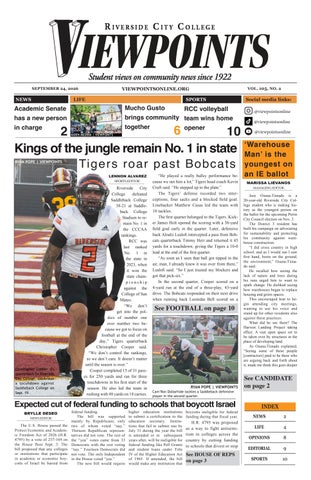
Riverside City College defeated Saddleback College 38-21 at Saddleback College Stadium to remain No. 1 in the CCCAA rankings. RCC was last ranked No. 1 in the state in 2023, when it won the state championship against the College of San Mateo. “We don’t get into the politics of number one over number two because we got to focus on football at the end of the day,” Tigers quarterback Christopher Cooper said. “We don’t control the rankings, so we don’t care. It doesn’t matter until the season is over.” Cooper completed 15 of 31 passes for 250 yards and ran for three touchdowns in his first start of the season. He also led the team in rushing with 48 yards on 18 carries.
“He played a really ballsy performance because we ran him a lot,” Tigers head coach Kevin Craft said. “He stepped up to the plate.” The Tigers’ defense recorded two interceptions, four sacks and a blocked field goal. Linebacker Matthew Casas led the team with 10 tackles. The first quarter belonged to the Tigers. Kicker James Holt opened the scoring with a 38-yard field goal early in the quarter. Later, defensive back Aloalii Lealofi intercepted a pass from Bobcats quarterback Timmy Herr and returned it 45 yards for a touchdown, giving the Tigers a 10-0 lead at the end of the first quarter. “As soon as I seen that ball got tipped in the air, man, I already knew it was over from there,” Lealofi said. “So I just trusted my blockers and got that pick-six.” In the second quarter, Cooper scored on a 4-yard run at the end of a three-play, 43-yard drive. The Bobcats responded on their next drive when running back Leonidas Bell scored on a
See FOOTBALL on page 10
RYAN POPE | VIEWPOINTS Cam’Ron Dollarhide tackles a Saddleback defensive player in the second quarter.
Expected cut of federal funding to schools that boycott Israel BRYLLE DESEO NEWS EDITOR
The U.S. House passed the Protect Economic and Academic Freedom Act of 2026 (H.R. 4795) by a vote of 237-169 on the House floor Sept. 3. The bill proposed that any colleges or institutions that participate in academic or economic boycotts of Israel be barred from
federal funding. The bill was supported mainly by Republicans; only two of whom voted “nay.” Thirteen Republican representatives did not vote. The rest of the “yea” votes came from 33 Democrats with the rest voting “nay.” Fourteen Democrats did not vote. The only Independent in the House voted “yea.” The new bill would require
higher education institutions to submit a certification to the education secretary. Institutions that fail to submit one by July 31 during the year the bill is amended or in subsequent years after, will be ineligible for federal funding like Pell Grants and student loans under Title IV of the Higher Education Act of 1965. If amended, the bill would make any institution that
boycotts ineligible for federal funding during that fiscal year.
H.R. 4795 was proposed as a way to fight antisemitism in colleges across the country by cutting funding to schools that divest or stop
See HOUSE OF REPS on page 3
@viewpointsonline
youngest on an IE ballot MARISSA LIEVANOS MANAGING EDITOR
Jose Osuna-Tisnado is a 20-year-old Riverside City College student who is making history as the youngest person on the ballot for the upcoming Perris City Council election on Nov. 3. The District 3 resident has built his campaign on advocating for sustainability and protecting his community against warehouse construction. “I did cross country in high school, and as I would run I saw first hand, boots on the ground, the environment,” Osuna-Tisnado said. He recalled how seeing the lack of nature and trees during his runs urged him to want to spark change. He disliked seeing how warehouses began to replace housing and green spaces. This encouraged him to begin attending city meetings, wanting to use his voice and stand up for other residents also against these practices. What did he see there? The Harvest Landing Project taking effect. A vast open space set to be taken over by structures in the place of developing land. As Osuna-Tisnado explained, “Seeing some of these people [contractors] paid to be there who are arguing back and forth about it, made me think this goes deeper
See CANDIDATE on page 2 INDEX NEWS
2
LIFE
4
OPINIONS
8
EDITORIAL
9
SPORTS
10
2 September 24, 2026
NEWS
Editor: Brylle Deseo | Viewpoints@rcc.edu
Applied Technology instructor takes over Academic Senate BRYLLE DESEO NEWS EDITOR
Patrick Scullin, instructor and former academic senator of applied technology, is taking the lead of the Academic Senate for the 2026-27 academic year. Scullin said that he has some “big shoes to fill” after former Senate President Jo Scott-Coe’s term ended in spring 2026. “I love our previous leadership team. President Jo Scott-Coe did an amazing and excellent job,” Scullin said. “My challenge is kind of living up to her legacy.” The Academic Senate is a leadership body made of representatives f rom the many depar t ments at Riverside Cit y College. Their bi-weekly meetings are where they can discuss issues, st udent and facult y needs and academic matters. “So the Senate is a good place for important issues to be discussed and voted on in regards to your faculty input,” Scullin said. “It’s an important forum for people to voice concerns and discuss topics that are important to the structure and direction of the college.” In the first of the 2026-2027 school year Aug. 31, Scullin and the Academic Senate have discussed student success and the future of RCC as a whole. Scullin shared plans on new buildings and programs. “There are a number of issues facing the college right now. I
KYLIE GOFORTH NEWS REPORTER
BRYLLE DESEO | VIEWPOINTS Patrick Scullin, the new academic senate president, drawing fanart of Darth Maul from the Star Wars franchise on Sept. 17.
would say organizational and process issues that always come up,” Scullin said. “Such as, ‘How to make Canvas better? How to make it more accessible?,’ things like that are commonly discussed on how to make improvements.” Scullin said RCC is planning to build an advanced-technology building with improved classroom spaces for automotive, HVAC, welding and other technical trades. There are also talks about a new cosmetology building coming to campus and down the line and a new campus in Jurupa Valley called the Inland Empire
Technical Trade Center (IETTC). “We have a number of issues related to (such as), ‘What are the best professions to get into? What are the best classes to take?’” Scullin said. “I think those are kind of (the) exciting discussions to have and how to make RCC relevant to what students need.” Aside from leading the senate or teaching, Scullin is an artist and a massive pop culture and comics fan. His office at Technology B, Room 103 was filled from top to the bottom with personal artwork depicting characters from Star
MARISSA LIEVANOS | VIEWPOINTS Jose Osuna-Tisnado, ‘Warehouse Man,’ recruits new members as vice president of the Catholic club at Riverside City College on Sept. 17. The District 3 Perris City Council candidate makes history as youngest name on the city’s ballot.
CANDIDATE from page 1 than I initially thought.” While in high school he was inspired by his English teacher, Mrs. Zuckert, to write a poem about his views. The poem, titled “Warehouse Man,” detailed his emotions about seeing his once beautiful city views be tarnished by a “warehouse man” who over-
Board of Trustees unveil new partnership
took the grace of greenery with blocky structures. The poem went on to win first place in the Val Verde Unified School District’s poetry contest and pushed the young man to move forward in his efforts in activism. Beginning in April, the sophomore at RCC has been involved with other environmentally centered communities in the Inland Empire and began speaking out alongside them in recent meetings. The student expanded on
Wars, Marvel and DC Comics. Scullin said students can explore RCC and try different things that could possibly lead to a career that they never intended on doing. “Look for something that interests you, that can lead to a career,” Scullin said. “And there’s so many options at RCC for that, so even when you’re in one program try another class, experiment, see what you like and see where that leads because now is the time to kind of open your eyes to what’s possible.”
two to four years Gen Z and millennials will make up more of the voter population. He explained that politicians will start to pander to their demographics more. “They have to listen to us, if we’re not taking advantage of that, if we don’t take action, they’re just gonna take advantage of us,” Osuna-Tisnado explained. The young man takes pride in being the youngest name on the ballot, explaining that he saw a lot of Gen Z on social media active in the digital space but not as many taking action when it comes to actually making a change. “Ask them if they know their local government, or any city council members and they blank,” he said. The history major is very clear about the fact that he is not a politician, nor does he plan to become one. What he does want to be is someone who speaks up for his community members and someone who protects his city. He saw an incumbent spot on the ballot and decided to take action.
the detriment of these projects by using the term environmental racism. “We only see them [warehouses] being built in Black and brown communities,” he said. He believes the installation of these warehouses is intentional and that it happens because the marginalized groups that populate the area lack the power to protect “I’ve lived in my city for 12 their land. This leads to citizens years,” he said. “And it doesn’t being taken advantage of, he said. take a degree to see what is causAccording to Osuna-Tisnado and supported by voting data, in ing detrimental harm to our local
The Riverside Community College District Board of Trustees approved a memorandum of understanding with Keck Graduate Institute regarding a Doctor of Pharmacy partnership program during the last board meeting Sept. 15. The partnership between RCCD and KGI will allow RCCD students to transfer to KGI’s School of Pharmacy as part of their Accreditation Council for Pharmacy Education KGI Doctor of Pharmacy – PharmD Program. “For me the location of RCCD being in the heart of the Inland Empire and the passion we have at KGI to support our communities,” KGI President Mohamed Abousalem said. “And making sure we are part of that economic mobility equation for all the students here in the Inland Empire is part of what inspired us. And even more the possibility of those students coming back to the community and delivering the value as health care professionals.” Students with a GPA of 3.0 or higher who complete the admissions process will be guaranteed admission to the program. However, students who are failing to meet eligibility can still be considered for admission to the program. In addition, up to 15 students with at least a GPA of 3.5 are eligible for a TAG scholarship in the amount of $20,000 per fall term. “I’m particularly excited about this opportunity for RCCD STEM-focused students,” RCCD Chancellor Wolde-Ab Isaac said. “(It’s) a viable pathway for our students to go straight from an associate degree to a pharmaceutical sciences program,” he added. The benefits offered by the program are application fee waivers, expedited application review, guaranteed seats in the summer Pre-Pharmacy Enrichment program and Super Heroes of STEM program, a Summer Program application fee waiver and free KGI Summer Science Prerequisite Courses, provided the selected RCCD students transfer into the KGI program the subsequent fall term. “The board is really looking Scan for full story
September 24, 2026
Viewpoints@rcc.edu
3
NEWS BRIEFS Riverside Community College District budget increases Riverside Community College District increased their budget this 2026-27 school year by $15,695,721 from the 2025-26 school year. DYLAN QUINONEZ | VIEWPOINTS Riverside Councilmember Philip Falcone listens to a question posed by a student at Riverside City College during a town hall meeting Sept. 9.
Council member dives into student issues GLORIA MARTINEZ PHOTOGRAPHY REPORTER
Philip Falcone, Riverside Ward 1 councilmember, made Riverside City College the last stop on his town hall tour. RCC students were invited to attend the Sept. 9 meeting on campus to ask questions about issues that affect their communities. Falcone, a part time instructor at RCC and University of California, Riverside, touched base with students on how local government responds to issues within the community and how Riverside residents can become more involved in those decisions. One of the many concerns discussed was the difficulty that residents come across when trying to find who is responsible for a local issue. Falcone explained that local, state and federal governments contain different responsibilities
but residents can report certain city issues through the Riverside 311 system. “A lot of times students either don’t know or understand which level of government is responsible for those particular things, or they don’t know how to express those concerns to the right person,” Falcone said. Falcone encouraged students to understand how the governmental systems function in order to communicate with elected officials and city departments when they come across community issues. “Especially for the younger generation, it is exposing them to what you really need to be able to do outside of just normal communicating on their computers,” Subrai, a nontraditional RCC freshman said. “ Yo u n e e d t o b e a b l e t o communicate face-to-face and really get into one-on-one, face-
to-face communication with each other.” Students brought the topic of public safety and surveillance technology to the meeting, specifically the use of Flock cameras. The tool has potential in assisting law enforcement, however, it raised concerns about privacy. The main question was, who has access to the information collected through these surveillance systems? The students expressed concern issue is whether or not law enforcement or private companies could misuse the information accumulated by the cameras. Falcone also discussed community worries with data centers. He explained that they require a vast amount of electricity, water, do not provide jobs and raise the concern for possible healthcare effects from contamination with previous chemical plants. He mentioned he will be having a
council meeting in efforts to ban data centers on Sept. 14. The town hall focused on how students could be more involved within their communities beyond attending public meetings. Falcone said working for the city is extremely beneficial for students and is a great way to not only gain experience but most importantly give back to the community. Falcone encouraged students to become more informed about local government and use available resources when addressing problems within their communities. Viewpoints and the Students in Politics Club will be hosting their own town hall event on Oct. 14 for voter education. Students can expect to learn more about the upcoming midterm elections and meet some of the local candidates running to represent them.
HOUSE OF REPS from page 1 conducting business with entities licensed, regulated or organized under Israeli law. “The antisemitic rot that has corroded college campuses must be eradicated – enough is enough,” Rep. Virginia Foxx, R-Va., said. “The safety and security of Jewish students, faculty and staff should never be threatened under any circumstances.” Democrats who voted “nay” said the proposal infringes on freedom of speech. While attacking colleges as a whole, it targets the students who have been at the forefront of expressing their distaste against the Israeli government. Tina Stavropoulos, an English instructor and adviser of Students for Justice in Palestine (SJP), said that Riverside City College has had an active SJP chapter in the past but is inactive this semester due to members having personal responsibilities outside of activism work. “What I think the bill is trying to do is stifle free speech,” Stavropoulos said. “The idea that we would lose federal funding – there’s no active divestment movement happening at RCC or anywhere else for that to even be a threat.” In a study conducted by
Five RCC students get selected for paid biology internships RCC interns are analyzing data this semester for the upcoming Community College Field Biology Alliance virtual symposium on Dec. 5. The symposium is meant to help students gain research experience to advance to the next stage of their careers. RCC Students tour Northern California Colleges to explore Black excellence Seventeen RCC students traveled to Northern California to explore higher education and envision themselves as scholars at prestigious University of California and California State University school systems. Local Election and Voter Ed Town Hall Oct. 14 In collaboration with ASRCC and Students in Politics, Viewpoints is holding a town hall to inform students about the upcoming elections. City council candidates, assembly candidates and congressional candidates were invited.
Riverside City Council looks to implement AI strategies city-wide.
ALIAH TUBBS | VIEWPOINTS Riverside City College students participating in a pro-Palestine rally on May 7, 2024.
Brandeis University, they reported that more than 77% of college students believe that Israel is committing a genocide in Gaza. Students in California institutions like the University of California, Los Angeles, the University of Southern California and California State Polytechnic University, Humboldt were the main schools that participated in protests in spring 2024. In the past, RCC students and an organization named Inland Empire Against Empire participated in its
own protest in support of Palestine on May 7, 2024. It is stated that the rally was peaceful and had a police negotiator and media representative in attendance. “RCCD (Riverside Community College District) is aware of H.R. 4795 and is monitoring its progress through Congress,” Director of Government Relations at RCC, LaShe’ Rodriguez, said. “Based on our review, the bill’s proposed restriction on certain commercial boycotts and international
academic exchanges would have limited impact on RCCD’s current operations and programs.” While the bill is moving through Congress, RCCD is continuing to monitor its progress and evaluating any potential implications as the legislation develops. The bill now awaits consideration by the Senate. A date for senate floor consideration has not been announced.
A group of three council members will look into how artificial intelligence could affect the local workforce, i n c l u d i n g t h e c i t y ’s education, infrastructure and economy. The Riverside leaders will discuss balancing the use of AI while protecting against the risks of privacy, cybersecurity and human accountability. If you have local news or upcoming events that you would like featured on the Viewpoints briefs, send information to our email: viewpoints@rcc.edu
LIFE
4 September 24, 2026 Clubs rush to recruit new members on campus MARIANA DANIELA ARIAS LIFE REPORTER
With over 26 active clubs, Riverside City College is offering safe places and community for its students. From clubs that offer academic support to clubs centered on fun hobbies and even new experiences, Club rush exposed RCC students to more than just classes on campus. Club Rush was held from Sept. 15-17 and the event allowed clubs and organizations to set up booths along Terracina Drive to advertise their clubs, allowing students to browse or sign up. The tables were decorated and run by the club members themselves, making it easy to learn what each club is about and giving students the opportunity to meet its active members. While various clubs have long been established on the RCC campus, this fall semester was the first for many, such as the Romance Book Club, Ballet Folklórico and MENASA, are just a few of the new clubs on campus. Students could choose from creative-outlets, clubs and work with their hands in clubs including the Culinary Arts program, the Jewelry and Crafts Club, Fashion Club and Art Club. “Art has always been a hobby since I was growing up, as well as fashion. The clubs seem fun, and
are something I look forward to. I also joined Ballet Folklórico. It always caught my interest in high school, but I never had the chance to do it,” said Marianna Roman, a first-year student at RCC. Many clubs on campus focus on interests and hobbies including K-Pop Club, Paleontology Club and the Bible Study Club. “In the Paleontology Club we study dinosaurs, ancient plants and ecosystems. It’s a place where we can come together and just explore that childhood wonder that’s never left us,” said Dylan Jolley, a member of the Paleontology Club. Sports clubs such as the Judo Club and MMA Club teach students self-defense and focus on a love of the sport. Both clubs preached about how to train physically, as well as how beneficial it is for your mental health. “In judo the point is to not be afraid to fall. When students join, I hope to teach them not only self -defense, but to gain confidence and build up that strength mentally to keep pushing through and never give up,” said Judo trainer Desiree Martinez. For the students who are in search of clubs whose mission is to help them succeed academically and find places on campus that can give them a sense of home, there are many to choose from. SHPE is a club where Hispanic students in STEM can
Editor: Maxwell Porter Viewpoints@rcc.edu
MARCOS AGUILERA | VIEWPOINTS Interested students ask questions about the clubs during Club Rush at Riverside City College on Sept. 16.
come together as a community and help each other navigate a field where very few of them are represented. The PUENTE Club’s mission is to guide and assist students in transferring to fouryear universities. Clubs like MECHA, SAGA, Queens of Umoja, and MENASA were created so communities and people from the same or similar backgrounds can find a place on campus that gives them a sense of belonging. The International Club welcomes all students to teach
others about their cultures and helps international students adjust to life at RCC. Clubs at RCC even collaborate and have events together. When the Psychology Club and the Chemistry Club got together they made slime and explained the psychological benefits of playing with slime to de-stress and then explained the chemical compounds of slime itself. “Collabing with other clubs is not only fun, but a great way to promote one another’s
organizations. We try to find activities that meet in the middle of both clubs’ interests and just have fun spending time together. At the end of the day, we are all community college students and we have to be uplifting each other,” said Javin Amador of the Psychology Club. What every club hopes to achieve is for its members to come together and feel a sense of belonging, letting students know it is possible to make new friends and connections even as adults.
‘My Bias, My Boss’ ANNIE LEE ASST. MULTIMEDIA EDITOR
MELANIE POPOK
VIEWPOINTS
Attendees of True Love Nite Market walk the grounds to shop for locally made goods on Sep. 19.
Romeo brings true love to Riverside ISABELLA LEON LIFE REPORTER
Downtown Riverside became a market for residents to enjoy music, grab food and shop from more than 60 vendors on Sept. 19. The True Love Nite Market welcomed all ages to the free event and provided a sense of community. From vendors selling toys, vintage clothing and jewelry to booths offering services such as makeovers, the market offered something for everyone. The vendors provided the opportunity for Riverside residents to get to know and support some of the small businesses in the area. “It’s really great for the kids.
Well, everybody– adults and kids,” an event attendee, Mike Vegas, said. The event coordinator who went by the name “Romeo,” said that he wanted to provide space for his community in Riverside to connect with each other. He wanted to create a fun environment where attendees could enjoy the evening with their loved ones and meet other Riverside locals. “I feel like everything I do, I put all my heart into it,” Romeo said while explaining why he chose to name the event True Love Nite Market. “This is people, the people (vendors), who put their time, effort and
energy into ensuring the best for growing their business.” The event welcomed people from all backgrounds and proved that the space was intended for everyone to enjoy. It brought everyone together regardless of their differences. As a result, a sense of community was built. “It keeps the family together, it’s just unity and we love seeing people together,” said another vendor from Ed’s Tacos & More. “Once I see people actually take the first bite and they really Scan for full story
into a K-drama, Webtoon decided to translate it to English an entire six years after its original release. The show demonstrates the most common tropes of Korean romantic comedies: a workplace romance and of course, a love triangle. I feel like while the show does play into the common trope, it also includes a new change of pace when the storyline introduces the idol as a potential love interest. It definitely spices up the love triangle plot. I do not think Da-reum fully realized what she would have to deal with when she was deciding to commit to a relationship with Lee Chan. She had an idealistic view where everything about being in a relationship with her idol would go smoothly, but the drama showcases how not all of Da-reum’s expectations played out how she envisioned. Instead, she had to face obstacles she didn’t know she would encounter. When Lee Chan and Da-reum started dating and people saw them together, he had to pretend she was a stranger rather than his girlfriend. For viewers who may not understand Lee Chan’s behavior in public with Da-reum, in Korean society, some fans are truly invested in the idols and their
Would you be able to take off the rose-colored glasses you had on for years in order for your idol to instead be your true match? “My Bias, My Boss” is a Korean romantic comedy drama that consists of 12 episodes. The show introduces Nam Da-reum, a major fan of the idol Lee Chan. As a dedicated fan, she applied to her beloved idol’s fashion startup to work near him and support his career. Although Nam Da-reum was accepted for the job, her fantasies are shattered when she finds out that she must work directly under the CEO, Kang Ha-gi, whom she initially clashes with. As Da-reum navigates her professional responsibilities and tries to keep her fandom a secret, an unexpected love triangle forms when Lee Chan and Ha-gi start seeing her differently in a new light. The main stars of the show are Kim Hye-jun as Nan Da-reum, Kang Hoon as Kang Ha-gi, and Cha Woo-min as Lee Chan. The Korean romantic comedy series aired from August 3 to September 8. The series is based on a popular Korean Webtoon illustrated by Sung-eun. The story was first published in Korean on Naver Webtoon, the Korean version of Webtoon. Because the story gained more Scan for full story recognition after being adapted
Editor: Maxwell Porter
September 24, 2026
Viewpoints@rcc.edu
‘SAGRADX’ exhibit invites all to sacredness BETZABETH CHAVEZ LIFE REPORTER
The Riverside Art Museum opened an art exhibit created by Riverside’s very own Perry Picasshoe. The exhibit, named “SAGRADX,” opened on Sept. 5
and will continue to be available for visitors until Jan. 31, 2027. Neveah Carlos HernandezMarquez Jr., whose stage name is Perry Picasshoe, is a queer Latino visual artist and has been notably recognized for melting ice blocks in the
AYSA BENDER | VIEWPOINTS Perry Picasshoe’s “The Desert, The Ocean, & Estrogen” on display at the Riverside Art Museum on Sept 18.
Riverside area as a stance against ICE raids. “Perry Picasshoe asks how sacredness is created, who gets to define it, whom it protects, and what remains after it has been desecrated,” a museum representative said on the exhibit’s website. A long red stripe leads to Picasshoe’s exhibit upon entering the museum, grabbing visitors’ attention as they walk through the door. The interior of the exhibit is filled with his art and painted red walls, which he has said to be his comfort color. “It’s very strong and it captures your attention,” Alejandro Volcado, a visitor, said. “The interplay, like the different themes of the ‘queer’ and ‘Latin’ and ‘male’, I think that’s just a juxtaposition that we don’t see often,” he added. Volcado also shared that he felt the deepest connection to Picasshoe’s photographs of individuals wearing masks. “I think there’s a play there between ‘are we really who we are?’ Do we wear a mask around others?” Volcado explained. Picasshoe is not only showcasing their art, but it’s also giving people an emotional reaction. “It depicted the thinking that cultures go through, and it focused on the Chicano
lens,” Brandy Clark, another spectator, said. “I’m an African American woman. It made me think, ‘Gosh, we’re so similar, then we’re different.’ It makes me feel like we should just be so united in love, versus being mean to each other,” Clark added. Picasshoe’s art pieces encourage people to come together and share the idea that everyone should love and care for one another. Picasshoe’s artwork and understanding has the ability to influence young LGBTQ+ members to not be afraid of who they are and to take care of what matters to them. “I’m happy that LGBTQ+ is being represented and pushed out there, because it’s here, it’s our children, it’s our loved ones,” Clark added. “I feel that everyone should be represented.” Visitors expressed that the work left a big impression on them. It could be easy for someone to feel the meaning behind the art and feel a connection between this exhibit and themselves. Picasshoe showcased that everyone has something sacred that gives them Scan for full story
LIFE BRIEFS September 25 Moon Festival The Museum of Riverside’s Heritage House will hold an Autumn festival event from 6-8 p.m. meant to celebrate Asian cultures and promote gratitude for our loved ones alongside honoring the role Chinese Americans played in building Riverside’s citrus industry. October 1 Justice Impacted Job and Resource Fair This event is opening on justice-impacted individuals to meet in the Business, Law and Computer Information Systems Building, Room 114A/B from 10 a.m. to 2 p.m. for information on training and career pathways alongside gaining access to various support resources. October 1 Financial Aid Application Workshop The Rainbow Engagement Center is hosting a workshop for students who need help completing their financial aid applications. Stop by the Martin Luther King Building, Room 304, from 10 a.m. to 4 p.m. to participate.
Court is now in session
October 5
LOUIS TOZSER NEWS REPORTER
After four years of being scrapped and brought back, “Coyote vs. Acme” debuted in theaters with mass positivity. The film premiered on Aug. 28 and received a certified fresh rating of 100% on Rotten Tomatoes upon debut, but that number has since dropped to 96%. The film is based on the article “Coyote v. Acme” written by Ian Frazier in 1990 for the New Yorker. The article follows cartoon character, Wile E. Coyote, suing the ACME Corporation, the company in the Looney Tunes Universe that makes all of Coyote’s products that he had used to attempt to catch the elusive Road Runner. It provides originality in an industry that, for years, has produced films for money instead of caring what the ticket holder has been wanting. It also was a fun throwback for the movie to be set in Albuquerque, N.M., as it was a city that had been frequently mentioned in Looney Tunes shorts, notably Bugs Bunny shorts, from 1945 until the end of its theatrical run in 1969 as a running gag, saying that he “knew I shoulda taken dat left toin at Albakoikie.” The film featured a cast list that I view as very immense and
5
Movement Monday Wellness Workshops
COURTESY KETCHUP ENTERTAINMENT Wile E. Coyote and his lawyer Kevin Avery (Will Forte) sits at the plaintiff’s desk in the U.S. Senate building during the congressional hearing for “Coyote v. Acme.”
impressive as it not only uses major actors as well as lesser known ones, including Will Forte as Kevin Avery, Lara Condor as Paige Avery, John Cena as Buddy Crane, P. J. Byrne as Bill Pelicanos and Tone Bell & Martha Kelly as Sal Maltese and Dottie Jones (named after Michael Maltese and Chuck Jones, the co-creators of Wile E. Coyote). Eric Bauza would also be included in the cast as he provided the voice lines for Bugs, Daffy, Porky Pig, the Road Runner, Foghorn Leghorn, Tweety, Elmer Fudd and many other characters. The movie takes a “David vs. Goliath” approach, where a small entity with little to no resources takes on a major corporation with everyone and everything on their side and stretches the case to its limits. This is demonstrated throughout the movie when Coyote and his lawyers, Kevin Avery and
Paige Avery from the fictional law office, Avery Jones and Maltese, have their case against ACME be shot down and later brought up on a higher level, such as when Judge Troppogrosso (Luis Guzmán) declared the case as a mistrial saying that is “the beauty of being a judge. I can say whatever I want. Mistrial? There, I said it. Case dismissed,” and when Sen. Elmer Fudd agrees to hear the case in the U.S. Senate under a congressional hearing. In terms of animation, it works and mixes really well with the live action elements of the film, such as when Daffy Duck went “looney” after being questioned by K. Avery about the case due to being told to meet Daffy by a “mystery source” revealed later in the film to be Bugs Bunny. The film also mixes CGI and hand-drawn animation as characters such as Bugs and Daffy are animated via hand drawn 2D ani-
mation while main characters such as Foghorn Leghorn and Wile E. Coyote are animated using 3D and CGI Animation. The same scene also takes Daffy back to his original 1930s attitude, where he is portrayed as an unhinged and chaotic individual instead of a rival to Bugs that he would grow to become in the late 1940s and beyond, something that emphasized his original wacky nature in a way that made sense to the story and the viewer. The movie also gives spotlight to many other characters in the Looney Tunes universe that aren’t as well known or talked about as much as Bugs and Daffy, such as Yosemite Sam, Witch Hazel, Sylvester and Granny. Pepé La Pew (Bauza) made a Scan for full story
Join the weekly wellness sessions that are designed to help students have a strong sense of mindfulness on their Mondays. Sessions are held in the Heritage Room, Bradshaw Building, from 10:30-11:30 a.m. and 1-2 p.m. October 6 From Classroom to Career: Using Handshake to Find Jobs and Internships A workshop hosted by the RCC Career Center, will be held via Zoom from 1-2 p.m. to teach students how to find jobs and internships through Handshake, an online job board, with representative Kendall Perez. If you have local news or upcoming events that you would like featured on the Viewpoints briefs, send information to our email: viewpoints@rcc.edu
6 September 24, 2026
Riverside celebrates Hi
AIDEN MEDINA | VIEWPOINTS Fusion band El Santo Golpe performs at Mucho Gusto Fest at John W. North Park in Riverside on Sept. 19.
Mucho Gusto Fest creates backyard party for community AIDEN MEDINA & CHELSEA SUGIMURA MULTIMEDIA EDITOR & EDITOR-IN-CHIEF
Mucho Gusto Fest, a onceweekly party turned into a vibrant annual Inland Empire festival, took over John W. North Park in downtown Riverside on Sept. 19 for its fourth year of music, art and celebration. Mucho Gusto brought musicians, artists and sculptors to celebrate their work and inspire positivity. The festival fostered a safe space for people to dance, enjoy the live entertainment and shop from a multitude of vendors. “It started as, and still kind of is, just a backyard party,” Richie Velazquez, the art director said.
Velazquez shared that his group of friends, before the COVID-19 pandemic, would get together every Sunday to DJ, catch up and reset for the week. He said it slowly evolved into something more and led to a conversation of how the group could turn their parties into an actual festival. Live entertainment included luchador wrestling, live music and dance groups. Aztlan, a ballet folklórico dance company from Corona performed a son jarocho style dance from Veracruz, Mexico. One of the dancers from Aztlan, Alison, said she enjoyed the opportunity to perform. She mentioned the festival helped bring people together, which allowed performers and artists to display
their cultures to the community. El Santo Golpe, an afroinspired fusion band, was one of the opening music performances. Vocalists Roxanna Valtierra and Ulises “Cheese” Rodriguez, who is also a founder of Mucho Gusto, led the band. With band members from Riverside and Los Angeles, Rodriguez said it was special to be able to come to a place where they could all meet other artists from different areas and create new friendships. Rodriguez also shared the importance of having safe spaces for artistic expression in today’s political climate. “It’s a great opportunity to bring awareness and to unite communities,” Rodriguez said. Along with the vendors selling
food, pottery and other trinkets, there were booths offering palm readings and businesses giving out free samples for people to try. The hair care company Suavecito was at the festival passing out small jars of its hair pomade for attendees to take home. Bry Gonzalez, an employee for Suavecito said she enjoyed being able to walk around and enjoy the different food and music at the festival. Gonzalez added that it was special to be able to celebrate Hispanic Heritage Month at a community event like Mucho Gusto. “It shows and represents small brands that are about the gente (people) Latino,” Gonzalez said. “The music is good, the vibes are
“
good, so it’s a great time.” Eddie Valencia, one of the cofounders of the festival, spoke about his goal to bring more positivity to the city. He said he wanted to create a carnival-style party that was done with love and good intentions for his community to share. He added that, while everything he does is political, he tries not to focus on that aspect and instead works on having a positive contribution to the world. “The idea is to celebrate ourselves, our joy, the community and do it in the I.E. where I feel like we could use a thing like this,” Valencia said.
Scan for the video
(Mucho Gusto) is a safe
place for families to come and
unwind. I think a lot of people need these kind of spaces where someone’s always looking out for each other. - Eddie Valencia AIDEN MEDINA | VIEWPOINTS Luchador wrestler El Chivo leans on ring ropes during his match at the Mucho Gusto Fest on Sept. 19.
”
Editor-in-Chief: Chelsea Sugimura Viewpoints@rcc.edu
ispanic Heritage Month
7
F.U.E.G.O. art exhibit uplifts Latino voices CHELSEA SUGIMURA EDITOR-IN-CHIEF
Students and faculty gathered to share artwork, poems and music at the Riverside City College Digital Library on Sept. 15 for the opening reception of the F.U.E.G.O. art exhibit. Citlalli Anahuac, an RCC ethnic studies instructor, said that part of the exhibit’s purpose is to highlight student stories and backgrounds. Anahuac co-curated the exhibit alongside Blanca Garcia, RCC’s diversity, equity, inclusion and accessibility librarian. The two shared the same goal of creating a space where Hispanic culture could be celebrated through students’ personal stories. “I want to put more of these types of events together so that we can become another third space on campus,” Garcia said. “We already kind of are one, but I would like a bit more of that cultural third space as well.” The pair hoped to inspire and educate students passing through the library during a time when Immigration and Customs Enforcement raids have become more prevalent in society. Anahuac shared the importance of staying “true to your roots” when faced with adversity. “The idea behind it is to invite students to lean on their cultures and their identities for strength,” she said. F.U.E.G.O. is an acronym for fuerza (strength), unidad (unity), esperanza (hope), gente (people), orígenes (origins). The artists’ work shared at the reception reflected those words and the theme of resistance throughout the event. “We don’t need permission to resist. We don’t need permission
BRYLLE DESEO | VIEWPOINTS RCC students Angel White and Amora Turnipseed view student-made art pieces at the F.U.E.G.O. exhibit on Sept. 15.
“
We don’t need permission to resist. We don’t need permission to be here. -Citlalli Anahuac
to be here,” Anahuac said. Martín and Miguel Lizardi, brothers from the musical group Axolotl, followed the resistance theme with their performance of the song “La Bamba.” Martín spoke about the song’s son jarocho tradition, which is a fusion blend of sounds from Veracruz Mexico. The song was popularized by singer Ritchie Valens but was originally written about people’s frustration toward the Mexican government.
”
“It’s a great party song but it’s important to remember that culture because in a lot of ways, the song ‘La Bamba’ is still relevant today,” Martín said. “We deal with the same types of things. Sure, it’s not pirates attacking us, but it’s ICE, or the police or anybody, really.” Remembrance was another way artists practiced resistance. Jessica Zenteno, an administration specialist for the Writing and Reading Center at
RCC, shared a poem she wrote about her grandmother. A conversation shared between them about her grandmother’s immigration from Costa Rica inspired the poem. Zenteno’s poem used some of the words her grandmother originally spoke and helped share the story of some of the hardships that come with immigration. She said she promised to remember the details of her family’s story for her grandmother. “I believe through age, often our memory can fail us and we can forget some of the most intricate parts of our life,” Zenteno said. Like Zenteno, many students chose to put pictures and artifacts from their family members within their art pieces. The art and stories shared by students serve as a reminder of the importance of
celebrating the different cultures on campus, RCC President Eric Bishop said. “A turnout like this shows the campus’ hunger to have events that connect to our community, connect to who we are as individuals, connect us to the majority of our students… which is why we’re an HSI (Hispanic-Serving Institution),” Bishop added. The exhibit and reception acted as the connection for the students and faculty involved. It served as a reminder of why strength and resistance are important on campus and in Riverside. “We wanted to create a moment where students, faculty and staff can contribute their art in a way to amplify our joy, our art (and) our talent, as we are, as a form of medicine to help us deal with what is happening right now,” Anahuac said.
LHSS honors the history of El Grito for Mexican Independence MARISSA LIEVANOS MANAGING EDITOR
In commemoration of Mexican Independence Day, the Languages, Humanities and Social Sciences Engagement Center at Riverside City College served students with a historical presentation on Sept. 16. The event highlighted why it is important to understand the day of independence and for people to celebrate it in the United States. Instructor Doris Namala, the engagement center faculty c o o r d i n a t o r, o p e n e d t h e presentation by playing a clip of Mexico’s president, Claudia Sheinbaum, leading the traditional “Grito de Independencia” (Cry of Independence) in Mexico City. “The first Grito itself goes back to (Miguel) Hidalgo,” Namala explained. “The historical Grito comes from a parish priest when he called his parishioners to follow
MARISSA LIEVANOS | VIEWPOINTS Engagement center coordinator, Doris Namala opens El Grito presentation in the Language, Humanities and Social Sciences center on Sept. 15.
him into a revolution against colonial rule.” Namala continued to provide more historical context about the 11-year war that brought Mexico its
independence from Spain in 1821. Another figure included José Maria Morelos, also a Catholic priest, who assumed the role as revolutionary leader after
Hidalgo’s execution and put the ideology of early movement into writing. He was specifically against “exploration and exploitation
of Mexican resources,” Namala detailed. And led an “abolitionist movement against exclusively taxing Indigenous communities.” Namala also gave significance to one man not mentioned in formal Grito’s named Agustín de Iturbide, the person who actually declared Mexico’s independence. He developed a revolution proclamation called the “Plan de Iguala” alongside Vicente Guerrero, an Afro-Mexican former army soldier, which put their fight for independence in motion. “The vision of these figures doesn’t exist, yet to this day the Mexican government remembers these people as if their legacy actually became,” Namala shared. She ended the presentation with a call to action saying, “it is important we think about who was remembered and how honest that memory is in terms of honoring the visions of those people.”
8 September 24, 2026
OPINIONS
LHSS majors don’t need to prove themselves EMMA GOAD OPINIONS REPORTER
In contemporary higher education, not all majors are treated as equal. Science, Te c h n o l o g y, Engineering and Mathematics (STEM) fields are consistently at the top of an implicit ranking of value, while fields in Languages, Humanities and Social Sciences (LHSS) are positioned as supplementary and impractical. This hierarchy is not accidental. It is the product of a longstanding alignment between university funding priorities and the United States perverted fixation on militarism and capitalism. As a result, LHSS students often feel compelled to justify the legitimacy of their work in ways that STEM students do not. The historical roots of this division are structural. Following World War II, federal education policy explicitly linked higher education to national defense. The National Defense Education Act of 1958 formalized the idea that producing scientists and engineers was a matter of security. Universities became central sites for defense-related research, a relationship that continues through Department of Defense grants, cybersecurity initiatives and federal funding for artificial intelligence engineering. In this model, knowledge is valued to the extent that it can enhance strategic dominance. A parallel logic operated under capitalism. STEM research is
O v e r consumption of content on social media has gone too far and someone has to pay the price. Meta, the owner of Facebook and Instagram, made recent headlines after a social media addiction settlement left the company with a payment of almost $18 billion as penalty. Forty-seven states pursued a lawsuit against the company, alleging that the platforms were purposely designed to be addictive for minors. Social media use has changed monstrously since the early 2000s era of Facebook and Myspace.
Flock cameras are killing our freedom JESSICA SANCHEZ OPINIONS EDITOR
COURTESY OF CAROL M. HIGHSMITH
Replica of French sculptor Auguste Rodin’s statue the “The Thinker” sits in Louisville, Kentucky.
more likely to generate patentable technologies, modular products and a workforce that feeds directly into high-profit defense industries.This is reflected in funding structures. In 2019, federal sources accounted for only 9% of research and development spending in the humanities, while STEM fields received between 33% and 67% of their research and development funding from federal support, observed from the American Academy of Arts and Sciences. The message is clear: Some forms of knowledge generate capital, while others do not. This economic valuation translates directly into cultural valuation. National data from the American Academy of Arts and Sciences found that only 30% of humanities majors said college was worth the cost, compared to 34% of STEM majors and 39% of business majors. At the same time, Pew Research Surveys found that about half or more of the general public believe that STEM jobs pay better, attract more of the brightest young people, and are more wellrespected than non-STEM careers.
LHSS students, in turn, enter a cultural environment in which their chosen fields are already perceived as less prestigious. Institutionally, this results in a decline in support. Reported from the Integrated Postsecondary Education Data System, the number of humanities degrees awarded dropped nearly 25% from 2012 to 2020, a period that coincided with increased public emphasis on workforce-ready STEM degrees. As programs shrink, LHSS students face larger advising loads, fewer course offerings, and heightened pressure to add technical minors to become “marketable.” The idea of human beings even having to make themselves seem marketable is incredibly dystopian and ludicrous. But what position is anyone in to counter this when to go against this is to almost ensure a life of struggle economically speaking. This marginalization does not reflect a difference in actual job satisfaction or intellectual rigor. Research on job satisfaction by major fields finds levels are relatively similar across
disciplines, with no statistically significant difference between STEM, business, social sciences, and humanities. Yet LHSS students experience a distinct burden of legitimation. They are routinely asked to explain what they will “do” with their degree’s, a question rarely posed to engineering or computer science students with the same level of condescension. The experience of LHSS students isn’t simply about individual choice of major, but about navigating a university system shaped by external, and unethical priorities. When usefulness is defined as the ability to produce profitable military applicable technology, fields that ask critical questions and critique the morality behind whether certain technology should be built, who benefits from it, and what its human cost is, are systematically undervalued. Recognizing LHSS fields does not require devaluing other majors. It requires broadening the definition of what counts as useful knowledge, and the acknowledgment that a university cannot fulfill its public mission if it only values knowledge that can be monetized or weaponized.
Social media addiction comes with a multibillion dollar price tag CHELSEA SUGIMURA EDITOR-IN-CHIEF
Opinions Editor: Jessica Sanchez| Viewpoints@rcc.edu
Apps like Instagram and TikTok have given users the simultaneous gift and curse of the algorithm, a neverending stream of content that is curated based on one’s interests. The problem at hand is larger than a tech company targeting minors. It is a deeper societal issue that begs us to question why we have become so attached to social media apps. Te c h n o l o g y i s m o r e accessible now than it was 20 years ago. More children nowadays have phones and are constantly surrounded by adults who make it a point to capture every moment for their next reel or photo dump on Instagram. It might be Meta’s fault that the apps are designed to trap you in a never-ending scroll but, they aren’t the only suspects at fault in this case.
The love for influencers on social media has normalized always having a camera or phone ready to document every single thing you do. A lot of people can’t even enjoy a meal right away anymore because “the phone eats first.” It’s easy to get caught in the cycle of scrolling when there’s content about everything being
shared at all times of the day. Part of the agreement with Meta was to put more safeguards in place for people under the age of 18. The company planned to limit the amount of notifications sent during school hours, create
Scan for full story
SHIYO GUNAWAN|VIEWPOINTS
According to the University of Michigan, around 210 million people are addicted to social media.
Surveillance systems have been used for years and with Ring doorbells and home security s y s t e m s becoming the norm, we are being watched more than ever. Flock cameras are supposed to be an improvement to the public security system, designed to capture footage of and identify criminals, record trafficbased crimes and scan license plates–or at least what the users want us to think. Flock cameras are extremely harmful to society and surveillance is killing our freedom. Flock has proved itself to be the opposite of protective surveillance. There have been cases of law enforcement officers using flock to stalk former partners, women they find attractive and to just collect information regarding the whereabouts of normal civilians. According to a recent Washington Post study, about 50 officers have been accused of misusing Flock cameras and technology similar to it. A recent example of this is in San Jose, where a police officer used Flock cameras to stalk the exgirlfriend of a relative. The officer planned to share the woman’s location with the family member who was also accused of domestic violence. How can victims expect to be protected when the so-called “protectors” are the ones abusing this technology? Not to mention, these cameras are incredibly discreet. They are usually high up, on traffic signals and utility poles around cities. If you don’t look closely enough you could miss them. There are no signs that point out that there are even cameras recording when you pass them. They are just small black lenses hiding in plain sight. Thankfully, communities around the United States have expressed their distaste for these cameras and are taking the initiative to locate them. Deflock is a website where you can find the Flock cameras in your area and anywhere else in the U.S. According to Deflock, there are about 692 Flock cameras in Riverside alone, the closest ones to Riverside City College being on the corner of 14th Street and Magnolia. However, this isn’t where the distaste ends. People have gone as far as decommissioning these cameras and removing them. According to Riverside County Sheriff’s reporting supervisor, Sergeant Ray Ricken, this is happening in the Inland Empire as well. Scan for full story
September 24, 2026
Editorial
Viewpoints’ editorials represent the majority opinion of and are written by the Viewpoints’ student editorial board.
Viewpoints@rcc.edu
9
STAFF LIST Editor-in-Chief: Chelsea Sugimura Managing Editor: Marissa Lievanos NEWS Editor: Brylle Deseo Asst. Editor: Aaron Friesen Eniya Farquharson Kylie Goforth Louis Tozser
SHIYO GUNAWAN|VIEWPOINTS Hispanic Heritage month spans from Sept. 15 to Oct. 15 and brings communities together to celebrate Hispanic culture.
Hispanic Heritage Month is worth celebrating At a time when Latino community members are being racially profiled and their civil rights are being brought into question, Hispanic Heritage month is essential to celebrate the culture and major contributions that Hispanic people have made to not only shape Riverside but the United States as a whole. It is important to our editorial team to acknowledge the importance of Hispanic Heritage Month, which is celebrated each year from Sept. 15 through Oct. 15 every year since 1968. In a city where Hispanic people make up over 50% of the population and are around 70% of the Riverside City College student body, there are so many reasons why Hispanic culture should be celebrated. Heritage months such as Black History month, Asian and Pacific Islander Month, Women’s History Month and Pride Month, among others, offer an exploration of so many beautiful cultures. They help foster communities and uplift voices that are often overlooked. They give everyone a chance to learn about cultures they may have never explored. In a political climate like ours, it’s important we stay unified. However, it seems as if the current presidential administration is trying to do the opposite. More and more people have grown to dislike the administration. Miami Republican Congresswoman Maria Elvira Salazar, has recently publicly condemned President Trump for his aggressive immigration laws resulting in the ICE raids around the nation. “In July, 50% of the 50,000 people that were detained had no criminal record. Be careful what your advisers are telling you about immigration policy. The same Hispanics who helped you get to the White House in 2024 feel betrayed today,” Salazar said in an advertisement she made. In a country that is so often referred to
as a cultural “melting pot” that promotes diversity, the United States has put Hispanic and Latino people through so much suffering and scrutiny. The Viewpoints editorial team has noticed the harmful stereotypes around Hispanic people, such as President Trump’s claim that Hispanic immigrants are taking American jobs. This claim is a common conservative talking point when discussing immigration. Not only is this claim extremely harmful and vilifying of Hispanic people, it’s also untrue. According to the Public Broadcasting Service article by Josh Bloak, these claims have no factual basis and are a poor attempt at reducing an entire group of people to what they add or “take” from the job markets. Another common, harmful stereotype is that all Hispanic people have the same background and race. The reality is, there are so many rich cultures that fall under the umbrella term Hispanic. According to Merriam-Webster, Hispanic simply means “of, relating to, or being a native of Spanishspeaking Latin America or a descendant of such a person.” It’s an erasure of identity to pretend like all of these people have the same culture. Mexican, Puerto Rican, Salvadorian, Dominican, Spanish and so many more Hispanic cultures get ignored every time someone generalizes them. Everyone should be acknowledged and recognized in their respective ways. Not only are Hispanic and Latino people generalized, their culture is often boiled down to food being the most important part of it. The same people who talk poorly of Hispanic people are the same ones using their recipes and enjoying the meals with no care to learn about their cultural significance and history. This type of enjoyment without understanding isn’t exclusive to just the food. Hispanic dancing styles are enjoyed
and learned by people around the world. Not to mention Hispanic artists like Bad Bunny, Karol G and Peso Pluma are some of the most streamed artists today. We aren’t saying that people shouldn’t enjoy these people and things, all we ask is that they offer their compassion and respect in return. While there is clearly still a long way to go, the editorial team wants to highlight what the city of Riverside has to celebrate and preserve the great contributions of the Hispanic community. A popular example is The Cheech Marin Center for Chicano Art in downtown Riverside. The Cheech showcases art made to celebrate Chicano art and culture. There is also the Spanish Town Heritage Foundation whose mission is to share the history of the Inland Empire’s first Hispanic settlers. The foundation is currently working to restore “La placita de los Trujillos,” the remaining walls of an adobe house from a Hispanic community in the 1860s. Not only is RCC a Hispanic-ServingInstitution, there are clubs and collectives dedicated to serving and supporting Hispanic students. La Casa is an engagement center whose purpose is to support Latino students in their academic and personal lives. The center also provides cultural education through their program. We hope in the years to come, people will embrace Hispanic and Latino culture and right the wrongs that have been made by not only the Trump administration but those who have caused hurt for years on end. Hispanic people have made great progress in the U.S and improved our agricultural systems, economy and architecture and it is absolutely necessary to recognize those contributions along with their culture.
Advertise with us in print or online
LIFE Editor: Maxwell Porter Asst. Editor: Aysa Bender Mariana Arias Betzabeth Chavez Shiyo Gunawan Jessica Leon OPINIONS Editor: Jessica Sanchez Asst. Editor: Violet Dawson Emma Goad Henry Reynolds SPORTS Editor: Lennon Alvarez Asst. Editor: Ernie Tobar Davis Galluzzo Andrew Gibbs Clarissa Mendoza Julian Vazquez MULTIMEDIA Editor: Aiden Medina Asst. Editor: Annie Lee Marcos Aguilera Aaliyah Hobson Tory Percell Juan Rivera PHOTOGRAPHY Editor: Jestine Tovar Asst. Editor: Dylan Quinonez Alessandro Gutierrez Gloria Martinez Melanie Popok COPY EDITOR Ryan Pope FACULTY ADVISERS Angela Burrell Rick de la Torre JOURNALISM SPECIALIST
Daniel Eduardo Hernandez
VISIT OUR WEBSITE
Viewpointsonline.org
REACH US: 951-222-8488 | Viewpoints@rcc.edu
LETTERS TO THE EDITOR should be kept to 250 words or less and include contact information. Email letters to Viewpoints@rcc.edu. Viewpoints
MEMBER:
Viewpoints is a public forum, First Amendment newspaper. Student editors have authority to make all content decisions without censorship or advance approval. The publication also adheres to the Associated Collegiate Press Code of Ethics and is committed to fair and responsible journalism. In keeping with this practice and in an effort to be transparent, any inaccuracies in content will be corrected promptly and as applicable, either in print or online. Corrections can be sent to Viewpoints@rcc.edu.
Vol. 105, Issue No. 3 Print Schedule
reserves the right to edit letters for space and to reject libelous or obscene letters. Letters to the editor and columns represent the opinions of the individual writers and do not necessarily reflect those of the entire Viewpoints staff, Viewpoints faculty advisers, student government, faculty, administration nor the Riverside Community College District Board of Trustees.
© 2026 by the Viewpoints staff, Riverside City College, 4800 Magnolia Avenue, Riverside, CA. 92506-0528. All rights reserved. No part of this publication may be reproduced without permission of the Viewpoints editor-in-chief.
Content & Ad Deadline: Oct. 15 Publish Date: Oct. 22
10 September 24, 2026
SPORTS
Running with the ones CHELSEA SUGIMURA EDITOR-IN-CHIEF
Riverside City College men’s and women’s cross country teams held their own as the only junior college at the University of California, Riverside annual invitational on Sept. 19. The men’s cross country team accumulated a total score of 483 and placed 18th out of 25 schools in the men’s 8K race. Head coach Jim McCarron said he was proud of the team’s efforts and was happy to see improvement from their 22nd-place finish at the prior year’s UCR invitational. “Psychologically, you have to prepare them (the athletes). You’re running against universities and you can’t worry about it,” McCarron said. “Almost every guy ran the race plan and we performed really well.” I a n Crocker was the first runner on the men’s team to cross the finish line with a time of 23:39. The team’s joint efforts resulted in an average time of 25:07 and McCarron added that besides their success, it was a huge benefit to have raced against larger universities. “That’s a big deal. It also really makes the student-athletes on our team feel special and like they belong and can run at that next level,” McCarron said. The women’s team went into the invitational
with a similar race plan as their counterpart. The team competed in the open 5K race and finished 26th out of 32 with a score of 667. Luella Berg led the women’s Tigers in the race with a finishing time of 18:33 and Denisse Munoz followed with a 20:23 time. Overall, the team’s average finished at 20:17, putting them ahead of six other schools. The sixth RCC runner to finish was sophomore Isabella Chavez with a time of 21:37. Chavez said she and her teammates visited the course the night before the race to get a feel for it and strategize what they wanted to do. “We were on the starting line with a really good plan,” Chavez said. “It’s just a great feeling to be surrounded by incredibly talented and really fast women.” Women’s head coach Damien Smith said that the team was coming off of a rough week and this gave them the opportunity to regroup for the season. “It was really not a whole bunch of expectations, just coming out to see what we could do at a 5K and sort of establish that 5K rhythm,” Smith said. The team is scheduled for a week off before the next race at San Diego Mesa College. Smith said they plan to use that race as a “SoCal preview” to get acquainted with racing a lot of the teams they’ll be seeing again throughout the season. Strategies will remain the team’s main focus as they continue to train in order to perform well at the end of the season. “They’re working on what we call making money, which is catching people throughout the race and not losing money,” Smith said. “That’s how we work. We don’t worry about nobody else and just try to get better every week.”
Men Invite - 8K Individual Results
1. Ernesto Ruiz | Unattached | 23:17.0 2. Ricardo Vargas Cal Poly Pomona 23:26.4 3. Victor Rosas | Unattached | 23:33.1 4. Itumeleng Ngxabazi | Unattached | 23:35.9 5. Noah Plaza Unattached 23:36.8 6. Dominic Silhol | Pepperdine | 23:38.8 7. Ian Crocker | Riverside City | 23:39.8 8. Logan Peel | Southern Utah | 23:41.9 9 . Parker Barnes | Southern Utah | 23:52.0 5 10. Elijah Gentry | Pepperdine | 23:52.8 11. Jerry Xu | Claremont-Mudd-Scr ipps | 23:55.7 12 . Tyler Saunders | Southern Utah | 23:58.0 13. Jefferson Wright | Pomona-Pitzer | 23:58.9 14. Ryan Hatch | Utah Tech | 23:59.5 15. Ryan Martin | Sacramento State | 24:00.1 16. Juan Chantaca | UC Irvine | 24:01.6 17. Jett Davenport | Pacific | 24:03.5 18. Amit Cohen | Southern Utah | 24:04.0 19. Gordon Nilsen | Pepperdine | 24:05.1 20. Matthew Kubler | Cal St. Fullerton | 24:05.7 21. Zach Elam | Biola (Calif.) | 24:07.5 22. Jacob Russell | Southern Utah | 24:09.3 23. Ziggy Nacco | San Marcos | 24:10.7 24. Ethan Smith | Grand Canyon | 24:13.1 25. Cullen Gully | Cal Poly Pomona | 24:13.6
6-yard run. On the Tigers’ next drive, Cooper found wide receiver Jewellz Parm for a 78-yard pass that brought the Tigers to the Bobcats’ 4-yard line. Cooper then finished the drive with a 4-yard rushing touchdown. He
Calling all Angels
Anaheim team changes leadership ANDREW GIBBS SPORTS REPORTER
Kroenke Sports & Entertainment announced their acquisition of the Los Angeles Angels for $4 billion on Sept. 1. Arte Moreno, the former Angels owner had owned the team for 23 years until he decided to sell the team to Stan Kroenke. Kroenke, who owns teams in many of the most profound sports leagues in the world, adds his first baseball team with this new contract, adding to the existing lustrous line-up of teams he owns with the Denver Nuggets, Los Angeles Rams, Colorado Avalanche and Arsenal Football Club. Since acquiring the Angels from Disney in 2003, Arte Moreno has burned the team down to the ground. While owning the franchise he has gutted many of the scouting teams and has not invested money into the team besides signing big names. S i n c e M i k e Tr o u t , t h e three time MVP and one of the greatest players of his generation took the league by storm in 2009, the Angels have had more name changes than he has made the playoffs. M i k e Tr o u t o n l y h a v i n g o n e p l a y o ff a p p e a r a n c e i n his career at 35 years old is
Scan for more
RCC runner Christian Zamora
RYAN POPE | VIEWPOINTS
FOOTBALL from page 1
Editor: Lennon Alvarez| Viewpoints@rcc.edu
Jewellz Parm rushes forward for 78 yards
added his third touchdown of the night on a 15-yard run. “I wouldn’t be able to get down there and get those touchdowns without the rest of my team doing the work,” Cooper said. “O-line blocking, receivers catching the ball, getting me in that position to get those rushing touchdowns.” The Bobcats responded before halftime when running
back Elijah Ayala scored on a 1-yard rushing touchdown, cutting the Tigers’ lead to 31-14. Things started to look shaky for the Tigers on their first drive of the third quarter when the Tigers fumbled the ball, allowing the Bobcats to recover. The turnover led to a Bobcats touchdown and allowed Saddleback, cutting into the Tigers’ lead.
T h e Ti g e r s l o s t t h e b a l l again when Cooper was intercepted by Bobcats defensive back Tristin R e a l . T h e Ti g e r s d i d n o t give Saddleback a chance to score, though. Tigers defensive back Markus Jones intercepted Herr and returned it 43 yards. Tigers running back Kurelle Thomas then rushed for a 9-yard run, helping secure t h e Ti g e r s ’ 3 8 - 2 1 v i c t o r y over Saddleback. The Tigers remain undefeated at 4-0 and No. 1 in the state rankings, while Saddleback falls to 3-1. Riverside City College will travel to San Marcos Sept. 26 to face Palomar College at 6 p.m. “It’s nice to win. It feels good, but sometimes when you win, you miss the coaching points,” Craft said. “You miss the growth that you might otherwise have if you took a loss early in the season like this. So I’m just gonna keep pushing them hard.”
CCCAA football rankings 1. Riverside City College (4-0) 2. Diablo Valley College (4-0) 3. College of San Mateo (3-1) 4. San Diego Mesa College (4-0) 5. Butte College (3-1) 6. SaddlebackCollege (3-1) 7. Golden West College (3-1) 8. Southwestern College (4-0) 9. Fresno City College (3-1) 10. Mt. San Antonio College (3-1) 11. Sierra College (3-1) 12. Chaffey College (4-0) 13. College of Redwoods (4-0) 14. Modesto College (2-2) 15. Cerritos College (3-1)
Editor: Lennon Alvarez| Viewpoints@rcc.edu
September 24, 2026
Charging to victory
11
B a s e ba ll prepares RCC volleyball wins home opener against Cypress for fall ERNIE TOBAR ASST. SPORTS EDITOR
Riverside City College women’s volleyball opened its home schedule with a 3-1 victory over Cypress College on Sept. 18 at Wheelock Gym. RCC won the first two sets 2520 and 25-19 before Cypress took the third set 31-29 to extend the match. The Tigers responded in the fourth set and closed out the match with a 25-21 win. The Tigers’ serving and blocking played major roles in the victory. RCC finished with 14 service aces compared with Cypress’ four and recorded 12 blocks while the Chargers had five. RCC entered the match on a two-match losing streak. “I think that’s the biggest thing that we always talk about in our gym is always on to the next game,” head coach Kiyhanna Dade said. “Always on to the game. And so, yes, even though we lost, mentally we were already ready to come in and win this game.” Freshman outside hitter Mya Yaisrael led the Tigers with 11 kills while also recording 10 digs. Sophomore setter Riley Rush finished with 32 assists, three service aces and six digs. The Tigers also received contributions throughout the lineup. Middle blocker Andrea Brewster finished with seven kills while providing a strong presence at the net, recording one solo block and seven block assists. Xochitl Correa added six kills on 10 total attempts with an error for a .500 hitting percentage, and Eunice Castro contributed seven kills. The Tigers took a 2-0 lead after Cypress jumped out to a four-point advantage early in the opening set. After RCC controlled the first two sets, Cypress refused to go away in the third. RCC and Cypress traded points throughout the closing stretch as neither team was able to gain the two-point advantage needed to win the set. Yaisrael recorded a kill to tie the score at 25 before the Tigers later took leads of 26-25, 28-27 and 29-28. The Chargers ultimately won the set after Audrey Johnson and Addison Riddle recorded consecutive kills to secure the 3129 victory.
ERNIE TOBAR ASST. SPORTS EDITOR
DYLAN QUINONEZ | VIEWPOINTS Riley Rush serves against Cypress College at Wheelock Gym on Sept. 18
“On the court, I would say our energy brought us up,” Rush said. “When we were in a funk in our third set, I feel like we kind of went down a little bit, and then we were just telling everyone, bring it up, bring it up, bring it up. We were playing very smart, very calm and very confident.” The Tigers built a 19-15 advantage in the fourth set before the Chargers cut the deficit to one at 20-19. RCC responded and prevented Cypress from completing
its comeback. Rush delivered a service ace to give the Tigers a 24-21 lead, putting them at match point. A Cypress attack error on the following play secured RCC’s four-set victory and ended the match. Although the Chargers finished with more kills, 48-39, the Tigers were able to capitalize on their advantages at the service line and around the net. “We’re feeling really great,” Rush said. “I feel like we’re really
excited to keep grinding. First home opener, too. We’re all really confident. We’re excited.” The victory improved the Tigers’ record to 5-5 and gave them their first home win of the season . their next game is on Sept. 25 at 6 p.m. against Saddleback College. “Just keep grinding. Keep the effort level to the max,” Yaisrael said. “I want every team to think they have to fight hard to score on us.”
Women’s water polo wipes out the competiton ANDREW GIBBS SPORTS REPORTER
Riverside City College’s Women’s Water Polo team routed the competition at the RCC water polo tournament Sept. 18-19. T h e Ti g e r s o p e n e d t h e tournament firing on all cylinders, beating the No. 1-ranked Santa Barbara 16-12 and dominated the
rest of the tourney, only allowing three goals in the following games. Riverside trailed Santa Barbara 8-7 at halftime before outscoring them 9-4 in the following two quarters. They were led by Isabella Stolpp and Angelina Beall, with both combining for 13 goals to defeat the No. 1-ranked team and avenge their loss the week prior at the Saddleback tournament. The following three games
against Bakersfield, San Joaquin Valley and Chaffey College, the Tigers outscored the opponents 55-9. Against Bakersfield, Riverside had 12 different scorers, leading to a score ending in 20-3. Beall added three more goals in this game alongside Chloe Bustos, who scored three in the first half. The Tigers’ balanced scoring attack continued throughout the
weekend, with contributions coming from throughout the roster, but Beall and Stolpp led the way for RCC. Saturday morning, the Tigers faced off against San Joaquin Valley and trounced them, coming away with a victory of 17-3. The team had scored 12 unanswered goals until the third quarter when San Joaquin scored. Similar to the first game, Beall and Stolpp led the
The Riverside City College Tigers baseball team is back on the diamond this fall as it begins preparations for the 2027 season. At the end of August, the Tigers released their 2026 fall ball schedule. The schedule features several games against other strong college baseball programs. Two of the most notable matchups are local games against NCAA Division I programs UC Riverside and California Baptist University. The schedule kicks off Oct. 4 with the SoCal Sophomore Showcase at Irvine Valley College and concludes Nov. 6 at La Sierra University. The Tigers will play UCR on Oct. 23 and CBU on Oct. 29, with both games being played on the road. These games do not count towards the Tigers’ official record because they are exhibitions games, but they provide valuable experience for the team. Fall ball also gives RCC players a chance to compete for positions and playing time following the departure of key players from this past season. Left-handed pitcher Jorge Rodriguez, who was named Orange Empire Conference Pitcher of the Year, transferred after last season, while utility player Grant Gray signed with the Chicago Cubs as an undrafted free agent. RCC finished the 2026 season with a 29-13 record and went 15-6 in the OEC. This makes fall ball an important time for head coach Rudy Arguelles and his staff to evaluate their players in game action outside of practice. Since these are exhibition games, the Tigers can experiment with lineups, evaluate pitchers in game situations and give younger players experience against competition. Fall ball also gives returning players an opportunity to establish themselves as leaders before the regular season officially kicks off. Although the results this fall will not appear on RCC’s official record, the games can still play an important role in determining what the Tigers look like when they take the field for the start of the 2027 season on Jan. 28.
way again with four goals each. The final game of the tournament was against Chaffey College, where once again, Riverside was victorious. RCC scored six goals in the first quarter, with two from Beall and one from Stolpp. Riverside had three goalies play in the game and had 13 goal scorers in an dominant 18-3 victory. The Tigers now head into Orange Empire Conference play with a 10-2 record.