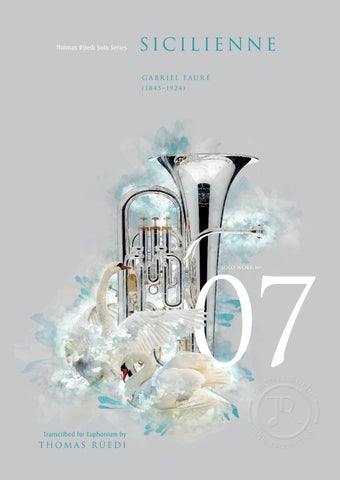
Thomas Rüedi Solo Series
SICILIENNE G A BR IEL FAU R É (18 4 5 –19 2 4)
07 SOLO WORK NO
Transcribed for Euphonium by
THOMAS RÜEDI
Thomas Rüedi Solo Series
SICILIENNE G A BR I E L FA U R É (18 4 5 –19 2 4)
Transcribed for Euphonium by THOMAS RÜEDI
PREFACE THE WORK
«Sicilienne» (Op.78) was written in 1893 for small orchestra as part of a larger commission of incidental music for the play «Pelleas et Melisande«. As Fauré was so busy teaching and playing during most of his life, he never had much time to compose. After he wrote the incidental music, he had one of his students orchestrate it for him. In the end, the music wasn’t used in the play but still exists in its larger form: «Pelleas et Melisande Suite» (Op. 80) for Orchestra. The sicilienne is the third section of the suite. Fauré had it extracted and arranged for cello and piano in 1898, most likely by one of his pupils. This version was dedicated to the British cellist, William Henry Squire.
THE FORM
«Sicilienne» or siciliano as it is better known, is a musical form from the baroque era. From the 18th to 20th century the sicilienne was used to convey pastoral emotions of melancholy. It can be found written in either 6/8 or 12/8, and is characterized by its dotted eighth-sixteenth-eighth rhythm such as «Silent Night». Fauré constructed a rather interesting form, a hybrid rondo: A-B-A’-C-B’-A”. Written in g minor (with the exception of the C section, which is in Eb major) Fauré follows the tradition of sicilianos being in a minor key. Another interesting twist is the addition of a counter melody in C section. Fauré had a great sense of how to color traditions with innovation, his «Sicilienne» is no exception.
PERFORMANCE CONSIDERATION
Even though «Sicilienne» was written during the early part of Fauré’s third compositional period, it is a certain reflection of his second period. His second period being famous for the melodious and languid aesthetic of his music. He had a disinclination for physical exertion and virtuosity during this time, so make certain the melody stays uncomplicated and clean. A careful analysis of the harmony and form can help inform the shape of phrases. Generally constructed in simple 4 and 8 bar phrases, be sensitive to small changes in the piano and try to help highlight them with subtle alterations to phrasing. Remember that Fauré was a soft spoken, gentle man; Try to imbue that into the sweetness of tone. He cared most for a beautiful line: clear, simple phrasing and effortless beauty are the goals.
THE ARRANGEMENT
This piece has been arranged for, or performed on many different instruments and is commonly found on recital programs. It lends itself nicely to the euphonium due to the lyrical and flowing quality of the melody. In this arrangement the key has been lowered a whole step, from g minor to f minor.
THE COMPOSER
á Mai 12, 1845 in Paris, France † November 4, 1924 in Paris, France Known as one of the most influential French composers of his time, Fauré was celebrated by his French contemporaries and respected by European counterparts. It took a while for Fauré to gain popularity. It wasn’t until he was about 50 years old that he started becoming a known name among those in the musical circles of Europe. Outside of France, with the help of Edward Elgar, England was the first European country to become enamored with Fauré’s wonderful sense of fluid melodic writing, followed by Russia and Spain. As director of the Paris conservatory he led somewhat of a revolution to modernize the conservatory in its curriculum, administration and politics. This angered many older faculty members to the point of them resigning from their positions in protest. Dedicated to the performance of new music and a general broad appreciation of all music, Fauré expanded the timespan of the curriculum taught on both sides of the timeline; back to renaissance polyphony and as far forward as Debussy. After Fauré left his position as headmaster at the age of 75, many of his forward thinking ideas were reversed by his much more conservative successor. During his life, Fauré had established personal relationships with many important composers. He was a student of Saint-Säens, as well as the teacher of Ravel. He was a confidant of Richard Strauss. Fauré had personal connections with composers from vastly different times, from Tchaikovsky who died in 1898, to Copeland who died nearly 100 years later in 1990. Fauré was known as a soft-spoken man with a gentle demeanor. During the years he was head of the Paris Conservatory, he was also a music critic; it was a job he didn’t particularly like. Due to his gentle personality and his broad respect for all music, he was not a very effective critic as he prefered to stay silent if he didn’t like something. Fauré was a charming man who did not let his fame change his simple ways. And until the end of his days, he stayed dedicated to new music and keeping himself available to young composers such as Honegger, Milhaud, Poulenc and Copeland.
MILESTONES
1870 – 1871 Enlisted in the Imperial Guard and fought as a member of the infantry to raise the siege of Paris during Franco-Prussian War . 1905 – 1920 Headmaster of the Paris Conservatory 1911 Began to lose his hearing. Before he became virtually deaf around 1920, his hearing began to also distort. High notes sounded a third lower, low notes a third higher and the middle register stayed the same.
Thomas Rüedi Solo Series
The Thomas Rüedi Solo Series is a collection of selected masterpieces arranged for euphonium and piano. This series strives to enrich the solo repertoire for euphonium, thus opening a window into the fascinating world of some of the leading composers of the Baroque and Romantic period. By studying these famous works, the performer develops a more profound musicianship and a more defined awareness of style and musical beauty. Audiences in turn, may appreciate hearing these beloved masterpieces performed in a fresh voice – the wonderful lyrical expression of the euphonium!
No. 01
Granados, Enrique
Madrigal Romantic
No. 02
Schubert, Franz
Sonata for Arpeggione - First Movement Romantic
No. 03
Offenbach, Jacques
Les Larmes de Jacqueline Romantic
No. 04
Ravel, Maurice
Vocalise-étude Romantic
No. 05
Tchaikovsky, Pytor Ilyich
Andante Cantabile Romantic
No. 06
De Falla, Manuel
Ritual Firedance Romantic
No. 07
Fauré, Gabriel
Sicilienne Romantic
No. 08
Schubert, Franz
Moments Musicaux Romantic
No. 09
Toselli, Enrico
Serenata Romantic
No. 10
Bridge, Frank
Four Short Pieces Romantic
No. 11
Scarlatti, Alessandro
Sonata No. 1 in D minor Baroque
No. 12
Gabrielli, Domenico
Sonata No. 1 in G major Baroque
www.thomasruedi.ch follow me on: facebook.com/euphtom
© 2017 All rights reserved by Thomas Rüedi | Cover Artworking by zuckerbrot.ch
THOMAS RÜEDI is a Swiss-born international euphonium artist, music educator and arranger. His solo engagements have led him throughout Europe, Africa, Asia, South America and the USA. Thomas Rüedi’s solo CDs «Elégie» and «Madrigal», both featuring his own arrangements, received international recognition. Thomas Rüedi is professor of euphonium and chamber music at Bern University of the Arts and Lucerne University of the Arts; as a guest professor he regularly gives master classes throughout Europe and overseas. Thomas Rüedi is also an acclaimed arranger and composer, thus supporting the further development and enrichment of the euphonium repertoire.
THOMAS RÜEDI is a BESSON performing artist.
euphtom www.thomasruedi.ch