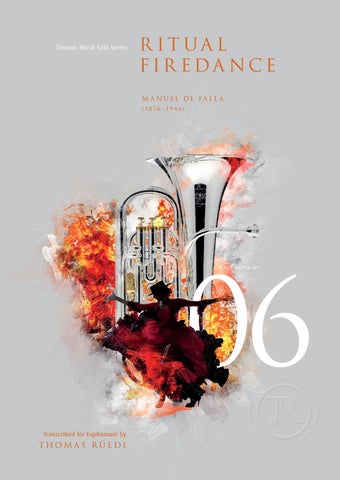
Thomas Rüedi Solo Series
R IT UA L FIR EDA NCE M A N U E L DE FA L L A (18 76 –19 4 6)
06 SOLO WORK NO
Transcribed for Euphonium by
THOMAS RÜEDI
Thomas Rüedi Solo Series
R IT UA L FIR EDA NCE M A N U E L D E F A L L A (18 76 –19 4 6)
Transcribed for Euphonium by THOMAS RÜEDI
PREFACE THE WORK
The famed «Ritual Fire Dance» (Danza ritual del fuego) is a movement from de Falla’s ballet «El amor brujo» (The Bewitched Love) and was composed in 1915. The story: Candela, a young Andalusian gypsy girl, is haunted by the ghost of her late husband. In an attempt to get rid of the ghost, all the gypsies circle around a camp fire at night, where Candela performs a Ritual Fire Dance. The ghost appears and they both start dancing together around the fire. As they whirl around faster and faster, the ghost gets drawn into the fire and vanishes forever. With its fast trills and ornaments, the work is said to be inspired by Rimsky-Korsakov’s «Flight of the Bumblebee». De Falla himself made several arrangements of this movement for various instrumentations, among them a hugely popular piano rendition (1921).
THE FORM
This work has an ABCABC Coda structure. The A-section (C-major) starts with fast moving trills in the piano. Fast changing dynamics, ranging from pp to mf, are an illustration of the blazing fire. In the B-section, the solo voice enters with the indication marcato il canto and in the orchestral version, de Falla has scored this for the oboe. This indicates that in performance, the soloist should strive for a singing quality and should not over-exaggerate the dynamic. At ms 40, the mood changes dramatically and the repetition of the theme is stated more fiercely ff e molto marcato. The C-section unfolds great dynamic tension as the melodic line enters ff subito, interrupting the previous pp ostinato passage. De Falla brings back sections ABC before tension is once more built up, reaching the Coda with a Piú mosso, ma giusto. The famous ff marcato chords with its rigid quarter notes are the final statement of this ritual.
PERFORMANCE CONSIDERATION
This work is technically quite challenging and the soloist is required to display the diverse moods with great consideration. It could easily happen that the music just serves as a flashy show-piece with thrilling dynamics displayed. Naturally, this music is about a ritual and the dynamic range has to be convincing. However, special attention should be brought to the ornamentations, making sure that they are not rushed in the ‘heat of the moment’. De Falla chooses Allegro ma non troppo at the beginning of his work and this should be kept in mind. If this music is played too fast, it will lose the character of a ritual.
THE COMPOSER
á November 23, 1876 in Cádiz, Spain † November 14, 1946 in Alta Garcia, Argentina Manuel De Falla was fortunate to have been born into a family of financial means. From a young age he studied piano in his own home from his mother. He quickly progressed beyond her knowledge and studied with several other teachers. His obsession with traditional music, which can be heard in all of his compositions, is said to come from this time that he was a small boy. His family hired a moorish woman as a domestic servant who would sing traditional Andalusian music and songs of Arabic or gypsy origins as she worked around the house. Before De Falla became known in Spain as one of its greatest composers, he first earned critical acclaim and fame outside of his country’s borders. His music was published first in London and Paris and was supported by the Russian Ballet. While studying at the Madrid Conservatory, he came under the influence of music theorist and composer Felipe Pedrell; the very same Pedrell who is credited with mentoring Enrique Granados and Isaac Albéniz. The Spanish Civil War was a troubling time for De Falla. He found it difficult to align with either side and was saddened his country was being ripped apart. Both sides tried to recruit him to write music, but he never publicly supported one party over the other, despite his music having nationalistic overtones due to his use of folk music and other Spanish traditions. He, instead, moved with his sister to Buenos Aires, Argentina to escape the tumultuous climate. De Falla lived his remaining 7 years in a small mountain village. After his death, his remains were transported back to Spain and given a ceremonial burial in Spain.
MILESTONES
1888 He was unanimously awarded the first prize at the Madrid Conservatory piano competition. – In spite of being a virtuoso pianist, his musical efforts throughout his life were overwhelmingly in composition. – Regarded as music nobility in Spain, his image was printed on Spanish currency for years following his death.
Thomas Rüedi Solo Series
The Thomas Rüedi Solo Series is a collection of selected masterpieces arranged for euphonium and piano. This series strives to enrich the solo repertoire for euphonium, thus opening a window into the fascinating world of some of the leading composers of the Baroque and Romantic period. By studying these famous works, the performer develops a more profound musicianship and a more defined awareness of style and musical beauty. Audiences in turn, may appreciate hearing these beloved masterpieces performed in a fresh voice – the wonderful lyrical expression of the euphonium!
No. 01
Granados, Enrique
Madrigal Romantic
No. 02
Schubert, Franz
Sonata for Arpeggione - First Movement Romantic
No. 03
Offenbach, Jacques
Les Larmes de Jacqueline Romantic
No. 04
Ravel, Maurice
Vocalise-étude Romantic
No. 05
Tchaikovsky, Pytor Ilyich
Andante Cantabile Romantic
No. 06
De Falla, Manuel
Ritual Firedance Romantic
No. 07
Fauré, Gabriel
Sicilienne Romantic
No. 08
Schubert, Franz
Moments Musicaux Romantic
No. 09
Toselli, Enrico
Serenata Romantic
No. 10
Bridge, Frank
Four Short Pieces Romantic
No. 11
Scarlatti, Alessandro
Sonata No. 1 in D minor Baroque
No. 12
Gabrielli, Domenico
Sonata No. 1 in G major Baroque
www.thomasruedi.ch follow me on: facebook.com/euphtom
© 2017 All rights reserved by Thomas Rüedi | Cover Artworking by zuckerbrot.ch
THOMAS RÜEDI is a Swiss-born international euphonium artist, music educator and arranger. His solo engagements have led him throughout Europe, Africa, Asia, South America and the USA. Thomas Rüedi’s solo CDs «Elégie» and «Madrigal», both featuring his own arrangements, received international recognition. Thomas Rüedi is professor of euphonium and chamber music at Bern University of the Arts and Lucerne University of the Arts; as a guest professor he regularly gives master classes throughout Europe and overseas. Thomas Rüedi is also an acclaimed arranger and composer, thus supporting the further development and enrichment of the euphonium repertoire.
THOMAS RÜEDI is a BESSON performing artist.
euphtom www.thomasruedi.ch