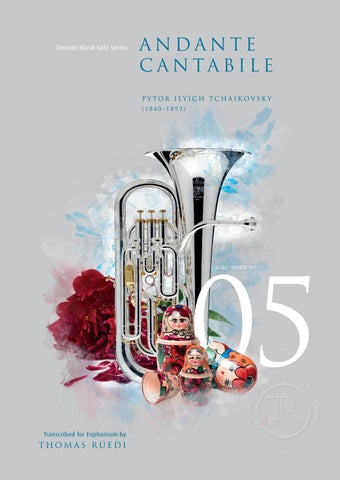
Thomas Rüedi Solo Series
ANDANTE CANTABILE P Y T O R I LY I C H T C H A I K O V S K Y (1840–1893)
05 SOLO WORK NO
Transcribed for Euphonium by
THOMAS RÜEDI
Thomas Rüedi Solo Series
A NDA N TE C A N TA BIL E P Y T O R I L Y I C H T C H A I K O V S K Y (18 4 0 –18 93)
Transcribed for Euphonium by THOMAS RÜEDI
PREFACE THE WORK
The famous «Andante Cantabile» originally forms the 2nd movement of Tchaikovsky’s «String Quartet Nr.1 in D-major» (Op.11). The string quartet was composed in February 1871 and premiered in Moscow the following month. The work is often performed in a solo version and Tchaikovsky himself made an arrangement of this movement for cello and string orchestra in 1888. The work is «…based on a folk song which the composer had heard at Kamenka, while he was staying with his sister» [1] When the quartet was performed at a tribute concert for Leo Tolstoy, the author was said to have been brought to tears by this movement. «…Tolstoy, sitting next to me and listening to the Andante of my First Quartet, burst into tears» [2] With this famous «Andante Cantabile» Tchaikovsky achieved the first of his many great hits.
THE FORM
The music alternates between a Ukrainian folk theme and a contrasting of Tchaikovsky’s own inspiration. The first part shows some irregular time patterns (2/4 and 3/4 time), a characteristic often found in Eastern European folk music. The middle section in Db major displays the elegance of a Serenade. Here, Tchaikovsky makes use of his beloved ostinato pizzicato accompaniment – just one of his many techniques which makes his style of writing so unique and instantly recognisable.
section
tonality
A
B
C
A‘
Bridge
D
Trans.
A“
Trans
(2x8ms)
(8ms)
(8ms)
(2x8ms)
(4ms)
(2x6ms)
(10 ms)
(2x8ms)
(16ms)
Bb maj
F maj
Bb min
Bb maj
Trans. to
Db maj/
Trans. to
Bb maj
Bb maj
Db maj
Bb min
Bb maj
coda
Bb maj
PERFORMANCE CONSIDERATION
It goes without saying that Tchaikovsky’s music calls for a strong melodic expressiveness of sound. Since the piano accompaniment is quite sparse, the soloist is required to keep the tension and drama of the music alive for the entire duration of the piece. This can be quite a challenge, not to mention the physical strain put upon the performer. It is therefore vitally important to have a clear ‘game plan’ in performance – where does the next phrase lead into? What character does it have? Also, deciding on the clear high-points of the music. With thoughtful consideration about the use of dynamics, phrasing and contrast, you will find this music to be a wonderfully inspirational – for you and your audiences.
THE TRANSCRIPTION
This transcription was left in the original key of Bb-major.
THE COMPOSER
á April 25, 1840 in Kamosko-Votinsk, Russia † October 25, 1993 in St. Peterburg, Russia «He was the first composer of a new Russian type, fully professional, who firmly assimilated traditions of Western European symphonic mastery. In a deeply original, personal and national style he united the symphonic thought of Beethoven and Schumann with the work of Glinka, and transformed Liszt’s and Berlioz’s achievements in depictive-programmatic music into matters of Shakespearian elevation and psychological import.» [1]
MILESTONES
– Although musically precocious, Tchaikovsky was educated for a career as a civil servant. – He was the first Russian composer who made a lasting impression internationally. – Tchaikovsky‘s sudden death at the age of 53 is generally ascribed to cholera; 1884 Was honored by Emperor Alexander III and awarded a lifetime pension.
[1] Catherine Steinegger, Notes to Recording of Keller Quartet (Erato, 2292-45965-2) [2] Alexandra Orlova: Tchaikovsky, a self-portrait quotes this as originating from «Diaries, 211»
OUP, 1990, ISBN 0-19-315319-X
[3] Boris Asaf‘yev The Grove Music Online; Roland John Wiley; biographical article on Tchaikovsky,
Pyotr Il’yich
Thomas Rüedi Solo Series
The Thomas Rüedi Solo Series is a collection of selected masterpieces arranged for euphonium and piano. This series strives to enrich the solo repertoire for euphonium, thus opening a window into the fascinating world of some of the leading composers of the Baroque and Romantic period. By studying these famous works, the performer develops a more profound musicianship and a more defined awareness of style and musical beauty. Audiences in turn, may appreciate hearing these beloved masterpieces performed in a fresh voice – the wonderful lyrical expression of the euphonium!
No. 01
Granados, Enrique
Madrigal Romantic
No. 02
Schubert, Franz
Sonata for Arpeggione - First Movement Romantic
No. 03
Offenbach, Jacques
Les Larmes de Jacqueline Romantic
No. 04
Ravel, Maurice
Vocalise-étude Romantic
No. 05
Tchaikovsky, Pytor Ilyich
Andante Cantabile Romantic
No. 06
De Falla, Manuel
Ritual Firedance Romantic
No. 07
Fauré, Gabriel
Sicilienne Romantic
No. 08
Schubert, Franz
Moments Musicaux Romantic
No. 09
Toselli, Enrico
Serenata Romantic
No. 10
Bridge, Frank
Four Short Pieces Romantic
No. 11
Scarlatti, Alessandro
Sonata No. 1 in D minor Baroque
No. 12
Gabrielli, Domenico
Sonata No. 1 in G major Baroque
www.thomasruedi.ch follow me on: facebook.com/euphtom
© 2017 All rights reserved by Thomas Rüedi | Cover Artworking by zuckerbrot.ch
THOMAS RÜEDI is a Swiss-born international euphonium artist, music educator and arranger. His solo engagements have led him throughout Europe, Africa, Asia, South America and the USA. Thomas Rüedi’s solo CDs «Elégie» and «Madrigal», both featuring his own arrangements, received international recognition. Thomas Rüedi is professor of euphonium and chamber music at Bern University of the Arts and Lucerne University of the Arts; as a guest professor he regularly gives master classes throughout Europe and overseas. Thomas Rüedi is also an acclaimed arranger and composer, thus supporting the further development and enrichment of the euphonium repertoire.
THOMAS RÜEDI is a BESSON performing artist.
euphtom www.thomasruedi.ch