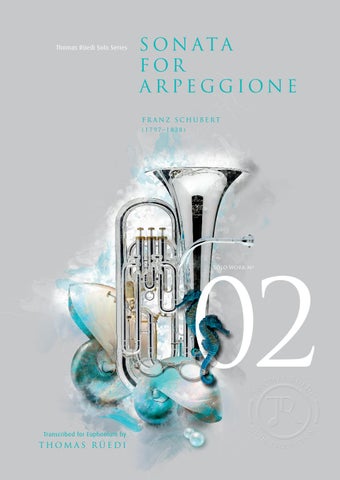
Thomas Rüedi Solo Series
S O N ATA FOR ARPEGGIONE F R A N Z S C H U BE RT (1797–1828)
02 SOLO WORK NO
Transcribed for Euphonium by
THOMAS RÜEDI
Thomas Rüedi Solo Series
SONATA FOR A R PEG GIONE ( F I R S T M O V E M E N T ) F R A N Z S C H U BE R T (17 9 7 –18 2 8 )
Transcribed for Euphonium by THOMAS RÜEDI
PREFACE THE WORK
Franz Schubert composed the «Sonata for Arpeggione and Piano D.821 in A minor» most likely for his close friend and arpeggione virtuoso Vincenz Schuster. The Sonata was written in 1824, only one year after the instrument was invented (Spring, 1823). The arpeggione is an instrument similar to a small cello in shape and bowed as such, but has six strings and a fretboard like a guitar, and utilizes guitar string tuning. Ironically, by the time that the Sonata was published in 1871, the interest in the arpeggione had evaporated. Today, only a handful of these instruments still exist, but a few commercial recordings of the Sonata performed on the period instrument have been recorded as recent as 2007. Most commonly now, it is performed with arrangements for cello or viola; however, it is also performed with modest frequency on most instruments including: flute, guitar, clarinet and saxophone.
THE FORM
Sonata Form or Sonata Allegro Form is a common form used in composition of the first movement of larger three movement works. Due to its popularity as the form of the first movement it is sometimes referred to as First Movement Sonata Form. The form became popular half way through the 18th century and is still used today. The form’s larger structure consists of the parts: exposition, development, recapitulation, and coda. However, the smaller parts within these larger structures often have differing formations of first and second themes and transitions. There is no real definition of how the smaller structures should be formed because so many different variations have been used by composers over the years. The first movement of Schubert’s sonata is a textbook example of Sonata Form: Exposition (repeated) – Development (bar 76) – Recapitulation (bar 126) – Coda (bar 190).
PERFORMANCE CONSIDERATION
This piece is extremely strenuous for euphonium; the repeat of the exposition may be omitted if it proves too difficult or for time considerations. The arpeggione was an incredibly nimble instrument due to it being fretted, especially with movement by thirds. The 16th note passages, especially the ones with movement by thirds, should remain easy, agile and fluent. Be sensitive to the key and mode changes; use them to help inspire colour and character changes. Schubert’s own issues with sudden mood swings due to his entering and exiting times of depression can perhaps be used to shed light on the topic. Note: while Schubert was experiencing bouts of depression at the time, it does not indicate the music is depressing or hopeless. Carefully consider what you want to convey to the audience. I personally think the musical spectrum of this movement is never darker than solemn and expands, at times, to divine joy.
THE ARRANGEMENT
The arpeggione had an incredibly large range. This causes some obstacles when arranging it for any instrument. Cello and violin arrangements take some sections down octaves to make it playable, because they simply don’t have a range large enough. When done carefully, it doesn’t disturb the music in the least. The euphonium does possess a range large enough to play the original setting (when moved down 1½ octaves), but in order to maintain the correct character of sound, this arrangement parallels that of the cello or violin. Like most arrangements for double bass, the tonality is shifted down a whole step from A minor to G minor, again only for reasons of sound and colour considerations, and practicality.
THE COMPOSER
á January 31, 1797 in Vienna, Austria † November 19, 1828 in Vienna, Austria Franz Schubert was a massively important Austrian born composer and pianist, who needs little introduction. Although he died at the young age of 31, during his lifetime he was incredibly prolific, with almost 700 pieces to his name, including 9 symphonies. Schubert was raised in a poor family in Vienna, his father was a school teacher. Although Schubert didn’t have money, he benefited immensely from the rich musical culture that was fueled by the First Viennese School; which consists of Mozart, Haydn, and Beethoven, though occasionally Schubert is added to the list. Financial issues continued to follow Schubert until his death. In the time Schubert wrote the Arpeggione Sonata, his health began to decline as he started suffering from the later stages of a suspected infection of syphilis and mercury poisoning (a typical medication for syphilis at the time). His unstable health at this time, and his strained friendships lead to unmitigated bouts of depression. He continued to fight depression until his death. Schubert requested to be buried alongside Beethoven, whom he always looked up to and respected. His request was granted, but a few years later his grave along with Beethoven’s was moved to a new cemetery in Vienna which is shared with Johannes Brahms and Johann Strauss.
MILESTONES
1814 Set the text of a poem by Goethe to music and composed his first masterpiece, «Gretchen at the spinning wheel». 1818 Left his career of teaching in order to pursue music full time. 1828 8 months before his death, he finally had enough money to buy himself his first piano.
Thomas Rüedi Solo Series
The Thomas Rüedi Solo Series is a collection of selected masterpieces arranged for euphonium and piano. This series strives to enrich the solo repertoire for euphonium, thus opening a window into the fascinating world of some of the leading composers of the Baroque and Romantic period. By studying these famous works, the performer develops a more profound musicianship and a more defined awareness of style and musical beauty. Audiences in turn, may appreciate hearing these beloved masterpieces performed in a fresh voice – the wonderful lyrical expression of the euphonium!
No. 01
Granados, Enrique
Madrigal Romantic
No. 02
Schubert, Franz
Sonata for Arpeggione - First Movement Romantic
No. 03
Offenbach, Jacques
Les Larmes de Jacqueline Romantic
No. 04
Ravel, Maurice
Vocalise-étude Romantic
No. 05
Tchaikovsky, Pytor Ilyich
Andante Cantabile Romantic
No. 06
De Falla, Manuel
Ritual Firedance Romantic
No. 07
Fauré, Gabriel
Sicilienne Romantic
No. 08
Schubert, Franz
Moments Musicaux Romantic
No. 09
Toselli, Enrico
Serenata Romantic
No. 10
Bridge, Frank
Four Short Pieces Romantic
No. 11
Scarlatti, Alessandro
Sonata No. 1 in D minor Baroque
No. 12
Gabrielli, Domenico
Sonata No. 1 in G major Baroque
www.thomasruedi.ch follow me on: facebook.com/euphtom
© 2017 All rights reserved by Thomas Rüedi | Cover Artworking by zuckerbrot.ch
THOMAS RÜEDI is a Swiss-born international euphonium artist, music educator and arranger. His solo engagements have led him throughout Europe, Africa, Asia, South America and the USA. Thomas Rüedi’s solo CDs «Elégie» and «Madrigal», both featuring his own arrangements, received international recognition. Thomas Rüedi is professor of euphonium and chamber music at Bern University of the Arts and Lucerne University of the Arts; as a guest professor he regularly gives master classes throughout Europe and overseas. Thomas Rüedi is also an acclaimed arranger and composer, thus supporting the further development and enrichment of the euphonium repertoire.
THOMAS RÜEDI is a BESSON performing artist.
euphtom www.thomasruedi.ch