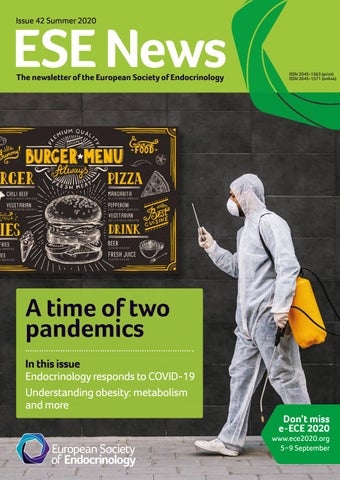
ESE News Issue 42 Summer 2020
The newsletter of the European Society of Endocrinology
ISSN 2045-1563 (print) ISSN 2045-1571 (online)
A time of two pandemics In this issue Endocrinology responds to COVID-19 Understanding obesity: metabolism and more Don’t miss e-ECE 2020
www.ece2020.org 5−9 September
CONTENTS & EDITORIAL
In this issue
Editorial
Society News
The world has seen much change since the last issue of ESE News. It has affected all our lives, but it is heartening to find that, around the globe, communities have united and become stronger. In just such a way, we – the members of the endocrine community – have worked together unstintingly, to meet unprecedented challenges in our professional and personal lives.
03 Introducing e-ECE 2020 04 The making of a virtual Congress, plus Metformin for steroid side effects 05 Andrea Giustina: your President’s perspective, plus From the ESE Office
ESE Committees
06 A time of twin challenges, and An early career in obesity research
Features
07 Endocrinology in the time of COVID-19 08 Obesity – the link with reproduction 10 Obesity, cancer and a role for epigenetics 12 The Endo Explorer: Gilles Mithieux on the intestine’s role in blood glucose control
Editors’ Selection
13 ‘Health gain’ surgery in obesity: the options
At the Back...
14 Renato Pasquali: a visionary in obesity 15 Early career endocrinology: 4 months in the time of COVID-19 16 Endo Prize Puzzle, plus ESE diary dates
Editor: Justo Castaño, Spain Email: justo@uco.es Co-Editor: Andrea Giustina, Italy Email: ese.president@ese-hormones.org Editorial Board: Luís Cardoso, Portugal Eva Coopmans, The Netherlands Olaf Dekkers, The Netherlands Josef Köhrle, Germany Sub-Editor: Caroline Brewser Design: Qube Design Associates Website: www.ese-hormones.org ©2020 European Society of Endocrinology The views expressed by the contributors are not necessarily those of ESE
2
This document is available on the ESE website, www.ese-hormones.org ESEndocrinology EuropeanSocietyofEndocrinology The addresses used to mail this issue of ESE News were supplied by the members of ESE and are stored in Bioscientifica’s database for future use. If you do not wish to receive further mailings, please advise info@euro-endo.org ESE thanks the following for their support. Premium Corporate Members: Akcea Therapeutics, Ipsen, Pfizer, Recordati Rare Diseases, Takeda Corporate Members: Advanced Accelerator Applications, Amryt Pharmaceuticals, Diurnal, HRA Pharma, Kyowa Kirin International, Merck Serono, Novo Nordisk, Sandoz International, Siemens-Healthineers, Strongbridge Biopharma, Uni-Pharma Supporter: Isotopen Technologien Munchen
Our Society, ESE, has stood alongside us to provide support, while COVID-19 has disrupted the way we care for patients and the way we perform research. The huge range of ESE initiatives (see page 5) has included the Society’s widely downloaded statement on patient management, and European Journal of Endocrinology’s series of essential articles on ‘Endocrinology in the time of COVID-19’ (page 7). With Endo-ERN, ESE is actively encouraging the collection of data on patients with rare conditions who are affected by the virus. ESE Talks provide an educational webinar series covering many endocrine conditions in the COVID-19 era (see page 9). ESE was determined that our community should still benefit from an annual Congress in 2020, to bring us together to share the latest research and best practice. In this way, our first fully digital Congress, e-ECE 2020, was born. Wherever you are on 5–9 September, you can be amongst your colleagues! Find out more on pages 3 and 4. Of course, the world also remains in the grip of another, longer established, pandemic. Obesity and its comorbidities weave their way through our endocrine practice. Obese patients are at greater risk from many other conditions, including COVID-19. On page 8, Manuel Tena-Sempere considers the often overlooked association between obesity and reproductive health. Obesity’s link with cancer is perhaps more widely recognised; on page 10, Ana Crujeiras and Felipe Casanueva examine the role of epigenetics in this association. Gilles Mithieux and his team have spent over 30 years researching the control of blood glucose, including the fundamental role of the intestine. You can hear the fascinating story of their research on page 12. On page 13, Alexis Sudlow, Carel Le Roux and Dimitro Pournaras discuss their recent review article in Endocrine Connections, on the metabolic outcomes of different bariatic surgical approaches. Finally, it was with great sadness that we heard of the untimely passing of Renato Pasquali, whose career was devoted to the study of obesity. His colleagues pay tribute to his work on page 14. I hope that you and your families and colleagues remain safe and healthy in the coming months. On behalf of ESE, I thank and congratulate you for your professionalism and stoicism throughout this remarkable period in our lives. I wait with anticipation until we can meet again.
Justo P Castaño Editor, ESE News
SOCIETY NEWS
Save the date 5−9 September 2020 Free to ESE members! www.ece2020.org
‘We’ll be disappointed not to see you face-to-face, but e-ECE 2020 will ensure the global endocrine community can still access vital science’
Introducing e-ECE 2020 ESE’s first fully digital Congress e-ECE 2020, ESE’s digital Congress, will run live online on 5−9 September 2020. The COVID-19 pandemic has created new challenges, making it difficult to connect with friends and colleagues, and forcing many of us to shift our primary focus from endocrinology. Connecting with the wider endocrine community to share science and best practice is now more important than ever. e-ECE will provide you with a rich and interesting experience. As well as listening to worldrenowned experts, visiting e-posters and seeing the latest hot topic research, you will be able to explore the virtual exhibition by visiting the ECE Hub and enjoy industry satellite symposia. We know many of you are managing both work and family commitments, with timesensitive schedules. e-ECE 2020 has been designed to be flexible.
You can choose to tune in for live sessions during the 5 days of the Congress or to watch later via ESE On Demand. Our streamlined programme allows you to build a personalised agenda around our Focus Areas, so you get to select the sessions you attend, at times that suit you. Career development is an essential part of the Congress, so we’re working with EACCME (the European Accreditation Council for Continuing Medical Education) to ensure you get the accreditation you need. As research in endocrinology develops rapidly, don’t miss this chance to learn the latest advances from leading experts in the field. We’ll be disappointed not to see you face-to-face, but e-ECE 2020 will ensure the global endocrine community can still access vital science. Prague is now set to be our exciting venue for ECE 2021 on 22−25 May next year.
ESE News goes ‘green’ You may have noticed that the packaging in which you have received ESE News has changed. To better care for the environment, ESE News is now mailed in wrap made from BIOPLAST300. This uses waste potatoes from the food chain, and is plasticiser- and GMO-free. It complies with European Standard EN13432, an EU-harmonised standard for compostable and biodegradable packaging. You can dispose of the wrap in a home compost bin, food waste caddy or green waste collected by your local authority. The material will be completely metabolised by micro-organisms in 6−12 months.
Free of charge to members
e-ECE 2020 is available to all ESE members free of charge. Not a member? Join ESE for as little as €10. Non-members can access the Congress for just €100, with a
reduced rate of €50 for early career endocrinologists and nurses.
Registration is now open Find out more at www.ece2020.org.
ECE 2020
22nd European Congress of Endocrinology
Diversity gives opportunity Inclusion is our strength
5-9 September 2020 e-ECE 2020, our new, fully digital Congress, brings you the latest innovations in endocrine research and patient care. Running live from 5-9 September 2020, e-ECE 2020 will bring you high quality lectures, symposia, Meet the Expert sessions, New Scientific Approaches and much more. While we can’t replicate the joy of meeting colleagues old and new in person, we are working to create a complete Congress experience. Our virtual exhibition, ECE Hub sessions and satellite symposia will enable you to stay up to date with industry. There will also be plenty of opportunities to meet online, extend your network and spark discussions. The e-ECE 2020 Congress will be free for all ESE members! Join ESE today for only €10 per year.
Register now at www.ece2020.org
www.ece2020.org #eECE2020
3
SOCIETY NEWS
e-ECE 2020
The making of a virtual endocrine experience
Zoom quickly became the ‘new normal’ for e-ECE operational planning meetings
Plans for ECE 2020 in Prague, Czech Republic, were well advanced when the world suddenly experienced unprecedented change. The ESE Team and Executive Committee (ExCo) had to make some quick decisions. But how do you change a physical event into a virtual experience in just a few weeks? By mid-February, over 1800 abstracts had been submitted to ECE 2020. The Programme Organising Committee had crafted an exciting programme, packed with the best science, research and clinical updates. Registrations were escalating ahead of the early bird deadline.
However, as the ESE Team finalised the papers for the ExCo meeting in Milan, Italy, on 6−7 March, it was clear that the world was changing. COVID-19 became a global pandemic. Parts of China locked down; Italy began to do the same. That ExCo meeting was the first to be held virtually; since then
all ESE Committee meetings have followed suit, including ESE’s first virtual AGM. But ECE 2020 was due to take place in Prague just 10 weeks after the March ExCo meeting – time was pressing! Collectively, we discussed options for postponing until later in 2020, cancelling, or
exploring a fully digital ECE. A dedicated Working Group was charged with analysing the options. On 8 April, ExCo made the decision to recreate ECE 2020 as a fully digital online Congress. Just 4 weeks later, we launched e-ECE 2020. Within 10 days, over 1000 people registered their interest. May saw the programme optimised for the online environment. The ESE Team invited speakers, engaged industry partners with satellite and virtual exhibition opportunities, and ensured the ESE On Demand platform was developed to host the e-Congress. Perhaps this sounds straightforward? The truth is that changing the direction of a large Congress such as ECE just before its live date was an immense challenge, requiring great teamwork and dedication to make the right decisions. These had to be made against a backdrop of rapid development of digital services by the events industry, in order to support congresses in moving to a fully virtual format. Make sure you don’t miss this ‘first of its kind’ experience, brought to you by ESE! Join the whole endocrine community on 5−9 September for your virtual Congress, whether you participate from your home or your place of work. You can find the programme and register at www.ece2020.org.
Metformin reduces steroid complications A recent phase 2 clinical trial conducted by Márta Korbonits (London) and colleagues examined over 50 non-diabetic patients on glucocorticoid treatment, and found that those treated with metformin showed improved clinical outcomes, including a 30% reduction in the rate of infections and lower hospital admissions, in comparison with the placebo group. Metformin also strengthened the intended anti-inflammatory effects of glucocorticoids and had beneficial effects
4
on cardiovascular, metabolic and bone markers during the 12-week trial. Previous research found that steroids can influence AMP kinase (AMPK), while other studies suggested that metformin acts, at least partly, via AMPK, but in the opposite way to steroids. This led the researchers to reason that metformin might reverse the unwanted side effects of steroids. The hope is that metformin could offer a simple and cheap solution to reduce side effects of steroid treatment.
Professor Korbonits commented, ‘Whilst developed countries may be increasing the use of biologics or other steroid-sparing agents, in many other parts of the world there’s still a heavy reliance on glucocorticoids. Our results suggest metformin has the potential to help these patients.’ Around 3% of the general adult
population and up to 11% of over-80s currently receive long term steroid treatment for chronic inflammatory disease. You can find out more about the study at Pernicova et al. 2020 Lancet Diabetes & Endocrinology 8 278−291.
‘Our results suggest metformin has the potential to help these patients’
SOCIETY NEWS
Find links to all ESE COVID-19 initiatives at: www.ese-hormones.org/covid-19-and-endocrine-disease
From your President Dear Friends During the first year of my presidency, which started with you all at ECE last May, the initial phase of my 2019−2021 Inclusion Plan has begun. These past 12 months have focused on the strength our diversity brings us, and the opportunity that embracing this gives. This strength has been shown by you all over recent months, as you have worked tirelessly helping and managing our endocrine and metabolic patients. Not only have we launched three new committees focusing on rare disease, membership and finance, established a new Early Careers Taskforce and opened an office in Brussels, we have recently had more ‘firsts’! These include the first fully virtual meeting of ESE’s Executive Committee, the launch of the ESE Talks webinar series on ‘Endocrine conditions in the COVID-19 era’ and ESE’s first virtual AGM. The pandemic has further
shaped much of our activity over the past 3 months. In March, we issued an ESE statement about managing patients with endocrine disease during the COVID-19 pandemic, as well as an ESE ‘decalogue’ – ten key tenets to help you keep your patients and yourselves safe. This ESE statement has already been downloaded over 10 000 times, and has an altmetric score over 100. The Lead Editors of European Journal of Endocrinology also commissioned a free-toaccess review series entitled ‘Endocrinology in the time of COVID-19’. This provides guidance on managing endocrine patients, as we face unprecedented restrictions on our diagnostic and therapeutic capacity. Additionally, the ESE Rare Disease Committee, alongside Endo-ERN, has engaged in an initiative to collect data on specific groups of patients with rare endocrine conditions who
are also affected by COVID-19. I strongly encourage you to increase the knowledge set by contributing. Sadly, this May we could not meet in person at ECE in Prague, Czech Republic. But, from the challenging situation presented by COVID-19, we have seized the opportunity to bring the endocrine community together by taking the Congress online as e-ECE 2020 in September – another first! I encourage you to join us during the 5 days, to connect with your peers and keep up to date. I look forward to seeing you all in person soon, to celebrate our friendship and the strength of the European endocrine community to which we all belong.
Andrea Giustina President of ESE Follow me on Twitter: @EsePresident
‘We have seized the opportunity to bring the endocrine community together by taking the Congress online as e-ECE 2020’
From the ESE Office What a difference a day makes, or, in this case, the few months that have passed since I wrote my last contribution ‘From the ESE Office’. No one could have predicted the rapid changes to our ‘normal’ lives over this short time. The challenges for our community have been immense, and I have been in awe of the response from those working in science and medicine as a whole, and the sacrifices many have made. For the ESE Team, this has also been a busy and challenging time. We have reviewed the plans for 2020, to
determine what is still possible and what needs to be adjusted, and developed new ones, to support you in the COVID-19 situation. Medical and scientific associations have an important part to play in this type of crisis and, over recent months, we have: •p ublished and disseminated research as quickly as possible: both the ESE statement and the excellent COVID-19 series in European Journal of Endocrinology • c reated educational resources for swift and easy access: see ESE Talks, our webinar series on
‘Endocrine Conditions in the COVID-19 Era’ • ensured that education and best practice can still be shared by reinventing our Congress as a virtual meeting: read about e-ECE 2020 on page 3 • quickly created a method to collect data on endocrine conditions and COVID-19, by close collaboration with Endo-ERN. We are proud to have played a small part during this crisis. If there is anything else we could do, please contact me: helen. gregson@ese-hormones.org. We all wish each of you continued good health, and look forward to
when we can see you again in person. Take care and stay safe. Helen Gregson Chief Executive Officer, ESE helen.gregson@ ese-hormones.org
5
SOCIETY NEWS
Twin challenges: COVID-19 and obesity
From the Clinical Committee This is a demanding and very uncertain time for us all, as well as for our families and friends, our patients, and our institutions. The consequences of COVID-19 are changing almost every week, with differences in burden and prevention strategies in countries across Europe.
All countries with a high prevalence of COVID-19 share in the struggle to also provide high quality care for patients with other diseases. We must therefore ensure that adequate care for our endocrine patients can be maintained. Many endocrine patients have multiple disorders, and circumstances leading to delayed or inadequate care may result in a negative clinical outcome as well. It is inspiring to see how our community adjusted to this new situation, by delivering care via alternative methods, such as telemedicine, to reduce the number of patient visits. Obesity, the theme of this issue of ESE News, is a very
relevant topic for multiple reasons, including the overrepresentation of people with obesity among COVID-19 patients in the ICU. You will also be aware that ESE recently published a clinical practice guideline on the endocrine work-up in obesity. The working group was led by Renato Pasquali, who unfortunately passed away recently (see our tribute to him on page 14). The Clinical Committee’s current guideline activities focus on ‘pituitary dysfunction during pregnancy’ and ‘endocrine side-effects of checkpoint inhibitors/targeted cancer therapies’, as well on revision of existing documents. ESE clinical
Robin Peeters
guidelines are essential for the optimal treatment of patients with endocrine disorders across Europe and beyond, providing important tools to deliver high quality care to endocrine patients in these challenging times. Robin Peeters Chair, ESE Clinical Committee
Early career research in obesity The Obesity Centre CGG at Erasmus University Medical Centre, Rotterdam, The Netherlands, provides innovative and personalised care for obesity, with a strong emphasis on scientific research and societal impact. Eline van der Valk joined the CGG in January 2017, to combine clinical work and research as a PhD candidate and residentin-training in internal medicine and endocrinology. She tells us about her experience.
Eline van der Valk
POSTPONED
8th EYES Meeting
New dates: 3–5 September 2021 Further information will follow
6
My motivation in choosing obesity was definitely the combination of a complex endocrine topic with its high relevance today. As the number of patients with obesity and its complications is increasing dramatically (despite all the efforts made by patients and society), it becomes clear that our current way of handling this disease is ready for an update. We need a thorough understanding of the many facets of the disease, which will ultimately result in more effective treatment options. Although this breadth of the topic attracts me, it can also be a challenge for a young researcher. Sometimes I notice that my enthusiasm for including as many interesting covariates, contributing factors and influencers of obesity also makes
it difficult to set boundaries and stay focused on the specific subtopic that is mine. We see a lot of underlying factors (other than those that are lifestyle-related), which contribute to obesity or impair weight loss. These include medication with weight-gaining side effects, psychological or endocrine factors, impaired resting energy metabolism and monogenic forms of obesity. So, it does mean that you’ll never stop learning when working in the obesity field! Promising topics in current obesity research definitely include the complex alterations that obesity and stress impose on the immune system, which are now even more relevant as we see that people with obesity are extravulnerable to severe COVID-19
infection. In this context, I am very happy that we have recently demonstrated that we can partly reverse these obesity-associated changes in the immune and stress systems (specifically T cell homeostasis and cortisol), by a combined lifestyle intervention. This is of high relevance to patients and policymakers, as it demonstrates the importance of a healthy lifestyle. In the coming years, we plan to study more obesityassociated alterations of the hypothalamic-pituitary-adrenal axis and the immune system, and subsequently their reversibility. My future work will mainly focus on the relationship between long term cortisol measurements and obesity-related comorbidities, which we are currently studying longitudinally in a large cohort in The Netherlands. Eline van der Valk Obesity Centre CGG, Erasmus University MC, Rotterdam, The Netherlands
FEATURE ARTICLE
Endocrinology in the time of COVID-19
In the face of the COVID-19 pandemic, endocrinologists are developing new care pathways to keep their patients as safe as possible and to respond effectively to patients presenting as emergencies. The Lead Editors of European Journal of Endocrinology have responded by commissioning a review series, providing guidance on how to approach the management of endocrine patients at a time of unprecedented restrictions on our diagnostic and therapeutic capacity.
Many endocrinologists combine endocrine practice with contribution to acute internal medicine. Frequently playing a role on the ‘front line’, caring for the most unwell, they also look after patients with endocrine or metabolic disease who are under their specialist care. They therefore balance the delivery of urgent care with the need to minimise the risk of viral transmission and with preparation of the vulnerable for the possibility of severe COVID-19 infection, while mitigating collateral harm resulting from the enforced pausing of less urgent clinical services. There is no evidence on how to adopt endocrine care in times of a pandemic. Consequently, in this time of rapid upheaval in clinical care, with staff shortages, there is no longer time to ensure that care is strictly evidence-based, as we provide an immediate, rational response to the demands upon us. We must, in short, be adept at delivering clinical care outside our comfort zone, without resources that we normally take for granted. Sharing of expert opinion and leadership has rarely been of more importance. European Journal of Endocrinology has responded by commissioning key opinion leaders in front line endocrine care to write guidance documents in an accessible format, with the aim of easing the adjustment of endocrine service delivery at this time. Peer review of these articles has been highly expedited and open, with reviewers listed, recognising their critical role in refining recommendations. Articles have already been published, and are available to all at https://eje.bioscientifica.com/page/covid19-collection. We have begun with guidance on the endocrine and metabolic conditions we felt needed most urgent advice (see panel). The statements are not based on systematic review or meta-analysis, but rather on rapid expert consensus. They are not intended to determine absolute standards of medical care. The guidance should, as ever, be tailored to the individual circumstances of specific patients, specific hospitals and specific countries. Focusing on short term crisis management does not mean abandoning an evidence-based ideal, however. Hand in hand with forced service reorganisation, many are creatively incorporating research into clinical practice, optimising data and sample acquisition, or even undertaking intervention studies. These efforts may allow practice to be more solidified around an evidence base, and we shall revisit each of the areas covered with more reflective, data-informed analysis once the first peak has passed. We have also asked authors to consider where opportunity may arise in disruption.
‘We must, in short, be adept at delivering clinical care outside our comfort zone, without resources that we normally take for granted’
https://eje.bioscientifica.com/page/covid19-collection • Gestational diabetes mellitus • Hyper- and hypothyroidism • Hyponatraemia and diabetes insipidus • Neuroendocrine neoplasms • Pituitary tumours • Thyroid nodules and cancer
Guidance published: • Adrenal insufficiency • Adrenal tumours • Calcium disorders and osteoporosis • Cushing’s syndrome • Diabetes services
Importantly, this challenge forces us to concentrate on the essentials, the ‘clinical bioassay’, i.e. the patient himself/herself. This may also facilitate the development of care pathways highly suited to endocrine care delivery in countries with chronically restricted access to the latest and most sophisticated diagnostic and therapeutic modalities. If the endocrine community can grasp this opportunity with determination and ingenuity, then a lasting legacy of good may yet emerge from the dark times in which we currently live. We extend our heartfelt thanks to the global endocrine leaders who have accepted our invitation to contribute to this effort, and will continue to work to update this collection.
Wiebke Arlt
Olaf Dekkers
Juliane Léger
Robert Semple
Wiebke Arlt, Olaf M Dekkers, Juliane Léger and Robert K Semple Lead Editors, European Journal of Endocrinology
7
FEATURE ARTICLE
An unexpected connection: obesity and reproduction Manuel Tena-Sempere contemplates the far-reaching reproductive complications of obesity, and cautions that to consider these simply as ‘fertility problems’ would be to mask the true magnitude of obesity’s influence. In the hazardous and uncertain times of the COVID-19 pandemic, we cannot forget about the currently silent, but distinct, burden of other prevalent conditions at the heart of endocrinology. These remain a real threat for the well-being of our society in the long term. In as much as we must beat the coronavirus outbreak now, we must also be concerned about how to prevent and handle these common endocrine conditions that may endanger our health in the post-COVID era. Obesity is certainly among those worrying conditions. Often referred to as a ‘pandemic’ itself, the escalating prevalence of obesity worldwide, and its plethora of comorbidities, have drawn the attention and been the preoccupation of governments, medical authorities and the public alike over recent decades. We are all aware of the alarming statistics regarding obesity, and how it is a major risk factor for the development of metabolic and cardiovascular diseases, from type 2 diabetes to myocardial infarction,1 which are among the main causes of mortality in Europe. Besides these obvious complications, solid evidence has surfaced that obesity also poses a risk for many other pathologies, ranging from osteoarticular diseases to cancer. All in all, these features qualify obesity as the major preventable risk factor for all-cause mortality.2
Obesity and reproduction
Among its disruptive effects, reproductive disorders caused by obesity are often neglected, possibly on the assumption that they are not lifethreatening conditions, and because they are frequently over-shadowed by other serious complications of obesity. While this is obviously the case, it must be recognised that obesity is detrimental to different facets of the reproductive system.3 Narrowing the scope of such an impact just to ‘fertility problems’ masks the true magnitude of obesity’s influence on all aspects of reproductive maturation and function, as illustrated by some examples below.
Impact on puberty
Undernutrition, rather than obesity, has historically been recognised as deleterious to puberty, the key maturational process whereby reproductive capacity is achieved. However, a wealth of clinical and experimental studies have highlighted that obesity has an distinct impact on the timing of puberty. While the situation in boys is still under debate, solid data show that obesity causes an advancement of the age at puberty onset in girls.4 This condition is also observed in preclinical models of early overnutrition.5 While such advancement in pubertal age does not often qualify clinically as precocious puberty, it defines, at the population level, a worrying trend that may pose a risk for later health. Indeed, disturbances in the age at puberty, to either earlier or later onset, have been linked to a higher risk of suffering a wide spectrum of disorders later in life. These include metabolic and cardiovascular pathologies, and even decreased life expectancy.6
8
In a search for the mechanisms behind such a worrying connection, we recently exposed the role of key neuronal populations (e.g. those producing the puberty-activating peptide kisspeptin) and energy sensors (e.g. sirtuins). These, at least in preclinical models, seem to operate as a conduit for the acceleration of puberty caused by obesity.7
Male hypogonadism
Another example of obesity’s impact on the reproductive axis is male hypogonadism. A decade ago, a European-scale study showed that men with a body mass index greater than 30 have an eightfold increased risk of hypogonadism of central origin.8 Similarly, population studies suggest that up to 70% of obese and type 2 diabetic men may suffer from low testosterone levels. Such obesity-induced hypogonadism has been the subject of active investigation recently. This has been due, in part, to the realisation that low testosterone levels in men might aggravate obesity and insulin resistance, thereby defining a sort of vicious circle in which obesity and hypogonadism feed each other reciprocally. The clinical dimension of such an interaction, which might be buffered by changes in the transporter protein sex hormone-binding globulin, is yet to be fully elucidated. However, it might be relevant in defining the actual spectrum of health problems associated with (or fuelled by) by hypogonadism. These may include not only subfertility and sexual dysfunction (as seen in conditions of extremely low testosterone levels), but also worsening of the metabolic profile. The fact that obesity-induced hypogonadism is of central origin has prompted investigation of the underlying neuroendocrine causes that, according to our own studies, seemingly involve suppression of kisspeptin neurones,9 and deregulated central microRNA pathways.
Female reproductive health
Obesity is also harmful to women’s reproductive health. Morbid obesity is linked to decreased fertility via multiple mechanisms, ranging from central perturbation of the reproductive axis to ovulatory dysfunction and implantation problems.10
‘Reproductive disorders caused by obesity are often neglected, possibly on the assumption that they are not life-threatening conditions, and because they are frequently over-shadowed by other serious complications of obesity’
FEATURE ARTICLE
Obesity
Hypogonadism
Fertility
Metabolic comorbidities
Insulin resistance
Low testosterone
Polycystic ovary syndrome (PCOS) is an example of a female reproductive disorder commonly linked to obesity. PCOS is the most common endocrinopathy amongst women of reproductive age, affecting up to 10% of this group. Besides the cardinal signs of PCOS, such as cystic ovaries, oligo-/anovulation and hyperandrogenism, over 50% of affected women suffer from obesity and insulin resistance. The latter is considered a putative pathophysiological component in the generation and/or progression of the disease.11 In fact, since aetiological treatments are not available, the first option for management of PCOS is lifestyle and dietary intervention, which is effective in a significant number of cases. In this context, treatment of patients with PCOS has benefited from insulin-sensitising drugs, such as metformin, albeit with variable results.12 Novel hormonal treatments for PCOS may include glucagon-like peptide-1 (GLP-1) analogues, and eventually GLP-1 based multi-agonists, which might improve control not only of the metabolic complications of PCOS, but also of its endocrine and reproductive alterations.
In summary
ESE Talks is a series of live webinars presented by the world’s leading experts. Each is followed by a live Q&A, so you can find the answers to pressing issues from endocrinologists at the forefront of their field. The first ESE Talks covered ‘Endocrine conditions in the COVID-19 era’: Cushing’s syndrome – John Newell-Price (UK) Diabetes – Manel Puig Domingo (Spain) Hyponatremia/diabetes insipidus – Mirjam Christ-Crain (Switzerland) Obesity – Bulent Yildiz (Turkey) Thyroid – Laura Fugazzola (Italy) Vitamin D/calcium – Anna Formenti (Italy) You can view past talks and register for future webinars at
www.ese-hormones.org/education/ese-talks
Sharing knowledge enabling collaboration
Mrch 2020
ntents
ISSN 0804-4643 (print) ISSN 1479-683X (online) Volume 182, Number 3 March 2020 https://eje.bioscientifica.com
–
Impact factor success
EE European Journal EJE of Endocrinology ISN -4 64080 (print)
–
Among the ample range of complications of obesity, we, as endocrinologists, must also consider alterations of the reproductive axis, which manifest, albeit in different ‘flavours’, at various stages of maturation and in both sexes. Notably, these reproductive complications of obesity are far-reaching and go beyond the more obvious ones, e.g. subfertility or sexual dysfunction, to include metabolic disorders, whose course and severity may be strongly influenced by the gonadal state, in conditions such as obesity-induced hypogonadism and PCOS.
Hot topics, presented live
New impact For the fourth year in a factor: row, European Journal of Endocrinology has received a record-breaking impact factor, which now stands at 5.308. The journal is ranked 22 out of 143 in ‘Endocrinology & Metabolism’. Endocrine Connections has also increased its score, to 2.592, ranking 96 out 143. –
REFERENCES 1. Bray et al. 2018 Endocrine Reviews 39 79−132. 2. Bluher 2019 Nature Reviews in Endocrinology 15 288−298.
–
Manuel Tena-Sempere Instituto Maimonides de Investigacion Biomedica de Cordoba (IMIBIC), Spanish Centre for Research in Obesity and Nutrition (CIBEROBN) and University of Cordoba, Spain
5.308
Clinical & translational endocrinology from around the globe
3. Jungheim et al. 2013 Nutrition Reviews 71 Suppl 1 S3−S8. 4. Reinehr & Roth 2019 Lancet Child & Adolescent Health 3 44−54. 5. Sanchez-Garrido et al. 2013 Endocrinology 154 3387−3400. 6. Lakshman et al. 2009 Journal of Clinical Endocrinology & Metabolism 94 4953−4960. 7. Vazquez et al. 2018 Nature Communications 9 4194.
Journal of Endocrinology’s impact factor now stands at 4.041, while Journal of Molecular Endocrinology received a score for 2019 of 3.562, with the journal’s 5-year impact factor increasing to 3.672.
8. Tajar et al. 2010 Journal of Clinical Endocrinology & Metabolism 95 1810−1818. 9. Sanchez-Garrido et al. 2014 Endocrinology 155 1067−1079. 10. P ractice Committee of the American Society for Reproductive Medicine 2015 Fertility & Sterility 104 1116−1126.
The score for Endocrine-Related Cancer has increased to 4.800. It is now ranked 25 out of 143 in ‘Endocrinology & Metabolism’ and 70 out of 244 in the ‘Oncology’ category.
11. Escobar-Morreale 2018 Nature Reviews in Endocrinology 14 270−284. 12. Sharpe et al. 2019 Cochrane Database of Systematic Reviews 12 CD013505.
9
FEATURE ARTICLE
Epigenetics: the bridge between obesity and cancer Ana Crujeiras and Felipe Casanueva consider a role for epigenetics in the relationship between obesity, cancer and, potentially, COVID-19. Obesity is a high risk factor for several kinds of cancer. This relationship could be promoted by the inflammation and oxidative stress resulting from the adipose tissue dysfunction that is characteristic of the obese state. These factors can create a microenvironment which favours carcinogenesis, and the link could be mediated by epigenetic modifications. In the era of COVID-19, these same epigenetic modifications that are induced by a microenvironment related to obesity could feature among the mediators of the increased severity of the infection in patients with obesity.
Obesity and cancer
Nowadays, obesity is considered to be a pandemic non-communicable disease. It presents a major challenge for the healthcare system. This is because obesity is itself a disease, as well as a risk factor for several other diseases. Among these, obesity is in second place after smoking when ranking modifiable causes of cancer. It could take the lead, if we take into consideration the decreasing prevalence of smoking together with the increasing prevalence of obesity worldwide.1 Excess body weight has been associated with 11 types of tumour, with cancers of the breast, endometrium, colon and liver the most affected.2,3 For these reasons, obesity should be added to our toolbox for the prevention and also the personalised treatment of cancer. However, the association between obesity and cancer has received less attention than the effect of obesity on the development of type 2 diabetes or cardiovascular disease, for example. Notably, despite epidemiological and clinical evidence, the mechanisms that trigger the association between obesity and cancer are still unknown. Several proposals have been made to explain this relationship. However, the most recent lines of research focus on the functions of adipocytes and their secreted factors, such as adipokines, or the inflammation and oxidative stress induced by dysfunctional adipose tissue.4 In this regard, it has been demonstrated that oxidative stress factors secreted by visceral adipose tissue could be relevant to the early steps in mammary gland tumour development associated with obesity.5 In addition, the liver of individuals with obesity showed expression of genes related to tumoural processes in association with excess adiposity and inflammation and oxidative stress markers.6 Relevantly, the changes detected in both these studies were found even before histological alterations were observed, and these oncological features are reversed after weight loss. This suggests that subjects with obesity are susceptible to cancer development, and that this susceptibility could be preventing by managing excess body weight.6 Hormones, cytokines and oxidative stress markers can induce and maintain epigenetic regulation. Epigenetic modifications have been observed in several types of tumour and specific epigenetic marks are
10
associated with an increased risk of cancer, a poor prognosis and a decreased probability of tumoural recidivism. Epigenetic modifications have also been found to be associated with obesity itself. Therefore, the obesity-related microenvironment could contribute to carcinogenesis by altering cellular epigenetic marks that increase susceptibility to the induction and maintenance of a tumoural state.
Obesity and COVID-19
In the current global COVID-19 emergency, obesity has also been evidenced as having the second-highest influence on the impact of the viral infection, after age. The illness occurs with higher severity than in patients of normal weight. This effect could also be induced by the obesity-related microenvironment, which promotes epigenetic mechanisms that are favourable to higher susceptibility to the infection. This hypothesis is based on the fact that influenza viruses regulate the host epigenome to control the innate immune antiviral defence processes, and COVID-19 disease was associated with the low-grade inflammation and oxidative stress characteristic of excess body weight. Thus, the epigenetic landscape favourable to COVID-19 is empowered by an obesogenic state.
Epigenetics in obesity and its comorbidities
Epigenetic modifications to the genome are the biological regulatory system through which an organism responds to environmental factors. Epigenetics refers to modifications to DNA that make genes active or inactive. These modifications do not change the DNA sequence, but instead modify the way in which genes are expressed in cells. Epigenetic modifications are stable and passed on to future generations. However, on the other hand, they are modified by environmental stimuli. Thus, epigenetic modifications induce heritable changes in gene expression that occur without altering the DNA sequence and play an important role in many biological processes through a person’s lifetime. Practically every aspect of biology is influenced by epigenetics, making it one of the most important fields in science. Epigenetic marks might explain the link between lifestyle and the risk for disease, and have been proposed as sensitive biomarkers of disease and potential therapeutic targets for disease management. In recent years, an increasing number of studies have begun to focus on epigenetics as a link between environmental factors and a greater predisposition to the development of obesity and its comorbidities.
‘The obesity-related microenvironment could contribute to carcinogenesis by altering cellular epigenetic marks that increase susceptibility to the induction and maintenance of a tumoural state’
FEATURE ARTICLE
‘An increasing number of studies have begun to focus on epigenetics as a link between environmental factors and a greater predisposition to the development of obesity and its comorbidities’
DNA methylation
Epigenomes may represent the molecular bridge connecting gene regulation and environmental factors in defining the risk of obesity. Moreover, it has been hypothesised that epigenetic dysregulation could contribute to a rapid increase in the prevalence of obesity and its complications, due to the heritability of acquired epigenetic marks. There are several players in the cellular epigenetic machinery. DNA methylation is the most studied and abundant epigenetic mechanism. DNA methylation occurs in certain areas of the genome with high concentrations of cytosine−guanine dinucleotides (‘CpG islands’) and usually leads to the silencing of both coding and non-coding genes. Our research group conducted a study using isolated DNA samples from subcutaneous adipose tissue and circulating leucocytes obtained from obese and non-obese patients. We demonstrated a specific methylation pattern associated with obesity in both tissues, and provided new and valuable biomarkers for the DNA methylation of adipose tissue pathogenesis related to obesity.7 There are several other examples demonstrating differential methylation in obesity when compared with normal weight. With regard to comorbidities of obesity, there is evidence of the existence of epigenetic modifications involved, for example, in insulin resistance and type 2 diabetes.8 Similarly, in examining the association between obesity and cancer, a specific methylome dependent on adiposity has been detected in breast cancer9 and colorectal cancer,10 for example. These epigenetic marks associated with obesity can be modulated by a weight loss therapy, such as bariatric surgery,11 or under a specific dietary regime, such as the Mediterranean diet.12 For all these reasons, we propose that epigenetic mechanisms could provide the bridge between obesity and cancer. Examining the epigenome associated with cancer that depends on adiposity and nutritional state could provide novel insights into the relationship between obesity and cancer, and the identified epigenetic marks could constitute a therapeutic target for the cancers that are associated with obesity.
Looking to the future
The contribution of epigenetics to cancer has been studied extensively. The use of DNA methylation as a biomarker in clinical practice is promising, particularly in terms of providing diagnostic and prognostic molecular markers, as well as novel therapeutic targets. However, there is still much we do not understand about how measures of anthropometry or body composition are associated with different molecular subsets of this disease. The regulation of epigenetics in obesity has been evaluated only in recent years, and few
studies are involved in clarifying the role of epigenetic marks in the physiopathology and management of obesity. As the features of obesity are regulated by epigenetic mechanisms that could provide the link with obesity-related diseases, and because epigenetic modifications are dynamic, reversible and change in response to dietary patterns, physical activity and weight loss, epigenetic markers related to obesity may represent therapeutic targets for the prevention of obesity-related disorders, including cancer. Ana B Crujeiras and Felipe F Casanueva Epigenomics in Endocrinology and Nutrition Group and Molecular and Cellular Endocrinology Group, Instituto de Investigacion Sanitaria (IDIS), Complejo Hospitalario Universitario de Santiago (CHUS), Santiago de Compostela University (USC) and CIBER Fisiopatologia de la Obesidad y Nutricion (CIBERobn), Santiago de Compostela, Spain REFERENCES 1. Renehan et al. 2016 Recent Results in Cancer Research 208 243−256. 2. Hong et al. 2019 Value in Health 22 1378−1386. 3. Lauby-Secretan et al. 2016 New England Journal of Medicine 375 794−798. 4. Crujeiras et al. 2013 Free Radical Research 47 243−256. 5. Crujeiras et al. 2016 International Journal of Obesity 40 514−523. 6. Izquierdo et al. 2020 FASEB Journal 34 2312−2325. 7. Crujeiras et al. 2017 Science Reports 7 41903. 8. Izquierdo et al. 2019 Reviews in Endocrine & Metabolic Disorders 20 89−102. 9. Crujeiras et al. 2017 Endocrine-Related Cancer 24 351−363. 10. Crujeiras et al. 2019 International Journal of Obesity 43 176−188. 11. Izquierdo et al. 2019 Frontiers in Endocrinology 10 232. 12. Lorenzo et al. 2020 Frontiers in Endocrinology 11 245.
Obesity in EJE Highly cited articles related to obesity in European Journal of Endocrinology: Modulation of the gut microbiome: a systematic review of the effect of bariatric surgery Guo et al. 178 43–56 Mechanisms in endocrinology: Endocannabinoids and metabolism: past, present and future Simon & Cota 176 R309–R324 Changes in regional body fat, lean body mass and body shape in trans persons using cross-sex hormonal therapy: results from a multicenter prospective study Klaver et al. 178 163–171
Mechanisms in endocrinology: Aging and anti-aging: a ComboEndocrinology overview Diamanti-Kandarakis et al. 176 R283–R308 Determinants of hypomagnesemia in patients with type 2 diabetes mellitus Kurstjens et al. 176 11–19 Find more on obesity at https://eje.bioscientifica.com
11
THE ENDO EXPLORER
The Endo Explorer
Intestinal signalling in blood glucose control Gastric bypass surgery
Gilles Mithieux’s team
Gilles Mithieux reviews his group’s work investigating an intestine−brain metabolic signal with anti-obesity and antidiabetic properties. Endogenous glucose production (EGP) is a crucial function for survival, allowing the body to maintain normoglycaemia between meals and during the night. It has long been known that the liver and kidneys are able to perform EGP, thanks to glucose-6-phosphatase (G6Pase), the enzyme that catalyses the hydrolysis of glucose-6-phosphate into glucose. I have worked to increase our knowledge of this enzyme’s regulation since 1988, when it was poorly understood. With my team, I have identified several mechanisms for control by nutrients, but especially by insulin, glucagon, adrenaline and metformin. This has provided a better understanding of the role of EGP in type 2 diabetes. In 1999, my team discovered G6Pase in the small intestine of rats and humans, which resulted in a series of studies leading to major advances in the understanding of glucose and energy homeostasis integrated at the level of the body, including the brain. Thus, in 2001, the team demonstrated the intestine’s contribution of 25% of EGP in fasting and in diabetic states.
Intestinal gluconeogenesis
On the basis of data from the literature on the hypothalamic effect (appetite suppressant) of glucose delivered into the portal vein, I then hypothesised that intestinal neoglucogenesis (IGN; which releases glucose into this vein) could regulate the sensations of hunger and satiety. In 2005, the proof of this concept was provided through the role of IGN in the satiety effect induced by protein-enriched diets. Since then, we have deciphered the mechanisms by which protein activates IGN gene expression. This involves neural µ-opioid signalling initiated by oligopeptides (Figure).1 This work has had a great impact on the scientific and medical community.
The involvement of IGN in the anti-obesity and anti-diabetes effects of gastric bypass (GBP) surgery for obesity clearly illustrates the application of IGN to human pathophysiology and medicine. Using a mouse model of GBP, in collaboration with Fabrizio Andreeli’s team in Paris, my team showed that the induction of IGN post-GBP in obese mice is crucial in the rapid corrective effect on insulin resistance and the reduction in food intake observed.4 This work has had considerable resonance in the diabetes and obesity surgery communities. It is noteworthy that the induction of IGN post-GBP, associated with a spectacular improvement in hepatic insulin sensitivity, has since been confirmed by several independent international studies in animals, but especially in humans. Moreover, work has recently been published to show that the metabolic improvement of patients undergoing GBP surgery is improved as the IGN regulatory genes are strongly induced at the time of the operation.3
The latest research
The team’s most recent work has raised the question of whether IGN can exert its metabolic benefits independently of any nutritional or surgical manipulation. Using a novel mouse model in which IGN is induced by overexpression of intestinal G6Pase, my team reported that IGN not only slows the progress of obesity and diabetes on a deleterious diet, but also prevents the development of non-alcoholic fatty liver disease, a major complication of human obesity, which may lead to cirrhosis and even liver cancer.5 Our work, which has been honoured by the receipt of many awards over the years, paves the way for the search for oral IGN activators, which could lead to new preventive or therapeutic approaches to metabolic diseases. This will constitute a major research axis for the team in the coming years. Gilles Mithieux Laboratory of Nutrition, Diabetes and the Brain, Lyon, France REFERENCES 1. Duraffourd et al. 2012 Cell 150 377−388. 2. De Vadder et al. 2014 Cell 156 84−96. 3. Soty et al. 2017 Cell Metabolism 25 1231−1242. 4. Troy et al. 2008 Cell Metabolism 8 201−211. 5. Vily-Petit et al. 2020 Gut doi: 10.1136/gutjnl-2019-319745.
(1) Protein Satiety
Fibre and microbiota
My team then showed, in collaboration with Fredrik Bäckhed in Sweden, that the activation of IGN is an obligatory link in achieving the well known but unexplained metabolic benefits of dietary fibre, after its fermentation by the intestinal microbiota into short-chain fatty acids.2 Butyrate and propionate activate IGN gene expression, while propionate and succinate are also converted to glucose by IGN.3 In the context of the exponentially increasing interest in the role of intestinal microbiota in human health, the impact of this research was wide-reaching. It was considered to be the first mechanistic chain linking food, the intestinal microbiota and metabolic health to be described.
12
(3) MOR (4) Gluconeogenesis
(2) Oligopeptides
Glucose sensing
Glucose
Induction of satiety by dietary protein. Left: dietary protein (1) triggers release of oligopeptides into portal blood (2), which interact with neural µ-opioid receptors in vein walls (MOR) (3), so inducing IGN gene expression via a nervous mechanism (4). Right: glucose produced is sensed by the periportal neural system and promotes satiety at the hypothalamic level.
EDITORS’ SELECTION
Bariatric procedures: metabolic benefits The authors of this recent review article, published in Endocrine Connections,1 discuss the importance of different bariatric surgical approaches in terms of metabolic outcomes.
New impact factor:
2.592
hitherto been unachievable with lifestyle intervention and, as such, the implications of obesity and its treatment were under-appreciated. These outcomes proved to be revelatory, confirming what had long been suspected on a population level with regards to the effect of the disease on morbidity and mortality. At the level of an individual patient, it demonstrated that sustained weight loss could lead to reversal or control of the metabolic effects of obesity. In addition to the clinical benefits of bariatric surgery, mechanistic studies examining how an operation mediates weight loss and improvements in glucose homeostasis led to the identification of key neurohormonal regulators and their role in the pathophysiology of obesity. These findings served to confirm the complexity of obesity. Several distinct but interrelated components of the pathophysiology involved have emerged, including the mechanisms of weight regulation, the importance of weight loss maintenance and, critically, the widespread physiological impact of obesity as a result of its metabolic effects.
Surgery to treat metabolic dysfunction
Obesity is a problem globally, and this has produced the impetus to improve our understanding of the disease, in order to produce interventions that will prevent obesity and also treat individual patients who are already affected.
‘Health gain’ rather than ‘weight loss’ surgery
Early views of obesity were dominated by the perception that it was primarily a disease produced by energy imbalance, characterised by excess adiposity. As a result, treatments have long been driven by the goal of achieving weight loss, often through dietary changes, physical activity regimes, pharmacotherapy or a combination of these. Similarly, the adoption of bariatric surgery as a treatment for obesity focused on weight loss. It was developed following the observation that the unintentional weight loss after upper gastrointestinal surgery could be used as a beneficial side effect in the context of obesity. Irrespective of the treatment provided, medical or surgical, the initial aim was predominantly centred on weight loss. As our understanding has evolved, in conjunction with a greater appreciation of the impact of obesity-related comorbidity, the focus has shifted to health gain, particularly with regards to the treatment of metabolic dysfunction and control of comorbidity.
Advancing understanding of obesity through surgery
The adoption of bariatric surgery has dramatically changed our understanding of obesity as a disease. For the first time, clinicians were able to provide an intervention which reliably produces 15−30% weight loss in the vast majority of patients, which is sustained in the long term. Weight loss on that scale and with that consistency had
The challenge of treating type 2 diabetes mellitus is evidenced not only by the availability of a range of therapeutic targets and pharmacotherapies, but also by the requirement, in many patients, to adopt a stepwise approach of escalating and combining various interventions. When considering bariatric surgery as one such strategy, the availability of several safe, effective procedures for managing obesity and type 2 diabetes mellitus offers clinicians the opportunity to provide treatments individualised to patients’ needs. Although this is clearly advantageous, there is understandably a degree of uncertainty amongst clinicians regarding the benefits of one procedure over another. An appreciation of the varying mechanisms of action by which these procedures exert their effects, in addition to the anticipated improvement in glycaemic control and weight loss, balanced against the potential complications, will inform the joint decision regarding which is most suitable. Clinicians treating obesity should be encouraged by the rapid advances in the development of novel classes of highly effective pharmacotherapy available for the treatment of type 2 diabetes mellitus, with more on the horizon in the near future. A clear understanding of the mechanisms by which both surgery and these medications act is the next step towards being able to offer multimodal treatment. It is a promising new direction in providing individualised patient care. Alexis Sudlow, Carel W Le Roux and Dimitri J Pournaras Department of Upper GI Surgery, Southmead Hospital, Bristol, UK, and Department of Experimental Pathology, University College Dublin, Ireland REFERENCES 1. Sudlow et al. 2020 Endocrine Connections 9 R28−R35.
13
HISTORICAL VIEW
Renato Pasquali: a visionary in obesity
Renato Pasquali
Colleagues pay tribute to the life and work of Renato Pasquali, who passed away recently and whose career made a huge contribution to our understanding of obesity. The connections between the pathogenetic mechanisms of obesity and hormonal alterations have long been known. Indeed, several endocrine diseases are characterised by the presence of obesity. Professor Renato Pasquali was one of the leading European experts on the tight interactions between hormonal dysregulation and the development and maintenance of obesity. He had a very broad spectrum of interests, regarding hormones such as glucocorticoids and androgens. Since the 1960s, it has been reported that the secretion and turnover of cortisol in obese patients exceeds that of normal subjects. A few years later, the role of obesity as a major risk factor for cardiometabolic diseases started to become clear, especially in those obese subjects where adipose tissue was mainly distributed at an abdominal level. In the early 1990s, Renato Pasquali performed several studies which highlighted how alterations of the hypothalamicpituitary-adrenal (HPA) axis underlay the abdominal distribution of adipose tissue, characterising a specific
14
phenotype in a subgroup of obese female patients. Those studies were performed along with those published by the group led by Pior Bjorntorp, a great Swedish scientist, whom Renato held in great esteem and with whom he had a strong friendship. Today, those findings have become established knowledge. However, over 30 years ago, the identification of the close correlation between body fat distribution, the differentiation of adipocytes and the alterations of the HPA axis were spectacular intellectual speculations, which would pave the way for further developments regarding the importance of body fat distribution in predicting cardiovascular events and metabolic complications. Renato’s further pioneering studies showed how the hyperactivation of the pituitaryadrenal axis under chronic stress represents an important determinant of obesity. At that time, when polycystic ovary syndrome (PCOS) was considered a disease pertinent to the gynaecological area, thinking that androgens had a decisive role in the onset and maintenance of visceral obesity in women was an enlightening hypothesis. Nowadays, it is well known that PCOS is a condition of clear endocrinological interest, with a very high epidemiological impact. Renato Pasquali’s contribution to this topic was pivotal. Thanks to his multifaceted vision, he ensured that the tight interplay among insulin, androgens and obesity brought PCOS back into the endocrine−metabolic area of interest, where it belongs. Over the years, the pathophysiology and pharmacological treatment of PCOS lay at the core of Renato’s milestone studies, and he ended up in writing world guidelines together with other scientists and friends.
‘Thanks to his multifaceted vision, he ensured that the tight interplay among insulin, androgens and obesity brought PCOS back into the endocrine−metabolic area of interest, where it belongs’ He actively participated in the expert conference organised by the European Society for Human Reproduction and Embryology and the American Society for Reproductive Medicine in Rotterdam in 2003, which introduced the ‘Rotterdam criteria’ for diagnosis of PCOS. Moreover, he was a member of the team that generated the position statement on treatment of obesity in PCOS for the Androgen Excess and Polycystic Ovary Syndrome Society in 2009.1 Professor Pasquali, together with other scientists, predicted the possibility that PCOS may evolve over the years towards metabolic variants, with an increased risk of chronic diseases such as diabetes. In this way he foresaw the important role played by testosterone and other androgens in the distribution of visceral fat in women with hyperandrogenism. Renato Pasquali was also a great innovator in technology. In fact, over 10 years ago, unsatisfied by the results of steroid measurement by radioimmunometric assay, he was among the first clinical endocrinologists to claim that mass spectrometry was necessary to refine diagnosis and to improve the therapy of steroid-induced diseases like PCOS and obesity. His highly multidisciplinary vision, his ability to span different fields of interest with keywords always in mind (such as the role of steroids and the presence of obesity), his great moral integrity and his exceptional clinical expertise made Renato Pasquali a great teacher.
In the sadness of his loss, we are consoled by the fact that his enormous contribution received important recognition twice towards the end of his career from ESE. One was his leadership of the Guideline Working Group on ‘Endocrine Work-up in Obesity’, recently published in European Journal of Endocrinology.2 The other was the prestigious Clinical Endocrinology Trust Award, which he received in 2017, in recognition of his remarkable scientific activity in the field of endocrinology. These two important awards made him a happy man. Alessandra Gambineri, Uberto Pagotto, Valentina Vicennati, Carla Pelusi, Paola Altieri, Guido Di Dalmazi and Flaminia Fanelli Division of Endocrinology, Department of Medical and Surgical Science, S OrsolaMalpighi Hospital, University Alma Mater Studiorum of Bologna, Italy You can read a full obituary of Renato Pasquali at European Journal of Endocrinology 2020 182 O1–O2. REFERENCES 1. Moran et al. 2009 Fertility & Sterility 92 1966–1982. 2. Pasquali et al. 2020 European Journal of Endocrinology 182 G1–G32.
A DAY IN THE LIFE
4 months in the lives of...
...early career investigators in the time of COVID-19 We asked three early career investigators how the COVID-19 pandemic has affected their lives so far, and how they have coped with the unprecedented challenges it has presented. Anisha Mistry William Harvey Research Institute, Barts and the London, Queen Mary University, London, UK
Anisha Mistry
I am a second year PhD student, investigating the role of Aip in pituitary tumourigenesis in Márta Korbonits’ group. During the COVID-19 pandemic, although I have focused on writing my PhD thesis, I haven’t been able to generate new data. Our lab
Nadia Sawicka-Gutaj Department of Endocrinology, Metabolism and Internal Medicine, Poznan University of Medical Sciences, Poland
Nadia Sawicka-Gutaj
I am a clinician with a scientific interest in medicine. When the COVID-19 pandemic started, the outpatient clinic was closed. It forced us to use telemedicine for our outpatients. We also significantly decreased the number of patient admissions to our department. These were limited to patients with severe
Cristina Olarescu Institute of Clinical Medicine, Faculty of Medicine, University of Oslo, and Department of Endocrinology, Oslo University Hospital, Oslo, Norway
Cristina Olarescu
I work as a clinical endocrinologist and a senior researcher in a 50−50% position. Working as an endocrinologist is challenging in these strange COVID-19 times. We rapidly switched towards offering phone consultations to the majority of our patients, allowing hospital access only to those who were most in need.
concentrates on experiments to make a difference to research, with a bench-to-bedside approach. During our e-meetings, we have also kept up to date with COVID-19 research, and considered how our projects could benefit COVID-19 studies. I look forward to returning to the lab when it is safe to do so, to focus on research that makes a difference.
How have you coped during the crisis? 1. I maintained a structure to my working day and continued meetings with colleagues via Microsoft teams. 2. Daily exercise in my garden in the nice warm weather really helped. 3. I was able to keep in contact with my friends and family using video calls.
endocrine conditions. This meant we had really interesting cases of rare endocrine diseases, such as patients with paragangliomas, adrenal cancers, hyperthyroid storm and large pituitary tumours. Every day, I regretted the fact that that medical students could not attend clinical rotations. We did our best to present our patients to them through e-learning. When the first patients presented with possible symptoms of COVID-19, some of us had to go into quarantine,
and we started rotations. Since I am a mum of two little girls, who stayed home, I rotated between a home ‘kindergarten’ and hospital. Honestly, I have a rest at work! The worst thing is, I do miss older members of my family and my non-medical friends...
Although this allowed us to continue providing medical care, we took the risk of missing important parts of clinical examinations. How could one assess the evolution of a Graves’ ophthalmopathy by phone? Or the presence of Cushing’s stigmata or hypopituitarism signs in a patient with a pituitary tumour? Regarding my research work, the COVID-19 quarantine limited lab access, but there were plenty of previous results in need of getting into a manuscript format. The virtual meetings worked just fine, but I really missed sharing a cup of coffee with my colleagues.
How have you coped during the crisis? 1. I definitely appreciate the greatness of nature more now, even if rediscovered in my near neighbourhood and through relatively short walks. 2. Taking time to experiment with new recipes and cakes kept the entire family happy. 3. As an optimist, I really hope that our lives will soon return towards ‘normal’ as we knew it, though ‘normal’ might need to be redefined.
How have you coped during the crisis? 1. My girls are keeping me sane. 2. I’ve read plenty of non-medical books. 3. I found time for exercise.
15
COFFEE BREAK
The Endo Crossword
Save the date
Send us your solutions to this topical puzzle for your chance to win one of three €20 Amazon vouchers! Let us have your answers, along with your name and email address, by emailing them to info@euro-endo.org.
For more information see www.ese-hormones.org/ events-deadlines.
Solution Answers to the puzzle in issue 41
22nd European Congress of Endocrinology
Across 4. Karel, 5. Nelson’s, 7. Renin, 9. Slivovice, 12. Josef, 13. Thymosin, 16. Karel, 17. Hepcidin, 18. Charvát, 19. Tvarůžky
27th ESE Postgraduate Training Course in Endocrinology, Diabetes and Metabolism
Down 1. Peptide YY, 2. Wenceslas, 3. Brno, 6. Bohemia, 8. Šilink, 10. Olomoucké , 11. Iron, 14. Moravia, 15. Pacák
5–9 September 2020 www.ece2020.org
15–18 October 2020 Bucharest, Romania
EndoBridge 2020 22–25 October 2020 Antalya, Turkey
ESE Clinical Update on Acromegaly 29–31 October 2020 Ljubljana, Slovenia
Across 1 See 8 down 2 See 6 across 6 and 2 across Common name for mid-14th century outbreak of 9 across (5,5) 7 Country experiencing serious outbreak of 9 across in 1770 (6) 9 and 11 down Bacterium responsible for bubonic plague (8,6) 11 The USA experienced major outbreaks of this virus in 1916 and 1952 (abbr.) (5) 12 See 14 down 17 Name given to Roman plague of 165 CE (8) 18 Infectious agent believed to be responsible for 17 across (8) Down 1 See 9 down 3 Virus responsible for epidemic in Guinea in 2014 (5)
4 Proportion of European population who may have died due to 6 across (4) 5 Epidemic of 1540s which killed 15 million people in Central America (10) 8 and 1 across 20th century pandemic thought to have infected a third of the world’s population (abbr.) (7,3) 9 and 1 down Mosquito-borne disease: cause of an 18th century epidemic in Philadelphia (6,5) 10 Surname of US President who suffered the after-effects of 11 across (9) 11 See 9 across 13 See 16 down 14 and 12 across Researcher who developed first vaccine for 11 across (5,4) 15 Modern viral epidemic of Central America, affecting unborn children (4) 16 and 13 down Nobel Prize recipient who developed a vaccine for 9 down (3,7)
EuroPit 2020
23–25 November 2020 Annecy, France
23rd European Congress of Endocrinology 22–25 May 2021 Prague, Czech Republic
Deadlines 31 October 2020
ESE-SEEDER-EU Grant Application deadline 30 November 2020
ESE Short-Term Fellowship Application deadline
Did you know? A malnutrition pandemic The World Health Organization’s definition of malnutrition encompasses undernutrition, a lack of vitamins or minerals, and overweight/obesity and its associated diet-related diseases. In 2018, 1 in 9 of the world’s population did not have enough food to eat, equating to 821.6 million people, mostly in Asia (about 500 million) or Africa (about 250 million). Amongst children under 5, around 150 million were affected by stunting (low height-for-age) and 50 million by wasting (low weight-for-height), while 40 million were overweight (high weight-for-height). In this age group, about 45% of
16
deaths are linked to undernutrition, principally in low- and middleincome countries. These same countries are, ironically, also experiencing increasing levels of childhood overweight and obesity. It is estimated that 1.9 billion adults are overweight or obese worldwide, with 1 in 8 adults (670 million) considered obese. In comparison, around 460 million adults are underweight. The United Nations General Assembly proclaimed 2016–2025 the UN Decade of Action on Nutrition. The Lancet has recently published a series of articles on ‘The double burden of malnutrition’. You can find links to the articles at www.unscn.org/en/topics/un-decade-of-action-onnutrition?idnews=2016.