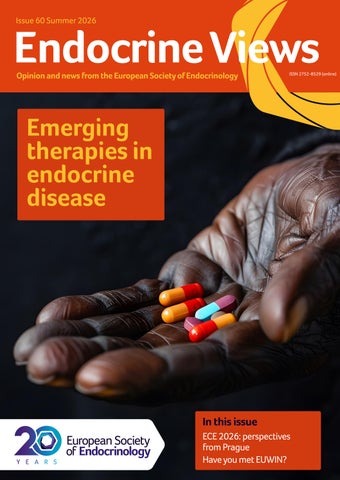
Issue 60 Summer 2026
Endocrine Views Opinion and news from the European Society of Endocrinology
ISSN 2752-8529 (online)
Emerging therapies in endocrine disease
In this issue ECE 2026: perspectives from Prague Have you met EUWIN?
CONTENTS & EDITORIAL
In this issue
Editorial
Society News
03 ECE 2026 marks 20 years of ESE, plus Committee updates 04 First Summit of the Presidents, State of Endocrinology insights, and new EndoCompass policy paper 05 An update from your President, plus World Hormone Day 2026 12 Celebrating ESE Award winners
Interview
06 EUWIN’s Trine Elisabeth Finnes and Anastasia Athanasoulia-Kaspar share their perspectives
Features
07 Thyroid eye disease: an update 08 Oral drugs for obesity 09 New medical treatments for acromegaly 10 Steroids and storytelling
Editors’ Selection
11 European Journal of Endocrinology: supporting you and your Society
Editor: Marek Bolanowski, Poland Email: marek.bolanowski@umw.edu.pl
©2026 European Society of Endocrinology
Deputy Editor: Eleni Armeni, Greece/UK Email: elenaarmeni@hotmail.com
The views expressed by the contributors are not necessarily those of ESE. This document is available on the ESE website, www.ese-hormones.org.
Co-Editor: Wiebke Arlt, UK Email: ese.president@ese-hormones.org Editorial Board: Faisal Ahmed, UK Bjørn Olav Åsvold, Norway Dorota Filipowicz, Poland Niki Karavitaki, UK Karim Meeran, UK Stavroula Paschou, Greece Victoria Withy, ESE Office Maria Chiara Zatelli, Italy Karin Zibar Tomšić, Croatia Managing Editor: Caroline Brewser Design: Qube Design Associates Website: www.ese-hormones.org
Cover Image: © Pixabay/bestPsychiatrist
The addresses used to email this issue of Endocrine Views were supplied by the members of ESE. If you do not wish to receive further mailings, you can update your mailing preferences in your Member Portal or email info@ese-hormones.org.
Welcome to this issue, which begins with a round-up of the many exciting activities at and around ECE 2026 in Prague, Czech Republic, in May. If you were there, you will know what a vibrant and inspiring environment we enjoyed, with over 4500 delegates (the largest number ever at ECE), attracting more than 2500 abstracts. The Congress saw ESE celebrate the Society’s first 20 years, and look forward to the future. Our President, Wiebke Arlt, captures this perfectly in her Update on page 5. She highlights the first Summit of the Presidents, which took place just before ECE, and the State of Endocrinology survey, as well as the EndoCompass Research Roadmap, with its new Policy Paper calling for investment in hormone research. You can read more details about all of these activities on page 4. Wiebke also reminds us that the Executive Committee and ESE Office Leadership Team have started work on a new Five-Year Strategy for our Society: make sure you provide your ideas when you are contacted. Other pages look at the latest developments in disease management. On page 7, Vickie Lee brings us up to date with thyroid eye disease, while Uberto Pagotto examines the options for oral obesity treatments on page 8. Sandrine A Urwyler, Georgia Ntali and Niki Karavitaki review the expansion in medical treatments for acromegaly on page 9. Elsewhere, you can find out more about ESE initiatives, including an interview with the Co-Leads of EUWIN (European Women in Endocrinology) on page 6, and a chance to find out more about EJE Rising Stars on page 11. This is, sadly, my last issue as Editor of Endocrine Views. I thank all the Editorial Board members for their energy and commitment, and the Editorial Team at ESE for their professionalism and support over the last two years. I am pleased to leave you in the very capable hands of my successor, Eleni Armeni.
Marek Bolanowski Editor, Endocrine Views
ESE thanks the following for their support. Premium Corporate Members: Alexion AstraZeneca Rare Disease, Ascendis Pharma, Esteve, Recordati Rare Diseases Corporate Members: Amgen, BridgeBio, Camurus, Crinetics Pharmaceuticals, Ipsen, Kyowa Kirin, Neurocrine Biosciences, Rhythm Pharmaceuticals, Soleno Therapeutics, Uni-Pharma Supporter: Immunovant Inc.
2
The Endocrine Views Editorial Board at ECE 2026. (L–R) Victoria Withy, Dorota Filipowicz, Eleni Armeni, Karin Zibar Tomšić, Marek Bolanowski, Maria Chiara Zatelli, Bjørn Olav Åsvold, Stavroula Paschou and Karim Meeran.
Areas of interest in this issue: Adrenal and Cardiovascular Endocrinology
Events
Awards
Pituitary and Neuroendocrinology
Diabetes, Obesity, Metabolism and Nutrition
Publications
Thyroid
SOCIETY NEWS
Illustrator Caroline Chapple creating a mural during ECE 2026, based on ESE’s History EXTERNAL-LINK
Celebrating 20 years at ECE 2026 ECE 2026 took place in Prague, Czech Republic, on 9−12 May. A special session looked forward to the future of endocrinology, while also marking the first 20 years of ESE.
President Wiebke Arlt began with an introduction to presentations by established experts on ‘Major breakthroughs over the past 20 years’. These covered rare endocrine disease (Elena Valassi), endocrine cancer (Guillaume Assié), environmental endocrinology (Pauliina Damdimopoulou) and obesity (Elisabeth van Rossum). Highlights included advances in genomics and molecular profiling, targeted cancer therapies, better understanding of endocrine disruptors, and development of GLP-1 receptor agonists. President-Elect Mirjam ChristCrain then introduced talks on the same topics entitled ‘What does the future hold?’. The previous speakers were joined by representatives from the early-career community: Barbara Altieri, Juan Manuel Jiménez Vacas, Kristina Saravinovska and
Julia Beck respectively. They gave their predictions for an exciting future, with advances in early diagnosis using multi-omics and AI, personalised treatment using stem cell and gene therapies, better biomonitoring and wearable technology for environmental exposure, and continued development of multi-receptor modulators for obesity. The session also covered the importance of patient advocacy, global collaboration and the balancing of resources between rare and common endocrine diseases, with past ESE Presidents AJ van der Lely and Jérôme Bertherat joining the speakers for insightful panel discussions after each group of talks. Your Society is ready to support you, as we anticipate the next 20 years of exciting developments in our field!
Watch the video of the 20th anniversary session
ECE 2026 − the largest ever
>4500 delegates
Representing
111 countries
>2500 >120
abstracts speakers
Committee updates The ESE Executive Committee welcomed Niina Matikainen (Finland) as ESE Secretary, Niki Karavitaki (UK) as ESE Congress Committee Chair and Kristina Saravinovska (Serbia) as ESE EYES Committee Co-Chair (ex-officio) at the recent AGM. Our grateful thanks go to Maria Chiara Zatelli, Cynthia Andoniadou and Juan Manuel Jiménez Vacas respectively, as they step down from these roles.
Current and retiring Executive Committee members. (L−R) Eleanor Davies, Kirsten Davidse, Maria Chiara Zatelli, Mirjam Christ-Crain, Charlotte Höybye, Sebastian Neggers, Wiebke Arlt, Gregory Kaltsas, Frédéric Castinetti, Elena Valassi, Niina Matikainen, Marek Ruchała, Kristina Saravinovska, Juan Manuel Jiménez Vacas and Niki Karavitaki. Cynthia Andoniadou is not pictured.
We also welcome our other new ESE Committee members: • Education Committee: Camille Buffet, Zoltan Kender and Richard Quinton • ESE EYES Committee: Juan Luis López Cánovas, Marc Phillipp Schauer and Louis Thomeret • EYES News Editorial Board: Ioannis Lempesis • Nominations Committee: Davide Carvalho • Nurse Committee: Jenny Fontaine, Dijana Jankovic and Stephanie Zopp • Science Committee: Danny Ben-Zvi and Maria-Christina Zennaro. We thank everyone who has recently completed a Committee role for their contribution to the Society.
3
SOCIETY NEWS
First Summit of the Presidents
This two-day event, part of ESE’s 20th Anniversary celebrations, was a chance to look at how to make hormone health more visible in national and European policy. Keynote speakers Professor Elizabeth Macintyre (former President of the Biomed Alliance) and Pavel Telička (former European Commissioner and Member of the European Parliament) set the scene with ideas for how the
Presidents of ECAS societies and representatives of some of ESE’s specialist partners met before ECE 2026 to discuss challenges and opportunities facing our field.
Insights from State of Endocrinology Delegates at ECE 2026 saw the first findings from ESE’s landmark 2025 State of Endocrinology survey. Around 2400 healthcare professionals and researchers took part, as well as over 250 nurses and 36 national endocrine (ECAS) societies, sharing their views on the future for the endocrine workforce in Europe. Early results indicate growing strain as the prevalence of endocrine diseases increases. Stress and burnout are widely
reported and over a third of earlycareer endocrinologists say they may leave their role in the next five years to seek a better work−life balance. If the workforce cannot keep up with rising demand, it will become harder to ensure people get the care they need, to attract new specialists to endocrinology and to make time for vital research. A forthcoming report will include the full findings and practical recommendations in response to the challenges. Learn more EXTERNAL-LINK
Transatlantic Alliance Award 2027 Nominate recipients before 29 July for this joint ESE and Endocrine Society Award. It will recognise an international leader for significant advancements in basic, translational or clinical research through work and collaboration in both the USA and Europe. To make a nomination (including selfnomination) read more EXTERNAL-LINK
Keep up to date with ESE on social media 4
Expert Reviewer We congratulate Sandra Pereira (Canada) who has won the 2026 Endocrine Connections Expert Reviewer prize. This recognises outstanding contributions to rigorous, high-quality peer review.
endocrine community can make an impact in public affairs. Participants also shared updates on major ESE projects, including early findings from the State of Endocrinology workforce survey and the new EndoCompass policy paper (see below), as well as access to essential endocrine medicines in Europe. Find out more EXTERNAL-LINK
EndoCompass policy paper A new EndoCompass policy paper calls for investment in hormone research. It sets out what needs to happen following the 2025 publication of the EndoCompass Research Roadmap EXTERNAL-LINK, which identified where research investment would have the greatest impact in endocrine science. The new policy paper, entitled EndoCompass Research Roadmap – Policy Priorities for Better Hormone Health in Europe EXTERNAL-LINK calls on policymakers to deliver the EndoCompass Research Roadmap and makes the case that endocrine science is an investment in Europe’s future. It focuses on four key areas: • high prevalence endocrine diseases, such as diabetes, obesity and metabolic conditions • addressing the endocrine causes and consequences of cancer • finding cures for rare endocrine diseases • promoting endocrine health throughout life and in our environment.
The EndoCompass Research Roadmap Policy priorities for better hormone health in Europe
Endocrine science is an investment in Europe’s future. The endocrine community calls on policymakers to deliver the EndoCompass recommendations and ensure a healthier, more resilient Europe.
Make sure you use the paper, especially when preparing research proposals or grant applications, as it can help show how your work contributes to these wider priorities for policy and investment. Read the policy paper today EXTERNAL-LINK
ESEndocrinology
EuropeanSocietyofEndocrinology
World Hormone Day
esehormones
European Society of Endocrinology
BecauseHormonesMatter
SOCIETY NEWS
Update from your President I was so pleased to meet with many of you at the hugely successful and fun ECE in Prague. Our annual Congress is such an important event for the endocrine community to network and hear the latest science and advances in clinical practice. This year’s event was particularly special: not only did we have the highest number of delegates (over 4500, from 111 countries), ECE also attracted the most abstracts (2500), had 170 speakers, and we announced that the Society now has over 5500 members − our greatest number to date. This shows the belief that you have in ESE being your professional home. In fact, during my President’s Session, nearly 80% of those in the room said that they agreed with this statement (see Figure). This is very good to see – and for those 20% who are still to be convinced, we want you to tell us what ESE could do to support you better in the future. Before we look to the future, this year is special for ESE, as we mark 20 years since its formation as an individual membership society. We enjoyed many celebrations during ECE – with the mural wall of the
Society’s history being drawn by an amazingly talented graphic artist during the Congress. The History Book is on the website EXTERNAL-LINK, full of photos, people and key milestones: please take a look. Activities continue throughout 2026 and the History Book will be updated at the end of this year, with all we are achieving together during ESE’s 20th year. ESE is forward-looking, and next year sees the start of the Society’s next Five-Year Strategy. It is my privilege to lead ESE during the Strategy’s development and ensure that the Society becomes the professional home to the 20% of you who were still undecided in the session at ECE. You also told us that most of you think Clinician Scientists and Researchers are served best by ESE, but that research needs more focus in the next five-year plan. You said that Nurses and Patient Advocacy
I feel that ESE is an important professional home for me... how far do you agree with this statement?
Wiebke at ECE 2026
Groups need more of our attention, and we learned that the Clinical Biochemists are an emerging key group in the Society and attention to this group is important. Another area highlighted was the endocrine workforce and ensuring that we are ‘fit for purpose’ in the future. Two projects that address some of these areas are already well underway. The 2025 EndoCompass Roadmap EXTERNAL-LINK laid out the key directions for the future of endocrine science. Work on actively advocating for this is beginning now, and was a major part of the discussions at the Summit of the Presidents EXTERNAL-LINK, which was held with the ECAS societies 38.53% 39.83%
1. I agree very much 2. I agree somewhat 3. Neutral 4. I slightly disagree 5. I strongly disagree
14.29% 5.19%
Some results from the interactive survey during the President’s Session.
1
2
3
4
2.16% 5
Raising awareness worldwide
Thank you to everyone who helped make World Hormone Day 2026 EXTERNAL-LINK a success! Hormone champions shared short videos on social media, explaining hormone health in ways people could easily understand. There were also newspaper articles, social media posts, live events, webinars, TV and radio interviews and podcasts. These efforts helped the campaign reach
an estimated global audience of over 248 million people in at least 38 countries and 23 languages. World Hormone Day returns on 24 April 2027. Until then, let’s keep hormones in the spotlight by using the hashtag #BecauseHormonesMatter to support other endocrine-related awareness days and campaigns around the globe. You can use the new public-facing materials EXTERNAL-LINK created for World Hormone Day at any time. Don’t miss the World Hormone Day highlights video EXTERNAL-LINK.
Wiebke Arlt ESE President
ESE EYES in Krakow
The 2027 ESE Young Endocrinologists and Scientists (EYES) Annual Meeting will take place in Krakow, Poland, on 17−19 September 2027. Save the date and watch out for further information.
©Pixabay/Roman_Polyanyk
On 24 April, the global endocrine community united to raise public awareness of hormone health. Endocrine societies, patient groups, clinical and research communities, and industry representatives shared clear, expert-led information about hormones and why they matter.
and other strategic partners in the days before ECE 2026. The other key part of the Summit was the State of Endocrinology EXTERNAL-LINK survey. This highlights that our field is facing a challenge, as the incidence of endocrine disease increases, but the workforce is not being developed and supported to cope with the resulting clinical and research demands. In the coming months, we will write the ‘Prague Declaration’ as a foundation for more active advocacy at national and European levels, to emphasise the issues and lobby for action. Informed and supported by the results of these major projects, the Executive Committee and the ESE Office Leadership Team are working on the Five-Year Strategy for 2027−2031. We will seek your input in the coming months by email – so please have your say when asked! If you have ideas before then, please send them to me (at info@ese-hormones.org), so we can include them in our thinking.
5
INTERVIEW
Meet EUWIN
Watch Anastasia and Trine in conversation about EUWIN EXTERNAL-LINK
EUWIN − European Women in Endocrinology − is a peerto-peer community providing support and guidance for women in European endocrinology and within ESE. We talked to EUWIN Co-Leads Anastasia AthanasouliaKaspar (Germany) and Trine Elisabeth Finnes (Norway) to find out more. What are your research/ clinical interests?
TEF I am a consultant endocrinologist and clinical researcher, with a combined clinical and academic role. My interests lie primarily in bone metabolism and osteoporosis. AAK I am a clinical endocrinologist and researcher, who is also active academically. My main interests are neuroendocrinology (including pituitary and adrenal disorders), gender dysphoria, obesity and diabetes.
Why did you choose endocrinology?
AAK I was drawn to endocrinology because of its complexity and how hormones connect multiple systems, as well as a personal experience with an endocrine disease requiring surgery at a young age. I was inspired by mentors including George Chrousos, Christos Mantzoros and, later, Günter Stalla and Martin Reincke − all leading figures in endocrinology. TEF Endocrinology attracted me because it combines complex physiology with long-term patient relationships and problem solving. I was particularly inspired by my now retired mentor, Helge Kapelrud, who showed how endocrinology can meaningfully improve quality of life through personalised care.
Why did you become a Co-Lead for EUWIN?
TEF I wanted to contribute to greater equity, visibility and career support for women in endocrinology. Despite a high level of gender equality, especially in Scandinavia where I am from, there are still some almost invisible obstacles in women’s careers. AAK As a female endocrinologist and mother of three, I have experienced many challenges at different stages of my career, which motivated me to help other women. I also wanted to improve opportunities and visibility for women in endocrinology.
6
What is EUWIN’s most important role?
AAK It is to build a strong, supportive community and create opportunities for women at all career stages. I hope it continues to promote leadership, mentorship, collaboration and visibility of women endocrinologists across Europe, while inspiring us through strong role models. TEF EUWIN plays a crucial role in connecting women across countries and career stages, while amplifying their voices within endocrinology at a European level.
Anastasia (left) and Trine at ECE 2026
AAK It is for everyone in endocrinology, from students to those in senior positions. Since launching in 2022, it has become a large, active network with increasing engagement through events, webinars and collaborative initiatives. TEF EUWIN is there for women at all career stages, and allies who support gender equity in the field.
focused on sex differences in endocrine health and the need to treat sex as a key biological variable rather than a confounder. It aimed to promote more personalised, equitable care by integrating sexand gender-informed approaches into research and clinical practice. TEF We are hugely grateful to Daniela Esposito, one of our CoLead Elects, who did a lot of work putting the programme together. Our motivation was to ensure that topics highly relevant to women − both as patients and as professionals − were discussed at a high scientific level within the main Congress programme.
Why should people get involved?
What other EUWIN activities can people benefit from?
Who is EUWIN aimed at?
TEF This is a supportive space to share experiences, gain visibility and build professional networks beyond national borders. Get involved and help shape the future of our specialty. AAK You will benefit from valuable networking, career development and mentorship opportunities, while contributing to a supportive, motivating community. There are engaging webinars and symposia featuring outstanding female speakers who can guide and support younger colleagues.
TEF EUWIN offers several ongoing activities, including an active LinkedIn forum EXTERNAL-LINK where you can share experiences, resources and perspectives in an informal setting. EUWIN also contributes to ESE Talks EXTERNAL-LINK, highlighting inspiring careers and relevant themes through accessible online sessions. We want to run more webinars, get involved in ESE events and collaborate with other ESE networks.
What is your advice for early-career women?
AAK Be confident, seek mentors and actively pursue opportunities − even outside your comfort zone. Remember that there is no single correct career path. TEF Your perspective is valuable and confidence grows with experience − even if it sometimes comes after action rather than before.
What have you learnt as a EUWIN Co-Lead?
TEF I have learnt how strong the need is for connection, visibility and shared support among women in endocrinology across Europe, and how much impact a dedicated network can have even with limited resources. I have been lucky to be involved in the analyses of the State of Endocrinology survey, which may improve working conditions for both men and women across Europe. AAK As women, we often have to work harder to achieve the same recognition and opportunities as our male colleagues, but our contribution to endocrinology is invaluable. My advice is to stay confident, support one another and continue striving for greater visibility and impact.
What led you to set up the EUWIN symposium at ECE 2026?
AAK I was motivated by the recognition that sex differences are still often overlooked in endocrine research and clinical practice, which is confirmed by my personal experience both as a clinician and as a female patient. The symposium
Find out more about EUWIN activities EXTERNAL-LINK
FEATURE
Thyroid eye disease: an update Thyroid eye disease (TED), also referred to as Graves’ orbitopathy, is a visually impairing and often disfiguring condition most associated with Graves’ hyperthyroidism. Most presentations of TED and endocrine dysfunction are concurrent. The presentations of TED are heterogenous, so ethnic and anatomical variations should inform individualised care. The underlying mechanism involves the expansion of tissues within the bony orbit, resulting in symptoms such as double vision and, in approximately 2–8% of cases, severe visual loss. TED often causes distressing changes in appearance, which can lead to considerable psychological and socio-economic consequences.
Classification and assessment
Clinicians should utilise the European Group on Graves’ Orbitopathy (EUGOGO) classification to determine the severity of TED, categorising it as mild, moderate-to-severe or sight-threatening. In addition, the Clinical Activity Score (CAS) is often used to gauge disease activity and guide management strategies. The Graves’ Ophthalmopathy Quality of Life (GOQOL) is the only TED-specific quality of life (QOL) tool validated for all severities of TED.1
Conventional management strategies
There is an emphasis on the need for early diagnosis and modification of risk factors, including achieving euthyroidism, smoking cessation and judicious use of radioiodine therapy. Supportive treatment for mild TED can involve a six-month course of selenium supplementation and management of ocular surface disease, although many cases of clinically mild TED can have a profound impact on QOL. For patients with moderate-to-severe or sight-threatening disease, the current EUGOGO 2021 guidelines and the American Thyroid Association and European Thyroid Association consensus recommend management in multidisciplinary team clinics, where endocrinologists and ophthalmologists collaborate to optimise earlier diagnosis and treatment. Orbital imaging (magnetic resonance imaging) is increasingly used to guide management.2 Generalised immunosuppression is typically used to reverse visual loss, improve double vision and reduce soft tissue inflammation during the active phase. Vigilance is always recommended, as there is no goldstandard clinical sign for sight-threatening disease, where urgent orbital decompression may be required, as well as systemic immunosuppression. However, conventional treatment has limited efficacy in addressing double vision and proptosis,3 which are usually more effectively treated in the chronic or inactive phase through a sequence of rehabilitative surgical procedures. Surgeries may include orbital decompression to reduce the proptosis, strabismus surgery to correct intractable double vision and eyelid surgery to reduce eyelid retraction. These surgeries can only be undertaken when the TED is quiescent and after the patient has settled into a long-term thyroid management plan. As the outcome of each operation has an impact on the surgical planning of the next procedure, full recovery is required before the next stage. This often results in a prolonged and challenging journey for patients, who must cope with both altered appearance and compromised visual function over many years. Unsurprisingly, TED negatively impacts QOL and is associated with anxiety and depression.4
Emerging therapies and paradigm shift
Recent years have witnessed the emergence of targeted TED biologic therapies. Agents such as teprotumumab, an insulin-like growth factor-1 receptor (IGF-1R) inhibitor, have demonstrated substantial improvements in proptosis, diplopia and QOL in clinical trials. The subsequent approval of teprotumumab in the USA to treat acute and chronic TED has sparked a significant surge of interest in the pharmaceutical industry to develop new therapeutics along different mechanistic pathways, leading to several clinical trials conducted globally.
CD40-CD40L receptor Plasma cell
B cell MHC class II-TCR TSH receptor
Thyroxine Antibodies binding to TSH receptor
IGF-1 receptor Receptor crosstalk
T cell
Inflammatory mediators released
CD40-CD40L receptor
Orbital fibroblast
TSH receptor Inflammatory mediators released
Thyroid gland Hyaluronic acid
Adipocytes
Pathophysiology of TED. TCR, T cell receptor; TSH, thyrotrophin.
Rituximab, a B cell-depleting agent, and tocilizumab, an interleukin-6 receptor antagonist, have also been explored as TED therapies, with varying degrees of success. While these agents represent significant therapeutic advances, they are not without drawbacks. High costs, the potential for serious side effects (such as hyperglycaemia and hearing impairment with IGFR antagonists) and limited access outside specialist centres pose challenges to widespread adoption. Long-term safety data are still emerging, necessitating ongoing vigilance in clinical practice.5
Conclusion
TED remains a considerable clinical and psychosocial challenge. Traditional approaches have centred on modifying risk factors and using non-targeted immunosuppressive treatments, but the introduction of targeted therapies marks a promising new chapter in TED management. There is ongoing debate regarding the suitability of the outcome measures established by the original pivotal trials. Many specialists in TED argue that these measures should be refined, with greater emphasis placed on resolving double vision and enhancing QOL, rather than simply achieving a 2-mm reduction in proptosis. Involving patient groups in defining what constitutes meaningful outcomes is also seen as essential. Further research is needed into the diverse presentations of TED, such as the ‘white-eye’ phenotype, which is particularly common among non-white individuals. Tackling the psychosocial effects by providing mental health support, as well as managing dry eye disease, can make a notable difference to patients’ QOL. Furthermore, considerations around accessibility, cost and side effects must be addressed, to ensure that recent advances genuinely lead to better outcomes for all patients and minimise global disparity.6 Vickie Lee Consultant Ophthalmic and Oculoplastic Surgeon, Imperial College Healthcare NHS Trust, London, UK Declaration of interest: Vickie Lee is the Secretary of the European Group on Graves’ Orbitopathy (EUGOGO) and the British Oculoplastic Surgery Society National Thyroid Eye Disease Lead. She is a research investigator and consultant for Viridian Therapeutics, Horizon Therapeutics/ Amgen, Argenx and a research investigator for Lassen and Sling Therapeutics.
REFERENCES 1. Bartalena et al. 2021 European Journal of Endocrinology https://doi.org/10.1530/EJE-21-0479. 2. Burch et al. 2022 Thyroid https://doi.org/10.1089/thy.2022.0251. 3. Douglas et al. 2022 JAMA Ophthalmology https://doi.org/10.1001/jamaophthalmol.2021.6284. 4. Al-Badri et al. 2024 Endocrine Connections https://doi.org/10.1530/EC-24-0259. 5. Moledina et al. 2024 Eye https://doi.org/10.1038/s41433-024-02967-9. 6. Lee et al. 2026 Eye https://doi.org/10.1038/s41433-025-04197-z.
7
FEATURE
Oral drugs for obesity ©Pixabay/Miguel Á. Padriñán
Uberto Pagotto reviews oral glucagon-like peptide-1 (GLP-1) receptor agonists for the treatment of obesity: the evidence, differences and potential applications. The pharmacological landscape for obesity is rapidly evolving, with new therapeutic options designed to better address the urgent needs of patients and to enable clinicians to tailor treatments to individual phenotypes. Two distinct oral GLP-1 receptor agonist strategies were recently evaluated in separate multinational, phase III, randomised, double-blind clinical trials, both published in New England Journal of Medicine.1,2 Before analysing the results, it is essential to examine the pharmacological differences between the two molecules investigated.
Overcoming barriers to oral administration
Both semaglutide and orforglipron are oral GLP-1 receptor agonists. Historically, the clinical utility of peptides has been constrained by their inherent nature, necessitating subcutaneous injection and cold-chain storage − factors that compromise patient adherence and global scalability. Peptide-based therapies are typically hindered by poor gastrointestinal permeability and rapid enzymatic degradation. To overcome these barriers, oral semaglutide is co-formulated with sodium salcaprozate (SNAC), which acts as a permeation enhancer. SNAC facilitates transcellular absorption by locally elevating gastric pH around the tablet; this not only protects semaglutide from proteolytic degradation by pepsin but also promotes its monomerisation and enhances membrane fluidity. Nevertheless, this delivery mechanism requires a stringent administration protocol, including pre- and post-dose fasting and controlled water intake. On the other hand, orforglipron (a novel, oral, small-molecule, nonpeptide GLP-1 receptor agonist) has been developed and evaluated across several clinical trials for the treatment of obesity and type 2 diabetes. This compound exhibits biased signalling, showing partial selectivity at the GLP-1 receptor toward the cAMP pathway over β-arrestin recruitment. Due to its non-peptide structure, orforglipron can be administered without restrictions regarding concomitant food or fluid intake. Recently published data for oral semaglutide 25mg and orforglipron suggest that these agents represent a viable and potent alternative to subcutaneous injectable therapies.
Oral semaglutide 25mg
In the OASIS 4 trial − a double-blind, randomised, placebo-controlled study involving 205 participants − oral semaglutide 25mg was administered to individuals without diabetes who had a body mass index (BMI)≥30kg/m² (or ≥27kg/m² with at least one obesity-related weight-related comorbidity). After 64 weeks of treatment, the semaglutide group achieved a mean bodyweight loss of 13.6%, compared to 2.2% in the placebo arm. Notably, 50% of subjects treated with 25mg semaglutide achieved a weight reduction of ≥15% from baseline, while 29.7% achieved a reduction of 20% or more.1
Oral orforglipron
In the ATTAIN-1 trial, 3127 participants, with clinical characteristics similar to those in the OASIS 4 study, were randomised into four arms to evaluate the safety and efficacy of once-daily orforglipron. Three dosages of orforglipron (6mg, 12mg and 36 mg) were compared against a placebo group. After 72 weeks, the mean change in body weight from baseline was −7.5% for the 6mg dose, −8.4% for 12mg and −11.2% for 36mg, compared to −2.1% for placebo. At 72 weeks, a body-weight reduction of 15% or more
‘Before analysing the results, it is essential to examine the pharmacological differences between the two molecules investigated.’ 8
was achieved by 36% of participants in the 36mg group, while 18% achieved a reduction of 20% or more.2
Adverse effects
The characteristic spectrum of gastrointestinal adverse events − including nausea, constipation, diarrhoea, vomiting and dyspepsia − was reported for both oral formulations. These events were primarily mild-to-moderate in severity. Rates of gastrointestinal adverse events leading to permanent treatment discontinuation were comparable between the two trials, occurring in 3.4% of participants for semaglutide 25mg and 7% for orforglipron 36mg.
‘Beyond their clear advantages in accessibility, their most significant potential lies in enhancing treatment adherence.’ Advantages of the new approach
In light of these results (which demonstrate remarkable efficacy, albeit lower than that of injectable semaglutide and tirzepatide), one must consider the ideal target population for these agents. Beyond their clear advantages in accessibility, driven by lower anticipated costs and greater ease of use, their most significant potential lies in enhancing treatment adherence. Indeed, as increasingly potent anti-obesity medications become available, the primary focus should shift from absolute weight loss metrics (such as the proportion of patients reaching specific thresholds) towards long-term weight maintenance. From this perspective, oral options like semaglutide 25mg and orforglipron could serve as an exceptional maintenance strategy following substantial weight loss − potentially induced by injectable agents − ensuring the lifelong persistence of the systemic benefits associated with weight reduction. Ultimately, while prolonged injectable therapies are highly effective, clinical literature frequently reports suboptimal adherence and modest compliance, probably due to the route of administration and, crucially, the prohibitive costs associated with these formulations. In conclusion, these two oral options, semaglutide 25mg and orforglipron, provide a highly promising strategy to address these issues, helping patients mitigate the compensatory physiological mechanisms that drive weight regain following successful weight loss. Uberto Pagotto Division of Endocrinology and Diabetes Prevention and Care, IRCCS Azienda Ospedaliero-Universitaria di Bologna, Department of Medical and Surgical Sciences (DIMEC), Alma Mater Studiorum University of Bologna, Bologna, Italy REFERENCES 1. Wharton et al. 2025 New England Journal of Medicine https://doi.org/10.1056/NEJMoa2500969. 2. Wharton et al. 2025 New England Journal of Medicine https://doi.org/10.1056/NEJMoa2511774.
FEATURE
New medical treatments for acromegaly The expansion of the medical treatment landscape for patients with acromegaly is welcomed by the endocrine community, and opens pathways for covering unmet needs. CAM2029
This is a subcutaneous, long-acting depot formulation of octreotide based on FluidCrystal® technology. The solution transforms in situ to a liquidcrystalline gel and encapsulated octreotide is released as the depot matrix biodegrades. In January 2026, the US Food and Drug Administration accepted a New Drug Application for CAM2029. This application was supported by data from seven clinical trials, including four phase 1, one phase 2 and two phase 3 studies conducted as part of the ACROINNOVA clinical programme. ACROINNOVA 1 was a 24-week, randomised, double-blind trial of CAM2029 in patients with biochemically controlled acromegaly on standard-of-care (SoC) somatostatin receptor ligands (SRL) at baseline. On week 22/24 (intention-to-treat analysis), patients treated with CAM2029 demonstrated superior response rates versus placebo for insulin-like growth factor-1 (IGF-1) and combined IGF-1/growth hormone (GH). Patients receiving CAM2029 had well-controlled symptoms, improved quality of life and treatment satisfaction versus placebo and baseline. CAM2029 was welltolerated; safety was consistent with SoC.1 ACROINNOVA 2 was a 52-week, open-label trial involving both new participants and some from ACROINNOVA 1. Sustained biochemical control and symptom improvement over a 52-week follow-up period were demonstrated.2
Paltusotine
This oral, selective, non-peptide somatostatin receptor type 2 agonist, administered once-daily, has been approved for the treatment of acromegaly in the USA and is currently being evaluated by the European Medicines Agency. It intrinsically permeates the intestinal epithelium and, unlike oral octreotide capsules, it does not need permeability enhancers. Its safety and efficacy have been evaluated in two phase 3 trials. PATHFNDR-1 was a randomised, double-blind, placebo-controlled study in patients with biochemically controlled acromegaly on a stable dose of injectable long-acting octreotide or lanreotide monotherapy. Patients were switched to paltusotine and the dose was increased up to 60mg/day during the first 24 weeks. Of 30 patients on paltusotine, 25 (83.3%) patients maintained biochemical control at week 36, compared with 1/28 (3.6%) in the placebo group (P<0.0001).3 In PATHFNDR-2 − a randomised, double-blind, placebo-controlled study in patients with acromegaly not receiving medical treatment at the time of randomisation − the primary endpoint of IGF-1 normalisation after 24 weeks was achieved in 55.6% of patients treated with paltusotine, compared with 5.3% in the placebo group (P<0.0001). Tumour volume remained stable or decreased during treatment with paltusotine.4 The drug was well-tolerated in both studies and the most common adverse events were gastrointestinal.3,4
OXTEND 03 (NCT06930625), an ongoing phase 3 study assessing its efficacy and safety in patients with acromegaly who were previously treated with SRLs.
CAM4071
CAM4071 is a subcutaneous depot formulation of pasireotide developed by using FluidCrystal® depot technology. In a phase 1 randomised, open-label study, CAM4071 was compared to pasireotide LAR in healthy volunteers. CAM4071 produced dose-dependent IGF-1 suppression for doses >5mg, with the 80-mg dose achieving a mean reduction of 58.9%. Suppression with pasireotide LAR (about −46.8%) was comparable to that with CAM4071 40mg (about −50.7%). Tolerability of CAM4071 ≤40mg was comparable with that of pasireotide LAR and higher doses were associated with more local injection-site reactions. Overall, CAM4071 demonstrated rapid onset and a duration of action comparable with pasireotide LAR 60mg.5
Prolonged-release lanreotide
A prolonged-release formulation (PRF) of lanreotide (LAN) was developed to increase the dosing interval to 12 weeks by using a hydrosoluable cosolvent. LAN PRF was evaluated in an open-label, multicentre phase 2 study in patients with acromegaly to determine the maximum tolerated dose. The 28 participants were divided into three groups which were offered different single doses of PRF LAN (180, 270 and 360mg), and 10 of them did not complete the 24-week study. No dose-limiting toxicities were observed and the most frequently reported adverse events were diarrhoea, cholelithiasis, fatigue and headache.6
ALXN2420
This drug (formerly known as AZP-3813) is a GH receptor (GHR) antagonist derived from sequences using a cell-free in vitro transcription−translation system, designed against the human GHR. In preclinical studies, subcutaneous administration of ALXN2420 resulted in IGF-1 suppression both in rats and dogs.7 This drug is being evaluated in a phase 1 study. Further agents that have so far been assessed only in in vitro and/or animal studies include HTL00030310 (a selective peptide agonist of somatostatin receptor 3 and 5)8 and Hu-13H02m (neutralising monoclonal antibodies against human GH).9 The development of novel medical treatments for acromegaly offers promising progress in the care of patients. Further studies establishing efficacy, safety and their place in management pathways are keenly awaited. Sandrine A Urwyler Lecturer in Endocrinology, University of Basel, and Consultant Endocrinologist, Clinic for Endocrinology, Diabetes and Metabolism, University Hospital of Basel, Switzerland Georgia Ntali Consultant in Endocrinology, Department of Endocrinology, Diabetes and Metabolism, Endo-ERN, Evangelismos General Hospital, Athens, Greece
Debio 4126
Niki Karavitaki Professor of Endocrinology, University of Birmingham, and Honorary Consultant Endocrinologist, Queen Elizabeth Hospital, Birmingham, UK
‘The development of novel medical treatments offers promising progress in the care of patients.’
REFERENCES 1. Ferone et al. 2025 Journal of Clinical Endocrinology & Metabolism https://doi.org/10.1210/clinem/dgae707. 2. Ferone et al. 2024 Journal of the Endocrine Society https://doi.org/10.1210/jendso/bvae163.1155. 3. Gadelha et al. 2024 Journal of Clinical Endocrinology & Metabolism https://doi.org/10.1210/clinem/dgae385. 4. Biller et al. 2026 Journal of Clinical Endocrinology & Metabolism https://doi.org/10.1210/clinem/dgaf579. 5. Johnsson et al. 2024 Endocrine https://doi.org/10.1007/s12020-024-03741-3. 6. Neggers et al. 2021 Expert Reviews in Clinical Pharmacology https://doi.org/10.1080/17512433.2021.1986004. 7. Ravel et al. 2025 European Journal of Endocrinology https://doi.org/10.1093/ejendo/lvaf043. 8. Regazzo et al. 2024 European Journal of Endocrinology https://doi.org/10.1093/ejendo/lvad171. 9. Hata et al. 2024 Endocrinology https://doi.org/10.1210/endocr/bqae033.
This is an intramuscular prolonged-release formulation of octreotide, administered every 12 weeks, with greater bioavailability than the longacting release (LAR) formulation. It is currently under investigation in
9
FEATURE
Steroids and storytelling The diverse aspects of steroid biology occupy a significant portion of biomedical and medical teaching. Here we offer some useful analogies and stories to improve the teaching of steroids in higher education. Steroids are fascinating and vital for survival, but teaching them can often feel content-heavy and ‘clunky’: for instance, the cyclopentane-perhydrophenanthrene backbone. In this context, it may be useful to consider approaches to improve teaching around steroids, within the framework of picturing science.1
Analogies and illustrations
It all starts with cholesterol. Nearly all its carbon atoms are sp3-hybridised. So, it can be imagined as single layers of a diamond, which contains exclusively sp3-hybridised carbon as well. In fact, it all starts with the making of cholesterol. Human cells lost the ability to make vitamin C or many essential amino acids, but they retained the ability to make cholesterol by themselves. And there is a certain magic to the single-step conversion of squalene to lanosterol, overseen by the enzyme lanosterol synthase. Think of ‘waffle-baking’ for the initial conversion, where seven chiral centres are established, nearly simultaneously – much more fascinating than the remaining 19 biochemical conversions needed until the actual cholesterol molecule is finished! There, think of whittling a twig, gradually refining the final shape. It is up to you to decide which one of the two you like more. Cholesterol is then fed into the mitochondria of adrenal cortex cells by a truly stellar protein – the steroidogenic acute regulatory protein or StAR protein – giving us three decades of ‘StAR gazing’.2 What follows is the action of ‘sooty’ oxygen-activating cytochrome P450 enzymes (CYPs) and ‘clean’ hydroxysteroid dehydrogenases (HSDs) with near surgical precision. ‘Sunshine’ vitamin D offers a special chemical treat, as the conversion of pre-vitamin D to vitamin D requires UV light, an endocrine ray of hope. Taken together, several steroids are made, varying greatly in receptor binding and biological action. If cholesterol is a durable raw material, then the different steroid classes are various ‘security keys’ forged from it, by removing a carbon atom here, and adding some oxygen there. If we line them up alphabetically, we get Aldosterone, Calcitriol (=vitamin D), Cortisol, Estradiol, Progesterone and Testosterone. Their first letters taken together should make you A-C-C-E-P-T that steroids are very important. In the ‘ocean’ that is our circulation, steroids distribute randomly – like ‘messages in a bottle’ they will get anywhere.3 Within serum, most steroids are bound to transport proteins, such as albumin, or conjugated to sulfate or glucuronidate. While transport proteins could be likened to ‘cargo ships’ in an ocean, conjugates might be thought of as ‘transport locks’. Conjugation makes the steroid molecule more water-soluble, whilst locking their biological effect during transport. Some of the steroid message hopefully arrives in a cell that expresses the appropriate nuclear or membrane receptor. The ligand-binding domains of nuclear receptors act as folding sensors. Without the steroid, the fluffy unfolded ligand-binding domain would be chaperoned within the cytosol
‘Which analogy to use in your teaching depends on personal taste. However, what they all have in common is that they link abstract biochemical or endocrine entities to everyday objects.’ 10
by heat-shock proteins. Upon binding of a fitting steroid, the ligand-binding domain folds ‘origami’-style, only to free itself from the strict chaperone. The now properly folded protein enters the nucleus and activates a large subset of genes containing a DNA response element that matches the nuclear receptor’s DNA-binding domain.
An overview
This walk through steroid biochemistry has brought up visual aids and analogies that may improve understanding steroid hormone action. As steroid endocrinology is highly diverse and complex, many more analogies could still be imagined. Looking at the comparisons highlighted above, there are ‘text-based’ comparisons, such as the StAR gazing and the A-C-C-E-P-T meme. Then there are certain ‘structure-based’ analogies: a slice of a diamond, all the different, but sturdy, security keys, as well as the sunshine vitamin D. The graphical comparisons from the pharmacodynamics of steroids might be classified as ‘process-based’: cargo-ship-like transport proteins, distribution processes for messages in bottles, and nuclear receptor domains that fold origami-style. This leaves a final category of ‘object personifications’ – where enzymes are attributed human-like properties: we have met wafflebaking enzymes and twig-whittling biochemical pathways; we have heard of sooty CYP enzymes and clean and precise HSDs. Which analogy to use in your teaching depends on personal taste. However, what they all have in common is that they link abstract biochemical or endocrine entities to everyday objects, thus improving learning and retention through the picture-superiority effect.4 Importantly, it is the graphical uniqueness, not dual coding of content, that primarily determines the didactic effectiveness.4 In addition, anthropomorphic comparisons may serve students with varying learning needs,5 and provide the basis for incorporating elements of storytelling.6 Why don’t you give it a go in your lectures, and then analyse your students’ feedback? It would help our specialty if we improved the translation of difficult concepts from lectures to better healthcare provision. Dominic C Y Lai and Jonathan Wolf Mueller Department of Metabolism and Systems Science, School of Medical Sciences, College of Medicine and Health, University of Birmingham, Edgbaston Campus, Birmingham, UK REFERENCES 1. Mierzwa & Goodsell 2021 The Biochemist https://doi.org/10.1042/bio_2021_156. 2. Miller 2025 Journal of Endocrinology https://doi.org/10.1530/JOE-24-0310. 3. Lai & Mueller 2025 Essays in Biochemistry https://doi.org/10.1042/EBC20240039. 4. Higdon et al. 2024 Quarterly Journal of Experimental Psychology https://doi.org/10.1177/17470218241235520. 5. Rebekah et al. 2019 Autism https://doi.org/10.1177/1362361318793408. 6. Haden et al. 2023 Frontiers in Psychology https://doi.org/10.3389/fpsyg.2023.1096833.
EDITOR’S SELECTION
European Journal of Endocrinology Supporting you and your Society European Journal of Endocrinology (EJE) is an official ESE journal. It publishes highquality original research, reviews and clinical practice guidelines, and also has other activities to support you, as ESE members. Read on to find out more!
Why publish in EJE? • Outstanding reputation and ranking • International readership • Rapid editorial and peer review process • Option to publish open access • Broad range of content − including animations! EXTERNAL-LINK Find out more and submit your papers EXTERNAL-LINK
NEW Impact Factor Additionally, authors can benefit from our streamlined submission transfer process: selected high-quality papers can be recommended for submission to another ESE journal, such as Endocrine Connections EXTERNAL-LINK, Obesity and Endocrinology EXTERNAL-LINK or Environmental Endocrinology EXTERNAL-LINK
6.7
EJE Rising Stars 2026 We welcome our new cohort of EJE Rising Stars. This initiative supports mid-career endocrinologists selected for their potential as independent leading clinical and translational endocrine researchers, with a two-year dedicated mentorship programme and a travel bursary for attendance at ECE and the EJE Editorial Board meeting. You can read more about the experience of previous recipients and mentors online EXTERNAL-LINK
EJE Rising Stars 2026–2028. (L–R) Thomas Uslar (Chile), Andreea Bena (Romania), Mikkel Thor Olsen (Denmark), Franziska Greulich (Germany), Grethe Åstrøm Ueland (Norway), Gamze Akkuş (Turkey), Alexander Busch (Germany), Gaia Tabacco (Italy) and Amin Ardestani (UK). Not pictured: Vasileios Chortis (UK), Andreea Georgia Constantinescu (Romania), Antonio C Fuentes-Fayos (Spain) and Rebeca Martínez Hernández (Spain).
‘While the programme is primarily intended to expand the network of the selected candidates, it has equally broadened my own professional network within the next generation of leaders in endocrinology.’ Felix Beuschlein EJE Editor-in-Chief
‘The mentorship programme provides a supportive and inspiring setting that is ideal for both professional and personal growth.’ Mirela Ilie EJE Rising Star 2024-2026
‘It offers a unique chance to learn from the best and to gain insights into how a leading journal maintains high scientific standards.’ Julie Refardt EJE Rising Star 2024-2026
‘Being selected provides visibility, mentorship and a platform to influence the future of endocrine research.’ Bjørn Olav Åsvold EJE Deputy Editor
EJE highlights New for 2026
2025 ESE guidelines Treatment of chronic hypoparathyroidism in adults EXTERNAL-LINK
For first time, abstracts from ECE will be published as a supplement to EJE!
Evaluation and management of menopause/perimenopause EXTERNAL-LINK
Popular articles
Pre-existing diabetes and pregnancy EXTERNAL-LINK
Osilodrostat dose impact on efficacy/safety in Cushing’s disease EXTERNAL-LINK
And not forgetting EndoCompass! Read the Research Roadmap here EXTERNAL-LINK
Management of aggressive pituitary tumours/carcinomas EXTERNAL-LINK
Glucagon-like peptide-1 receptor agonists and muscle health EXTERNAL-LINK
Coming soon Hyponatraemia (jointly with the European Renal Association)
International guideline on genetic testing of children with short stature EXTERNAL-LINK
Arginine vasopressin deficiency (jointly with the Endocrine Society)
11
ECE 2026
Celebrating success at ECE 2026 Honorary Membership
Special Recognition Awards
Anton Luger (Austria) was awarded Honorary Membership in recognition of his service to ESE, including as ECAS Representative, and for his contributions to the pituitary field and to the European endocrine community.
(L–R) Johan de Graaf (The Netherlands), Jo Grey (UK) and Peter Lakwijk (Sweden) received Special Recognition Awards to acknowledge their partnership with ESE as Patient Advocacy Group (PAG) representatives and for their instrumental role in raising the voice of the PAG community in ESE, as founding Co-Chairs of the PAG Board.
Poster Award winners
Award Lecturers
The 2026 winners were Amina Attia (France), Federica Bistolfi (Italy), Kanyada Koysombat (UK), Matthias Oettle (Germany), Debora Rocha (Brazil), Angela Rubio Tenor (Spain), Virginia Samaritani (Italy) and Isabel Stüfchen (Germany).
People’s Choice Award winners Martin Reincke (Germany) Geoffrey Harris Award
Maria-Christina Zennaro (France) European Hormone Medal
Marco Medici (The Netherlands) European Journal of Endocrinology Award
Anna Gloyn (USA) Transatlantic Alliance Award
Awards for the best clinical, basic and translational abstracts as chosen by delegates and the Programme Organising Committee were presented to Simon Kloock (Germany, translational), Antonio Prats-Escribano (Spain, basic) and Irem Sonmezoglu Kutuk (Turkey, clinical).
Best Nursing Poster Award winner Charlotte Rowe (UK). Tracy Ann Williams (Germany) Clinical Endocrinology Journal Foundation Award
Elisabeth Rutten (Belgium) European Endocrine Nurse Award
Young Investigator Award winners Wiebke Arlt is pictured with our 2026 winners: (L−R) Marc Philipp Schauer (Germany), Maria Mirabelli (Italy), Yasmine Kemkem (UK), Alexander Paul (Germany), May Fayad (France), Wiebke Arlt (ESE President), Caitlin MacRae (New Zealand), Federica Bistolfi (Italy), Katarzyna Siemienowicz (UK), Hieu T N Tran (Singapore/Vietnam), Sandhi Nyunt (UK), Panagiota Siatra (Germany) and Leonie Warringa (The Netherlands).
12
Ido Goldstein (Israel) Jens Sandahl Christiansen Award (Basic Science)
Camille Vatier (France) Jens Sandahl Christiansen Award (Clinical Science)
Watch out for the awardwinning abstracts in European Journal of Endocrinology