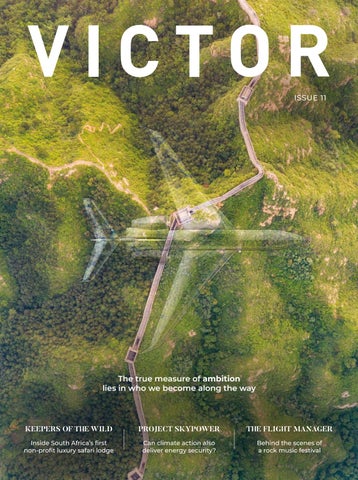
ISSUE 11
The true measure of ambition lies in who we become along the way
KEEPERS OF THE WILD
PROJECT SKYPOWER
THE FLIGHT MANAGER
Inside South Africa’s first non-profit luxury safari lodge
Can climate action also deliver energy security?
Behind the scenes of a rock music festival
A Bag to Suit the Adventure. Every Bennett Winch product is handmade in England. Using traditional skills and materials, we engineer accessories tailored to a contemporary world. We are not driven by seasonal trends or fashion, inspired instead by objects of soul and purpose. Our mission is simple: build the most enduring and innovative products we can. The Bennett Winch Suit Carrier Holdall is no exception; a single piece of luggage that does the job of two, engineered to suit the adventure.
A WORLD of POSSIBILITY.
SILVER FOX, 72M, SANLORENZO, 12 + 2 GUESTS
EDMISTON.COM
Yachting offers the ultimate luxury: freedom. The freedom to be exactly where you want, when you choose. Whether exploring distant shores or simply escaping the everyday, few experiences compare to a life lived at sea. Discover the world of yachting with Edmiston.
LONDON MONTE CARLO NEW YORK MIAMI
NEWPORT SOUTHAMPTON MEXICO CITY SAN JOSÉ DEL CABO
V ICTOR MAGA ZIN E
0 06
Contributors Editorial This Victor Magazine has been written in-house by the Victor team, drawing on the knowledge and experience of the people who shape our service every day. Contributions come from senior figures across Victor, offering informed, first-hand perspectives on private aviation, travel and the ideas and stories continuing to shape the industry.
CONTRIBUTORS Editor-in-Chief James Farley Managing Editor Max Stott Design DOIA Creative Studio
Design The design of this edition is by Harriet Bedder of DOIA Creative Studio. Her considered approach to layout, typography and imagery shapes every page of this edition. Working closely with the Victor team, Harriet has created a publication that reflects the quality and attention to detail our members have come to expect, balancing editorial clarity with a refined visual identity that brings each story, feature and partnership vividly to life in print.
Commercial Dialogue Agency has worked closely with Victor to develop relevant, high-quality commerical content and partnerships for this edition. By connecting Victor with brands that share our commitment to exceptional service, craftsmanship and experience, the team has helped shape commercial content that offers readers genuine value.
PHOTOGRAPHY CREDITS Front Cover © Michael Linde / Alamy | P15 © Unsplash/Jamie Street | P16 © Robert Ormerod | P17 © Carles Rodriguez Marin | P18 © Shutterstock/Euan Cherry | P19 © AerialBVI | P22-29 © Liam Baldock | P30 © Unsplash/Vitaly Gariev | P32-35 © QAPTUR/ Thomas Deregnieaux | P41 © Unsplash/Jakob Rosen | P42-46 © YUNGBLUD/Tom Pallant | P48 Unsplash/Manuel Torres Garcia | P50 Unsplash/Marko Pavlichenko | P51 © Max Stott | P52 Unsplash/Sora Sagano | P55-58 © Scott Dunn Reserve/Bawah Reserve Gorilla:Shutterstock/PhotocechCZ / Iguassu: Shutterstock/sharptoyou / Angkor Wat: Shutterstock/Boule / Cannes: Getty/George Pachantouris / Vatican: Shutterstock/Kate Connes | P61 Unsplash/Alexander Sinn | P62-69 © Marriott Hotels | P70-73 © Cashel Palace Hotel | P75 © Bürgenstock Hotels | P66 © Marriott Hotels | P78 © Unsplash/ Samuel Regan Asante © Juliette Remi © Unsplash/Sebastien Gabriel | P79 © Unsplash/ Natasha © Unsplash/Xingchen Yang © Unsplash/Museum Victoria | P80 Kenzo Khan | P81 Unsplash/Shanna Camilleri
VICTOR Washington DC +1 877 275 9336 10 G Street, NE Washington DC 20002 Suite 600 London +44 (0)20 7384 8550 20 Fulham Road London SW6 1AH Abu Dhabi +971 2 635 5762 Aldar HQ, Al Raha Beach Abu Dhabi Level 3
COPYRIGHT & DISCLAIMER All material in Victor Magazine is protected by copyright and all rights are reserved. No part of this publication may be reproduced, stored or transmitted in any form without the prior written permission of the publisher. While every care is taken with material submitted for publication, the publisher and its agents accept no responsibility for loss or damage to photographs, transparencies or other materials submitted, nor for any loss or damage arising from the contents of this publication. The opinions expressed are those of the individual contributors and do not necessarily reflect those of Victor Magazine or its publisher. Any matters arising from such opinions should be addressed directly to the relevant contributor.
07
L U X U R Y O U TD OO R F U RN I T U RE, MADE I N B RI TAI N
COCOWOLF.CO.UK
V ICTOR MAGA ZIN E
008
V ICTOR MAGAZ INE
CEO’s Letter
TOBY EDWARDS
I
N EVERY VICTOR OFFICE HANGS A PLAQUE bearing our three values. Ambition, Empathy and Accountability. The first of these is Ambition, and beneath it sit four lines we try to live by. We are brave and strive for greatness. We are disruptive and have the confidence to change. We are resilient in the face of adversity. We want to be the best version of ourselves. We chose those words with care, because ambition is a powerful and precarious thing. It has driven almost every great human achievement, yet few virtues slide so easily into vice. As children, we all learned the story of Icarus who, intoxicated by the gift of flight, soared ever higher until the very sun he reached for brought him down. It is a lesson that has stayed with us. Ambition without judgement or morals is just blind appetite. That lesson has rarely felt more urgent. We are living through a shift that may yet prove more consequential than the printing press, the industrial revolution, or even the invention of flight, the achievement to which our own industry owes everything. Artificial intelligence is reshaping how we work, how we do business and, most profoundly, how we think. There is something Promethean in that change, and in time it will ask harder questions of us about what we value and what we are willing to let go.
JAMES FARLEY
So, for this magazine we chose challenge over convenience. We crossed four continents to sit face to face with people chasing extraordinary goals with courage, conscience and care, and brought their stories home to shape – with love and attention – the pages you now hold. Within them, you will meet Kojiro Shiraishi as he prepares himself for the Vendée Globe, sailing's loneliest and most unforgiving race, in pursuit of becoming its oldest ever winner. You will travel to the banks of the Olifants River, where a luxury safari lodge is helping to heal old wounds by handing local youth the means to protect their wilderness. You will visit the Maldives, one of the world's great laboratories for climate adaptation, where marine biologists are safeguarding its future for the next generation. This year also marks 15 years since Victor first took flight. We would like to thank our clients, our partners and every member of our team – past and present – for the part each has played in our mission to offer a better way to fly. Toby Edwards and James Farley Co-CEOs
09
The perfect setting for life at the water’s edge A rare residential estate on Cap d’Antibes, comprising a contemporary main villa and two guest villas, set within 1.47 hectares of landscaped gardens. Offering exceptional scale, privacy and entertaining spaces, including spa facilities, private cinema, swimming pool, chef’s garden, and olive grove. An opportunity to acquire a once-in-a-generation home of this calibre on the French Riviera. ENQUIRE TODAY
Scan to enquire
LAETITIA GARDÉRE: +33 (0)4 93 33 32 22
| laetitia.gardere@caudwell.com
caudwell.com
V ICTOR MAGA ZIN E
010
Contents
Radar
Flight
016 AMBITION EMBODIED
042 THE FLIGHT MANAGER
022 KEEPERS OF THE WILD
048 PROJECT SKYPOWER
Five remarkable lives, five kinds of ambition. A dreamer, explorer, believer, visionary and enthusiast reflect on what drives us, and how they define ambition.
Surrounded by 2.5 million hectares of borderless African wilderness, this eco-safari lodge channels every dollar of profit into Koru Camp, training local youth to become the wild's future custodians.
030 HEALTHCARE WITHOUT BORDERS Vital health records still get lost between hospitals, countries and systems. Vitaspan founder Mark Jackson explains why fixing that gap is deeply personal.
032 THE ODYSSEY OF KOJIRO SHIRAISHI
The youngest sailor to circumnavigate the globe solo and non-stop at 26, Kojiro Shiraishi now sets his sights on becoming the Vendée Globe's oldest ever winner.
Half a century after Led Zeppelin's Starship, we put a rock star's touring party aboard a custom-wrapped VIP Boeing 737 bound for a festival's first international edition.
Electric and hydrogen aircraft won't cross the Atlantic for decades. For long-haul flying, the most immediate solution to lower emissions is already here.
055 AMBITIOUS ADVENTURES
Five Scott Dunn Private experts reveal the extraordinary journeys they've crafted for travellers seeking something beyond the conventional.
011
Landing 062 AGAINST THE TIDE
074 LICENCE TO CHILL
068 THE OCEAN ESTATE
076 BEYOND THE SEASON
A closer look at the people, ingenuity and ambition behind the Maldives’ luxury spectacle, with a visit to a resort determined to future-proof its fragile island.
See inside the Maldives’ largest overwater villa, an extraordinary 1,726m² property suspended above the Indian Ocean.
070 A DIFFERENT BREED
From Cashel Palace, one of Ireland's finest country-house hotels, to the legendary Coolmore stud, a journey into the heart of Tipperary's equestrian world.
Once a James Bond backdrop, Bürgenstock Resort above Lake Lucerne has quietly become one of Europe's most compelling places to spend a winter of wellness.
St Barths is in the middle of a reinvention. The Caribbean's most exclusive island is being reshaped into a year-round retreat, a place of world-class food, serious wellness and quiet discretion, where the season never really ends.
V ICTOR MAGA ZIN E
012
A R E YO U SE E ING THE F U L L PIC TU RE W HE N YO U FLY PRIVATE ? You wouldn't book a hotel without knowing what the room looks like. You wouldn't book a commercial flight without knowing the airline. Why should booking a private jet charter be any different?
With Victor, nothing is hidden. You see the operator you’ll fly with, the aircraft tail number, and real images of the interior – at the point of quotation. We'll always give you the full picture before you book.
DOWNLOAD OUR APP AND BOOK NOW
Abu Dhabi +971 2 635 5762 London +44 (0)20 7384 8550 Washington DC +1 877 275 89336
013
flyvictor.com flyvictor.com
014
V ICTOR MAGA ZIN E
015
Radar 16 — Ambition Embodied | 22 — Keepers of the Wild
30 — Healthcare Without Borders | 32 — The Odyssey of Kojiro Shiraishi
Around the world, leaders and visionaries continue to challenge conventions
V ICTOR MAGA ZIN E
016
WORDS: JAMES FARLEY
AMBITION EMBODIED W
E ARE TAUGHT to admire ambition. It is the quality behind the success stories we celebrate, the achievements we measure and the lives we hold up as examples of what is possible. Ambition is responsible for many extraordinary acts of courage, invention and imagination. We build cities, cross oceans, climb mountains and venture into the unknown because, somewhere within us, there is a desire to achieve something and go further. Yet ambition is often misunderstood. At a fundamental level, ambition is rooted in the same biological machinery that has driven humans to endure and compete for scarce resources. It is a function that our genes use to trick us into doing tasks that maximise our evolutionary fitness. Understanding ambition within this framework is instructive: it is a biological tool designed for survival, but not for satisfaction. From an evolutionary standpoint, our brains have not evolved to make us
happy or content, nor have they evolved to tell us when enough is enough; they have simply evolved in one direction – to keep us alive and reproducing. This reality reveals three crucial truths about how ambition functions. Firstly, the goalposts will always move. As evolution relies on continuous effort, our brains are wired with a "hedonic treadmill." The moment we achieve a goal, the dopamine spike fades, and the baseline resets. We are therefore biologically programmed to ask, "What's next?" Secondly, it is by design an illusion of necessity. Ambition tricks us into believing that the next promotion, the next dollar, or the next milestone will finally bring lasting peace. And thirdly and perhaps most importantly, we must manage it intentionally. In the modern world of relative abundance, unmanaged ambition can easily warp into chronic anxiety, burnout and permanent dissatisfaction.
It is no surprise, therefore, that we often find ourselves confusing the pursuit with the prize, the journey with the destination, and the outward symbols of achievement with the deeper reasons that set us moving in the first place. And when we do finally arrive at the realisation that ambition is a vehicle through which we find purpose, the essential more personal question invariably becomes: "What was it all for?" To explore this, we spoke to five individuals whose lives have been shaped by ambition, each in remarkably different ways. There is the dreamer who defied expectations simply to stand among the world’s greatest athletes; the achiever who continues to push the boundaries of human exploration; the believer whose ambition is inseparable from his vision of a more peaceful world; the visionary who has turned personal conviction into a movement dedicated to restoring lives; and the enthusiast who found a lifetime of meaning in the simple pleasures of leisure.
017
THE ACHIEVER: VICTOR VESCOVO Victor Vescovo is a venture capitalist, explorer and former US Navy Commander whose ambitions have taken him from the summit of Mount Everest to the deepest points of the world’s oceans. Having completed the Explorer’s Grand Slam and become the first person to visit the deepest point in all five oceans, he has pushed the boundaries of human exploration. There is always something more to explore, not just geographically, but also technologically and to test the limits of human capability in extreme environments. I think I am a little unusual in that I am not a specialist when it comes to exploring, even though I might be best known for ultra-deep ocean exploration – I like to work in many, very different, environments. For example, I continue to have an intense interest in mapping the massively unexplored seafloor but am also hoping to contribute to high altitude aviation technology and get a cave diving certification. I've recently learned that underwater caves are some of the most unexplored areas of our planet, probably because they are pretty dangerous environments to visit, but they could hold amazing, pristine records of scientific data that would be unique records of Earth's historical climate and reveal some unique evolutionary pathways. There is a natural symbiosis between science and exploration, and since I'm not smart enough to be a great scientist, I am instead just doing my best to help develop new technologies and perfect them personally to provide greater scientific data to those who can use it best. I believe there must be a genetic component to my pretty intense, enduring curiosity, but I was also privileged to grow up in a family and environment (Texas) where taking risks and having a 'just get it done' mentality is really strong. Given some of the, shall we say, 'a bit risky' endeavours I have pursued, I think I have a pretty acute sense of my own mortality and realise that we are just not on this planet very long. Since we are not, it is incumbent upon us all to live as densely and well as we can not just for ourselves, but hopefully to leave the world a little better than we found it. I think that advancing technology is one of the noblest things humankind can do since, to me, it has alleviated more suffering and provided more rewards for our lives than anything else. So whether it is in the air, mountains, space, caves, or the very deep ocean, I'm hoping to put all my efforts to help push us forward as a species. So it is part personal drive that is simply core to who I am, but also a mission that I have become convinced is the best use of my short existence.
THE BELIEVER: SATISH KUMAR Satish Kumar is a world-renowned author and international speaker, best known for his 8,000-mile nuclear-disarmament peace walk, spanning two and a half years, to the capitals of four nuclear-armed countries. Now in his 90s, he has devoted his life to campaigning for ecological regeneration, peace, social justice and spiritual fulfilment. I was inspired by Lord Bertrand Russell to work for peace. I walked from New Delhi to Moscow, Paris, London and Washington delivering packets of 'peace tea' to the political leaders in the Kremlin, Palais de l'Élysée, 10 Downing Street and the White House. I walked 8,000 miles, through 15 countries. That was an ambitious journey! My mission to establish peace in the world continues, to see that peace prevails. My new ambition is to persuade the 194 countries of the world to establish Ministries of Peace, so that wars will become a thing of the past and humanity can witness a new emergence of the age of peace. World leaders should be able to solve all disputes in a civilised way through dialogue without killing countless people and destroying precious resources. I was honoured to meet Lord Bertrand Russell, who was a great source of inspiration. His ambition was to see peace prevail, and I have the same ambition too. My drive for ambition comes from the examples of the great leaders of the past. They are my inspiration. I met Dr Martin Luther King, who was a gentle hero. He was an embodiment of love, despite being imprisoned 29 times! Also, great philanthropists inspire me. They use their wealth in the service of humanity. My ambition is to serve humanity and work for the wellbeing of planet Earth so that a good future for the world is assured.
V ICTOR MAGA ZIN E
018
THE DREAMER: EDDIE ‘THE EAGLE’ EDWARDS Eddie ‘The Eagle’ Edwards became Britain’s first Olympic ski jumper in 1988, defying expectations to compete on the world’s biggest sporting stage. His unlikely journey, fuelled by determination and a refusal to accept the odds, later became the subject of a Hollywood film. My original passion was always skiing. I remember seeing the athletes in their Team GB tracksuits and thinking they looked so cool. I wanted one of those tracksuits. I wanted to be part of that team. Looking back, just making it to the Olympics, walking out at the Opening Ceremony and wearing that tracksuit felt like winning a gold medal to me. There were plenty of people who didn’t believe in me, or who thought I had no business being there. And, of course, part of me wanted to prove them wrong. But if I’m honest, I think I was doing it for myself more than anyone else. I wanted to prove to myself that I could do it. I’ve always believed I could be better. My mum used to say I was stubborn, but I prefer to call it determined. Even now, I hate being told I can’t do something. It makes me want to try even harder. When I was trying to make it as a ski jumper, people told
me it was impossible, or that it was too dangerous. I didn’t have much money, so I slept in barns and underground car parks, scavenged food from bins and, at one point, even lived in a psychiatric hospital in Finland. I did whatever I had to do to keep going. You have to believe in something before there’s any evidence that it might happen. I’m a great believer in trying to win. You should always give yourself something to aim for. But you shouldn’t beat yourself up if you don’t achieve it. The important thing is that you get out there, you try and you give it everything you’ve got. I’m not very good at tennis, for example. But if I were playing against a Wimbledon champion and managed to win a single point, I’d consider that a huge victory. That one point would mean I’d done something I wasn’t expected to do. You don’t have to win the gold medal to feel like a winner. Sometimes it’s enough to turn up, have a go and surprise yourself. For me, the dream was always bigger than the result. The Olympics was the dream. Wearing that Team GB tracksuit was the dream. And everything that came after was simply the reward for having the courage to chase it.
019
THE ENTHUSIAST: DAVID DAVIS David Davis is the founder of Top100GolfCourses.com and Lockhart Travel Club, whose passion for golf has taken him to the world’s most celebrated courses. Having completed the World Top 100, he is among the most travelled golfers in the world, placing him in the top 0.01% by distance covered. I finished my first World Top 100 at Augusta National in November 2018 – and, if I'm honest, the moment itself was strangely anticlimactic. My son Bodhi had arrived just three and a half weeks earlier, so I turned up thinking about him far more than about any golf course. The finish line was never really the point. I wasn’t trying to become the most travelled golfer in the world, or to collect courses simply for the sake of collecting them. I was curious and passionate. I wanted to see what was out there, to understand what made these places special, and to share that experience with other people. The list was simply a way of giving that curiosity some direction.
The real pull was always architecture: understanding not just where the great courses were, but why they worked, and you can't form an honest opinion on that without standing on the ground yourself. Getting there is where it actually happens – the people you meet, the countries you'd otherwise never see, moments that feel genuinely spiritual at times. It doesn't really end, either. Golf never sits still – new courses get built, old ones get rejuvenated, there's always something else worth seeing. That restlessness is what turned a hobby into a profession. These days it shows up daily, helping other golf travellers find those same moments through Top100GolfCourses.com, and more specifically Lockhart Travel Club.
THE VISIONARY: BRITNIE TURNER Britnie Turner is an entrepreneur, philanthropist and founder of Aerial Recovery, an organisation dedicated to helping survivors of human trafficking and disaster. From living in her car to building a global movement, her ambition has been guided by a deeply personal conviction. At a very young age, I found a mission that spoke to my soul: helping stop human trafficking. I built my business, beginning while living in my car, because I knew conviction needed resources to become action. Along the way, I felt guided somewhere I never could have planned: to an island in the British Virgin Islands. That island became The Aerial, BVI, and ultimately helped lead to the founding of Aerial Recovery, through which veterans and first responders have helped rescue more than 9,000 people from disasters and human trafficking. But rescue is only one expression of the mission. The island is changing lives too. I watch people arrive exhausted, disconnected or hurting, and leave with hope, healing, restored relationships, renewed faith in themselves and sometimes an entirely new relationship with their own life. My ambition is to keep creating places, people and movements that make the world more alive. I believe we are all here for a reason, and that some of the greatest peace we will ever experience comes when our lives become aligned with that reason. Everything at The Aerial, BVI is built around that belief: nothing should deplete you; everything should add something back. Because saving a life does not always look like pulling someone from rubble. Sometimes it looks like helping someone remember that their life is worth living. That is what drives me now: not simply to build more, but to leave people more alive than I found them.
020
V ICTOR MAGA ZIN E
021 R ADAR
Keepers of the
WORDS:
MAX
STOTT
Wild Sashwa – River of Stars, a luxury eco-safari lodge, sits in a truly borderless ecosystem, with roughly 2.5 million hectares of African wilderness flowing uninterrupted around the property. Here, protecting the wild begins with investing in the people who live alongside it, giving the next generation a genuine opportunity to become its custodians and protectors. Every single dollar of profit generated by guests directly finances Koru Camp, a nearby non-profit sanctuary that provides safari education programmes for local youth.
V ICTOR MAGA ZIN E
024
I
T’S LATE SPRING and my host, the philanthropist Peter Eastwood, is waiting at the tiny Hoedspruit airport in a safari vehicle that looks less like a Land Rover and more like an armoured personnel carrier. He is taking me to his new non-profit safari lodge, Sashwa River of Stars, on the outskirts of Kruger National Park along the banks of the Olifants River. As we drive deeper into the reserve, the landscape becomes animated and increasingly surreal. Giraffes emerge beside the road, nearly a hundred elephants amble across our path and herds of zebra congregate in the distance. Our host regards it all with expected, easy familiarity. Since selling in 2019, the homebrewing business he built and ran for nearly three decades, Peter Eastwood has given himself over to a gentler way of life, with an unpretentious warmth and easy likeability that follows him everywhere. Along the way, he stops to chat several times with local business owners and security guards, referring to their children by their first names, and asking how their studies are progressing. As we drive closer to the lodge, we stop momentarily to watch a giraffe graze. This prompts Peter to ask if I’m hungry and, before I can answer, he tells me not to worry. The kitchen at Sashwa is cooking up a treat tonight. I already know what’s coming. Sashwa is not just one of the only non-profit luxury safari lodges in Africa, it is also the first to be entirely plantbased, from the food and drinks on the table to the carpet underfoot and the soap in the bathroom. Its food is grown through permaculture in an ‘abundance garden’ on the property and prepared and served with a level of gastronomic artistry that befits a luxury resort of this calibre. Despite knowing this, I confess to him that I’ve already been teased back home about not being able to enjoy a world-famous South African steak. “People ask me why we don’t just do it as an option,” Peter retorts, “but I don’t believe in half measures. We are trying to do something really different here. If we’re saying we’re a not-for-profit, if we’re saying this place is about the land and the people, then we have to go the full way; we’ve got to go all in, not just the bits that are easy.” It is the first time I glimpse the steely resolve behind Peter’s otherwise gentle manner. While some visitors might drive through this wilderness believing they are entering a world untouched by civilisation, the reality is anything but, and Peter is one of the few outsiders
“ I don’t believe in half measures, we are trying to do something really different here.”
acutely aware of this. These plains and riverbanks were once home to the Mapulana, Pedi and Tsonga peoples, whose ancestry is stitched into every bend of the Olifants and every ridge of the Lowveld. They never entirely left; they simply found themselves on the other side of boundaries drawn by someone else. Tourism in remote and vulnerable environments is one of conservation’s greatest paradoxes. A “necessary evil” is how Sir David Attenborough describes it. There are few conservationists who would disagree with this view. In the case of the African safari, there is certainly an argument that tourism funds much of the wildlife protection, but it also, without a doubt, has a drastic impact on the landscapes and animals it claims to preserve. While many safaris have evolved and matured, for the most part they still carry the language and aesthetic of their colonial beginnings. It’s not uncommon in many high-end lodges to recognise some of the animals on the menu from your game drive earlier in the day. The “Big Five” remain the animals visitors most hope to see – not because they are
the rarest or most ecologically important, but because they were once considered the most difficult for late-19th-century European aristocrats to kill. The modern safari is an experience that, intentionally or otherwise, does blur the line between appreciating wildlife and consuming it. For this reason, Sashwa – River of Stars feels deliberately different from the safari lodges around it. It does not simply acknowledge the painful history of this land; it is trying to address some of the damage left by generations of exploitation. Financial input is a clear starting point. South African Tourism estimates that wildlife tourism generated $1.8 billion in 2023, with visitors spending almost three times as much as the average tourist, so if a model like Sashwa’s could be replicated at scale, the potential impact would be significant. However, the impact of safari tourism in South Africa is felt not only by the environment but also by the local population. As more visitors arrive, rural communities have been pulled closer towards new economies and new expectations, and in the process generations of ecological knowledge have begun to fade. What was once
025
026
V ICTOR MAGA ZIN E
R ADAR
027
“ If the landscape is to endure, the people who live alongside it must have a significant stake in its future.” passed down through ancestral practice has been replaced by wages, supply chains and the ever-increasing need to service the outsider’s view of Africa. This is the central idea behind Peter’s vision. If the landscape is to endure, the people who live alongside it must have a significant stake in its future. At the centre of that effort is Koru Camp, a community programme funded by Sashwa and set just a few kilometres from the property. It welcomes children from neighbouring communities for immersive programmes centred on environmental education, confidence and leadership, social integration and career pathways, reconnecting them with a landscape that should be both their inheritance and the future source of their livelihood. The camp also recognises that local community elders within the region often hold the key to long-term societal shifts and therefore works with Non-Governmental Organisations to bring local ‘gogos’, or grandmothers, into the wilderness for the first time. Many of the gogos lived their entire lives in poverty outside the reserve, but here, they can experience nights beneath the stars, listening to lions calling in the darkness and watching wildlife at close range. As the matriarchs of their families and communities, they can take that experience home with them, sharing a new understanding of the land and why it is worth protecting. In this way, the gogos become a vital part of the effort to change attitudes towards the wildlife that has always lived alongside them. This is clearly the beating heart of the whole operation, and it’s what Peter is most proud of. “Any time I’m having a bad day because a generator’s broken or there’s a pipe leaking somewhere,” he tells me, “I just drive up to Koru, see the kids and remember what it’s all about.” On our visit to the camp with Peter, he can barely make it through a doorway without being intercepted. “Peter!” comes the cry from somewhere inside, followed by a sprint, a grin and a hug. Then it happens again in the next room, and again after that. He is greeted like family. There is an ease and affection in the way people respond to him that is impossible to manufacture and says more about what he has built here than any plaque on a wall ever could. For years Peter and others were solely supporting Koru with money out of their own pockets. Eventually he realised he had the equation the wrong way round. Rather than asking donors to trust where their money might end up, why not build a lodge whose profits would fund the camp directly? “Philanthropists always want to know where their money’s going. How is it actually being used?” At Sashwa, every booking helps finance the programmes taking place a few kilometres beyond the reserve fence. At Koru, the impact is tangible. We meet dozens of people whose lives have been shaped by the programme,
including Melody, who grew up beside Kruger National Park but had never seen its wildlife first-hand. An outreach workshop changed that. It sparked a fascination with the natural world that eventually led her to overcome the barriers faced by many young people in neighbouring communities and become an apprentice guide at Koru Camp. Her story is precisely what Peter believes the model can achieve: giving people who have grown up alongside Africa’s wildlife a reason, and the means, to become its custodians. For Peter, though, Koru was never intended to be a one-off. “It would be narrow-minded to do all of this work and then make it exclusive so it can’t be replicated by others.” His personal ambition is to establish 24 Koru Camps and six Sashwa lodges across Africa, creating a model in which conservation, tourism and community development reinforce one another. The challenge is making sure that purpose survives as the model grows. While eco-lodges are often vulnerable to changes in ownership or corporate buyouts, Sashwa has built permanence into the land itself. Its 1,000-hectare private reserve now benefits from a formal Protected Area Declaration, legally committing it to conservation in perpetuity. One afternoon, as I ate lunch alone on the deck, a herd of elephants emerged from the trees just metres from my table, a tiny calf tucked between its mother’s legs. They moved through the same landscape that had produced the food in front of me and, for a few minutes, there was no sense of being on safari at all. I was simply another creature sitting quietly in the bush. The philosophy behind Sashwa started to feel like common sense. That feeling extends into Sashwa’s approach to wellness. Yoga takes place in a shala where elephants are likely to wander into your eyeline, and your morning sunrise meditation can be unexpectedly, and quite comically, interrupted by a troop of baboons. The Sashwa experience asks you to relinquish the idea that everything around you is
028
there for your benefit, and that is a luxury you will seldom discover anywhere. With its 12 beautifully designed luxury suites, the focus is on micro-exclusivity and intimate, highly private stays that enable true “bio-harmonising” and high-end healing experiences. The lodge itself is architecturally configured around the Olifants River, which cleanly reflects the Milky Way onto the water, providing a unique and arresting view that truly captivates and gives the lodge its name. There is no nagging sense that enjoyment has come at someone else’s expense. You can eat well, sleep soundly, and as there is zero institutional friction between your stay and the work that your stay enables, you leave with complete certainty that the money you have spent generated benefits beyond your own. The setup at Sashwa offers you an inspirational front-row seat to a social enterprise and you can see that Peter has created something special that has taken root and spread far beyond the lodge. You feel it in the people who work here, in the children at Koru and I am even convinced the animals can sense it too. Before coming here, I had met with Peter in London and he had told me the land had an "energy", a "magic" quality that I’d
V ICTOR MAGA ZIN E
love. I assumed he meant the landscape in a spiritual sense. I realise now he was talking about something much more tangible and human. What makes Sashwa different is that the wilderness itself becomes part of the wellness experience. There is no timetable of treatments to work your way through and no expectation that you spend the day within the confines of the lodge. Your time is genuinely your own. You might spend the morning tracking on foot, an afternoon painting in the art studio, or an hour in the pool, gym or Himalayan crystal infrared sauna. There are dedicated meditation spaces and a small spa when you want them, but nothing here feels prescriptive. Alternatively, you can always find more ostentatious lodges elsewhere, offering an experience of the wilderness, the wine, and the steak. What you cannot buy is this sense of affection, or belonging, that you are contributing to something real. On our final morning, Peter and I sit on the banks of the Olifants River watching the sunrise. Across the water, a dozen local teenagers are taking in the first orange light, equally mesmerised by the view in front of them. Peter watches them for a while before turning to me. “I still can’t believe we did it, you know.” He looks back towards the rising sun. Then, almost to himself, he says, “It’s a miracle.”
029
030
V ICTOR MAGA ZIN E
Healthcare Without Borders Modern medicine can do extraordinary things. Yet vital health information can still be lost between hospitals, countries and incompatible systems. For Vitaspan founder Mark Jackson, closing that gap is personal.
M
EDICINE IS ADVANCING AT A PACE that would have seemed like science fiction a generation ago. We can now edit the genes responsible for inherited disease, engineer the immune system to fight cancer and use AI to help discover entirely new treatments. And yet, if you ask a patient for their complete medical history, the answer is often still a trail of PDFs, passwords, referrals and paperwork. It is one of the great paradoxes of modern healthcare. We have never had more data, but that does not mean we have a complete picture of the person behind it. The cost of this fragmentation is not simply administrative. In 2024/25, NHS trusts in England spent £239.5 million storing paper medical records. Meanwhile, millions of people are turning to AI in the hope of making sense of their health. OpenAI reported that 5% of all ChatGPT messages globally relate to healthcare, with more than a quarter of a billion people asking ChatGPT healthcare questions every week.
For those who travel or live between countries, the problem is amplified. A specialist in London may not have access to records from Dubai. A consultant in New York may not know what happened during a previous treatment in Switzerland. Even within a single country, moving between providers can mean starting the story again. A missed piece of history, a duplicated test or a delayed referral is not just an inconvenience. In more serious cases, incomplete information can contribute to the wrong decision being made. Behind every missing record is a person, and behind every person is a life that cannot be reduced to a collection of disconnected documents. This is the problem that Mark Jackson, founder and CEO of Vitaspan, wants to address. His company is building what it calls a Living Health Record: one connected, evolving record of a person's health that can be used across providers and countries. The idea came from experience. After 20 years living in the Middle East and the United States, Mark and his wife returned to the UK in 2021 and found that their health records had effectively been left behind. His family had also experienced the consequences of fragmented and incorrect medical information. “Health information does not always travel as easily as we do,” he says.
R ADAR
ADV E RTO R I A L
031
“ Your health is more than your latest test result.”
MARK JACKSON, CEO AND FOUNDER
PUTTING THE PATIENT BACK AT THE CENTRE
Request a private Vitaspan demo
In simple terms, Vitaspan is designed to bring together a person's medical records from different places and turn them into one organised, usable health history platform. It works across existing healthcare systems, rather than requiring hospitals or clinics to replace the systems they already use. Vitaspan is not another app asking patients to keep track of every appointment, nor is it simply a more sophisticated chatbot. It is intended to become the connective layer between the different providers involved in a person's care, acting as steward of the patient's data rather than the owner. Any clinician, no matter their specialty, or preferred language, should be able to open a Vitaspan record and see the patient's history, the sources of that information and the relevant context, without spending valuable time searching through disconnected records. “Each provider holds part of the story; bringing it together too often falls to the patient or family,” Mark says. The aim is to give people greater control over their health information, while making it easier for those caring for them to understand the whole picture. Patients can decide whom to share their information with, with permissioned, time-bound access designed into the system. For someone accustomed to moving between countries, the proposition is compelling. Whether receiving care in London, Dubai or New York, the patient should not have to reconstruct their medical history every time they meet a new specialist. Vitaspan uses AI to help organise medical histories, produce clinically validated summaries and highlight changes or patterns for a clinician to review. It practices digital twin visualisation, mapping medical records to the body, and predictive and preventative insights based on longitudinal trends. The ambition is for healthcare to become cumulative rather than episodic. Every appointment should build on the last, rather than becoming another isolated snapshot. Every new specialist should have access to the information they need, wherever the patient happens to be. “Vitaspan is the foundation,” says Mark. “A longer, fuller life is the purpose.”
O DYSS EY
THE
KOJ I RO S H I RAIS H I
OF
034
V ICTOR MAGA ZIN E
R ADAR
T
HERE IS A REASON more people have travelled into space than have sailed alone, without stopping, around the world. Those who attempt it often describe the experience as a form of psychological torture. On scraps of sleep and
cold, freezedried meals eaten straight from the bag, sailors often slip into a halfwaking twilight where dreams and reality begin to blur. Days lose their shape, and months pass with no human voice but their own. Eventually, even that voice becomes
difficult to trust. Kojiro Shiraishi has sailed solo around the world five times. The first was in 1994, at the age of 26, when he became the youngest sailor at the time to circle the globe alone, non-stop and unassisted. Now 59, he is preparing for the 2028 Vendée Globe, widely regarded as the toughest solo race in sailing. Victory would make him the oldest winner in its history. On 12 November 2028, Kojiro will leave Les Sables-d’Olonne and steer his bow toward true south, descending into the Southern Ocean where he will circle Antarctica. He will round the three great capes, cross the Indian and Pacific oceans, pass Cape Horn and turn north into the Atlantic, with 45,000 kilometres of open water between departure and home. The race is a prolonged assault on the human body, and for three months he will sleep an average of just three hours and forty minutes a day. Some sailors come home up to 1.5cm shorter than when they left, their spines compressed by months of pounding waves and cramped quarters. Historically, only just over half of those who start make it to the finish line. Although this is his fourth attempt, he won't start as a favourite. The front of the fleet belongs to deeppocketed French campaigns and sailing titans such as Richomme, Ruyant and Herrmann. But after three Vendée Globe campaigns, including finishes of 16th and 24th in 2020 and 2024, Shiraishi is still chasing the result he wants. He finally has a boat built to win: a radical, bespoke design unlike anything else on the water. Yet for Shiraishi, what's under his feet is only half the story. "Sailing isn't just about what you can see in front of you. You must never just focus on the material world. You must connect with the invisible – your relationship with your crew, your inner spirit, your gut instinct." These are Kojiro's words, relayed to me by his translator. Spoken in Japanese, with his eyes closed and one hand drifting slowly through the air, they sound far more poetic and profound coming from him.
THE ODYSSEY OF KOJIRO SHIRAISHI WORDS: MAX STOTT
035
Kojiro is speaking to me on a clear, still morning in New York, the Hudson river just outside is flat and unassuming. In less than 72 hours, he will take his new boat out for its first real test in a race across the Atlantic ocean. He then has two years to prepare for his final Vendée Globe. “This is the last one,” he says. “The last big impossible challenge of my life.” Affectionally known as the ObiWan Kenobi of sailing, Kojiro has an unmistakable affinity with the mystical. He speaks in metaphor, and even the simplest question can draw an answer closer to a parable. The most important lessons he ever learned, he says, had little to do with sailing. They came from his mentor, Yukoh Tada, the taxi driver turned ocean racer who won his class in the first BOC Challenge, a man Kojiro remembers as "a true artist". In 1990, Kojiro was part of Tada's shore crew when disaster struck. On the 50-day leg from Cape Town to Sydney, Tada's boat capsized six times, and by the time he reached port he was far behind the fleet and forced to withdraw. In March 1991, in Sydney, the 61-year-old tragically took his own life. Kojiro was 23. In a deeply defining act of devotion, he travelled to Sydney, repaired his mentor's battered boat and sailed it home to Japan. Two years later, aboard that same boat, he set out to honour the man who had shown him the way and became the youngest sailor ever to complete a solo, non-stop circumnavigation of the globe. He re-named the boat Spirit of Yukoh and has dedicated his entire career to keeping his mentor's memory alive. What makes his relationship with the sport even more complex is something Kojiro mentions almost in passing. His translator pauses, exchanges a few words with him, then turns back to me: "He also gets terrible seasickness." I assume something has been lost in translation, but Kojiro just laughs and gives me a thumbs-up. "Yes, it's true." In the opening week of every race, he takes medication strong enough to settle his stomach and keep him awake. "I don't sleep for the first week," he says, with a shrug. He likens himself to a diesel engine, slow to start but stronger with every passing day, until his body finally makes its peace with the sea.
V ICTOR MAGA ZIN E
036
More than three decades on, the boat that will carry him into his final Vendée Globe is built to help him endure this familiar adversary. Unveiled in Lorient in June 2026, DMG MORI Global One is arguably the most radical IMOCA of its generation. "This is going to be my last boat, so I want to make it special," Kojiro says. He asked its designer, Guillaume Verdier, the architect behind the America's Cup's foiling AC75s, to work with "a free mind, free ideas, no limits". The result is a hull unlike any other in the fleet. Where conventional IMOCAs are wide and flat, built to heel hard over and slam from wave to wave, this boat features a pronounced bustle along the underside. It is designed to sail almost upright, at a heel of around eight or nine degrees, to lift onto its foils earlier and to slice through the swell instead of crashing down on it. Verdier admits the idea began with the sailors themselves. Skippers had told him they were exhausting themselves on hulls that slammed relentlessly. It is a fitting vessel for a sailor who has never sought to conquer the ocean, only to find harmony with it. This boat isn’t built to overpower the waves, but to move with them. The boat is impressive, but the people around it are perhaps more revealing. His programme brings together French, British and Japanese sailors, among them Samantha Davies, Nicolas Lunven, Gaston Morvan and Charlotte Yven, while younger Japanese sailors including Arisa Moriya, Kodaï Endo and Koki Sawada are being brought into the wider project. It is an unusual mixture of experience, nationality and age, and one that reflects the idea that not one single perspective possesses the whole answer to ocean racing. Before the official launch of the boat, Kojiro appeared in a black robe for a traditional Japanese sake ceremony. A gold coin was slipped beneath the mast, following French tradition, before a bottle of champagne was smashed against the hull. The boat was sent into the world with Japanese ritual, French superstition and Western ceremony. “Luck is the most important aspect of sailing,” Kojiro tells me. “We take all the luck we can get.”
Offshore racing requires a combination of sailing ability, technical knowledge, money, sponsorship, contacts and an understanding of how to build and manage a campaign. Kojiro has tried to make the workings of the sport more visible to the young sailors coming behind him, rather than simply showing them the glamorous end result. “In Japan, ocean racing still feels like a distant world to many people,” he says. “There are young sailors who may want to pursue it but have no idea where or how to begin. I can lead by example, but they must be the ones who walk through the door.” Kojiro's ambition comes as sailing struggles to attract the next generation, even in Britain, where the sport is woven into national culture. The Royal Yachting Association reports junior participation in its coached groups has fallen 24% since 2015, citing cost, access and awareness as key barriers. It is precisely why the sport needs role models like Kojiro. Perhaps that is why his answer to the question of retirement is so revealing. “I do not see life as a one-way journey from challenge to success,” he explains. “In spring, the seed begins to grow. It flourishes in summer, bears fruit in autumn and returns its seeds to the earth in winter. Then, when spring comes again, new life begins to emerge. I believe that life moves in the same way. Even when I retire from racing, my relationship with the ocean will not disappear. For me, the ocean is not only a place of competition. It is where I have learned about life and where I have faced myself. The nature of that relationship may change, but my connection to the sea will remain. At the same time, the desire to attempt something that no one has done before is part of who I am.” Victory would rewrite the record books. The oldest winner to date, Yannick Bestaven, was 48 when he crossed the line in 2021. Kojiro will be 61. Months of broken sleep and the relentless hauling of sails and equipment across the deck are trials
that favour youth. But he is already looking beyond the finish line. “I may one day stop racing, but I do not think I could ever let go of the spirit of challenge. Perhaps my next ‘impossible challenge’ will not be
something I accomplish myself, but creating a path that allows the next generation to accomplish something that today seems impossible.”
037 R ADAR
040
V ICTOR MAGA ZIN E
041
Flight 42 — The Flight Manager | 48 — Project Skypower 55 — Ambitious Adventures
From pioneering aircraft and sustainable aviation fuels to the destinations they make accesible, this is your guide to the next frontier of flight
V ICTOR MAGA ZIN E
042
THE
Flight MANAGER
With special permission, Katie Henderson, Head of Group Charter Operations at Victor, takes us behind the scenes of a major rock and roll tour, revealing the extraordinary logistics required to keep an entire operation moving from one city to the next.
WORDS: KATIE HENDERSON
FLIG HT
043
“ Welcome to Yungblud airlines”
I
T STARTS WITH AN EMAIL on a wet Tuesday morning in London. The subject line reads: “Booking confirmation – Yungblud.” It only takes a quick glance for me to realise this isn’t just going to be any ordinary flight. London to Oslo. Oslo to Czechia. An entire touring party travelling together. A VIP Boeing 737. Thousands of kilos of equipment. Branding for the aircraft. Grammy Award-winning artist, Yungblud, is taking Bludfest, the festival he created, overseas for the first time. What started as a simple concept has become a major production and we are going to be responsible for the travel. There is zero room for error. By the time this booking confirmation has reached me, Yungblud is everywhere. Only a few years earlier he was picking up awards as one of music’s breakthrough artists; now Dave Grohl, the Foo Fighters frontman and former Nirvana drummer is hailing him as an “unstoppable force”, Mick Jagger is calling him the future of rock ’n’ roll and Ozzy Osbourne featured Yungblud prominently and poignantly in his final concert before his passing only a few weeks later. This festival, therefore, represents a significant occasion and milestone in his career, and Yungblud wants the whole touring party flying together to share the experience. He wants the journey to have the same sense of communal celebration as the festival itself, which meant finding a travel partner who understood that the brief was never simply to get everyone from A to B. Unlike other artists, who often
fly separately from their crew, this flight has to feel like an extension of Bludfest. Having joined Victor's group charter team just four months ago, I'd helped move cricket teams, a supercar touring group, an ice hockey squad, a football team for the World Cup and facilitated a luxury round-the-world tour. But nothing quite prepared me for organising Yungblud's flight to his first international Bludfest.
THE BRIEF: 85 DAYS UNTIL SHOWTIME Given Yungblud’s instruction that the flights to and from Bludfest needed to be inclusive of his whole team, we needed an aircraft with X factor, large enough to carry the entire group comfortably, while still feeling a long way removed from an ordinary commercial airline. The answer was a VIP Boeing 737 with 68 business-class seats in a spacious 2+2 configuration supplied by KlasJet. There was room for the touring party, while the forward cabin could be reserved for the A-party. Just as importantly, the hold could accommodate around 2,500kg of backline equipment alongside the passengers’ luggage. It had the scale to carry the whole operation, but enough character to become part of the story. There was one more request. Inspired by the iconic images of Led Zeppelin with their own branded aircraft labelled ‘The Starship’, Yungblud wanted to pay homage to the golden age of rock and roll travel and to wrap the whole aircraft in his own logo.
044
V ICTOR MAGA ZIN E
FLIG HT
045
THE PREP: 41 DAYS UNTIL SHOWTIME With the aircraft locked in, the real work for me began. For weeks, I was tightly orchestrating the operator, airport handlers, ground transport, security, and catering all while keeping track of passenger details, baggage, equipment and every other piece of the tour schedule that could affect the flight. There are over 100 intertwining variables that make up the flight preparations for a music tour, from the branded napkins and headrest covers, to the cases of champagne and biscuits made in the shape of the aircraft with Yungblud’s logo. None of it happens by itself. Every request has to be sourced, approved, timed and delivered. Then there was the aircraft itself. We worked with a leading specialist decal company to turn the 737 into an epic asset of the Yungblud tour, coordinating the artwork with his team before arranging the installation of a 10-foot-wide decal to take place overnight in a hangar. There was a very specific window to get the aircraft wrapped, checked and ready for departure, so I was requesting updates every 30 minutes to ensure that one delay wasn't going to create another somewhere else. It is the kind of work where the closer you get to departure, the more acutely you feel the hours slipping away. Then, 48 hours before the flight, the Oslo show was cancelled. Overnight, the itinerary we had spent weeks building had changed completely. As with all our flights, we were prepared and ready to react. The multi-sector routing was replaced with a direct flight from Biggin Hill to Czechia, which required revising the operation and resetting the moving parts around it: flight planning, handling, ground transport and timings. I then drove almost five hours from Cheshire to Biggin Hill the day before departure to walk through the passenger journey with the handling team, making sure everyone knew exactly what was supposed to happen and when.
On screen, it would look as though he had just arrived in Czechia and was stepping straight into Bludfest. We had walked a tightrope between the spontaneity of rock ’n’ roll and the strict realities of aviation. My job was to make sure one could exist within the other. It looked effortless on screen, as show business demands, with all the hard work neatly hidden from view. And just as importantly, even with all the unexpected changes, I’d ensured that we were still departing on time. Once aboard, the cases of champagne were promptly opened and the logo biscuits were passed around. Just before take-off, Yungblud picked up the tannoy and welcomed everyone to “Yungblud Airlines”. The cabin erupted, with cheers and laughter vibrating the aircraft. There was a tangible buzz on board. Friends, crew and fans were all in the same cabin, and the usual quiet formality of air travel had gone out of the window. It felt both relaxed and slightly chaotic and exciting. It was at this point I was handed a backstage pass for the festival too, which would make the whole experience even more unforgettable.
72 HOURS UNTIL SHOWTIME
THE RETURN LEG
By the day of the flight, we had decided to arrive at Biggin Hill Airport early in the morning and shoot the footage from there, before flying to the festival. It was going to be a tight window. Before security opened, we took the artist and the band out to the aircraft while it was still parked, using the quiet window to capture the stills with the doors closed. The days and weeks of stress seemed to fall away the moment the artist stepped onto the tarmac and saw the aircraft wearing his own logo for the first time. Rock ’n’ roll careers are not short of memorable moments, but I could tell this one was personally important. He stood there for a moment, taking it in, before breaking into a grin. Then, in his thick Yorkshire accent, came the verdict: “This is absolutely sick, man. Wow!” Once the airport opened, everyone cleared security as normal while the crew prepared the aircraft and Yungblud changed into his stage clothes. We then brought him back out to film the arrival sequence, with the crew opening the doors so we could capture him stepping out, walking down the aircraft stairs and boarding again for the shots inside.
The return leg brought a different kind of challenge. Unlike most private jet flights, a group charter of this size can operate through a commercial terminal, bringing it into contact with public areas, scheduled airline traffic and hundreds of other passengers. After the controlled environment of the outbound flight, we had to think about moving one of the most recognisable people in the country without creating a scene. With another departure taking place that morning, we had worked closely with the handling team to keep everything as discreet as possible. Yungblud was checked in separately, the security lane was briefly closed while he passed through, and we kept him on the tour bus until the last possible moment. From there, he was escorted directly to a separate boarding area and onto the aircraft. It might sound like a small part of the operation, but this is where all the work beforehand can fall apart at the last hurdle. One late passenger, one crowded corridor or one photograph at the wrong moment can change the atmosphere completely. When you are moving an entire touring party, there is always another piece to think about, and the responsibility is to make sure none of those pieces
046
becomes a problem for the people travelling. As a result of our meticulous preparation, we were able to complete the final leg without any drama, crowds or disruption. The best execution in private aviation is often the part nobody notices. By the time the aircraft doors closed, the passengers were resting comfortably after delivering another incredible performance, and the next moves were already being reconfirmed and put into action.
THE PART NOBODY SEES People often imagine charter aviation is all about luxury aircraft and VIP passengers. In reality, the aircraft is only one part of it. The real job is everything that has to happen around it: the calls, permissions, timings, contingency plans, last-minute requests and constant coordination that allow the experience to feel effortless. For me, that is what makes group charter so rewarding. You are constantly balancing chaos and order, creativity and precision, against the often unforgiving realities of aviation. When those worlds come together properly, the passengers never see the work behind it. They simply have a great flight, and that is music to the ears of any flight manager.
V ICTOR MAGA ZIN E
047
A private Mayfair residence 47 Park StreetSM offers a selection of luxuriously furnished, spacious apartments in Mayfair for the amount of time you personally require in London each year. Individual and corporate fractional interests from £82,800. www.47parkstreet.com | Tel: +44 (0) 20 7950 5528 | info@47parkstreet.com
Data protection: Your personal information and details will be stored by Marriott Vacation Club International, part of a global group of affiliated companies (“Affiliates”), and your personal information may be shared among the Affiliates and transferred outside of your country of residence. Personal information that is transferred outside of the European Economic Area is done under data transfer agreements that contain standard data protection clauses adopted by the European Commission that provide safeguards for such transfers. For more information about the use of your personal information, or to exercise your rights of opposition, access, rectification and deletion please review our Global Privacy Statement found at marriottvacationclub.com/privacy/ or contact our Privacy Office at privacy@mvw.com. IQL-20-001. THIS ADVERTISING MATERIAL IS BEING USED FOR THE PURPOSE OF SOLICITING THE SALE OF TIMESHARE INTERESTS. Subject to applicable terms and conditions. This is neither an offer to sell nor a solicitation to buy to residents in jurisdictions in which registration requirements have not been fulfilled or where marketing or sale of fractional residence club membership is prohibited and your eligibility and the membership clubs available for purchase will depend upon the jurisdiction of your residency. Prices are subject to change. Key information is available upon request by contacting 47 Park Street Grand Residences by Marriott, Mayfair, London, W1K 7EB, United Kingdom or email moreinfo@47parkstreet.com. Marriott Vacation Club International and the programs and products provided under the Grand Residences by Marriott brand are not owned, developed, or sold by Marriott International, Inc. Marriott Vacation Club International uses the Marriott marks under license from Marriott International, Inc. and its affiliates. ©2026, Marriott Vacation Club International. All Rights Reserved. 26-701-6314150
*Terms and conditions apply.
PROJ SKYPO 048
V ICTOR MAGA ZIN E
JECT OWER 049
Europe has more than 40 large-scale e-SAF projects announced and not one has reached a final investment decision. Victor has joined Project SkyPower to change that, backing a drop-in fuel that slashes emissions, strengthens energy security and could power your next flight.
WORDS: TOBY EDWARDS
V ICTOR MAGA ZIN E
050
“ e-SAF is no longer an environmental argument but an energy security one.”
E
VERYTHING WE DO AT VICTOR comes back to one question – can we find a better way to fly? For more than seven years, we’ve disclosed the estimated emissions of every flight we quote, because people can’t make better choices without knowing the impact of the journey. But data alone won’t decarbonise aviation. Nor will more efficient aircraft solve the problem on their own. Electric and hydrogen aircraft may eventually transform short-haul flying, but neither is going to carry a business jet across the Atlantic within the next two decades. For long-haul flight, the most immediate answer is sitting in the fuel tank.
WHAT E-SAF IS Almost all sustainable aviation fuel flying today is made from waste oils and fats – used cooking oil, tallow, agricultural residues. It works, and it is the right thing to be using now, but the supply is finite, and pushing past sustainable limits creates new problems around land use and food. Electro-SAF, or e-SAF, is different.
Renewable electricity is used to split water into hydrogen, which is then combined with carbon dioxide captured from the atmosphere or from biogenic sources. From these unlikely ingredients comes synthetic kerosene, a fuel that is chemically almost indistinguishable from the fossil jet fuel used today, but with 85–95% lower lifecycle carbon emissions. Researchers are investigating whether e-SAF can also reduce contrails and particulates, potentially making its climate advantage greater still. As a drop-in fuel, e-SAF requires no modifications to an aircraft’s engines or fuel systems. In theory, the next aircraft you charter could run on it tomorrow. And unlike bio-based SAF, it isn’t constrained by the availability of agricultural feedstocks. Its raw ingredients are electricity, water and CO₂, all of which are available at scale. And it is not theoretical. Demonstration plants in Germany, Arizona and Montreal are producing e-SAF as you read this – just nowhere near the volume's aviation needs.
FLIG HT
051
TOBY EDWARDS, CO-CEO
WHY IT MATTERS BEYOND THE CLIMATE CASE Around 95% of Europe’s jet fuel originates from imported oil feedstock, roughly 40% of it transiting the Strait of Hormuz. This year’s crisis pushed jet fuel prices up 130%, and shocks like that land on airlines, on operators, on brokers like us, and ultimately on the people flying. Fuel made from European electricity, water and captured carbon is far less exposed. That is why e-SAF is no longer only an environmental argument but an energy security one. It is also a means for Europe to compete in a clean industrial future.
SO WHY CAN’T YOU BUY IT? European law now requires an increasing share of e-SAF in jet fuel uplifted at EU airports from 2030. The demonstration plants already running prove the technology works. The obstacle to scale for e-SAF is the economics not the engineering.
A single commercial-scale plant costs €1–2 billion, and to raise that an e-SAF producer needs a buyer committed for 10 to 15 years. Airlines buy fuel on one-to two-year contracts and run on thin margins. Nobody wants to be the first to lock in a price that will be five to eight times that of fossil jet fuel for a decade while competitors wait and see. So Europe has more than 40 large-scale e-SAF projects announced and around 60% of the global pipeline, but unfortunately not a single one has reached a final investment decision.
WHAT PROJECT SKYPOWER IS DOING ABOUT IT Project SkyPower was set up in 2024 to break that deadlock. I was proud to be one of the first CEOs to help spearhead the campaign. Now more than 80 organisations sit within it – airlines, producers, airports, manufacturers, financiers, and us. The target is one European plant reaching a final investment decision by early 2027.
052
Governments have set the ambition. What has been missing is the machinery to deliver it. The coalition brings fuel producers, financiers and airlines together with the policymakers writing the rules to establish which instruments would genuinely unlock investment: mechanisms that bridge the price gap between producers and buyers, tools that reduce the risk carried by first-of-a-kind projects, and the regulatory certainty an investor needs before committing for 15 years. The most advanced is a double-sided auction, where a publicly backed intermediary buys e-SAF from producers on long contracts and sells it to airlines on shorter ones, with public funds covering the difference. Germany has committed €2 billion to a pilot.
WHERE WE CAN HELP We have never believed progress comes from asking our clients to compromise, but from making the better choice easier. That is why our “Pay Here, Use There” SAF solution works on any booking anywhere in the world, why clients who buy SAF now earn Alto loyalty points, and why we are involved behind the scenes championing the production of getting next- generation fuels.
V ICTOR MAGA ZIN E
Business aviation gets surprisingly little credit for what it has given the wider aerospace industry. Winglets first appeared on a production Learjet in the 1970s and are now commonplace on airliners. NASA has used business jets including the Learjet, and Gulfstream, as flying laboratories, testing everything from quieter engine technology to atmospheric research. Even digital fly-by-wire, now fundamental to modern aircraft and the Space Shuttle, found its way into business aviation, with the Falcon 7X becoming the first business jet to use it. More recently, the first transatlantic flight on 100% SAF was flown by a business jet. Our sector is small enough to experiment, agile enough to move quickly and well-resourced enough to go first. Every voluntary SAF purchase is a demand signal, and demand signals give governments and investors the confidence to fund plants. The cost differential is real today and it narrows with every plant built. Making the better choice easier is the whole job. Right now, part of that job is making sure the better choice exists at all – which is exactly what Project SkyPower was built to do. If the coalition succeeds, Europe gets its first e-SAF plants, a fuel supply it controls and an industry worth leading. And what is a voluntary choice for our clients today becomes, in time, simply the lower-emissions fuel that all aircraft run on.
053
Where the Algarve opens up
Some places simply invite you to stay a little longer. At Palmares, days move easily between the golf course and the Atlantic, with the beach always close by. Stop at the Clubhouse for a drink, take in the view, or sit down at Preceito, where local ingredients and the spirit of the Algarve come together naturally. From slow mornings overlooking the greens to long lunches and evenings by the ocean, Palmares is about enjoying good food, beautiful surroundings and time well spent.
GOLF. OCEAN. A WAY OF LIFE.
ANCHORED BY THE SEA, OPEN TO EVERYTHING BEYOND IT.
Discover more vilamouraworld.com
Come ashore and discover a way of life that stretches from the marina to the fairways, along the coastline and beyond. All just 25 minutes from Faro International Airport.
FLIG HT
055
Ambitious Adventures WORDS: SCOTT DUNN PRIVATE
Book your next adventure
Luxury travel is changing shape. For our members, it is no longer about thread count or square footage, it is about access: experiences that mark a life rather than fill a calendar, a door opened few others could access. Scott Dunn Private builds the world's most remarkable adventures; in destinations most will only ever read about, each shaped around what a member is truly seeking, whether spoken outright or only hinted at. Here, five Scott Dunn Private travel experts share the stories behind ambitions we have helped realise, each answering a growing appetite for travel beyond the conventional.
056
A LIFE WITHOUT REPEATS: A FIRST JOURNEY ACROSS THREE CONTINENTS VICTORIA REYNOLDS, MEMBERSHIP MANAGER A couple celebrating retirement wanted their first Scott Dunn Private holiday to answer a lifetime of 'one day': a 55 night escape across three continents, no repeats, no filler, nothing that could pass for an ordinary holiday. Through Thailand, Laos, Cambodia, Singapore and Indonesia, before continuing to New Zealand and Australia, the ambition lay in the density: elephant walks in the Golden Triangle, sunrise at Angkor Wat, a heli-hike across Franz Josef Glacier, three days coast to coast aboard the Indian Pacific, five nights at Bawah Reserve. The quietest moment we secured was at dawn: a private audience with a senior monk at a riverside temple in Luang Prabang, the Mekong quiet below and the morning's alms-giving still settling – a fitting start to the freedom they had spent a working life waiting for.
V ICTOR MAGA ZIN E
FLIG HT
057
ROME TO THE LAKES: TIME, SLOWED TO ITS OLD PACE JULIE DURSO, PRIVATE TRAVEL MANAGER For a couple marking a wedding anniversary, the wish was quieter than most – not to see more of Italy, but to feel it slowly. Anyone can visit the Vatican Museums. Few ever walk them a full hour before the gates open alongside the custodian who carries the Vatican's own keys, alone in the Sistine Chapel as the lights come on. That morning set the tone for what followed: the Vatican Necropolis, an ancient burial ground closed to casual visitors, then a yacht off Portofino, a guide through Cinque Terre's five villages, and a private boat across Lake Como to Bellagio, quiet enough to feel like their own lake. Evenings closed differently in each place – an aria at the opera in Milan, a wine tasting in the Langhe hills – dinners that rarely make a guidebook.
CANNES, REIMAGINED: A WEEK THAT FELT LIKE BELONGING LUCIANA LEE, RELATIONSHIP MANAGER A Hong Kong-based member and their child, a recent graduate hoping to break into film, came to us wanting more than a seat at the world's most photographed festival, they wanted to belong in the room where the industry actually talks, to walk the carpet as though it were already theirs. Cannes rarely opens its doors this way. Years of relationships with the festival's own gatekeepers secured a red carpet arrival at the Palais des Festivals, orchestra seats, an official festival car, a photographer and videographer capturing every step, before an after party on Cap d'Antibes. Either side of it, quieter days: a wine tasting and lunch at Commanderie de Peyrassol, an afternoon through Èze and Monaco from a sea-view suite at the Hôtel Barrière Le Majestic – a week of unrivalled access.
V ICTOR MAGA ZIN E
058
10 COUNTRIES, ONE CONTINUOUS STORY
THREE GENERATIONS, ONE SHARED AMBITION
DOMINIC ATTERTON, MEMBERSHIP MANAGER
JULES MAURY, HEAD OF SCOTT DUNN PRIVATE
For a family determined to see as many new countries as possible without overlooking what each of them loved, six weeks moved them across four continents, from Rio and Iguazu Falls to Buenos Aires, New York, Seoul and the Philippines. A morning in Taman Negara's rainforest with conservationists protecting the last Malayan tigers, an afternoon through George Town's shophouses on Penang Island, four days of jungle and coastline aboard the Eastern and Oriental Express through Malaysia, Agra's Taj Mahal at sunset and sunrise, then five nights on Gili Lankanfushi in the Maldives, where we arranged a private cinema screening beneath the canopy. What made it ambitious was never the distance but the range within it – a family who moved through a multitude of cultures and landscapes, and came home with the whole family's view of the world changed.
An extended family spanning three generations came to us each carrying a different wish: a grandparent's lifelong dream of trekking with gorillas in the wild, and their children and grandchildren wanting nothing more than peace together on a private island. The brief was Africa and the Indian Ocean, written in a way few itineraries ever attempt. We moved the group by private helicopter and jet between Rwanda, South Africa, Botswana, and Madagascar. Two gorilla treks in the Virunga and tracking golden monkeys the following morning unfolded into game drives and boat safaris from private camps in the Okavango, before six nights at Miavana, a private island off Madagascar's coast, reachable only by helicopter. Eye contact with a mountain gorilla one morning, then a reef a five-minute swim from the villa days later – entirely different worlds folded into one continuous journey.
059
E L E VAT I N G T H E A R T O F T R AV E L S I N C E 1 9 8 6
Our invitation-only membership unlocks insider access that matters, shaped by trusted relationships and four decades of expertise. Delivered by a global network of award winning insiders, every experience is curated with intention, executed with discretion, and reserved for the privileged few.
D I S C O V E R S C O T T D U N N P R I VAT E Call us on 020 4571 2892 | Visit www.scottdunn.com/sdp
V ICTOR MAGA ZIN E
060
ARTIST & SCULPTOR www.johnfitzgeraldart.ie info@johnfitzgeraldart.ie Tel: +353 86 2567797 Commission a portrait of distinction, created by a celebrated sporting artist
061
Landing 62 — Against the Tide | 70 — A Different Breed 74 — Licence to Chill | 76 — Beyond the Season
We highlight some of the most exceptional journeys and destinations that continue to push the boundaries of exploration and discovery
063
A closer look at the people, ingenuity and ambition behind the Maldives’ luxury offering, with a visit to a resort determined to future-proof its fragile island.
WORDS: MAX STOTT
AGAINST THE TIDE
064
V ICTOR MAGA ZIN E
“ Excellence alone no longer sets a resort apart.”
H
OWEVER MANY TIMES I MAKE THIS JOURNEY, the view from the seaplane never quite loses its power. The country stretches across roughly 90,000km² of the Indian Ocean, about the size of Portugal, yet just 298km² of that are land. Its 1,192 islands are scattered across 26 atolls, meaning an extraordinary 99.7% of the country is water. From the air, the Maldives looks less like a collection of islands than an enormous expanse of ocean, punctuated by tiny fragments of land. For 45 minutes, those fragments pass beneath us, resort after resort seemingly stamped from the same mould. Then, before the pilot has even begun his descent, Vommuli comes into view. The overwater villas fan out from the island like a shoal of manta rays, and on the lagoon's edge a bar the shape of a whale shark opens its enormous mouth towards the sun. Of all the islands that have slipped beneath us, it is the only one I can recognise easily from the air. Eleven hours after leaving London, the journey at last has its reward. An hour earlier, I had landed at Velana International Airport, where the Maldives' ambitions are written in concrete. The wider airport expansion is part of an infrastructure programme costing around $1 billion, and the new international terminal alone has been designed to handle 7.5 million passengers a year. In 2025, the Maldives welcomed 2.25 million tourists, meaning the country has built for a future considerably busier than its present. My chauffeur was waiting as I stepped out of arrivals, and within minutes we were gliding along a freshly tarmacked road to a sprawling, multi-storey seaplane terminal where, as only the very top resorts do, Vommuli has its own private lounge. There are now 178 operating resorts in the Maldives, with a combined capacity of almost 45,000 beds. Last year's 2.25 million arrivals, roughly a third more than in 2019, spent more than $5.4 billion on their resorts. Set that against a population of just 394,054 Maldivian citizens and a GDP of $8.13 billion, and the country's dependence on tourism becomes self-evident. It is popular for good reason. The Maldives offers the service of London and Paris, the wellness of Switzerland, the beaches of the Caribbean and the diving of French Polynesia, all wrapped in a level of privacy that no other nation can match at such scale. There is simply nowhere else like it. However, for those visitors, the bar has never been higher. The overwater villa, the private pool and attentive concierge have become ubiquitous. Excellence alone no longer sets a resort apart. Those that stand out have found something genuinely their own, and at Vommuli, it lies beneath the surface. My butler, Sareer, is waiting on the jetty when the seaplane
touches down. Few hospitality traditions are as storied as the St Regis butler, introduced by John Jacob Astor IV at his New York hotel in 1904 in imitation of the attendants who served Europe's nobility, and still the measure by which the rest of the industry is judged. Here, every villa has one. On my first morning, a mask, snorkel and fins appear on my deck before I have thought to ask, the fins, somehow, in exactly my size. Opened in 2016 in the Dhaalu Atoll, Vommuli sits on a naturally formed island with its own house reef and no neighbouring resorts on the horizon. Singapore's WOW Architects designed it as a tribute to the creatures in the water around it. The villas take their form from manta rays, the Whale Bar from a whale shark and the Iridium Spa from a lobster shell, while much of the island's dense vegetation has been left standing around them. On paper, it could easily have become theme-park kitsch. Instead, it has been handled with enough restraint to feel elegant, even futuristic a subtle homage to the natural world that surrounds it. There are 77 villas, 44 over water and 33 on land, each with its own pool. The largest, the three-bedroom John Jacob Astor Estate, extends across 1,725m² of overwater decks, living spaces and terraces, vast enough for three generations, and so removed from the rest of the island that it feels like having your own superyacht at anchor. Elsewhere, there are seven restaurants and bars, an overwater spa, the largest hydrotherapy pool in the country – known as Blue Hole – an underground wine cellar, an observatory and Norma, the resort's 66-foot Azimut yacht. The resort is effectively a small village. Around 400 people live and work here, drawn from 31 nationalities, and general manager Özgür Cengiz has the slightly unusual responsibility of running a five-star hotel and a remote settlement at the same time. Around 45% of that community is Maldivian, a figure the resort is working to raise, particularly in senior and management roles. In a country where tourism is the economy, who rises through its ranks matters, and nurturing that talent may be the most enduring investment a resort can make in the country that sustains it. Not every resident, however, answers to Özgür. "We joke that Bob is the real owner of the island," Özgür tells me. Bob is a grey heron and, by the standards of island politics, a fairly ruthless landlord. He has developed a habit of landing beside guests' plunge pools with a fish in his beak, dropping it into the water and presumably waiting for room service to take the hint. "Try explaining that one to the guests," Özgür says. It is difficult not to see Bob as a small act of defiance from nature against all this immaculate human planning. Nature takes centre stage at Cargo, the resort's South
065
V ICTOR MAGA ZIN E
066
Indian restaurant, lantern-lit and tucked into thick tropical foliage. It is deliberately informal, serving small plates and food cooked over charcoal, and the chef tells me about the fish curry his mother used to make. As the smoke drifts up through the palms, carrying the scent of curry leaves and charcoal, the gloss of five-star hospitality softens into something warmer, and dinner starts to feel like an invitation into someone's home. Elsewhere, the dining rooms travel considerably further, and none more ambitiously than T•Pan. Set at the edge of the beach with only a handful of seats, it serves modern kaiseki, the Kyoto tradition of many small courses composed around the season. The result is a meal of precision, each course paired with sake from Japan's celebrated Dassai brewery. ALBA serves comfortable Mediterranean cuisine, Orientale roams across Asia, from sushi to Korean fried chicken,
and the Whale Bar pairs tapas with a flamboyant Bloody Mary in a shellshaped glass, best taken as the sun drops into the lagoon. The driest, calmest months run from December to April, when the seas are at their clearest, while May and November bring quieter islands and gentler rates. But for all the polish above the waterline, the most remarkable work at Vommuli happens just beyond it. Corals live in partnership with microscopic algae, which give them their colour and most of their energy. When the sea becomes too warm for too long, the coral expels the algae, turns white and, if the heat persists, dies. In the Maldives, this is particularly devastating to witness. Reefs feed the fisheries, sustain the marine life that tourism depends on and, crucially, break the waves that would otherwise erode these low lying islands. In a country that sits barely a metre above
the sea, coral isn’t just decoration. It is infrastructure. In 2023, Vommuli began working with Reefscapers, an independent restoration organisation that has spent two decades rebuilding Maldivian reefs, with methods tested in peer-reviewed research. Together they attach fragments of living coral to metal frames and place them around the house reef. By the end of 2025, they had installed 300 frames holding more than 16,800 fragments across four sites. Then came the hardest possible test. The 2024 global bleaching event was the most extensive ever recorded, with more than three-quarters of the world's reefs exposed to bleaching-level heat. At Vommuli's restoration site, around 70% of the frames showed signs of bleaching in early May, and by the end of June roughly half the coral had died. Fortunately, resident marine biologist Hazel Araujo and her team are
L ANDING
and share my passion for the environment," Hazel tells me. "Watching them build a coral frame and realising what's living beneath the surface is incredibly rewarding. Once they understand it, they want to protect it." Her optimism is infectious. She has watched coral bleach through ever hotter summers, yet talks enthusiastically of recovery rather than collapse. On my last evening, I sit outside with a drink as the light fades over Vommuli. The water turns from the improbable turquoise of the afternoon to a deep, inky blue, and somewhere beyond the reef, Norma is making her way home. Bob has taken up his post beside a neighbour's pool, patient as ever. Somewhat belatedly, it occurs to me that almost everything I can see is made of coral. The sand beneath my feet, the island itself, the reef that holds the ocean at arm's length. The Maldives was not built on the reef so much as by it, a few millimetres at a time, over some 5,000 years. Its first resort, by contrast, opened in 1972. Tourism has had barely half a century to learn how to live alongside something so ancient, and it has not always got it right. But at the very best resorts, the lesson is being learned. On one small island in the Dhaalu Atoll, a marine biologist, a few hundred colleagues and 16,800 fragments of coral are working to a different timescale altogether, one measured not in seasons but in generations. It offers hope to the question of whether my children will be able to see this is reef in 20 years. I am struck by how faintly miraculous it all is. Here in the vastness of the Indian Ocean, on a scrap of coral barely a metre above the tide, a few hundred people have congregated to make this a functioning real-life paradise.
“ Once they understand it, they want to protect it.” on the front line in Vommuli. Day after day, they work underwater, clearing algae, replacing what has been lost and recording every change. A year on from the bleaching event, the restoration sites were reporting an average survival rate of 91%, a figure marine specialists would consider excellent at the best of times, let alone after the worst bleaching on record. More telling still, the restored corals have begun to spawn, casting new life into the current on nights timed by the full moon – proof that they have reached maturity and are now seeding the reef around them. The oldest colonies are now large enough to supply fragments for new frames. The reef, in other words, is starting to rebuild itself – a key milestone of any restoration project. Guests can build their own frames or adopt individual corals, which are tagged and photographed over time so they can follow their progress from home. It subtly changes the nature of a stay. Rather than simply indulging in the environment, you can leave having put a small piece of it back, with a reason to keep checking on it long after the tan has faded. "My favourite days are when I get to work with the children
067
068
ADV ERTORIAL
V ICTOR MAGA ZIN E
The Ocean Estate The John Jacob Astor Estate is the Maldives’ largest three-bedroom overwater villa, with 1,726m² of private living space suspended above the Indian Ocean
T
HERE ARE OVERWATER VILLAS, and then there is the John Jacob Astor Estate. At The St Regis Maldives Vommuli Resort, this three-bedroom residence spans 1,726m², making it the largest of its kind in the Maldives. To put that into perspective, it is roughly the equivalent of nine and a half full-size tennis courts. Named after John Jacob Astor IV, founder of the original St Regis in New York, the estate offers an extraordinary amount of space. In the Maldives, where land is finite and privacy comes at a premium, having this much room above the lagoon is a considerable indulgence. Spread across two levels, it accommodates up to ten guests, with three bedrooms, expansive living areas, private pools, a cinema, spa facilities and dedicated staff quarters. The outdoor space is impressive enough. A 92m² infinity pool stretches towards the ocean, accompanied by two plunge pools, a jacuzzi and generous terraces furnished with daybeds, sofas and loungers. The master bedroom occupies the upper floor, with a private balcony and uninterrupted views across the water. The two further bedrooms open onto the terrace and feature their own plunge pools, whirlpool baths and spa rooms. Inside, floor-to-ceiling glass brings the lagoon into the living room, where high ceilings, plush furnishings and an elegant chandelier give the space a distinctly residential feel. A formal dining room and show kitchen provide the setting for long lunches and dinners, while the private gym, home cinema and spa treatment rooms mean there is little reason to leave the estate unless you want to. The cinema, equipped with an 85-inch Bang & Olufsen television and surround sound, is particularly appealing after sunset. The lagoon turns dark, the last of the daylight disappears and the question becomes whether there is anything worth watching beyond the windows. There is also a fully equipped kitchen, butler pantry and three rooms for personal staff. The estate’s capacity for ten guests is useful, but the real luxury lies in the space between them. Everyone can have their own corner of the terrace. It is the privacy of a private island, with the service of one of the world’s most established luxury hotel brands.
THE ORIGINAL BUTLER SERVICE The St Regis butler tradition dates back to 1904, when John Jacob Astor IV opened the original St Regis in New York. His ambition was to combine the grandeur of a private residence with the attentiveness of a well-run household. Butler service was part of that vision, and it remains one of the brand’s defining features today. At Vommuli, the service is designed around anticipation rather than interruption. Personal St Regis Butlers are available around the clock to arrange private dining, spa treatments, excursions and the practical details of a stay. The John Jacob Astor Estate offers a combination of scale, seclusion and service that makes the experience so unusual: a private residence above the ocean, with everything you need and very little reason to go anywhere else.
069
070
V ICTOR MAGA ZIN E
L ANDING
071
A DIFFERENT
BREED WORDS: MAX STOTT
In the heart of County Tipperary, where bloodlines are assets and generations have been devoted to breeding horses, Cashel Palace offers a rare way into Ireland’s equestrian world. We begin at one of Ireland’s finest country-house hotels and end at Coolmore Stud, one of the most influential breeding operations in the world.
‘‘W
ELCOME to the real Ireland," our driver says as the road winds through Tipperary and its bright green hills, hawthorn hedges and small stone houses scattered across the fields. It is a piercingly cold January morning and the sky is perfectly clear. As we turn a corner, the Rock of Cashel appears, presiding over the tiny town below. Once the seat of medieval kings, this landmark has stood here for more than a thousand years, its imposing ruins rising starkly above the landscape. For all my Irish ancestry and years spent working in travel journalism, I'm ashamed to admit this was my first visit beyond Dublin. Minutes in, I was smitten and already lamenting the years I had wasted not coming sooner. I had come specifically to see whether Cashel Palace Hotel lived up to the hype. This year it retained two Michelin Keys and a Michelin Star for its restaurant, The Bishop's Buttery, adding to a string of accolades that includes Condé Nast
Traveller's inaugural Triple Crown and Tripadvisor's Travellers' Choice Best of the Best. But I had also come to experience Coolmore first-hand. Both Coolmore and Cashel Palace are part of the Magnier family’s business empire, with John and Susan Magnier among the owners of the hotel. Their family roots in the Irish equine industry stretch back nearly 180 years. At Cashel Palace, Magnier has restored an old archbishop's residence into a country-house hotel that celebrates the landscape and traditions of the region; at Coolmore, he has built the most renowned thoroughbred breeding operation on the planet. Built in 1732, the house first opened as a hotel in 1962, and in the decades that followed became a discreet retreat for the likes of Jacqueline Kennedy, Princess Diana, Elizabeth Taylor and Richard Burton. It reopened in 2022 following a substantial and painstaking restoration. As I walk through the property, there is a familiar warmth,
a feeling that the hotel has been dutifully returned to the house it once was. There are 42 well-appointed rooms including eight elegant suites, all with sweeping views of the fertile landscape. The public rooms have the comfortable proportions of a private country home, with fireplaces, period furniture, a museum-grade collection of Irish art and enough quiet nooks to enjoy a whiskey in peace. From the gardens, the Rock of Cashel feels as if it belongs to the grounds of the property. Heritage runs deep here. Richard Guinness was once land steward to Dr Arthur Price, later Archbishop of Cashel, and among his responsibilities was overseeing the brewing of beer for workers on the estate. According to Guinness, it was here that his young son Arthur first encountered the craft that would shape his life and give Ireland perhaps its most famous export. Even the gardens retain traces of the past: two 300-year-old mulberry trees, planted in 1702 to mark Queen Anne's
V ICTOR MAGA ZIN E
072
coronation, still produce fruit that the kitchen harvests for its delicious afternoon tea preserves. The Bishop's Buttery is tucked beneath the house in the original vaulted kitchen, with heavy stone walls, low ceilings and the warm glow of a central fire. The name is a knowing nod to the room's former life – a buttery was traditionally a less formal corner of the house, away from the ceremony of the dining room. In an archbishop's residence, I like to imagine it becoming a useful place to disappear for an hour, escaping the duties of the diocese for a plate of something rich and a bottle of wine, with neither the congregation nor, perhaps, even God knowing quite where you were. It still feels that way today – intimate, comfortable and slightly secretive, as though you have stumbled upon the best room in the house by accident. The food has something of the same spirit. There are no precious canapés or fine-dining theatrics. Instead, the cooking is generous and deeply nourishing, built on simple but
fine ingredients and traditional Irish cooking. From local game to what may be the finest butter in the world, the menu is rooted in exceptional local produce, treated with precision but never so much that the chef's hand overwhelms it. The natural flavours of Ireland are the star of the show, and an evening at The Bishop's Buttery is a celebration of the country's land, waters and climate. That matters in Tipperary because the landscape outside the window is not merely there to be admired from afar. Ireland is also a global powerhouse in bloodstock breeding and the largest producer of thoroughbreds in Europe, with its limestone-rich land helping to produce young horses with strong bone density and sound athletic structure. The Irish thoroughbred breeding and racing industry contributes an estimated €2.46 billion to the economy, almost 1% of Ireland's Gross National Income, and supports more than 30,000 jobs. On a per capita and relative economic basis, the breeding and racing industry is more important to
Ireland than to any other country in the world. The next morning, I meet Emma-Mai Roche, Cashel Palace's Equine Concierge. She is the only Equine Concierge in Ireland, and her knowledge of the bloodstock world is encyclopaedic. She not only provides access to Coolmore but, more importantly, the context that makes the experience meaningful. Walking through the Coolmore facilities, she points out the mineralrich grass that gives the horses their remarkable skeletal strength, the pavilion lined with old car tyres that provide a low-impact surface for walking, and the statues commemorating the 'Kings of Sires' dynasty, descendants of Galileo, who is widely regarded as the defining stallion of the modern era. Coolmore is considerably more than a stud farm. Built under John into an international breeding business, its operations now extend to the United States and Australia and encompass some of the most valuable bloodlines in racing. The value of a horse can be determined partly by what it has
L ANDING
already achieved, but just as importantly by what its offspring might achieve. Breeding is, in many ways, an exercise in high-stakes genetic gambling. Ireland's bloodstock market illustrates just how serious those bets have become. In 2023, the worldwide value of Irish-foaled horses sold at auction exceeded €500 million euros. The industry's extraordinary economics are built on a peculiar combination of science, patience and speculation: decades of knowledge condensed into a pedigree, and then a gamble on what that pedigree might produce next. "You have to think of pedigree foals as if they are made of glass - they need to be handled with exceptional care," Emma-Mai explains. "To the untrained eye you just see a beautiful young horse, but the staff here can spot a potential champion within a couple of minutes, from the way its hind leg tracks beneath its body to the way its hooves touch the ground, or even its temperament." As we stop to admire Camelot in his opulent stable, the glass analogy becomes self-evident. He cuts a handsome,
stoic figure, and there is little doubt about the force contained within him. His hindquarters are vast and sculpted, as dense and deliberate as carved marble, yet all that muscle rests on legs as slender as the stem of a wine glass. At close to 500kg, he can drive roughly three-quarters of a tonne of force through a single hind leg, and at full gallop he can reach around 65km/h, covering the length of a football pitch in under six seconds. Last year, his yearlings alone sold for up to €1.2 million. The vision at Coolmore extends far beyond raising the next generation. The operation was an early pioneer of the shuttle stallion, flying its most valuable sires between the hemispheres so they can cover mares during both breeding seasons. It is an ambitious exercise in maximising genetic potential, turning a single exceptional horse into a bloodline capable of influencing thousands of future thoroughbreds. In early Irish mythology, the prosperity of a kingdom was inseparable from the health of its land. At Tara, the ancient seat of Ireland's High Kings, each new
073
king was symbolically wed to the goddess of sovereignty, binding the fate of his reign to the fertility of the earth. The land was never simply something to own or profit from. It was woven into the Irish consciousness itself, carrying generations of memory, knowledge and belonging. Here in the Golden Vale, that ancient idea feels tangible in a distinctly modern form, and it is clear that every generation has cultivated its own relationship with the land. At Coolmore, the horses depend on the grass, the limestone, the climate and the accumulated knowledge of those who have worked here for generations. At Cashel Palace, that connection is expressed in the food, the gardens, the paintings and the views that bring the surrounding landscape into the house. They are different manifestations of the same inheritance, and for both Coolmore and Cashel Palace, their greatest triumph is not what they have brought to Tipperary, but how beautifully they reveal what is already there.
074
ADV ERTORIAL
V ICTOR MAGA ZIN E
Licence to
Chill
At Bürgenstock Resort Lake Lucerne, Switzerland, a former James Bond backdrop has become one of Europe’s most compelling winter wellness destinations.
T
HERE ARE FEW THINGS more satisfying than a winter escape to the Alps – the mountains, the crisp air, the prospect of a roaring fire and a few days of doing very little. Perched high above Lake Lucerne, Bürgenstock Resort is a 64-hectare Alpine estate that makes you wonder whether you have arrived at a luxury hotel or the latest James Bond set. In fact, the connection is real. The resort’s Palace Hotel hosted Sean Connery and the crew during the filming of Goldfinger in 1964, cementing a cinematic association that feels entirely appropriate for a destination of such drama and glamour. Today, Bürgenstock Resort's appeal is less about espionage and more about escapism. Its exceptional spa, authentic dining, cinematic setting and extraordinary experiences make it a compelling alternative to the traditional Alpine ski retreat. At the heart of the experience is the award-winning Alpine Spa, a 10,000m² sanctuary dedicated to restoration. After a day exploring the mountains, guests can soothe tired muscles in natural lake pools, move through hydrotherapy circuits or retreat to Finnish saunas, steam rooms and salt baths. For those who prefer to remain active, the resort’s winter walking trails offer a gentler way to experience the landscape. There are also indoor tennis courts in the Diamond Domes, where panoramic Alpine views accompany sessions and LUX Tennis events led by ambassadors Martina Hingis and David Ferrer. Afterwards, guests can retreat to the Bürgenstock Cinema for a blockbuster or classic film, complete with buttery popcorn and sweet treats. Dining is equally central to the experience. Across 12 restaurants, lounges and bars, the resort offers everything from Asianinspired cuisine at Spices Kitchen & Terrace to Oak Grill’s farm-to-table, nose-to-tail cooking, recently awarded 14 Gault & Millau points. At Lakeview Bar, cocktails come with frosty
views across Lake Lucerne, while traditional cheese fondue is served at Restaurant Taverne, made with regional ingredients, and offering a more suitably Alpine conclusion. The Seven Kitchens Cooking Lab takes things a step further, inviting guests to select a cuisine and prepare a three-course menu with drinks pairing. From Asian specialities to Oak Grill’s carving and flamed flavours, it is an experience for those who believe the best souvenirs are edible.
BEYOND IMAGINATION For those who want their winter escape to venture beyond the spa, Bürgenstock Resort's more adventurous offerings are suitably cinematic. Its ‘Beyond Imagination’ experience takes guests on a three-night showcase of the resort’s lifestyle frontiers, from helicopter flights over the Alps to a glacier landing, where a chef prepares Swiss raclette accompanied by snow-chilled champagne. The spa experience is equally extravagant, with AMRA treatments featuring rare active ingredients such as pearls and platinum, concluding with a 24kt Gold Hot Stone massage. The resort’s 007 experience offers a different kind of adrenaline. Guests can take a private flight from Buochs Airport to Locarno aboard a Pilatus PC-12, soaring over the Matterhorn and the Verzasca Dam, the setting for the legendary opening sequence of GoldenEye. Back at the resort, whisky and chocolate pairings at Lakeview Lounge provide a more measured way to recover. Getting there is part of the theatre. Private jet travellers can arrive at nearby Buochs Airport, approximately 15 minutes from the resort by road, before transferring to the mountain. Alternatively, the more cinematic approach begins with a hybrid catamaran across Lake Lucerne, followed by the historic Bürgenstock Funicular, which climbs approximately 500 metres from the lakeshore to the resort.
075
076
V ICTOR MAGA ZIN E
L ANDING
077
BE YOND THE
SEASON WORDS: MAX STOTT
St Barths is in the middle of a reinvention. For decades the island has been synonymous with glamorous parties and New Year's Eve celebrations, but its tourism board has other plans. Rebuilt after Hurricane Irma, the Caribbean's most exclusive island is being reshaped into a year-round retreat, a place of world-class food, serious wellness and quiet discretion, where the season never really ends.
I
STEP OFF THE PLANE AT GUSTAF III AIRPORT and pause on the tarmac, letting my eyes adjust to the vibrancy of the colour. After a month of grey English skies, the blue of the sea and the brilliance of the sun is almost blinding. On the approach I had indulged in a little yacht spotting over Gustavia harbour, and found just one which I recognised. The 80-metre M/Y-Artefact, sat alone on the water like the first guest at a party. Within a few weeks she will be joined by dozens more, all dropping anchor for the end-of-year crescendo. Waiting for me outside the airport is a representative from the island's tourism board, who has invited me here for the Saint Barth Gourmet Festival, a week of Michelin-starred cooking. It is an event that escaped my notice until recently, and I suspect the island's devoted food crowd would prefer it to stay that way. The festival is not the only secret the regulars guard so closely. Come summer, St Barths enjoys just as many hours of sunshine as it does in January, when the island is at its most popular, and the sea is a couple of degrees warmer. The only thing missing is the crowd. The festival is part of a lesser-known evolution of St Barths. Behind the champagne and the superyachts, the island has spent the past few years reimagining what its year could look like, filling the calmer months with events that reward those who come outside the peak season. That shift did not happen by chance.It began with a storm. In September 2017, Hurricane Irma, a Category 5 storm, tore through the island, part of a disaster that caused an estimated €1.2 billion in insured damage across St Barths and neighbouring Saint Martin. Homes, businesses and livelihoods were gone in a matter of hours, and it was islanders, clearing roads and rebuilding piece by piece, who brought the place back. They did it quickly. Traffic through the island's tiny airport
fell by almost a quarter the following year, then leapt 32% in 2019 to match the pre-Irma record almost to the passenger. But the rebuild also exposed an uncomfortable truth, that the island's economy leaned far too heavily on a few short winter windows. The pandemic only sharpened the point. As borders closed and the season fell silent, many who live and work here faced a hard choice between the island and family on the other side of the Atlantic, and airport traffic dropped by more than a third in 2020. The recovery, when it came, was emphatic. Passenger numbers have nearly doubled since, reaching a record 232,535 last year, 25% more than the pre-Irma high. St Barths was rebuilt under planning rules that keep most villas to a single storey, cap their size and even dictate the colour of the roofs, which is why it still looks like itself. Its hotels are raising their standards too. Of the 11 or so hotels on the island, at least three now hold Green Globe certification for sustainable tourism, and in 2025 Hotel Christopher became the first on the island to earn the scheme's Gold status, awarded only after five consecutive years of independent audits. Success still brings its pressures, from high-season traffic to house prices few locals can meet, and this year the tourism board began drawing up a new roadmap with residents to make sure the island's popularity never comes at the cost of its character. "Privacy is one of the biggest reasons people come here. If you're well known, there are very few places in the world where you can truly let your hair down," explains Narcisse Dupré-Paule, deputy managing director of the St Barths Tourism Board. "Nobody here is going to chase you for a photograph. Everyone can enjoy St Barths in peace, and there's no status or hierarchy. It's simply a place to be." Discretion may be what brings people here, but for one (Continued on page 80)
V ICTOR MAGA ZIN E
078
12 The ultimate celebration.
Superyachts, champagne and a skyline of fireworks in Gustavia
Ne
w
e t Fe s
ti
va
a r's E v e
EM
l B
1
E D 2
B CEM
ER
V
11 Renowned chefs,
O
exceptional dining and a
N
celebration of flavour across
crescendo. Now the island is offering something
OBE
EPT
rarer still – a reason to escape in every season.
09 S
For years, St Barths has had one great annual
10 OCT
A Year of Escape
R
11
the island
Seven signature events. Twelve extraordinary
EM
months. One island that always inspires.
BE
Fe
i va l
07
A unique blend of international talent and Caribbean soul on the beach
08
M u s ik
R
am
st
J
SB
G
m ou r
Ye
A
U
G
U
ST
07
JU
LY
ER
01 International classical
c Fe s t i
va
079
l
M
usi
musicians in an
extraordinary setting
01 J
AN
UA
RY 0 2
et k c
FE
Bu
BR
R eg a t t
a
UA RY
03
The world's most beautiful sailing yachts gather in Gustavia for a week on the water
04
Fe st
AP
RIL
i va l
03 MARCH 04
AY M
Th e a t r e
m Fil
F
es
performance, creativity and island inspiration
al
05 A month of
t iv
06
E
extraordinary settings and a touch of Caribbean glamour
05 N JU
Bold stories,
080
week in November the island talks about nothing but food. The idea behind the Saint Barth Gourmet Festival is to bring five chefs from some of the world's most decorated kitchens and pair each with a resident chef, with each pair cooking a menu together for five nights. Dinners run from Tuesday to Saturday and move around the island, so by the end of the week you have eaten your way from Gustavia to Grand Cul-de-Sac. In between come masterclasses where Barons de Rothschild champagne flows freely and Sturia caviar is served generously. On the Saturday morning, the quayside in Gustavia is handed over to "Les Petites Toques", a pastry competition for the island's youngest cooks, most of them around 10 years old, judged by the visiting chefs. It is a wonderfully wholesome counterpoint to a week of fine dining. The theme of the event, "All About Latin America", was no accident. Demand from South America to the Caribbean has surged by 117% and Brazilians are now among the island's fastest-growing summer visitors. Eugénie Béziat, whose food at L'Espadon at the Ritz Paris draws on her childhood in Africa, cooked at Le Barthélemy. Franck Putelat brought two stars and the full weight of Carcassonne to L'Esprit in Saline. Alexandre Koa came from Le Pressoir d'Argent in Bordeaux to Rosewood Le Guanahani, pairing French technique with the spices of Cameroon, and Manuelle Ferraz brought the cooking of Bahia, by way of São Paulo, to Nikki Beach. The plate I keep coming back to is Beatriz Gonzalez's. Born in Mexico and raised in her family's restaurant on Cozumel, she trained at the Institut Paul Bocuse and cut her teeth at Lucas Carton under Alain Senderens and at La Grande Cascade in the Bois de Boulogne before opening Neva and Coretta in Paris. Cooking at Bagatelle in Gustavia, she saved her finest moment for the very end of the festival – a dessert inspired by the chocolate cereal she ate as a child, reimagined as a cacao symphony of vanilla mousse, chocolate biscuit and caramelised pecan. I have eaten at some remarkable Michelin-starred tables around the world, and for many of them I still need to scroll through photos and notes to recall what was on the plate. Not this one. I have never seen a single spoonful carry a whole table of grown adults back to their childhood breakfasts. Although I am here to report on gourmet food festival, there are plenty of opportunities for wellness. Resonance Consultancy's 2026 Future of Luxury Travel study found that 34% of travellers from America's wealthiest 1% of households are planning a trip primarily for health and wellness in the next year, up from 23% in 2019. St Barths' best hotels are now thinking in decades rather than days, with blood panels, sleep specialists and doctors who aim to reduce your biological age. Since I expect to leave St Barths with a fair amount to atone for, it is reassuring to know the cure is never far from the cause. Le Guanahani sits on its own peninsula, with the Atlantic on one side and a calm, sheltered lagoon on the other. Its spa is open to the air, with a reflection pool and yoga at sunrise. On 1 November it reopened as Airelles Le Guanahani under new owner Stéphane Courbit, the first Caribbean hotel in his Airelles collection. What Airelles brings to it will be worth watching, but the setting has always done most of the work. No hotel on the island has embraced the longevity movement quite as wholeheartedly as Le Barthélemy.
V ICTOR MAGA ZIN E
With Dr Franck Baudino of Saint-Barth Longevity, it now runs stays that begin with biological age testing and a deep look at everything from hormones to the microbiome, followed by sessions with specialists in sleep, nutrition and movement. Franck calls it a "clinic without walls", the idea being that the light, the sea air and the island's slower pace do part of the treatment. Below ground, a Nordic bath circuit offers an unexpected taste of Scandinavia beneath the Caribbean sun. Cheval Blanc, on Flamands beach, holds France's official Palace distinction, a status held by just 33 hotels in the country, and it was the first in France's overseas territories to receive it. The title usually conjures gilded Paris lobbies and white-gloved doormen, but this is a Palace in flip-flops. Jean-Michel Othoniel's glass sculpture turns slowly at the entrance and the manicured beach unrolls directly in front of the rooms. Where Le Barthélemy starts with clinical diagnostics, Cheval Blanc excels at "soft wellness", with a yoga studio, personalised fitness sessions in its state-of-the-art gym, island hikes and a Guerlain spa redesigned by Isabelle Stanislas, the Paris architect behind the 2019 redesign of the Élysée Palace's grand ballroom, the Salle des Fêtes. Among the treatments created for the island is the St Barth Muscle Treatment, a deep, sculpting massage developed in collaboration with Slav Marinov, a Bulgarian-born, Londonbased massage therapist who won gold in sports massage at the 2022 World Championship in Massage (and yes, there is such a thing). Nearly a decade on from Irma, St Barths has done more than rebuild. It has used the blank slate to rethink what it wants to be. The festival, the longevity clinics and the quieter months filling up with visitors all point the same way – towards an island that isn’t so reliant on the peak winter season. On my last evening, I drift into the orbit of Le Café and fall in with a crowd who traded Europe for the Caribbean, mostly chefs, sailors and waiters who came for a single season five years ago and never quite got round to leaving. When I tell them I'm flying home to London, they wince with genuine sympathy, as though I've just announced I'm due a minor operation. One of them raises a glass and wishes me luck. Sitting there in the warm dark with the sea lapping at the end of the bar, I can't for the life of me think of a decent counterargument. "People still think St Barths is all about the parties," Narcisse tells me, "but that has only ever been one part of the story. You can surf here in the morning, sail in the afternoon and sit down to a remarkable dinner in the evening. You can come for a week of wellness, for art and music, or simply for peace and quiet. Whatever you're looking for, you'll find it here, and nobody will ever judge you for it." He's right, and that is what makes the island's next chapter so interesting. The tourism board wants a year-round haven, and it is well on its way to becoming one – a kind of enclave where connoisseurs, gourmands and the merely exhausted all find their own corner. Monaco and Saint-Tropez are the family's glamorous elders, at their best under the spotlight. St Barths is the effortlessly cool younger cousin, barefoot, sun-kissed and quite happy out of the frame. People go to the first two to be seen, but they come here to be left alone. Nobody ignores you here. They simply let you be.
FOR PASSIONATE DRIVERS
www.lapland-ice-driving.com
+44 (0) 1473 557 504
Architects use the term for modern houses dressed up as something older. Decorative beams. Period additions. A borrowed sense of history. Our new Trident Biscay Automatic may take its cues from the great skin divers of the 1960s, but there’s nothing decorative about it. Its slim proportions, highly legible dial and vintage warmth are all rooted in the same practical thinking that shaped the originals. We’ve simply applied everything watchmaking has learned since: chronometer-certified movements, surface-hardened bezels, modern luminous materials, marine-grade alloys and a bracelet that adjusts without tools. This isn’t a contemporary dive watch in fancy dress. It’s a 1960s skin diver, built 60 years wiser. Do your research.
christopherward.com