Adventure rewards those with the courage to pursue it
WINGS OF TIME
Falconry soars to new heights in Abu Dhabi
FUELLING THE FUTURE
The race to scale sustainable aviation fuels
FRONTLINE OF PARADISE Trekking with great apes in Rwanda and Uganda
Adventure rewards those with the courage to pursue it
Falconry soars to new heights in Abu Dhabi
The race to scale sustainable aviation fuels
FRONTLINE OF PARADISE Trekking with great apes in Rwanda and Uganda
Adam Hay-Nicholls, Alex Moore, Harriet Hirschler, Jonathan Wells, Lisa Kjellsson, Rachel Ingram
Editor in Chief James Farley
Lead Contributor
Max Stott
Imagery
COVER: © Victor
Jonathan Wells is a writer and editor who has contributed to The Telegraph, The Guardian, HTSI and The Independent, among others. Previously, he has edited several men’s lifestyle magazines, including SHARP and Gentleman’s Journal, and written for GQ and Esquire, with a focus on culture and interviewing prominent figures.
Rachel Ingram is a journalist, editor and author specialising in luxury yachting and private aviation. A regular contributor to prestigious publications including Robb Report, Forbes and BOAT International, she is globally recognised for her expert coverage of superyachts and high-end travel, profiling the people, brands and trends shaping modern luxury.
A regular contributor to The Sunday Times, Country Life and Air Mail, Adam Hay-Nicholls is an automotive, travel and luxury writer. He also spent many years embedded in the Formula 1 paddock and is the F1 columnist for Metro. For this issue of Victor, he looks 75 years into the future to consider what grand prix racing might look like in 2050. When he’s not test driving supercars and reviewing five-star hotels in the far flung, Adam lives on the north west Norfolk coast.
Freelance writer Lisa Kjellsson specialises in wellness, sustainable tourism and luxury travel. She writes for the likes of Wanderlust, Tatler Spa Guide, Country & Town House, SLEEPER and Condé Nast Traveller. Follow her adventures on Instagram: @thelkedit.
P13 Courtesy of Vripack P14-20 Courtesy of SELAR; Bear Grylls; Mike Horn; Jasmine Harrison; Alex Honnold; Stéphane Peterhansel; Sophie Galvagnon; Benedict Allen; Jenny Graham; Laura Dekker P22-26 © Adobe Stock; © Unsplash/Jonathan Borba P28-34 Courtesy of Icon Yachts; © Christopher Scholey; Courtesy of Sunreef; Courtesy of REV Ocean; Courtesy of Arksen; Courtesy of Vripack; Courtesy of Rossinabi
P36 Courtesy of Buff Medical Resort P39 © Adobe Stock/DOF P40-44 Courtesy of Miavana; Courtesy of Aurora Lodge; Courtesy of Sheldon Chalet/ © Chris Burkard; Courtesy of Rio Palena Lodge/© Eleven Experience/ Bryan Gregson Photography; Courtesy of Banwa Private Island; Courtesy of Pelorus Private Island/ © James Vodicka P46-50 © jorge ferrari/ www.ferrari-photos.com; Courtesy of Bentley Bentayga Falconry by Mulliner; Courtesy of The Abu Dhabi Falcon Hospital P52-53 Courtesy of Textron Aviation P54-56 © Adobe Stock/mimadeo; Courtesy of Lydian Labs; Courtesy of Arcadia Fuel P59 © Unsplash/bibek-maharjan
P60-66 Courtesy of Volcanoes Safaris
P68-69 © Victoria Reynolds P70-73 © yasmeen.alshyoukh@ neom.com; Alamy Stock Photo/ Sipa US
P74-76 Courtesy of Porto Zante Villas & Spa/© impressionsphotography.org
VICTOR
WASHINGTON DC
Tel: +1 877 275 9336
10 G Street, NE Washington, DC 20002
Suite 600
LONDON
Tel: +44 (0)20 7384 8550
522 Fulham Road
London SW6 5NR
ABU DHABI
Tel: +971 2 631 7879
Seer By Nair Hall, 3rd Floor, Erth, Khor Al Maqta, Abu Dhabi
PUBLISHING HOUSE
FMS
CEO Nigel Fulcher
Publisher Irene Mateides
Director William Fulcher
Editor Harriet Hirschler
Graphic Design
James Randall
Advertising Enquiries
Rachel Eden and Debra Davies



A spirit of adventure has long been fundamental to the success of Victor. From managing extraordinary journeys for our clients and bringing innovative services to market, to forging new partnerships and expanding into new territories; for us, adventure means continuously testing the limits of what is possible.
As we cross into the second half of the 2020s, fluctuations in the global geopolitical landscape continue to emerge. However, it is no secret that ages of extremes give rise to opportunities and reward those that can chart through and embrace them. That is why adventure is the theme for our 10th edition of Victor Magazine. Adventure today is not about recklessness. It is about vision and having the courage to imagine alternatives in a world bound by the familiar and the ostensibly inevitable. It is the willingness to embrace discomfort as the price of positive progress.
Within these pages, you will encounter perspectives from some of the world’s most renowned adventurers, whose lives are defined by risk, resilience and imagination.
Find dispatches from East Africa showing how eco-tourism has rewound the extinction clock for wild gorillas. Meet entrepreneurs reshaping and enabling a cleaner future of aviation. Uncover the future of Formula 1 and how the fastest sport in the world might entertain the next generation of fans. Overall, this is our most expansive and varied edition yet, bringing together voices from all over the world.
Marking our 10th edition is also a milestone of its own, a reminder of how far Victor has come since our inception in 2011 and the journey that has led us to become one of the largest jet charter companies in the world. We would therefore like to use this opportunity to thank all our valued clients, all our trusted partners and all our current and former staff, each of whom has contributed to our ongoing mission to offer a better way to fly.


Toby Edwards and James Farley Co-CEOs
14 DEFINING ADVENTURE
In a world that feels mapped and commercialised, the concept of adventure is harder to pin down. To explore what it means today, we asked 10 of the world’s great explorers, record-breakers, and endurance athletes to define it in their own words.
22 FORMULATING THE FUTURE
Formula 1 marked its 75th anniversary in 2025, having evolved dramatically since the inaugural world championship race at Silverstone in 1950. We ask the experts to weigh in with their predictions for what F1 could look like over the next 75 years.
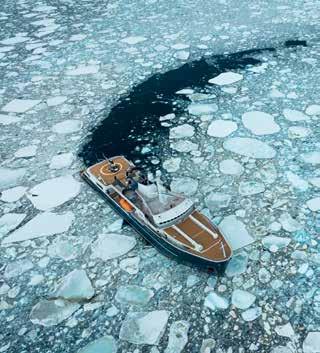
28 MAKING WAVES
Driven by curiosity and climate-conscious design, explorer yachts offer a new experience of leisure travel at sea. We highlight the shipyards and vessels leading the charge into uncharted waters and examine the rise of exploration without emissions.
36 THE RESORT REDEFINING LONGEVITY
We check into Buff Medical Resort, founded by seasoned hotelier Hans-Jürg Buff, who is uniquely positioned to challenge the pharmaceutical status quo. Buff is not just running another wellness retreat, and over the course of our stay we learn what sets this resort apart from the rest…
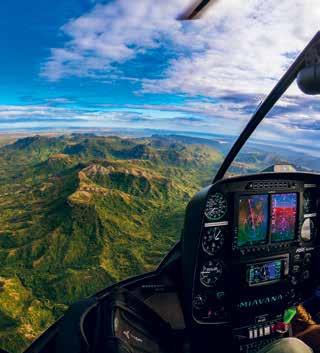
40 THE EXTRA MILE
For the ultimate escape, we set our sights on remote retreats that are often best reached by helicopter. Beyond being hard-to-reach, these destinations promise luxury and adventure – from exploring the Arctic under the Northern Lights to diving the Great Barrier Reef.
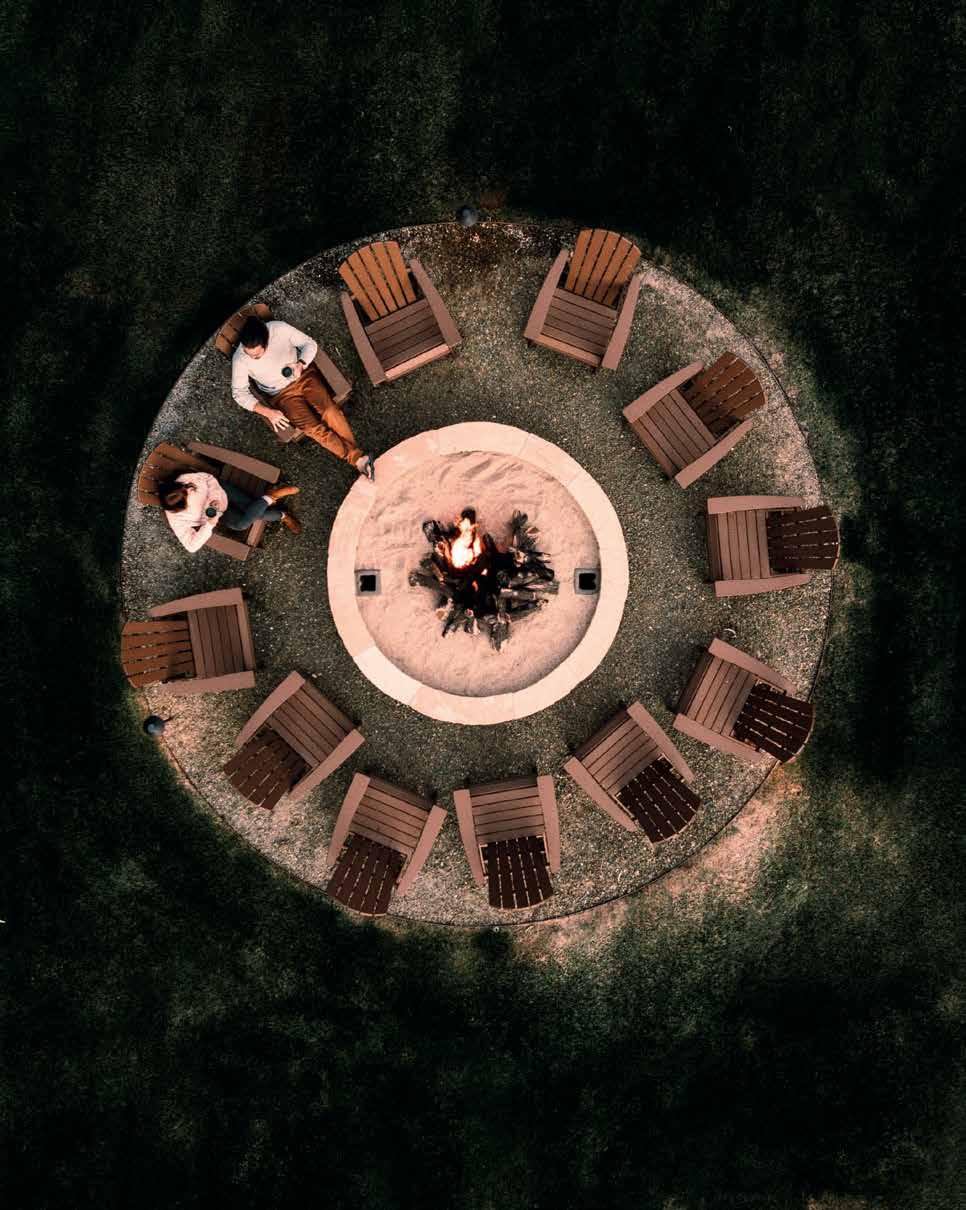
46 WINGS OF TIME
We explore how falconry is evolving in Abu Dhabi, from modern training techniques and advanced veterinary care to conservation efforts, to discover how this centuries-old tradition is preserved and adapted for today’s falconers and their birds.
52 A NEW BUSINESS MODEL
We examine how the Cessna Citation Ascend combines advanced technology, enhanced cabin comfort and performance to meet the needs of today’s operators while shaping the future of private aviation.
54 FUELLING THE FUTURE OF AVIATION
We speak to two key figures driving the development and scaling of sustainable aviation fuels, to check-in on the advances of e-SAF as a tool to help decarbonise a sector responsible for around 3% of global emissions.
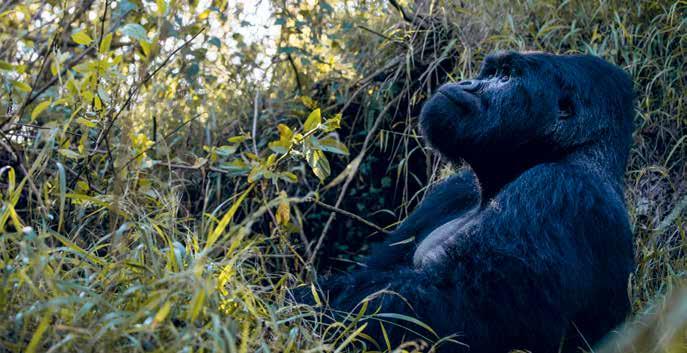
60 THE FRONTLINE OF PARADISE
In 1980, fewer than 250 mountain gorillas remained in the wild. Through the tireless efforts of conservationists and the support of a thriving tourism industry, that number has quadrupled. We flew to East Africa with Volcanoes Safaris to see how they balance eco-luxury experiences and tangible conservation impact.
68 BEYOND THE BIG FIVE
Adventure in Africa is no longer about ticking off a checklist. Scott Dunn Private crafts journeys that let guests connect with the people, landscapes, and experiences that make each trip uniquely their own.
70 THE NEW OFF-PISTE
Across continents, human ingenuity is bringing snow to places nature never intended. This article examines the latest efforts to create enticing resorts away from alpine environments – and how they reflect the ski industry’s search for solutions in a warming world.
74 BEST KEPT SECRET
We visit the ultra-luxe Porto Zante Villas & Spa. Arguably Europe’s most private resort, tucked into a quiet cove on Zakynthos. With just nine villas, it offers service and seclusion few can match.
You wouldn't book a hotel without knowing what the room looks like.
You wouldn't book a commercial flight without knowing the airline.
Why should booking a private jet charter be any different?
With Victor, nothing is hidden.
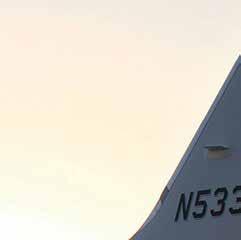
You see the operator you’ll fly with, the aircraft tail number, and real images of the interior – at the point of quotation.
We'll always give you the full picture before you book.

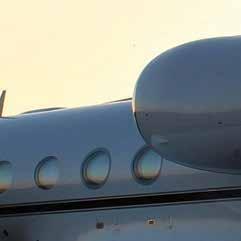
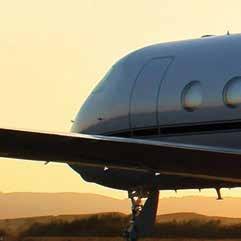

Around the world, leaders and visionaries continue to challenge conventions and innovate, whether it be for environmental concern, industry progress, or personal advancement
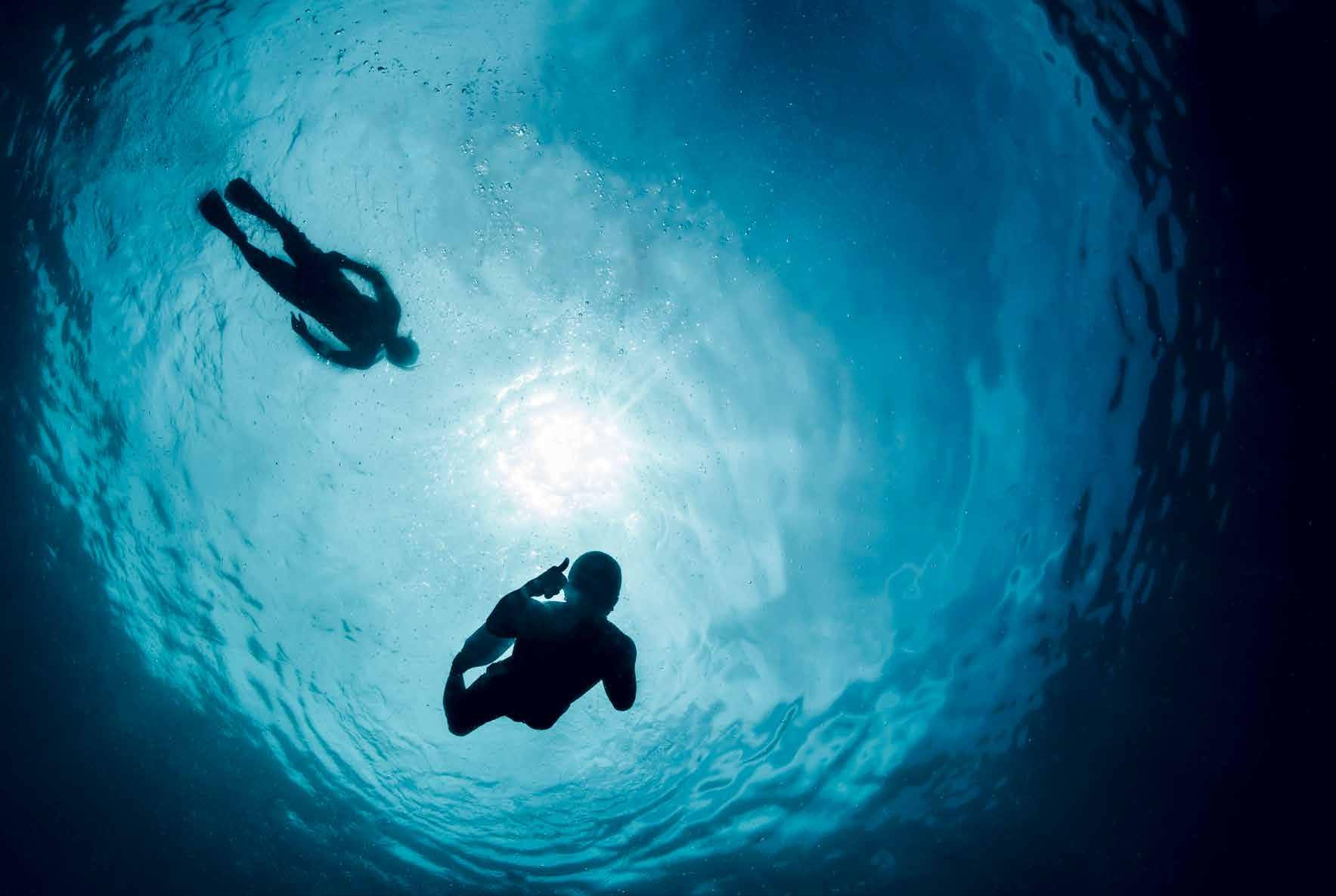
FROM SURVIVALISTS TO SAILORS, ROCK CLIMBERS TO RALLY DRIVERS, EXPLORERS FROM AROUND THE WORLD EXPLAIN WHAT ADVENTURE MEANS TO THEM AND WHY ITS PURSUIT CONTINUES TO BE OF IMPORTANCE
words > JONATHAN WELLS
The human brain is hardwired for adventure. Long before it became a lifestyle choice, it was a survival instinct. Neuroscientists call it ‘novelty-seeking’ and define it as the restless drive that once sent our ancestors over mountains, across oceans and into the unknown. It has always been a fundamental part of our evolutionary survival code, and, without it, civilisation as we know it wouldn’t exist.
As we enter the second quarter of the 21st century, adventure feels trickier to pin down. Much of the world is mapped, commercialised and instantly shareable. You can fly across entire continents in your sleep or stroll past one of the Seven Wonders of the World while on your way to enjoy a breakfast buffet. So, what does adventure really mean today, and what is left in the unknown?
At a time when convenience is the default, adventure reminds us what it feels like to risk, to stray, to surrender. It speaks to freedom, curiosity, and possibility – the qualities travellers crave when just ‘getting away’ is no longer enough. That, perhaps, is why adventure matters more than ever.
The title of ‘adventurer’ has always been fluid, but it remains reserved for those who push against boundaries –geographical, physical or psychological. To seek the answer to our question, we asked 10 of the world’s great explorers, record-breakers and endurance athletes to define it in their own words.
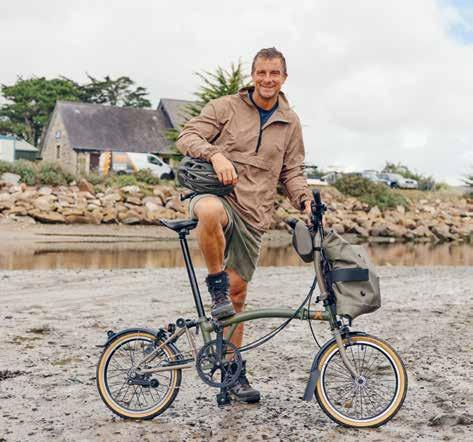
Mike Horn, 59 EXPLORER
A prolific alpinist and polar explorer, Horn circumnavigated the equator in 2001: 18 months on foot, by bike and by sailboat For me, adventure starts where comfort ends. It’s not about chasing adrenaline, but rather embracing uncertainty. Real adventure begins when you’re no longer in control, when you step into the unknown – prepared to adapt, to learn and to push beyond fear. If there’s no risk of failure, no chance of discomfort or loss, then the word ‘adventure’ begins to lose its meaning. It becomes entertainment, not exploration. True adventure requires commitment, something you can’t switch off. It reveals who you are, in the purest sense.
There’s also no such thing as a ‘small’ adventure. Whether you’re crossing an ocean or walking out of your front door without a plan, it changes you. It humbles you. If it makes you feel alive, then it’s adventure – the scale doesn’t matter. What does count is your mindset. I’ve crossed the Arctic in total darkness and sailed solo around the world, but I’ve also found deep meaning in a short trek with my daughters, or in a conversation around a campfire. Extreme adventures may test the limits of human endurance, but they’re not necessarily more worthwhile. Sometimes, the most powerful moments are the simplest: the quiet of nature, the spark of a connection, the act of leaving routine behind.
I’ve always been drawn to explorers who followed their instincts. People like Sir Ernest Shackleton, who led with purpose and never gave up on his crew. Or Roald Amundsen, whose attention to detail and humility allowed him to succeed where others had failed. But my inspiration doesn’t come solely from history, I admire modern adventurers, too – anyone who dares step into the unknown, regardless of recognition. What I respect most is not records, but resilience: a willingness to suffer, adapt and respect the environments and people you encounter. True explorers don’t conquer. They collaborate, they learn.
The former SAS trooper has summited Everest, crossed the Atlantic unassisted and navigated the Northwest Passage
What is adventure? Adventure is a state of mind. It’s how we live and how we approach everything in our lives – whether that be work or relationships. It’s everything from the goals that we set ourselves to the attitudes that we carry close; from our own ambitions to how and where we choose to put down roots. It’s what we eat, and it’s who we love and choose to start a family with.
But it’s also about being a stickler – a nevergiver-upperer. It’s about being a force for good, and having a kind and positive heart. Adventure is choosing how you live. It’s about embracing risk and taking the path less-trodden in pursuit of a life that honours that one beautiful truth: that even being alive is a gift beyond all other gifts.
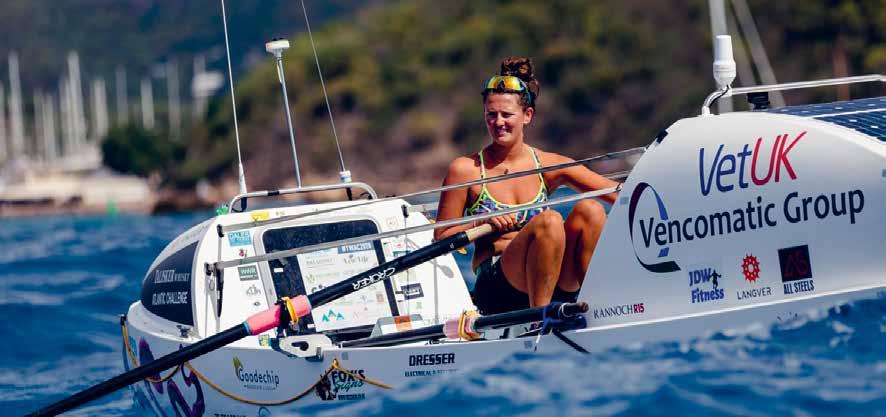
The youngest solo female to row the Atlantic, and the first-ever woman to swim the length of the British Isles Adventure? It’s something that excites but also scares you –where you don’t know the outcome. Most adventures contain lots of stress and hardship, so you have to focus on the good things and the reasons you’re doing it. But that makes the achievement even better. If it were easy, it wouldn’t be an adventure, and it wouldn’t feel as good once completed.
In 2021, I rowed solo across the Atlantic from La Gomera in the Canary Islands to Antigua. It took me 70 days, and I broke the record for the youngest solo female to do it. I felt the most pioneering and adventurous in the middle of that trip, when I was completely becalmed and there was no wind at all. The only way to go anywhere was by rowing – there were no waves or wind to help me get to the finish line.
I’d say humanity has definitely lost that sense of freedom and adventure. Technology can be absolutely amazing, but it’s really nice and liberating to be free of it – to be able to see clearly and not have your phone ringing all the time. While rowing, I visited islands that didn’t have Facebook groups or weren’t reporting everyone’s every action, and it made me feel a lot freer.
I definitely think that, as humans, we have advanced, but not necessarily in a good way. These days, everybody is so hooked on being perfect that it makes it trickier to actually enjoy life – and adventures.
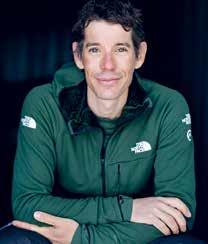
The fearless free soloist was the first climber to ascend Yosemite’s El Capitan without a rope or harness While I mostly use the word in the context of big outdoor experiences – climbing huge walls or mountains – I’d say adventure is anything where the outcome is uncertain, where you’re pushed out of your comfort zone to the extent that you feel at least a tinge of fear or excitement. After all, if it’s not a little scary, are you even pushing yourself?
But, honestly, even some of my earliest climbing experiences felt like big adventures because it was a 12km bike-ride across town to get to the gym. I was a teenager exploring my newfound freedom, and riding home at night was always particularly exciting. Once I started climbing outside, it obviously got even more exciting, because any new experience is an adventure, and back then everything was new. If I’m being honest, fatherhood is probably the biggest adventure in my life, but I don’t generally think of adventure in those terms. I usually reserve the word for describing physical pursuits and, by that definition, my biggest adventures are probably those connected to climbing expeditions, like when I travelled to Antarctica or Greenland. All of that skiing over glaciers and camping in the snow felt like a big adventure –
even though it was all admittedly in the service of climbing!
Also, there are still tonnes of places I’d love to visit. Some are hardcore climbing destinations that would require full-on expeditions, such as the Karakoram mountain range in Pakistan or the big granite walls on Canada’s Baffin Island. But also places I’d love to visit with my family, like Thailand, Vietnam and Croatia. One of my biggest non-rockclimbing adventures was a couple of summers ago, when my friend and fellow climber Tommy Caldwell convinced me to cycle from his home in Colorado to Alaska in order to climb a mountain. That took two months, and covered an awful lot of terrain: 2,000 miles. Again, it was for climbing, but that’s the beauty of rock climbing – there’s rock almost everywhere on Earth, so any kind of travel experience or adventure can be justified as a climbing trip!
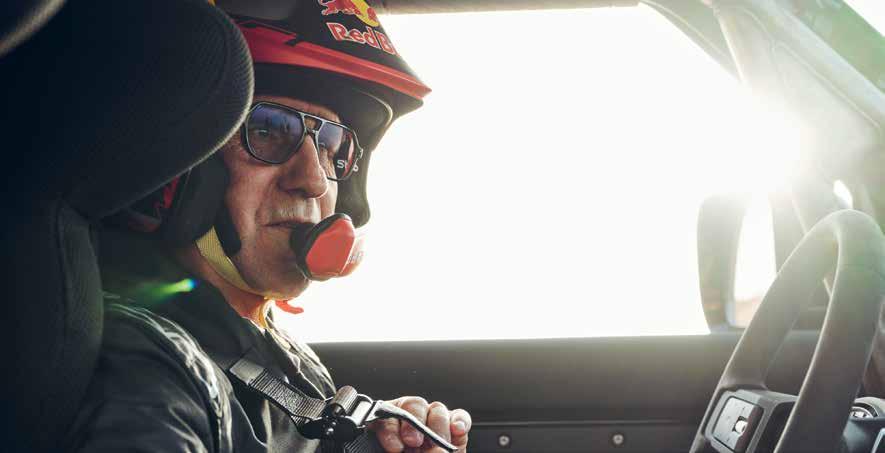
The French endurance racer holds the record for Dakar Rally wins – six times on a motorbike, eight in a car Adventure, for me, is when I have no control over the elements, whether that be desert, mountains, or even the ocean.
That’s how you experience true adventure. During the Dakar Rally, my favourite destinations were those between 1988 and 1992, when we raced through Africa. It’s a wild continent, completely different in its north, its centre and its southern regions. Back then, we had no tracking or GPS systems, and I remember the feeling of being nothing in the middle of the desert. It was such a disconnection from the normal world.
But the Dakar Rally is more than an adventure; it’s also a sport, so you need to be well-prepared physically. You’re extremely busy, and only have a very limited amount of time to prepare and rest. The race stage can range between 300 to 600km, so it’s not easy, and sometimes you’re required to manage and reduce your speed. It’s less about aggression, more about strategy, and you must remain focused in order to not make mistakes – always being connected to the race and anticipating what’s to come.
Yet, while it requires a lot of focus, we’re still able to experience the most beautiful deserts in the world. There’s something really special about that; being in the middle of these toughest parts of nature. That’s why the Dakar Rally is also a human adventure. To me, it means everyone is pushing the limits of what’s possible. And when you feel you have no real control over what’s to come – whether that’s the next day or just the next kilometre – that’s true adventure.
The Arctic captain and expedition leader is the youngest captain to be awarded the French Maritime Merit award
Adventure is stepping into the unknown. It begins when we surrender control and open ourselves up to transformation. For me, it’s not about risk or adrenaline. It isn’t even just about reaching new places. It’s about being changed by them.
Both sides of my family – Swedish and French – come from generations of land workers and farmers. That meant our family holidays weren’t to theme parks, they were wild, unsupervised adventures on the edges of fields, forests and streams. We built tree houses out of scrap wood, slept under the stars in the middle of nowhere, and tried to hunt and forage for our food. It felt entirely as if we were on our own: sovereign kids of the countryside, untamed and unstoppable.
But adventure is also 90 per cent mindset. It’s having the willingness to move forwards even when you don’t have all the answers. For me, creating my solar- and wind-powered expedition vessel, Selar, was the most adventurous decision I’ve ever made. I left a stable maritime path to build the vessel of my dreams, one that reflects my values: of emotional
depth, a radically more inclusive way of operating and of low-impact travel. Because what’s the point of exploring if we destroy what we came to admire? In the Arctic, I’ve seen places so fragile, so untouched, that even a breath feels like a disruption. We must travel with humility, not to conquer but to connect. These remote regions are not just beautiful, they are also transformative. They remind us of what silence feels like, what wonder really means. The true challenge is not to go further, but to go deeper without leaving a mark. That, to me, is real adventure: learning to approach the world with reverence and to let it change us without changing it.
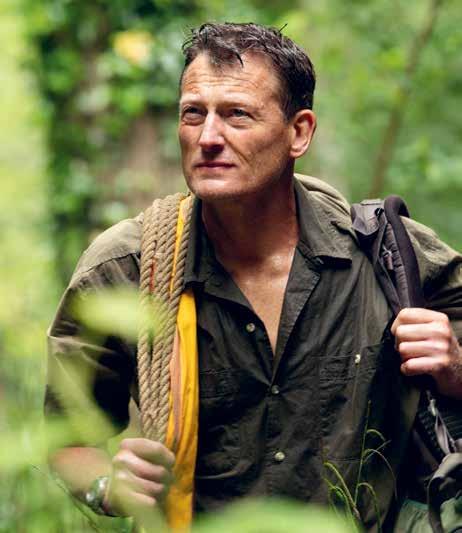
An indigenous immersion expert, Allen’s hazardous journeys have led him to tribes and natives from Sumatra to Siberia Adventure, to me, is something visceral. You head off and experience all manner of different sensations as you pursue – or become embroiled in – physical or emotional challenges. I wrote my first book, Mad White Giant, in 1985, which told the story of my exciting but rather naïve first journey. With no money and hardly any experience, I had set off on an almost impossibly ambitious journey, a 400-mile crossing of the then-largely unexplored Northern Amazon. I was a 22-year-old in search of adventure, but I was also horribly earnest, fresh out of university and felt the journey could only be justified by some wider, greater purpose. There were, of course, thrills along the way – including an encounter where I was attacked by gold-miners and was forced to flee – but the book itself was my attempt to make a statement about the many invaders of the rainforest, hence its title.
Also, when I started out, nobody would sponsor me. The only solution was to go it alone, and spend time learning by living in places such as the Amazon. This became my philosophy of adventure, and I made being alone and unsupported a virtue. I’d be free to travel at the speed of the locals, unencumbered by companions, outside equipment and other distractions. People criticise me for not taking a GPS and all the usual backup, but I feel that I’m always in the best hands with the indigenous people, learning to see places like New Guinea as a home, not a threat. That way, I’m given an unparalleled view into another world.
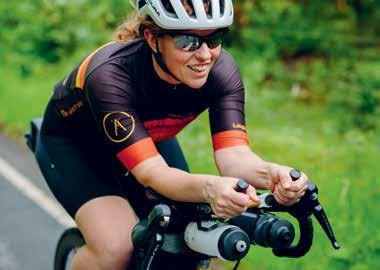
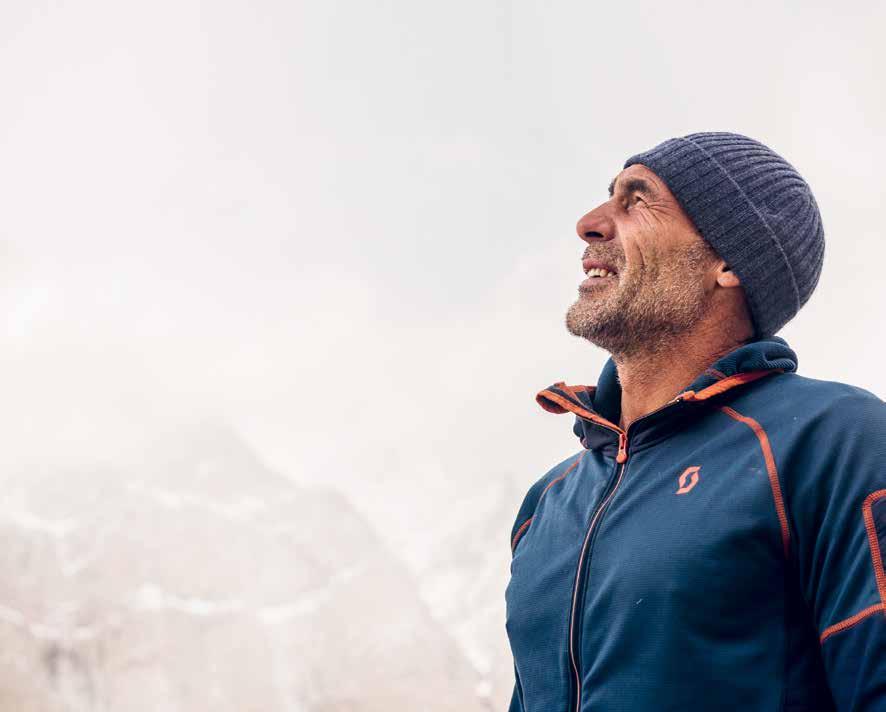
In 2018, Graham became the fastest woman to cycle around the world unsupported – a 124-day, 18,000mile journey
Adventure starts with a spark of curiosity – a tug in your gut or flicker in your mind that makes you sit back and think: “I wonder…” But alone, that isn’t enough. You need to act on it. There’s a quote from Scottish mountaineer WH Murray which I love: “We had definitely committed ourselves and were halfway out of our ruts. We had put down our passage money – booked a sailing to Bombay. This may sound too simple, but is great in consequence. Until one is committed, there is hesitancy, the chance to draw back.”
From that passage, I also recognise that adventure doesn’t need to be big or bold. It can take all kinds of shapes. We in the endurance and mountaineering worlds have sort of claimed the word ‘adventure’ for ourselves, and it can be easy to forget that, for some, adventure is closer to home or under the radar – but it can hit just as deep. I just do what makes me feel most like my most authentic self. And, over time, I’ve realised that usually involves some level of hardship or challenge.
When I was riding around the world, for example, I was in awe of the landscapes and cultures I passed through. When I think back, I picture myself cruising along a dusty Siberian highway on my tri-bars, the sun beating down, and a big long train chugging alongside me. A feeling of freedom, and no real plan beyond riding, eating and seeing what the day might bring. That moment captures so much of what the journey was for me.
But I was also curious as to what I could handle. How far could I push myself? To feel truly fulfilled, my adventures must involve a big physical push. They have to get uncomfortable. I need to dig deep into the bank of resilience I’ve built over the years and it’s when things get almost silly – when it stops making sense to keep going, yet I do – that’s when I feel most alive. That’s my adventure.
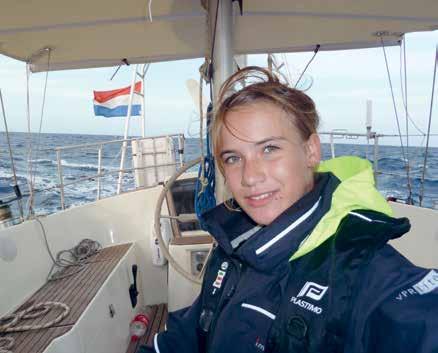
In 2012, at the age of 16, the Dutch adventurer became the youngest person to complete a solo circumnavigation of the globe
Adventure, for me, is linked to fun memories of uncomfortable moments – moments from which I learned about myself, nature, other people and my surroundings. I’ve been adventurous for as long as I can remember, and never shied away from pushing myself. I never minded being muddy, cold, wet or tired because it brings me such joy to see new places and to do new things. And I love sailing because you feel so connected to nature: the wind, the waves, the currents.
And there’s something very cool about travelling the world with your home. Boats allow you to visit places that other people don’t go. My dad is a sailor, and I learned a lot from him. He always encouraged me to be me, and especially to never give up when things got hard. Because the hardship is the part we really learn from, where we get to know our own limits and expectations. It’s amazing to go through these moments during adventures and come out the other side with new realisations about ourselves.
But I never look at my adventures through rose-tinted glasses. I’m very realistic, and tell myself that it will be tough, that things will break – whether the rudder or the sails, or an electronics fail – and I’ll have to deal with them. That way, problems never come as a surprise, they’re just part of the deal, and I can enjoy the good moments all the more. You just prepare as best you can, set a deadline and go. When things get hard, I can be hard on myself, but you just have to tell yourself to stop whining and deal with it. Life is all about decisions. I wanted this, and I put myself there, so wherever those decisions put me, it’s my job to get myself out. Of course, sometimes things happen beyond our control, but even then it’s still you who must make the decision to do something, and to make it to a better place.
The American adventurer – and president of The Explorers Club – has led expeditions to Mount Everest and Mexico’s Yucatán jungle
There’s a standing joke among explorers –often attributed to Roald Amundsen – that “an adventure is an exploration gone wrong”. At The Explorers Club, we make a clear distinction between the two: exploration has a mission, while adventure is what happens when things don’t go according to plan.
That said, I don’t believe every adventure needs to be extreme or far-flung. Raising young kids, some of our greatest adventures were on local sandbars at low tide. To me, adventure is a state of openness, of being willing to push outside your comfort zone, embrace uncertainty and engage with the natural world – no matter the scale. The common threads are those of wonder, curiosity and courage in the face of the unknown.
But exploration has never been a solo act. Even the most iconic journeys were made possible by teams, and good leadership in exploration, as in life, is all about relationships; knowing who you can count on, and giving credit where it’s due. It’s about surrounding yourself with smart, loyal, creative people, and I’ve had the privilege of working with such teams. In fact, I credit much of our success to the friendships and trust we’ve built, and the truth is that whether you’re summiting Everest or launching a podcast, no journey worth making is made alone.
I consider the greatest expedition in human history, for example, to be the Apollo 11 mission. What inspires me most is the astronauts’ deep preparedness; their ingenuity when things didn’t go as planned. That combination of precision and adaptability is the model for all exploration, as they understood that success came from preparing meticulously for the unexpected.
So I remain optimistic that humanity isn’t losing its adventurous spirit. Back in 2009, I wrote a guidebook called Born to Explore to remind people that adventure doesn’t even require a passport. Sometimes, it’s just about seeing something familiar through a new lens.
Take the ‘full moon illusion’, for example – when the moon looks enormous on the horizon, like a beach ball. It’s just a trick of the mind, but it’s also a reminder that wonder is often right in front of us – we just have to look differently.
I see exploration as a mindset, not a destination. Nature is nourishment, and more than ever I now believe that the real call to adventure is to re-engage, with curiosity and care, with the natural world.
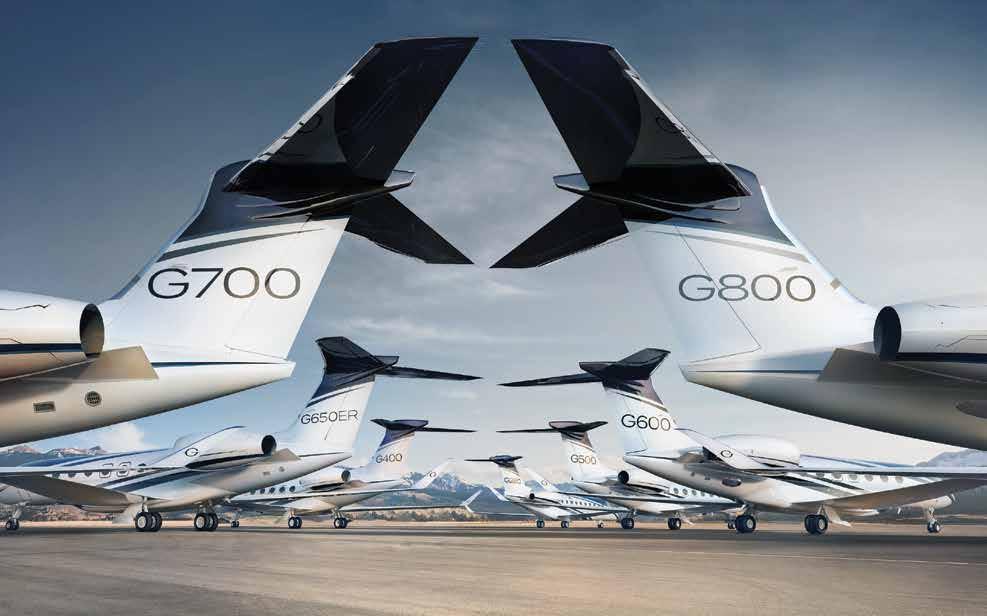
Your success is our inspiration. Every investment we make—in advanced technology, sustainability innovation, precision manufacturing and worldwide customer support—is an investment in you.
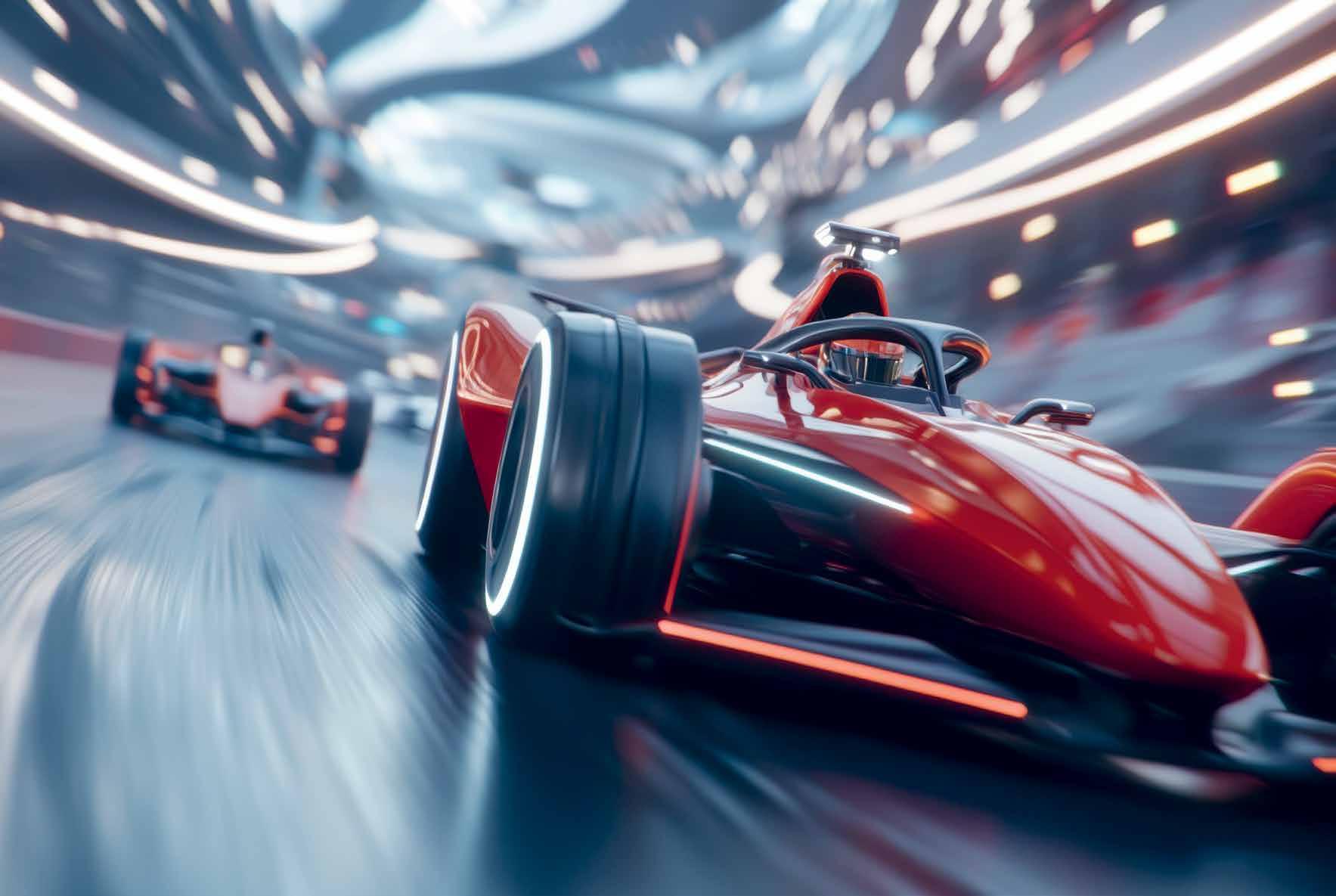
AS FORMULA 1 CELEBRATES ITS 75TH ANNIVERSARY, WE EXPLORE HOW A SPORT BUILT ON SPEED, INNOVATION AND SPECTACLE IS LIKELY TO EVOLVE OVER THE NEXT 75 YEARS
words > ADAM HAY-NICHOLLS/JAMES FARLEY
On 13th May 1950, 150,000 spectators descended upon Silverstone to witness the inaugural Formula 1 World Championship race. Built to replace the Brooklands national racing circuit following damage caused in the war, Silverstone, as with many circuits at the time, offered the opportunity for the crowds to stand near to the crash barriers and precipitously close to the action. Though the clouds were overcast, the air carried a sense of anticipation and excitement, further heightened by the presence of the beloved King George VI.
Behind the starting grid, 21 cars lined up, representing five constructors, all front-engined, cigar-shaped and on wire wheels, with each painted in their respective national colours. The drivers were professionals, but safety standards were rudimentary, with only cloth skull caps and cotton overalls for protection.
Of all the drivers to start, only 11 completed the race. The winner was Nino Farina, who crossed the finish line after the 70 laps, 2.5 seconds faster than Luigi Fagioli, who had started next to him at the front of the grid. Both drove the Alfa Romeo 138, with Farina setting an average pace of 91mph and a top speed of 180mph, velocities that truly thrilled the uninitiated crowd.
While not televised live, highlights would later be shown on Pathé newsreels, which spread the buzz beyond the circuit and helped the novel sport build anticipation towards the next Grand Prix events. It quickly became apparent that F1 had the potential to endure and capture the imagination of the public.
While the early era of F1 was dangerous, with a romantic image underpinned by innovation, daring individual heroism and national pride, today’s era can be characterised as a highly professional and structured athletic pursuit of the finest of margins.
Seventy-five years after Farina’s victory, Lando Norris would also lift the British Grand Prix trophy, driving a mid-engined 1,000bhp hybrid McLaren at an average speed of 188mph, effectively doubling the average speed of the 1950 Alfa Romeo. With a worldwide fanbase of over 800 million able to tune in from home, through traditional broadcast or social media channels, the sport’s reach is as wide and global as ever.
Perhaps the most obvious place to start when projecting the future of F1, is the speed of the car. McLaren’s future concept MCLExtreme imagines what racing will look like in 2050. It has sidepods that expand and contract like the gills of a shark. These transform it into a 310mph bullet, which improve on the current maximum speeds of 235mph with the pods expanding in braking zones and corners to provide stability and control.
Some concept cars predict that wheels will finally become enclosed, not only for aerodynamic efficiency but also to reduce spray in wet conditions, which has plagued previous generations of cars.
Former F1 driver and Formula E champion Lucas di Grassi is also designing an electric concept ‘car for the future’ with Lola, one of the oldest and largest manufacturers of racing cars in the world. Utilising existing technology and set to be unveiled this autumn, it will sport power-dense electric motors and use ground-effect aero engineering to generate maximum downforce.
“If you have to transform energy into mechanical motion, there is nothing better than an electric motor,” Di Grassi says. “Ninety-eight per cent of energy can be turned into motion by an electric motor. A superconducting motor is the next step, whereby you cool the electric motor to four Kelvin, nearly absolute zero. This will allow you to convert 100-per-cent electrical energy into motion.” The cars could be charged by the circuit itself via a magnetic coil buried under the tarmac.
But, he says, “Eventually, I believe F1 will be propelled by electric nuclear power. If you use nuclear fusion or fission to create motion, the car will be several million times more energy dense than a car that uses fossil fuels.” To borrow a line from Back to the Future: are you telling me this sucker is nuclear?!
Many experts believe that the locations will be different and the tracks unrecognisable. Sean Kelly, F1’s resident statistician, who provides expert information to all the major broadcasters, sees the future more clearly than most.
“Races will be held on temporary circuits in locations such as Tierra del Fuego and Iceland, as they will possess the temperate weather that attracts big tourist dollars,” he predicts.
Further evolution may be more extreme. Di Grassi believes motorsport will no longer be limited to tarmac. “I think race tracks will go up into the sky somehow… and the courses will become three-dimensional.” He predicts tracks that could loop-the-loop like a Scalextric. Banking and sharp gradient changes would reduce their footprint which is useful in city centres. A current F1 car could stick to the roof of a tunnel at 185mph, just using its wings to generate downforce. With different aerodynamic regulations, they could do so at much lower speeds.
Di Grassi, also a Harvard Business School graduate and electric mobility thought-leader, explains “The most efficient way to generate downforce is using atmospheric pressure. You take the air underneath the car, create a vacuum, and this sucks the car to the ground. It’s much more efficient than wings.”
Taking inspiration from spaceships, Di Grassi has further ideas. “There will be new ways of generating grip, maybe with side thrusters and rocket technology, which will help the car to overcome inertia. There will be an evolution of grip which will be completely different to how we generate grip today.”
The long-term dream of fans? Formula 1 races beyond planet Earth. Although this may seem like a pipe dream today, by 2100 humans will likely have established a continuous presence on the Moon and over time, it would not be unreasonable to expect a public demand for lunar spectacles of sport. However, given the significant differences in atmospheric composition and gravity, if F1 wanted to run an exciting Grand Prix on the Moon’s surface, the cars would have to be completely unrecognisable from those of today. Large, specialised wheels coupled with battery-powered, open-cockpit designs with significantly different aerodynamics and cooling systems are just some of the hypothesised innovations that would be required.
“
I think race tracks will go up into the sky somehow. It could turn into a type of drone racing, and the courses will become three-dimensional ”
As for autonomous racing, forget about it. Even though artificial intelligence (AI) will play an increasing role in engineering and testing, “the human aspect is crucial,” says Di Grassi.
Through advancements in genetics, biomechanics and neurology, humans could be enhanced to react faster and withstand the enormous g-forces generated by new technology.
Innovation may also help open the door to a wider group of participants. Karting for many years has been the natural breeding ground for future F1 drivers, but it is becoming prohibitively expensive for most families. Anthony Hamilton, Lewis Hamilton’s father, has warned in the press about these financial barriers in motorsport and how their rise is reducing the pool of future talent: “If costs continue to escalate at the junior level, and junior series remain financially unregulated, then I think Lewis will be the last of his generation.”
Virtual racing could help address this by identifying the most talented children aged 4–10 with the best reactions, instincts, and overtaking skills, creating a fairer pathway into physical racing. “Formula 1 will be the only racing series that takes place in real life, as simulators are already so accurate it isn’t necessary to bother with the expense of junior formulae,” agrees Kelly. This will democratise racing, allowing children from around the world to be identified and trained, rather than limiting access to only wealthy households. By opening and widening the field of future drivers earlier on, the chances of female drivers in F1 can also increase. Several studies have shown that the barriers to participation are more culturally and systemically rooted than based on any real physical limitation and initiatives like
the F1 Academy and programmes such as ‘Girls on Track’ will also further promote female participation.
But while virtual racing might have a role to play in talent identification and development, it will unlikely supplant the real thing. Di Grassi stresses that some things cannot be simulated. “There’s no risk – the risk of injury or financial loss. The process of decision-making is completely different. You need risk to create the adrenaline. There’s no adrenaline when you can just press restart and try again.” That, despite the rising interest in virtual racing, is true for spectators too. If it gets too safe, it will be boring.
While cockpits may someday become enclosed for safety, visibility of the driver remains essential to the viewing experience. Di Grassi says: “We want to see more of the driver, not less. Maybe in the future we will have a transparent material that is lighter and stronger than carbon fibre. Material science could help to protect and expose the driver at the same time.”
Kelly suggests another approach: “The drivers’ faces could be projected onto their helmet designs, allowing us to see their expressions in real time.” AI could also sense the driver’s mood and make the car glow red when they’re about to take big risks.
While the crowds may no longer stand inches from the barriers as they once did, the connection between driver and spectator remains at the heart of the visceral F1 appeal. It is therefore encouraging that those presiding it’s evolution remain focused on this bond and that seventy-five years after that first race at Silverstone, Formula 1 continues to cater to the same human instincts that created it – the pursuit of speed, mastery, and innovation. This sport has always been more than just a contest of cars. It’s a measure of ambition itself, and that race shows no sign of slowing.
DRIVEN BY CURIOSITY AND CLIMATE-CONSCIOUS DESIGN, EXPLORER YACHTS OFFER A NEW EXPERIENCE OF LEISURE TRAVEL AT SEA. MEET THE SHIPYARDS AND VESSELS LEADING THE CHARGE INTO UNCHARTED WATERS
words
> RACHEL INGRAM
No form of travel combines freedom, privacy and reach quite like a superyacht, where every route is of one’s own making. In pursuit of more fulfilling experiences, owners and charterers are looking beyond the conventional ‘milk run’, the annual 2,000–3,000 superyacht rotation between the Mediterranean in summer and the Caribbean in winter. Consequently, more remote and exhilarating destinations are capturing the imagination, fuelling the rise of adventure yachting aboard highly customised, purpose-built explorer yachts.
Shipyards around the world, from legacy builders to emerging experimenters, are rising to the challenge. Shipyards such as Icon Yachts, Oceanco and Arksen are driving the innovation, crafting explorer yachts that are as technically advanced as they are elegant.
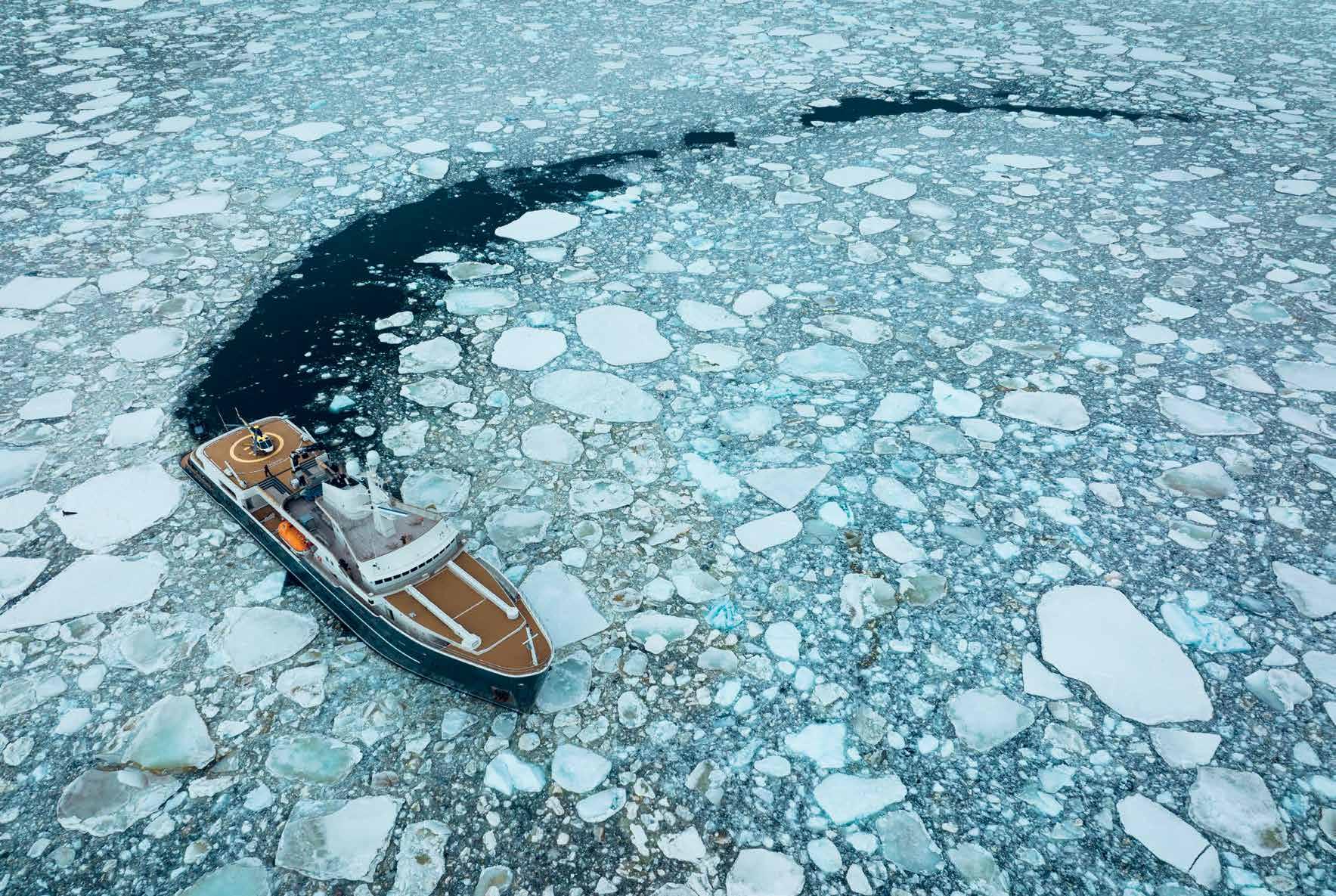
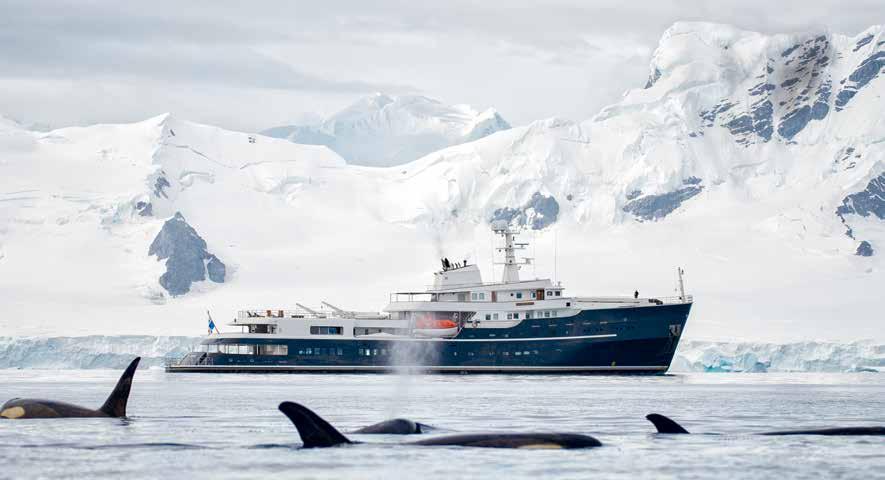
Icon Yachts has made a name for itself by converting commercial vessels into robust, long-range explorers –yachts that can break ice and traverse the furthest reaches of the Arctic, without sacrificing comfort and polished design. One of its most renowned conversions is the 77.4m M/Y Legend, which began life as a Soviet icebreaker before being transformed into a luxury expedition yacht by the Dutch yard in 2015. Available for charter, M/Y Legend is frequently seen cruising in polar regions and is equipped to support adventure sports and off-the-beaten-path expeditions. Its arsenal includes diving equipment, a deep-sea submersible and a helicopter for heli-skiing or remote excursions.
“Clients are no longer satisfied with a simple luxury cruise,” says Micca Ferrero, owner of the ICON Yachts Group.
“They want to explore remote and exotic locations, which require specialised equipment and technologies that can only be supported by well-conceived explorer yachts.”
The yard is currently working on the 70m Project Master, a former offshore rescue vessel being transformed into what ICON calls one of the world’s most capable explorer yachts. It will be equipped with a state-of-the-art diesel electric hybrid propulsion system, meeting current and future environmental standards, while complying with IMO Tier III Emission Reduction Regulations.
“Many yacht owners don’t realise how much impact. they can have with their boats, regardless of their yacht’s size,” Ferrero adds. “They often don’t also know that many scientists would welcome the opportunity to join a trip. We recognised that early on and were fortunate to be in a position to act on it, engaging with scientists and explorers from the very beginning.”
It is striking how little we know about our own oceans. As of 2025, only about 25% of the seafloor has been mapped in high resolution (100m grid or better). By contrast, the Moon has been mapped almost in its entirety (98%), with missions like NASA’s Lunar Reconnaissance Orbiter producing imagery down to 5m in many regions. We know the contours of a distant celestial body more intimately than the depths of our own planet. With nearly 6,000 superyachts traversing the seas, it makes logical sense to harness them as platforms for science.
Fortunately, this blend of science and seafaring is gaining momentum across the industry. According to Boat International and other trackers, the dedicated explorer fleet has grown
“
By bridging world-class science with extraordinary expeditions, we are redefining what it means to explore the ocean
from only a few dozen projects a decade ago to several hundred hulls today. Industry snapshots put the fleet at roughly 740–786 vessels, with more than 100 explorer yachts currently in build or on order. These are record highs that could represent mid-30% growth in recent order cycles.
Oceanco, known for its sleek superyachts and high-profile orders for Jeff Bezos, owner of the 127m sailing yacht Koru, and Steven Spielberg, former owner of the 109m Seven Seas, is now channelling its design prowess into rugged explorers. One such example is Esquel, a 105m diesel-electric expedition yacht created in collaboration with adventure specialist Pelorus. Designed for extensive cruising in remote regions, from the North Pole to the South Pole and everywhere in between, Esquel has a 7,000-nautical-mile range and offers all the aesthetics, amenities and finishes expected from an Oceanco superyacht.
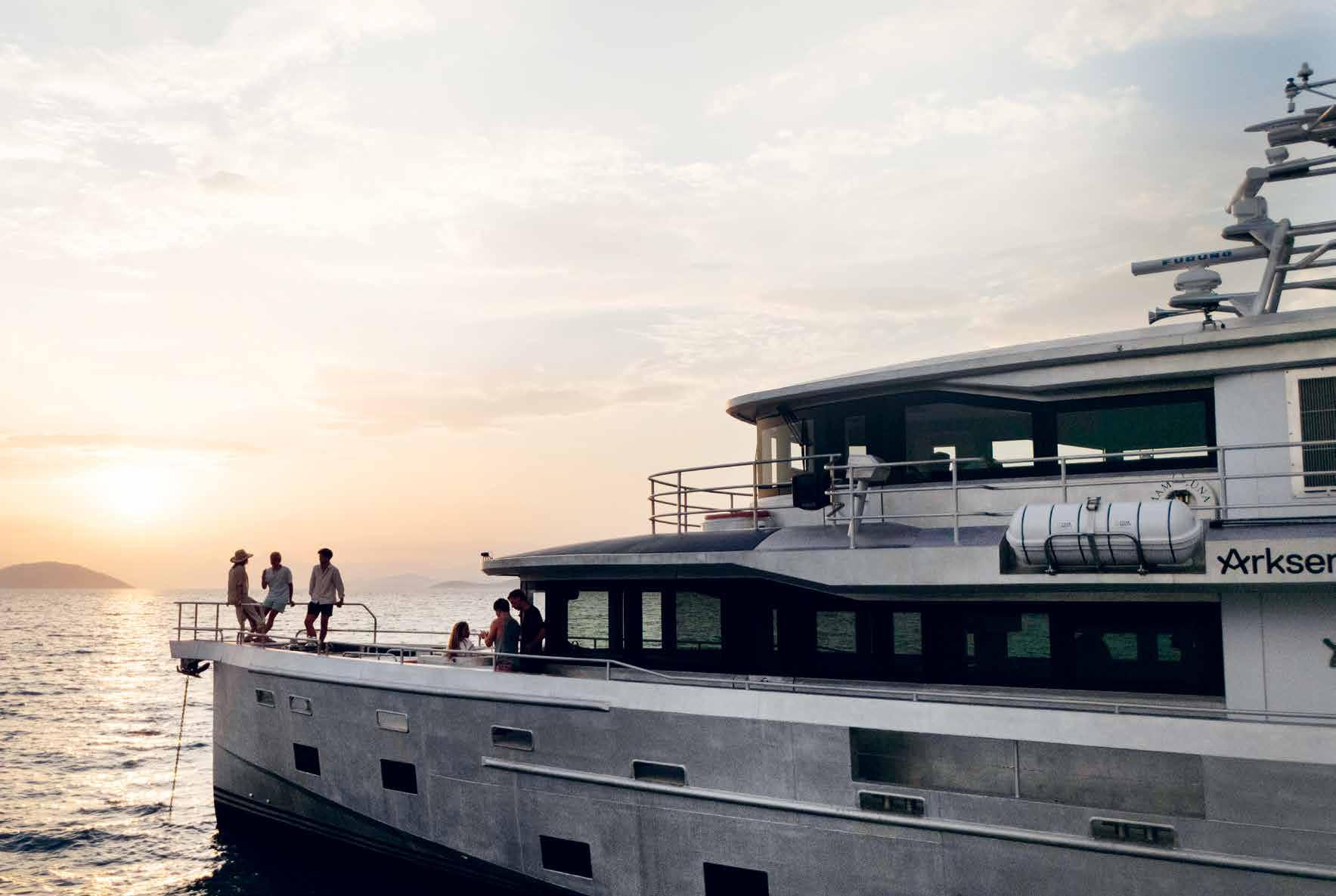
Another boat builder at the forefront of innovation is British boatbuilder Arksen, founded in 2017 by tech entrepreneur Jasper Smith, which is developing a new category altogether: explorer yachts with a conscience. Built with climate action at its core, Arksen’s vessels are designed for ocean research and lowimpact travel, demonstrating that adventure can be sustainable. Its flagship Arksen 85, also known as Project Pelagos, is built for long-range, semi-autonomous exploration with a strong emphasis on sustainability. It features a recyclable aluminium hull, hybrid propulsion and solar power. At 9 knots, it burns just 25 litres per hour, less than half of what you would expect with most motoryachts of similar size. With a 7,000-nautical-mile range, it serves equally well as a private yacht and scientific platform. It’s also part of the Arksen Explorers’ Club, which encourages owners to make their vessels available for research and environmental missions.
“At Arksen, we’re not just designing vessels, we’re designing opportunities for extraordinary experiences,” says Jasper Smith, founder and CEO of Arksen. “Project Pelagos represents the next step in our mission to create yachts that are not only highly capable, but deeply meaningful.”
A more compact option is the Arksen 65. Built for more nimble adventures, it features an efficient hull, eco-conscious systems and has been proven to operate in remote waters with minimal crew. With a draft of just 1.17m, it is still versatile enough to cruise around the Exumas in the Bahamas or the Tuamotu atolls in French Polynesia.
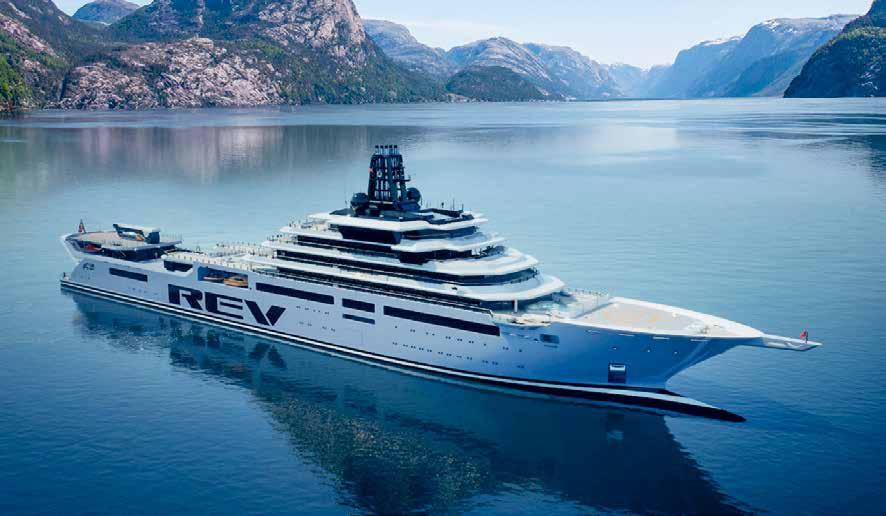
However, no project captures the spirit of this new era more than REV Ocean. Under construction at Norway’s VARD shipyard, this groundbreaking vessel is set to become the world’s largest and most advanced explorer yacht. Commissioned by Norwegian businessman Kjell Inge Røkke, REV Ocean is more than a private yacht; it’s a floating research facility, complete with science labs, autonomous submersibles and a mission to study the marine environment.
Rev Ocean represents a new era in ocean exploration –one where adventure and impact go hand in hand,” says Nina Jensen, CEO of REV Ocean. “By bridging world-class science with extraordinary expeditions, we are redefining what it means to explore the ocean. Every journey aboard Rev Ocean contributes to vital research, conservation, and the solutions we need to safeguard our blue planet for future generations.”
Organisations like the International SeaKeepers Society are already proving how this synergy can work. Since launching its Discovery Yacht Program, SeaKeepers has facilitated more than 180 scientist-led expeditions aboard private vessels. Research has ranged from black-coral and reef studies in Raja Ampat to shark-tagging in the Mediterranean, seagrass surveys in the Solent and manta-ray monitoring in the Maldives. In many cases, yacht owners and their guests participate directly in citizen-science activities, underscoring the role that explorer vessels can play as platforms for both luxury and conservation.
The spirit of adventure is no longer the preserve of giant, gleaming white motor yachts. Increasingly, the most radical innovations in yachting are happening under sail and feature more than just one hull.
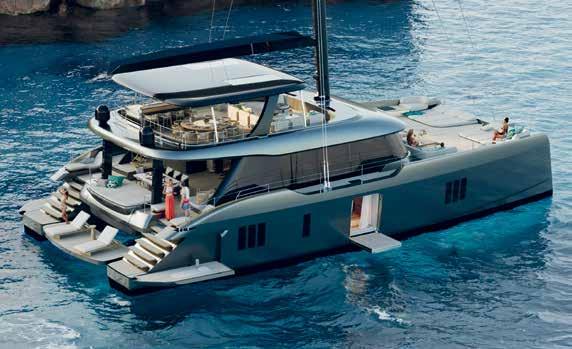
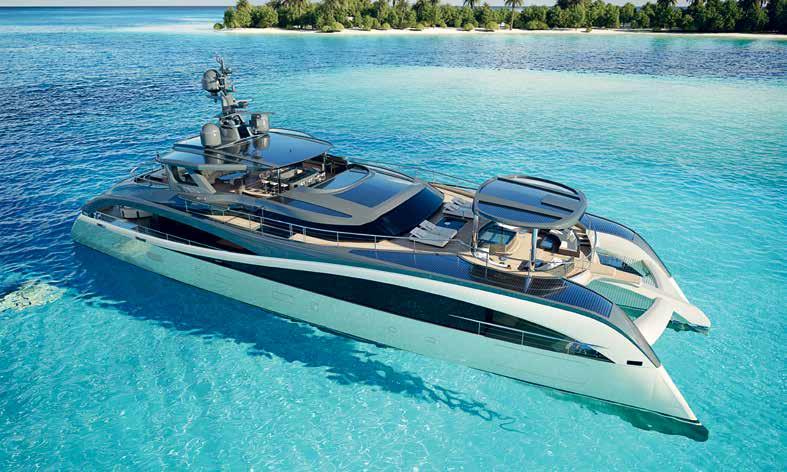
Hydrodynamic, electrically propelled catamarans are rapidly gaining ground. Rossinavi’s Seawolf X and Sunreef’s NEXT line both offer whisper-quiet, emission-free cruising, with solar-clad decks and battery-powered systems reshaping expectations of what a superyacht should look and feel like. A recent report from Unmuted Consumer Insights, revealed that 68% of US recreational boat owners consider a brand’s environmental commitment when choosing a vessel.
“If your mental image of a superyacht is a towering white monohull, it’s time to update it,” says Francis Lapp, founder of Sunreef Yachts. “Clients now ask about solar capacity and sound levels rather than horsepower. Luxury has become quieter – more about presence, wellness and shared time on board.”
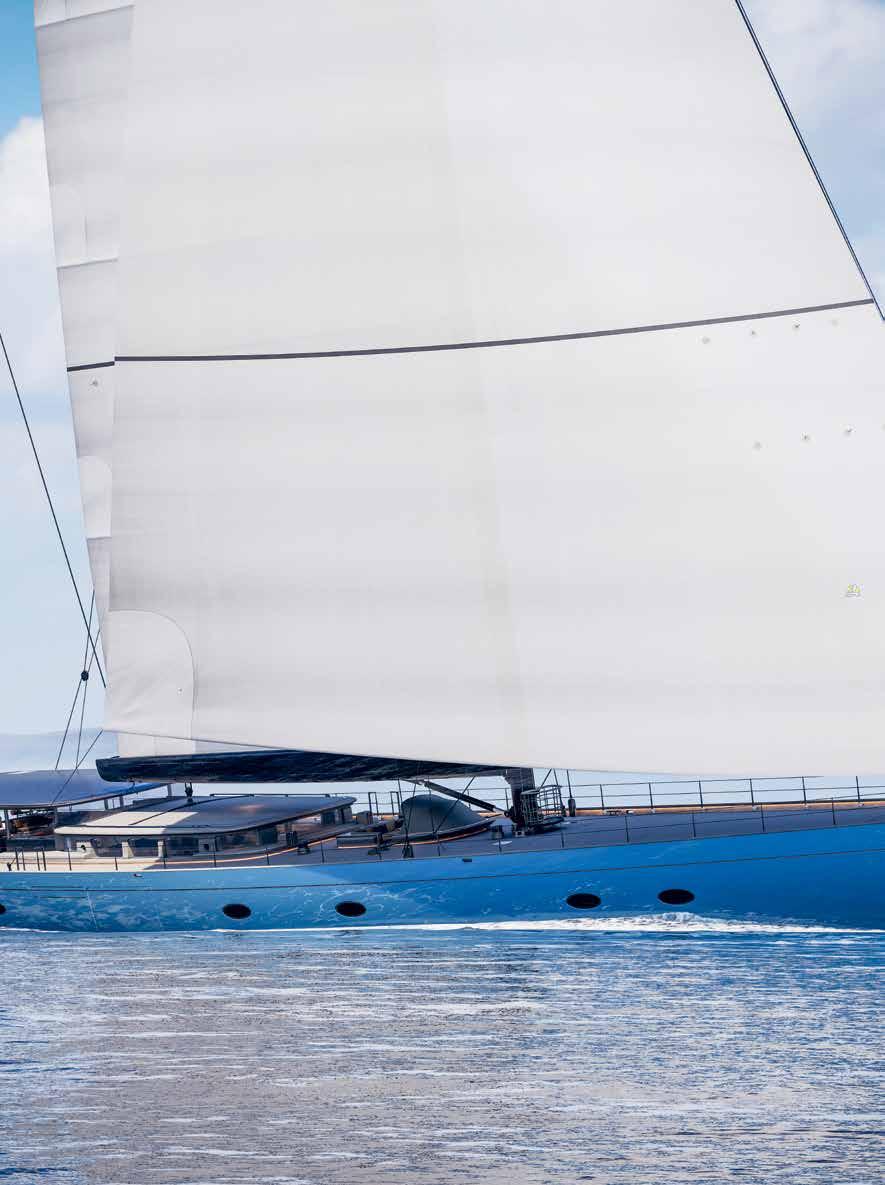
The sailing yacht segment is also forecasted to grow steadily, with a notable rise in orders for hybrid and electricassisted yachts. According to Fraser Yachts, sailing yachts now account for nearly 15% of new builds, up from around 9% a decade ago. Take Project Zero, for example. Due for delivery in 2026, it has been touted as the world’s first true zero-emission superyacht. Conceived by Dutch design house Vripack, Zero represents a step change in naval architecture: regenerative propulsion, clean energy systems and a hull designed as much for efficiency as elegance.
A 60m motor yacht typically emits over 7,000 tonnes of CO2 per year if used intensively – the equivalent of 1,500 cars, so the need for radical innovation is imperative. “This project has always been about showing what’s possible,”
says Marnix Hoekstra, Vripack’s co-creative director. “We wanted to demonstrate that comfort, design and performance can coexist with fossil-free operation. It’s not a concept or a paper exercise – it’s a working model others can learn from.”
For Hoekstra, sustainability isn’t a constraint but an opportunity. “It’s our generation’s greatest design challenge,” he says. “Zero demonstrates that sustainability, technology and aesthetics can be synthesised into something the industry has never seen before.”
The movement isn’t limited to sailing yachts. With shallow drafts that allow access to reefs and lagoons previously offlimits, and interiors to rival much larger motor yachts, these catamarans underscore a new reality. Against the backdrop of the IMO’s targets to cut emissions by 40% by 2030 and 70% by 2050, these yachts aren’t just indulgences, they’re also necessary prototypes. As Lapp puts it, “This is the future of yachting – where luxury meets responsibility. And we are only at the beginning.”
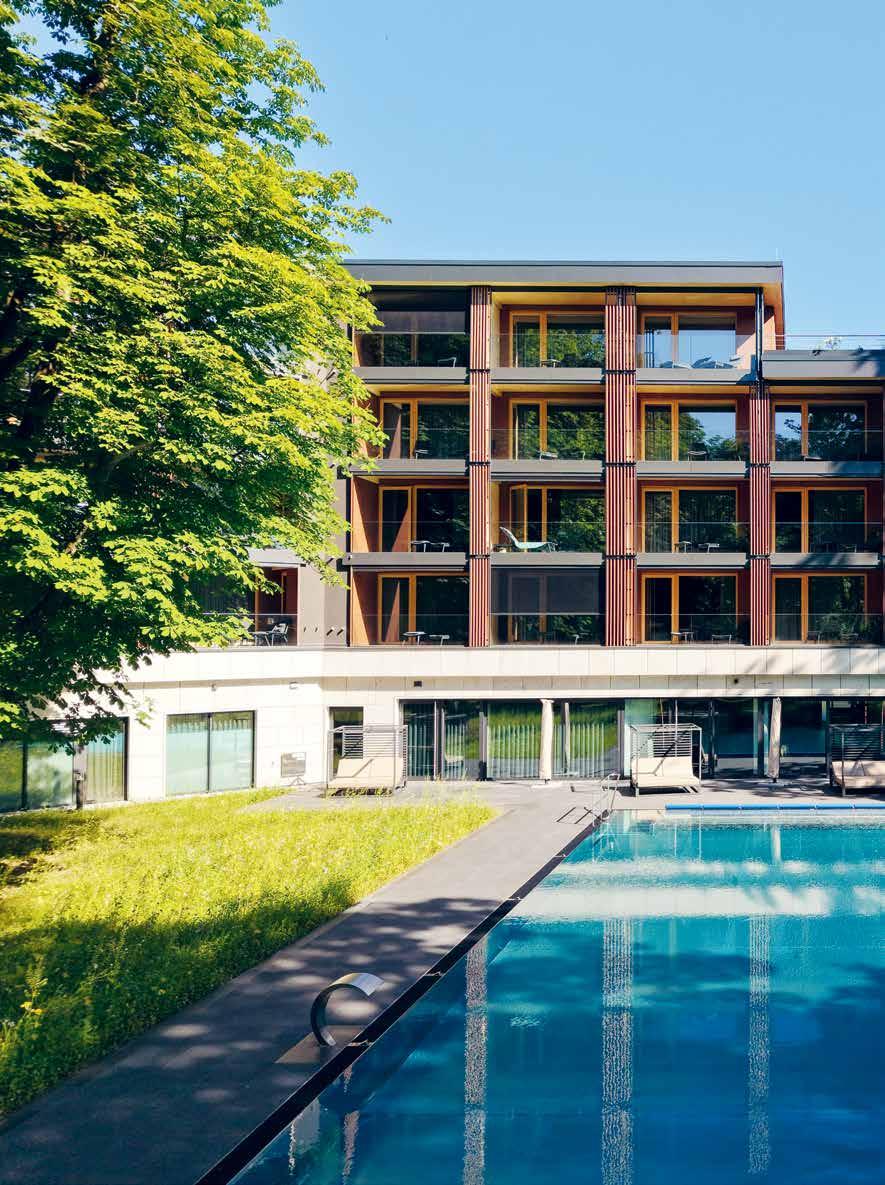
Whatever you do, please do not write an article about this resort,” says Hans-Jürg Buff, standing before a group of journalists in a crisp, modern lobby overlooking Lake Constance, Germany. He pauses long enough to draw a few raised eyebrows, then smiles. “Not unless you truly believe this place is one of a kind.”
It’s an engaging, though disarming start. Buff may have the easy charm of someone seasoned in hospitality, but what comes through more strongly is his directness, his contrarian streak, and his quiet certainty. He built this place from nothing and has no interest in validation. What he’s looking for, it seems, is alignment. Either you see what he’s doing here, or you don’t.
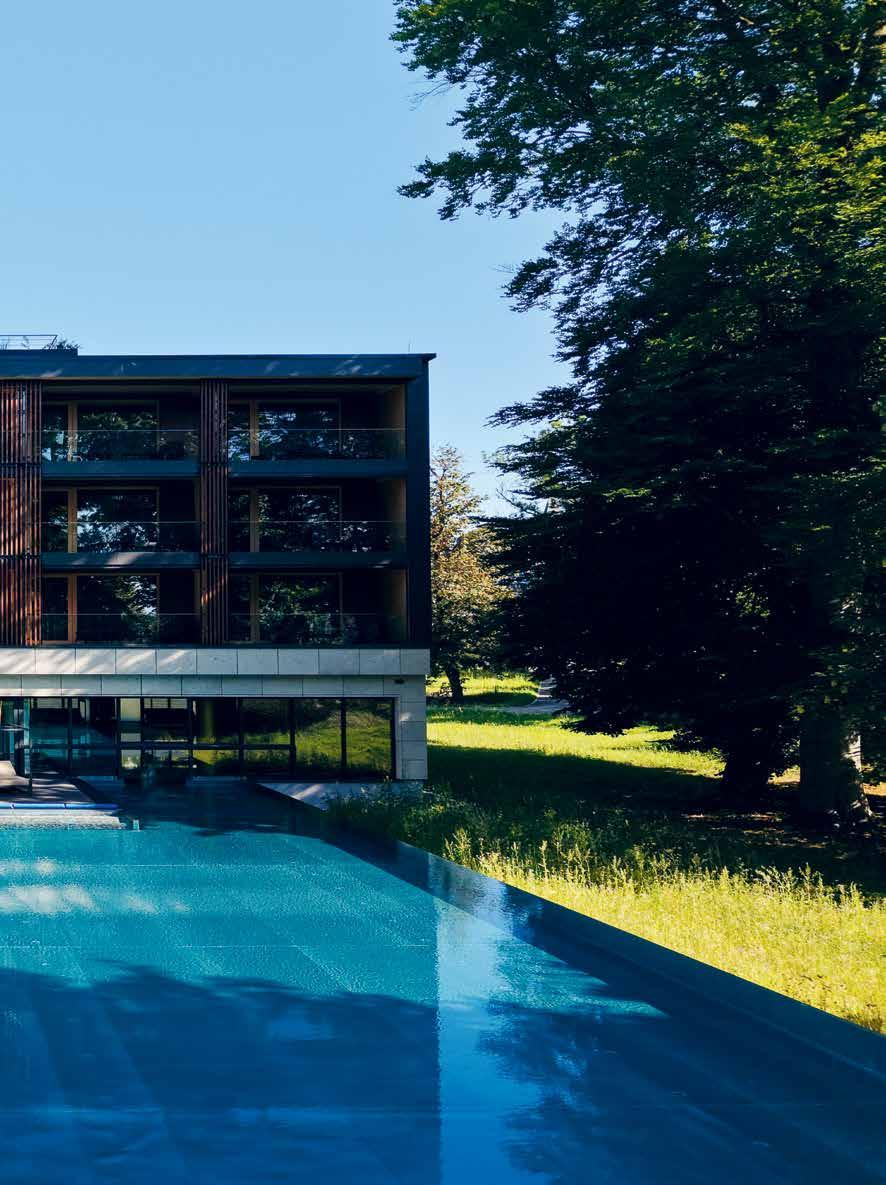
From the outside, Buff Medical Resort could be mistaken for another wellness spa chasing its share of an industry set to reach $1.35 trillion within two years. Step inside, though, and the understatement gives way to something far more exacting. This is not a retreat but a medical clinic with the refinement of a luxury hotel. It is also a family-run venture, invested not in trends but in outcomes.
words > MAX STOTT Buff Medical Resort × 4 Pillars
Hans-Jürg, runs six properties under the Swiss Mountain Hotel Group, and has spent a lifetime refining the art of hospitality. But this project, opened in early 2025, carries the weight of personal conviction. Several years ago, when his 82-year-old mother was diagnosed with terminal cancer and prescribed 18 pills a day, Buff made a decision to intervene. He stepped in, took control of her care, replaced the pharmaceuticals with a targeted regimen of natural
supplements, and he believed this helped extend her life by two years. The experience was transformative.
Buff Medical Resort is his response: a purpose-built destination rooted in personalised, preventive care. There are no gimmicky detox packages, no empty promises of instant rejuvenation. Instead, guests begin with full diagnostic testing, followed by targeted interventions: unrivalled cardiovascular insights, hormone balancing and postural analysis. Each stay is bespoke, and each recommendation is backed by data.
Buff’s language is deliberately provocative. He speaks of the pharmaceutical industry as dependencydriven, and describes Buff’s philosophy as one of independence: “We teach people to take responsibility for their own health. We give them the tools to become self-reliant. Luxury and longevity is not the main event here,” Buff says. “The real luxury is adding life to your years, not years to your life.”
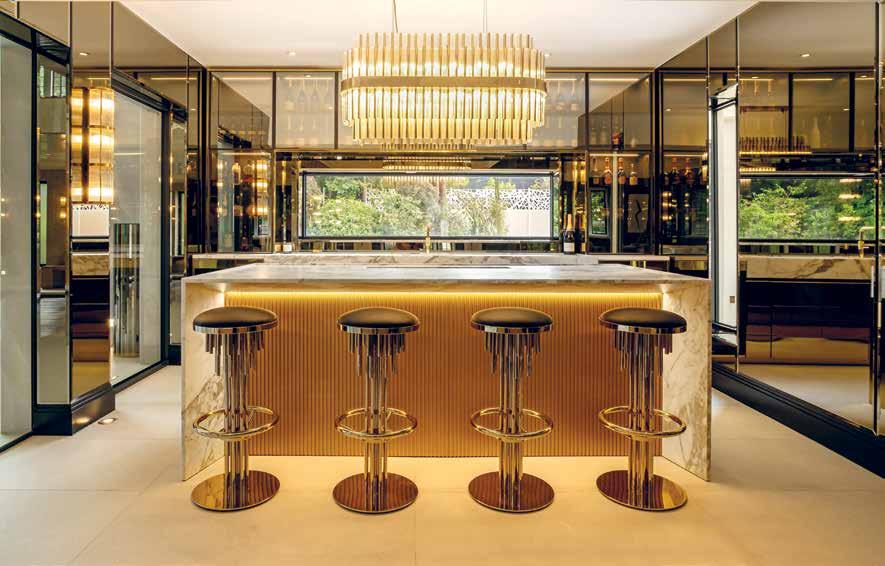
The resort features an in-house cardiac MRI which is the very latest model and nicknamed the ‘Rolls-Royce’, gait and mobility labs, and rooms equipped with adjustable altitude simulation up to 4,500m (the same as the foothills of the Himalayas) to encourage red blood-cell production. On the ground floor of the property sits a golden swimming pool, and at the top of the building sits a bulletproof presidential suite with its own elevator and car park. With Lake Constance just steps away and the Alps rising on the horizon, the resort grounds feel calm and connected to nature.
“
Real luxury is adding life to your years
”
Nutrition is led by FX Mayr principles, with options ranging from structured fasting to the GourMED menu – where the occasional carb is allowed alongside wild fish and slow-cooked veal. The approach is scientific, but not joyless. Treatments include osteopathy, Ayurveda and biodynamic facials, delivered with rare technical skill.
What becomes clear by the time you leave is that Buff isn’t running another wellness retreat, he’s redefining what healthcare can look like. In a landscape with crowded with promises of quick fixes, guests here are given everything they need to take lasting ownership of their wellbeing, and are expected to do so. In a resort that has been carefully and purposefully optimised to stimulate real lasting changing, it is this equal demand for commitment from its guests, that truly sets it apart.
1. Altitude Climate Technology
2. Cardio MRI Diagnostics
3. FX Mayr Medicine & Intestinal Health
4. Gait & Movement Analysis buff-medical-resort.com

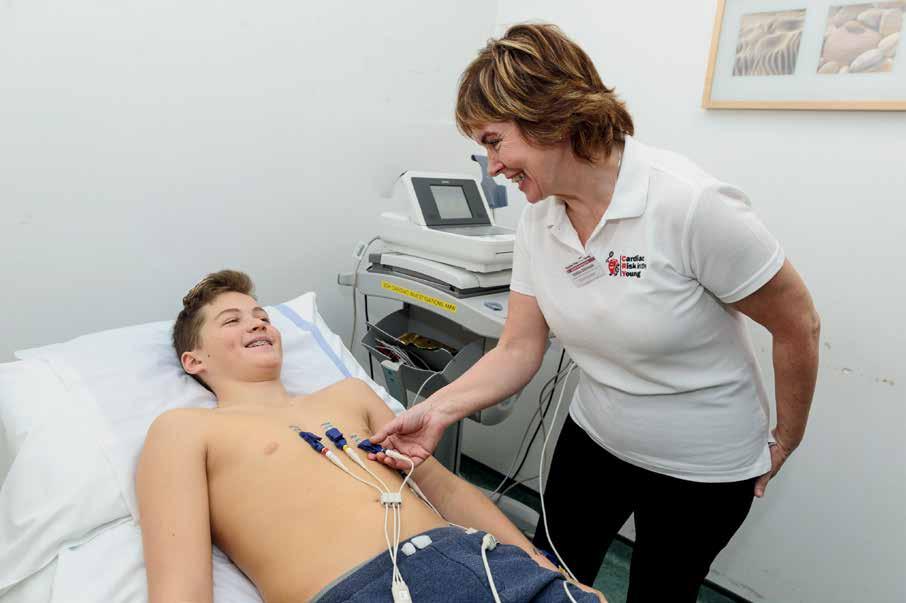
Every week in the UK, 12 young people die suddenly from undiagnosed heart conditions. "I’ve witnessed the devastating impact of young sudden cardiac death. But I've also seen the power of prevention through Cardiac Risk in the Young’s work. Your support can help save young lives."
Help us save young lives:
www.c-r-y.org.uk/partnerships

BREAK AWAY FROM IT ALL TO A RETREAT SO SECLUDED YOU’LL NEED A HELICOPTER TO GET THERE
words > LISA KJELLSSON
As much as the usual luxury holiday spots have their appeal, sometimes you want a complete change of scene and an escape to your own private paradise. Surrounded by otherworldly natural beauty, in a location so remote it is only accessible by helicopter, you can decompress and recharge in blissful solitude. Below we reveal the world’s most exclusive boltholes you’ll reach through the skies –each offering a unique and awe-inspiring experience. Whether you want to be spellbound by the Northern Lights or dive on the Great Barrier Reef, you’ll be whisked away to these dream destinations in double-quick time.
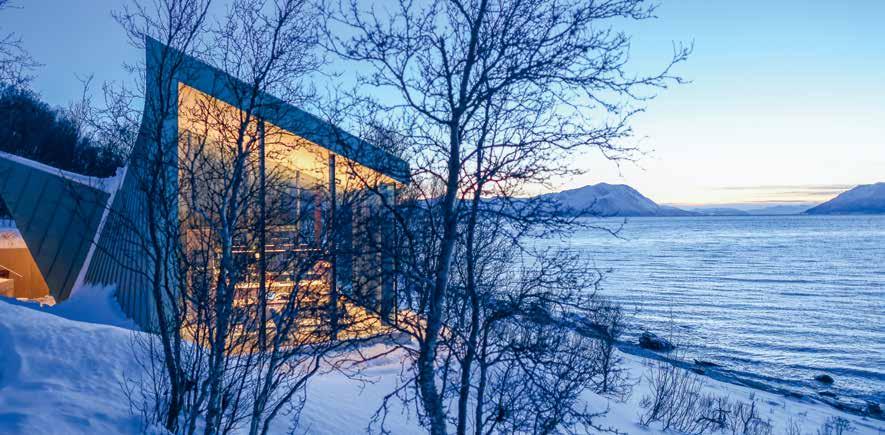
North of the Arctic Circle, in Norway’s Lyngen Alps, you’ll find one of the best vantage points for what is surely nature’s most breathtaking spectacle – the Northern Lights. A fjord-facing luxury lodge with floor-to-ceiling windows is perfectly positioned for optimal viewing of the swirling ribbons of green, pink and purple dancing across the night sky. Designed by architect Snorre Stinessen, the Scandichic retreat sleeps 12 guests across six suites and comes fully staffed with a private chef and celestial specialist on hand to ensure you don’t miss out on the magic. Your stay will be complemented by a programme of seasonal experiences ranging from kayaking with orcas to off-piste skiing. The best time to see the aurora here is between November and April, while the whales are usually spotted in January and February. The property is bookable exclusively through Black Tomato.
• 25–60 minutes by helicopter from Tromsø blacktomato.com/destinations/norway/aurora-lodge
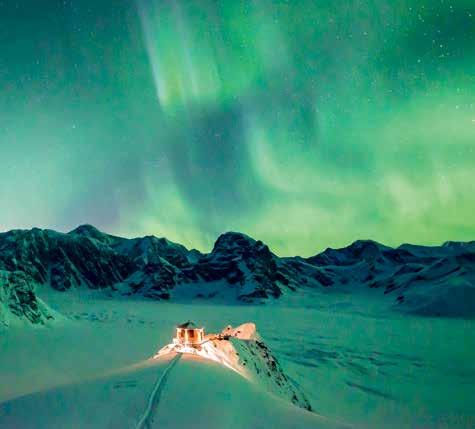
Perched on the rocky flanks of North America’s highest mountain, Denali, at an altitude of 6,000ft, sits one of the most remote hotels in the world. The hexagonal Sheldon Chalet overlooks the majestic Ruth Glacier in the Don Sheldon Amphitheater and offers panoramic views of the Alaska Range, as well as exceptional stargazing and aurora viewing (September to April). Getting here means a helicopter journey on the longer side, but one that rewards you with sweeping views of Denali National Park and its snowcovered peaks. Owned and managed by the Sheldon family, the cosy five-bedroom chalet accommodates up to 10 guests on an exclusiveuse basis. Each stay is carefully curated for both exploration and relaxation, including activities such as celestial photography, sledding, glacier trekking, mountaineering and heli-skiing. The chef will whip up anything you like, using locally sourced delicacies such as king crab, salmon, halibut and Alaskan oysters.
• 75 minutes by helicopter from Anchorage sheldonchalet.com
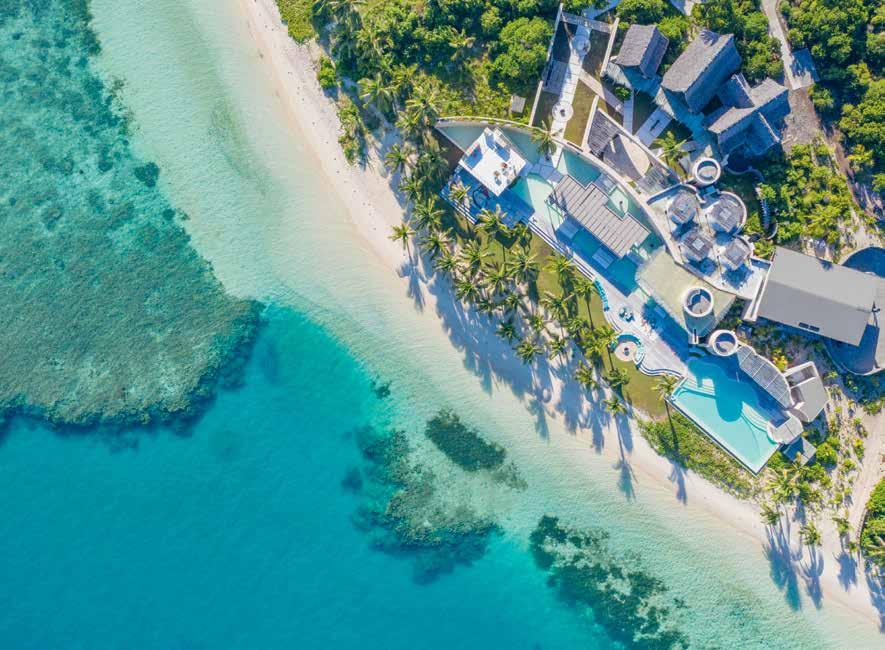
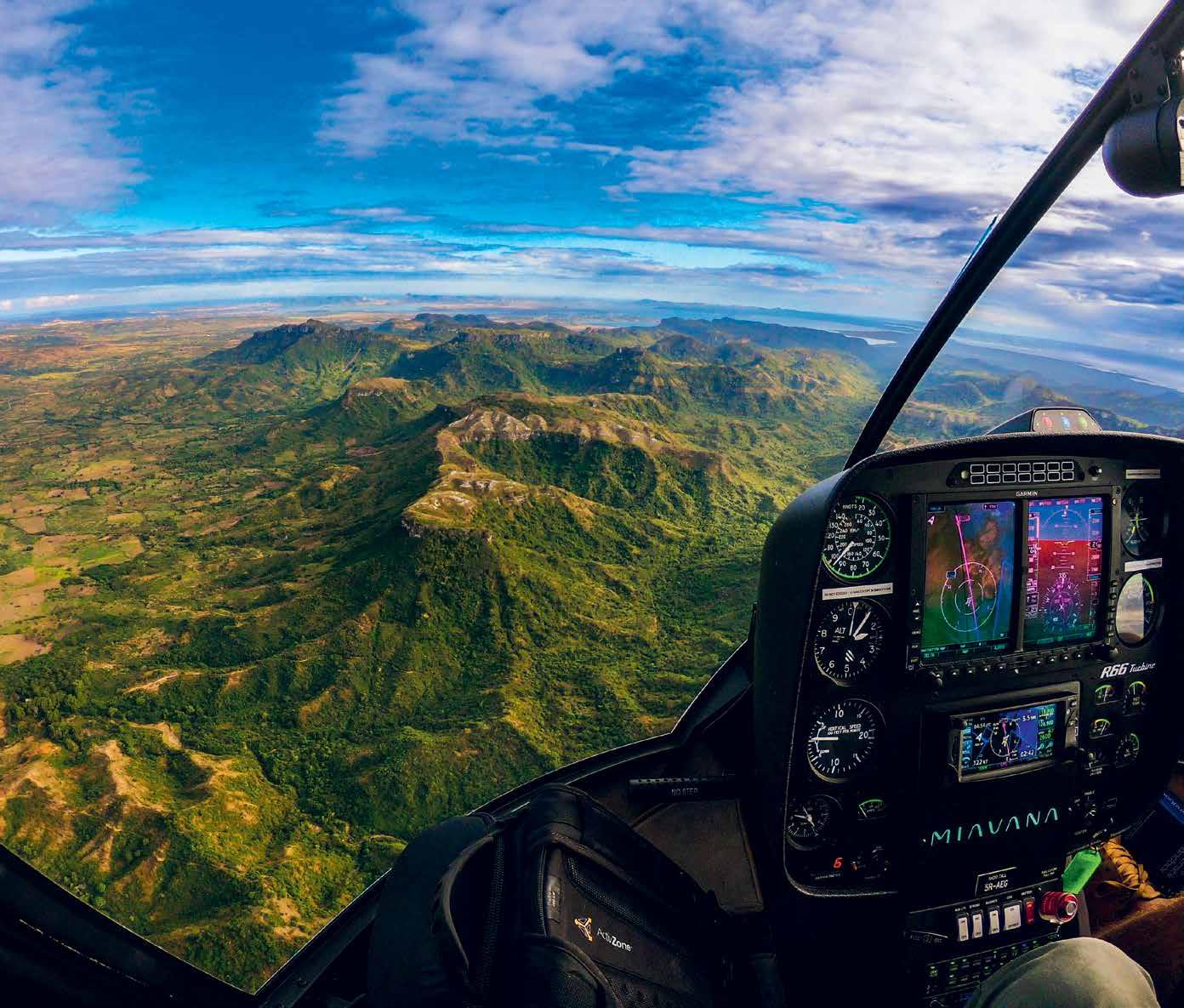
A private island off the northeastern coast of Madagascar is home to one of the Indian Ocean’s most exclusive resorts, Miavana by Time + Tide. The former pirate hideout is a lush oasis in countless shades of green and teeming with wildlife. Thirteen butler-serviced ocean-front villas are the epitome of barefoot luxury and can be booked on an exclusive-use basis, one of the reasons A-listers including Tom Cruise and Leonardo DiCaprio have holidayed here. Another highlight is the cuisine, a celebration of local flavours ranging from mangrove crab and yellowfin tuna to Madagascan Rova caviar and zebu-milk buffalo mozzarella. Beach-lounging and spa-pampering aside, guests can snorkel and dive on the marine-protected house reef, spotting sea turtles, manta rays and spinner dolphins, or enjoy helicopter excursions, kite boarding and lemur trekking. The island is a year-round destination, ideal for adding on to a safari trip in mainland Africa.
• 30 minutes by helicopter from Diego Suarez
• 60 minutes by helicopter from Nosy Be miavana.com
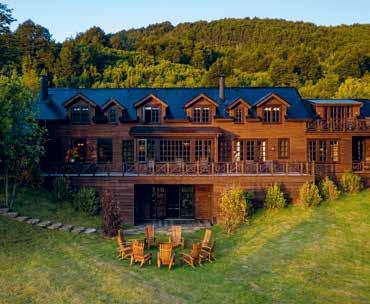
Set in a pristine valley on the banks of the glacier-fed Palena River in the Chilean Lake District, a former fly-fishing lodge turned luxury retreat is an ideal basecamp for Andean adventures. With no neighbours for miles in any direction, the 13-acre property enjoys complete privacy. It spans seven suites with ensuite bathrooms and king-size beds, sleeping up to 14 guests, and comes fully staffed. Your bespoke activity programme can include anything from heliskiing (September to October), kayaking, fly fishing, whitewater rafting, biking or hiking on a glacier or dormant volcano, all with expert guides. Afterwards, relax in the wood-fired sauna and hot tubs and enjoy a traditional asado paired with the finest Chilean wines. While the property is technically accessible by car, driving distances in remote Patagonia are huge. Far more comfortable is flying by private plane from Santiago or Puerto Montt to Palena airfield, or catching a helicopter from Chaitén.
• 45 minutes by helicopter from Chaitén elevenexperience.com/lodge-destinations/chile/ eleven-rio-palena-lodge
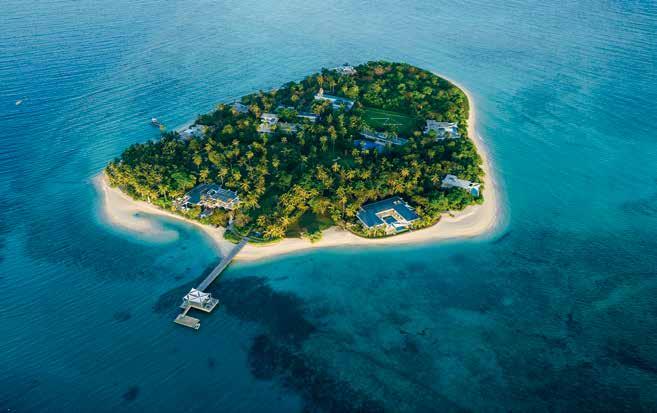
Located in the Sulu Sea, just east of Palawan and in the heart of a UNESCO Biosphere Reserve, Banwa Private Island offers a complete respite from everyday stresses. Six beachfront villas – each with a private infinity pool – and additional suites are available for exclusive use and can accommodate up to a total of 40 guests. Sport fans can enjoy a game of golf, pickleball or tennis, as well as a whole raft of water activities, while wellness seekers can relax in the spa. A dedicated kids’ team is on hand to ensure children are kept entertained.
Conservation is a big focus – guests can learn all about efforts to preserve the island’s fragile ecosystem including endangered species such as the hawksbill turtle and dugong (sea cow). Perfect for wedding parties or multi-generational family holidays, this marine-protected sanctuary will undoubtedly provide a memorable stay.
• 2 hours 15 minutes by helicopter from Manila banwaprivateisland.com
Pelorus Private Island, Queensland, Australia
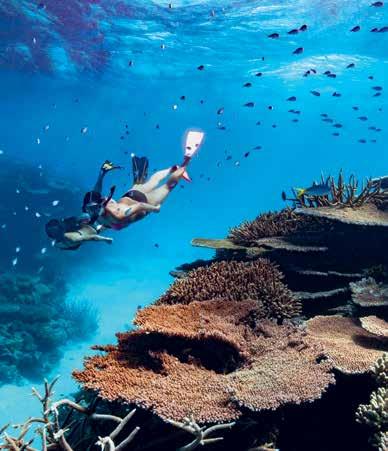
The Great Barrier Reef’s first private island residence, surrounded by one of the seven natural wonders of the world, is a real bucket-list stay. Located on the northernmost cluster of the Palm Island group, arrival is by helicopter or private yacht from Townsville. You’ll luxuriate in complete seclusion in the palm-fringed, five-suite beach bungalow (sleeps 11) that blends into the nearly 1,000 acres of wilderness. Australian financier and tech investor Chris Morris bought the island in 2017 and turned it into a hideaway for one-percenters. His vision was a property that operates like a superyacht, with a head chef and house manager tending to guests’ every need. A toybox is laid out each afternoon equipped with everything from water bikes to jet skis and Seabobs, but you’ll be forgiven for wanting to simply snorkel up and down the house reef, marvelling at the colourful corals and hundreds of fish species that call it home.
• 30 minutes by helicopter from Townsville pelorusprivateisland.au
ANCIENT TRADITION MEETS CUTTING-EDGE TECH AS THE TRADITION OF FALCONRY CONTINUES TO EVOLVE IN MODERN ABU DHABI
words > JAMES FARLEY
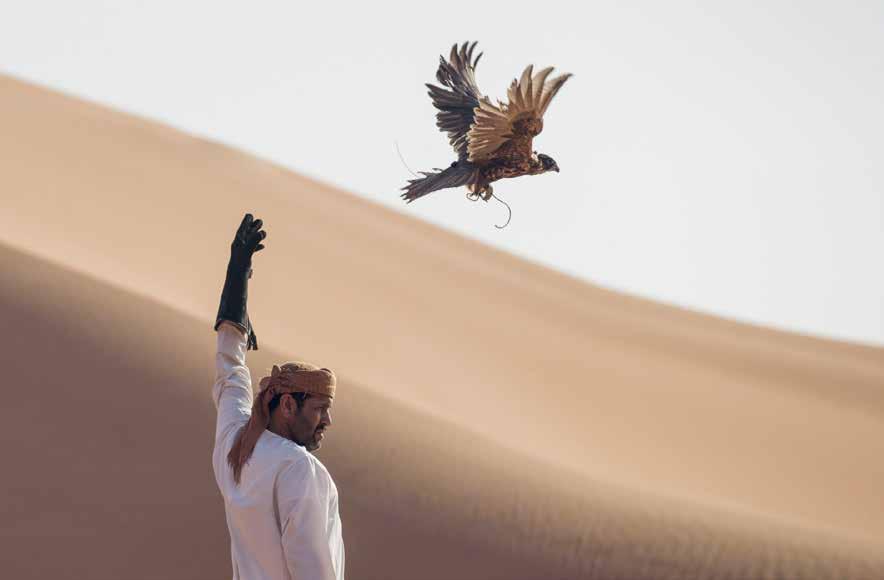
Falconry, has been an integral part of Emirati culture for over 2,000 years. Originally a vital means of survival for Bedouin tribes, who used falcons to hunt small prey in the harsh desert environment, this practice has evolved into a revered sport and cultural symbol that attracts both Emirati nationals and international enthusiasts.
The UAE has been at the forefront of preserving and promoting falconry. Falconry is a practice that preserves centuries of cultural heritage while fostering responsibility, patience and a profound connection with nature. In 2010, UNESCO recognised falconry as part of the Intangible Cultural Heritage of Humanity, acknowledging its significance in fostering a sense
of identity and continuity among communities, a recognition that underscores the UAE’s commitment to safeguarding this ancient tradition while integrating modern advancements.
Across the capital city, stores like Al Dhafra Falcons are at the cutting edge of these innovations, offering equipment used to track, train and maintain the region’s most prized raptor species: peregrines, sakers and gyrfalcons. For the modern falconer, the essentials have expanded far beyond the traditional perch, glove, and lure.
At Sinjar Falcon in Dubai, alongside ‘quail flavour’ supplement powders and ‘falcon recharge’ additives, a selection of remote-control airplanes is on offer, which staff claim “are the best way to build a falcon’s muscles” during
high-altitude training. But even these planes, which resemble the models a hobbyist may maintain, are fast becoming obsolete.
Leading-edge falconers now employ purpose-made drones developed specifically for raptor training. With advanced stabilisation and GPS technology, some resemble stealth bombers, while others mimic the appearance of birds, featuring folding wings, bi-copter designs and expanded polypropylene constructions. The drones, to which lures are attached, must be sturdy enough to withstand the impact of a falcon diving at speeds exceeding 100 mph. The birds, too, are bedecked in technology such as radio transmitters hooked into their plumage that track data and progress.
“
For Emirati families, especially those with Bedouin roots, falcons are more than just birds, they are cherished members of the family ”
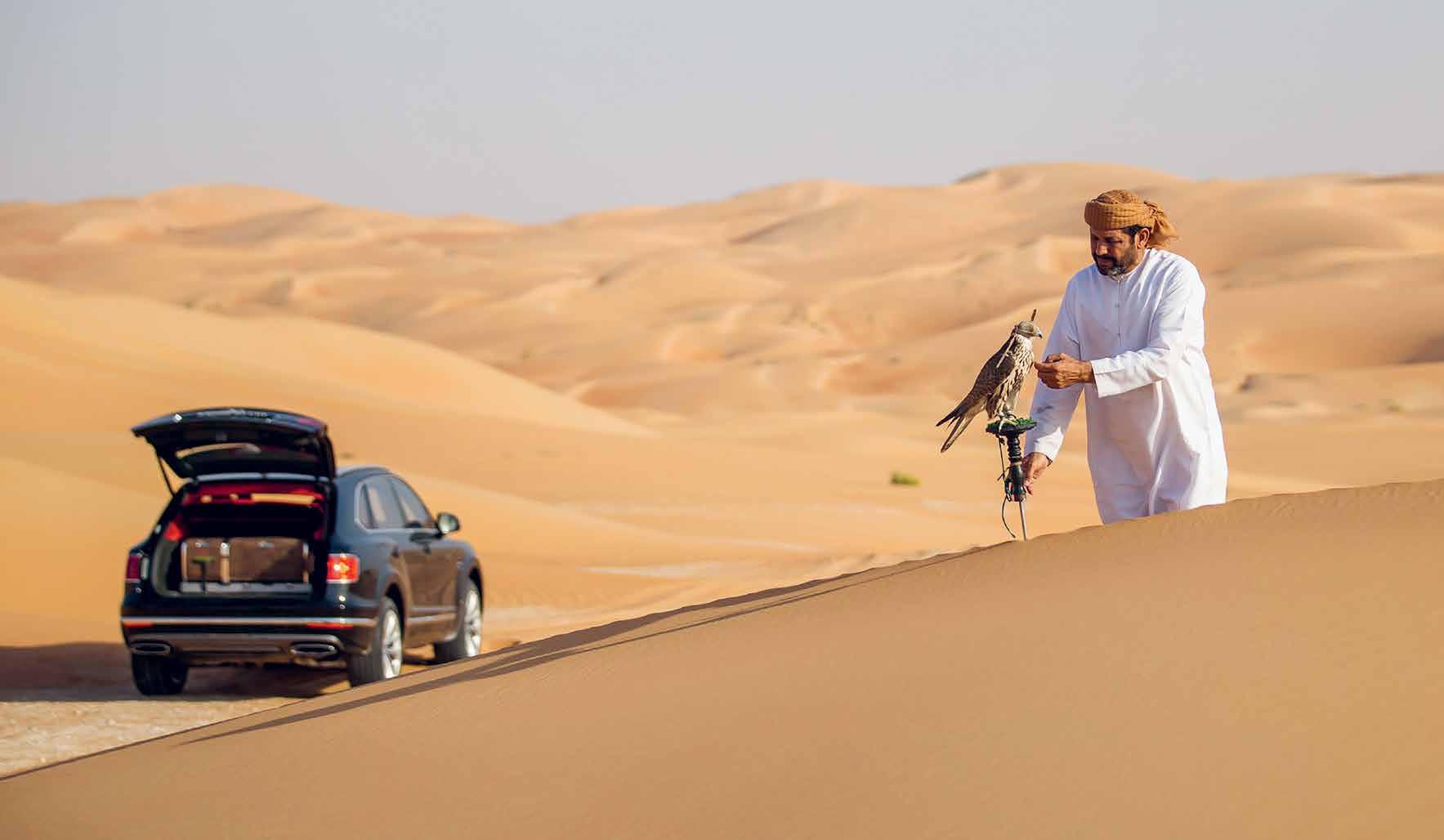
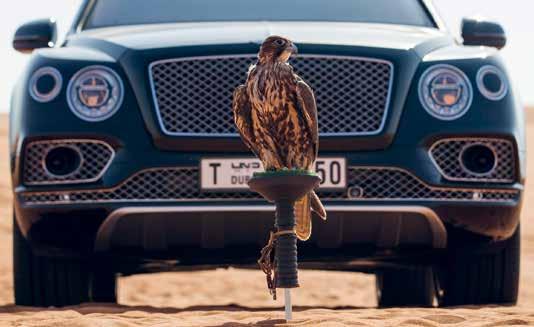
But training tech is just one area of modern falconry development. Even luxury cars have been adapted to accommodate keen falconers, perhaps most notably when King Hassan II of Morocco tasked automotive designer Franco Sbarro with adding a bird-perch bar and retractable windscreen to his 1977 Rolls-Royce Camargue coupé. In 2017, Bentley’s bespoke team, Mulliner, eclipsed their British rivals with the Bentayga Falconry, a car featuring an armrest-mounted perch, a ‘master flight station’ in the boot, and a slot for GPS bird-tracking units.
Such bespoke transportation reflects the unique lives of these Middle Eastern falcons. Falconry remains a high-stakes pursuit. With auctions for top-tier birds exceeding £200,000, reflecting both rarity and training quality. Beyond the initial purchase, upkeep costs, from air-conditioned aviaries to specialised veterinary care, can run into thousands per bird each year
“For Emirati families, especially those with Bedouin roots, falcons are more than just birds,” says Dr Margit Gabriele Muller, executive director of the Abu Dhabi Falcon Hospital. “They are cherished members of the family, treated like sons and daughters.”
Muller’s hospital is world-leading in falcon care. “Over the past few decades, medical care for falcons has advanced significantly,” she says. “We specialise in surgery, rehabilitation and preventative care, treating thousands of falcons each year from across the region, using treatment methods for fracture repair, liver and kidney diseases, endoscopy and more.”
Over the course of her work, Muller has discovered two new falcon-specific diseases and their subsequent cures.
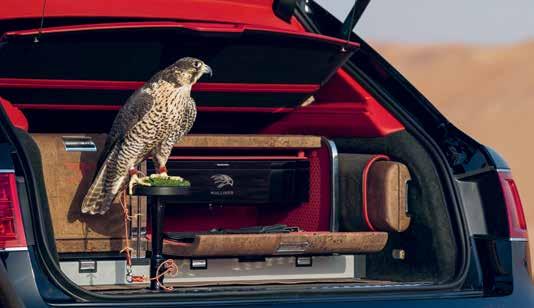
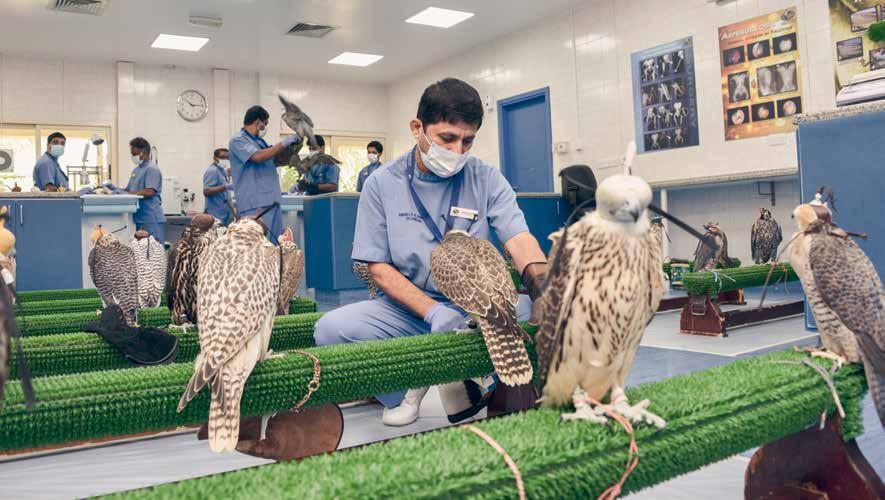
She says that falconry is “much more than a sport” and that the hospital is open to locals and tourists alike to educate visitors about the birds’ historical, social and spiritual significance. The Abu Dhabi Falcon Hospital Tour, Muller says, offers “a captivating journey into the heart of Emirati heritage, where the ancient art of falconry is brought to life in modern times.” It has twice won the World Responsible Tourism Award.
It is far from the only opportunity to experience authentic falconry in Abu Dhabi. At Anantara’s Qasr Al Sarab resort, a five-star falconry experience takes place in the Rub’ al Khali, a region which resort conservation manager Mark David Penfield describes as “the largest uninterrupted desert expanse on Earth”.
Like the hospital, much of the tech and investment into falconry here is directed towards the raptors’ safety.
“For the younger birds,” says Penfield, “we use GPS tracking for training purposes only, and if they do lose their
way in the vast desert, we can easily locate and bring them back to camp.”
With trained handlers placing an emphasis on cultural accuracy, the Qasr Al Sarab falconry experience balances education with entertainment.
“It’s also held at sunrise or sunset, when the desert is at its most tranquil,” says Penfield. “It’s not only a performance, but an essential cultural touchpoint.” It is a tradition that has fostered generational self-reliance, profound respect for nature, and an unshakable bond between humans and these extraordinary birds.
Beyond luxury and tradition, falconry in the UAE has a tangible conservation footprint. The Abu Dhabi Falcon Hospital treats over 11,200 falcons annually, many of which are rehabilitated from injury, disease, or accidental capture in the wild. In May 2025, the UAE released 81 falcons (48 peregrine and 33 saker falcons) into their natural habitat in the Karaganda region of Kazakhstan as part of the Sheikh Zayed Falcon Release Programme.
The hospital also collaborates with the UAE’s National Falconry Centre and regional wildlife authorities to monitor migratory birds and protect endangered species such as the saker falcon, whose numbers have declined globally due to habitat loss and illegal hunting. GPS trackers, fitted to hundreds of falcons each year, guide training while also providing data to inform ecological research, helping authorities identify key nesting sites and feeding grounds across the Arabian Peninsula.
In a region modernising at perhaps the fastest rate in the world, falconry serves as a bridge between past and future. It is a living reminder that culture, care and conservation can soar together, ensuring that these majestic birds, and the human traditions they inspire, continue to thrive for generations to come.
This page
The Abu Dhabi Falcon Hospital (ADFH)


CESSNA CITATION ASCEND REPRESENTS THE NEXT CHAPTER IN TEXTRON AVIATION’S PURSUIT TO GO FURTHER, FASTER – AND WITH GREATER PURPOSE
Innovation in private aviation has never been measured by speed or range alone. Its true value lies in how it helps businesses and individuals bring their ambitions within reach. For over 50 years, the Cessna Citation series of aircraft has been doing exactly that.
Combining performance, reliability and cabin comfort in a versatile package, Citation jets have become one of the most widely flown and trusted families of business jets.
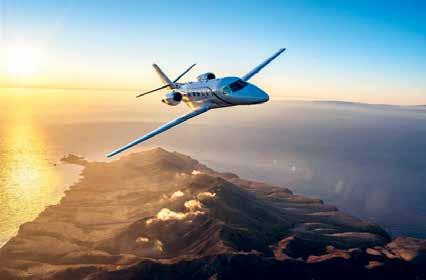
The newest evolution in this story, the Citation Ascend, is set to continue that trajectory. And with the first production jet now rolled out, Textron Aviation is one step closer to the moment operators and owners can experience it for themselves.
Designed by Textron Aviation based on extensive customer feedback and input from a Customer Advisory Board, the Citation Ascend is built to do more. In the cockpit, the Citation Ascend debuts the most advanced Garmin G5000 avionics suite yet fitted to a 560XL-series jet, delivering optimum efficiency and control. Its clear, intuitive interface features the latest software, and when paired with synthetic vision technology and full-flight regime autothrottles, it reduces pilot workload and supports precision approaches into even the most challenging airfields.
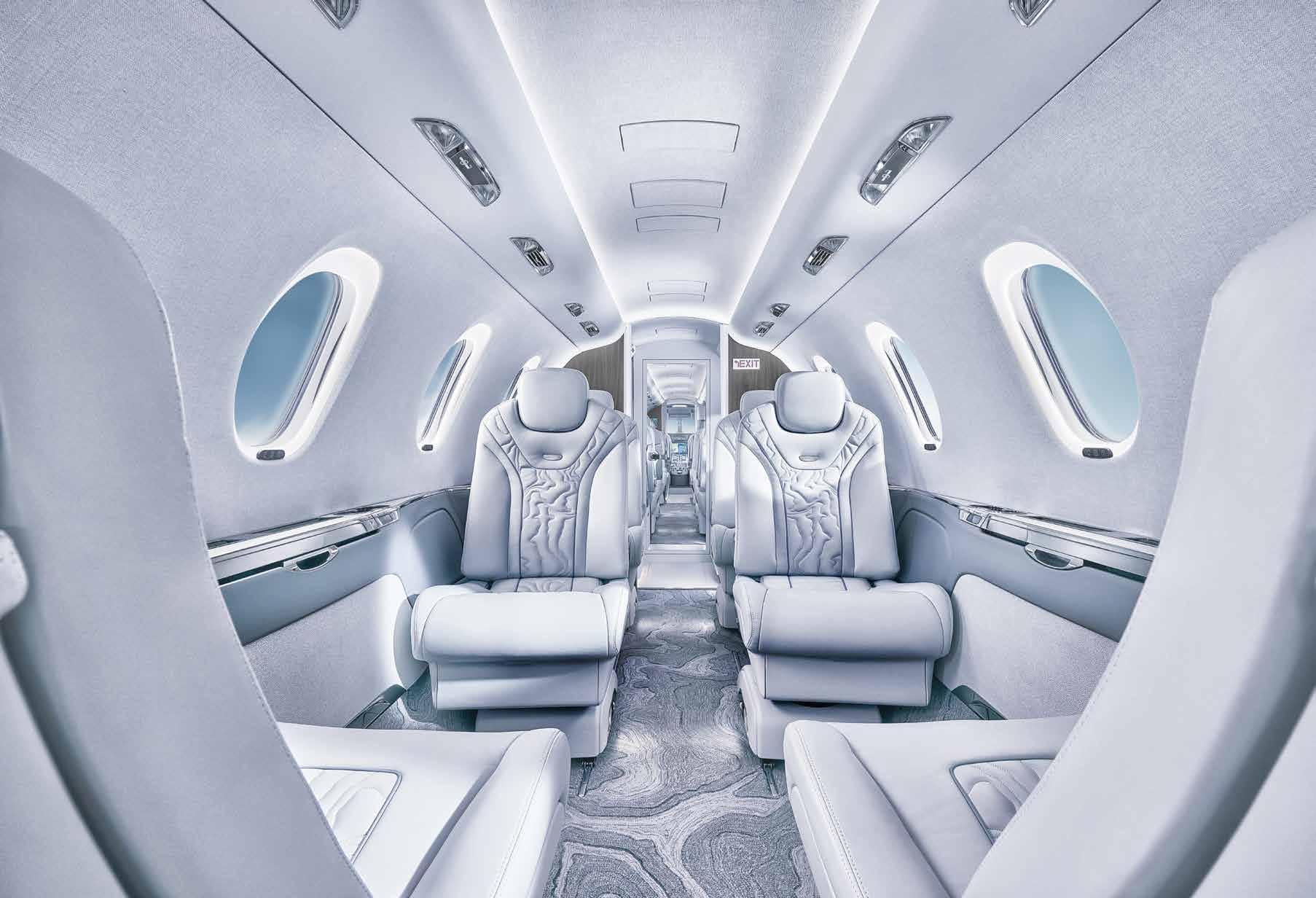
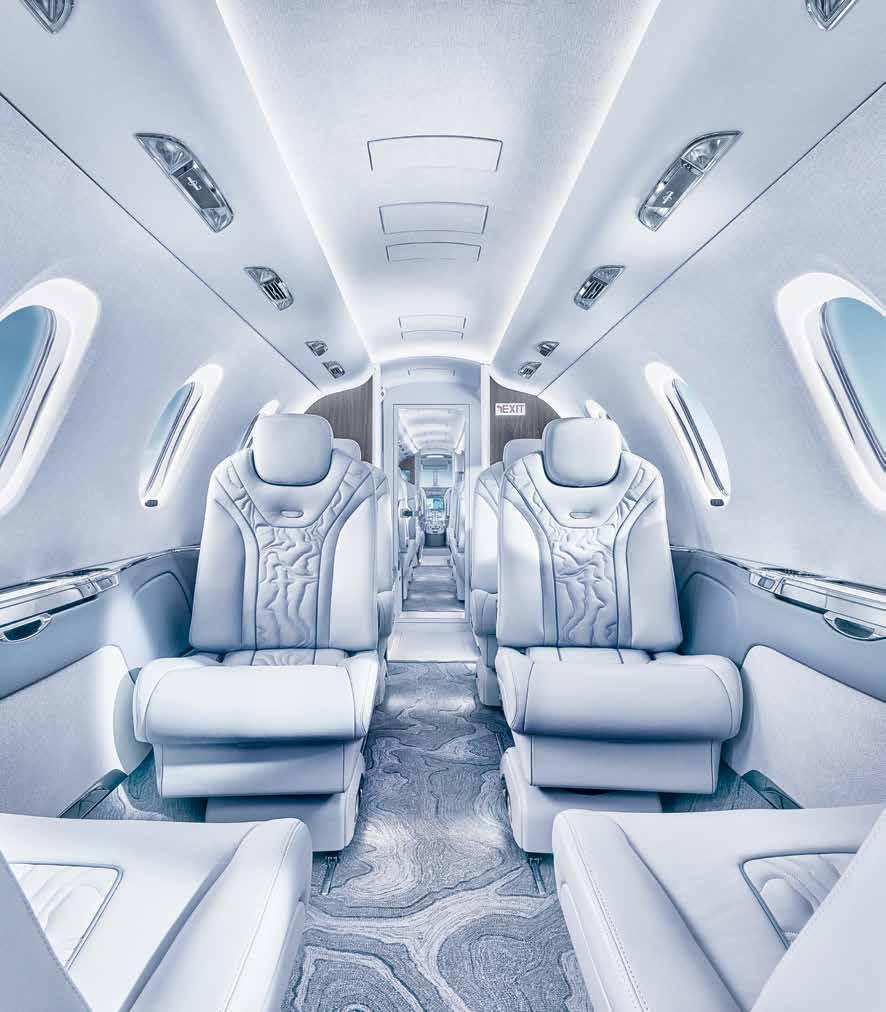
Inside, the cabin redesign reflects the same focus on capability. A flat floor and optional dropped aisle create more space to move, swivel or stretch – while windows 15% larger
than its predecessor flood the cabin with natural light. Quiet-cabin technology allows passengers to work or rest without distraction, and generous baggage capacity adds flexibility for longer or more complex itineraries. A choice of sustainable finishes and a wide range of customisation options allow operators to tailor the interior to suit any mission profile.
Performance improvements underpin the entire experience. New Pratt & Whitney Canada PW545D engines deliver more thrust and better fuel efficiency, extending range to 1,900 nautical miles at high-speed cruise, with a 20% increase in engine time between overhauls.
Greater efficiency is good for business, but also for the planet. In addition to offering sustainable interior options, the Citation Ascend is compatible with sustainable aviation fuel, while Textron Aviation’s Kansas facilities are powered entirely by renewable wind energy.
The result is an aircraft that raises the bar in performance, comfort and capability – all shaped by the people who will fly it. It shows how Textron Aviation is innovating with its customers today, while building the aircraft they’ll rely on tomorrow. To find out more, please scan the QR code.
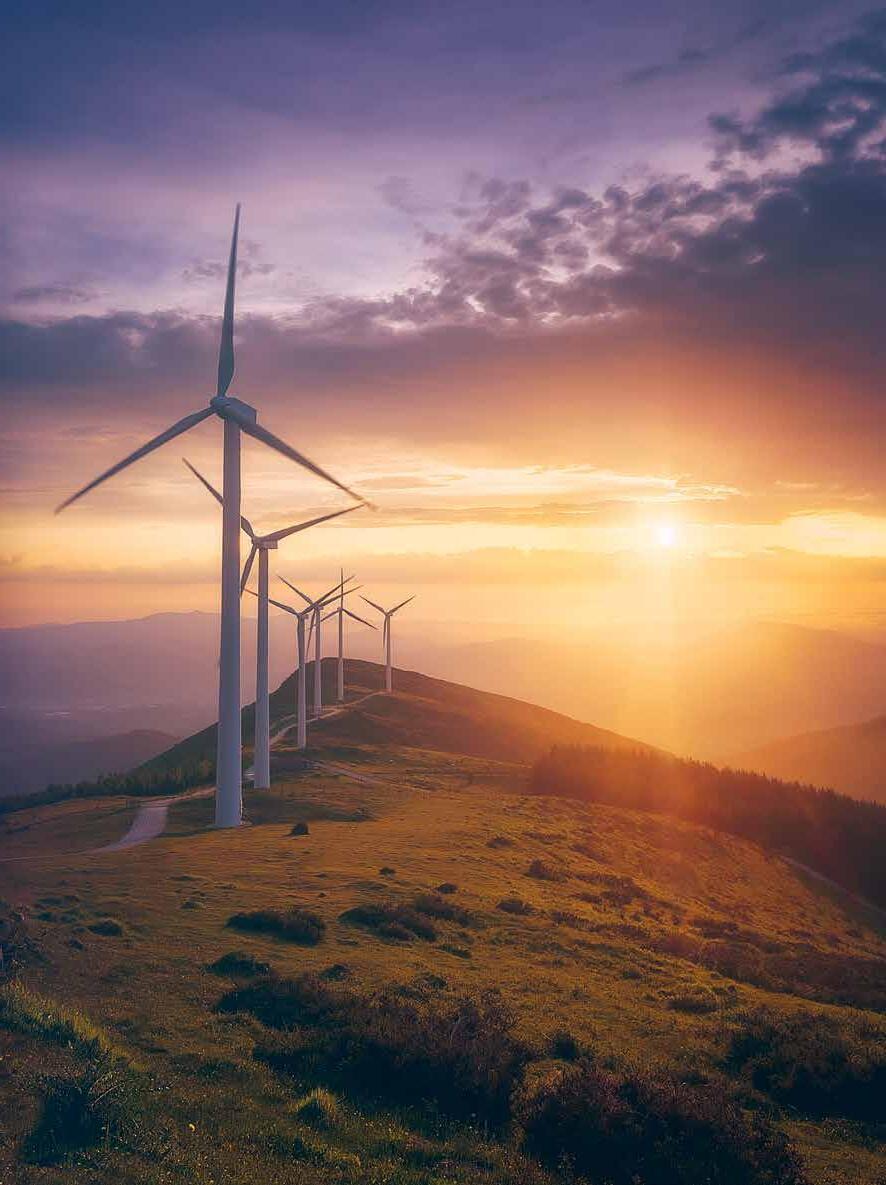
VICTOR SPEAKS TO TWO FIGURES AT THE FOREFRONT OF THE RACE TO SCALE SUSTAINABLE AVIATION FUELS
words > MAX STOTT
In the debate over aviation’s climate impact, few subjects inspire as much optimism as the rise of sustainable fuels. They represent the brightest beacon of hope for a sector that is notoriously hard to decarbonise, contributing around 3% of global emissions today – an impact amplified further by contrails and other nonCO2 effects. Projections suggest that if aviation continues on its current trajectory, it could account for more than 20% of global emissions by 2050.
The race to decarbonise aviation hinges on whether sustainable aviation fuel (SAF) and its emerging sibling, e-SAF, can scale quickly enough. Traditional SAF is typically produced from waste oils, agricultural residues or other biological feedstocks, while e-SAF is made using renewable electricity to combine hydrogen with captured carbon. Both are designed as ‘drop-in’ solutions that work in today’s aircraft and infrastructure, but e-SAF holds particular promise in sidestepping the constraints of feedstock availability and land use.
For this article, we spoke to two figures at the forefront of this race, both navigating the fine line between pragmatism and ambition as they push towards making their vision for aviation a reality.
Amy Hebert, CEO of Arcadia Fuels, brings over 25 years of global industry experience, including 12 years in executive leadership roles across refining, chemicals and polymers.

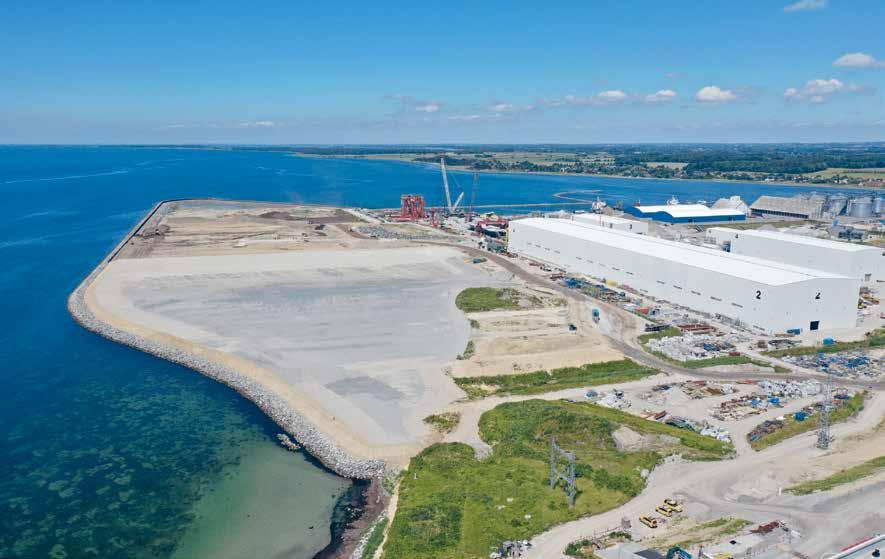
Today, she is working to commercialise e-SAF at scale. Arcadia’s proposition is, on paper, what many would call a ‘nobrainer’. They want to create net-zero fuels that work seamlessly in existing engines, pipelines and supply chains. The company is developing a handful of large-scale plants, each designed to produce 100 million litres annually, with sites already underway in Denmark, the UK and the US. Crucially, their process avoids fossil inputs altogether, marrying a range of proven technologies.
“The really obvious good news is that the planes don’t have to change,” Hebert explains. “We don’t need new engines or infrastructure. That’s what makes e-SAF so powerful – it can drop straight into the system we already have.” Her outlook is grounded in the practicalities of building supply chains and proving that the technology can move beyond pilot projects.
“The challenge is not whether it works,” she adds, “but how quickly we can produce enough to meet demand and reduce the overall cost.”
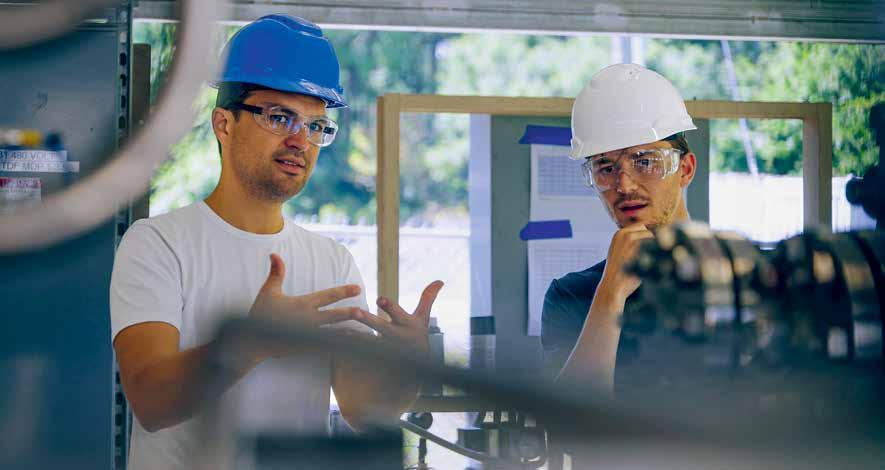
Meanwhile, Joe Rodden, the millennial co-founder of Lydian Labs, represents the next generation of innovators. Having cofounded the Cambridge, Massachusetts-based company in 2021, Rodden saw the potential of cheap renewable electricity to unlock something extraordinary: liquid fuel made from nothing more than CO2, water and energy. “You can make fuel anywhere in the world from CO2 and water,” he says. “That’s remarkably exciting for transport, security, defence – even space exploration. This kind of technology changes the way the world can think about energy altogether.”
“
We don’t need new engines or infrastructure. That’s what makes e-SAF so powerful – it can drop straight into the system we already have
“
Our goal is cost-competitive e-SAF without asking governments, airlines or consumers to pay more
Lydian Labs has already moved at remarkable speed, producing its first fuel product and commissioning a pilot demonstration. Its approach relies on novel catalysts and reactor designs that simplify production and cut costs, with lifecycle emissions reductions of up to 95%.
Compared to fossil jet fuel. Rodden’s conviction is that in the near future, e-SAF could not just compete with, but undercut conventional SAF on cost. “What the sector needs most right now is proof – plants running, fuel flowing and a glimpse of what the future looks like. Once people see that, they’ll get behind it.”
He is unflinching about the role aviation must play. While 2–3% of global emissions might seem marginal compared to other industries, Rodden is a strong advocate for continual innovation. “You can find lots of 2% problems,” he says. “They all add up to 100%. Everyone has to pull their weight if we’re going to solve this global issue.”
Both Hebert and Rodden are cleareyed about the hurdles ahead. Building supply chains at scale demands not only technology, but also capital, policy incentives and public understanding. Hebert stresses that government mandates and subsidies are critical in the near term. “Let’s not forget that the fossil fuel industry has long benefitted from enormous subsidies and grants,” she says. “What we really need is a policy framework that creates certainty, so producers can build plants and investors have confidence. Otherwise, we risk missing the bigger picture and the hidden costs of clinging to fossil fuels.”
Rodden echoes the need for incentives but cautions against long-term dependency. “Our goal is costcompetitive e-SAF without asking governments, airlines or consumers to pay more.”
Geography will also shape the future of the sector. Europe is driving forward with mandates, and regions such as the Middle East are leaning on abundant renewable resources. Denmark, a rare example of a nation that produces more energy than it consumes, has become prime ground for e-SAF plants.
Yet beneath the technical debate lies a deeper moral tension. Should we simply be flying less? Both Hebert and Rodden are united in rejecting that idea. Aviation remains fundamental to global connectivity and economic exchange, they argue, and limiting it is neither realistic nor desirable. “Flying on an aircraft shouldn’t have to come with guilt,” Rodden says. “Our aim is to make sure people can keep flying safely, affordably – and ideally without destroying the environment.”
Hebert agrees, adding that true success will come when e-SAF becomes so embedded in the system that it no longer warrants discussion. “By 2035, I hope SAF will be unremarkable,” she says. “It’s just fuel.”
Their shared vision is simple –a world where passengers continue to board flights without a second thought to what powers them. Neither claims that e-SAF is a silver bullet, but both are emphatic about the need to act now with the tools at hand. For them, the future of aviation will be defined not by aspiration and bureaucracy, but by action, scale and results.
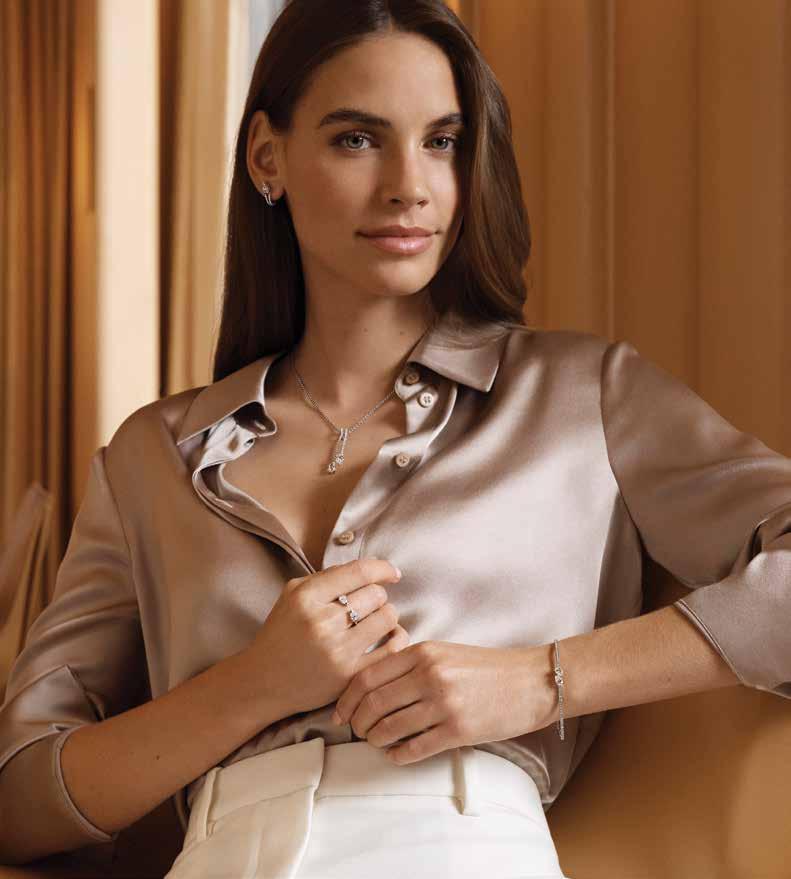
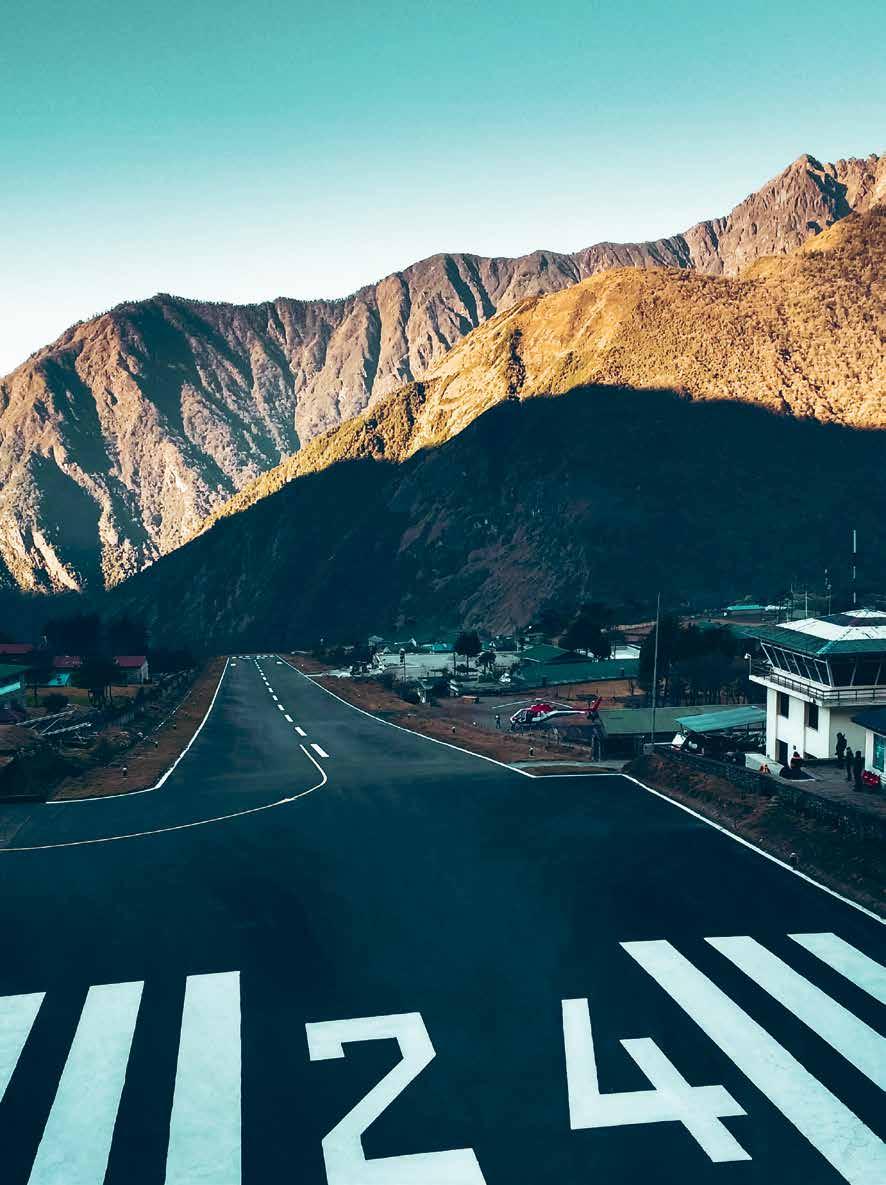
In today’s travel landscape, truly unique experiences that transcend the ordinary are increasingly rare. We highlight some of the most exceptional journeys and destinations that continue to push the boundaries of exploration and discovery
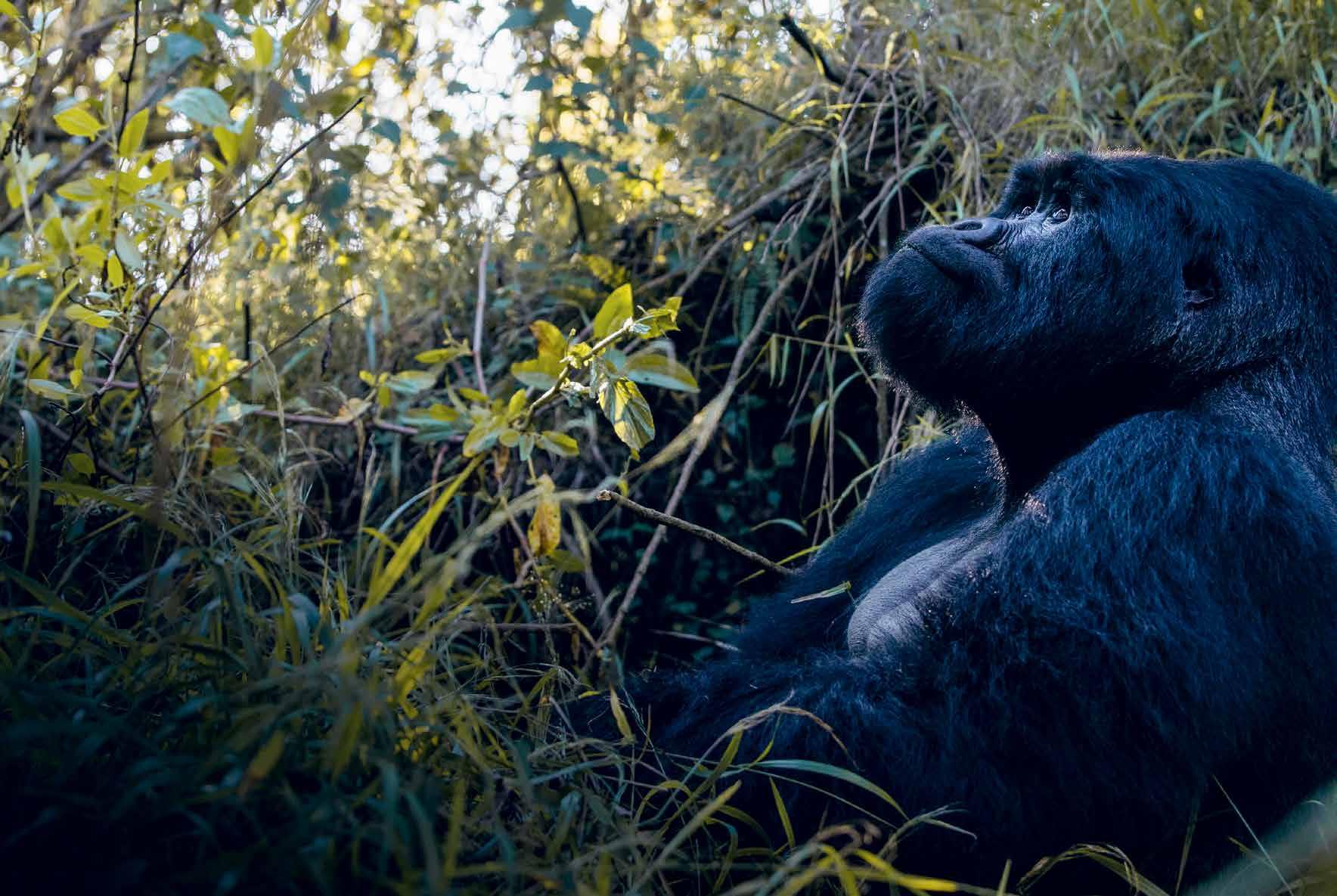
IN 1980, FEWER THAN 250 MOUNTAIN GORILLAS REMAINED IN THE WILD. THROUGH THE TIRELESS EFFORTS OF CONSERVATIONISTS AND THE SUPPORT OF A THRIVING TOURISM INDUSTRY, THAT NUMBER HAS QUADRUPLED. WE FLEW TO EAST AFRICA WITH VOLCANOES SAFARIS TO DISCOVER HOW THEY BALANCE ECO-LUXURY EXPERIENCES AND TANGIBLE CONSERVATION IMPACT
words > MAX STOTT
The journey to the Virunga Forest, home to one-third of the world’s mountain gorilla population, begins on a small farm on the lush slopes of Mount Nyiragongo, an active volcano. We are told the trek could last anywhere from two to eight hours, with no guarantee of a sighting. After all, these gorillas are among the rarest creatures on earth – scarcer than giant pandas, snow leopards and white rhinos.
However, from a conservationist’s perspective, the mountain gorilla stands as one of the great success stories of our time. In the early ’80s, just 248 remained. Their existence was on the precipice of vanishing within three generations, which placed them firmly in the ‘critically endangered’ category. Dian Fossey, the famed primatologist who dedicated her life to studying these animals, predicted they would be gone by 2000.
Since her death in 1984, the population has more than quadrupled. A recent census put the number at 1,063. They remain endangered, still vulnerable to disease, snares and the steady creep of farmland through which we are walking. But their story bucks the grim trend of biodiversity loss, thanks in large part to funding from the luxury tourism industry, which generates nearly $1 billion every year and 386,000 jobs in Rwanda alone.
Volcanoes Safaris, the company hosting me, has spent decades developing what its founder, Praveen Moman, calls “sensitive tourism”: a model that blends eco-luxury with tangible conservation impact. I’ve been invited to stay at their Virunga Lodge in Rwanda and their new Kibale Lodge in Uganda.
From the moment I arrived, it was clear what sets them apart from larger international chains present in the region. Every measure of the operation is designed with local impact in mind. Though the lodges are heavily protected, my driver explains that little security is actually needed: “The locals all understand the benefit we bring – all the employment, the opportunities, the financial impact. It’s great for the community.” The entire resort, including all the furniture, has been built by the local community. They also maintain a plethora of projects, from solar panels and water tanks to microfinance schemes.
The resort is positioned for arrival by helicopter, offering complete discretion, private lodges, daily massages and outdoor showers under the stars. On arrival, you’re
handed a smartphone, which is your direct line to your private butler at any hour.
A small critter in the room? Gone in minutes. A late-night craving for ice cream? At your door in under five. They even keep tabs on your hiking boots, ensuring they survive the trek unscathed. Mine returned to London looking newer than when I left (something my partner was all too quick to point out).
The butler service extends to your morning wake-up, but don’t expect a phone call. On my first morning, mid-toothbrush, I heard faint music drifting towards me. I pulled on some clothes, drew the curtains, and there was Peter, my butler, performing a traditional folk song in full a cappella. The performance continued as he entered and poured my first coffee of the day, greeting me with a beaming smile.
Despite such commitment to making these small moments memorable, there is still a sense that this is just the build-up to seeing the animals, who are the true stars of the show, with the staff and conservationists acting as mere supporting cast. There are also constant reminders that your stay here is not just about glamour and luxury, but that it is a contribution to a much greater cause.
Before trekking to see the gorillas, I was invited to the Kibale Lodge in Uganda, where Volcanoes partners with the Jane Goodall Institute and the Albertine Apes Alliance. There I met Dr Emily Otali, Africa’s first female primatologist with a PhD, who co-directs the Kibale Snare Removal Project and runs the Kibale Forest Schools Program. Her work is as much about people as it is about wildlife, weaving conservation into daily life through education and community outreach.
Her philosophy echoed what Dr Adrien Emile Ntwari of Gorilla Doctors shared one night by the fire in Rwanda. He recounted rescuing a baby gorilla whose wrist had been cut deeply by a metal snare. Without their intervention, it would almost certainly have died. Such rescues, carried out quietly beneath the forest canopy, are a side of the work most visitors never see, yet they are essential to every tourist encounter.
Those words followed me the next morning as we hiked through farmland and tangled forest paths, the air heavy with mist and anticipation. So when we finally came across our first gorilla, perched on a stone wall at the edge of a farm, the moment landed like a shock.
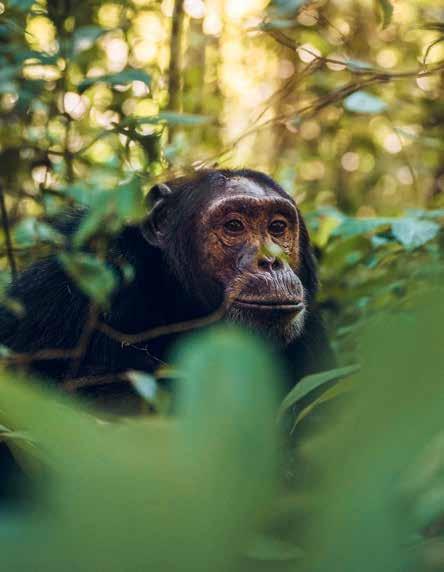
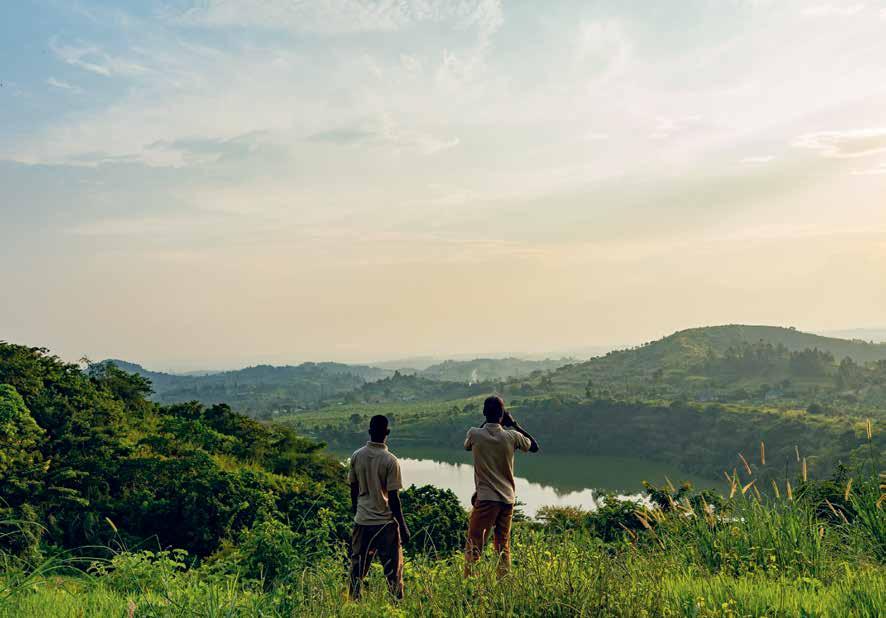
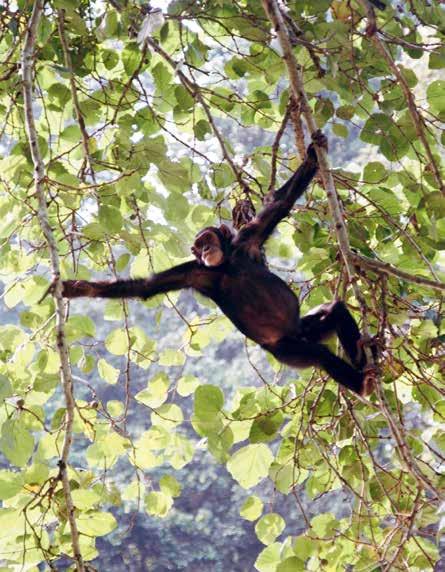
“
What we were doing here – fumbling through the forest as strangers in an unfamiliar land – is also the very thing helping to keep this fragile ecosystem alive
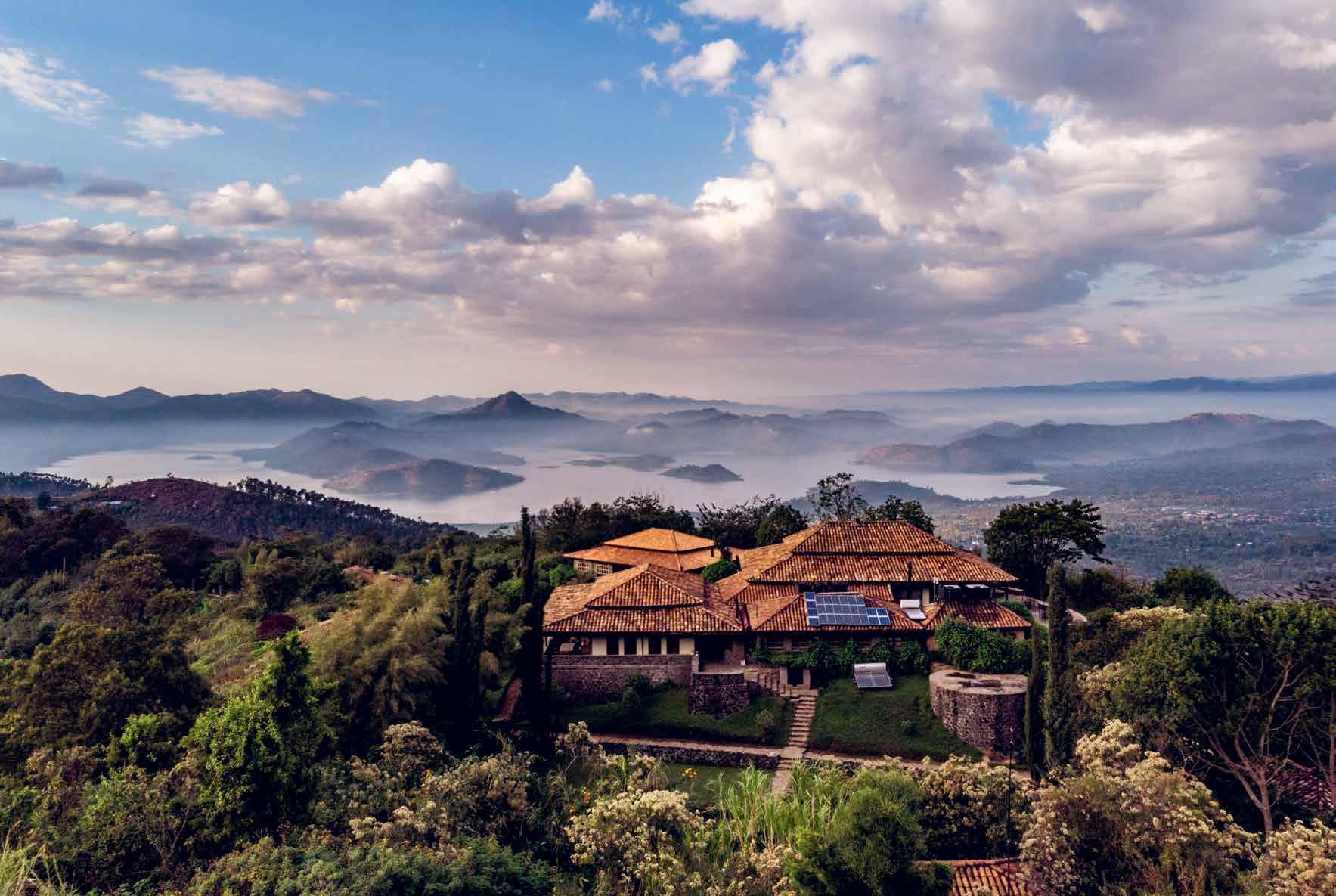
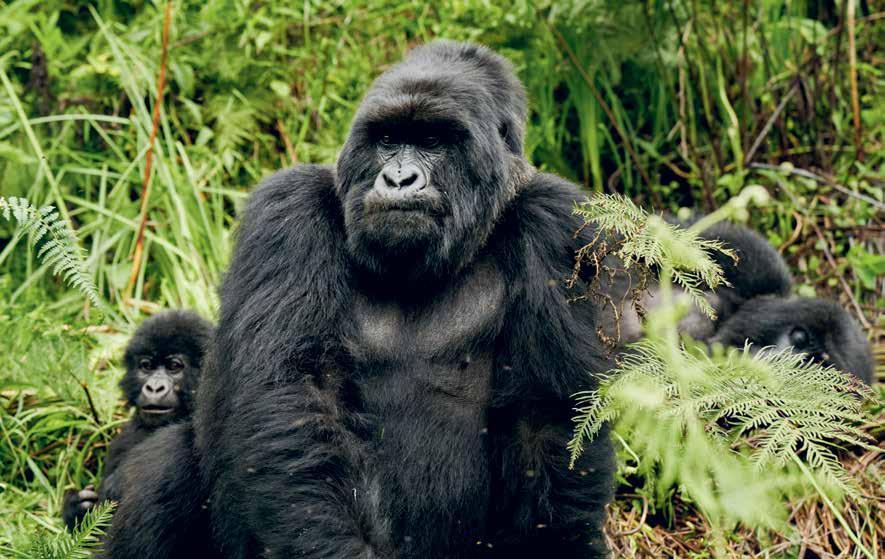
It doesn’t matter how many documentaries you’ve watched or zoos visited: nothing compares to standing face-to-face with these animals in their own territory. Without cages or barriers, the experience is visceral, unsettling and electrifying. Deep in the jungle, far from civilisation, your senses sharpen and adrenaline surges. In collective response to these sensations, the first reaction of our group was to lower our bodies, bow our heads and avert our gaze. The gorillas, meanwhile, remain at ease – unbothered, comfortable, almost indifferent to our presence.
This was our introduction to the Muhoza family, grazing casually on eucalyptus along the border fence. At the centre sat Marambo, the silverback, radiating serene authority. Mothers carried their infants, including one barely four months old, all spindly limbs and a comically oversized crown of hair. Juveniles tumbled from the undergrowth, springing and wrestling just feet from us, careless and joyous in a way only children can be. One photographer beside me clapped a hand over her mouth to stifle a squeal.
For half an hour, we stood transfixed, watching them roll, wrestle and chase. A young male arose theatrically on his back legs before collapsing, only to be pounced on
by two smaller siblings. Another clambered clumsily up a low branch. In their bubble, they seemed untouchable, as though the outside world could never breach this clearing. And yet, knowing what I knew, that illusion carried heartbreak; how fragile they are, and how quickly carefree play can be interrupted.
In the end, what lingers is not only the memory of the gorillas themselves, but also the intricate web of people, projects and principles that make those encounters possible. Conservation here is not a glossy add-on to luxury tourism, designed to simply soothe the conscience. It is the foundation without which neither lodges, staff nor animals would survive. Every butler, porter, doctor and conservationist is part of the same fragile chain holding back extinction.
Watching the juveniles tumble together, it is tempting but naïve to believe their world is safe, that the worst has passed. The reality is far more delicate and conditional. These forests remain contested spaces where decades of progress could be undone in a fraction of the time. What sustains them is vigilance, investment and recognition that privilege carries responsibility.
Paradise here is not a postcard idyll, but a barely living, breathing frontier. Precarious yet defiant, it is worth every single penny to protect.
How to get involved
Ruwenzori Foundation ruwenzorifoundation.com
Kibale Forest Schools Program kasiisiproject.org
Gorilla Doctors gorilladoctors.org
Dian Fossey Gorilla gorillafund.org
Jane Goodall Institute UK janegoodall.org.uk
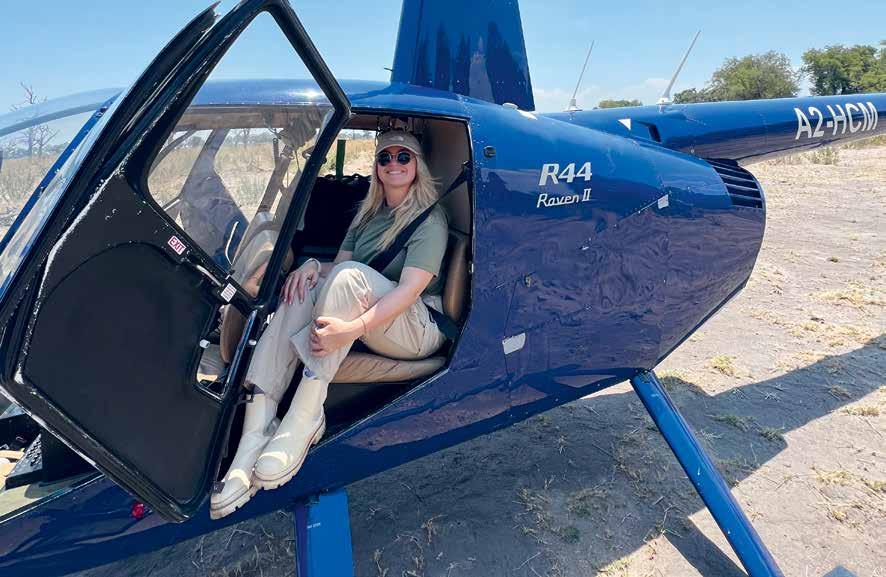
AFRICA IS A CONTINENT LIKE NO OTHER, AND SCOTT DUNN PRIVATE KNOWS HOW TO CRAFT A JOURNEY AS EXTRAORDINARY AND AUTHENTIC AS IT IS PERSONAL
images > VICTORIA REYNOLDS
There was a time when a safari was a straightforward thing: you went to see lions, leopards, elephants, buffalo and rhinos. You checked them off a list, like stamps in a passport, and went home with the story neatly wrapped up. That worked for a while. But the world – and the traveller – has changed. For those who have been almost everywhere and done almost everything, the checklist has lost its appeal.
“These days, adventure is less about collecting sightings and more about peeling back the layers of a place,” says Victoria Reynolds, Scott Dunn Private Membership Manager. “Our members don’t just want to look. They want to take part, to really connect with the people and landscapes they visit.”
Scott Dunn Private exists in that space between looking and living. We’ve spent 40 years perfecting our craft; knowing who to call, what strings to pull, and how to make extraordinary things happen quietly, seamlessly, without fuss. Scott Dunn Private members gain access to parts of Africa
most people will never see. And the magic comes not from a list of inclusions, but from the feeling that the trip could only ever have been yours.
Kenya is often where an African journey begins, and seeing it from above gives you a sense of its sheer scale. From a private helicopter, the Great Rift Valley stretches to the horizon – ridges, rivers and villages scattered across the landscape. The pilot knows every corner, pointing out places you’d never find on a map, like a narrow waterfall hidden between cliffs. When you land, there are no paths or crowds, just open space and, if you’re lucky, the quiet movement of wildlife nearby.
Madagascar has a completely different rhythm.
On Miavana, a small island off the northern coast, mornings might be spent snorkelling over vibrant reefs, while afternoons take you into rainforests where lemurs
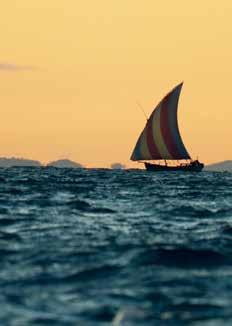
move through the trees. The island’s luxury is matched by its purpose. Through the Time + Tide Foundation, each visit helps protect local ecosystems and supports nearby communities, so that tourism plays an active role in keeping the environment healthy and sustainable.
Then there’s Zambia’s Liuwa Plain. Here, the wildebeest migration rivals the Serengeti, but without the convoys of vehicles or the crush of other travellers. In fact, there’s only one permanent camp in all of Liuwa Plain, which tells you everything about how remote it feels. There are no crowds here, no line of safari vehicles edging in for a better view –just you, the animals and an open landscape that seems to stretch forever.
Of course, Rwanda’s gorillas get plenty of attention, and for good reason – seeing them up close is unforgettable. But there’s more to this small country than the misty mountains and long jungle treks. In Nyungwe National Park, you can spend a morning in the tea fields, learning to pluck and brew leaves the way locals have for generations. And in Kigali, the Genocide Memorial offers a difficult but essential look at Rwanda’s past and how the country has rebuilt itself.
And how about skipping the land altogether? “Our members are also increasingly embracing what we call ‘safari-to-sea’ travel,” says Victoria. “After days in the bush, they want time to relax by the ocean.”
For laidback charm, the boutique hotels and idyllic Indian Ocean waters of Kenya’s Diani Beach are unparalleled. Our members are loving Kinondo Kwetu’s charming cottages and the luxurious Alfajiri Cliff Villa. Further north, UNESCO-listed Lamu is one of the oldest and best-preserved settlements in East Africa, surrounded by towering palms and snaking mangrove forests.
Behind these journeys are the people who make them possible. Over decades, Scott Dunn Private has built a network of pilots, guides, conservationists and local insiders who can open doors most travellers will never see. “It’s all about who you know,” says Victoria. “These relationships can’t be found online or booked with a click. They’re built on trust and shared experiences over many years.”
Many members also want their travel to have meaning beyond the personal. They may spend a day with researchers tracking endangered species, support wildlife restoration work, or visit a community initiative making a tangible difference in local lives.
“These aren’t staged activities,” Victoria explains. “They’re authentic exchanges, and they leave a lasting impression – both for our members and for the people and places they connect with.”
While members are out exploring, our global team of travel specialists work quietly in the background. Permits are secured, transfers arranged, and countless details aligned so that even complex, remote travel feels simple.
“Africa will always deliver the iconic moments – the wildlife, the sunsets, the vast open spaces,” says Victoria. “But what our members remember most are the experiences they couldn’t have planned themselves. Those personal stories that stay with you long after you’ve come home.”
To learn more about becoming a member of Scott Dunn Private, contact Victoria Reynolds on Victoria.Reynolds@scottdunn.com

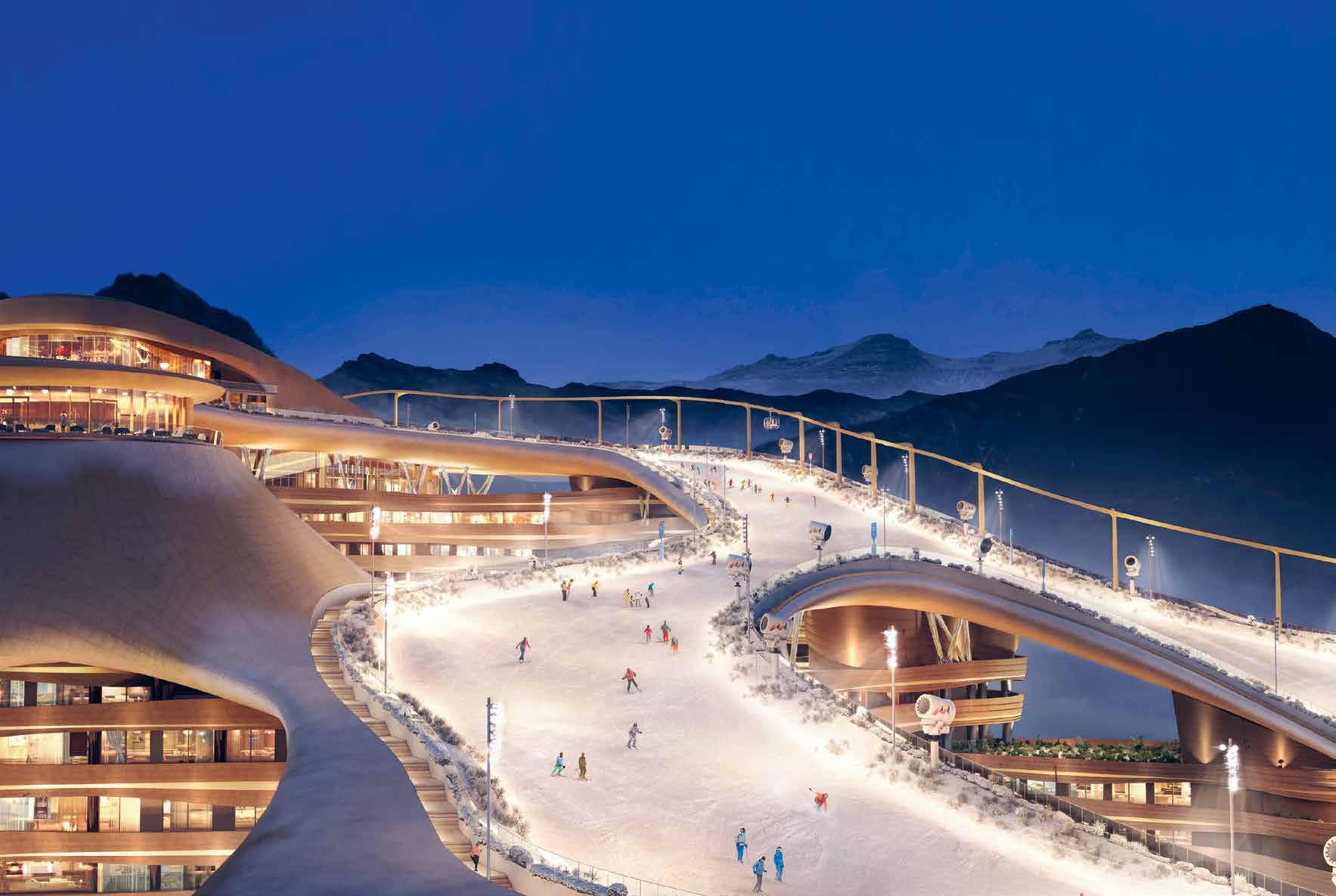
ACROSS CONTINENTS, HUMAN INGENUITY IS BRINGING SNOW TO PLACES NATURE NEVER INTENDED. WE SPEAK TO THE PEOPLE BEHIND THESE REMARKABLE PROJECTS – AND FIND OUT HOW THEY ARE AIDING THE SKI INDUSTRY’S SEARCH FOR SOLUTIONS IN A WARMING WORLD
words > ALEX MOORE
Temperatures are rising faster in the Alps than almost anywhere else in Europe. Since the 1970s, the ski season here has shortened by more than a month, with snow arriving later and melting sooner. In France alone, more than 180 ski areas out of 400+ have closed in the last 50 years, according to the French Ski Federation. The longterm picture is even bleaker. The World Meteorological Organization (WMO) predicts that by 2060, the ‘zero-degree line’ – the altitude at which snow can reliably settle – will rise to 1,500m, almost double today’s 850. This means that for bustling resorts operating below that threshold, like Courchevel, Ischgl, and Les Gets, the clock is ticking. In the United States, exclusivity has become the hedge against retreating snow and growing crowds. Resorts such as Montana’s Yellowstone Club, whose members include Tom Brady, Jennifer Lopez and Mark Zuckerberg, or Utah’s Powder Mountain, bought by Netflix founder Reed Hastings
in 2023, sell the promise of quiet pistes and fresh tracks long after a storm.
Despite their altitude, these private ski resorts do rely heavily on artificial snow. According to the International Commission for the Protection of the Alps (CIPRA), producing 2.5m³ of artificial snow requires nearly 1,000 litres of water. That adds up to around one million litres per hectare of skiable slope, and in warm or sunny conditions, these volumes may need to be replenished multiple times a week.
To put this in perspective, Les Trois Vallées, including Courchevel, spans around 10,500 hectares of skiable terrain. Covering it in artificial snow would require roughly 10.5 billion litres of water per season – equivalent to the annual consumption of nearly 80,000 UK households. That is enough to supply more than the London borough of Chelsea and Kensington, for an entire year.
For almost all resorts, there is also a second issue,
“
Standing at the peak of this human-made mountain makes me curious and excited to see what ideas this summit may spark in the minds of future generations ”
namely the need to balance artificial snowmaking with local water demand, a challenge felt even by Verbier in Switzerland, despite the fact it sits above one of Europe’s most abundant fresh water reserves.
Building snow in one of the world’s driest regions raises bigger challenges still. In Saudi Arabia, Trojena is one of the country’s Vision 2030 ‘gigaprojects’ – a futuristic ski resort currently under construction in the mountainous part of the NEOM region that will offer year-round outdoor skiing and adventure sports. Water for artificial snow will be pumped 250 kilometres from a desalination plant at NEOM port to a manmade lake at the foot of the pistes. Using new high-recovery reverse osmosis membrane technology, the plant is expected to supply the entire region. Within 10 years, it is believed the plant will be able to process up to 1,000,000m³ of water a day.
“Everything we’re doing is through the lens of sustainability,” says Clark Williams, Director of Marketing and Communications at NEOM. “Since we’re actually building the slopes at Trojena, we have the foundations for irrigation systems, so 70% of the meltwater will be recycled.
“The mandate is that we only develop 5% of the land – and that’s a hard stop,” he adds. “So I’m basically taking a typical mountain village – think Verbier or Zermatt and all of their amenities – and putting it all into one building. Other than making a really interesting architectural asset, it uses way less land mass.”
Not convinced? The project is slated for completion in 2026 and has already secured the 2029 Asian Winter Games.
Trojena is just the latest, and arguably the most highprofile, ski resort to be fashioned out of bricks and mortar. In 2019, the Danish architecture firm Bjarke Ingels Group unveiled CopenHill, the world’s cleanest waste-to-energy plant, in Copenhagen. Perhaps more notable, however, was the dry ski slope running down its roof to the waterfront.
“My son turns one next month, and he won’t ever remember that there was a time when you couldn’t ski on the roof of the power plant,” Ingels said at the launch.
“Standing at the peak of this human-made mountain that we have spent the last decade creating makes me curious and excited to see what ideas this summit may spark in the minds of future generations.”
Some of the world’s leading architects have followed suit, erecting ski slopes in major cities around the world. China has been particularly proactive since hosting the 2022 Beijing Winter Olympics. Its 50th indoor resort, Shanghai L+SNOW, opened in September 2024. The $2 billion development is the largest in the world, with 100,000 square metres of piste – the equivalent of almost 14 football pitches and six times
bigger than the only indoor ski centre in North America, Big SNOW American Dream in New Jersey. It is so vast that skiers must take a gondola to reach the summit, which also serves to enhance the authenticity of the experience.
Still, Shanghai L+SNOW will not be the world’s largest indoor ski resort for long. Shenzhen has a bigger project in the pipeline. Due for completion towards the end of 2025, Huafa Snow World will sit at the heart of Qianhai Bay, the city’s burgeoning tech hub. Photovoltaic panels will cover 40,000 square metres of sloping roof, expected to generate more than 7 million kilowatt hours of electricity – enough to power nearly 2,000 UK homes for a year.
“Advances in technology are enabling us to create greener and more sustainable urban ski facilities, serving a broader skiing community in densely populated urban areas,” says Javier Perea, Principal at 10 Design, the international architecture firm leading the Shenzhen project. “These facilities can also reduce the collective carbon footprint from individuals who used to travel long-haul to ski at the more remote mountain resorts.”
Purists may very well dismiss these man-made solutions as gimmicks, yet the reality is unavoidable. Snow is retreating, and with it the traditional idea of skiing as an alpine-only pursuit. The future of the sport is pointing towards exclusive clubs for those who can afford it, mega-projects in improbable landscapes, and vast indoor arenas for the masses. By 2050, the Swiss Federal Institute for Snow and Avalanche Research predicts that many Alpine resorts below 1,800 metres will lose up to 80% of their snow reliability. Against that backdrop the question is no longer whether or not skiing evolves, but how it will evolve and the degree to which it can remain accessible to all.
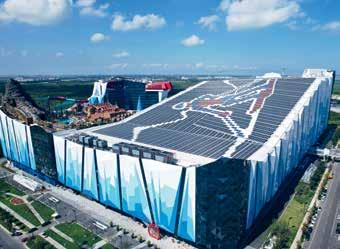
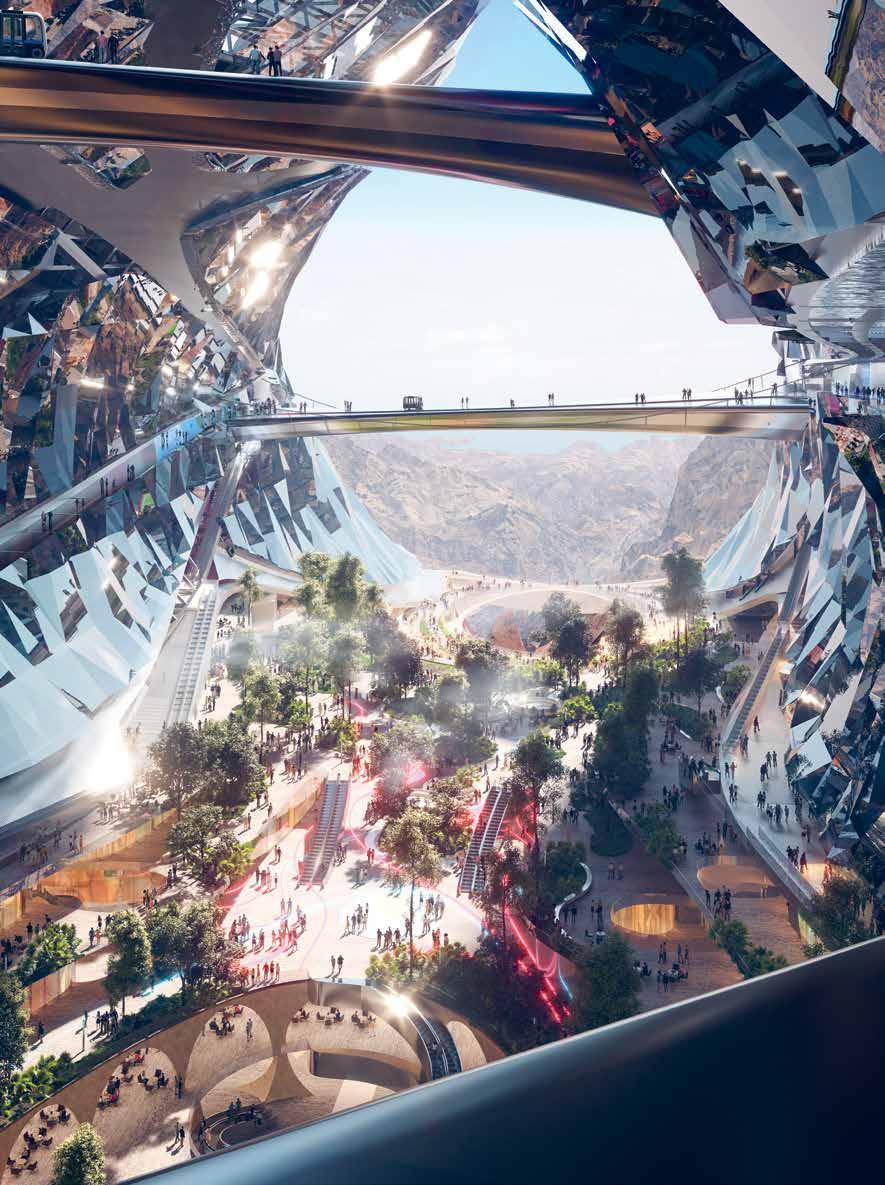
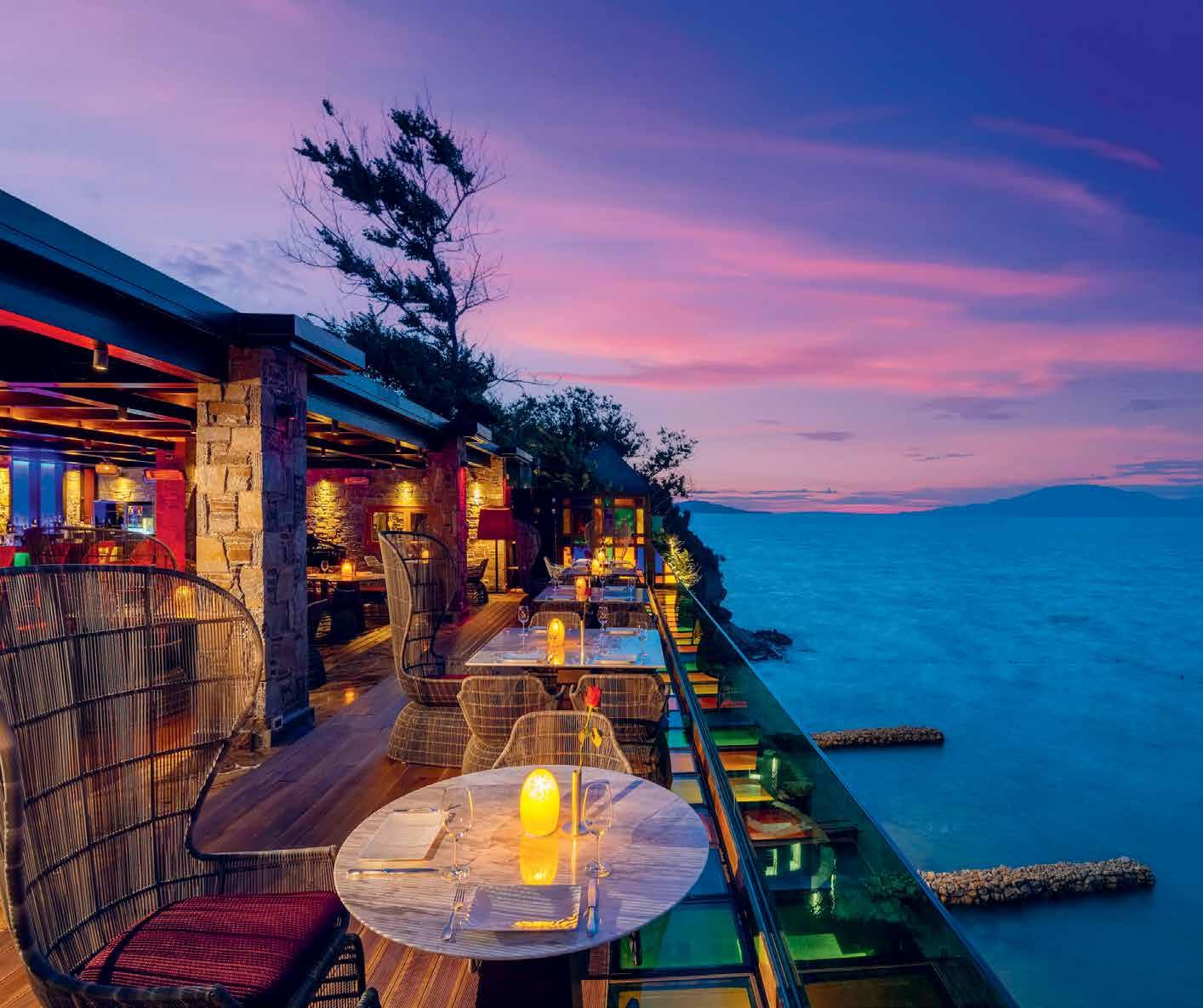
words > MAX STOTT
The ultra-luxe Porto Zante Villas & Spa has a reputation that precedes it. On Zakynthos, an island crowded with international five-star chains, this family-run resort of just nine villas has managed to stand apart. Awards such as Europe’s Leading Villa Resort and World’s Best Family Hotel confirm what its 95% occupancy rate (even through the pandemic), already suggests. There is something exceptional at work here, and so I decided to visit the resort myself to uncover the secrets of its success.
Our journey began with the complimentary chauffeur transfer, a short 30 minutes from the private jet terminal. On arrival the resort feels deliberately hidden. There are no signs, no sweeping drives, no grand entrance. Porto Zante feels less like a hotel and more like an ultra-private enclave.
After a seamless check-in we were given a quick tour of the grounds and our villa. The layout is simple, with one- to four-bedroom villas, each with its own pool, private garden and outdoor living area. The design is understated, akin to what you might find in the Maldives but with a distinctly European chic and a few bold contrasts. Whether you are in the one-bedroom Deluxe Spa Villa or the sprawling Imperial Spa Villa with its own guest house, every property feels like a private estate.
Our first stop was the private beach, a sheltered strip reached by a path cut into the cliff. Here, we found five members of staff on constant standby, ready to anticipate our every need and comfort. A fluffed pillow was slipped behind my head before I lay down, an umbrella adjusted the moment I tilted against the sun, a Bellini appearing on a silver tray just as I thought, “could this get any better.”
The surprises and delights continued. While at the beach I mentioned in passing that my shirts were creased after a rather intrusive security check at the hands of an overly enthusiastic baggage clerk at the airport. When we returned to the villa before dinner, every garment had been pressed, hung and made ready for the evening.
We chose to have our first meal at the Club House, set on a clifftop terrace soundtracked by a live pianist and the undulating waves. The waiter promised the kitchen would prepare anything our hearts desired. He told the story of a guest who spotted a tuna while snorkelling and asked to have it on his plate that same evening. We opted instead for something more traditional – a Greek mezze. As someone who has lived in the Mediterranean for over two decades, I can say with conviction this was among the best seafood I have ever tasted.
The octopus in particular, a dish even top restaurants so often overcomplicate, was grilled in simple garlic butter that perfectly complemented its delicacy.
The following night we visited the resort’s other restaurant, Maya, which offers Michelin-level Mediterranean and Asian fusion. Fresh fish and lobster
come straight from the fishermen’s catch, while many of the herbs and organic products are sourced from the resort’s own private estate. The Royal King Crab tartare was the standout dish. It arrived meticulously presented, the sweetness of the meat lifted with citrus and seasoning.
The next morning we decided on a slow start. At Porto Zante, breakfast arrives on your schedule, served under a shaded pergola beside your private pool. A single ring of the in-room phone put us through to staff, who entered through a hidden doorway to lay out the table without knocking or breaking the calm of the morning. Within minutes it was transformed into a lavish spread of still-warm pastries, pancakes stacked high and eggs Benedict with rich, bright Béarnaise.
Beyond the stillness of the villas, the water is the main draw for activities. Electric jet skis give parents a fun option to explore the coast, while younger guests can spend the day at the kids’ club with crafts, games and beachside activities. For those wanting to venture further, Porto Zante offers yacht charters to hidden coves, neighbouring islands or the Zakynthos
Marine Park, where loggerhead turtles nest. Between late July and October you may even see hatchlings scrambling to the sea, a rare and remarkable experience.
Weeks later, what stays with you is not the private staircases that vanish into the water or even the remarkable dining. You may come here first for privacy and discretion, but you return for the people. Vasily, the charismatic sommelier, who turns bottles into stories of lineage and history. Artemis, the lead masseuse, who sets you at ease with her soothing aura before she begins her treatments. Georgios, the mixologist, who treats cocktails as high craft. His Ionian Harmony, vermouthbased and delicate, distils the timeless essence of the region.
Porto Zante has elevated service into an art. The approach is precise, anticipatory and attentive. It is the intimacy of this service, impossible to replicate at scale, that sets the resort apart. This is a place where every detail is handled for you, and the rest of the time is left quietly, and deliberately, your own.
portozante.com
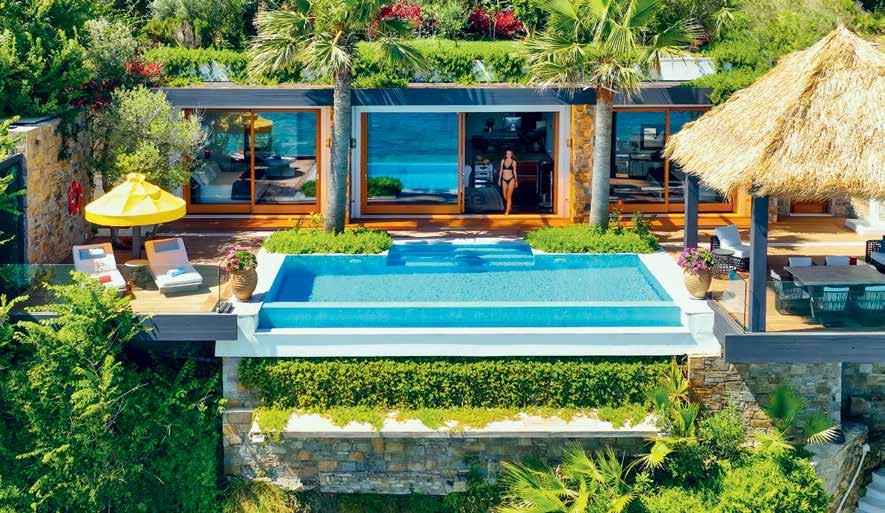

When you fly close to the speed of sound, you can see a dawn that never ends.
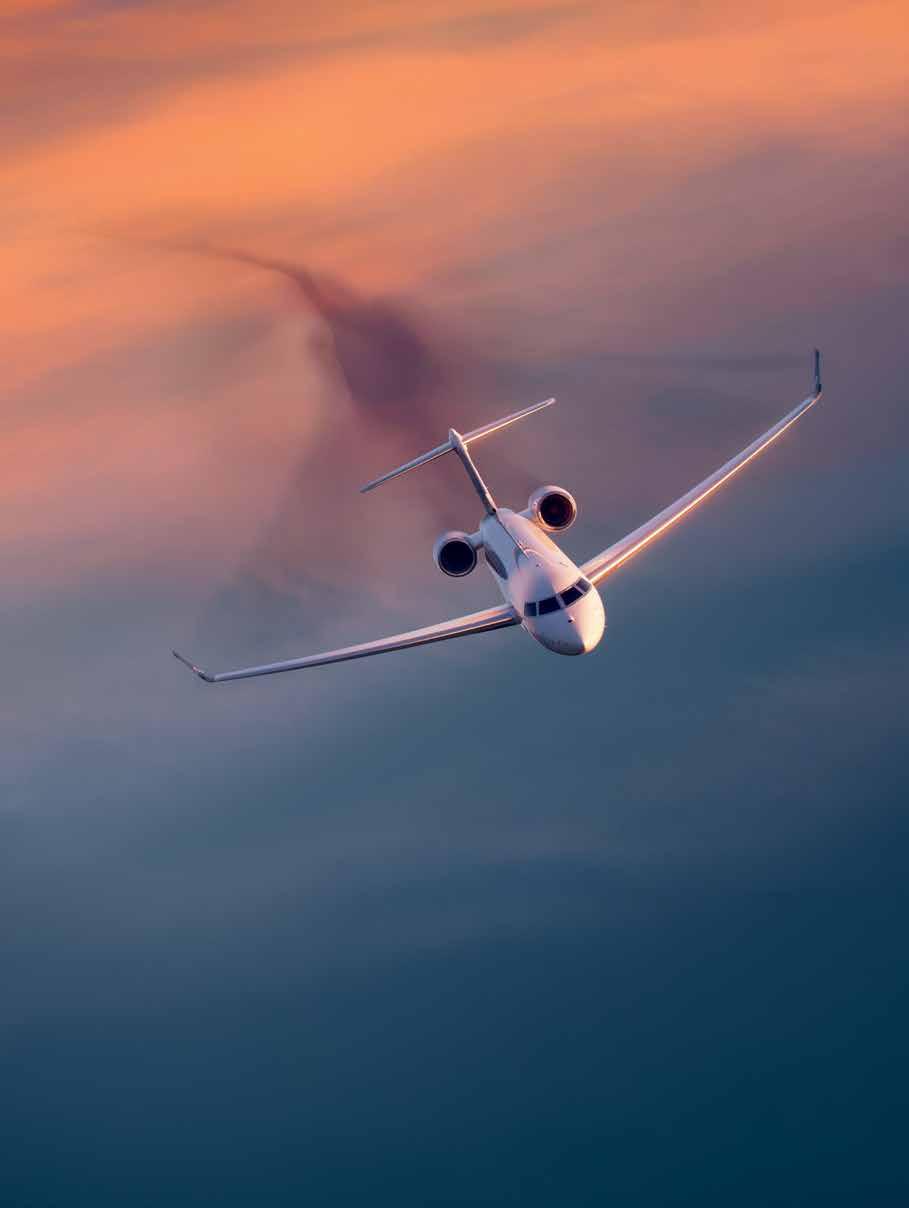
Introducing the Bombardier Global 8000
The world’s fastest private jet