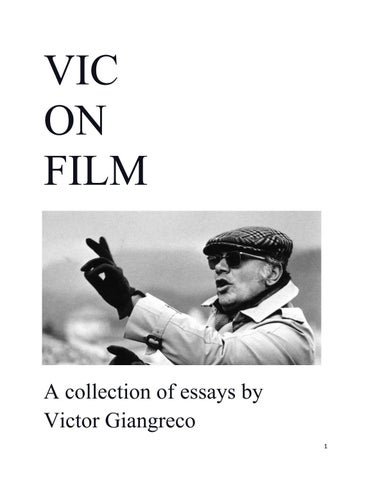
VIC ON FILM
A collection of essays by Victor Giangreco 1
Smooth Talk: When an Adaptation Makes Too Many Changes When it comes to adapting books to the big screen there are likely to be major changes added to the original story. This could lead to masterpieces like Andrei Tarkovsky’s Stalker and Alfred Hitchcock’s Psycho. Sadly, that is not always the case. With Joyce Chopra’s Smooth Talk, the many changes made from Joyce Carol Oates’ Where Are You Going, Where Have You Been? Brings the film down from potentially being a great movie due to its more conventional and less ambiguous approach to the story. The film begins at the closest point stylistically to the story. When the original story is this anywhere anytime style containing a tone relevant for the rebellious youth of the 1960s. Smooth Talk shifts its setting to the pop music, tacky clothing, and bright lights of the 1980s. For as dated as it could be it is a testament to how this story can be told from any time or place which easily becomes the best quality it has. Yet, even in these early moments’ things start to differentiate between page and screen. The first particularly noticeable difference is how the dad in the movie talks. In Where Are You Going, Where Have You Been? the dad is summed up with the sentence “Their father was away at work most of the time and when he came home, he wanted supper and he read the newspaper at supper and after supper he went to bed.” And that could not be any bigger difference to the dad’s character in the movie. With Smooth Talk, there are entire scenes with just the dad and Connie that are completely absent from the story such as one where he talks to her at home outside on a quiet night. This is part of a reoccurring problem with the film in how it takes a terrifying story of teenage youth and puts it into a more subdued drama about Connie’s life at home. As the movie progresses the mom even becomes a large departure from the book. In the beginning, the mom is saying line for line what is in the story like “Hair spray? I don’t see your
2
sister using that junk.” But later as tensions and events such as the added plot of Connie needing to get a paint roller while at the mall, the mom becomes a softer and more lovable character even if they can be stubborn at times. Changes like these added scenes and character dynamics create a thinner line between Connie’s life inside and outside the home, making for a less engaging movie. In the story, there is a very distinct difference between how Connie acts at home with her mom and June, to the life she has outside spending time together with her friends and making love. It is another part of where Smooth Talk becomes more of a conventional 80s drama than an adaptation of Joyce Carol Oates’ story, keeping it from being as great of a movie as it could be. Easily the biggest change between the story and the film is their endings. Joyce Carol Oates based the character of Arnold Friend off of the serial killer Charles Schmid and ends with Connie opening the door and going to Friend’s car that could implicate a rape or murder. The film changes this to show that Connie is ok after a car ride and ends on a much more optimistic note unlike the haunting and ambiguous ending of the original. There is also a supernatural element to the story with the appearance of Arnold Friend changing before Connie’s eyes does not exist in the adaptation. Take, for example, this sentence from the story that states, “His smile faded. She could see then that he wasn’t a kid, he was much older-thirty, maybe more.” That visual information of Arnold Friend’s face changing is not well realized in the movie but could benefit to add more to the already intense scene that it is. On top of that, the film shows the character of Ellie just leaving the car and staying at Connie’s home which, is an odd moment to see play out even if the viewer has not read the story. The ending of the film not only changes its overall meaning but, also removes all of the ambiguity and supernatural elements that make the original ending great.
3
Given these points, the changes made in Smooth Talk removes elements from Joyce Carole Oates’ short story and instead adds plot points, character dynamics, and a difference in endings making for a poor adaptation of its source material and a more conventional drama than it should have been. Again, changing what is in the source material for a film is not always negative but, for a case like Smooth Talk, it could be a much better movie if it did.
4
The Origins of Film Noir Crime, romance, detectives, criminals, smoke, shadows, neon lights, bars, rich mansions, snappy dialogue, and dirty streets. These are typical elements of what is in a film noir. It could be a genre, a movement, a style, but what is known is that it is a recognizable trait in films since the 1940s and even a bit earlier. So how did this type of narrative and look in films start and how did it change until the late 1950s where its golden era ended? First, there was the German expressionist movement. In the 1920s and early 1930s, German filmmakers like Fritz Lang, Robert Wiene, and F.W. Murnau changed the way of how movies could look. Movies such as M and The Cabinet of Dr. Caligari used distorted images, sharp shadows, and dutch angles making the films far away from reality compared to other movies made at the time. German filmmakers like Billy Wilder, Max Ophuls, Robert Siodmak, and even the above-mentioned Fritz Lang would make noir movies in America even if they were not associated with the expressionist movement in Germany. In 1930s France, the movement called French poetic realism had heightened aesthetics with a focus on telling stories about the working class and criminals in society. An example would be Julien Duvivier’s Pepe Le Moko which told the story of a gangster on the run. The style of the film used heightened aesthetics and a form of sympathetic criminal storytelling that would later become a staple for film noir. In Marcel Carne’s Port of Shadows, there is a striking use of fog and a romance that seems close to the way Hollywood would start making noir films just a few years later. Jean Gabin who played the lead in both of these films would later go to play as a gangster and criminal in several noir movies for decades through the 1970s.
5
The United States in the 1930s also had factors from which film noir’s style would emerge. German director Josef Von Sternberg went to make numerous films with Marlene Dietrich in the 1930s including Shanghai Express that created an atmosphere of darkness, cigarettes, and romance with its unique use of lighting. The gangster movies at the time also helped create film noir. An example of this would be Howard Hawk’s Scarface, a violent film even today, with its use of sound and shadows heightening what is going on in the movie. With Sternberg’s light and Hawks’ darkness, the emergence of film noir was soon to come. In 1941 John Huston’s The Maltese Falcon was released. The point where all critics and scholars typically say is the start of film noir. Humphrey Bogart plays the private detective Sam Spade in a mystery thriller adapted from a Dashiell Hammett novel who would be one of the three main authors a large number of film noirs would be adapted from or inspired by. Another author named Raymond Chandler co-wrote Billy Wilder’s Double Indemnity from 1944. It would be one of the definitive examples of film noir and helped lead this style to its popularity due to its success. The source material from James M. Caine (the third main noir author) contains a style of storytelling that is very much a part of what we now know as film noir. The plot centers around an insurance salesman and a now typical femme fatale character played by Barbara Stanwyck trying to get away with murdering her husband by accident to get more than the face value of his insurance due to the double indemnity clause. It is thrilling and romantic with fast dialogue, Venetian blinds, and the setting of a large Spanish colonial-style house in Los Angeles. Another Bogart detective story is Howard Hawk’s The Big Sleep an adaptation from the Raymond Chandler novel of the same name. The confusing story seems to stay in the background compared to the relationship between the two leads being Humphrey Bogart and Lauren Bacall. Take for example this quote that Bogart’s character Philip Marlowe states after
6
Lauren Bacall talks about not liking his manners, “I don't mind if you don't like my manners. I don't like them myself. They're pretty bad. I grieve over them long winter evenings.” This kind of writing is what would be used until the 1970s with detective movies like The Long Goodbye and Chinatown. As the decade continued stories of mystery, revenge, and crime continued ranging from small towns to urban hellscapes, the surreal and the real, and the further pushing of boundaries against the Hollywood system with its heavy implications of sex and increasing use of violence. In the 1950s film noir became more stylish and brutal than ever. The low-budget 1950 film Gun Crazy contains on-location shooting with a plot involving a crime spree from lovers on the run. It remains today one of the most thrilling and influential movies ever made. A notable section of the movie included a long take inside the car as a bank robbery went on and the female lead trying to keep a police officer distracted. It becomes removed from the past norm with studio sets and lighting with a more realistic look by filming at real places. Another movie that utilizes on-location shooting is Samuel Fuller’s remarkable Pickup on South Street. Instead of telling a straight story of communists, pickpockets, and the police every side is looking for a small strip of film containing government secrets for distinct reasons. With tight closeups, fights with no edits, pulp-style dialogue, and strong characters, Fuller created a social commentary for its time with a tough film noir look. One thing audiences and critics point towards being the last noir movie of the classic era in the 40s and 50s is Orson Welles’ Touch of Evil. Welles was always known to be one of the greatest directors and Touch of Evil in its fully restored version is one of his best. Instead of still shots being edited back and forth between people and scenes, Orson Welles and cinematographer Russel Matte created a film filled with movement and unconventional shots. As if the look of film noir while still recognizable was warped and
7
changed at the closing of a decade in 1958. Even today the film’s long takes, and crane shots are some of the most impressive the medium has seen. The story itself involves a crooked and rough-looking police captain named Hank Quinlan who plants evidence and tries to frame others in a border town between the U.S. and Mexico. His corrupt nature is what leads to his downfall but instead of it just being a positive outcome for everyone else they show an understanding and melancholy seeing a man go down this low especially from Marlene Dietrich’s character Tanya who sees him as an old friend instead of an enemy. As characters like Hank Quinlan spiral downward, the classic era of noir begins to end. By 1960 film noir completely changed with more color, violence, sex, new directors, and fewer censors. Yet, the influence from this period of two decades is immeasurable with a change of visuals and storytelling to movies that can still be seen in films today.
8
The Formation and Impact of The French New Wave During the late 1950s and early 1960s, the most important film movement came and went. This was the French New Wave (also known as La Nouvelle Vague). The ideas and filmmaking techniques from this group of filmmakers have forever changed the landscape of movies and its impact can still be felt on the big screens today. After World War II, France received films from the United States that consist of what are now old Hollywood classics. These films from directors like Alfred Hitchcock, John Ford, Orson Welles, and Nicholas Ray became immensely popular with audiences and critics in France. Henry Langlois screened and curated many of these films to the future French New Wave directors who would often meet each other for the first time in Langlois’ Cinémathèque Française. Another leading figure of this movement would be Andre Bazin, who led the magazine Cahiers Du Cinema. Andre Bazin is also credited for contributing to the auteur theory which was made by film critic Andrew Sarris. The theory is based on the idea that directors are the equivalent of authors for movies in which they leave their own personal style to a film. Going back to Cahiers Du Cinema the writers for it include Eric Rohmer, Jean-Luc Godard, Francois Truffaut, Jacques Rivette, and Claude Chabrol who would all go on to be a part of the French New Wave. The earliest examples of the French New Wave are unclear on what should be considered the first film from the movement. It could be Agnes Varda’s La Pointe Courte, Claude Chabrol’s Le Beau Serge, or Louis Malle’s Elevator to the Gallows. But it is considered to start around the late 1950s. Easily the biggest successes of this movement came out in 1960 being Jean-Luc Godard’s Breathless and Francois Truffaut’s The 400 Blows. Breathless utilizes handheld on-location cinematography, low budget, little to no script, and unconventional use of 9
jump cuts that continue to influence a large number of films and tv. The 400 Blows also uses more modern editing techniques, including the freeze frame, but it is used to effectively tell the story of rebellious youth that is deeply personal and semi-autobiographical of the director’s own life that goes to help prove the auteur theory. Another notable film from the French critics at Cahiers Du Cinema is Eric Rohmer’s My Night at Mauds. The film explored themes of existence, ethics, religion, politics, and love through long, meaningful, and engaging conversations. It is opposed to filmmaking conventions from long ago and the popular one at the time. These movie-obsessed critics from Cahiers Du Cinema paved the way for modern-day editing and narrative in film. The other side of the French New Wave is known as the Left Bank Group. These directors were not obsessed with movies and typically older. They were not against the other group of filmmakers and collaborated quite often. Directors from this group include Chris Marker, Agnes Varda, Alain Resnais, and Jacques Demy. Chris Marker’s short film La Jetee created a science fiction story with mostly still images, narration, and music that was quite different from any other approach being done with the movement. Agnes Varda’s Cleo from 5 to 7 displayed the anxieties of possibly having cancer with a real-time trip around Paris, using fast cutting, changing from color to black and white, and on-location cinematography. The Left Bank while being a different group of filmmakers they are still on the very modern and innovative side of the French New Wave and left an impact on film in a comparable way. The French New Wave does not have a specific stopping point as a majority of the directors continued making films for the rest of their lives including Jean-Luc Godard who is currently still making movies. However, by the May 1968 protests in France from political issues and Henry Langlois being fired, the landscape was changing, and the movies changed to reflect
10
that. Around the mid to late 1960s the movement ended, yet the lasting impact of the French New Wave spread everywhere. Nearly any movement with a new or wave in the title was strongly influenced by the films of the French New Wave and created new visions, stories, and styles. A terrific example of this influence can be found in Sam Peckinpah’s The Wild Bunch, a New Hollywood film in which shootouts are done with fast-paced cuts, loud gunshots, and even a little bit of slow-motion added in to create some of the most memorable montages made in Hollywood. For a more recent example, Wes Anderson’s newest film, The French Dispatch, shows a bike ride with obvious intentional use of stage lighting and colors reminiscent of the opening of Jean-Luc Godard’s Pierrot Le Fou, where Jean-Paul Belmondo and Anna Karina sit in a car as lights of primary colors move past them as if they were streetlights. Despite the movement ending, its influence can still be found in movie theaters today. From critics to curators, the people involved in the French New Wave helped pave the way for modern filmmaking. These low-budget and on-location films used a style of editing and storytelling to set themselves apart from others while also studying and appreciating the classics. The movement was an explosion to the film world, and it still is a large number of incredible movies that continue to inspire audiences and critics alike.
11
Francesco Rosi: Truth Within Historical Narratives In a day and age where historical narratives based on real-life people come out as lazy Oscar bait and the occasional good movie, there is an aspect to the films of Francesco Rosi that is unlike either of these sides. Through Rosi’s attention to realism, non-linear structures, and an ongoing search for the truth, the films come out as tastefully done depictions of real-life figures that are unlike most modern movies today. To put into perspective where Rosi’s place is in the world of Italian cinema, he was a part of a group of post-neorealist filmmakers following the influential Italian Neorealism movement of the 1940s and 1950s. Salvatore Giuliano is a film about a Sicilian outlaw and political fighter. The movie utilizes real locations and nonprofessional actors that were in the events depicted. Instead of using a set or unrelated location, Rosi shows the Sicilian landscapes and small towns for what they were. When Francesco Rosi was interviewed by Cineaste magazine on using nonprofessional actors he stated “where the women rush from their homes to the town square to protest the army's arrest of their husbands and sons, these women had been involved in the actual events. I knew that involving them in the film would provoke a huge emotional response, a remembrance of what had happened to them.” (Crowdus). Akin to the documentary filmmaking aspects of previous Italian Neorealist films, scenes are effective in providing a convincing depiction of real historical events. Similar to the jumbled timeline Orson Welles uses with Citizen Kane, Rosi frequently uses a disordered chronology of events in his films. In his 1973 film Lucky Luciano, it chronicles the life of the father of modern organized crime in the United States known as Charles ‘Lucky’ Luciano. Throughout its entirety, time is frequently being switched back and forth. From agency
12
investigations into the mafia to showing scenes of mafia dealings with the US during World War II within a single cut. Homages to gangster movies such as slow-motion shootouts are delivered next to tense dialogue-driven scenes. Fanciful dinners cut next to police questionings and investigations into those same people. With this style of editing, Rosi questions the political and economic aspects in which the film is set in. Not only does it keep the film at a fast-moving pace but also contextualizes scenes that are right next to each other, even if they are a decade apart in time. The search for truth is arguably one of the biggest points director Francesco Rosi wants to make in his films. Even in an interview, he states, “I always felt an urgency to make a type of cinema that would help understand the reality of things” (Vivarelli). His film The Mattei Affair is without a doubt his greatest display of this. A good portion of the movie is a documentary seamlessly woven into the biopic on the head of ENI known as Enrico Mattei. The documentary section of the film looks into a journalist hired to find out about Mattei’s last two days in Sicily who was disappeared and killed by the mafia during the making of the movie. The director himself investigates these events by asking questions about Enrico Mattei and the disappearance of journalist Mauro De Mauro. This investigation along with interviews and an explanation of the global oil market, make it one of the most accurate and impactful biopics. The way Rosi combines documentary and narrative within an investigative perspective creates a compelling film that is willing to challenge audiences with its unanswered questions. That is not saying that newer biopics or historically based movies are not good. In recent years there have even been great ones. Pablo Larrain’s Spencer is an incredible film displaying the inner conflict of Princess Diana with an exceptional performance from Kristen Stewart and a score from Johnny Greenwood. However, the film does not go out to seek the truth 13
as much as Rosi’s films. Spencer is a movie depicting three days of Princess Diana's life that is based on rumors, real events, and figures. Pablo Larrain takes artistic liberties to tell this dramatized story. As Rosi states in an interview, “Why fabricate something just because it makes for more spectacular cinema and an easy way to grab the audience? No, I have all the room I need in my films to interpret the reality and this is the important thing for me, the interpretation of facts” (Davis). In another recent film, however, Vice attempts to pull off a political biopic with a non-linear structure but is poor in comparison to Rosi’s efforts. It is tonally confused in attempts at humor and to crack at the current political climate. Instead of being a compelling film on Dick Cheney, it is lacking in the open-ended perspective and truth found in The Mattei Affair. The ambiguous and fact-driven approach from Rosi is the most tasteful way to do a historical narrative as it goes for the facts instead of looking into rumors. Fractured timelines, realistic settings, and an all-around different thought process of making films sum up the style of Francesco Rosi's films. An innovator who challenges, provokes, and asks questions in politically charged environments with stories that feel as real as they can be. His way of making biographical films remain unmatched over 50 years later.
14
Works Cited Crowdus, Gary. "Francesco Rosi: Italy's postmodern neorealist." Cineaste, vol. 20, no. 4, Oct. 1994, pp. 19+. Gale OneFile: Fine Arts, link.gale.com/apps/doc/A16456180/PPFA?u=brewste&sid=bookmarkPPFA&xid=8706d2b5. Accessed 6 Dec. 2021. Davis, Natalie Zemon. "Film as Historical Narrative." National Forum, vol. 81, no. 2, spring 2001, p. 16. Gale OneFile: Fine Arts, link.gale.com/apps/doc/A79058973/PPFA?u=brewste&sid=bookmarkPPFA&xid=8d6e6886. Accessed 6 Dec. 2021. Vivarelli, Nick. "Rosi's realism right in Lion's den." Variety, vol. 428, no. 3, 27 Aug. 2012, pp. 26+. Gale OneFile: Fine Arts, link.gale.com/apps/doc/A302297854/PPFA?u=brewste&sid=bookmarkPPFA&xid=34edb2dc. Accessed 15 Dec. 2021.
15