the newsletter of emmanuel college – winter 2012
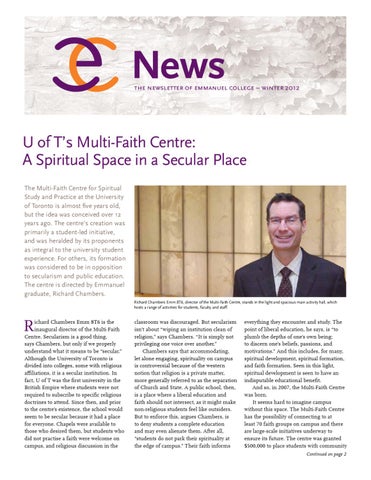
U of T’s Multi-Faith Centre: A Spiritual Space in a Secular Place The Multi-Faith Centre for Spiritual Study and Practice at the University of Toronto is almost five years old, but the idea was conceived over 12 years ago. The centre’s creation was primarily a student-led initiative, and was heralded by its proponents as integral to the university student experience. For others, its formation was considered to be in opposition to secularism and public education. The centre is directed by Emmanuel graduate, Richard Chambers. Richard Chambers Emm 8T6, director of the Multi-Faith Centre, stands in the light and spacious main activity hall, which hosts a range of activities for students, faculty and staff.
R
ichard Chambers Emm 8T6 is the inaugural director of the Multi-Faith Centre. Secularism is a good thing, says Chambers, but only if we properly understand what it means to be “secular.” Although the University of Toronto is divided into colleges, some with religious affiliations, it is a secular institution. In fact, U of T was the first university in the British Empire where students were not required to subscribe to specific religious doctrines to attend. Since then, and prior to the centre’s existence, the school would seem to be secular because it had a place for everyone. Chapels were available to those who desired them, but students who did not practise a faith were welcome on campus, and religious discussion in the
classroom was discouraged. But secularism isn’t about “wiping an institution clean of religion,” says Chambers. “It is simply not privileging one voice over another.” Chambers says that accommodating, let alone engaging, spirituality on campus is controversial because of the western notion that religion is a private matter, more generally referred to as the separation of Church and State. A public school, then, is a place where a liberal education and faith should not intersect, as it might make non-religious students feel like outsiders. But to enforce this, argues Chambers, is to deny students a complete education and may even alienate them. After all, “students do not park their spirituality at the edge of campus.” Their faith informs
everything they encounter and study. The point of liberal education, he says, is “to plumb the depths of one’s own being; to discern one’s beliefs, passions, and motivations.” And this includes, for many, spiritual development, spiritual formation, and faith formation. Seen in this light, spiritual development is seen to have an indisputable educational benefit. And so, in 2007, the Multi-Faith Centre was born. It seems hard to imagine campus without this space. The Multi-Faith Centre has the possibility of connecting to at least 70 faith groups on campus and there are large-scale initiatives underway to ensure its future. The centre was granted $500,000 to place students with community Continued on page 2
cover story Continued from page 1
organizations to foster interfaith projects with young adults across the GTA. In its first year, about 25 events were hosted there weekly; now 55 events take place every week. So while the student experience continues to be defined by the classroom, it seems that it is no longer bound only by it. The notion of the “whole student” has always been alive and well at Emmanuel. The advantage to being a theological student is that one’s faith is expected to inform one’s education and even oneself. For Chambers, his theological education at the College allowed him to visit a variety
The presence of the Multi-Faith Centre is a tangible sign that students can raise religious questions. Chambers recalls a visit to U of T by an ambassador from South Africa who came to speak in support of apartheid during the 1980s. Many students, not only Emmanuel students, were outraged. But most students did not know how to balance their desire for free speech on campus with their abhorrence of the ambassador’s own politics. Fortunately, Emmanuel students were able to take a leadership role in terms of thoughtful and ethical reflection. It is good to have free speech—even if
The advantage to being a theological student is that one’s faith is expected to inform one’s education and even oneself. of churches and take classes with a variety of students—some with different religious backgrounds and some from different faculties. He recalls his time at Emmanuel with a fondness and remarks that the notion of religion informing education was, in some ways, radical at the time. The freedom to let religion inform an opinion was something that students in other faculties felt they could not exercise.
that speech is controversial—but not if in allowing it, another voice’s group is silenced. The ambassador did come to campus, but he did not have “a happy day.” The Emmanuel College students held a worship service on the front lawn of the College and formed a choir of singing protestors. This type of event illustrates how religion can co-exist with a liberal education and a common student experience.
For more information on the Multi-Faith Centre and its tranquil spaces, please visit www.multifaith.utoronto.ca.
2
winter 2012 | ec news
After graduating from Emmanuel, Chambers went on to do graduate work in applied ethics at Harvard University and cognitive and moral development in young adults, receiving a ThM in 1988. Since then, he has held a variety of positions within the United Church of Canada, most recently as the associate executive minister of justice, global and ecumenical relations. While he could not have foreseen the eventual birth of the centre as a student at Emmanuel, he has always been interested in young people and in people of all faiths. His experience coordinating the General Council’s federal advocacy work, combined with his own deep faith, worked together to make him an ideal director for the centre. The Multi-Faith Centre has already had an immeasurable influence on many students, faculty and staff at the University of Toronto. The university encourages students to visit the centre, noting on their website that: “Although the University of Toronto is a secular institution, we recognize that faith is an important part of many students’ identities and adds richness to our diverse campus.” While he was a student at Emmanuel, Chambers may have taken for granted how his faith influenced his graduate studies and his ministerial vision. Fortunately, now all students of every college are able to enjoy and exercise this educational right.
principal’snewsline message
2012: End of the World or Cause for Celebration? by mark g. toulouse f you google “end of world 2011,” you will get more than 4.6 billion hits. The magnitude of this number is likely due to radio evangelist Harold Camping who predicted the end of the world on May 21, and then October 21, 2011. If you search “end of world 2012,” you already get around 1.3 billion hits. I predict that these hits will actually surpass the number achieved for 2011 before the end of this year. Why? The fascination with end-of-the-world scenarios grows every year, but in 2012 there is an additional growth factor. Many believe the Long Count calendar of the Maya predicts the end of the world in 2012. The calendar enabled the marking of historical events that happened over spans of time longer than those covered by their shorter calendars. Scholars agree that this calendar will “run out” after 5,126 years, which happens this year, on December 21. So did the Maya really predict the end of the world in 2012? Some believe they did and that a natural catastrophe is going to happen this December. Most scholars, however, have argued that there is no notion of doomsday in the culture. Instead, the Maya generally celebrated the end of cycles created by calendars. Likely, they meant for the calendar to begin anew, after 5,126 years. They believed there was a cycle before this one and were likely comfortable with a cycle to follow. Rather than taking the catastrophic view of 2012 based on doomsday theories and misinterpretations of an ancient calendar, I prefer to emphasize the theme of celebration, a theme often associated with the beginning of a new year! Certainly 2012 has begun with a number of things to celebrate at Emmanuel. Enrollment remains strong this year with nine new students joining us in January, seven of them as MDiv students. The thoughtful support of our graduates is also a reason to celebrate. The total support of our Annual Fund is ahead of where it was last year, and the College has benefitted from a number of legacy gifts this past fall. The number of graduates beginning to think in terms of legacy gifts is definitely growing. These gifts provide major support both for the College and for our students. A recent example of the work of one of our MTS graduates illustrates the point. Elizabeth Anne Sabiston Vic 9T1, Emm
Photograph: Peg McCarthy
I
9T4, past president of United Church Women in Toronto, and a lay minister at both Timothy Eaton Memorial and Metropolitan United, always expressed a genuine interest in supporting students at Emmanuel College. While on the Emmanuel Alumni Association Executive, Elizabeth helped to create the United Church Women’s 40th Anniversary Award, a fund that is well on its way to $100,000. In addition, she left a bequest in the form of scholarship support at the College of more than $200,000 to support the work of future Emmanuel students. We are deeply appreciative of the legacies left by people such as Elizabeth. They provide strong personal examples because they have sought to live out the gospel through their own ministries. Elizabeth and others like her have extended those legacies by providing financial support through their estates, dedicated to educating the next generation of ministers. We are proud of the fact that so many of our graduates are known for a lifetime dedicated to serving others. We are honoured that a large number of our graduates remember Emmanuel and other worthy causes with their generous financial support. Such generosity is certainly worth celebrating, in this year or any other year, on anyone’s calendar!
Rather than taking the catastrophic view of 2012 based on doomsday theories and misinterpretations of an ancient calendar, I prefer to emphasize the theme of celebration, a theme often associated with the beginning of a new year!
winter 2012 | ec news
3
news
Ten Years after 9/11
O
n November 2, Emmanuel College hosted a colloquium entitled Reflections on Interfaith Relations Ten Years after 9/11. Michael Bourgeois, vice-principal and associate professor of theology, acted as moderator and the three guest speakers included: Johnson Mbillah, general advisor, Programme for Christian-Muslim Relations in Africa, and Anne Duncan Gray Visiting Scholar, Emmanuel College; Nevin Reda, independent scholar and instructor in Emmanuel’s Canadian Certificate in Muslim Studies; and Tom Reynolds, associate professor of theology, Emmanuel. Mbillah, who was with the College from September to December 2011, spoke about the reality of Africa as a religious continent in ways that Europe and North America are not. He discussed how it is in the mutual interest of people of different faiths to find ways to live and work together, citing in particular the example of Muslim-Christian relations in Kenya. Reda discussed the legal aspect of religious diversity in various Muslim countries and how citizenship and religion are variously related in different countries. Reynolds discussed Christian-Muslim relations in Canada, and the United Church of Canada’s report That We Should Know Each Other as one recent example of constructive conversation. All three speakers worked toward the colloquium’s goal of increasing inter-religious understanding.
An Insight into Canada and its United Church The United Church of Canada: A History has just been published by Wilfrid Laurier University. Remarkably, all but four of the essays in the book are written by friends of Emmanuel and Vic. Current faculty members with writing credits for the text include Emmanuel’s Michael Bourgeois, vice-principal and associate professor of theology, William Kervin Emm 9T4, associate professor of church and society at Emmanuel College, C.T. McIntire and Alan Davies, both professors emeriti of Victoria and the University of Toronto’s Department for the Study of Religion. Emmanuel’s own Crucified Woman statue makes an appearance on the cover. Chapters on worship styles, theology, ministry, and global and cultural relations are included. To purchase the book, please visit www.wlu.ca/press/Catalog/schweitzer.shtml.
4
winter 2012 | ec news
Johnson Mbillah and Tom Reynolds
Emmanuel College hosts two colloquia per school year. Students must attend one colloquium per year of basic degree study, and this non-credit requirement focuses on issues that transcend particular course or degree requirements. The colloquia address topics relevant to contemporary contexts of theological education and ministry and are intended to enrich community life, deepen theological integration, and foster spiritual and vocational formation.
Off to Camp Principal Mark Toulouse is set to be the evangelist for Berwick United Church Camp this summer, from July 27 to August 5, 2012. Joining in the fun is a contingent of Emmanuel faculty and graduates: Tom Reynolds, Emmanuel’s associate professor of theology and camp Bible study leader; Mark Ruhnke Emm 1T0, music leader; Bronwyn Corlett Emm 1T0, youth leadership; and Jennifer Canning Emm 1T0, youth leadership. Berwick Camp is located in Berwick, Nova Scotia, and is one of the longest running religious camps in North America, celebrating 141 years. Learn more about the traditions of Berwick Camp and available volunteer opportunities at www.berwickcamp.org.
newsline news
The Gift of Laughter The Emmanuel College Student Society presented worldrenowned scholar Paul Scott Wilson Vic 7T2, Emm 7T7 with a light-hearted gift at this year’s advent celebrations—a t-shirt emblazoned with “The Sermonator.” Wilson, a professor of homiletics, has been teaching at Emmanuel for 30 years. His research interests include the history of preaching, rhetoric and poetics, creativity and use of the arts, homiletic methodology, theology of and theology in preaching, and uses of narrative. Here’s to many more years serving the Emmanuel community!
Emmanuel Students Travel the Globe
S
heryl Johnson, Cynthia Breadner, and Sandra Jenkinson have been accepted to the third annual Global Institute of Theology (GIT), sponsored by the World Communion of Reformed Churches, and held in Yogyakarta, Indonesia, from June 8 to July 1, 2012. The GIT provides theological students and faculty from around the world with the opportunity to learn, teach and practise theology in a culturally diverse setting and from an ecumenical perspective and relating this to local, regional and global contexts. All students are enrolled in a core course, as well as two electives. This year’s theme for the core course is: “God of life, revitalize our spirituality, our theology and our praxis.” It is GIT’s hope that this type of educational event will result in the formation of a new generation of ecumenically minded church leaders and strengthen ties among its member churches across the globe. And although our Emmanuel students will be on the other side of the world, they will run into some familiar faces. Peter Wyatt Vic 6T6, Emm 8T3, associate professor emeritus and past principal of Emmanuel College, will be serving as dean of GIT. Joan Wyatt Emm 8T6, assistant professor emeritus of Emmanuel College, will be GIT chaplain. For more information, download the GIT brochure at www. presbyterian.ca/webfm_send/6614.
Bill Blaikie Book Launch
E
mmanuel College celebrated the release of The Blaikie Report: An Insider’s Look at Faith and Politics on November 3. Authored by Bill Blaikie Emm 7T7, the book offers a unique insider’s perspective on political life in Canada. With a foreword by former Minister of Foreign Affairs Lloyd Axworthy, Blaikie reflects upon three decades in the House of Commons from the perspective of a United Church minister.
Open House for Prospective Students Is somebody in your life exploring faith or interested in a theological education? Why not tell them about Emmanuel College’s open house event “A Day with Emmanuel” on Saturday, March 3! Experience a day in the life of the college and attend mini-lectures and worship from 9 am to 5 pm. Please register online at www. emmanuel.utoronto.ca/prospective/events/register.htm. This is a wonderful opportunity to explore Emmanuel’s academic opportunities and experience its community life.
winter 2012 | ec news
5
faculty voice
Forming and Sustaining Worship Communities in Antiquity … and Today by Judith H. Newman
O
ne of the dimensions of faculty life at Emmanuel that I relish is our participation in the larger institution of the Toronto School of Theology. We have not only the added benefit of students from other colleges in our classrooms, but also the richness of a larger cohort of faculty to expand collaborative teaching and research opportunities. During the past months, I have been pleased to launch a research project with my New Testament colleague at St. Michael’s College, Colleen Shantz, who studied under my Emmanuel colleague, Leif Vaage. We share an interest in community formation in early Judaism and formative Christianity. We plan to investigate the ways in which new groups were enabled and enhanced through prayer and other embodied practices. She has written an award-winning book, Paul in Ecstasy: The Neurobiology of the Apostle’s Life and Thought (Cambridge, 2009) in which she explained the cognitive neuro-scientific basis of Paul’s religious experiences, often labeled mystical, ecstatic, or charismatic. These experiences that lie beyond words were transformative for Paul and inform much of his talk of life “in Christ.” His letters not only make reference to his experience, but also to the life of the new congregations he was busy cultivating. His writing is laced with prayers and blessings and descriptions of congregational life. The letters themselves were read in the churches in order to shape them. My own writing has focused on prayer and scripture, so that’s where our work intersects. I still have unfinished business from my first book, Praying by the Book: The Scripturalization of Prayer in Second Temple Judaism (Atlanta, 1999). The basis for my study was the observation that prayer became an important feature of life in early Judaism. In contrast to earlier texts of the Hebrew Bible, later texts are full of prayers and accounts of people praying. The books of Daniel and Esther, for example, were extended in their Greek versions by the addition of prayers. We see examples of this in the Gospel of Luke in the Prayers of Mary, Zechariah, and Simeon. Prayer and worship were also important to the communities associated with the Qumran movement in Palestine. Of the 800 or so texts found among the Dead Sea Scrolls, roughly 20 percent are prayers, hymns, and psalms. As one example, the Songs of the Sabbath Sacrifice have been thought to reflect the mystical experience of members who understood themselves as praying with angels. In short, the abundant textual evidence of prayers is clear, but their social context remains to be mapped. Since Jesus, Paul,
6
winter 2012 | ec news
and their first followers were Jewish, they likely shared many of the same rituals and practices of others of their day, not to mention structures of group organization. The questions we will ask of antiquity are also relevant to today’s sometimes beleaguered and diminished churches. How did prayer and worship engage individuals and shape new communities? What kind of imagery in sermons, prayers and hymns was instrumental? What role do “charismatic” leaders play in attracting and sustaining membership in fledgling communities? On the assumption that the biological makeup of human beings has not changed terribly much in the past 2000 years, we hope to answer these questions in ways that are informed by contemporary studies of neuroscience as well as psychology and social anthropology. As the old saw goes, two heads are better than one, especially when studying brain science! I look forward to working with my colleague to develop some answers. No doubt we will also be tapping other faculty in liturgy, religious studies, and other disciplines. Our students will help us think, too. Access to the fabulous library resources and talented staff of the University of Toronto, which has the third largest collection among North American universities, is a special privilege and boon for us here. Where will our joint work take us? Stay tuned. Judith Newman is an associate professor of religion and Old Testament/Hebrew Bible at Emmanuel College.
milestones
Achievements Douglas H. Barr Vic 6T5, Emm 6T8, president and CEO of Goodwill Southern California was presented with the Kenneth K. King Outstanding Management Award for Executive Excellence during Goodwill Industries International annual delegate assembly in Rochester, NY. The award recognizes a CEO whose performance consistently demonstrates strong organizational impact related to mission, excellence and sustainability. Douglas can be reached at dbarr@goodwillsocal.org. Kent Garrett Emm 9T9 is almost 75 years young. He invites all to attend The Journey of Life in Words and Music on Sunday, June 10, 2 pm at St. David’s United Church in Woodstock, Ont. If you would like to attend, please call 519.421.2064 or e-mail kdjg@execulink.com. Doug Martindale Emm 7T6 retired from politics after 21 years as a Member of the Legislative Assembly of Manitoba. He has
completed his first term as a sessional lecturer at Booth University College and in September will be teaching at Providence University College.
Rev. Lt. Colonel Leslie (Potts) Dawson Emm 8T7 is a chaplain in the Canadian Forces. She has been highly recognized by the military for her work in Afghanistan and other tours of duty. She currently holds a senior executive position within the Chaplain General Office.
Births To Brigid Maya Brathwaite Emm 0T8 and Kevin David Brathwaite, a daughter, Olivia Amélie Elise, on December 18, 2011, in Toronto.
Deaths Helen Ross Jones Emm 0T0, in Toronto, on February 18, 2011.
Are you a member of the Class of 9T2? This year marks the 20th anniversary of graduation. Get together with fellow classmates and professors for a special worship service and dinner on June 15, 2012 at Emmanuel College. Please contact Stefanie Rosar at stefanie.rosar@utoronto.ca, or 416-585-4503, for more information.
milestones Alumni are invited to send information for inclusion in Milestones. For marriages, please indicate, if applicable, whether you prefer to be known by your married or birth name. An obituary must accompany death notices.
Emmanuel Days May 9-10, 2012 Preaching in a Windstorm: Speaking Gospel in a Fragmented, Spiritually Restless Age We live in a time when the world bristles with communication, when we may be overwhelmed by messages— Tweets, Facebook exchanges, political rhetoric, rival claims to wisdom and truth. We also live in a time when the reliable contexts of preaching— church, biblically aware hearers, stable culture—have eroded. Thomas Long’s two presentations will explore how preachers can speak gospel with confidence and clarity in the midst of this windstorm. This event brings preachers and hearers together to explore how the Gospel is spoken and heard.
Keynote Speaker:
Rev. Dr. Thomas Long Professor of Preaching at Candler School of Theology, Emory University
Workshop Leaders: Rev. Dr. Anthony Bailey Senior Minister at Parkdale United Church in Ottawa
Rev. Dr. Emily (Rodgers) Bisset We hope you come back to Emmanuel this spring!
Grad Year: Vic
Minister of Knox, Oshawa
Emm
Name (Please add title and/or maiden name if applicable) Address City Telephone:
Province
Postal Code
E-mail:
Please include my e-mail address in my Milestones notice.
Or e-mail your Milestones news to emm.alumni@utoronto.ca.
winter 2012 | ec news
7
continuing education and coming events
MARCH
Holy Ground: Pastoral Care of the Dying and Bereaved with Anne Simmonds Caring for and supporting dying and grieving persons is a critical aspect of pastoral ministry for which clergy often feel ill-prepared. This workshop combines the “very personal face” and “immediacy” of caring for the dying and bereaved as well as a theoretical and theological basis for this work. Friday, March 23 and Saturday, March 24, 10 am to 5 pm, Emmanuel College. Workshop fee $175. Register by March 15. APRIL
Religion and Public Policy: An Ecumenical Conversation with Ofelia Ortega Suárez, Barbel Von Wartenberg Potter and Janice Love Emmanuel College has been fortunate to have Lois Wilson in our midst as distinguished minister in residence since 2010 and previously as ecumenist in residence for the Toronto School of Theology. In celebration of Lois’ 85th birthday, we are hosting a full-day celebration in honour of her ministry and mission among us. Wednesday, April 18, 9:30 am to 6 pm, Emmanuel College. Please contact Betsy Anderson for more information. Navigating the Hazards of Church Leadership with Roy Oswald Few clergy will deny that their ministry in congregational settings can be hazardous to their personal health and their relationships with their spouse and children. This workshop will focus on working “smarter,” not harder, and include some self-care strategies that really work. We will also focus on leadership styles that enable lay
leaders to take on increasing amounts of the ministry in the congregation. Saturday, April 21, 10 am to 4 pm, College Ave. United Church, Woodstock. Workshop fee $50. Register by April 12. Emotional Intelligence and Human Relations Skills with Roy Oswald This five-day program is designed to enable participants to learn about, build and practise emotional intelligence skills. Skilled facilitators provide tools and feedback to enable participants to learn about themselves and to immediately practise emerging skills. Workshop participants complete a comprehensive self-assessment. Monday, April 23 to Friday, April 27, Emmanuel College. Workshop fee $800. Register by April 12. Social Justice and Human Rights Conference Co-sponsored by the ICS Centre for Philosophy, Religion and Social Ethics, and Emmanuel College, the conference will feature keynote lectures by Dr. Nicolas Wolterstorff of Yale (“What is Justice and Why does it Matter?”) and Dr. Melissa Williams of the University of Toronto (“Linking Fates Together: New Political Imaginaries of Justice and Democratic Rights”). For more information please visit conference.icscanada.edu or call 1-888-326-5347. April 27 to 28, Emmanuel College.
Please forward address changes or items for Milestones to emm.alumni@utoronto.ca or Victoria Alumni Office • 73 Queen’s Park Crescent Toronto ON M5S 1K7
winter 2012 | ec news
The Natural City: An Invitation to Co-Creation with Stephen Scharper In this century, for the first time in history, more people live in cities than in rural communities. Our scripture uses many images of City. Where do we find God in the city and how can we connect God’s love for the city with our present ecological challenge, including “urban sustainability?” How do questions of urban ecology interface with the broad and growing intersection of the religion and ecology movement? We will explore the city and these questions in the course of our “visioning.” Saturday, May 12, 10 am to 4 pm, Emmanuel College. Workshop fee $95. Register by May 4. JUNE
More Than Franchises: A Fresh Brew with Phyllis Tickle, Douglas Todd, Martha Grace Reese and Marina Nemat Maybe you are witnessing something the Spirit is bringing to life in your congregation or ministry that offers hope for creating new vitality within the church during these times of change. Consider sharing that gift of hope with others! For more information, visit www. united-church.ca/getinvolved/events/ morefranchises. June 16 to 18, Emmanuel College and Victoria University.
For event details and registration, visit www.emmanuel.utoronto.ca or contact Betsy Anderson at ec.events@utoronto.ca or 416-813-4096. A congregational discount of 15% is available for groups of two or more participating members, and students pay half price. There is a 15% discount for an individual attending two or more events in the year.
EC News is published twice yearly by the Office of the Principal, Emmanuel College, 75 Queen’s Park Crescent, Toronto ON M5S 1K7 416-585-4539, www.emmanuel.utoronto.ca
8
MAY
Editor: Liz Taylor Communications Officer Alumni Affairs and University Advancement Copy Editor: Frank Collins Design: De-Ann DeGraaf, degraafics.ca