
•
•
•







•
•
•
Each of us has a personal story to tell—one from the past, as some might reflect, “Remember the good old days, when…” Or stories shared of today’s happenings…or dreams for the future ahead. Stories capture the imagination, whether telling or listening. They build bridges, bringing us closer to the people around us. Here’s a story from the past that looked forward in time and unfolded in a song and rhyme.
I once met a young man who told of an adventure he went on for the better part of a year, exploring the states, driving from “sea to shining sea.” During his travels he landed in Rose Hill, Kansas. By the looks and feel of it, the spring temperatures were in the seventies. But by the calendar, it was winter—February 14, 1989. Suddenly, temperatures plummeted to the thirties, and it began to snow…a magical snow!
On that Valentine’s Day, the man told me that he sat at a piano and began to play and write a song, dreaming of a future with wife and children, whom he had not yet met. He gave me a copy of his song, titled “Sprinkle of Magic” and here’s how it goes:
Walkin’ through this prairie land on a cold and wintry day. I can hear our children play, I can hear our children say… (Chorus)
“There’s a sprinkle of magic in the air, sprinkle of magic in your hair. There’s a twinkle of love in your eyes, sprinkle of snow in winter skies.”
As the snow falls on the land, holdin’ hand and hand in the lane.
I whisper your sweet, sweet name, a gentle kiss without restrain.

V Vision: Provide a Resource Guide to inform and Magazine articles to inspire!
V Mission: Help seniors, families, and care professionals navigate the many options available for vibrant senior living and care.
V Publication: Semi-annual, distributed to over 325 locations in the region.

Kirk Blankenship Publisher - Business Director/Sales

Christine Blankenship Publisher - Business Director/Designer
You wake up in the mornin’ just in time before I go. I turn to you, I see the snow, in your winter eyes, I’ll always know. (To Chorus)
In winter skies, the snow is fallin.’ In winter eyes, my love is callin.’ I’m callin’ for you. (To Chorus)
Well, I suppose it’s no secret that the adventurous man is me. Shortly after returning to Bellingham, Washington from my journey, I met my future wife who had returned from her adventure overseas. One year later, we married on September 7, 1990. This year we celebrated our thirty-fifth. “Happy Anniversary, Christine!”
Over the years, as our three children became part of our story, we often gathered on wintry days with guitar, piano, violin, and voices, and sang together:
“There’s a sprinkle of magic in the air, sprinkle of magic in your hair.
There’s a twinkle of love in your eyes, sprinkle of snow in winter skies.”




On this autumn or winter day, I encourage you to reach out to someone, near or far. Create a new story with a friend— reflecting on days gone by, looking ahead, or simply sharing a magical moment while the snow is falling.
Speaking of stories, explore our Articles in the Table of Contents on Page 5.
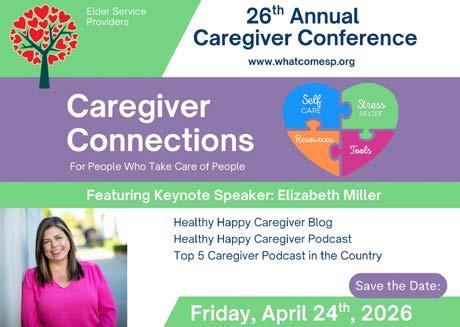
Mark Your Calendars: Friday, April 24, 2026—Elder Service Providers 26th Annual Caregiver Conference, “Caregiver Connections, For People Who Take Care of People.” Register at www.WhatcomESP.org Kirk Blankenship, Publisher











Libby Chenault
Exercise is vital for staying actively engaged and safe as we age. The CDC recommends 150 minutes of physical activity per week, along with two strengthtraining sessions for all adults. Moderate exercise immediately helps regulate blood pressure, improve sleep, and reduce anxiety. Over time, regular movement habits boost brain and heart health while lowering the risk of certain cancers and diabetes. Other benefits include improved balance, bone density, and strength to help seniors remain independent longer.
Meeting these guidelines can feel daunting if you don’t love the gym or don’t have a Zumba class nearby. But by incorporating active transportation into your routine, you can often reach the 150-minute goal without ever stepping into spandex.
for Staying Actively Engaged
The average adult can walk a mile in about
20 minutes. That means a simple one-mile stroll to the pharmacy, coffee shop, or library gets you well on your way toward the weekly target. As a bonus, you’ll even build more strength if you carry a few items home in a tote or backpack.

We also explore ways the WTA bus can connect us to the natural environment. Visit places from deep forest walking to birdwatching in city parks. Explore and learn about marine life at the waterfront. The bus can help us stay in touch with the wild places around Whatcom County and keep you actively engaged outdoors.
On a bicycle, covering that same mile takes only about seven minutes, opening up a wider range of destinations. Adding a basket or panniers makes carrying items easy. Seniors find that upgrading to an e-bike builds confidence, whether you are pedaling in traffic or climbing hills. You control how much assistance the battery provides, allowing you to push yourself for more exercise when you want.

Retirement may also give you time to brush up on your skills and take the scenic route. Pauline Black of Bellingham learned to ride a bicycle through Smart Trips during retirement. “I’ve been having fun doing errands on my bike and enjoying the challenge of getting to new places. My heart is always pounding when I get somewhere, but it’s good.”

Need help learning to ride the bus or tips for biking in Whatcom County? Contact Smart Trips for information on guided bus trips and motivational
Visit WhatcomSmartTrips.org or call (360) 756- 8747 to get started.
Even riding the bus adds movement to your day. “The short walk to the nearest bus stop is just what’s needed to get you in action,” says Marsha Partlow, also from Bellingham, who enjoys guided bus trips with Smart Trips. “Your steps will add up before you know it!”
Staying actively engaged can be done with a variety of activities. Whether for a special outing or a regular appointment, the way you get places can add essential movement to your week.
Trying an active mode of transportation keeps you learning and keeps your body moving.
If you’d like support riding a bike, finding a good walking route, or navigating the bus system in Whatcom County, give Smart Trips a call for free classes and consultations—or visit our website listed below.
Libby Chenault Smart Trips
Education Coordinator Whatcom Smart Trips www.whatcomsmarttrips.org 360-756-8747







Kristine Jarrell, Au.D.
Disequilibrium of aging refers to the imbalance and dizziness that may occur in older adults due to the natural decline in the body’s balance system. Left unchecked, this deterioration can lead to an increased risk of falls and injuries, as well as a decline in quality of life. It’s a complex issue involving multiple systems, including the vestibular (inner ear), visual, and musculoskeletal systems, as well as possible central nervous system problems.
Feelings of disequilibrium are characterized by dizziness, lightheadedness, a lack of coordination and spatial awareness, or a persistent sense of imbalance and unsteadiness when standing or walking. Individuals may feel like they are drifting or being pulled to one side when walking, have difficulty keeping their balance as they walk on different surfaces, or feel dizzy when they change body positions. Individuals may experience one or more of these symptoms at any time, and the condition is often without clear localizing signs (meaning it’s not always clear which specific part of the body is causing the problem).
Inner ear disturbances account for 85% of dizzy disorders, but the loss of balance that comes with aging has many causes. That’s why it’s crucial to inform your practitioner about your symptoms to determine if a referral for balance testing or therapy may be needed. Left untreated, disequilibrium of aging can lead to falls and injuries, reduced mobility, and increased anxiety related to fear of falling. While there isn't a
single cure for disequilibrium of aging, various treatments can help manage symptoms and reduce fall risk, including:
• Balance retraining: Exercises to improve balance and coordination.

• Habituation exercises: Exercises to help the brain adapt to sensations of dizziness.
• Posture training: Exercises to improve posture and body alignment.
• Vision stability exercises: Exercises to improve eye movements and visual stability.
• Medication management: Reviewing medications for those that may contribute to dizziness.
Diagnosing and addressing balance problems early can help prevent falls, maintain independence, and improve overall quality of life. We can help with a diagnosis by offering specialized balance testing to determine if damage to your inner ear may be contributing to your symptoms. Ask your practitioner if a vestibular and equilibrium evaluation may be right for you.
For a free brochure and self-quiz Understanding Imbalance, contact us today.
Kristine Jarrell, Au.D. Audiologist, Owner
Hearing Health Services Hearing & Balance Center www.coupevillehearing.com 360.678.1423


We know that healthcare for you and your family doesn’t take days off. At Skagit Regional Health, our mission is Exceptional healthcare, always — and our MyChart patient portal gives you access to the tools you need anytime, day or night.
With MyChart, you can use your phone, computer or tablet at home or on the go to manage your health online 24/7.
With more than two dozen locations across Skagit, Island and north Snohomish counties, Skagit Regional Health is here to care for you. MyChart is a powerful tool that connects your care across all our locations, offering a secure, convenient way to stay on top of your health in between primary care appointments, after urgent care visits, during hospital stays and anytime in between.
MyChart can make it simple to manage your health. Skip the phone tag and paperwork — instead, access your health information, see your provider by video and stay connected with the expert care team you’ve come to know and trust — all on your own schedule.
Inside MyChart You Can:
• Schedule directly with your primary care provider:
• View test and lab results instantly
• Request medication refills online
• Exchange secure messages with your care team
• Conduct MyChart Video Visits
• View provider notes
• Make payments and manage bills
• Complete check-in forms ahead of time
• Manage family accounts with one login
MyChart is part of Skagit Regional Health’s electronic health record (EHR) system, called Epic. This patient portal brings together all your medical information in one secure, unified place. Whether you’re in the hospital, getting a lab draw or visiting a specialist, Epic keeps your care connected seamlessly across all Skagit Regional Health clinics and hospitals. And with your approval, other clinics and hospitals that use Epic can be granted access to your medical record, helping you receive coordinated care wherever you go.
MyChart can be downloaded onto your mobile phone or tablet, providing you access to your health record — anytime, anywhere. Visit SkagitRegionalHealth.org/MyChart to register.




Northwest Regional Council
Medicaid Alternative Care (MAC) and Tailored Supports for Older Adults (TSOA) Programs began in 2017 in Washington State. These programs provide support and services to help individuals remain in their own home and potentially reduce their need for long-term care facilities. These home-based support programs also focus on providing tangible resources to unpaid caregivers/helpers
who help care for another person. Caregivers/ helpers might be a parent, family member, spouse, or friend.
On MAC or TSOA, clients work with their case manager to personalize a monthly homebased benefits package that can be used on a variety of items. Benefits may include home delivered meals, personal emergency/safety buttons, specialized equipment (grab bars, bath
Northwest Regional Council 4
benches, railings, etc.), incontinence supplies, inhome care, consultants, and case management services.
If you would like additional information or help applying for one of these home-based support programs, please reach out to us at NWRC! We are happy to help.
Phone: 360-676-6749
Website: www.nwrcwa.org
Whatcom Address:
600 Lakeway Drive| Bellingham, WA
Skagit Address:
301 Valley Mall Way | Mount Vernon, WA
Category Medicaid Alternative Care (MAC)
Age Eligibility
Functional Eligibility
Financial Eligibility (Single Person)
Financial Eligibility (Married)
- Applicant must be 55+ years old
- Must have an unpaid caregiver age 18+
Must be receiving help with Activities of Daily Living (ADLs) such as:
-- Bathing, Toileting, Eating, Walking, Transfers, Medication reminders/ management
-- Must be enrolled in Apple HealthMedicaid
- Gross monthly income of less than $3,868
- Resource limit: $77,052
- No estate recovery
- Free services
- Applicant's Gross Monthly income: less than $3,868;
- Resource limit: $149,581
- Spouse’s income not counted
- No estate recovery
- Free services
Tailored Supports for Older Adults (TSOA)
- Applicant must be 55+ years
- Can be an individual applicant OR can have an unpaid caregiver age 18+
- Must be receiving help with ADLs (same as MAC)
- Must not be enrolled in Apple Health
- Same as MAC
- Same as MAC


ments
Geriatric
(www.uslegal.com)

Fiduciary: A fiduciary is a person or organization that has a legal and ethical obligation to act in the best interest of another person or entity. Fiduciaries play an essential role in estate planning as trusted partners who manage financial and legal affairs with loyalty, discretion, and impartiality. Common fiduciary roles include: Personal Representative/Executor - A fiduciary can be appointed as the personal representative of a will. Trustee - Often a trust is established as part of an estate plan. A fiduciary can serve as the trustee of the trust. Durable Power of Attorney/DPOA - A fiduciary can be designated as agent under durable power of attorney to manage financial affairs in the event of illness, cognitive decline, or incapacity. Engaging a Fiduciary ensures that the individual’s intentions and wishes are honored.
(Contributed by Profiducia)
Melissa Walpole
Planning ahead may not be the easiest thing to think about, but it’s truly one of the most meaningful gifts you can give to your loved ones.
When it comes to naming someone as your Power of Attorney, Executor, or Trustee, most people naturally think of a spouse, child, or close friend. In some situations, that can work out fine. But it’s not always the best—or easiest—option.
Maybe your family lives far away. Maybe there are complicated relationships or simply a desire not to burden the people you care about. Whatever the reason, it’s worth considering whether a loved one is the right person to take on such an important role.
These roles come with a lot of responsibility. A Power of Attorney may need to make quick financial decisions. An Executor has to pay bills, file taxes, sell property, and settle your estate. A Trustee might be managing assets, handling records, and making distributions for years to come. It’s not just paperwork—it’s timeconsuming, technical, and often motional work.
For a family member, juggling all that— on top of their own life and, potentially, their own grief—can be a lot to handle. And unfortunately, it can sometimes lead to misunderstandings or tension between relatives.
A fiduciary is a trained, experienced professional who can step into these roles—Power of Attorney, Executor, or Trustee—on your behalf. They’re neutral, independent, and focused on doing things by the book. They understand the legal requirements, deadlines, and the big picture. Their know-how helps avoid costly mistakes and delays that can happen when someone is navigating it all for the first time.

But most importantly, bringing in a professional takes the pressure off your family. They don’t have to wade through complex forms or navigate difficult decisions. They can focus on what matters most: being there for one another and remembering you.
By choosing a professional fiduciary, you ensure that your affairs are handled with care, clarity, and fairness. It brings peace of mind now—and offers your family comfort, support, and relief when they’ll need it most.
Melissa Walpole VP of Operations Profiducia clients@profiducia.com
www.profiducia.com 206-573-5276
See Ad on Page 17

Aubrey Wilson Financial Advisor

Article Provided by Edward Jones
You may have heard of the “4% rule” when it comes to retirement. The idea is simple: After you retire, you withdraw 4% of your investment portfolio each year. In theory, this helps ensure your savings last for your lifetime. While this rule can be a helpful starting point, it’s not a one-size-fits-all, and it’s definitely not a substitute for a plan tailored to your specific needs, wants and wishes.
The truth is, how much to withdraw in retirement depends on factors like when you retire, if you’ll work part time, how long you expect retirement to last, your lifestyle goals, inflation and whether you want to leave a financial legacy to heirs. So, the 4% rule should be viewed as more of a guide than a strict rule.
Let’s start with age. The 4% rule is often based on someone retiring at 65 and expecting
to live until about 92. However, if you retire earlier, you may want your portfolio to stretch further. In that case, you may need to start with a lower withdrawal rate, perhaps closer to 3%. If you retire later and depending on your financial situation, you might safely withdraw a little more, perhaps 4.5% to 5%.
Your retirement lifestyle also plays a big role. Are you planning to travel the world or spend more time at home? If you expect higher spending in the early years of retirement, you may need to adjust your withdrawal rate or plan to reduce spending later to balance things out.
Your financial flexibility matters too. If you have less wiggle room with your expenses, rely heavily on your portfolio for income
Continued From Page 19
or want to preserve wealth for your heirs, a more conservative approach might be wise. In this conservative scenario, your portfolio withdrawals may be met from interest and dividends.
Let’s start with age. The 4% rule is often based on someone retiring at 65 and expecting to live until about 92. However, if you retire earlier, you may want your portfolio to stretch further. In that case, you may need to start with a lower withdrawal rate, perhaps closer to 3%. If you retire later and depending on your financial situation, you might safely withdraw a little more, perhaps 4.5% to 5%.
Your retirement lifestyle also plays a big role. Are you planning to travel the world or spend more time at home? If you expect higher spending in the early years of retirement, you may need to adjust your withdrawal rate or plan to reduce spending later to balance things out.
An additional consideration is the inflation rate. A well-built strategy usually includes small annual increases in withdrawals to keep up with rising costs roughly 2.75% per year, but if the markets have had a tough year or you don’t need the extra income, it might be smart to skip an increase. Being flexible can improve the chances your money will last.
The bottom line? The 4% rule is a useful starting point, but it’s just that — a starting point. A good financial advisor can help you build a strategy that reflects your age, your goals and your full financial picture. By revisiting your plan regularly and staying flexible, you’ll give yourself the best shot at turning your savings into a secure, fulfilling retirement.
This content is provided by Edward Jones for use by Aubrey Wilson, your Edward Jones Financial Advisor at 360-588-4548. aubrey.wilson@edwardjones.com



• Annual Enrollment Period: Oct 15 - Dec 7 if you are already on Medicare
• Open Enrollment Period: Jan 1 - Mar 31 - Medadvantage members can make a change
• Special Enrollment Period: You are eligible to make a plan change if you have moved or have a change in Medicaid/Medicare status



•
•
•


Jennifer Eddleman
As a real estate professional specializing in senior housing, I frequently help clients navigate the transition into 55+ communities. Understanding your options is crucial for making the best decision for your lifestyle and budget. Here is a breakdown of the three most popular community types, along with their key advantages and drawbacks.
Pros: Single-family homes in age-restricted communities offer the most privacy and space. You’ll typically have your yard, garage, and freedom to modify your home, although there may be CC&Rs (Covenants, Conditions, or Restrictions) or HOA (Homeowner Association) rules governing updates. These communities often feature amenities like clubhouses and fitness centers. Property values tend to appreciate well.
Cons: Single-family homes require the most maintenance responsibility and carry the

highest price tags. Even in 55+ communities, you will likely handle exterior upkeep and major repairs, and you may or may not still be responsible for landscaping. Larger spaces can become challenging to maintain as you age.

Pros: Condo living strikes an excellent balance between independence and convenience. The homeowners’ association handles exterior maintenance and landscaping, often including amenities like pools and fitness facilities. You’ll own your unit while sharing common area costs. Many developments offer elevator access and single-level living. “Detached condos” bridge the gap between single-family homes and traditional condos, offering privacy with maintenance-free benefits.



Cons: Monthly HOA fees can be substantial and typically increase over time. There are often community rules regarding renovations and pets. Special repairs can create unexpected expenses, and resale can be more challenging in some markets.
Pros: Manufactured Home Communities offer the most affordable entry into 55+ living. Home prices are generally lower, and many feature clubhouses with active social communities. Homes are typically single level, making them accessible as mobility changes. Many are gated, which provides added security.
Cons: Manufactured homes usually will not appreciate at the rate of single-family homes and condos. Site rent for the leased lots can vary widely from park to park, as can park approval requirements and pet policies. Financing options are more limited. You are responsible for maintenance of the structure and your individual lot, which can result in added expenses.
Each option meets different needs and budgets. Consider your long-term financial goals, desired maintenance responsibility, and lifestyle preferences. Consider visiting multiple communities in each category to experience the differences firsthand before making this important decision.
Jennifer Eddleman, Realtor, SRES
Full-Time Realtor
Seniors Real Estate Specialist
Windermere Real Estate
Phone: 360-333-4048
E-Mail: jenneddleman@windermere.com
Website: www.jenneddleman.com/
Jennifer is a full-time Realtor and Seniors Real Estate Specialist serving clients in Skagit, Whatcom, and Snohomish Counties.















Glossary: Home Support
Home Care: Supportive care provided in the home by a professional agency. Certified Caregivers provide assistance with daily care needs and
Services: Home Care agencies provide non-medical services to people with functional limitations, enabling them to maintain their highest level of independence and to age in place in their own homes. Care may include assistance with dressing, bathing, medication administration, meal preparation, household chores, errands, and more. Hours/Days: Scheduled help 2 to 24 hours per day, up to 7 days per week, or as respite care. See Home Care Directory on Page 28.








Home Health: In-home services provided include Skilled Nursing Care and various therapies prescribed by a physician. This includes physical, occupational, respiratory and speech therapies, often used for seniors who are recovering after a hospital and/or nursing home stay. See Home Health Directory on Page 32.
Home Modifications - Safety & Accessibility: Regular attention to Home Safety and Accessibility is known to decrease fall risks and increase the chances of aging in your own home. Home Analysis for potential improvements should be done by a Home Contractor who is a Certified Aging-In-Place Specialist (CAPS




Services for seniors and families who seek help in selecting senior housing and care. An advisor knows the local providers and can recommend solutions, saving clients time and confusion in their search. Advisors may also set up appointments and provide tour assistance if desired. Partnering housing and care providers enable these services to be free to seniors and their families.
Glossary: Housing - Independent
Affordable Housing: A subsidized apartment rental program for people who are disabled or elderly, including Section 8, HUD, public housing, and tax credit buildings.
Independent/Retirement: Private apartments rented to seniors. Some offer three meals per day. Activity programs and housekeeping may be provided, but residents are capable of independent living. Private pay only. Retirement Communities are maintenance free to seniors.
Adult Family Home (Adult Care Home): A residence owned or rented by a licensed provider. Room and board, trained caregivers 24 hours a day, and assisted care services for 2 to 6 adults are provided in a home environment. Licensed Nurses on staff are not required, but may be available. (Non-secured memory care may be available)
Assisted Living Community: Apartments for seniors with physical and/or cognitive impairments who may need assistance from trained caregivers. Meals, housecleaning, and activities to help seniors stay physically active and socially engaged are provided. Trained caregivers 24 hrs/day and Licensed Nursing up to 24 hrs/day. (Non-secured memory care may be available)
Continuing Care Community: These offer three or more types of senior housing in one community location, reducing the need for a senior to move as they age. Senior housing options may include: Retirement, Assisted Living, Memory Care, Skilled Nursing & Rehabilitation.
Memory Care Community: This is special care in a secured community for people who have Alzheimer’s disease or other forms of dementia. Some are stand-alone Memory Care communities, while others are located within Assisted Living or Skilled Nursing facilities. Trained Caregivers 24 hrs/day and Licensed Nursing up to 24 hrs/day.
Skilled Nursing & Rehabilitation: A qualified facility that has the staff and equipment to provide round-the-clock skilled nursing care (RN’s and LPN’s) and rehabilitation services such as physical, occupational, respiratory, and speech therapies. Also included are Social Work services, Medical Director oversight, and care giving staff to assist with personal care needs.
Back in the day, we were promised that computers would make life easier. Easier! All I remember was wrestling with printers that jammed if you so much as looked at them, waiting forever while that little hourglass twirled on the screen, and watching Solitaire cheat me out of victory like a rigged pinball machine at the corner café.
And when we finally figured out how to send an email without accidentally forwarding it to the entire bowling league, along comes “artificial intelligence.” AI, they call it. Personally, I call it the nosy nephew who eats all your pie, and then lectures you about cholesterol.
Artificial Intelligence swears it’s here to help. Sure. Mention “my back hurts” once, and suddenly you’re buried in ads for braces, heating pads, and recliners that look like they belong on the Starship Enterprise. Honestly, it listens harder than my old party line neighbors. Take these “smart” gadgets. I bought one of those robot vacuums—mistake of the year. Did it clean the crumbs? No. It circled me
like a suspicious mall cop, chased my slippers across the living room, and nearly herded me into the recliner. When I unplugged it, I swear it growled. Give me a broom and strong knees any day.
And the voice assistants? “Alexa, call my daughter,” I said politely. Instead, it blared The Lawrence Welk Show theme at full blast, bubbles and all. I didn’t know whether to laugh, cry, or grab my accordion.
To be fair, some features are handy. AI reminds me to take my meds, sets timers so dinner doesn’t come out like roofing shingles, and even translates Spanish if I finally cash in those S&H Green Stamps for a trip to Cancun. Beats flipping through a phrasebook where the page you need is always missing.

But don’t worry, friends. No robot will replace us. Machines can’t sniff out a bargain at a










Continued from Page 36
garage sale, haggle over a toaster, or patiently teach a grandkid to drive in the church parking lot without losing your religion. Those skills are timeless.
So, here’s my advice: don’t fear the bots. Mock them, sass them, and unplug them when they misbehave. We survived typewriters, rotary phones, and VCRs flashing “12:00.” A little artificial intelligence? Child’s play. And if that robot vacuum lunges at your slippers again—remember, we still know how to pull the plug.
Kirk Blankenship, Publisher Developed with AI assistance
























For many of us, chocolate treats appear on special occasions. It is even sought out for non-occasions.
My first memory of my early "cooking" skills was chocolate Quik. Just stir a scoop (or two) of mix into a glass of milk and drink it down. “It’s so thick and rich and chocolich, but you can’t drink it slow - if it’s Quik!” (Nesquik Bunny) Alternatively, there was Strawberry Quik, but the chocolate was better!
I think our family farm survived because of Oreo Cookies! I can still see the chocolate wafers glued together by creamy, rich frosting. There was always an Oreo package sitting at the top of the refrigerator, conveniently located en-route to the doorway outside. Dad rarely left the house without grabbing a handful “for the road.” As for my brother, he would grab a handful of Oreos for bedtime. I am still unsure how this helped his sleep. We only know about this nighttime consumption because Mother would find plenty of crumbs under his pillow on laundry days. Those chocolate discs partially fueled our farm work and family survival!
Important farm and finance documents lived in the old gray chest, along with Mom's homemade Rocky Road Squares. These were chocolate brownies topped with a stormy sea of melted marshmallows, caramel, and chocolate chips. Mom made the best…and she knew it! Thus, the reason for the lock-up of this 9 x 13 hunk of dessert. The key was safety-pinned
on her blouse like an antique brooch. Not that any of our family were greedy thieves, we just worked and played ourselves into hungry teenagers!
The first real baking I did was with the “My Favorite Chocolate Cake” recipe, which I found in an old school fundraiser cookbook. As this recipe was contributed by my grandmother, I was proud to bake this moist and fluffy chocolate creation! It was an easy recipe with simple ingredients. Years later, I searched the “new” internet technology, just in case the recipe was there. To my disappointment, I found it under multiple names and differing recipe authors. Depression blogger says, “Wacky cake, also known as crazy cake, war cake, depression cake, and three-hole cake, is a simple chocolate cake recipe that has been used in kitchens for nearly a century. This cake was created when many common ingredients were hard to acquire, or food items were being rationed, so the recipe doesn't include any butter, eggs, or milk.”
www.southernliving.com/recipes/wacky-cake
For our family’s past and current generations, this recipe has contributed to countless special and sweet occasions. As for me, the recipe is rich, it comes from my grandmother, and it is “My Favorite Chocolate Cake.”
Throughout Junior High and High School, my summer job was to milk cows twice a day. I am not here to convince you that cows produced chocolate milk on our farm. However, my parents compensated me with finances
♥ Award-winning SPARK activity program
♥ Exceptional Community Living
♥ Excellent Dining!
♥ Social Outings and Scenic Drives
Call 360-279-2555 to learn about our SPARK Montessoriinspired program or to schedule a tour.
171 SW 6th Ave
Oak Harbor, WA 98277
HomePlace Memory Care at Oak Harbor provides an enriched, meaningful living experience.
for school clothes, school supplies, and snack purchases from the high school Associated Student Body (ASB) club. I have fond memories of my friends and I consuming ice cream cones, Reese's Pieces peanut butter cups, Milky Way bars, and Kit Kats! Somehow, those cows financed my chocolate fixes at school.
On one of our first dates at Dairy Queen, Kirk and I shared a Banana Boat Sunday, with mounds of ice cream, streams of chocolate syrup, peaks of whipped topping, and three dots of cherries on top. Through the years since, our chocolate tastes have matured. Our quest turned to finding “healthy” chocolate alternatives for the family. We have settled on Dark Chocolate, the kind with less sugar and more chocolate. Even Harvard approves of this:
“Cocoa is rich in flavonoids, which appear to have beneficial effects on blood pressure, cholesterol, blood flow, and other heart risks…

The higher the cocoa content of the bar, the better it is for your health (look for bars with 70% cocoa or more). Although a couple of chocolate squares may not do wonders for your heart and brain, they will please your taste buds without adding too many inches to your waist.” www.health.harvard.edu/heart-health/
Unlike our coffee tradition, our adult children are all in! The challenge is eating just one piece. We have differing favorite flavors, including orange, mint, coconut, cherry, raspberry, almond, sea salt, and coffee. Well, not coffee for some of us.
Our family continues to indulge in dark chocolate on occasions of games or movie nights. It often shows up on gift-giving occasions and non-occasions. The writing of this article has been fueled by a daily dose of about one square inch of dark chocolate. On this day, the flavor is orange. What would be your favorite?
Christine Blankenship, Publisher Vibrant Senior Options



The Power of Adult Day Care, In-Home Support, and Respite
Kris Mason
Jane* has a mother who is aging and has multiple health challenges that need consistent and caring attention. As a daughter, Jane finds that being a caretaker for her mother is one of the most meaningful things she can do. However, the truth be told, Jane has become emotionally drained, physically exhausted, and downright overwhelmed. Because of her commitment to helping her mother, she ignores these symptoms and keeps the status quo of care.
Jane is thinking, “Things will get better, and I will get to personal shopping next week.”
Although she has not identified the seriousness of her waning strength, Jane does sense herself becoming impatient and
* Jane: This name is fictional and is added for clarity.
exhausted. Yet she believes that no one else could care for her mother as much as she does.
While the concept of caring for a parent is rewarding, this mindset may lead to Compassion Fatigue. That is, a state of depletion that goes beyond burnout. It’s what happens when your empathy tank runs dry.
Like many family caregivers, Jane felt guilty even thinking about taking a break. But the truth is, no one can pour from an empty cup. To be present and effective in your caregiving role, you need regular times to rest and replenish. That’s where help – from adult daycare, in-home caregivers, and respite facilities come in—not as luxuries, but as lifelines.
Adult Day Care programs have structured, supportive environments where your loved one can engage in safe, enriching activities while receiving supervision and care. It’s a win-win: they get stimulation and connection; you get a few hours to breathe, regroup, or take care of your own life.
In-Home Caregivers provide professional support right in your home. Whether it’s help with bathing, medications, mobility, or companionship, these services lighten the load and ensure your loved one’s needs are met, even when you need to step away. And because it happens in the comfort of your own home, transitions are often easier for everyone.
Respite facilities offer temporary stays ranging from a few days to several weeks.
Whether you’re vacationing, recovering from surgery, or needing an extended break from 24/7 care, respite stays provide peace of mind and professional support. They’re also a great way to explore longer-term care options if you’re starting to consider them.
What Jane should understand is that she needs to harness the power of other care options to help her survive. She also needs to know that the risk of compassion fatigue is real. It could diminish her ability to care for her mother. Taking a break isn’t just about selfcare—it’s about creating a sustainable caregiving plan. Using available support services isn’t a sign of weakness. It’s a bold act of love that says, “I want to do this well, for the long haul.”
Continued on Page 48
Compassion Fatigue
Continued from Page 47
Show Up with Compassion, Not Compassion Fatigue

If you’re feeling worn thin, don’t wait. Reach out. Ask for help. Your well-being matters as much as, and even impacts, the well-being of your loved one.
Kris Mason Maple Valley, WA
Caregiving is a marathon, not a sprint. Building in breaks, sharing responsibilities, and honoring your own health ensures that you can continue to show up with compassion, strength, and grace. Scheduling for help and taking breaks are necessary as part of the ongoing caregiving plan. For Jane, this would enable the caregiving relationship to thrive longer, enabling her to love her mother even better! Not only that, but there is also no longer the guilt and health risk of Compassion Fatigue.







Whatcom County
Bellingham
Brookdale Fairhaven IL/ AL
Chuckanut Ridge AL
Cordata Court Senior Living AL
Highgate Senior Living AL
Orchard Park IL/AL
Sapphire at Woodway IL/AL
Solstice Senior Living IL
Spring Creek IL/AL
Summit Place AL
The Willows IL
Ferndale
Avista Sr. Living AL
Grace Retirement AL
Lynden
Lynden Manor IL/AL
Meadow Greens IL/AL
Skagit County Anacortes
Cap Sante Court IL
Chandler’s Square IL/AL
Rosario Asisted Living
San Juan Assisted Living
Burlington
Creekside IL/AL
Where The Heart Is by Cogir AL
La Conner
La Conner Retirement IL/AL
Mount Vernon
Heather Village IL
Highland Greens IL
Mountain Glen IL/AL
Salem Village IL
The Bridge IL/AL
Bellingham
Cordata Court MC
Highgate Sr. Living
Silverado Memory Care
Spring Creek MC
The Bellingham at Orchard by Cogir
Lynden
Christian Health Care
Lynden Manor Memory Care
Skagit County
Anacortes
Lighthouse Memory Care
Rosario Assisted Living
Burlington
Creekside MC
HomePlace Memory Care by Cogir
Where The Heart Is by Cogir
Skilled Nursing & Short Term Rehabilitation
Whatcom County
Bellingham
Alderwood Health & Rehabilitation
Avalon Healthcare
Highland Health & Rehabilitation
Mt. Baker Care Center
North Cascades Health & Rehabilitation
Shuksan Healthcare
Sedro-Woolley
Country Meadow
Village IL/AL
Island County
Freeland
Maple Ridge IL/AL
Oak Harbor
Harbor Tower Village IL/AL
Regency on Whidbey IL/AL
Summer Hill AL
Welcome Home Oak Harbor AL
San Juan County
Friday Harbor Village at the Harbor IL/AL
North Snohomish
Ashley Gardens
Whispering Willows
Sedro-Woolley
Birchview Memory Care
Island County
Oak Harbor
HomePlace Memory Care
Regency on Whidbey
Welcome Home Oak Harbor
Arlington
Cascade Valley
Senior Living AL
Olympic Place by Bonaventure IL/AL
Marysville
Cascade Village at Smokey Point IL
Grandview Village IL/AL
The Gardens at Marysville IL/AL
Windsor Square Retirement Community IL
Smokey Point
Fields Senior Living IL/ AL
Stanwood
Brookdale Stanwood IL/ AL
The Suites at Josephine AL
Warm Beach Senior Community IL/AL
Arlington
Cascade Valley
Senior Living
Marysville
Fieldstone MC
The Cottages at Marysville
Smokey Point
Fields Senior Living
Stanwood
Brookdale Stanwood
The Meadows at Josephine
Blaine
Stafholt Health & Rehab of Cascadia
Lynden
Christian Health Care
Skagit County
Anacortes
Soundview Rehabilitation
Mount Vernon
Life Care Center of Mount Vernon
Mira Vista Care Center
Sedro-Woolley
Lifecare Center of Skagit Valley
Island County
Coupeville
Regency Coupeville Rehabilitation and Nursing Center
North Snohomish
Arlington
Arlington Health & Rehabilitation
Marysville
Marysville Care Center
Mountain View Skilled Nursing
Snohomish
Snohomish Health and Rehabilitation
Stanwood
Saratoga Transitional Rehab - Josephine