October 2026 Volume 7, Issue 1
Via Verde Student Travel Magazine
IN THIS ISSUE Cat Capital of the World Service Abroad Carrying Faith Home
WANT TO PLACE AN AD WITH US? Contact viaverdemagazine1@gmail.com
BARCELONA, SPAIN Photo by Lise Concolato
PUBLICATION POLICY Operating under California Education Code 48907, Via Verde, a student travel magazine published by students at Palo Alto High School, is a designated limited open forum for student expression and discussion of issues of concern to its readership.
ADVERTISING The staff published advertisements with signed contracts providing they are not deemed by the staff inappropriate for the magazine’s audience. For more information about advertising with Via Verde, please email us at viaverdemagazine1@gmail.com.
LETTERS TO THE EDITORS The staff welcomes letter to the editors but reserves the right to edit all submissions for length, grammar, libel, invasion of privacy and obscenity. Send all letters to viaverdemagazine1@gmail.com or to 50 Embarcadero Road Palo Alto, CA 94301.
PRINTING & DISTRIBUTION Via Verde is printed by aPrintis in Pleasanton, California. The Via Verde staff will distribute copies at no cost around the Palo Alto High School campus. All previous Via Verde work is available at issuu.com/viaverdemag.
VIA Verde 2
VIA VERDE Palo Alto High School’s Travel Magazine
MISSION STATEMENT Via Verde aims to be a travel magazine that uses the power of the student press and desktop publishing to pursue the values of the Palo Alto Unified School District, Palo Alto High School and scholastic journalism. More specifically, the mission of the Via Verde is to provide: The Paly community with information on travel issues from student perspectives; a forum for students to submit and publish their experiences related to travel; and an independent journalistic magazine that models integrity and creativity seeking to educate its readers on local and international cultures; The larger scholastic journalism community with a role model publication that embodies the best of scholastic journalism and for future student-created magazines; and, The magazine’s student staff with journalistic and leadership opportunities that increase their ability and desire to participate meaningfully in our society and global community; and skills to become leaders within future endeavors.
OCTOBER 2026 VOLUME 7 ISSUE 1 EDITOR-IN-CHIEF Julia Curtis MANAGING EDITOR Caitlin Ko STAFF WRITERS Ashley Wu Jack Lindauer Juni Thurston Lise Concolato Mack Reller Navya Narayanan Sebastian Tung ADVISER Paul Kandell CONNECT @viaverde.mag issuu.com/viaverdemag
LETTER FROM THE EDITOR Welcome aboard to Via Verde! We are delighted to have you travel around the world through a Paly student lens. Via Verde, Paly’s unique student travel magazine is here for its first issue in Volume 7. Via Verde serves as a space where students are encouraged to broaden their perspectives on local and international travels with the discovery of new cultures. In this issue, staff writer Navya Narayanan takes us on a journey to Bali and Singapore to explore her faith, while Mack Reller shares his experience biking through France during the record-breaking heat wave this Summer. We then fly to from Peru to Japan and Mexico with Lise Concolato and Ashley Wu to discover student service trips abroad. Additionally, I can’t wait for you to join me in discovering the cat culture of Istanbul and the magic of Paly choir’s international touring tradition. I’m honored for Via Verde to share this journey with you. Bon voyage!
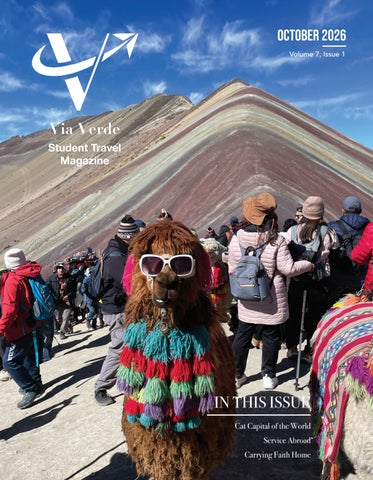
ON THE COVER Hiking atop layered mountains in Peru, a festivly decorated alpaca stares through stylish sunglasses at the camera. Photo by Kavita Fulton
Julia Curtis
VIA Verde 3
IN THIS ISSUE
VIA Verde 4
LAKE BLED, SLOVENIA Photo by Julia Curtis
INSIDE: 6 American Exchange 8 Cat Capital of the World 10 Service Abroad 14 Carrying Faith Home 18 Biking through a French Inferno 20 International Enesmble 24 A Career Built Around the World 25 Gallery
VIA Verde 5
COMMON GROUND Text by JUNI THURSTON
BATTLEFIELD BARROW: After hiking through the Gettysburg battlefields, the Pennsylvania State Memorial was where we ate our lunch. In the battlefields, we saw the Klingel House, a home built in 1812 that Union soldiers took cover in. Now, the building is deteriorating, but the fact that a structure that old in the middle of a battlefield is still standing was impressive. Photo by Juni Thurston.
VIA Verde 6
EXPLORING GETTYSBURG, PENNSYLVANIA WITH THE AMERICAN EXCHANGE PROJECT
I
N APRIL, I APPLIED for a trip with My trip was far from limited to Get- into Appalachia towards rural West Virginia. the American Exchange Project, a free tysburg proper. The city is only a few miles There, we began our ventures by river tubing intranational exchange program aim- from Pennsylvania’s southern border, so we in the Shenandoah River. ing to bridge gaps between American ended up taking two trips outside of GettysBeing from California, where most of youth. The only catch? I had no clue where burg: one to camp in West Virginia and one our rivers are steep and fast from snowmelt, I’d be sent. to Washington, D.C. I was expecting a harrowing white-water exEventually, I got my assignment, and In D.C., we visited the National Ar- perience. East Coast rivers, I learned, tend to come late June, I was chives, the Washing- be much calmer; it ended up being a relaxing getting dropped off at Over the week, we ton Monument, and time floating down the slow-moving river, SFO Airport and boardthe National Museum looking at the scenery and talking with my grew close, discoving a plane to Gettysof African American newfound friends. burg, Pennsylvania, set- ering our differences History and Culture. From there, we went to our campsite. ting to cross the country We also stopped by the Perhaps “camping” is a strong word to deand, more important- Great American State scribe what we were doing — we stayed in a all alone. Once I landed, I ly, our similarities, all Fair, America’s 250th cabin and there was a chlorinated pool 500 found my host family anniversary celebration. feet away — but it was nonetheless fun. As I while exploring one and we began to drive Though Lafayette Square reflect on my trip, I keep coming back to our up from the Baltimore of the most historical- was closed, we still got moments still around the campfire, making airport into Gettysburg. see the White House s’mores with all these people from around the ly significant regions to During the drive, I was from a distance. As a country that I otherwise would have never already getting to know in the country. prospective international met without the American Exchange Project. the other exchange sturelations student, I was Sione Fusimalohi, a Paly senior who dent staying with us: Chloe, from Grants- captivated by being in the American city per- went on an American Exchange Project Trip ville, Utah — a small, majority Mormon haps most pertinent to that interest. to American Fork, Utah, said his favorite town west of Salt Lake City. One of the coolest things about D.C. thing about his trip was learning about evChloe is a senior at Grantsville High was the Washington Metro. We used public eryone else’s life experiences. School and a Utah girls wrestling state cham- transit to get in, out and around the city — “I just liked talking to everybody about pion. Being from a Mormon family, she has and it was surprisingly straightforward. The anything, especially because I was the only never drunk tea or coffee. Her school has an underground’s Brutalist architecture was a person from the West Coast in my group,” open period dedicated to learning the teach- striking and impressive introduction to the Fusimalohi said. “Getting to know people ings of the Church of Latter-Day Saints. city, and was certainly a different vibe than who had very different experiences than me, Around 80% of her town voted for Donald riding Caltrain. and getting to know their way of life and Trump in the 2024 presidential election, A few days later, in a far cry from D.C.’s comparing it to how I live daily was my facompared to just 15% in Palo Alto. In many dense, urban landscape, we went further vorite.” v ways, her hometown is a complete opposite of mine — but that didn’t stop us from becoming good friends. Other exchange students came from Colorado, Arkansas, Minnesota, Texas and beyond. Over the week, we grew close, discovering our differences and, more importantly, our similarities, all while exploring one of the most historically significant regions in the country. Over the next six days, we spent time exploring the downtown area of Gettysburg, learning about the rich Civil War history of the town, visiting the homes of local students who were participating with us and immersing ourselves in the community. Even small things, like visiting the local high school, surprised me — as I’ve lived in California PRETZEL PARTY: At the house of my host parent’s in-laws, we all got together to make pretzels. This for the vast majority of my life, I almost for- photo was taken in their dedicated lake-kitchen! Their property had a whole mini-lake on it that we got got that fully indoor schools are the norm in to canoe on and swim in. Such properties that include large, natural elements don’t really exist in the Bay Area — you have to go real far to find anything like that here. Photo by Project Manager Niki. most of the country.
VIA Verde 7
Cat capitol o The rich feline culture of Istanbul, Turkey
A
Text and Photo by JULIA CURTIS
fter my long flight from Paris to the street cats have no reason to compete at a yer sofrasi restaurant, a traditional floor Istanbul in June, I was delight- for food. In fact, the city seems rodent-less seating arrangement of low tables and comed to discover that the hotel I thanks to them — the initial reason cats fy cushions to sit on. As several customers stayed at had a residential cat: a were brought on ships to Turkey in the 7th enjoyed smoking the shisha, a long Turkish big, fluffy, orange one who wasn’t afraid of century B.C.E. pipe, a small gray and white cat settled unstrangers. However, I soon realized that this That doesn’t stop them from begging at der our table as we ate our kebab and pide wasn’t unusual for Turkey. In fact, the mo- restaurant tables, however, although I didn’t dish, her eyes wide and playful. ment I stepped off the hotel mind the company. The next day, after a boat ride across steps into the street, on my On my first night in Isthe Bosphorus Straight, I landed in a small I felt four way to visit the Blue Mosque tanbul, just as I was about to town outside of Istanbul. Colorful towna couple of blocks away, I paws jump into dig into my margarita pizza at houses lined the shore, railings descending was instantly greeted by two my lap. an outdoor restaurant, I felt from the porches into the salty, turquoise street cats meowing and rubfour paws jump into my lap. I waves below. As we strolled past seafood bing up against my ankles. looked down to see an orange restaurants and souvenir shops, several I soon realized that, unlike while walk- and white cat rubbing his head against the jaunty cats followed closely behind our feet. ing along the streets of Palo Alto table and my hands, asking While walking past the water, where stray cats are uncommon, I for pets and perhaps a nibble I looked a fluffy tuxedo stared at the couldn’t stop to pet every Turkish of food (he refused a bite of frantic fish swimming below kedi I saw, or my 5-minute walks pizza when offered, howev- down to see an the surface. As we entered to the tram would take hours. er.) I couldn’t help but smile orange and a mini-farm-turned-coffeeSunbathing on mosque steps, knowing I was giving a stray shop, with miniscule bantam napping on windowsills, rolling cat some love. Unfortunately, white cat rub- chickens running around the on top of cars and resting under after petting and scratching bing his head dried grass, dining tables and trees in the shade; they were ev- his chin for the entire dinner, hammocks to relax in, a tramthe poline overgrown with weeds erywhere. it was time to leave; he had against Unlike many stray cats I had other ideas, however. After table and my and a tall tree swing shifting seen before, the Turkish cats I trying to ease him onto the in the breeze, a cat was laid met were mostly well-fed with ground by slowly tilting my hands out on the steps of the coffee glistening coats and happy de- legs to the side (to which shop, basking in the sun. meanors, like other well-kept he decided the laws of gravity didn’t apply Back at the hotel the next morning, housecats. You wouldn’t even to him, digging his claws into my skirt), I where breakfast was served in a lush garknow they were homeless just had to scoop him up and release him back den terrace lined with vines by looking at them. into the street. Immediately, he entered the and potted Because locals leave out restaurant and trailed behind a waiter’s footbowls of kibble and water daily, steps. on doorsteps and windowsills, The following night, we dined
VIA Verde 8
o f the world hydrangea plants, a mother cat and her two kittens frequently visited. The mother taught her babies how to jump up on tables, snatching bites of scrambled egg or fish. Often, the little ones got distracted, scampering up tree branches and scaling the uneven brick wall, while the mother cat kept one eye on her kids and the other on our breakfast plates. On our way to the Grand Bazaar, a massive mall with rows and rows of textile, spice, dessert and trinket vendors, we passed by a triumphant, chubby striped tomcat
perched upon his throne — a cushiony red starving stray cats and identified helping chair. After wandering the endless stalls in them as virtuous, hence the hundreds of the bazaar, we stopped for juice where a food and water bowls dotting the streets. fluffy tabby jumped up onto In the Middle East, street cats the counter and plopped Instead of are treated as communal pets as right on top of our menu. opposed to strays. poking the Instead of poking the purrThe infrastructure benefiting feline, the cashier simply purring feline, ing strays, however, is minimal. handed us a new menu withSince the cats have no single the cashier out blinking an eye. I soon owner, they get little to no vetrealized that the abundance simply handed erinary care and regulations on of stray cats in Turkey was sterilizing and vaccinating are normalized and completely us a new menu sporadic. Although they receive integrated into daily life. without blink- daily access to food, shelter and Although Istanbul community care, a large pering an eye. is considered a centage of cats in Istanbul cat-magnet with carry disorders and disapproximately 125,000 stray fe- eases like mild immunodeficiencies, lines, according to a 2019 New untreated infections and leukemia. York Times Article, so is the rest What I appreciate most about of the Middle East. In Islam, the cat culture in Istanbul is that the cats are considered one of the cats there learned to trust humans only pure domesticated animals who treat them well and are overall and therefore have the freedom much more sociable than strays in to wander in and out of houses many other cultures. If other counand mosques as they please. Ac- tries treated stray animals the same cording to hadiths, stories about way, with care and empathy, the the Prophet Muhammed passed world might be a safer place for undown for generations, Mu- housed animals. hammed even warned against So, next time you see a stray cat, remember the Turkish street cats and be sure to give it some love. v
SUNROOF SUNBATHING: Rolling around on the roof of a car near my hotel, this single-toothed orange cat enjoyed playing with the sleeves of my top.
VIA Verde 9
SERVICE Abroad Text by LISE CONCOLATO and ASHLEY WU
FRIENDLY COMPETITION (left): Victor Chen plays soccer with the children during his mission trip in Ensenada, Mexico. SELPHIE(right): Fulton takes a selfie with kids from her service trip in Cusco, Peru. Photo: Kavita Fulton
VIA Verde 10
groups built houses. … And we also For students who Some went out evangelizing.” Victor Chen said he expected his trip to leave Palo Alto for be mostly hard work, but the experience ended up being less intimidating than what he service trips, the imagined. work, … it’s biggest lessons of- always“Fortheanymosttypescaryof missionary to go out and proclaim gospel, especially to people that you’ve ten come from the the never talked to before,” Victor Chen said. you start, it goes so smoothly and it people and cultures “Once starts being so fun and fulfilling.” Beyond the work itself, one of the major they encounter differences in culture that Victor Chen noticed was the difference in hospitality. along the way “It was really cool to see how hospitable
S
TUDENTS PACK THEIR BAGS to build houses, teach kids and volunteer in shelters. What they often don’t expect is how much they’ll be the ones learning. Palo Alto High School students participate in some type of volunteer trip during their breaks. Most leave home to serve communities thousands of miles away, ready for a week full of community service. But when they return, the students bring something unexpected with them: a different understanding of how people live, connect, or care for one another. Despite the wide cultural variety in Palo Alto, people here live distinctly different lifestyles from communities abroad. Service trips can serve as a way to show the younger generation new perspectives. The summer of his junior year, senior Victor Chen traveled to Ensenada, Mexico, for a mission trip where his church worked to help local communities. “Our mission trip was a one-week trip in June,” Victor Chen said. “We helped out at domestic violence shelters.
these people were and that’s something that I feel like in America we don’t see very often, especially out in California,” Victor Chen said. Victor Chen also found that experiencing local traditions gave him a different perspective on Mexican culture. “It was cool to see how people worship God in Mexico,” Victor Chen said. “It’s different and it’s also unique.” Victor Chen wasn’t the only student, whose trip wasn’t what they expected. Senior Kavita Fulton went to Cusco, Peru for four weeks to work with kids and assist with teaching in a rural community. “I have really had no idea [what] Peruvian culture was,” Fulton said. “I went in there thinking I had to speak Spanish, and that’s it.” Working with children gave Fulton another way to see the differences between cultures and family life. “I connected a lot of my early childhood development … and seeing how
W e helped out at orphanages.
VIA Verde 11 VIA Verde 11
their culture is socially different from children in the U.S.,” Fulton said. “In Peru, they’ve grown up in such loving and close families. They come running up to you as soon as you walk in.” Although the students traveled with the intention of serving others, their experiences often felt less one-sided. Sophomore Lily Chen participated in a service trip in Tokyo, Japan, this summer. She assisted teachers at an international school and provided guidance for the kids. Through her trip, she learned that the compassion she showed others often returned to her. “I really learned that when you treat people the way you want to be treated … you’ll see others be genuine and honest back to you,” Lily Chen said. Lily Chen said the relationships she built during the trip became just as meaningful as the work itself. “When I was interacting with them I felt an exchange of values.” Lily Chen said. “I contributed by helping them and in the end they gave me gifts and cards.” While the students left their homes hoping to help others, their experience also changed the way they viewed service. For them, volunteering became an opportunity to learn, build relationships and see life from a different perspective. Victor Chen said he believes many students have a view of the world that isn’t encompassing every part of it. “Do not limit yourself with what you pre-existingly know,” Victor Chen said. “At home we have an idea of how the world is, but the world is so different. Go into it to see how different the world is.” Fulton said she encourages other students to take the leap and participate in a service trip. “I definitely recommend it for upcoming juniors,” Fulton said. “It’s a good time to try and figure out what you want to do, … I recommend it for people who are culturally curious.” While Fulton emphasized exploration and independence, Lily Chen said the motivation behind volunteering matters just as much. For her, volunteering is most meaningful when students choose to serve because they genuinely want to help others. “When you’re volunteering, you’re providing service for free, so figure out if it’s something you actually want to do,” Lily Chen said. “A lot of people volunteer because of college applications. Make sure you’re providing a genuine service.” v
Top: Fulton stands holding a paintbrush as she prepares to repaint a classroom. Middle: Lily Chen sits in the middle of a group of students in a classroomt in Tokyo, Japan. Bottom: Victor Chen hugs kids in Ensenada, Mexico after making balloon swords with them.
VIA Verde 12
26’-27’ Meeting Schedule Wed, Nov 4, 2026 Wed, Jan 20, 2027 Wed, Mar 3, 2027 Thurs, May 6, 2027
VIA Verde 13
Carrying faith home
WATERFALL VIEWS: I sit inside a woven structure with a view of Tegenungan Waterfall.Photo: Nithya Narayanan
VIA Verde 14
Eight days of offerings, incense and holy water show how home can be found 8,000 miles away
Pura Puseh Desa Batuan, a Hindu sometimes called Agama Tirtha, the temple in the village of Batuan. Ba- religion of holy water, and we spent a linese villages traditionally have tem- day rafting the Ayung River through ples honoring the three forms of the gorges lined with jungle and small Hindu trinity, and this one is tied to shrines on the banks. The river had Vishnu and Brahma, carved the gorges, fed Growing up names I have heard my the jungle hanging over whole life. We entered Hindu in Palo them, and slipped past through a candi bentar, Alto, my faith every shrine along the a towering split gate of way. Nothing there exhas often felt red brick and gray stone isted apart from it, and like something carved from base to by the end, calling it peak, with stone guard- I practice pri- holy made sense to me. ians standing on either vately. We finished our time side. I wore a sarong, a in Bali at Jimbaran Bay, grew up visiting Hindu temples wraparound cloth skirt that visitors where days on the beach slowed the in the Bay Area, lighting a diya borrow at the door, around my waist pace of our trip significantly, and (a small clay oil lamp used for at the entrance, as every visitor does, I had time to reflect on what I had worship) and folding my hands and walked in. seen. before I knew what the Inside, nearly every Growing up Hindu in Palo Alto, I never expectword meant. I never exsurface was carved with my faith has often felt like something pected to feel that same ed to feel that flowers, divine figures I practice privately. In Bali, it was evfamiliarity 8,000 miles same familiar- and fierce guardian fac- erywhere: woven into streets, fields away, on an island where es. One pavilion held by and rivers. most people practice a ity 8,000 miles a gilded doorway was From Bali, we flew into Singapore. away, on an isversion of Hinduism I crowned by a snarling On our last day, we visited the Budhad only read about. land most people golden face, flanked by dha Tooth Relic Temple in ChinaBali is the only Hin- practice a ver- painted guardian statues town, its ornate red and gold facade du-majority province beneath red and orange rising above the surrounding shopin Indonesia, a country sion of Hindu- ceremonial umbrel- houses around it. Inside, the air was ism I had only that is mostly Muslim. las. Toward the back, thick with incense and filled with This summer, my family read about. weathered stone sculp- quiet murmurs of prayer. traveled there to explore tures, worn and spotted Standing inside the temple, I rechow religion is practiced somewhere with moss, were gathered together ognized more than I expected: the inelse and to see what the country had like fragments of the temple’s earlier cense, the offerings, the bowed heads, to offer. centuries. the sound of changing I went looking My family spent our first days in The style looked in a language I did not Sayan, a village just outside Ubud, nothing like the temples for new places understand but someand the first thing I noticed on the I had seen before, but and found pieces how did not need to. drive there was not the jungle or hu- the feeling was familiar: Eight days, two counof home instead. midity. It was the offerings. Small incense in the air, quiet tries and two faiths, and palm-leaf trays filled with flowers, footsteps and the sense that people I kept coming back to the same feelrice and incense sat on doorsteps, had been praying in this exact spot ing. The rituals looked different evsidewalks and car dashboards, placed for generations. I realized that my re- erywhere we went, but the reasons fresh every morning. They are called ligion is bigger and more varied than behind them felt familiar. I went canang sari, and seeing them on near- the version I grew up with and that looking for new places and found ly every step and doorway made an its core, devotion and gratitude, trav- pieces of home instead. v island that was new to me feel imme- els well. diately less foreign. Water turned out to be the heart of On our second day, we visited the whole trip. Balinese Hinduism is Text by NAVYA NARAYANAN
I
VIA Verde 15
GOLDEN TEMPLE: A gilded stone shrine sits tucked beside a courtyard wall, its ledge scattered with pebbles and small offerings at Pura Puseh Desa Batuan Temple. Photo: Navya Narayanan
VIA Verde 16
GROWING TRADITIONS: I plant rice by hand in a flooded rice field, wearing a traditional woven hat. Photo: Nithya Narayanan
VIA Verde 17
Biking through a French inferno My summer biking trip in France’s historic heat wave
H
eatwaves, great food, and 50mile bike rides dominated my unique trip through the countryside of southern France this past summer. I spent a week in the Provence region with my family biking through lavender fields, Roman ruins, and quaint hilltop villages. The trip started in Arles, a lively artistic town where Vincent van Gogh took inspiration for some of his most famous paintings, including The Starry Night. The local farmers’ market was going on and had taken over the main street and was overflowing with local residents. After spending time walking around the town, we packed up for the night and got ready for our first day of biking. On the first day we found that our hotel didn’t serve lunch until 8 a.m. Usually, this wouldn’t be an issue for me — who doesn’t like sleeping in on vacation and grabbing
VIA Verde 18
lunch at 10 a.m.? Unfortunately, this is where the temperature started to become a problem. Our trip lined up with one of the biggest heatwaves in France’s history. Every day the high was above 100 degrees Fahrenheit. Combining 50-mile bike rides with 100 degree heat was not very appealing to my family or me, so we wanted to get up and go as early as possible. But with the late breakfast, we were getting out on the road at 9 a.m. or 9:30 a.m. — not ideal for dodging the heat. On the first day, we biked from Arles to Castillon, covering 51 miles. After the first 30 minutes, I was drenched in sweat. The heat was brutal but it didn’t make the ride totally unenjoyable; looking at all the scenery as we traveled through fields of lavender and animal farms made up for the blazing heat. In the middle of the relatively flat ride, we came upon a steep hill that required all
of my strength to get to the top of. Once I reached the summit of the hill, I hopped off my bike, found a lone tree, and panted underneath its shade, trying to catch my breath. I realized I had 26 miles left and that the temperature was going to be in the 100s for the rest of the ride. I spent the next 30 minutes recovering and mentally preparing myself for the rest of the day. I slugged my way through the heat and eventually arrived in the tiny village of Castillion. The day ended with a brutal 500-foot climb, which put us at the highest point in this small hilltop village. The hotel we stayed at overlooked miles of farmland with mountains looming in the background. The second we got to the hotel, we jumped straight into the pool, trying to escape the heat. “This has to be the most refreshing experience in the world,” I said to my dad. We spent the rest of the day relaxing and
recovering, getting ready to do it all again the next day. Over the next several days, we repeated this cycle. We would get on our bikes around 9 a.m., bike for 4 hours, get to the hotel, and immediately hop in the pool. Each day we ended up in a new location, so after recovering for some time by the pool, we would explore the village we were in for the day. Every meal tasted better than the last, I looked forward to dinner every day. The most memorable meal was a Bolognese pasta with a lamb meat sauce. The richness of the sauce and the perfect al dente texture combined to make the best pasta dish I have ever eaten. The fourth day was an outlier. I looked at my phone, the directions in my hand showed 45 miles and 5,000 ft of elevation. Until that point, the most elevation I had done in a day was 1,000 ft. My heart dropped to the floor, and a wave of despair came over me. This was
going to be the most physically demanding part of the entire trip. The ride started off with a 20-mile climb that took us up 4,000 feet. I remember the road getting steeper and steeper to the point where my speed slowed down so much that I had no more breeze cooling me down. I could feel the heat reflecting off the asphalt, and it felt as if I was biking in a sauna. Once we got that initial climb over, there was an amazing downhill stretch for almost the rest of the ride. We were in a canyon with steep walls and dense vegetation; it looked like a tropical rainforest. As I was biking through this amazing landscape, the downhill slope let me pick up a nice breeze, so the heat wasn’t so bothersome. In total, we biked for around five hours. One thing that I noticed in Provence, and even more so when I got home, is how different life is for the locals there versus in
Palo Alto. People live in these remote hilltop villages that are hundreds of years old. There are no grocery stores, air conditioning, or fast food restaurants. The people of Provence live a slower, more peaceful lifestyle compared to Palo Alto. This was an unexpected element that made me appreciate the trip even more. In total, we covered over 230 miles and climbed around 15,000 feet of elevation. Experiencing this new culture and getting to see so much of France from my bike was unlike anything I have ever done before. I got to spend so much quality time with my family which made the trip even more special, making this week by far the highlight of my summer. v
Photo and text by MACK RELLER
VIA Verde 19
International Ensemble
Paly choir’s decades-old tradition of touring internationally
FRIENDS AND FALLS: Graduated seniors Alex Fersman and Woody Chehadeh and curent senior Miles Joing pose in front of a rushing waterfall in Plitvice Lakes National Park in Croatia. Photo: Julia Curtis
VIA Verde 20
PERFORMANCE PALS: In front of the garden in the middle of Dubrovnik, Croatia’s oldest church, Juniors Sophie Stillger and Zoey Meixner pose for a photo before their final concert on tour. ”This photo was taken right before our very last concert,” Meixner said. “We wanted to document our last musical experience on that trip.” Photo: Adina Steinberg LAKE BREAK: Seniors Fiona O’Neill, Julia Curtis, Eleanor Rainey and Zoe Quintana stand in front of Lake Bled, Slovenia, after a boat ride and gelato break. “It was the most beautiful thing I’ve ever seen in my entire life,” Rainey said. “We went to Lake Bled, this beautiful aquamarine lake and we took a boat to the middle of the lake on an island with a church and an ice cream store on it. I’ve never been to Europe before and I gained a lot of cultural knowledge while being with my friends the entire time.” Photo: Molly May.
VIA Verde 21
PERFORMANCE PALS: Walking outside of a historic chapel in Zadar, Croatia, the Paly madrigal singers sing rennaissance pieces while dressed in 16th century attire. Photo: Adina Steinberg FINAL BOW: The entire tour stands behind Najar and Kerby as the audience applauds in the ancient church in Dubrovnik, Croatia. Senior Mila Caspari remembered the audience response from the final performance.“This was a night from our last concert,” Caspari said. “I could see all the local people being really into the music, we even got a standing ovation. I feel like we had a true impact on the community. It gave our music a purpose.” Photo: Tanya Shashko.
VIA Verde 22
E
very very other year, the Palo that we know very well.” for students who can take these experiences Alto High School advanced voSharing music is also more than just with them to college and beyond. Touring cal choirs travel internationally, coming together in harmony; it has per- with Paly choir’s has significantly impacted from the jungles of Brazil to the sonal benefits as well. Singing on the steps my college search, as well. Whether or not ancient cathedrals of the Vatican City and of a massive cathedral in Spain not only the university choir tours internationally many more countries all over the world. accustomed me to singing in unique loca- is an important factor in applying to colThis summer, I traveled tions, but it also helped lege because of how life-changing my high with Paly Choirs to the show me how significant school experiences were. Sharing mu- performing can be for the sandy beaches and crysSimilarly, after touring with Paly tal-blue lakes of Slovenia audience. Choirs to Croatia and Slovenia, senior sic, which feels so and the historic cities “There’s the common Miles Joing realized the importance of the simple, can be so answer: If music is the choir’s international impact. and churches of Croatia. It was the most magical common language of hu“It’s nice to share music with people impactful. experience I’ve ever had: manity, then we should from Palo Alto, but a lot of people in these —Michael Najar wandering the streets be sharing it with each countries don’t get to hear music like ours of Ljubljana, Slovenia, other to bridge more un- all the time,” Joing said. “It’s really importwith my friends, relaxing on a small boat derstanding,” Najar said. “And then there’s ant that we go and share that with everyin the middle of Lake Bled and performing a more practical answer, which is: singing one and hopefully inspire them to listen to in centuries-old cathedrals and churches. in these places other than your own gives more choral music.” This wasn’t my first rodeo — two years ago you appreciation for how important your While Joing specifically enjoyed sightI spent ten days with Paly choirs explor- work is and you get to see it reflected back seeing with his best friends on the tour, his ing the bustling ports of Spain and fishing to you.” favorite part of the tour was performing in towns of Portugal. New audiences enrich high school intricate cathedrals and ancient churches as Before Michael Najar, director of Paly choirs’ understanding of musical cultures opposed to Paly’s performing art’s center. madrigal singers, premier choir and viking and perspectives, but actually performing “A lot of the churches we sing in are chorus, arrived at Paly in 2003, the choir alongside local singers has even more pro- very old and beautiful with so many differhad only been on one international tour. found effects. ent styles,” Joing said. “Some churches had “When I came in [to Paly], I knew I “Oftentimes on our tours, we’ll try to older figures in them while some had newwanted to tour just because I had done it so do a partnership with a local choir and get er frescoes. It was incredibly eye-opening to much and it was an important part of my to learn from them and have this shared perform in new places.” musical singing experience,” Najar said. “It’s experience of singing together,” Kerby said. One of my personal favorite parts of just something that choirs do. That’s part of “Singing is such a comtouring is singing, not in the culture of being in choir.” munity building expetall, intricately decorated Brittney Kerby, who teaches AP Music rience when you take It’s significant cathedrals or massive conTheory and directs Paly concert choir and your ensemble and you cert halls, but on the street because we get to for pedestrians walking aurora voce, also values touring interna- travel, it just makes that tionally because of her college experiences. ensemble closer. It gives share music with past. Often, passersby will “I went on tour after I graduated high a deeper relationship to whip out their cellphones, people all around taking videos of our choir school,” Kerby said. “I went to Germany the music that you’re and Austria. There’s definitely a culture of singing. You’re sharas if we were famous perthe world. —Miles Joing taking tours for choir, primarily because ing it with people that formers, not high school we’re singing music from other countries you’ve never met and students. and what better way to share than to go to creating a connection to those people.” “When you sing a song on the street and different places and share a cultural expeOn one tour to Brazil, a tour guide led people come around, they’re taking videos rience in whatever place we choose to sing Najar and Paly Choirs on a walk through a and they’re so excited to see performers,” in? And typically, we choose places that we rainforest. Little did they know, a surprise Kerby said. “Not to say we wouldn’t get that think have a depth of musical history that would be waiting for them deep into the in the United States, but it’s a different culwe can share with students.” trees. ture. People will listen to music [abroad] in One of the most important reasons for “We were walking and there were a different way than they do on the streets touring abroad is the chance to experience monkeys and everything and then, sudden- of San Francisco or on the streets of Palo new audiences and performance cultures. ly, you hear this distant singing in the back- Alto. … There’s something about that that Especially for us choir members, we get ground,” Najar said. “I was like, ‘Is that sing- makes you feel like the world isn’t such a used to performing for our parents so ex- ing? We’re in the middle of the rainforest!’ big place. It keeps you grounded in a very panding our reach is helpful for our stage They had arranged for a children’s choir to interesting way: that sharing music, which presence and connection with the audience. greet us for lunch. It was the most moving feels so simple, can be so impactful for the “Mr. Najar and I prioritize that music thing I’ve ever seen. We had lunch and we students and also people you’ve never met shouldn’t be performed in a bubble,” Kerby collaborated with them. It was nuts.” in your entire life.” v said. “When we sing at our school, which Singing abroad also emphasizes the we love to do, we’re performing for our importance of maintaining international parents, we’re performing for a community connections and relationships, especially Text by JULIA CURTIS
“
”
“
”
VIA Verde 23
A Career Built from
Around theWorld
Turning a love of travelling and planning into imagining and planning others’ dream trips.
F
OR SOME PEOPLE, travelling can mean taking a trip once or twice a year. For others, it becomes a career. For Denae Gerik, a lifelong love for travelling and planning trips became a beloved job of helping others create experiences around the world. A part time teacher, Gerik has spent the last year and a half as a remote travel advisor writing itineraries and booking trips for clients. She is also a part of a 13-member social media team behind “That Resort Girl,” an Instagram account with over 150,000 followers, where she helps connect supporters with the trips they’ve been dreaming of. In the Q&A below, Gerik helps answer questions reflecting on what drew her to the industry, what a typical day looks like and what she loves most about helping clients plan their trips. Q: What made you want to get into the travel industry?
A: I have always loved traveling. Even when I was a senior in high school, I planned our senior trip [with] another friend of mine. We love planning trips. We loved traveling. I think just growing up with my parents taking me [to] so many different places and
Art by ROSHAN GAUTHAM
VIA Verde 24
traveling, I loved it. I was a teacher and you have to be really organized; that kind of fits with a travel advisor because you’re dealing with numbers, times and layovers. Some people are very specific about what they want in their room, and the type of bedding they want. As a teacher, I love planning too. So it’s planning in a different way, but planning things for other people. I really enjoy it. Q: What does a normal day look like?
A: A normal day is [where] I would get up and check the inbox or social media. [I will] respond on social media with other customers, send them [a] form, or answer questions about resorts. Our boss has done a lot of research and you need to respond within an hour. If you wait longer than an hour, people will go on to someone else or something else to find what they’re looking for. Then when I get a lead [customer], I’m texting, or emailing the lead and asking them questions, if they want to connect, talk on the phone, to plan their trip. Then after that, I’ll look at my leads for the day or the leads from the day
before and finish up an itinerary. We have a program that puts together an itinerary with pictures of the room, [a] description of the room, the hotel and it just makes it look really nice. It’s called Tern. You send them a link to that platform and they see their trip and it has the rooms they can select. Q: What’s your favorite part about being a travel advisor?
A: When clients are either on vacation or get back from vacation, they are so excited to tell me about what they saw, what they did, or the [overall] experience. It’s kind of like teaching, when kids would tell you if they go above and beyond for you. So that’s the most rewarding part. v Editor’s note: Denae Gerik is a family friend of Jack Lindauer’s.
Text by JACK LINDAUER and SEBASTIAN TUNG
BARCELONA, SPAIN Photo by Lise Concolato
VIA Verde 25
LANDING
LIBERTY, MAINE
Photo by Siena Siljak
RENNES, FRANCE Photo by Miles Joing
VIA Verde 26
TREBINJE, BOSNIA AND HERZEGOVINA Photo by Zoe Quintana
PARIS, FRANCE Photo by Fiona O’Neill
DUBROVNIK, CROATIA Photo by Eleanor Rainey
TOKYO, JAPAN
Photo by Naomi Espinoza
VIA Verde 27