JAN 2026 Volume 6, Issue 1
Via Verde Student Travel Magazine
IN THIS ISSUE Lost In Translation
pg. 10
California Students, Cuban Streets
pg. 14
Senior Trip Secrets
pg. 28
WANT TO PLACE AN AD WITH US? Contact viaverdemagazine1@gmail.com
FOZ DO IGUAÇU, BRAZIL Photo by: Iris Liao
PUBLICATION POLICY Operating under California Education Code 48907, Via Verde, a student travel magazine published by students at Palo Alto High School, is a designated limited open forum for student expression and discussion of issues of concern to its readership.
ADVERTISING The staff published advertisements with signed contracts providing they are not deemed by the staff inappropriate for the magazine’s audience. For more information about advertising with Via Verde, please email us at viaverdemagazine1@gmail.com.
LETTERS TO THE EDITORS The staff welcomes letter to the editors but reserves the right to edit all submissions for length, grammar, libel, invasion of privacy and obscenity. Send all letters to viaverdemagazine1@ gmail.com or to 50 Embarcadero Road Palo Alto, CA 94301.
PRINTING & DISTRIBUTION Via Verde is printed by aPrintis in Pleasanton, California. The Via Verde staff will distribute copies at no cost around the Palo Alto High School campus. All previous Via Verde work is available at issuu.com/viaverdemag.
VIA Verde 2
OUR POLICIES IN MORE DETAIL:
VIA VERDE Palo Alto High School’s Travel Magazine
MISSION STATEMENT Via Verde aims to be a travel magazine that uses the power of the student press and desktop publishing to pursue the values of the Palo Alto Unified School District and scholastic journalism. More specifically, the mission of the Via Verde is to provide the Paly community with information on travel issues from student perspectives; a forum for students to submit and publish their experiences related to travel; and an independent journalistic magazine that models integrity and creativity, seeking to educate its readers on local and international cultures.
LETTER FROM THE EDITOR Welcome aboard to Via Verde! We are delighted to have you travel around the world through a Paly student lens. Via Verde, Paly’s unique student travel magazine is back for its first issue in Volume 6. Via Verde serves as a space where students are encouraged to broaden their perspectives on local and international travels with the discovery of new cultures. This issue, we delve into staff writers Lise Concolato and Julia Curtis’ insights about the towns they traveled to in France and where in California they’re comparable with, and Joyce (Leyi) Ma’s experience navigating Korea without knowing the language. Meanwhile staff writer Juni Thurston’s experience in Cuba with Paly history teacher, Caitlin Drewes, and other Paly students and Paly math teacher Misha Stempel on connecting back with her Irish and Scottish roots. Via Verde can’t wait to share this new journey with you, traversing the globe, together. Bon Voyage! Cailey Lilly Quita
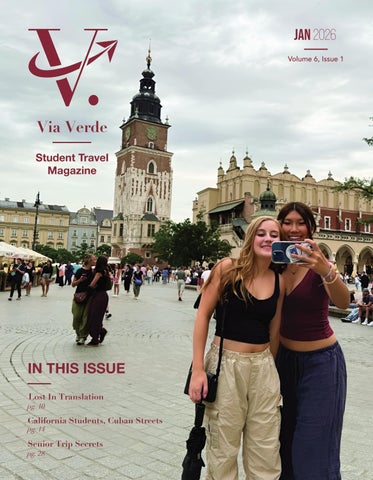
JAN 2026 VOLUME 6 ISSUE 1 EDITOR-IN-CHIEF Cailey Lilly Quita BUSINESS MANAGER Richard Zhang ART DIRECTOR Doreen Hou PHOTOGRAPHY DIRECTOR Alexander Lawson STAFF WRITERS Lise Concolato Julia Curtis Joyce (Leyi) Ma Chiara Martin Navya Narayanan Julia Nunes Tarika Pillay Veronica Qiu Mack Reller Juni Thurston Chapin Walker Amily Zhang Richard Zhang ARTISTS Doreen Hou Joyce (Leyi) Ma ADVISER Paul Kandell CONNECT @viaverde.mag ON THE COVER Palo Alto High School seniors Ava Knapp and Joy Tan sneaking a selfie in Krakow, Poland. Photo by: Jordan Knapp
VIA Verde 3
IN THIS ISSUE
VIA Verde 4
CASCAIS, PORTUGAL Photo by: Ava Knox
INSIDE 6 Lift off
EXPLORE 8 Castles 10 Jeju 13 San Diego
14
Cuba
18
Cape Cod
16 20
22 24
France vs California South Africa Twain Harte Portland
REFLECT 26
28 30
Map of Student Travel
Senior Trip Secrets Gallery
VIA Verde 5
BEST TAKEOFF SONGS Compiled by Cailey Lilly Quita
Lost in Japan
3:38
•••
Roses
3:47
•••
8TEEN
3:49
•••
Shawn Mendes
The Chainsmokers, ROZES
Khalid
ERBATIM V When have you experienced the worst delay when traveling? What was the reason? “One time I had an international flight where I had to fly back to China. Our flight was only delayed for two or three hours because of weather conditions so we had to find a place to wait during that time.” — Hao Zhang, 11th Grade
American Boy
4:45
Brazil
4:12
•••
Supercut
4:38
•••
•••
Estelle, Kanye West
“In Hawaii once I was trying to come home and our flight got delayed for more than a day so we had to reschedule it and had to get a hotel which was really annoying” — Zoe Masu, 10th Grade
Declan McKenna
“I was going to a wedding in Washington D.C. over the summer and the plane got delayed by about eight hours because of thunderstorms”
Lorde
Empire State of Mind JAY-Z, Alicia Keys
All The Stars (with SZA)
— Drew Good, 9th Grade 4:37
3:52
•••
•••
The Weeknd, SZA
“I went to New York two years ago and there was a snowstorm during the winter and my flight got delayed for a couple of hours” — Zach Lucina,11th Grade
just like magic Ariana Grande
VIA Verde 6
2:30
•••
Compiled by CHAPIN WALKER
VIA Verde 7
Clans, Castles & Connections
Text by VERONICA QIU and CAILEY LILLY QUITA
VIA Verde 8 VIA Verde 8
SCOTLAND THE BRAVE: Stempel proudly standing in front of the Edinburgh Castle in Edinburgh, Scotland. She observed the statue of her ancestor, William Wallace. Photo by: Julie Rubery
ROBERT THE BRUCE (LEFT): The grave of the leader who led the Scots to independence from England is found in the Dunfermline Abbey. Stempel said visiting several significant battle grounds was very moving and emotional. Photo by: Misha Stempel COLORFUL CURVE (ABOVE): Victoria Street in Old Town Edinburgh, UK provides a whimsically colorful visual for locals and tourists. Named after Queen Victoria and lined with cobblestone streets, boutiques, and timeless charm. Photo by: Misha Stempel
TEACHER RECONNECTS WITH HER ROOTS
F
OR PALY MATH TEACHER Misha Stempel, travel isn’t just about seeing new places. It’s about connecting with her history and family. Her trip to Scotland and Ireland offered both, leaving her with meaningful memories. “When I landed in Scotland, I got a little teary because I could just feel my ancestors,” she said. Stempel explained that one of her clans is the Wallace clan, as in William Wallace. Thus, when she stood at Edinburgh Castle, she experienced history in a way textbooks can’t replicate. “The whole time—I got emotional at grounds where Scotts, including my
ancestors, lost in extremely bloody battles to stone street and ancient castle seemed the English; you’ll think I’m crazy, but I swear to whisper the stories of past generayou could feel the spirits of the men who died tions. there,” Stempel said. “Seeing the William WalShe said her trip really made her lace statue at Edinburgh Castle and his memo- feel proud of her heritage. rial in the distance in Sterling also grabbed my “It [the trip] definitely made me heart.” feel more connected and more proud Her father’s past made her trip even to be Scottish,” Stemmore memorable. He pel said. “I’ve always was born in Ukraine “I could just feel my been pretty in touch and raised in Germany with my Ukrainian side during World War II, ancestors.” since my dad and his where he survived the — Misha Stempel, teacher mom were from there, war’s chaos and immiand I was raised with grated to the U.S as some of the Russian a child, and even attended Palo Alto High Orthodox trwaditions.” School. Through Scotland and Ireland, “When I was walking around in Berlin, I Ms. Stempel discovered more than was thinking to myself, ‘Oh my God, my dad scenic beauty: she discovered belongwas here and saw everything that was going ing. She walked with her ancestors, on,’” Stempel said. “I called him, saying I was retraced their struggles and triumphs, here and walking around, and he told me to go and returned home with a deeper unfind his house.” derstanding of herself and her roots. For Stempel, Ireland offered its own won“I do think that, overall, travel ders, though she admits her heart was focused gives a person a better perspective and on learning about her family history and the appreciation of the world and of peoconnection she felt to the land. Every cobble- ple,” Stempel said. v.
VIA Verde 9
LOST IN T RANSL AT ION NAVIGATING JEJU WITH GOOGLE TRANSLATE
T
When we first stepped out of the cab, HE MUGGY SUMMER HEAT I could tell that Aunt Ma was confused enveloped us as we stepped out of — she was the one who had arranged the the air-conditioned cab. Bright accommodations, and she could immeditraffic signs, familiar in the corner of my ately see that this tiny strip of road in the eye, turned incomprehensible with unfamiddle of nowhere was not the site of the miliar text as my aunts and I wandered cozy apartment she had expected. After a further from the drop-off point. Weighed back and forth with Google Translate, we down by heavy luggage, I took in the were assured by our driver that, according urban streets with a sense of deja vu. It to Uber, this was the place. looked like any other street, blended in However, the more we ventured away a hodgepodge of hard concrete and pale from our drop-off zone, the more I realwhite stripes, but we were lost in a whole ized that we were way in over our heads. new world. At that moment, I had a sudEvery sign around us was in Korean, and den realization: my two aunts and I were as much as I hoped Google Translate on our own. would come in to save the day, it was of We came to the island of Jeju, no use. After half an hour of trekking in Korea, with high hopes. Between the the suffocating heat, travel fatigue set in, three of us, we knew lanand soon, light sprinkles of guages: English and Chinese. Aunt Wang only What if I couldn’t tropical rain started to fall. To our dismay, we were no closer spoke Chinese. We quick- understand the to our supposed destination. ly learned that our EnThe promise of shelter away glish and Chinese meant heavily accented from the humid summer heat almost nothing when it English? seemed like a faraway dream. came to communication. Aunt Ma finally decided to call our Our first hint of impending catastrophe host at the hotel. Frustration started to came at the airport when we realized my rise. Our host on the other end of the Aunt Wang’s Chinese skills weren’t much phone kept on repeating a phrase, but she help when the arrival card was only in couldn’t decipher the words. Finally, Aunt English and Korean. Thankfully, Aunt Ma shoved the phone at me and asked me Ma and I were able to fill the cards out to use English. Frankly, it was terrifying to between the two of us. have that level of responsibility. What if I Next, we had to figure out a way couldn’t understand the heavily accented to get to our hotel. We didn’t know any English? What if I had to explain everyKorean, but in the age of rideshare apps thing in Chinese and failed miserably? like Uber, how hard could it be? With the They trusted me to figure it out, but if I help of Uber, we set off from the airport.
VIA Verde 10
led us wrong, it would be all my fault. I didn’t have time to navigate the storm in my head — I had to act. As I held up the speaker to my ears, all I could hear from the other end was this: “Mc dona deu! zai Mc dona deu!” I didn’t have a clue what he was saying either! I tried asking for clarification in English, but it seemed our host was getting impatient — he just repeated the same phrase louder and faster. In hindsight, he was actually trying to communicate with us in Chinese: zai means “at” in Chinese, and the hotel was zai (at) McDonald’s. Turns out, our hotel was settled right behind a huge hill — the very building that we had passed by earlier. Uber’s navigation worked fine in the U.S., but when it came to the actual location of our hotel in Korea, it dropped the ball and sent us 900 meters away in the middle of nowhere. Two hours after arriving in Jeju, we finally shambled into the main lobby of Jeju Ollero Pension, a set of apartments facing the sea, sweaty and exhausted. On our first day, we visited Nuwemaru Street, a famous tourist attraction lined with colorful shops and busy restaurants. Most stores had signs with English, Chinese, or both in addition to Korean. One barbecue restaurant even advertised its Chinese-speaking staff. Located nearby at 36 Singwang-ro, Yangsabuyangkkochi (Lamb Skewers) served the best Korean barbecue I’ve ever had. The menu had a photo for almost every dish, and every
Text and Photos by JOYCE (LEYI) MA SPLASHING WITH STYLE (LEFT): Aunt Wang poses for the camera during a senic break near Undo Island. Before boarding the boat, our tour guide passed out plastic raincoats for everyone to wear. Although I loved the exhilarating rush every time our boat free-fell down to the water, not everyone was a fan. Passengers were instructed to hold on to the metal handlebars attached to the seats in front because there were no seatbelts. FOGGY HORIZONS (BEHIND): the view from a public deck near our hotel. This high above the shore, we would’ve been able to see across the horizon if not for the foggy weather that day. Despite the gloomy weather, the air was warm and humid. The jagged black rocks lining the shore were formed from magma millions of years ago.
item had both Chinese and English names hard could ordering food be? Just point and of the earlier issues using Google Translisted. It was a breeze to simply point at pay, right? Well, I was wrong — the language late, but it didn’t work. He took one look the items we wanted. The language of barrier struck again! The vendor clearly want- at the translated text and laughed at us. food was something we all understood. ed to explain something, but even with the We could literally see our hotel pass us by After realizing that navigating a for- help of Google Translate, the conversation as we sat helplessly in the car. In the end, eign country would be harder than ex- dragged on with no conclusion in sight. A we resorted to shouting “McDonald’s” repected, we opted for guided tours with a couple lined up behind us, but after 10 min- peatedly at our cab driver. He looked at us Chinese-speaking guide. utes of back and forth, they like we were crazy, so we ended up pointWe took a ferry to Udo Is- The language ing frantically out the window. He probsoon left. land for a boat tour, which At this point, the vendor ably thought we were hungry maniacs, was half sightseeing and of food was was getting frustrated. Final- but at least we ended up within walking half wave-jumping. On something we all ly, we hit a key term — DIS- distance this time. Maybe our hotel host one big wave, a girl’s hand PLAY. Oh! The tantalizing was on to something — the language of slipped, and she banged understood. hot dog I was pointing to was national fast food chains really does tranher head face-first into the only meant as a display sam- scend cultural and language divides. metal railing, and blood started to flow ple! I was so hungry I didn’t care Looking back, our from her nose. Her friend started shout- if the final product was differbiggest obstacles were ing “Stop!” at the captain in Chinese. communication and ent. Although the sausage was He took one look The problem was, none of us knew hot and sizzling, the bun was at the translated navigation. Instead of how to speak Korean, and he didn’t know limp and cold. Still, I scarfed it using Uber, it would text and laughed have been better to opt Chinese. It was only when he saw the down with relief. bright blood flowing down her face that for a local option like My aunts wanted to try at us. our boat finally came to a sudden stop. some local foods, but seeing the Naver Map, which inHe looked shocked, and as he stuttered huge lines, we realized it would be hard to get cludes English translations and Romanthrough an “Are you okay” in broken En- a word in when everyone else could quickly ized labels. glish, I could tell he finally understood. Meanwhile, Kako T, with over 90% order and leave. It left us with a sense of the However, there wasn’t much he could helplessness that we felt earlier — we could of drivers in Korea, is the best option for do — there were no medical supplies on- literally see the tantalizing black pork sizzling hailing taxis. In fact, it offers English opboard, and we still could only communi- in front of us, but that thin intangible bar- tions and allows users to call and pay for cate with “yes” and “no.” The rest of the rier of language became an insurmountable taxis without speaking a word of Korean. ride was silent as tears streamed from the wall. In the end, we had to settle for a bowl Still, most translation options available girl’s red eyes. of convenience-store ramyun at a CU corner have notable flaws. Our tour concluded at the Dong- store, the equivalent of finding dinner at a Google Translate was great for quick mun Traditional Market, Jeju’s largest gas station. image-to-text translations, but quickly and oldest permanent market. Food carts Our cab ride back to the apartment was fell apart during real conversations. Even lined the crowded path, and our group also doomed by the language divide. We though exploring the island on our own was famished. I saw a hot dog stand. How tried to warn our Uber driver ahead of time
VIA Verde 11
WALL OF APPRECIATION: Located at the lobby of Jeju Ollero Pension, well-wishes from previous guests are pinned. This board also has helpful QR codes of nearby restaurants for guests to order food online.
SUNSET SEND OFF: The view from our balcony on our last evening in Jeju. By the time the sky turned black, we could see fishing boats bobbing in the distance. Their bright lights turned the dark waters into a sea of stars.
VIA Verde 12
Riding Solo in SoCal FIVE WEEKS ALONE WITH A FREE BUS CARD
M
OVING AROUND AS a the city opened up a little and became a lot kid was always a challenge less scary. Grocery runs were faster thanks for me— starting over some- to the convenient placement of the route. where new with no knowlA week later, my basic needs were beedge of the people, roads, or places was an ing fulfilled, but the boredom started kickintimidating process. However, one thing ing in. I wanted to see more, not just wander that I took for grantaimlessly from my beded was the simple room to my workplace necessity of accessi- I never grew overly fond to my kitchen. I startble transportation. of buses, but one thing ed looking closer at the This summer, I bus maps and realized I I did like was how they could basically go anyspent five weeks in La Jolla, San Diego, brought people together. where in the city if I sat renting an apartment still long enough. The by myself. I spent the beach, yoga studios, and first few days enjoying the freedom that liv- giant malls. I made good use of my free Proning alone had to offer—no nagging parents to card and built a giant routine out of whatand no annoying brother. Soon, however, I ever was within thirty minutes of a bus stop. realized I was very limited in many aspects. I explored San Diego to my heart’s content. For one, I couldn’t drive. The nearest Of course, I was definitely not an expert grocery store was a 25-minute walk away, in navigating public transportation. Even afand on the third day of living in La Jolla, I ter weeks of using the same bus lines, I still hauled a Trader Joe’s tote bag filled with a jug missed the bus more times than I’d like to of milk, frozen foods, and fruit all the way admit. I got off at the wrong stops someback from the store. Once of that torture times, and got onto completely wrong buswas enough. I registered for a Pronto (public es. Sometimes the issues weren’t my fault— transport) card—which, to my delight, was there were often delays, and even more free for anyone under 18—and suddenly frustratingly, there were
often buses that left ahead of time. Despite this, I was thankful for public transportation. Not only as a way for me to get from place to place, but also as a way for me to connect with others in the community. When I left for work in the mornings, I would often bump into friendly UCSD students who chatted with me, told me about their majors, and shared entertaining anecdotes that happened on campus. My favorite story was of the two owls who lived on the seventh-floor overhang of the biology building, named Owliver and Owlivia. Even people who didn’t talk to me told their own stories— surfers boarded the bus near the beach, a young couple sharing wired earbuds, a group of friends wearing pajamas for a slumber party— so much life buzzed around the monotonous routes of the old, shaky buses. By the time I left La Jolla at the end of the 5 weeks, I had already memorized bus numbers, routes, and even the faces of some bus drivers. I never grew overly fond of buses, but one thing I did like was how they brought people together. I may have been by myself during my time in San Diego, but I was never really alone. v.
Text by AMILY ZHANG Art by DOREEN HOU
VIA Verde 13
California Students, Cuban Streets A 10-DAY, 800 KILOMETER ROAD TRIP THROUGH THE CUBAN COUNTRYSIDE
T
TRAVELING ABROAD AS AN American it’s almost a given that you’ll see glimpses of life at home. Whether that be a Starbucks in Germany or a McDonald’s in Japan, many American phenomena permeate the world. In Cuba, things are a bit different. Since 1962, the United States has almost entirely barred American companies from trading with Cuba. Additionally, American tourism to Cuba has been banned since 1963, with travel only allowed in select circumstances — one such circumstance being educational activities. Despite rocky relations between the two countries, Cuba was perhaps the most welcoming country I’ve ever set foot in. Caitlin Drewes, a Palo Alto High School history and economics teacher, helped facilitate a 10-day educational and cultural tour of Cuba with EF Tours over the summer. She brought eight students, seven of us from Paly. The tour took us across the entire western half of the island; the capital of Havana, as well as cities such as Remedios and Trinidad, among others, letting students and chaperones experience a broad and diverse piece of Cuban culture. Cuba, in large part because of the American embargo, is very much separate from other places Americans often visit. Drewes said that Cuba was unique in comparison to other places she’s visited. “I consider myself pretty well-traveled, and I’ve never been to a country like Cuba,” Drewes said. One unique aspect of Cuba that is noticeable from the moment you step out of the airport is its vintage cars. Since the beginning of the American embargo, most major car manufacturers have been unable to import their modern cars into Cuba, leaving cars from the 1960s and before to populate much of the country. We visited a local car restoration site and drove around Havana in some
VIA Verde 14
of their classic cars. Many of these cars have sula, we live in a very individualistic culture. new, replaced engines and interior technolo- Seeing a place that has vibrant and tight-knit gy, but retain their classic frame. local communities was wonderful. In these cars, we stopped at various hisPaly junior Tess Kim, another student torical landmarks of Havana, one being La who went on the Cuba trip, said that a highPlaza de la Revolución (Revolution Plaza), light of her trip was experiencing the comwhere a large statue of José Marti — Cuba’s munity-oriented Cuban culture. most prominent national hero — is situated. “My favorite part of the Cuba trip was Despite being an experience catered to just being able to experience a culture that tourists like us, the tour still provided us with was so different from what I’ve grown up an authentic taste of some of the most prom- with here in Palo Alto,” Kim said. “People inent features of Havana. in Palo Alto can tend to be a bit individualI, along with a few friends who were istic, whereas the culture we experienced in also a part of the trip, noticed similarities in Cuba was very much a community, and very a lot of the historic focused on uplifting all architecture. Espe“My favorite part of members of the comcially in parts of the munity.” country where set- the Cuba trip was just Although we were tlements began early being able to experience not there for “Las Paron, iconic Spanish randas,” we were in colonial-style build- a culture that was so town for the city’s anings that we often different from what I’ve niversary festival, celesee here in California brating 510 years since were very common. grown up with here in the founding of the city. Some Paly buildings Palo Alto.” In this festival, we were would have stylistiset free to explore, see — Tess Kim, junior the fireworks, buy food cally fit right into the city centers of Triniand drinks from local dad or Remedios. vendors, and converse with locals. Overall, my favorite part of the trip was This freedom of exploration was given seeing the strength of the community that to us in every city we visited. This may sound seemed to impact nearly every facet of Cu- unusual because here in America, many ofban culture and life. ten presume that countries in Latin America, In Havana, for example, we visited Arte especially less wealthy Latin American counCorte, a local community project that aims tries, are inherently dangerous. to both teach Cuban youth hairstyling and to Cuba, however, is generally considered use art to help improve local infrastructure. one of the safest countries in all of Latin Moving east to the city of Remedios, America. While we were still encouraged we learned about the Christmas festival “Las to stay aware of our personal belongings to Parrandas,” in which each year on between avoid any petty crime, locals in cities such as Dec. 16 and Dec. 26, the two neighborhoods Cienfuegos or Remedios told us that violent that make up the city come together to cre- crime generally wasn’t something to worry ate elaborate art installations and compete about. v. against each other in a friendly rivalry. Here Text by JUNI THURSTON in America, and even more so in the Penin-
HAVANA HARBOR (ABOVE): On our second-to-last day in Havana, we ventured out to the main waterside highway and overlooked the Havana Harbor. Here, we got to go see the skyline of the city while watching boats venture in and out of the bay. Photo by Max Manbeck CUBAN CRUISIN’ (BELOW): I remember being shocked at the sheer variety of vintage cars — old American Chevys and Fords, Soviet-era Ladas, and even vehicles from now-defunct manufacturers like Pontiac. Photo by Juni Thurston
VIA Verde 15
Coasts In Contrast
their friends, while others visited the the meadow, and, of course, visit the lake for CALIFORNIA with historic château (castle) de Pornic, built in even more fun. the Middle Ages. California’s sunny coastline in San DiFor beach-goers looking to surf, ego gives of Mediterranean life, but AND FRANCE: compared to the daunting waves of Cal- the South aoftaste France feels like its older, more Huntington Beach, surfing in storied sibling. Driving down the winding A CULTURAL ifornian the French coastal resort city of Royan coastal roads through Marseille, Cassis, Banwas much less intimidating, while still dol, and Saint-Cyr-sur-Mer, each town reSanta Barbara also matches the veals its own shade of Provençal charm. MarCOMPARISON exciting. feel of Royan in its bustling yet not overly seille hums with centuries of history, while
T
HE SAND AND ROCKS urban downtown area, while its sprawling under your feet may feel the same, beaches are covered in signature blue and but the stories they tell couldn’t white striped umbrellas. After mornings of be more different. While Califor- downtown window shopping and boutique nia’s seamless sand beaches stretch endless- hopping in Royan, it’s time to board the colly along the Pacific, across the world, each orfully decorated minivan, ready for an afFrench coastline has its own personality; the ternoon of surfing. When dinner time rolled Mediterranean sun of the south and the qui- around, picnicking on the beach at sunset et villages of the north. made the perfect end to the day. To experience Sometimes, the quaint charm what’s more picturof Le Port de Poresque than an ocean nic, tucked away on beach is a lakeside the northern coast one. Californian of French Brittaclassic, Lake Tahoe, ny, visit Sausalito has rentable kayor Catalina Island. aks and stand-up Both are cities built paddleboards, as into hillsides, with well as hiking trails beachside thrift and boat rides. It stores and bouclosely matches the tiques, and beautiful atmosphere and views. While there the appearance of are many glaciers the French lake of (ice cream shops) Nantua in central and boulangeries France, although (bakeries) in Pornic, much bigger and my favorite is the more touristy. The FANCY IN FRANCE: The streets of Nice in family-run sorbet clear waters of Lac the south of France are lined with colorful, yellow-toned buildings. shop overlooking de Nantua are surthe port: La Fraiserounded by rolling raie (The Strawberry hills and mounPatch).On weekends, the small streets and al- tains, with sections for swimming, docks for leys of Pornic are transformed into le marché jumping off of, stations for renting pédalos (market), where local vendors sell fish, veg- (pedal boats), and even a lakeside café restauetables, sausage, cheese, and even jewelry. rant.. While visiting Nantua, I stayed with Walking distance from the charming bou- another close friend and her entire family tiques in town are beautiful beaches in every in their 40-bedroom château from the Middirection, sprinkled with shells of all shapes dle Ages. Every year, as many as 80 family and colors. While some read under the hot members reunite come summertime to play sun with a drink from the bar, some dove Just Dance in the château library, watch fireinto the ocean, or played beach volleyball works on Bastille Day, play family games in
VIA Verde 16 VIA Verde 16
Cassis offers cliff-framed beaches at Les Calanques de Marseille (the calanques), where turquoise coves are only reachable by hike or boat. Further along, Bandol and Saint-Cyrsur-Mer echo that Mediterranean warmth in a quieter, more intimate way that even San Diego’s surf towns can’t quite capture. The air carries a scent of pine and palm trees, les cigales (the cicadas) hum from morning to dusk, and les pointus (traditional fishing boats) decorate the harbors. Unlike California’s long stretches of sand, these compact beaches feel timeless—woven with history, community, and the enduring rhythm of seaside life. California beaches may be close by, nothing compares to the rich culture of the North and South of France, so we would choose France any day. v.
TRADITIONAL EATS: A typical French breakfast complete with croissants, yogurt, fresh fruit and tea.
Text and photos by JULIA CURTIS and LISE CONCOLATO
1
VIA Verde 17 VIA Verde 17 2
1: Boats sit in Pornic, France, a the sun quietly sets. 2: Snowy mountains next to Lake Tahoe, California sit behind boats.
2 1: A side view of the narrow Plage de Renecros, in the South of France. 2: A side view of a house staircase winding down a cliff in Capitola, Califronia.
2
1
1: A sidewalk view, in Sausolito, California, 2: An ocean view of Pornic in the North of France Guess whether the picture was taken in France or California!
California or France?
AN EVENING ON THE BEACH: Light from the houses and the setting sun illuminate the sand as I take in the view. Photo by Fiona O’Neill.
VIA Verde 18
Cruising Through Cape Cod A SUMMER FULL OF EAST COAST CHARM
W
HERE DO THE surfable waves of Cousin’s Beach meet the charming bookstores and brunch spots of Star’s Hollow? Where colonial style homes and blue hydrangea gardens sit walking distance from piña coladas and mini golf locations — Cape Cod, Massachusetts. Cape Cod, a Massachusetts peninsula made up of fifteen small towns, is the ideal summer location. When I visited my best friend’s summer home in Brewster this summer, I immediately knew I wanted to revisit the following year. Driving from small town to the next from the Boston airport, I watched out the window as beautiful coastal and colonial homes whizzed by. It felt calmingly residential, without big city pollution or noise, and less claustrophobic than Palo Alto. The beaches sprawled far along the coast, the waves were sprinkled with surfers, and the sand was dotted with blue beach umbrellas. Ocean Edge Resort and Club was by far my favorite, only a bike ride away from the summer house. The historic mansion offered coastal dining and outdoor family activities, while the beach resort provided food and drink
— my favorites were the ice-cold piña coladas. The crashing of the blue-green water, always carrying a sailboat or two, made the perfect background for reading under the sun. While the Cape is known for its lobster and clam dishes, there was much more to the peninsula than seafood. The Kitchen Café was a family favorite, conveniently located en route to Ocean Edge. The blue-painted, coastal-style restaurant, half outdoor patio and half indoor area, was the perfect brunch spot to start the day. We ordered mason jar chai lattes, toasted breakfast sandwiches, and burritos while discussing how to spend our afternoon. Cobie’s was a popular lunchtime burger and ice cream joint in Brewster, with outdoor seating and a bike path leading straight to the summer house. For dinner, Land Ho was the ideal choice, red gingham tables underneath the creatively decorated ceiling full of hanging signs from all over the peninsula. For a classier meal, the Ocean Edge mansion offered both outdoor seating with an ocean view, and a candlelit indoor meal option. My summer ice cream needs were more than met, with swirled soft serve from Cobie’s, creamy root beer floats
from Brewster Scoop, and my personal favorite — rich brownie ice cream smothered in chocolate jimmies from Arnold’s. While the towns were small and almost everything within town was a minute’s bike ride apart, we never ran out of activities. When we weren’t at the beach, we were browsing at the quaint Brewster Bookstore, hopping between the various thrift shops and boutiques, bowling at The Alley, or playing mini golf at Arnold’s Lobster and Clam Bake in nearby Eastham. One night, we stocked up on candy and snacks from Brewster General Store, padded the back of the hatchback with blankets, ordered two large pizzas, and rode to the Wellfleet Cinemas drive-thru movie theater to watch How to Train Your Dragon under the stars. I had never been to a drive-thru movie before, and suddenly wished there was one in Palo Alto. If you are ever stuck on where to spend your small-town summer, Cape cod embodies every aspect of the ideal vibe — delicious food, drive-thru movies, quaint boutiques, and relaxing days at the beach. v. Text by JULIA CURTIS
VIA Verde 19
Text and photos by TARIKA PILLAY
Sights of the Sanctuary
EXPLORING AFRICA’S GREATEST PREDATORS
T
WO HOURS AWAY FROM MY HOME IN SOUTH Africa, there was a wildlife sanctuary that I visited with my family. There, we met lions, cheetahs and hyenas that could no longer survive in the wild by themselves. Romeo, the 13- year-old cheetah pictured left is the oldest animal in the sanctuary. The animals were patient, calm and even somewhat friendly, and they were by far the prettiest animals I’ve ever seen in Africa. v. STALKING HIS PREY (LEFT): Romeo the 13-year-old cheetah looking at his handler, Pele. SUNBATHING (TOP): Lioness is staring at her sisters eating dinner in the distance. SHAKING PAWS (RIGHT): A handler, Pele, and one of the hyenas at the sanctuary showing off his paws.
VIA Verde 20
VIA Verde 21 VIA Verde 21
Going Off The Grid
A CHAOTIC TWAIN HARTE BACKPACKING TRIP
T
WAIN HARTE, A SMALL town Eastern California, has a vibrant downtown accompanied by some of the state’s most pristine wilderness. Over the summer, we went off the grid into the backcountry with a group of friends to experience the adventure of backpacking. To begin the journey, we grabbed our last enjoyable meal from a local sandwich joint and stashed it into our overstuffed packs for lunch on the trail. Before we knew it, we were amidst the towering grassy mountains, hiking along a dirt trail with our belongings on our backs. Our relaxing and peaceful daily routine was ripped from us, and it felt as if we were completely separated into a different reality among the mountains and trees engulfing us. Our destination was Bear Lake, a spot where many backpackers set up tents on the flat land around the lake. However, we made many stops along the way, our first one being a barky tree trunk sprawled across the ground, inviting us to have a seat. Here, we savored the tenderness and juiciness of our sandwiches, knowing that our next meal wouldn’t be nearly as easy to enjoy. With the rocky face of a cliff on one side and what seemed to be an endless forest on the other, we took a final glimpse of our unique view before continuing on our journey. After two hours of hiking we finally reached our destination. The first hours at Bear Lake were chaotic. Some of us had forgotten our camping chairs, others their water bottles, and we were all conflicted on where to set up our tents. We ended up settling on an area with two sections – one section elevated from the other, requiring us to maneuver up a rock to access it. This would be where we had
VIA Verde 22
our nighttime gatherings and meals, whereas the soft grassy area below was where we set up our tents. To our surprise, there was no shortage of activities for us. From swimming to fishing to scavenging for firewood, we all dispersed and enjoyed our time isolated from society. When the night came, we gathered around a campfire and prepared the store bought freeze-dried food we brought in our packs. That was when we realized we were in a predicament – there were only enough servings to feed us all for five meals, while a regular breakfast-lunch-dinner routine would require us to have eight. This brought us to a consensus decision of skipping lunch on both days, and breakfast on the morning that we hike back. One by one, we dove into our tents and snuggled into our sleeping bags for our first night at Bear Lake. The next morning, we woke up with a sense of determination. The spine of a mountain was wrapped around the opposite side of the lake, and the peak had been looming over us since our arrival. Today we were going to climb it. We filled our water bottles with filtered lake water, and headed towards the spine of the mountain. Among the obstacles we faced during our 1500 foot ascent was the thinning of the air, threatening our breath with every stride we took, and the pesky shrubs relentlessly gashing at our shins. On top of that, the summertime heat blazed down at us while our water bottles were depleting at a concerning rate. Shirts soaked and bottles empty, we overcame the most challenging maneuver of the hike, scaling across boulders and trudging through shrubbery to finally reach the peak. The 360 view atop the mountain was mesmerizing. Standing at the edge of the cliff,
you could observe every detail of the valley below you as if you were a bird. There were lakes scattered below your feet, but looking up you saw the vast mesas of Eastern California in front of you. With the turn of a head you could see the very trail connecting Bear Lake with the town of Twain Harte, accompanied by the thousands of trees scattered around it. The final night at Bear Lake called for another campfire gathering, where we enjoyed each other’s company and made fulfilling meals out of our final freezedried portions. We scraped together all the remaining snacks we could find — dates, figs, granola bars — and used them to fuel ourselves through the night, until exhaustion dragged us into our tents. Amidst the cold, piercing air, we rested in preparation for the ensuing journey back to civilization. The backpacking trip was a huge success altogether, with every one of us coming back in one piece. We spent quality time with friends and made memories to be long remembered, but our execution was flawed in many ways. Our insufficient food supply caused problems and stress, and much of our camping equipment was left back in Twain Harte. Most importantly, a fishing rod is a necessity for our next adventure. Countless hours were spent attempting to catch fish with a sharp wooden stick, and that frustration and disappointment will not be forgotten. On our next trip to Bear Lake, the sheer amount of fish we reel in will make freezedried portions a problem of the past. v.
Text by MACK RELLER and RICHARD ZHANG
VIA Verde 23
FUN IN THE SUN: After going for a swim in an alpine lake, Paly Juniors Clement Romanski, Greg Goody, Owen McGraw and Cole Kristofferson bask in the sun before continuing on their backpacking journey. Photo by: Mack Reller
VIA Verde 23
FORTNIGHT FRIENDSHIPS A STUDENT’S REFLECTION: SIX YEARS AT CISV Text by JULIA NUNES
B
EFORE DIVING INTO MY EXPERIENCE I WANT to ones. They were the small, in-between times — planning an activity be transparent: I’ve been part of Children’s International Sum- with people I barely knew, solving a problem when no adults were mer Village (CISV) for six years, and I’m personally involved around, or trying to make group decisions when everyone had different in the organization. While that means I have a unique insider’s ideas. I learned that true collaboration isn’t about taking charge; it’s perspective, it also means this story comes from both my journalistic about listening, compromising, and trusting that everyone brings somecuriosity and my personal connection to a community that has shaped thing valuable to the table. who I am. One of the volunteers I’ve learned a lot from is Henrique Marttos, While many teens spend their summers relaxing, traveling, or who has also been in CISV for six years and now serves as junior branch working, mine have looked a little different. For the past six years, my board activities chair for the Miami chapter. He described the program summers have meant packing for a CISV program — a chance to learn as transformative. about peace, leadership, and understanding through “CISV gives kids the chance to see the world not shared experiences with people from around the just as tourists but as members of a global famiworld. Last summer, I joined the Fortnight ly,” Marttos said. “They learn that peace starts program in Portland, Oregon, one of CISV’s with understanding, and that begins in childThey learn that peace domestic camps that brings together teens hood.” starts with understanding, from across the U.S. for two weeks of culThat idea stuck with me. Over the years, tural exchange and teamwork. CISV has taught me to approach people and that begins in childAt Fortnight, no two days were ever the with openness — to listen before judging, same. Mornings often started with “energizto ask questions before assuming, and to hood. — Henrique Marttos, CISV Activities Chair ers,” quick group games that got everyone notice how small actions can create a ripple laughing and awake. From there, we’d dive of kindness. Including someone who feels left into themed activities designed by staff or even out, speaking up when something feels unfair, by us campers. One day, we built a “mini city” to exor simply being patient in a disagreement. All of those plore cooperation and fairness. Another day, we rotated through sim- moments are lessonss for life. ulation games about communication barriers, learning how language Hearing my friends talk about their struggles, laughter, and discovand assumptions can lead to misunderstanding. In the evenings, we’d eries reminded me that growth doesn’t happen all at once. Sometimes have cultural nights — each group sharing traditions, dances, or foods it’s as simple as learning to share space, or as deep as realizing how much from their region. you’ve changed in two weeks when living together as a wholesome famiBut the moments that changed me most weren’t the structured ly sharing an inseperable bond. v.
“
”
VIA Verde 24 VIA Verde 24
SHARING SMILES: Above the Columbia River Gorge, CISV participants pause for a photo during the Fortnight program in Portland, Oregon. The two-week domestic camp gathers teens from chapters across the U.S. to explore cultures, build teamwork, and strengthen friendships. Photo courtesy of CISV USA Portland Chapter
VIA VIAVerde Verde25 25
Paly Student Sum
VIA VERDE ASKED PALO ALTO HIGH SCHO SUMMER, HERE’S W
Compiled by LISE CONCOLATO and NAVYA NARAYANAN Art by JOYCE (LEYI) MA
KEY FRESHMEN SOPHMORES JUNIORS
SENIORS
VIA Verde 26 VIA Verde 26
mmer Travels 2025
HOOL STUDENTS WHERE THEY WENT THIS S WHAT THEY SAID:
VIA Verde 27
CINQUE TERRE, ITALY Photo by Clara Hoffman
DUBROVNIK, CROATIA Photo by Svina Narang
VIA Verde 28 VIA Verde 28 VIA Verde 28
ROME, ITALY Photo courtesy of Gus Soedarmono
SENIOR TRIP SECRETS
TIPS FROM PALY GRADUATES FOR PLANNING YOUR SENIOR TRIP Text by CHIARA MARTIN
Backpacks stuffed, passports in hand, and friends by their side, many Palo Alto High School seniors choose to have the ultimate send-off — a senior trip. Seniors will sometimes go as far as across continents, trying to make memories that will last a lifetime before embarking on their post-Paly plans and aventures. However, having a fun vacation is easier said than done. Between agreeing on destinations with your friends (and parents), finding places to stay, and most importantly, budgeting, planning a senior trip can be a daunting task. To help the new seniors, we interviewed three class of 2025 Paly graduates to find out their tips and tricks for having the best senior trip possible.
1. PLAN EARLY
Paly graduate Clara Hoffman stresses the importance of planning early. “My biggest advice for planning would be to plan at least six months before,” Hoffman said. “I know some people planned their trips a lot closer to when they left, but it’s a lot less stressful to plan in advance.” Planning early is also good to conserve money, as tickets and lodging will often be cheapest far in advance. Having planned on the later side, just a month or two in advance, Svina Narang agrees with Hoffman. “We planned super late, but I would recommend just sitting down for a couple of hours and trying to figure out a plan early on,” Narang said. “That way, we could have saved more money.”
2. WHERE TO GO AND STAY
Picking a destination is really dependent on the wants of your group. Many groups
try to go to multiple places to see as much as possible, and vacation for around two to three weeks. Hoffman traveled all over Italy, journeying from North to South, from Milan to Cinque Terre to Naples, taking many stops in between. Narang visited Italy and Croatia, spending time in two cities in each. Gus Soedarmono traveled all over Europe, starting in Italy and journeying to France and then to Spain. Although it was worth it to see different places, all graduates agree that their least favorite part of the trip was traveling from place to place, so keep that in mind before choosing too many destinations. “My least favorite times were travel days when it was super hot and we had to wear our backpacks while trying not to get lost,” Hoffman said. As for finding places to stay, Hoffman and Narang took different approaches. Hoffman booked early and found cheap Airbnbs, while Narang stayed primarily in hostels. While both options are good places to stay while saving money, it’s essential to book early for Airbnb.
3. BUDGETING
For most, the hardest part of going on a senior trip is the cost. Traveling isn’t cheap, but there are ways to mitigate the high price. Hoffman bought her tickets six months in advance, which is usually when the best deals for international travel are available. For the rest of the expenses, she was able to spend those six months effectively saving and staying on the same page with her travel mates. “I picked up extra shifts at my job and put at least half of all my paychecks into a savings account just for my trip, and I went to town and country a lot less,” Hoffman said. “It’s also helpful to have a shared Google doc with everyone on the trip to figure out budgeting and keep track of travel and housing costs.” Soedarmono took it a step further with
a spreadsheet. “Creating a spread sheet and also gathering the parents to explain your itinerary to them was especially important,” Soedarmono said. Soedarmono also saved money through public transportation. “If there are available transportations besides a taxi or Uber I would highly recommend taking it,” Soedarmono said. “It also adds to the experience of a senior trip.” Overall, the best thing for budgeting is planning early and planning smart. It’s important to keep in mind the costs aside from travel, for things such as food and activities, which pile up quicker than expected.
4. FAVORITES Hoffman, Narang and Soedarmono all had an amazing time, despite their obstacles and different planning experiences. “My favorite times were swimming in the ocean in Cinque Terre and trying all of the food throughout Italy,” Hoffman said. “The only thing I would do differently is I would pack as light as possible and spend more time at the beach since that was my favorite part.” Soedarmono was more interested in the cultural aspect, and was glad he got to visit so many different countries. “My favorite part of the trip was exploring different cultures,” Soedarmono said. “Each city featured their own specialty or was unique in a sense compared to the others. It was really cool to see how different types of people in each city had their own customs and values.” For Narang, she was grateful to be able to spend time with her friends before college while also seeing new places. “My favorite part of the trip was just getting to explore such beautiful places,” Narang said. “And of course to spend time with my friends before we all go to different places for college and to meet so many cool new people from different places.” v.
VIA Verde 29
WOLFGANGSEE, AUSTRIA Photo by Zara Dorsey
LANDING
STUDENT TRAVEL PHOTOS FROM AROUND THE WORLD
NEW YORK CITY, UNITED STATES Photo by Jonathan Chen
VIA Verde 30
LAKE ATITLAN, GUATEMALA Photo by Adrienne Lec
D
NHA TRANG, VIETNAM
Photo by Zoey Meixner
TOMAR, PORTUGAL Photo by Jessie Kwan
VIA Verde 31
RIOMAGGIORE, ITALY
Photo courtesy of Alice Sheffer