,:.)
...
..
~lllllllllllllllllllllllllllllllll llllll lll l llll lllllllllll ll lllllllllllllllnllll ll lll lllll lll lllllllllll l llll l lllllllllllllllllll l lllllllllllll llllllllll ll llllllllllllll l lll lllll l llll lllllllllll l lllllllllllllllllllllllllllllllli llllllllllllllll.';:
~
= :~
~
.·==
.
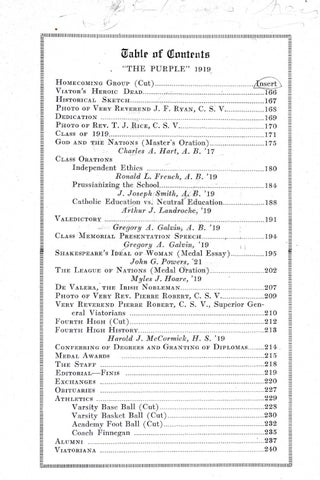
Wablr nf QJ:nntrnts
HoMECOMING
GRo~:7~t~U-~:~~'' J~jg~ __
, _________
--~
VIATOR's HEROIC DEAD ____ ______ _"_: _______ ~ ----------------·----- •- -------------166 SKETCI-I ____________ _t~· ~·.,; · 167 PHoTo oF VERY REvE;R.J?ND J. · F. RYAN, c. s > v. __________________ 16s DEDICATION _____________ : ~-~;:- -- --- - -- -- - --~- ------------- - ------------------------------169 PHOTO OF REv. T. ' J . .RICE, C. s. v _________________________________________ 170 BrsTo·R I CAL
__-_, _: ____________________________________________
~
-
. ;:
CLASS OF 1919 .... -- - ---- ~- ~ ------- ~ ------------------ ------------------ ---- - -., ~ --- - ----171 GoD AND 'Jfa'E N ATION.S. (Master's Oration) _______ ,_._________________ 175 ~/
Cha:rJes~
A. H ar·t~ A. B .. ''17
CLASS ORATIONS Independent Ethics ------- - - ~----------------------------------------------180 . Ron'ald L. French, A. B. '19 Prussianizing the _SchooL _____________ ~_----~ -- ---:-:: ... ~--- - ~--- ---- --~- --184 J. Joseph rSmith, 4,~ 11. '19 · . Catholic Educ-at1on vs .l N eutra~f Education ________ , ___________ 188 __.. . ..,-· : . . Arthur J:. Landroche, '19 .V ALEDICTOR"i::'..••..,. _____ -: ___ ~ ______ _------- - ---- ------- ~ ---- __________________ : _____ ______ 191 _ ~·"''·: ·. Gr·e·gory A. .G.al.vi:r.v, A . .B. '19 , CLASS MEMORIAL PRESENTATION SPEECH. ... -------,J------ ' -'- --- --- --19 4 . yregory A. Galvin, '19 · i 1 SHAKESPEARE's IDEAL oF WoMAN CJ.\fedal Essay)----------------195 John G. Powe'l\;s, '21 THE LEAGUE OF NATIONS (Medal o \ation) - ~ ------- --- ---- -- -------- 202 . Myles J. Hoare, '19 DE vALERA, THE IRISH N OBLEMAN _____ _____ _____________ __________ _____ __207 PHOTO OF VERY REv. PIERRE RoBERT, c. s. v. ____________________ 209 VERY: REVEREND PIERRE RoBERT, C. S. V., Superior General Viatorians _______________________________________________ : ________________ 21 0 FouRTH HwH (Cut) _________________________________________________ :__ ____ ______ __ 212 FouRTH HwH HISTORY _________________________ ___________________________________ 213 Harold J. McCormick, H; S. '19 CoNFERRING OF DEGREES AND GRANTING oF DIPLOMAS ________ 214 . lVfEDAL AwARDS --------------------------------------------------------------------215 THE sTAFF ----------------.------------------------ ----- --- --- ----- __ ·_--- ----------------218 EDITORIAL-FINIS -- -- ------- --- -------------- ------------ ---------- --- -------------219 ExcHANGES --------------------- ---- ---- --- ----------------------------------------·------220 OBITUARIES ________________ ___ : __ _______________ ___ ___ ___ ______ __ ___ _______ : ______ ___ ____ 227 ~
'
ATHLETICS -------------- ------ ------------ --- ----- --- -- ------------- --------- -------------229 Varsity Base Ball (Cut) ___________________________________________ __ __ ___ 228 Varsity Basket Ball (Cut) -- --- ---------------- --------------- -- --------230 Academy Foot Ball (Cut) -- --- ------------ --- ---------------------- -- ----232 Coach Finnegan ------------------ -------------- -- ---- --- ----- ------------ ----235 ALUMNI -------- -- -------- -- -- -------- - ---------- ----- --------------------------- - ---- -- ~ ---237 VIA TORIAN A ---- --- ------ --------- -- -- -- -- ---- -- -- --- ------ --- -- ------- -------- -- ----- --- -240 ~JIIIIIIIIIIIIIIIIIIIIIIIIIIIIilllllllllllllllllllllllllllllllllllllllllllllllllllllllllllllllllllllllllllllllllllllllllllllflllllllllllllllllllllllllllllllllllllllllllllllllllllllllllllfllllllllllllllllllllllllllllllllllllnlllllllllllllllllllll~
. ,.,
j ~:
-·..
·
•
lftatnr'!i !1rrntr
mra~
LIEUTENANT JOSEPH P. 1\IIUNDAY, .CHAPLAI ' 'OS CAPTAIN HARRY W. BURNS, ' 10 LIEUTENANT ANDRE A. GUNDELACH; '09 FRANCIS L. ADKINS, ' 15 PETER F. BOYLE, '14 SAMUEL N. CALKINS, ' 13 EDWARD B. CRANE:, ;09 BERNARD GORDON, '09 JOSEPH E: HARMON, '08 JOHN M. HEANEY, ' 18 ELROY N. LANGLOIS, ' 12 MAXIMILIAN J. LEGRIS, ' 13 FRANCIS J. LYNCH, ' 12 r . JAMES V. LYONS, ' 15 DENNIS P. McCARTHY, ' 13 FRANCIS D. SEYBERT, ' 18 "Greater love than this no man hath that a man lay down his lHe for hi s friends.'; St. John xv: 13. ..
. .
.
.
... -·-
~
~--~ ·· ···-·-~-
--~- · ·--·····
·~
ll f a to ·~ f a u · FAC ET SPERA
Volume 36
Purple Number,
1919
Number
4
ST .. VIATOR COLLEGE HISTORICAL St. Viator College was founded in 1868, at Bourbonnais, Ill., fo ~ .the higher education of catholic young men. Six years later it rec~ived its University chart er ·from the State Legislature of Illinois ; By virtue of this charter from the State of Illinois the institution is empower ed to grant d egr ees in Art, Science, Letters and · Philosophy. On Feb. 21 , 1906, the entir e institution with the exception of the gymnasium was destroyed by fire. As this building was erected in . 1901 the present plant consists exclusively of modern buildings. The . college now has six large and perfectly equipp ed buildings upon its . campus: Marsile Alumni Hall, facing east, 160 feet long and 80 feet wide and four stories high, a splendid stone memorial building-; Roy Hall, with one hundred and ten private rooms, four stories high, 172 , f eet long, and 50 feet wide; Gymnasium, 153 feet by 97 f eet, fully equipped; S cience Hall, just east of the gymnasium; St. Joseph's Hall and I nfirmaTy _; and Maternity Church, all buildings well lighted and heated from a central plant. CouRSES There ar e nine courses of studies open to the applicant: Th e College D epCt.rtment comprise? six cours es: Philosophy, in which the divisions of Philosophy and their history a r e ma jored ; L ett ers, liter ary criticism, rhetoric, modern languages, composition, orato:ry, history and philosophy; Science pre-mediCal, preparatory also for pharmacy, mechanical, civil, and electrical en"gineering ; Classical- prepares for l aw, medicine, and theology; H istory and E conomics; E du catio,n. Th e H igh S chool D epartment so arra nged that student may choose · a grou·p of studies that will best prep are him for t:he college course he may wis h to pursue lat er. Comme'rcial D epartment- Two and four year courses comprising . all branches n eed ed for a finished business education. G r adu at es ar e awarded diplomas. A gri-cultural CouTse-Comprises all branches necessar y for effec.tive f arm work ; toget her with a business education which every far mer.;
shoU.Ia '11ave·: --
-··
·-
Sp ecial S tudents- · Cou:rse for those who h ave entrance r equirement s t o mak e up .
168
THE
VIA TORIAN
VERY REVEREND
J . F.
RYAN~
c. s. v.
President of St. Viator College
~!! !! II!I II! I · !II II :II !!! !II !I ! !IIIIII!! ! I{! I I !!I!,! I I · I I I I H II ! I!II !!I I • II !!I! I I II I II I !II !! ! !Ii!!!ll l lll!ll ! ll!!l l i!I I III! I I ! III I ! I I I ! I J,! ! I I, !Ij,j l !l l !ll ll l l l! l ! lll l! l ll l!ll l!!~
THE. PURPLE 1Eatn ]fir
~'''''''"''''''"''''''"''''""''''''"''''''"''''''"''''''''''''''''''''''''''''".'''''''''''"'''m"''"''''''''''''''·'''''''"'''''''''''''''''''"'"''~
wn our rntrrmrb aub ]irry 1Rrurrrub
Jrrstllrutf lJamre 1F. i!{yau aub
wn tqr :!Wtrmnry of nur liar i!;rrnrs .G.
mr tqr Ebttnrn tllllnnt rrnprrtfully b·rbiratr auytqiug of mnrtq in tqr tqirty-nixtq unluntr nf tqr lliatnriau rnntplrtrb by tqin
~<Qrqr Jurplr~~
uumhrr
ifllitnrtal
~taff
nf tqr Jurplr
31. JJnnrpq
~mtt17~
1Ebttnr-ht-Qlqirf
Asanriatr ·i.Ellttnrs ~rrgnry ~. ~aluiu
~rtqur
1Rnualb 14. 1Rrrnrq
JL iGaubrnrqr
.<
170
(.',. . .
THE
VIA TORIAN
-r.~
REv.' T. J. Rrc:Ej c ~
s:路v.
Vice President of St. Viator College
THE
VIA TORIAN
171
]. JOSEPH SMITH, A_. B. '19 ST. LO.UIS, MO.
"] oe," "Bookie" ((I never saw that you did pointing need Because thou art a fellow of excellent respect, Thy life has sublime honor · in it."
Baseball (3); Dramatics (3, 4); Viatorian' Staff (3, 4) ; Class Officer (2, 3, 4) ; Commencement Orator; Class Prophecy. In the day when St. Louis was the Mecca of imbibers and one of the fountain heads of life's golden elixir, it was noted for effusive and genial· products. To our young and romantic minds w~ pictur~d. it . as the ideal spot in which to receive a primary education. We were curious t~ see a human product from such a ,famed,. metropolis. In th.e fall of 1916 our dream$ were realized when a' stu dept of -an agl gressive appearance came to inspect .t'P:~ educational facilities proffered by Bourbonnais. After matui·€ deliberation and conscientious research the blushing youth del .cided to remain. From the very first Clay of his educa'tional career at S.. V. C. the stranger armed ,with keenness of intellect and forcefulness of personality chiselled the enduring name of J. Joseph Smith on Viator's monument of fame. i Undaunted by his new surroundings, Joe easily initiated him·self into all college activities. As a classman and. scholar he tow"' ered above all competitors for intellectual laurels. His subtlety of intellect combined with dialectical ingenuity enabled him to assume an eminence in which he was the intellectuaJ monarch of all he surveyed. His mastery of perfect phraseology lit the barren waste of philosophical knowledge and brought his class associates to his feet seeking for intellectual efllightenment. The power of words enabled him to express his ideas with such luc1dity that his language enriched the mind of his reader. During the lafter part of his collegiate course Joe was the official speaker of the Senior Class. His melodious voice and choice words enthralled his hearers. He delivered his .message with such effectiveness and clarity that the college students considered it an honor and inestimable privilege to hear him. However, Joe's supreme triumph ·w as his histrionic ability. Without ever losing his naturalness he could easily pass from the tragic t<? the pathetic, even in his condescension to portray the ludicrous he raised it to the sublime . . During the last year of his course he was unanimously chosen as Editor-in-chief of the Viatorian. Due to the war he labored .. ,, '
172
THE
VIA TORIAN.
under many difficulties but it is safe to say that under his guidance the Viatorian retained its enviable position in the field of college journalism. As a true and tried friend, as a cheerful classmate, and diligent student, Joe set a high ideal to his fellow students. If we were prone to prophesy we could p"aint his future in roseate tints, but we must rest secure and say with Shakespeare, ' "He was a man, take him for all in all, I shall not look upon his like again." ARTHUR J. LANDRO·CHE BOURBONNAIS~
ILLINOIS
"Art," "Arty," "Toots." ((His form accord's with a mind Lively, ardent, frank and kind."
Class Historian ( 4) ; Class Secretary (1, 2, 3, 4) ; Commencement o ·rator; Orchestra ( 1, 2, 3, 4}; Via tori an Staff ( 4). Arthur first saw the light of day in the flourishing little city of Chippewa Falls, Wis. That was away back in the middle · '90's. However, not long was he destined to remain in the "old home town." A few years later, Providence guided this youthful prodigy to the · educational Mecca of Kankakee County, Bourbonnais. Here, in the quiet little Oxford of America, he en. tered .the Seventh Grade of St. Viator College in which institution he remained until he finally crowned his arduous studies by winning the Bachelor's Degree. For his perennial smiles and perpetual dimples Art is well known. His good humor is proverbial; his silvery laughter infective. In stature_ Art strikes a happy medium, being neither a Lilliputian nor a Brobingnagian. He has a military walk and never fails to impress one as having held in by-gone days a captaincy in St. Viator's famous Columbian Guards. To Arty, Dame Nature was very prodigal with her physical and intellectual endowments. She gave him a splendid inheritance of dark, wavy hair and flashing brown eyes to which she added the priceless treasures of a capable mind, tenacious memory and sure judgment. · Music is his hobby. For many years both in the orchestra and the band he has been Viator's champion drummer; he is also a versatile pianist. Whether interpreting Beethoven's "Moon. light Serenade," or ragging the latest "Broadway Fox Trot," he is equally well at home on the ivories. In athletics Art shines as a handball player. In this popular game his natural agility, wiry
THE
VIATORIA .N
173
frame and quick eye score for him many triumphs over his unfortunate adversades. Toots is by no means a bookworm. In exams he generally 路went well "over the top" and invariably came up smiling from those trying intellectual combats. Having witnessed the sterling qualities which adorn Art's nature we predict for our amiable classmate a brilliant future in the vineyard of the Lord. Art, we greet yot.l and wish you the best of luck. GREGORY ALOYSIUS GALVIN ASSUMPTION~
ILLINOIS
"Greg," "Fat." He spake~ and into every heart his woTds CaTTied new strength and ~ourage . n
u
Managing Editor, Viatorian (3, 4) ~ Varsity Football (2, 3) ; Debating Team (2); Dramatics (1); Class President (4); Winner of Oratory Medal; Valedictorian; Homecoming Banquet Speaker; Philosophy Medal; College Excellence Medal. Indeed we have here a man of many parts, but little did we know it on that eventfu l day eight years ago when "Greg., " a mere lad of thirteen years; entered the halls of Viator. I-Ie stole into our midst unheralded and unnoticed. As the years passed on, however, we found him to be a diamond in the rough. He soon gave promise of the brilliancy becoming so precious a gem. A year was sufficient to make him one of the most popular and respected students in the College. Few honors were conferred that he did not carry off with the greates't ease. His high school career was a continual triumph in scholarly contests. With this admirable ambition he entered college and from his freshman year to his graduatjon ''Fat" was in the field for everything, and he could ever say, "Veni, Vidi , Vici." In dramatics and oratory he was p~r excellence; well deserving the title of a second Demosthenes. To these rare talents we may add the singular combination of athle'te and business man. He had the strength of a Gibraltar while defending his own goal, and in offensive work he tore through the line like a modern war tank. Defeat never entered the minds of his team mates as long as Greg was on the job. The admirable success of the Viatorian during trying periods speaks abundant praise for his managing ability. There is no doubt that Greg, in whatever field of endeavor he may enter, will continue to meet with like success and will be ever accompanied by the heartiest best wishes of his classmates.
174
THE
VIATOR IAN
RONALD I. FRE NCH , A. B . BIRKENHEAD~
E N GLAND
" B y the fru it of his labo,rs you shall know him." " H e is truly worth his w eight in gold/'
Oratori cal Cont est ( 4) ; Class W ill ( 4) ; Commen cem ent Orator. A t the b eginning of the second sem est er of our Sophom or e yea r a robust , sturdy a nd handsom e young ma·n was initiated into our ranks. H e introduced himself t o .hi s n ew class mates as R onald L. F rench. He t old u s that h e was b orn in the great s hi pbuilding city of Birkenhead, England , w hi ch boast s of produ cing B ritain''S m ost " Sup erdr eadna ug hts"·· and formidabl e "Battl e Crui sers." In this · fam ous port his childh ood days w ere sp ent. The L~v~ erpool J esuit · Schoo l, St. Francis Zav iet ; saw him throug h hi s elem entary studi es. Like so many of ·hi ? a ncestors, fill ed w ith the d esire of adventur e and knowledge , Ro n immig rat ed t o Cana da. W ith th e com pleti on of his n q rma~ cou rse at Ri ga ud Coll ege, R on disting ui s hed him self as a scholar a nd s ubsequ ently as a s uccessful t each er. In 1916 he came to th ~ U nited St at es and ent er ed St . Viator's wh er e he beg an his Phi~ losop hy Course. · · By hi s s uav ity , affab leness and candour h e has w on t o him, self m any loyal friends. T h e g r eat s ucc ess w hich attended hi s p hil osop hi cal end eavors vividly point s out th e sincerity of his zeal for hig h er things . Rath er t ha n sp end hi s leisure in playful occ upation he devot es thi s precious tim e t o referenc e vvo rk and intensive reading. H is appetit e for th e hidden lor e is so unres trained that no on e eve r sees R on without a book. That he paid th e pena lty of such a rdu ous wo rk is p roven beyond a doubt by th e fac t that our frie n d has th e r eputation of being th e b est so porific ge ntl ema n in our midst ; w h eth er ly ing , standing, kn eeling or sitting , nature's ge ntl e nurse soon st eeps hi s sens es into forgetfuln ess. T hi s is especially true in th e d ear old philosophy class w here, in sp it e of W illi e's fr equ en't nudges, R on unconsciously slip s into th e a lluring arm s of M orph eus . Neverth eless, in spite of all t h e elfs a nd sp ri tes · in Dreaml and , R on cuts throug h hi s wo rk ju st the sam e a nd brings " hom e the ba con." T his generous fe ll ow ha a hobby- sk et ching . Pencil s and pe ns itch in h is fi ngers. H is m as t erl y caricatures have draw n fort h from the u ns us.p ectin g victim s m any burst s of ire and laughter. In ornat e penman ship _a n d eng ravi ng he excels. Ro n, ou r best w is h t o yo u is that s uccess will continu e t o lH a rk yo ur futur e as it ha$ st amp ed yo ur college career.
THE
VIATOR IAN
175
~'''''''''' :''o'"''''''"''''''"''''''''''''''''''''''''''''''"''''''"''' ' '"''''''''''"''''''''il''''''''"'''''''' "''''''''''''''''''' ' ""''''"''' '''"'''' ' ' ''''''""''''' ~
,f
(l;nb aub t4r Natinu!l CHARLES
A.
HART,
A. B., '17
l; l
(Master's Oration)
•
T O-DAY is the child of yesterday. Th~ twentieth century is . but the legitimate descendant of the cent uries that have gone be~ore. Last from the -womb of time it finds in its heritage all that Is good and great as well -as all that is ill and evil. The · sins and blessings of the father alike fall upon the child. And today the nations of the .earth standing upon lhe threshold of what is undeniably a new era, may well pause in solemn council to take stock of their possession. The serene self-satisfaction so prevalent in those· halcyon days of early 1914 has fled. For life is shaken to its very depths in these years of heaped-up horrors. The world has become a huge interrogation. The question that has haunted the philosopher from time immemorial , now faces with an insistence that will not be put by amidst the desolate ruin of a civilization that was once considered well nigh perfect. \iVhither are we going? The old way is no longer a possibility. Stark destruction of fair lands, countless graves of the fallen dead, the misery and anguish of the maimed living cry out that we are traitors all to what they have sacrificed for, dare we think of returning to the old standards of our Modernism in which we had been wont to set our snug complacency. It is but natural that civilized nations . should experience a tremendous revulsion, an utter loathing· against every force in the world that has made lhe las.t five years a logical necessity. So it · is that in the mind of every thinker to-day there is but one thoug ht that excludes all others. How shall we make such a nightmare as we have just passed through forever im'possible in the future. The great masses everywhere in the common walks of life upon whom as always the burden of strife has fallen heaviest , are awake a s never to the crisis and its right solution. They are demanding with a voice that b-rooks no trifling that never ~hall their children be,· as they have been, the fLgures up on a diplomatic chessboard. They will no longer tolerate that system under which countless past generations have suffered, a system wherein they have no. real say in deciding between peace ·and war but are ever at th e mercy of some department-a Foreign office, . which c~nducts .theii~ matters a Chancellery, a High Commandfor them and st,.tddenly confrol)ts th~m with a sitnatwn from w hich there is ' ·no honorable escape hut war. Therefore have they : . ' '
'
n~.
''· .,
:'
',.,
[I ,.A
176
THE
VIATORIAN ¡
charged that momentous Congress m.e t to-:day at Versailles with something more than a mere drawing up of a perfunctory peac~ treaty between belligerent powers. If no more comes out of those deliberations then the work of the representatives there assembled shall have been worse than a criminal failure. History's deadly parallel would force us to see in such an outcome only the sowing of the seeds of a desperate discontent and an ultimate overthrow of all existing order. Even now we hear the rumbling over the earth of an outbreak popularly styled as Bolshevism which must warn us that the old subterfuges of the diplomats will not satisfy, that it is but sane conservatism to stay positive anarchy with wise radicalism. But the stage for August lJ 1914, was not set in a moment. The meaning of that day, which so evidently spelled the doom of our civil,i zation as then constituted, must be sought in the thought, the ideals and the standards that impelled man for full half a decade of centuries when the era of our Modernism then began. For history is an inexorable logician that will not allow us to posit any action, even a thought, be it in the political, philosophical, religious, economic, or social sphere without also compelling us to bear every jot and title of the conclusion which flows from those thoughts and actions, whe'ther they work themselves out in the lives of men in a year or a century or a decade of centuries. Too often we are apt to think of history with the mental perspective of an agnostic as "a chaos, a disorderly succession of meaningless movements, an empty and tumultuous agitation, some dream we carry on without knowing when it was bee:un nor whether we shall finish it, nor why we are dreaming it." It is then that we seem to lose the thread of the gTeat drama we call . life, a loss that leaves us helpless in the face of present difficulties and paralyzes in our attempt to banish our own acknowledged false standards from the future. It is not always seen that our m0dern civilization has moved forward to the ultimate catastrophe of the Great War with all the perfect unity of the most faultless drama ever issued from the pen of a Sophocles, an Aeschylus, or an Euripedes. About five hundred years ago the play began when we hailed the opening of the Modern Era with what we liked to call the Renaissance-a rebirth indeed, but a rebirth of pag-an godless ideals and pagan principles and a corresponding breakdown of the Christian unity of nations and Christian standards of the Catholic Middle Ages as exemplified in the most selfish league of nations ever devised-the Holy Roman Empire of the thirteenth century. Should we seek to know whence came this monster of militarism that only now has met defeat after wrecking the fabric of our civilization, we shall find it in the Renaissance with its banishment of the distinctly Christian and Catholic politiGal principles, so often and heroically defended by the heads of the Catholic Church namely,
•
q Ti
II
'
~:~
THE
VIATOR IAN
177 ·'
the responsibility of the ruler to the subject. We shall find it in the Rennaissal)ce that deified pagan Roman law and Imperial absolutism, thus paving the . way for that hyper-nationalism that scourges us to-day. Likewise in "the moral and intellectual life this sane revival meant a complete abandonment of the spiritual standards .of right and wrong, of justice and injustice that the previous universal Catholicis~ had always insisted upon. In its . stead was set a purely material measurement for all the values of life well named the quantative standard and destined to sink to those frightfully debasing levels when applied to the industrial revolutions of the eighteenth and nineteenth century and culminate in the rampant economic injustice of ·concentrated wealth in our day- a malefic growth that mus t inevitably be its own destruction.
... ..'
.I
The religious phase of modern life beginning with the Protestant Revolt of Luther is but a repetition of the destructive forces already at work in other spheres. It is well said that Luther with his cohorts has four centuries of German history to his account. With hi~ political maxim that the land's ruler fixes the land's religion in full acceptance by the time of the Peace of Westphalia the Church in countries where Protestantism obtained a hold became nothing more than the creature of the state. It is this profoundly anti-Chris'tian relation that finds its apothesis in Lutherian Prussia of to-day, that has made the true worship of God little .m ore than a hollow mockery. To-day Luther and his followers may behold the full fruitage of those seeds of sectarian chaos they sowed after tramping out the flower of Catholic unity and with it r:nuch of the spiritual and ethical force of religion that alone can hold in check the dominant passions of men, that alone keeps them from endless strife. Well does the four hundredth anniversary of the enunciation of those principles in politics and religion find a not unexpected commemoration in the blood debacle just closing.· Such facts , however, are seldom forced by pseudo reformers, who loudly seek everywhere for the cause of the breakdown of our civilization but will not see the very ob. vious one which his't ory lays before their very eyes. So it is that the nations of the world are n1et in council to bolster up the shattered edifice which five hundred years of false building has reared. The utter failure of the past is recognized. Something for the future might be saved by the honest acknowledgement of the futility of the old order and a sincere effort to create a new ideal in keeping with man's right relation to his Maker as the end and object of his being. With eager anticipation did we look to our leaders who were to give the form to the new modernism to rise from the ashes of the old. But have the new prophets gathered at Versailles been equal to the tremendous task? Man can show his attitude of mind only by his mode of speech. If this be true, then a careful scrutiny of the work of
'·I
'I
•'
h
j
'·,
., \ ... I
~.
,:
•"' 4
I~
f, ~
,I
I.
178
THE
V-I AT 0 RI AN
our major prophets must lead one to. believe that the -nations of the_world ar~ i1tterly pagan. The covenant of the leag1.1e of na-_ tions may be taken <;iS a concrete expression _of. OUr attc::mpt tQ erect a new 01:der under which common life might again be possi-. bl~. That covel)apt in its original draft does not so much as mention the naine of God, To all intents and pur-p oses it might have . been drawn up by pagan nations long before the Son of God cam~ upon earth to restore to men the possibility of fulfilling the end of . their ~xistence. Indeed it has been openly debated whether our own nation should ever be classi·fied as Christian. Such would hardly point to 3:ny change of heart or repudiation of tho~e forces which during the· last five centuries were slowly but surely spelling the doom of the existing order. The statesmen i_n w_h om one of the leading nations pl·aced so much confidence must have been pleased that his ·exuHaht dedaration of a fe·w · years ago, " \ N e have turned out the light in heaven," had seemed actually to have t o come to ·pass. Justice for all and a lasting peace with a banishment forever· of all hiture wars is published with much acclaim but God, the Author of Justice arid of Peace, who· holds the uni verse 'in the hollow of hi s hand, finds not the slightest ac:_ knowledgement of His ·omnipotence and creature dependence in th e proceedings that are to bring about this poet's dream of the "parliament of man, the feder·a tion of the world." Likewise the vica r l.tpon ·earth of the Sori of God is scornfully refused even an advisory · position in the deliberations. In the presence of such an attitude which can not but clearly indicate_the mind of_ the .world to-day we may well call to mind the _a wfu.l warning that God Himself has spoken through th.e wouth of His own Revelation: But the Lord is the true God:. He is the living G9d and everlasting King: at His wrath the earth ~hall tremble_ and the nations shall not be able to abide . His threatenings. We can only h ope that there may yet be a way out, that -yet a true leader may be raised to bring the nations back to Him \Vho is the end and ob j ect of men and of nations without the attainment of Whom all other. work is vain. And h ope we shall join in the humble prayer of a.ne who thoug-h blinded by many errors yet. here .has seen the ri g ht relation of God and the. Nations. · . The tuinuit a.nd · th~ shouting dies-The captain and the kings de.part,_ . Still stands thy ancient sacrifice · A n humble and a contrite he.art. ;Lor:d, of Bosts be with us yet Lest ·we forget, fe st we forget , _ If dnink with sigh.t of power we foose \Nild tongues 't hat ha1re not Th~e in awe-
TH E
V I AT OR
IAN
Such boa tina a the Gentile u e Or le er breed without the lawL or d God of H o t , be ith u y et, Le t we for g et, le t w e for o-et. The heath en heart t hat put h er tru t In reeking tubes and iron sha rdA ll valiant du st 'that bui ld on du t A. nd g uarding call s not Thee t o g uardF or frant ic boa t and fooli h wo rd, T hy .mercy on T hy peol?le, L ord.
179
1'
••
.. '
,1
'
'i !t
..
I
.
. t
J ;
•• I 1
·' '
'I
'
180
THE
RoNALD
VIA TORIAN
L.
FRENCH,
A. B., '19
~ l !!l!ll ll llllll ll ll ! !lllllll!! l llll!!lll ll lll!!lll!! l !l ll lllllll!l ll lll!!!ll ! ll!!ll-!! llllll l ll l ! l lll l l l lll l llll ll ll l l l ll l ll ! ! l ! ! l ! !lll l ll l l~! l !l!!llll ll ll!! l ! !l ! ! lll! ! ~
E
VERYONE is to some extent familiar with the subject matter of Ethics. For, roughly speaking1 路ethical speculation deals with what is right and wrong. It leaches men how to regulate their mode of living in view of a successful moral career. Consequently Ethics touches upon life. Life is an important matter. What is the real meaning and value of life? Has it any final goal- an ultimate end- a supreme good? Or is it a short, birdlike flight across the lighted chamber of existence, and then the unknown dark hereafter? This is lhe question which ethics attempts to answer and all its special problems in t h e last analysis focus on this one point. Ever since the dawn of civilization, the greatest minds of the universe have 路 ceaselessly grappled with the complex problems of Ethics, because they realized the supreme importane of a right understanding in this science of sciences. Upon the proper solution of these moral intricacies depend the peace, happiness and prosperity of individuals, whole nations, aye, the world itself. If to-day in the four quarters of the globe moral misery, blighting degradation and withering turpjtude boldly stalk unchallenged, if at the present hour, throughout the length and breadth of every land international disturbances, strikes and lockouts, social upheavals , and chaotic Godlessness are the order of the day, may we not trace their origin to a wrong conception of the correlative terms of rights and duties? As agriculture cannot be independent of the soil and its qualities, neither can ethical culture withoul dooming itself to absolute sterility ever become oblivious of complete human nature which is the soil it is meant to improve and adorn. Complete human nature comprises the social, political and spiritual sides of man. Man is a religious being. He sees in lhe vast and glorious vault stretched over his head the name of God t raced by countless multitudes of luminous stars. He sees how wise and powerful must He be who has made worlds as innumerable as the grains of sand on the seashore. He is ready to exclaim in the language of Scripture, "Every star makes haste to go where God commands it," and when He speaks they answer with trembling, "We are here." Ergo Christian Ethics will tell us that God is man's last end and that all his free acts must harmonize with His laws. Schol-
\
THE
VIATOR.IAN
,. '
181
astic Philosophy teaches us that morality, or the distinction between good and evil is founded on the natural conformity or non::: conformity of our acts without supreme end. In the light of these principles w·e- see th~t upon the concep tion which a man forms of his final destiny essentially depends his criterion of morality. Hence from an ethical point of view m~n are divided into two great classes, according as they accept or reJect God as a personal Being directing and governing by His Divine Providence all created things. The latter class· of men are those who profess the doctrine of Independent Ethics. They declare themselves independent of God, consequently of the Divine Law, the N aturallaw, the Sacred Scriptures and of all Tradition. They glorify. themselves in their theory of private judgment in all matters pertaining to morality. They really hold, as true, the falsehood told by satan to our first parents, "Y e shall be as Gods, knowing good and evil," that is, in order to kn_o w good or evil you shall not need to look beyond your own nature, nor to recognize yourselves as subject to, or dependent on, any authority above or distinct from it. "It is," says Brownson, "the one fundamental error that meets us in all gentile philosophy, and all modern phi., losophy and science, that holds itself independent of God. This in a few words is the nidus of Independent Ethics. · H owever, not always does it answer "adsum" to this arrogant title. Other misnomers it pretentiously assumes, · such as Epicureanism, Hedonism, Uti litari anism, U ltrai sm, Egoism, Liberalism , Moral E voluti onism and Rationalism. ·B ut just as · that deadly oriental flower botanists tell us about would be every . bit as poisonous to the touch even though called by another name, so in the saine way, this theory of Independent Ethics whether camouflaged by different high-sounding learned epithets would still remain the same deformed and unnatural ethical monster-a code of morality without God. According t o the ancient Greek philosopher, Epicurus , father of Independent Ethics,- pleasure is the st1preme good at which man should aim. Be taught that all animals from the moment of their birth, seek pleasure and avoid pain. This is the first principle of Epicurean ethics; avoid pain; seek pleasure. Apart from pleasure all the virtues taken together are worthless, says he. Never was an e'thical system more voluptuous and more melancholy than this degrading sensualism. · Not to be interested in anything but oneself or drawn to anything, 'to play as small a part in life as possib le-this, according to Epicurus, was true wisdom, the only road to happiness. Utilitarianism- is ano'ther vile offspring of the. Theory of In- dependent EthiCs. Hobbes and Mills are its· chief exponents. They t each that conduCt sbottld be regulated with a view to the useful. Self-love was the only rule they reco !Snized. I-Iobbes and in general all the adherents of the Theory of Independent Ethics
t
;.
..;,
''·'I·'
'I
., r:
'
•
,I
/
THE
182
VIATOR IAN
consider man's well-being, that is, the pleasure of the present life, to be the sole motive-force of all our actions. In consequence, since the goodness of an action consists for everyone in its relation of conformity with his supreme end, pleasure and pain are the standard of right and wrong. \!V ell-being thus becomes the ultimate criterion of morality. The latter disciples of .lay or independent ethics such as: Littre, Herbert Spencer, and Huxley differ from Hobbes in this, that they have attempted to substitute the well-being of the community for the egotistic pleasure of the individual. The Moral Rationalism of Kant advocates that man is absolut el:v self-ta u g ht and self-governing, that his reason is the measure and creator of truth and of right, the only standard of morality and that its dictates are the supreme standards and must be obeyed on their own account, insomuch that in complying- with them out of mere respect for authority the very essence of morality consists. Again Kant says, "morality consists in obeying the law solely out of reverence for the law." But there are many acts which are m orally good and which are not commanded by the law, for instance, charity, visiting the sick, instructing the ig nm-ant, consoling the afflicted, returning good for evil. Hence Kant, t o be consistent with his principles mu stjud g-e these laudable acts as morally foul since they are not matters of obligation. The g ist of Kantian Ethics is the deification of man, the revival of the luciferian promise made many centuries ago when our race had jus't begun its course: "Ye shall be as gods, kn owing good and evil." Now we condemn drunkenness and licentiousness, we look up on them as vices because they degrade and disgrace us, because they turn us away from o ur last end-Goq. Not so the men of Godless morality, they say these evils must be avoided because they are injurious to the health, or because severe chastisements are meted out by the state to those guilty of such crimes. We esteem temperance and chastity as true virtues becau se they ennob le us and lead u s t oward God. Not so the disciples of Independent Ethics, they say: Be temperate and chaste so as to live longer and enjoy more fullness of life. Even in our own day we have our advocates of morality without God. Professor Dealy of Brown University declares that race morality and individual m orality is a pure matter of human evoluti on and that heaven has nothing to do with humanity. In secular schools the young are taug-ht that there are no abs.olute evils,· that the hi g hest ethical life consists at all times in breaking rules which hav e g rown too narrow for the present circum s tances ~ Prof. Sumner of Yale sees nothing in ethics but idle figments of spect.dation unwbrthy of a serious mind. t • , l · V\Tith these few examples ,I have , attempted to g-ive you an idea of the s ubstanc e of this nefariou s ethical system. All that r
•
•
1
•
~
1
•
;
•
•
~
1
.. THE
VI AT 0 R I.A N
183
this Independent, po itive or lay morality aim at i to suppress God and de troy religion. ow, a moral sy tem without God is as erroneous as it i impracticable. To expect the m oral law to be observed without recourse to the idea of God is a vain hope. For how is the observance of the moral law to be sufficiently guaranteed if man ha no certitude that a ju t and powerful God will sooner or later establish an eternal harmony between v irtue and happiness on the one hand, and between vice and misery on the other. A true rnoral law cannot be conceived without a sanction capable of gu iding all men along the st rait and narrow path of righteousness, without a sanction perfect enough to reach all men's ·most secret thoughts. In his imm ortal work, the Republic, th e noble-minded Plato : striving to make his friends understand the difference betw ee.1 metaphysical shadows and realities had recourse to th e following parable: Behold! human beings living in an underground den, legs and necks chained so that they cannot m ove, and, their head s can only see before them. Above and behind them a fire is blazing at a distance and between the fire and the prisoners there is a rai se d way. Along this way, men, animals and figure s are passing, but the prisoners see only their own shadows or the shadows of the se men and animals which the fire throws on the opposite wall of the cave. On the contrary, continues the old Greek philosopher, those who live outside in God's sunshine gaze with love, reverence and thankse·iving up on the light of the moon, stars and spangled heavens. They see realities. Applying this beautiful parable to the matter in hand may we n ot say that tho se who advocate morc:.lity without God, as do our advocates of Independent Ethics, see but the shadows of things here below. They mistake shadows for r_ealities. They are like unto human beings living in an underground den rt1anacled by the chains of their passions and vices, spiritually blind to the harmony of the universe. They fail to recognize it as the architectural masterpiece of the author of all things noble and true, the omnipotent Lord of thi s visibl e world and the immediate so urce of reas on and truth in the intellectual. In closing, I say, sound ethics cannot stand without God and relig ion. Religion gives us the complete and final reason for the great slruf!~- l e between our higher and lower selves. vVhy should it be so? For thy sake, 0 Lord , that we may prove ourselves worthy of Thee. Thou art the living Ideal of moral perfection for which we are striving. Thou art the Eternal · Lord. Thou art the ideal of our souls. A ll human pleasure that separates us from you is worth less. vV e pass from time t o enternity tran sce ndin~- the world of sense, _little by littl e, by the very fire of our passion s, our souls are purified till with innocent hands and a pure heart we come at last to Thee. the Eeternal \i\Tisdom whom we have served,- our God and our All.
•,
184
TH .E
VIATOR IAN
~!! ! ! ! !!lll!!!ll t ;,,, , ,,,,,,, , ,,, ,, , ,,,, , ,,,, ,,,, , , ,,,,,,, ,,,,,, , ,,,,,, , ,, , ,,,,,, , ,,,,,,, , , , , ,,,,,,,,,,,,,,,,,,,,,,,,,, , ,,,,, ,,, ,,,, ,,,, , , ,,,,,,,!llltti t tt l !!ll•l ' ''''''''''''!''i{fj
Jru!l!iiaui~iug
tqr
~rqnol
J. JosEPH SMITH, A. B., ' 19 ~! l!ll ll!ll t tltll!ll)'ll!!!!!!!! !! !!!!!!!!!!!!ll ! lll tlt tlllt l!lo!l!!! !! !!! !!!!!l o ll!! l-l !l l!!!l!!l l ! ·tt ll!! ltiDC.li!Ili!IliCII!Ittltlltltttlllltlttllllltlltllt!!!!ll!l!!!l· !~ -
0
N CE more our sta rry banner has been borne v ictorimi.sly through a wa r fought in defence of the eternal principl es of ri g ht and justice . The stru ggle against autocracy has be ~n s uccessfull y waged. On the altars of democracy our youths' bl ood h as been s h ed that the everlastin g ve riti es of fr eedom may not perish from the earth . We have proclaimed t o the world that our ideals of gover nm ent a r e based firmly up on the in-a lienable ri g hts of a ll m en to life, lib ert y and th e pursuit of happiness . It was the fear of losing th ese ch eris hed inh eritances that aroused the young manhood of A m erica, making it w illing t o immolate itself up on the altar of their country's freedom rather than tamely s ubmit to any deviation from the id eals of the past. The God of n ations has heard ou r prayers and rewa rd ed o ur sacrifices with victory. But as we foug ht the tyrant of European absolutism and d espotism, the sacr ed palladium of our own lib ert y was being insidio usly menaced b y our own legislative assembly. W hil e our President in bursts of s ublim e a nd idealistic oratory said that "we were fighting for lib erty, self-gove rnment and undi ctated development of all people, and th e privilege of men everywhere t o choose their way of life and obedien ce," in our senate chamber there was introduced a bill inconsist ent w ith _th ese wore-is and w ith A merica's cherish ed ideal s of gove rnment. This bill aims to erect in the United States an Educational A utocracy . . I refer 't o the Smith bill introdu ced in co ng ress for th e fir st tim e on October lOth , 1918, by Senat or Hoke Smith of Geo r g·ia. Sinc e its initial appearance it has und ergon e a few insig nificant m od,ifications and has been call ed s uccessively the S mith bill , th e Smith-T owne bill and the Smith- Bankh ead bill. A brief outlin e of the m eas ure as introduced in J'v1ay will serve t o clarify its fundam ental principles. It. is entitl e_d, _".A bill for the creati on of a Department of Education_, t o appropriate money for Federal co-op eration w ith the States in th e encouragement and support of ed ucation, and for other ptlrp oses ." Th e ti t le at first sig ht seem s harm less were it n ot . for the possibility of evil that underlies th e last phrase. ·B ut a Closer scrutiny of it reveals a different st ory a nd g ives every true patriot sufficient reasons to tise in protest against it. Briefly sumrparizing the important points we find that it creat es a new executive department presided over by a Secretary of Education, who is appointed by
THE
/
VIA TORIAN
185
the· President by and with the consent of the Senate. This secretary is to be aided by numerous assistants , and all matter's pertaining to education, in any way exercised by the United States, are, at 't he discretion of the President, to be transferred to this department. It also requires the secretary to report annually to Congress, and to make such special investigations and reports as may be required· by the President, or by Congress, or as he himself may Cieem necessary. It further prescribes that, " It shall be the specific duty of the Department of Education to co-operate · with the States in the development of public educational facilities, including public health education within the respective States. In the operation of the bill we note that the large sum of $100,.:. 000,000.00 is to be appr6priated for the upkeep of this department. I--:Iowever, no allowance will be given to the respective States unless an equal amount has been provided by the States, and that it be used for certain specified ends." N o money shall be used for the aid "of any religious or privately-endowed,· owned or conducted school or college," but solely for schools entirely owned , controlled and conducted by the State, county, distr.ict or local authority, as may be provided for under the laws controlling and regulating the public school system of the said State. "Again no 'appropriation _will be granted a State unless it provides a satisfactory system of preparing teachers." The course of studies pursued by the pupils and any plan adopted by the local boards must be submitted to this Department for approval. Even the untrained mind can recognize the sweeping usurpation of power and the superior influence which such a bill assumes. It would be the most powerful executive department of our government. Such a department would exercise an unlimite1l right· of investigation because it would extend an influence into the very homes and daily lives of every citizen. Any system that exercises such direct control over the thinking and training elements of the country has no limit to its power. Can we not see in it the grasping hand of autocracy striking- down the initiative of the individual and making the State predominant? We concede that the bill contains a beneficial endeavor in striving to unify our systems by expending money for the furtherance of our educational pursuits., biJ't we cannot blind ourselves to the glaring- and overbalancing evils which it contains. The able Jesuit writer,. Paul L. Blak~ly , has set forth these evils in four points. First, it costs too much-callins; for an annual appropriation of over $100,000,000.00 from the Federal government, while almost an equal amount must be raised by the States. Secondly, it tends towards the suppression ofprivate initiative in education and is consequently opposed to public policy. Thirdly, it is a complete reversal of the relations which have hitherto existed between 'the Federal gov.ernment and the schools · of the respectjve States. The last and most important is that it establishes at
186
THE
VIA TORIAN
Was hing t on a p olitical bureaucracy d ominating th e free sch ool s of a free peop le. O f th ese four reasons fo r op p osing the bill n on e stands out more prominently and n on e is m ore appealing to th e li berty-loving and patriotic American than that which tends to cent rali ze under the control of a political m achine the school syst em of ou r co untry . It would s ubject our sch ools to tyrannica l bosses w h o wo uld blight education a nd rend er th e sch ool system odiou s. B ut the pathetic part of it all is that few are hilly awake to the poss ib iliti es for evil which the bill contains. Most of us are carried away by the id ea of a m ore perfect system of educati on w hi ch w ill be aided by gen er ou s g ifts fr om the Federal government. We do not see its t end en cy towards centralization of g-ov- . ernm ent w hi ch is adverse t o o ur ideals of lib erty. To centralize o ur school system by placing it under a political appointee at vVashingt on is adverse to the principles of a d em ocratic gover nment; fo r it takes from th e hands of the people a ri g ht and duty of private initiative which is th e ir~alienable prerogative of every A merican citizen. This is the right and duty g rant ed t o man t o m o uld th e mind of hi s child , or at least t o have a dir ect hand in selecting its tutors. B ism a rck, th e g reat advo<::ator of autocracy, knew well th e advantages of such a system t o su stain his p olici es. It cann ot be deni ed that s uch a meas ure is in embryo th e first g iant stride towards educati o na l autocracy. T'h e essence of a utocratic and paternalistic gove rnm ent is, that it sways the r o d . of superv ision imm ediately ·over the head of the indiv idual citizen . This is w hat the Smith bill aims to d o. By means of this bill h ow cl ose the Federal gove rnm ent will b e brou g ht t o the individu al ? Instead of dealing thr ou g h the States its influence , th oug h appar ently indirect , will be actually direct. Then we will not have th e tru e democ ratic citize n , imbu ed with a rightful sp irit of indep endenc e and dauntless love of liberty as the product of o u r sch ool, but we w ill have th e pliant sycophant of an aut ocratic rule looki n g- for th e ever g uidin g hand of a fatherland. Aside fr om thi s m ost potent argument, Cath olics especially, and oth er reli gi o n ~ d en ominati on s h ave furth er reason s for taking decided action against th e enactm ent of thi s bill. Its enforcement wo uld spell compl et e ruin t o th e Church's syst em of education, becau se it wo uld be imp ossibl e 't o compete with the public schools while being overtaxed t o s upp ort them. M o reover , as the plans do not cou ntenance any r elig ion whatsoever it would necess arily oppose th em , and thus it would lead t o infid elity- and th e loss of o ur standin g as a Chri stian na't i on. S u ch a course of action is opposed to ju stice because " if th e st ate," says B rown son , "ackn owledges the law of justice, it mus t respect the con science of the minority, as well as the conscience ('•f t h e majority; a nd then if it d ecides t o make provis ion at th e publi c expen se for th e education of all the children within its t er- · ri t ory, it must provide sch ool s for the minority as well as th e maj ority."
I(
THE
VIATOR IAN
187
Now as the dawn of a new day of justice breaks upon the horizon of hist ory there appear many new nations born to live a life of democracy founded up on the principles of justice which have made America great in their eyes. The United States have played a most important role in aiding the e yo ung nations. vVe are looked up on as the champions of a just cause and as the vindicators of the ri g hts of the oppresse d. We are hailed as the lovers of democracy and personal lib erty. Yet with all this love for utopian humanity and the cause of freedom_ we are passive before the feeble task of opp osing autot ocratic syst~ ms within our own gates. \i\T ith one hand we extinguish the blasting exhalations of a cancerous autocracy and with the other we raise up as a tree to stifle our own individual liberty. The passage of the Smith bill would be highly inconsist ent with the ideal s and practices of justice of our coun'try and it would be one of the surest and quickest ways of leading to an autocratic form of government. If we are to have a government founded up on the princip les laid down by ¡Lincoln, we mu st oppose with all our strength the passage of such a bill.
\
;•
188
T HE
.
V IATOR I A N
(!latqnlir1ÂŁburatiou us.Nrutralitburatinn A RTHU R
J.
bA ND R O CHE ,
' 19
-~I! II!! !I! !!I ! I IIJI!I!!IIj iij i ji !lj i !l;j!li j ij i j!lj i jjij!lijijl!!l lj ii j !l !j!ji j!l !jlj !jj. i !l!l ijijijjji i ij i i jiji jijiilljj jjj !ll j i ji i!lijijij!l!l!lij!IJI!Iji!l i ijiji!lij iij ij ~
HERE is no q u es ~i o n t o-day whicl~ h.as _s~ directl y affect ed th e welfa re a nd tnt er est s of every mdtv tdual , and consequently th e entire nation as that of E du cation. Th e imp ortance of E ducation n eed s no em p hasis, esp ecially in thi s country at th e present tim e for no p eop le are m or e ali ve t o its utility a nd n ecessity th an th e A m eri cans. F urth erm or e, no other p eopl e have made m ore lib eral p rovisions for its ge n eral advancement. W hil e agr eeing on th e utility and n ecessity of edu cation , A m eri cans t otall y disagr ee on an imp ortant p hase of th e qu esti on . I n t his fair land of ours th er e are t wo g r eat fac tions, th e Catholics a nd t h e No n-Catholics , w ho are diametrically opp osed t o each oth er regarding th e manner in ~ hi c h education should b e impart ed to t h e students . T h e cry of both is : what kind of educat ion w ill p rove the m ore eff ectual , and th e m or e b en efi cial for th e yo uth of t o-day a nd of t o-morrow. Th e No n-Catholi cs in their att em pts to solve this d ifficulty w ould have r elig iou s instru ction bar red com plet ely fr om th e cl ass root11 . T o prove this, let m e quot e t h eir own wo rds: " L et th e pri est s attend t o r elig ion . .. . th e schoolmas t er h as nothing t o do w ith it. The t ea(:hing of r eligion is th e wo rk of th e Church and of th e S unday School. Th e school hours a re t oo short for acqui ring th e secular knowledge rieed ed t o fit th e pu pils fo r th eir resp ecti ve places in life." Surely thi s is not a Cat holic's ideal of tru e education; n or is it the ideal of any Chri stian denomin ati on , w hat ever doctrin es it may t each. T h e Chu rc h a n d Sunday School can do a g r eat deal in the matter of r elig ious t eaching,-but w hat if thi s r elig-iou s t ea ching is count eract ed by t hat of the wee k-d ay school? Relig ion should not b e a thing ap art fr om ed ucatio n, it should b e interwoven , as it w ere, in 'th e w hole syst em , for r elig ion is a factor which reg ulates the entir e mind an d happ iness of a p eopl e,-h ence, education t o be t ruly good and soc ially u seful mu st b e fundamentally relig iou s. Th e im porta nce of relig-ion a nd the difficultie s attending r elig ious tra ining at p resent d em a nd that reli g ion sh ould p ermeate th e w hole life of the c hild, and that whil st hi s m ental faculti es' are developing they s hould b e constantl y k ept und er the influ ence of r elig ion. Th e tru e aim of edu cation is not th e p erfe cting of th e fac ulties of th e intell ect only b ut th e d evelopm ent of man' s m or al fac ulti es as well , t hat i's, th e formation of character. In fa ct charact er b uilding is consider ed even m or e important than the, m er e t raining of m an 's m ental powers . In one's scholastic career h e encounter s m an y circ umstances w hich exert a positiv e influ ence T
.. THE
VIATOR IAN
189
on character, The book read, the example of teacher and of fellow pupil , the teaching method and the ethical atmo phere of the cia sroom; all have important m oral bearino· and it i necessary that relig ion be pre ent (a a faithful guide and helpmat on the thorny r oa d of chool-life. ' nTake care in outh to form the heart and mind. for a the twi()" i bent, the tree i inclined. ' Relig iou training mu t then be combined w ith ecnlar education . H owever, it h ould not be taught in the ab tract way, nor in theory only, but s hould be inculcated in practical ay . Reminders of the un een world of g races , and insp irati ons of holiness and prayer should meet the pupil's g aze at every turn. s a reult of this training, sound m orals, the greate t fruit of religion would be deeply rooted in the youth's very soul Our opponents,- the advocates of Neutral Education, would tell us that it is not the duty of the teacher t o give the pupils relig ious instructions, that it is the duty of the pri est. They err gravely in this doctrine. vV hat is the teacher but the representative of the parents while the child is attending school? If the parents are obliged to look after the moral training of the child while in their care, it is only logical that the teacher , who assume s this responsibility as soo n as the child is placed in his charge, should realize that h e will be held accountable also for the moral well-being of that child. Nor is it beyond the teacher's scope of g ivin g the youth religi ous in structi ons. It is considered the teacher's essential duty to train the child to form good habits; t o administer timely word of advice and to give warning of thr_e atening dangers . Our opposing friends would still ur!Se that this system of education does an injustice to the secu lar learning of the child; that the profane branches suffer g reatly from the intru sion of religion. The ob jection surely cannot be based upon fads, for facts and statistics prove overwhelming ly to the contrary. Let me cite you a few instances which tend to prove the superiority of Catholic educati on over No n-Catholic education. Take, for example, this little village of Bourbonnais. Here in matters of education the Church and State work hand in hand. The public schools for both g-irls and boys are Catholic; both profane studies and religious doctrine are imparted 't o the children. Those who com·· plete their preparatorv course here, compete in an annual State Board examination. The papers are examined by members of the Spring-field Board of Education and when the graded list returns it is invariably found that the names of our school children head the long list with g·eneral averages of 97 and 98 per cent. Just a few weeks ago in Chicag·o, there was an educational contest between the parochial or Catholic schools and the nublic schools. The final results sh ow the Catholic children to be far superior in training. Hence, what better and rr:ore eloquc:nt testimonial could there be of the g reat value of eth1c1.l educatwn. Let us now examine the results of secular education. There 1s no doubt that young men coming from these schools made
II',
i
190
THE
V IA TORIAN
wo nd erfu l progress in profan e studies. It is tru e ag ain that a goo dl y n umbe r of th e.m h ave attain ed positions of the g r eatest ho n or an d res pect , b ut it is also tru e very oft en onl y on e sid e of their natu r e h as been develop ed ; th at th e other, n am ely, th e moral side h as been s hamefully n eglected. W h er e is this irreligious education going t o lead? S uch a godl ess _s ystem cannot fai l to lead to infi d elity and its bli g hting consequ en ces. Man is h u man an d possesses pa ssion s, a n.cl without a m oral incentive t o . avoid ev il h e w ill follow th e di ct at es of pleasur e w hich lead t o me ntal an d phys ical r uin. W hy is it 'th at we have so many m en and wome n in asylums, h ospitals and sanitarium s? W h y, th e whol e country is literall y fill ed w ith such instituti ons ! St atistics taken fro m th ese · instituti on s com e o1J.t b oldly and st at e that it vvas for th e m ost par t a lack of m or al courag-e r es ulting· from ir rr~ lig ious t raining. Yo u w ill p robab ly say : "Yes , but the m a jority are ignora nt, they a r e n ot w h oll y t o blam e." T o r efut e thi s let me q uot e yo u a few exam ples : In t h e p erson of L ord Byr on , th e gTeat bard of th e E ng li sh language, we h ave a man of wo nderful k n owledg·e, a ge ni us, second onl y t o Sh ak espeare and w ith all th at a man devo id of p u re m orals. W h at w a s hi s co nduct , and what did h e gain w ith all his kn owled g·e ? H is m oral condu ct w a s so degrad ing t hat on e refr ains fr om even thinkin g· of it. Again we have ot her ge ni uses as Ro usseau , Voltair e, Gibb on, F ielding, all me n - of wo n derful intell ect s, a n d yet lackin g· in e-oo cl m oral s. W hat goo d did t h ey im part t o oth ers? H ow thankful w e w ould be if th ey .gave us a sem b lan ce of good . B ut s uch is n ot th e case, for -s o tak en up wit h t h eir passion s a nd so m ark ed wer e th eir failing.-s in mo ral .courage th at far fr om in s pi r in ~ u s th ey are th e ob jects of our pit y . Now in the face of all these fact s can our oppon ents h onestly a dmit th at th eir p r oposed system of education will prove m ore ben eficial a nd eff ectual t o t h e futur e career of yo ut h ? Sur ely if t h ey w ill b ut r efl ect up on th e qu estion th ey w ill have t o admi t t h at educati on w ithout r elig ion is far fr om b eing a n ideal system. Mo r eover , th ey a r e forc ed t o admit th at irreligio n brings abo ut disr espe-ct for hi g·h er a uthoritv and t h erein is found anarc h y, t he g r eatest evil t h at can befall th e social world . · H ow was th e W oriel Wa r , th e g r eat est confli ct ever w itnessed, b r ou g h t abo ut? If yo u w ill examin e th e ·causes whi ch lead to it , yo u w ilJ n otice th at th er e w as a sh am eful lack of m oralit y am on g all t h e nati ons. Th at Go d , th e A uth or of all things , temporal and etern al, was being· fo rgo tt en. Ma n in hi s p rid e a nd con ceit , th ou e-ht himself s uffi cient a nd r efu sed t o r end er Go d his j us t d u es, w h ich dr ew down div ine ven geance. In th e mid st of th is great catastrop h e m a n re ali ze d that hi s error , and r eadily ack nowled ged t h e h a n d of Go d directin g all. He soon admitted God to be hi s Mas t er a n d S uprem e Goo d a nd th en on b ended knee he invoked H im t o b ring ab out Peace. Th e wh ole of humani ty had learnt t hat g r eat m or al lesson that " \ iVithout God there is nothing a n d w ith Hi m every thin g ."
.. THE
· viATORIAN
191
~ITITiml!llllllllllllll·lllllllllllll!lllllllllllllllllllllllllllllllllllllllllllllllllllllllllllllllllllllllllllllllllllll.ll!!lllllll!lllllllllll!!lll!!ll!llllll!llllll!llll~
1Taltbirtnry G. A.
G:ALVIN,
'19
13111!111111111111111-lllllllllllllllllllll!ll· lllllll.ll!llllllll l llllll•lllmrrrrmm~= llllllllllllllllllllllllllllllllllllllllllllfllllll· llllllll!l~ ...
wIT~ an impressive silence,' similar to that which foll ows a
m1g hty p eal of thunder, the g reatest war ever recorded on the pages of history 'c ame to an end. No longer do war-worn soldiers wait in anxious expectancy for the attack of the foe ; no long er do silent sentinels keep strict watch as heroic armies lie in restless sleep; no longer do the cries of the wounded and dying · render dismal the European battlefields ; no longer do flamin g and flarin g shells light up the torn and ravag ed plains of No Man's Land; no longer do mighty cannons belch forth tons of murderous steel; the sputter of machine g uns with their neve r-ending message of death can be heard no more; implements of. war are . already rusting on battlefields but yesterday the scent of fri g htful carnage; broken field pieces, ruined homes, shattered cathedrals, rav aged plains, and innumerable graves are now but s ilent witn esses of a tragedy that once was, and is no 1nore. Peace has returned t o a war-sick and tired, tired world. Courag·e and victory has led h er back a captive t o her former home . The innumerable activities of warfare, carried on with the g reat\St amounts of intensity and efficiency have r elaxed. Peace s miles a nd bids sobbing earth dry her tears. At her sweet command the features of the earth distorted with four years of m ourning g ives way to an expression of joy and happiness. Ships n ow sail peaceful waters; men crouch n o more in tr enches but walk erect and free of da nger; clouds of black sm oke from th e mig hty throat s of war factori es no more muddl es the lig ht of day: tired but happy lab orers are wending their way h om eward ; military camps are being slowly deserted , a nd th e r ebuilding of devastated countries has b een carefully plann ed; the t erribl e st orm of blood and fir e has spent itself; the world draws a s ig h of r elief and with lifted eyes t owards the Mig hty of Mighties breathes a prayer both of r ep entanc e a nd thanksgiving. Peace, ·w hat a sweet , sweet word. Neve r in the annals ·Of history was ever a word received with g r eat er dem onstration s of joy. Never in 'the a nnal s of history did ever a word sp r ead with such lig htning rapidity. As it sped fr om nati on t o nation, from city t o city, from village t o v ill age, poor t oiling, tired l~um an ity cea~ed i~s lab ors and gave full ve nt to its feelings of JOy. H umamty d1d well, to rejoice for a cruel, h eartless shuggle has been brought t o
,.
~~
.
"!
i
., .
192
THE
VIATORIAN
a close. Humanity did well t o rej oice for peace has returned t -=: b less the earth w ith her numberl ess g ifts. Though war ha s settl ed on e g r eat question, Peace has raised many oth ers. As an aftermath to the war noted s tatesmen _and far-seeing professors of social science realize that a crisis has come, and that it mu st be met as bravely and as courageously as our soldiers met th e enem y at Chateau Thierry. The terribl e strugg·le of th e last four yea rs has brought about a mig hty moral upheaval, and t o-day the forces of discontent are d emanding reform wit h voices loud as the huge g un s that s h ook th e impreg nable forts of Metz. Peace h as close d the work-shop of Mars and as a co nseq uence thousands have b een deprived of the means of Sl.Jbsistence. O ur soldiers are returning in larg e numbers day after day and a r e in sear ch of work. Violent contraction is b ound to result from this en orm o us inflation; Bolshevism, the off-sprin g · of Soc iali sm, w ith it s evil influence is constantly g rowing in po·\iver; hi g h prices for th e necess iti es of life along with the eternal question of wages are some of the problems that must be faced. The task of stra ig ht ening o ut the t ortured and distorted form.s of civili zation demands an acuteness of mind amounting t o geniu s . . A world filled with such p erplexing problems is enot1g h to strike fear into the hea rts of the braves t and cause men, old in the sch ool of wo rld q u estw ns, to cry out, " niore strength, m ore stren g th ." But w hat of the college g raduate, as he leaves hi s coll eg e h om e? \ iVith what fear and trembling mu st he go forth into a wo rld w h ose weighty problems stand so many g iants ready to g-rapple and destroy him? What will be hi s part; what will be, if any, his r ole? Fact s prove that th e college g raduate has always played an important r ole in the affairs of the world. College men have been 1\~aders of progress and achievement for years. Review the nam es of our g r eat men of t o-day a nd with few exc~ptions you will find that they are all college g raduates. Review the names of th ose w h o st eered th e ship of state throu g h the angry waters of revolution, disaster and di scontent and you will find 't hat they were coll ege m en. Ask men w h o have been the benefactors of humanity-th e answer comes, m en w h o have made a college course. It is pot strange that the college man should wield such a power. for h e has been g iven · oppo rtuniti es and advantages which necessaril y make him so-and with the arrival of 't his ag e he needs must be a g iant. A crisis is h er e. A n ew a ge is here . . A time of change is here and th e college man is destined to prove a potent fact or in bringing about a settlem ent of disordered conditions. The world is cry ing with a ve ngea n ce for political and industrial democracy. ':::'h e men who died did n ot die in order that the world might remain as it was befoi·e. Just insofar as .m en permit themselves t o think old th ou g hts and r eturn t o the old habits of pet~s o nal . and
t.l
THE
VIATOR IAN
19.)
national greed. insofar will the war .have been a hoUow mockery and a miserable failure. But the wodd must not fall back into the old regime of injustice and stupidity and the college graduate, the expert workman, must prevent this catastrophe. Armed with the sword of justice, protected by the shield of truth, he must go forth conquering to conquer and fight for the po litical, social and economic independence of the world. The panacea for all our inequalities and evils of our economic system will be found only in wise government, based on a sound code of Christian Ethics. The state must protect the lab orer and insure him the rights of a human being. If the state performs these duties then a powerful influence for good will be brought about in every branch of our national economics. A mutual understanding, based on principles of eqt.1ality and justice must be established between capital and labor. With content and harmqny brought between capital and lab or both Bolshevism and Socialism w.ill be uprooted. The growing power of capital and the ip.fluence of monopolies must be limited. The wage-earners must be given tha路t to which he is entitled-in a woi-d-ju::; tice must reign and then social and economi<; harmony will be attained. Thus the college graduate may, by the application of the Christian teaching received and by a proper realization of what is right and just be able to bring about a union between capital and labor and thus heip solve great problems of reconstruction. Ladies and Gentlemen, this day we of the class of 1919 partthis day our college c-areer ends ,-this day we bid farewell to friends. For all the favors unmerited and unmeasured and for the inestimable gift of a college education which w.e have received fr om the faculty of this institution there is no return in our power but the sincere acknowledgement of grateful hearts.
'.
.i'. ., .
路l
'':
194
THE
VIA TORIAN
~ lll !l!l!ll!l!ll!!llll!llll!ll!lllllllll!llll!!!!lll!!l'l!!!.!.*ll!llllllllllllll!l!!l!lllllll!ll!lll!!l!!lll!ll!!l!!l!!lllllll•
Qllasn :!lrmnrittl Jrrnrntatinn §prrrf1 GRE G ORY
A.
GALVIN,
' 19
~~~~~Ei···~""'"~'''""~''"'''*'''''''"''''''"''''''''''"''''""''''''"''"""''''''"''''''''''''''"'''''''~ R
EVE RE ND Fathers, Ladies and Gentlemen: The word g ratitude includes 'five things, first, deep and lively recognition of b en efit s recei ved; secondly, an ardent love and complacency in th e benefactors; thirdly, an imm ediat e beginning in repaying or at least in expressing our thankfu lness; fourthly, a fixed purp ose of heart t o make better returns if ever in our p ow~ r; and fifthly , a d et ermined resolution to retain g ratitud e for benefits and fa vo rs r eceived. I have n o d oubts th at the gratitude in the hearts of the Class m en of ' 19 includes these fi ve qualities. vVhen we think of· what S t. V iator's has done for us in giving us the benefits of a college edu cati on h ow can we help being g rateful. As a sign of our love a nd gratitude we bequeath you, our A lma Mater. a beautiful bron ze statue six feet in h eight, surmounting an artistic Bedford s t on e base, which monument is to be erected on the campus during th e lah er part of July. This m em orial is to commemorate the lives of the sixteen Viator men who sacrifi ced their all for their country and also for the other Viator heroe s who participated in the ·v iar. This gift was m a d e possib le throu g·h the earnest co-operation of all the stud ents of the Coll eg·e and the kindness of friends, t o whom we ext end our sin cere st thanks. vVe h op e b y this little token t o tnanifest some slight expression of the loyalty and love we bear for our A lina Mater in return for the priceless heritage of a Catholi~ Coll ege educati on. May this memorial which is t o commemorate the deeds of those who n ob ly gave th eir lives foi- their co untry, teach us and the students after us, the le sson of duty nobly done. May we and the students yet t o pass throu gh th e halls of Viator fulfill our duties as well as those m en in w h ose h on or this m onument is t o be. erected and thu s sh ed g lory t.1pon the sch ool that gave us birth.
a
O ur Very Reverend President responded with tnsptrmg words of prai se and g ratitud e for the class of ' 19.
THE
VIATOR IAN
195
~lll ljjjijjjljjjj l ljjjjiilllljjjjjjjjljjjjjjjj jj lljj illj[j jjj lj jilij J i jj !l lljjjjiljjjijljjjjjj i ljjjjijj l iljjjjjj l il l j lj jjlljl ll jjljjjjjjjijjjjjjjjlijjjjjjjl l ijjiljlijjjjjjjjlljjjjjjl l !i~
I
~.Qak.rsp.rarr'.a 4J~ral of llt!lomau JoH N G. PowERS, 1 21
~~~~!E~"""~"'''"~'"""'~'' "''''~m''' '''''''"'''"""' ' ''"'"'''''''"'''''''"'''''''''"''"'''"'"'"'"~ (:Medal Essay)
T
HE Grecians were ti1e first to reali z e the depth of the human heart and the bewildering maze of the mind. They alone of all ancient. peoples were th e first to train and develop the intellect. Their genius laid the foundation of philosophy, un earthed the first wonders of science. artd unfolded the beauty of art. But the true m or a l t on e ."that Chris tianity has bestowed on man was n ot present to t emp er the flan1e of thought and chasten the alrt1ost g ari s h brilliance of their philosophy. \ iV ithout the restrai nt of true religion error crept into th eir sch ools, w hilst her art degenerated into the 路sens ual. The Grecia n soul, benighted by- Paga ni s m , co uld n ot gras p th e sp iritu al, the ennobling stimulus of the mind and h eart. The Divine S pirit of Truth has broadened man 's intell ectual v is ion. He is n o lon ge r charmed by the things of sen se . 1\!Iere physical b eauty does n ot constitute the ultimate perfection. Man n ow sees in th e transcendant p erf ection of creation the路 r efl edion of the attributes of th e Creat or. Liter ature, th e eterna l r ecord of the advancement of the so ul, is freed from th e ~ hackle s of pagan i!?-nor a nc e and err or and we may n ow s tudy the effe ct of the sp iritual up on the m ental faculties in the Chri stian ideal s, potent impul ses that actuate our daily life and imp el ~1s t o the development of o ur n ob ler natures . In th e emancipation of th o u g ht from the servitude of the mate rial , in this purgati on of man's id eals woman has assumed h er rightful position in society for a just and hig h concept of h er is inseparabl e fr om n obility of so ul. 路 C hris t raised woman t o a hi g h station in th e m ora l world and His Church has maintained this s tanda rd . Th e next powerful champion of woman is Shakespeare, for h e has enri ched the literature of England beyond that of th e other nati ons because h e has et ernally established a conception of woman that sh all endure. He vo ices the emancipation of wo man from th e d egradati on of paganism t o the iofty esteem of the Chri sti a n. He t yp i.fi es the spirit that cons titutes th e dive rgent element of t wo covohzations . We n1ay consider S hakespear e's ideal of woman from two viewpo ints; th e fir st as s h e exists in h erself ap,a1~ t from th e influence of en v ironment; the second, her sp h ere in society and th e force within her that fa shions her character. Woman existed in hi s mind as the n oblest creation of God. I-I e vis uali zed h er as a
,,
!
...
196
THE
VIATOR IAN
creature endowed with a soul enriched with the choicest gifts of the Creator, a heart capable_of the most refined and elevated emotion, of an adroit and talented 'm ind. This ideal he reverently enshrined in the m ost. secret recess of his intellect. It was au inspiration to him in his struggle for pe.rfection in th~ delineation · of her character. He was too intimate a student of human nat ure to permit the imperfections of man to destroy his faith in woman, because the reality failed to conform to the ideal. At her creation she had embodied the perfection of the Divine mind but sin and the weakness of fallen nature has sadly marred the · handiwork of God. This consideration strengthened Shakespeare'::; faith in her. If the per£ection of God's thought could be incorporated in her she was capab le of re-embodying the ideal of the finite mind. But this did not lead him to clothe the ideal in the form of his characters. His concept was a creature of the mind preserved by th e environment of thought, an atmosphere as ideal as the being itself. It could not retain its ab,solute beauty in the s urroundings of actuality but would be influenced by forces beyo nd its control. Hence, we may say no single female character of Shakespeare is th e embodiment of his ideal, it was rather the power that preserved him from the disillusionment of reality and g uided him in the study of womankind. He was unable to perpetuate this perfect creature in a single character but he did this more admirably by renclerin~- some v irtue of it the predominating trait of on e heroine. Were we t o combine, in one creation, the principal characteristics of hi s women, such as the innocence of Ophelia, the fide lity of Desdemona. the g ladsome heart ·of Rosalind, the intellect of Portia, we would have the concrete presentation of Shakespeare's perfect woman . Even his villainesses have so mething in common with her. His wicked characters are usually distinguished by the intellect, the wit and the vigor of the emotional nature . forc es of the mind and heart that enrich character whe n turned into the channels of v irtue. V\l hat, then, was the purpose of thi s id eal fi ~ tue of woman if she was n ot presented in each characterization? It quickened his sensibility and trained hi s perception in the· study of man and w oi11an in every clay life. It insp ired in him those deli g htful delineations of woman that he has left u s. · His knowledg-e of human nature tempered the fire of enthusiasm in the work of creation. . From th e h eroin es of his play we g lean tge knowled ge of the ideal that h e formulated regarding woman's sta'tion in society and the forces that shap e her destiny. No female character usurps the commanding position in any play; she is rather the element that comp let es the fulln ess of the hero's delineabon. She is a creature that mu st love and be loved. Her love· is the basis of her idealism. It is her nature to surrender herself totally to the power of her passion. This characteristic was the all-powerful influence, not only in th e fonnation of her own character., but in
THE
VIA TORIAN
197
. contributing to the elevation or fall of the hero. If the ob ject o f her love 路was base and ig nobl e thei-e was a corresponding corruption of her nature; if it were high and noble, it heig htened the . beauty of her so ul. The woman that failed to entwine her heart and soul in th ose of the lover received n o charaGter develop ment. C:.he was a failure in the realization of her own object .in life and contrib uted to the ruin of another. vV e see R osalind the godd ess of destiny to three pairs of lovers. Her love gave her the courage to seek Orlando in the Forest of Arden , an action that set s in motion the entire series of events that terminate in the happiness of all concerned. Had she failed to comply with the dictates of her heart she would have frustrated the end of the play. Were we to pour throu g h all his plays we would find the ..sam e inevitable conch.1sion confronting us. vV e shall content ourselves with the s tudy of tw o, for of all the characters that m ove across the s'hakespearean stage they most forcibly impress thi s conviction on us. The first is Lady Macbeth whose love centered on a base object; the second is Ophelia who fail ed to act a s duty prompted her. Lady Macbeth was a woman of resolute will and determination bt1t this power of soul was perverted and exercised in the . practice of evil. I-Ier ideal in life was false for she loved a moral ''' eakling, a creature even more vicious than a soul given t o sin. The vacillating character of Macbeth created an atmosphere that nurtured the seed of ambition in her soul. Woman is susceptible to temptation and liable t o the weakness of our nature but her innate horror for si n coupled with her deep moral sensibility renders her stronger than man against the attack of evil. But there js another power that sustains or weakens her n1oral fibre and that is the domination of her beloved. Macbeth's will was not stron g against the s ubtleties of temptati on; his character was a 'veak fabric of good and evil impul ses in which the latter were held in check through the fear of the consequences of detection. "What thou wouldst highly, That woiJldst th o u h olily, wouldst not play false A nd yet wouldst wrongly win." . Hence, 路 Lady Macbeth's ideal; her love for a craven 路 soul, brought out the evil side of her nature instead of impelling her n ob ler instincts. Woman loathe s s in .and clings tenaci o usly to the good . Repeated sin has n ot a deadening effect on her nature . There are flashes of emotion in the acts of a fallen woman that could be insp ired only by n ob le, a sp irations of the soul. These fleetin g evidences of her virtuous impulses are the results of. the ceaseless _struggle of her better nature to assert itself. Lady Macbeth deliberately chose an evil course. In this dreadful resolution she strongly attests her womanly nature. This assertion seems at first paradoxical but . the truth is present in the further action of
,1_
198
THE
VIA TORIAN
th e play. As it p rogr esses on its trag ic course blood , brims 9--n d overflows its pages. I n th e carniv al of murder Lady J\lacb eth looms lik e a n oth er Medusa. She .is th e g uiding spirit of the murderous h a n d of 1\!Iacb eth for sh e spu rs him t o th e d eed by th e st ing of h er scorn a n d ridi cul e. \ TV e s hudd er at thi s fur y fearlessly ent ering th e death chamb er of Duncan and dabbling in th e b lood of th e murder ed kin g . It seem s im possibl e that this cru el, re lent less wo m a n bears a ny r esembla n ce t o a n ideal unl ess it be t h at of a fi end. Neverth eless sh e is a striking confirmati on of Sh ak espeare's id eal. · Lady M acbeth surrendered h erself t o the forc es of evil thro ug h h er love for a d eprav ed wea kling. Her abandonm ent t o he r d eb ased id eal is a bsolute and compl et e. Desp·it e thi s, in the t reatm ent of h er charac t er and ac ti on we p erc eiv e th·e g uidin g h an d of Sh ak espear e's id eal of womanly perfection.· Thou g h we h ear Lady Macbeth's praye r t o th e powers of evil , th o ug h we are p r esent in th ose scen es w h er e s h e a pp ears th e ve ry incaration of a fie nd , tho ug h we a r e cogni zant of h er s har e of g uilt yet , as th e play p r ogr esses, we a r e con v in ced th at sh e did n ot s ucceed in abandonin g· h er natu re . T his was th e ultimate aim of the sinful forces contending w ithin h er but the b etter nature overthr ew th e evil in thi s r egard. Lady Macb eth di ed th e v ictim of co nscien ce, t hat m ercil ess instrument w hich stun g h er t o desponden cy w h en she t h oug ht of h er past action s. Lady Macb eth comp ell ed herself t o th e performance of crime by a s up r em e effort of w ill. Her state of mind at th e · murder of t h e king is n ot ch a ract eri stic of h er, but is rather a hys t erical suppression of t h e tru e promptings of h er h eart r estrained b y fo r ce. T h e lin es, "That w hich h as made th em drunk hath made m e b old , W h at has q uench' d them g ives m e fir e," testify th at sh e is s ustained b y a strained a nd fal s e courage such as bolsters th e w in e-bibbl er aft er th e cons umpti on of liquor. Th e voice of con scien ce is buri ed in fr en zied 't h oug ht and hurried speech for, ' "Th ese deeds mu st n ot b e th ou g ht Afte r th ese ways! so, it w ill m ak e u s mad. " B ut th e co nsciousn ess of h er g-uilt cann ot b e stifl ed. R em orseful brooding·s en g r oss h e· mind . Th e m ental stru gg·l e t o strike down the insist ent p r om p tin g-s of th e h eart exhaust s her. Th e poig·nant ago ny of h er soul breaks out in th e incoh erent sp eech of th e sleep -walki ng scen e. "O ut, damned spot , o ut, I say !F ie, m y lord, fi e ! a soldi er and a fear ed . W hen h ave we t o fear w h en n on e can call o ur p ower To account ." Sh e cont inu all y li ves agam th e scen es of h orror sh e has
THE
VIATOR IAN
199
passed through. Her attempt to di ssipate these recollections and strengthen her spirit by the constant repetition of the arguments she advanced to Macbeth is futile. The s hallow assurance of their secutity from detection does not sati sfy. The warring instincts of her nature gain the victory over will. The anguish and remorse of her despair rings out in her sig h , "O h, oh, oh !" Truly here is a heart "sorely charged." Lady Macbeth did not unsex herself; her nature dominated her to the end. Despite her ruth-les sness and cruelty we cannot but feel a certain sympathy for her. · The possible beauty that would have been hers had s he moved in a different environment, had s he been under the en-· n obling love of a strong, moral character g ives her something in common with Shakespeare's ideal. Her nature ·was brought · under the tainting power of forces outside her control. She had to . conform 't o .the unswerving demand of her ideal to the detriment of character. Woman must surrender herself wholly to her l ove or fail in her mission in life. The vocation of wifehood and motherhood transcends in grandeur the noblest callings of man. In these two positions she wields a mig·hty power over man and she shapes his destiny. They embody the ultimate end of woman and she must fit herself to comply to the obligations of both. She must sacrifice all to the stern demands of duty or she will cause disruption in the eternal scheme of creation. This is the essence of the catastrophe of Ophelia for she failed t o see and meet her obli gations Her mission in life was t o remain at the side of Hamlet to guide and sustain him in all the vicissitudes of his life. Hamlet loved· Ophelia for he had "of late made many tenders of hi s affection" to her. Ophelia loved hi1n in return but throu g h th e incapacity of her nature she was unable to fulfill her obligation. The mutual love. of man and woman for each other is the outward evidence of God's call. They are predestined for each other. And the trials of Hamlet were now compelling his reco g nition of th e g r eatness of his love. The great sorrows that burdened his heart filled him with the intense desire t o ooe n his h eart to so me person . He turned to the woman he loved, for it has been ordained by God that s h e s hall soothe the troubled spirit of man , assuag-e the bitterness of his disappointments and failures , and sustain him in the every day li fe strug~·l e by her faith and love. Hamlet found but a rebuff where he shou ld have received sympathy and confidence. Ophelia was unable through the incapacity of her nature to step in the place destined for her. Hamlet was t oo keen a student of human nature to be ignoran't of her charact er. This one incident aroused s uspicion in his mind , which poison ed the well sprin g·s of trust and confidence. Because of this fatal weakness Ophelia abrogated her station in life and pron ounced the doom of Hamlet in her own catastrophe, because she lacked 't he courae:e t o strive to fit herself t o be the guide of Hamlet when he needed her n1ost.
200
THE
VIA TORIAN
Her weakness lies in her inability to sever the bonds that bound her to her father. The love of husband is more sacred than the love for parent. God has s·et His precept for the woman must leave all and cleave to her husband even as the husband must remain steadfast to the wife above all others. Ophelia lacked the moral courage to take the step. Her better nature prompted no defence to the scandalous attack of Laertes and P oloniu s upon the pure lov e of Hamlet. To the insulting question, 1 ' " Do you believe these tenders as you call them?" ;:;he offers n o protest to the m ocking- tone and mean spirit that prompts t h_em, but the meek rejoinder, "I do n ot know, my lord, what I should think." She v acillates between the voice of God calling her in her lo ve for Hamlet and th e command of her father. She accedes to the demands of th e father above the will of God. " I shall obey, my lord." Her supreme surrender of principle is reached when sh e accepts the role of d eceive r to Hamlet to whom she should have cleaved. In the " nunn ery" scene that follows her disgraceful fall the love of Hamlet is killed and ·with it dies his last vestige of fa ith in hum3:n nature. Ophelia poisoned the soul of Hamlet. · The catastrophe of Ophelia has reached its climax. The death of Polonius de troys the s upport for which she bartered the noblest influence of her life. The grief and remorse unseats the weak mind , and 't he · ge ntle, but credulous , Ophelia moves through the haze of insanity to her death. She lacked the strength of acting as duty demanded. _ ~he had not the courage to resp ond to the Divine call and in forfeiting her mission on earth s he evolved her own catastrophe and precipitated 't hat of Hamlet. Had he enjoyed the assist_a nce and confiding love of Ophelia, had he been fortified by her fidelity and strengthened by that cry of pain, "But break my heart for I must hold my tongue," wo uld never have been spoken. Had there been one, more closely knit t o him than by the bond of friend, to whom P,e could have unburdened his heart the catastrophe of Hamlet would have been averted or it would be different. The place Horatio filled was the place which Ophelia imperfectly filled. Ophelia sinned, and . sinned mortally, against the ideal of woman as laid down by Shakespeare because woman is the embodiment of the love of God . Her heart alone is capable of that fire which is the nearest approach to the affection of God for ·man. He has endowed her with a delicacy of conscience, a refinement of soul, a spiritual depth and conception beyond those of man. Though physically inferior to man she is capable of a •fortitude and heroism that towers immeasurably above his bluff courage. But to arrive at a tru e conception of woman we must analyze love. She is a r~-.--0~ -·
THE
VIATOR IAN
201
creature whose entire being revolves about this grand em otion of the soul. It is the ultimate charm of her being for she is ~h e embodiment of Divine love for man. The love of God created 111a n ; it stayed His anger; it preserv ed His belief in fallen nature; it imp elled Him to redeem this fallen creature at the cost of s uffering and death to 1-Iimself. \ Vo man alone is inspired with love like to this. I-Ier love fa shions man's life and m oulds his character in youth; it enables h er to bear the ing ra titud e of a wayward son or husband; it k eeps alive her eternal faith in the obj ect of h er love; it leads her to s uffer poig nant g ri ef, m ental a ng uish, and he(lrt-breaking sorrow with the passive heroism that find s n o comparison but in th e passion and death of our God. I-Ier love can drag he F down t o th e depth of ig nominy or raise h er t o the h eights of sublime virtue. H er love is the g r eat est p ow er for goo d in 't he w:o rld. vVe may s ay that the lov e of w oman is a sacram ent, the ever pr esent tang ibl e sig n of God's endL1ring lov ~ for us. If all degr ees of h er love cannot b e consid er ed in thi s lig ht we can unh esitatingly assert it of a m oth er's love. Lik e this g r eat wells of sp iritu al streng th that Chri s't h as left m an in the. ministry of I-I is Church, thi s g r eat sacram ent of w oman's natur e must be r ever ed by man. That m a n or that p eopl e that d epraves wo m a n com mits a sacril ege tha't n ot only blast s th e m oral nature of th e indiv idual but destroys th e m oral s tamina of th e n ati on. Wo m a n carries in h er ve ry na tur e a punishm ent against th e degra dation of h e.rself or h er p ositi on in soci et y that has und erm ined the p ower of g r eat p eopl es. 路 Her fall is m or e ruinous than th at of a ny oth er earthly or spiritual force b ecause th e depth of -h er fall is prop ortionat e t o th e perfection of h er nature. T hi s w as t h e ideal of th e g r eat dramatist. A n ideal 'that all m en 1nust adhere to if th ey seek t h e hig h er a nd n~o r e ennobling plane of .truth in tho u g ht and ac t. A n essential ideal that can raise man above t he 1nate rial a nd carnal.
202
THE
VIA TORIAN
~lllll!l!ll l!!lll!!l! ! ! l!!l!!lll l,< \lll!llllrllll!llll!!! !l !ll!iiiii!I!IIIIIIII IIIIIII!IIII ! • I!HI III!,!II II•~ I!I!IIIIIII!II I • I • III I)! [J!III I IIIIIIIIII!II!IIIIIIIIIIIIII• !!!I I !r.II!III!IIJ! !j.j~
1£ragur nf Natinne :M YLES
J.
HoARE,
' 19
•
;~~!!ll•li !ll llllll lllll l! !lll ! !!lll llll!llllll!!ll ! !.! !!llll!j,ji!ll l !!llm•*!!j; Illlllll~llliiiD~IlDj:gi!ji~~~~~~~~g§~
(l\1edal Oration)
HE Leag u e of Nati ons 'is abou't fall en from the , womb of opportunity-a dead thing- still born! There is · a monstros ity w hich bears a di stant outward semblance to a league of nation s; but ther e is n o life in it. vVhatever activity it possesses comes fr om a process of galv anization . The beat of its heart is artificial; its n er ve centers r espo nd to a forc e from without. The world yea rn ed for a leag ue of nations: Neve r before in all hist ory was there s uch a war; neve r before was humanity so "str ained and tri ed. Men have learned to hate war and the vision of s uffering and misery w hich it con j LUe s. The g reat heart of the wo rld throbbed at the prospect of an alliance of the nations which wo uld banish war forever. The mi ~ hty hymn of a new-found d emocracy fl oated over the earth, blendin g with the Christmas message; " p eace on earth t o men of goo d will. " Men h·u gged to th eir so uls th e b eautiful dr eam. Starving ·nati ons started singing, buoyed up by the h ope tha't hate and war were go ne forev er. The brotherhood of man w as up on them; the war flags were to be furl ed for aye. U ni ve rsal Dem oc racy! Universal Justice! U niversal Peace! The t on g·u es of m eri lingered on these honeyed wo rds. B ut alas! The league of natio ns is but the stron g· will oi four strong men. Liberty is but heavier chains. Democracy, a word-symbol of cheat and dilu sion. Peace; the ominous lull before th e for ces of civilization are- rent asunder. The curse is upon the handiwork of m a n, b ecause they have n ot kn ow n God nor His Chris t. Th ere is n o soul in thi s heralded league of nations. It is all dry, insipid. materiali sm. Barnum-like, the world will exhibit this m onstr os ity. Lat er , so re , sall ow and dry, it will enter th e cabinets of the mu seum of hi s'tory, because the nations have begot but a clang ing curse. This deadly British dev ice was constructed with the threefold purpose of h olding Ireland in per[:>etual bondage; of depriving· the A m erican commonwealth of its sovereignty as an independent s tate , al!-d of ab oli shing the Monroe Doctrine. For n early three ce nturies E urope has been governed by wha t is gene rally known as the "Con cert of Europe," a body com pose d of th e representatives of the g r eat states whose duty it is to g uard w hat is called " the halance of power." Earl Grey once said that " the poorest peasant. in England is in'terested in the bal-
T
THE
V'I AT 0 RIA N
203
ance of power, and that England ought to interfere whenever that balance appeared to be really in danger." I do not exaggerate, therefore, when I say that the right of every American, the right of every Irishman, to self-determination has been jeopardized because the balance of power has been suddenly overthrown. Just before the great war began the guardians of the European balance of power were Great Britain, France, Germany, Austria, Italy and Russia . . Out of these six great powers two triple alliances had bee-n formed, the one composed of Germany, Austria, ::md Italy, and the other of Great Britain, France and Russia. Thus ~atters stood when the struggle of the Titans began. The startling outcome of the great struggle has been the complete overthrow· of the Concert of Europe and the consequent collapse of the balance of power; and what is more startling, more unexpected still, is the fact that out of the wreck there has arisen a well-defined domination in England, which, with her sea power encircling the earth, now menaces the future peace of the world. Russia, the colossus of the East, has fallen, and Turkey lies prostrate at her side; the mighty military monarchies , Germany and Austria, are grovelling in the dust, starving and begging peace of the Entente. .,W hat do I mean. when I say the Entente? I mean the British Empire with its dependencies , · France, Italy and Japan, all bound together in the mystic ties of treaties, many of them secret, in which we have no part. Do you know that while this exhausting struggle has been weakening every o'ther power, the British Empire has been expanding and growing stronger than ever before. She holds in her hands the surrendered German fleet, the German colonies, and the long-coveted Dardanelles, besides the Suez Canal, and a kind of over-lordship over our own Panama Canal, which can be defended only by s ea power. When to all this is added the combined sea power of her allies, France, Italy, and Japan, she is not only the mistress of the seas, but empress of the world, in a way in which no world power has ever been since the fall of the Roman Empire. The imminence of the peril has been confessed frankly by the confidential adviser and official mouthpiece of the President, Senator James Hamilton Lewis, who, after stating that Germany ucan not in :fifty years have a new navy that can oppose Great Britau1," makes an urgent public appeal for an independent navy that can compete with that of England on equal terms. I have indulged in these preliminary statements because it is in1possible for us to grasp the conditions that confront us, until w e first accept the fact that through some strange disposition of Providence the g-reat war ha~ g-iven to England the over-lordship of the world. With France, Italy, and Japan bound to her by treaties in such a way as to make them quasi-vassals, there is no power capable of becoming a troublesome rival of the Colussus but ourselves. With that fact staring them in the face , do you think it strange that British statesmen should have set themselves
,r
·I
,.
l '•I'!
,,
: '
:11
204
THE
VIATOR IAN
to th e task of co ns tru cting a yok e nnder which th ey can h old in bondage the strong g ia nt of the \tV est, who has unfortunately far more material strength th a n · diplomatic brain and experience? T h e yoke in qu estion is call ed th e leagu e of nati ons and it was made in Downing St reet by Viscount Gr ey.. Do n ot imag ine for a moment that P r es ident \!V il so n had anything whatever t o do with dev ising t hi s Briti s h league of nations of w hich h e is n ow the at::;gr essive champion. The famotts newspaper eOrrespDndent, Mr. Frank H . S imonds, w h o has wat ch ed the entire proceedings at Paris says th at the so-call ed leag·u e of nations is purely a .British invention. It is e sential t o face the fact that so far as President \Ni lson and E uropean expedition are co n cerned, th e President went t o Pari s with no definite or clear or coherent program for a league of nations. Certain id eas, certain phrases, even certain principles were expressed in various of his speeches, but only in the vagu est sort of way. He went there t o plead his cause, but h e did not g·o there prepar ed to present any working basis of an organization for a league of n ati ons. In a very marked d egr ee the President, then, we nt to Pari s empty- handed. British states m en, like Lord Robert Cec il , like Gene ra l Smuts, like M r. Asq uith, had in recent times OL1tlin ed specifically and d efinitely certain sk etch es of a machine to be call ed the leagu e of n ati ons. A ll th ese various t entati ve s u ggestions and proposals confronted Mr. Wilson on his arrival. It was supposed by many that he in tuni would present fo·r his countr y th e Ame rican v iew of w hat a leag ue of n ation s sh ould be. In point of fact, h e had no sch eme, and a situation approaching paralysis resulted during a certain period of time. Thus the President's position developed rath er into an inactive attit ude . So far fr om proposing, h e remained silent. His real contribution, it would seem , was t o vet o th e British plan in various poi nts, w h er e suggesti on s confli ct ed w ith hi s princi~ le s proclaimed in his A m eri can speech es . . Afte r a certain len g th of time, h owever, it became clear that if real progTess was to be mad e, it wo uld be necessary to cease discussion of abstract principles and get dow n to actual constructi on of m achin ery, and at this point the President was helpless, a n d his associates in the A m eri can Commission were useles s, and it fell t o the British, logica ll y and in evitably, t o beg in the ta sk of constructing som e framework. . The substance of what I have just said the President himself confirm ed at the fam o u s White House dinner given after his return, when h e said very frankl y that th e British had drafted the scheme then pending. · T h er e is a calamity r ep resented by thi s Trojan h orse conti-ived in . Downing Street and called th e leag-ue of nations. Its provisions are insulting and d egrading t o this Republic and our anger s ho uld be patriotically aroused when we r ead them. We should rather call it a leagu e with the devil. If it is ever adopted that will be th e nam e g iven t o it by every patri~t in Ireland be-
THE
VIATORIAN
205
cau se th e primary purpose of A rticie X is t o hold her in bondage foreve r , by cutting o ff all possible aid from her faithful children in the United States. If such a leagu e of nations had ex isted in 1776, there could have been no United States, because it denies absolutely the right of r evolution. A nd m ore , it would have denied the rig ht of 路Fr(;\.nce t o gi v e us any help whatever. If under such conditi on s th e colonies had v entured t o appeal for help to the leag ue its elf, th ~ y w ould, no doubt, hav e r eceiv ed the reply g iven by Presid ent W 1lson t o certain S enators who, after they had qu esti on ed him r egarding Ir eland, were t old: ((That is not an international qu esti on, but on e to be settled by the parties concerned." L ove rs of Liberty, do n ot d eceiv e y ours elves . If this deadl y contrivance called the leag ue of nations , concocted by B riti sh st at esm en w ith the futur e of the ancient sove r eig n state of Ireland, 6n e of the primary sove reig n states of Chri st endom , clearly in v iew, is ever a d op t ed it w ill be the d eath w arrant of the fr ee- 路 do m of Ireland b ecau se it w ill ar'm th e B riti sh E mpir e w ith t h e p ower bitterly t o r esent any a ction tak en in her b ehalf by th e Gove rnm ent of the U nited States. A part fr om o ur ge nuin e fri ends hip fo r Tr elan d we, th e A m eri can p eopl e, 1nust join w ith h er in d efeating this B ritish d evice, b ecau se it s t r ikes directl y at our lib erty . Th e constitution of this leagu e t o n1a ke et ernal the p ower of th e B riti s h E m.pire, p urposes serio u ly t o im pair th e over eig nty of t h e A m eri can common wealth as an inde p end ent s tat e, t o comp el Co ng r ess t o d ecl a r e wa r w h en ever call ed up on to d o so by an ext ernal sover eig n ty, t o coi11p el Co ng r ess t o a ccept the mandate of a n ext ern al p ower in r egulating th e s ize and comp ositi on of o ur a rmy and n avy, fortifi cati ons and armam ents , t o comp el Co ng r e t o se nd armi es overseas ag ain s t its w ill, t o d eprive the U nited States of the ri g ht t o p r eser ve its n eutrality in case of w ar b et wee n t wo or m or e for eig n s tat es, and las t , and w0rst of all, t o comp el th e U ni ted St a t es up on th e o utbreak of a for eig n w ar, t o s u spend its comm er ce w ith any stat es even ag ins t th e will of Con g ress. A ll t h ese t r em endo us sa crifi ces we a r e called up on t o m ak e in order t o adva n ce E ur opean inter est s and E uropean ambiti ons. vV e are a ske d t o s ur re nd er o ur pr ecio us birt hrig ht of isolation and independen ce, w it h o ut r ece iv in g even the tra diti on al m ess of pottage . B ut that is n ot all; ther e is still anoth er trem endo us sa crifice w e are call ed up on t o m a k e w hi ch is of th e g r avest imp ortance. O n th e East coa s t of As ia th er e is a kind of dupli cat e of th e British I sles, eq ua ll y imp erial a nd equ ally a ggr essive , kn own as J apan . That ri sin g p ower h as j u t said t o our b elove d A m eri ca. " I d emand of yo u that yo u am en d your immig r ati on laws so th at th e yellow m a n of t h e Orient , w ith th eir ch eap la bor , m ay com e in waves and overw h elm th e wes t ern coast of th e U nited S tate路s." Certain da rk sch emers at Paris k now perfeCtly well that th at deadly desig n against ou r int egrity as a n I nd epe nd ent Nati on cannot b e car~路 i ed
,,.
206
THE
VIATOR IAN
out without an abolition of ou r moral Gibraltar-the Monroe Doctrine. \ i\Th en we look back upon th e events of the past two years our love of country s hould comp el us to call out: "Would to God that a g reat national leader could be sent to us who is at once a fu ll-bloo ded and full-hearted A merican." In fancy let us go back to the fatefu l day when the Continental Cong ress found such a nati onal leader as · we now need in the person of General Georg~ \lif ash ing ton. After servi ng for eight years without pay in a terrib le w ar against this same Britis h Empire, he surrend ered his commi ssion to the Congress and retired to private life wi th out accepting a sing le present from anyone at home or abroad. He "'as not a present-taking President. A ll he accepted was the thanks of hi s countrymen, and in return he gave in his farewell address a priceless admonition to th em t o keep forever fre e of entang ling alli ances w ith European nati on s. Gen eral Geo rge Washing t on thu s became the first bitter and outsp oken opponent of any co nnection w hateve r with a Eu.r opean league of nations. · O nly a few words m or e whic h shall be confi ned to th e question of questions so far as Ireland is concern ed. Now that the sm oke scre en call ed the leag-ue of nations has fl oated away, we w ill soon have the Treaty of Peace in w hich the real business will be don e. A vital part of that Treaty of Peace will consist in the recognition and guarantee of the right of self-d etermination ; . so fa r as the n ewly created nation s w ith hard names are concerned. ln that li s t of small nations the name of brave and ancient Ireland wi ll not appear. \ i\Till the U nited States Senate place it there as ;t condition precedent t o ratification? It has the power t o do so, i£ it wi ll. That is the only way, in m y op inion , in which Ireland can h ope to w in th e ri g ht of self-determination. There is one g r eat party in the Senate which will , I a m sure, be fa vo rable to our just and ri g hteous aspirations. · If the other party, for which we have done so much in the past, forsakes us at th e critical mom ent, the blame wi ll be at its door. Let us n ot listen for a m o_m ent t o th e cowardly and h ypoc ritical declarations of certain people who are n ow attemptin g- to carry wa't er on both s houlders by pretending ihat the adoption of the so-call ed leag u e of nation s will actually advance the cause of Ireland. · Again st this British inve ntion called the league of nations we mu st prese nt a unit ed fr ont ; we mu st stand or fall together. A nd las t , and m ost of all , every patriotic American mu st see t o it that no Peace Treat y shall be ratified by the Senate of the United States which does not include on the li st of small nation s to be g uaranteed th e ri g ht of self-d etermination the name of ancient and long-s uffering Ireland.
THE
VIATORIAN
207
~lllliiliil i illlllllll ! l!llj!l l ll i llllllf!llllllfl!llfllf! l lljl l l l lllllll l lllllllllllllll!!!llil! !! d l ll lll fll!j !! !!Jjlj lj j !l=lllll i !!l!lllllllll !ll ).!ill!jllf!llllll~.(
mr
ltialrra~
tqr 3Jrial1 Noblrman
\
I
S. P. t~.q:TU!illlllllliiillllillllllllf!llllllf!lllllllllll.lllllil i JUIIIIIII!!IIIIIIi.T!UJIDiill!lllllllllllilliliii!Jiiiiiiiillli!llllllllillllll!llllllllllilll l~
T
HE recent war, in which the blood of two great continents freely mingled to swell the tide that was to irrigate an arid world of autocracy with the fructifying waters of what we were told was " democracy," has been the n1eans of bringing America in closer contact with an aristocracy whose influence every American war (excepting the latest) was fought to destroy. All ranks of nobility have graced our country, even princes and kings announce the desire to do honor to the United States by visiting its shores. · It may be of advantage to the American people to have a democratic and plebian atmosphere charged with an air of aristocracy; their customs, n1orals, manners and even their laws may take on a tone more congruous with the dignity of manhood. Whether or not royal blooded and titled Europeans, as the term "royal blooded" and ''titled" are commonly accepted, can give to Amehcan institutions that much needed· elevation, the future alone can reveal. But there is in our midst one whose visit to America cannot but leave Americans better for his coming. Without title, as titles go in Europe, without royal blood, as blood i:S reckoned royal in Europe, he bears a title greater than which · there is not and in his veins flows blood more truly royal than which there flows not. The chosen leader of a strangled but never dead race, the chivalrous knight of real democracy, with a heart throbbing 'with the royal desire and unshakable determination for freedom from · the last vestige of autocratic rule Eamon de Valera, the spokesman of the "far-flung Gael," comes to America to teach Americans Amer-icanism. He bears none of the earmarks of an unscrupulous politician nor the serpentine crafti~ess of an intriguing diplomat. Upon justice as seven hundred and fifty years of unpunished injustice has taught him to know justice and upon right as God has given him to see · the right he ·pleads with the American people to recognize Ireland's cause in its true light, stripped of the gloss of propaganda with which stolen British gold has so long tried to cover seven centuries of wantqn exploitation of a sister race. His personal appearance as the embodiment of his own dear land tells to Americans, what Americans since 1775 and 1812 are apt to have forgotten, what hardship and cruelty a liberty loving race has suffered and is still suffering from the arch despot of the world, the last trace of Kaiserism . . The tall, great, powerful frame, clothed i·n wasted
i
l
·. I
'q
208
THE
VlATORIAN
fLesh , speaks of th e t ortur es th e E ngli sh gove rnment, a cham ~ pi on ( ?) of " dem oc ra cy," can inflict on a lover of lib erty; th e drawn, haggard features t ell of a brutality w hich Eng lish gao l et~s w it h seven h undred a nd fifty y ear s of experience t o g uid e th em can bestow on on e w ho dar es vindi cat e justic e. B ut the darkness of Britis h dungeo ns have only enkindl ed a bri g hter flam e in fl as hing eyes, t h e darkness of imp erial pri son s have onl y added g r eater heat t o blood cours ing w ildlydo r fr eedom , the atrociti es of English g-aols have only chiseled d eeoer th e lin es of g rim det ennina...: tion that mark a countena nce b ent t o look on the lig ht of a n ew dawn. Typ ically r epr esentati ve of th e Irish p eople who althoug-h beat en, robb ed, and ravis h ed for the past seven centuri es, ar e only str engthened th e m or e in th eir r esoluti on t o wring fr om E nglarLd's t hieving hand w hat oth er 路 nation s h ave w rung fr om h er Teutonic cousin, Eam on de Valera, P resident of the Irish R ep ub lic, stands b efor e A m et;icans as a living exampl e of pur e A m eri can I deali sm . He asks th eir p rofession of fa ith in principles ha nded down by the Go d of justi ce and tru'th and long ago enunciat ed by m an . If t h ey do profess h e will bring back to th e last w hite n ation in subj ecti on a m essage of encouragem ent; if t hey re ject his plea and prove traitor t o the principles up on w hich their gover nm ent w as found ed and p r eserve d he r eturns t o a people emp t y hand ed a nd disappointed t o face the champion of imperiali sm sin g le handed and alone w ith as much d et ermination as if t h e millions of p seudo-knig hts of democracy w er e at his back. L ike th e tru e nobl eman h e spurns all but hon est means t o gain a n hon est end, conv ince d, as the Iri sh race ha s alw ays b een convi nced, that "th ere is a certain nobility even in failur e wh en the cause itself is g r eat." The r esult of President de Valera's v isit to th e U nited States w ill b e a t est wheth er or n ot the dem ocracy of A m erica is b ut a ly ing hy pocrisy oth er .tiations have pract ice d on an unsuscepting a n d credulou s p eopl e.
S. P .
' H
I
T 路 RI
OY
l
'
REv. P. RoBERT~ C. S. V.
210
THE
VIA TORIAN ]''''''''''''"'''''' ,,.,,,,, "''''''''''''''''''"r' J.L~'Y
<Vqr 1tfrry 11\rurrrnll firrrr 1Rnbrrt, Ql. ~. 1tf. ~uprrinr ~rttrrul ~~:':";_,mDI=i · liimmmniliiiiii iiiiiiiiiiiiiiiiiiHIIIIIIIIIIIIIIII - I IIIIIIIIIIIIi l llllllllllllll•llllllillillllllllllllllli·illiill l lllllllliliiilllll ~
N May 22nd_, 1919, at th_e general c_hapter of the Co~munity . of the Clencs of St. V1ator held ln Brussels, Belgmm, the Very Reverend Pierre R obert, C. S. V. , was elected Superior Ge n eral to s ucceed the Very Reverend P. D. Lajoie, C. S. V., who died in February of the present year in the ninety-third year of his age and the twenty-ninth year of his generalship . Very Rev erend Father R obert had been chief assistant to Father Lajoie and Vicar of the Community since 1909. He has also for many years been cl os ely identifi ed with the governme.nt of the Community of St. Viator as a member of the general administration and as V isitor General. Prev iou s to his entrance into the governing body of the entire Institute he had won distinction as an educator in the capacity of president of St. l\tiichel College, Paris, and as administrator of community interests in the office of Provincial of V o url es. It was fr om this latter function that he .was in 1909 elevated t o the position of Vicar to the Superior General. During his v icars hip Father R obert visited the provinces of Cana da and the United States, thus making· himself personally familiar w ith the reli g-ious and educational conditi ons, the ne€ds and the aspirations of the Viatorians in America. Upon the occasion of his v isits t o the different institutions on this side of the A tlanbc, Father Robert w as liberal in his appreciation of America and g-en erou s in hi s praise and .admiratioh of the work accomplished here by the memb ers of the community. He could but wonder at _a nd h eartily bless the preciou s liberty we here enjoy to undertake and carry out enterprises which are so · often hampered by iniquitous laws in other lands. A man of lofty relig ious and educational ideals he is therefore in cordial sympathy with whatever spell s advancement in spiritual worth and real prog-ress in intell ectual culture. The students of the Viatorians in America, we are s:tue, will reap a large s hare of the blessings of his enlig htened and zealous leadership. This sturdy son of Aveyron, still in hi s fifty-ninth year, with his inherited combative love of France, will continue t o apply hi s splendid energy in uniting the impaired forces of the Frerich Viatorians in victorious reconstructive efforts a!!ainst th e Goliath of infidelity. vVith thankful delig ht Father Robert will prosecute the constructive work so auspiciously commenced in Belgium and in Spain during the last decade.
0
THE
VIA T O R I AN
211
Frmn th e ye ar books of th e Community we find that Father Robert h as publish e 1 a life of the founder of the Viatorian s, the ery Revere nd J. L. 1\1 . Querb es . This publication , b eside g iving e iden c of th e thorou g h scholars hip of its author, gives a urance t hat under his g uidance th e Community of St. V iator w ill not be allowed t o sh ay from the spirit of th e saintly founder a nd ' from the t ra dition of th e pi on eer memb ers. F ather R ob ert, a man ther Eur opean , p eaks s everal lang uages . Stud ents o::': St. iat r Coll ege w h o we r e h er e on the occa ion of F ather R obert' vi it t ha nkf ull y r em em ber that h e sp oke t o them in very ,o-ood E ng li h . In offering ou r re p ectful h om age t o Ve ry R ever end F ather Robert e tud ents of St . iat or Coll ege exp r es the hope that he ill g ive u t h e op portunity of welcoming him am ong u and of extendino- to him in person our fi lial g r eetings a nd fe licitations.
212
' '路
THE
VI A.T 0 RIA N
·~THE
I
T
RI
ntene ro, Pia hilippine I land . McEnroe John J. ewanee Ill. radley Ill. 1uth Loui orman, Bradley, Ill. R incke ee , Jarne , Indianapoli , Ind . . _ mith, nthony hicago, Ill. Daly J o eph, hicago, Ill. Brennan, John, hicago, Ill. The commercial diploma wa Moore Indianapoli , Ind.
conferred upon Harr
1\l .
Having ucce . fully completed the Cour e in the Preparatory Department. ·certificate were awarded to the following: rtery, James Burkhart, Philip Dooley, Clayton Hanley. Thomas , cherer, Wi ll iam Whittaker, Francis Bradley, J ohn
:taltr{)al i\war{)n Philos·o phy Medal Donated by The Rev.]. J. Hurley, Chicago, IlL warded to Gregory A. Galvin. Assumption, Ill. C ext in Merit, Ronald L. French, Bourbonnais, Ill. College Excellence Donated by The Rev. vVm. Burke, Peotone, Ill. Awarded to Gregory A. Galvin, Assumption, Ill. ext in Merit, Arthur ]. Landroche, Bourbonnais, Ill. Oratory Medal Donated by the Rev. J. H. N awn, Park Ridge, Ill. Awarded to 1yles]. Hoare, Bradford, Penna. ext in Merit, Daniel O'(onnor, Holyoke, Mass. E nglish Essay Medal Donated by Rev. M. ]. Marsile, c. s. v., Bourbonnais, Ill. A warded to John Glenn Powers, Chicago, Ill. Next in Merit. Robert L. Russell,· Decatur, Ill. Latin Medal Donated by Rev. James J. Shannon, Peoria, Ill. Awarded to Robert L. Russell, Decatur, Ill. Next in Merit, ]. G. Powers, Chicago, Ill. 4th High E xcellence Medal .Donated by the Rev. Th omas T. Shannon, Chicago, Ill. Awarded to John Lustig·, Bradley, Ill. Next in l\1erit. Louis Pluth, Bradley, Ill.
216
THE
VIA .TORIAN
Mathematics Medal Donated by the Rev. ]. P. O'Mah on ey, Chicago,' Ill. Awarded to Harold ]. Botschen, Chicago, Ill. Next in Merit, J oh n J. Brennan, Chicago, Ill. Physics Medal Donated by M.]. McKenna, Chicago, Ill. Awarded to Felix Mooney, Philo, Ill. Next in Merit, Harold ]. Botschen, Chicago, Ill. 3rd High Excellence Medal ? Donated by the Rev. ]. J. Morrissey, Ch icago, Ill. Awarded t o Vic t or Cardosi, Kankakee, Ill. Next in Merit, J ohn Brennan, Chicago, IIC Chemistry Medal Donated by Rev. Thomas McDevitt, Oak Park, Ill. Awarded t o J ohn ]. Brennan, Chicago, Ill. Next in Merit, V iCtor Cardos i, Kankakee, Ill. History Medal 路 路 Donated by the Rev. Z. P. Berard, St. Anne, Ill. Awarded t o Louis Pluth, Bradley, Ill. Next in Merit, J ohn ]. McEnroe, Kewanee, Ill. t-
?
7
2nd High Excellence Medal Donated by the Rev. Richard F. Flynn, Champaign , Ill. Awarded t o John A . Ryan, Elmhurst, Ill. Next in Merit, Andrew O'Laughlin, Spring field , Ill. Catechism Medal D onated by Rev. P . Dufault, Irwin , Ill. Awarded to A ndrew O'Laug hlin, Springfield, Ill. Next in Merit, J oh n A. Ryan, Elmhurst, Ill. 1st High Excellence Medal Donated by Rev. P. O'Dwyer, Chicago, Ill. Awarded t o James Thulis, Chicago, Ill. Next in Merit, W m. McGavick, Libertyville, Ill. 8th Grade Excellence Medal Donated by Mr. ]. J. Condon, B looming t on, Ill . Award ed to Thomas E. Hanley, Milwaukee, \Vis. Next in Merit, vV m. Scherer, Alton, Ill. Penmanship Medal Donated by Rev. H. Van Pelt, J oliet, Ill. Awarded to James P . Foley, St. Charles, Ill. Honorable mention deserved by James Keough, Arthur Dufault, Lambert Panli ssen, Xav ier Larrea, Norman Danner, Harry Stull , Mic h ael Arte ry, Arthur L ong, Thomas Sullivan.
,,
!
THE
VJATORIAN .
2t7
'I I
Senior Conduct Medal Donated by the Rev. Michael Dermody, Aberdeen, S. Dak. Awarded to James J. Sees, Indianapolis, Ind. Honorable mention deserved by Lawrence B. Poudrier, Eugene Surprenant, Joseph vV eiss, John Ryan, Leo O'Brien, Elroy Freehill, John McEnro~, John Korkey, James Creighton) William Bunge, John Lyons. Academic Conduct Medal Donated by the Rev. ]. ¡M. Reily, Reddick, Ill. Awarded to Robert Heintz, Chicago, Ill. I-Ionorable mention deserved by William l\!IcGavick, Thomas Gallagher, Thomas Sullivan, Harry Graetz, Michael Artery, James Artery, James Thulis, Manning Ahern, Vincent Brady, Joseph Cosgrove, John Killian, Walter Shea. Politeness Medal . Donated by the Very Rev. James F. Ryan, c. s. v. Awarded to Pio Montenegro, Philippine Islands.
I
II
.. l
:j I !
French Medal Donated by the Rev. ]. A. Charlebois, c. s. v., Outremont, Canada . A warded to Sarto Legris. Next in Merit, Lawrence Raiche, Kankakee, Ill.; Arthur Dufault , Kankakee, Ill.
I
.I
.I ,:1
•'I'
'I
l
.,I
J. JOSEPH SMITH, '19 Editor-in- Chief
JOHN H. NEWMAN, '21 Athletics
GREGORY A. GALVIN, '19 ARTHUR J. LANDROCHE, '19 Bus•ine;<;!l i\ia.na.ger Alumni
ROBERT L . U.USSET~ L. '21 Alumni Assistant ·
DANIEL A. O'CONNOR·, '20 Exchanges
THE VIA TORIAN STAFF 1918 1919
J. ROBERT EL])'ISLIE, '19 Inter Alia
J. GLEN POWERS, '21 Viatoriaua
THE
VIATORIAN
219
Published Quarterly by St. Viator College, Bourbonnais, Illinois
PuBLICATION OFFICE, BouRBONNAIS, ILL.
EDITORIAL STAFF Editor-in-Chief ____________________ J. JOSEPH SnnTH, '19 Exchanges .... DANIEL A. O'CoNNOR, '20 Inter A lia __________ J. RonERT ELMSLIE, '19 Athletics .............J OHN H. NEWMAN,' '21 Alumni ________ AnTHUR J. LANnnocnE, '19 Viatoriana ____ __________ J. GLEN PowEns, '21 Alumni Ass'L .. RonERT L. RussELL, '21 Business Manager ..........GREGORY A. GALVIN, '19 Entered as second -class matter Jaml.ary J2, 1917. at the · Postoffice at Bourbonnais, Illinois, under the Act of March 3, 1879.
Subscription p1·ice, One Dollar pe1· year, _payable in advance. Single cop·ies, . twenty-five cents. All business communications should be addt·essed to ((Business Manager, -The Viatorian, Bow·bonnais, Illinois."
·. With this issue of the Viatorian we comp lete the F. INIS. thirty-sixth volum e of our coll ege magazine. The volum e
..
n1ay be looked upon as a binding chain bridging over a period fraught with trials and difficulties most trying t o supporters of such publications. A student body sad ly depleted by the necessities of war, financial difficulties most embarrassing, together with inexperienced hands to guid e the destinies of the paper were the dull prospects under which the staff took up the work of editing this year's Viatorian. In consideration of these drawbacks what added praise may be given the dauntless laborers to whose untiring efforts is due this inspiring volume. It is our fond hope that the united efforts and the uh.stintecl sacrifices made by the staff wi ll be to our successors an ever ready source from which they may draw renewed courage in their difficulties. We extend to them every good wish and hope that the blessings of peace may aiel them in the good work.
...
220
T HE
VIA TORIAN
A
NO TH E R scholastic year has slowly d escended into th e west of y esterdays, and th ere remains only the brilliant afterg low of tasks well accomplished to tell us that all has not b een in v ain, that anoth er ep och of our life has ind eed passed, but that its cherished m emory w ill ever ling er, and its fruits will remain a sourc e of pl ea s ure and profit. It has b een our g ood fortune during th e year t o pass in friendly r eview . many of the publications of our broth er and sis t er colleges, and t o record such r em a rks as w e thoug ht fittin g and prop er. vVe hop e that we have not off ended or unjus tly criticized any of them , but if we have unw itting ly don e so we hereby take advantag e of thi s our last opp ortunity t o beg th e humbl e pardon of those whom we have vvronged. A nd n ow in th e g lad fell ow s hip of perfect reconciliati on , we may proceed w ith a joyful spirit l o the fulfillm ent of th e dut y that has bee_n laid upon u s. For many m onth s w e have b een listening t o the Chimes of S t. J\!I a ry's, and their m essage has ev er be en one of joy and gladn ess. Th er e is an atmos phere in " St. M ary 's Chimes," published Ly St . Mary 's College, Notre Dame, Indiana, which gives it a d istinct personality, and makes it unlike any oth er college publication. W hat this a tmos phere is, w e are unable definitely t o decid e. Pe rhaps it is the nam e, perhaps it is the form and arrang ement of th e paper; but whatever it may be w e are conscious of its pleas ing presence. A nd it seems t o u s that St. J\tiary's Chim es is written for th e primary purpose of pleasing its read ers. B ut this does not mean that the primary end so predominat es the pap er as t o exclud e oth er wo rthy end s, such as the progress of learning and th e spread of enlig htenment. The v ery fi rst articl e in th e May issu e of St. Mary's Chimes proves our point, for it is entitled "A Study of M y thology in the Inferno." T h e author of this pap er s how s cl early how the great Dante has used th e an cient legends of gods and g oddess es to serve the purpose of hi s wo rk, _w ithout at the same time debasing hi s dig nity as a Christia n-a b eli ever in th e one only true God. " In th e Sp ring- " is an amu sing- st ory that w ell illustrates the ca refre e joy thal is charact eri stic of th e "Chimes. " The mast er skill of Poe as a corr ect w riter is w ell broug ht out in the articl e entitled "Poe as a M a st er of T echniqu e." - Great skill and insight int o
THE
VIATOR IAN
221
character is shown in the development of such simple subjects as "A Kindergarten Circle," and "Windows." Childlike simplicity is "the keynote of the short story, "The App le of Discord," and yet . when 1we reflect that men are but grown-up children, we realize that the true love which made Hyacintha Marie conquer every obstacle opposed by the superior beauty of her rival, Mary Ellen, will also conquer many a struggle for men 9-nd women. Evidently the girls of St. Mary's do not take English Themes very seriously judging from 't he comments contained under the heading "English Themes." Well, if we examine ourselves on the subject we may be inclin ed to agree in large measure with our friends. From a student viewpoint, at least, themes are a nuisance, but they may be classified under the heading of "N ecc>ssary Evils." "For the Honor of His House" is a patriotic story that awakens our interest and arouses our enthusiastic sympathy. It may be summarized by saying that there were heroes in the recent war besides those who fought and died on the battlefield. r..i...... he editorials are just what we would expect from St. Mary's. Lightheartedness, seriousness and piety are exemplified in them. The editorial against "Socialism" especially is a timely one. Adieu l St. lVIary's Chimes. "The Villanovan," coming from Villanova College, Villanova, Pa., measures up to our standard of what is required for a serious, sensible college paper. "The Mystery of Rexford Keep" proved to be an interesting anecdote, in which the horrors of a ghost story are well relieved by the fascination of a love story. "Etymologically Speaking" awakens us to an appreciation of the valu e of the study of words and the roots from which they are derived. We were especially impressed by the closing remarks relative to "this highly abbreviating ag·e of ours." \1V e fully · agree with the author that there can be no real and helpful improvement in the spelling of words or in anything else unless sanity gives the impulse and the guidance to the movement. To illustrate our point: we recently saw a sig·n in a college town which read as follows: "Dot Pak here." Evidently this is an attempt at phonetic or some other kind of spellim;·. Could anything be more absurd? If we had a few men in the country like Clem I-Iains, a character in the shor"t story, "Prohibition," it is quite safe to say that the liquor trade wou ld not now be in the throes of its death agony. Abstinence from liquor, we admit, is a good thing for those who care to make the sacrifice, but we cannot approve of the prohibition which is being forced upon us. "The Queen's Abdication" is a fascinating: love story. '1\Te especially commend the cleverness of the writer in arranging and explaining the final meetin g· between Vivian and Vernon. The editorial on "Health Insurance" is one that should arouse the interest of everyone who is interested in social problems. Indeerl something sh.ould be done to improve the condition of the work-
I I
222
~ TH E
VIATOR IAN
ing man, along this line, and we think the plan outlined by the editor is a very feasible one , chi efly because it properly dis'tributes the burden of the in surance on the three parties concerned, viz., the community, the employer and the laborer. " Word Pictures" is a subj ect akin to Etym ology, and interested us g re atly. The "Splinters" of th e V illanovan m erit o ur especial approval. The jokes are r ~a l laug h-producers, and ,the jingles contain true humor. What is lacking in quantity in the way of p oet ry is well made up in quality. The poem entitled "The Soldier," if we judge correctly, has the true poetic ring . The style reminds u s of .Joyce Kilmer. A lm ost equally d eserv ing of praise are the poem s, "The : May Q ueen," and " Twilig ht R everie. " We read your poetry with r eal pleas ure, Vi llanovan.
1
·
"A thing of beauty, and a joy foreve r. " Such is our appreciation of "T'h e Lab arum " from Mount ·St. J oseph Coll ege, Dubuq ue, Iowa. A tasteful cove r d esig n, a b eautiful fr ontispiece, and a neat arrangement of material, with goo d clear type, are th e features that ' help t o create a fa vorable fir st-impression, which pro-ves t o be a las ting one. "Lead ers of Men" is a character study wort hy of a serio us student. \li/ e agree with the author in the conclusion that Ferdinand Foch n o less than Pre sident Wilson and Card inal Mercier is entitled to an h onored plac e on the pages of history, as on e of the g r eates t m en of our century or any century. T h e war st ory, "Old and New/' makes a strong appeal to ou r sympath y. The meeting b etwe en Jim and his "Grandad" well illustrates h ow str on g· men dislike to s h ow their hue emotions. "A man is kn own by th e company he keeps," says an old " saw." This is perhaps th e reason why th e author of " H orace and His F ri ends" s ucceeds so well in revealing th e character of ,the m aste r poet , by bringing u s in touch with some of his ft-iends. True friend8hip, we know, s h ould be between equal s. H orace knew this too, and while h e was consortin g with those who were great er than h e by birth and wealth·, yet he ever recognized that his accomplishments of mind and heart plac ed him on a level w ith or perhap s :e levated him above those whom he called friends. Hence it was that Horace ever maintained an unpretentious, respectful eq uality even t oward his patrons. "A House .Uivid ed" is an inter estin g st ory of th e Civil \ li/ ar days. Its especial merit lies in the fact that it reveals the prejudice which existed in the South ern St at es during the war, and sh ows how ·some of this prejudice was brok en down durine.· the war. A t ouching Indian sto ry is that entitl ed "W atiwa." The effect of civilization and religious training on th e savage h e.art is clearly brou g ht out in the case of the h er oine, "Watiwa. " She was a real heroine because s h e sacrificed h er all, even her li fe, for the sake of justice and right. n is a regrettab le fact that civilization and reli g ion do not make more "W atiwas." O ne of the best appreciations of Joyce Ki lm er we have read is that entitled, "A Glorifier of the
'., •
THE
VIA TORIAN
223
Commonplace." The author has evidently found the keynote of Kilmer's noble character. His simple s·oul did indeed glorify the commonplace. Among other things the short story, "The Revolt of Number . Four," presents a good expose of the sham and hypocrisy of so-call ed "swell" society. We believe the editor is quite correct in saying that the ,·,men who sit at the Peace Table" need th e wisdom of King· Solomon ·in order to assist the,m in effecting a just and lasting peace. But we must not overlook the fact that Solomon obtained his wisdom from God, whereas the men at the peace table seem .to be wiser 'than God. Our President might well be flattered if he, read the appreciation of his statesmanship and gentlemanliness contained in the "Labarum." Admitting all President "'\\Tilson's great qualities, and admiring his· suavity, there is yet one bitter thought in our heart which will not permit us to enshrine him alongside of \TV ashington and Lincoln. President Wi lson 1had it in his power to do a great act of justice toward ·an oppressed small nation. It is hardly necessary for me to say that I refer to Ireland. Had he performed that one act, it alone would have been sufficient to immortalize him, and to signalize him as a man who loved honor and justice better than all the pomp and prosperity, all the pride of place and position which the world could offer. He failed to do that act which was dictated by the principles which he had declared before the world, and in so failing he was guilty of an act of injustice which whole oceans of hig·h sounding words and professions of lofty principles cannot wipe away. You have a beautiful magazine, for all that, "Labarum," . and we sincerely hope it will keep up and even improve its quality in future years. We wish to offer our sincere thanks to the many .oth er colleges that have sent us their publications during the year. Space will not permit us to review each one at length as we would lik e to do, but we feel called upon to append this brief note of thanks to the excellent college journals that have exchanged witl\ the "Viatorian" during the last year. -
1Bnnk i!lruirws "The 1\tfost Beloved Woman," by Father Garesche. Published by Benziger Brothers, New York, Cincinnati, Chicago. Price, $ .90 net. ·In his latest book entitled, "The Most Beloved Woman," Father Garesche brings before the minds of his readers the ideal, the most exalted type of Christian womanhood, the Blessed J\1other of God. The author's purpose in writing- this book, as he himself se'ts forth, is to stir up a more ardent love for the holy Mother, and fill men with a desire to read more of the Marian literature. Truly this is a worthy motive for undertaking such a task of love. And like a true son, Father Garesche has succeeded
224
T HE
VIA TORIAN
in portraying all the charm and loveliness of the Blessed Mother. In the pages of his book he has unfold ed to u s the compassion and th e love of the h eart of Mary. He has indeed established her in th e minds and h earts of his r eaders as "The M ost Beloved Woma n ." He has g lorifi ed the 1Most Holy Virgin as the exemplar of wo m an h ood , and inv ited all women to follow in her blessed footsteps. A nd this little volume should appeal t o men no less than t o wom en. For, w h o among us can contemplate the sub lim e v irtu es of the Mot h er of God and our own m other, without feeling enkindled 'i n his 路h eart a greater respect for all women, and with out a r ousing in his. soul some d esire, however slig ht, to be a more worthy son of so exalted a m other. The form of the book is s imilar to Father Garesche's other recent books. It is divided into s h ort tracts, co nveni ent for daily r eadin g. We earnestly commend thi s volume to our readers. " \ i\T h ose Nam e 路 is L egion ," a Novel, by I sabel C. Clarke. Pub lished by Ben ziger B r others. Price, $1.35 net. " \ i\T h ose Name is Leg ion," the latest novel of the tal ented Cath olic writer, Isabel C. Clarke, is one of the best " exposes" on the s ubj ect of Spiritualism. The leg islation of the Church is cl early against th e diabolical practice of Spiritualism, but even t:1is is not enough t o prevent som e of our so-called Catholic peo.p le from tampering wi th thi s dange rous s ubject. T o those who are curi ous t o kn ow m or e about Spiritualism and just why it is that h oly Moth er Church forb ids this practice, we would recomm ent the careful r eading of "VVh ose Name is Leg ion." This will not prove eith er a difficult or an uninterestin g task for the book is written in n ovel form by on e who has been acclaimed the greatest Cath olic n ovelist of the present time. The first part of the st ory is cent er ed in rural England, and later the scene of action is transferred t o A lg iers, in A frica. The author brings out h er s ubj ect w ith thrilling realism, and g ives a clear idea of the effect of Sp iritu ali sm. One of the characters is Father Benedict, a Cath olic priest, w h o, in th e course of the story, expounds very clearly th e Cath oli c d octrine on Spiritualism and other magic practices. He warns Catholics lest their curiosity should lead them to meddle in these forbidden zo n es so frau g-ht with evil for a ll men, and especially for those who treasure the priceless gift of Fa ith. A charming love story runs throu g h the book, and the g-rea t skill of the author in telling a story keeps up the interest to the end. O n th e whole it is a w ork that every intelligent Catholi c shou ld read for .hi s pl easure and profit. "Our Own St. Rita." A life of the Saint of the Imposs ible. By Rev. M . J. Co rcoran, 0 . S. A. 12 Mo., cloth ~ illu strated: net , $ 1.00. Publi sh ed by Benzigar Brothers. T his is an age of heroes . From the battle fields of Europe resou nd the names of men 路w h o have fought and died for one of
THE
VIATOR IAN
225
·the noblest of human ideals-patriotism-the love of country. B ut there is another kind of hero-a hero about whom we hear, alas! far too little in these modern times. The hero we refer to is the patriot of God, the saint who has fought the good fight against the world, the flesh and the devil, and died that th e name and the cause of God upon e.arth might be glorified. All the saints of God, then, in the truest sense were heroes. And this is especially true of St. Rita, "The Saint of the Impossible." If anyone doubts this we recommend that he. read the life of this saint by Rev." M. J. Corcoran, 0. S. A. He will be simply amazed to note the heroism of Rita in all the various stages of her lifein girlhood and womanhood, as maiden, wife, mothe-r, widow and nun, she proved herself to be heroically holy. And none but the grossest sceptic will deny that it does take great heroism to be holy, to grapple with unseen dangers and win the victory when every odd seems to be against one. Father Corcoran has a charming and interesting style and pictures St. Rita as "a living, breathing, loving personality, thoroughly sweet and thoroughly good, yet thoroughly human." Much is added to the charm of the volume by the bea~1tiful pictures which illustrate various stages in the life of the Saint. St. Rita is called the "Saint of the Impossible" because of the wondrous favors which she secures for her devou·t clients. One has but to read her life in order to be convinced of her merit before God, apd then he will be led to invoke th e goo d St. Rita with confidence.
l\lumui l\annriatinu nf §t. lliatnr Qlnlbgr ®ffirtra 1919-1920
'H onorary President Rt. Reverend A. J. McGavick, D. D., '8S __ :_____________ Chicago, Illin ois President Hon. James G. Condon, '9L _______________________________________ Chicago, Illinois Vice Presidents Reverend Robert J. Pratt, '89 _________________________________ _Kokomo, Indiana Reverend George A. Williams, '96 ___ _________ ___ ___ ________ 0ntario, Canada · . · Ilrmots · Rtchard B. ·Brad 1ey,· '90 ----- ------- --------- --- ------ -- --------- -- ----- -- P eona, Rev. Joseph A. Casey, '9S ______ ___ __ __ :_____ __ ____ ___ _____ _____ ____ Chicago, Illinois J osep h W. Cremin __________ ___ ___ ___ _____ ___ ___ _______ ___ ___ ___ __ ____ __Chicago, Illinois Reverend Maurice P. Sammon, '9S __ _____ ___ _____ _______ ____ ____ Peoria, Illinois William J. Ryan, '92 _____ ___ ______ ___ ________________ ____ ___ ______ ____ Danville, Illinois Rev. J ohn L. McMullen, '02 ___________________ ___________ __ Gibson City, Illinois Reverend Edward J. Dillon, ' lS ________ _____ ___________________ Chicago, Illinois Lowell A. Lawson, '14 ________ ___ ________________________________ ___ __ Chicago, Illinois Treasurer . Frederick E. Legris, '8L _________________ __ __________________ Bourbonnais, Illinois General Secretary
' I
.I
226
THE
VIATORIAN
J ames L. Dough erty , '07 ____ ____ ____ ~ -------- - -- -- ---- - --- -- ----Kankakee , Illinois · · Resident Secretary Reverend A. A. B_racken , '19 _______ ______ _____ ____ __ ____ Bourbonnais, Illinois Tru st ees Ex-Officio Very Reve r end James F. Ryan, c. s. v ., '95 P r es ident of the College , Honorab le J am·es G. Condon P r es ident of th e A lumni Association 19 19-1920 Reve & nd Patrick C. Conway, '84:______ ____________ ___ __ ___ _Chicago, Illinois Dennis M . Carroll, '94 ___ ___ __ _____________ _______ ____ ____ _____ __ __ ___ Chi cago, Illinois Reverend Thomas C . Ha rri son, ' 13 ___ ______ _____ ____ Rock I sland, Illinois
01lana iety an.b i!;nmr-roming MONDAY, J U N E SIXTEENTH 10 :30 A. M. SOLEMN HIGH MIL ITARY MASS Celebrant__ ____ ___ ___ ________ Lieutenant Ha rris A. Darch e, U . S. Marines Deacon _____ __________ _________ ______ C hapla in J. B. S hi el, U. S . N avy Sub-deacon __ __ F irst Lieutenant A dhemar J. Savary, . U.S. A rmy Baccalaureate Sermon ___ __ _T h e Rev. J o hn L . I\1dv1 ull en, A . M. , '01 B lessing of the F lag ____ __ __ ____ ___ ____ __ ___ __ __ ______ __ __ Rev. J. F. Ryan , C. S. V. 12:30 .
BAN QUET
Sel ecti on - - - -- -- - - -- - -- - -- - - -- ---- -- ---- -- - ------ -- -- - ------------- -~-- - - ----College Orchestra T oa stmaster_ __ __ ______ ___ ______ ____ ____ _____ ________ ___ __H on. James G . Condon , '93 \ IV elcome ___ __ __ __ ___ _____ ______ ___ _____ ________ __ _____ ___ _Rev. ] . F . Ryan, C. S. V. , '95 Our H oly F a ther__ ____ ______ __ _________ ____ ___ __ _______ ____ _________ __Rev. ]. T. Bennett Our Country _______ ___ ________ ___ ___ __ ___ ________ _Cap t a in J oh n L. O'Donn ell , '08 Ch ap la in 132d In£., U. S. Army Remini scences1874-1 880 ____________ _________ __ _____ R ig ht Rev . Msgr. G . M . Leg-ris , D. D . . 1880-1890 ____ ____ __ __ ____ ___ ___ _____ _______ __Very Rev. M . J. Mar sil e, C. S. V. 1890- 1895 ____________ ----- --- --- ----- -------- --- -- ----- ---------- --- -- --- .T osep h vV. Cremin 1895-1 900 ____ ___ ______ ___ ____ ____ ___________ __ ____ _____ ________ __Dr. Daniel B . Hayden 1900-1 905 ____ ____ __ ~ - - -- --- --- --- -- ----- -- --- - -- - --- -F ir s t L ieut enant A. L. Girard Chap lain 132d In£. , U. S. A rm y 1905-19 1Q__ ____________ __ ___ ______ _____ ______ ______ ______ ____ __ ____ ___ ______ _Edward J. Stack 19 10-1 9 15 _____ ___ ___ _____ _________ ____ ___ ___ ___ ______ _____ ___________ Rev . Eel ward Dill o n Class ' 1 9------ -- --- - --- - -------- -- ------ -~' -- - - --- -- --- - ---- -- - - ----- - -- Gr eg-ory A. Galvin Fin ale _______ _________________ ___ ______ :___ __ ___ _______ ___ _____ __ ___,___________ Coll eg e Orchestra
THE
I
T
RI
®hituary "Ha e pity on
me~
at
least~
you my fr iend
:~
~'''''''''''"n'''·ili'''''''"'n''''''''''''!!IU!n•••••"'''''''''''''n''''*''''''itl•u•u••••·•••J••••••u••n'''i"'''''''"'''n'''"''''''lillill>>n••• ~ R eq uie cat in Pace
The ympathy and pray erful mementoe of the Faculty and student body are extended t o J ohn F. Cox, of the la s of '17, in th e loss of his preci ous friend and devoted m other.
Th e Faculty wish to express their heartfelt sy mpathies t o th e bereaved fami ly of Mr. Oliver Fras er in the sad death of their devoted m other, Mrs . Oliver Fraser. May her soul and all th e sou ls of the faithful depart ed throu g h the mercy of God re st in peace. \ V ith a deep sense of sympathy we chronicl e th e death of Mrs. Philip McDonald, the pi ous and kind aunt of Reve rend Broth er John L y nch . T o him and his relati v es we offer our condolence in this their sa d moment of loss.
To th e Darents and relatives of Charl es McKenna , th e Faculty of St . Viator wish to extend their heartfelt sympathy at the lo s of their belove d one. May his soul rest in peace. · Blessed are the dead w ho die in the Lord.
N N 00
I"
~
i.
::r:
---li:lt~ ~ -.--.1111''' ' ~· ·'•' .~$ ·.··,_, :_ ,,, ..,·_,_ ,l4!.. . , · ' >
.,,
:_.:,."
>
t?j
..
l4W!JA~~~~~~- ~~~~Wii>J!i_.l:(>-:i%~~1§ll'~'L\."!J$•J~J:m' -~~
-<! H
> ~
0 ~ H
>
z
VARSITY,
'19
CHAMPIONs oF LITTLE NINETEEN CoNFERENCE Top row, l eft to right: Baer, Francis, D. Walsh, Barre tt, Smith, Bolger, Sween ey Bottom row, left to ri g ht: D e la n ey, Lyons, Bush e ll , Capt., F'itzgerald, H. Walsh
THE
VIATORIAN
229
~-
St. Viator 7- Illinois Reserves 8 The first ga.m e at home was lost to the Illinois Reserves from Cham-paign. The visitors were really outplayed but won by timely hits coupled with costly errors. The Viator team showed real base ball ability which was to lead them to future victories. Score 1 2 3 4 5 6 7 8 9 R H E 7 5 7 St. Viator --- --------------------- 0 0 1 0 0 1 1 2 2 Ill. Reserves_____ ________________ 0 1 0 1 3 0 0 1 2 8 10 5 Batteries- St. Viator, Sweeney and Baer; Ill. Reserves, Heikes and Quaid. St. Viator 1- Detention Bears 8 A ltho considerably handicapped by age and experience our yo ungsters fought till the last against the prize team from the Great Lakes, but succeeded in registering only two safeties. Score 1 2 3 4 5 6 7 8 9 R H E St . V iat or ___ ______ _____ __ _____ __ _ 0 0 0 0 0 0 0 1 0 1 2 4 'Det ention B ears __ ___ _______ __ 1 6 '1 0 0 0 0 0 0 8 6 1 Batteries-St. Viator , Sweeney and F ranci s路 Detention ' Bea rs, F riedman and Carr. St. Viator 7-Millikin_University 6 In th e fir st conference g ame of the season Millikin, our last yea r's r iv al, m et d efeat: With two m en on in the ninth inning, Lyons tripl ed t o rig ht fi eld, turning an apparent defeat into victo ry. Sweeney allow ed but 7 hits and stru ck out 11. Score 1 2 3 4 5 6 7 8 9 R H E St. Viator ________________________ 0 2 2 0 0 0 0 0 3 7 5 2 Mill ikin U niversity ________ 2 0 0 0 0 0 0 4 0 6 7 4 Batt eries- St . V iator, Sween ey a nd Fra ncis; Millikin, Bennet, Yo ung a n d Pi ng.
~4:t
N
w
0
~
::c t"rj
~ H
>
~
0 ~ H
>
z
/. VARSITY,
'19
To p ro w, le ft t o r i g h t: S t. A ubin , Coach, Q ui g le y, Kork ey, Swe e n ey M idd le row , le f t to ri g h t: Kea rn ey, D e la n e y, Gapt. B ush e ll Bottom ro\y, le f t to r i ght: F itzge ra ld, Lyo ns
.r THE
VIATORIAN
St. Viator 9-East. Ill. State ormal 1 · This proved to be the best game of the season. Sweeney allowed but 5_ scattered hits and whiffed 15 of the teachers. Not an error was made by the team, while they were credited with 12 hits. The dexterity shown by the team in thi game was a sign that they were to be the victors of the " Little 19." Scu1e 1 23 45 6 7 8 9 R H E St. Viator---- ----- --------------- 0 0 2 1 4 0 0 2 x 9 12 0 E. Ill. State NormaL ____ 0 0 0 0 0 0 0 1 0 1 5 2 Batteries-St. Viator, Sweeney and Francis; E . I. S. N., McKenzie, Moore and Hiles. St. Viator 25-St. Joseph 5 St. Joseph ·College ·was again overwhelmingly defeated, our boys affording the Hoosiers some excellent track practice. Capt. Bushnell did the twirling and his hitting is worthy of mention, reaching the initial sack in safety 7 times out of many trips to the plate. Lyons secured 4 hits, one a circuit drive, whi le -Bulger and Fitzgerald contributed 3 each. Score 123 4 5 6789 R HE St. Viator ____________ ____________ 0 0 3 2 14 4 1 1 x 25 16 4 St. Joseph __ ____ __________________ 0 0 0 1 2 1 0 0 1 5 5 8 Batteries- St. Viator, Bushnell, Delaney and Francis ; St. Joseph, Harbor, Fehrenbach, Wellman and Vonderharr.. St. Viator 6-Indiana State Normal 2 In a fast, clean ganH})ndiana State Normal was donated the sm'all end of the score. Timely hitting and brainy base running was the main feature of t he game. · Score 1 2 3 4 5 6 7 8 9 R I-IE St. Viator ______________ __________ 0 0 0 0 5 0 1 0 x 6 7 1 Ind. State NormaL ___ _____ 0 · 0 0 0 0 1 0 0 0 1 6 3 Batteries- St. Viator, Sweeney and Francis; I. S. N., :r<;err and Clark. St. Viat or 19-Illinois Wesleyan 1 In the last • game of the season we met I flinois vV esleyan, whom we found "easy picking." This victory assured us of the Little Nineteen Championship. Sweeney allowed but two hits, while our boys used the hickory to good advantage, gathering a total of 14 hits. Score 1 2 3 4 56 7 8 9 R H E St. Viator _________ ____ ___________ 4 2 4 1 5 1 2 0 x 19 14 2 Ill. vVesleyan _____ ____ ___ ______ 0 0 0 0 0 2 0 0 0 2 2 4 Batteries-St. V iator, Sweeney and Francis; Ill. \fY esleyan, Abrams and Kibler.
N
w N
~
::c tzj
~ H
> ~
0 ·~ H
>
z
• ST. VIATOR AcADEMY
Top row, left to right: McCormick, Walsh, Kork e y, Bunge, Owczarzak, McG r ea l, Swee n ey, L. O' Brien Sit ting, le ft to r:ght: Korkey, Fitzgera ld , H . Walsh, O'Connell, O'Connor, Capt. , Anderson, M. Walsh, See s , Boos.
THE
St. St. St. ..~ t. St. St. St. St. St.
VI AT 0 RI -A N
Season Via tor ____________ __ _·________ ___ ___ :__ __ 0 Viator ____ __ ____ ____ ____________________ 7 Viator_ _________________________________ 1 Viator __________________________________ 7 Viator_ ___ _______________ ___ ____ ___ _____ 11 ·viator_ ___ ------ ---- ---------- --------- 9 Via t or _________ _. _______________ ,__ ____ _,25 Viator _______ _______________ _____ ___ ____ 6 Via tor ______ ______ ___ ___ ___ ______ _______ 19
233
Scores Illinois U ni ve rsi ty _____ __ _____________ 11 Illinois Reserves _____ ______ ~ -- - --- - - -- 8 Detention Bears ___ ____ _________ __ __ ____ 8 Millikin University ________ ___ _____ __ 6 St. Joseph College ________ _____ ___ ____ 2 Eastern Ill. State No rmaL__ __ 1 St. Joseph College __________ ____ ______ 5 · . Indiana State NormaL _:__ __ __ ____ 2 ·Ill. Wesleyan University ________ 2
THE TEAM Capt. Bushell Undoubtedly the best short stop "in the Little Nineteen, "Bush" contributed largely to the success of this year's Varsity, setting his team mates an excellent example. His ability to reach the initial sack in safety is surpassed only by his stellar fieldin g . .E-le also aided "Pat" on the mound, twirling in big league form. Francis Sweeney Pat, alias the King, our husky pitcher, is deserving of much credit for the year's work. His "benders," coupled with his wonderful control, are responsible for the g reat number of strikeouts he attained. Raymond Francis Possessing all the earrparks of a great catcher, Ray took care of th e r@ceiving end in a manner "par excellence." · He has an op ti on on the half-way mark and fortunate are they ind eed, who succeed in purloining this sack. Harold Walsh " \ iViggie's" fir st year with the team saw him holding down the initial sack in true Sislerian style . A ltho young at th e game, h e g ives evidence of superb work in the future. John Lyons Since th e lVIillikin game, the nid~ name "B ananas" has been superc'e ded by "Three-bagge r." J ohn handl ed second in a creditable manner and his triples were big factors in severa~ victories. Walter Fitzgerald "Wallie" completes our exceptionally good infield quartet, taking care of hi s corner in a manner ~ la Grah. He is a tim ely hitter, clean fielder and possesses a lin e of lingo that h elp s to w in ball games. Russell Delaney _ "Abe" t ook care of th e large gard en in perfect st y le, not an error being· ch alk ed up against him. He poss-e sses a good arm, unerring judgment and hi s hits are like letters frmn h om e, "come when m ost needed."
234
THE
VIATORIAN
Anthony Smith "Tony" co-operated with "Abe," and by his wonde1:ful reach and fteetness of limb, robbed many a batter of a would-be hit. He has a good eye and is right there with the willow. Jacob Baer " ] ake" took care of the right field garden in a style character- ¡ istic of big leaguers. Altho the heaviest member of the team he was exceptionally fast and a hitter of no mean ability. Joseph Bulger " ] oe," a synonym for speed, demonstrated his ability as an all-round ba:ll player fr om the start. He can play almost any position and as a base runner ranks among the top-notchers. John Barrett Johnnie sustained a broken ankle during the first part of the Millikin game, which eliminated him from base ball for the remainder of the season. It was eertainly hard luck for he had proved his worth as a fast little infielder. Dale Walsh Dale Walsh , although the youngest member of the team, is an excellent fielder , hard worker and we look for him to be a " comer" in the future.
'•
THE
VIATOR IAN .
235
Q!narq 1J1tuurgau In the distant days of 1915 and 1916 when we mentioned the name, Tom Finnegan, immediately the idea of foot ball became uppermost in one's . mind. In those days Viator had a college foot ball team seco_nd to none in the Middle West, and Finnegan will ever be associated in the minds of Viator men as the chosen leader who placed her in such an enviable position. In the Little Nin~足 teen the name of Finnegan was a power to be feared for he had toppled the ambitions of many teams of that circle and contributed not a little to the defeat of the state's best schools. By reason of his powerful of-fensive work and hiis "'trong defensive playing Tom stood a peer among the ends of '15 and '16. At all times cool, scrappy, and aggressive, his unerring diagnosis of plays, his shifty, unswerving attack, his deadly tackling, and ability to judge the forward pass marked hirn as a defensive player par excellence. All interference crumbled when it reached his wing, he never failed to drop the half that attempted his end, and his , plunging closed many a hole before a charging full. Speedy, shifty and heavy, Tom did fine work in advancing the ball. His uncanny ability to snatch a pass from the air brought, time and again, the crowd to their feet, tingling and cheering. He was a terror to the receiver and the fastest man on the team under a punt. Tom was an admirable leader, peppery, cool-headed and aggressive. And he was acclaimed the strongest defensive player in the Conference. Finny hated a yellow streak more than he did the Hun and we may say that his "sand'' did much in smashing our way to the championship. The playing ability of this resourceful and hard-~
;.,\
!
1,
236
THE
VIA TORIAN
hitting player may be summed up in these few words-for the both seasons that he played he was chosen by critics as the best end in college ball in the Middle West. But then America entered the European War and Tom changed the campus for the. camp and the pig-skin for the sword. He was one of the first of Viator's men to enlist and he was one of the first American soldiers to reach France with the ' famous 1st Division. Tom is reticent about his exploits on the European battl ~fields but from his previous record as a foot ball player Tom's associates may know what he did. His record was such that he became a sergeant of the Presidential Guard. Just as we go to press Tom-just back from France four days-visited his Alma Mater, the scene of his exploits. The result of the visit was that the Athletic Director has signed Tom . as foot ball coach for the ensuing year. To the old students we know that it will be a pleasure to hear that Tom ¡is to be the leader of the foot ball team. They can feel confident that under Tom's tutelage Viator will reap many a victory. To the new students who have not known Tom except by name, we say that you have a foot ball coach of whom you may well be proud. If the future can be measured by the past then the men of Viator may feel confident that they ha ve a foot ball l eade1~ who has proved himself both on the campus and the battlefield.
I
"
•'
THE
VIATOR IAN
237 I<
•
I
jj..
1\lumui iGirut. i!;arolb 'II. Iiurna "Greater love than this, nO man hath, than to lay down his life for his fellow-man." This , in all truth, may be said of Lieut. Harold Burns, '11 , who g ave up his life on the battlefields of France, just nine days before the signing of the armistice. While at school hi s zeal for industry marked hi s s uccess in his studies. While at Harvard University, the sam e traits w:ere pred ominant in him. . When the "Call to Arms"' was fir s t so ~1nded Harold eagerly j oined the 308th Battery Trench A rtillery. A fter an intensive training in the tactics of frontline . w arfare h e and his reg iment w ere ordered across. Harold saw imm ediate acti ve service and prov_ed his bravery and valor by th e decorations which he receiv ed, s uch a s the Croix de Gu erre with_P alms and the Disting ui shed Service Cross . · We g ri eve with th e b er eaved n1other in the loss of an only · son , but ~gain w e rej oice with h er in th e fact that h e di ed for hi s God and Country, and that he died in the a ct of p erformin g heroic deed s . Li eut. Chaplain J ohn L . O ' D onnell , ' 11 , has recently returned with th e 33rd Div ision t o which h e was g reatly d ev oted . F or this m eritoriou s service di spla y ed t o hi s men especially on th e battl efi eld , Cha plain O ' D onn ell w a s d ecorat ed with th e Disting ui s hed Servic e Medal. O f him Gen eral P ershing say s: "As r egim ental Ch aplain he was cea sele ss in his efforts t o b etter th e welfare of the m en and durin g th e period of op erations accompani ed th e attacking waves in every a ction in whi ch the r egim ent t ook p a r t. · "Exposing himself t o a rtill ery and m achine g- un fir e t o ca r e per sona lly for t h e wo und ed , orga ni zing p arti es of stret ch er b earer s, go ing- w it h out a thoug-ht t o p er so nal d a ng-er wh er ever h e was n ee ded, h e set an exampl e of courage a n d h erois m appreciably ra ising th e m or ale of those· w ith w h om a nd for w h om he wo rk ed ." S u ch m en as h e a r e d eser ving of all th e h on or s b est owed u pon t h em . A noth er son of Viator t o r eceive th e D isting ui sh ed Ser vice Medal was Colonel J . R. McA ndrews, Ge n era l St aff, "for ex-
.
''
238
THE
ViA TORIAN
ceptionally merit orious · and conspicuous service. As senior officer in the small g roup of the Operations Division, General Staff. designated as 'the Section in Charge of Priorities of Equipment and Shipm ent, he was charged with th~ handling of the whole matter of preparing units for movement to the ports for oversea serv ice, and is now engaged in the reverse process of moving returning units from the ports t o camps for demobilization. all of w hich has been marked by conspicuous ability and rn_eritorious service t o the Government." On Sat urday, May 3, 1919, Harry Weiss, '00, was joined in th e bonds of Holy Matrimony t o Miss Pearl D. Ranke, of Logansport, Indiana. T o them th e Faculty of St. Viator extend their s incere wishes that a life filled with success and happiness may attend them. · It is m ost pleasant news t o th e Faculty and older students to learn of the success of William M. Moran, Jr. , of Mattoon, Illinois, in his chosen profession of the law. He has made a m ost creditable showing in the State Attorney's office of Coles County from 19 12-1916 and about tw o years ago was honored by the Ho n. Edward ]. B rundage in being appointed by that official as a member of hi s staff as A ttorney General of the State. Mr. Moran is a fine orator and is District Deputy of the K ni g hts of Columbu s. A t the last state convention of the order at A lton he was chosen, by the high est vote of that assemblage, as the delegate fr om 'th e State of IHinois t o the Supreme Convention to be h eld nex t m onth at Buffalo. Mr. Moran is active in th e republican politics of his section of th e stat e and is cl osely identified with the Congressional organi zation of the Hon. William B. :M cKinley. He represents his hom e ward as committeeman and is Secretary of the Mattoon Township Republican Central Committee. A lthou g h still a very } Ou ng man we predid for him a most brilliant future.
Lieut. Chaplain A. L. Girard, 'OS, has recently returned hom active service over seas w ith the Prairie or 33rd Division. His career as Chaplain, although arduous and trying, was so pleasing to him that h e asked t o remain in service in the camps "over here." H is wish was g rant €d and now he is statiooed at Camp Lee, Virginia, as Chaplain of the R. 0. T. C. Infantry Camp.
1Renrrrttll 1Rnbert Jratt T hurs day , Jun e 19th , marked the twenty-fifth anniversary of the ordination of t h e Rev. Robert ]: Pratt, now pastor of St. Patrick's Church , at Kok om o, Indiana. This privilege feast is of great interest to all thos e who knew Father Pratt and especially ·t o the Faculty of St. Viator's. Father Pratt att end ed St. Viator's in 1889 where he pursued his Philosophical co urse. While at coll ege. throug h hi s amiabl e
·'".
THE
239
VIA TORIAN
disposition and winning personality, h~ claimed for himself many ·staunch friends. To our Silver Jubiliarian, the Faculty wish to extend their congratulations. It is their earnest wish that Almighty God be pleased to bestow upon him the grace of continuing his good work "ad multos annos" in the Vineyard of the Lord. · On May 30, 1919!' the Rev. Andrew J. Burns, an old Alumnus of St. Viator, and now pastor of Stei:-ling, Illinois, was called upon to deliver the Memorial Day address to the people of Dixon, Illinois. To him much praise is due for the beautiful ideals which he embodied in his address. Father Burns $poke in glowing terms of the accomplishments of the young soldiers of the world war. He paid a glorious tribute to those who sacrificed their all that their fellow-man might live. He exhorted those who re- . mained <:~.t home to help the returning victors and last but not least he pointed out to them the necessity of virtue and religion; for these are two factors which are absolutely essential to a government. Quoting the · words of ·the greatest English statesman, Edmund Burke, he says: "There are no qualifications for government but virtue and religion." Word was received recently that the Rev. Chaplains Vl. ]. Bergin, c. s. v. , W. J. Stephenson, c. s. v., and J. W .. Maguire, c. s. v., enjoyed the singular privilege of a most pleasant interview with His Eminence Cardinal Mercier of Belgium. Before their · departure Cardinal Mercier promised them that during his visit in the United States he would make it a duty to visit St. Viator College. The names of Chaplain Francis E .. Walsh and Chaplain Lucien G. Libert were unfortunately omitted in the article, "Viator and the War," written by Gregory A. Galvin.
-==---= -
240
THE
VIATOR IAN
THE PREFECT'S L AMENT As I walk down th e corridors of' silence Re-echoes are brought t o my ken; The joys and the boys are all ·parted And stark as a tomb stands the gym. I sit and I sleep mid the rustling leaves, And ·there is n o orie t o solace m y woes; And before my mind's eye flit the phantoms of those W ho but yesterday reeled beneath m y blows. Bill: Say, what size underwear does Mullins wear? Sam: (B. V. D .) 2. '··-:.J
Jim: He wields a wicked trowl.
·.~·. '
N.: Do you know anything of Fath er Hazen's whereabo uts ? Miss B. : Yes, they' re in th e laundry. ·
;\
B----W I am the monarch of all I survey, What's in line of vision and what fl oats away. The rod of my empire with rubber is tipped. And in the realm's mansion s is every day dipp ed.
·.1
,'",,
A. : What are scho81 colors? S.: Gold and purpl e. Why?. A . ': I don't see any sig ns of eith er. ~.,'i"