-
'
~ l lllllllllllllllll lillllllllllllllllllllll llll llll lllll llll llllll llllll ll lllll lll ll llllll ll llll)lll) ll lllll ll ll llll ll llllllllllll lllllll llillll ll l llllllll l lll lllllll lll lllll lilrlllllllll llfllllllllllll llllilllllllllllllflllfllllllllllfllllllllfg
·i
I
.
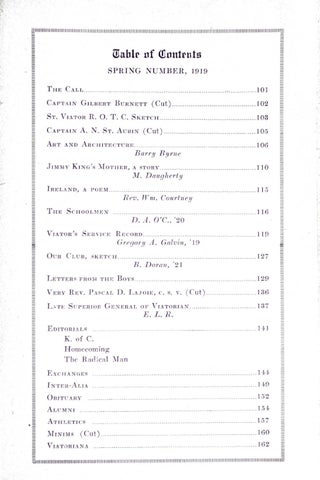
CAPTAIN GILBERT B u RNE TT (Cut) --- --- -------- --- -- -- ----- ---- --- ---- -- -102 ST. VI ATOR R. 0. T .
~
I I·
I·
!
I
C APTAIN
A. N.
~
I
SKETCH.·________ ____ _______ _____ ___ ____ ___________ ___ l03
ST. AumN (Cu t) ---- ----- --------- ----- -- --- -- ----- ---- ---- -105
ART A . D AR CHITECTURE __ _______ , __ ______ ___ _____ __ __ ________ __ ____ ____ ____ _____ _} 0 6
BaTr,y B y rne JIM MY KING's 1\l oTHER,
A
STORY ____________ ____ ________ ____ _____ ___________ .. I I 0
M . Daugherty I RE LAND
PO E M______ ___: _____________________________________________________ __ ____ _l l 5
~
I . I
c.
R ev. W rn . Courtney THE
S c HOO L TEN -------------------------------------------- _____ ________________ ___ 1 1 6 D . A . O' C., ' 20
V IATO R'
I
1-
SERVICE R EC ORD ______________________________________________________ l19
GTeg01·.1J A . Galvi n, ' 19
§
!
J
O uR CLuB,
I
L ETTER . F RO M THE Bo ys __________________________________________________________ l29
I ~
I I i
liET CI-L ___________________________________ _____ ____ ____ ____ ___ ____ ___ __l27
B . Doran,
VE RY R Ev.
PA
CAL
D.
L J OI E, c .
' 21
. v . ( Cut ) ___________________ _____ 136
L'-TE SuPERIO R G ENE R L o F Vr ATORI AN _____ ____ ______ __ _______________ 13 7
E.L.R. ED ITORIALS ---- -------------------------------------- ----- -------------· ___ ___________ ___ 14 1
K. of C. H omecom ing
T he R adical :\fa n ExcHANGES ___ .. ------- ------ --- _______________________________________ ---------------- .. 1 44 I NTER-AL IA ---------------------------------- ----- ---------------- ------------------- -- --1 4 9
I
·I I
I
0 BITU ARY
---------- -- -- ...... ___ . ----- ___ --- -·----- .. -----.---.----.----------------- -... 1 5 2
ALUMN I ------------·-------------- -- ·--- -------- ----.---- _: ____ -. ·-·- ------------------- .. 1 5 4 ATHLE TI CS :M I NI MS
-------------------------------------------------- .. ------------------------ .. 1 5 7
(Cu t) -------- ------------------ -- ---- -------------- --- -------------- -- --------- 160
v IATORIAN A
-------------------------------------------- --- -----· ------------------- ... ... 1 62
-
~llllllllllllllllllllllllllllllllllllllllllllllllllllllllllllllllllllllllllllflllfiiiiiiiiiiiiiiiiiiiiiiiiiiiUIIIIIIIIIIIIHIIIIfllfflllllltlllllllllllllllll11111111111lllllllllllllllllllfllllllflllllllllfllllllllllllllllllllllHIII!IIIIIIIIII$
' II
'
ADVER TISEMENTS
Your .路 Photograph :IIIIIIIIIIIIIIIIIIIIIIIIIIIJIIIIIIIIIIIIIIIIIIIIIIIIIIIIIIIIIIIIIIIIIIIIIIIIIIIIIIIIIIIIIIIIIIIIIII!IIIIIIIIIIIIIIIIIIIIIIIIIIIIIIIIIIIIIIIIIIIIIIIilll!llllllllllllllllllllllllllllllllllllllllllllllllllllllllllllllllll l\11111111 .
~
I
Is the most precious gift to the folks at home and to your friends. 路 路 Special discounts to the students and their families
PO WELL S.T UD/0 Producers of fine portraits 128 South Dearborn
Distilled. Water Ice lrl l l l lil l l lllllllllllllllllllllll!l!!lllllllllllllllfllllllllllllllllllliiiiiii~IIIIIIIW~!!!miWilJ
THE FAMILY ICE ABSOLUTELY PURE ''"'' ' ' lllllll!!lllllllllllmll(ll!lllllllllllllllllfflllllllmllllmlllmlllllml!mllllllllllllllllll
F. D. Radeke Bre'\Ving Co. Both Telephones 132 PATRONIZE
. OU R
KANKAKEE ADVERTISE .RS
'r..; 'I.
...
FAC ET SPERA
''·'•
Volume 36
Number 3
Spring Number, 1919
..,• "''·'
I.
'I
. I
Wanted!
Wanted!!
Wanted!!!
BY YOUR ALMA-MATER
One Tho~sand of Her Old Students ·
YOU MUST BE ON THE COLLEGE GROU DS IN TIME FOR CHOvV -JUNE 16REMIND YOUR FELLO\i\T ALUMNUS AND PERSUADE HIM TO ACCOMPANY YOU. BOYS WHO SAW SERVICE IN EVERY BATTLE OF THE vVAR WILL BE PRESENT, AND WE GUARANTEE IT WILL BE ONE OF THE MOST ENJOYABLE DAYS OF YOUR LIFE. NOW-LEST YOU FORGET, MARK THIS DATE ON YOUR CALENDAR . AND DON'T LET ANY THING OR PERSON INTERFERE WITH YOUR PLANS TO BE THERE. EVERYONE WANTS TO SEE AND SPEAK TO EVERYONE ELSE. YOU'RE O r E OF THEM ) S0 BE THERE vVITHOUT FAIL. "NUF SED" TO THE LOYAL ALUMNUS. vVE'LL MEET YOU.
~
i
,.
.. I
:~
102
THE
VIATORIAN
CAPTA r:::-:r GILB ::<: ilT BuRNETT
/
. .•r.
T H E
VIA TORIAN
103 \
·~.
I
"'i~
~lllll l llllllj i !!II!Jolll!lll!! l llllll!!llll!!ll!!l!!llllllj! jj j l j ! !l j ii i ! O! !!IIiil l lllllllll l lllllll l llll l ll l lll l !lllllllll l ll!llli l ll l llllllllll!liil l !l ! l l ll.l l l ll lli!l i!·!jll' ll j! i llll l ~ i.
1. oo. ~!j ! l! l l l lllllll l !!j!jjll!!l lll l l llj!j! l!l!! ll l l l !! l!i ll !l !i!! l i! ll !l !l! !! l l!l !l li l !i . l
m. <n.
' .,, ...,'
i l ll l l l !ll l l ll l!l! l j ilil!!l ! lil j li !lli.lll i !i !ii l!l!l !ll!li!i!l l l ll l!illii!H !Ij ! ! !! l!~
.
,, j',
S
HORTL Y after th e sig ning of t he A rmi stice Viator saw the passing of h er S. A. T . C. U n it . The young soldiers had g r own to love army life at Coll ege , and many of them expressed r egrets a t having to leav e. The discontinuance of the un it , h owever, did not chang e thin g s very_ materially; for mi litary tra ining had _ been es tab li s hed t he year b efore by Rev erend . Father O ' Mahoney, the former pre sid ent of the Coll ege . Tho u g h gover nm ent s upp ort was wit h drawn the bug le continued t o sound taps and rev eill e as in the day s of the S. A . T. C. Two or three weeks after the di sbandin g- of the student army word cam e fr om vVas hing t on inv iting th e Coll ege author ities t o estab lis h a R es erv e Offi cers' Tra inin g Corp s . T hi s inv itation w a s h earti ly r ecei v ed a nd within t wo 1nonths V iat or was a r ecogni zed R. 0 . T. c.· During th e in t erim Captain A. N . St. A ubin, well known a nd res p ect ed a s Captain of the Il li n ois Reserv es of K.ankakee . k ep t u p th e military discipline a nd training . \V h en Captain B urnett, w h o w a s sent by the W as hing t on authorities, arriv ed t o a ssum e command h e fo und a hig h 1norale a m ong the st udents. A lthou g h th e incentive of imm ediat e serv ice w a s a th in g of th e past , yet Captain S_t. A ubin h a d so inspired his yo un g- so ldi er s · th at th ey exhibited th e zeal of m en m akin g ready for "Over Seas" duty. T h e day after Captain B urnett a rrived h e expla ined t o th e boys tha"t th e Gover nment d esir ed every boy of fo urteen year s a n d over t o e nroll in th e R eser ve, and th at th ey wo ul d b e furn is h ed. fr ee of ch a r ge, full equipm ent a nd milita ry instructi on_. ''T h e in itial all owan ce of eq uipment," h e stated , " w o uld b e abo ut for t y -two d oll a r s, a n d th e conditions a r e s imp ly t o b e a stud ent a t th e Coll ege and a tt end the dri ll s." No oth er obligatio n s w h a t soeve r we r e imp ose d. Neither a phys ical examinat io n nor a promise of con t inu ed se rv ice was t o b e exact ed. In return for their drilling · three or fo ur h o urs a week , th e govern n1ent wo ul d, a ft er t wo years of s uch tra ining, pay each stu dent for t y cents a day bes id es eq uipm ent a nd a wee k or t wo each yea r a t som e m ilita ry camp. Eve n th e r ailroad fare to the s u mme r camp is t o h e pa id by th e g-overnm ent. As a r es ult of t h e Capt ain's talk 192 stu de nts ~ nr o ll e cl in th e serv ice.
'I
104
THE
VIATORIAN
\
.
The entire Corps is doing nicely under the able direction of Captains Burnett and St. Aubin, who at路e assisted by two Regular Army Sergeants, Carmel Smith and Myron Penrod. Captain Gilbert Burnett is from Louisville, Kentucky. He is an Alumnus of the Law School of the University of Virginia, having graduated from that school in 1908. Shortly after passing the bar exami-nation he opened an office in Louisville. When the war broke out h e.; gave up a very good practice and made arrangement to join the colors. He entered the first Officers' Training Camp at Fort Benjamin Harrison and was commissioned in November, 1917. He was then assigned to Camp Grant, where he remained in charge of the 343rd Infantry until given charge of the S. A. T. C. Unit established at the Old Quarry in Chicago. At this post he won for 路 himself the distinction of conditioning his men in the shortest time. \Vith the signing of the Armistice he aided in closing the unit and was then transferred to his present station. There is no doubt that -vvith the able assistance of Captain St. Aubin and the two enthusiastic Serg路eants Captain Burnett will have one of the best Reserve Officers' Training Corps in the country.
He that holds fast the golden m"ean, And lives contentedly between The little and the .great, Feels not the wants that pinch the poor, Nor plagues that haunt the rich man's door. -William Cowper.
·j. I I'
'.
·'
THE
VIATOR IAN
105
11:.).· !•/
...
/\
'·' "'
":·.,
...,.....' ·'
,;,
...,.,,
~ ·~
'• ~tJ
.i
·;-.
,J' ;
I
11/; 1
F.j
.,
.,. r·,.t.· I
,.
•i '
~>, ..,~
~~i· ~~t
i
!!:j
.~~~
,!. ,.r !\!;; --:~
·li
'
i: [·
CAPTAIN
A. N . ST. AuBIN
,..
106
THE
VIATORIAN
~ lll!l ! !!l! l ll!!llllll i!ll! l!ll!!lllll !l !l!llll!!llll!ll!!!lll!!lllii ll! !lllllll!.ll!lilill!lll l l l! ll!llli!l!ll! ll !lllll•lll!l!lll!l l lj.(!lll!!l l ll!!lll!!ll l !l!!l~l!!l!lll!l!l!l!ll~
Art
an~
Arrqitrrt
FRAl"o' CIS BARRY BYRNE,
s. A. T. c.
~ lllll l l!lll ! ll!!llll·lll!l l lllll l i!llll!lilllllll!!lllll!l l !li!lllll!llll l l!l l llllll l*lllllll!ll!l·l!l!l!;!!llll!lll!lllll l l!lllllll!lllllll!llllllll l llllll!lll!ll l ll!lll!!l~ ·
A
RT is essentially sp iritual in this sense :-its impelling- quality: its power t o thrill and m ove, emanates from its creat or-th e artist. A r ep ro du cti on of a g reat work of art cannot have this, and it is of n ecessity comparatively a d ead thin g·. A rt 1s creative and indiv idu al. To quote Victor H'ugo : "Art is a reg ion of equ als." O n.ce a work attains the plac.e or stature of art it stand s alone, ind epend ent, and is t o b e judged on its own basis. O n thi s basis it m ay be quite s upreme, no matter how v arious a nd beautiful other and differ ent styles of art may b e.. My purpose in elucidating thi s matter of the spiritual or creative element in art is t o m eet a standard obj ection that is adv ance d against· the creative id ea in A rchitectural desig n. The obj ectiog is this : a n ew A rchite cture cannot hop e t o have the refinement of Gr eek, Goth ic or Renaissance styles and th erefore creation s h ould n ot be attempted. The answer is a very simple on e : refinement d oes n ot make a wo rk of art, for art is the product of personality. It exists because of thi s personal qualit y, and the s up erfi cial refine-. m ent of forms or st y le has ve ry little t o do with it. vV hile th e individual intag inati on and th o u g·ht of the A rchitect g ives the stamp of art t o his work, still th ere are beyond thi s certain fundam ental, basic principles which are common t o all A rchit ectur es. \ i\Tith out these basic principles, n o st y le of d esig n in building can -vv ith truth ri g htl y be called Architecture. I n r eviewing th ese elem ents that form the basis of Architecture, let u s at th e o utset understa nd that they are fundamentall y simple. · A r chitecture primarily 1s building; it 1s constructi'on; brick ly ing on bri ck in th e wall; beam sp anning fr om post t o post; stone re sisting st.o ne in the thru st of an arch . · These and th eir kind are the elem ental things of A r chitecture, as it were. its anatomy, which the A r chitect arranges and clothes as hi s imassination and capacity permits. These fa ct s of s tructure he va ri es and fa shi ons to s uit th e purpose of hi s building, but they are still th.e sali ent facts of a building and its place a s a work of A r chitecture depends up on th e de g-re e t o w hich thes e elemental fact s · are mad e expressive. While Architecture is construction first, it is m ore than thi s; it is con structi on beautified, either by arrangement. d ecorati on or by both. . Arc hitecture, therefor e, is structure decorated. It develops
THE
VIATORIAN
107
ahd g row s fr om the in side outwa rd , and it conce rn s itself w ith the truth of its ex pression of purpos e or use, and of th e material s and constructi on employed. On thi s basis of fact , it develops and inten sifies the truth and make s b eautiful the already interesting and stimulating fact s of structure. For th e fa ct s of stru cture, h onestly us ed, are in th em selves suggesti ve of b eauty a nd occa si onally we find that t he purely utilitarian building alon e w ithout the addition of aesth eti c d esig n has a maj est y and naturaa b eauty of its own. In st a n ces of thi s are th e g reat con cret e g rain elevators which in their simple aust erity, their statement of pure fact without needless and fooli sh emb elli shm ent, a r e truly m onum ental structures. On the other hand, th e st eel skeleton of a fire p-roof offi ce building is not in its elf beautiful , except in th e workin g or machine sense, as the human skelet on is beantiful. It is n ot of itself harm oniou s or app ealing . It is, howeve r. s u ~?;ges ti ve of a p eculiar lightn ess and bea uty , which is its di stinctive. stru ctural quality ~ This ri g id lig htness di sting ui sh es it n ot onl y fr om oth er of our modern buildings but m ore particularly from the buildings of any other period of hi"s tory. This building is a purely m od ern product, and I am going t o discu ss its Ar chitectural desig·n critically with a view of n1aking mo re evident thi s wh ole matter of sincerity as a basis of an inv entive and m od ern A rchit ecture. H ere w e hav e then a problem that is new in its conditi on s. The structtire is a skel eton of relati vely li g ht fram e, on e that is t o be covered. Its heig ht is imposing· and ov ershadow? every thing in building that preceded it. It is utilitarian in it s purp ose. Thes e are the fa ct s of thi s building and the test of its A rchitec- · tnral design mu st li e in th e degr ee t o which it expresses th es e fact s with clarity a nd b eauty . A rt is al w ays a m ecliun1 for the ex pression of ideas and in the case of the tall buildings , the fa ct s of the structure and the purpos e of th e huilding a re the idea s which the arti st mu st express. Now thi s express ion of the fac t s of structure is n ot any~ thing literal like exp osing the steel fram e t o sig ht, or t o use an ab s urdity to force my compari son, encasing it in g lass, so that yo u can see it. It is m ore a question of harmony with the characteri s-t ics of the fram e, which , a s I have already said , are its lig ht_ness, ri g idity and use. This probl em of desig n is th e g reat chall en g·e of our day t o th e A r chitect. Let Ll S examine his sol uti on of th e problem, his answ er t o the chall en ge. Th e architect. not findin g a · skyscrap er in hi s b ook s on Renai ssance or Gothic A rchitectur e, and n ot b eing trained t o des ig n fr om th e in side outward, does th e painful thin s; of takin g hi s antiquities and piecing th em out over the · st ori es of hi s building in the n1atter of a patchwo rk. Thi s r esult, by the way, is ou r final confession of a rtisti c impot en ce, and on e mu st b e ca rel ess of th e truth , indeed , t o brag of a rti stic
·"il '•'
.
.,.,
' ~; ~
•1.); 1:' I, '
;I
..' i' l
.
1·
''·
108
路 THE
VIA TORIAN
p rogress in the fa ce of this m onumental arti stic failur e, the skyscraper. Yo u 路w ill na turall y a sk w hy the skyscraper as us ually de- . sig n ed is so incredibly bad , so illogical and p er verse. Thi s analogy w ill illu strate the point. Suppos e a sculptor wer e called up on t o d esig n th e coverin g of th e human s kel et on , making it as expr essiv e and harm oni ou s as th e cov ering of ti ss ue and mu scle w ith w hich we a re familiar. Our sculptor, howeve r , had devoted all of hi s tim e t o th e study of cats. 1-Ii s m odelling of a paw was a delig ht, of a cae s h ead a joy of r ealism. H e, therefor e, pi ec es out hi s cat over {h e human sk elet on, s uppl em enting it a s best h e can w ith extra neo us m att er and s urfa ces, all comi cally unrelated t o th e skelet on. Can yo u p icture th e abs urdity? This, th en , is th e m eth od of d esig n use d in our tall buildings where th e cat is the in evitab le Re nna issance, or other hi st oric A rchitecture, pieced out over th e st eel sk elet on. \ N e can inve nt a goo d m ac hine, and I have ye t t o h ear of a scienti :hcally trained m an thumbing over d et a ils of eli carded t ypes of m ac hin ~ r y w h en h e has to d es ig n a part for s u ch a ma,. chin e. O n th e oth er ha nd , thi s is th e prevalent m ethod of our A rchitectu ral des ig n. We build A rchit ectural anomali es and mi sfit s a round th e goo d cl ean stru cture w hi ch eng in eering science has perf ect ed. Thi s coverin g is a confu sion of forms , pad ding, d et ail s that ar e m eaning less, columns t h at do n ot s uppor t, bracket s that are hung, a w hole m elange of foolish unrelate d form s a nd d ecorations. I t is a ve ry m assacr e of A r chitecural for ms, t ak en fro m all so urces and hung- up on an hon est ste el fr am e. T hi s is, in th e main, th e a nswer of our clay t o thi s challenge of beauty . T here ar e a few excepti ons . it is tru e, a nd so b rave is th eir effor t , it wo uld b e un g r aciou s t o fail th em a r ecog. nit ion so ri chl y d eser ved. In th e m ain , howeve r, our sop hi sticati on has bee n our downfall , and we h ave n eed h ere, a s every w h ere, fo r that simpli city of outlook w hi ch is th e k ey t o g r eat t hings in a rt as in life . T he essent ial fa lsity of t hi s a rtifi cia l m ethod a nd t yp e of t ho ug ht, a lth oug h fre qu ently less evid ent , is none th e less a fa ct in any b uil d ing. It is a d eni a l of p rogr ess, of in venti on , of national and pe rso nal individua lity. Fo r in a dditi on t o th e fundam en ta l fac t of tru t h t o stru ctur e, th er e is also th e truth t o life, w ithout w hi ch qu ality no wo rk n1.ay b e d es ig-nat ed as a rt. I n eed scarcely point out th at th ere is no r elation b et wee n our clay and th e A rchitectu re of th e Italian R enai ssan ce, n or th e architect u re of a ny oth er peri od of hi st ory . A rchitecture and all art is of it s ow n time a nd d eeply, symp ath eticall y, of the b est spirit of t he p eop les of that tim e. Our b uildings a re our records . Th e ability t o t est th eir v alue w ill lie w ith post erity w ho w ill find them a r ecord of our nati onai h omogc:nity t o th e ext ent that we have b een ourselves in them , as
THE
VIATOR IAN
109
they will find them a record of our proviii.cialism to the extent . we have copied other times and countries. This not only applies to Architecture, as _such, but to the arts of painting and sculpture also, for these and Architecture are really parts of a whole, and should be so viewed. Painting and sculpture have their value and meaning in the economy of life only as related to Architec. ture, where they serve their highest purpose as decoration. Archite~ture reaches the fullness of its expression, when these other arts a,re allied to it with their more vividly emotional qualities. This is important in the purpose of this paper, because the essential purpose of the modern revival of Architecture is one of unity among the arts and a restoration of a condition of Architectural design where this is possible. Architecture in its truth and principles is constant, but style in Architecture is the expression of periods and individuals. The development of a modern organic style of Architecture, therefore, is dependent primarily on our application of certain fundamental principles. Beyond this , however, lies the invention and thought of the artist which deepens and beautifies these principles. To repeat, Architecture is primarily building, and the person who wquld 路 design Architecture must view the structural facts of a building in the simplicity of their_ primitive relation. Primarily a building is an assemblage of materials which constitute the structure and protective covering- of it. This is the simple basic fact of all building, and the quality and depth of a style depends initia!ly on the ex.t ent to which this is perceived and made expressive. W-~ find the fa me sense of basic facts in all art; in the design of great literature; in sculpture, where there is the clear evidence of a surface cut or m odelled; in painting, etchin~路 and weaving, where the initial fact of the particular medium forms the basis of aesthetic appeal. It is the sense of the piano which we feel in the design of Chopin's music; of finger striking a keyed instrument. Music builds up on thi s basis, just as architecture, no matter how diversified, is clearly, eloquently built up , brick on brick, stone on stone. So we return to the central fact that art, and therefore Architecture, is essentially of the simple and common thin g路s of building, and of life. It is this, primarily, and any other basis, no matter how deviously overlaid with refinements and clever conceits, is bad at the core and mu st lead t o stagnation and artistic futility. Art cannot be separated fro m reality and still live. It is a living and sentient fact , the product of the entire mass of the people, for the artist is but the populace become vocal. It mu st be of our tim e, an outgrowth of the idealism that is the common heritage. It is finally the measure of our growth in understanding, in depth and in sensibility.
... Jlflf ............
T H E
路V I A T 0 R I A N
1Jtinmy I(tug~.a :!lntf1rr lVIARTIN
W.
DoHERTY,
Academic
""""
T
HERE was 路a lull in the usual din and clamor of the editorial room of the " Morning Rumor" on that Monday night so eventful in the rives of both Jimmy Kin g and Stanley Green . Jimmy and Stanley, two young reporters, and the city editor were the only persons in the office on that dull and uninteresting night. Seated in a reclining chair with his feet on the desk was Jimmy, indulging in his favorite pastime, day-dreaming at night, while ~tan l ey was standing a few feet away, watching him with jealo us and hateful eyes. He was trying to surmise w.hat it cou ld be that a lways eng-aged Jimmy's attention. .He finally concluded that it must be love. Jimmy cared little for conversation, this was a sure sign of ' love. It was n ot infatuation, h owever , that produced this effect on Jimmy, it was ambition. He wanted t o be left alone to ponder ov er hi s plans for the futL1re. On this account he was disliked by many of his fellow workers. Amongst these the most malignant was Stanley, who carried his dislike~ to bitter detestation. When Stanley hated, he hated with all the venom of a v icious and depraved heart . The derision of others had little effect on Jimmy, he continued t o dream as if his calumniators had not existed. 路 The plans and h opes which Jimmy fostered were, in a way, more laudable than censurable. He did not yearn for great wealth or fame; these had little attraction for him. His long-ing-s were of a loftier and nobler nature. The littl e reporter anxiously awaited the day when he could put an end to the privations and discomforts which poverty brought upon his brave little mother. He firmly intended to fulfill all the cherished expectations which she had centered about him, her only son. A lthoug-h Jimmy was not talkative he was a g-ood reporter, ever alert when about his duties and always willing- to expend any effort to obtain a story. Had Jimmy not possessed these indispensable qualities the city editor would probably not have sent him on the assig-nment which won him both . a reputation and the increased enmity of Stanley Green. The drowsy, humming sound of revolving electric fans was the only n oise heard until the harsh voice of the city editor reso und ed throug h the room.
TH E
V IATOR I AN
111
"O h, K ing! 路 Com e h ere," call ed t h e portly editor. Jimmy w as there in a n instant, ready fo r furt her ord er . " Jimmy," continued . t h e editor, ''I wa nt yo u to go out to Ravenswood and ob tain a n interview w it h 11 rs. Graceland, t h e woman accused of m urde r. So far, she has refu eel t o talk. I ow it's up t o yo u to m a ke h er t alk. \ A/ e are s hort of n ews t o-nig ht a n d that st ory is just the thing fo r t he firs t p age. \ iVh en yo u g et it, jump into a t axi a nd hurry bac k." J im my g rabbed hi s ha t and dis app eared inst a nt ly. A ll the world w as not smiling w it h Jimmy as h e w hirl ed al on g throug h th e g r eat m etropoli s . Stanl ey Green did no t join in Jimmy's exultations; in stead h e was w ishing hin1 all t h e ha nn a diaboli cal mind could co nc eive. He was a ng ry n ot onl y w ith Jimm y but w ith th e city edito r as well. Appa r ent ly th e poor edito r was not awa re th at th e talented St a nl ey Gr een was present, so Stanl ey ha d t o inform him. "Say, Cap ," s aid St a nl ey t o "His J ournali stic :Ma jesty," " Why didn't y ou se nd m e t o g et that interview? That m op e is so bashful that h e' ll 路f aint if s he s n eezes . Yo u couldn't vvake hi m up if yo u put him und er on e of th e p r esses, and ye t yo u send him on an ass ig nm ent lik e that. I h ave n' t had a decent st ory in a long tim e." "If I w ere yo u ," th e edi to r ad vised, "I'd li e low w it h th at kind of talk. It wo n't get yo u a ny pl ace. Jimm y m ay not be ve ry sociabl e, but h e can get a st ory w hen h e goes out fo r it. If I n eed yo u, Gr een, I 'll send for yo u." W hile Jimni. y w as conv incing th e wo m a n acc used of murder , that p ubli city of h er innoce nce was th e sur est way of vi.ndi cating h erself, Stanl ey was striv ing h a rd to fi nd a w ay of humiliating hi s riv al , and if p ossibl e of cau s ing him t o lose hi s positi o n on th e staff of th e "Mornin g R umor. " Stanley was th e first t o offer hi s con g ratulati ons t o Jimm y w 4 en the st ory appear ed in print. H is complim ents we re so p rofu se as t o cause Jimmy t o blu sh. "Now , m y good fri end ," d eclared St a nley, concluding his flattery, " I insist that yo u let m e have th e h onor of taking yo u 路 t o sup per. A ft er t hat t errific strain yo u w ill enj oy a good m eal." Dumfounded at thi s invitation, from one w h o had n ever b efore sp ok en a pl easant wo rd t o him, Jimmy could not d ecline. L ittl e s usp ecting th at Stanl ey's kindness was actu at ed by a ny m otive other 路t han fr iendliness, h e accepted it. T his h e thoug ht a n opport un e m om ent fo r conciliating his hith erto h ostil e aco uain t ance. , Th ey imm ediat ely r ep aired t o a n ea rb y cafe, wh er e a n app et izing m eal w a s o rd ered. Never b efore h ad this g uil eless yo uth din ed in su ch a r oom. He look ed about w ith amaze m ent a t th e weird carv ings, th e sh owy decorati on s and t h e many dust y palm tr ees. He li st en ed w ith p leas ure t o the w ild a nd cat chy music of th e orch estr a a nd the rag-tim e sing ing . T h e m errim en t of
112
. THE
VIA.TORIAN
the place fascinated his simple mind. Jimmy's 路 bewilderment afforded Stanley an excellent opportunity for carrying out his p lan. With .a fraternal smile he excused himself for a few moments to speak with some friends in a distant corner of the spacious room. Upon meeting Daisy, the waitress, he stopped to give her some instructions regarding her part as his accomplice. She nodded her head sever~! times and after accepting something from him she continued her work. After they had finished their savory meal, . Stanley ordered a little light wine. Jimmy could not arous.e 路c.nough courage to refu se to drink although he had often ' been warned by his mother. He reasoned that since his friend had treated him in such princely style it would be an insult to refuse to have a little drink with him. Believing that Stanl~y would. think him a "regular fellow," he drank the contents of the glass, unaware that Daisy had put into it something more than wine. As Jimmy became more stupefied under the effects of the adulterated wine, Stanley's mu sings became more 路 mirthful. He gloated over the fac t that he could boast of being the first one to lead Jimmy from the "straight and narrow path.n Intense gratification was the only emotion he experienced while watching Jimmy gradually s uccumb to the baneful drug. A few m oments later the doors were locked and two detectives announced that no one would be allowed to leave the room until all had been searched. A man was seen talking with one of the offi cers of the law, apparently describing some article that had been st olen. They had not proceeded far with the search w hen they came to the innocent young reporter. As he rose w ith a feeling of unsteadiness to be examined there fell from under his vest a wallet. This purse the gentleman accompanying the detectives immediately identified as his stolen property. "Call the wagon, Tom," said the officer who had taken ' Jimmy into his custo dy. "B ut, officer, I swear by Heaven, that I never took that pock et book,n excitedly responded Jimmy, as his bemuddled brain see m ed to clear. "I couldn't have stolen it, for I never left this table since I came in. " He looked about for Stanley to cor. roborate his statem ent, but he was not to be found. Stanl ey was then hurry ing back to the office of the "Morning Rumor.n Before entering the office he stepped into a cigar s t or e, call ed up the cafe and asked for Daisy. "Hello, Daisy, how did he take it?" he queried. "Awful hard, n she replied. "He refused to go. He kept mumbling something about not disgracing his mother, and when they attempted t o take him by force he knocked over two tables and broke a lot of china. 路 They finally had to hit him on the head in order t o ge t him out. n ''Good , that will make a fine st ory," exclaimed Stanley. "Bye, bye , Dear,' w ill see yo u later."
THE
'·
VIATOR IAN
113
As he hurried into the office his flushed and grinning face and the devilish twinkle in his eye betrayed the satisfaction of his . heart. "Say, Cap," he remarked to the editor, " I've got a dandy story for you. Just what you want. Jimmy King was arrested in the Turin Cafe for stealing a purse full of money. He was drunk and refused to go. In the scuffle he overturned several tables, destroying a lot of china. Men scrambled to their feet and women shrieked and some of them even fainted. He had to be ·"knocked cold" . .before anything could be done with him. The proprietor of the Turin threatens to bring s uit against him. How does that sound?" "It sounds like a lie," savagely retorted the angry editor, "and if a word of it is true, it's a miserable frame-up. I am not here to ruin the reputations of innocent people. Not one word of that goes into the paper. What is more, if you value your position on this staff you had better get Jimmy out of this mess. Until you arrange everything satisfactorily don't let me see your face inside of that door." Unlike the grinning, jubilant reporter who entered the office · a few minutes before there went out of it a dejected and crestfallen Stanley. He knew not what to do. The only course his mind suggested was to go and consult Daisy. "The only thing to do," Daisy said, "is to go to Jimmy's mother and get her to pay his bail. You know a mother's love and what she'll do for a son. Tell her you are Jimmy's friend and that you have tried to get him out of this trouble but failed. You can say that you have kept it out of the papers and all that sort of stuff. She'll fall for that line all right. You see." In the office of the ''Morning Rumor" there was also worrying and wondering. The city editor thought a great deal of Jimmy, and he could not work when he believed his young friend was in danger. He suspected Stanley of trickery, and this he wanted to prevent; so he decided to go to Mrs. King and explain the case in ·a favorable light, lest she should hear it first from less sympathetic lips. . Stanley had just entered the parlor of the Kings' home when a taxicab stopped at the door and the sound of footsteps on the stairs were heard. He told Mrs. King not to tell the visitor of his presence, as he quickly stepped into a back room. Mrs. King, · alarmed and perplexed at these strange events, opened the door with a nervous hand and spoke in a tremulous voice. Having shown the f!ew visitor into the parlor and given him a chair, she excused herself and retired to the room into which Stanley had taken refuge. Standing near the door, the culprit nervously began to tell of Jimmy's arrest. "Mrs. King, I hate to tell you this-it's about' Jimmy. You see, he, he-" began Stanley.
114
THE
VIA TORIAN
" My God! Has he bet,:n killed?" excitedly exclaimed the woman. " No, no, n ot that," he replied, " n ot that, he's only been arrested. Yo u kn ow; h e, he-he } ~stole a pocket book while he was drunk. He has been taken to jaiL It won't be so terrible, for I have asked the editor n ot to print anything about it, and he promised that he wouldn't." · The poor woman was about to fall when he caught and held her. The pe·r spiration stood out on Stanley;s forehead, as he thought of the awful wrong he had done. 'T he plaintive moaning of Mrs. King deeply affected him. " Oh my son," she cried, putting her arms about Stanley and holding him in a mat erpal embrace, "why did you let them lead y o u into such crimes? I kn ow you are innocent, I know you are. :May God forgive those who did this to you. 1\!Iy son, my little ch ild, my sweet baby, you are innocent, you are, you are." Stanley felt like running a sword through his own heart, he was so miserable. Never before was he in such an embarrassing position. If his distress was agonizing whe.n alone with the poor woman, his confusion was indescribable when the city editor stepped into the room. "You are about the most debased and degenerate type of man that I have ever had the i11isfortune of meeting," sai.d the . editor. · "How can yo u be so craven? Can you let that mother bestow upon you all the affection that she would lavish upon h~r son whom yo u have maliciously seduced? How can you permit that and still refuse t o do what lies in your power to remove the causes of her g rief? If I had positive proof that you are the culprit , I , n1yself would have you arrested." Stanley gave no answer but ignominously left the room and Vlrandered o ut into the streets. As soon as 1\tfrs. King could compose herself she and the city editor went to the police station to obtain Jimmy's release. About an hour later mother and son were locked in fond embrace, weeping softly over their misfortune. A lthough the stigma was not remoNed, Mrs. King told Jimmy repeatedly that she believed he was innocent. Even the corpulent and unsentimental editor . was about · to shed tears , when his attention was arrested by the opening of the jail door. Stanley Green, the personification of despair, entered and stood fer a moment watching the pathetic scene. "Mrs. King," he pleaded in a faltering manner , "please don't . be angry with me, although I cannot blame you if you· are. 1 am responsible for all your trouble , but I have explained it to the Captain and Jimmy ·may now go free. I used to pate Jimmy but I don't any more. I envy him. I could never imagine what he used to be dreaming about, but for the rest of my life I'll dream of 'the time when you thought l was your son and you kissed and caressed me as you do Jimmy. I guess the reason why I had hi s wine doctored and had the wallet put into his
THE
VIA TORIAN
115
pocket when he was dizzy, was because I never had a rnother. ]im1ny is a lucky fellow." . . It was not a look of indignation or anger that played upon Mrs. Ki~g's haggard face but a look of tender pity and maternal compass10n. ., "I can have two big sons if you want to be my boy," she said kind,ly, as she took Stanley into .her embrace and petted him. "Put it here, you're a man," declared Jimmy. "And put it here, you're all right," added the city editor.
<'-.,:
路 Jrrlan~ 0 fairest island of the seas Wi1ere spirits flit in twilight breeze, A crooning lonely threnodies; A magic place is Ireland. Where earth and sky and waters meet In harmony and beauty sweet, The flow'r decked sward beneath your feet; A lovely place is Ireland. A land of Honor, Virtue rare, No lurking beast hides in his lair, The breath of God is in the, air; A holy place is Ireland. Aye n1agic, lovely, holy place; Nor time, nor distance can efface, As memory its steps retrace; . My love for thee, my Sireland. And when my soul flies home to God, I'd rest beneath the shamrock ~o<;l, The ground where saints and martyrs trod; Oh make 1ny grave in Ireland. REv. WM. CouRTNEY
116
THE
VIATORIAN
~I I I III!!IIII!II!IIIII!!I I II I II!!II ! !!!!I I !I!I!III!!IIIIII ! II!I!!I!!IIIII I IIIIIII I IIIIIIIII ! !J!!III I I I IIII!!IIII I !II!I!!I I I! I I!II ! I!!IIIII I III I I I !! ! I I II!I! ! IIII I II I II!!III! ! I ! ! I !I ! ! I !!I!tiJIJ
Wqr DANIEL
W
~rqnulmru A.
O'CoNNOR,
'20
HAT is known as the "Scholastic Era" extended from the ,_ f1fth to the fourteenth century. The men in whom we are_ interested at present, and who bear the title of "Schoolmen," lived and flourished from the eleventh century to the close of the scholastic peri()d. vVhat was the character and the work of these men, and what lasting effects have their lives bestowed on future generations? These are the questions that will occupy our attention. But first let us revert for a moment to the 路 ancient times. Of all the philosophers who lived before the Christian era, of all those who professed in varying degrees to be "lovers of wisdom," I will single out but two. Plato, the Idealist, who was guided more by fancy than reason; and Aristotle, the philosopher by pre-eminence, who followed the path pointed out by reason with the greatest care. In his intellectual pursuits Aristotle did not, like Plato, permit himself to become confused by the abstruseness of the questions in hand and attempt to fly . on the wings of contemplation before he was able to walk with steady tread along the path of natural reason. I mention these two philosophers because of the peculiar and important influence they exerted on the thought of the middle ages, the time of the Schoolmen, as well as on the intellectual accomplishments of later times. With the dawn of Christianity the teachings of these ancient philosophers were forgotten or at least eclipsed for a time before the brilliant light of the great doctors who were destined to be the fathers of Catholic thought. A Jerome, a_n Augustine, Hilary, Ambrose, Basil and Gregory found themselves fully occupied in laying the foundations of Christian philosophy. Undoubtedly they were influenced and aided by the achievements of those who had been the great thinkers of ages long past, but their " greatest attention was directed toward the study of the lives and teachings of th ~ apostles and martyrs who were so near to them in point of time, and especially they were bent on the development and on the explanation of the teachings 路o f our Lord as recorded by the Evangelists and transmitted by tradition. Hence, their philosophy tended to be mystic rather than rational, Plat onic rather than Aristotelian. And I make this contrast because the reconciliation, the harmonizing, defining and arranging
THE
VIA TORIAN
117
of the teachings of these two schools 路 were the problems which gave life; vigor, labo1路 and existence itself to the Schoolmen of the middle ages. Or again I might refer to Plato as a theologian and to Aristotle as a philosopher and then all the controversy of the middle ages is resolved into a contest between philosophy and theology, which in fact it was. Vv~ e can concede that the teachings of the Fathers of the Church influenced the ages and directed the thought of Christianity, and let us pass along to the time of Charlemagne, which we may style as a new era of intellectual activity, the beginning, the revival rather, of interest in the affairs of the mind. Although Charlemagne was not a scholar himself, nevertheless he appreciated the value of intellectual training, and lent his powerful efforts to its development. Schools were established throughout the empire under the judicious direction of Alcuin, and men of letters were everywhere treated with respect and were encouraged in their labors. This conduct redounds to the credit of a man, who, although his own sword was mightier than his pen and probably than any pen of his time, yet he was broad-minded enough and sufficiently endowed with the force of native intellect to ~ppreciate the power of learning in other m~n. But our chief concern is not with the great Emperor of the vV est. Admire him as we may, there is yet another type of man who interests us more 路at the present time. The development of intellect which ' commenced in Charlemagne's time was destined to increase and progress in the eleventh, twelfth and thirteenth centuries, and reached its climax in the fourteenth. The coming of the ages of faith meant not only the birth of a keener interest in matters of faith and morals, but of everything that could interest the human mind. Ecclectics like John of Salisbury were.to shine as men of universal knowledge. Roscelin, Abelard and Peter Lombard were to sound the depths of reason in following their old master, Aristotle. By depending t oo much on their own intellects to solve the truth of faith, they did indeed fall into grave errors, but even their mistakes proved a source of enlightenment. Had there been no false doctrine to combat, truth would not have been so gloriously championed. Mysticism, which we may well call the perfection of Platonism found able defenders and true subjects in St. Anslem, St. Peter, Damian and St. Bernard, who, because they relied more on faith than reason, were destined to be more successful in the pursuit of all truth. The School of Chartres, which was dedicated to the study of Plato directed particular attention to the teachings of the ancients, and thus turned the thought of the middle ages toward these fruitful sources of knowledge. In the 13th century came the great harmonizers of huma11 and divine truth. It was the function of these luminous minds clearly and distinctly to mark the pr6vinces of philosophy and
\
118
THE
VIA TORIAN
theology. They were ·at one and the sam e time eminent as exponents of reason and mysticism. They taught that ali knowledge was true, and as such it was desirable; that there . was in fact no conflict between philosophy and theology, but that each had its own sphere. The teachings of both Plato and A ri st otle were reviewed, purified and used for . the fuller devel oprp~nt of Christian philosophy. vVe are especially ind ebted to · St. Thomas . for an .acc ui·ate translation of the Greek t ext of A rist otle. These men are the crown and g lory of the middle ages. 'The fruit of their labors we now enjoy and posterity w ill ever profit by the service th ey have rendered. Nor s hould we fail to 'take-notice of ' and pay homage to Roger Bacon for the valuable service h e rendered in promoting the study of natural sciences; to 'the critical Duns Scotus, who was deemed a worthy oppon ent of St. Thomas by his Franciscan brethren; t o mystics like Thomas A Kempis, and lat er on to the Jesuits Toletus, Vasquez and Suarez, who recall ed all the g lories of the 13th century. · The name of Descartes closes the scholastic period. The contest between philosophy and theology as rival system s of th ought was at an end. Henceforth they were to be recognized as separate sciences, each having its proper zone. This was the gi·eat result a.ttained by the Schoolm en of t he middle ages by lives devoted to the pursuit of learning. vVe of to-clay are the beneficiaries of the fegacy of wisdom which they have left. As such a sacred trust lies upon us. It is our duty to see that none of their labo rs w ill be lost, that the superstructt{re of the edifi ce of learning for w hich they have so solidly laid the foundations s hall rise to the stars, the glorious monument of intellectual achievement.'·
Educati on is a better safegtrard of lib erty than a standing army. If we retrench the wages of the schoolmaster, we must raise tho se of the recruitin g sergeant.-Everett.
THE
VIATOR IAN
119
•
~lll lljjj li jj;!l jl jjjjj!jlljjjjiijij j j tj lil!jjj!li!ll! !llij j lii!!llilli!liill!i!:jjjij!lj!jlj ! llllijil!lii!lljlii lllij iji llillijiilljji!il!lljjjtj!jllll!llllljijijjjjljjjijjjjljlliijljj~
®ur
~rruirr
GREGORY
A.
1!\rrnrb
G ALV I N,
'19
THE hi sto ri c war j ust ended the ons of V iato r palyed an I Nimpo rtant r ole that is wor th y of profo und r espect and admiration. At the fir t sound of the t ocs in m any of h er actual students left their quiet a nd r etired life of stud y to t ake up th e hard and try ing lot of a so ldi er. Tru ly, it wa a sad s ig- ht t o see th ese boys just in the fir st vig-or of m anhood, w ith hi g h hopes · and great ambition s, force d t o surrender their li fe 's objective and strik e out on a dange rou s and different path. Though their d eparture was fro m on e point of v iew an occas ion of sorrow _and regret, still-from another it \< v as a ource of joy and justifiabl e pride-for these boys were goi ng forth t o fig ht for the lib ert y of the world. The service flag that float s triumphantly over th e co ll ege campus tells a st or y of four hundr ed and twenty-three sturdy Sons of V iator-loyal b oth to their count ry and t o their A lm.a Mater-who helped t o form that great army that America launched against the en emi es of civ ili zation. E ncl osed in a field of blue stars are twenty -two crosses that sig rtify the numb er of Chaplain Sons of St. V iator w h o accom pani ed our soldi ers fr om camp to camp , fr om A m erican s hores to Eu ropean battlefi elds, tending to th eir spiritual ne eds and com forting them w ith words of ch eer a nd h op e. The fifteen gold star s stand for those w h o 1 in 'this terrible conflict were called up on to sh ed their lif e's blood in ord er that the great ideals of th e A merican nation mig ht be preserved and perpetuated. Many facts can be r elat ed of th e h eroism displayed on the bloody fields of F rance by th ese gallant Sons of V iator. In the battle of Cha'teau-Thi erry , whe r e the Marin es turned the Hun drive into a g reat German catastrop h e, Chaplain Harris A. Darche, First Lieutenant, U. S. M . C., was among the men cited for bravery. During thi s memorable battle Colonel Hug h es, second in command of the Six th Marines, speaks of Lieutenant H. A. Darche in the following words: "vV e had a Catholic priest in our re g iment w h o was th e m ost remarkable man I have ever known . He worked tirelessly, cheering the boys, dressing th eir wounds, and was always in the thick of it. W ith his orderly h e d.ug graves and buried men and I have always su spected that w hen the fighting was good he may have done some. The F rench made him a Chevalier of the ' Legion of Honor.' " · Father r
;~
..·::·
120
THE
VIATOR IAN
Darche was similarly p raised by other men in the regiment, for his unswerving fidelity to duty, his arduous zeal, and courageous spirit. On another occasion during the progress of some hot fighting, Father Darche requested permission to accompany his men over the top. His · request was denied by the Officer in Command. Chaplain Darche then procured a Red Cross. Band for his arm and under this new role succeeded in following his men over the top. This heroic priest was at one time reported dead but the report proved to be false. His obituary was written by one of his friends, and Captain Darche had the rare privilege of reading the account of his death. A humorous letter was received by his obituarist, in which he thanked him kindly •for all the panegyrics bestowed upon his character, and dryly added that he hoped some day to return the compliment: Chaplain Darche was cited for bravery on three different occasions, and is thought to be the first American priest decorated. Sergeant John V. Hogan, In£., U. S. A., star football player of '13, received the Distinguished Service Cross for bravery. No one will deny that ]bhn really deserved this distinction after reading his words: "For myself I do not know what an average American will do, but I do know what I did is what I would expect of a comrade. They say I did something exceptional but I thought myself doing only my bit. Along on No Man's Landa machine gun was popping at my platoon and me-eight boches around the gun- what would anyone do with a loaded rifle? Just what I did- kill the gunner and his aid, and the rest, if they did not surrender. Six cried, 'Kamerad,' and I sent them behind · the lines. A little 'further on three machine guns two inen and myself captured. Frankly, would not another do the same thing in my place? I think so, but my officers do not, so they recommend me for a Distinguished Service Cross." John is with the 89th Division of 355th Infantry, in Co L. Lieutenant Emmett Trainor, '13, of the U. S. M. C., was selected by his superior officers to reconnoiter the positions of · the enemy- so well did he accomplish his duty, and so courageously did he face the dangers which it entailed, that he was cited for bravery. A letter of praise was sent to his parents from the Headquarters, U. S. M. C., in which was enclosed the following message: "Second Lieutenant Emmett Trainor, U. S. M. C., in action near Vierzy on July 19th, in order to reconnoiter the position held by the enemy, constantly exposed himself to the fire of machine gunners and snipers .to secure this vitaJ information." Emmett was decorated with the Legion of Honor by the French government. In a later engagement, while fighting with the same dauntless courage shown in the action near Vierzy, Emmett suffered the los;; of an arm. The action of First Lieutenant "Jack" O'Donnell, Chaplain of the 32d Division, was warmly praised by Colonel Davis. It was said that on one occasion during the progress of a battle, the
THE
VIA TORIAN
121
Colonel desired to speak with the Chaplain. A man on laison duty was sent in search of him. He found Chaplain O'Donnell leading a platoon in the thickest of the fight. Letters have been received from old students in the 32d Division and numerous articles have appeared in the daily newspapers, telling how . Chaplain O'Donnell accompanied his men over the top and was always in the thick of the battle. He is known to his men as " Fighting Chaplain O'Donnell." We were not surprised to hear of this for the fighting abilities of Father O'Donnell were many times · shown in the hotly contested football games on the college gridiron. Sergeant William I. Vl alsh, another member of the 32d Division, who was a student here during Father O'Donnell 's time, was likewise praised for his courage and valor. Bill and his ·company were holding the lines, and were exchanging compliments with the enemy in the form of a constant volley of ·shells. Four days and f~mr nights this unceasing fire continued. A stray piece of shell wounded Bill slightly but he remained at his P.OSt. A second burst of shell killed his companion, wounded Bill ·severely, and buried him under a mound of earth. Luckily Bill's head was not covered, but while in this position he was gassed. Sergeant Walsh remained helpless for two days and was finally rescued by comrades, who dug him out and sent him to the base hospital. Bill has completely recovered ·from his injuries, but is still weak from the deadly effects of the gas. He was among the first of the wounded soldiers to return fron1 France. Lieutenant James V. Dougherty, '08, while gallantly leading his men over the top , was hit in the right leg by shrapnel, and fell seriously w ounded. Jim is convalescing at Fort Sheridan, and is awaiting his discharge. Captain W. J. Potter, 91st Division, won his commission as . a Maj or by his gallant actions, ability and courage shown in the Argonne Forest. The Major of their Battalion was killed during the battle and Captain Potter too k command. He directed the advance of the Battalion and s ucceeded in gaining their objective. On the third day of this hard-fought struggle Captain Potter was struck in the side by a fragment of an exploded shell. Fortunately, his loaded cartridge belt received the force of the steel, and only two of hi s ribs were broken. The following day Captain Potter, while leading his men, was struck by a machine gu n burs t , was hit in the s houlder, shot through the lung, and had two ribs and hi s s houlder blade broken. The 91st Division saw fighting in Belgium as well as in France. This division was cited for courage and valor by the American, British, / French and B elgian A rmies. Not only on land but also on sea have Viator m en won renown and sh own their mettle. J osep h Wheeler , U. S . N ., won the medal for bravery by
122
THE
VIATOR IAN
performing a singular feat. Due to his courage and ability, a badly damaged submarine chaser was brotighf back into port. . Joe, for his trouble and courageous actio,ns, w<)h a ci~a tion. The above ni.en .who were decorate!d 芦lith 路 the 路irisignia for bravery, and those who fell wounded, whif.e gallantly fighting , serve as a standard by which we may jt1dge the deeds and character of the other four hundred Viator men in the service. Most of the Viator men selected for the position of bffi cers had little or no training before enlisting, but after enteri1'1g the serv ice; showed ambition to rise to higher ranks, perfotm:ed well each duty assigned, and in every case demonstrated their h onor, intelligence, and reliability. Encouragement came from their s uperior officers, and opportunities for pro motion were soon forthcoming. Among the Viator men commissioned are Colonel Joseph McAndrews, General Staff; Major William J. Potter, Captain James ]. Burns, Executive Staff in France; Captain E dward McShane, Captain vVilliam Carroll, . Captain A . N . St. A ubin, Lieutenant J ohn McKenna, Lieutenant Gerald Cleary, Lieutenant Maurice F. Dillon, Lieutenant Raymond Shannon, Lieutenant Thomas P. Grant, Lieutenant Alex J. Burke, Lieut enant James V . Dougherty, Lieutenant Harold V. Burns, Lieut enant Ralph Hefferenan, Lieutenant Andre Gunderlac, Lieutenant J oseph J. L y nch , Lieutenant Daniel Hayden, Lieutenant Imus Rice,' Lieutenant Jame s McAndrews, Lieutenant John F inn, Lieutenant A rthur Goudreau, Lieutenant Clement Riordan, Lieutenant Harold V. A rnberg, Lieutenant Emmett Trainor, Lieutenant J ohn Russell, Lieutenant (j. g.) Harry V. Kaminsky, U. S. N., Ensign Edmund F. Conway, and Ensign Edward Roache. In addition t o th ese men are the twenty-one Chaplains, who rank as First Lieutenants. The Chaplains are as follows: Reverends William J. Bergin, C. S. V.; J ohn W. Maguire, C. S. V.; VVilliam J. Stephenson, C . S. V.; J. F. Moisant, C. S. V.; F. P. Co upal, D. P. Monaghan, M.]. Heeney, B . ]. Shiel, A. D. Girard , J. M. Lonergan, C. C. Boyle, E. A . B roadman, J. P. Munday, S. Libert, J. M. Kangley, J. P. O'Mahoney, L. V. O'Connor, J. L. O'Donnell, Felix Helta, James McKay, A. H. A. Darche; Savary and J. McCarthy. AU these Chaplains performed excellent work in the camps of the United States and in the battlefields of Europe. Their faithful discharge of duties; the fatherly soli citude and kindn ess exercised towards the soldiers; their devotion to the wo unded and the dying, has time and time again been remarked and praised. Soldiers with whom they came in contact characterized' their work and deeds as worthy of the greatest prai se and di stinction. St. Viator was represented by one of her sons in every branch of the service , and is proud of h er record. Henry Ruel , an old student and an able lawyer of Kankakee, and Thomas J. No rm oyle, of Chicago, served as K. of C. Secretaries in France.
. I
THE
VIA TORIAN
123
The work of these secretaries has been warmly ptaised by soldiers who have teturhed_. and, no doubt, the untiring effort s put forth by Mr. Ruel and Mr. Normoyle have occasioned at least a . portion of this justly merited praise. \iVith such a large number of commissioned men St. Viator's certainly deserved to be represented at the Peace Confererice. Unofficially we learned that E lmer J. Kenyon, for four years Professor of English in the College Department, and an excellent master of Latin, . Greek, German and French, was selected be'cause of his knowledge of langt1ages as an interpreter at the Conference . . Corporal Thomas J. Finnegan, '15-'17, former football player at Viator, was chosen as one of the body guard of President \iVilson at the Peace Conference. Men are chosen to act in such ca·pacities only after they have proven their courage, honor and reliability. Those who have known Tom and have ;;een him in action on th e college gridiron know that he possesses a ll these qualities in an eminent degree. Sergeant William Bayer, '18, all aro und athlete, won the distinction of being the best hand grenade thrower in France. To see Bill whip the ball to second we little wonder that he won Stich an honor and we know that the Boches must have had a hard time in getting out of his range . . Not satisfied with her part in the war, Viator undertook t o train men to become officers. In the early part of July word was received from the government inviting students of the coll ege t o undergo an intensive course of training to prepare themselves t o train students who would enrol,l in the Students Army Trainin g Corps. These units were to • be established at every college throughout the United States that could meet the conditions . Reverend J. P. O'Mahoney, C. S. V. , then president, informed the graduates of this offer on the part of the government. The result was that St. Viator was represented at Fort Sheridan by Francis Ortman, Francis Kennelly, Walter Marquadt, Joseph Lynch, James Gallahu e, John Madden and T . E . Fitzpatrick, C. S. V., as faculty member. At the clo se of the ·course five of the · above were recommended as Instructors in the S. A. T. C., and Joseph Lynch, the sixth man, was awarded a Commission. The coll ege, through the generous assistance of Rev. J. P. O 'M ahoney,. and the untiring efforts of Rev. J. F. Ryan , succeeded in meeting the conditions and secured government recognition . Captain W. E. Dove, Lieutenant G. F. Upling·er, Lieutenant L . N. Thomas, assisted by the students from Fort Sheridan, were sent here to take charge of the Unit. Under the able leadership of these officers and under the tutelag-e of competent teachers the unit was proving a great success. Government Inspectors commented upon the spirit of harmony and satisfaction that existed among the faculty, officers and students. \iVith the signing of the armistice came the demobilization of the S. A. T. C., but Viator, having a taste of army life. liked it and wanted m o re. In
124
THE
VIA TORIAN
comp liance with the gove rment's wis h and plan, an Officers' Reserve Training Corps was established . The unit · is composed of about t wo hundred and forty men and is under the command of Captain G. Burnett, In£., U. S. A.; Captain A. N. St. Aubin, Ill. Res.; Sergeant C. Sniith, In£., U. S. A., and Sergeant M. Penrod, In£., U . S. A. Under these men the cadets are being brought to perfecti on in the mechanical movements of close order, exhibition drills and. other manuevers. A mong the men known to have been wounded or gassed on the battlefields of France are Lieutenant James · V. Dougherty, Private Homer Steinhoff, Private Richard Shields, Sergeant \ Villiam I. Walsh, Major W. J. Potter, Lieutenant Emmett Trainor, Chaplain Harris A. Darche, Private Hugh Graham, Pri- · vat e D. Rioridon,. Donald Somers and Clarence Houle. Sadly do we record the Viator dead, who nobly sacrificed their lives up on the A ltar of Democracy. Lieutenant J. P. M unday, Chaplain at Great Lakes, and former Professor of Dogma at the College, was the one Chaplain called upon to make the s up reme offering. Here at the Great Lakes, while administering t he last sacraments t o a victim of that dread plague-the influenza-he contracted the malady and after a few days succumbed tu its relentless attacks. S. Newell Calkins, 349th Infantry, was taken ill with pneumonia at Camp Pike and after six weeks illness he died. Dennis P. McCarthy-, '13-'14, enlisted at Camp Lewis but was discharged later because of poor health. In the selecti ve draft he was accepted and sent to Jefferson Barracks. Here he was s uddenly taken ill and a few day s later passed away. l'v1aximillian J. Leg ri s entered the service in August, 1918. After a few months of inten se training h e was on his way to France. l\1ax died of the influ enza and was buried in mid-ocean. Peter F. Boyle, '14, while undergoing training at Great Lakes , also fell a victim t o the influenza. J . F. Lynch (Jerry) , ' 06- ' 12~ imbu-e d w ith the spirit of patriotism, enlisted in the U. S. Navy. After a yea r of service , performing-the duties t o which he was assigned, he contracted th e influ en za and after a short period of illness expi red. Walter Evans, Elroy L a ng lois, and Bernard Gordon, three other former students, also died in camp during the influenza epidemic. J osep h Harmon, member of the Canadian V olunteers, and one of th e first of the Viator men to enter service, died at one of the training- camps in Canada. A. E. Anderson, former Professor of P hys ics and Mathematics at th e college, fi ll ed w ith th e fire of patriotism, w hi ch could not be checked even by physical disability, enlisted for clerical work. Professor Anderson was assigned t o Camp Zachary Taylor, and he had bee n at camp on ly a s hort time when influenza claimed him as one of its many v ictim s. Though these noble men were not permitted t o die upon the battlefi eld , th eir deeds are non e the less g lorious for they died martyrs to duty in their country's cause.
THE . VJATORIAN
125
. Edward B. Crane, 18th Inf., U. S. A ., saw service in Mexico under Ge nera] Pershing. A t the outbreak o,f . hostilities with Germany, he again enlisted and was one of the first of Viator men to fall fatally wounded in actual battle. Corporal Frank Seybert, football player of ' 16, was killed in action at Chateau Thierry on July 15th, 1918. Frank's regiment was on the Marne during all the bitterest fighting . . On the 15th of July Corporal Seybert and anjther corporal w ith a small g roup of me~ 'Yere ~ent . down to a position :.J ear the village of Fossey. It is said that Corporal Seybert vol'unteered for 路this duty outside the village although he knew it meant certain death . Here while performing . his duty he was killed by shell fire. It .was in thi s memorable fight that Chaplain Harris A . Darche won his citation. Lieutenant Andre Gunderlach, '07-'08, was killed in the last air raid made by the Americans against the Germans. In this last air battle, Andre s ucceeded in bring ing down two enemy planes. At length his machine was damaged by the enemy and this heroic aviator crashed to the earth. Truly unfortunate tha"t this lieutenant, who passed safely through so many air struggles, had t o be killed just on the eve of Peace. James V. Lyons , another fearless son of Viator died of wounds received in battle. James was one of the first to enlist, one of the first to cross over to France, and one of the first to die in defence of his country's cause. The grateful memory of mankind a.nd especially the students and almnni of Viator will never forget these martyrs. "Not dead for their memory liveth, Columbia their bivouac keep s While American spirit lingers Where each hero-martyr sleeps." Their names shall be preserved i路n the hearts of men when all other . monumental structures shall have passed away. Every one of their deeds is to a Viator man an especially sacred memory and every one of their graves a consecrated shrine which "The morning will gild with light, The holy stars keep watch at night, The winter spread soft pall of snow, The summer flowers above them grow, The sweet bird s si ng their Springtime call God's love and mercy gu ard them all." 路 Men of Viator, behold the true .Christian Jaith and courage exemplified in the li:ves of these your fellow~co.mrades. Follow in their footsteps and make the world your d~Lbtor by clinging tenaciously to the truths and principles for which they fought : bled and died. Truly St. Viator has every reason to be proud of
T H E • V I A T ·O R I A N '
her war -work; the number of men commissioned; the efforts on the . pa·rt of the faculty to make the S. A. T. C., and R. 0. T. C. a SUC<;:eSS'; the fou-r -minute men sent out to increase the enthusiasm and ,morale; .the tireless efforts of her men in th·e Liberty Loan drives; the number cited for bravery along with the number of- he1: wounded and dead, which will form many a golden page . in the hi,story of her career, .. Proudly does she unfurl · her service flag spangled with stars, each star representirig a young man trained and nurtured at her breast. Especially dear are the fifteen golden stars, as they represent the fair forms of fifteen of lief; noblest sons who .died for the principles of Justice, _Right and Liberty. Soldier and martyred sons of Viator, you have fallen in line behind that great file c f Catholic heroes and patriots that have gone before. You have carried the Cross and the Flag and have gone smiling to your death. The standard of Catholic patriotism set up in the past has been. equalled by your valorous deeds. Your Alma Mater rejoices in you, her worthy sons, for by your conduct you have . shown the fruit of her teaching, and have shed lustre upon her name .which shall never fade as long as true '' Fame her eternal ~-ecord keeps."
a
Oh, fear .not, in a world like this, And thou shalt know, ere long-· Know how ·sublime · a thing it is To ·s uffer and be strong. · -Long-fellow.
THE
VI AT 0 R IA.N
127
~11!- il_ l!.!!li! Ci ! !i!!H il, j l • i • ! · ii!!ll.l!l l , i !lll!ll:i i il· i - 1 ! !1!10.;-, !.l i!;i · ! i• l . j jjl>li-!!!-III! ! !T!: II! ! - ! Ii ! l i !! I !HI H I! ! 'iii !Hill!!ll l llill! i iiiii!I IIH· III I• I · I HI I!.I ii i l iii! I .! I! Hil ll n,-,Hw!i·l ·ll,~
OOur <trlub B. T. D ., '21 ~~~~~~~~·~·" · '_"~' - """~"""'~ ' ''! '''*~='··~lll!.!j~ !l llll~!!l!!!iti'~~~~~~
there is an-y th!ng which makes the memories of coll_e ge life I Ffascinating to · an alumnus, it is the close and intimate relationship of the students. The business world rarely bestows such lasting ties of true ind siricere friendsh ip which are found among college friends : The reasons are clearly perceptib le. -It is the homelike a-t mosphere which pervades the haunts of learning, and the unison of purpose which exists between student friends that creates such simi larity of fee ling. vVi t hin t he revered precincts of his coll ege wall s the earnest students see "Welcome" written in every nook and corner. It is a foster home for him , and its meeting places are melt ing pots of lasting friendships . One of the principal means of prm~o t ing this unanimi ty of feeling is the recreation halls or club rooms of t he college. Thanks to the artistic touclfes of Fat her Hazen's master hand and to his thoughtfulness, we have recently come into possession . of one of these social halls. The southwest corner of our gymnasium h~s been partitioned off and converted into a club room, and it admirably answers this purpose. 'Three massive mahogany booths fitted with cat:d fables and three hug·e davenports occupy considerable space around· the walls. Pictures and pennants add beauty to the mdral artistry, greatly augmenting its coziness. Abundant light i~·, A.urnisped by means of six double windows, tastefully decorate'd ' with fancy curtains. At night a beautiful floor lamp lends both light and artistic charm, while several small er hanging lamps .afford a pleasing glow to the interested readers. Here also are found library tables, huge morris chairs and well stocked magazine. cases. These cases are always filled with the latest variety ()f -Catholic and secular literature. It is of vital importance for Catholic young men to be well versed in religious and current topics. We are certain that this necessity is not overlooked here. If our club room possessed nothing else than its rich assortment of reading material it would prove - to us an inestimable benefit. ·· Besides affording a place where the championship of cards or/checkers may be settled, our club is also well adapted for use as a modern forum. H.et~ illustrious youths thrash , out the problems of yesterday. to~d-ay and to-morrow. Their words give evidence of their educative. environments. Should.. any politician
128
THE
VIA TORIAN
wish a solution to some problem that has driven him to the precipice of despair let him visit our political circle, and he will receive the desired information. A victrola and piano never cease to enchant us with the,i r sweet harmony. \1\! ords on the importance of music need be few. Music is man's greatest friend; it can change tears into smiles and smiles into t~ars. Shakespeare condemned the man without a soul tor music when he said: " The man that hath no music in himself, And is not moved with concord of sweet sounds, Is fit for treasons, stratagems and spoils." This verdict finds no harbor in our club members, whq patronize the heavenly harmony of Orpheus, digest it with their daily bread and , inhale it with the fragrant air. . We wish to thank Father Hazen, Brother Bracken, Mr. Keeley, Mr. Radeke and the members of the S. A. T. C. whose contributions and labors made possible this highly delightful dub room.
A thing of beauty ~s a joy for ever: Its loveliness increases; it will never Pass into nothingness. -John Keats.
THE
'
VIATOR IAN
129
I
i4rtttrs frnm
t~t
ilnys
· ....
Leutsdorf on the Rhine, Mar. 14th, 1919. Dear Father Marsile: Your letter of October received but a few days ago, and I was indeed very glad to know you have returned to Bourbannais, and also the good changes at the College. I am always glad to hear of the success of old St. Viator's.
•
I have returned to my former regiment since Dec. 20th and now living in. a chateau on the shores of the Rhine; this is a very picturesque locality, ten miles north of Coblentz. Up to· the present the German people have given us no trouble, so at the present our occupation of invaded territory is rather monotonotis, after the terrific struggle we were engaged in. My great difficulty now lies in the fact that I know very little of the Boche language. In the Rhineland area, the Catholics are in the majority and .attend mass on Sundays very much like in Bourbonnais; the confessions and communions are very ntnnerous. In Metz I found the Cathedral one of the finest I have seen in Europe; very shortly I expect to visit Cologne, especially to contemplate its Cathedral. · Father Gerard's regiment remained in France, so I hq,ve ·practically given up hopes of meeting him on this side of the ocean. I have written to Father Savary, but as yet have re" .c eived no answer. I was very sorry to hear of Father Ralph and Max Legris' death. When you meet Mr. Legris offer him my deepest sympathies. I an1 unable to announce when we shall return to the States, as no doubt we must wait for the signing of peace; so here's hoping it won't tarry. · · May God bless you a hundredfold, is the prayerful wish of Your humble servant, Harris A. Darc,h e, U.S.N. 6th Marines My kindest regards to Fathers Ryan and Rivard.
•
THE
130
VIA TORIAN American Reel Cross Hospital, Denver,. Colorado, Match 45, · 1919.
My dear Friend: You~- le~_ter
gave me many details of my friends at St. Viators that brought back pleasant memories now hazy and haJf forgotten. · I am out here rehabilitating the lung that "Fritz's" bullet smashed so badly. I am afraid it ·vvill never be · quite ·normal but as long as it is healthy I am satisfied. Th.e piece of shrapnel in my side was not cut out, but it does not bother me, so I do not car·e:· . you asked me to tell you something oo£ . my expe~iences in the W oriel War. To do justice to such a ·sL1bj ect needs a more girted pen thah. mine, buf anyli.ow here goes. When the Huns' drive in the Spring of 1918 became alarming, we were ordered overseas. We escaped the fate of the Carpathia by a narrow margin, . for that ship was torpedoed about two hundred miles · ahead of us and a Dutch trader about _eighty miles .w~st of us. We were under order~ to proceed directly to France . but a wireless message warned us of the presence of eleven submarines lying in wait for our convoy of sixteen vessels loaded_ with Yanks; so the course was changed. The convoy was split, half going to Liverpool and the other l1alf to Glasgow. Our vessel skirted the north coast of Ireland and proceeded to Glasgow up the Clyde. The children gave us a great welcome, running alongside the boat when it was near the banks and shouting; "HOORAH FOR UNCLE SAM" and "GOOD LUCK WITH YE". The scenery on the Clyde is the most wonderful in the world. Our ragged mountains are marvellous and stupendous, but the scenery of the Old World is soft and beautiful. . \l\[ e went from Glasgow to Southampton by rail, · receiving ovations from the Britons, who were on their knees by this time worn out with the struggle. They shouted, "GO TO IT, YANKS, IT IS UP TO YOU." Our steel hearted chaps shotHing back, · "LEAVE IT TO US, BO. WE'LL FINIS~ UP Y01)R GAL DARNED \l\1 AR." We crossed the channel at night, rested at Bleville, which is on the outskirts of LaHarve , and then started for th~ Marne, where our boys were awaiting for the Huns' Big Push. At LaHarve we could hear the far-off rumble of the guns, and it brought the seriousness of the job home to a great many. We reached Paris just · after Chatea.u Thierry and were oxder·ed to Foulain. We proceeded to MeuseLe-Roi en Route Marne and received some rations and remained . there for a month. ' we were 1'n 't he- country traversed by the Hu~- in t}:l.e great dri-ve- ·o n Paris in 1870. Fort Dempierre at Chanfort was the chief land fortification in the valley, the next belo:w being about thirty kilos further down the valley. We moved towards Metz, marching at night at the ra:te of
··11.' ~,
THE
i·"' ~
f:
~
f.
...
~t· t(
., ~
~
'/
t "'
;1:
..
VIATORrAN
thirty to forty kilos at a stretch. Nothing exciting beyond . a few Boches' bombs· from the planes and a little machine gtul straf_fing when one of th.e ir machines · caught us on the · road. We were in the drive at St. Mihiel but did not do any fighting. They pqshed a few shells at us, · but we were in ·reserve and did ·not ·get hurt much. , : Here I will ex.,plain why we were . moved so · much . .Our Division, _the Ninety-first or the " \ iV ILD WEST DIVISION" ~, was composed of shock troops and we were intended for assau~ts and counter attacks. In 9ther words, if things went badly we w-ere to be shot in to stop the enemy or to hold the ground. Qqr 'cowboys made wonderful soldiers and chafed at the delay, but their tirne was soon at hand. . - · ·...We were moved from St. Mihiel through Void; Ba1~- I,:...e·Deur to Verdun (a magnificent monument t o the valor: of the ~French soldiers). The villages were but heaps of ruins. What pathos was expressed in a sign post planted over a few hills of rubbish! "THIS WAS PARVIS, THIS WAS VAN QUAIS." A few miserable, insane beggars crawled about the stones, the Temnants of a sturdy peasantry. Their misery was our inspira,tion and the Hun paid. We billeted in the ruins of Parvis a few kilometers west of Verdun. The Boche had surprised a French regiment in the town a short time previously and killed three hundred of them. In the morning a few 155m shells were fired o n us but- our consolidated batteries laid down a drum fire and silenced them . Whil~ 'at Parvis th e Colonel ordered us up into the Fort DeHesse. It was well he did for that evening Fritz laid down a searching fire from his heaviest g uns on the village and destroyed what little was left of it. We listened t o the shells as thew . flew- over our heads , and then gave him the laugh. "YVe took position in the marvellous defense of Verdun and perfected on r plans for the · now famou s Meuse-Argonne offensive. My company was given the honor of first going into the line. We· relieved the French Seventy-third Division. Up to this time it had been a quiet sector but 't hings certainly li ve ned up when we ' got there. Our lines were now four hundred m eters fr om the Boches. They treated us t o a little hate two or three times each night. Our artillery replied just often enough to get their range properly, and every one waited. Fritz sent over a few "P A TROLS," they were promptly detected and destroyed. On September twenty-fifth, 19 18, our barrage opened . its thunde ro us salvo. No pen can depict th e marrow-chilling horror of that howling, screaming ro0f of steel as it went over our heads from fifty t o a thousand yards hig h. The night was turned into a red day by the fla sh of thousands of guns. Looking back t o our rear, the trees of the forest stood in bold relief a:gainst a solid wall of fire, and that fire was the flash of innumerable cannon. The reports were so rapid that the result was
132
THE
' VI A-TOR I AN
'~
a horribl e rumble with a major note from the heavy Naval g uns far in the rear, to the staccato notes of the 75's. Frig·htened birds flew back and. forth; rabbits even ran along the woods, Jumping over the q ui·e t figures of the soldiers waiting·, tense and deter·mined, in the high. ran,k graves of "NO MAN'S LAND". We stood on the banks of the river Buanthe from 11 :SO p. m. to 5 :30 a. m. The nervous strain of those waiting was terrible. No one dared to smoke, so we all chewed tobacco, and you could only make yourself heard by putting your lips to the other fellow's ear and shouting. There in the waist-high rani< grass, with ord and new shell holes near by, the scattered bones of the long fallen; in the fogs of early morning we moved like uneasy ghosts in a world of shades with Hell just four hundred yards 'a head of us. From .w hePe we stood as far ahead as the eye cou;l d see was the wonderful spectacle of bursting shells. Along the enemy lines was a continuous line of fire, a destructive churning of steel. In the middle and in the . distance, completely covering the entire objective, were the bursting shells exploding instantly. It was a huge field full of active fireflies. There were three distinct sounds, the rumble of continuous discharge, the damned soul-like shriek of the flying shells and the roar of the bursting explosives. . It was a relief to me at five -thirty to blow my whistle for the forward movement that meant death and wounds to so many. I felt in a dim way the grandeur of the moment. Ot.1r Chaplain, Father VI eber, at five thirty as the men moved forward, pronounced general abs olution for all the soldiers. Upon · out first movement forward the Bache exploded a mine under the men, hut by the mercy of God no one was hurt. We plunged throtigh the river and then up the farther bank, tramping down the wire our artillery had not destroyed, and sometimes falling into · shell holes full of bones and slimy water. ·· It was a gray world ·of an early morning, foggy and smoke darkened. There was/ a pall of smoke above that shut the sky out of vision. Our barrage was falling a few hundred yar·d s to the front. As it lifted we rushed forward across the shell holes , still reeking with acid, smoke, and luminous flames playing in and out of the clods. The ground se·e med hot to o·m· feet , the air quivered and shook. Our skin prickled with the chiD, and it was hard breathing. Fritz was now dropping shells ' all around us , they threw up great foun·t ains of earth and stone. The fragments rattled down on our helmets and clothes. We were gashed and torn by the cruel wire, sweat rah down our faces and got into our eves and made our mouths sting. \!\! e crossed "NO MAN'S LAND", jumped into the enemy's trench, which was un~ tenanted save for the dead. We pushed on without stopping save to tear off the shoulder straps of the Boche dead to see what unit they belonged to, and then plunged through to the enemy's second position. As we passed the entrance to a dug out, some-
THE
VIATORIAN
133
one heaved a hand gtenad~ down. If there were ·any men down there they are still there. Everyone was anxious to come face to face with the enemy, but those who were not shot surrendered ·a nd were hurried to the rear. vV e took the second position without a struggle and then pi unged into the Argonne. The old forest, solid with the underbrush of four years' neglect, ·was cross-cut by frequent paths, each path commanded by a machine gun. The trees were· wired together, and the whole covered with an overgrowth of brush. We cut and slashed our ;way through this maze, uncovering the machine gun nets. Camouflaged snipers shot at _us from the trees and the machine guns like a myriad of bees combed the woods with bullets that bewildered, they came from so many directions. Fritz put up a game fight and died at his gun, but our boys did not ask. for quarters, though a steady stream of prisoners kept going to the rear. My company had taken two hundred before noon and God only knows how many they killed . . The woods were so thick it was almost individual fighting', and many were the little tragedies in that Hell cauldron. I could hear on all sides "KAMERAD" in shrill stricken voices. Sometimes the answer was a sound of shots accompanied by screams and curses. Other times it was a panting grunt followed by a scream. That last was the bayonet, other times a heavy blow. Sometimes a yell, "Where is the Captain?" that meant prisoners. vV e pushed on, giving and taking, until mid-afternoon. My God, how tired and exhausted we all were! Our water was gone and we drank from shell holes or from streams that ran red. The wounded would crawl to a stream and then dying, bled into it. Every one was crazed, it was kill or be killed. As a German officer shot at me, one of my men ran him through the throat. They threw "POTATOES MASHERS'·' (grenades) at us , we replied with our bombs. It was the Red Death of the Japanese. Kipling speaks of the "FOG OF FIGHTING". I have seen it. Our eyes were red and staring and we laughed at trifles. · My leggings unwrapped and drag·g·ed behind me until it tripped me. I cursed it and cut it off. My men laughed, they thoug·ht it funny. There was nothing about our attack, no yelling but a deadly killing silence. I did not think we were butchers, but it looked like as if we were executioners . .It is no use trying to be graphic, yet this is what I saw. Men were thrown in all directions by the bursting shells. Sometimes they jumped up, and kepl going anyhow. Bodies torn and broken · lay ·all around. Fragments of our dead were strewed over the ground and on us. Some of the men bled from the nose, caused by the concussion of the red balled shells that were bursting over us. We staggered like drunken men, callin~· back and forth to keep the line. The trees wer'e broken and shattered by shell fire. In places the woods took fire. \1\f e dragged out our wounded and what Boche we could find and then pushed on. That
l.
THE
VIA'l)' ORIAN
was the main thought-keep on, keep on. All the officers kept their eyes glued to their compasses and .directed the movements. The men around them protected them from attack. I had a conipass in one hand -and a map in the other. Vlhen the Boche put over gas we never bothered about our masks but rushed throug-h it. It is no wonder "FRITZ" said the Yanks were " DEVILS". We certainly got a dev il's diet there. ·He threw a murderous mustard gas on us, we walked through it. He dropped chlorine on us, we went through it. His planes swooped down, firing ma:chine guns and dropping live-phosphorou s. He sent over "FLY~ IN G PIGS" and yet somehow we were not all killed. The air snapped and cracked with machine gun bullets, yet the God of battles was with us, and we were unharmed. · One of my mep near me was hit in the stomach with a shell. It went through him but did not explode. Another lad had his head shot off, a third was hit in the leg with a large shell but kept on going till h~ dropped. Men wounded unto death wandered back and forth with no o.n e having time to help them. No use going into details of the horror of the wounded, I ~want to forget that. I will pause here to say our wounded were the braves t of the brave. It was most uncanny to hear groans from men without arms and legs, with half their face shot away . yet quietly, heroically bearing their burdens: The good God of Heaven will reward them and remember our gallant dead. · Our maj_oF was killed, and I took command of the battalion. We . had pushed on so far that the Boche cut us off.. We turned back and fighting on four sides cut our way through and g-etting into some trenches, we beat them off. Our battalion had the distinction of first reaching the Corps' Objective. · Each day was a repetition of the first. Each night a hell of ·fire. At night we lay still, holding what we had gained, beating off counter attacks and ~-etting straffed by artillery fire. I had been cut and scratched by flying particles but had escaped real injury, until the third nig·ht out. Whil~ talking with the Col:.. onel, making plans for the next day, we heard the shell coming that we kn·ew would ~et us. It exploded and a fragment about eight inches long and three inches wide hit me flat on. It flattened the cartridges and broke two of my ribs, a small fragment penetrating. I . laugh rtow when I think of how when I regained . co nsc iou sness I put my hand to my side expecting to pt..ish it in up t o my wrist, but fo und I was not hurt. Fritz had my address all ri~ht but did n ot know how to spell it. , · . ·The hext day we -were befor·e Gesnes and west of Cregies . I got in front of a machine gun bullet which lodged in my side! going t o the shoulder. Got hit twice more in the back and once in the sho ulder blade. All this time it was raining pretty hard. and we bega n to get cold. We were all pretty thirsty , having spent twenty -eig-ht h ours in the trenches. I was operated .on, without anesthetic (did n ot need it). The bullet did not go
I
THE
135
VIA TORIAN
all the way through was just under the skin and one slash of the knife brought it out. The "Doc" wrapped it up in a piece of gause and I have it yet. One month later I was hobbling around again, and it is now about six months since, and I feel almost as good as new, and in a few more months will be 0. K. Excuse me and any of mJ faults as I dashed this off as the spi rit mov ed me. Cordially, .... ·. · .
vV.
J. P~~§~ ,_ ...o1',; ~,£'~,..
,..
Major U. ;:,. 1nt· ·"
Truth is the g olden chain which li nks the terrestrial w ith the celestial , which sets the seal of Heaven on the things of this earth and s tamps them to immortality.-} ameso n.
136
THE'
VIATOR IAN
VERY H E v . PASC AL
D.
LAJOIE,
C. S.
V.
Sup erior General of th e Clerics of St. Viator
THE
VIATORlAN
137
1£atr ~nprrinr ~rnrral nf 11ftatnriau (By E. L. R.) ~.t!i!H. Iintii•il!llj,tflli!.!!!II!W!I•ii!j,jii'!IJ.!I· Hi<[lli.!.I• IH!!IIil!•iij,jj.j!H. i!Hiiii•iiii· I·!!!Hilii!ii·ii!• !!!!!!!ii.i!in!iii!Hiii•i · ii!ill!!illil!!!.tl·illti·HI·,I · !I, !• II!!HI!H!!!!,~
BRUSSELS, March 1, 1919.-''Father J:--ajoie dead. Robert." Following this cable came the usual laconic death notice worded as follows: " We regret to announce the death of Very Reverend Father Pascal D. Lajoie, Superior General, who died in Brussels on the :first of March , in the ninety.:.third year of his age, the seventy-second of his religious life, the sixty-seventh of his priesthood,· the twenty-ninth of his General SLiperiorship . Fiiially offer in behalf of the soul of our regretted Father General the prayers prescribed by the rule." How much history is contained in this simple me.ss~ge which covers nearly a centuty! Had the death of a young entrant into religion been announced the notice would have been likewise simple and complete. The sweet rules and customs of religious communities have for long centuries m;;tde safe the democracy of religious life and death .~ Both the young religious who dies, as St . .Viator, having been 1nade perfect in a brief space, and the octogenarian who, as St. Just, departs from life after long apostolic labors, are hailed by God as faithful servants and leave behind them stimulating examples for others to follow . · Intensity of brief service and perseverance in long service are both highly meritorious and worthy of emulation by those aspiring to the honor of that militant soldien;hip which leads up to the triumphant citizenry of the saints in Heaven . . PubHc men to whom God grants with other gifts length of days, like Gladstone, Leo XIII , Cardinal Gibbons, arid let us say Father Laj o ie, acquire a ripeness of wisdom and a mellowness of charity which not qnly wins them the loyalty of those whose interests they directly serve, but which also elicits worldwide interest and reverent attention. The ·world at large knows that engaged in ceaseless achievement they have lived from jtibilee to jubilee with the cheery iteration of the friendly wish ad in'u ltos annos. Those living near these venerable patriarchs have sipped daily the honey of their counsel and felt the invigorating influence of their personal example. To live in the companionship a nd under the direction of wise and good old age is indeed a very g reat p r ivilege, for which the dutiful never fail t o thank Providence.
138
THE
VIATORIAN
Father Laj oie enjoyed the rugged health of a Trappist monk until a few weeks before his death. Interned in Brussels since 1914 and forcibly separated .from his spiritual children, he dis~ played heroic constancy in enduring the material hardships and m oral privations induced by the state of war. He even · refused t o avail himself of passports obtained in 1915 through the State Departments of vVashington and ·Berlin, and he freely elected to ,-emain at his martyr post, beside Cardinal Merciei·, near those who suffered most, rathet~ :than seek the ease and sa'fety offered by his American subjects.· Throug·h the good offices of the Cardinal of Cologne he succeeded in sending spiritual advice to the membership of the Community. His circular letter on "Spiritual War-Profiteering" was one of the most timely and fecund religious documents issued during the war. · It exhorted us to make store of the numerous opp0rtunities afforded us by the times to practice in a higher degree a number of very necessary virtues; patience, generous self-sacrifice to help others, prayer and trust in God, His own perfect abandonment of himself and of the dear interests of his Society to the hands of Providence was a life-long trait of Father Lajoie and was especially remarkable during the trying years of the war. His confidence was always rewarded, and signally so up on the occasion of that series of vexatious events following the infamous law of religious expulsion when Providence led the French exile into Belgium and Spain. Cardinal Mercier eagerly welcomed the fleeing Viatorians and their venerable chief. He exhorted his clergy to confide the children of their parishes to those able teachers, and it was not long before the Clerics of St. Viator were conducting . a number of large and prosperous schools in Belgium . . A Novitiate and a House of Preparatory Studies were also established and filled with candidates for membership in the Institute of St. Viator. Simultaneously a new prov ince was being erected in Spain, whither a number of Viatorians had fled. Canada r~ceived the reinforcement of ovet ~w o score of brethren exiled from France and was thereby en-: abled to extend the sphere of it's educational activities. The Province of Chicago was projecting its influence westward by es tablishing a colleg·e in Chamberlain, South DakOta; and accepting the direction of a number of parishes in the diocese of Sioux Falls. It was while these providential developments were taking place under the guidance of Father Lajoie that his greatest and last jubilee occurred. It was 0n the occasion of the · sixtieth anniversary of his priestly ordination, September 12, 1912, that the Very Reverend Father Lajoie saw gathered around him in Brus-:sels delegates from a11 the Provinces of the Institute, bearing · messages of filial congratulation and pious thanksgivin'g . But . what made this jubilee particularly foyfiJl and blessed was the presence of our Cardinal Protector, His Eminence Vincenzq
THE · VIAT .ORJAN
139
Vanutelli, who came expressly from Rome to lay at the feet of the ve nerabl e j ubilarian the mo t preciou g ift w hich his heart might crave, namely, the homage of the Holy Father himself in the form of a rescript granting, be ide the po tolic Benedic-· tion, a ·plenary indulgence on Sept ember 12, 1912, to all th e members of the Institut e, to the student of their schools and to their parishioners under th e usual condition of Confession and Holy Comm union. This rescript is igned by His Bolin e , Pope I'ius X , and dated Rome, August 7, 19 12. The abundant lit erature of thi s epochal jubilee is redolent o£ the filial piety of the entire V iatoria n family and of the sweet humility and Chri stian joy of its ve n erabl e head. After w itn essing the splendor of these scenes in which God through His V icar set the seal of His approval up on th e aged s up erior's life-work. fain wo uld he, then in his eighty-sixth year, have begged of th e Lord t o di smi ss him now in p eace; but it ~~ras decreed in Heaven that he sh ould still at the head of hi s· band of edu cat ors traverse the years of the war, s ustain the courage of those in tb e trenches , d jrect the continued ope rati on of schools in Belgium and F rance appoint s up erior s and coadjutors in place of those claimed by death in the near and far provinces, and thu s by hi s sure and .e xperienced leaders hip usher · his r elig ious battalion into the dawn of peace before going t o hi s well earned reward. V iatorians cannot without a t ear of filial regTet see disappearing from their fond and so long accustomed gaze th e figure of that white haired father, so gentle and yet so firm, so cheerfully thankful in prosperity and so joyously strong in adversity, so calmly judicious in perplexity and so fixedly deci sive in n ecess ity, t o us a love d personality that was a beautiful white t ower vf strength and of goodness . We will remember how tenaciou s h e was of traditi ons without being unprogre ssive, how wary of mere innovations w ithout reserving all hi s praise for the past, how sweetl y cheerful in the consciousness of his g raduall y waning strength , in a word, not a querulous old man, n ot a mere praiser of by-gone days; but a sing ularl y yo ung and r everend and lovable old man. A life that culminates in a chapter such as is here briefly sketched necessarily holds many other preceding chapters. Christianly reared by good parents of Catholic Quebec, young P ascal Lajoie, having· completed studie s fitting him for the profession of school teaching, was admitted as a Novice in Joliette: Canada, at the ag.e of twenty. In due course of time he became Catechist , Priest; Director of Schools, President of Colleges . Master of Novices, Visitor General, Pastor, Rural Dean, Assistant t o the Superior Ge neral , Provincial of Canada; h e becam e Yicar General of the Community in 1880 and was elected Superior General in 1890. During the Chapter of 1895 he reorganiz ed the general admini strati on of the Conimunity and established its headquarters at Oullins. near L yons, m oving thence to Paris in
140
THE
VIATOR IAN
1896, where he remained until 1903, when. the Law of Suppression compelled him to seek hospitality in Belgium. · The General and his staff first resided in ·Aerschot and in 1908 finally found a permanent abode in Jette, near Brussels. Since the publication of Roman decrees ·concerning Religious Communities in 1900 and after, Father Lajoie made it his business at the General Chapters so to modify our regulations as to bring them in perfect confoTmity with the requirements of the · new laws. In December, 1918, he proclaimed important modifications respecting the periods of temporary vows as demanded by the new code of Cat}on Law. Throughout his twentynine years of Generalship his deep sense of loyalty to Rome ever prompted him to bring the particular legislation of our Community in perfect conformity with the legislation of the Church for Religious Cong~egations. In this as well as iu the. general government of the Community his efforts were crowned with splendid results owing to his confident reliance on God and to his own peculiar gifts of tact, prudence, and goodness, qualities which won him cordial welcome in France and the "constant and loyal co-operation of the Provinces of Europe and America. His great task is done and his mortal remains now lie in the war plowed ground of hospitable Belgium; upon his humble far away grave we with our students and parishioners lay ·o ur garlands of filial regTet and gratitude and we devoutly pray that he v.rho in this early pilgrimage did believe may now see in Heaven, that he who w1~ought so tirelessly may rest, he who suffered may be comforted and he who wept may sing eternally the glories of the Lord and still continue in bliss to watch over us .
Count a thing known only when it is stamped on your mind, so th at you may s urvey it on all sides with int:elligence.-Ca.rlyle.
THE
VIA TORIAN
141
•
Published Quarterly
qy
St. Viator College, Bourbonnais, Illinois
PuBLICATION OFFICE, BouRBONNAIS, ILL.
EDITORIAL STAFF Editor-in-Chief ____________________ J. JosEPH Sl\UTI-r, '19 Exchanges .... DANIEL A . O'CoNNOR, '20 Inter Alia __________ J. RoBERT ELMSLIE, '19 Athletics ............ JoHN H. NEWMAN, '2.1 Alumni.. ...... AnTHUR J. LA~DROCHE, '19 Viatoriana ______________ J. GLEN PowERs, '21 Alumni Ass'L .. RoBERT L. RussEIJ,, '21 Business Manager .......... GREGORY A. GALVIN, '19 Entered as second-class matter January J2, 1917, at the Postoffice at Bourbonnais, Illinois, under the Act of March 3, 1879.
. Subsc1·iption price, One Dolla1· pe1· yea1·, payable in advance. Single copies, twenty-five cents. All business communications should . be acld1·essed to "Business Manager, The Viatorian, Bourbonnais, Illinois."
i K. nf Ql.
T
HE battle cry of freedom and democracy needed not a second sounding to bring to its standards the loyal support of the Catholics of America. The response was so spontaneous, so general and so wi ll ing that we have silenced for ag-es the charges of the Guardians of Liberty and of the remnants of the A. P. As. Thi s call to arms was made by our country, to which we owe our life, in the cause of right and justice. It was our duty to heed the call, but the response made appeared to be that of a privilege. Our duty and our privilege is fast coming to an end, and we can look forward to the reward due good and faithful servants. In the exercise of our duty we have learned many things, and one standing _Dut most prominently is that of Charity to our fellow men. This lesson has been taught in wor,ds and deeds by that greatest of fraternal organizations of America, the Knights of Columbus. The lesson they' have taught to the whole world,
142
THE
VIATORIAN "'
and the wo rl d seem s hig hly appreciati ve of it. W e heai· fr om mo uths of non-Catholics and even from the pulpits .of th e P rotesta nt s un stinted praise for this noble organization. And now amid th e acclamati ons of prai se and the best owal of t: ~ward s th ese same n oble Knig hts come forth and throw open their doors t o their Cath olic brethren and invite them t o share in its good wo rk and cong enial companions hip. O ne milli on has been made the goal .of thi s y ear's campaign, vVho will not heed the call? W ho wi.ll .not now don the acco utrements of a , Knight? T o allow failure mark this campaig n will cau se our protestant neig hbors t o w onder if not t o be scandalized at our i·n g ratitude and lack of co-operation in such a good cause. E v ery Catholic w ho is elig ible s hould join the Banner of Columbus, and every Catholic who has been a K night and is in bad standing s hould take imm ediate steps t o g et into good standing that the g lot"y of the son s of Coh1mbus may be increased and that th e strength of . U ni on may bless their undertaking s. th~
i!;omrrnming O n Tuesday, May 30, 1916, Viato r had its · first homecoming • of O ld Students. Since that au spici ous day when old- friend s hip s w ere renew ed our N ation has go ne throug h a crucial test and has come out a tried champi on. It hp.s b een put throu gh the fiery trial and ha s come forth branded pure gold. ·V iator's men answered the fir st call of battle in the same fashi on in which they al w ays responded t o the beck of their A lma Mater. A s v ictory has crowned the efforts of our nation's arms and most o£ our A lumni have returned t o resume the duties of private lift:. Viator ag ain sounds her clarion t o h er old boys and cordially inv ites them hom e t o v isit the hall s wherein they receiv ed those h igh ideal s which cau sed them so \_Villingly to offer their life for liberty's cau se. A lthoug h some of the old familiar faculty mem bers may be missing, yet the call is made with that same heartfelt w elcome as on the fir st H omecoming day. It is the g ood cause of Catholic educati on that extends its hand t o y ou and inv ites yo u back t o renew old acquaintances and recall old days of innoncence and real sport. It is for the noble_ w ork of UlJbuilding and k eeping- alive a united bond of true sympathy for (..\ Ur syst em of Catholic education. B ut m ore especially the ca.ll com es this year. that we may have an opportunity of lauding the h eroic d eeds of V iator's men in the war and of cong ratui.Ltin g them upon the noble way in which they put into practice the ideal s acquired in the halls of Alma Mater. T o refu se t o hee d t his welcome hom e, t o allow any little feelin g t oo small to mention k eep yo u aw ay is ne edle ss t o say a trait not only unbecoming a son of V iato r but even of a "Christian g-entl eman. Necessity a lon e will keep yo u away on that day . Y our bi.g· heartedness must rule on that occasion and g ra nt t o youfself the pleasure of
THE
VIA TORIAN
143
a day devoted to renewing old friendships, memories and lessons. A hearty welcome awaits you, a warm hand will be extendeQ. t o . receive you and a rig ht conscience will sanction it. Heed then the call!! Answer t o the beck of your Alma Mater.
- It seems to be the commonly accepted opinio n that the man who is not following the beaten paths of his predecessors , who is not hugging old traditions, who fears not to ve nture on new enterprises and express his views without dread of criticism, or who launches ou.t into the sea of the unexplored theories .of new government and achievements, is a man t o be looked upon as unbalanced. He is called, with a meaning cl ose to that of fanatic or imbecile, a Radical. Many indeed are too prone t o look upon the• Radical man as one who sins against that all solving argument of the conservative, the uni versal consent of men: and for this sin he is no longer one t o be considered seriously. We cannot, however, deny that there is a class of men who de;_ serve the term Radical tak ~n in its perverted sense. ¡ These men are not the class to which reference is here made. Men such as Aristotle, Plato, Socrates, Gallileo. Pasteur, and Columbus were men radical in the true sense of the word. They clung not to the old ways. of thinking and acting and in doing so they were decried , put into prison and even looked upon as ipsane. Few believed in them , few assisted them , but many joined to throw obstacles into their new blazed trails. As time, the healer of all wounds and the solver of all mysteries , elasped, we came to the knowledge that these men, radical thou g h they were, were the true geniuses of their age. They were the wise and learned, the courageous and original, the inventors and explorers, whose praises will continue to .be sung for centuries. Of course, we must not greet every new theorist as a hero. Nevertheless, we should remember that to be original and courageous enough to ' advance a theory and defend it to its ultimate conclusion is a mark of the true man, though in doing so he veer from the trail marked out by other men. True genius is not found among the many, but among the few. It is very often stifled in embryo; due to the fear that one will be considered Radical. Let the Radical man pursue the apparently uneven tenor of his way and assist him in his just efforts to prove his case. If this were done in the days of the past we would n ot have t o look back with r.egret on the days of Columbus and R oger Bacon. The thing needed to-day is to break away from the old beaten path of a barren conservatism and try to open new roa ds t o advancement. Orig-inality coupled with courage is what the world wants, but we have lacked it so long that we now mistake these vi rtues for something which we erroneously brand as Radical.
• 144
T
THE
VIATORIAN
HE EXPONENT,"' of St. Mary · College, Dayton, Ohio : impresses us as a substantial, well-balanced paper. Its articles are interesting, its stories entertaining:, and its poetry pleasing. " The Mission of Erin's Apostle" gives us a brief account of the life and labo rs of the g reat .Apostle of Ireland, St. Patrick. In that account two ideas stand out most prominent: first, that the Irish as a nation were well-prepared 'to receive the deposit of Faith, and, secondl y, that St. Patrick was well qualified for the mis sion that Divine Providence entrusted to him . And it was for these two reason s that th e conversion of Ireland was so complete, and the fruits of that conversion were so abundant. Witness thi s in the heroic constancy with which the Irish have g uarded the Faith of Patrick, and in the testimony o~ the learned Montalembert, whom the author quotes: "Suffice it to say that one hundred and fift y saints of Iri sh origin are honored as patrons and founders of churches in Germany alone , forty-five in Gatti , thirty in Belgium and thirteen in Italy." Thus has the influenc e of th e " I sle of Saints," set aflame by the spirit of Patrick, spread itself over Christendom. Indeed the labors of the Apostle of Ireland were blessed by the Almighty. " Marion's B irlhday" is a short st ory that sustains its air of mystery and suspense until th e la st line. The article entitled "Salvaging the l\1an " proved t o be in structive and intensely interesting . It is gratifying t o learn that the nations which gained the crown of v ictory in the recent war at the cost of so much blood and sacrifice realize their indebtedness t o the men who engaged in mortal combat for them, and that they are making such strenuous efforts to refi t maimed m en for civil life. Such articles as this one are really worth while. A fitting- tribute t o the mem.o ry of one of America's g reatest men is paid in "Roosevelt and the Strenuous L ife." He certainly believed in and practiced the "Strenuous Life." Theodore Roosevelt is entitled t o an honored place in the pages of hist ory, because, by hard work, h e made his life a power for th e good of his country . "The Housing Problems in Modern Industry" deals with a sociological problem of vital concern to the industrial community. Conservation in the use of man power is on e of th e . great lessons taug ht us by the war. As the w6ter 'Of thi s article points out, manufactur·e rs have found that t h ey cannot get effi dent service from their employees unless
THE
VIATOR IAN
145
they are properly housed. It is rather regrettable that efficiency is the highest motive that prompts employers to look out for the welfare of their employees, but at any rate the improvement of the living conditions of the working class will be productive of mt1ch good. The editor of the Exponent in an able editorial brings to our mind the fact that it is almost useless to hope for permanent peace in the world unless this peace con1e from the Prince of Peace, through his Vicar, the Pope. It is indeed a matter <;>f regret that the Father of the Nations, the big-hearted Benedict XV, has no voice in the Peace Conference. Let us hope that God will pass over this insult to the Chair of Peter, and despite their unworthiness enrich with the blessing of a lasting peace his children, who are more prone to err than to do aright. It seems to us that the author of the short story, "The Result of Incompatability", would be obliged to do some clever explaining in order to justify the success of the Hon. Leslie J. Parker, B. A., LL. B. There is nothing in the character of the young Leslie Parker of college days to indicate that he would make more of a success in after life than he did in college life. The St. Patrick's Day number of "The Laurel," St. Bonaventure's College, St. Bonaventure, N. Y., is a fitting tribute to the memory of the Patron Saint of Ireland. A beautiful cover design adorns and m路akes thi s issue attractive. The author of "A Plea for Universal Justice" says with truth, that: "vVithout justice there can be no permanent peace." And he consistently concludes that unless Ireland, as well as other small nations, is 路 given the right of self-determination, we cannot hope for a lasting peace. Again, he maintains: "England, treacherous and deceiving as you have always been, you must agree to honorable terms." I would that we had the same confidence as our friend. But alas! the war does not appear to have changed the policy of old "John Bull." He is the same old selfi sh, dominion-loving individual, and will sooner part with his roast beef than with his favorite slave, Ireland. In America indeed li es the present hope of Ireland, and it is a patriotic sentiment to say: "And America vdll see her project through to the finish." However, neither the Government of America, nor its chief representative, Woodrow Wilson, has given any very strong assurance that they have espoused the cause of the Emerald Isle, and will in the end have justice done to her. But, we fear that "Interests," and not justice will hold the balance of power at the Peace Conference, insofar as Ireland is concerned. When the author of this paper says that Ireland 路 is entitled to "home rule," we suppose he means independence. Ireland is a nation, and as such is entitled to work out her own destiny, without any interference on the part of Great Britain; It was truly enlightening- to be entertained with an article such as "Along the By-Paths of Irish
146
THE
VIATORIAN
Philology." What a shame that this beautiful language should be almost destroyed. England has done~ her utmost to ·rob Ire'land of one of her choi ~ est possessions, but fortunately ha.s · not altogether succeeded. An independent Ireland will inake notable contributions to the literature of the world, for her gifted sons and daughters will not be long in developing· the beauty of their mother tongue. We need but quote two or three passages from " Ireland's Sacrifice in the World War" in order to put to shame maligners who claim that Ireland was a "slacker" during the "\>var. For instance: "Sixty per cent. of Ireland's manhood was under arms before the armistice was signed. This percentage does not include the men in servic.e when the war started, or those who enlisted in Scotch, Welch, or English regiments." \~T hat other nation can show this glorious record? Surely the blood of Irishm_e n that has flowed on the battlefields of Europe must be a convincing argument in ·favor of the independence of Ireland. Fur"thermore, the writer maintains: "Ireland has been s econd only to our own country in supplying food to England during the war." Would it not be for the best interests of England to keep such a nation as an ally, rather than train her to be an enemy? The speedy and complete conversion of the Irish ·to Christianity is well set forth in the short essay entitled, " Ireland." The author makes .us aware of this fact when he says: ''Then i"n the dawning of their Christianity, they became a na"tion of priests, bishops, monks and nuns." And he substantiates his statement by giving a long list of Irish · missioners who brought the tidings of the Gospel to distant lands. "The Elements of Irish Literature" is an appreciative article on _the literary accomplishmenls of the Irish. It points out some of the notable . traits of the character of this people, which have been embodied in their literature. These are: their innate love of liberty;" "versatility of talent;" true love and respect for womanhood, and a never failing sense of humor. "The Constancy of t he Persecuted Gael" but rehearses a thought which is familiar to all of us , namely, that no oppression or tyranny has been able t o driv e the Faith of Patrick from Irish hearts. Like the shamrock, it · has refused to be trampled out of existence, but on the co ntrary has found noLtrishment and strength in persecution. " The Call" is an appealing short story on a subject that cannot fail to win our attention-the unexpected home-coming · of a y oung- priest. The author maintains an air of realism. throughout the story. In a v ery convincing· editorial, the editor of the " Laurel" establi shes the fact that Ireland, like all other small nations , is entitled to self-determination. And this from the very fact that, ."Of late it has been · ' regarded as axiomatic· that every nationality, just because it is a nationality, has an inherent right to be united and ·t o be Hee.' '' And for the same reason may Lithuania cla_,im her freedom. The noble-minded sons of L it-huania, many of whom hav e become such excellent A,m eritan
Tf{E
VIATOR IAN
citizens, . certainly should not be constrained to ··f orm p_a rt .of .. Poland or any other nation. Another very timely editorial. :-is , that entitled: "One Million in 1919." . And this does not : mea'Jl ·· a million sordid dollars, but a million n'o ble Knig·hts of Colum.bus, who will be a power for good in Church and State. By aU n1eans let us have the million· Knights, and even two million,,. if ,poss-ible. The Knights of Columbus have proved their worth . and they deserve the support of every Catholic man. We ·would be guilty indeed did we fail to pay passing tribute to the thrilling poetry which comes from the loyal - Irish heart of Amadeus Breffni O'Reilly. He certainly has an Irishman's love for old " Mother England," and the "Irish Love Song" would bring joy · to the heart of any lady love. "Columbus College Bulletin," Columbus College, Chamberlain, So. Dakota. It is our pleasure to welcome into the ranks of college journalism a n.ew publication. Our joy in receiving the first pages of this paper is akin to that of a father who, for the first time, beholds the face of his new born son. We admire the enterprise of this rising young institution, which prompts it to shoulder the task of editing a college paper. · Although tl; e "Bulletin" is onlv in pamphlet form, at present, still we have the announcement that the Columbus College Bulletin will be a regular quarterly magazine next year. Again, Welcome! Columbus College Bulletin! We look for great achievements frorh you. The Ex-man ·of "The Saint Francis," St. Francis College, · Brooklyn, N. Y., has suggested that the exchange editors of the different magazines pick out an "All College" staff. Here is our c hoice: Editor-in-Chief: John G. Brunini, Georgetown College Journal. Assistant: ·A. Misukiewicz, The Laurel. Exchanges: E. Dubuisson, Jr. , The Borromean. Associate: Richard J. Deger, The Exponent. It is our pleasure to welcome the ·following new faces to our Sanctum: "The Niagara Index, Niagara University, New York; uThe Patrician," Aquinas College, Columbus, Ohio; and "The Labarum," M t. St. Joseph CoHege, Dubuque, Iowa. "YOUR NEIGHBOR AND YOU," by Rev. Edward F. Garesch e, S. J. Published by Benziger Bros. P rice: $0.75 n et; by mail, $0.85. "Take up and read" were the words that converted the illustrious St. A ug ustine. These stirring words might well be ap-
".
148
THE
VIATORIAN (
'•'
..
'\
1•
r.
..., i
! !·.·, ~
'
4 \j '
l
•
plied to every Christ ian who has seriously at heart th e great affair of hi s salvation. The readin g· . of good books is undoubtedly an effective m eans t oward holi er living. ' And fortunately there is an ab undance of books of thi s character which ca·n be obtai n ed wi thout much trouble and at small cost. Among the choice volumes which have recentl y b een presented t o the public is Father Ga resche's, "Your Neighbor and You." Like all of hi9 publi cations, this work is intensely practical, and s uitabl e for men a nd women who are leading th e busy life of the worldthose w ho are too ap t to sidetrack their sp iritual concerns and regard them as matters to be attend ed to during a half-hoLl.r or an hour spent in the church on Sunday. To such people, we wo uld r ecommend the r eading of b ooks such as ''Your Neig hbor and Yo u, " which will soon convince th em that the spiritual need not be alienat ed from th e material , but that the truth of the matter is their one· great conc ern sho uld be to spiritualize the material co ncerns of ever y day life. The titles of the chapters in Father Garesch e's wo rk are suggestive of the means he r ecommends for th e working of this transformation. For instance, do not these subjects interest men and women living in the world: "Our Talk at Home," "The Apostleship of Encouragement," "Th e Power of Praise," "O ur Talk in Business," "The Ethics of Saturday Night," "The Poor- Our Creditors," "A Summer Opportunity," and others of a lik e import? Indeed they do, and no upright Catholic can afford t o let pass the opportunity thus offered him t o learn how to sanctify his everyday life. To those w ho have read any of Father Garesche's book s or a rticl es, it is unnecessary to say that the style is simple, clear and entertaining. Those who ha ve n ot yet becom.e acquainted w ith · thi s author w ill. we believe, agree with us, after reading "Your Neighbor and You," that he is all we cla.im him to be .
.,'• \
THE
VIATOR IAN
~t. Jatrirk~ .6
T
149
may
HIS day found students, Alumni and friends gathered together to chant the praises of Ireland's N ational Saint, whose spirit has kept alive, through all the long dark centuries of sorrow, the faith and patriotism of the children of Gael. The feast of this great saint was celebrated with impressive religious ceremony and a very enjoyable production by the Thespians. At 9 a . m. Solemn High Mass was sung in the College Chapel. The celebrant of the occasion was the Rev. ]. F. Mainville, assisted by Rev. J. F. Ryan, c. s. v ., president of the College, as deacon, and Rev. Bro. R. L. French, as sub-deacon. The choir, under the direction of Father ]. R. Plante, with Mr. E lmslie assisting as organist, and Prof. Martineau as orchestral director, displayed the result of thorough training and artful direction. The union of these talents made Rosewig's Mass in "F" a pleasure to linger for some time in the memory of its auditors. Very ¡ Rev. E. L. Rivard sang Millard's "Ave V erum" at the Offertory, and his rendition of this piece showed the touch of the master and artist. The Right Rev. G. M. Legris, D. D., '78, preached an inspiring sermon on St. Patrick, in which he depicted the glories of Ireland and the influence of the saint over his children through all the ages. In the afternoon the. Dramatic club staged the "Old Home.,. stead," a rural comedy in four acts. The plot was skillfully executed and much realism was introduced to make the play a success. To the moderator of the ch1b, Rev. Patrick E. Brown, assisted by Mr. ]. J. Smith, is due the success which greeted the "Old Homestead". The college orchestra, under the direction of Prof. Martineau,. furnished the music for the day, as did also the glee club in the performance. The following students were in the ca~ t: Joseph Marron, ]. J. Tinley, Harry Cm-ken, T. Dun-
• "
150
THE
VIATOR IAN
phy, Edward Ham ilton, Leo Spinelli, C. Doyle, E. Conway, J. Loftu s, Myles J. Hoare and J. J oseph Smith. The Glee club was cori1posed of H. McCormick, L. Poudrier, E. Surprenant, H. Graetz, W. Bunge, J. Marks, J. M lcEnroe, and John Lyons. ~tnstrrls
The B lack face Son s of Minstrelsy h eld forth in high carnival at the college Feb. 24th, when they presented "A N ight in Dixie". Mr. J. J. Tinley presided as Interlocuto r and was a decided success. The . Bon~s-Messrs. J. J. Smith, T. Bunphy, and A. Smith, and the Tambos-Messrs. Th6s. S mith , B. Faltus, and B. Doran, kept the ho use in a continuous uproar of · laughter. The choruses were of hig h order and each soloist made a: mark for him self in hi s r ole. The foll owing ge ntlemen were soloi st s: G. P icard, J. J. Smith , J. Foley, H. McCormick, J. Connors, E . . Surpr enant, L. Poudri er, and H. Cm-ken. They were ably as- · sis t ~d by Messrs. Sweeney, O'Brien Hamilton, Donahue · and Ma rks. The n ovelties we re furnished by L. Hollenbeck, H. Powalski, H . Marchi , E . C ullen and E. Mahoney. Rev. P. B rown. c. s. v ., was Director and to hi s · endeavors tl1e success o'f the p-e rformance is due. A short time ago news was received announcing· the death of th e Ve ry Rev. P. D. Lajoie, c. s. v ., Superior General of the Viatorian s. S hortl y up on this notice followed another, calling the Cleric s of St. V iator t o m eet in conclav e and select delegates to th e conve ntion t o be held in Brussels May 22 for the purpose of electin g a new Superior General. The meeting of the mem:... bers of the Chi cago Province was h eld at the College. The Very Rev. E . L. Rivard. D. D., Rev. W. J. Bergin, and Rev. W. J. S urpr enant were selected t o represent thi s province at the Bel- · g ium conferen ce. Father Ber g in is already in France and the other Reverend ge ntlemen expect t o sail May 1st. Rev. Father T~ J. Rice was selected as ~lternate in case any of the others would be unab le t o attend. On the evening of February 11. the Cecilian Philharmonic Soc iety t endered a reception t o Very R ev. E. L. Rivard and Rev. P hili p Dube of Ma t ernity Church , Bourbonnais, Ill. The receptio n was in th e form of a mu sical. Father Dube , who is an accomplished ma st er of th e piano, g ave several selections that enrap tured the h earts of his a uditor s. Father Rivard spoke t ouch ing ly on St. Ceci l_ia and th e influence qf Music in generaL Several numb ers we r e also presented by th e Music students. At t he clo se of the recep ti on a three course buffet-luncheon was served to th e g uests and m embers.
THE
VIA TORIAN
151
Arrangements for the annual outing of the Cecilian Philharmonic Society, to be held soon, are in full swing. Various committees have been selected to make - the arrangements and the affair promises to be a grand success. The society has proven itself a social factor of gr_eat worth to the institution, by promoting the love of music and especially the spirit of good-fellowship among the shtdents. The great interest shown by the music students is evidenced by the generous donations made by them towards beautifying their department. Among the many donations received are beautiful curtains and draperies, and a charming statue of the patron saint of music.
Jlayrr Jiattn The Faculty Community Room has received a very substantial gift from the Knights of Columbus in the form of a splendid Steger P layer-Piano and roll s. It is a gift much appreciated by the Rev. Brothers, who have found many hours of enjoyment in listening to its sweet harmonies. The faculty extend . their sincere thanks to the Knights for their magnificent . gift.
umqr 1llpprr i!toom~' On .F riday, April 11, St. Viator's Dramatic Club, of St. Viator'? Parish, Chicago, presented Robert Hugh Benson's liturgical drama, "The Upper Room," portraying the tragic story of Good Friday. Each actor deserves mention for the excelrent manner in which they handled their 'part. Miss Margaret Hartigan , as Mary the Mother, was indeed par excellent. While Miss Irene Dunn as vocalist captivated the audiencee by her beautiful singing. The play was directed by Father Sheridan of Chicago, and was another gem added t o his already brilliant constellation of successes:
IDqr
Hfllllnnirn ~ 7
The Drama of Silent Art enters our 路collegiate walls weekly and up on the silver screen are featured th e galaxy of stellar beings whose s ucc ~ss has won for them the halo of fame. Pickfords, Talma_ges, . Chapin, etc., pass in review, leaving the best impression which their art produces, while Fatty Arbuckle and Charlie Chaplin cause the hearts of the Juniors t o mount unto the seventh heaven. of delightful enjoyment. The day of the "n ickle" . shows is past, and the 17c specie now h olds forth, but the "Viator Movie House" surpasses all records when they present the students with eight-reel dramas, which show the man_ager's artistic taste in the selecti ons. Large crowds greet the performances, which are "run off" under the skillful direction of Father Plan.t e and Brother Lee. Future bookings show that the . coming "features" will even sm路pas the past successes.
THE
VIATOR IAN
~! !!!!ICIJ!•I) I!II!!I!I!_III!!!.!!II!II•II!j,!!!!ll!ll-1•11·11!!!!11!.11)111•1 i•l• lilll,~ lllil!(i!i•i!liii•ii•i!l•i: IHIIIIII!il•lli• i •IIHIIIIIIIII,!I,IIIii·l·!liiwlli llllilllll"''1-l i;l!i•i' l i•lmmfrmj0~
®bituary
- I
"Have pity on me; at least, you my friends. n ~IIIIIJII I I!II!IIII !I!I iill !ll lli llijl lilll!lill !ll!ll lll llli lll lil lill illiiil ~illlliilllllii i i l ii•l· llllil!l:llllil!l' l llllliliiii i iHIIIII!IIIIii'l!llllllllllll 'lf~
Nar tiaar. 1!\ tp·ar!l After a linge ring illness Mr. Narcisse Ri va rd, an old resident c f Ka nkakee County, passed away. Mr. Ri vard was born in Bourbonnai s November 13, 1861. He attended St. Viator College in 1874. In 1S80 h e married. Miss Louise Grandpre, who survives him . . He is also s urv ived by fo ur dau g hters, one of who m is a member of the congregation of Notre Dame. His sons, L eo pold, ·n ow deceased, and Rene were both students of the college in recent years. Mr. Ri va rd was a fervent Catholic and fr eq uently r eceived the sacraments during his last illness. The funeral was h eld from Maternity Church. T o the bereaved·· on es, the fa culty and many friends offer their sincere condolence and prayers.
tlargarrt Wiualry llalrrhta On February 21 the angel of death summ.oned the soul of Mrs. Margaret Tinsley Valeriu s , the wife of the esteemed chef of St. Viat or Coll ege. Mrs. Valerius had been sick for over two years, following an· operation. Being a m odel of perfect Christian womanhood, nev er did s h e complain of her affliction, but was ··ever r esig ned t o t he h oly will of h er Creator. Each day found h er awake early t o welcome the Divine Banqu.e t with whic h she daily n ou rished her soul. Surrounded by her husband . sister, m other, and her only daughter, and grandchildren, and fortified by the rites of H oly Mother Church, to whom she ' was so devoted all her life, she passed t o her reward. Mrs. Valerius was born at Toronto, Canada, 54 years ago. . To the devoted husband, aged m other, and loving daughter, we extend our h eartfelt sympathy, a nd pray God t o admit her speedily into her heavenly h om e.
!Irs. iKrarury It is with r egret that we chronicle the death of the m other of Reverend Fathers W m. L. and Jo seph R. Kearney. This saintly lady passed to her h eavenly reward March 1st at Dixon, Ill. The funeral was held March 6th frorn St. Patrick's Church, Dixon. To the bereaved sons we extend our smcere sympathy. and offer them th e solace of our prayers.
•
r
I
I
~ mong the recent influenza victim '•e note the name of ev. Father Lotti •. Kro .. howicz, who pa . d awa • after a ver brief iiJne,~. Father Kro.. howicz wa well known in Bradl and had attend d Viator for part of hL philo. ophical trainin . HL brief tay at our college did not give tt •. sufficient titne to 1 arn he beauti ~ of hi quiet and amiable dL po ition which bloom d forth to hL flnck. who loved and admir d him. Our heartfelt ~., mpathie we proffer hi grief . tricken relative .. To Emmett Jordan. H .... '1 . the Faculty and .. tudcnt. of ._ t. Viator . tend their heartfelt and prayerful sy mpathie at th lo .. s of hi. beloved . i. ter, who went to her reward on .. tarch 1 t. ay her ~ oul r . t in peace.
tr rr11 On . . unday evening, April 6th. the community was startled to hear that the .. oul of [r. A. Bergeron. pioneer of Bourbonnai , had been . uddenly called to it. heavenly home. 1 Ir. Bergeron a making the rnL ion, and while at one of the sen·ice. wa taken ick. He left the church, and made his way to hi re idence. only a hort distance away. \Yhen other members of the family returned home. the/ found that death had preceded them . and claimed their loved one. l\fr. Derg-eron was one of the well known pioneer of I""ankakee County. a gentleman, a model husband and father, and a perfect Chri , tian. The ma,. of requiem wa celebrated by hL ~on. Rev. A. Bergeron of Chicago. a, sisted by Rev. Father lVfar ile a deacon. and Re,·. J. F. Ryan, a. ubd aeon. l 'f any dL tingui hed member. of the hierarchy were in att ndance. The remain. were laid to rest in the village cemetery overlooking the valley of the Kankakee River. ?\1r. Bergeron L nn·ived by a devoted wife. and three . on . . one a prie t. and the other prominent phy ician. in Chicago. A
bitu ry "Ala~!
Ala ! we ne'er hall ee their face \\.ithin those wall . nor greet them in this air! • faiL the ro. e-leave. from yon cry. tal va ..e To bloom no more in ruddy fragrance fair, ~ o from Life' ruby gla their •.and. have run. The toiler toiL no more-their ta k are done!"
"Beati mortui, qui in Domino morinntur."
.,,.,
~
154
THE
VIATORIAN
Alumni tdl!.
On February 19, the Faculty had the great pleasure of entertaining the Rev. Father Thomas Cleary. He was especially welcomed by the members of his "Virgil" dass. Father Cleary is now pastor in Westville, Illinois.
)
The Faculty and students were glad tg 路have in their midst once again their old friend, the Rev. Father McDevitt of Oak Park, Illinois.
l路
Together with Brother Leo T. Philips, c. s. v., we rejoice at the safe return of his brother, Serg. John Philips, who was in France over six months. vVhile training in Camp Taylor, John Philips was raised to the position of Sergeant Maj.or. He was sent overseas and there worked in the American Officers' Headquarters. Early in February his Division, the "Lincoln," was order路e d home. He has since resumed his former position with the Illinois Central R. R. at Clinton, Ill. The flame of filial devotion towards Alma Mater is ever kept aglow by her dutiful children. It is indeed with a hearty welcome that she invites all her sons within her walls, and those who responded to her call during the last quarter were: Ensign Edmund Conway, A. B., '18. Edmund was on his way home from the east, where he had been stationed. Ensign William Roche, B. S., '18, was also on his way home from the eastern naval camp. Both of these young officers have received their discharges. Among- others were Charles McBride, Harold Donaldson: John Gallahue, Patrick Meegan, Frank Kornacker, Charles Din:nen, James Corbeft, Augustine Doyle, and James Cahill.
,
I
Leo Gartland, '12-'15, "Koke", Viator's star forward and third baseman, paid us a short visit. Koke alleges that his father's business could not succeed without his assistance. Hence the rush. \!\! e were all glad to see you, Koke, and we hope to see yon here with the rest of the boys on May 30th. Great is our pride and joy when we can greet ag-ain those heroic sons of Viator who have heen in service both in France and 路America. This joy was realized when the many friends of
THE
155
VIA TORIAN
Sergeant William I. \V als h welcomed him back into their midst. You are n o doubt aware that Sergeant al sh ha ~ seen six month s' service in the front line ; also that while on duty he was shelled , g assed and remained entombed for four day . Members of his company were fortunate enough t o recove r him and sent him to a base hospital, where he · received immediate care and atten~ion. Sergeant vValsh returned home early in February and has since resumed his former position in one of the largest commercial h ouses of Chicago. "Lieut. J ohn Russell , on his way· home from Camp Grant, where he received hi s discharge, enjoyed a few pleasant hours with his cousin James Gallahue and his many friGnds. •
f
After an absence of five years. Lieut. Harry Kaminsky returned to St. Viator to renew acquaintances. Harry assures us that he would have visited his Alma Mater sooner, but that at the outbreak of the war he was assigned to the destroyer "Turkey" and was constantly scouting the High Seas in search of the Demon of the Deep. Harry's visit was indeed a short but extremely pleasant one. On April 15 Lieut. H. Kaminsky sailed for France, where he is now engaged in marine work. · Among the members of the S. A. T. C. Unit who returned to St. Viator for a little chat with their friends were: P. T. Scherer, T. Lee, W m.. Burke) L. Cahill and James Prince. '
· Major W. J. Potter. professor of Economics. '14-)16, is at present in a Red Cross hospital in Colorado recovering from a wound in the left lung received while in the thick of the Argonne Forest battle. At the government's first call for volunteers Professor Potter quitted the Chair of Economics at Washington U. and entered service. He was sent to camp with the commission of Captain and was successively changed from Camp Lewis. \ ;V asn., to Camp Presidio, Calif., and then back again to Camp Lewis. His company was of the 361st Regiment and of the 91st "\i\Tjld \AI est" Division. Early in September of 1918 his company was ordered overseas and there took active part in the decisive battle of the Argonne Forest. · During one of the attacks their Major was killed; Captain Potter. filled with keen sense of duty and valor. took his place and there led lais men to the defeat of the Boche. They had been fighting two long- davs and had received but few casualties. The Boche seemingly knew their address but could not spell it correctly. On the third day the Hun aimed a volley of shells at the American lines. Shrapnel flew in every direction, inflicting wounds upon many. Captain Potter suffered a broken shoulder, four broken ribs, a broken arm and a puncture in the left lung. His valorous deeds were soon recognized and immediately the authorities appointed him Major of his reg-
156
THE
VIATOR IAN
iment. His band of courag-eous men was cited by the French, Belgian, English and American officials. The "vV ild \i\Test'; Division returned home . on Christmas Eve. Major Potter has been in the hospital since but expects to be ou't soon. He informs us that he will resume the Chair of Economics at Washington University in September. Again must we inscribe on the Year Book another vi'ctory of that little dart-warrior, Cupid. On March 25-, 1919, Captain James T. Burr;.s was united in the bonds of Holy Matrimony to Miss Anna Laura Gernon, of Kankakee, Illinois. . The Nuptial Mass was celebrated in St. Patrick's Church, Kankakee, Illinois. Surely Cupid is a wonderful warrioi路, he has even defeated this great World War Captain 7 Cupid teaches us that perseverance is the key t q success. May this happy couple ever perseve re in the high ideals they formulated on that happy day; and may their reward be the result of that great virtue, PERSEVERANCE. " T. W. is back on the job. Father Ryan was pleased to hear the other day that Mr. Thomas W. Reilly had received his discharge from military service and had resumed his practice of law in the National Life Building- in Chicago. We wish him the success due a loyal citizen and alumnus. 路 A mong the Reverend gentlemen whom the Faculty had the great pleasure of entertaining- were: Mo.nsignor Kelly, Chicago, Ill.; Father ]. Kelly, Chicago~ Ill.; Rev. vV. ]. Surprenant, Beaverville, Ill.; Rev. A . Granger, Kankakee, Ill.; Rev. W. Granger, Bradley, Ill.; and Rev. A. Mainville, Chebanse,_Jll.
(
.. THE •
VIATOR IAN
157
1\1~1(
rr
HOUGH the basketball season ended somewhat disastrously , for our outfit, we feel justified in indulging in a little complacency after the series of conquests that preceded their fall in the tournament. Every game of the season was played with teams of superior weight and yet the record shows only one decisive defeat and one very dubious lose to the Great Lakes Aviators. St. Viator 32; St. Joseph 13 The fir'st encounter with St. Joseph did not interrupt the course of our . conquering heroes. The game was staged ~t home and the Rensslaereans were played off their feet fron1 the very start. Advantages of size and weight only served to render the futile efforts of the Hoosiers more ridiculous. "Pat" Sweeney played the star role both on offensive and defensive work in this tussle. The line-up: St. Viator St. Joseph Bushell __________________________ R. F.__________________ ______ Schaeffer Lyons _______________ :____ ___ __ ___ L. F. ____ ______ __________ ,___________ Rose Sweeney -------------------------- C. -------------------------- Well man Kearney ________________________ R. G. __________________________ O'Brien Delaney ____ ___ _______ _____ ___ __ L. G. ____________________________ Harper Field Goals-Bushell (6), Sweeney (5), Lyons ( 3), Dela,ney (1), O'Brien (3), Wellman (2). , Free Throws-Bushell (1), Lyons (1), O'Brien (3). Referee-Ogden. St. Viator 65; St. Ignatius 7~ Viator's ancient rivals lost some of their wonted pride when ".Abe" Delaney's bunch handed them the meager end of a score of 65 to 7. Former disastrous encounters had taught our boys to look for a hard fight and ~Qn$equen.tly there was a bit of dis-
•
158
THE
VIATOR!
N
appointm ent at th e outcom e of thi s eng ag em ent. B ushell brok e all records by scorin o· fift ee n tallies fr om th e field. L yons foLlowed w it h te n . Condon of the visitors off er ed the only appre~ ciab le op position t o our boy s. • T h e line-up: St. V iat or St. I g natius B ush ell (Fitz) __ __ _____ _______ R . F ._. _________ __ ____________ _ Co ndon Lyons -- ·---· --- ----- ---· ---- -·-----L. F .. ... .. .. Sullivan ( Coffe_y) Sween ey _____ ____ ___ __ _____ ______ ___ c. _______ ___ __ ________ ____ ___ ___ K oebel Delaney ________ __ ___ ___ ____ __ ____ R . G.__ __ _____ __ __ _____ ____ ___ _M cN ally Kea rney -· --·--- -····---- -- --·--L. G·--· -- -- ····- --------·- -- --- -·- Barth F ield Goals-· B ush ell ( 15 ), L yo ns (10) , Sw eeney (4) , Delan ey (2), F itzge rald ( 1), Sulliv an ( 1) , M cNally ( 1),· Barth (1). Free Throws- B ush ell (3), Sulli van ( 1) . · Referee-O gd_en. St. V iator 30; Spalding Institute 12 Sp alding Institute o ff ~ r e d some stiff opp ositi on but not sufft cient t o cau se any g r eat · alarm t o our fi g hting Trojans. Only fo r ·th e fir st few minutes did th e issue r emain dubious ; then th e hom e quintett e found their strid e, and it was easy sailing for the r est of th e tim e. L yo ns cam e t o the fr ont again in this quarrel by putting aw ay t en fi eld goals w hile Bushell caged six from the nng. Th e lin e-up: _.,. St . V iat or Spalding B ush ell ---- ---- --------·--· --- ---R· F __ ______ ___ __ ________ __________ Fahey L yo ns -· ·-- ·--· --- -·---·--· ---- -- ·--L . F. _______ ___ __ _____ _______ __ Rathum D elaney -- -- --- ---·- ----- -- ·--- ----- C·------- --- Colgan ( Donnelly) Kearney ____ _____ __ ___ ___ __ __ ___R. G_ ____ ________ _____ _____ __ Maloney Ko rkey -·--· ---·-·------ ·- --·--·-·-L. G ...... .... ..... ...... ... ... Whalen F ield Goals-Lyo ns ( 10), B u sh ell ·(2), -M alone (3). F r ee Throws-Bush ell (6 ), Malon e (6). R eferee-Og den. St. Viator 26; Gr eat Lakes Aviation 30 Th e gam e with Great Lak es will long b e r em embered at V iat or as on e of th e m ost sp ecta cular ev er played in the home gy mnasium. Th e reputation and s eri es of victories that the flying gob s broug ht t o Viator did not di shearten the hom e crew, w ho we nt into th e gam e w ith a det ermination to win. A t the w hi stl e for th e half th e score st ood 22 to 18, with the balance low on th e V iat or side. The seco nd half was played to a de·adlock , 26 t o 26, w ith th e locals fr esh t o the end and fi g hting lik e fi ends . F ive minut es ov ertime and a co uple of unfortunate accidents lost th e gam e t o V iat or. Disint er est ed sp ectators attribut e th e defeat t o a n obv ious foul overlook ed by the referee in th e last few minutes of play. " Grid" K earn ey, on the hospital li st , was r epl aced by J ohn K orkey, w hose clever passing and
THE '
V!ATOR1AN
159
defensive work gave him the honors for individual playing . Bushell and Lyons, playing the forward posts, were handicapped by the superior weight of their opposing guards and were obliged to score by the long route, whkh they according ly did. The featur e of the game was a brilliant tally by "Abe" Delaney i:rom hi s -op pon ent's ring . · A like enthusiasm has never· been witnessed in Viator gym . Every score brought a roar of applause that threatened t o raze the building to the ground. The line-up: St~ Viator Great Lakes Bushell ------------- ------ ---- ·--R. F.______________________________ Cook Lyons ________·, ___ ________ ______ __ __L. F. _________ __ ____ ___ ________ Tilleson Sweeney ~~ --- ----- ---- ------- - -- -- C. --- --- ----- -------- --- ---- ----- --- Von Delali.ey ______________________ ---"R. G .......... ______ .. __ __ ___ Bernard Kor k ey _______ .. __ __ ___________ __ L. G ·------ .. __ __ __________ ____ Robins Field Goals-B,ushell (5), Sweeney (4), Lym~s (2), D elan ey (l ), Cook (4), Tilleson (4) , Von (5), Bernard ( 1) , Robins
(1).
. Free Throws-Bushell (2). Referee-Ogden.
1Basrball Fair weather brought out the baseball recruits 1n large mJmb ers as early as the nineteenth of March. B ush ell, Delaney and L yo ns were th e only veterans t o report, but among the new r ecruits Father Kelly has found a number of excep tionally talent ed 1Jerformers. "Pat " Sweeney, a product of Spalding Insti- · h1te, who figured so promin entl y in basketball this winter, is h eaving them from the mound . Baer is holding the backstop position in big league style. Barr ett, Smith, Walsh a nd Bolger are other newcom ers who have attracted much attention by clever and consist ent work. 'Bo hn ert holds secon d place on th e pitching st aff and 1s doing admirable work. A practice game wit h the Kankakee Browns was an easy vict ory for our boys and serv_e d to bting out the faults as well as the good po ints of the t eam . After th e first t wo innings the 'Varsity lost its stage fright and pulled th em selves together; w inning the game by a score of 7 t o 1. '
University of Illinois 11 ; St. V iat or 0 .Father Kelly .showed hi s · confidence in his team w h en he picked out Illinois U . for th e first game of the season . Consid, ering that this was the first gam_e of the season, the account rendered by our outfit oug ht to in sp ir e optimism . Not until the fift h inning did th e V iator crowd find the Champaign hurler, and then only for two hits w hi ch did not register a tally. Sweeney pitched a good game, all owing only five hits.
160
THE
VIATORlAN
THE
VIAT OR IAN
161
The lin e-up: Illinoi t. Viator Diehl, lf_____________ _______ ______________ _____ _______ ----·B u hell (C) Dos (C) cf---------------------------------- ---- ---~ Barrett, 2b. Kaiser c ____ _____________ ___ _____________ _____ __ ________ _Baer, c. Ingerson, 1b ___________________________ ________________ Delaney lf. Kopp, 3b ______ ______ _______ __ __ ___ ______ _________________ Smith, cf. B arklage, 2b ____ ___ ______ ___ ____ __________ ____ _________ B olger, rf. Springston, ss __ ____ ______ ____ __ __ ___ ____ ___ ____ __ ____ Lyons, 3b. J ohnston, rf-- -- ·----- ------------- ----- -- ---- ---------·VI alsh, lb. W ropskey, P -------- ---- ------------ --- ---------- --- -- Sweeney, p. Ryan, P -------~---------------------------------------- - -.- Fitzgerald, 2b.
Arnbemir ArtinUien The Minim Basketball League
The Juni ors t ook the championship in the Minim league w ithout n1uch oppos ition, after holding the lead from the beginning of the season. The Shamrocks and Maroons fought h ard for second place. The Invincibles were the victims of unpropitious fortune, losing the mainstays of their team through illness. O'Laughlin, A h ern and Soucy di vided the h onors for th e g reatest number of baskets. The final standing is as follows: Team Captain Won Lost Ave. Junior s ________ __ ________ M. A rterY- -------~----------- 9 1 .900 Shamrocks ____________ .0' L9-ug hlin __ ~---- ~ ------ - -- · 4 .400 6 Maroons ________________ 1Greene ____ __ ___________ __ _______ 4 .444 5 Invincibles ____________ Kehoe __________ __ ______ ___ ____ __ 2 .222 7 ,-_ The Academic Baseball League is ready t o be launched as soon as the Easter Recess cl oses and enthusiasm over the out. come is at its heig ht. In two games staged with Kankakee the Ac ks have shown their pep , easily w inning both performances. They t ook also the h onors fr om the ·Seniors again as in basketball and football.
•
162
Prof. : Are you Hungary? J oe : · Yes, Siam. Prof.: Come down to the store and I'll Fiji. J ohn: What is he going to speak on? J oe : On the stage. J ohn: Well? Joe: Well? J ohn: Oh!
F. S.: What passage did you like best? S. S.: From the stage to his seat. J awn: Gee! The collection on that bench looks like the village graveyard. ~ P. S.: Yes, we do see funny sights at our "movies." A GOOD ONE Bill: (Deleted.) · Sam: " Ed's .note: It's rotten and we won't have it. Bro.: What is a dialogue? · H.: \; A sort o' ~onversation in which dogs talk. Ed: Bill Shakespeare was an awful b0ozer. Pat: Huh? Ed: Bro. said that at time s he had too many feet and couldn't get them on one line. •
THE
VIATORIAN
163
Once upon a morning dreary, a I andered, eak and weary Up and down the ice-cold flag "tone of the frigid nd floo~·s I tumbled lowly grumbling, uddenl there care a nunbhng of om ething gently tumblin o-, tumblino- in my middle fo re. wTi that bl ooming fruit,' I muttered, "Tumbling in n1y middle fore,Merely prune and nothing more" . A big, long beard and a hurling brick W a our conception of a Bolshevik. But a conje strike and the noiseles "can" Ha changed our ideas concern the clan. (For further parti~ulars write or 'phone M. \N.)
Reverberations from the fourth floor M. H.: ((He could not be king because his m other was a female. I brain y·o u with a chair. Vl ell, P. P. said t o come back. Get out of here before I kick yo u out. Come back with a note. If I had ten cents and take fifteen from it, how much will I have left? Twenty-fi ve cenb, Bro. Ye gods! Free drill for you, young n1an." F.K.: So you have studied astronomy? Spot: Oh yes, I overlooked it a little. F. K.: Well, how far away is the most recently di scovered I . star? ' Spot (rapidly) : 32,000,000,340,271,916,422,101.23 miles. F. K.: Would you mind repeating? Spot: Yes, I do think we will have rain thi s evening. •
t
John: How much are the rings , ·Bro.? Bro.: Two dollars. John: Give me a nickel's worth of jelly beans in two bags . T. S.: Did you enjoy the game with Kank:? Tin.: Not as much as the dry humor of Dunphy expended on Radeke. Extract: "Bananas is raising a moustache, otherwise we are all happy." With a pleasing grin-"Whatcha know bout dat ?"
.;!!