t.
•
.'
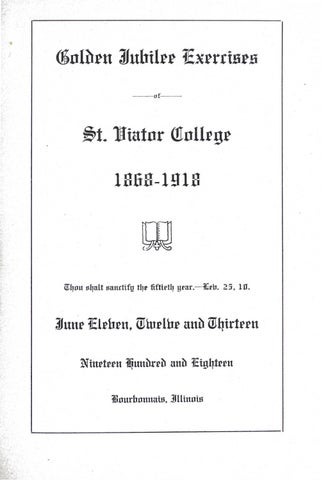
~nl~ru
3Jubtlrr 1£xrrrtsra -of-
~t.
]ttatnr <1tnlh gr 1868-1918
',,'
~·
i't
ID4ou .a4alt naudify t4t fiftirt4 yrar.-1Drh. 25, lU.
.3Juur 1flrbru, Whtrlhr null IDqtrtrru ·
1inurbnuuais, lJlliunia
Viatorian Community Archives . Scanned 2015
Original page blank
/
l-T~·VIA·r·oRIAN-·{ · i l
lll'nt
d
Volume 35 ·
• •_ . . _ .
•
July, 1918
• • - . _ _ . . . _ _ ... _ . _ _ . 11_ 11
h
1
§p.rrn
.._ __.a-Q-eu-aa-tea_.a-au-a ..-
+·-·-----~·_.._.._.._.._
ua-.a-
au-au-..-te+
Number 5
e.--a . .-.n-aa-t~~-.a-a• ....... •
•u-aa
I
au-..-.+
THE GOLDEN JUBILEE CENTENNIAL DAY TUESDAY, jUNE ELEVEN
Fifty years in the work of Catholic education! Fifty years in the service of God! What glorious golden light such service sheds upon the individual or institution. This year it was St. Viator's happiness to commemorate a half century of noble work in Illinois. A most e1.aborate celebration had been planned, but war and its accompanying unsettled conditions an~ forces that change nations over night, and it would be wholly unexpected if Viator's Jubilee festivities were not affected. Even in such adverse circumstances, however, the occasion was one that will long live in the memory of her children and frj ends. At the opening program, Tuesday; June 11th, the old campus was alive with Viator men. Priest, monsignor and bishop and representa- · tive from every walk of secular lite, even the sailor and soldier whose uniforms told the story of Viator's tribute to the nation's cause-all . came to sjng the praises of their Alma Mater; some whose work in distant parts of the land had kept them from their college home for the past quarter of a century, some whom Fortune had given the opportunity to frequent the old school to watch with loving eyes each rapid stride she made towards the front rank of educational institutions. The spirit of loyalty, love and devotion, the true spirit of Viator, manifested itself more strikingly than ever as Alumni, young and old, flocked to halls and campus, each nook and corner of which held cherished memories of days that fade into the past . Upon such a gathering of jubilant hearts nature herself could not· but smile with sympathetic grace. At eight o'clock, Tuesday evening, the orchestra leader on the veranda of Marsile Hall raised his baton. A second later the Jubilee exercises had begun. After the address of welcome, Thomas E. Shea, president of the class of 1918, presented to Father O'Mahoney the memorial of the dass, a beautifully illumined Celtic cross erected on Marsile Alumni Hall. In presenting the cross, Mr. Shea said: "There are times and occasions when the emotions of man wjll not speak themselves in halting words, when they must be expressed in some more forcible manner. Rev. Father, when we, the class of '18, realize what this college has done for us in giving us a Catholic
244
THE VIATORIAN
education and instilling into us that same glorious spirit that animates her, the feeling of gratitude we experience must find expression in something other than speech. With this end in view, as but a sign of our love and gratitude we bequeath to our college home this Celtic cross. It can never adequately tell what feelings prompted us to make the bequest; it can never tell the bequest we ought to make; it can never tell the bequest we will make. We beg you to receive it only as a token of the love it can never measure. May this sacred emblem make known to the world outside the cause for which St. Viator exists, the glory of God alone . . May its form, the cross of Calvary, signify the noble SCJ,crifice you men are making by dedicating your lives in poverty to enrich the Catholic youth of America. May its golden light ever shed lustre on the glory of the men you have .taught and on 'you wh0 have made them real men of whom the world may be proud." . Father O'Mahoney in a brief address accepted the class memorialand expressed his heartfelt appreciation for the appropriate gift. Then followed the. regular class exercises during which in history, will and prophecy debts long overdue are paid in full. After the investiture of the Junior Class, John J. Madden presented to ~ather O'Mahoney the memorial of the High School class and the Illinois State Centennial Flag. Mr. Madden said: "Upon this, the eve of our departure from St. Viator College, _the graduating class of the high school department wishes to bequeath to its Alma Mater a slight token of gratitude. Unfortunate circumstances have rendered it impossible to have our- memorial for this occasion. But, however, within two weeks a drinking' fountain will be erected on the campus to the memory of our class. "The High School graduating class of 1917 have established the precedent of giving to St . Viator's the flag of our country. In order that we may confirm this precedent so excellently begun by them and in order that by our example the classes that follow us may perpetuate the custom, we wish to present to the college this flag. Furthermore, in view of the fact that tonight we celebrate the centennial of our native state we give to our Alma Mater the centennial flag of Illinois. May these two emblems-the one symbolic of the greatest nation of the world and the other second路 only to the firstmay these. ever gloriously 路float over the halls and campus of Viator to make known to the world the love and devotion she pledges to both." Father O'Mahoney after accepting the memorial introduced the speaker of the evening, Honorable James G. Condon, '93, who delivered the Centennial Address.
j-'
THE VIATORIAN
245
ADDRESS OF RON. JAMES G. CONDON , '93 . VERY REVEREND FATHERS, LADIES AND GENTLEMEN :
I am indeed somewhat impressed by your vast expectation as expressed in the introduction given me by my distinguished friend, Father O'Mahoney. His enthusiasm is reflected in the Class of 1918 whose members have delighted us with their class-day efforts. They seem to know more than college men did a quarter of a century ago. The class historian is really a philosophical fellow. He probably feels that he has written a permanent record of real facts . So did our class historian about twenty-five years ago, but we have since found that he wrote fables, and perhaps the historian of this class will enjoy the thought a generation hence, as we do now, that there is morepleasure in campus fables than there is in serious facts . The class prophet saw visions of great days to come. Should he become a famous detective and distinguish himself along that line the chances are that twenty-five years from now hardly a single clew to any of his prophecies will remain to locate the fugitive . However, he will not be disappointed because he has been modest in his prophesies and seems free from the conceit that disappoints and destroys. The genius and safety-first member of this class is the man who wrote the will. The interesting feature about the will made by the 1918 class is the fact that there has been no provision made for the payment of their just debts. That reminds me of the story of the darky boy I had caddying for me at Excelsior Springs a couple of years ago. One day I said to him, " What is your name ?" He said, " Jim." " Well,'f I said, " that is my name, too." He said, " That sure is a good sign. We ought to get along together." After a while I said , " Jim, where did you come from ?" He answered, "Topeka, Kansas." I asked him how he happened to get to Excelsior Springs from Topeka, Kansas. " Well, Mr. Jim," he said, " You know Kansas is a Prohibition State and they have bootleggers down there. When you sell liquor on the sly and they catch you , you have to go before the judge. Well, I was hauled up before the judge one day and he said, ' Jim, you are a bootlegger ain't you ?' I said, ' I don't know.' ' Well,' he said, 'you are, and I will give you just twenty-four hours to get out of Kansas!" Jim looked up at m e and said, " Say, Mr. Jim, do you know Kansas owes me just twenty-t hree hours and fiftyfive minutes." Father O'Mahoney 's introduction reca11 s to my mind the story I read the other night and an interesting feature about the reading was that when I took the book from the library shelf it was entitled " Irish Wit and Humor." All of the binding was broken . It must have been many years since I had occasion to look at it, and t o m y amusement I found that upon every fifth page .w as stamped " St. Viator's Library." I did not bring back the book and I am not gojng t o. It brings to me a memory of old St . Viator's library t hat I do
246
THE VIATORIAN
not want to efface even at the expense of acknowledging a little unconscious pilfering. In that book I read the story that I want to tell you because it seem s applicable. Father O'Mahoney has remained a true student, a true disciple and a loyal cleric of the church. I have gone into the law and can see the advantages in associating with men like those around h ere tonight. According to the story, Father O' Leary, the most distinguished priest of Dublin in his day, was at a dinner given by a notable person living in Dublin. Among those present wa:s John Philpot Curran. During the course of the dinner Curran said to Father O'Leary, " Father, I wish you were St. Peter." Father O'Leary r eplied , " Why; Curran, what m.akes you say you would like to have me be St. Peter ?" Curran answered, "Well if you were St. P eter and had the keys of H eaven, you could let me in." Father O'Leary said, "Well, it would be better for you if I had the keys. to the other place, and then I would be able to let you out. " I have much to expect from. Father O'Mahoney's friendship . _ During the last few days at odd times I have indulged in some recollection and much reflection. When your beloved President invited me to be h ere tonight, I accepted the invitation with a great deal of pleasure, but like m.any busy men, have not given the matter the concentr ated thought the occasion deserves and I feel ill prepared in this distinguished company. But in these days thoughts multiply ve1 y rapidly in every mind so that out of the complexity it is possible to say som.ething. I wj ll not speak long. At the present time long speeches are unpopular and justly so. What people_d~ir,e from a speaker is the expression of som.e thought upon whjch 路the people them.selves may build a structure worthy of their genius and effort . The detajl of t h e plan is insignificant. A very desirable consummation may lose its advocates by the author seeking to lay open a blue print. The impracticability of the plan m.ay disgust your listener. Let us devote our time to announcing and promulgating som.e essential principle or line of conduct. Let us develop a unified spirit in favor of building a pathway of justice and nght along which all m en _can march with h eads erect and with a firm step. We m.ust avoid a confusion of intersections leading to indefinite p 1 aces. In these days, conditions change so rapidly that what is practical today may seem ridiculous tomorrow. The fundamental tl uths and facts do not change and if we can establish an adherence to these essentials, America and mankind will r eap their reward. Tonight I would point out to you the difference between today and twenty-five or thirty year s ago. Many who are here tonight were students in this college at that time. This is a time for counsel. I wish to call your attention to the difference in opportunity that the young men have who are leaving here today and the opportunities that we had. While we were prepared for the battle of life by earnest 路 men filled with noble ambition and zeal, and to know them was to love and admire them, still when we went out into the world as all
THE VIATORIAN
247
other young men did, we entered a sphere where we became the slaves of custom. Instead of the highway inviting efforts of initia. tion and originality, we had before us a troubled path displq,ying the maxims and the listless thoughts that had engaged men fm a generation before our time and have continued until recently during the past twenty-five years. It is the difference petween the thought and ambition for material success with the narrow vision that accompanies it, and going into a theater of action where men are to be m.easured by the service they render to civilization and the willing sacrifices they endure in behalf of an ideal that has no motive of self-interest except , as it may be made subservient to the supreme thought of this day which calls for the exercise of brain and body in behalf of our fellow man. Such is the spirit of St. Viator which gives us the inspiration to do things worth while. Its expression is not found alone on the battlefield but may be in1pressed into every activity in life where the mind and body play a part. The mere onlooker of today will not be in the cast. Every character in the great dram.a is one of action, even those who do not have a speaking part. The Great Author has not provided a place for the coward or the hypocrite. Only the fearless and the true can be seen. All others have been eliminated. By some strong but definite line of action, we of this land, however removed from the pit of turm.oil and thunder are to be the determining factors in preserving for future generations that which is worth keeping, and in the same operation destroying fm all time that which never should have been. We are in the undertaking where the opportunity is given us to meet with the tyranny which all the world now 路 recognizes as a menacing evil. This broad, robust, square-jawed demon has strutted up and down before our eyes and yet we failed to tag it. We were thinking of our individual selves. Our kind of culture was seeded in a small urn. The roots did not take any fresh energy. The flower was withering very quickly. Then we recalled that Bismarck many years ago said the battle for the supremacy for world power would have to be fought out with the United States of America. While we were absorbed in figures and in peace construction he and his feJlows were studying the language of power expressed in their Kultur by the term force or m.ight. This coterie inculcated into the hearts of their people an ambition to expand{ and annex without regard to law or conscience. They talked the principles of Paganism and we neglected to teach and make plain its dangers. We became so thoughtless that we 1ooked with adm.i ring eyes on feats and figures which we now readily recognize in:their naked iniquity. They were symbols of destruction and demolition and yet we did not heed the consequences. Now, thank God, we are awake and doing. In the accompJishment of our destiny, let us not be diverted and separated by any germ which will bring division and decay. We m.ust pledge our lives and sacred honor to the fulfillm.ent of our duty . To do otherwise is to fail.
248
THE VIATORIAN
While I do not want to inculcate into the hearts of these young men a spirit of vindictiveness or blemish them with a desire to do that which is uncivilized, I still hope that they will realize quite clearly that this is not child's play for them, but that they must take an active part in the world's great struggle in order that the world may enjoy the great benefits of democracy which Father O'Mahoney said was so wefl exemplified on the cross centuries ago. As I look at t hat cross placed by this class tonight on the roof of Marsile Hall, studded with electric lights that may be seen from afar, I am reminded of t he vision of Constantine, who centuries ago saw in the sky a flaming cross. Its spirit penetrated his soul and with the vigor of righteousness that he gathered from its lesson, he went broadcast over the Roman world at that time and made Christianity the religion 路of the Roman Empire. Such was the victory accomplished by his sterling qualities, his lofty ideals and his spirit of sacrifice. The young men of today who go forth to save for mankind the essence and benefits of a true and permanent liberty must go with the inspiration 路 of martyrs to an ideal begotten in the Christian heart without which there is no such thing as Democracy. Of course I do not mean that all men and women must pray at the same altar. I mean that the great underlying thought of righteousness and .other ideals that go hand in hand with a Christian viewpoint are essential to a permanent Democracy. Do not misunderstand me. Do not t hink t hat I am trying to take you into the clouds. Such is not t he fact .. E:very word I have utte~ed has a prac~i<::_a~ aBPlication. That whtch ts of the essence of a thtng must have tts va-lue. If the protection of property, a just regard for labor, the development of t rade and commerce, a broader vision of the world's activity, the development of the arts and sciences and improved citizenship and higher education are to be made real with a people who govern t hemselves, then it is certain that the thing without which that people will fail in its mission must be protected and preserved in all of its simple beauty and power. There can be neither permanent m aterial success nor virtue in Paganism and its fruits , and therefore t he Christian spirit must control your lives and energies if you hope to accomplish anything posterity will remember. Boys, think it over. Great minds long since gone have spoken t hese t ruths. The next few years are very important years. While it is not my thought to be disloyal, still I am conscious of the fact t hat probably this war may accomplish some good. I fear a great many of us have been moving in a narrow sphere. We have failed to realize the great mission in life. One of the important features of the college boy's life in the past during the vacation period was to walk down the boulevard with a stooped-over shamble or to drive an auto at high speed with his muffler open that he might thereby . distinguish himself from the rest of mankind, and were it not for the war or some powerful influence which would release him from a
THE VIATORIAN
~.
'
~
249
negative life he might go along in the world and accomplish very little. I do not speak doubtfully of the soldier boy on the other side. His vision is secure. At this time not to realize the importance of great ideals means a failure in life. lt is the putting off until the time is past the opportunity to do something of consequence for principle. Nothing that I say must in any way weaken your activities in war work. Those of you who are qualified should jump into the uniform and take up the task of the soldier without hesitation. Those who cannot, have a great duty at home. This duty goes to the boy on the other side. We must maintain here that for which he is fighting over there. I would leave you another thought . 路While we are thinking .of the war and devoting our efforts to 'its winning, we must also keep in mind that there is before us a period of reconstruction. Dickens expressed our situation most truly in his "Tale of Two Cities," and if he were to write of today he would probably use the same words. You will recall that in speaking of that period of 177 5 he said, "It is the best of times and it is the worst of times; it is the season of light and it is the season of darkness; it is the age of reason and the age of thoughtlessness; it is the spring of hope and the winter of despair," and so on. Out of that picture every young man and every old man, every young woman, because there are no old women, every man, woman and child can see a lesson from which they can gather sufficient material to take an active and important part in any field that they enter during the period路 of reconstruction that is confronting America and other countries. In ordet: to do welJ what is to be done, we will have to do more than learn from history. History gives no precedent to guide us . The wars of history record the ambitions of monarchs who sought to gain territory and domain. They tell the story of peoples whose scope of vision changed but little, if at all. Defeat or victory might mean a different sovereign but not a different people. There was n) great principle involved and the people took no other part in the conduct of affairs a拢 ter the war than had been their custom. The present war was conceived in the same ambition by the Prussianism that planned it. But it rema路ined for America to apply to this war on behalf of those who were fo :-ced into it a nobility of purpose, to make it a foundation for new hopes , to give the whole world the inspiration that ours is a land of deeds and that we exemplify a real and not hypothetical Democracy. We must prove our case. This is the first time in ihe history of the world that Democracy is to bring about a world-wide reconstruction. We have before us the spectacle of peoples of different soils, different climates, different foods and as Buckle says of different aspects of nature directed towards a new ideal. And out of that complexity it becomes the purpose of young America to set before the world the pure light of Democracy. We entered this war with a clear and definite declata-
a
250
,
THE VIATORIAN
t ion that our part was not for aggrandizement or domain, but rather that we telt it a duty to inculcate :into the heart of humanity the world over the desire for great opportunities, great lessons and the great :idemis accompanying real liberty. Ours is not an easy task. It calls for the display of genius, of intelJigence, of fair play and ot industry. A declaration of good intentions will not satisfy. The demands of today requite the enlistment of all Gf us. America is on trial, and if we fail at home what sincerity of purpose can we claim for ourselves from m.ankind. Are we a nation of people who only talk about the rights of liberty and the pursuit of happiness and then stealthjly and without qualm of conscience abstract from life its values for our individual selves, or do we Jive up to the principles of the fathers of our liberty, and are we willing to have permanently engraved upon t he ho ;izon of all future ages those everlasting truths for our guidance and the direction of m.ankind? We shall be judged by our example. If we fail to measu1e up to our :ideals, this war, no matte1 what mq,y be our victories on the battlefield, will have been won withou~ any _ permanent glory or advantage. If out of the chaos we fail to reconstruct along t he lines of the spi1it oi law and order and a just consideration of the rights of all, we have only proven the case o¹ those wh o contend that the people cannot be trusted with their owh destinies. If we pe ~ mit the spirit of anarchy o~ of seln shness to m.ar shall the qualities and quantities that m.ake our country great, and out of t hat cernes diso: der on t h e one hand .or an autocracy of wealth on the oth er wh ich will fail to recognize the plain and manifest rights of all persons, we wi ll take the desire for a dem.ocrat:ic form of t overnment out of t he hearts of other peoples and bid them cry eut, " Away with your boasts and t h eir empty victories." To accomplish our destiny we m.ust proceed with wisdom and moderation and with a firmness of purpose that will give hope and heart to all mankind and at the same time preserve for ourselves the her itage given us. At all events, we must proceed according to the law o¹ t he land. When the fathers of our country conceived the true meaning of lib erty, as we enjoy it, they m.ust ~ave been endowed by an All-Wise Providence because at the sam.e time they gave us a medium and agency by which that liberty could be maintained. T h ey declared that without law there could be no permanent liberty . They gave us the Constitution of the United States. The~ gave us t he implements with which to preserve the fruits of their inspiratior .. While we are battling in other lands fm an international rule of law for all civilized nations, we must not forget that law should remain suprem e and exalted at home. The great Constitution of the United States is ample in all of :its phases to bring :into existence the realities for which we are ¡ fighting and which the present and coming gene.: - ations will bring into being. It has been sufficient in tim.e of peace and is adequate :in t ime of war. It is clear that if our people fail to get liberty and
THE VIATORIAN
251
justice, that failure is not due to a deficiency in the fundamental law of the land, but rather due to a failure on the part of the men who are selected to properly represent the people. A failure on their part is not evidence of the inadequacy of law, but is due to the default of the voters in making proper selections of men who ate autb.orized to enact legislation. The路 Constitution is sufficiently broad to enable all necessary .refonns to be b::-ought about according to the rule of reason and the rule of law. I mention that at this tim.e in order that these young m.en and all of us m.ay fully realize that in this period of reconstruction which is facing us that we are confronted with a pduty not so m.uch to make new opportunities but rather to gather in the rea1ities in life which are plain and distinct before us . There is no conception in the mind of the most agile that cannot be m.et by the fundamental law and any effort or any attempt which has for its purpose or its effect the setting up by anarchy that which can be done by law will destroy the benefits that this wat m.ust bring to us and to future generations. It is in the hom.e of the rich and hum.ble where selfishness and Socialism. in their worst sense do not abide that we must place our hope, and with the Christian education that is gathered here and in m.any other great colleges, the young m.en of today must realize that every good that can be accomplished for this and com.ing generations must be secured in the spirit of reason rather tha路'1 in the spirit of wrath. When you hear m.en scoffing at the integrity of the courts, tell them. they do not understand. Tep them that law and order are essential to a democratic form of government and that the courts are the vita] and im.por ant instrum.ents by which law is made effective. The courts have been and are still the protecting arm. for rich and poor, citizen and soldier, em.ployer and em.ployee. When leaders of thought seek to destroy the efficacy of courts they make an attempt to do away with the tribunals which apply the principles for which we live and are willing to die. Our fundamental law is capable of taking care of the conditions of employm.ent and our courts have declared that all matters touched with a public interest and affecting the questions of health, safety, comfort and wages may be treated by Congress and the Legislatures of the different States in a reasonable way for the benefit of those who live within our jurisdiction. There are many instances on the books corroborating this statement. The Workmen's Compensation Act , the Adamson Law, Employers' Liability Act and others are all recerc.t examples. In a clear way our courts have held that under the Constitution the States may protect themselves ft om imm.oral containination from without. If business needs regulation, the Constitution is bread enough to authorize a just consideration of it by Congt ess and our hearts have justified the legislation. I m.ust stop, 1.ave already gone beyond my lim.it. Every honor is open to you. If you desire to become soldiers, to join the great anny across the seas, that privilege is given to you, and it is not
'
.;I
'i
'路'
252
THE VIATORIAN
because I am denied that privilege that I am courageous. I know t hat no accomplishment in life will give to the men of the fut . re as much satisfaction as the realization that they have taken a part in the great struggle now going on. When you think of the soldier boy going over there, how your heart fiJls with enthusiasm, how every emotion 路wells up, how we can grasp his hand and slap hi:; ba~k because we know that he is carrying aloft the banner of freedom; that he is taking into a bankrupt world the wealth of a Democracy and not impoverishing his own land. With him he carries the flag which heretofore has been the subject of inspiration in song and poetry. Now it is the very essence of his life, of your life and of mine. When your service flag was unfurled this 路evening it called to our minds the heroic devotion, the duty and the willing sacrifice of many protessors and boys. They will not be iorgotten. The chairs they have left are vacant, but they occupy a bigger place in our hearts and are always with us . They have made the sacrifice for God and country in behalf of Christianity and a world-wide freedom. In conclusion, my friends, I want to express my gratitude for having had this opportunity of addressing you. It is from institutions such as this that the world can hope for its ideals. Out of these walls comes the thought that men and women have a right and an inalienable right to life, liberty and the pursuit of happiness, and I am quite sure that the young men who leave here have gained much from Father Maguire, even though it may be tr_~~ jihat he has no money in his pocket as was said of him, but that he is rich in ideas. There is no heritage that you can leave any greater than a wealth of ideas. There is no will dealing with money only that which will have as much opportunity in it for posterity. He and Father Bergin and Father O'Mahoney and all of the other men who are devoting their lives to this worthy cause exemplify in their beings the gr~at thought that no young man and no generation has the right to barter away human freedom either for himself or for posterity. It is out of their lives that we get the inspiration that property ha~ rights and labor has rights and that property has its obligation and labor has its obligations, and when we all realize tbat and realize to the fullest extent the supreme thought that unless as a people we com.e to a complete and full realization of the big thought that property and labor must go hand in hand with Christianity and with Democracy, we will not make progress in civilization. The failure to realize these great ideals has brought about whatever void now exists between these two agencies. I say to all of you and to the boys of this class in particular that a great life is before you. Face it with a clean vision, an honest heart and the courage of great big fellows. Rise to the unusual and live in a sphere where petty things and small-路 minded men have no abiding place."
THE VIATORIAN
253
JUBILEE DAY WEDNESDAY, JUNE TWELVE
At an early hour Wednesday large crowds of visitors arrived t o swell the already vast concourse assempled to assist at the Pontifical Mass of Jubilee. At ten thirty o'clock the long procession of clerical dignitaries and gowned graduates followed by Right Reverend Alexander J. McGavick, D. D ., '85, Right Reverend Edmund M . · Dunne, D. D . and Most Reverend George W. Mundelein, D . D ., each with their respective chaplains began its course from Marsile 'Alumni Hall to Maternity Church. Rt . Reverend Edmund M . Dunne, D . D. celebrated Pontifical Mass, assisted by Very Rev. James J. Shannon, Vicar General d the Diocese of Peoria as Arch priest; Rev. John B. Suprenant of Saginaw, Mich., as deacon ; Rev. E. P. Burke, C. S. C., ·of Notre Dame University, as subdeacon ; Rev . F. E. Munsch, C. S. V., as Master of ceremonies; Rev.]. A. Rebedeau of Chicago and Rev. F . F. Connor of Rockford, as assistant masters of ceremonies, and Rev. F . Walsh of Camp Grove, Ill. , as cross bearer. Among those present in the sanctuary were : The Most Reverend George W. Mundelein, D. D ., Archbishop of Chicago ; Chaplains to the Archbishop-Rev. Robert Pratt, 'Kokomo, Ind. and Rev. Michael Dermody, Aberdeen, S. Dak. ; Rt. Rev. Alexander ]. McGavick, D . D., '85; · Chaplains to the Bishop-Rev. John P . Parker, Dwight, Ill. and Rev. Daniel Sullivan, Pekin, Ill.; Rt . Rev. Abbot Vincent, 0. S. B., Peru, Ill. ; Chaplains to the Abbot-Rev. P. E. Hand, Lostant, Ill. and Rev. F . B . Dickman, Rutland, Ill.; Rt. Rev. Monsignor Hoban, Chicago, Ill.; Very Rev. E . L. Rivard, C . S. V., D. D. , Provincial of Viatodans in the United States, and Very Rev. 0. Joly, C. S. V., Provincial of Viatorians in Canada. Rt. Rev. Alexander J. McGavick, D . D ., '85, preached the Jubilee sermon. The Bishop waxed eloquent in the praise of the indomitable spirit which has ever animated the men at St. Viator, a spirit which has enabled them in spite of grave difficulties to establish an institution which has rendered such splendid service to humanity. BISHOP McGAYICK'S SERMON.
II
"We have reached today a point in the history of the institution which might be called the end of the first chapter-the Golden Jubilee of its foundation. It is a time of jubilee indeed, a time of rejoicing.· The very buildings which stand grouped around like silent spectators, the campus which we consecrated with play, the fields where we wandered, the woods which heard our shouts, seem to shine today with a new light. The eye wanders over them almost with reverence. Old students have come from afar, from the busy walks of life, from the shop and the office and the farm, and the weary rounds of pastoral · care. They come with the effects of their labors and of the passing
)"
254
-~
THE VIATORIAN
years showing on them, with the scars of the conflict on them, tokens of service rendered. Not all are here. In the heat and toil of the day many have fallen . They are not forgotten. Their memories live. But for all that, those who are gathered here this .morning are most happy. Joy is in every heart and beams in every face. It is a day of jubilee and the jubilee is a golden one. It is n,ot simply an occasion which marks the lapse of fifty years, but one which marks the acconpJishment of a great work. The years are not empty but filled to overflowing with achievement. They are not barren, but 路 fruitful years The harvest thereof is piled high, not alone in these stately buildings, but in the lives of the multitude of young men who have sought knowledge and inspiration here The work which has been carried on irr these sacred preciRcts during the past fifty years is God's work. God has blessed it from the beginnin ~路 . His strength has supported it and His wisdom has directed it. We see this in the very circumstances of its origin and development. ' It began humbly. This seems frequently to be a mark of God's inspiration and guidance. Christ began His career humbly. He began it as an infant, born in obscurity, born in a stable and laid in a manger. In what' humbler surroundings could the Son of God place himself? And He was humble in His life as well as in His birth and humblest on the Cross. The Church, too, began humbly. The Apostles were poor men, taken from the simplest walks of life. They were fortified neither by learning, influence nor power,._yet they were commanded to conquer the world and win it to Christ. What a lowly origin for the great Church which was to fill not alone the world but Heaven also. So jt was with this institution. As its patron and protector there was chosen a humble saint whose life was buried in a remote past. St. Viator, we are informed, lived in the 卤ourth century. He was a lector in the Church of Lyons. His duty was to instruct the faithful in the catechism. We can easily imagine the youthful saint pursuing his labor as teacher in these far off days, in the small hamlet of Lyons within sight of the blue waters of the Mediterranean and near the old Roman road that led to Gaul and Britain, where the conquering legions passed. We can easily imagine him gathering his little flock about him, instructing them in the catechism, stimulating 路them to _ virtuous habits and edifying them by his saintly life. Probably he taught them more by his example than he did by his precepts. That is the way with all great teachers-consciously or unconsciously. He did not aspire to the priesthood. He was satisfied to teach the catechism. Thus he went on, performing his simple duties, until God called him to enter the religious life in an Egyptian monastery, there to end his days in prayer and penance. What could be humbler than the simple circumstances d this beautiful life? Yet, fifteen centuries later, away here in the heart
·' f ..
..
'
.
~
'
li". ~;:.
"
·'"
l.: ·,
THE VIA TORIAN
255
of the new world so distant in time and place, he is chosen as · the patro.n and protectm: of this College. That is not the way of man, but it is the wa'y of God. G Jd ·uses the weak things of this world to confound the strong. He exalts the humble. When the C!erics of St. Viator caine to Bourbonnais, they had no thought of establishing a college. They came to teach the district school tor boys, the girls being already provided by the Sisters in the neighboring convent. A priest and. two brothers came-the priest to be pastor of the parish and the brothers to teach 1n the school. . That was a worthy purpose, but it was the only purpose then in view. Plainly it was a humble purpose . That was in 1865 . The war was just over and the soldiers were return1ng to their homes. The country, no doubt , was in a disturbed and unsettled condition, but the work which the brothers came to do was courageously taken up and carri~d forward. As time advanced, the prospects widened, opportunity developed, hope br1ghtened, courage grew, and marvelous as it appears, at the end of three years the foundation of this College was laid. Help was summoned from Canada, a faculty was organized, students assembled and the College was an accomplished fact . We see God's work in this. It reminds us of seed time and harvest. The seed is put into the earth and it seems to decay and perish there, seems lost arid forgotten; but very soon the blade springs up and· is nursed by rain and dew and sunlight, and before the summer is passed the reapers are gathering the harvest. That is what God does with the sma~l seed that is cast into the earth, and that is what He did too with the humble purpose which the good priest and the two brothers had in their minds when they first arrived in the peaceful village of Bourbonnais, more than fifty years ago. But God's works seldom progress without privation and suffering. Their pathways are seldom smooth. Rarely i -, the da y fair to the end. Our Lord did not walk in the sunshine. He trod the winepress of s.orrow. He felt the stings and arrows, not alone of evil fortune but of human malice. Think of the persecutions of the Church! They have followed her as her shadow.- But that is to be expected , since her life is the life of her divine Master, projected into all time and throughout the world. It was the sa'm e with the College. She struggled slowly forward with great labor and amid many disappointments. Hope shone brightly at times only to be quickly obscured. Means were not always at hand. She had no wealthy benefactors. Her support came from humble sources. Finally occurred the dreadfu1 tragedy of the fire . That was twelve years ago. Every building on the grounds with one exception was destroyed. The fire started in the early evening and burned through the night and it was a cold winter night. We can easily see in imagination the red flames mounting high in the darkness and throwing a lurid glare over the housetops of the village and far out over the surroundin g country. The wind
256
THE VIATORIAN
sweeps them from building to building, and as the night wears on, all save one are enveloped in the seething furnace. The little community, under their devoted and wann.hearted leader, Father Marsile, wept and prayed, or wandered apart dazed, helpless and hopeless. They rescued whatever of value they could. They fought tbe flames, but with little result. As the walls fell one after another and the roofs crashed, they felt they heard the death knell of all their hopes. When morning came there was nothing left but a great pile of ashes and charred timbers. One might think of it as a new grave, with the fresh clay heaped up and some fair young . promising form sleeping below never to rise, and loved ones weeptng. It looked like a new grave indeed, but it wasn't a grave. It was not the grave of the college. God willed otherwise. A greater college rose out of that pile of ashes. Courage mounted with occasion. Sympathy poured :in-practical sympathy. Help came from many quarters and from some unexpected ones. The fcund:1tions of the new and better buildings were laid, the walls leaped upwa d, the scattered students were gathered together and the work of God was again moving forward under conditions vastly more promising and encouraging. An entire new college, more spacious and imposing, was built on the ruins of the old. In the midst cf desolation and death, life bloomed anew. ATe Deum might have been sung. The . hand of God was there. There can be no doubt of it. It is His way. He snatches victory from defeat. He turns 路thorns_imo roses and tears :into jewels. He makes wounds shine like stars. . When God desires a great work dcne He chooses suitable instruments therefor. He does not choose worldly m_en for it, nor selfish men, nor those who love comfort and luxury and home and ease. No, He chooses spiritual, self-sacrificing men, who will put themselves wholly in His hands, who will kneel at His feet and say, "Lord, do with me as Thou wilt." That was the character of those who founded this institution. Father Boudoin and Brother Berna! d and Brother Martel were the first of the community to arrive and undertake the work. They were the pioneers. They laid the foundation. They were pious, devoted, saintly men. Poor in m_aterial means, they were rich in faith, in courage and in the confidence that they were inst!uments in God's hands, and that success must come to them if they be willing and faithful instruments. Such, indeed, they tried to be and truly we1e. They rejoiced to spend themselves in the work that was given them to do. We find that to be tlue not alone of those who founded the institution, but of those as well who came after them and who have since controlled its destinies. But if we see the hand of God in the circumstances attending the origin and growth of this institution, we see it more clearly in the nature and character of the work done. Education has entered largely into the life of the Church from
,
.,, "''-l'"''l .,.,., H~ '!¥~ ' 1 ~ ~
j\1
'
...
·v .. 1
~
,, ' • r
"
I
.
THE VIATORIAN
257
r,
the beginning. Christ was the teacher of men as well as t heir Saviour. He was the Light of the World, He cornm.issioned His Apostles to teach. He said to them , ·"Go teach all nations." I might say that'the Church has three g1eat passions. She has a passion for souls, a passicn for charity and a passion for education. She' goes to the ends of the earth in quest of souls. She crosses deserts and seas. She seeks the savage as well as the civilized . Think of the labors of her m.issionaries in all ages. What journeyings, what privations, what sufferings! And the purpose of it all was souls-to save souls. Any price for a soul. Her charity has been as bouvdless as human want and pain. There is no sorrow which she has 'not sought to assuage and no warit which she has not tt ied t o relieve. Her charitable institutions cover the earth. Her passion for education is just as intense as her passion for souls or for charity. They com.e from the same source-her divine Founder. She loves souls as Christ loved them. She loves to relieve suffering as Christ sought to relieve it and she loves to teach as Christ also taught. She has the same spirit and heart which Christ had. During the Middle Ages when all civil education had ceased the efforts of the Church in the cause of education were nothing less than marvelous. Time was when these ages were referred to as dark ages. · By darkness was meant, of course, the lack of education. This view satisfied many who could not conceive of great faith and enlightenment as subsisting together. But "truth crushed to earth shall rise again." The truth as to educatjon in the Middle Ages has long been crushed to earth , but it is rising now. The clouds are dispersing and the fair vision cf the wonderful and fruittul efforts of the Ch~rch along these lines during that turbulent period is corning into view. Not infrequently today indeed are these ages referred t o as the bright ages; bright not alone with faith, but bright with~char ity and bright especially with the intensiveness of educational effcrt . Then, as now, education followed the faith . The school followed the Church. Wherever a Church was built a school was established and there were pra-ctically as many schools as churches. There were the monastery schools, the Cathedral schools and the parish schools. The priest was not merely a teacher in the Church but a teacher in the school and he taught not only the catechism but the liberal sciences and the rnahual arts . Even normal schools abounded for the training of lay teachers. The assertion is made and probably is true t h at in proportion to the population there was better provision for the secondary education of youth during the Middle Ages than at any time since. We speak of the old Cathedrals of Europe as eloquent of the faith of those days; we might also speak of the old Universities, those now Catholic as well as those which have ceased to be such, as equally eloquent of the education which flouri~hed then. The monuments of education are as wonderful as the monuments of faith.
\•
258
'
THE VIATORIAN
Necessary as Christian education has been at all times, it never probably was more necessary than now. This is due to the false education which prevails so extensively today. Modern education outside the Church, particularly higher educaticn, is hostile to the Christian faith. It is not merely hostile to the fahh, but destructive of the very foundation on which faith rests. So fat as principles are concerned, it has sunk to a purely materialistic basis. Now materialism is a thing of earth and clay. It belongs wholly to this world and to this passing life. It sees and recognizes only matter and the forces ccntained in it. It affirms that the term God, if it means anything, is nothing other than force cr a tendency. The immortality of the soul is set down as a dream, and of such stuff as· dreams are made of. It points to death as the end of all hope, as a wall without gate or door, where life's procession stops. And man in his nature as well as in his origin is animal, coming from the animal, from the lair of the brute, and with nothing which he did not receive · from his animal ancestors. This in principle is the basis of modem non-Catholic education. Its leaders define education as the preservation and development not of our intellectual inheritance or of our spiritual or moral inheritance, but of our animal inheritance, implying thereby that everything good in human life comes ±rom that source. It is possible that modern education has insisted upon this degradation of man too much and taught it too well. It is possible, yea probable, the world would be happier today and more peaceful without it. You can't degrade man's nature, trail_ his' dignity in the dust, take away his self-respect and strip him of 1iis highest ideals, even in the name of education, without sad consequences following. We hear a great deal today of force being substituted for the moral law, but it should not be forgotten that moral law is impossible without God and the elimination of God can have no other effect than the enthronement of force . A godless education in so far as it is Godless de~fies force. It exalts the sword and makes it the arbiter of right . We hear much, too, of democracy, but who will find a basis for democracy except 1n the natural rights of man and where, I ask, will you find the theory of natural human rights taught today except in our Catholic schools? Elsewhere the state is made the fountain of fundamental human rights and not nature or God. We need liberty to enlighten the world, but if Christian teaching does not enlighten the world, there will be little chance for liber~y. Christian truth is the truth which makes men free . But our chief concern about modern materiaJistic education is it.; antagonism to everything Christian. This is most evident jn the higher educa tiona1 institutions, where novelties in doctrine seem to be sought quite as· much as truth and where no novelty is sought with such relish as the one which sliock; most the Christian conscience.
. !
THE VIATORIAN
259
The progress of this form of education cannot but mean the progress of unbelief Its triumph y.rlll mean the triumph of a gilded paganism. It will come as near to putting out the lights of heaven as is poss1ble for ah.y human agency. And it should not be forgotten that this pagan form of education has behind it, encouraging and supporting it, a large share of the wealth of the world. Great foundations of wealth are being organized with the purpose, poorly concealed, in view and the power of these immense foundations is well n1gh incalculable. 路 It is idle to think that we can oppose successfully this movement of materialistic education by preaching trom the pulpit. It can be done only through the agency of the Christian school. This explains the great and pressing need of Catholic educational institutions. We need them to combat pagan error. We need them to defend and propagate Christian truth. We need them to defend the Church and therefore God's Kingdom on earth. We need them, too, in such riumbers and with such efficiency and such completeness of equipment that it will be in the power of all Catholic .youth to obtain Catholic training in any and every department of learning, from kindergarten to University. Anything less than this would fall short of the necessities of the occasion. And there is so much at stake! Not only 1s the salvation of souls at stake, and the extension of the Church and the progress of the Christian faith, but there is at stake also , without doubt , the permanence of the Christian social order, the preservation of a rational liberty, and the happiness and peace of man. The Chr1stian school is the defender not alone of Christianity, but of civili.zation. For fifty years here in the open fields thi.3 college has pursued peacefully and persistently its great mission. For fifty years it has defended Christian truth, has built up Christian character, has propagated C.hristian influences and nourished Christian ideals. F er fifty years its graduates have gone forth to the ends of the earth as 11ghtbearers, pursuing the paths of truth themselves and illumining other paths and lighting up the world's dark places. Its progress during those fifty years has been such as could only come from persistent labor~ heroic sacrifice and the unfailing blessing and guidance of God. It has pushed forward amid great difficulties. It has climbed upward on a hard road. It has achieved a success of which its students and graduates and all well wishers are justly proud. No doubt in the years to come it shall mainta1n the same unfail1ng pace of progress, ever growing, expanding and multiplying its facilities, ever increasing in influence and becoming m ere a leading power in educational work throughout the middle west . The spirit of St. Viator as embodied in Father Roy and Father Mars1le and Brother Bernard and in those who labored with them or have followed them , that spirit is going to march on. It is the spirit of Christ. It is the spirit of the Church. It is the Christian apostolic spirit. It is a
•
260
THE VIATORIAN . ...
,.
spirit which never weakens or falters ; is not deferred by difficulties and does not slacken in privation and suffering. That spirit will march on. It is an unconquerable spirit and the achievements of the n ~ xt fifty years compared with ~that which already has been accomplished, although wonderful :indeed, will be as " another sun risen c·n t he noonday ." , . · May Gcd illumine and guide those t o whom the destinies of this :institution have been committed. May He make them equal at all times to the heavy responsibilities resting on them. May He, by Hjs grace, be a lamp to their feet, a staff to their hands and a cup of strength to them in every dark hour, and may He reward them abundantly at the close of the long day when, weary and broken with toil, they pass the precious burden to other hands.'' THE JUBILEE BANQUET. At 1:30 p . m . a delicious banquet -was served :in the college dining hall. At the end of the banquet, Rev. P . C. Conway, '84, as toastmaster a'rose to introduce the various speakers. Toastmaster: There is only one name we must mention to establish our Faith, and that name :is "Our Holy Father," and so too there is only one name we need mention in our province or archdiocese to determine our Faith and our loyalty, abd that js " Our Archbishop." And when t hey are in agreement and accord as they always-are ~d a1ways will be t he Faith :is safe and devotion is assured. We will now hear our beloved Archbishop respond to the toast : "Our Holy Father," and ask him, though he is very busy and in a great hurry, to remain until Father Nawn, who bas been handpicked.by us to speak to the sentiment, ''Our Archbishop," responds . Fathe1" Nawn will arise immediately after the Archbishop, and I tell you he bas got the opportunity of his life. Some people say he resembles the Archbishop somewhat. Well, that won't hurt Father Nawn a:ny. Be very diplomatic, Father Nawn, do not say too much, but be sure and say enough and your fortune :is made.
Most Rev. George W. Mundelein, D . D.-"Our Holy Father ." It seems proper that on this day, when the clerics of St. Viator, commemorate the fiftieth anniversary cf their coming to this diocese, and the golden jubilee of their foundation of this educational institut ion which has done so much for the good of religion in training worthy candidates for the clergy ahd splendid representatives among the lafity, t hat our thoughts should first turn to the Vicar of Jesus Christ on earth, the head of our church, the commander-in-chief of our arms, our Sovereign Pontiff, Pope Benedict XV. None of us have seen him, for this is the Pope whose inheritance is "The Religio Depopulata," a war-torn suffering world, who is cut off frcm many of
/
THE VIATORIAN
261
his children, but who for that very reason has perhaps come closest to them of all. In the now three years of his pontificate, he has showed himself in truth our Holy Father, for he has been the father of us all, favoritism for norre. All of the warring powers have tried to draw him to their side, but none has succeeded; he has held himself aloof from their quarrelling, he has sided with none, and this is the only position he could really occupy. Whatever his sympathies may be, he must hide them from all, for he is the father of all. I yield to no man in my love and attachment to my country, yet 7I would not ask him, I could not expect him, indeed, I would think it unfair of him to side with our country in this war. For there are millions of others who differ from us, who love their father-: land, as much perhaps a's I love mine, and he would wound them sorely, for he is their father, even as he is mine; he is not the arbiter in this cause, to him they look for sympathy and consolation in their suffering. Moreover, some day there will be a peace table, and at it, we want the Holy Father to sit and he cannot sit there unless he has been absolutely neutral and unbiased. Even indicted criminals in ou,r courts have the right to object and reject a juror, who has formed an opinion jn advance and has prejudiced the defendant's guilt or innocence. Even so when the German military system is arrayed at the bar of the world's justice, our Holy Father as one of the judges, must have been entirely neutral in the past. And so we maintain in very truth that these attacks on our Holy Father, which have come forth lately, are doing the cause for which our boys are fighting, more harm than even the most vicious Germain propaganda; for with us,路 with you and me and our people, our love for our Holy Father, the Pope is not a thing of today or yesterday, but sown in the blood and bred in the bone a:hd tied up with our very being; when you touch him, you strike one of our hearts' strings, and the discord mars our entire peace and happiness. War, like politics, make stran~ bedfellows, and it is because our country tells us, that we have gladly joined hahds with Britain, in this war, but in return we ca'h at least demand that she put the extinguisher on the "hit the Pope" stories and that she intern the Morning Post of London like a dangerous alien enemy for the period of the war. . We, of Chicago, love our Holy Father, even though he be far from us, for to us, he is the successor of St. Peter, the Vicar of Christ on earth, the head of the universal church. We have shown our affection, our devotion, our loyalty, in deeds not words. Our magnificent contribution, twice given, is the best proof of our love, forwe have taken upon ourselves the burden of others besides our own, and 路 as we have done, we will do again. We will not lag, the Holy Father shaH net want, for there are one million of us here, cle:-gy and laity, ready to come to his aid.
262
THE VIATORIAN
Rev. john H. Nawn, '97.-"0ur Archbishop." Three years ago the robust young diocese of Chicago was deprived of its Shepherd and left in its orphaned state for six months. It was no easy task to find a man who in the eyes of Rome was fitted for t h e important See . He should be, not only a man of God, his state in life guarantees that, he must be a diplomat, for the diocese is one of the most cosmopolitan :in the world, a nd to counsel and guide, direct and govern, the enormo11s catholic population of mixed races and many nationalities, requires the skill of a tried diplomatist. He must be a scholar and alipe one, for not only is the metropolis of the middle west one of the greatest educational centers in America, but into the very hands of the Ordinary are placed the welfareand destinies of half a dozen seminaries, a dozen colleges and universities, twenty-five crt:ademies, almost as many high schools ahd nearly threehundred parochial schools. To enter :into sympathy with these progressing activities demands an erudition and refinement above the ordinary. Again, the Shepherd of such a great diocese must be a 111an of greci.t heart, for the calls of charity are in proportion to the greatness of the place. Tears of sorrow are da:ily falling, like drops of dew from the leaves of trees. Like the wayside flowers that each day open their shrinking beauty, fearing to be crushed, the hands of little children, orpha.ned or forsaken, are daily raised in humble supplica1
ti~.
.~
The great White Shepherd of Christendom- was cognizant of all these needs and made our cause his own. The best was 路none too good fer the great American diocese- , and if the best, then American blood should be called upon. Peter spoke, and the son of America's defenders, in whose veins runs the blood of the American soldier, stands in our midst, our Shepherd. He has been ours now for more than two years ahd with giant strides has he grcwn in the good estimation of his people. No highbrowed potentate, wrapped in the awe of his sacred purple, but an exemplar whose restless activities act as a saving leaven, causing priests and people to be up and doing. A bishop who does things, 路 yet a true follower of the Good Shepherd who banishes fear and invites approach. Whose skillful handling of his large a!hd ever increasing fold, shows a knowledge of diplomacy that is both admirable and rare. . The educational institutions have found him to be the most powerful ally of progressiveness, which is really the red blood of their lives, and without which comes stagnation and decay, but there will be no stagnation or anemic condition in the school, college or university of catholic Chicago, while the present director of their destinies is with us. His very letters breathe progress, incite to higher aims, and make us proud of the hand that penned them.
THE VIATORIAN
263
Above this, and above all, he is the father of his people, as both Chicago and the world found out from his very entrance to his See. His kindness to the orphan and the destitute, is perhaps the most striking charatteristic of his regime, for when the voice of cha卤ity pleads, fer h1m all other voices die. So true is this that the great world-wide organization known as the Red Cross .Society, proudly looks upon him as one of its strongest patrons and our illustrious President, now guiding our beloved country in its battle for the rights of humanity, . sends his Secretary of State to do him honor. Right worthy of the honor of his country, most deserving of the love and admiration of his people, the sons of St. Viator's wish to join in the outburst of praise, and cry "Long ljfe to his Grace." May he spend many happy years with us, and when his sun is setting, may it be like the sun in the heavens, in crimson glory. Toastmaster: 路 If the Archbishop were not in such a hurry, I think he would make another speech after Father Na.w n's, because even I would feel flattered if those things were said about myself. Father Nawn though is not o~r only orator. Why, we can pick up a man almost any place to make an eloquent talk. We have one here who had a speech on tap last year at the homecoming, and he was displeased because he was not allowed to make it, but we told him then if he would just wait a bit we would be more in need of his assistance, and maybe we would listen to his speech if he would smooth it down for twelve months. He has done so, and he will come forth before you now, and will speak to you on a 路subject the most sublime next to the Church. Any of you would make a good speech on it, and he will make an excellent speech, and you will go home prouder than you ever felt before of Our Country, and Father Durkin will respond t o that tcast.
Rev. Patrick H . Durkin, '91 .-"0ur Country." "Our Country! In her intercourse with foreign nations, may she always be in the rjght; but our Country, right or wrong." This is not my key-note, but just a little pleasantry, thrown out to rttf-fie the placid front of the faculty of theology, and to tempt it to sound a riot call for the Concilium a Vigilantia. If Commodore Decatur used these words in their oblivious sense, he is now being visited with condign justice by路the esteemed Chicago Tribune, which daily displays the motto as an editoria1leader, and daily danms the Germans for -living up to the sentiment. The Tribune and its strange bedfellows to the contrary notwithstanding, we choose to take our slogan frcm a greater American than Decatur, from him who gave to democracy a heart and a soul : "Let us have faith that right makes might, and in that faith, let us, to the end, dare to do our duty as we understand it." A nation whose roots seek nurture in the religious principle of the God-given rights of men cannot hope to endure as a race of
264
\
. . THE VIATORIAN
freemen if she is led by a spirit less exalted. God has been too good to America for her to permit herself to forget that the love of God is the only law that transcends the love of fellow man, artd love is incompatible with injustice, whether toward God or man. •That God has been very good to America is so clear, even to the man who listless_ly turns the pages of the history of the nations, that it would be frivolous of me to indicate the proofs. Only an inspiration of His all-loving Providence could suggest to our fathers the possibility of the work they accomplished: the establishment of a commonwealth upon the high plane of equal rights to all, a nation reserving its prizes to no accidental possessor of distinguished birth or favored environment, but embracing in a catholic comprehensiveness of fraternity every fellow that needs a friend; truly -a city of refuge which all may enter who have too long endured the yoke of oppression and the chains of tyranny, where the only credentia1s required are the evidences of honorable manhood, and the will to concede to others, and to preserve to posterity at all hazards, the blessings freely bestowed upon themselves. What is this but the culmination of a movement first begun with the preaching of the Gospel of Him who died to make men free, who recognized no distinction of Jew or Gentile, barbarian or 'Scythian, bond or free? It was]this feature of Christiartity in particular which brought down upon the new born Church the fury of the Caesars, because it was destructive of the theory of government then obtaining. We remember enough of the Commentaries of Julius Caesat, that rare joy of our high-school days, to recall the definition of Ariovistus: "It is the law of war that they who prevail may rule those whom they conquer in whatsoever manner they see fit." It was the law of "Vae victis," the dominion of strong beasts of prey in human form. To suggest the Christian ideal that 'slaves be transformed into brothers, was to invite the abdication of}ancient autocracy, and autocracy, whether ancient or modern, submits only when the weapons of persecut:on . fall from palsied hands. But, despite the fiercest opposition from above, the struggle was to continue until the doctrine of the equality of soul with soul WJuld leaven in part at least all the nations within the pale of civiUzation. Men fought and died for it in every generation, but, as usual, it was reserved to the weak ones of the world utterly1to confound the strong, to the hungry and half naked little group of American patriots to wrest freedom from tyranny and to set up permanently upon an almost unknown continent a nation consecrated to the ideals of liberty and equal rights. Of all who flocked to America to enjoy thjs wonderful thing that is come to pass, or who were born here to the happy exiles, none are more grateful, as none have more call to be grateful than Catholics . . It is no exaggeration to say that the prophecy of Christ has been verified in the story of every nation save our own: "You shall be hated of all men for My name's sake." Not to go back into the
THE VIA TORIAN
265
musty records of a long departed past, what a litany of terrors is inscribed in Penal Laws, Kultur Kampfs, Laws of Associations, that made the last century a nightmare to those who clung loyally to the Rock of Peter! But here "in America, while bigotry has indeed, raised its venomous head to strike the unoffending, while misguided and malicious organizations plotted in the night their campaigns of hate, while here and there the fires d persecution were actually started the nation at large .has cried: ''For shame!" and bas given the conspirators to understand that the wicked spirit which they called up has no _chance ±or life in the air of America, which is deadly t) the unclean things that are born of darkness. The land of the square deal has tried to give us no less than justice, bas created for us the opportunity to prove that the mission of tbe Catholic Church is a mission of benefic 2nce, that her work is the development o£ moral righteousness and Christian culture, ·without whi :::h all government is tyranny, and freedom is but anarchy. After a severe and searching test o± a century and a hallf, we point to the record of the Church in America as a surety that neither life nor death, nor things present nor things to come can swerve our people from whole-souled loyalty to God, expressed. in whole-souled loyalty to Country. Were it to the purpose to prove again what should now appear self-evident, there is the response of the Church to the call of the Nation in her present crisis. The lives of our promising young manhood are the pawn of our devotion, and "greater love than this no man man hath." Every available record points to Catholic enlistments in the Army and Navy as far beyond our proportion of the population, and this fact is a source of pride to every Catholic in ~the land. During the past generation the Catholic subjects of the various nations have had such scant courtesy from their rulers that our devotion to the government that is too honorable to pena1ize our faith should be measureless. Incidentally, we are about to convince the powers of the world, if they are amenable to evidence, that it would pay them to look upon their Catholic citizenship~a·s wholly human. If today, in their crucial test, some of these powers are disposed to be suspicious, it is perhaps due to the fact that the memory of their base dealings with our people in the past has aroused in their guilty hearts the fear that enthusiastic Catholic loyalty is too much to expect from normal human frai~ty . Trying to trick the world into the conviction that the Catholic is not to be trusted, they have now reached the panicky stage of believing their own foul calumnies. (But we a\):e movetl by a holier purpose than proof of personal integrity, by iwthing less godly than the vindication of national honor and internationa1 justice. The pirate of Potsdam, grown great on Caesar meat, has oiled the machinery of Schrecklichkeit for a final drive to make the world safe for autocracy. Like the frontier bad man of our western territories of the generation now gone to sleep,
)
<"1'1
266
•
THE VIATORIAN
who set out to shoot up his market town until the whole populace danced to the music of his sevenshooter, he 18 discovering that the civilization he would molest is not largely productive of lady-like ahd incorrigibly pacific gentlemen. The Catholics of America, with their fellow citizens, go forth to right a wrong,-go forth, not in the riotous spirit of a lynching party, not dominated by that hate that would bring about a recrudescence of the worst days oi barbarism, but rather as taught by Lincoln: "With malice toward none, with charity for all, with firmness in the right, as God gives us to see the right." With them, jn the flesh or in the spirit, heroes over there, sappers and miners over here, is the alumni of St. Viator, one hundred pe!: cent loyal, determined that America shall defend from tyrants what she won from tyranny; determined that their children shall inherit in fee simple the liberty and self respect which red blooded fathers won for them in other days that tried men's souls, and voicing with all America the patriots' historic pledge of life and fortune and sacred honor.
Toastmaster: There is no doubt now, lardies and gentlemen, but that we love the Pope, and we love cur country. If there were any doubt about the latter Father Durkin has dispelled it, and His Grace the Archbishop ha:s most eloquently expressed our filial devotion to our Holy Father. But if we love God's representative on earth a'nd our country, we must remember the scripture that says: "Unless you love man you cannot love God." Unless you love man whom you see, you cannot love God whom you do not see except by Faith. Unless we of St. Viator College love the College that begot us and love the men of the ColJege who gave us our intellectual life and spirit, we are but sounding brass aild tinkling cymbals when we say that we love our country, or our Church or our God. Gratitude to our college is of such a sacred character that unless we have that we cannot claim love for those other sublime principles or persons or institutions. And Alec Granger, the little Frenchman of some years ago, who remains a Frenchman, and by the way things are going now he will have the pleasure of always remaining a Frenchman, will express our love and reverence for old St. Viator. He was able to hold his own as a boy anq as a youth, intellectua1ly and physically; and since he has grown up he has developed both mentally and physically. I am proud to call him one of the boys of my time. He was my ideal of a real boy, even though he was a Frenchman, and I was an Irishman. Alec Granger will tell us all about our great, great, best beloved College. Mr. Alexis L. Granger, '87.-"0ur College." My subject is so broad that I am rather embarrassed to know what aspect of it to treat. I might touch on the historic events which
THE VIATORIAN
267
mark its development, but that has already been referred to and I judge will be more fully discussed in other toasts which will follow. After looking over this toa!pt list I see that my subject is fairly covered by the toasts which will follow, so that if my toast were eliminated everything which it suggests would nevertheless have been said. I wish I could in a proper manner 路set before you the memory oE those happy days _that we spent in these surroundings in the days of long ago, when Father Conway, myself and some of the older membersof this association were boys here together. I wish I were a poet in order to do such a subject justice. I would attempt to describe the beautiful scenery in which our college is nestled, the green fields that surround it and the glorious sunshine in which it was genera'lly enveloped in those days of long ago . I would speak to you of the shaded lanes, the caves and the woods on the b~;nks of the gently flowing Kankakee where we disported ourselves in those happy days. I often wonder why it is that the sun in these days seemed to shine so much brighter and the birds even sing more sweetly than they do now. I suppose it is because in those days, free from the cares and responsibilities of life, our souls were attuned, as it were, to those harmonies of nature. I might treat my subject from the standpoint of the intellectual life whkh we here learned to love. I might speak to ycu of the exhiliration that we felt when we discovered new <3:hd ever widening hQrizons before us, when we learned to wa1k with the heroes, saints and sages of all times, and when we ourselves began to dream the dreams that the .young only cah dream, dreams of ambitious achievements in the years to follow. It would be pleasant for me to dwell upon such themes but the times in which we live turn my thoughts to m.ore serious topics. And I think it is only right that in the response to every toast here today, there should be found a patriotic note , for in these days one thing is uppermost in our minds and in our h earts , and it is the desire and ambition to help win the war in which our country is engaged for the defense of right and justice. For that reason I desire to speak of the moral training which we received at college and of the high ideals which we here learned to reverence . That was a point on which our minds did not much dwell in those days . While boys at college everything seemed good in the world around us. All knowledge seemed desirable, all philosophy interesting, everything seemed to lead to good and we refused to believe that there was anything wrong with the world. But after we had battled with the world a while, we soon began to appreciate the value of an ideal. We soon discovered that as one cannot from a false premise r each a right conclusion, so one cannot hope for right human life without high ideals to inspire it. This point is 'exemplified in this war in which the world is now plunged.
268
T HE VIATORIAN
We have, placed before us, 路 the spectacle of a nation great in learning, in science atid the arts and great initsmaterial andin dust rlal development, even great in the science of government so far as the administration of its internal affairs is concerned, led astr ay by a false national ideal. This nation had set up before itself a:h ideal of pride and conquest. This is evidenced by its national hymns, its "Deutchland uber Alles" and its "Ein V aterland muss grosser sein." Animated by this idea of conquest this nation begins to reach out for what belongs to other nation~. And whereas the Master had said, "Blessed are the meek for they shall possess the land," they set up for themselves the motto: "Blessed are the strong and t hose who have a mighty sword, for they shall possess the land." And so they went out, as a writer has well said, '' c-n a murder expedition, '' attacking neighboring countries with whom they were at peace, disregarding their treaties, disregarding every law of God and man, destroying historic monuments, works of art and even the temples of God. And why all this! Because this nation for generations has been following a false ideal. I wish to contrast this with the ideals of our beloved country. As was sa'id by Father Durkin, we have here a nation founded on the principles of liberty, justice and the equality of men before God. Here we have liberty in the only true sense, which means liberty not only to the strong and powerful, but to the poor and weak. And to this ideal our nation has remained faithful throughout the years. I invite your attention to the development of this ideal in the course of our history. In 1861 the question of human slavery demanded a solution. There were people and a great number of them in this country, who were interested in perpetuating slavery, but the Country, true to the principles of the Declaration of Independence, fought for four yeats and gave willingJy a million lives of its best sons, in order that liberty might live. And. now in this war what do we find? As we had in 17 76 declated that men were born free and equal, as we had in 1862 fought to extend that liberty to every human being within our borders, so now as a corollary to that principle, we declare that all nations ar~ free and equal, and thaJt the rights of small nations are as sacred as those of the largest and greatest. This brings me to the question of the loyalty of our Alumni to the country in the present crisis. I surely am proud to see that service flag floating over Marsile Hall, with all its stars. We sons of St. Viator did not need the proof of the patriotism of our people, but scme men in the world around us seemed at times to doubt our loyalty as Catholics. This fla/g and the attitude of Catholics t hroughout the land during this war, demonstrates the fact that our people are patriotic not only by instinct but also by education. I want to say one word on behalf of one of the officers of our
THE VIATORIA
269
Association, who is with the forces in France, and -vvith whom I have han the pleasure of being associated for several years. I refer to Lieutenant J ames L. Dougherty, our Genera;l Secretary. About the time war was declared we used to hold our little counsel of war at the office the first thing in the morning, where we discussed the latest war news, and the great princ:iples involved in this great struggle. One morning I remember Jim strcilightened up in his chair and said: "Now that the country is in the wa'r, it is evident that every man must get into it sooner or later. I have come to the conclusion one might as well g~t into it at once. I believe I will try for t he Officer's Tralning Camp." While I admired the sentiment a:nd the pluck that inspired it, I did not ray much, because I feared that the condition of his hea!lth ha.r dly would withstand the hardships of camp life. H e had had two serious operations within two years and was far from rugged. But he immediately went and enlisted and after being examined returned beaming with joy because he had passed. After three months of intensive training, where instructors sought to impart in that short time pra'c tically a 1 that is taught at West Point in a three year course, he returned with his commission. We ha:n a letter from him only a few days ago from France, where he now makes part of the Army of Reserve of General Foch. Walter]. Nourie, another m ember of t he firm and a St. Viator 路 boy, is in the Navy and now probably on t he high seas on his way to France. I am the only sla:c ker of the three. But I don't know that I ought to say that either when I am a corpora l in Brother St. Aubin's Company of the Home Guard. I do not t hink t his entitles me to a Star in the Service Flag, but at least it is some contribution towards keeping the home fires burning. Gentlemen : I lift my glass to Old St. Viator. Long may "Our College" live aind prosper , until the stars in its service flag ate as countless ais tbe very sta:ts of heaven, and as glorious in their brilliancy.
Toastmaster : I wish to announce the results of the nomination committee for the coming year. The officers for St. Viator Alumni Association are : Honorary President, Rt . Rev. A . ]. McGavick; President, Honorable James G . Condon of Chicago; Vice Presidents, Rev. Francis J . O'Reilly; Mr. Bernard O'Connor, Indianapolis, Ind. ; Rev. Clarence P. Conway, Struble, Iowa ; Rev. Z. P . Bera!rd, St. Anne , Ill., Mr. Wm. C. McKenna, Chicago; Rev. P . H . Durkin, Kewanee, Ill.; Tnasurer, Frederick E. Legris; Resident Secretary, Prof. Clarence]. Kennedy, St. Viator College; General Secretary, Lieutenant James L . Dougherty, France. 路 Trustees : Ex-Officio, Very Rev. ]. P . O'Mahoney, C. S. V.; James G . Con don; Very Rev. J . J. Shannon of Peoria; Rev. ]. J. Morrissey, Chicago, 1918-20; Albert E. O'Connell of Chicago;
270
THE VIATORIAN
Patrick Cleaty, Momence, Ill. These are the officers in whose hands are the destinies of our Alumni Association for the next year. If there is one virtue that shines out preeminently in the boys of St. Viator's, it is the love for the men of other days who founded this cqllege, and we have secured one to respond to this sentiment who was reared within the sacred shadow of St. Viator's and who now occupies the important position of Pastor in that great City of Pilgrimages, St. Anne.-Rev. Zephyr P. Berard.
Rev. Zephyr P. Berard,' 81.-"0ur Founders. " I have often heard it said that it js a mark of good breeding and of character not to be. ashamed of one's origin, nomatterhowhumble it may be. Therefore today we old boys of St. Viator College love to go back in thought to the first years of its existence and recall the names and the deeds of its founders, and thereby trabe out its progress. As we all know, institutions like men have their beginning, and their growth. Sma:ll and incomplete in the start, with the years they grow and expand and become popular. The remarkable success they achieve from such small beginnings give us an idea' of their merits and true worth. Hence we are glad to know that St. Viator College has kept pace with the progress and the needs of the time, and has forged its way upward, so that it occupies now an important position among the great institutions of the country. "When we look at its long list of alumni who are distinguishing themselves in every walk of life, we understand and realize something of its importance and of its usefulness in the world. Therefore when we find our Alma Mater today decked out as it were in the bright colors of her Golden Jubilee, ahd we rejoice a路t its progress and the grand results she has achieved, we thjnk it is just that we call to mind her founders and pay them a tribute of honor, love and of gratitude. Let me mention here that the first inhabitants of Bourbonnais were French Canadians. This brings to mind the thought of their mother country France, with whom we are now fighting as an ally . As she had befriended and h~lped us in our struggle for independence it was altogether fitting that America should go to her assistance. To her were once applied these glorious words: "Gesta Dei per Francos." France, heroic France, as you know, gave America some of its first explorers as well as some of its first martyrs. Many a western city and village has been founded by French immigrants, and let it be said to their glory that wherever they settled down they planted the cross of Christ. Hence it is we find ibout the early patt of the last century the French Canadians settled in many a village of Kankakee County, chief among which was Bourbonnais. And here was la.i d the foundation of St. Viator College. I need not rehearse or r peat the story to you. The Rt. Rev. speaker at the Mass, Bishop MeGa vick, brought back those things to your minds in a better and a more eloquent way than I can. I
'路'
THE VIATORIAN
t~
~
'
r
t ft. J
'
271
But let me bring before you the memory o拢 the brothers and fathers who labored here so ceaselessly and so unsparingly in order to build up the new institution. They had come to this new country not through the spirit of adventure or worldly ambition, but with 路this one idea, actuated by this true and pure motive, to bring the blessings of a Catholic education to the youth of the pioneers. For this noble purpose alone had they left brethren and parents, had they forsaken. their country, the Province of Quebec, with its many flourishing Catholic villages and cities, situated on the bahks of the beautiful St. La:wrence River. Of their humility, their spirit of self-sacrifice, and their truly Christlike zeal with which their hearts were inflamed, I need not say anything here. We, who had the pleasure of knowing them, understood well that their only ambition and joy wis to put forth every effort to advance the cause of Catholic education. Hence today their names stand inscribed in golden letters on the roll of honor of St. Viator College, as they are enshrined in the hearts of the old students. Let me call the roll and make a brief mention of each one of them. Brother Martel : He was laborious and cheerful. During the few years that he spent here he rendered invaluable service, and proved himself a' fenr -:nt and model religious. Who is there amongst the old students who does not remember the good Brother Bernard? Humble, patient, ever kind and affable. He must have been an excellent financier, for in spite of many difficulties, he ~anaged the affairs of the college with great success . And we _wko have had some experience in the line of building easily understand how quickly a rising and growing institution, with its repa-irs and improvements, absorbs its revenue. We read that in fairyland there are such things as golden wands that turn everything they touch into gold. I am sure good B rather Bernard was not favored in such an extraordinary way, but owed his success to constaht toil, strict economy, good judgment, and above all trust in God. Then there comes Father Beaudoin. He was the first President of St. Via tor College and for many years pastor of Bourbonnais. A great many of our boys remember him for his genial manners, and well known hospitality. While ministering to the spiritual needs of his parishioners, he was every ready to assist his teaching brethren, and to exert his influence in their behalf. Lastly, there looms up Father Thomas Roy, tha't la'r ge h earted , noble minded man, the first director of St . Via tor College. H e towers over them all, because he was first in importance and in dignity, for in fa'c t artd in truth he was the guiding spirit of the rising institution. He was the father of aU, beloved a;n d esteemed by all ; he was a true teacher and a born leader. To him we owe a special tribute of honor and of gratitude . 路 These were the founders of St. Viator College. They are worthy
272
THE VIATORIAN
of praise for their lives and their labors, which will always be a source of inspiration for their successors. By their achievements they have enlightened and bettered their fellow men, and today St.Viator College stands as the monument to their zeal, a:hd their faith . And now on this memorable day of 1ts Golden Jubilee, in fancy we weave garlands out of beautiful, fresh, sweet scented flowers, one for each 路of them, which we lay on their graves as the tribute of our honor, of our love and of our gratitude. Toastmaster: I wish I .could make the speech I ought to make on introducing l the next speaker. The Founders of the College whom so many of us never knew were undoubtedly great men, with kind hearts and spirits. But there is one founder remaining, the man whom we all know, the man who called us ''My Boys,'' the man who stood the first gentleman in the United Sta:tes, the man who loved his toys better than any other man did or ever could, the man who was loved by his boys with a deeper, warmer and more enduring love I believe, and so do all the boys who were here with me believe. We willihear from our dear, great, big-heaited Fa!ther Marsile.
Very Rev. Father M.]. Marsile, C.S. V., '71.-"0ur Boys." Your applause, I understand it, is an hom'age paid to my former office. However, in ascending to Him from whom comes all power, it finds a quick response in my heart. Thanks for your cordial salute. You forget not; and may I not be permitted to say with the Divine Shepherd: "Mine know me and I know mine." No toast could please me more than the one assigned to me. Others, higher in aims, greater in scope, are not to me dearer. This toast tells in two words the story of my labors for thirty-five years among you; :it resumes all the affections of my heart, the whole thought of my soul, the efforts and endeaVors of my life. ''Boys ! '' This is a magic word! Like the breath of Spring it touches the lips; it sounds to the ears as the voice of hope; the promising buds bring no more joy to the eyes. Guido Reni no doubt painted from one of those faces the triurn.p hant Archangel. And if in these youths dwells a noble soul, a soul that dreads a stain more than death, a soul that met assaults and resisted them, with maiden's modesty in their looks, with victor's pride on their brows, they stand in the words of even a corrupted philosopher as "the world's fairest sight!" "St. 路viateur!" a blessed name and most befitting to the youth. A brother to Aloysius and Stanislaus, the faithful companion of St. Just during his exile in Egypt. One fancies him either moving decorously in the sa'n ctuary or kneeling piously at the grave of St. Paul duga by lions. His name heard long ago in the silent desert, .in the shadow of the pyramids, repeated anon from the noisy Metropolis of the West to this quiet village, is today lovingly borne by this
THE VIATORIAN
273
Institution, like a fieur-de-lis and a palm on her glorious golden jubilee. This name is an echo of yearly and joyous celebrations when eloquence, drama, music, drills , and banquets vieq in doing 路honor to our holy patron: for St. Viator's and St. Patrick's days are 路 here ever eagerly awaited and piously remembered. Without offense to any one I fondly believe that these two lovable words, St. Viator's Boys,-although I did not say so to everyone at the read1:ng cJ the notes-form the name of the best, the fir .est boys in America. I know them well. I stood by the cradle of their Ccllege Home and saw its full growth. Were I to recall a past, so fraught with fragrant and sa'c red memories, I fear I would inflict on you the longest of my many long talks. The St. Viator,'s Boys are religious . They feel the need of God, the polar stat of the soul. It is a consolation never to be forgott.:m to have seen them at prayer : at times near a wooden tabernacle ; again before marble altars. Heaven-like was the new chapel with its dazzling windows, its bri111ant organ! Angel-like were the innocent songsters with voices so fresh and pure! Oh! the novenas of the Immaculate Ccnception, the annual retreats and First Communions! But that day of days the First Friday of the month when the students 卤elt the Sacred Heart beat on their hearts! Celestial familiarity that revealed to them new and higher ideals! This spirit of faith new accompanies them in all the walks of life as their 11ght, their strength, to make them a power for good. This inspiring spirit led many to enlist in the Christian militia of our m.odern crus_a ders, the Knights of Columbus! The St. Viator Boys are studious. They like their books, though they willingly give them a rest in vacat1on time. . Besides their . studies, reading and debating societies, frequent dramatic representations, a student's journal were to their mind what the hive is to the bee. The hive means honey, wings, humming and also a sting. To the pupils their sum of knowledge meant more than honey combs, their defense was a sharp pen, their pinions winged thoughts , their songs a well modulated vcice, the finishing touch of delivery. Such a taste for culture delights their leisure mcments, renders them thorough in their work. Why would not scme of them leave to last eternally a thought, a name? The St . Viator's boys likewise have a just appreciation of discipline, which is order, "Heaven's first law." They understand tha-t discipline is as necessary to right training as logic to reaEoning, as essential to an institution as to an army; it is the grea)t apprenticeship of lil: erty. In fact it is the general opinion of Am.erican publicists that the first result to follow the deadliest war will te the cenefit of discipline, habits of respect and sacrifice. Often I heard from Our Boys' lips-thanks-because they have been tciught how to bear a _yoke so salutary, which carries with itself God's promised blessings. The St. Viator's Boys, finally, I will add are -loyal; they love
274
THE VIATORIAN
their Alma Mater, and where is the son who does not love his mother? Sons of St. Viator's, your spiritual mother enlight~ned your intellect, disciuli ·.ed your will, molded your heart, built your future, and at what a cost! You cannot forget it, you do not forget it, you shall not forget it.·. The love for your Alma Mater has been fostered by the sweetest brotherhood . The College not being too large, the family spirit exist s among you; The very walls are like embracing ·a rms that can yet press her children to a mother's heart ; on this solemn anniversary she draws her sons still closer to remind them of the price of their intellectual birth and rearing. Now, dear Boys, tha\ experience has ripened your years, you msty well exclaim with the poet : "How I have loved thee, Mother! !never told thee so." But your Alma Mater knows how you loved her. You told her so when you helped to erect · that thing of beauty, the Roy Memorial Chapel! You told her so when you contributed to the building of this spacious gymnasium, the realization of the dream of a former prefect, the active, the devoted F3:ther Ryan! You told her so when you matched Carnegie'.s generous gift to bid St. Viateur rise from her ashes; you will again tell her so on this memorable festivity and thus prove your undyl.ng loyalty. I could mention many more qualifications of St. Vjator's Boys. Perhaps too, some defects. In Springtime they thought any of the many nice days was the proper time to get a "conge." To escape their pleadings, I now confess that more than one~ I hid myself in dear old Father Beaudoin's house, and in urgent cases, some say, in my clothes-press. Is it a dream? I hear a ·Minim lifted by Seniors to my transom crying out in desp3.ir: "He is not in!" On such a bright day as this the shadows are invisible 1n the tableau; they pale like night before the rising sun. Those boys were confided to our care like a priceless trust; do you wonder then that, a-ound these growing youths, as today around our soldiers' carrips, w~ place a safety zone? If a few have staggered and fallen on the· way, with pride we point to the many who lead in thejr career, who have already won or who will surely win the victory of life. It is a reward, an honor, a ·glory to have my name linked, dear Samt Viator's Boys, with your own on the front of the Matsile Alumni Hall. And were time to ~fface these n:1mes, I know that, in· spite of my m:1ny failings,-but because of our mutual esteem and reciprocal devotedness,-! know well, I say, th:1t there is for me in your immorta'l souls as in mine for yours a more latting im.mortaJity! Toastmaster: To enable the College to live that greater life until about 2571, Fa't her Ben Shiel will speak on "Our Golden Jubilee Endowment Fund ."
Rev. james B . Shiel 1 '06.-"The ·Golden jubilee Endowment Fund." A word is a thing of power. A wealth of magic lies in a · great
THE VIATORI-AN
~·.
275
name that oft delights the soul and dispels the clouds in which time has shrouded it, and mikes up for plea~ure and love and affect ion which we did not realize. It reveals a depth of love and of affection which the shadows of time ha·v e covered over. Such is the magic influence of a. true name and of a loved character. Aspirations and hopes ma.·y have been realized, but they have fallen short perhaps of the great ideal which we formed during our young manhood. Our a'Ccomplishments have perhaps fallen short of these ideals that were suggested in the internal part of our young manhood. We have lost perhaps the beauty of these ideals, perhaps they ha'v e become tarnished with time, ahd so today under the magic influence of many a true name and of a loved character we go back in spirit to our college days, a!n d dream again the hopeful dreams of our college life. We feel again the warm clasp of enduting and lasting friendship . We see agalin the glory of her classical halls, and every nook and cranny of the campus of old St. Viator's welcomes us. We feel happy in the thought that the solidity of our love and devotion for St. Viator's has withstood the ravages of time. · · And so today, my dear friends, we rejoice in St. Viator's realization of her hopes and her aspirations. The work that was begun a half century ago by a band of fearless Christian heroes has been prosecuted with such vigor and intensity of purpose that today St. Via~or's sta?J,dS honorably in the best known educationa'l circles. That old unconquerable spirit becahne an integral part of St. Viator's and of her men, so that no matter what difficulties are to be overcome, no matter what sacrifices are to be made, the men of St. Viator will make them cheerfully and courageously. Must we, my dear friends, beg ourselves to do what can be done in a tangible way to show our love, our deep loyalty, our appreciation for th3.t service they have done for us? . Are we not willing to assume a little of that burden, are we not willing to make little sacrifices for her great cause? The Alumni on special occasions have shown their great love and great zea'l for St. Viator's, principally .1n the building of Marsile Hall and Roy Hall and the other college buildings, but there has been no concerted effort from year to year to help her · to bear her burdens until the pa:st year, when the Alumni organized on a · practical business basis to get the Endowment Fund started today. Now, my dear friends, we, the Alumni of St. Viator's, who stand second to none in the land of the free have come to St. Viator's College today to set her free from her debt, and to break her chains. We sa'w this unbecoming burden ever on the increctse, but the Endowment Fund which, we will give .. to St. Via tor's will break down the obstaCle which h~s shackled her ahd destroyed her energy. These' God-fearing men ate giving their entire lives in order thai St. Via1tor'.s may abound in spirituail wealth, and we will give the material sanction
276
THE' VIA TORIAN
to them which will make her second to none in the caluse of Catholic education. Toastmaster: We are all very proud to see amongst us a. rea1. living member of the great milit2.ry or ganization of this country in the shape of a war chaplain of t he United States navy. We have him in the person of the R ev. Daniel Monci~han, alumnus of St. Viator -and Chaplain on the good ship Kearsage which we all hope will return safe and sound after many and many a victorious encounter. Father Monaghan will arise and tell us how they will do it. Rev. Daniel Monaghan, Chaplain in the United States Navy. Whenever a man is called upon to speak to an audience such as this he ought to say something worth whlle, and in order that he may say something worth while, in order that he may say something that will be remembered, a little preparation is necessary. I suppose, however, that on an occasion of this kind and after 路listening to the eloquent expression of such sublime thoug路hts, it ought to be easy for a man to speak without preparation. So it is with me, but my only difficulty is to express the thoughts that arise in me in~ cn:e sort of clear and consecutive order. I am stationed with the Atlantic fleet and hence to be present at this celebration has cost me no little trouble. But for all the trouble that it meant I consider the price small indeed , for , the joy I experien ce at being back amongst old friends rejoicing in Viator's fifty years of valiant service is priceless. It pleased m e much when you greeted me today for it tells me t hat the spirit of Viatcr is the same spirit t hat ever hovers over the m.en in service speaking words of encour~. gement to them to give their all for the cause they have espou sed. When I return to my ship on which there are 900 sailors I will be glad to tell t h e boys about t he spirit of patriotism that animates Viator. It will be a source of much strength for them, fer ther e is not hing that pleases the men so much as to know that those at home are really doing som ething fer them. No one save he who wea rs路 the unjform can adequately measure the influence patriotism at home has on our boys. It is vitally important to the preservation of their m orale and yet there are men, many of them, right here in our country, who by neglect of their duty in this regard are doing more to defeat our cause than the Hun who turns his machine gun upon our soldiers in France. Therefore the sooner we can arouse a m.ore patriotic feeling in our people the so oner will our boys march on to victory, for, , equipped and trained as they are, all they need is the assurance that the people back h ome believe in them and in the cause 拢or which they are willing to die . To protect the people at home, to preserve for them their colleges, universities, their institutions is the cause for which they are willing to give up their lives. Surely this
THE VIATORIAN
277
is a commendable service and one which demands ·o ur deepest gratitude. I earnestly hope that whenever you see a man in the unifcrm of this country you will treat hirri kindly and invite him into your closest friendship. He deserves if · · ·. · · ·· · I would like to bring before the minds of our bishops and priests a need that is becoming more 'u rgent every day as the number of our soldiers swells, a need which they alone can ·relieve· the ·absolute . necessity of more priests in the service. Could you but see as I have seen the thousands of Catholic young men on ships wher~ there was not a single Catholic chaplain you would readily understand how imperative this need is. · ·· . I came in touch with one ship having 600 Catholic boys on board that left New York without a 'C atholic chaplain. ' I heard. confessions on board that ship two Saturdays, and on Holy -Thursday the ·bo_a t left with a non-Catholic chaplain in charge ~ Mnst of the men were from Boston, and were Irish Catholics of the highest type. ' Many of the men asked me if it were possible for ~ me to go With them, but, of course, it could ·not be arranged because the non-Catholic chaplain had already been appointed. He was very kind to~ me, and when I was leaving the boat on Holy Thursday afternoon a;.s ked me if there was anything else I could do for the benefit of the boys. I said I did not think so, but that he might a1nnounce to the men that I was on board a;'n d prepared to he.a r confessions. Although I thought all the· men had received the sacrament before, I heard confessions until about five o'clock. When the time came for the ship to leave offl-cer told me that I would have to go on shore. Still 'there were many boys waiting to go to confession. As chaplains we have faculties in cases of this kind to ask all the men to make ah act qf contrition . even though we ha've not heard their ·confession, and to absolve them all together. So I absolved them, just before the ship was ready to leave. As I was talking with the chap~ain just before leaving, a little boy came up, and, a'lthough he wa·s breaking the regulations in doing so, whe:g. he knew that I was a priest he took off his h a;t and said: ''Father, are you coming with us.'' I told him it was impossible as the chaplain 'Ya's already appointed. So you see the demand for chaplains on boa'rd our ·s hips is very urgent. I am firmly convinced that this war is a scourge sent to the people on account of the injustices inflicted on the Church and that it will not end until the truths of our religion are brought to the souls of mep. Hence the sooner priests get on those ships or get into the army the sooner will the end of the war be accomplished. I believe this most firmly, and I wish to assure any priest who can get permission from his bishop that it is not only right for him to go, but it is his duty to get into the service. I would like to have had the opportunity to have said this in the presence of our Archbishop and Bishop, because I would have told them in stronger words in the hope that they would help in this work. · I
an
278
THE VIATORIAN
One thin,g more. Today, there is a great wave of false teaching going about, and it is sent abroad principally by tbe sect called Christian Scientists. I feel that we are not doing our duty in this matter. Some people are kind enough to send us reading matter in the navy yards, such as Sacred Heart Messengers and other publications, but you know things are developing and pr~gressing sora!pidlynowadays that such papers soon go out of date, and these ~gazines are of little use except for their stories. I wrote to our bishop in New York about this asking him to urge every Catholic paper in the United States and every Catholic publisher, if possible to send about five copies of their publication to every ship in the navy andeverycamp in the country. I think that really ought to be done. Just after we arrived in the Boston yards, the ship that I am on was visited by a Christian Scientist, who came on board with his papers. I received him most kindly, and allowed him to distribute his papers to the men without examining them. After a few days, however~ I .found one of those papers, and on examining it discovered printed therein certain things that were not true. I resolved that I would be more careful and I took this paper to my room in case the ~n:tn should come wgain. A few days after he came with his papers and this time I looked rather displeased. I can look pleasant at times, but I can also look displeased. He said: '' If you do not mind, I will distribute the papers among the men." I said : "No sir, I am on this ship for that purpose; I am a_ppointed by the government to look over the literature that comes on board. I will inspect your paper, and if there is anything in it that is not true the men will not get them." He was very much offended that I should say such words, and asked: " Do you think there is something in these papers that is not true? " I sajd: .!.q have ceased thinking about it, I know it. Furthermore, I have a paper here in which you compare the Pope to the Kaiser, and that is not true. The paper that speaks about the Irish not fighting to save Catholic Belgium, and such things as that tells falsehoods of the worst type." I told hi.n all this in as nice a way as I possibly could. He never appeared on the ship again. Those men, however, will go on other ships in order to spread their venomous literature, and for.this reason I would like to see the literature given to our men in the service in a systematic way, so that they can halve good reading without endangering their faith or 路mora1s. In conclusion I wish to assure you once more of the inestimable pleasure that is mine for being present here today and for having been given the privilege of tcl:lking to you about my work. I feel sure that in such a gathering as this the pleas I have made for the men in service will not have been made in vain. Toastmaster: I have just received word to the effect that the Endowment Fund to date amounts to approximately $30,000. $30,000 is just
,!1'. ... ..
'.
v:., "'
''{.
.
,•··
THE VIATORIAN
279
about one-tenth of what will be donated before these five years have elapsed, when the obligations are due. We are not as numerous as the alumni of other colleges, nor are we wealthy in money' but we are wealthy in heatt, and I believe that if we start to think seriously of raising $300,000, we will do it in the next three years. Our loyalty to the college has been demonstrated, our loyalty to country has been professed, and now we will call on a young man to speak to us on a subject that is dearest to every heart today, for we all have some dear one carrying the colors. We will call on Mr. Shea to speak of "Viator at the Front."
!.
Thomas E . Shea, '17.-"Viator at the Front." This afternoon those men of the golden past-the men of '68, the men of '76, and the men of every other past age in the history of our college, have been crowned with wreaths of eternal glory woven by eloquence that still rings in our ears so that it may seem futile even to attempt to immortalize men of the present whose lives at Viator have been less eventful than those of the pioneers that preceded them. And did their immortality depend upon my poor ability alone to win, they should sleep forever in the oblivion of ordinaries. Fortunately, however, they themselves by their own illustrious deeds have won a fame far beyond the power of any man to a'dd or detract, for they have given themselves to toil, to fight and 1£ needs be to die for the noblest cause man can espouse-the sacred cause of humanity. When nearly four yeats ago tr!1ghty engines of destruction flashed around the earth the message that Europe had become the scene of the worst conflict the history of man could record, the world stood aghast at the awful consequences it meant . Nation after nation dispelled all hope of remaining immun.e from the scourge and plunged itself into the seething cauldron. Why they had unsheathed the sword no one seemed able to adequately exp1cl:in. Only they themselves knew there wa:§ :q.o other course open to them. All the great nations of the earth engaged in war! All save one,_for America· alone kept peace with the world-kept peace until peace was no longer honorable. For two and a half years whilst other great nations, bespattered with the blood of their millions, fought for victory, she alone stood immaculate. Then suddenly the principles at stake loomed up from the smoke of ruined cities, ahd arose from a wreckbestrewn ocean. " Humanity with all its fears, with all its hopes of future yea~s was hanging breathless on her fate ." Then from their cherished homes she sent her eager millions t o bare their breasts to the enemy's fire , to give back to that humanity the liberty with which a law begot of infinite love had endowed it. Amongst the first to .answer the call and amongst the millions that have imitated their example Viator men have taken their places-some who had just begun to reap the harvest of a student's sowing-some within a few months of graduation, some mere boys not yet out of high school
280
THE VIATORIAN
-but all with the hearts and courage of men, ready to pay the supremy price. Each succeeding month saw new names added to our roll of honor. Each succeeding month saw new stars placed -upon our service :flag until now they number approximately 250. These men have gone forth not to appease the god of vengeance, not to make new conquests, no not even to protect their own lives, but to give them freely as the God Man ·gave His on Calvary's heights that others might live. "Greater love than this no man hath, that a man lay down his life for his friends ." No selfish ends are theirs, no thought of material compensation for sacrifices freely made. To their country they have offered their all : their brawn, their brain and their blood that humanity might be free. Could man sacrifice, himself for a nobler purpose? Could such a purpose enlist · · nobler defenders? If there· a:re men whose lives of heroic sacrifice for God reflect the spirit of '68, if there are men whose lives reflect the spirit of '76, and the spirit of every other age, so too there are men whose lives and deeds toda·y embody the immortal spirit of ' la, and tomorrow along with the names of those men of '68 and '76, the 250 loyal blue stars of our service flag that represent the loyal service of Viator at the Front will fill the brightest of the golden pages of her history, for all in serving humanity serve God. Toastmaster: I am awfully gla'd thar I did not belong to the college during the time of Mr. Bradley, because he is going to give reminiscences. He has such a manner of relating incidents, that I am afraid he would make ·my minor misdemeanors appear like capital offenses. Mr. Bradley, you can roast the life out of those who were here during the time of ycur "Reminiscences." Mr. Bradley. Mr. Richard B. Bradley, '89.-''Reminiscences.'' Rev. Fathers, Ladies and Gentlemen: The Toastmaster has been well named, especially the" Con" part of it. In my per1cd of existence at St. Viator's from '86 to '89 there was a very queer crowd of humanity gathered here, ahd when I behold the gray hair of our venerable Father Marsile, I realize that myself and my brother undoubtedly have been r~sponsible for many of them. · We were constantly leaking for a chance to "put it over" as they say, on the people who were then our · teachers.. Father Marsile's office was just en one side of the main entrance.. I remember it very well because when we entered there we were greeted with an affectionate smile that made you glad you came and also made it hard to leave. Father Marsile recalls a little head peering over his transom, and I think it must have been mine, because I was the smallest boy in the college. If there is one word that has brought pleasure to my life, it is that word "Conge." I feel it even today, and that is the cause of my being here.
THE VIATORIAN
281
Brother Ryan, now Father Ryan, also stands cut very prominently. Also Brother McCormick and Brother Callahan. Those Brot.-_ers were a father to me. It was the first time I ever vyas away from home. M y father left me here, and told me he would. call for ,. me in the morning, but of course he was not there in the morning. Then I was led out into a hallway, and introduced to my beloved friend Brother McEachen, who was pref{(ct of the minims . These• men never seem ' to grow old. I can truthfully say that Brother McEachen and Father Marsile have chased more wrinkles caused by frowns from boyish faces and supplahted them by th~ dimples taus d by smiles than any meni have ever met. Mention was made of Father D ooling. Now to a person of m y disposition, Father Dooling was the principal character in the college . If there was any misdemeanor in the hall, when Father Dooling's back was turned, Creel Quinlan or myself was sure to be blamed. I want to tell you folks, we were made to realize the fact that Father Dooling was the prefect of discipline . He had a taking way o± impressing himself on the student body. Father Dooling did not believe in arguments. · All I have to say is that none of the big leaguers of our day have anything on him, for his· batting average was about a thousand. Theif' there was Brother Cregaan. He was the singing .teacher. Brother Creagan had an a wfullot of music in him, but not much of it ever came out. The fact is they used to have him as the death test in the village church. Brother Creagan used to sing the requiems in the old Church, and if the corpse laid there while he was singing, it sure was dead. Another activity of 1mportance in those times was our military organization of the college which was under the leadership of Brigadier General Grandchamp. He had enough lace on the front of his uniform to free Ireland. If I ever were to become an historian there is one thing I would write about and it is this . . I have been made to realize that Germany has been preparing for nearly half a century to begin its attack on the world, but I want to call your attention tc· the fact that the Kaiser waited until St . Viator's military brigade had become incapacitated for military service , before he began his attack. At one time, which some of you may remember, we were the victim of a German propaganda in the shape of an epidemic of sickness. Out of 200 boys about 196 were sick. Speaking about sickness, that reminds me tha't in these dlays that was the only way to get something to eat. When a boy took sick, he went down to see Pere Marsile . He would say: "My boy, you are not well today?" He would allow you to lie down on the sofa for a time, and then if you did not feel well, he would send you to the infirmary. The sick test w'a s as bad as Brother Cre -gan's death test. Anyone who was lodged in the infirmary was sure of getting something to e:tt. The infirmary was just
282
THE VIATORIAN
over the kitchen, and you can imagine the feelings of a sick boy in the infinn<try; who could smell the food cooking, but was too sick to eat it. You know the story that is told.about a couple of Irishmen who went out in front of the tt~nches, arid were told that they would get twenty-five cents for every German they killed. After a time they became tired, and one promised to watch, while the other rested. Fogarty was the first to guard, and he said to Clancy : ''If I see anything unusual coming, I will call you." After a while he sighted a detachment of Huns, and he went over to wake Clancy, saying: "They are coming, they are coming ." Clancy asked how many they were?-" Oh, about fifteen or twenty thousand," was the answer. -"Well, come on Fogarty, here's where our fortunes are made," said Clancy. · St. Patrick's day was a great day. It took a great deal of Christian Charity for all the Irish in the college to remain the allies of France at that time. On the 17th of March, we had our famous college plays. After that date we could go out on the play-ground after supper; St. Viator's day closed the s·e ason of evening recreation. During my time, after St. Viator's day, we were only permitted a short recreation at night, and then were obliged to go to the study hall. · Another gentleman who has indelibly impressed himself on my memory is Brother Strauss. He ttsed to court trouble with a particular love. Brother Strauss was the German· teacher, and I confess that I was always confused to know whether he w~s speaking German or English. One day he sa:id to me : ' ' Don't you understand English ?" I said : " Yes, do you speak it?" and then I left the room. Brother Strauss was afflicted with crossed eyes. · One day someone t hrew a misdirected spitball which landed on the professor's desk. Three boys were requested to stay after school. He said to the first boy: " Did you do that? " The second boy answered, " No, I didn't do anything." Then looking at the second fellow, lle said : "Speak, when you a:re spoken to ," and the third boy said : " I never said a word." In t hose days we were not bothered with bills of fare . W~ could tell from the study hall what was in store for us at meals. There was nothing elaborate about the service that was given us . We were not troubled much with the shuffling of dishes, but for all that we had a greater variet y of food t han most hotels furnish today. They were not so particular about putting it in individual dishes , but we got 1t all right. Some called it mystery, but hotels label it hash . I do not believe any boys ever had a more fervent desire than we had for that blessed period of three months known as vacation. All poetry might be interesting and pleasing, but I think we had · poetry during that period t hat outclassed anything I ever heard :
THE VIATORIAN
283
Thirty days until vacation, Then we leave this Grub-stuck station ; Put the buckets in the well, And tell the prefects to go to-Kankakee. We used to go on trips to the woods to get inspiration fm writing compositions. I know I was more anxious to climb around in the c:aves and chase gophers in those days than anything else. I did the only obvious thing to do, resorted to the library, and there found this gem : · " There is no mah who does not enjoy the cool shade of a natural wood. We feel as we walk over the carpet of green grass and under the shade of large towering trees that although man has done much to beautify nature, this work cannot be compared, even in a positive degree to nature's own, etc." Brother McCormick corrected it and marked it zero. He wrote on it : "A fair copy, but you left out two commas." I was delayed after class, and became better acquainted with the ''Wood.'' One great delight in coming back here today is to contrast the past with the present. The college at that time had not produced such men as Bishop McGavick and all the celebrated clergy, who are an honor to our great country. When I t hink of Father Shannon · and Father Sammon of Peoria, and when I can stand up in an audience in Peorici ah.d say : " I studied in the same place that they learned" it is indeed a great pleasure to me. I know the Peoria people t horoughly appreciate the wonderful work cf these two men and others. They stand preeminent in our part of the country, and are leaders in everything and their example is followed by the other clergy in t heir community. It is due in a large measure to the opportunit ies that these men have had in this college that they have been able to develop into su ch great men. Youth and white paper take any impression and· one thought that is deeply impressed in my min d is · that if religious training is planted in our youn g men, n o matter how far they may stray away from the straight and narrow path, it will always bring t hem back. I know I have felt this to be true in my own case, and that the religion I gathered here has been my salvation. · If t he·seed is planted in the hearts of our youn g men , t h e harvest will come. T hat is t he great fundament al principle of the success of this inst itution as I see it , there is something enduring; and there is nothing so enduring as Cath olic education. There is no obligat ion that can be m ore sacredly bindin g upon us than our obligation t oward the brotherh ood of this grand instit ution. When I look back over the years that are past an d recall t he labors and st ruggles of the m en who have clung to t his institution in its darkest hours, I cannot help but feel love and grat itu de t owards t hem . I want to say t o you folks that the loudest noise any i.n dividu al in this gathering t oday can make will be the scratching of a ·pen
284
THE VIATORIAN
on. the bottom of a good sized· check payable to the Alumni Association. · · · · " Oh how sacredly sweet are the echoes that ~ start when memory plays an old tune on the heart .'~ · (I just read those lines this morning.) I want to tell you a._ fable that seems to apply to this coll~ge . A lion's cub strayed away from its mother, and a sheep that had just lost one of its offsprings, took up the cub, nursed it and raised it. The lion's cub followed the example of the old sheep, and became just like it, timid and afraid of the least thing. One night a lion came and roared on the mountain side. The tame lion heard it. and immediately he came into possession of the life that had been lying dormant in him. He left his sheep mother and went back to t he life that was his by birth. St . Viator's is. like the lion's cub . She has been leading the sheep's life, but today when we come back to her, she hears the lion's rear. She will go on and on until she attains her rightful place. She is to do the deeds of a lion. She is to go ever onward until she realizes to the full the hopes of her founders. Toastmaster : St. Viator's is the younger daughter of old mother Montre~l, and Father J oly is the Father of Montreal Province of the V{atorians, ~o now Father Joly will deliver to the daughter the mother's greet-' 1ng: Very Rev. ]oly, C.S.V., Provincial of the Viatorians. Father Joly .expressed his regret at not being able to · address his audience in English. He ·congratulated the College on the splendid attainments of fifty years, and said that these accomplishments reflected glory on the Canadian Province, for the three religious who founded the College came from Canada in 1865. Father Joly praised t he spirit that had enabled the men at St. Viator College to succeed in t:he 'difficult task of education. He also said that this work must go on now as much as ever, because the men who will be at the head of the nation after the war must receive proper instruction, and must be given strong characters which will be their best resources . This . will enable them, said Father J oly, to work for the glory of God and of their country, as well as that of St. Viator. Toastmaster : In these days we are hearing much about the work that is to be done for God and Country. There is a little giant of a Kerry Irishman here, who has done great things, is still doing great things, and for whom there are still greater things in store tc be done. I am sure there is no cne we would rather listen to than the President 0£ this College, Father O'Mahoney. Very Rev. john P . O'Mahoney, C.S.V.-"For God and Country." What is it that bdngs the sons of Viator here today by the hundred? What is it that brings Viator today to the minds of thous-
<
~;~路-
?-
THE VIA TORIAN
285
c:tnds whose absence is determined but by the decrees of fate or the stern mandates of duty? What is it that has made the gorgeous pageant of this morning a glimpse of the Church triumphant; that has b:rought the chief .shepherq of 路 the flock from his metropolitan activities to . cur pastoral quietude; that has prompted Peoria's prelate to put aside the claims of duty to answer the call of friendship ; that has inspired the golden eloquence of Viator's noblest son, our own Bishop McGavick? What motive attuates prelate, priest , layman, alumnus, friend, the veteran who has borne the burden and heat of the day, the youth who has just crossed the threshold of Alma Mater, his countenance glowing with radiant hope, dreaming dreams and seeing visicns ? What is it that has stopped the throb o:E your daily toil so that you may join your voices in the SC)ng of gladness which arises from-the heart of Viator to the throne of Him to whom alone be honor andglory ? Is it the material grandeur and splendor of an institution, with half a century of h}story to glorify its name and emblazon its deeds in the lives of men who have done valiant service for both church and state? St. Viator's fifty years of unstinted service to God and humanity would be in itself sufficient to warrant this day of jubilee, but your presence here means more than congratulation for the past and encouragement for the future, it is your tribute to that victory which overcometh the world,-our faith , it is your acknowledgment of the supremacy of ideals when enshrined in the hearts of men . Ideals alone move the world, they are the dynamic forces of scciety. It is the current of thought throbbing through the national body that begets national life. . St. Viator's, born in poverty, nurtured in privation and reared in adversity , could not command ycur admiration today were it not for the ideal which gave it birth and t he $acrifices which circulated through 1ts arteries the life-giving blood which made it wax strong and grow apace into sturdy maturity. It isthis ideal which we worship today and in the worshipping it we but pay homage to Him whose diyine light shines upon us through the ideals which He bas placed a路s stars fer our guidance in the firmament of life. For God and Country were St . Viator's foundations laid, for God and Country its superstructure reared, for God and Country its traditions perpetuated. For God and Country is its ideal; .religion and patriotism one and inseparable, its motto. St . Viator's of today is St. Viator's of fifty years ago, changed only by the ever fluctuating circumstances of time, but eternally the same because of the ideal which actuates its faculty and inspires its students. Within its hallowed halls the youth of today learns the same lesson which has made civic integrity and moral virtue the crowning glory of every true son of Viator. There, he learns that service and devotion to God go hand in hahd with service and devotion to country; that the virtues of patriotism and religion are united . and inseparable; that whether he kneels with body bent before the altar of his God or stands
'
286
THE VIA TORIAN
with head erect beneath the starry folds ofhis nation's flag, in either posture he but recognizes a Power Divine and in his devotion, whether it be called patriotism or religion he but feels that transforming power which alone begets nobility when in very deed he realizes that with God or 'country "to serve is to reign." Is it any wonder then that the present generation of St. Viator's sons vie with their elder brothers in answer1ng their country's call to arms. Our halls 路 are deserted but our hearts are not desolate for our children have gone forth to do the deeds of men. They a.re true to the ideals to which the1r spiritual fathers have consecrated their lives for they have gone forth to seal these ideals with their blood. Our country, true to_her God-given mission, to place the stamp of nobility 路 on manhood, stands today girt around with the power and might of a hemisphere determined to champion the sacred cause of truth, justice and liberty. She has sworn and she shall not repent that the cause of right shall triumph over the arrogance of might, that nationsweakandoppressedshall benolongeroprressed and shall cease t o be weak, that humanity shall be forever saved from man's inhumanity to men. With the "God wills it" of the crusaders of old she is bound to triumph, for her cause is the cause of God. 路 Sons of Via tor, be assured that in the reconstruction which will task the faith and strength of America when new social conditions will demand thdt economic justice without which our triumph would be but a dismal failure, St. Viator's College will be true to its ideal and as it has done its share in the past to help our country solve the mighty questions which perplexed her, so it shall establish its right t o continued existence by sending forth young men cleat of vision and stout of heart to grapple with the complex problems which will then demand solution. For God and country they will ever keep the banner of St . Viator unfurled on the fertile prairies of Illinois.
Toastmaster : There is one absent from our midst today, whom we purposely elected a year ago in order that he would be the most honored of our alumni, the President of the organization. We elected him presi~bnt for this year 1n order that he could sit at the head of the table , ashe is first in our hearts and first in our gratitude and love. I refer to the Rt. Rev. Monsignor Legris, whose modesty and humility I believe caused him to be absent today, because he knows that we would insist on honoring him. We acted rightly in honoring him because he is the greatest benefactor that the College ever had, his family too was the first benefactor of the College. In conjunction with the name of Legris there might be many others mentioned, and I wish to call attention to two in particular, Father Paradais and Father Letellier , who will always have an honored place in our memories.
't..r
THE VIATORIAN
287
There will always be a prayer in cur hearts for them and many other benefactors of the College. The Rt . Rev. Provincial of this Province, Father Rivard, will say a few words before he gives the thanksgiving. He is a boy of the . village, an associate of our own. He ought to be good, and we have elected him to the highest place in this Province. ·
'.•
V ery Rev. E . L . Rivard, C.S. V., Provincial of the Viatorians in the United States. I used to get Father Beaudoin excited by telling him I was here before him, but he used to say : "You were not very much at that t ime." I was here in the village· before the college was spoken of at all, made my course in the college during its early days, and have been more or less conpected with its development. I am certainly delighted .to notice the growth and increased interest in St. Viat or Colleg~ . I desire to thank our worthy colleague, the Provincialof Canada for the very kind words we have received from his province, to which we owe so many of the great men who have labored in this institution. I ask him to bear our thanks to all our confreres in .Canada .. 1 also desire to say that we recently received a postal card from the Superior General of this community, Father Lajoie, who is practically a prisoner in Brussels, Belgium-he cannot write anything that will reach us but a postal, sent via Holland. -Our venerable Superior General sends his greetings to the College, with his personal blessing, and his wishes of continued success and prosperity. I do not want t o make a speech, but as Father Mainville said sometime ago in Chicago that he would make a speech by way of a check, I conferred with the Provincial Pro cur a tor, and he thought the Province was rich enough to make a gift of a thousand dollars to the College. COMMENCEMENT EXERCISES . . I..
On the evening of Jubilee Day the fiftieth annual commencement exercises were held in the College auditorium. The subject for t h e Bachelor Orations was " The New Democracy." Leo T. Phillips treated the civil and political aspect of the question and Thomas E . Fitzpatrick, the social and economic phase. The two speakers proved themselves worthy examples of Viator 's well known school ot oratory and with an insight that might do credit to much older thinkers they brought before the audience the burning qu estions that must face the world after t he war. Thomas E. Shea delivered the Valedictory. Immediately after t he Bachelor Orations medals for excellen ce in the various departments were awarded, diplomas granted and degrees conferred. Father O'Mahoney then introduced the speaker of the evening, the Very Rev. James J . Shannon, '83 , who delivered the Baccalaureate Address. In introducing the
288
THE VIATORIAN
reverend speaker Father O'Mahoney said: "The moment has arrived when the crowning glory is to be placed on the beautiful festivities of the Jubilee. For this purpose we have chosen a man who has the mind of a scholar, the heart of a lover, the imagination of a poet, the spirit of a patriot and the soul of a saint-one of St. Viator's t;lOblest 路 noblemen , the Very Reverend James J . Shannon, Vicar General of the diocese of Peoria ." 路 When Father Shannon stepped on the stage the hall vibrated with the greeting of an enthusiastic audience. The 路 applause was prolonged for some time, then all were silent awaiting the oracular message they knew Father Shannon would deliver. If ever words were true those which Father O'Mahoney spoke . in introducing, Father Shannon will live always in the minds of the audience as the exact description of the orator, for every sentence-he uttereQ.. was proof of the admirable qualities our president attributed to him. With scholarly depth he analyzed the time in which we live as the hercic age; with a poet's imaginative power he lifted his audience. ,. out of the present and made them live for the timE; in .therealmsof future days, and with the warm glowing love of a patriot he appealed to the college graduates and to all men of America to beco~e real,, live, red-blooded Americans. Father Shannon spoke for aln;mst an hour and at the end of that tim.e the rapt aud1ence would gladly haye listened to him for as long more. With the Golden Jubilee, the greatest event in Viator's history the name of Very Rev. James J. Shannon will always be ccnnected as "the crownin g glory cf the . beautiful festivities.'' MEMORIAL DAY. THURSDAY, jUNE THIRTEEN.
At 9:30a . m., Thursday, Very Rev. E. L. Rivard, C.S.V., D.D ., '82, celebrated Solemn Requiem Mass. The touching 路ceremonies cf the Church on this occasion, the black vestments of the priests, the solemn ''Requiem aeternam dona eis Domine'' of the choir, bore a striking contrast . to the jubilant festivities of the preceding day. Rev. John W . Maguire, C.S.V., '09, preached a masterful sermon in memory of the deceased teachers, students and friends of St. Viator. FATHER MAGUIRE'S SERMON. " Do not possess gold nor silver, nor money in your purses, nor scrip for your journey, nor two coats, nor shoes, nor staff, for the workman is worthy of his hire.-Behold I send you as sheep among wolves. Be ye therefore wise as serpents and simple as doves ." My dear friends: One of the most remarkable scenes in our Divine Saviour's life was the one where he sent out his apostles upon their great mission. The day before He had spent the entire day in preaching to the multitude and in healing the sick, and when
'
"'
THE VIATORIAN
289
evening was come He 路ascended up the side of the mountain from which He had preached the beautiful sermon on the' mount , and spent the night alone in prayer with God. From the top of the mountain toward the north he could see the Mount of Lebantis, and the setting sun brings before Him the cedars from whose mightiest columns the great temple of Solomon had been built. Away to the northeast, like a great serpent, wound the road that led to Damascus along which one day the great Apostle of the Gentiles was to be stopped in his persecution of the early Church. And the Lord saw the shore of the sea of Galilee which He knew and loved so well. To the north lay the little village of Capharnaum and Bethsaida that He loved to dwell in. These scenes met His eye as the setting sun spread its glory over the western sky. He spent no great time considering the beauties of nature, but He immediately lost Himself in communion with His Divine Father, for the next day one of the great acts of His life was to take place. The next day He summoned the twelve apostles and told them to go forth to heal the sick and cleanse the leper and cast out devils, and preach that the Kingdom of H eaven was at hand. Then he gave them the most amazing, the most astonishing instruction that any man could give to those whom He had chosen for so great a mission. He told them to go without gold or silver, without money, without even what might be considered a necessary amount of raiment. He told them to go without" these things, and to convert the entire world . Below the shores of the sea of Galilee stood the City of Tiberius, the place where the conqu ering Romans came to recr~ate ; and perhaps even as He was speaking there came up to Him the sounds of the riotous merriment of the Romans below, and He said to His Apostles these words : '' Behold, I send you a.s sheep among wclves; be ye therefore wise as serpents and simple as doves." He chose poor men for His twelve apostles. H e did not chose Nicodemus or any of the other learned men whom He might have selected, but He chose the humble fishermen of the Gallilean sea. He called those unlearned and uncultured men to confound the wisdom, the learning and the philosophy of the world. My dear friends, from the very beginning of the Church this remarkable scene has been recurring on many cccasions. We find St. Peter, with his strong and honest faith, without a:ny of the education or training to which the world attaches so much importance, going to convert Rome, the proud empire, with the gentle doctrine of Christ. Although he was ignorant and latking in the learning and culture of the world, he did not fear to starid in the courts of the Caesars and speak to those Romans who had been shaken by the eloquence of Cicero. We find St. Paul too standing in the midst of subtle philosophers and teaching them about the unknown God, in whose honor they had set up an altar. So throughout the history of the church,
'-
290
.
THE VIA TORIAN
whenever she has undertaken any grea't work, she has in the greater ma]ority of cases chosen the poor and ignorant and humble men of this world as the instruments, in order to confound the strong and the wise. 路 A little over fifty years ago this scene was enacted again. Three humble religbus were sent by their spiritual fath(tr from their homes in peaceful Catholic Canada down into the strange land of Illinois. They were also told to go without money, without gold or silver .. They were also told to go without scrip for their journey; to go with nothing but a strong ~nd ~biding faith in God who can do all things . And they laid the humble foundations of this institution whose golden Jubilee we have been celebrating. This institution was brought forth ~hd given birth by men who cared not for the fleeting praise of the world, who wished to remain humble and unknown before men, and still to do the Master's work, to bring His knowledge to the hearts and minds of God's children. Today we are assembled to do memory, to pay our tribute of love and devotion to the !llemory of the men who toiled to make this institution what it is, and who have now passed to their eternal reward. As the eloquent preacher of yesterday .morning told you, one of the great passions of the Church has always been the passion 路 for education. Although she has very often made use of the poor and ignorant to do _s_ome of her great works, she has never been forgetful of the comma:hd of the Divine Master also to couple the wis:.. dom of the serpent with the simplicity of the dove. Education therefore has been a passion with the Church. There is no greater thing in life after all than the human soul, with its divine gifts of free will and intelligence, the two great endowments that make man like unto God Himself. If we looked out upon the universe about us, we would-realize that in comparison with the objects about him man is but ati insignificant being; but on further study we find that the greatest thing in the world is the human soul. All the beauty, the brightness ahd wealth of this universe are nothing except in so far as these attributes are given by the human mind. we find that the mind needs to be trained and developed up from the material things of the world, up to the things of God. We know that for untold ages savages walked upon the shores of the sea, listening to its loud voice speaking of omnipotence. He saw the beauty of the glorious dawn and the _splendor of the fold and purple sunset. He walked beside the straggling shore of the majestic river; his eyes have rested upon the sparkling freshness of inland seas. He has watched the spring bring forth the green blade, and the autumn arrayed in the gold of the fields. And yet the sava:ge has remait:~-ed the savage, whose thoughts and affections ate chained to the material things of earth. It is only when the mind of man is lifted up that he can reach ~he grea~ destiny f~r which he wa's created, and therefore the Cathohc Church has always been cateful to educate the souls of her
THE VJATORIAN
291
. young people, to give them the only true education, to teach them that all science comes from the hand of God. She has always held that any form of education that would teach profane knowledge and yet forget about the great lessons of religion is incomplete education, and therefore she has chosen some of her noblest and best to give their lives up to the great cause of Catholic education, and especially to them has she always said the words of our Divine Master: "Do not possess gold or silver or money in your purses, or scrip for your journey, nor two co<;~.ts, nor shoes, nor a staff, for the workman is worthy of his hire. 路 lll Before she allows anyone to attempt the Christlike function of education, she will detach that soul as far as she can from all earthly things. She asks the soul to give up everything, to be as it were nailed cilive upon the cross of Ohrist by the three nails of the vows of religion, because she knows full well that though .a man may be gifted with a powerful mind, though he may have the skill of the orator, or the sublime accomplishments of the poet; that unless his life mirrors forth the great truths which he has to teach, he will not be able to teach as she would have him teach. She has always held the great ideals, that the mind is man, that the teacher is the school. It is not the halls, the buildings with marbled pilasters, the majestic corridors or well equipped libraries that make the school : it is the teacher burning with truth, it is the passion for truth laid up in his so1;1l that makes the great, the successful teacher. It is this kind of t eacher that the Church would have in her school. She does not always require of him all the knowledge that theworld thinks important : she requires far more that they shall teach by the appealing and powerful exatnple of their lives rather than by their words. She knows full well that a teacher who is a doer can make others doers. She knows full well that one who is a striver can make others strive, that believers can make others believe. 路 She knows that those who love can make others love. And that' kind of manhood is the sort of man the Church will have to 路teach in her schools, a man who will willingly give up all to the sacred cause of Catholic education. And it is men such as these whose memory we revere and honor today. Men, whom perhaps the world would not honor as great, whose names perhaps will not be found posted conspicuously on the pages ot history, but men who nevertheless gave their all , who gave up their homes and country, who gave up all they could_, in order that they might be worthy to consecrate their lives to teaching the young to know the ways of God. The Church has stripped them of everything, she has asked them to be priests like Christ, according to the order of Melchisidech. She therefore demanded that they, like Melchisidech , should be without family, without father or mother, without genealogy, even without friends. Then she sent them forth down here to found this school. Who would have thought that after fifty years an institution such as this would have sprung from such
292
THE VIATORIAN
SIT?-all, such.humble beginnings? But in this institution and in every Catholic institution is mirrored forth the history of the life of Christ and of the Church . 路 Those of us who are left to carry on the great work that has been bequeathed to us can learn valuable lessons from their lives. They were .pioneers, they began to build this institution on the pra:iries of Illinois, with nothing but hope and divine faith as their equipment; They had to conquer all the difficulties of pioneering. The greatest lesson we can draw from their lives, in my opinion, is that we also must be pioneers. We must not sit idly by and think that everything is done. We must go on building on the foundation they h9ove left 路 us, and that work will never, never end. Institutions are greater than men. Men pass away: there is no man that ever lived who is essential to any work. The only place where any man is indispensa路ble is in the hearts of those who love him. .But great works which individuals begin have to continue on and on. So we also must not think that any of us are indispensable. We must not stop in our work, even when some of our fellow laborers are taken from our midst. Like them we must build upon what we have fm:md. They built upon the virgin prdiries of Illinois. We have to build on the superstructure that they have erected, and we must not be forgetful of the great command of Christ: that he has sent us as she~p among wolves, that we must beware of the great dangers with which the world is always threatening us, the dangers to Faith, to morality, to Catholic and Christian life. We must ever be prepared to combat these enemies. We must remember that we Christian teachers are in the very first line trench of the Christian warfare. ''The man,'' as a wise writer once said, "who can form men :is better than one thousand reformers." We. have to form men, and unless we are equipped to to do this work we cannot do it as we should. ''Be ye therefore wise as serpents and simple as dov~s." And we ourselves must be careful sometimes that we do not excuse another kind of simplicity by mistaking it for the simplicity of the dGve. It is no less necessary that we have the wisdom of the serpent in order that we m.ay save the souls for which Christ died. We have to go en building in the fulfillment of our mission, like the m<;n who labored before us, who gave their best, even their all. So also we must go on building, stripped of the things of this world, without affection for these things, without desire for these things, but only caring to make ourselves efficient in order that the Kingdom of Christ ffiC;LY b~ spread further upon this world. Oh may our souls burn with zeal as their souls burned . May we be ready to give up a:ll as they ga'v e up all. Furthermore if we would be t eachers of truth our souls should bum with love for truth . We must give up all, not only :in wish and desire, not c.nly by our words, but by our lives. . While we look back today upon fifty years of accomplishment, some of us may be filled with the dread of the future. These are
THE VIA TORIAN
293
times that try men's souls; the future, at present looks dark and dreary. We must look back to those men who went before us. What prospects had they? There was no bright cloud to gladden their eyes~ Here they came without money, silver or gold, to save the souls of the children. They were expected to build, and did build an institution such as this. · But their strength and · their buckler and their sword wa·s their hope and. confidence in God. And so it must be with us. Though the world is now toni asunder, though it appears that God Himself is almost forgotten by the el).tire human race, yet we can find reasons for great hope and consolation. · These things ate bringing men's souls back again jn sorrow and contrition to the feet of God. After a time they will realjze that society cannot be built "xcEpt upon the :Brm foundation of the principles taught by Christ Himself, and me,_ will learn that these principles have ever been taught and fostered ·by institutions such as this-institutions of higher Catholic learning. And therefore we may take courage from these thoughts to go bravely down the path that lies before us, doing what our hands find to do, filling our minds with the truths of Christ, stripping ourselves of self love, that we may spend and be spent in this great and glorious service. While we take e11couragement and strength from the lives of the men who have gone before us, the ceremony, the great fraternal act which we have just witnessed, the sacrifice of the Mass offered up for the souls of these noble men who gave all they had to the service of Christ, reminds us also that we must never forget them in our prayers. It is not ours to judge; that function is reserved to God Himself. It is possible that some of the defilement of earth may be still clinging to some of th~ past teachers, benefactors and students of this college, and we must never, therefore, in the gratitude of our souls forget to pray for them, to pray that the Eternal light may shine upon them, while we take inspiration and courage and hope . from them, to perform our tasks mere bravely and courageously, t o go on as pioneers, building upon what they have bullt, and our daily prayer for them must alwa·y s be : "That their souls may rest in peace.'' The memorial services marked the end of Vjator 's Jubilee exercises and on Friday morning the last of her visitors, -affectionate sons who deferred departure from long cherished halls and campus as long as possible, bade farewell and were gone, leaving St. Viator, refreshed by the joy of a jubilee to continue her· course towards the pinnacle of · .glorious success.
294
THE VIATORIAN GENERAL PROGRAM
CENTENNIAL DAY TuESDAY, JuNE ELEVEN, NINETEEN HuNDRED AND EIGHTEEN COLLEGE CAMPUS, 8 P. M. Overture, " Maritana " . ... . . . . . . .. . . . . . . . . . ... . . . COLLEGE ORCHESTRA DEDICATION OF CELTIC CROSS M emorial, Class of 1918 .. .. . . . . . . . . . .. . . . . . . . . . .• . . . THOMAS E. SHEA Acceptance of Memorial. . .. ..... . .. REV. JOHN P. O'MAHONEY, C. S. V. " M ignonette" ... . .. : .. .. . . ..... . ... . . .. . .. . COLLEGE ORCHESTRA Class History . . . .... ... ... . . .. ... . .. ... .... . .. BERARD J. MOMBLEAU Class Prophecy .. .. .. ... .. . ... . ... . . .. .... . . . ... . ... EDWARD A, KELLY " Illinois " . . . . . .. ~ . · . ....... . . . ... . . . . . . . . .. ... . ..... . .. . CLASS CHORUS Class W ill .. . .... . .. . . . .. . . ... . .. ... . . .. ... ... .. .. . . ·... . PAUL A. DUNN Investiture of the Junior Class PRESENTATION OF THE ILLINOIS STATE CENTENNIAL FLAG M emorial, H . S. Class of 1918 . .... ... ... . .. ........ . . ... JOHN J. MADDEN Acceptance . .... . . . ... .. .... . . . ........ . PRESIDENT OF THE COLLEGE T enor Solo, Selected . . . ... . . . ... . .. . . . .. .. .. . ... F . GORDON McDONALD CENTENNIAL ADDRESS BY THE HONORABLE JAMES C . CONDON, '93 March .. . ...... . .. . ........ .. . . .. .. . . . .. . . . .. .. COLLEGE ORCHESTRA JUBILEE DAY WEDNESDAY, jUNE TWELVE, 10:30 A.M. PONTIFICIA.L MASS OF JUBILEE IN THE PRESENCE OF HIS GRACE MOST REVEREND GEORGE W . MUNDELEIN, D . D . ARCHBISHOP OF CHICAGO CELEBRATED BY THE R IGH T REVEREND EDMUND M . DUNNE, D . D . BISHOP OF PEORIA jUBILEE SERMON BY THE R I G H T REVEREN D ALEXANDER J . McGAVICK, D .D ., '85 CHICAGO M USIC BY THE ST. PATR !CK'S SOCIETY. REV. A. N. ST. AUBIN, c .s.v. , DIRECTOR M AR7o's FIRsT MAss OFFERTORY E ccE SAcERDos M AGNus BLESSING OF THE FLAG IN THE CHURCH BY THE REVEREN D J OH N P . O'M AH ONEY, C. S. V. PRESIDENT OF THE COLLEGE R ECESSIO NAL " HARK! WHAT M EAN T HOSE H oLY Voic Es" P ROCESSION TO THE F LAG STAFF FLYING THE FLAG H . S. CLASS OF 1918 THE STAR-SPANGLED BANNER AUDIENCE
THE VIATORIAN
..
~
295
12:15 P .M. ANNUAL ALUMNI MEETING IN COLLEGE AUDITORIUM
JUBILEE BANQUET WEDNESDAY, jUNE TWELVE CoLLEGE DINING HALL,
1 :30
P . M.
MENU Fruit Cocktail Radishes Olives Spring Onions . Chicken Gtunbo Baked Lake Trout, Maite d'Hotel Chicken'Fricassee, Country Style New Potatoes in Cream Tutti Frutti Ice Cream Assorted Cakes Cigars Coffee TOASTS '84, TOASTMASTER Overture ......... . .'...... .. .... ..... . . ....... . . COLLEGE ORCHESTRA Our Holy Father .......... . . MOST REV. GEORGEW. MUNDELEIN, D. D. Our Archbishop ..... ... .... ... . .. .. .. . .. .. . . . REV. JOHN H. NAWN, '90 Our Country . . . . ... . . . . ..... .. . .. .. ... REV. PATRICK H. DURKIN, '91 Our College .. ....... ; . .... .. ... .... .. ........ ALEXIS L. GRANGER, '87 Tenor Solo, Selected . . . .... . .. . ...... ; . ... .. F. GORDON McDONALD, '20 Our Founders . .... .. . ... ... .. . .. .. . . . . .. REV. ZEPHYR P . BERARD, '81 Our Boys . . .... .• . .. ...... ... .. VERY REV. M. ]. MARSILE, C. S. V., '71 The Spirit of '76 ..... . . . . .. ... ... . .... REV. ANTHONY MAINVILLE, '71 The Golden Jubilee Endowment Fund ... . . . .... REV. JAMES B. SHIEL, '06 "The Lost Chord" .. .. . .. . ... . . .. . .... : . . ST. PATRICK'S CHORAL CLUB Viator at the Front .. . .. .... . ..... . . . .... . . ... . .. . . THOMAS E. SHEA, '18 Reminiscences ... . : . .. . . . .. . ..... . . . ........ RICHARD B. BRADLEY, '89 For God and Country . . ... , .... . . REV. JOHN P. O'MAHONEY, C. S. V ..,'Ol Finale . ... .. .... ..... . . . . . . ... . .. . ... ...... . ... . COLLEGE ORCHESTRA REV. PATRICK C. CONWAY,
CONCERT 6
P. M.
VERANDA COLL~GE AUDITORIUM COLLEGE ORCHESTRA
DIRECTOR, PROF GAUDIOSE MARTINEAU
FIFTIETH ANNUAL COMMENCEMENT EXERCISES WEDNESDAY, jUNE TWELVE NINETEEN HUNDRED AND EIGHTEEN COLLEGE AUDITORIUM
8 :00P. M. RIGHT REVEREND ALEXANDER] . McGAvicK, D. D .
'85,
PRESIDING
Selection ............... . ................... . ... COLLEGE ORCHESTRA
296
THE ·VIA TORIAN
BACHELOR ORATIONS THE NEW DEMOCRACY Civil and Politica:l D emocracy .... . . . ... . . .. .. . . LEO THOMAS PHILLIPS Social and E conomic Democracy .... ·.. . . . . THOS. EDWARD FITZPAR TICK Valedictory . . . . .. .. . ...... . . . ..... . . ... .. .. ... THOMAS EDWARD SHEA AWARDING OF MEDALS GRANTING OF DIPLOMAS CONFERRING OF DEGREES BACCALAUREATE ADDRESS VERY REVEREND JAMES J . SHANNON, '83 Vicar General of P €oria, Illinois Selection .. . . . . ... . .... . .... .. . . . ... . . . . .. . . . . . . COLLEGE ORCHESTRA MEMORIAL DAY TH U RSDAY, J u NE THIRTEE N
9:30A. M..
SOLEMN MASS OF REQUIEM F OR DECE AS ED STU DENTS, TEACHERS AND BENEFACTOR S CELEBRATED BY THE
· VERY REVEREND EUGENE RIVARD, C. S. v.·, D . D ., '82 Provincial, Congregat ion of St. Viator Memorial Sermon by the REVEREND JOHN W . R . MAGUIRE, C. S. V., ' 09 M U SIC BY THE COLLEGE CHOIR
J. Robert Elm slie Organist
THE VIATORIAN
297
ST. VIATOR'S (An editorial from the "New World", J une seventh.)
Fifty years is a short span in the life of any college. The venerable antiquity of our Mother who counts centuries instead of years, to whom .cycles long past are as . of yesterday, makes small our petty reckonings. But the Church . always takes on some of the cast of the country where she finds herself housed. Here in America a half a century is more than a third of our national existence. A catholic institution that has behind it fifty years s~ems to us already mellow with associations. Already there have sprung up traditions and customs that single it out. Already from its alumni men have mounted 路to distinction. A tablet tells the deeds of one, the generosity of another. Now in its corridor hangs the list of honor of those who have gone out to die. Glittering stars show this ambition plentifully fulfilled, even while the war is yet young. There are crowding in our own Catholic; colle,ses brave records that will be the enduring heritage of those who come after. The Catholic college has to its credit that it has been the nursery of patriotism as it has of learning. The coming week sees the Golden Jubilee of St. Viator College. For fifty years it has filled a very special niche in this Middle West . More intimate than any similar institution in the country, she had the enviable ability of making her students her sons . Loyalty of .a nature that only springs up in the family group has stamped these. St. Viator was not their college alone, it was their home as well . The gatherings of her alumni were as a family reunion. Her honor was theirs. Such fraternity is the proudest boast and greatest asset of any college. It is only fitting to pay homage to St. Viator's on its day of Jubjlee. It is only meager justjce to the clerics of St. Viator, who have labored in humility for years, to lay at their door a chaplet of praise. They may well be proud of their work . Their deeds are in the storehouse of the hearts of thousands. Procede et Prospera!
THE VIATORIAN
298 .
THE VIA TORIAN Published Bi-Monthly by St. Viator College, Bourbonnais, Illinois.
.
.
Publication Office, Bourbonnais, Ill.
EDITORIAL STAFF Editor-in-Chief~THOMAS E. SHEA, '18. Exchanges-LEO T . PHILLIPS, ' 18. Inter Alia-CLAUDE M. GRANGER, '20. Athletics-JosEPH F. SHEEN, '21. Alumni-EDWARD A. KELLY, '18. 路 Viatoriana-THOMAS P. KELLY, ' 19. Societies-}. JosEPH SMITH, '19. Business Manager-GREGORY A. GALVIN, '19.
Entered as second-class matter January 12, 1917, at the P ostoffice at Bourbonnais, Illinois. under the Act of March 3, 1879.
Subscription price One Dollar per year, payable in advance. Single copies twenty cents. All business communications should be addressed to "Business Manager 1 The Viatorian, Bourbonnais, Illinois."
EDITOR's NoTE.-Since this issue of the Viatorian is the Jubilee Number, we think the most fitting editorial is the appeal the Endowment Fund Committee makes to every true, loyal son of Viator. It needs no word of comment from us; it speaks eloquently for the only thing necessary to give St. Viator a place amongst the foremost 路 colleges o卤 America. In these days a college withcut an Endowment Fund is like an army without guns, supplies or equipment. The The Endowment army may be well trained, physically perfect, and Fund. unquestionably courageous, but without arms and equipment it can do nothing in the field. Similarly a College may have a well trained, scholarly, and devoted faculty, but without the equipment afforded by an Endowment Fund it can do little in the modern educational field. Educational standards are being constantly raised with consequent necessity for increased
THE VIATORIAN '·
i..
299
equipment in the form of scientific laboratories, apparatus, libraries and research facilities. All the great educationa'l standardizing assoassociations require large Endowment Funds in all Colleges upon which th~y place their stamp of approval. Do you know that, despite the disapproval and opposition of Bishops and Clergy, there are more Catholic students of College standing in Non-Catholic Colleges and Universities in the State of ·Illinois· thati there are. in the Catholic Colleges? The reason is that . the former institutions are heavily endowed, and are thereby enabled to afford the equipment, the science laboratories, the libraries, so essential to modern College education. We know, however, the vital imporfa:hce of Catholic education, but we cari not enroll all Catholic students in Catholic Colleges until we can give them the advantages of all these things. Many Catholic Colleges, realizing the tremendous necessity of an Endowment Fund, have recently made successful campaigns for this purpose, notably M-a'r quette University, which raised over half a million ; and Dubuque College, which now has an Endowment Fund of nearly a million and a quarter dollars. St. Viator College also needs an Endowment Fund, and for this she is dependent upon her loyal and devoted ~lumni . · St. Viator College has for fifty years striven to give the best Catholic education she could with the resources at her command, and there is no student who has not received from her more than he gil:ve in fees for board and tuition. ~very alumnus, therefore, owes a debt of gratitude to his Alma Mater, which he can now pay by helping her to maintain a high place in the educational world. Not only does she need increased equipment , but she needs to train professors, who will be specialists in their respective subjects. The day of the general practitioner in education is past, as it is in every other profession, and · it requires money and equipment to train specialists, and afford them the opportunities of special study and research. This work cannot be dc.ne without an Endowment Fund. An Endowment Fund raised by the alumni will be the liquidation of a debt of gratitude. St. -Viator College not only has no Endowment Fund, but she is burdened ·by debt. The members of the faculty are doing the best · they cah. They labor early and late to keep her abreast of modern educational requirements. They stint neither sacrifice nor zeal, but has it ever occurred to you that they are eating their hearts out , and inwardly chafing at this tremendous handicap of debt they have to overcome? They ask nothing but that you should relieve them of this burden, and then they will take the responsibility of placing your Alma Mater in the forefront of Cathol1c higher education. Wat times are times when many calls are made upon your generosity. You have to subscribe to Liberty Bonds and many worthy war funds. Support of your College is also a patriotic duty, for St. Viator College is training young men to be loyal and devoted citizens,
300
·THE· VIATORIAN
and in the days of social reconstruction after th~ 'Yar, soc1ety wlll need men who have :been trained in the sound principles of morality, t ruth, justice and religion. The war has taught you how much you can really give to worthy objects, and you have given more thah you ever thought possible. Can you not g:.ve just a little more, and give it to your Ahna Mater towards the Endowment Fund? You can help your country and your College by giving your Liberty Bonds. Buy bonds and give them to the Endo7.pment Fund of St. Viator College. St. Viator College is not begging. She is merely asking for that to which she has a right . She has a right to be free from debt and to an Endowment Fund, in order that she may do untrammeled the work of Catholic- educa;tion, which is a work for God and country. You will be doing your share for God and country by subscribing what you can towards the Alumni Endowment Fund . When peace has come, may God speed the day, and all the Liberty Bonds are cashed, then may St . Viator College, freed from debt, be enabled to do a giant's work in the noble cause of Catholic edu?ation. •
Endowment Fund Committee : REV. PATRICK C. CONWAY, '84, Chairman. JUDGE JOSEPH P . RAFFERTY, '85. VERY REV. JAMES]. SHANNON, '83. HONORABLE JAMES G: CONDON, '93. REV. JAMES B . SHIEL, '06. HONORABLE WILLIAM C . McKENNA, '06.
A D VE R TISE
fENTS
1
.,
t
•
~
ct
.DISTILLED WATER ICE THE FAMILY ICE
ABSOLUTELY PURE
F. D. Radeke Brewing Company Both Telephones 132
KANKAKEE
ERZINGER BROS. Fancy Groceries ..
,,
'
Fresh Fruit, Confectionery and Bakery Goods of all kinds a Specialty.
229-232 Court Street
'
i;•} . ~~.
KANKAKEE
II
ADVERTISEMENTS
WE EARNESTLY REQUEST OUR READERS TO CONSIDER : : OUR LIST OF ADVERTISEMENTS : : : TRY A
STUDENTS!
CINCO CIGAR
The pest of service will you at the
be given
F. 0. Savoie Company
COLLEGE STORE
KANKAKEE
DROPIN
COFF_E E ROASTERS IMPORTERS MANUFACTURERS ·
Telephones: Private Exchange all Depts. Superior-7970, 7971, 7972, 7973, 7974 Automatic-32, 332
•
B. A. RAILTON CO. WHOLESALE GROCERS CHICi\GO, ILLINOIS
373-405 West Erie Street
FOR TRUE PHOTOS
GELINO BROS.
TRY
THE BIG STORE
POWELL'S 128 Dearborn Ave.
Comer Schuyler Ave. and Court
Kankakee
Kankakee, Illinois
ROYAL CLEANERS
AUTOMOBILE G• A• FORTIN 'Distributo r
W e are prepared with our modem fireproof plant for all cleaning and pressing.
151 East Station Street
D . D . NICHOLSON Students' Trade Solicited Bell 343
COURT ST.
All Standard Cars:- Buick- Hudson- M ax well-Studebaker-D etroit Electric.
AUTO LIVERY AND TAXIS hid. 7
Telephones 40
III
ADVERTISEMENTS
D.
J. O'LOUGHLIN, M. D. PRACTICE LIMITED TO ,
E Y E , E A R , N 0 S ·E A N D T H R 0 A T Independent Telephone 704 Kankakee, Illinois
191 Court Street
.•
Interior. Trim and Cabinet Work
'
Plate and Window Glass, Mirrors
~
Paulissen Mfg. Co. 463-499 S. Washington Ave. ILLINOIS
KANKAKEE, •··
-OUR MOTTO-
"QUALITY FIRST"
.. \
In all Our Lines of Goods
]. LECOUR & SONS Kankakee, Illinois F . E. LEGRIS, Pres.
T. A. LEGRIS, Cashier
LEGRIS BROTHERS' ·BANK 't .
4% Paid on Time Deposits 159 S. Schuyler Kankakee
CHAS. WERTZ CO. Lumber, Cement, Brick, Lime, Sand, Sewer Pipe, Hardware, Plaster, Glass, Coal
BRADLEY
•
rj ••
Independent Telephone 472 · We Do Repairing
F. A. LOTTINVILLE SHOE DEALER All New Ideas in Fashionable Footwear
162 Court Street
Kankakee, Illinois
RIELY & RICHERT Electrical .Contractors Agents for Federal Washing Machines, Little Ben Vacuum Cleaner, Tuec Stationary Cleaner and Fostoria Mazda Lamps Ind. Telephone 923 Bell Telephone 995 370 E . Court St., Kankakee, Illinois
Always drink Pasteurized Milk. Our wagons pass your door every morning before you have breakfast.
Milk---Cream Bulgarious Butter M ilk
Kankakee Pure Milk Co. 396 South Schuyler Ave. Both Telephones 45 Drink Pur e Milk
ADV ERTISEM E NTS
IV
SPEICHER BROS.
LAMARRE'S
JEWELERS
CONFECTIONERY
Expert Watch and Jewelry Repairing
Ice Cream, Luncheon and Cigars
127-132 Schuyler Avenue
Kankake-e, Illinois
Amedee T. Betourne PHARMACIST Headquarters for Kodaks and Supplies Eastman System of Developing and Printing 119 E. Court St.
North Side
Bourbonnais, Illinois
You'll like the kind of service you get at the
VANDERWATER CLOTHING CO. as well as the kind of clothes 154 COURT ST.
KANKAKEE
•
Boyd & Proegler
Boys, Drop in and get your
SODAS
JEWELERS
at
247-249 EAST COURT STREET
Le ·Boeuf & Granger
KANKAKEE , ILLINOIS
183 COURT STREET, KANKAKEE
- - - - - - - - - - - - - - - -------7-----'--------- - -
Mrs . D. H . Kamman
H. Handorf
D. H. Kamman & Co. Manufacturers of
High Life Ginger Ale and Grape and All Kinds of Soft Drinks KANKAKEE
ILLINOIS
Telephones: Bell 237 ; Independent 4
C. RUHLE Manufacturer of Lime
Gas, Electricity and Accessories STUDENT LAMPS OUR SPECIALTY
Public Service Company
Kanlrakee Book Store 116 COURT STREET
Wholesale and Retail Cement, Brick, Sewer Pipe, Sand, Etc.
Fine Stationery, Popular Copyright Alger and Henty Books , Post Cards and Albums. Pennants and Plllow Covers, Sporting Goods.
Office and Warehouse 503 West Avenue KANKAKEE, ILLINOIS
THE GIFT SHOP
v
ADVE RTIS EMEN TS
•
~:
JOHN J. DRURY PLUMBING Steam and Hot Water Heating, Gas Stoves and Ranges, Coal Ranges, Hard . and Soft Coal Heaters Both Telephones 72
276 Schuyler Avenue, KANKAKEE , ILLINOJS
THE SCHUYLER McBROOM BROS.
American State and Savings Bank
Proprietors
184 Court Street
154 Schuyler Ave. Kankakee , Illinois First Class Restaurant and Cafe
KANKAKEE, ILLINOIS
GEORGE ARSENEAU
D. M. Norris & Son Dealers in
BAKERY BOURBONNAIS, ILLINOIS Specialties : Pies and Cakes
Stoves, Ranges , Hardware and Paints. Galvanized and Tin Work Telephone Main 30 Cor. of Court and Schuyler
JOSEPH TURK ·MFG. COMPANY BRADLEY, ILLINOIS MAKERS OF
Colurn bia Iron and Brass Bedsteads Special attention to Furnishing Institution BED S
Prices and Illustrations on Application
VI
ADVERTISEMENTS
WUNDE路R LICH'S
Just "HELLO!" From
STYLE SHOP
A Store For Young Men The Home of Styleplus Clothes $17
BARRON'S CONFECTIONERY Kankakee
Schuyler Avenue
Everybody Likes ANDERSON'S CREAMERY
JERSEY ICE CREAM 282 N. Schuyler Ave.
Kankakee, Illinois
THE LAFAYETTE -
Boston Shoe Repairing Co.
HOTEL CAFE
AU Work Guaranteed. Shoes Repaired While You Wait. Best Work Neatly Done.
'
Kankakee's Best Restaurant R . H . BOBBITT, Proprietor
K
EEP YOUR LOTHES LEAN BY RE VIER
JOE SHAPIRO, Prop.
Telephone Bell 1386-2
225 Schuyler Ave., Kankakee, lllinois
PLUMES DYED AND CLEANED BELL TELEPHONE IND . TELEPHONE A124
ARTHUR CREVIER DRY CLEANING, Tailoring, Pressing and Remodeling An old St. Viator boy solicits your patronage.
206 E . Station Street
Kankakee, Illinois
A. J. BYRON Groceries, Ice Cream, Cigars and Confectionery
LUNCH ROOM Bourbonnais
Illinois 路
.LET THEM LOOK YOU UP AND DOWN You can stand it- in fact you can invite scrutiny when you wear the clothes that we recommend for you Young Men
J. G. KNECHT CO. " KANKAKEE'S GREATEST CLOTHIERS''
ADVERTISEMENTS
At 10 o'clock Today Stop and Ask Yourset拢 if You Have Started Your Banking Account A bank account protects your money , promotes good business habits, gives you firmer financial 路 standing and cr-edit, conducts your affairs in an orderly way, gives you comfort and convenience and is one of the foundation stones for business success. LET US HELP YOU .
VII
MAJESTIC, the Clean, Clinkerless
COAL Mined and Sold by the
CITY .NATIONAL BANK
CRERAR CLINCH CO.
"Only National Bank in Kankakee" Kankakee County Trust and Savings Bank We pay 4% on time deposits 路
The Rookery CHICAGO The Best is the 路c heapest
The HAT HOSPITAL LISTEN St. Viator Boys: We will make your old hats look like new.
HAT HOSPITAL So. Schuyler Ave.
Compliments of the
First Trust and Savings Bank Kankakee, Ill.
Kankakee
W. S. Quinby Coffee Co. Importers-Roasters-] obbers
HIGH GRADE COFFEES AND TEAS BOSTON
CHICAGO
Samples sent free on request-Correspondence respectfully solicited.
42 East Kinzie St., CHICAGO, ILLINOIS
NOTRE DAME ACADEMY A Select Boarding School for Girls and Young Ladie s This institution is conducted by .the Sisters of Notre Dame, and offers every opportunity to young ladies for a thorough christian and secular education. Prices reasonable. For catalogue address
SISTER SUPERIOR,
Notre Dame Academy, Bourbonnais, Ill.