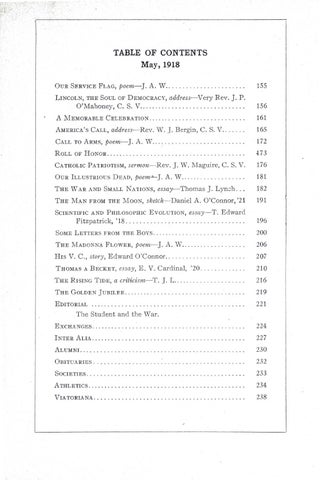
TABLE OF CONTENTS May, 1918 OuR SERVICE FLAG, poem-]. A. W. ... . . . . . . . . . . . . . . . . . . .
155
LINCOLN, THE SoUL OF DEMOCRACY, address-Very Rev.]. P. O'Mahoney, C. S. V. . . . . . . . . . . . . . . . . . . . . . . . . . . . . . .
156
A MEMORABLE CELEBRATION.. ...... . ... . ... ............
161
AMERICA's CALL, address-Rev. W.
J.
Bergin, C. S . V. . . . . . .
165
CALL TO ARMs, poem-]. A. W ... ~ . . . . . . . . . . . . . . . . . . . . . . .
172
RoLL OF HoNOR . . . . . . . . . . . . . . . . . . . . . . . . . . . . . . . . . . . . . . . .
~ 73
CATHOLIC PATRIOTISM, sermon-Rev.]. W . Maguire, C . S. V.
176
OuR ILLUSTRIOUS DEAD, poem..r.._]. A. W . . ... .. . . . . . . . . . . . .
181
J.
Lyn ~h .
..
182
THE MAN FROM THE MooN, sketch - Daniel A. O'Connor, '21
191
SCIENTIFIC AND PHILOSOPHIC EVOLUTION, essay-T. Edward Fitzpatrick, '18 . . . . . . . . . . . . . . . . . . . . . . . . . . . . . . . . . .
196
SOME LETTERS FROM THE BOYS.. . .. .. ... . ................
200
THE MADONNA FLOWER, poem- ]. A. W ........ . . . . . . . . . . .
206
His V . C., story, Edward O'Connor. .... . . . .... .. ..... , . . .
207
THOMAS A BECKET, essay, E. V . Cardinal, '20 ......... . ...
210
THE WAR AND SMALL NAT IONS, essay- Thomas
THE RISING TIDE, a criticism-T.
J.
L ....... . . . . . . . . . . . . . .
216
THE GoLDEN juBILEE ................. .. .......... 路. . . . . .
219
EDITORIAL . . . . . . . . . . . . . . . . . . . . . . . . . . . . . . . . . . . . . . . . . . . .
221
The Student a nd the War.
\
EXCHANGES .. . ..... ... .. : . . . . . . . . . . . . . . . . . . . . . . . . . . . . . .
224
INTER ALIA ...... . . . . . . . . . . . . . . . . . . . . . . . . . . . . . . . . . . . . . .
227
ALUMNI .. .. ........ . .... .. .................... . ...... .
230
OBITUARIES ........ 路........... : . . . . . . . . . . . . . . . . . . . . . . .
232
SociETIES. . . . . . . . . . . . . . . . . . . . . . . . . . . . . . . . . . . . . . . . . . . . .
233
ATHLETICS ... .. . ... .. . .. ..... ..... .....................
234
VIATORIANA ............... . . ..........................
238
II
ADVERTISEMENTS
DISTILLED WATER ICE 路 THE FAMILY ICE
ABSOLUTELY PURE
F. D. -Radeke .Brewing Company Both Telephones 132
KANKAKEE
ERZINGER BROS. Fancy Groceries Fresh Fruit, Confectionery and Bakery Goods of all kinds a Specialty.
226-232 Court Street
KANKAKEE
I
'' '
路~
ADVERTISEMENTS
III
WE EARNESTLY REQUEST OUR READERS TO CONSIDER : OUR LIST OF ADVERTISEMENTS : : TRY A
STUDENTS!
CINCO CIGAR
The best of service will be given you at the
. F. 0. Savoie Company
COLLEGE STORE
KANKAKEE
DROPIN Telephones : Private Exchange all Depts. Superior-7970, 7971 , 7972, 7973 , 7974 Automatic-32, 332
COFFEE ROASTERS IMPORTERS MANUFACTURERS
B. A. RAILTON CO. WHOLESALE GROCERS CHICAGO , ILLINOIS
373-405 West Erie Street -
FOR TRUE PHOTOS
GELINO BROS.
TRY
THE BIG STORE
·p oWELL'S 128 Dearborn Ave.
Comer Schuyler Ave. and Court
Kankakee ·
Kankakee, Illinois
ROYAL CLEANERS
G• A• FORTIN ' AUTOMOBILE D istributor
We are prepared with our modern fireproof plant for all cleaning and pressing.
151 East Station Street
D . D . NICHOLSON Students' Trade Solicited Bel1 343
COURT ST.
All Standa rd Cars:- Buick - H ud son - Ma x well-Studebak er-D etroit Electric.
AUTO LIVERY AND TAXIS Ind. 7
· Telephones 40
ADVERTISEMENTS
IV
D.
J. O'LOUGHLIN, M. D. PRACTICE LIMITED TO
EYE, EAR, NOSE AND THROAT Independent Telephone 704 Kankakee, Illinois
191 Court Street Interior Trim and Cabinet Work
Plate and Window Glass, Mirrors
Paulissen Mfg. Co. 463-499 S. Washington Ave. ILLINOIS
KANKAKEE,
- OUR MOTTO-
"QUALITY FIRST" In all Our Lines of Goods
J.
LECOUR & SONS Kankakee, Illinois
F. E . LEGRIS, Pres.
T . A. LEGRIS, Cashier
LEGRIS BROTHERS' BANK 4 % Paid on Time Deposits 159 S. Schuyler Kankakee
CHAS. WERTZ CO. Lumber, Cement, Brick, Lime, Sand, Sewer Pipe, Hardware, Plaster, Glass, Coal
BRADLEY
Independent Telephone 472 We Do Repairing
F. A. LOTTINVILLE SHOE DEALER All New Ideas in Fashionable Footwear
162 Court Street
Kankakee, Illinois
RIELY & RICHERT Electrical Contractors Agents for Federal Washing Machines, Little Ben Vacuum Cleaner, Tuec Stationary Cleaner and Fostoria Mazda Lamps Ind. Telephone 923 Bell Telephone 995 370 E. Court St., Kankakee, Illinois
Always drink Pasteurized Milk. Our wagons pass your door every morning before you have breakfast.
Milk---Cream Bulgarious Butter Milk
Kankakee Pure Milk Co. 396 South Schuyler Ave. Both Telephones 45 Drink Pure Milk
\'1<.
r.. :·<t • v
ADVERTISEME N TS
SPEICHER BROCS.
LAMARRE'S
JEWELERS
CONFECTIONERY
Expert Watch and Jewelry Repairing
Ice Cream, Luncheon and Cigars
127-132 Schuyler Avenue
Kankakee, lilinois
Amedee T. Betourne PHARMACIST Headquarters for Kodaks and Supplies Eastman System of Developing and Printing 119 E. Court St.
North Side
Boyd & Proegler
Bourbonnais, Illinois
You'll like the kind of service you get at the
VANDERWATER . CLOTHING CO. as well as the kind of clothes 154 COURT ST.
KANKAKEE
Boys, Drop in and get your
SODAS
JEWELERS
at
247-249 EAST COURT STREET
Le Boeuf & Granger
KANKAKEE, ILLINOIS
183 COURT STREET, KANKAKEE
Mrs. D . H . Kamman
H . Handorf
D. H. Kamman & Co. Manufacturers of
High Life Ginger Ale and Grape and All Kinds ot Soft Drinks ~NKAKEE
ILLINOIS
Telephones : Bell 237 ; Independent 4
C. RUHLE Manufacturer of Lime
Gas, Electricity and Accessories STUDENT LAMPS OUR SPECIALTY
Public Service Company
Kanlrakee Book Store 116 COURT STREET
Wholesale and Retail Cement, Brick, Sewer Pipe, Sand, Etc.
Fine Stationery, Popular Copyright Alger and Henty Books, Post Cards and Albums, Pennants and Pillow Covers, Sporting Goods.
Office and Warehouse 503 West Avenue KANKAKEE, ILLINOIS
THE GIFT SHOP
I
ADVERTISEMENTS
VI
,r
JOHN J. DRURY PLUMBING Steam and Hot Water Heating, Gas Stoves and Ranges, Coal Ranges, Hard and Soft Coal Heaters 276 Schuyler Avenue, KANKAKEE, ILLINOIS
Both Telephones 72
THE SCHUYLER McBROO'M BROS.
American State and Savings Bank
Proprietors
154 Schuyler Ave.
184 Court Street
Kankakee, Illinois
First Class Restaurant and Cafe
KANKAKEE, ILLINOIS
GEORGE ARSENEAU
D. M. Norris & Son Dealers in'
BAKERY BOURBONNAIS, ILLINOIS Specialties: Pies and Cakes
Stoves, Ranges, Hardware and Paints. Galvanized and Tin Work Telephone Main 30 Cor. of Court and Schuyler
JOSEPH TURK MFG. COMPANY BRADLEY, ILLINOIS MAKERS OF
Columbia Iron and Brass Bedsteads Special attention to Furnishing Institution BEDS
Prices and Illustrations on Application
•
f;
ADVERTISEMENTS
/ WUNDERLICH'S
VII
Just "HELLO!" From
STYLE SHOP
A Store For Young Men The Home of Styleplus Clothes $17
BARRON'S CONFECTIONERY Schuyler Avenue
Kankakee
Everybody Likes ANDERSON'S CREAMERY
JERSEY ICE CREAM 282 N. Schuyler Ave.
Kankakee, Illinois
THE LAFAYETTE
Boston Shoe Repairing Co路
HOTEL CAFE
All Work Guaranteed. Shoes Repaired While You Wait. Best Work Neatly Done.
Kankakee's Best Restaurant R. H. BOBBITT, Proprietor EEP YOUR LOTHES LEAN BY REVIER
JOE SHAPIRO, Prop. Telephone Bell 1386-2 225 Schuyler Ave., Kankakee, lilinois
PLUMES DYED AND CLEANED
K
BELL TELEPHONE IND. TELEPHONE A124
ARTHUR CREVIER DRY CLEANING, Tailoring, Pressing and Remodeling An old St. Viator boy solicits your patronage.
206 E . Station Street
A.
J.
Kankakee, Illinois
BYRON
Groceries, Ice Cream, Cigars and Confectionery
LUNCH ROOM Bourbonnais
Illinois
LET THEM LOOK YOU UP AND DOWN You can stand it-in fact you can invite scrutiny when you wear the clothes that we recommend for you Young Men
] . G. KNECHT CO. "KANKAKEE'S GREATEST CLOTHIERS' '
路'' -~ J."
VIII
ADVERTISEMENTS
At 10 o'clock Today Stop and Ask Your-
MAJESTIC, the C~ean, Clinkerless
self if You Have Started Your Banking Account A bank account protects your money, promotes good business habits, gives you firmer financial standing and credit, conducts your affairs in an orderly way , gives you comfort and convenience and is one of the foundation stones for business success. LET US HELP YOU.
COAL Mined and Sold by the
CITY NATIONAL BANK
CRERAR CLINCH CO.
" Only National B3;nk in Kankakee" Kankakee County Trust and Savings Bank We pay 4 % on time deposits
The Rookery CHICAGO The Best is the Cheapest
The HAT HOSPITAL
Compliments of the
LISTEN St. Viator Boys: We will make your old hats 路look like new.
First Trust and Savings Bank
HAT HOSPITAL So. Schuyler Ave.
Kankakee, Ill.
Kankakee
W. S. Quinby Coffee Co. Importers-Roasters- ] ob b ers
HIGH GRADE COFFEES AND TEAS BOSTON
CHICAGO
Samples sent free on request- Correspondence respectfully solicited. .
42 East Kinzie St., CHICAGO, ILLINOIS ..
NOTRE DAME ACADEMY A Select Boarding School for Girls and Young Ladies This institution is conducted by the Sisters of Notre Dame, and offers every opportunity to young ladies for a thorough christian and secular education. Prices reasonable . For catalogue address
SISTER SUPERIOR,
Notre Dame Academy, Bourbonnais, Ill.
v IATORIAN I
+.-ew-!1.-ee-•.-..-.•-••-a•-••-•a-••-••-t~a-ttl-t~U-nl-••-•,_.•-••-••-en-lw-tl+
. T I HE I
i
hiu;;3~-:~;: 7~:~--·--Nt;mb~~_a-i' ~
+1-tl:t-tlt
••-••-•t-ea-~~.s-.a-a!l-11~11-tli-111-lu-al-tta-ea-tla-tll.-:r-••-t~n-.a-e+
OUR SERVICE FLAG. Hail flag of rainb:::>w dyes, Flag of our sacrifice, We sing of thee. Triumphant may you wave Honoring our forces brave, Honoring the sons we gave . For Liberty. Thy field of crimson-red, The blood our brothers shed, T:::> make men free . Thy snowy field of white, Shaws forth our spirit bright, Pure, noble, just and right, Sweet Liberty. Each star of azure blue, Means more t() me and you Than words can tell. Each means a hero grand Of our victorious band, Their praise through all the land Let music swell.
-J.
A. W.
'1.-,.
THE VIATORIAN
156 +.-au-••
II
••-._,.,_.,._.._.._,._.._IN-r..-.11
II
••-•a-••-••
..,....,...,_._.,.._.....-.+
l__:mco::r,~T~ SO~O~R.~~:~l
No man can lay claim to the true titles of real worth unless he has dedicated his life to a noble cause. It matters little whether that dedication finds expression in the shedding of one's blood to obtain the martyr's crown or in the pouring out of one's life drop by drop in the slow, steady, monotonous toil of a life-long -consecration to duty. Confessor and martyr are alike entitled to our admiration, the one because he has lived for a noble cause, the other because he has died for it, both because they have espoused nobility. What t he sun is in the physical world, an ideal is in the moral. When darkness broods over the deep the offspring is uncertainty, disorder, chaos, but when the sun shines out upon the world all is clothed in loveliness and beauty. So likewise in the moral order, life without a purpose is not life, it is death, nay it is worse than death-it is darkness where all is horror and despair. But place an ideal in the firmament of life and all shines bright once more . The clouds however dark and lowering are ever gilded; the mist so dismal is transformed into a thing of heauty as the rainbow of hope lifts its arch into heaven. There is no station in life so lowly as to be beyond the ennobling power of an idea; there is no position so exalted as to transcend its glory . The mountain peaks r ear their heads in majesty only when they are kissed by the ethereal rays of the God of light ; the valleys teem with abundance and beauty only when the gates of heaven are opened and the Prince of glory descends upon them. So likewise with human life ic is not ot the earth, earthly, but of heaven, heavenly, wh en it shines r esplendant in the golden glow of a noble ideal. F or this reason the circumstances of life in themselves have but little worth . They are but the casement in which life is set. That jewel has but little value which derives its lustre from the setting; while poor indeed must b e the setting which is not enhanced by the brilliancy of the diamond. . "Honor and shame from no conditions rise Act well your part, there all the honor lies Fortune in men has some small di.fferenc_e made One flaunts in rags, one flutters in brocade; Worth makes the man and ivant of it the fellow!" Either consciously or unconsciously we are giving expression to this idea today in commemorating a life so great that it could not be obscured beneath the overalls of a pioneer backwoodsman, nor outshone in t he galaxy of the world h eroes where true worth has placed Lincoln. We commemorate him today half a century after his death; others, more numerous millions will gaze upon him a century from *Address delivered by Very Rev. J ohn P. O'Mahoney, C.S.V., F ebruary 12.
THE VIATORIAN
157
that date and thus down the ages generation after generation will rise up to call him blessed because he remains a fixed star in the firmament o拢 time, the star of democracy, the hope of mankind. It was by the consecration of his life to a noble ideal that his memory is enshrined forever in the hearts of mankind. His life work sheds luster upon circumstances that would be mean and ignoble were they not transformed by the reflection of true nobility. Like the stable where the Saviour was born the brightness of H eaven shone round about that wretched log cabin in the wilderness of K entucky where one hundred and nine years ago he was born. That humble abode was more than palace, for a greater than king dwelt within. His first outlook upon life was from the vantage ground of a Christian home-a home dominated by the sublime principles of the Gospel of Jesus Christ. There from a kind-hearted , generous, honest fat her and a saintly mother he received that r eligious training which was the foundation of all his greatness. His own testimony bears out t his assertion when he said: " All that I am or hope to be I owe to my angel-mother : blessings on h er memory." Cradled in poverty, reared in hunger, nakedness and privation, h e presents to us a figure which is the admiration of a"ngels and men, the most sublime spectacle in the eyes of God, a just man struggling against adversity. This struggle b egun in m ere childhood in K entucky, continued t hrough youth to manhood in Indiana, was n ever relinquished during the years of maturity in Illinois, so that as farmer with poor harvest for his sweat , as laborer with a mere pittance for his toil, as boatman on the Mississippi with but scant r eturn for his industry, as student drudge with law, groceries and surveying to djstract his thoughts , as lawyer whose hon esty brought him unpopular. causes, as congressman whose efforts won him no financial gain; h e wrestled on until with the strength of a moral giant h e issued forth from t h e sch ool of adversity to meet and vanquish an adversary t ha t was ent r en ched upon the custom s and traditions of his country since its birth. Before his onslaught the forces of slavery in t he North retreated and as he made the hills and valleys of his native land resound with the clarion call of justice and htimani ty, the spirit of America, awakened, took form in the mjllions of her sons who went forth to right the wrong which for well nigh a century stored up against us as a nation in the court of eterna l justice not the blood but the strangled souls of millions of our fellowmen. With the strength of the strong man, the man made like the gods by his stru ggle against adversity, Lincoln, the embodiment of the sovereignty of the sovereign citizens of free America, cleansed from D emocracy the last spot of defilement and presented it to the world withou t a stain, without r---proach. His blood washed our national sin away; his blood, the price of redemption to a conquered race, his blood, the pledge of salvation to countless millions yet unborn. 路 Lincoln is truly great, if not among world heroes the greatest of
158
THE VIA TORIAN
the great., because his li{e is the perfect embodiment of true democracy, That idea, for the externalization of which the poets, the dreamers, the best of mankind in every age and clim.~ lived and died, has found in him its perfect expression. H e is the spokesman not of a nation, not of a generation, but of humanity. In strife, in tumult, in labor, humanity groaned in travail for centuries until the offspring of its loins was brought forth perfect in every feature, sound in every 11mb, ' strong ir brain and muscL~, destined by nature's God to rule the free will of man. Lincoln crystallized for all time th e true concept o拢 democracy when he gave utterance to that sacrament of thought which baptized this -offspring as a "government of the people, by the p~ople and for the people.'' Upon the head of chis same youth now grown to sturdy manhood, be pour路~ d the strengthening oil of confirmation when h e declared that no man is so great, so powerful, so holy as to have the right to govern any other person without that person's consent. Here we have the complete acc . . . ptance of that law in accordance with which the Creator moulded the human heart. Lincoln looked into that heart and saw that it reflected its maker's image. And in the light of that image h e saw man not as a creature of circumstances bound by the iron law of necessity but like the breath oCthat omnipotence which gave him existence, free, like unto the living God Himself, free with tbe freedom with which God had made him free, so that he could bring the sacrifice of homage and adoration in acknowledgment of the gifts which were to him being, life, light, everythin g. In the light of reason and revelation, Lincoln saw man in the divine effulgence crowned with honor and glory little less than the angels, t h e temple in which the very image of God wa3 en2hrlned, for God made 1nan to his own image and likeness when he gave to him: an imperishable, an immortal _,oul. Was jt any wonder then that in this vision the mere circumstances of time, place, peace, color and all previou::;, present and future conditions vanished, and this man with eyes that pierced the shadow saw beyond the "fleeting show for man's illusion given" the realities which constitute the "morning dream of life's eternal day"? Was it any wonder then that as he gazed upon the Eternal Father peopling the world with the human race as his children h e determined that there should be for him no di stinction of bond or free, Jew or Gentile, Greek or Barbarian, but that all should be united in the bonds of unjversal brotherhood under the common fatherhood of God, our Father who is in Heaven? Linc:: > ln' .:: democracy is the perfect realizatioi1 o拢 the Christian teaching that "th ere is no power but from God." With the simpli city of true greatness he acknowledges his dependence upon tbe Almighty. In his farewell to his Springfield friends when P.e left to assume the hj ghest honor and the heaviest burden which tbi~ nation ever gave, he uttered in the following words a belief in the efficacy 路 of prayer which should inspire the heart of every ruler: "A duty devolves upon me which is perhaps greater than that
THE VIATORIAN
159
which ba;:; devolved upon any other man since thedays ofWa.:>hington. He never would have succeeded except for the aid of Divine Provid.ence, upvn which he at all times relied. I feel that I cannot succeed without the same divine aid which sustained him. In the same Almighty 'Being I place my reliance for support, and I hope tbat my friends will :tll pray that I may receive that divine assistance, without whkh I cannot succeed, but with which succes:s is certain." The GJod Samaritan of humanity, be snatched :its bleeding, lacerated body from the highwaymen of the centuries, pcured upon its wounds the oH of brotherhood, brought it back to its true inn, America, and there enthrusted it once more to the care of a people preordained by the God of nations to be the shrine of liberty, the land of the brave and the borne of the free. He admonished that pecple of tbe sacred character of the trust committed to them in the memorable words: "'A house divided against itself cannot stand! I believe that this government cannot endure permanently half-slave and half-free. I do not expect the Union to be dissolved, I do not expect the bouse to fall; . but I do expect that it will cease to be divided. It will become all one thing, or all another. Either the opponents of slavery will arrest the further spread of it, and place it where the public mind shall rest in the belief that it is :in the course of ultimate extinction, or its advocate.:> wi,ll pufh it forward till it 2hall become alike lawful in all the States, old as well as new, North as well as South." Tbe issue thEn for the American people was either slavery or freedmn. Under the prophetic guidance of this man of God they elected freedom and paid for,it in blood and treasure, a price beyond the power of calculation. -In the price they paid they establish,ed their true worth, for they prized life 2bcve death, freedom beyond Jlavery. The guid1ng star of Lincoln, true d emocracy, should ever illumine the path cf every true A1nerican in his dealings with hi.; fellow citizen, and in ]nternational relations. In the national question ; which arise no true American will seek another star. The weal or woe of our great nation depends upon whether or not we establish class or creed, race or color within its borders. "Eternal vigilance is the price of liberty" and consequently we, like Lincoln, must be pr epared to sacrifice everything rather that that a" Government of the people, by the people and for the people should perish from the land." Like him "witb malice towards none, and with charity for all" we must heed as appropriate to our own times the warning which was no more necessary in his time than it is in ours. In his days he found it necessary to say: 路 "Our progress in degeneracy appears to me to be pretty rapid. As a nation, we began by declaring that' all men werecreatedequal.' We now practically read it, all men are created equal except negroes. I a.m not a Know-Nothing; that's certain. How could I be? How car;. any one, who abhors tbe oppression of the negroes, be in favor of
160
THE VIATORIAN
degrading classes of white people? When the Know-Nothings get control, it will read, ' All men are 路 created equal, except negroes aqd foreigners and Catholics.' When it comes to that," continues Lincoln, "I should prefer emigrating to some country where they make no pretense of loving liberty,-to Russia , for instance where despotism can be taken p ure, without th e ba::e alloy of hypocri sy." If every American is as .;incere in his advocacy of democracy as Lincoln, we need have n o fear of race hatred and religious prejudice, and even thou gh these twin spawn of hell are well ni gh imp.ossible of extermination, yet the mi nority who would brood them will be so dedmated by the patriotis路m of t he chHdren of Ljncoln that th ey will not dare to crawl out. of their dimy, serpentine abodes of darkness into the light of public opinion. Folbwing th e guidance of the true star of democracy jn our relation::; with our fellow citizens there shall be no enemies from within to threaten the existence of our ideal. Today in the darkn ess of stygian night in which the earth is plunged, in the awful storm which the furjes of hell ha ve let loose upon the world, Lincoln, the same star of hope which guided our fathers in their long dark night of fratracidal strife, shines out upon the troubled waters to guide not the ship of state, but the ark of humanity. Thank God, the watchman upon the world 's tower has espied that star, and with a determination wruch is equal even to that of Lincoln he has decreed that A路merica sha ll face the conflict until the world is made safe for democracy. He too ha3 sound ed the clarion note of alarm and awakened America to t he realjzation that the hopes of humanity are in the balance. "Ame rica," he calls," humanity with all its fears, with all its hopes of future year.;, is hangin g breathless on thy fate." Through him the mighty Lincoln sends forth to the world the warning that a house divided against itself cannot stand , that the world cannot exist half democratic and half despotic, that we have to crush the power of the tyrant or the tyrant will crush us. I s t he price which our fathers paid for freedom too great a price for us ? Then we are the degenerate sons of worthy sires. Perish the t hought. How can we doubt for a moment the loyalty of our great nation to t he ideals of liberty? Despotism at this moment has embattled her forces before the very throne of high heavens, she has loosed the very gates of hell, and beneath the tread of her mighty legions th~ world quakes. Earth, sky, sea is the battlefield whereon freedom must take issue with that dragon that would 路 enthrone upon th e ruins of liber ty. The power of might may arrogantly thunder at the gates of right, but behind those gates there is t h e God of right who has withstood immovable the shock of centuries .. The outposts of humani ty had been taken and hope seem ed about to bid the world farewell when the spirit of Lincoln, calm and self-possessed, became once more incarnate in him who guides the destiny of America and "with malice towards none and with charity to all" h e and we, one hundred mi1lion loyal Americans, are at the service of the God of right unti 1democracy shall possess its h eritage, the earth.
THE VIATORIAN
161
There have been and there will be recorded in the history of St. Viator few days more magnificently memorable than February 22 , 1918. St. Viator has always observed with great solemnity the birthday of our own immortal Washington, but she excelled all precedent in her celebration of his natal day this year. lnstead of the usual festivities that mark the commemoration of this day St. Viator thought she could not honor him" Who was first 路in war, first in peace and first in the hearts of his countrymen" more fittingly than by doing honor to her own valiant sons who had gone forth to brave the cannon's fire in defense of the democracy he himself brought forth and nourished by noble sacrifice. Washington recognized the full content of liberty and with the zeal and devobon of a true patriot he suffered much to enshrine it forever in a land that should ever keep it bright in the hearts of jts citizens. The spirit of Washington has manifested itself in Viator's sons who have broken the ties that bound them to follow in the footsteps of their great ideal, ready to suffer as he did that the liberty he and his comrades conceived and brought forth should not perish from this earth. Is it any wonder theri that on the birthday of him whose pathway they have chosen Viator should do honor to her young heroes? At 9 :15 a. m . assembly was sounded and the entire student body in military uniform formed ranks in the gymnasium. In several places the lines were broken where vacancies had been made by those who had left the little army to commence the 11fe of the soldier in reality. The lines of the smaller students alone remained intact. Thence they marched to the flagstaff that surmounts the mound in the middle of the campus. The command SALUTE was given and while the band played the "Star Spangled Banner" the flag was slowly raised. The battalion headed by a guard of honor that bore a large service flag containing 210 stars marched to the chapel where Solemn High Mass was celebrated for the boys in the service. Ve_ry Rev. E . L . Rivard, C.S.V. was t he celebrant, assisted by Rev. F. E . Munsch, C.S.V. as deacon and Rev. J. P. O'Mahoney, of Louisville, Kentucky, .as subdeacon. Rev. ]. W. Maguire, C.S.V., preached a sermon on ~,Catholic Patriotism.'' Father Maguire in an inspiring word picture showed how religion and patriotism, the cross and the flag, have always gone hand in hand in the trials of our country from the time Columbus unfurled his banner and planted the cross on the shores of San Salvador up to the present when priest and nun are givjng themselves with the countless members of the chi ldren of the church to the defense of the nation's cause. Immediately after mass Very Rev. J. P. O'Mahoney, C .S.V., blessed the service flag .
162
THE VIATORIAN
At three o'clock in the afternoon the college auditorium was filled with spectators. The servke flag borne by the guard of honor was brought into the hall and draped at the rear of the stage. The first number of the afternoon program was "The Star Spangled Banner'~ sung by the audience, after which Mr. Thomas E. Shea, the president of the Senior Class, in the following words presented the flag to the college: "There is no deed nobler, grander or more exalted than a service done for humanity. We can look back through the vista of yesterdays and under every action that has won the admiration of man we can see enscrolled pro humanitate, for humanity. To day we have assembled to write that same inscription beneath another noble deed. "Since last April, when President Wilson threw down t,h e gauntlet to Germany, the air at St. Viator has been full of farewells. During each month of the school year we have assembled once, twice and even three times to say farewell to those who were leaving behind the comparatively carefree life of a student to take up the stem business of war. At almost regular intervals the doors of our institution swung open and a group of youthful h eroes went forth, each time leaving behind a smaller assemblage of wistful faces to smile 'Good-bye! Good luck! and God speed!' "These young men in closing their books were closing out from their view the realization of years of dreaming. Some in leaving the classroom were turning their backs upon that whkh within a few months would be the reward of years of tireless toil. Yes and even some were giving up that which after years of a student's drudgery they had just begun to enjoy. But a stronger voice than that of self happiness called out to them. They heard the demoniacal exultation s of the fiend as he spread terror amongst the peoples of the earth. They heard the cries for succor of the millions of jnnocent that had fallen victims of his outrages. They listened and their country, the defender of the oppressed, summoned and in that summons they heard the cry of humanity and in that cry they recognized the voice of God, and in the powerfully eloquent words of General Pershing when he visited the tomb of Lafayette they nobly answered 'We are here.' ''To heed that call meant courage, meant renunciation, meant sacrifice, meant, perhaps, for some even death. But.country called~ humanity called and with the strength that God fearing teachers nourished 210 answered the summons. Today we honor them and rightly so for theirs is a noble deed. They are serving the nation and in serving the nation they serve humanity and in serving humanity they serve God. Today we dedicate a Service Flag. Every blue star on its white field represents a loyal son of Viator now serving our country; the crimson, one who had shed his blood; the gold, two who have already made the supreme sacrifice for justice sake. To you, Reverend Father, we present this flag_; it represents Viator's gift to humanity."
THE VIATORIAN
163
Very Rev. John P. O'Mahoney, C.S.V. then accepted the flag from the student body. Father O'Mahoney said: 路 "I accept with gratitude from you the student body this symbol of your appreciation of the devotion, loyalty and heroism of the young manhood Df St. Viator College now dedicated to the service of our country. This flag shall crystallize for all tjme the pu,rpose for which St. Viator College was established in the fertile prairies of Illinois. For God and country were its foundations laid, for God and country was its superstructure reared, for God and country are its , traditions and ideals perpetuated. Religion and patriotism one and inseparable is our motto. 路 "The circumstances which have begotten this day's celebration prove beyond the shadow of a doubt that our motto is not an empty slogan but a vital principle. Here at this font of true education. for half a century American youths have imbibed the spirit of Lincoln and Washington. Is it any wonder then that by the hundred they respond to the clarion call of justice and humanity whjch reverberates throughout the land? Home wjth its hearth fires has no ties too strong to hold them; friendship with its gripping hold of the human heart cannot stay them; business with its manifold cares cannot distract them from their supreme duty for they have learned that it is sweet to~ dje for one's country. ''The two hundred and ten stars in our flag typify two hundred and ten sons of St. Viator who are the pledge that every son that Viator has is America's son to live for h er in peace and if need be with God's help to die for her in war. The stars in blue bespeak the loyalty of our men in service, the star in red is but emblematic that every star in blue when the test shall come will blossom crimsbn with a patriot's blood; the stars in gold shining with the mellow sheen of the glory of martyrdom, but reflect exteriorly the golden light whjch every Vjator star will shed when it rises over the hill of sacrifice. "Take then this flag of service and place it in a hallowed shrine where it shall speak in the burning eloquence of deeds and liyes to future generations of student s of that love greater than which no man hath that a man lay down his life for his friends ." After a few vocal selections rendered by the highest talent of Kankakee, Rev. William J . Bergin, C.S .V . delivered the address of the day. Were there nothing else to make memorable at St. Viator the 22nd of February, 1918, Father Bergin's address alone would be sufficient to write it in bold heavy letters in Viator's history. Father Bergin's ability 路 s an orator has made him fatnous throughout the Middle West and has done much to place the name of Viator on the lips of thousands. On such an occasion then, it was not unexpected when he delivered an oration the equal of which has never been heard at the college. From time to time throughout the address thunderou.:; applause told the keen appreciation of the large audience. As he turned to leave the stage after he had fini shed, an applause prolonged
164
THE VIATORIAN
. for almost five minutes fairly shook the auditorium. The address is one of the great landmarks in the oratorical world at St. Viator. When the history of St. Viator is written its period of existence during the Great War will be an era of no small importan.ce and from the Washington's day celebration the historian can well judge the .spirit that animated Viator in those trying days.
-s.
'!) I
~
>'I
t., , ....
·~'"'
D
i
~~
"t "'" ,
. ·,~
~
.
«-or
r... -
'l'HE VIA TO RIA
16'"
. ...
+· .. . Throughout the length and breadth of the United States thousands of service flags are telling the story of the devotion, the loyalty, the patriotism of America's young manhood. They are rightly symbolized by stars on a field of spotless white, for every man of them is a shining star in 'the firmament of Am~rica's glorious consecration. Hence today, with joy and pride, with reverence and admiration St. Viator unfurls her service flag, for 210 heroic sons of hers are shin1ng stars in the firmament of America's stainless honor. The t.ramp of marching feet is heard throughout the land. In the midst of populous cities and across the vast expanse of silent prairies the sharp word of command is borne upon the ear. America has become a vast camp and the flower of her manhood has put on the fearful habiliments of war. They come in their teeming thousands from every condition and walk of life. With fruition of life's hopes still untasted, with life's bounding ambitions still unrealized, with the ~hining goal of distinguished achievement still unatta1ned, the young lawyer and physician have b1d farewell to their peaceful vocations and have buckled on the sword of deadly conflict. The clarion voice of war has resounded through the halls of learning and filled the students' souls with the spirit of battle. The campus and the lecture hall shall know their manly forms no more. The spider is weav1ng his net . across their unused books; they have abandoned their eager quest of knowledge; they have forsaken those stirring athletjc contests which thrill the ·heart of youth. On the altar of their country's service they have offered the strength of their young manhood; at the sacred shrine of patriotism they have sacrificed the vistaed hopes of the futu.ce years, the glorious dreams of immortality which only the magic fancy of youth cp.n weave. They have felt the trembling hands of a father resting upon their young heads in parting benediction; the hot tears of a loving mother have fallen upon their upturned faces as she kissed them good-bye; they have said farewell to younger sisters and brothers and marched away to join those other thousands who are ready to pay the full measure of a patriot's devotion. The call to arms is heard above the din and roar of vast machinery and the brawny sons of toil reply, "We come, father Woodrow, five million strong." Those mighty shoulders which have borne the burden of a nation's toil shall know their tasks no more. Those powerful hands which wrought with cunning sk111 for the nation's sustenance have ]aid aside their peaceful tools and replaced them by the rifle and the knapsack. Those sinewy arms which felled the forests and wrought the wood and forged the steel and bent all nature to their *Address delivered by Rev. W.
J.
Bergin,
C.s.v:,
February 22.
166
THE VIATORIAN
conquering will are pledged to the last ounce of their strength and energy to wrest the diadem of liberty from ! autocratic hands. Those strong-hearted men with nerves of steel and frames of iron who stood with glowing faces before the mouth of seething furnaces; those intrepid spirits who tunneled the bowels of the earth · and beat the granite rock to powder, have laid their strong, young manhood, their tireless energy, their dauntless courage, their de~th- · less devotion on the altar of their country's service. In honoring · t hem, we honor our own manhood and womanhood; in honoring .them we proclaim to the wo:dd that the heart of America is still alive to the touch of nobler things. In honoring them we renew our faith in the great ideals of justice and liberty for all men which are the guiding stars of America's destiny; in honoring them we consecrate ourselves anew to the high purpose of giving all mankind a new birth of freedom. Here , my friends, is the stirring spectacle which meets the eye on every side. But the story of America's young manhood is not half told. In obedience to their country's call, in response to the cry of oppressed and downtrodden humanity throughout the world, in obedience to the voice of right and justice which is the authentic voice of the eternal God, other teeming thousands are ranging themselves in battle array. The men who live closest to the great heart of nature; who watch with loving eyes her ever changing moods; who follow with obedient feet the cycle of the seasons; whose eyes have seen a· thousand times the miracle and the mystery of unfolding life; whose patient industry and calm courage of enduring labor have won from bountiful nature the means of life for all the children of men; who . know the soft caress of gentle spring and the fervent kiss of glowing summer; whose hearts are attuned to the gorgeous splendor of rich autumn and the boisterous greeting of rough bu't kindly winter; all these have left the scenes of beauty, of peace and of plenty; they have renounced t heir kinship amongst toilers; they too are consecrating their strength , their p·a tience, their courage, their clear minds and fearless hearts to the great cause America has espoused. And let us not forget that. consecrated army of radiant angels, whose soft hands will cool the fevered brow; whose deft fingers staunc]l the ebbing stream of life and bind the wounds of aching limbs; whose loving care and gentle ministrations rekindle the llght of intelligence in darkened minds; whose patient courage of heroic service in the lonely hospital holds at bay the grim spectre, thundering at the gates of life; whose sweet faces and cheering words and divine sympathy bring hope and heaven to the dim eyes of dying patriots. The greatest, the noblest, the best and dearest of all of that glorious army of consecrated women-the heroic nurses of America. At their feet, we lay the homage of our adm:iration and reverence, our gratitude and love. They come in their teeming thousands from the majestic Rockies · of Colorado and Montana;· they come from the vine-clad hills and
. \
THE VIATORIAN
167
orange groves of California; they come from the primeval forests and sun-kissed valleys of Oregon and Washington; they roll onward like a tjdal wave from the fertile plains and boundless prairies of the middle west; they spring up like sentinels of destiny from the stubborn soil and storm-swept coasts of historic New England; the mighty hosts of battle are mustered from the soH consecrated by the blood and sacrifice and heroism of our revolutionary sires; they come from the land of warmth and sunshine where the palm and the magnolia , and the cotton .blossom grow; they come from the towns and v.illages and hamlets of the land; they come from the populous city where the throbbing heart of commerce and industry is never stilled; they come from the open country where nature displays the magic of her wondrous power. They have left their heartl;l_s and homes and fi1esjdes ; they have taken a final leave of those who ~re dearer to them than the ruddy streams that visit their st.rong, young hearts-father, mother, sister, wife and sweetheart. Many a young father is bending . for the last time over the cradle of his new born infant and the hot tears of a strong man are falling on the tender face of a sleeping babe ; he clasps his young wife to hjs aching heart and for her sake chokes down the strong emotions which shake his, very soul. One last, lingering look with the light of undying love shining in his eyes, and he is gone, perhaps, never to return. Many a mother steals from her bed at night and with no eyes to observe her, save the eyes of the heavenly Father, she weeps and prays for her absent boy. And, now, my friends, what is the meaning of it all? Why does America gather her young manhood about her and gird their lojns for battle? Why is she spending her treasure like water and dedicating her manhood to deadly conflict? Why is she beating her plows into cannon and her steel into engines of war? Why has she put off ""the garb of beautiful peace and clothed her majestjc form in the horrid habiliments of war? Why has the smile fled from her kindly face and a threatening frown darkened her queenly brow? Every American knows the answer.' Our honor was affronted, our manhood challenged; our sovereignty mocked and derided; our patience and longsuffering forbearance were called fear and cowardice, our earnest pleas for the rights of humanity were scorned and despised. A proud and haughty nation, drunk with military power, mad with the lttst . of cortquest, would listen to no reason, would respect no rig'Qts, ti0t ... even her plighted word, would stay her hands from no bruta1ity _s:n~ '. outrage. America aroused herself from the dreams of peace; . she. , stdod erect in the majesty of her might and strength and hurled the .路 gage of battle into the face of lawless autocracy. Why are we at war-? Why is the heart of America fired with in- 路. dignation? Why have we sworn before high heaven that our sw0rd . shall 路 never know its scabbard again until ruthless power arid/ the 路 Christless code of arrogant might have been humbled to the dust ? Listen to the shrieks and cries of helple-ss women and children and -
168
THE VIATORIAN .
innocent babes, as the icy waters of the Atlantic closed .over them, and ask those questions if you can. They had done no wrong"; 路 they had violated no rights; they had jeopardized no interests ; they had given no offence; they were exercising the right guaranteed them by the laws of nations; they had been assured by their own government that no harm would come to them. But without warning, without mercy, without pity, a monster of the deep struck them and s~nt mothers with their babes clasped to their breasts to a watery grave. If America had suffered that outrage in silence, if the manhood and womanhood of America had not felt a thrill of horror clutching their very heart strings; if we had not been ready to spend our treasure and our blood to render the recurrence of the ghastly atrocity forever impossible, we should have deserved the scorn, contempt and contumely of every chivalrous and highmitided nation. Why are we at war? Why is peace loving America an armed camp? Why have the youths of America left their homes and firesides, their kin and dear ones? Why have they gone forth from their schools and colleges, the country house and the marts of trade, the farm and the factory? Why have they turned their splendid energy which ministered so bountifully 路 to the convenience and comfort of life to the stern purpose of war? The answer is written in the streams of crimson blood of the slaught ered manhood and the outraged womanhood of gallant Belgium. It is written in the ruined homes and starving people of that once happy land. It is written in the lifeblood of martyred patriots whose only crime was love of their native land. It is written in the smoking debris of majestic cathedrals and stately universities. It is written in th~ gp,unt, starved faces of naked children. It is written in the cries of orphans and the broken hearts of widows. It is written in the shame and agony of violated virgins. It is written in the clanking chains which bind the limbs of freedom's noblest sons. Belgium was at peace with all the world. By her genius and industry, she maintained in decent comfort the densest population in all the world. Better than any other nation with equal resources, she had solved the vexing problems of poverty and wealth. She was a beautiful center of intellectual, industrial and agricultural life. Men of genius shed luster upon her name and made the whole world their gratef:t卤l debtors. She was strong in the consciousness of her own inherent rectitude and in the guarantee of security and integrity to which all the nations of Europe had pledged their faith and their sacred honor. No word of hers had given offense; no act of h ers had infiicted_an injury; no thought of hers had harbored an evil interest against a living soul. But in the name of lawless power, in the name of triumphant might, in the n~p:ne of i~solent C!-nd brutal autocracy, in the name of the mailed fist and inilitary absolutism, she was asked to abdicate her sovereignty, to play the wanton with her queenly hon'or, to forswear herself 1n the court of eternal justice, to take counsel of servile fear , cowardiGe and treachery . . Belgium's answer will live forever on the pages of
;
THE VIATORIAN
169
history, it is written indelibly in the love and reverence of an admiring world. "Belgium is a nation to whom honor and justice are dearer than life. You may crush us beneath the juggernaut of war; you may rend us limb from limb with your engines of destruction ; you rna y level our cities to the ground and drench our plains in the blood of her children; you may make Belgium a desert and a wilderness over which the silence of death forever reigns, but we swear by the -truth of Eternal God you shall not make us cowards and cravens." If America had looked on unmoved; if she had uttered no word of protest against the brutal aggression; if she had raised no hand to vindicate the claims of outraged justice and humanity; if she had lent no succor to crushed and bleeding Belgium; if she had suffered, unchallenged and unrebuked, triumphant wrong to trample peace beneath its savage feet, and drag sweet mercy by her golden tresses along the pavement of the-路s treet, she would have been false to her high mission; she would have dishonored the memory of Washington and Lincoln; she would have been an apostate and a traitor to her . national faith, she would have prostituted her honor at the feet of greed and cowardice. And what would it have profited her, had she gained the wealth of the world and lost_her national soul. For not in bread alone do nations live, but in truth, in justice, in honor, fidelity and righteousness . America, we honor, love and reverence thee. Our hearts and our hands, our treasures and our blood are at thy sacred service, because thou hast hearkened-to the 路cry of bleedjng innocence. Thy mighty voice has thundered in the ears of tyranny and oppression; thy kindled wrath has filled the heart of autocratic power with terror and dismay; 路 thou hast proclaimed to the world, that peace shall return .to the earth no more, until every foot of Belgium's sacred soil has been restored; until every wrong, inflicted upon that nation of heroic men and women has been righted; until every outrage has been repaired. At the sound of thy majestic voice, justice, right and liberty lift up once more their queenly heads and the light of an exalted hope shjnes in their tear-dimmed eyes because full well they know their redemption is at hand. Why are we at war? Let scourged and crucified Poland be our answer. Answer, ye dead innocents who pressed your parched lips in vain to the dried breasts of your starving mothers. In all Poland, there is not a baby alive. Why are. we at war? Answer, ye dead and unburied children whose cold, white faces are upturned to the midnight stars. In all Poland, there is not a child alive below the age of twelve. Answer, ye old men and venerable matrons whose stark, frozen bodies lie beneath the winter snow. In all Poland, there is scarcely a man or woman alive above the age of sixty. Answer, ye gaunt and haggard spectres who were once the manhood and womanhood of martyred Poland. Courage, ye heroic Poles! The long, dark n1ght of your tears ~nd anguish and slavery is nearing its close.
170
THE VIATORIAN
The first rays of liberty's bright su·n are gilding the horizon. America has sworn and she will not repent. She will raise thee up from the dust; she will strike the chains from thy tortured limbs, and p_ull down thy proud oppressor from his throne. Why are _we at war? Belgium, Poland, France are our reply; and the greatest of these is France. I shall not tell the story in tb.e cold, halting words I may be able to command. Only the flaming words and molten thoughts of an inspired poet can fittingly express the measureless debt of gratitude the world owes to chivalrous, undaunted, heroic France. Give us a name to fill the mind With the shining thoughts that lead mankind, The glory of learning, the joy of art,A name that tells of a splendid part In the long, long toil and the strenuous fight Of the human race to w1n its way From feudal darkness ·to fullest day Of Freedom·, Liberty, love for RightA name like a star, a name of light .. I give you F ranee ! Give us a name to stir the blood With a wanner glow and a swifter fiood,A name like the sound of a trumpet, clear, And silver-sweet,_and iron-strong, That calls three million men to their feet, Ready to march, and steady to meet The foes who threaten that name with wrong,A name that rings like a battle-song. I give you F ranee! Give us a name to move the heart, With the strength that noble griefs impart, A name that speaks of the blood outpoured To save mankind from t.he sway of the sword,A name that calls on the world to share In the burden of sacrificial strife Where the cause at stake is the world's free life, And the rule of the people everywhere,A name like a vow, a name like a prayer. I give you France! • In the presence of that heroic spirit every generous heart should feel the thrill of those noble and exalted sentiments so beautifully expressed by the poet : Uncover the head, kneel down, kneel down, A monarch passes without a crown,
THE VIATORIAN
171
Let the proud tears fall, 'but the heart beats high ; The grea~est of all is passing byThe "spirit of gallant France, On its end!ess march in the en,dless plan ; " Qui Vive ? " "The Spirit of Man." " 0 Spirit of Man, pass on, advance! " And who shall lead? Who hold the van ? Uncover the head, kneel down-kneel down , The Spirit of gallant France. Beyond this, naught that is merely human may ever hope to go. To surpass it, we must turn our eyes t_o the cross of Calvary with it8 dead Christ. The God-man alone has 路m ounted to loftier heights of heroic sacrifice. America has caught the spirit of France and the stars and stripes have kjssed the Fleur de lis. In the name of justice, right, and liberty, arise, ye down-trodden peoples ; shake off your chains, ye fettered nations ; ye are all the brothers of Christ, the sons of the Eternal Father and the heirs of an immortal inheritance-from henceforth your god-given heritage of liberty shall not be wj thheld. You shall b~ free to live your own lives; to work out your own destiny. The flaming sword of America is enlisted in your cause; for the cause of freedom is the cause of God.
172
THE VIATORIAN
r-·-·-·-·. ----·-··-··---~~L ·T~
~~·. .. • .. •• ..
·~
+--·· .• •. .• .._.._.._..._.._......... ·------·-·-·-·-·---~~-··-~··-·--·· •• •+ Arise, Columbia's sons, arise At Freedom's clarion call; Beneath her starry banner bright If need be for her fall;
Upon a distant battle shrine ·'
Your young lives sacrifice, That freedom and her holy cause Triumphant may arise. Arise, ye loyal sons, arise, From Columbia's verdant shore; Make haste to foreign battle field, March boldly on to war; Strike, strike the tyrants awful power, Until each foe expires, · Bid Tyranny forever down, Enkindle Freedom's fires. March on, ye ,noble sons, march on, March on to victory, Beneath our sacred banner fair Enshrine Democracy. Enthrone her on the Balkan Peak$, By Danube's azure waves, By Dardanelles and castled Rhine, Man shall no more be slaves.
J.
A. W.
THE VIATORIAN
I
. .
+a-~.-.a-aa-ea-..-..-..,_.•-•~~-•.a-an-..~11
aa
173
••-••-1~-t~a-••-•,_••-•u~••-u+
ROLL OF HONOR. .
I
+~N-na-~a.-aa-lhl-ua-••-••-•o-aa-••-••--•-••-•----•u-ua-aa-tta-aa-au-e+
Atkins, Walt er. France. Arseneau, R oy. France. Amberg, Harold V., · Sergt., Camp Sheridan, Montgomery, Ala. Ashe, Eu'gene. Berry, Richard G., Camp Grant, Rock· ford, Ill. Burns, James, Major, Camp Logan, Houston, Texas. Burns, Harold _W., 2nd Lieut., Camp Logan, Houston, Tex. Bayer, William, Co. M, 355 Regt.,· Camp Funston, Kansas. Boland, Earl. Burton, Viator. Britton, Charles J., Co. M, 131st U. S. Inf., Camp Logan, Houston, Tex. Burke, Alex W ., Dr. Lieut. Surgeon. Burton, Fred, 28 Aerial Squadron, Field No. 2, Garden City, Long Islan::l, N. Y. Berry, Mathew, Sergt., Houston, Tex. Brown, George, Great Lakes, U. S. N . Brodmann, Rev. E. A., Chaplain, Marine Barracks, Port Royal, S. C . Boos, Joseph, Ambulance Corps, France Carroll, William, Capt. 1st Conn. Inf. , Camp Greene, Charlotte, N. C. *Calkins, Newell, Camp Pike, Ark. Cullen, Dennis T., Quartermaster's Dept., Madison Barracks, N.Y. Conway, Edmund F ., U. S. M. R . F. (Radio), Great Lakes Training station. Concannon, Emmett, U. S. Navy. Corcoran, Melchoir, 323 Field Battalion, Co. C., Camp Funston, Fort Riley, Kansas ~· · Conroy, David. Carberry, Paul T., Sergt., Co. I, 135th Engineers, France. Curtin, Timothy, Camp Grant, Rockford, Ill. . __ Cassidy, John, 82 Fiel1 Artillery, Fort Bliss, Tex. Caron, Menard, Co. F, 129 Inf., Houston, Tex. Carroll, James. Caron, Victor, Rainbow Div., 150th Aero Squadron, France. Clemens, Hillary G. Cleary, Daniel, Camp Grant, R ockford, Ill. *Deceased. · t Killed in action.
Carey, Joseph, Camp Logan, Houston, Tex. Chapman, Bliss, U. S. N ., N ebish, Mich. tCrane, Edward B.~ France. Cleary, · Gerald V., Lieut., Quartermaster's Corps. Collins, Wm., E. S., 314tb Ambulance Corps, Camp Meade, Md. Coupal, Rev., Fred C. M ., K . of C., Chaplain, Camp Kelly, San Antonio, Tex. Edgerton, Roy, Corp. , 125th Aerial Squadron, France. Darche, Rev. Harris A., 1st Lieut. , 6th · Reg. Marines, France. Dougherty, James L. , 1st Lieut., Camp Greene, Charlotte, N. C. Dondanville, A. Lawrence, Medical Dept., Brig. Infirmary 237, Camp Dodge, Iowa. Dinnen, Robert A., Camp Taylor, Louisville, Kentucky. Dandurand, Yvon. Dougherty, Edward P., Quartermaster's Corps, France. Derr, Emil H. , Corp., Co. 332, Machine Gun Battalion, Camp Grant. Dillop, Maurice, Quartermaster Unit, Co. Base Hospital, Camp . McClellan, Ala. Dandurand., Arthur, Corp. Q. M . Corps, Ft. Benja.m in Harrison Indiana. De Clerk, August, Corp., Camp Gr?,nt, Roddord, Ill. Doyle, Armand, Aviation Corps. Davenport, Ralph M ., Reported injured in France. Dowling, Michael T., 1st Sergt., 378 Aero Squadron, American Expeditionary Force, France. Finnegan, Thomas J,, Corp., Battery D., U. S. Field Artillery, France. Flynn, Emmett Vii., Corp., 3 Y Barracks, M. 0. T. C., Fort Riley, Kansas. Fitzgerald, Robert, Cainp Dodge, Des . Moines, Iowa. Ferguson, Duncan, Great Lakes Training Station, Great Lakes, Ill. Fisher, Chas. E.
i~
THE VIATORIAN
174
Fredericks, Chas. Frondell, Gerald, Camp Logan. Gallagher, John, Quartermaster's Dept. Camp Logan, Houston, Tex. Godin, Maurice F., Co. L, I. N . G., Camp Logan, Houston, Tex. Gilbeault, Arthur, 14th Field Artillery, Ft. Sill, Oklahoma. Garrity, Jerry, Camp Grant, Rockford, Ill. Gareau, E. Glenieck1, Robert. Gunderlack, Andre, U. S. Aviation Corps, France. Griffin, Holland, 1332 Street M., M. S. C., Camp Hancock. Ga. Gerard, Rev. Arthur L., Chaplain, Camp Logan, Houston, Tex. Goudreau, Arthur D., Lieut., Co. G., 129th In£., Camp Logan. Gallivan, Thos. J., Aviation, Rantoul, Ill. Galligan, James, Kelly Field, No. 1, Line 337, Sect. F., San Antonio. Haggerty, ~ Clement, 125th Aerial Squadron, France. Houleban, Alfre1, First Wisconsin Cavalry, Waco, Texas. Houlehan, Forrest, First Wis :-:onsin Cavalry, Wa ~o, Texas. Hefferman, Ralph, Q. M. C., Camp Grant, Rockford, Ill. Houde, Edward, Co. L., I. N. G., Camp Logan, Texas. Hughes, F. Healy, John P. Hoare, Myles J., U. S. N., Detroit, Michigan. Hangsterfer, F. C., Yeoman, U . S. N., Great Lakes, Ill. Hayes, Michael, Co. L., 342 In£., Rockford, Ill. Houle, Clarence L., Battery B, 149th Field Artillery, France. Hughes, Joseph R. Harrington, Lloyd, 82nd Artillery, Ft. Bliss, Texas. Houle, Frank E., U.S. S. Connecticut. Hayden, Dr. Daniel B. *Harmon, Joseph, Canadian Volunteers. Hayne, Leslie. Hayne, Verne. Judge, Joseph, Camp Logan, Houston, . Texas. Jacobs, Clarence. Kennedy, Leo F., Engineering Corps, France. Kern, Leo, U . S. N. R . S. (Radio), Great Lakes Training Station. *Deceased.
tWounded .
Kavanaugh, Emmett. Klops, H. Knoezer, Leo. Kilbride, Matt., Co. D ., 410 Telegraph Battery, Camp Morse, Leon Spgs., Tex. K1ssane, Emmet J. Kekich, Emil, Rainbow Division, France. Kramf, Arthur C. Kangly, Rev. Jos. M., Chaplain, U. S. Army. Keikicn, Thos., 149th -U. S. Field Artillery, France. Keily, Gerald, Aviation Corps, France. Kennedy, Nor bert, Camp Grant, Rockford, Ill. Kerwin, R., U. S. N., Radio Service, Great Lakes. Killelea, Roger, U. S. N., Radio Ser' i:ce, Great Lakes. Kelly, John. Kelly, .T osep 1-J. Lonergan, Rev. Jos·e ph M 0 Camp Grant, Ro::kford, Ill. Legris, Justin, France. Lenihan, William T. Lynch, Peter. Lynch, Frank J., U.S. Marines. Labeau, E. Lynch, Raymond, Camp Grant, Rockford, Ill. Laundry, Louis, Co. L., I. N. G. tLyons, James V., France. Moisant, Rev. J. F., c. s. v., Chaplain, Camp Presidio, San Fran::isco, Cal. Marcotte, Ignatius, France. Mentgen, Martin J., Co. F, 108t h Ill. Engineers, Camp Logan, Houston, Tex. Murphy, Edwad, Quartermaster . Dept., Washington, D. C. Mullins, John. Morrissey, Milton, Camp Funston, Kansas. Montrof, Theo1ore G. · McDermot, Joseph. McShane, Edward C., Capt., Kelly Field, U. S. Aviation Sec., Signal Corps, San Antonio. Mortel, Edwin, U. S. Navy, Rifle Range, Peekskill, N. Y. McCarthy, Bernard, Camp Dodge, Des Moines, Iowa. Montroy, Douglas. Maher, Frank, Co. F, 24th Engineers, Camouflage Dept., A. M. University, Washington, D. C. Mahoney, Con., Quartermaster Dept., Fran:ce. : ·
'_\
THE VIATORIAN Mortel, Leonard J., U. S. Navy Rifle Range, Peekskill, N.Y. Mulvihill, John S., Co. B, 349th Inf. , Camp Dodge, Iowa. McGuire, Dr. Wm., Medical Corps. Miller, Ward. McKenna, John, 1st Lieut, Camp Dix, Arkansas. Morgan, Stephen. Monaghan, Rev. Dan. J., U. S. N. , Chaplain, Brooklyn Navy Yard. Merz, Otto. McCarthy, Gordon, Quartermaster Corps, France. McGrath, Arthur. Maroney, Leon, Aviation, France. Marrum, Wm. J ., Co. B, 8th Supply Train, Div. Motor. · McDevitt, Mathew, Battery B, 332 Inf., Rockford, Ill. Nichols, Hilton. O'Donnel, Rev. J. L., 1st Lieut., Chaplain, Second Ill. Regt. , Camp Logan, Houston, T ex. O'Connor, Edward T:, Quartermaster's Dept. , Camp Logan, Houston , Tex. O'Connor, Leo F., Camp Grant, Rockford, Ill. Oakey, John M ., Sen?;t., Quartermaster's D ept., Ft. Riley, Kansas. O'Meara, Sergt. John, Camp J ohnson , J ack sonvilJ e, Fla. O'Connell, James V., 745th Regt ., Casual Co., Motor Mechanics, Camp H ancock, Augusta, Ga. O'Connor, R ev. Louis V., Chaplain, U.S. A. Primeau, Lawrence, Camp Custer, Battle Creek, Michigan. Pemberton, Hubert, France. Peters, John, Co. H, 130 U. S. In£., Camp Logan, Houston, T ex. Ploussard, Edw., Aviation Corps, France. Parker Raymon1, Great Lakes, Ill. Rooney, George, Corp., 2nd. Inf., I. N . G., Camp Logan, Houston, Tex. Rice, Dr. I mu s, 1st Lieut. Ryan, Raymond P., Co. 72nd Batt. 162 Depot Brig., Camp Grant, Rockford. Roy, Raymond, U. S. Navy. Roche, William, U. S.N. R. F. <Radio), Great Lakes Training Station. Richert, Leonard, 325th Aerial Squad, Kelly Field, Tex. Roth, Dr. Jesse.
175
Russell, John Sergt., 349th In£., Camp Dodge. · Stephenson, Rev. W. J., c. s. v. , Chaplain, Camp Wadsworth, Spartanburg, S.C. Somers, Donald J., U. S. Field Artillery, France. Senesas, William, Co. L, I. N. G., Camp Logan; Houston, T ex. Sammon, William. . Shields, Richard , Co. G, 130 Inf., Camp Logan, Houston, Tex. Steinbach, Harry, U . S. N. Storr, Gustave. Sweeney, James. Sullivan, James D , Corpl., Co. C, 8th Field Batt., Signal Corps, 4th Dist., Camp Green. Seybert, Frank; Co. A, 7th In£., American Expeditionary Force, Fran·::e. Shannon, Raymond, 1st Lieut., Camp Grant, Rockford, Ill. Schovin, E . Sweeney, _W . ]. , 53rd Co., U.S. M. C. Haiti. Spaldin,;;, Truman. Sammon, Maurice. Trainor, Emmett, U. S. Marines, France. Tiffany, H erbert C., Cadet Flying Squad, Kelly Field, San Antonio, · Tex. Tompkins, Wm.]. Tetreault, Albert, Camp Logan, Tex. Tolbert, Harold C, Battery C, 332 L. F . A., Camp Grant, Rockford. Von Ruben, Charles, Battery E, 122nd U. S. Field Artillery, Camp Logan. Walsh, William I., Second In£., I. N . G. Camp Logan, Tex. Wilson, Myron]., Range D etachment, Co. L, Harris Island, S. C. Warren, Jerry, Co. D, 344 Inf., Camp Grant, Rockford, Ill. Walsh, William C., Great Lakes Training Station. Walker, Charles, Coast Artillery, Port Royal, S.C. Wheeler, Frank P . Ward, Louis H., Canadian Volunteers. Walsh, Gregory. Warren, J ohn. Ward, Lawren ce T . Wilkinson, Harry Melvin, 170051, Royal Flying Corps, Camp Nenbrook, Fort Worth, Tex. Wright, John E., Rainbow Div, 150th Field Artillery, Fort Wayne.
176
THE VIATORIAN
+---._..-..-..-.a-w.-..-..--.-.., -.._.·-··-·.1-11_..,_..,_.._.._.__.._.__.__.+
I
CATHOLIC PATRIOTISM *
+--l-111-a.-..-.._.,_.._,._.,_.,_.._.._. .. _u•-•.-•-..-.r•
• ••
I
lt-11~~-t~•-n-t+
" Render therefore to Caesar the things that are Caesar's, and to God the things that are God's.-(Matt. 22: 21.) For three and a half sad, dark years the nations of Europe have been engaged in the greatest war of the world's history. For two and a half anxious years we of the western hemisphere peered across the Atlantic and gazed with alternating hope and fear upon this titanic struggfe. We hoped it would soon end ; we feared we might be compelled to engage in it, not with the fear of cowards but with the fear of brave men who hate to fight except when forced. Three years ago with pain.and amazement we saw an autocratic government drunk with lust for power, and believing that might makes for right , shake its mailed fist in the face of the world. With just indignation we have witnessed this power slay and slash its way through gallant little Belgjum that cared more for honor than for life. We have seen it with relentless and iron heel crush the life from Servia. We have seen it annihilate Roumania, and crimson the Russian snows. We have seen-it sweeping through France, splashing death and ruin over h er vine-clad hills. We have seen it take possession of the depths of the seas, and under cover of t h e vell of th e waters send steel-clad death to innocent men , women and children, who were pursuing the path s of peace. Yes, we have even seen this power whiten the floor of the Atlantic with the bones of citizens of this country , and still we waited, too proud to fight. When, however, this ruthless government declared it had seized God's great highway, the trackless seas, and t hat we could sail th em only under its direction, loud and clear the war bugle blared forth the call to arms throughout this land. The flower of t he nation's manhood has flung aside the garments of peace and put on the habilimen ts of war. They have laid down the tools of industry and have flung the rifle across their shoulders. The air . has rung with the rhythmic sound oflnarching feet, co·m ing from city, town and village and far flung fields, and today America stands P?-noplied, booted and spurred ready for the fight , ready for t he fight in which sh e has been always willing to engage, the fight for liberty, for · . justice, for democracy, which is the people's cause. In such a crisis and upon a day when we are assembled to do honor to young Catholic patriots, I do not deem it unfitting to speak of Catholic Patriotism. I come with no apologies upon my 11ps, with no defense of the patriotism of Catholics, for it needs no apology and no defense from me or from anyone else. I 1nerely wish to emphasize to some who doubt that the staunchest defenders of the freedom of this country will be the sons and daughters of the Catholic Church. Our starry flag fluttering in the breeze speaks of Cathollc patriotism *Sermon preached by R ev. ]. W. Maguire, F ebruary 22.
THE VIATORIAN
177
to all who can hear and see. It tells you : "My red stripes have been 路 dyed in the blood of Catholics, shed on countless battlefields in the sacred cause of liberty; my snowy bars reflect the pure, noble and clean lives of countless thousands of Cathollc citizens; my blue ground shows their loyalty and their fidelity. " And how _could this be otherwise when it is remembered that for well-njgh two thousand years the Catholic Church has, with divine authority ,in the words of her Master, been commanding her children to . ''Render unto Caesar the things that are Caesar's, and unto God the things that are God's." Patriotism to a Catholic is a religious duty, and he knows full well that if he does not serve his country, if he be not loyal and obedient to her just laws, he is delinquent in his duty towards God. 路 From the dawn of reason the Catholic Church has taught him: "Be subject to higher powers, for there is no power but from God and those that are ordained of God. Therefore he that resisteth the power resisteth the ordinance of God, and they that resist purchase to themselves damnation." Thus the Catholic learns obedience to law which is the essence of patriotism; obedience in times of peace and obedience even to the cannon's m0uth and to death itself in times of war. The Catholic Church belongs to no country but has a divine right in every country, 8nd every country needs her, for government is based upon the observance of law, which she teaches as a command of God, to the neglect of which are attached the awful sanctions of divine punishment. Her sphere is spiritual, and she interferes not in the temporal sphere of the state, but she supports the state by teaching the sacred duty of observance of the civil law. Despite this some fear her chjldren cannot be loyal because they owe spiritual allegiance to a foreign Pope, and refuse to recognize the distinction between the spiritual sphere of the Church and the temporal sphere of the state. In reply to these the Church makes no argument. Instead she points an eloquent finger to the patriotic deeds of her sons. She points to thousands of service flags such as this one flying from every Catholi e institution in the country. She points to the battlefield grave of Lieutenant Fitzsimmons of the United States Army Medical Corps, the first American to fall in this war in his country's service, who died a soldier's de.ath upon a battle-scarred field in France. It is fitting that a Catholic and a Knight of Columbus should be the first to die, Jor this typifies the foremost place that true Catholjcs will always take in the fulfillment of the stern duty of patriotism. 路 She points to Vera Cruz, where again Cathollc boys were the first to give up their lives in response to their Country's call; she points to the letter. of the archbishops and bishops of America, offering to the President the hospitals, buildings and resources of the Catholic Church in the hour of the nation's need. She points to the great camps and naval training stations where her sons have flocked by thousands eager and willing to cross the seas and repay with their lives if necessary the debt this country owes to the Catholic France of more than a century
178
THE VIATORIAN
ago. As Catholic Lafayette, Rochambeau and De Grasse crossed the Atlantic to help this country in her time of need, to liberate her from the force of tyranny, so now Catholic boys w11l cross to France to help to push back from ht-r borders the banded swarms of militaristic power. Many of them wHl never set their faces west again, but will .lie over there until the last great trumpet sounds, a little bit of America, pillowed on the poppy fields of Flanders or the lilied bosom of France, but the debt will have been paid, and 路one more glorious deed added to the long roll of Catholic patriotjsm. She points also with pride to the action of the Knights of Columbus in undertaking to pro vide clean, moral recreation for the young men who are entering their country's service, conduct which tells us tbat religion and patriotism must ever go hand in hand. Yes, my dear friends , we may be excused, if we recall the glorious . deeds of Catholic patriotism , not to fill our hearts with vain pride, but to stir them to noble emulation. In 1492 Columbus landed in the new world and planted the cross and the flag of his country side by sid e, and from that day to this cross and flag, the religion and patriotism of Cat holics, are indelibly stamped on every page of American history . Cross and flag together in the hands of intrepid Catholic pioneers _and missionaries have hewn their way through primeval forests, have crossed sunbaked deserts, have sailed unknown lakes and rivers, have scaled mountain heights in order to win this vast continent to God and t o ci vtJization. Cross and flag together have faced the northern blizzard, and perpetual ice first saw th em in the hands of Sebastian Cabot. Cross and flag first blazed the way to the land of palm and flowers with Ponce de Leon, and with Balboa followed the westering sun to t he coraled sands of the Pacific. Cross and flag mingled with the clouds when Laverandrye scaled the rocky mountain s, and were laved in Niaga-ra's eternal mjst when Father Hennepin first stood in reverential awe before its avalanche of waves. Cross and flag st eered Cartier, the first to sail the blue St. Lawrence, and guid ed De Sot o and Marquette to th e Father of the Waters. Cross and flag first furrowed the Great Lakes with La Salle, and were by him set up where the Mississippi rushes to meet the gulf. Cross and flag, God and country, have been the guide and inspiration of the worldwanderin g feet of Franciscan and Jesuit, as they walked up and down the earth from the folding doorway of the East to the golden gateway of the路settin g sun to win thi s land for us at the price of their sacrificial lives. Thj s has ever been the story of Catholic patrjotism. As Catholics dared to conquer the virgin wild, so they have dared to defend it against tyran;ny and oppression . Liberty has ever been dear to Catholic h earts, and let it not be forgotten by those who would ch,a1'ge us with m eek submission to tyranny that Catholic barons, with a Catholic bishop at their head, with the blessing of the Church upon t hejr banner , wrested th e Magna Charta; the Cbarter of all our
!J
•.' HI'.'I(..'J
t
~"'.,
-1 1i,·
r:··;,....,
.. '
<I' 1
~
,T
THE VIATORIAN
179
liberties, from King John. It is therefore not surprising to find that when the spirit of liberty first awoke 1n this country and battle smoked around her feet, that Catholic swords leapt from their scabbards in her defense. In reply to the charge of lack of patriotism on the part of Catholics come nngi:bg down the years the words of Charles Carroll: ''If there was a s1D;gle Catholic traitor to the cause of the American colorucs in the Revolutionary War, the world never heard of him," and also the letter written by George Washington to the Catholics of the country, thanking them for t:he heroic fight they made for ,the new' republic. The great Father of our country was not forgetful that his persona! guard, the ·fiower of his army, was largely composed of Catholjcs. He did not forget that fear never spared the spur or pulled the curb of gallant Stephen Moylan, who led his dragoons to victory or to death in every battle he fought. He did not forget that Catholic bishops and priests had mortgaged all the Church property of France to raise six million dollars for the cause of American freedom; nor did he forget that Catholic France lent us sixty-six million francs and gave us her noblest and her best, her LaFayette, Rochambeau, D 'Estaing, and De Grasse._ He did not forget that Delaney, Shea and the Mies brothers gave their treasure to Morris .when he was raising fifty thousand dollars for the aid of the Colonjal army durjng the winter at Valley Forge. ' Thus on sea and land Catholic bravery was the shield of liberty in the Revolutionary War. Imperishable upon the pages of American history stand the names of smiling Jack Barry, the father of the American navy, who never missed a target when that target was a Bntish ship, and would not sell his country for an the gold in England; unsurpassed is the glory of the gallant memory of Pulaski and Koscius.ko, who taught our Continental army how to fight , and died among the bravest of the brave. Across the plains of the vast Northwest is written the glory of Father Gibault, who without shot or shell, but armed with the cross al.one, won old Vincennes to the Revolutionary cause and the boundless territory of the Northwest to the new union of the states, Clear upon the roll of the country's heroes stands the name of Charles Carroll, of Carrollton, who signed the Declaration of Independence, though death hovered over him while he wrote. On that deathless list of sjgnatures is also ·the name of Wjl11am Paca, and history will record the patriotic names of Daniel Carroll and Thomas Fitzsimmons as long as the Constitution of the Unjted States Jives in the memory of man. The battlefields whereon our independence was won have seen the death daring, dashjng courage of the Irish and Catholic regiment of Pennsylvania ; and Yorktown ·is eloquent of the crashing charge of the French troops which drove Cornwallis and British dominion from this land forever. The age-old tale of Catholic patriotism is told once again by the bloody pages of the history of the Civil War. Read them over and see the roll of honor: Rosencrans, Thomas, Sheridan , Corcoran,
180
THE VIATORIAN
Meagher, Shields and Guiney; Stone, Newton and Ewing ; Hunt, Sands and McMahon. The h eights of Fredericksburg, and the blood. soaked field of Gettysburg tell the deathless story of matchless heroism of Meagher's brigade and the Fighting Sixty-Ninth. The ·grim valley of the Shenandoah has shaken with the reckless daring of little Phil Sheridan, and Winchester has not forgotten that wild night when battle-worn and weary little Phil, h earing the cannonading at . Cedar Creek jumped from his bed, leaped upon his horse, and meeting the Union army in rout, reformed their ranks, and crashed the1n back to battle and to victory. So the old tale is told again. Where death is flaring from cannon's m outh, wherever shot and shell are flying t hickest, there you will find the cr:oss and the flag in the hands of some intrepid Catholic, fighting for God and country. Let me not close the grim pages of war without pausing to pay a tribute, halting and uneloquent thou gh this t ribute must be, to the noble army that '· wears no colors or crest, that carries no rifle and draw.:; no sword, but goes where death is splashing and men are torn and mangled to lay a cool, soft hand upon the fevered brow, to staunch the gaping wound, to whisper the names of Jesu s, Mary and Joseph to the d ying soldier; to the army of the pure white angels of the battlefield , the nursing sisterhoods of the Catholic Church . Their names, unknown . though they be to us, are emblazoned forever on the golden pages of the book of life, as servants of their country and their God. The stirring record of Catholic patriotism in the past should spur us on to nobl€ emulation. War is the offspring of H ell, but there are things even worse t han war, and one of them is to submit without resistance to tyranny and oppression. God grant that the day of universal peace may soon be here, but God forbid that the day should ever come, when man wjll be too debased to fight fo.t principle, for right, for justice, for trut h, if n eed be. St. Viator College t his day .is glad to unfurl her service flag spangled with stars, each one representing a young hero she has trained and nurtured, who is ready to fight for principles of right, liberty and justice. With tear-dimmed eyes we have seen them go from these walls hastily thrusting books aside, but a holy joy has filled our hearts t hat t hey have been noble enough to make the sacrifice, and their Alma Mater today rejoices that she has nurtured ap.d brought ±orth men. A prayer ascends from all our hearts today that God may guide and protect these young heroes, that He may give them courage and grace to acquit themselves bke men, and if it be His holy will, that they may return to us safe and sound again. Many of them perhaps wjll n ever look upon this fajr land of their birth again, but these will have gi ven up their lives in a glorious cause, and will not have died in vain. We believe that we are engaged in this war for a just cause; we believe that liberty and democracy.have been attacked, and in their defense we, as Catholics and Americans, are ready to fight. The war drum has beaten, the bugle has blown, and we fall in behind that
;:'i t':!.i~~~·'.r.:;. ~ f
.~
....
.,
~
<\,
><t<'
r"
I
<
THE VIATORIAN
181
long, line of Catholic heroes and patriots, who have fought b efore _us ip. .the same cause, and insp1red by their example, with cross and flag in our hand s we march forth to -liberty or to death, with t he blessing of the Church upon us anO. t he Mast er 's words ringing in our ears : " ~ender un.to_C9-es~r t he things_that are Caesar's and unto God t he things that -are God's." · -·
·'
OUR ILLUSTRIOUS DEAD . On F ebruary 5th, 1918, the American transport Tuscania carrying t roops to France, was torpedoed by a German submarine off the northern coast of Ireland . .As the ship was sink1ng, the American soldiers stood at " attention " singing the S tar Spangled Banner, and thus went nobly joyfully t o the1r death. Not d ead on the field of honor , Nor killed by the cannon's red breat h ; But out on the deep-heaving ocean, Have our noble m en gone to t heir death. _Not slain midst the din ofthe battleBut afar from our sh elterjng shqre, Were drowned by a fri ghtful foeman Unheeding t he honors of war. No chance to fight for Old Glory , No chance to conquer the foe; But done to their death our heroes By a tre-acherous unseen blow. Not dead , for the1·r memory liyeth, Columbia their bivouac keeps; While America's spirit lingers, Where each hero-martyr sleeps.
182
THE VIATORIAN
+•-~t~-111-••-•a-~~-...-a•-a•-••--•-ia-
' Ii ..
Ii
.._.,_,,_,._.,_,,_,a-111-tJ-..-.•-••-t+
THE WAR AND SMALL NATIONS. THOMAS ]. LYNCH. .
+•-••-•t-n•-••-•---•-•--••-••-••-•. -•.-cu-tta-..-.a-~~•-•~•.-,••-n•-•.-a+
The sublime catastrophies of the world's history are enacted at the close of certain epochs of civi lization, and at the same time they foreshadow the dawn of new hopes for mankind. It demanded the disruption of E11.ropean society to overthrow the effete Roman civilizat1on. Europe was becoming inoculated with the immorality of the Empire; and it n eeded rejuvenation and regeneration at the hands · of the Northern barbarians. At this time the formations of the different European nationalities were conceived in bloodshed and born beneath the lofty disdain of an Emperor's smiles, who unwillingly witnessed the varied nations assume a vague form of government along the lines of their national aspirations. Thus the downfall of the Roman Empire was an event of transcendent importance because civilization was trembling in t he balance. It was a happy day when these warlike nations arose and would not allow the Emperor to bestride their path. The spirit of incipient nationality conquered and the future history of Europe consisted broadly in the struggle for the preservation of nationaljty and its preser\ration from encroachments which may happen to come either from within or without. During the next thirteen centuries nwnarchical rapacity was the chief citadel of attack. Monarchs, who sometimes claimed rule by divine right, tried to impose their own wills on a reluctant populace and the principle of constitutional government was awakening and corning to the front for vindication and supremacy. The battle for the rights of the people was fought and wO'n in England and it stands as a monument to the everlasting honor of the English nation that she won a constitutional victory for the people and freed herself from tyrants who claimed the assent of the Divinity to their illegal acts. France, whose populace groaned beneath the exactions of a Louis XIV, already heard faint rumblings of t he great revolution which despite its madness liberated her populatjon from the galling yoke of serfdom. But the torrents of bloodshed were necessary for revivifying France and Europe. In other countries which were at this time suffering from the palsy of monarchy, and wh,ere peoples were allowed to voice their sentiments t hrones tottered. The subject nations of Europe whose national aspirations had been crushed to the dust despite indomitable resistance, had to be content with the awakening of their national spirit for future liberty. The storming of t h e Bastille resounded from. Siberia, where the Polish peasant was paying the penalty for his love of liberty, to Dublin where the Irish patriot who loved justice and hated iniquity had chains of adamant clanking at his feet . But the sunshine of Democracy had not yet smiled on downtrodden Europe when the power of Napoleon arose on the hori-
I '•
/
THE VIATORIAN
路路'
183
zon. For a few more years Europe groaned beneath the despot's sway and it needed concerted action to dethrone him, for ills foot was on the neck of new-born democracy. The map of Europe was again re-arranged but not along the lines of "self-determination," and national ideals were not satisfied. These great struggles in the history of Europe awoke her from her lethargy and impressed upon h er mind id~als different from those which actuated heT statesmen previous!y. Still countries whose God -given right and privilege was freedom and complete realization of their national aspirations were allowed to remain subj ect to legislation whose principles were opposed to their natwnal development . Peoples whose national soul had no affinity with the conqueror were kept in bondage and their hopes were allowed to lie dormant. These subj ect nations were often goaded ' into revolution, but the bljghting hand of despotism crushed their love for democracy. Nations of Europe built up efficient governments for themselves on the ruins of their weaker neighbors and waxed strong from unjust exactions wrung from the oppressed. They were content to satisfy the political aspirations of their native populations, but in so acting they widened the breach between themselves and their less fortunate neighbors. The national impulses of the oppressed and downtrodden nations 路 cried aloud for satisfaction but they were offered simulated refonns which helped only to further thejr grievances. The great European powers were not content with spoils already reap~d, but they eyed with avidity thE; conquered countries of other nations .. Responsible European statesm en took no cognizance of the hopes and dream s of their dependencies and seemed to live unaware of the fact that different nations have different ideals and that you cannot impose foreign made laws on a ljberty loving people. These statesmen were unaware of the fact that the surest way of preserving a love for liberty in the mind of man is b y curtailing it. This subjection of nationality to the whims and fancies of statesmen could not endure and the present struggle that is bleeding Europe white stands as a monument to thwarted national aspirations and ambitions and will ultimately prove to be the tomb of grasping monarchy. The mighty struggle that is b eing waged in Europe will prove ultimately to be the end of national subj ection and it portends a new era for democracy. It is the final culmination of two-contradictory principles, democracy and autocracy, principles that were uppermost in t h e political thought of Europe since the French R evolution. Nations could not remain callous to the pleadings and ideals of their conquered provinces, no matter how prone they were to stifle them with oppression. It was this repression and inse:nsj bility to national individuality that made the peace of Europe so precarious for the past fifty years. Some nations, no matter how small, have unconquered and unconquerable souls and they can never lose their
•'"fl ;1 '
184
THE VIATORIAN
national identity. It is the greatest fault of European diplomacy that it. needed the reality of war to arouse it to an understanding of this political principle. No sooner had the din of war resounded than the blatant hypocrisy of European statesmen awoke to this fact and with a hypocritical tongue they made open profession of their adherence to the principle of righting the wrongs of small nations whHst st111 holding the hand of tyranny to crush the1r national soul. Even the words in which they professed their democratic aims were ambiguous and it needed the power of some outside force to invigorate European political ideals. The awakening of the world to the wrongs perpetrated against the small nations of Europe could not come from European statesmen, because in professing them.they would give utterance to a confession of their own guilt. It needed the invigorating influence of some superior power schooled in pure political ideals to consecrate_this war to democracy and to righting the wrongs inflicted on the small nations of Europe. The· magic words of President Wilson are the stars lighting the battlefields of Europe and dedicating them to a noble cause. His war message is unrivaled as a profession of pure political ideals and it is the noblest confession of national disinterestedness that remains to be enshrined in the pages ·of history. By it the cause of the downtrodden peoples of Europe is resurrected, and the permanent re-distribution of Europe along purely national lines will be the result when the angel of peace shall kiss the blood -sodden battlefields. By it the nations of Europe whose ambitions of national independence were thwarted by foreign domination will come to a realization of their cherished dreams of freedom and self-determination. By J t the world is awakened to the wrongs which the conquered and subject nations of Europe have endured and it has awakened the world to the fact that these nations have preserved their national identity amidst their vicissitudes. It has filled the peoples of the world with righteous indignation at the wrongs infEcted on Alsace-Lorrajne, Poland, Schleswig-Holstein, Ireland and the Balkan States. President Wilson says that "No people must be forced under a sovereignty under which it does not wish to live." He also says "We are glad to fight for the rights of nations great or small, and the privilege of men everywhere to choose their way of life and obedience. The world must be made safe for democracy. Its peace must be planted upon the tested foundations of political liberty." . In his Russian note of May 26th, 1917, the President emphatically vindicates the rights of small nations when he says," We are fighting for the liberty, the selfgovernment, and the undic tated development of all peoples, and every feature of the settlement that concludes this war must be conceived and executed for that purpose." If we take these explicit words which embody the truths enunciated by the president of our country and apply them to the history and the· aspirations of the peoples of Alsace-Lorraine, Poland, Schleswig-Holstein, Ireland, and t he Balkan
'.
I •·. \' '
"
<
~
~;~:路~~~~ ~
{
THE VIATORIAN
185
States, and in fact all the small states of Europe which are now groaning under alien rule , we shall see whether or not they have been allowed " undictated development." We need but glance at the recent political history of these countries to judge that the maxim s of political government enunciated by President Wilson must be the ru] es that guide Europe on that day of final reckoning when her statesmen will sit in th~ peace conclave. What then has been the attitude of those countries just mentio.n ed to those who hold the rod of political sway over them. Are they willing to live under that sovereignty which now controls them or are they Jonging and demanding that they be allowed control of their own government? Does political expediency demand that they should be liberated? If we but examine the recent history of those countries whose wrongs demand rectification we will be forced to conclude that the denial of their national aptitudes canrot be b_orne with impunity. The problem of Alsace-Lorraine is of vital importance to the peace of Europe and its settlement after the war will be an urgent necessity. Ever since the Franco-Prussian war of 1870, when they were torn from France, they have been a constant menace to the peace of Europe. 1 Despite the industrial advancement these provinces have made under German rule, they never have submitted. Their sympathy, when freely aHowed to declare itself, was always with France. No doubt a few native governmental functionaries were willing to sell their national birthright for the crumbs of profitable politics. AlsaceLorraine and its government ought to convince Germany and Europe that peoples cannot be treated like a h erd of cattle. The province of Lorraine is essentially French and the vast majority of the people speak French. They had to suffer and allow an alien power to impose its goverri.m ent on them physically, but their spirit was never morally conquered. If they supinely submitted to German rule the world would not ring with the indignities and insults heaped on these provinces by Germany. Someone has well said that to change the nationality of a people you must offer it an ideal superior to that from which it has been torn, and in this instance Germany was bankrupt for an ideal to satisfy the political 'aspirations of these provinces . If these provinces have so lost their own national identity with loD:gings of lofty affection to be included in the German empir e, or if these provinces were German, which the Germans have tried to prove by the laws of ethnology, then we have the patent contradiction to this that Germany, like all other conquering powers, never treated AlsaceLorraine as a recovered province. Germany has treated these provinces as peculiarly her own sphere of action deemed necessary to Germanize. If there is to be any hope of a permanent peace the reconstru.ction of Alsace-Lorraine must be along the principle of government by the consent of the governed and that "no right anywhere exists to hand peoples about from sovereignty to sovereignty as if they were property." Now nationality is to a nation what
: '
186
THE VIATORIAN
individuality is to the individual, and when the sense of nationality becomes firmly engraved on a people you cannot destroy it. But politicians actuated solely by expediency would never make any concessions to the principle of nationality, which would even bear the sligh+est semblance to the national characteristics of weak countries. Germany cannot conciliate the provinces of Alsace-Lorraine becau~e she has outraged their national soul by committing breaches of the principle of nationality. The national individuality of these provinces cannot be appe'a sed by industrial progress, because they know from experience that this is only giving them the means of forging chains which would draw them closer to their oppressor. Conciliation has been tried in the balance by Germany and has been found wanting. The nations are professedly at war to prevent any nation from imposing its system of government on the world. Peoples must be allowed the privilege of choosing their own form of government, because they know the form of government best suited to their own capabilities. If permanent peace is to be realized and the aspirations of nationality justified, justice demands the autonomy of AlsaceLorraine. If these provinces were annexed to France when peace is declared, Germany would long for the day of deliverance and try to repair the insult given to her national dignity. These provinces should be given complete independence and when this is achieved they can have recourse to the right of self-determination. They have suffered the repression of their nationality and the principle expounded by President Wilson for the governance of nationality and democracy must be applied. Alsace-Lorraine must be made free and independent and then she can determine her own future and her national rights will be vindicated. If the national will of these provinces is for re-annexation to France and if France is the Sovereignty under which she wishes to live, she must be allowed to pursue her course unmolested. Were it necessary, a covenant of nations should be entered into to preserve the independence or re-annexation scheme and this would serve as a bulwark to repel aggression. The grievances between France and Germany are the same as those that exist between Germany and Denmark in reference to the co路mplicated question of Schleswig-Holstein. In our judgment the same plans should govern the settlement of this question as those which we have applied to Alsace-Lorraine, because fundamentally the questions at issue are the same. "I take it for granted, for instance," states President Wilson "if I may venture upon a single example, that statesmen everywhere are agreed that there should be united independent, and autonomous Poland, and that h enceforth inviolable security of life, of worship, and of industrial and social development should be guaranteed to all peoples, whohavelivedhithertounder the power of governments devoted to a faith and purpose hostile to their own.'' Poland, whose partition was thrice nurtured in intrigue and fanned by internal dissention, will have
:;;;~
..-,.
;l';t.~
THE VIATORIAN
187
her right to autonomy vindicated. The blighting cancer of overlordships and persecution which have frustrated the aspirations of Poland since its dismemberment must be cut. That travesty of political justice by which Poland was divided must be righted. The sacred charter of Polish nationality whose white flame has burned for justice during the past and whose recompense was the mailed fist of autocracy and diabolica~ oppression must cease. Years of bitter conquest and malignant persecutjon have not quenched the ardor for freedom in Polish breasts, but on the contrary it has intensified the persistence of the Polish national genius in quest of independence. She has been the stamping ground for Cossack hordes who wreaked vengeance on her national spirit . From being the proud defender of European civilization against barbarous Asiatic hordes, -her inhabitants have sunk to the position of aliens in their . own lands. Her possessions have been triparted and her national soul has been bartered by foreign greed. Oppression has* riveted the galling yoke of serfdom on her subjects, and today they are victims offered to the god of war for principles alien to their own temperament. But during all the period of frightfulness and horror through which Poland has passed the glow of a future resurrected nationality was the light that guided her fainting footsteps. Insurrection and revolt were grim protests to warn the conquerors, who fattened and preyed on her substance, t hat subserviency was no part of Polish national ideals. . She was the prey of Russia, Austria and Prussia and her sons are forced to swell the armies of th e conqueror to rivet closer 路the chains of despotism on their own country. Extennination and colonization proved inefficient to curb the ardor of Polish nationality and her nationality grew stron ger when she was threatened with national extinction. Germany tried to supplant the native population by German settlers, but they were finaJly forced to admit that the indomitable spirit of the Poles had conquered. Poland was divided, but her ideals remained firm. Her national consciousness persevered during the night of oppression, and when she was in the lowest depths of political bondage her patriots' hopes were illumined by the dream of future liberty. The con~tant bickering with the right of peoples who love liberty could end in nothing save revolution and political discontent. Speaking of this perseverance of Poli sh national ideals through the centuries of alien rule Willis ]. Abbot says: "Not until it had been thrice hacked into segments by the sword of tyranny, or treacherously divided by Machiavellian diplomats, did Poland begin to show the qualities that would fit it for independence or even autonomy." The inefficiency of the Poles to govern themselves was the justification alleged for the partition. H 'e r domestic government was weak, whilst her neighbors became strong. She could not defend herself, therefore she had to succumb to the tyre;tnny of Frederick the Great, Catherine and Maria Theresa. These pirate nations that dismembered Poland, and whose ideals of p.o litical justice consisted in might, must right the
188
THE VIATORIAN
wro ngs of Polish grievances and no longer will the world watch the wholesale destruction of a nation inspired by an ancient history. But America has explicitly pledged herself to repair- the wrongs inflicted when h er great spokesman says that peoples now in subjec- ¡ tion "to governments with a faith and purpose hostile to their own must be freed and the day has passed when m en can be delud ed by • specious promises. Poland has suffered the pangs of national martyrdom at the hands of rulers with a faith hostile to h er own . "A united, independ ent and autonomous Poland " must arise from her presen t ruins. Protection over her cannot be given either to Austria, Russia, or Germany, because protection leads to annexation and the same questions of political discontent now dominant in Ea::.tem Europe would arise. When her dreams of national ind ependen ce are achieved sh e will be th e bright jewel of Eastern Europe. " Tht->n the free peoples of th e world must draw together _in some common covenant to fecure peace and justice in the dealings of nations with one an other," and then the independence of Poland can be secured from fu rther aggression by the three nations that now hold her in t heir clutches. The Balkans are also continually disturbed by the conbnuous meddling of som e of the great powers. This vexed problem must be settled along the lin e5 of nationality, because like Ireland they have never lost their riational identity despite the seething pOlitical discontent which continually disturbs the peace of th e near East. They, like Ireland, 1: ave cried for retribution and t h e statesmen that can settle the futt-re gmErr.ment of these countries along national characteristics wdl be t he ~ aviors of Europe. Probably in none of the small nations of Europe is the cry for Independ~n --:e so insistent as in Ireland. The cup of seeming liberty was already t o her lips in t h e early days of the war, but the spirit of a bigoted faction overcame right and ever since Ireland has cried for liberty in the wilderne~s of political discontent. The national consciou sness of Ireland was once more awakened and h er patriots demanded th e " right of self-determination." I gnorance and bigotry load th em with obloquy because her patriots have t he presumption to demand what is to th e immortal glory of America to espouse. She demands th e application to h er of the political principles advocated by President Wilson as th e principles for the future governance of t h e world . She demands the position and power of economi c control as that possessed by self-governin g dominions, and unfettered cont1ol over taxation, customs, excise and trade policy. These are the principles for which sh e h as fought during the past, and which are th.e principles that actuated America when she threw down the gauntlet to Germany. George Russell (A . E.) speaking of Ireland' s de.mands says," The demand of Ireland is not merely for admjnistrative power but the power to fashion its own national ¡policy, and to build up c;t civilizat ion of its own with an economic character in keeping by self11
'''"'''''''"""'"
···; :t.
·--
'
,J
I<
THE VIATORIAN d~vised
and self-checked efforts. To misunderstand this is to suppose there ii? no such thing as national idealism, and that a people will ·accept substitutes for the principle of nationality, whereas the past history of the world and the present circumstances in Europe is · ·"evidence that nothing is more unconquerable and immortal than national feeling, and it emerges from centuries of alien government .and is ready at any time to flare out in insurrection. At no period in Irish history was that sentiment more self-conscious than it is today." The checkered pages of Irish history, the innumerable army-of martyred patriots, the thwarted aspirations, the unrealized dreams of Irishmen, the demands of the present stand as lasting monuments of Ireland's rejection of alien legislation. She-claims the right of "undictated development." Just governments derive their power from the consent of the governed and the amazing persistency of Ireland 's efforts in her fight for nationalliberatlon condemn that government which holds her in subjection . Thus we see that the small nations of Europe are not content and that the cause of their discontent is alien rule. Their nationality has been stunted and their true ideals have not yet been realized because these ideals need a sympathetic hand to guide them. The national consciousness of these smaJl nations bas re-awakened unllke anything 'in their past history and· national self-determination is its watchword. Their collective national demands will stand as a mighty reminder for statesmen to make their political professions a reality. These nations cannot be del~ded by the outward semblance of democracy and they will demand a full measure of liberty. The allies ·are professedly waging a war to vindicate the rights of . these small nations. "Self-determination," "governments derive their just power from the consent of the governed," are the phrases by which the allied statesmen have dedicated thejr armies in the fight for freedom, and the persistency with which they are echoed indic.a te that they have become part o± the national consdence. The peoples of the allied countries believe in the full meaning of their war policy and they will demand that the ideals for which they fight will become a reality. The peoples of the world have awakened to the new democracy and they cannot be blindfolded by the whims of statesmen. The liberation of small nations is the principle for which nations are shedding their blood and the concrete thjngs for which they fight must be ·made a reality. Peoples may be governed by force or may be blessed with self-government and these are the two principles which are being decided in Europe. But autocracy which would force its own ideals of government on nations blessed with lesser resources is portrayed today in all its hideous and naked deformity, and it is held up to the world as the monster which must be crushed. This war is being waged so that "Social development should be guaranteed to all peoples"who have lived hitherto under the power of governments devoted to a faith and purpose hostile to their own."
.
190
THE VIATORIAN
But all small nations today are governed by nations with a policy hostile to their own, and statesmen today stand for a .J;'eversal of this policy. Statesmen must live up to the1r demands because the democracy of the European battlefields would forbid any sinister motive to actuate statesmen when the clash of arms has ceased. The small European nations will be freed and the words of President Wilson must be the decisive po11cy guiding statesmen and then the small nations of Europe will walk forth in the future , ''redeemed, regenerated, disenthralled in the spirit of universal liberty."
t
••
~
'I
Forever fioa;t that standard sheet! Where breathes the foe but falls before us, W1th Freedom's soil beneath our feet, And Freedom's banner strea1ning 0'er us. - ] oseph Rodman Drake.
:;,
.
)~, .,.~-~:.~
J
~.
;
.
T. ,.
THE VIATORIAN
Ii
191
+e-•.-...-•.a-e.-n-.-.•-•u-nJ-It-aa-al-t~l~.,_,.._.._,._,._,"_''-a•-·~-·+
.I
THE MAN FROM THE MOON. DANIEL
A.
O'CONNO:R,
f
'21.
~
+•--•-•~.--a-.a-aa-•a-•u-u•-•a-•a-.•-•a~.-..-•u-~~~-t~u-at
ScENE
11
.
•u-ao-a+
I.
The Allies in consultation. Time: August 15, 1918. Place. S~nate Chamber, Washington, D. C.
PRESIDENT WILSON : Gentlemen, as Mr. Baker has just stated in his opening speech, we have met here to discuss matters of the gravest importance for the nations of the world. In view of our recent victories over the German nation, we have come to draft a peace proposal, which, if accepted by our enemy, will insure a lasting period of friendship and prosperity to the nations of the world. KING GEORGE: I heartily agree with you, Mr. Wilson, that the time has at last arrived when we sh ould take the most strenuous measures to secure the long-wished for peace to a war-swept world. For four long years our hearts' blood has bedewed the battlefields of Europe, and at last it appears that our innumerable sacrifices are to be crowned with the diadem of an honorable victory. Nevertheless, I recommend that such terms be proposed as will leave no doubt in the minds of our enemies nor in those of after generations regarding the uprightness of our dealings with Germany. M . POINCAIRE: When sacrifice, sorrow and pain have been the lot of liberty-loving people, none have been more ready, none more generous in bearing these burdens than the sons of France; and so too in the present crisis, none are more ready to insure the blessings of peace to the whole world by offering every concession consistent with-the principles of bberty and democracy to an empire that has been beaten in its very stronghold by the force of arms. (A loud knock is heard on the door of the chamber room. · The proceedings of the assembly are interrupted, whilst the porter goes to -the door . He opens it, and a colossal man, equipped with wings, enters the room . The Gentlemen are greatly startled by the appearance of this individual but soon set at ease by his friendly voice.) MOON MAN: Gentlemen of earth, I beg of younottobealarmed. My mission is a peaceful one. Be not astonished either at my strange appearance, for know that I am an inhabitant of the Moon and _not of this earth. My purpose is not to give you any lengthy account of my people, for that I am not permitted to do. PRESIDENT WILSON: I beg of you, Mr. Moon, Man , to be seated. We, the chief executives of the greatest nations in the world, France, England and America, are en gaged in discussing momentous questions . with regard to our national welfare, and possibly your
192
THE VIATORIAN " -
superior mind will be able to aid us in the solution -of these perplexing problems. l\100N MAN: I thank you, Mr. Wilson, for your courtesy, but know that we moon-men never sit down, we never grow tired, and· hence we never rest. We are indeed aware that there is .__some extraordinary disturbance upon Earth, for during the past. four years we have been troubled by nauseating vapors and gases, which our scieriti_sts determined must be coming from the planet earth. The air of the l\1oon is much rarer and purer than your air, and since my people preserve life simply by breathing the air, the effect of these poisonous gases has been very disastrous. · M. PO IN CAIRE: I assure you , Mr. Moon-man, that we are deeply grieved that we men of earth have caused you such fatal annoyance and we are ready to do all in our power to remedy matters. MOON-l\1AN: I beg of you then to briefly lay the situation before tne, for I cannot remain any length of time upon earth without being overcome by the air, which seems so foul in comparison with that of my realm ~ M. PO IN CAIRE: For four years my country has been engaged in a deadly combat with a nation which wanted to rule the world by power and brute force, a nation which for years laid plans, heaped up large stores of munitions of war, preparative to striking a blow on an unsu specting world which would n1ake militarism supreme. Such an empire is Germany, which did not hesitate to crush the life out of innocent little. Belgium in order to hammer its mailed fist at the gates of my beautiful France. MOON MAN: If what you say is true, then every principle of justice has been violated and great .indeed will be the vengeance wreaked upon the head of the offender, for I have come not only as a pacifier but also as a punisher. But I would fain hear what the King of England _has to Eay with regard to this affair? KING GEORGE: I can corroborate the statements of my Hlustrious ally, and further, I can add that England has only been defending her most sacred rights in t his war. For years Kaiser Wilhelm and his people were jealous of the prosperity and commercial supremacy of the Brjtish Empire and determined to crush our national life, at any cost and by any means-fair ·or foul. · MOON MAN: And now, Mr. Wilson? I am overwhelmed by these testimonies and only wait to hear your explanation of this planet-wide calamity before I hasten to ~nvestigate the other side of the case in the German Court. PRESIDENT WILSON: Mr. Moon Man, America is a peaceloving nation. Her lands are broad and fertile ; her natural resources rich beyond measure. She is content to develop these .under the principles of liberty and justice. She cares nothing for the achievements of war, and bas never maintained a large standing army, whose
.~
~
:,
I
,-~~ '!,~
• 'I
~
.,
THE VIATORIAN
193
aggressiveness and lust for spoil would ever be a menace to her neighbors. But when she beheld the · War-Lord of Europe with satanic fury reach out his clawy hand and strike down the most sacred barriers of justice and right conduct, stamping out t he life of innocent ~en, women and children, she looked on and gasped in amazement; and finally when she saw that t he principles of democracy and liberty · were at stake she threw h erself into this terrible caLamity with all the might of an honest hear:t . MOON MAN: Gentlemen, I must not allow myself to be prejudiced, nor to judge the case until I have secured the testimony of the man who seems to be responsible for this great war, and hence I go at once, and with the quickness of thought I will be before the Emperor of Germany. You shall h ear from me again. ScENE
II.
Time: The same. · Place: A private room in the palace of Wilhelm II . . is in consultation with the Crown Prince.)
The emperor
EMPEROR: Yes, it is quite true that our forces have met with some rever.ses during the past few months·, but these are not serious. When we get the new Krupp guns into the field the allies will not be able to withstand the force of our great military machine. Germany must conquer the world. She is destined to rule all men. CROWN PRINCE: I have just received a message from one of our men in America to the effect that the allied nations are about to hold a convention. · No doubt they intend to propose peace terms, relying on their present advantage for an acceptance. EMPEROR: (Laughing scornfully.) Ha! ha! do they think the great Wjlhel-m is a school-boy? Let them talk of peace, but there will be no peace until the big guns of Germany forces those unhallowed dogs to ·submission. (A loud knocking is heard at the door of the room.) CROWN PRINCE: It must be one of the secret service men with some important dispatches. ShaH I admit him? · WILHELM: Yes, and woe betide him unless he has good reason · for interrupting our conference. (The Crown Prince opens the door and admits the Man from the Moon . The Prince steps back quickly . A momentary shudder passes over the frame of the Emperor, but he quickly recovers his stern visage.) WILHELM: What monstrous freak is this ? MAN FROM THE MOON : I believe I am talking to Wilhelm, Emperor of Germany, and· I perceive you are in the company of your Crown Prince, the successor to your throne. Know that I am an inhabitant not of the planet earth, but of the moon. WILHELM : And what might be your business with me? Am I not busy enough fighting all the nations of earth, without meddling iri the affairs of the moon?
194
THE VIATORIAN
MAN FROM THE MOON: You ate indeed engaged in a great and destructive war. The poisonous vapors and gases from the war have had an ill effect upon the health of the people of the moon, and the supreme council of the nation has sent me to investigate the trouble. I have already consulted the heads of the nations whh which you are unfortunately at war and they promise to do all in their power to aid me in my peaceful mission. WILHELM: Has Germany's king asked your help ? I cannot, I will not brook interference in the affairs of my nation. The allies may 1ndeed be ready to sue for peace but peace is impossible for us. We are ..a nation of warriors. We are different from all other men. With us the sword is mightier than the pen. We live to conquer or to die. . CROWN PRINCE: You must realize, Mr. Moon Man, that your proposed action is preposterous, qnd cannot be considered by my father. ' 路 MOON MAN: You refuse then to consider any terms of peace? WILHELM: Any except those which secure victory to the German arms. The very life of our nation depends on this. We have no choice in the matter. . MOON MAN: Should you persist in this unreasonable conduct, I shall be forced to urge the high council of the Moon to send OJlr army against you and the inevitable result will be utter destruction for you and your people. WILHELM:: I defy you and your army. Though your men be as numerous as the stars路in the heaven, they cannot overcome the undaunted bravery of the German soldier. When we have conquered. the nations of earth we wi ll extend our domain to the moon. "Erde und Mond" will henceforth be the motto of the conquering Germans. . MAN FROM THE MOON: Ah, my friend, I perceive now the cause of earth 's disaster. I warn you that your militaristic people will be destroyed. (Exit Man from the Moon.) ScENE
III .
Time: One month later. Place : On the battle-field on which the German force_s are contending with the allies. An elevated spot behind the German lines. The Kaiser Wilhelm is surrounded by the crown Prince and his staff of field generals. WILHELM: This is Germany's day. We have lost nothing by being driven from our trenches, for now open-field warfare is inevitable, and the German soldier knows no peer in hand to hand combat. With one dec1sive blow we will crush the force of democracy forever. Like Alexander we will not die of sorrow for the lack of worlds to conquer. Our scientists and great military leaders will devise ways and means to assault the men of the moon who will soon be made
'l
THE VIATORIAN
195
subjects of our great empire. Perhaps there we shall find the secret of prolonging our existence forever . . 路FIELD MARSHAL: Your Royal Highness, the enemy is preparing to advance on the left flank. Have you any message for your faithful soldiers? WILHELM: Tell them to remember that they are fighting beneath the banner of the great war lord, Frederic Wilhelm, that they must conquer or die. Tell them that we have yet greater designs for them, that their motto is" Erde und Mond." They will go with me to conquer the moon. (Exit Field Marshal .) CROWN PRINCE : Oh! father, father! I see.a great sjght in the heavens~ It seems as though a cloud of fir e were descending upon our troops. We are lost, it 1s the men from the moon in their chariots of fire . KAISER WILHELM: The unworthy son who tbinks his father can be conquered in war deserves to die. (He kills the Crown Prince.) I am mad with the lust of power. Now my heart has but one desire, - to conquer the moon and the earth and to reign fm ever. FIELD MARSHAL: (Returning from the front). I f~ar your Majesty had better retire to Berlin. A great air f9rce has attq,cked us. You might be killed in the combat, and then all our hopes of future greatness would be at an end. WILHELM: Germany's fate is decided here today. I will be the first to receive her victory and the last to share her defeat. (Looks through field glasses.) The greatest army the world has ever known is be1ng swept from the field like standing grass before an oncoming torrent. Can it be that my power is at an end. (A detachment of Moon-men bear down upon the Kaiser and his party. After killing the body guard of the Kaiser, the leader advances to Wilhelm.) LEADER: This is the death of autocracy. 路 Yield to the oncom'ing t ide of democracy, or die . WILHELM: (Drawing his sword.) Never w111 I yield to any power. My spirit will go forth to conquer the legions of Hell. LEADER: (Dispatching Kaiser.) Then die, base tyrant. Your army has been crush ed in battle. The pride and ambi6on of autocratic rulers shall nevermore disturb the peace and harmony of the earth, but henceforth every people of the earth shall have the undisputed right to work out its own destiny. (A bugle sounds .) Hark, our bugle sounds. Let us hasten, my men, back to our beloved moon lest the breath of earth should taint our spirits. (Exeunt .)
And ne'er shall the sons of Columbia be slaves, While the earth bears a plant, or the sea rolls its waves. . 路 -Robert Treat Paine.
196
THE VIA TORIAN
+.-. a-au-••-••-•a-t•-••-lla-uu-~:~ a-a ~t-uo-aa-aiJ-IID-aa-ll u-niJ-n
1
i i
J-••-••-••-••-•+
SCIENTIFIC AND PHILOSOPHIC EVOLUTION. ·~ (Speech delivered before th~ Philosophy Class .) T.
E DWARD FI TZP ATR!:C K,
'18.
J
i
i
+•-a•-•~-t a- au -n u-U«-e u-J:u-••-o•-•u-au-llu-a e-ta-ts-••-aa-••-ttt-DI-IiiJ-Du-•+
Probably no scient ific theory since N ewton's discovery of the law of gravitat ion has so a nimated the scientific and popular world as the th eory of evolut ion. H eretofore, newspapers and magazines have continually reminded us of it, di scovering numberless missing links and expounding wonderful new theories. But the present European conflict h as som ewhat arrest ed this ardor; yet, so vast, so significant a question cann ot be thus easily forgotten and in the cove ted days of · peace, it will soon claim the attention of all thinking men. Why, we nat urally ask , is the question of evolution so important ? W hy should we vex ourselves abou~ it? The answer to these queries lies in t h e words of that great lover of truth, Cardinal Newman, who . on ce said : "I want the intellectual layman to be religious, and the devout ecclesiasti c t o be int ellectual." Evolution is both a religious and an intellectual question and we should know something about it, in order that , armed with the swords of truth we may valiantly defend our fait h against the insidious attacks of materiallsm. Let u s begin with a clear understanding of the term, evolution , and then briefly consid er it scientifically and philosophically . Fundament ally, evolution means the gradual development of the m ore perfect forms of life from rudimentary and imperfect forms. One now might ask , " How did these forms of life ever develop from t h e imperfect to t he more or less perfect ?" "What power or force mad e t hem so a dvance? " "Was it matter itself or something beyond and infinitely superior to it ?' ' The answers to these que::;tions lead to t he various philosophic theories of evolution. By a positive and negative answer t o them , we distin guish Theistic from Atheistic E volution . The latter is based on Materialism, a system of philosophy which has, for a lon g time, received wide credence. It bows God and t he spiri t u al world out of exist en ce, and with them Virtue and Duty, H eaven and H ell,- offering in return what is supposed to be, a com plete and plausible explan ation of the universe, void of all annoying responsi bility. · This, however is putting the proverbial cart before the horse. W hat of evoluti on; first, as .a scientific hypothesis? As such, it is neith er concerned with the principle of life nor the origin of th e world. Scient ific evolution seeks onlv to determine the succession of animals a nd plants on ~mr eart h and to show how they gradually evolved from widely different ancestors by purely natural causes. May we believe that su ch a process takes place ? Yes, for the facts. of science undoubtedly prove that a natural evolution of species does take place. We may accept t h e hypothesis, therefor e, in so far as the facts prove 1t to be the best explanation of the varied phenomena of nature. ''1
THE VIATORIAN
197
Now what actual evidence have we for scientific evolution? The direct proofs are supplied us chiefly by the sciences of morphology, embryology and palaeontology. Although no one of these sources may offer complete evidence, they aJl point in the same direction , lending great probability to the theory. 路 Morphology leads to the conclusion that in the various divisions of the animal kingdom endless kinds of structure may be found, but all seem to be but different modifications of the same fundamental plan. When, for example the wing of a bird, the flipper of a whale and the fore-leg of a horse are carefully cornpared, it is evident that the plan of structure is the same in all cases. 路 How explain this genetic connection? Scienbsts have concluded that the explanation . can be found only in the theory of evolution. Embryology, a study of organism development from the ce11 to th e adult stage, offers further testimony. It does not demonstrate, as Haeckel supposed, that the evolution of the individual is a repetition of that of the race, but rather it shows a continuation of race development. Furthermore, the undeniable facts of this science point out that organisms advance from what is simple to what is complex. Now this , as it will be recollected from our definition, is the very esse11ce of evolution. Finally, if there be any truth in the theory of evolution, palaeontology, or the science of fossil remains, ought to be one of its strongest supports, because palaeontology treats of the actual remains of organisms which formerly inhabited the earth. They represent, as it were, links in process of development and are therefore tangible bits of evidence that evolution is based upon fact . Wasmann demonstrated this in the case of the ant development. ''We cannot but conclude,' ' he Eays, "that our present ants are descendants of fossil varieties and that they have come into being by way of natural evolution and not by new creation." It follows from Father Wasmann's observation, that scientific evolution does not consider the present species of animals and plants as forms directly created by God. This, instead of lessening, rather adds to His mnnipotent power. St. Thmnas tells us, "The force of any power is greater the farth er it is extended." The testimony of science, then, ascertains that evolution as a scientific hypothesis is not to be despised. What of the theory of evolution considered as a philosophy? As a scientific hypothesis it was confined to the field. of biology. In the domain of philosophy it attempts to apply its principles to the origin of the world and the life existing upon it. Here is a more important phase of evolution. Here we must do battle with the brains of materialism, which calmly cast the all-powerful God aside and set up in his stead the god of brute force and lifeless 1natter. .The problem offered for our solution is, ''Whence came this world and the life and all the teeming life around us?" Materialistic evolutionists hold that there has been a gradual advance of dead inorganic matter into a
.
198
THE VIATORIAN
I
living organic substance. Furthermore, that this progress was controlled solely by the power of unintelligent matter. On the other hand, Theistic evolutionists maintain that there is some greater force outside of matter and points to the external God as the controlling power of evolution. Materialistic evolutionists, in postulating the eternity of matter, are forced by the logic of their position to explain the whole development of this universe in terms of matter alone. Hence, they must assume that life sprang from matter, that there is no purpose or design in the universe, and finally that man is nothing more than a superior type of animal. In the face of such an oppressive theory, how much more consoljng is the view of the Theists who hold that there is an omnipotent God, who created both matter and life, and infused into man a spark of His Divine likeness, an immortal soul. 路 If the two fundamentaL postulates of the materialists, eternal matter and spontaneous generation, fail to square with the facts of science, materialistic evolutjon is entirely untenable. But these two so-called laws are not only supported but rather emphatically contradicted by every fact of science. Therefore, materialistic evolution is positiv~ly indefensible. I need only prove my minor premises and the conclusjon follows necessarily. Science tells us that though the earth makes one complete revolution on its axis in twenty-four hours , a time will come when it wlll perform t his act annually. A day and a year will then be synonymous,-in other words the earth's movement is gradually slowing up. Now, if matter were eternal, this slowing up process would have been completed an eternity ago. Yet we know for a fact that the process is still going on. How then can matter be eternal. Secondly, let us appJy the well established law of the dissipation of energy to the action of the sun . Science tells us that the sun is gradually cool1ng. If this be true; the time must come when the:e wm be no vegetation on the earth, since heat is necessary for the continuance of life. Therefore, when this cooling off process is completed man can no longer exist. Now all these things must take place in time. Yet if matter were eternal the problem must be solved in eternity. But it is not yet solved. Therefore, matter cannot be eternal. 路 Let us briefly consider the second part of the minor. Is spontaneous generation supported by science? Far from being supported, every fact of science vigorously points the other way. It had been unquestionably e路s tablished that at one time life did not exist upon the earth. But now life exists. Whence did it come? In order to account for this amazing reality and yet be consistent with their position, materialists desperately grasp at the proverbial last straw and brazenly tell u s that life sprang from inorganic, lifeless matter by way of spontaneous generatiop. Like good logicians, which all of us strive to be, we may accept this theory only in so far as it is sup-
t
I ..::1.
THE VIATORIAN
199
ported by actual proof. Where is this evidence? There cannot be a single thread of evidence to support it, for a11 the facts point the other way. Why, the mere mention of Pasteur's famous experiment is enough to disprove this wild speculahon. The second fundame!}tal postulate of this theory is therefore erroneous and can be regarded as but a product of the air. The ' two main postulates of materialistic evolution having been weighed in the scale of fact and having been found wanting, the conclusion necessarily follows that materialistic evolution is wholly untenable. Thus if we allow reason and truth to guide us we must of necessity conclude that there is some wonderful power beyond matter, the eternal God, who fashioned the universe and continues to gujde its destinies in the palm of His almighty hand.
Praise the power that hath made and preserved us a nati<:m! Then conquer we must for our cause it is just, And this be our motto : ''In God is our trust''; And the star spangled banner, 0 long may it wave, O'er the land of the free, and the home of the brave.
-Francis Scott Key. 路
·zoo +---•-••
I
THE VIATORIAN ,._..,_.._.a-w.-.a-ea-•.-.•-t.-te-111-aii-111-Ja-rr
lt-U
SOME LETTERS FROM THE BOYS
1a
•-----•+ .
.
I
+__.._..__.._•. _ . . _ 1 1 , . _ 1 _ _ . . _••_ 1 1 1 - l l t - I I - 1 . _ 1 1 - I . _ I . _ N - 1 . - a i i - I J I I -..- a . _ l l - t l +
During the -past two months, Father O'Mahoney ·and other members of the faculty have received several letters from Viator boys in the· service·. Space perrnits the· publication of only a few of thes.e·. Late in January Father O'Mahoney received this short note from Rev. H. A. Darche, now -a chaplain in the Navy. It is written from Philadelphia. Dear Father O'Mahoney: Just arrived jn town with my battalion, we leave for France early tomorrow morning. So by the time yo u receive this letter I shall be on the Atlantic, may I ask your prayers that we reach port safely. My best wishes to the fathers at St. Viator College and the student body. Sjncerely yours in Christ, Chaplain H. A. DARCHE, U. 8. N., 6th Regt. U. S. Marines, American Expeditionary Force, Care of N. Y . Postmaster. France: About the 1st of March the following letter told of Father Darche's safe arrival in France. France, February 21, 1918. Dear Father O'Mahoney: Today being your birthday, · also the anniversary of the "fire" you will know that you and the rest oi my friends at St. Viator are not forgotten . We landed safely Feb. 5th, the trip across was very rough due to storms. The submarines failed to put in an appearance as we were prepared to meet them, havjng kept a vigjlant watch from the time we left America. We are billeted in a few small villages, in close proximity. Fortunately there are churches with resident priests so my soldiers can attend mass on Sundays. In this village I am pastor "pro tempore" -the cure is gone to war. I visit the other villages also to hear confessions . Emmet Trainor at St. Viators in '08 is a sergeant in my regiment, and is now in line for a commission as lieutenant. Remember me to Father Bergin and the other Fathe:t;s at St. Viator. Wishing you many more birthdays, "ad multos annos." · Sincerely yours, . · · . HARRIS A. DARCHE, U.S.N., Chaplain, 6th Regt. U. S. Marines, American Expeditionary Force, Care of New Postmaster. France.
York
• !
"I
')~
'
i
Jj ~
THE VIATORIAN
201
Father Stephenson, since last summer a Knights of Columbus Chaplain at Camp Custer and Camp Greene respectively, has within the past month received a commission as 1St Lieutenant in the Regular Army: War Department, Quartermaster Corps, .U.S. Army, Cambridge, Mass., March 30, 1918. Dear Father O'Mahoney: 路 I know that you were glad to hear of Father William's appojntment and I am inclosing a few newspaper clippings that tell the story. I don't believe there is any Pdest in the service who is better fitted to fill the difficult position of Chaplain than js Father Stephenson and from what I have heard about his work at Camps Custer and Greene, he has made good. He was here last week and we certajnly enjoyed his visit. He has made scores of friends in Boston and Winthrop and during his short stay he was busy every moment. He asked me to let you know of his appointment and iassureyouit is a great pleasure for me to carry out his wishes. I do not know whether you hear very often from Father William, but I do know that you are uppermost in hi s thoughts and he has always spoken of you as his best and dearest friend. We will all offer up to God our poor prayers for his welfare. With my kindest regards, I am R everend Father, Very Sincerely, Res., 20 Centre Street, ]OHN F. LEE. Winthrop, Mass. The clippings referred to the above letter are from Boston papers, one from The Pilot reads: _ "Rev. William ]. Stephenson, C: S. V., of St. Viator College, Bourbonnais, Illinois, who has been a Knights of Columbus chap1ain, at both Camp Custer and Camp Greene, has been appointed a chaplain of the R egular Army, and has been assigned to Massachusetts troops now preparing at Camp Wadsworth, Spartansburg, S. C., for serv1ce oversea. Father Stephenson was the guest this week of Chief Clerk John F. Lee, of the chjef quartermaster's office here, with whom he served in the army years ago." A Lowell correspondent of The Pilot writes as follows: . "Having had a telegram from Camp Greene, in Charlotte, N . C., announdng the serious illness of my &on, I visited the camp to render whq,t assistance a father. could do for his stricken boy. Being unaccustomed to military requirements, and unable to know what course to pursue it seemed providential for me to meet and become acquain-路 ted with Rev . William]. Stephenson, C. S. V., who kindly took upon
' ''!l)f~. 路~,路.~ \J!
202
THE VIATORIAN ,
himself the task of assisting me. To him is due my deep debt of gratitude. "My experience while at the camp leads me to say that the fathers and mothers of young men stationed there, might rest assured that the spiritual affairs of their dear ones were well cared for under Father Stephenson's guidance, with the assistance of the good . Chaplains, Fathers Ryan, Tracey, Tierney and Rankin and others. ''Father Stephenson has had an experience which in an especial manner enables him to understand men. Left an orphan at the tender age of two years in the "Island of Saints," he found his way to the land of freedom at the age of 15 and for several years has been employed in the mills, at express work, in the mines and on the ranch. He also spent three years in the regular army, having seen service on the Mexican border. He always had a desire to become a priest of God, and now he is the good shepherd. While in his room one day he picked up a copy of The Pilot and said that he had found in it the address of a mother who had inquired for her son and immediately wrote to her.'' Lieutenant James Dougherty from Camp Greene writes: Camp Greene, Charlotte, N. C. Dear Father Bergin: There are enough representatives of the Old Gold and Purple here at Camp Greene, to warrant your receiving some news from us. Fearing that others may be as negligent about writing you as I have been in the past, and knowing that you are always interested in what we of good old S. V. C. are doing, I am writing you these few lines. First I am going to tell yqu who is here. First of course is Father Stephenson, who is surely doing wonderful work as K. of C. chaplain. He has made many converts here, has had a class confirmed, has straightened out many a matrimonial tangle, and many a man who has fallen away and become case-hardened in past years he has brought back to his senses and his duties. This is a sample of how he works . One evening I was sitting in his room when there was a knock at the door. At his invitation "come in," there appeared a very trim young sergeant, who introduced himself, and said: "Father, did you send for me?" "Yes," said Father Steve, "Mrs.--- iS very much interested in you, and wrote me saying you were in Camp.'' After a few remarks Father Steve said: "Sergeant, how long since you have been to confession?'' The sergeant answered, and Fr. Steve parried with "Don't you think you had better go tonight?" As he asked the question, he reached for a newspaper which he placed on the floor beside his chair and said to me: "We will excuse you for a moment, Lieutenant." Some time later the sergeant came out shrived. You see there's no getting away from him. He has four masses in the K. of C. Bldg., every Sunday and at every one of them the building is crowded to its capacity.
1 , l路路
.
] J ~ I
.~
h
,t,.
'
THE VIATORIAN
203
Then there is "Bill" Carroll, Captain of "B" Company of the First Army Headquarters Regiment. That Regiment js composed almost exclusively of French speaking men, and is more than 85 % Catholic. They are to do Military Police duty "over there," and will come continually into contact with the French people. Since the 路requirement that the men speak French, Carroll is very busy reviewing the French he learned at S. V. C. And then I am here,. (I impolitely interpose myself h~re as I am cataloging us according to rank) the ranking lieutenant of "B" Company of the 58th U. S. Infantry, a regular army regiment belonging to the 4th Division. Over with the ~th Field Signal Battalion, as a Sergeant of "C" Company 1s James D. Sullivan. I djdn't know him except in a very casual sort of way while he was at school, as he came after my time. He is a fine boy, a big strapping fellow. He was promoted from a Corporal on February 1st. My company received a number of recruits from Lincoln, Ill ., yesterday. Among them is a young fellow named Ryan, who was at S. V. C . a few years ago. I don't know how long he was there, but probably only a short time. He has not received a uniform yet , but he will be learning to do a "right face" tomorrow. There may be others here fromS. V. C. but the foregoing are all that I know of. I would have enjoyed being present at your. Service Flag dedication 'on Feb. 22nd, if for no other purpose than to have heard your masterful talk. I congratulate you upon it. " How do I know about it?" I am reliably informed that it was the most excellent oration you ever delivered; knowing that, I can form a hazy, inadequate idea of what it was, and am keenly conscious that I missed an intellectual feast. This division is not filled to war strength yet , so we do not know when we will leave the U. S. A . Men are coming in daily, though ; so we are kept busy gettjng them into shape. Of course we have plenty of drill, for nothing so gives a company the necessary discipline and blind obedience as close order drill. Then there are lectures to giv~, on personal hygiene, care of the feet, musketry, which includes target designation, etc., on gas attacks and the use of the gas mask, grenades and their use, etc. I being a college man, and having had some experience in talking, have most of the lectures to give. Then all of the officers h~ve to go to school every evening. I have attended two special schools, one on gas, and orte on the automatic rifle , and begjnning tomorrow I am detailed to take a two week course in bayonet fighting under an English Captain, who is supposed to know all about it. I never did like bayonet drill , and would try to " kick out" of this, orily I know how absolutely imperative it is that I know it thoroughly in order to instruct the company. It is excellent exercise however, and I sho'-lld come out of the course as hard as jron. I am in tip-top health, never felt better. It is wonderful what effects accompany living like a clock,-by bugle calls and breathing all the fresh air one is sure to get by living in a tent, and then in addition is
204
'
'
'
THE VIA TORIAN
the systematic exercise of daily calesthenics, drills, hikes, etc. Every day I b$come a stronger advocate of universal military training for young men, even though we may never have to fight another battle atter t his war is over. In addition to the physjcal ben efits, it teaches obedience to and respect for s1;1.periors better than anything else I . know of. It teaches a man to pay the closest attention to what is told him, makes him alert, coordinates muscular and nervous systems, etc. Thi s effusion is stringing out to a tiresome and unwarranted length, but there is one other thing I want to say. W e were obliged to go to Charlotte and attend two lectures by Col. R. V. Kaplin, of the King's Hussars (En glish Army) the first of t he week on "Discipline and Traini ng." They were wonderful. Among other things he said: _ "As a nation thinks, so does its army fight." Th e army must fairly bristle and snap with discipline. You can imafine the dis6pline, Fath er, t hat is necessary to have t housands of m en step out of a tren ch at an exact instant and advance across "No-man's land" at 120 paces per minute behind a gradually lifting barrage. An instant too soon and your own barrage wipes you out , an in stant too late, or if yo u stm.ggle, t he enem y barrage will get you when it is let down. To get back,-that sort of djscipline is necessary for the army, but t he Colonel said we are an undisciplined nation. Many of our civiljans are wishin g the war was over,-end it regardless of terms; they think jn the wrong direction and openly express their views. Young men are drafted and not exempted, and think they were discriminated against, parents and friends agree with him and send him away dissatisfied instead of patting him on t h e back. Cheerfulness is t he first ingredient of morale, and morale is a synonym for victory, yet many m en receive depressing letters from home. Civilians must not only t ry to cheer up and encourage the soldiers, they must cheer up and encourage each other. The people at home must all be buoyant, cheerful , hopeful, for the army reflects the spirit of the civilians at _ home. If moth ers , wives, sisters have tears to shed they must do their crying at night and m eet their n eighbors with a smi~e by day. It had not occurred to me so forcibly before t hat the civilian populatjon could p lay su ch a great part by simply thinking in the righ c direction , but now the more I think of it the more it grows on me. 路 I am starting out to mold the public mind . In every letter I write I t ry to do it a little. Maybe the foregoing is all "old stuff " to you,. but if it is not , maybe you will se~ somethin g in my rambling remarks t hat su ggest wherein the.public should be educated. Make the civilian population t hink along correct lin es so that the army may fight accordingly . In a word, di scipline the nation a little as Germany and France are disciplined. I crave yo ur pardon for inflicting all of t his on you Father. Taps are soundin g and it 's high time I was in bed. . My sincerest good wishes for all of my Viatorian friends and the old Coll ege. As always I am;路 Most sincerely and respectfully, JAMES L . D ouGHERTY.
THE VIATORIAN
205
Camp Stanley; Leon Springs, Tex . . Dear Father O'Mahoney: A few weeks ago I received your letter and wish to thank you for sending the same. It was my intention to take the Bar Exams in . Camp Logan through the Judge Advocate office, but shortly after my return to camp I was placed on Detached Service and sent to the Officers' Training Camp at Leon Springs, Texas·. Since coming here I have been so busy that time would not permit me answering your kind letter. This week we are being trained in trench warfare and, believe me Father, it's some work. The last two days we have been digging and doing all field fortification work and the rest of the week we live in the trenches, cooking ·and sleeping whenever possible. So you see training here is quite intensive. No matter where you go you meet St. Viator men. Last Sunday I met young Kilbride(" Rose") here who is with the Signal Corps . Best regards and wishes to you and all at S. V. C. Sincerely, GEORGE A. RooNEY , Officers' Training Camp, 5th In£. Co., Leon Springs, Tex. Camp Stanley.
Navy Rifle Range, Peekskill, N. Y . Dear Father O'Mahoney: I received your kind letter several weeks ago, but as today was the first chance we had of ca:Uing :on Sister Mary St. Clare, I hope you will excuse me for not writing ·sooner . Sister was quite surprised and pleased to meet us and we certainly spent an enjoyable afternoon with h er and the other sisters. Just as. soon as I mentioned Father O'Mahoney, why we sure batted an even thousand around the convent . So you can see that you have a place in their thoughts. Dan Quinn also went over there with us. Dan, Leonard and I are in the best of health and are getting along fin e with our work. We have been picked with thirty others from one camp, to go through some intensive training for several weeks, with the purpose of getting us ready to go to France. I think we -will go in about a month but, ·of course, we don't know for sure, as we get very little information about what we are going to do. All we have to do is work about fourteen hours these days. We are learning all about the Lewis and Colt rna chine guns, rifle, pistol, signaling and about fo;rty other things . We have all become very good shots with the machine guns and rifles . We went down to Mineola, L. I., to see some fellows fromhomethat were down there. Whilst there we met ''Scoop'' Pemberton, from Bloomington and a fellow ·named Lowery, from Champaign, Ill. You will probably remember they attended St. Viator several years ago . They ·expected to leave for France som e time last week.
206
THE VIATORIAN
Dan Quinn and Leonard join me in sending you our kindest regards. Thanking you for our memento in your daily mass, I am Very truly yours, EDWIN MoRTELL. Camp Logan, Houston, Texas. Dear Father O'Mahoney : Just a few rather delayed lines acknowledging the receipt of an invitation to the annual meeting and dinner of St. Viator's Alumni. Owing to present circumstances you know it is impossible for me to attend. 路 St. Viator's has appealed to me more in the last year or so, than I could ever imagine it would, and, Father, you may rest assured that there is one more ex-pupil who does all the "pluggjng" possible for good old St. Viator. But I do not wish to occupy your time longer so I will close. With sincere good wishes, I am, Yours most respectfully, Private CHARLES]. BRITTON, Co. M. 131st U. S. Inf., Camp Logan, Houston, Texas.
THE MADONNA FLOWER. In memory of the martyr-tears, By Mary shed throughout the years, From Bethlehem's lowly manger bright To Calvary's somber rock-strewn height ; The Christ to show the Virgin's power Made each tear-drop a waxen flower. On mountain crest, in verdant dell, Where'er maternal tear-drops fell, A fragrant bloom of spotless snow On Easter morn is seen to grow; For of His passion she partook, Nor once her Holy Child forsook.
]. A. W.
THE VIATORIAN
•Ir . -
m---=~~~ ~~:=-·-· Second
Academi~.
207
.. ~~
+--··-•---a-aa-Je-lt-le-lle-__.a-l:t-Bt-1.-lt-llt-Da-1.-le-111-ti__.._D__.t-11+
It was the season of new life. The "shaven-lawns" of Oxford were clothed in a new mantle. The tall straight elms sent forth new shoots to measure up to the old spjres. The birds happy in newly made houses chirped new melodies as they skimmed across the smooth trim lawns or flitted about through their leafy homes. Everything was new save the old spires of Oxford that looked down in maternal tenderness on old friendships. In their shade walked two students, the elder, Karl Stroff, who wjthin a short time was to receive his master's degree which would end his 11fe at Oxford and mark the beginning of h1s career in his native country, Germany, the younger Stanley Wilson, who would not receive his degree for another three years. In spite of the disparity in class standing a strong friendship bound them to each other which evidenced its influence the more that soon they were to part ways. "Well, listen, old fellow" said the impetuous Stanley, breaking in upon Stroff's speech about preparations for departure, "can't you delay this beastly thing a few months? " "Hardly," laconically answered KarL " We would have a jolly good time here in England and then you could return home. A fellow rea11y deserves a vacation after he wins his degree. Don 't you enjoy English life? . "Well, rather," returned Karl, "but I tell you, Wilson , it is abso- lutely imperative that I return home at once. And then it would be useless to put off my departure, it would only make it more difficult when I did leave." Further persuasion would avail nothing and Wilson resigned himself to what seemed to him the irony of fate. " I'm really sorry, Karl," he said somewhat gloomily, "but I suppose you are right. At any rate," he continued lightly," we'll arrange a little farewell reception in honor of our h ero. who is going back to revolutionize the thought of the 'Vaterland.' I must leave you now for I am out for tea and it promises-to be quite a' swell affair,' as our American friend would say, so I must make preparations accord·ingly." · Two weeks later Karl Stroff received his first class degree. Stanley Wilson watched the beam of happiness and pride ljght the face of his companion- the expression of a man who has reached the mountain top panting and tired but happy in that he has gained his goal. He pictured himself in the same position three years hence and with the aid of his imagination he experienced a feeling very much akin to Karl Stroff's-perhaps there was more pleasure in the anticipa-
208
THE VIATORIAN
tion than would come with the realization. At any rate a great feeling of joy took hold of him, which for a mmnent seemed to alleviate the pang of grief he felt at the thought of losing the friend of his happiest hours. The great war struck the people of England like a thunderbolt . So unexpected to t h em and so terrible in its unexpectancy. At the first declaration of war the wheels of industry paused, the hum of business ceased, t he laughter and smiles of society vanished. Then s uddenly as the awful truth, whose first revelation paralyzed, began to dawn upon them, a new life coursed through the country. The - wheels of industry turned with greater .swiftness and machinery hummed more loudly with t he manufacture of engines of war. The smile of society gave way to the look of anxious fear. A new atmosphere surrounded everything, even Oxford, for there the tall grey spires which a year ago looked down on three thousand students making their entrance on anoth er term now echoed only the lonely footstep of old professor s. Among the very first of Oxford's sons to cast his books aside was Stanley Wilson. At the first call h e enlisted with an Oxford unit and was already in the first line t renches fighting grimly to drive back the Hun. No longer was h e t h e carefree student of a short time ago. No lon ger were hi s petty worries confined to the battle for intellectual honors. Now h e was t he serious soldier battling for his life, for the life of t he nation . Hardened by weeks of continuous fighting in the trenches h e had forgotten the Master's words , " Love your enemies, do good to t hem that bate you. " The roar and din of battle had choked in his h eart such holy sentiments. Almost every spark of human nat ure had been smothered by hat red of the foe . Every spark perhaps, save one. h e coveted th e honor of receivin g a V. C . Twice had his gallantry been commended but each time his desire for t he V. C. became stronger . In t h e course of the days following an attack had been planned against th e German trenches. It was deemed n ecessary to lay mjnes and aceordingly volunteers were called to fulfill this dangerous mission. Wilson 's heart leaped with joy but he was keenly disappointed when a young American of t he Foreign Legion was accepted . That night t h e plucky Yankee departed for the enemies' trench. . Thr ee 路 days passed by wit hout any sign of his return. Finally it was decided that the American had paid the supreme price for his bravery and anot her call was issued for ~mneone to attempt the unfulfilled task. This time Wilson made sure that he was th e first to answer and he was accepted. At last t he opportunity was his. No thoughts of danger entered his mind, only the vision of t h e V . C . filled his soul. With a light heart he made his way across the desert of "No Man's Land ''-perhaps too eagerly-and reached the enemy's trench in safety. In worming his way across the fields he had wandered far from a strajght path and had come to a sector of the tren ch that was
THE VIATORIAN
209
deserted. H e climbed over the parapet and let himself down OJ;l the other side. Could it be that the Germans had abandoned the trench entirely? Was his mission after all to be fruitless? Crouched in the narrow pass he was lost in wonderment for a few 1noments but he was suddenly aroused from his stupor by th e sharp command" Hands Up.' He wheeled about quickly, surprised at the words spoken in his native tongue and for a moment t he realization of the trap he was in was lost. ]3:is captor struck a match revealing Stanley's features and at the same time disclosing his own person. ''Wilson!'' he exclaimed. "Karl!" gasped the amazed Wilson. For a moment the immediate danger was forgotten. The great conflict itself with all its horrors was lost in the subconscious. A thrill of momentary pleasure filled the heart of each as they wandered back in me-mory to Oxford. Once more t he old spires ''looked down on careless boys at play," and in the trees' shade two students walked again. A dozen questions were put and briefly answered. What about Oxford! the professors! the old haunts! the old friends! But the war had left its effect on everyone and everything. Oxford was almost deserted, haunts were no more and old friends-all were ''Somewhere in France!'' " But what are you doing here?" finally asked Karl. There was silence as the painful realization of their present position came to both. What was he doing here? The answer was pJain, it was war. It was evident some dangerous mission sent an English soldier a lone into a German trench and to think that from t he countless rmmbers it might have been, that soldier was Stanley Wilson. And what was he doing here? H e knew well what he was supposed to be doing but h e was face to face with a German officer and to t hink that from all that it might have been it was K a rl Stroff. H e could take his chance at killing him , in fact that was _the only thing to do , but his captor was Karl Stroff, which changed t he situation considerably. But what could he do? H e couldn't allow himself to be taken prisoner, he would pay the penalty first. H e couldn't acc01nplish his task nor could he return to his comrades and admit failure . Suddenly a noise not far distant along the t rench broke in upon their thoughts. Some action was imperative. Which should it be, capture for Wjlson or a hand to hand death struggle with his old friend? Neither alternative was very inviting but the noise was approaching. From the British lines came t he challenge of fire. Hell was let loose preparatory to a well re路membered charge. The next day as the detachment of English officers explored the captured tren ches th ey discovered the body of Stanley Wilson lying across the corpse of a German captain. Far behind the lines a freshly made grave was marked: " Stanley Wilson, awarded V. C. for overcoming in mortal combat a German captain."
210
T HE VIATORIAN
+-t-a-~~ .-..-n,,....,._,.-••-••-a•-wa-••_.._.._.•-•--•.-.u-u-~a-•.-•-ila-!l+
. ,, THOMAS A BECKET, ECCLESIASTIC AND STATESMAN. E.
v. CARDINAL,
I
'20.
+--••-•a-~a-~~u-a.-J.-111-IIJ-Jn-tltll-11_18_,,_.._.._
.. _ . ••-
••- ••-••-••- ••-e.-.+
In the galaxy of great men wh o flourished in the twelft h and thirteenth centuries, T h omas a Becket stands out preeminent ly as a man l:p.timately connected with on e of t he gravest problems of his time, viz. , the questjon of Church and State. T h e sempiternal question of Church arid State was t hen making inroads into t he peace an d p rosperity of nations. It was a question which lent color to all .th e important events of this time,-all other questions being su bsidiary t o this important struggle. Every st udent of E ngJish history is bound to realize to smne extent th e practical issues th at arose between Church and St ate; between ecclesiastical and' civil jurisdiction; between Churchmen and civil magistrates. These manifestations of rising conflicts of civil and eccJ esiastical righ t s, privileges and libert ies, are not more evident, perhaps, than in the life of him who did so much for the preservation of English liberties, the betterment of social and civil condit ions in England, and finally in a greater degree still, the upholding of the Church again st the t yranny of monarchs. Thomas a Beck et was born in London of French parents in 1118. H e received his early education in the London schools a,t the famo us mon astery of Augu stine canon s. H e was an exceedingly active youth and was fond of sport of all kinds. It is well to not~ h ere that h e h ad an instinctive love, even as a boy, of fair play and a hatred of ov erbearin g arrogance. These wer e a few characteri stics of Thomas as a boy, and we shall find , that th ey were his ruling motives in his later life. Later , he studied at Oxford and Paris; h e also studied law at Boulogn e. It was n ot long b efore his unusual m ental capability won for him minor offices under the Archbishop of Canterbury, Theobald , and during t his tim e h e was made deacon to insu re him of a few ben efi ces. Shortly after t his event, the office of chancellor became vacant, and H enry II offered the position to Thomas, as an acknowledgement of his high administrative ability. As chancellor h e was vigorous and independent . -It was under his influen ce t hat En gland passed from a state of dissolution, t o one of a strong, cent rali zed kingdom ; h e was "the guide and mast er of the king." The young ch an cellor was ever faithful in performing his man y dut ies and n othin g wo uld det er him from doing so, as the fol lowing very apt ly illustrat es. During his ch an cellorship a serious and weighty m easure was passed against t h e lords a nd eventually against the clergymen . F rom t he t im e of th e Norm an conquest until th e reign of H enry the Second, t h e kings of England had required monetary paym ents from their subjects. T h e latter gradually becam e accustomed to fuJfill
THE VIATORIAN
211
their obligations by military services, but when Henry came to the throne this mjlitary service was replaced by "scutage," or money payment for each shield. This no doubt, lessened the independence of the Qarons and ecclesiastics. Thomas upheld and even counselled the king to pass this measure. This indicates that Thomas was no Church-partisan, that he had independence of action, and the courage of his convictions. He djd not care to support any immunities of the wealthy clergy to the detriment of the king's exchequer . He was pree.m inently a man of action. In public actjvities he was a leader and a great administrator. Realizing the truth of the proverb: "Verba volunt; exempla trahunt," with indomitable courage and unflagging energy, he set about the accomplishment of the stupendous tasks placed before him by the king. He became the guiding star of the eventful period in which he lived-a man who won the admiration of all loyal Englishmen w'ho were interested in the true progress of England. Henry recognized the ability and briJliant attainments of h~s young chancellor and manifested his affection and confid;e nce in his 路adviser by many royal favors and large endowments. Thjs intimate friendship lasted for many years. Many of the reforms and much of the prudence and forethought of action in the early part of Henry's reign must be attributed to Thomas. Then, too, the agreement between the king and his chancellor on the momentous questions that confronted them, their unity of thought and action, and wisdom of po)icy, gave an impetus and an efficacy to the administration. Thomas' years of chancery were indeed ren1arkable. What a feat of tact and diplomacy to keep Henry of Anjou . tinder control! As a monarch and as an individual he was exceedingly imperious, selfish and irascible. His passion was said to be the raving of a madman, and the fury of a wild beast. He was continually asserting his superiority; and both in public and private, he was domineering 'and disagreeable. Strangely this superiority was never exercised over Thomas. This independence of spirit and action on the part of the king gradually made itself felt in every office and toward every individual save one, the Archbishop of Canterbury, who, by virtue of his position could well assert his independence of the king. As Archbishop he had the right to attend the royal council and there express himself independently of aH royal influences. Such a man was dangerous and embarrassing to a man of Henry's ten1pera1nent and ambitions. Henry had long sought to make the Archbishop of Canterbury subservi~t to h1rri. An opportunity seemed to present itself in the death of the Archbishop and Henry proposed to make Thomas a Becket the successor. He conceived the idea of uniting the office of chancellor and Archbishop under one head, his faithful and obedient Thomas. How greviously did Henry err, in his well conceived plan! Could he not. see that to be Chancellor and Archbishop was an impossibility? How fatal was his mistake!
212
THE VIATORIAN
Theoretically there should have arisen no difficulty b etween the offices of Thomas as Chancellor and as the Archbishop of Canterbury . . The sph ere of the Church is distinct from and independent of that 路 of t he state. Both th e Church and t h e State are societies supreme in t heir own sph ere; both are p erfect societies. By reason of theicoexistence on the earth , com路munity of subjects, and a need iri comr m.on of some of the same means of activity, however, it is inevitable that t hey sh ould have mutual relations in the juridical order. Now the question of t he relation of Church and State, the limits of power of E:ach , i. e., t heir respective sph eres, is as old as Christianity it :;elf. It vexed t h e ancient world and the modem world has not solved it. Christ gave a solution when H e said : " R ender unto Caesar the things that a:re Cae~ar's a nd to God the thing.:; t hat are God's." Ac:ording to the mind of Christ, t he State is not suprem e in the world, neither is the Church , to t he excJ u sion of the State, but each is supreme only in its own 路sphere. E ach h as ri ghts which th e other is bound to r espect. History sh ows t hat t he violation of the rights of one or the oth er m.eans ser1ous h arm . The rule of Chr1st alone can bring about civil and religious peace . The violation of this rul e cart be laid at the feet of Church-men , on t he one h and , who have sou ght political prestjge at t h e expen se of the good of religion ; on the other hand, can be attribu ted to Kings and State Leaders, who , in their desire to dominate the Church , h ave unscrupulously taken over t h e regulation of things religious to t h e great detriment of religion . All this is to misdirect and miscarry a divine ordination which is in itself good and calculated to produce peace and order and further t he interests of men for time and eternity. The human element so evident in all history, was destined to cau ~ e a rupture between the Kin g of England and his Chan cellorArchbishop. The ambiti on and tbirst for power of a passionate king called fort h the best there was in hi s hit h erto obedient Chancellor. Becket was not long in office when the foreseen difficulties arose. Whatever theoretical harmony may be predicated of Church and State in England at this time, to be Arch bishop and Chancellor at the same time, Thomas found a practical impossibility. There was but one t hing to do , viz., to resign . This h e did, giving as his reason that " he was not equal to the two offices." This. move on the part of Thomas surprised and vexed the King and his subsequent absence for a space of five years in France 9-lone prevented an open rupture; Durin g the king's absence inevitably Thomas became more and mor e confirm ed in his position and office as Archbishop , and proportionately in silent opposition to t be absent monarch. At t his time Church and State were contending for supremacy as r egards 1nany things which car1 be t ermed " R es mixtae"; that is to say, affairs which belonged to t he both spheres, and consequently were legitimate and pregnant sources of bitter strife. In the question of the jurisdiction of Church courts, appeals from these courts, the amount of fines and
THE VIATORIAN
213
dues, and many other such judic1al questions, the Church found itself in .constant c~nflict with the civil .authorities. Naturally Thomas had to take one side or the other. His position as Archbishop 1nade clear his choice. He took up the defense of the Church and the vindication of her liberties and andent rights. Beyond this official attitude forced on him , deep down in h1 s heart he had firm and undying convictions confirming him in the position he had taken. These it was that prompted him to force the 1ssue with the King upon his return. In so doing he "represented all路the high ideas of the time concerning the independence of the Church, just as Henry represented the power of the civil government." All the elements of opposition between King and Archbishop were localized in the issue that arose in the Council of Clarendon. The purpose of this Council was to draw up a list of customs of the land. These customs were written on paper and signed by various officers. Thomas, being there by right of office, was called upon to give his endorsement to the bill, to which demand h e conscientiously objected. Physical force being threatened a verbal promise was obtained from him, but in order to make it more official and more binding the King desired the Archbishop to put his signature to it. In answer Thomas replied , "Never, by the Almighty God, as long as breath remains in my body will I put seal to this.'' . Why did Thomas object? He had asked the king, "If these were the custmns of England ," some were, to which Thomas would have gladly assented, but some were not. "Was it a cu stom in England that the chief tenant of the king could not be excommunicated without his consent ; that no appeal could be made to the pope? Was it a custom in England that no bishop ]eave the country for t he pope's court without royal consent?" None of these were the customs of England, they were innovations made by the k1ng. History relates that some of the bishops were willing to sign this document but not a Becket. He alone had a conscience of right and public duty, the will and the manhood to contend for them. He was forced into verbal subm1ssion, but when opportunity presented itself, he never faltered to contend that government by threats and violence should not prevail in England if he had anything to do with it. H e was passionate in his demands for right. He was reared amidst the strangling arm of tyranny, but he was determined to hold sacred with his life the last vestige of Engl1sh liberty and Church liberty. The passionate Henry grew more and more displeased because of the Archbishop' s obstinacy. To remain in London would be endangering his life. In hi s difficulties and dangers, obeying the command of St. Matthew, "When they persecute you 1路n one city, fly ye to another," he fled and placed the issue in the hands of the Pope. Thus he left honors , wealth and position, in order that the freedom and independence of the Church might be maintained against the encroaching despotism of an impious king. At this juncture the words which Tennyson puts into the mouth of Thomas the Archbishop , are applicable:
214
THE VIATORIAN
''I served Theobald well when I was with him, I served King Henry well as Ghancellor, I am his no more, and I must serve the Church." Shortly after Thomas' :flight, Henry exiled all his friends and relatives, lay and clerical, rich and poor, young and old, the able-bodied with the decrepit, to the number of four hundred . Besides, he confiscated t heir properties and estates. Some of these adherents of Thomas were in no wise under obligations to the king, nor directly concerned in the quarrel, still, they were made victims to the tyrannical order. Thomas mjght ha ve saved these by returning to England and weakly submitting to H enry's demands. But h e chose rather to 8acrifice everythin g t han surrender to the grasping policy of a despot. The independence of the Church was, he knew, at stake and to submit the point at issue would have been to place the Church, h er courts and can on law at t h e mercy of the caprice and fickle judgment of an English king and his ambitious ministers. This Thomas, noble and generous as he was, -and peace-loving, could not in conscience do , so his only answer was bold and uncompromising: "Never, never wh1le there is a breath left in my body." Becket was in banishment six years before a reconciliation was effected. Henry ; who rightly feared the power and stren gth of the spiritual arm saw fit to recall Thomas, promising at the same time to reinstate him in all his former rights, lands, and possessions. No doubt, this reconciliation was pharasaical on H enry's part as hi s procrastination proved. Month after month. passed without any restitution of Thomas's properbes, who, stjll fired with determination to protect th e rights of the Church and so far as possible to vindicate their infringement placed three English bishops under excommunication, and also the soldiers of the king who had taken part in the confiscation of Church property. When Becket desired to have audience with th e King to explain to him just why he had taken this action , the latter refused to see him and told him to go back to Canterbury. Later when he heard of the excommunic'ation his fury knew no bounds and in t h e heat of his rage h e cried out: " Of all the cowards who eat my bread, i s there not one who will free me from this t urbulent priest?" These wo rds were as sparks on a sun dried prairie. Immediately t he auditors set to work to accomplish 路the king's rashly expressed wish . The four soldiers planned the insidious plot and soon Thomas was to leave this vale of tears for the land of everlasting bliss : The miserable kn1ghts found their victim in the Cathedral assistj ng at divine worship. When Becket saw his murderers and reali1.ed t heir purpose he exclaimed, '' Are you come to murder me?'' " I am ready." " I shall not desert my Church again. Never again shall th e seal (of office) lie between me and the Church .'' There as he knelt in prayer in the transcept of the great Cathedral of Canterbury he was brutally murdered. What a cold-blooded, atrocious
1
THE VIATORIAN '!
215
crime! What barbarity! There he lay, Bishop and Martyr; asleep in death , his complexion unchanged in color, his eyes and mouth 路closed, his countenance beautiful in its frank and cheerful expression , his limbs sblllax; a Bishop, who died at his post of duty like a true spldier of Jesus Christ; a statesman who died a martyr to t he tmscrupulous ambition of Henry II. Great was the consternation of his confreres who witnessed the murder. Greater still was the indignation and sorrow of the people, when they heard of the awful crime. A deep horror spread over the Christian world. Even Hemy mourned. The penitential remorse which Henry manifested, if 1n any degree sincere, suggests that he never really wjlled the murder of Thomas, but acted out of anger and from impulse. Be that as it may, it js certain that the victory which Thomas had been unable to accomplish while alive, was assured by reason of his tragic death, since the people universally proclaimed him a martyr. Heaven had taken him up. The people needed no decree from Rome to tell them of their sa1nt and martyr. Nature itself proclaimed the glory of his death by a tempest of rain and thunder, followed by a beautiful aurora. Thomas died the champion of liberty, . the protector of Church liberties. As Chancellor he had been instrumental in crushing the tyranny of many lords and barons; as archbishop, he had stood for the rights of the people and those oppressed. The Aurora of the night of his murder was the dawn of a new day, the dawn of liberty. He had lived and died for liberty, justice and charity. The moment of his death was the triumph of his cause.
There is one means by which I can be sure never to see my country's ruin-I will die in the last ditch.-William of Orange.
.a.
' '
216
THE VIATORIAN
+a-~u.-u.--t~-u)...,.Ca-••-•,.._,, ~ ---•-•u-eut-en-aw-t~a-tw-IIM-tii-JD-Ra-u•-•lt-llli-1+
I I i
THE RISING TIDE. T. ]. L.
. t I
+--n-1 .._,.1_11-IM-H-It-RI-II_f.,_.~U-1 1-Ifl-tll-ta-DJ_.b_lll-eiM-JI-Idli-MII-t:+
" The Rising Tide "-this is the title of Father Maguire's first efforts as a playwright and with its appearance on the stage he added new laurels to his already envious position as a litterateur. The play deals with the rising tide of Irish democracy, and England's treatment of that fairest flower of man's political genius. In the form of an allegory the past with its joys and its sorrows is unrolled and the future of Ireland is pictured in the roseate hues of hope, and political justice combined with industrial prosperity is the prophecy which Father Maguire makes for the New Ireland. With a pen steeped in the truest principles of political justice the case of Ireland against England is vindicated and in readin g the play we are reminded of the burning and eloquent words of a Swift and a Malone or the eloquent pleadings of an O'Connell combined with the invectives of a Grattan. England and Ireland are allowed to state their case on the stage of justice and the might of England must cede Ireland's right to justice. Buller in the play represents England's treatment of Ireland. He wants to marry Kathleen Houlihan, who typifies the national soul of Ireland. Kathleen's father is one of the ascendant party who sways the Protestant garrison in Ireland and his future is bound up with the fortunes of Buller. He pledges Kathleen's hand to Huller. Padraic McCullough represents tpe active principles of Sinn Fein and he is in love with Kathleen. Around these principal characters Father Maguire weaves his plot and its intricate workings. Buller is bent on entering parliament and his marriage with Kathleen would be the consummation of all his desires. But she, steeped in the tragic romance of Irish history, loathes the touch of Buller's hand because he is the embodim ent of principles alien and antagonistic to her soul. Through these characters and minor ones the past history of Ireland is unrolled. The tragic panorama of Erin's ideals are depicted with love and wi~h reverence. The pure white glow of Ireland's aspirations and England's blighting influence on the growth of Irish nationality are sketched by the pen of a master mind. The long and weary night of travail, anguish and oppression is driven home with a realistic touch. The cancerous growth of a lien legislation which represses the soul of Ireland is unmasked in all its hideous deformity. The age-long struggle of the liberty loving nation for the realization of its national individuality unstin ted by foreign ideals has the glamour and glow of the sublimest tragedy when woven by the master hand of Father Maguire. Padraic McCullough is the personification of Sinn Fein. With the passionate and eloquent pleadings peculiar to his race and party he unravels the tangled skein of Irish history
~!'-:~ ~~H_,
'
'
"
•''
THE VIATORIAN
217
with sympathy and with hope. For him the magic freshness of the Irish hills and the bea,uty of the Irish landscape are steeped in symbolism. He knows Erin with the smile and the tear and his future ]s bent on achieving the treasured heritage of hi s race . He knows of the materiali~m which is undermining the spiritual s·=-n~e of his race and his ftrt.ure is decided in cutting the Gordian knot of its cancerous growth. England to Padraic's mind is the defender of materialism, he knows the spiritual legacy which his forbears have bequeath ed to him and with the ideality of the ~ pititual man he denies England's right to bind hjs country to the nephitic touch of irreligion and ultim.ate decay. In him Father Maguire trEaEures the legacy of spiritual Ireland untouched by the fal~e tirJ.~el of modern pro~ perity and pharaEaical industriaJi~m. In him we ~e e Patrick P earEe the h eroic defender of his country's rights in theillfatedEaster week R ebellion. The un ~ u.n.g tragedy of Erin's nat icnal rq= re~ fic n is trEa~ ured in him and the past ideals of the race are in n:·m re-incarnate. De~pite the golden glow of futur e prosperity Kathleen abandons Buller for the in secure fortunes of Padraic McCullough. She Eees Buller as the living exponent ot England. She has peered into the past history of h er ill-fated country and ~ he knows that Buller's ascendancy in Ireland would mean the vaniEhing of all that is dear to the heart of Ireland. She knows the purity of the principles which actuated and still im.p ells the Sinn F einers in their glorious fight for national independence and with rnarvellous intuition she sees in them the trEasured ideals of the rast. Therefore Ehe decides to m.arry Pad.r aic McCullough and live in poverty rather than 1narry Buller and be rocked in the lap of luxury and ease. She is the soul of Ireland who would prefer to live h er own life along the lines of undictated development and perhaps in poverty rather than espouse the cause of England 's prosperity with the consequent loss of Irish spiritual idealE. Then Father Maguire pictures Ireland living her own life in peace and comfort when the smoke of the present war has cleared away. England, in the past, was incapable of ruling Ireland because their national souls are antagonistic. ·Therefore Ireland mu,st be given her inalienable right to independence. Thus the allegory ends with a sublime prophecy of Ireland's future national independence. We have r ead the plays of Yeats, Synge, and Colum of the Irish RenaiEsance but none of them have cau ght the glow of Ireland's national ideals like Father Maguire. They may have caught th e haunting melody of Ireland 's aspirations but none of them are capable of entwining them with t h e soul-longing of Ireland like Father Maguire . He combines t h e romance of Irish history with t h e passionate longing for Irish Independence. Would that we had a few more Father Maguires to vindicate the true ideals of S1nn F ein from the popular and ignorant obloquy to which it is subjected. W e have followed the course of Irish history with rassionate earnestness, we
218
THE VIATORIAN
have read the best of the modern Irish school of writers, but we are路 earnest when we say that Father Maguire's play even if subjected to the most searching criticism can compare favorably with anything we have read dealing with Ireland. In prm:e and style it can be compared to the inimitable works of a Davis and in portraying the haunting witch ery of Ireland 's soul Father Maguire can be compared to Clarence Mangan. Go forward then Father Maguire in your work and t h at p-en of t ruth and justice will be your best introduction to a world that is craving for men like you .
路 THE RED CROSS. H ail Cross of Calvary, Cross of Humanity, All praise be thine. May t hy sweet charity, R eaching from sea to sea, All hearts entwine. Hail Cross of Christ Divine, H ail Mankind's sacred shrine, Mj gh ty in power. Stained by t he saving Flood, Of the R edeemer's Blood, l\1ankind 's rich dower. Sign of t he R ed Cross Band, Easing in every land, Sorrow and pain . H ail Cross of Christ Divine, Hail Cross incarnadine, Endless Thy reign. - ].A. W .
.
'
THE VIATORIAN
I
219
I
+.-B.-.a- ••- ••- u -•a- •t-••- •a- •u- ••- ••- ••- •,._.•-••-caa- ••- ••- ••--•- •a- ••--+
THE GOLDEN JUBILEE.
+•-t~ ll-•n -•u-aa-An-••-•J-aa-lt-J a-•a-••-•a-•n-•u-•a-•a-ua-ue-•a-11a-•a-•a-•+
Plans for the celebration of the GOLDEN JUBILEE of the college are very nearly mature. The joint committee of the alumni and the officers of the college have decided that in view of the fact that the nation is at war it would be more becoming to have the celebration on a more modest scale than was contemplated at first, and instead of having a three days celebration it will be confined to two. As soon as th~ program is completed, it will be sent out at once ~ith an invitation to all the members of the ALUMNI ASSOCIATION and the friends of the college. The ALUMNI ASSOCIATION, however, is pushing with as much energy as possible the promotion of the GOLDEN JUBILEE ENDOWMENT FUND with which it plans to signalize the fiftieth anniversary of the founding of St. Viator College. The resident secretary of the ALUMNI ASSOCIATION, Professor Clarence J. Kennedy, has had fairly satisfactory response to appeals he has sent to the alumni throughout the year, but as the time of the Jubilee is now drawing near, a special appeal was recently issued urging all the alumni · to be as generous as possible in their subscriptions to the GOLDEN JUBILEE FUND. Only one thing is preventing St. Viator College from occupying the foremost place in tP,e field of Catholic education, and that is debt. It is the hope of every loyal alumnus that this obstacle will be very largely removed next June by the _ ENDOWMENT FUND. In pursuance of this object, the following letter was sent to all the alumni who had not yet subscribed to the fund: My dear Fellow Alumnus: At the last annu~l meeting of the ALUMNI ASSOCIATION, at which over three hundred members were present, it was unanimously decided that the year 1918, the FIFTIETH ANNIVERSARY of the founding of ST. VIATOR COLLEGE, should be signalized by the establishment of a perpetual ftind known as the GOLDEN JUBILEE ENDOWMENT FUND. In accordance with the plan adopted, the contributions for this fund may be extended over a period of five years, or may be made in one payment. We wish to record in the books of the ALUMNI ASSOCIATION your share in this great work and for this purpose we are sending you the enclosed subscription card. A complete financial statement will be made at the ANNUAL REUNION and published in the ALUMNI NUMBER of the " Viatorian." To maintain the best standards of education, to overcome present and pressing difficulties, and to meet triumphantly the problems of the future, ST. VIATOR COLLEGE needs the loyal, practical support of all those who are interested in her welfare. The loyalty of
220
THE VIATORIAN
VIATOR STUDENTS is · proverbial. We wish to crystallize this loyalty in the GOLDEN JUBILEE ENDOWMENT FUND. In this way it shall be a perennial source of strength to our ALMA MATER. A college without an endowment is like a business without capital; a college with a debt is like a giant fettered and manacled. Let us break ST. VIATOR'S chains, and make her strong and free for the accomplishment of great things in the glorious cause of CATHOLIC EDUCATION. By responding to this appeal in a manner in keeping with his means, every ALUMNUS can become a sharer in the noble work which the ASSOCIATION hopes ST. VIATOR COLLEGE will continue to perform for years without number. Rally around the OLD GOLD and PURPLE so that it may ever wave in the vanguard of the battle for CHRISTIAN EDUCATION. With full confidence that this appeal will strike a responsive chord in your heart, I remain Gratefully yours, J.P. O'MAHONEY, C. S. V.• Chairman. Will not every alumnus answer this appeal? Whether you can give much or little, give what you can and in this way do your bit to help your ALMA MATER forward in her struggle to give the best Catholic education possible.
A day-an hour-of virtuous liberty is worth a whole eternity in bondage.-Webster.
THE VIA TORIAN
221
THE VIA TORIAN Published Bi-Monthly by St. Viator College, Bourbonnais; Illinois.
Publication Office, Bourbonnais, Ill.
EDITORIAL. STAFF Editor-in-Chief-THOMAS E. SHEA, '18. Exchanges-LEO T. PHILLIPS, ' 18. Inter Alia-CLAUDE M . GRANGER, '20. Athletics-JosEPH F. SHEEN, '2 1. Alumni-EDWARD A. KELLY, '18. Viatoriana-THOMAS P. KELLY, ' 19. Societies-]. JosEPH SMITH, ' 19. Business Manager-GREGORY A. GALVIN, '19. Entered as second-class matter January 12, 1917, at the Postoffice at Bourbonnais, Illinois, under the Act of March 3, 1879.
Subscription price One Dollar per year, payable in advance. Single copies twenty cents. All business communications should be addressed to "Business Manager 1 The Viatorian, Bourbonnais, Illinois ."
When the great black cloud of the present conflict that hung over Europe finally broke and poured down its torrents in red streams, millions of men rushed from every walk of life to The Student and stem the tide that threatened to inundate a conthe War. tinent and a world beneath the murky depths of an unchri:stian inhumane system. Industries of every kind and description that had no direct bearing upon the present issue were made destitute of workers who were hastily enlisted in the service of defense; professions of every character were abandoned so that the mighty force necessary to repel the vicious attack might be augmented, every occupation, in short, was forsaken to give greater strength to the combatant of injustice. Of all walks of life there is none, perhaps, that has been left more destitute than the student life. The tocsin's sound was the signal for dismissal and from schools, colleges and universities they streamed forth 1n thousands, all turning
222
THE VIATORIAN
hastening steps towards the carnage fields of France. This fact is no less pronounced in our own country, for since the dedaration of war by our government there is not a college or university whose attendance has not been greatly reduced . Universities whose walls before the war enclosed a young city of inhabi t ants are now but fair sjzed colleges. Coll eges whose registration before the war reached five hundred have been reduced to a mere handful, whilst most of those whose attendance fell below two hundred and fifty have within the 路 past year been forced to close their doors. When we consid er the great number of students , university and college men, from this country, and the vast multitudes from other count ries t h at are now en gaged in the great battle of the world we sometimes wonder if. they play any particular part in the world tragedy whose prindpals are kings and rulers, and if they are di~tin颅 gui sh ed from the great crowd, if they do play any particular part what is it. It is hardly possible that the student )s readily dj stinguishable from t he millions of nations' defenders but there can be no doubt that they as a class will. occu py a prominent position in the readjustment of t h e world after the war. The tremendou s struggle had been going on for almost three years. The buge vat of human carnage had boiled and simmered and simmered and boiled in almost regular alternation . To and fro giant waves of human beings surged leavin g the indelible trace of cr.imson wherever it tcuch ed, and yet there seemed to be a haze about the principle for which t hey spiHed their blood. No doubt t h ere was a principle, the same t hen as now, but men could not see it, nations could not formulate it. Insbnct told them it was there, that it was mighty and t hat it was eminen t ly worth the greatest sacrifice they could make but what it was they couldn't state. Then whilst statesmen and rulers were gropin g in the darkness, whilst nations were fighting blin dly a foe they could n ot recognize, America stepped into the field, Amenca entered the war. Was t h ere stj ll to be the same misty doubt concernin g principles? Was more confusion to be added to the jumble of "caw:es"? No, America had en tered into the war in defence of principles as had the other allied powers but she did not enter untjl she saw clearly what those principles were. In her own constitution sh e saw embodied the principles that were now at stake. Liberty, the basjs of. her foundation , was bein g menaced ; democracy, t he cornerstone of t he world's greatest nation, was being attacked, and t hen our great leader from his position on the heights called to America to "make the world safe for democracy," called to America to fight unto death for the God-given ri ght sh e possessed; called to America to defend the weak fr01n the unjust aggressor. The answer came back in the action of millions of her sons and immediate! y the allied nations recognized the crystallization of that for which they had been seeking for almost three years, and the cause of America
THE VIATORIAN
223
became identjcal with their cause. "Democracy agajnst autocracy," " defense of the weak," "the self determination of small nations," became the slogans that called another nation to arms and gave those already. in the throes of battle new heart. " D emocracy," "Self-determination for sm:all nations," these are the things that are gojng to be the primal elements in the readjustment and these are the things that America and especially the students of Arnerica :will have to defend with as great a vigor and strength as they are displaying now. Perhaps these principles will never agajn be the issue on fields of blood-God forbid -but at all times and particularly immediately after the war they will need defenders just as they have them now. Selfdetermination for small nations may not be for some powers as easy to grant as times of war foreshadow, especially if it means the cutting off of fruits long enjoyed,路 but men are fighting and dying for thjs principle and when victory is theirs they are not going to lose sight of their cause easily no matter if it is their own government that stands in the way. When Germany broken and conquered lays down her arms the fight for democracy and the independence of small nations will not be at an end,. for Germany is not the only foe of independence. The war now being waged is not for jndep.e ndence from Germany alone but from every country that holds small nations in subjugation. Nor is it for political independence only but for social and economic independence as well. The conqueror dare not demand the relinquishment by the conquered of unjust clajms and she herself remains guilty of the same crime. The conqueror dare not demand liberty for nations held in submission when she herself permits within her own borders countless numbers of her citizens to be bound and shackled socially and economically. If we are fighting for democracy, if democracy means anything to us more than a name we must see that it is granted to all nations indiscriminately. We are not fighting for the self-determination of Belgium, Poland, Alsace-Lorraine, or a;ny other _small nation in particular. We are fighting for the liberty of all nations, for the democracy of the world, as our great spokesman said. When Germany is beaten to her knees and suppliantly begs a truce it is the student, the educated, that will be the leaders of men, the men who have grasped the true meaning of democracy, the men who realize how far democracy must extend . It is the student, the thinker, who will guard with jealous care the democracy for which nations will have given their best blood. This will be the student's part after the war, a part as important as any played in the world's battle today, a part equal to the position of America herself-the defender and guardian of democracy.
224
THE VIATORIAN
Georgetown College ] ournal: A consciouc:ness of the seriousness of the times is the dominant note of t he March issue of t h e Georgetown College Journal. The very first contribution, the editorial "Spring and the War" strikes the keynote of the issue. Springtime, the erstwhile harbinger of youth, love and peace will see, in the editor's opinion, the occurrence of events which will alter the destinies of nations and change the face of the earth . " A D emocracy Needs a Great Organizer" is a well written essay. The author defends th e contention expressed in the title by copious references to the wretch ed conditions attending the birth of D emocracy in France and Russia. America, in the writer's opinion, had what France and Russia did not have, a great leader in the person of George Washington. The exman is glad to be at one with the author in his main contention. While nothing is further from the desire of the exman than to detract from t he honor and glory rightfully due to the Father of Our Country, still he cannot help remarking that the author has erred in overemphasizing the position of Washington. Washington was a great figure, a very great figure, but not the sole outstanding figure. "Sims-The American" is another contribution by a hero worshjpper. In the shmt space allotted to the author a fairly complete sketch of Vice Admiral Sims is given. H e had cleverly seized upon two events jn the admiral's life which place the hero in a more vivjd light than pages and pages of abstract words and phrases wo uld ever do. The poetrv, even more than prose, is inspired by themes of war. All selections of verse breathe forth t h e sentiment thus expressed by one of Georgetown's budding poets, that this awful strife "may grind out anew tbe Bread of Life." "A Soldier's plea" expresses well the spirit of the American heroism: "We freely give that you so far away, May well preserve the dearest charms of life Untouched , unsullied by the loathsome hand, That there has passed, and passing left its .brand Of shame, dishonor, dreaded woes of strife, That but unwearied time can now allay.''
THE VIATORIAN
225
The· Mountaineer. · ·From Catholic Maryland comes t he Mountaineer teeming with productions whkh are really literary, The pages of t he combined D ecemb er-January issue suffer from no dearth of verse. Judging from the selections of this jssue verse treating of nature must be in hjgh favor among the contributors to the Mountaineer as is evidenced by the titles " D ecember," " To a Fragment ot Ice," "The Sonnet to a Garden,"" January," and " The Valley." Of these the last named js especially praiseworthy for its beauty and imagery. · "The Novels of Rob ert Hugh Ben son" is a well-planned and executed review of the works of thi s great Catholic author. Though the scope of the essay forbids a detail ed critical analysis of the novels, nevertheless in the short summary allotted to each the author displays a praisewo:thy knowledge of them. H e has su cceeded in his aim to show that the guidin g purpose of Monsignor Benson's novels was ," T o assert Eternal Provid ence," and "justify th e ways of God to man.'' ''A Nineteenth Century Scholar,'' and '' The Dream of Gerontius" are essays in embryo which if developed more fully would give promise of great things . Evidently the author of " Thinkm g-and th e art of Stu dy" has mastered and popularized a difficult subject. Unfortunately the homilebc and didactic attitude painfully evident in the introduction is ill-calculated to enli st the sympathi es and interest of the reader. This aversion, however, is shor t-lived. The practical knowledge and happy expression of the elementary principles of psychology dispels it. "The Follies of 1606," the fint short story of the issue displays an imaginative power that knows no bounds. It show.3 an outrageous disregard fo r the primal requi sites of p robability and possibi lity. As an atte·m pt to picture t he 11ves ot t he Elizabethans it is a miserable failure. May not the exman respectfully suggest t hat such composition s be placed in t he college lo cals where they will be taken at their face value. ''An U n1ntentional Apo3tle,'' t h e second short story, redeems in full measure the failings of the former . Interest is cleverly aro used at the start by the creatwn of atmosphere of mystery and .s ma1n tained throuvhout by the comp lexity of the plot. The exman cannot conclude without bestowing a word of comm endation on t he alu·m ni ed itor. Certainly no alumnus of Mount St. Mary's can read thjs column without geri uine interest and p leasure. The Lorrettine: While a imlessly t urning over of the F ebruary issue of t he Lorrettine th e eyes of the exman rested on the headin g-" Patriotic Pageant at Loretto College." Matters of pure 1.y lo cal interest seldom interest stran gers. But this account is an exception . The author seems to have had well in view th e readers who had not had the good fortun e of being pre3ent, and sh e has adopted her sty le and treatment accord-
226
THE VIATORIAN
ingly. The first short story of the number, " In the Bishop's House," by Anna G. M~nogue, is excellent. The numerous essays on the great English poets as well as the verse contributions of amateur talent lends a poetic tone to the magazine. The essays" The Purpose of the Witches in Macbeth," "Adonais" and the "Poetical Characteristics of Shelley" indicate that the author's 路 study of poetry has been something rrrore than surface-deep.
De Paul Minerval: The De Paul Minerual is always a most welcome vis:itor to our san ctum . The gener al make-up of the magazine appeal s to us. Every issue contains one or more literary essays, short stories, and last, but by no means t he ]east, a well written philosophical essay. The'- February issue in our opinio11 is slightly inferior to the usual standard maintained by D e Paul . The i11itial es~ay, a comparison . of the " P eace Threnody" of T e11nyson , is too limited in its treatment to give an adequate idea of t h e r elative merits of these two productions. Nevertheless the author displays co11 siderable 1nterpretative power, a facu lty for discerning characteristic differences, and a power of giv1Dg concise and forcible expression to ideas. "Only a Girl," is a fair piece of ljterary composition and psychological analysis, but not a very interestin g short story. It suffers grievously fron1 the want of that action which is t h e primal requisite of a short story. '' The Existence of God" is a philosophical essay that is really scholarly. The treatment is thorour-h and the arguments advanced invinc.i.ble. If read by or delivered befor e philososophic or scie11tific circJes it would receive its due appreciat1on. But in our opinion the tone and treatment are far above the range of the average man uninitiated into subtleties of philosophy. The language 1s the language of scholars and speciaJists, not of the average man. The essay enti tled " The Unspoken Lan guage" presents a new point of view from which music can be stud~ ed with profit. The author demonstrates well the chief te11 et of her posit: on that ''the only way in which one can h ave a proper apprehensio11 of the materials music works with, of t he t.hings it relates, and the faculti es to which it is addressed, 1s to study 1t as a language."
.'
...
THE VIA TORIAN
227
The bjrthday of Georg-e Washington was chosen for the dedication of St. Viator's service :flag. The ceremonies began with a Solemn High Mass which was celeb1ated by Very Rev. E . L. February TwentyRivard, C. S. V., Provincial of tbe Order, assisted Second by Rev. F. X. Munsch, C. S. V., as deacon, and Rev. J. P. O'MahoDey, as sub-deacon. A most eloquent sermon was preached bv Rev. J. W. Maguire, C. S. V. The :flag raising took place jn the afternoon, in the pre~ence of a large audience. The :flag contains 13 crosses, representing those priestly sons of St. Viator who are serving God and Country as chaplains in the army or navy. The sta1s number 210, and for each star there is a former student of Viator helping to win the war, many of thEm already being jn France. Rev. Father Bergin, C. S. V. was the speaker and his words will not soor. be forgotten by all those who were ~o fortunate as to be present. As a fitting conclusion to the Lyceum course, Father Maguire obtained the services of Miss Myrna Sharlow, prima donna of the Chicago Grand Opera Company, for a concert which was held on Thursday, March 14th, at the Miss Myrna Maj路e stic Theatre in Kankakee. Miss Sharlow, Sharlow who is one of the youngest prima donnas singing in opera, sprang into prominence about three years ago. Her voice is a rich soprano, whose beauty was admirably brought out in every number and especially -in the two arias which appeared on .the program. Mr. Robert Dolysi, a most able violinist, accompanied Miss Sharlow jn two numbers, and played several very difficult solos in a masterly way . The audience, while not so large as was expected,
228
THE VIATORIAN
was exceedingly enthusiastic, following ea ch nuimber with storms of · applause, as indeed each and ev ery number deser ved . F ather Maguire cert ainly sh ould be congratulated on his success in procuring .so excelle!\t attractions such as this concert and the various en te rt ainm ents which preceded :it throughout the winter . ... '
Ma rch 17th falling on Sunday, the celebration of St. Patrick 's Day was deferred until Monday. A solemn High Mass and sermon formed the mornin v's progra·m . In the afterJ;100n St. Patrick's t he numerous vi sitors wi tn essed the production of Day " The Ri sing Tid e," a drama of the present day , written by the R ev. John W . Maguire, C. S. V. The play, which is allegorical, treats of present day conditions 1n Ireland, and the author gives an outline, a ·prophecy, of what h e, as a student of t he Irish question, believes to be its ultimate solution . The play was also staged on Sunday evening, for the benefit of th ose who were unable to be present on Monda y. Both audiences proclaimed " Th e Risin g Tide" a great success, fr om every point of Vlew . Credit mu st be given t o all th e 1nembers of th e cast and a great m easure of t he su ccess of th e play is due to the excell ent acting of Miss Ail een Higgins. Amon g the new candidates for Thespian laurels we wi sh to congratulate M r. Thomas E. Shea and Mr. Joseph Smith upon their splendi d su ccess. Amon g the old-time rs, Mr. Paul Dunne and Mr. Gordon McDonald did more than justice t o thejr respective parts, both of which wer e very difficult . Mr. J oseph F . Leonard also deserves credit for a very good pi ece of characterization. The vocal numbers by Miss Aileen Higgin s and Mr. Gordon Mc.D onaJd were mu ch appreciated . The program follows. Prologue .. . .. . .. ... .. . ... . . ... . . . .. .. .... Mr. Gregory A . Galvin Character s in order of appearance. J ames H oulih an , a Protestant gent leman farm er Mr. Thom as P. Kelly Mich ael Lowry, M r . H oulihan 's servan t . . . Mr . Thomas C . Harrison J ohn Buller , an E n glishman , agen t of t h e Clonduff E state, ·Mr. Paul A. Dunn K athleen Ho ulihan, J ames H oulihan's dau ghter Miss Ail een Higgin s P adraic McCullou gh , Sch oolma ster , Leader of the Kilboyle Sinn F einers . ..... .. .. .... . ... . . . .. Mr. F . Go rdon M cDonald T eren ce D oyle, a Bank Clerk and Sinn F einer ... Mr. Joseph F . Sheen J ohn Croker, a'rich Irish-American ....... . ... . Mr. J. Joseph Smith Daniel Kilfoyle I ( Mr. Francis T . K ennelly Owen O'Grady l Young Farmers J M r . J ames C . Corbett James Farley an d I Mr . Fra ncis A. Ortman P eter Rafferty Sinn F einers l Mr. J oseph J. Leonard
f
'!
l
I
j
··~
'
THE VIATORIAN
'
229
Timothy Flavin, a Shopkeeper and Sinu .Feiner 路 Mr. James M . Heeney Father Cleary, Parish Priest of Kilboyle .. ... Mr. Thomas E . Shea James Judson, John Buller's English servant . . . . Mr. James T . Sees Wil11am Carey, John Buller's Ir1sh servant .... Mr. Joseph D . Lynch Matthew Sullivan, an old farmer ... . . ... .. ... Mr. John J. Madden Patrick Flav1n, Tjmothy Flavin 's father . . ..... Mr. John J. Fleming Hugh O'Grady, Owen O'Grady 's father .... . Mr. Jo~eph J. Leonard
230
THE VIATORIAN •
+--J~--:--•-•--••-• .._., •-••-••-•.._.. •_.._..- .-.u-~cu-•.-.a-aa-••_.._.._,,_,+
i
i
.
ALUMNI NOTES.
I
.
I
+---~~-••-aa-lla-Ja-aa-•u-au-Ma-•u-lle-ttll-a.-1111-lll-aa-lla-aa-.•-"•-••-•a-••-•+
A short time ago, Corporal Emmet W . Flynn, quarterback of 1915-1916-1917 football team , but now stationed at Fort Riley, stopped at the College for a few days. Our President, The Very Rev . ]. P. O'Mahoney, has been sjngularly honored by being appointed chajrman of Catholic ACtivities jn Kankakee County and also chairman of Local Neighborhood Committee, State Council of Defense. On April 6th, at the request of the State Council of Defense, Father J . W . Maguire de]jvered a stirring patriotic address at Harrisburg, Ill. Among th e otherS. V. C. Boys who are trainjng at Camp Greene, js J ames O'Connell, H . S. ' 14, " Pat" of trigonometry fame (thanks· to Father O'Maboney) 1s solvjng the problem of gett1ng the Kaj ser's goat. Answering t he call , Bro. St. Aubin, C. S. V., has accepted a captain's commission in the Illinojs Home Guard . His prevjous experience and su ccess with the " Zouaves" warrants the appointment. The R ev. W . ]. Stephenson, C. S. V., for the last nine months Knjghts of Columbus Chaplain, has received his commission as a 1st L1eutenant, U.S.A., and :is n·o w stationed at Camp Wadsworth, Spartansburg, S. C . May he continue to meet with great success jn his earnest desire to be of service to the Catholic soldj ers.
~************************************************~
** ~
~
*
ALUMNI
*~
~
Remember. the 11th and 12th of June is ~ THE GOLDEN JUBILEE CELEBRATION ~ AND YOUR HOMECOMING ~
t
!*
i
.
Let no other appointment engage you · on those days
! ~
~
*************************************************~*
THE VIATORIAN
. 231
-B efore Father L. O'Connor's departure for the East, the faculty had the pleasure of entertain1ng him. The Rev. L. O'Connor is now Chaplain of the 310th Cavalry, Fort Ethan Allen, Birm1ngton, Vermont . . To accept the position of Chaplain, it was necessary for Father O'Connor to give up the pastorage of Piper C1ty, where he recently built a new church. 路 The Viatorian 1s pleased to instant this manifestation of Catholic patriotism. Word has reached us that Lowell A. Lawson has opened office at Suite 614 Harrjs Trust Buil_ding, Chicago, where he will engage jn the general practise of Law. Members of the College faculty and student friends .offer congratulations. Our first alumnus (that we have heard of) to win a medal for distinguished sermce 1s Joseph Wheeler, U.S. Navy. Due to his courage and ability, a damaged submarine chaser was brought back into port. No doubt other Viator boys in service wjll emulate Joseph Wheeler and, bke him, bestow honor and glory upon their Alma Mater. From "Somewhere jn France," Clement Haggerty, Aviation Corps, acknowledges recejpt of the Viatorian . Archbishop Mundelejn has appointed the Rev. ]. F. Ryan, C. S. V. to djrect the sales of Liberty Bonds in Northwest parishes of Ch1cago. We record with pleasure the marriage of Ciro Boeta which took place at Tampico, Mexico, during the month of February. The Viatorian joins w1th the many friends of Mr. and Mrs. Boeta in wishing them a long and happy mar.cied life. We were, 1n the celebration of the feast of St. Patrick, unusually honored by the presence of so many of our friends among the clergy. A few oi the > reverend visitors were : Edward ]. Dunn, E . H . Dillon , Charles Doherty, Irwin Murray, F . A. Sheridan , Wm. Courtney, W. E . Frawley, Chas. Rimme1s , W. P . White, John Kleinsorg, P. E . Lebon, ]. P . Parker, ]. H. Cannon, A. Mainville, M . P . Sammon, J . M. Kiely, S. A. Daigle, C. A. Poissant, Wm. Granger, P . Dufault, 0. R. Bourdeau , J . A. Charlesbois, P . McGee, A. L . Labrie, Z. P. Berard,].]. Gearty 1 ~-Tardif and A. Baltutis. On April 1st, 1918, the Rev. Edward Unruh, A.B., '13, was raised to the dignity of Holy priesthood at the Cathedral of Kansas City by the Rt . Rev. Thomas F. Lillis, D . D. Father Unruh celebrated his First Solemn High Mass jn the Cathedral, Chicago. His many friends at the College wish to express their sincere wishes for his long life, health and success in the performance of his sacred duties.
,Ti
232
'THE VIATORIAN
OBITUARIES "Have pity on mel Have pity on mel
At least you my friends."
Each succeeding day brings news of the supreme sacrifices made on the Altars of Democracy" Over There." Edward B. Crane was one of the first of Viator's men to fall mortally wounded in action. This noble martyr heeded the first call for battle . . He accompanied Pershing into Mex1co at the time of the chase after Villa. Then again as soon as war was declared against Germany he enlisted in the Eighteenth United States infantry. His courage, alertness and marksmanship brought him among the first to the line of action. St. Viator is proud to be able to record among its fallen heroes the name of Edward B . Crane. To Honorable Judge Harry Dolan, Eddie's ward and uncle, as well as to his other relatives, we extend our sympathies. Death claimed for its own Miss Catherine Creighton, the fajr sister of James who 1s so well known at Viator. Miss Creighton, who was but sixteen yea.rs of age, was attending the convent at Springfield when the fatal malady attacked her. After a brief jl]ness she passed to her heavenly-home on March 29th, in the Springfield Hospital. The burial took place at Ivesdale on the First of April. Reverend John Armstrong celebrated solemn requiem Mass. He was assisted by Reverend F. X . Hazen, C. S. V. and Reverend J. V. Rheams, C. S. V., who also preached the sermon. Reverend J. J. Corbett, C. S. V., gave the last blessing. To James and his bereaved parents the faculty and students extend their heartÂŁelt sympathy.
Requiescant in pace.
233
THE VIATORIAN
I. . .
.
+--111-IU_N...,_.tJ-•a-t~a-11.-IU-ttl-lll-lll-111-lll-llu-ltl
PI
SOCIETIES
II
..-·-----·-----+
..
.
.
I
·+---·-··--·-·~~-·--·~~--:··---··-----~~----~~---··-----·-·--------~~-----·-----+ THE CHOIR The choir, although quite conservative jn sodal activitjes during these war days, shone forth resplendently on St. Patrick's day. Its rendition of Rosewig's Mass jn F reflected in no small degree the talent of the organization and the devoted and earnest work of the director, Mr. J. Robert Elmslie. The ·arrangement of having a portion of the choir surpliced and accompc:nying the celebrating ministers added much to the inspiring ceremomes. THE THESPIAN CLUB The happy return of the feast of the Emerald Isle's patron saint brought into the limelight again the talented thespians of St. Viator's Dramatic Club. Since the presentation of "My Boy'.' last October 21st, the society has gone through a trying period and has been called upon to give to the cause of Liberty some of its best talent. This indeed was severe enough but added to the loss of so much good quality their able Moderator, Reverend Father Sheridan, was called away to labor in fields more needy of hjs untiring zeal. For some t ime the dwindling association of actors struggled on to what seemed inevitable ruin but finally Reverend Father J. W. R. Magu1re assumed the duties of Moderator. Father Maguire found in the society a handful of green though talented embryonic thespians but by his ardent zeal and unselfish qevotion he presented a play highly deJightful and entirely devoid of amateurishness. Well may the new moderator be called a man of many parts. He at once unites the rarely combined qualities of playwright, manager, and teacher. · As to the members of the cast, they are to be warmly complimented on their excellent showing. A most diligent judge would have to cede equal honors to the principals while the minor characters added realism and interest seldom surpas~ed. The society and ·its able moderator are to be congratulated on their adm1rable success.
234
THE VIATORIAN
~/Al chough
the basketball season closed with the losses in.the majority] yet we cannot say the career of thi s year's t eam was unsuccessful. JudF.ing the ability of the t eam by its playing and not by the number of games lost and won this year's five was representative of the average high school team . It is true the victories are not as many as have been to the credit ot former Viator aggregations, but it is not due to inferior playing but rath er to som e slip or stroke of hard lu ck whkh gave the opponent the upper hand within the last few minutes of play. T eam-work at all times was good and basket-throw1ng on many occasions was excellent. The following is the list of games played und er the Catholic Hi gh School Leagu e and th e results: St. Rit::t .... ..... . . 13 St. Viator .. ... . ...... 32 De La Salle ........ 34 St. Viator ...... .. .... 14 D e Paul ........... 38 St. Viator. ....... . ... 22 St. Ignatius .. .路..... 20 St. Viator . .... ... .... 18 St. PhilJips ......... 10 St. Viator .. . . . . . . .. .. 33 St. Rita . 路. ...... .. . 11 St. Viator ............ 45 St. Viator ............ 10 De La Salle ........ 13 St. Ignatius . ....... 27 St. Viator .... . ....... 22 De Paul ........... 26 St. Via tor .. . . . ....... 16 ST. VIATOR- ST. RITA. 路 In thei r first game on a stran ge flo or the Viator boys showed their ability to rin g baskets by defeatin g St. Rita's Academy by a score of 32-13. The gam e was played in De La Salle's gymnasium . Bushell's basket throw)ng was the outstanding feature of the game. ST. VIATOR, 32 . ST. RITA, 13. Bush~ll. .. . ........ Right forward .......... Walsh Cavanagh .......... Left forward .. . ....... . Callaghan Deutsch .. . ... . .... Center ... . ... . ... . .... Long K ennelly ....... . .. Right 'guard . .. ..... .. . . G . Henry Lyons .......... .. . Left guard .. .. ... ...... P . Henry
THE VIATORIAN
235
Field Goals : Bushell (9), Wilkin s (4), Cavanagh (1), Lyons (2), P. Henry (2), G . Henry (1) , Lon g (2). Free Throws: G . H enr y (3), Substitution s: H eaney for Deutsch , K ennel ey for -Cavanagh . ST. VIATOR-ST. IGNATIUS -t
.
.
From all reports the loss of this game can be attributed to a certain fellow sometimes ca1.led Jinx but often-er called hard luck. At the end of th e first half the score stood 12-4 in favor of St. Ignatiu s, but our pluc;ky b_oys as usual lifted up their h eads and fought an uphill fight, losing by the close score of 20-18 . ST . VIATOR, 18. ST. IGNATI US, 20. 路Bushell . . .......... Right forward ... .. .. ... Brady. Cavanagh ....... .. . Left forward .. .... .. . . . Allain Deutsch ........... Center ..... . ........ . . Dugan Kearn ey . ... ....... R1 ght guard ....... . ... Russell Lyons .. .. .. . .... .. Left guard ... . . .. . ..... Condon Field Go1ls: Cavanagh (4), Bushell (2), Deutsch (1), Lyons (1), Allain (4) , Brady (3), Ru ssell (2), Dugan (1). Free throws: Bushell (2) . Subs btut~ons ; Barth for Russell. Besides the games in the Catholic High School League the team played two formidable opponents .in Spalding Institute and Onarga. ST. VIATOR-SPAULDING INSTITUTE. This game proves conclusively that weight does not always determine a good basketball team. At first glance th e P eoria aggregation looked as though they mi ght be "easy meat" for our chesty boys, but after the first few mjnutes of play Spaulding's dazzlin g speed .in passing and their accurate basket shoot ing brought the spectators to their feet and kept them on their toes un til the fin al whistle. The final score was 17- 14 in our favor . 路 ST. VIATOR, 17 . SPAULDING, 14. Bushel f. .......... . Right .forward ... ....... K ell y Cavanagh . . . ....... Left forward .. ....... . . Fahey D eutsch .. .... . .... Center ................ Sweenev Lynch ............. Right guard ... . ..... . .. Malone. Delaney .. . .. .. . .. . Left guard .. ... ....... . Dries Fi eld Goals: Bushell (4), Fahey (2), K elly (2), Cavanagh (1) , Sweeney (1), Lynch (1), Lyons (1) . Free throws: Bush ell (3), Sweeney (4). Substitutions: Sheahan for Cavanagh. Lyons for Delaney. ST. VIATOR- ONARGA. Under the double handicap of playing on a stran ge floor and b eing hopelessly outweighed, our team lost to Onarga by a final score of 20-14. The basket shoot1n g and. head work of Bushell for S. V. C. and of Cran gle for On a rga were the features of the game.
236
THE VIATORIAN
ST. VIATOR, 14. ONARGO, 20, Bushell . . . .... . .... R1ght forward . . ... . . .. . Crangle Fitzpatrick . .. ...... Left forward . .... . ... . . Cannon Dolan .. . .......... Center ..... .. . .. ... . .. Thurston Delaney . .. . . . . .... Right guard ... . ... . . ... Randolph Lynch .. . . .. ....... Left guard . ...... . . . . . . Kewley. Field Goals: Crangle (6) , Bushell (3), Cannon (3), Fitzpatrick (1), Dolan (1). Free throws: Bushell (4), Thurston (2). The High School team with the addition of Dolan and Fitzpatrick as center and forward after a week of strenuous practice entered the Little Nineteen tournament and succeeded in tak1ng third place 1n the division entered. Much credit must be g1ven to the team for the great showjng made in the tournament. Being the smallest team on the floor they offered strong opposition to their huskier opponents, andafter three days of strenuous playing succeeded in bringing home a trophy. Much credit must be given to Howard Bushell for his excellent playing during the whole season. Throughout the season he has been a consistent point-getter, and led in the tournament .for the number of points scored . A great future is predicted for hjm and we wish him every success.
ST. VIATOR-CARTHAGE. Our first opponents and our first victims in the tournament was Carthage. Bushell and Fitzpatrick took all the fight and spirit out of them by an unerrjng eye for the basket. The final score was 38-22 . ST. VIATOR, 38. CARTHAGE, 22. Bushell ., .... . .. ... Rjght forward .. . . . . . .. . Doughty Fitzpatrick .. . . . .... Left forward .. . .... . ... Jenkins Dolan .... : .. . ..... Center .. . ... . . . .... . . . Beard Lynch .......... . .. Right guard . ... .. . ... .. Muegge Delaney ..... ... . . . Left gu.a rd .. . . . .... . .. . Brooks Field Goals: Bushell (7), Fjtzpatrick (4), Lynch (3), Delaney (1), Beard (5), Jenkins (3). Free throws: Bushell (8), D oughty (6). Substjtutions : Cavanagh for Bushell; Deutsch for Dolan; Doe for Brooks. BASEBALL. In spite of the fact that an 1mportant engagement with a certain fellow, William Hohenzollern by name, has required the departure of several of Viator 's best athletes, baseball is not going to suffer as greatly as did football and basket ball. Long before the first robin put in an appearance, gloves were brought out and given a thorough examination, bats were handled fondly and anxious eyes looked t oward s a favorite spot in the campus. When the sun finally did
THE VIATORIAN
237
drive ,the winte~路 chill f~om the air a squad of enthusiastiC ~ouths crowded around the -_ diamond 路to limber up. Everything so far augurs success. The team wilt be small-but it certajnly will lack nothing much in the way of .skill . Such favorable -signs at this early stage of the season spells a warning to Vjator's opponents for this year.
,. t
238
THE VIATORIAN
.f.',·
The last Quarter js here with only one more exam to" pull." And we have lotsa sugar, Spring Days and Conges so great thjngs are expected in the " Grand Finale" ot the Scholastic Year.-Whoop 'Em Up. Bro. French (and the rest of the cJass) were convinced beyond the shadow of a doubt that there was enuf matter for a Philosophy Exam. Watch your step, Bro., when Professors are wrihng speeches. ONE ON THE ED. "Say, would you Eke to read some good jokes?" "y es, sure. , "So would I ( ?) " Prof.-" Your themes should be written jn such a manner that even the most ignorant may understand them." Joe.-" Well, what part of jt don't you und erstan d?" No names mentjoned, butHe thought he'd surely make a hit, Whev for his photograph she prayed; "Out when this calls" she wrote on it, Ar.d gave it to her majd . "LET 'S trade sweaters, DOC." After the Prorillsjng Youth had returned to school : " I don't know that I'll ever make of that son of mjne." "Why, isn't he gifted in anyway?" "Gifted? W ell I sh ould say so. He hasn't a single thjng that wasn't given to him ." Bush-" I suppose jts a Play on the Labor Situation." " Pie."-" Yes and I'm one of the minors (mjners) .
,.
·,•
"
L,_.
THE VIATORIAN
239
Some of the Audienc~ may have missed: "Bygobs, here comes all the byes." . "Shure, you're both wrong." "WeU, I guess I did act like a beastly cad." "--Padraick McCullick goes to jail." "Mr. Buller!-Pause-Handshake.'' ''Open the door-Open the door." But jt didn't look like rain. '--,1
Andy:-" Do you路 want to see some kidnapping. Min:-''Ye~.'' - 路 t. Andy-" Come on down to the barn and_se(the sleeping sheep." "Yes, Chester." WARNING! The band will practise tonight at 7 :30. IMPOSSIBLE. "Going down to Kank without meeting Red Marron!'' "Salerno tak5ng a certain hint!'' "Fran M. divulging any part of his oration." " Memorizing the Nervous System of the Lumbrkus Terrestris." (Added by Ed .-in-Chief) "Receiving columns at appointed tjme." AN EXTRACT FROM CERTAIN FACULTY MEMBER'S DIARY. "Our language is a funny thing, . In words as well as sounds; , We often call a lake or stream Splendid fishing grounds." If a little lamb is called a lambkin, why isn't a little nap called a. napkin? 路
"Who were the Pilgrim Fathers?" was the first question in the History exam. The bewildered student approached a member of the faculty and seriously inquired: "Say, Father, what order of priests were the Pilgrim Fathers?" "Pabsy" discloses some very fine biological truths when pressed for infurmation. Pab will converse only in Spanish this week and Latin next.
THE VIATORIAN
240
The Prefect of Studies was compelled to seek assistance to disperse the mob outside the bookstore. Later he learned the cause of the gathering was a sign on the bulletin board which was misinterpreted by the unlettered. It read: "Third High students will call for The Princess at the book store." Increased Membership. 1000 before June. Wazza l\1attah!!!
•'