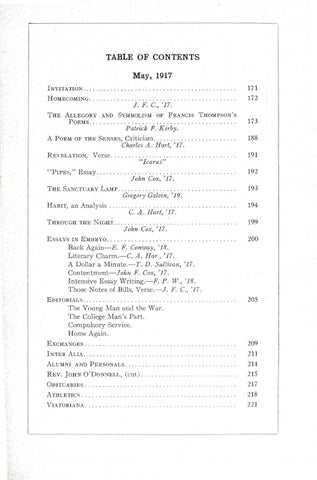
TABLE OF CONTENTS May , 1917 INVITATION .... . . . . . . . . . . . . . . . . . . . . . . . . . . . . . . . . . . . . . . . .
171
HoMECOMING..... ... .. . ............ . ... . . .. ... ........ J . F. C., '17.
172
THE ALLEGORY AND SYMBOLISM OF FRANCI.S THOMPSON's PoEMs. ... .. .......... . .... . . . . . .. . ........... . .
173
Patrick F. Kirby. A PoEM OF THE SENSES, Criticism. . . . . . . . . . . . . . . . . . . . . . . .
188
Charles A. Hart, '17. RE\: ELATION, Verse.... .. .. . ....... ... ..... ............
191
'' I carus '' ''PIPES," E ssay.. . . . . . . . . . . . . . . . . . . . . . . . . . . . . . . . . . . . . . .
192
J ohn Cpx, '17. THE SANCTUARY LAMP.... .. .. .... .. .... .. ... .. ... . . .... Gregory Galvin, '19.
193
H AB IT, an Analysis ... . .. . .... . . ........ . .... .... . . .... . C. A. Hart, '17.
194
THROUGH THE NIGHT .. ......... . .. ..... . ...... . . .... ... John Cox, '1'f.
199
EssA .Ys IN EMBRYO . . . . . . . . . . . . . . . . . . . . . . . . . . . . . . . . . . . . . Back Again-E. F. Conway, '18. Literary Charm.-C. A. Har ., '17. A Dollar a Minute.-T. D . Sullivan, '17. Contentment-John F. Cox, '17. Inten sive E ssay Writing.-F. P. W ., '18. I Those Notes of Bills, Verse.- ]. F. C., '17.
200
EDITORIALS . ... . . .. ... .... ' ....... .. .. .. ... . . . ' . . . . . . . . The Young Man and the War. The College Man's Part. Compulsory Service. Home Again.
205
EXCHANGES . . . . . . . . . . . . . . . . . . . . . . . . . . . . . . . . . . . . . . . . . . .
209
INTER ALIA . . . .. .. . ....... . . . ..... . . . . ... 路 . . . . . . . . . . . . . .
211
ALUMNI AND PERSONALS .. .. .. . . .. . ...... .. .... .. .... . ..
214
REv. jOHN O'DoNNELL, (cut ).......... . . . .... . . . . . . . . . .
215
OBITUARIES . . . . . . . . . . . . . . . . . . . . . . . . . . . . . . . . . . . . . . . . . . .
217
ATHLETICS. . . . . . . . . . . . . . . . . . . . . . . . . . . . . . . . . . . . . . . . . . . .
218
VIATORIANA............ ........... . .......... . ..... . ..
22 1
-路
.
Jl~
~~~-.-1
..
.
ADVERTISE -MENTS
II
W
E earnestly request our readers · . to consider our List of Adver• • • • ttsements • • • • •
W. S. QUINBY CQFFEE CO. Importers- Roasters- } ob hers
HIGH GRADE COFFEES AND TEAS CHICAGO
BOSTON Samples sent free on request
Correspondence respectfully solicited
42 East Kinzie St., CHICAGO; ILLINOIS
EINBECK'S PHOTO STUDIO
GELINO BROS.
THE BIG STORE
Bell Telephone 407 143 North Schuyler Avenue KANKAKEE, ILLINOIS
Dr.
J.
A. ZWISLER DENTIST
City National Bank Bldg. Kankakee, Illinois
Corner Schuyler Ave. and Court Kankakee, Illinois
ERZINGER BROS. FANCY . GROCERS Fresh Fruits, Confectionery and Bakery Goods of All Kinds a Specialty. 226-232 Court St.
Kankakee, Illinois
rn
ADVERTISEMENTS .
.
D. J. O'LOUGHLIN, M. ·D. PRACTICE LIMITED TO
EYE, EAR, NOSE AND THROAT Independent Telephone 704 Kankakee, Illinois
191 Court Street
MAJESTIC
DR. Z. J. PAYAN
The Clean, Clinkerless
COAL.·
DENTIST
Mined and Sold by Independent Telephpne 48 123 Court Street
CRERAR CLINCH CO.
Kankakee, Illinois
-. OUR MOTTO-
"QUALITY FIRST" In all Our Lines of Goods
162 Court Street
T . A.. LEGRIS, Cashier . (
{
LEGRIS BROTHERS' BANK
Kankakee, Illinois
RIELY & RICHERT Electrical · Contractors Agents for Federal Washing Machines, Little Ben Vacuum Cleaner, Tuec Stationary · Cleaner and Fostoria Mazda Lamps
4 % Paid on Time Deposits 159 S. Schuyler Kankakee
Ind. Telephone 923
CHAS. WERTZ CO.
Always drink Pasteurized Milk. "Our wagons pass your door. every morning . before you have breakfast.
Lumber, Cement, Brick, Lime, Sand, Sewer Pipe, Hardware, Plaster, Glass, Coal
BRADLEY
.,\:"
F. A. LOTTINVILLE All New Ideas in Fashionable Footwear
Kankakee, Illinois
'
Independent Telephone 472 We D.o Repairing
SHOE DEALER
J. LECOUR & SONS
F . E . LEGRIS, Pres.
The Rookery Chicago The Best is the Cheapest
Bell Telephone 995
370 E . Court St., Kankakee, Illinois
.
.
Milk-Cream-Cottage Cheese · Kankakee Pure Milk Co. 396 South Schuyler Ave. Both Telephones 45 Drink Pure Milk
ADVERTISEMENTS
IV
SPEICHER BROS.
LAMARRE'S
JEWELERS
CONFECTIONERY
Expert Watch and Jewelry Repairing A Most Complete Stock of Diamonds and Jewelry 127-132 Schuyler Avenue
Kankakee, Illinois
Amedee T. Betourne PHARMACY Both Telephones 88
Ice Cream, Luncheon and Cigars Bourbonnais, Illinois
Clothes for Collegians of Every Typ~- from the Lively Lads to the "Bookworms"
V ANDERWATER'S
119 E. Court St
KANKAKEE, ILLINOIS
DISTILLED WATER ICE The Family Ice
Absolutely Pure
F. D. RADEKE BRG. CO. Both Telephones 132
Mrs. D. H . Kamman
H . Handorf
D. H. Kamman & Co. Manufacturers of
High Life Ginger Ale and Grape and All Kinds of Soft Drinks KANKAKEE
ILLINOIS
Telephones : Bell 237-R; Independent 4
C. RUHLE Manufacturer of Lime
Kankakee, Illinois.
Gas, Electricity and Accessories STU:QENT LAMPS OUR SPECIALTY
Public Service Company
Kanlrakee Book Store 116 COURT STREET
Wholesale and Reta,il Cement, Brick, Sewer Pipe, Sand, Etc.
Fine Stationery, Popular Copyright Alger and Henty Books, Post Cards and ~.!bums, Pennants and Pillow Covers, Sporting Goods.
Office and Warehouse 503 West Avenue KANKAKEE, ILLINOIS
THE GIFT SHOP
v
ADVERTISEMENTS
JOHN J. DRURY PLUMBING Steam and Hot Water Heating, Hot Air Furnaces, Gas Stoves and Ranges, Coal Ranges, Hard and Soft Coal Heaters Both Telephones 72
276 Schuyler Avenue, KANKAKEE, ILLINOIS
THE SCHUYLER McBROOM BROS.
American State and Savings Bank
Proprietors
154 Schuyler Ave.
184 Court Street
Kankakee, Illinois
KANKAKEE, ILLINOIS
First Class Restaurant and Cafe -
GEORGE ARSENEAU
D. M. Norris & Son Dealers in
路BAKERY路路 BOURBONNAIS, ILLlNOIS Specialties : Pies and Cakes
Stoves, .Ranges, Hardware and 路 Paints. Galvanized and Tin Work , Telephone Main 30 201-7 Court St., Kankakee
JOSEPH TURK MFG. COMPANY BRADLEY, ILLINOIS MAKERS OF
Columbia Iron and Brass Bedsteads Special attention to Furnishing Institution BEDS
Prices and Illustrations on Application
" ..
VI
A D V ERTISEME N TS
Just "HELLO !" From
WUNDERLICH'S STYLE SHOP
.BARRON'S . CONFECTIONERY
A Store For Young Men The Home of Styleplus Clothes $17
. Schuyler
Kankakee
Avenue
KA -NK -A--K EE ICE CREAM CO. ~urity
and FlaV9! Our Specialty Kankakee, Illinois
139 North West Ave.
THE LAFAYETTE
Boston Shoe Repairing Co ..
HOTEL CAFE
All Work Gu.a rantefl d . Shoes Repaired While You Wait. Best Work Neatly Done.
Kankakee's Best Restaurant The Proof of the Pudding is in the Eating J. O'KEEFE, Proprietor
JOE SHAPIRO, Prop.
Telephone Bell 1386-2
225 Schuyler Ave ., Kankakee, Illinois
ILLINOIS PRINTING CO.
Printers, Lithographers_,. Stationers DANVILLE, ILLINOIS ~2
G. OSCAR H. BYRON G• A • FORTIN ' Groceries, Ice Cream, Cigars and Confectionery
LUNCH ROOM : t
Bourbonnais ,, ·; . : ~.
Illill~is
Aut omobileDistributor ..
151 East Station Street All Standard Cars : -Buick-Hudson-Maxwell-Studeba~~r=-I?,etroit Electd !;:
AUTO LIVERY ... AND TAXIS Telephones 40
+---•-•.-w.-•.-.a-t~a-•n-•••-a•-••-••-••-••-••-•n-•••-••-•--••-w•-••-••-n•-•+
i
ii THE 1
I
.
l
VIATORIAN 1J1ar tt !;prra
Ii I
I
+u-~~.-.a-•a-t~•-••-••-•a-~~•-••-••-•a-an~u-•Ja-aa-•a-aJI-uu-ua-au-uu-utt-ua-• +
Volume 34
May, 1,917
Number 4
+•-•a-•.-••-••- •a-aa-aa-na-tJI-ua-••-••-••-•n-••-••-••-••-••- •u-rr•-•n- ••- •+ + -l t - I U- a a - n l t - II. _ •
._.II_&U-AII-1111-UU-nii-III_U._.IJ-IIU-I.JU-JII-tU-niJ-BU-IIll-1111-n+
i
!*********************** i
i fallr. Q!Hb ~tubrut i 1\uy Jlarr, ']~ 11\. ~. 1\. 1 ~ir: I lnu arr 4rrrby rrl]urntr(l tn put iu au apprari i aurr at your Alma fallatrr, ~1. lHatnr OJnllrgr, unt latrr i t4nn timr fnr lliuurr nu irrnratinu iny, !Qlluy t4irtirt4. I uiurtrru 4uu(lrr(l au(l nrurutrru, w4ru au(l w4rrr t4rrr will br a mammnt4 Ql)J(l ~tu(lrutn' .fhinmrrnmtug, srrnu(l auuual rrlrhratintt. r&tggrnt an(l hrnt rurr. ~nmrt4tttg · i ikntug rurry mtuutr. lnu rau~t affnr(l unt tn rnmr. 1\ll i uu(lrr _nur trut. 1£xrurntnu ratrn nu all railrna(ls. j fnu nrr nl.!ln rrqur.!ltrll tn tdlnt ll'll.!lt fittr ntl!er i nl(l frllnwn nf ~. ]t. OJ., au(l tn takr itt tnw at lrant nur j. nl(l ttmrr w4n wan' ut t4tttktug nf rnmiug. 1£urryhn(ly'n ii hnnnttug fnr a big (lay. ~rt nu t4r bau(l wagnu. !;
i
j I
I
i i I
1
i
j I
i
j
I !
j
I i
ii i
tlnn.!lt! -
1llnnat!
1llnn.!lt!
j I
'~********~*****~*******' i i
+~~---~~~-•.-.n-aa_.._a,_.n-•u-• •-•u-n a-•a-n;o-n rl-nu- •u-u•-••-••-•a-alf-lrt-llt-al-1+
172 +·--·-.,1-al-al-11
=_:.:I
. THE VIATORIAN ..
la=--tll-le-tii-11-11-'IIJ-111-11-ti-11_..1_11-I.-11-IU-q-11+
HOMECOMING.,. J. F. c., '17.
1
+·-··-··-·---·----·------it-11·-··-··-·--··-··-··--·-··-··-..-··-··-··-··-·+ Men who are engaged in the business of life; men who are fighting life's battle every day-do you not sometimes think of the earlier days before you took the burden upon your shoulders? Do you not recollect the care-free time of youth when all things seemed bright? Do you not remember the companions of those days and, in particular, do you not recall the places where you spent many happy hours with those companions? Surely you do, and you often wish to see those old familiar scenes and faces : Many t~mes you feel a hankering to visit the old places, to greet the old friends, to talk over the bygone times, to recall past days and deeds. It is only natural that you should for the memory of every man brings up before him, from time to time, scenes and happenings from the springtime of life, and especially vivid is the memory picture of home. St. Viator is your old home, for, during your stay here, it took the place of your real home. You lived here in close companionship with y our fellows . You lived with them as brothers; you studied with them, ate with them, played with them, slept with them. This close companionship, one of the great factors of life at boarding college, gave you opportunities of forming associations which are imprinted indelibly upon your memory-they are second only to the ties which bind you to your parental home. Because of this you often feel the call of home. No matter how short or how long the time of your absence; no matter how near or how far away you are, you often desire to take a few hours off from the routine of your business or professional duties, that you might come back home and visit. ' Alumni of St. Viator, the opportunity to do th1s will soon be at hand. The officers of your alumni association met at the college on April 18th and discussed plans for the Second Annual Hom.ecoming to be held on Memorial Day, May 30th. A big program has been arranged for that day, wh1ch, combined with the regular Memorial day exercises, will make this Homecoming one long to be remembered. You who attended last year's reunion-your enthusiasm at that meeting is an assurance that you will be back. You who did not come, take this opportunity to visit the old home and m eet the "old crowd' ' once more-it may be your last chance to see them for many will probably b e in the trenches next year. The heartiest of welcomes will be accorded you and your presence will be a sign of your loyalty; it will jndicate that you still feel the call of home and are willing to '' do your bit" toward making this Second Annual Homecoming a real Homecoming, in every sense of the word.
THE VIA TORIAN
+--i -
.
!
i I
J 2
173
------~~-·--·------·-··--·-··--·-·~~-·---·-··-··--·-··--·-··-. ·--+
.
THE ALLEGORY AND SYMBOLISM OF FRANCIS THOMPSON'S POEMS. PATRICK F. KIRBY
I
i I. J •
+•-•.-..-.••-••-••-•ll-la-a.-.a-•.-•--••-••-••----••-••-••-••-ta-~~a-a•-••-•+
That allegory as a literary form is far from dying out, is seen from the number of modern writers of both prose and poetry, who have made use of it. Even su ch a modern writer as Mr. Rudyard Kipling has seen fit to write in allegory when prudence so demanded, and has been well received by a public that believes it dislikes the form. The charming prose allegories of Olive Schreiner also have their following, although they are too philosophical to appeal to the ordinary reader. What the vast reading public dislikes is the conventional, romantic allegory. Our modern reader is too hungry for novelty to find pleasure in the revamping of old themes and characters. He is also too prosaic to care for long tales of adventure, in which giants and dragons and fair maidens in distress vie with one another for "a place in th e sun,'' for deep down in his heart he does not believe in giants and dragons and their kin. He can accept without compunction a tale in wh1ch a chance acquaintance in a street-car is a count in disguise. He is willing to read of strange supermen, who mingle romance and business in a hundred and one ways, and make love with a daring and vim that would fill Aucassin or Lancelot with envy, but that is only because he believes in the existence of such beings. It is precisely because the larger part of our all ,~gories are of the romantic type that the term allegory has fallen into disfavor. But allegory in itself can never lose its charm. Half of our modern novels can be turned into allegories by changing the names of the of the leading characters. If we, for instance, take Jack London's '' John Barleycorn'' (in itself an allegorical name), and call the leading , character Mankind, or Pilgrim, or some similar name, we find ourselves at once enveloped in allegory. When we turn to the poets, we find but few of those possessing great imaginative powers, who have not risen frequently into allegory. As none of our modern poets can compare with Francis Thompson in this imaginative quality, so few of them have so frequently had recourse to the method of allegory. There are traces of allegory to be found in almost all of his poems, and in some eight or ten of them we find professed allegory. It is my task to analyse these professedly allegorical works, and to point out allegorical traces in the rest of his work. These latter are sometimes real allegories, although very brief. At other times they border on simile or metaphor, but have a pronounced symbolic value. In the first group of professed allegories, we find four of the poet's most famous poems : The Hound of Heaven, The Mistress of Vision,
•
174
THE VIATORIAN
The After W omari, · and A Narrow ·Vessel. In three of these the: allegory is religious or ecclesiastical,-in the fourth it deals with poetry and inspiration. All are r eplete with mysticism, for it is in his. mystical works that Thompson makes· the greatest use of the symbol. As a result a great part of this paper must be devoted to his religious,. works. · The Hound of Heaven finds its prototype in one of the songs. accredited to St. Francis of Assissi which Thompson translates.. in part in his prose works. I have not attempted to go into its historyfurther than this . It belongs to what we may call the "chase 'rallegories, which are found in a few of the works of the mystics. In_ this type the central figure is represented as being pursued, usually by the powers of evil. "The devil he goeth about like a roaringlion, seeking whom he may devour." In St. Francis as in the Hound of Heaven, it is God who pursues the soul that flees from him .. In the Hound of Heaven, it is tlie poet himself who is the .hunted . He flees from God, the Hound of Heaven .who follows relentlessly after _ " Up vistaed hopes I sped, And shot, precipitated, Adown Titanic glooms of chasmed fears." · H e pleads at casements, behind which dim forms are moving,. but the casements close at his approach. He turns to the stars: "Across the margent of the world I fled, And troubled the gold gateways of the stars, Smiting for shelter on their clanged bars." But nowhere can he find shelter. He calls to Dawn and to Eve~ for assistance, to "all swift things for swiftness," but their loyaltyto Him who follows makes them false to the fugitive . All things. betray him . · • So he seeks no more for help "In face of man or maid," but turns. to the little children. Alas, their guardian angels pluck them away from him . He turns to Nature. She is kinder. Under her tutelage= he learns all the secrets of science. He attains to perfect communion with Nature. But even this cannot avail him long. Exhausted, he· gives up the flight, and waits for the stroke, his heart filled with fear.. To his surprise, he finds that it was Love, not Anger, which inspired, t he Pursuer. He finds that in losing his race he has won all that is. worth while winning, and has conquered in being conquered. The Allegory, of course, represents a Soul that is trying to do . without the Divine Grace, that spurns God, "Lest having Him, I might have naught beside ." It tries to find satisfaction, and to escape from its spiritual cravings in human love, but finds itself barred from enjoyment . It turns to the stars, and soars in the highest . realms of art, but in vain. With little children it might be happy ~ but there is a vast gulf between the fugitive Soul and the innocence:
•.''
THE VIATORIAN
175-
of a llttle child. In the secrets of nature, and in study, in the acquisition of knowledge, if finds a temporary relief, until a sense of the . vanity of such things comes, and the Soul capitulates, only to win . all for which it has been seeking. _ Of course, this is almost pure mysticism, but mysticism of the Scholastic type. It breathes the atmosphere of tll.e "Confessions" of St. Augustine, and of course is deeply influenced by the Mystic of Clairvaux. It appeals to the limited circle who accept such a . view of life,-to those who refer back all human desires to the ''Amor Dei,'' rather than to the more sensual instincts which the modern philosopher sees in them. As regards form, it is undoubtedly one of the most perfect lyrics ever written, and sustains a remarkably high level throughout. The Mistress of Vision is an allegory of an entirely different type . It savors more of the conventional allegory of the Middle Ages in its setting, although its theme is one that did not · come in until the Romantic revival. We are transported at once in the person of the poet, to a strange • and beautiful garden. There is no cumbersome dream~motive to . take up our time. The garden is surrounded by the fosse of Death, behind which sits Life, the warder of the garden. Inside the fosse is a wall, made entirely of an emerald . Birds hung silent in mid-airand there was no sound save the singing of the lady, the Mistress of Vision, who sat in the midst of the garden, and ''Sang a song of sweet and sore And the after-sleeping; In the land of Luthany, and the tracts of Elenore." In the garden there were many flowers, in the fullness of theirblossom. A low, hazy sun lights up the garden. · In tlfe eyes of the lady as she sings, the poet reads great and dreadful mysteries. They are fringed pools, he thinks, and they are continually changing their expression. Her song is of the singer, and she tells the poet that he must. learn all his art of song in the land of Luthany, and the region E lenore, of which she sings. The poet at once makes up his mind to seek out. that region, and asks the way. She tells him : "Pierce thy heart to find the key; With thee take Only what none else w.ould keep; Learn to dream when thou dost wake, Learn to wake when thou dost sleep. Learn to water foys with tears, Learn from fears to vanquish fears)· To hope, for thou darest not despair, Exult, for that thou dar' st not grieve)·
176
THE VIATORIAN Plow through the rock until it bear; Know, for thou else could'st not believe; Lose, that the lost thou may'st receive; Die, for no other way canst live."
If th~ poet follows these rules he shall see the things which arc sight less to other men , and may .enter into the land of Luthany. The poet understood her m eaning. His eyes saw not but h e saw. Of course, in this poem, the mistress is nothing more than the muse of son g, who points out the way which h er follower s must go. in order that they may se~ the things that are hidden to other men . D etails, such as the em erald with which the garden is encircled , seem to have no allegorical meaning, but to be m er ely parts of the imaginative setting of the poem. I confess m yself unable to solve the m ystery of the Fosse of D eath about the gar"den, and of Life, who is warder to the garden . Both are plainly allegorical, but it must be doubted whether t he poet h ad any clear conception of their r -3lation to the rest of the poem. The After TiVoman has as its source the Canticle of Canticles, or Song of Songs, which according to the interpretations of the father s , represented t he Church as the bride of Christ. In this poem she is also represented as a woman , forever young and new. The poet adjures her to : " The celestial trai tress play, A nd all mankind to bliss betray,路 With sacrosanct cajoleries And starry treachery of your eyes, Tempt us back to Paradise!"
Then he calls upon her to take her place at the head of her army, t he Church Militant. She is to lead all to Christ, and who is there shall not answer : "T!Vhen to love you is (0 Christ's Spouse!) To love the beauty of His house; Then come the I saian days; the old S hall dream,路 and our young men behold Vision-yea, the vision of Tabor-mount, Vll hich none to other shall recount, Because i n all men's hearts shall be The seein g and the prophecy.'' Then the poet tells u s that he must be silent until the hour when She is revealed. H e ends with what might be used as a description of all allegory : '' This song is sung and sung not, and its 路words are sealed."
THE VIATORIAN
..
L
,
J'
.,
~;
177 .
Actual aliegorical action is almost missing in this poem, which is. largely an apostrophe to a personification. The language is, however, almost entirely allegorical, and the exhortation is a call to allegorical action, so that the poem may be safely ranked as a conscious allegory. Of a different type is the poem, or rather sequence of poems entitled A. Narrow Vessel, being a little dramatic sequence on the aspect of a primitive girl nature toward a love beyond its capacities. This is to all appearances a group of love poems, dealing with a rather shy, sensitive girl who gives her lover a lock of her hair, and is thereupon greatly frightened at what she has done. Although she truly loves the recipient, she holds herself aloof, for deep in her heart she is afraid of him, and is afraid every fa·v our will lead to another. The· more she gives the more he will ask. In the poem entitled The End of It we have the following explanation of her love : "Sf?e did not love to love, but hated him For making her to love). and so her whim From passion taught misprision to begin. And all this sin VIl as because love to cast out had no skill Self, which was regent still. Her own self-will made void her own self's will." Even yet we have no hint that the poem is anything more than a very charming story of a girl's shy love. . It is in the epilogue that. follows that we are shown the allegorical nature of the poem, much in the manner of the stories of the '' Gesta Romano rum,'' or the ''Phoenix'' With a suddenness that almost stuns us we an~ told: ''She that but giving part, not whole, Took even -the part back is the soul)· And that so disdained LoverBest unthought, since Love is over. To give the pledge, and yet be pined That a pledge should have force to bind, This, 0 Soul, too often still Is the recreance of the will." In his letters Thompson insisted that he meant this series of poems as nothing more than an allegory, but his biographer, Everard Meynell, holds a contrary view. According to him, at least some of these poems are to be regarded as geil'Uine love poems, but were· twisted to an allegorical purpose because of the poet's growing feeling that nothing profane was worthy of his ·songs. The Veteran of Heaven, and the Lilium Regis, which are printed together as Ecclesiastical Ballads, are also allegorical. The former is a "divine parody" of Macaulay's" Battle of Naseby." Although
178
THE VIA TORIAN
·the allegorical material is but slight, the entire poem is built o:p. it. Christ is in this poem the Veteran of Heaven, addressed as ,the "Captain of the Wars," and is asked how he won his great scars. He ·tells of being surrounded, and being forced to war without armor or arms. He was slain, and was none-the-less the conqueror; and he ·who was victorious was defeated. The Lilium Regis is, as the poet himself tells us, ''A prophetic .apostrophe of the Church under the title of "The Lily of the King." The poem is very short, but. that does not prevent the poet from get·ting his allegory very badly mixed. Thns , the first stanza gives us ·the following: "0 Lily of the King! low lies thy silver wing, And long has been the hour of thy unqueening)· And thy scent of Paradise on the night wind spills its sighs, Nor any take the secrets of its meaning.'' Here we find t he two chief conceptions which run through the poem, the lily, and the deposed queen, both referring to the same -organization, and apparently not thought of as interfering in any way with one another. But we also get the idea of a bird, or an angel, or some other winged creature, now unable to fly. Of a scent that spil~s ·its sighs it is perhaps best to say nothing. It is a conception that should thrill Amy Lowell, -but I am not sure how well it would be received among u s poor mortals. The poet, continuing with his theme of the lily, goes on to say that the hour approaches for the troubling of the land, and the lily is urged to sit fast upon her stalk, and be n ot afraid of the tempest, for (and here we get back to our other figure) the hour of her queening will t hen be approaching. Now the lily becomes a thing of the past, as the poet goes on to tell of the procession that shall accompany the · -victorious queen, and of the joy that shall be as she is crowned. I must confess that such a confusion of ideas does not at all detract from m y enjoyment of the poem, for I find myself perfectly able to carry t he two ideas in mind,-to regard each of the figures as a -simile of the other. Poets in all ages have gone on twisting their conceptions together in just such a fashion, and probably will continue to do so until the end of the world. For, after all, poetry is not mathematics nor logic, and the poets who write with a text-book on rhetoric as their model, instead of following their own imagination, are likely to find themselves superseded in the popular taste by those who write from their hearts. One of our poet's shorter poems, entitled Whereto Art Thou Come? 1s both allegorical and explanatory. It is an allegory ·because it represents abstract figures in action. It is also an explanation of a real occurrence as allegory, for the action portrayed is nothing less than the kiss of Judas on the slopes of Gethsemane. Truth it is that stands upon the mountain, ·and asks of all who
.
,,.. .
-~
THE VIATORIAN
179
~orne
in search of her, "Friend, whereto art thou come?" She waits answer from the mouth of deed. (What a powerful figure this :is!) Men woo Truth is diverse fashion: "This, as a spouse; that, as a light-o' -love, To know" an.d having known, to make his brag. But woe to him that takes the immortal kiss, And not estates her in his housing life, Mother of all his seed! So he betrays Not Truth, the unbetrayable, but himself: And with his kiss's rated traitor-craft The H aceldama of a plot of days He buys,. to consummate his ]udasry Therein with Judas' guerdon of despair." In Ultimum we have a single, short allegory. Love is dead. Around him throng his offspring songs like children. They are filled with fear, for they did not know that Love cou!d die. One of them lifts Love's wing, and finds it cold and bloodstained. All weep. The poet joins in their weeping, for it was he that slew Love. "He lifted me Above myself, and that I might not be Less than rnyself, need was that he should die; Since Love that first did wing, now clogged me from the sky." .He takes comfort in feeling it is best Love be dead, for: "The days draw on too dark for Song or Love,
....
And did Love live, not even Love could sing." The poet closes with a conventional epilogue to his lady . A number of the poems of Francis Thompson have allegorical matter scattered through them. Sometimes a complete allegory is brought into a poem not otherwise allegorical; sometimes a long po2m . -is made up of three or four allegories, often hopelessly confused. Perhaps the best example of this first type is found in The Poppy, which is, next to the Hound of Heaven , Thompson's best known poem. The poem is one of those which deal with childhood. The poet walks in the fields with one of his child-friends, who spies a red poppy growing among the wheat, and gives it to him. He meditates upon the wide chasm that separates him from the child, and then, at the >end of the poem, he thinks of himself as the poppy. '' The sleep-flower sways in the wheat its head, Heavy with dreams, as that with bread; The goodly grain, and the sunfiushed sleeper, The reaper reaps, and Time the reaper. I hang mid men my needless head, And my fruit is dreams, as theirs is bread;
180
THE VIA TORIAN The goodly men and the sun-hazed sleeper Time shall reap, but after the reaper The world shall gleam of me, me the sleeper." Love, Lover your flower of withered dream In leaved rhyme lies safe, I deem, Sheltered and shut' in a nook of rhyme, ' From the reaper man, and his reaper Time. Love! I fall into the claws of Time; But lasts within a leaved rhyme All that the world of me esteems My withered dreams, my withered dreams.''
Of a like sort are the poems "The Cloud's Swan-Song," "A Question" and "All Flesh," although .i n them the allegorical feature is more marked. The Cloud's Swan-Song is Shelleydan in inspiration, although handled in Francis Thompson's peculiar manner. The poet begins by telling us that '' There is a parable in the pathless cloud.''
1'
He walks, alone and very much depressed, over the windy hills, meditating on the heaviness of his lot. · "Of my wild lot I thought; from place to place, Apollo's song-bowed Scythian, I go on; Mak1:ng in all my home, wdh pliant ways, But provident of change, putting forth root in none." Then he becomes conscious of a fe.w drops of rain, and looking up, sees a tiny cloud far above his head. "It was a pilgrim of the fields of air, Its home was allwheres, the wind let it rest, And in a little forth again did fair, And in all places was a stranger and a guest. It harked all breaths of heaven, and did obey With sweet peace their uncomprehended wills; It knew the eyes of stars which made no stay, And with the thunder walked upon the lonely hills." He addresses the cloud: "Right poet, who thy rightness to approve, Having all liberty, didst keep all measu1'e, And with a firmament for ranging, move But at the heaven's uncomprehended pleasure.''
·~
To him this is a type of the ideal which he should be. The cloud is allegorical of his life, its fate js his fate, and its behavior should be his beh~vior. The Singer Saith of His Song is a shorter poem, containing hardly ,, •t
t
THE VIATORIAN
181
more than a dozen lines. His Song is represented as a wmnan, perplexed by modern speech. She is sad, and there is a sound of falling tears through all her songs. ''She sees the Is beyond the Seems," and she "sings the songs of Sion by the streams of Babylon." Passing over the discrepancy in the fact that the Song is herself pictured as singing the songs, it is 路 interesting to note the influence which a contemporary poet had upon him, although a poet of an entireJy different type . It was not very long before this time that A. C . Swinburne ' published his "Songs before Sunrise," containing the powerful chant: "By the tv aters of Babylon we sat down and wept; Remembering Sion. ''
_,-.
.k
Of course this had a very evident Scriptural source in the Psalms of David, and it may be that Thompson drew his inspiration direct .from the Scriptures, much in the same manner in which two prominent 路s tatesmen recently had on their minds a quotation from Ezekiel which pointed to the value of preparedness. However, I am inclined to believe that the poet really did draw his inspiration in this regard from Swinburne, although as a theological student in his youth, he had been obliged to read the Psalms over every few weeks, the Roman office requiring as much. For Francis Thompson was as unafraid of borrowing what he required as was Shakespeare, although most of his echoes were unconscious. Compare his "Great earthquaking sunset rolling westward from Cathay," and his "Land of Luthany, and the "region Elenore," which seem to go back to Kipling and to Poe respectively. The second class of secondary allegories to which I refer, are those that occur in poems which have a wealth of allegorical material, but in which several allegorjes are intermingled. , A good example of this is found in the Laus Amare Doloris . In the first strophe of this 'poetry is represented as the Nile demon. The Nile represents the poet's tears, which well up at the command of the demon, and bring the demon forth a great crop of songs. Then follows an apostrophe to the austere goddess, Pain, to whom the poet, now a woman, has offered up her children one by one. Only one she saved, and that one she loved more than all, but the goddess commands, and even that must be sacrificed. But the mother cannot forget her children, and goes sorrowful. As she treads the chambers of her house, she seems to hear their spirits passing by her. Then the allegory shifts once more, this time to show how Poetry is not, as she has pictured in the first part of the poem, a thing accursed, but rather a solace and a deljght. There is no need of going into this in detail, for there is nothing in these bits of allegory that differentiate them from those which have been treated in the preceding pages of this essay. 路 Of interest is the passage in the Sister Songs, another of these
i
182
'
THE VIATORIAN
melanges of allegory and simile, where the poet finds himself stretched on the margin of a cruel sea (that of Despair) whence he had been rescued. He is so dazed that he is unable to tell whether he is indeed alive or dead. H e hovers between life and death, until a child comes and brings him to himself. He takes her childhood as an omen of the dawn which awaited him. _ Of course, this is an allegorical expression of Thompson's own experien ce when rescued from starvation and despair by a girl of the London streets, herself scarcely more than a child, a favor which Thompson never forgot, for many a time he searched for her in vain after fortune had smiled upon him, hoping to rescue her, if she still needed rescue. ~ If we look back t hrough the preceding pages we find that there are one or two mot ifs which stand out above the rest. We may distinguish the "Chase" figure, to whjch attention has already been called in the discussion of t h e "Hound of Heaven." We may also distinguish the "martial " motif, as in the "Veteran of Heaven"; and the "nature" motif, in the " Lilium R egis: " This latter we find to be, perhaps, t he predominating figure in the allegories which we have reviewed. It occurs in "All Flesh ," in "The Poppy," and in two or three others. The " Laus Amare Doloris " brings us still another, which we rnay call the "rnat ernal " therrie; " A Narrow Vessel" uses human love as its symbolism; and "Art Thou Come," and " The After-Woman" h ave what will be recognized as " script ural '' motifs. Into t hese six groups almost all the symbolism of Francis Thompson falls. The similes and metaphors of which he was so fond , can usually be classified under one of t he divisions noticed, and as it is t he purpose of t his essay to deal wit h the symbolism of Francis Thompson, rather than wit h his allegory alone, a short discussion of these various forms of symbolism follows. By far t he rnost common figure in Thompson' s poetry is what we may call the "ecclesiastical" figure,-which can perhaps be regarded as a division of the "scriptural ," which is found in his allegories. But as it is best to separate these two, we shall do better if we discard the type which we have called " human Love ," which he rarely uses, and regard our chief types as follows: Ecclesiastical, Script ural, Martial, Chase, Nature, and Maternal Symbols. Only a few figures do not fall into these groups and these we shall not consider in this paper. Francis Thompson's symbols were almost always original with himself. In som e of his poems we find reminiscences of Shelley and of Crawshaw, and he occa.sionally drew a figure from his readjng, from t he Scriptures, and from pagan m ythology. His most vivid figures, however , are t hose which represent some vivid sense experience which the poet himself had undergone. To t his original type belong what I have called his ecclesiastical
;.,G, ~ ~.,
I
路~:
tt:. ,w;
THE VIATORIAN
183
f
'
,'1_
''t
I"
.~..:¥
~~f~ ...
,, '•
i-_.
'• ~···
·· symbols, dealing for the most part with the rituals and forms of the Catholic church. They spring from the days when he was a seminarian, and was only stopped from being ordained a priest because he appeared to his superiors to b e exceptionally dull. Thereupon Thompson turned his mind to medicine, but as far as I can see, there is no hint of his medical experience in his poems. Perhaps the most elaborate example of this type is to be found in the opening strophes of the Orient Ode, which run as follows: '' Lo, in the sanctuaried East, Day, a dedicated priest In all his robes pontificial exprest, Lifteth slowly, lifteth sweetly, From out its Orient tabernacle drawn , Yon orbed sacrament confest Which sprinkles benediction through the dawn,· And when the grave procession's ceased, The earth w1:th due illustrious rite Blessed,-ere the frail'fingers featly Of twilight, violet-cassocked acolyte, His sacerdotal stoles unvestSets, for high close of the mysterious feast, The sun in august exposition meetly · Within the flaming monstrance of the West . 0 salutaris hostia, Qui coeli pandis ostium!'' For the benefit of any reader who may -possibly be uninitiated, it may be wise to say that Thompson here has seen in the sunrise the benediction service of the Church, and has described it with a closeness and a fidelity that only an ecclesiastic could find. (Thompson h\mself had been ordained in minor orders~. Even the benediction hymn is brought in, in the lines of Latin. In the "Hound of Heaven" we find the following: " I was happy, with the even, When she lit her glimmering tapers Round the day's dead sanctities,'' in which the burial service is introduced. It is the sun which enters oftenest into this phase of Thompson's symbolism, and his hymn to the sun is filled with such imag~s. In , the '' Mistress of Vision'' it is a thurible: "The sun which lit that garden wholly, Low and vibrant visible Tempered glory woke; And it seemed solely Like a silver thurible Solemnly swung, slowly , Fuming clouds of golden fire, fo1' a cloud of incense-smoke."
184
THE VIATORIAN
In the hymn to chastity, "Ad Castitatem," the sun is a priest: Speaking to Chastity, the poet says: "Through thee the waters bare Their bosoms to the ai?', And with confession never done Admit the sacerdotal sun, Absolved eternally By his asperging eye." The Scriptural motif is even more common, although rarely so vivid. In the poem ''Penelope,'' which forms part of ''A Narrow Vessel," the lover says: ''Like to a box of spikenard did you break Your heart about my feet." I have counted this same figure of the Magdalen and her box of ointments in no fewer than four places . In another place we find such figures as these : '' The hardest pang whereon He [the poet] lays his head may be a Jacob's stone." "0 Nature, never-done Ungaped-at Pentecostal miracle, We hear thee, each man in his proper tongue." This last quotation is taken from the "Night of Foreboding." In this poem we find, also, the resurrection of the' grass and flowers in the spring, spoken of as the day of judgment. The figure is rather elaborately worked out. The sky trumpets and wakes the dead. The birds sing ;"ubilate. The graves are riven, and the sun comes with power amid the clouds of heaven. Another conception of the spring, which is not much dissimilar, includes: "the stony winter rolled From the unsealed mouth of the holy East.'' The martial motif is not as common as the two which we have treated of. At the close of the "Hound of Heaven" we are told: "Naked I wait thy love's uplifted stroke! My harness piece by piece thou hast hewn from me, And smitten me to my knee,路 I am defenseless utterly." From "Sister Songs" we get another conceptjon of the Spring: "Yet, even as the air is rumorous of fray Before the first shafts of the sun's onslaught From gloom's black harness splinter, And Summer move on Winter With the trumpets of the March, and the pennons of the May.'
185
THE VIA TORIAN From t h e "Dread of H eight" : "A nd ever with victorious toil W hen I have made Of the defic peaks dim escalade, My soul with anguish and recoil Doth like a city in an earthquake rock, As at my f eet the abyss is cloven then , With deeper menace than for other m en .''
..,.
,.,. '
;-:.:v-
A variation of this martial motif introduces the old allegorical idea of t he siege. In the following stanza the usual order is inverted , -it is the powers of good that assail man's soul, and not the powers of evil. Thompson's work is full of this idea of the soul resisting God. ''God! if not yet the royal siege Of Thee, my terrible sweet liege, Hath shook my soul to fall; If, 'gainst Thy great i nvestment still Som e broken bends of rebel Wi ll Do man the desperate wall,-'' ·- ...
Of course t he great type of t he chase sumbol is the "Hound of H eaven." But the idea occurs on several other occasions. So for inst ance, from t he "New Year's Chimes" : "The chase· that's chased is the L ord of the chase, (A nd a million songs are as songs of one,) A nd the pursued cries on the 1'ace; A nd the hounds in leash are the hounds that run .'' In this last line; as in t he m eter of the whole poem, we find a t race of Swinburne again .. · As in most poetry, Francis Thompson's work is crowded with nature symbols. Sometimes , as in t he "Lilium R egis, " t hey are made to serve the ends of religion. Of this type also is the passage in the proem to the '' Sist er Songs '' : ''Sweet stem to that rose Chxist, who from the earth Suck'st our poor prayers , conveying them to him; Be aident , tender lady, to my, lay .11' I
i"
• ·:J:· ~~. ifi·/ .
i
, I,.
More oft en it is the r esult of a vivid sense-impression, instead of, as in the above, a botanical knowledge, which he u ses, in "To Olivia:" ''White flake of .childhood, clinging so To my soiled raiment, thy shy sn ow At tenderest touch will shrink and go ." Or, in a more wonderful passage: "The hours I tread ooze memories of thee, Sweet, Beneath my casual feet .
.., . ,i:. '
186
THE VIATORIAN Ml ith rainfall as the lea, The day is drenched with thee; In little exquisite surprises Bubbling deliciousness of thee arises From sudden places, Under the common traces Of my most lethargied and customed paces.'' -Sister Songs.
Closely akin to these nature symbols are a small group which have to do with the London str·eets, and the things which the poet saw there: ' ' 0 God! Thou knowest if this heart of flesh Quivers like broken entrails, when the wheel Rolleth some dog in middle street." -A Holocaust.
~
'<
' ~ ·~
'-~ ~•')
4
•. ,!\
•:, '1
'' Death, that doth flush The cumbe1'ed gutters of humanity." -Anthem of Earth. Or that passage in which the poppy is said to have drurik of the sunshine: "Till it grew lethargied with fierce bliss, And hot as a swinked gypsy is, And drowned in sleepy savageries With mouth wide apulse for a sultry kiss." The few passages of this type are among the most vivid to be found in any literature . · The maternal symbols appear occasionally, and often 'tend toward the conventional. They spring in great part from the Scriptures, which are filled with such imagery. "Nature, poor stepdame, cannot slake my drought; Never did any milk of hers once bless My thirsty mouth." -Hound of Heaven. "Life, ancient and o'erchilded nurse, To turn my thirsting mouth averse, Her breast embittereth V.Vith cry foretaste of death." -Ad Castitatem. Interesting also, to the student of allegory, is one little symbol which appears only once, in the poem entitled "Gilded Gold." It is very brief also, but as it is a descendent of a noble family that
THE VIA TORIAN
187
includes Henryson's "Garment of Good Ladies," it will serve well to end our essay. "So for thy spirit did devise Its maker seemly garniture, Of its own essence parcel-pure,From grave simplicities a dress, And reticent demurenesses, And lovei encinctured with reserve."
1--•1
With which "reserve" I take my leave.
"Sail on, 0 Ship of State, Sail on, 0 Union strong and great! Humanity with all its fears, With all its hopes of future years, Is hanging breathless on thy fate." -Longfellow.
~.··
'ii,\1.
;~·'f~
~
188
THE VIATORIAN
+--··-··-··-··-··-··-··-··-~~·-··--·-··-·--··-·tl-lll~tll....,-1--··-·•-••--:-·--·--·+
Ii
A POEM OF THE SENSES CHARLES A. HART, '17
l
I
+•-••-•ff-RM-I't-n•-••-••-••~aa-ua-nlr-tl.-lt-na-aw-aa-••-••--•-r· a-nw-ta-ta-•+
" St. A gn es' E ve-ah, bitter chill it was! The owl for all h'£s f eathers was a-cold; The hare lim p' d trembling through the fro zen grass , A nd silent was the flock in woolly fold ; From t h ese opening lines of K eats' ' ' The Eve of St. Agnes '' to the closing verse a continuous feast is served to each of the senses until a very revelry proclaims a state almost akin to that of sensuous intoxication, -if such a kind of inebriety ever exists. This is really t he essence of the poem , for h ere, as in all of the poetry of K eats, there is the never-ending search for beauty, and it is usually beauty of the sense t hat is sought . Indeed this quest for beauty .is the sum total of existen ce if we would believe K eats. Elsewhere he t ells us, in "An Ode on a Grecian Urn'' that '' ' B eauty is truth, truth beauty, ' -that is all Y e know on earth, and all ye need to know . 1 ' Always t here is form, always color, perfume, music. At the slightest instance t he poet is off in a sensuous rhapsody. "The Eve of St . Agnes" is built on the merest thread, .-the vision vouchsafed to Madeline, a wondrously beautiful maid, through the intercession of St. Agnes, and t he simple realization of that vision. One would hardly suppose that a whole poem of some forty Spenserian stanzas, or t hree hundred and sixty verses, could be composed on such a slight foundation. T o judge from this work it would seem that them e really has ver y little to do with poetry. For Keats, as he h eaps beauty upon beauty for t he delectat ion of the eyes, the ears, the s~nse of taste and of smell (even feeling or touch is not forgotten) , makes t heme, indeed, a quite minor consideration. Little of story is told,only a soft, sensuous, pulsing rush of b~auty is the effect . Madeline retires for t he night to become the recipient of St. Agnes ' favor s. Thus it is described : " Her vespers done, Of all i ts wreathed pearls her hair she fr ees,· Unclasps her.warmed jewels one by one,· Loosens her f ragrant bodice; by degrees Her rich attire creeps rustling to her knees: Half hidden, like a m ermaid in sea-weed .'' One is half doubtful of such lines . Are they really worth the effort? Is all this catering to the senses poetry in its truest meaning ? R eal poetry, methinks, is, and by its nature must be, of the spirit . So does the poet serve the eyes,· here and in many other places .
THE VIA TORIAN
189
Porphyro now appears in the maiden's boudoir, when, '' The poppied warmth of sleep oppressed Her soothed limbs.''
H e n eeds must feast in his beloved one's sleeping chamber,ostensibly because he is hungry, but in reality becau.s e the poet wishes to afford delight to the taste. Accordingly it is .related of Porphyro that, ., · "He from forth the closet brought a heap Of candied apple, quince, and plum, and gourd; With jellies soother than the creamy curd, And loosed syrups, tinct with cinnamon; Manna and dates, in argosy tr-ansferred From Fez: and spiced dainties , every one, From silken Samarcand to cedar'd Lebanon." Small wonder that such a feast should "fill the chilly room with perfume light." . Porphyro plays to his love upon a hollow lute,need it be said "tumultuous," and in chords that "tenderest be," accents voluptuous as even an Epicurean might desire. Indeed the critic would not be far from the truth in terming Keats the poet of the Epicureans, the apostle of voluptuousness. Keats, being a poet of the senses, in no way serves the spirit, at least in the poem h ere discussed·. It may be argued that in the beautiful images he constructs for the senses he indirectly attends to the higher faculties of man. I am well aware of the old . Scholastic formula that there is ''nothing in the intellect which is not first in the sen ses." H ence beauty in the senses must mean beauty for the intellect. Somehow in these verses this does not seem to apply . There is no r:ising above the sensuou s, unless the passionate be considered superior. The arousal of the latter can hardly be avoided jf one · reads '' The Eve · of St. Agnes ' ' with any degree of careful thought, The setting, the time, the night covers, t he aroused emotions of the actors, all conspire to bring about this end. In very ecstacy, in ~'fine frenzy," in exuberance of spontaneous outburst, the poet pictures Porphyro at Madeline's awakening: "Beyond a mortal man impassioned far A t these voluptuous accents, he arose Ethereal, flushed and like a throbbing star Seen mid the sa_pphire heaven's deep repose,· Into her dream he melted, as the rose Blendeth its odour with the violet."
,. ,-"'
Nowhere in all of English Literature shall we find more passionate lines than those that tell of Madeline's emotions as she goes to p er bed and her dreams:
.,, <!
,.r.
i
.
~·
~.~
.
;
.
}-·"
190
THE VIATORIAN ''No uttered syllable, or woe- betide! But to her heart, her heart was voluble, Paining with eloquence her balmy side; As though a tongueless nightingale should swell Her throat in vain, and die, heart-stifled, in her dell."
In sleep she is as, "Though a rose should shut and b.e a bud again." Not many are the poems in our language which possess such sustained emotion and beauty of expression as this one, "The Eve of St. Agnes." "Poetry is simple, sensuous, passionate," said the great Milton and who shall gainsay him? If the old Puritan had been reading this little work of Keats which was not writt~n until a hundred and fifty years later, he could not have more carefully described it than in the three words he used to describe all poetry. ''The Eve of St. Agnes " is simplicity itself; it is sensuous beyond all expectation of the possibility of mere words as conveyors of the sensuous; it is passionate as few poems are passionate. Yet it cannot be said that the total effect is all that might be desired of a truly great poem. Is this all we are to receive from poetry, that it arouses our sensuous feelings, our passions? Is this all that Matthew Arnold found in poetry when he gave it the place of religion which he banished from his soul? Is the outcry of a bereaved spirit in" In Memoriam" or in "Lycidas," or "Adonais," nothing more? If the answer is affirmative then I will have no more of poetry for it is a delusion and a snare. It is rather because I believe that poetry has also a higher mission to perform, namely, service to the spirit of man, that I place it highest among all the arts; because it may administer solace to that spirit in dire distress in flowers like these I have picked at random from the garden of really noble verse: On the new shores that God is showing me, 0 joy, I speak, and I am understood! And none but answers glad in our sweet tongue, On the new shores that God is showing me. 0 fair eternal bridegroom of our souls, Cut quickly now the cables of my bark. Take me . . . . they say thou speakest the tongue I love Thee in! In the eternal kiss speak to my soul. Lovers of verse will go on praising Keats and it shall not be for me to oppose them. Yet no keener appreciation of their admired one will ever convince me that his verses reach the pinnacle. For as the spirit is above the body, so is spiritual poetry which he has never written, above the merely sensuous.
TilE VIATORIAN
191
I
+a-na..:..aa-•u-••-••-••-•a-aa-aa-an-aa-au-ua-aa-•n-•••~-ru-ua-aa-na-aa-n :•-na-•+
,. •
.I
.
. REVELATION. "ICARUS"
•
.1
+a-a:s-na-au-a;:•-••a-aa-ap-aa-Ptt-na_.a-an-a a- v a - aJt-na-aa-•:t-ua-aa-•a-•u-au-•+
One time at dusk I
walk~d
a mile with her ,
H er gray eyes wistful as the autumn moon R emembering the dead summer, that so soon .':·.·
Had spent its flowers.
Scarcely were astir
The crickets in the grasses, and the whir Of whip-poor-wills above the lonely dune Was almost silence, like the phantom tune Of winter winds upon the leaves that were. Her face, I thought, a little older seemed Than that which came across the years to me; Her voice had caught a quiver, as if strange And lonely things had happened while I dreamed,Things that my eyes might never clearly see, So limited I knew m y spirit's range .
,,•·
.
192
THE VIATORIAN
+ )~<•-••-••-••-•--•n-r:•-•- •-••-••-••-•--•a-a.w-au-u•-••-•u-u•-••-••-••--•-•+
i
i J
.
"
PIPES. J. F . COX.
.i
i .j
+••-•a-••-a.u-•a-aa-.~.~-aa-a...,.....au-••-•u-au-uu-•w-•u-••-•n-••-•u-IIJ-Ja-au-au-•+
There are, in general, t hree ways of en joying" My Lady Nicotine" of t he. smoke-by way of the cigar, the cigar ette or the. pipe. To the inexperienced eye a cigar always looks the sam e; it is only a cigar. And so with the cigarette-it is nothing more than tobacco rolled in paper. But the pipe-here we have a very noticeable variety and . individuality . Have you ever looked round you , while sitting in the smoker, and observed some of the specjmens? In the mouth of t hat lively loobng, nattily clothed young man who sits next to the window, is t he "college pipe." Very ornate in design, with half curved stem, it bears on t he bowl a silver m onogram of the smoker's university and his class numerals. On one side are carved the symbols of a Gr3ek letter frat ernity; on the other, the owner's initials. It has ever y requisite for labeling the youth a college student and it introduces him as su ch to t he other passen gers. In a way it represents him . It is youthful in appearance, seems proud of its connection with a university, and boasts of its membership in a fraternity. Thus, besides giving service and enjoyment as a pipe, it identifies its owner, characterizes him , and adverbses the university whose initial it wears. The pipe smoked by the student's seat com panion is in direct contrast to the college pipe. It is not bright and new, but old and worn. It is of that variety often called the "Missouri Meerschaum," but commonly known as a cob. It is browned and blackened from use and its" face" or bowl seems parched and dried u p-even cracked in places. It gives a sort of wheezing sound, as if it h ad a hard time to breathe. It looks very much as if it had seen better days. No need to look closely at its owner in order to individualize hin1 , for the cob possesses the traits of its master. He is an old man, probably a retired farmer, for like the pipe, his face is browned and cracked as if from long exposure to the heat of the sun. H e breathes in short puffy jerks and looks as if the better part of his life is over. From all appearances the pipe and the man seem to be old and inseparable friends and companions, the pipe serving to give peace a11d enjoyment to its master. Across the aisle is a youn g man, probabl y a tourist; one who spends his summers at a Northern resort, and his winters in the South. H e is dressed in the height of fashion, has the general appearance of a matinee idol, and seems bored with life. H e takes from his pocket a fine leather case and from its plush lined intel;"ior removes a rich brown and mahogany colored pipe. It is an aristocratic meerschaum, wit h dainty' gold filigTeed bowl and rich amber
!.~'
1.,~.·~ '
THE VIATORIAN
..
.
4
·,
:
;
l ••..
'
t'· ~ ,{f ·~·
~·.·l ~
'!I
J ~
.
193
stern. "What a beauty!" you exclaim. Yes, truly a beauty, for that isjts main characteristic. It is a pipe often smoked only in the presence of others to show them that its master has only the best. Its practical worth isn·'t high. It is for "show purpos2s only." It must be handled with the greatest of care, must not be "mussed up" or blackened and, after being smoked, must always be returned to· its case. In many ways it expresses the character of its ownera butterfly of fashion, fond of personal display; a luxurious idler who always has the best of care and is of no practical use. A pleasant thing to look upon and to be admired for its appearance,. it serves as an expression of vanity. That straight, grim looking "bulldog" pipe gripped by the teeth of the gentleman in the corner seat proclaims his traveling salesman qualities. Fjom its appearance we would say he is firm, full of bull dog determination and purpose in'' going after'' a sale. That broken, blackened clay pipe is smoked by the twinkling-eyed, broad, genial 'faced Irishman. Each kind of pipe, after the breaking-in process, serves to give pleasure to its owner and will generally tell you something of his nature. You might say ''Foolish idea, that! Who ever heard of character reading by means of a pipe?" Perhaps not real character reading, but if you step into the smoking car and observe the different pipes and their owners you will often be able to see some characteristic resemblance.
"THE SANCTUARY LAMP." GREGORY GALVIN,
'19.
All the day and all the night, Calmly shines the altar light . Like a diamond in the dark Like an ever-glowing spark. Like a sentinel of old Standing there, majestic, bold. As a guard before the door As a beacon on the shore.
194
THE VIATORIAN
·+•-•u-••-••-•u-au-•••-••••-rfo~-•u-•u-u•-•u-•a-an-uu-na-•u~••J-I JI-IIu-•ta-•u-u•-•+
Ij j
.
HABIT-An Analysis. CHARLES A. HART, '17.
ij j
.
+ u-ut~-au-uu-uu-nu-uu-uu-t~a-aJI-IIU-ua-au-a••-nu-au-aiii-UIJ~II-Uu-au-nu-••-••-••+
Habit has been defined by Aristotle as a more or less stable disposition whereby a subject is well or ill disposed in itself or in its relation to other things. From a metaphysical viewpoint it is one of the four great groups of the accident quality. It is usually considered with dispositions, though strictly speaking a disposition 1s usually transient and unstable, whereas a habit is by nature more or less ~table. Further, disposition is more correctly used when referring to the particular ((set'' acquired by tools or instruments or to the facil\ty attained by organs of m en or animals, through repeated action. Habit has its abiding place, properly, only in the spiritual faculties of intelligent and free agent. It implies something more than mere mutability in the . subject. A being determined to one line of action cannot have a habit, for habit consists in u a stable modification of some power or faculty which can have its activities ·i n one or other of a variety . of channels or lines." _The faculty wherein a habit resides must be a power able to move or to determine itself to various courses. ~~In vain one throws a stone," says Aristotle, ((it does not assume the habit of remaining suspended.'' The only sense, further, in which we may say that even the sentient powers and activities of man are the seat of habit is in their more prompt and easy obedience to the commands of the higher faculties, this obedience havjng been made easy by repeated act. The habit however is primarily in the higher faculty. Likewise the facility of action acquired by animals which results in organic dispositions are not habits, strictly, but only extensions or effects of habits thc:~t dispose the supra-sensuous human faculties. Metaphysically considered, the function of habits is the actualizing of the potential powers of a being. Hence only finite beings can have habits. All beings seek their perfections. Habits by nature facilitate the actions of the being striving toward tp.at end. In the fact that every act modifies the faculties we find the origin of habit. We must postulate this, else memory would be inexplicable and knowledge impossible. This something that remains after the act is habit . It may even arise from one act; the mind's immediate intuition of an axiom becomes directly habitual. Usually accumulated residues are required. Habit then is acquired, in opposition to instinct, which is inherited. It is the facility of reproduction of acts of a particular kind brought about, in nearly all cases, by repetition. Physiologically considered, habit is not clearly understood. Hypotheses have been advanced which greatly appeal in their sup-
.;;,. • ·- )!.;~
·:\.
THE VIATORIAN
,.
195
posed clearness and simplicity. Their only defect is that they frequently r efuse to hold,-assuredly a rather fatal defect. They all proceed on the principle enunciated by Carpenter that "the organism grows to the mode in which it is exercised." It is well to note .right ;here, before proceeding further , that any discussion of the physiology of habit considers only the aptitude of bodily material organs. From this it seems an easy step•to make habit wholly physical and hence to explain it on purely mechanical lines . This is the method largely pu.rsued by James in his treatise on habit. . That it is largely hypothetical and without actual proof or evidence he admits. Sowe truth is contained in the view, however. His first proposition is that ''the phenomena of habit in living things are due to the plasticity of the organic materials of which their bodies are composed." Plastic structure is tbat which is weak enough to yield to an influence but strong enou gh not to yield all at once. Habit is the r esult of a path worn in the muscular and nervous systems, just as though it were a cut on the hand . That scar makes a path which is more liable to future abrasions than are the neighboring parts. This is his next assertion. Then he asks, "Can we now form a notion of what the physical changes may b e like, in organs whose habits are thus struck in new paths? Certainly we cannot in anything lik~ a minute or definite way. But our usual scientific custom of interpreting hidden molecular events after the analogy of visible massive ones enables us to frame easily an abstract and general schem e of processes which the physical changes in question may be like." This is a candid admission of just how far our knowledge actually extends in the matter . It is all very well to imagine, with the distinguished Harvard professor, that these paths in the nervous system are like paths or channels in ordinary matter. The more they are traversed the deeper they get. The imagination can, and has, accomplished wonders, but it, cannot be made the sole basis for what might be offered as a scientific fact. Again, what makes the path the first time? Why did the nervous current flow in just that particular way? J ames sifts his own admittedly hazy discussion down to just this: a new path may be formed by the sort of chances that in nervous systems are likely to occu.r. The whole discussion only goes to show how little we really know about the nervous and cerebral systems . Certain physiological psychologists have claimed that the frontal lobes_of the brain are the central station or guiding force in the acquisition of habits. Prof. Ladd of Yale after carefully viewing the evidence presented concludes that the frontal lobes are concerned in the acquisition of new performances, but t hat no one spot is indispensable for the acquisition of a particular act; that by practice su ch · acts naturally become reflex, in which condition the frontal lobes are, of course, no longer necessary . . The psychological aspect of habit brings us back to the law of assoc~ation by contiguity that the mind in the presence of an object
J,
..... ,,
~ 路路
196
'
THE VIATORIAN
or event, whether actual or ideal, tends to recall other objects and events, formerly closely connected in space and time with that now present. What is true of memory is true of other mental processes, so that we may say with Carpenter that any sequence of mental 路 action which has been frequently repeated t ends to perpetuate itself. As these m ental actions thus become pepertuated the physical organs that indirectly control also assume a definite line of action . Finally t he process frequently b ecomes refl ex and the thinking principle is no lon ger necessary. H ence it is t hat thousands of our actions become reflex and a great mental saving is thereby effected. How true it is t h en that "Habit is second nature"; t hat "man is a bundle of habits" is hardly realized by most people . "Habit," says James , is the enormous fly-wheel of society, its m ost precious conservative agent ." As Maher observes, ''Every volitional act which a man exerts, be it good or ilL is r egistered in the cells of his brain, and leaves a bent in his soul which proves its reality by the increased inclination to repeat t hat act." By m eans of this ''bent" he develops facility . When we realize that man is born with a tendency to do many more things t han he has ready-made arrangements for in his nerve-centers; t hat habit makes up for the gr eat deficit by transferring t housands of t h ese activities to the automatic and reflex , we begin to understand what a wonderful economizer is habit , what a sorry plight we would be in were it not for this thrifty agent. All our time would be taken u p in dr essing ourselves, for instance, and a few such simple bodily action s. By far t he m ost important are the ethical implications of habit. Ethical t raining is, in fact, nothing but the acquisition of moral habits. " Habit is second nature," exclaimed the Duke of Wellington;" why, habit is ten times nature." Because habit begins with free vo lition we are responsible for actions which result from our habits, be they good or bad. It is t his fact which is often lost sight of by present day moralists who find it convenient to deny free will and like to make u s mere creatures of environment. We say that action is the result of repeated acts. Character is nothing but the accumulation of habits and our lives are that of which our character is made. Motives make acts; acts, habits ; habits, life. " Every act is a foundation stone of well or ill being. Every thought is a foundation h ead of life and death." What a tremendous significance in our thoughts and acts. They are all so numerous, we think them so fleeting that we are almost unconscious of them. Yet like unconscious builders we are er 2cting our character , one brick upon another and the stones are t he slightest thoughts and deeds. "Habit, alone," says James in one of t he very fine passages in his "Psychology," " is what keeps us all within the bounds of ordinance and saves the children of fortune from t he envious uprisings of the poor. It alone prevents the hardest and most repulsive walks of life from b eing deserted by those brought up to t r ead t herein. It k eeps t h e fisherman and the deck-hand at
THE VIATORIAN , ;路 -:<!,
~
197
.
..
'.
sea through the winter; it holds the miner in his darkness, and nails the country-man to his log-cabin and his lonely farm through all the months of snow; it protects us from invasion by the natives of the desert and the frozen zone. It dooms us all to fight out the battle of life upon the lines of our nurture dr our early choice, and to make the best of a pursuit that disagrees, because there is no other for which we are fitted and it is too late to begin again." Our intellectual and professional habits are formed between twenty and thirty; our personal habits, such as vocalization, pronunciation, address, motion, dress, and the like are formed before the age of ten and twenty. Hence it is that early education and tra~ning are Eo important from every standpoint. Habits of speech, of dress, of conducts formed during these early years can hardly be erased. Far more emphasis should be placed on the attainment of right habits than is allotted in our present educati~nal system. As James puts it, "we must make au:tomatic and habit~ial as early as possible, as many useful actions as we can, and guard against the growing into ways that are likely to be disadvantageous to us as we should guard against the plague." If we do not we shall become creatures of indeGision: Half our time will be spent in deciding or regretting things which should require none of our mental energy but should have long ago become reflex. Combining his own observations with those of Professor Bain, . James lays down four really admirable maxims which should be followed by those desiring to acquire a new habit or leave off an old vitiating one; first, take care to launch ourselves with as strong and decided an initiative as possible. Envelop the resolution with every aid at your disposal. Make it under imposing circumstances if possible. Do the very things which are at odds with the old habit. Sometimes in the case of drug fiends and the like, it is not possible to stop the habit all at once. This is too great a moral burden and it it is not advisable that one should assume burdens greater than one can bear . . But if it is any way possible to stop the entire habit all at cnce this is most desirable, as it launches the new regime with greater initiative. Second: Never suffer an exception to occur until the new habit is securely rooted in your life. Never lose a battle in the beginning. Do not make exceptions. It is surprising how soon a desire will die if it is never fed (and better, has no hope of being fed.) James relates of Goethe concerning a man who consulted the great German philosopher and litterateur about an enterprise but mistrusted his powers: "Ach man!" said Goethe, "you need only blow on your hands.'' Third: Seize the very first possible opportunity to act on every resolution you make. "The acquisition of knowledge," says Payou, depends very much more on the cultivation of will than of intellect.'' The trouble with the cultivation of the former is that it is made up of
198
THE VIATORIAN
t he little insignificant things which are hardly noticed. After all it is the acts, not the resolutions so much, that count. Fourth: Keep alive the facu1ty of effort by doing some little good act every .day, even though it may be most difficult . . Deny thyself, as Christ taught. The opposing Epicurean advice, enjoy thyself, leads but to the quagmires. Nowhere do we find this ascetic principle路 more strongly urged upon the attention than in James, and this is all the more weighty in view of that psychologist's anything but ascetic and scholastic teachings. H e compares it to the tax which a man pays as fire insurance upon his house. It does him no good at the . t ime, but if the fire does come his having paid the tax will save him from ruin. It is the man who has thus disciplined himself by performing t hese litt le, even unnecessary, acts against his desires who can say "no" when the great temptation of life comes. Then will he stand like a Samson of old while his weaker fellowmen go down to destruction. In conclusion, if we could only remember that nothing we ever do is in strict scientific literalness, blotted out, how much more careful would we be of t he habits we acquire. We need have no anxiety about t he upshot of our education 1f we keep ourselves occupied every hour of t he day. The result will be, for such a man, that he will one day wake up to find himself truly competent. It is the man who is . always making the exception , who doesn 't count this time, that finds himself sooner or later in the rubbish heap 路of mediocrity. "But this profound and all pervading influence of habit ," says Coffey, "in the mental and moral life of m.an is unfortunately far from being adequately appreciated by those responsible for the secular, moral and reli gious edu cation of the young. This .i s perhaps mainly due to the fact that the influence of habit on the conduct of life, enormous as it is in fact, is so secret, so largely unconscious, that it easily escapes notice." Would that we might shout it from the housetops . For truly are habits the" grand conserving and perfecting-or the terrible undermining and destroying force of life, " the fruit of the past and seed of the future. In them the words of Leibnitz find their fullest verification : " The present is laden with the past and pregnant with t he future ." Let us, then, rem ember this above all, to make our nervous system our ally inst ead of our enemy by making automatic and habitual as early as possible, as many useful actions as we can. Let u s cease perpetual beginnings and we will find our lives happier and better. Then, and then only, may we face the pregnant future without fear.
"It is a fine thing to have a great thought_, but it is a :i:nuch finer thing to pass a great thought to others." -Selected.
THE VIATORIAN
199
+•~•-•u-•u-aa~-aa-aa-ua-na-•a-•n-ua-aa-all-la-•1•-••a-•••-••a_.•-•:~-na-•u-•a-t~+
Ij
Ij
THROUGH THE NIGHT. J. F. COX, '17.
=
•
+•--••-na-11-111-1!1-lfJ-a.a-au-•a-att-aa-aa-•••-••a-••,-•Ju-au-uu-n•-•a-an-uu-ua-•+
Tonight! Tonight! 0, that I might
~
'
See where my course is wrong! Alas, for me, there is no light To aid me to be strong. My friend! My friend! Where is thy hand
·i .
To guide me on my way? Ah, no! My friends do ·naught but stand . And watch me go astray. My home! My home! What of the ties That bound me in my youth? They're faded mem'ries, far off cries; They lead me not toward Truth. Friends, home or self-they do not finq _ A pathway toward the light. Wha~
• b
can I do but go on, blind
And stumbling, through the night.
.
.·
.
"'lj '•.
200
THE VIATORIAN
T.-.a.-•u-n•-•a-•a-•u-u•-••--•-••-•u-••-•--••-n•-••-••-- •---•-••-••-•·• -au-u+
I
.i
ESSAYS IN EMBRYO. .
•
l ~
1
+ · - · 1 - l t - 1 1 -l e - l t - a i - U I I - I I t - I I - ) . U - I L I - D ' I f - D I - I I - U I - 1 1 - I U - I I I - I U - 1 1 1 - a u - a i - I I - D +
"BACK AGAIN" The weakly limited bore'' Giblet'' Gilbert into Kank on a Tuesday evening about five-fifteen. ''Giblet'' had been home on a vacation supposed to be of a week's duration, but by convincing t h e ' ' boss'' that he was absolutely infatuated with tonsilitis, he was allowed to remain home several days over time. The note in his vest-pocket would explain matters to t he president of the school. H e arrived in t he old burg and experienced the usual hazy, blue feeling one always feels on returning to the st2ady life; in fact, he felt so dejected t hat instead of staying down-town until the last car hove into sight, he caught the five-thirty for school. Things seemed worse than ever. H e asked himself, "wh y did I come out so eatly when I might have enjoyed myself downtown?" Giblet m et the prefect of discipline, the only person to be seen on the ground,-the others were eating supper. A thought struck somewh ere near the oblongata. " I 'll just catch the same car back to town , get a m eal and t hen go to a movie." So saying, he cau ght t h e car, went down-town to t he hash-house and after ordering a plate of sausage, said , " I might as well make the best of the wurst. '' After putting away the meal he started out for the movie. A familiar figure was coming towards him and the sight of its approach caused Giblet to gasp for breath. It was the prefect. There was not the least doubt but that Giblet would be shipped home for going down-town without permission. "Good-evening, Gib," was t he only salutation from t he prefect . Gib walked on . . The light and airy drama preyed on Giblet's nerves, for he was now in a position to appreciate thoroughly the tragic because he was thinking of tomorrow and its consequences. He left the th~ater before the pictu;e was finished. As h e strolled towards the corner h e met the gang from school. " How'd' ye, bunch, why so many of you down-town?" " Why, there's general permission tonight," said one of the crowd, ''we came to hear a lecture on puncture-proof tires ; when did you get in?' ' " Just arrived," said Gib, ashe heaved theconventionalsighofrelief. · E. CoNWAY, '18.
,-
'
\!t
. .~
' ' LITERARY CHARM.'' A darkened coach which stands in the train-shed awaiting the signal for departure is not an ideal environment for inditing immortal
i~ I
of'~
.. ..1 ·~
THE VIATORIAN
201
lines upon a subject so delicate and withal so difficult as that of literary charm. However, I do not propose to lay any claim to everlasting memory upon words I here inscribe, hence my persever-路 ance. As a certain blending of colors to the young artist, an indescribable touch to the beginner in music, a nicety of outline to the sculptor, such is literary charm to the wielder of words, the writer. What a despair, a will-o'-the-wisp, is this something we call literary charm! How it lightens up the commonplaces of life-an invisible flam e that shineth where it will, playing its bsams, now over this stretch, now over that, immortalizing whatever it touches, obliterating what it misses. All effort in letters is for naught, without this quite indispensable magic talisman, this writer's fairy wand. Without it the writer pens only "words, words, words." With it he brings an entranced world in wonder to his feet. One thing he knows, and this only, that he must follow it all the days of his life with an unfailing faithfulness. When it departs from him he beholds the handwriting 9n the wall, his knell is sounded, he sings his swan song, and shuffles off the lit'3rary stage, doubtless sans teeth, sans eyes, but assuredly sans taste. 路 It is the favorite child of fortune that possesses this priceless literary charm. To look over the million of pages be-spattered with printer's ink is to realize how very rare is this rara avis. Think of the endless array of dead, dull books whose only utility is to catch the dust that permeates the library atmosphere-if this can be called utility. There they stand or repose as specter witnesses to the fact that literary charm has passed them by. And of the shattered hopes of their authors who vainly sought this litterateur's boon, what shall we say? Not a word, for the world ignores both the authors and their works with rude contempt. They are not worth a passing thought; they are not of the elite. All are busy about the adoration of the Literary Charmer. A kind of literary Socialism does not and cannot exist in the world of letters, and who cares to plead for a C. A. HART, '17. lost cause?-Not I. "A DOLLAR A MINUTE." Josh Watkins had been loafing around Bartlett's "Village Parliament" for many a moon. He had whittled probably several hundred feet of good soft pine into the coal scuttle. He had worn out a half dozen checker boards and won all the local championships. His information on general topics was amazing and he had become the ipse dixit on local affairs. The daily salute of his brother villagers was, "made any money today on it, Josh?" But such a remark to an unacquainted listener was unintelligible. Nevertheless they all laughed about it heartily and I inquired of
',
j,路
202
THE VIATORIAN
Bart lett what the joke was, but he gave me no satisfaction. It was a sweltering day in June and Old Sol was pouring his burning rays into t he little village of Dry Acre with unusual vigor. I had just sold Bartlett a big order of general merchandise and felt rather cheerful. Closing m y memorandum, I turned to the members of the soap-boxclub and asked them to have a little cider or pop or whatever l\tlr. B. had on tap. No one refused and Josh was in fact on the reception committee immediately. Over the gingerale I got chatty with J osn , remarking about the torridness of the weather and that it would be a hard day to look Old Sol straight in the face . The home..:mad ~ statesm an looked me over t:arefully and said, "Well, if you're half an honest m an you can do it." " That would be too much of a t est on my honesty, Josh , and in fact on any man' s for that matter." "Well say. Mr. Jones, I'll just b($t you I can look that old light producer right in the face, and she's on full blast today." . . "You don't mean it, Josh ," for I thought he was crazy enough. to try. " I sure do m ean 'er and I'll do h er with one eye shut for five minutes, too ." "Well here's five says you can't, old man," for I had to be game. " I 'll take you," said Josh casually and nobody was kind enough to give me a t ip." The old man took up his position out in the street and closing his right eye began his wistful gaze . It was an extremely t ense situation for m e for three or four minutes with apparently no effect whatever on J osh. Then som ebody laughed outright and shouted: '.' He's kiddin' ye, Mister Jones ; that's a glass eye he's usin." I hadn't b een t h e first one to get stung, and to be a good sport I paid J osh 's salary for that week. T. D . Su LLIVAN, '17. CONTENTMENT . Contentment-what is it ? I s jt a state of mind, or is it a feeling of physical satisfaction ? I s it that warm feeling of well-being which often comes wit h a goodly supply of things material, or is it, simply, mental peace? Sometimes we think we have it, b eing well endowed materially, but an ever growing desire for something more, something 路better, destroys the illusion. Those gifted mentally often believe they possess it, but t h er e are many moments of doubt when the mind gropes for more knowledge, or when the body would be better satisfied with more of the comforts . What, then , is this thing called 路 contentment, which is with us路 for a while, then departs; which we often feel but cannot see; which we often describe in positive concrete terms, but which we cannot lay the finger on; which we look for thron gho:ut an entire lifetime, only to die without ever having completely viewed? 路
THE VIATORIAN
203
The rich man worries because of the magnitude of his interests, or because he cannot do justice to a bounteous meal. The poor man rants against, and envies the wealthy; h e could get some of the coveted goods and should have them, but he does not know how to go about it .- The scholar often tires of his researches and his confined life, and longs for something more active. The athlete wearies of vigorous training and longs for the flesh-pots. The city dweller dreams of green fields and pastures; the rustic eye grows bright at sight of the lights and the cafes. The laborer wants a white collar and a desk; the office man wants an open air job . On every side we hear the words '' I wish-." But all this gets us nowhere. Contentment, it seems, cannot be defined, nor even d escribed. It is ever changing-here today, gone tomorrow. It is seen, attained, and then lost; for it is a mirage. It is the mean between the extremes-路so near yet so far. It is the happy . medium which, in striving to attain, we either fall short of, or overreach. It is one of "Life's little ironies." . ]. F. Cox, '17 .
"INTENSIVE ESSAY WRITING" Said Clarence casually" What's due for English to-day, a short or a long theme?" ''Short, I guess,'' groaned Jack. Clarence sat upright in his ch<:tir, threw his half-consumed cigarette into the overflowing ash-tray and impatiently began : "Say, it seems to me that English has become what was once said about life,-one d--n theme after another.'' The three Juniors lounged carelessly in a room in Roy Hall. The aspect of the room was enough to inform t he visitor that the quarterly examination was near at hand. 路 The beds had evjdence of not having been made for two days or more, the floor exhibited an accumulation of a week's dirt and the disorder of desks showed the carelessness that only_an approaching examination can bring. Neither of his companions deigned to comment on Clarence's remark, so he continued: '' Writipg is, of course, the thing a student needs most, but I don't see how we are going to derive any good from the system we are following.'' ''Well,'' ventured Frank, more to start an argument than to impress his convictions on his hearers, "the teacher ought to be the best judge of the course to be followed.'' ''Yes he ought to be,'' said Clarence, laying special stress on ought.'' "Now if we have four or five equally important studies to follow we cannot devote three-fourths of our time to English, even though som e professors demand it. With all this work u pon u s it stands to reason that when we have to write five themes each week we are not going to exer cise much care. Our _only aim 路with such work is
THE VIATORIAN
204
to write the required two or three pages and have the theme in when it's due. What good can come of this?" His question remaining unanswered, he continued: " If we were to write less extensively and more intensively the purpose of writing essays would be attained; we could write more 路 thoughtfully and more carefully and thereby derive the benefit t hat essay writing is supposed to bring. " "Cornelia Comer's 'Intensive Living' may have been an appropriate theme, but to me, a more important subject to be discussed is 'Intensive Essay Writing.' I thirlk the application of Cornelia Comer's principles to our English course would work wonders in that class. It has always see,med strange to me how a professor can tell a class how well adapted these principles are to our daily lives and yet be entirely oblivious of how n ecessary they are to his own work." ' ' Well, why don't you tell your troubles 路to K , then your remarks may do sorr.re good?" interposed Frank. " I intend to," answered Clarence, "for the subject of my essay for today will be "Intensive Essay Writing." FoR THE PuBLIC WELFARE, '18. 路 THOSE. NOTES OF BILL'S. (Formal apologies to Wordsworth). I sit and dream within a cloud Of smoke, that round me wafts and floats , When all at once I see a crowd, A host of fun,ny German notes. Beside m y desk , piled to my knees, When will their ceaseless coming cease? Continuous as the stars that shine And twinkle on t he Milky Way, They'd stretch in never ending line From Linco1n back to Oyster Bay. T en thousand see I at a glance. To answer them-what chance! What chance! Our notes beside them lay, but they Outdid our notes in lying--see? A Daniels could not but be gay In such a peaceful company. I gazed and gazed but little thought What wealth those notes to me had brought. For when, to my white house I hie Myself, and sit in pensive mood, They flash upon that inward eye Which is the bliss of solitude. And then my heart with pleasure fills And laughs at those kind notes of Bill's.-J.F.C.,'17.
.
.
'
路~~
THE VIATORIAN
205
THE VIA TORIAN Published Bi-l\4onthly by St. Viator College, Bourbonnais, Illinois.
Publication Office, Bourbonnais, Ill.
EDITORIAL STAFF Editor-in-Chief-CHARLES A. HART, ' 17. Exchanges-THOMAS E. SHEA, '18. Inter Alia-FULTON]. SHEEN, ' 17. Athletics-TIMO.THY D. SuLLIVAN, '1 7. Alumni-FRANCIS C. HANGSTERFER, ' 19. Viatoriana-EDMUND F. CONWAY, '18. Societies-CLAUDE M. GRANGER, '20. Business Manager-JOHN F. Cox, ' 17. Entered as second-class matter J anuary 12, 1917, at the Postoffice at Bourbonnais, Illinois, under the Act of March 3, 1879.
Subscription price One Dollar per year, payable in advance. Single copies twenty cents. All business communications should be addressed to "Business Manager, The Viatorian, Bourbonnais, Illinois."
Homo sum; h11mani nihil a me alienum puto. -TERENCE.
War has finally taken within its consuming flames the last great neutral nation. More fuel is added to wh~t appeared to be a slowly dying fire. Destruction finds new vigor in sources hitherto untouched. The United States, through The Young Man its chief executive, elects to leave off its position and the War. of peaceful spectator and enter into the thick of the greatest combat mortal man has ever undertaken. By its sheer proportions it must have been inevitable, sooner or later, that we should have been drawn into the whirlpool. There can be no question of the young man' s part in this titanic struggle. As a nation we hav~ cast our lot with the democracy of
206
THE VIATORIAN
the world against a ruthless militaristic autocracy which would not allow peace to the world. The ambitions of that autocracy are as. boundless cis they are evil. They must be crushed ere the world may hope for any thing resembling secure peace. You, young college men,. must fight democracy's battle. You cannot avoid this duty. Your duty is the duty of the' hour. Hide behind what subterfuge you may ~ avoid the issu e as you ch9ose, y ou cannot lessen that duty one iota. By t he fla1ning words o.f our President -we have become no longer neutrals but warriors. The brunt' of battle rests squarely upon you. Your fathers will remain at home to raise the m eans to give your arm its strength and to keep it strong; mothers will hope and pray for your mighty victory; sister s will com~ to you when you have fallen on t he field of honor; but you alone will do the fighting, you alone are __ t he h ope of the lib erty-~qving world . Never was a young m an £ace to face with a m or e tremendous problem. _But the world has confidence in the American youth, and well it might. He will vindicate himself and show that he· is not the soft, self-seeking, luxury-loving youth that some would lead u s to believe. He will win because he cannot, must not, lose. Too much depends u pon him even to think of loss. But if the foregoing applies to the young 1nan in general jt applies to the college man in particular. H e has no special home responsibilities, no one who depends upon him at present. The College Just now, in the matter of dollars and cents, he is Man's Part. a liability rather t han an asset. This is his supreme moment to assert himself with all the force he can · muster. He has had his ambitions, his hopes, for a great career. They are as nothing now, for his country has called and who will answer if he does not lead? Let hin1 put away his plans at the behest of the most sacred duty t hat ever faced a man as a citizen of a great republic. Let him head these hosts who will drive despoiling autoc-racy from the face of t h e eart h and restore peace once more to a world t hat js weary £or peace. His sacrifice is very great, but the greater it is the more wort hy of him. He has a right to a leading position for he is one of t h e natural leaders of t hose of hj s age and it is these· upon whom we rely for victory. May not a single college man seek to avoid this plain duty, though words of exhortation seem hardly necessary. He has been, and he will be, doing his bit as an example for the rest. In passing the conscription features in the army bill Congress has performed one of the first sane, intelligent services to the country it r 2present s since the great war began almost t hree years ago. The m easure comes just about Compulsory two years late, but let us hope not too late to be Service. of value. E ven at this eleventh hour the iniqui-
THE VIA TORIAN
207
_tous volunteer plan was not without its proponents. In the face ·of the striking lessons this war has brought home _to any man possessed of a brain that functions at all this is inconceivable. But even if England's tragic mistake in wasting time with volunteer methods was rtot so painfully evident our own history should teach us. Common sense and our reputed national trait of fair play should likewise tell us that ' the volunteer system is iniquitous, undemocratic. unjust, discriminative, inefficie'nt, and everything else .suggestive of evil. Yet we even contemplated the use of this antiquated weapon against the most efficient natjon the world has ever seen. Driven now by the actual .declaration of war we have adopted this belated compulsory service measure. The details are now being vvorked out. We will try to doin a few months what we should have . been doing in that number of years. If we have phenomenal luck we shall get into the fighting before it is all over. If not, the success. of Germany seems inevitable and then the proverbial Hades to pay. But the ordinary American does not seem to realize this truly dangerous state of affajrs-at war with a military nation the like of which has never been known, an enemy which without our interven. tion would have victoriously dictated peace before December . We may wake up when it is all over but the shouting, and in that event we will not be doing the shouting but the paying. The question of what ages to select for first service should not detain us. Experience has shown that men from thirty-five to forty do not make good soldiers. During the present war their mortality has been almost a hundred per cent. Those from thirty to thirty-five are littie better. In our own Civil War about two-thirds of all· the Northern soldiers were under twenty-five. These have always made the best soldiers both in point of endurance and in the rapidity with which they are· converted into a fighting machine. Men over thirty will not be considered if we allow experjence to t each us. The best and strongest are none too good at their best. It remains for us to get into the fighting as soon as possible. If we linger we shall be obliged to fight Germany without the Allies. Match swords with her we must. There is no avoiding an issue so d eadly. Compulsory service must be utilized without more delay. All power to it.
L
•'
On May 30th, Decoration Day, the m embers of the Alumni Association of St. Viator College wHl gather at their Alma 1\!Iater for the second annual homecoming. Every old student of St. Viator is a m ember of that organizaHome tion by virtue of his former attendance at school Again. here and every old student owes it to the institution which has given him so much to be present on this occasion. The Viatorian is using this Homecoming number a~ a special appeal to you, students of other days. It wants to do everything in its power to promote the widest possible interest in this Alumni Association
208
THE VIA TORIAN
and its coming m eeting. We want it to be an unqualified success, surpassing even the initial efforts of last year. You, old student, who may read these lines, can help to .boos t. Call up some of those boon companions of your schooldays at St. Viator's. Tell them that you ~re n ot going to fail in your loyalty and get their promise to show t heirs by attendance at the Homecoming. · If you see an old student on t he streets, don't fail to tell him. Drop five cards to five old timers, especially those who might not get word, and advise them of t he big time in store for them at their Alma Mater. As for yourself, you are coming without fail and you're not cmning alone . You will have at least one fellow with you . All together now for the biggest meeting ever . " H arne," replied the little Scotch girl on being asked the definit ion of t he word home, '' hame is where mither is.'' What a naive yet truthful definition [ This then is a real and most sacred home of yours, Mr. Old Student; it is where the mother of your mind and t he spiritual side of you has received fo.:;tering care at the very time such guidance was so vital to the forming of your character and t he settjng you on the right ·road. What do you not owe to the force t hat has come into your life at that critical time. This precious life of yours has been made infinitely richer and nobler and broader. That is a great debt. You at least owe now your presence, your moral support, at this gathering of the Son? of Viator. J3o you will be home for a day, we believe, without fail. It is that gratitude, that loyalty, particularly the last that will bring you. You know what a wonderful t hing is loyalty . We are having h eroic exemplifications of its potent influence just now, in these days of strife. Life without loyalty is a barren waste, a cheerless empty thing not worth the living. · Even from a self-cent ered point o£ view t hese bonds of loyalty that tie you , that draw·you to noble institutions, are very much worth while. It is good for yourself, you young and o1d alumni, even from a purely utilitarian basis to hold on to some of these anchors to t he past. You n eed t h em and you are the better in every way for h olding on to them. Your own ego grows in nobility, in esteem, in love by your loyalty. The opportunity comes to you on May 30th by attending the second annual Homecoming and you are going to seize t hat opportunity. There is no other right attitude.
TO AMERICA "Our Our Our Are
hearts, our hopes, are all with thee, hearts, our hopes, our prayers, our tears, f<aith t riumphant o'er our fears, all with thee, are all with thee. " -Longfellow.
. ;.' ,
THE VIA TORIAN
209
i路路J
AS OTHERS SEE US. The Ex-man presents herewith a few notices the Viatorian has received late1y. He craves your indulgence on behalf of the Staff if you think him or his associates egotistic. He thinks it the part of fairness however to allow others to do a little talking occasionally, in view of his previous continued m onopoly of the floor- h ence these notices : "From cover to cover, it is a magazine that well upholds the honor <;>f St. Viator's. Its neat cover and the tasty arrangement of its contents evoke our praise. ' The Reform Candidate' is a very clever story bearing on the workings of politics. It is developed in a highly interesting manner with an absorbing style and is the best short story we have r ead in any of our exchanges. '' ' Labor and Labor Reform' is a rat her lengthy article on the evils of our social system. The author argues that if r.e form should come, it would have to come through the distribution of wealth. Let us quote a few lines: " 'Society seeks to establish a normal relation between men and their surroundings. This normal relation imperatively demands a much more equitable division of wealth than we have at present-a more secure and economically sufficient position of the laborjn g class and a much lesser powerful status of the capitalistic division of society.' "Charles A. Hart, the author, is to be complimented for his masterly t reatm e,nt of the subj ect."-The Rostrum. "At the present mmnent when our country has just emerged from a threatened strike of colossal proportions, three articles in the January Viatorian treating of various aspects of strikes, make timely reading. ' Ethical Aspect of Strikes and Boycotts,' ' The Legal Aspect of the Strike' and' The E xtent and R esult of Strikes,' treat the subj ect with dearness and sanity. All are the products of senior pens. If t his number had nothing else to commend it but t hese three thoughtful essays it would be a real success. "-The College Spokesman.
210
THE VIA TORIAN
"Even now with ·Christmas joys as ·swe.e t memories, New. Yea~'~ .,~ .... , . : · Resolutions still urging us on to earnest endeavor, .and semest~r :.. :·'....; examinations knocking at our door, The Viatoriawplaces before us an ·.: '-t article so well written that 'The Dusty Goddess' truly tempts us to cast all aside for awhile and dream of vacations gone by and those that are yet to be, and along paths which do not lead to hig~ progress marks. ' The R eform Candidate' is a well-written story. 'An · Evening Prayer' expresses in simple but beautiful words the thoughts · of many faithful hearts."-The Nazarene ; " The latest number of Tke Viatorian treats admirably .of the social question 'strikes,' from several .viewpoints. The article, t ' Poland,' vividly depicts the pitable condition of the people andJand, < under which that nation is striving for existence at the present time.'' -The Villanovan . · " The editors of The Viatorian certainly should be given credit of h aving great thoroughness in considering topics of great social importance. To have three such essays as 'Ethical Aspects of Strikes and Boycotts, ' 'Legal Aspect of Strikes' ·a nd 'Extent and R esult of Strikes ' in one issue is the essence of thoroughness and appropriateness. That such is a wise policy is open to controversy. The subj ect of strikes is a rather dry one; and then, too, the bickerings of labor and capital cause our disgust and intense displeasure, which does not matter much except ourselves and our digestion. It reminds of the story of Aesop about the stomach that rebelled against the rest of the body and received nothing but an unpleasant experience from the act. The author of 'Poland' evidently sees t hrough t he slightly veibd Salome of modern diplomacy which is sham and deceit plainly visible under the torn silks of broken promises. But th1 s is 'Nobody's Business' and we do not wish to intrude. Since 'brevity is the soul of wit' we have been brief-but here's the rub . Where's the wit ?"-The Collegian.
"To live content with small means, to seek elegance rather than luxury, and refinement rather than fashion, to be worthy, not r espectable, and wealthy, not rich, to study hard, think quietly, talk gently,. act frankly, this is to be my symphony." -Channing. ·
.;
THE VIATORIAN
211
A large number of students attended the lecture "Peace or War" delivered by David Goldstein, at the Majestic Theater, Kankakee, on the evening of March 15th. The affair was under David Goldstein. the auspices of St. Viator Council, Knights of Colun1bus, and wa$ well attended. St. Patrick's day was observed in the usual fitting manner. The p rogram began with Solemn High Mass in the college chapel with . R ev. W. ]. Bergen, C. S. V., as celebrant. The St Patrick's Day coll~ge . choir, directed by R ev. F. A. Sheridan, . Celebration. C. S. V. with Mr. J. Robert Elmslie at the organ, sang Leonard's Mass in E fiat. In a splendid 路 effort of sacred el6quence R ev. L. M. O'Connor of Piper City told of the life and works of St. Patrick. At 2 :15 in the auditorium the Thespian Club presented John Galsworthy' s "Strife." The production was one of the besf presented here 路in recent years and the efforts of Rev. F. A. Sheridan, C. S. V. and his Thespians were well rewarded. It would be amiss to pass over a review of the program without chronieling the superb acting of Laurence Dondanville, '17, jn the part of David Roberts, the strike breaker. Perhaps never before in the history of theatricals at St. Viator has any character been so interpreted and so well understood. The feminine character s were well acted by Louis Dougherty and Francis A. Tabaka. .The cast of characters was as follows: ''STRIFE'' A drama in three acts written by John Galsworthy, author of "Justice." Staged under the direction of Rev. F . A. Sheridan, Orchestra under direction of Prof. Gaudiose Martineau.
212
THE VIATORIAN
, John Anthony, chairman of Trenartha Tin Plate Works .. . ........... ...... ... . . . . ... . ............... John F. Cox Edgar Anthony, his son I ( Thomas P. :((elly Frederick B. Wilder ) Directors J Charles A. Hart William Scantlebury of sam e I Myles J. Hoare Oliver Wallace l Claude M. Granger Henry Tench, secretary of same .. . ... . . ...... . .. . Fulton J. Sheen Francis Underwood, C. E., manager of same ... Edmund F. Conway Simon Harness, a Trade's Union official. . .. . .... T. Daniel Sullivan David Roberts I ( Lawrenc€ A. Dondanville James Green f The I Edward T . O'Connor John Bulgin Workmen's ~ Francis M. Hughes H enry Thomas Committee l Donald Summers George Rous J ·l Thomas J. Finnegan Hen~y Rous I r J at?es K . Cro~s LeWis 1 I Vtncent Cahtll Workmen at the William J. Roche J ago Evans Trenartha Tin Plate George E . Meers A Blacksmith ( \Norks I Charles A. Walker Davies I James V. Cahill A Youth j' William Magt+irc~ A Youth · Edward Nichols Frost, valet to John Anthony .................. Joseph E. Skrypko Enid Underwood, wife of Francis U ndcrwood, daughter of John Anthony .. . .. . .... . ....... . ............ Louis V. Dougherty Annie Roberts, wife of David Roberts .......... . .. John J. Madden Madge Thomas, daughter of Henry Thomas . .. .. Francis A. T abaka Jan, Madge's brother, a boy of ten ....... . ...... Thomas N. Sheen Crowd of men on strike.
l
j
l
The final trials for the Varsity debating team were held on Wednesday and Thursday evening, March 21st and 22nd, in the college aud1torium. The following men were sue-· Varsity Debating cessful fro:in a field of fifty-two candidates: Team. Affirmatives-Thomas E. Shea, '18; Edmund F . Conway, ' 18; and T. D. Sullivan, '17. E. T. O'Connor, ' 19, alternate. Negatives-Charles A. Hart, '17; Fulton J. Sheen , ' 17, and Gregory Galvin, '19 and John F. Cox, '17; alternate. Arrangements have been completed to m eet lVIorningside College of Sioux City, Iowa, in a dual debate on May 18th. The Affirmative team will travel to Sioux City, while the Negative team will remain at home. Morningside College has established an enviable record in debating, having been victorious ]n a triangular debate with Upper State Iowa University and Hamline University of St. Paul, Minnesota . The Compulsory arbitration of industrial disputes has been selected as the subject for discu,.ssion.
.,
' ~~
..,., t
A"
,. ·4:f'. ~
'
~l~~. ' ;·-\_,( ~ !'~
·•
THE VIATORIAN
213
On the evening of April 27th the student body and several members of the faculty took part in a monster patriotic parade given by the citizens of Kankakee. The students, numberPatriotic ing over three hundred and fift,y marched in groups, Parade. each group being led by an athlete wearing the national monogram, while every student wore the national colors as an armband. The entire section was headed by the college band and a squad of Minims attired h1 Zouave costumes . The Viator delegation was the largest in the parade. A feature of the memorial day exercises will be the dedication of a flag staff, the gift of the high school graduation class. The staff is of tubular steel, 92ft. in height and will be placed on a.::entral spot in the campus, the founNe_w Flag dation having recently been built. The local Staff. troops,if not by that time called into service, will be invited to raise the first flag on the n ew staff. All the Catholic Societies of Kankakee have also been invited. A prominent speaker will deliver the patriotic address of the day. "
.
'" ~路
.... f...-
路~.
"
The Senior Class of 1917 gave their fifth entertainment of the year on April 11th and 12th in the College auditorium. The program consisted of dramatic and humorous recitals by James Francis O'Donnell, America's famous chauSenior tauqua lecturer and entertainer. The first night Entertainment. "The Sign of The Cross" was presented. The second evening Mr. O'Donnell entertained with humorous selections. Large and appreciative audiences greeted both performances.
"Study yourself, your talents, and believe with all your heart that success awaits you; then develop the courage that will enable you to reach out and grasp the good that belongs to you." -Selected.
214
THE VIA TORIAN
+•-uu-a••-nu-aJt-ltu-uu-uu-u••-'tll-nu-an-.:u-all-au-•u.l-tiD-IM-llu-na~-tlll-nH-III...._Da-a+
i
1 i.
r
ALUMNI AND PERSONALS .
f
i.
+a,...._uu-nN-D tl-au-uu-nu-uu-au-au-uu-ull-uu-uu -ntt-n.u.._au-uii-IIU-t~u-u••-nu-uu-llu-a+
It is with no little rejoicing that the Viatorian has to record 'the sublime honor of priesthood recently conferred upon one of the most worthy sons of Viator in the person of Reverend Ecce Sacerdos. James A. Lowney, C.S.V., of Columbus College, Chamberlain, South Dakota. Father Lowney was ordained to the holy priesthood on W ednesday, April 11th at St. Michael's Pro-Cathedral, Sioux Falls, S. D. with the Rt. Rev. Thomas O'Gorman, D .D ., as officiating premte. Be celebrated his first solemv, high mass at the Church of the Sacred Heart in Butte, Montana, his former home city, on the following Sunday, April 15th. The newly ordained was 'instructor in College Latin at St. Viator College until three years ago when he went to the Catholic University to pursue advanced work in psychology. From thence he was removed to Columbus College at Chamberlain, S. D ., .where he has remained for some t ime past as professor of philosophy in that rapidly growing young institution. During his many years at St. Viator Father Lowney n1ade scores of friends in all departments by his helpful inspiring work in ·t he class rC?om and his always genial enthusiastic character. Everyone who knew him joins heartily \\rith the Viatorian and the faculty in wishing their esteemed friend a long, happy life of service in the most noble career he has chosen . They have every reason to expect very great things from Father Lowney as a servant of the Lord:
We are rather new in the role of Alun1ni ·~ditor. The regular scribe (that is Hank) departed from these parts som e weeks ago to embark in the more lucrative field of business . While the salary of F. C. Hangsterfer, as Alumni Hank in a editor of t he Viatorian for the past three years, was New Role. not so large as that he will receive as assistant manager of one of theWoolworth stores at Racine, Wis., yet we are certain that Hank was as loathe to leave us as we were loathe to permit him to leave. Among the many things attributed to him we shall miss particularly his pleasant smile(?) (we should have said that more emphatically) and the Viatorian will lose their 'ism' man. His 1nany friends at St. Viator's and in the n eighboring territory regret his departure but join in best wishes for his success in the commercial world . Hank ought to be a money baron in no time.-Not t hat he needs the dough (apologies to F.C.H. ' 18 .) Robert Hanley, ' 14, of Loyola Law School again blew in, bringing with him, this time , cold April blizzards from the Windy City. Not
~
THE VIATORIAN
215
"A Son of Viator in Country's Service" REV. JOHN L. O'DONNELL, '11 Chaplain of 2nd R egiment, Illinois
'
216
THE VIA TORIAN
that Bob was in any way frigid. We can't imagine it. You're as welcome as the flowers in May, Bob. On April 12th, St. Viator's had the honor of entertaining four distinguished Alumni in the persons of Father James Fitzgerald, '10, of Kewanee, Ill., Father Gerald Bergan, '12, of Peoria, Father Gilbert Flynn, '13, and Father Frank Cleary, '11, .of Rock Island. We all voted this to be some combination of visits and we hope said combination will occur very soon again. We are pleased to publish the picture of Rev. John O'Donnell, an old student of St. Viator. Father O'Donnell is chaplain of the 2nd Regiment, Chicago, and all reports indicate his great popularity with our nation's defenders in that regiment. Richard Shields, Lester McGinnis, W. C. Walsh and Paul Somers, all old high school students of a year or two back, are now enrolled as students at the University of Illinois. We hear the first named has taken up a government grant of land in Canada where he will begin intensive agriculture along the methods outlined by our ·state un1versity. Eddie Stack, '10, called on us for a few days in April and incidentally umpired the ·st. Viator-Cathedral College Game . The incident was especially slight in the eyes of the S.C.V. varsity. For particulars see the Athletic column. The following old students of St. Viator have joined the cavalry of the U. S. Army at Detroit: John Cassidy, Loyd Harrington, and Dunavan Riordan. From faraway Tampico Tamps , Mexico, comes a letter from Pedro Zorilla, '11, to the effect that he is having much success in the business world. The Academics will be pleased to know that their former classmate, Ray Hermes, '16, is to be captain of '17 football team at East Aurora High School. Father Patrick Conway of St. Pius Church, Chicago, Father Shields of St. Mels, F. E. Legris of Bourbonnais, James Dougherty, and A. L. Granger of Kankakee, attended the April meet1ng of the officers of the Alumni Association, proceedings of which meeting are recorded elsewhere. Mr. Leo Dougherty, '13, has departed for South Dakota, where he will engage in farming. C. A. H. '17.
••.1
...,
'J.
,(. _!
"If you cannot do a kind deed , speak a kind word; if you cannot speak a kind word, think a kind thought .''
<
,i
w
THE VIA TORIAN
I
.
217
I
+•-••-••-s:~t-u•-••-••~••-••-•--••-••-••-••-•u-aa-••-•.t-na-a:~-na-na-aa-••-•+
OBITUARIES.
+....,._.••-••~••-••-••-••-•a ~u.-••-••-••-••-•a-aa-aa-~a-aa-aa-aa-at~-a:a-ua-aJ-al+
J+,, . ~
\Vord was r ecently received from the Provin~ial House in l\1ontreal, of the death of R ev. Brother J . C. Leduc, C .S.V., on March 16th at St. Boniface Hospital, l\1anitoba. Deceased Brother Leduc was born in Quebec in the year 1865 : · In his childC. S. V. hood days he gave every evidence of a call to the religious life and at the age of nineteen he joined the Viatorians. For twelve years he taught the Commercial classes and acted as Assistant Treasurer of St. Viator College. Members of the present faculty who knew him remember brother · Leduc as a man · of deep piety, and devotion to the cause of education. Requiem mass for the repose of his soul was celebrated in the College Chapel on March 21st.
em.
When, Friday, April 27th, the Master of Souls saw fit to snatch young Edwin O'Connor of the Academy D ~partment from his · earthly pilgrimage, the college lost one of its promEdwin O'Connor. ising students and the young boys of his department lost a sincere and happy playmate. · Edwin was only fifteen years of age, and though his death seemed untimely, yet we find consolation in the fact that it often pleases the Divine Master to call to an early reward such exemplary souls. His funeral took place from his home in Irwin, Illinois, to St. James Church on Monday, April 30th. Solemn High Mass was celebrated by Rev. Fath2r Default of Irwin assisted by Rev. McDevitt of Chicago and Brother Gregory Galvin, C.S.V. Brother Edward Fitzpatrick, C.S.V., was master of ceremonies. Rev. J. P. O'Mahoney, C.S.V., president of St. Viator College, delivered a touching sermon on the high promise which this youth gave and comforted the bereaved ones with the thought that God in His wisdom had seen fit to select this innocent youth as one of His _ chosen children. The faculty and students join in extending their most heartfelt sympathies to his family in this hour of sorrow. The boys of the Academic department as a token of their esteem have offered a spiritual bouquet consisting of 40 masses, 100 communions, 100 visits to the Blessed Sacrament and 100 Rosaries. · The following resolution was adopted by his schoolmates:WHEREAS, It has pleased Almighty God to remove from our midst Edwin O'Connor, and WHEREAS, His family lose a loving Son ai1d a devoted brother, Therefore, be it Resolved, That we , his schoolmates and friends, tender to his famil y our sincere sympathy in their sad bereavement. THE AcADEMICS .
~
''
~
..
1, .... ,_._
~····
'
;~·
.-<_... . .lr."·~~'1',,.~·J~'"""~~·~>;.·.'l'~'i~:~ ~·
,
~~~~· ... ~·
;• ' . : .. ' . '. :1' r:.~j~.~. ~
218
THE VIATORIAN
..a=,..
''STUDENTS PARADE' ' Friday evening, April 27th, saw a huge patriotic parade in Kankakee in which the students of St. Viator took part . Under th ~ leadership of T . C. Harrison and Brother K elly , the entire student body and seminary department were drilled thoroughly . The students marched four abreast in military fashion through the street s of Kankakee and presented a likely contingent for the U. S. A. ' 'HIGH SCHOOL BASEBALL.' ' So far the high school ball club has played one game · at home. St. Stanislaus College of Chicago suffered defeat at the hands of Coach Harrison's men on April 20. The locals had the visitors outclassed at n early every turn although the hitting of the Chicago college was effective. The final score was 9- 4. Among the younger m en Berry, Smjth, Cavanaugh , and McCarthy Seem to be the comers. Berry and Smit h as batter y m en are of varsity caliber, while Cavanaugh and M cCarthy play their infield positions like vet erans . VARSITY
4 The Cathedral game proved t o be a walk-away fo;r Capt. Conrov's nine for they n etted thirteen runs before the end of the seventh. The first two innings however looked much . like a real ball game but in the third the Chicago crowd began to weaken and Viator started on her way to victory . Connors and Fitzpatrick led with the stick, getting two hits apiece. l\!Iurphy worked for five innings on the mound but was r eplaced by Somers. This was the first appearance of Schissler 's m en on the home field and the team promises to b e in good trim before long. So far t he weather has been unfavorable, not giving the club a good opport unity to work out. The pitchirtg staff has r esorted to gym practice ST . VIATOR 13 -
CATHEDRAL
j,
219
THE VIA TORIAN
and considering the indoor work the tossers have made an excellent showing. The fielding work has been done outside buiJ due to conditions the men have had no opportunity to open up. ST. VIATOR R H PO A E CATHEDRAL R H PO A E Goldenstein 3b 1 0 3 1 2 l'v1ahoney ss 0 2 2 1 0 Sullivan c 2 2 8 1 0 McGuire lf 0 2 0 1 0 Kernan · 2b 2 1 2 1 0 Keefe 2b 1 0 2 1 1 Beyer 1b 2 1 6 0 0 Anderson rf 1 0 0 0 0 Connors cf 2 2 0 0 0 McMahon cf 0 1 0 0 1 · Conroy rf 1 1 0 0 0 Bush 3b 1 · 0 1 0 0 Roche 1£ 1 1 1 0 0 Ryan 1b 0 1 5 0 1Fitzpatrick ss 2 2 1 1 1 · Eustace c 0 0 8 1 3 Murphy p . 0 0 0 10 . 1 Royer p 1 1 0 11 3 Summers p 0 0 0 2 0 13 10 21 16 4 4 7 18 15 9 ST. VIATOR . .. .... . ... . . .. ... ... ....... 1 0 10 0 1 1 x-13 CATHEDRAL . .... . . ·. ........ .. . .... .... 0 0 0 3 0 0 1- 4 Hits-off Murphy 5 in 6 innings. Off Summers 2 in 1 inning. Home rtin-Kernan. 3-base hit-Beyer. Stolen · bases-Sullivan, Fitzpatrick 5 Bases on balls-Murphy 3, Royer 5. Wild pitches· Royer 2. Strike outs-Murphy 6, Royer 9, Summers 2. UmpireStack. Probably the fastest game seen on Bergin Field in several years was played on April 28, when Schissler's men crossed bats with Augustana College of Rock Island. The Viator men faced some real pitching in the person of Jacobson, but managed to chalk up nine blows against the man from the tri-cities. Beyer, Conroy and Connors fatt ened their averages by getting two apiece. l'v1urphy tossed for the locals, letting the visitors down with but three hits. Kendahl and Lundberg starred for the visitors. . It was a disagreeable day but the weather did not prevent the attendance of a large number of fans. The game proved fast enough to hold the crowd until the finish. Viator will meet Northwestern College in their return game May 5, on the Bourbonnais field. ST. VIATOR R H Po A E AuGUSTANA R H PO A E Goldenstein 3b 1 1 1 4 0 Lundberg · 2b 1 1 0 1 0 Sullivan c 0 0 9 1 0 Molander 1£ 1 0 1 0 0 Kernan 2b 1 1 2 1 0 Dempsey 1b 0 1 8 2 0 Beyer 1b 1 2 7 0 0 Bloomberg ss 0 0 1 0 0 Connors cf 1 2 5 0 0 Kendahl cf 0 1 2 1 0 Conroy rf 1 2 0 0 0 Palmer rf 0 0 0 1 0 Roche 1£ 0 0 0 0 0 Taber 3b 0 0 2 1 0 Fitzpatrick ss 0 0 3 1 1 Johnson c 0 0 9 2 0 Murphy p 0 1 0 11 0 Jacobsen p 0 0 1 9 1 )
~
5 9 27 18
1
2
3 24 17
1
220
THE VIATORIAN
ST. VIATOR .... . ....... .. ... ... .. . 0 0 0 1 1 2 0 1 x-5 AUGUSTANA ..... . . . .... . ... ... . .. 0 0 0 0 0 0 0 2 0-2 Strike outs-Murphy 9, Jacobsen 7. Bases on balls-Murphy 5. 3-base hits-Conroy, Beyer. 2-base hits-Beyer, Kernan. Stolen bases-Murphy, Goldenstein, Lut1dberg. Double play-Fitzpatrick-Kernan-Beyer. Dame Fortune does not seem to be smiling on the prospects of the Viator ball club. For four innjngs Schissler's men played a style of ball against Northwestern College on the Naperville field that was nothing short of professional but then the rain fell and the game was called at the end of the fourth. Up until that time, Somers had granted no hits to Kluckholm's men and the Viator team had put three runs across. Considering the heavy field and the darkness of the day, Somers was pitching exceptional ball. TJ::le return will be played May 5 and if the weather permits th ~ scrap will be finished . A big crowd is expected since the Northwestern team comes with a good record, having defeated amongst others Chicago University.
St. Viator. Northwestern College Goldenstein 3b Hellman Sullivan c Kluckholm 2b Stenger, C . Kernan 1b Erffinger Beyer Connors cf Junker Conroy rf Hci.ll Roche 1f Stenger, G. Fitzpatrick ss Lindon Somers p Silver ST. VIATOR .................. ..... ... .. ... . ...... .. . 1 2 1 NORTHWESTERN ....... . .. . ..... . ................... 0 0 0
2b c ss cf p 2b 路 1b 1f rf 0 0
'' There is no higher wisdom than to lose yourself in useful industry and be kind." -Elbert Hubbard.
THE VIATORIAN
221
REMEMBER! ALL YE ALUMNI: The time-May 30th, 1917. The place-S. V. C ., Bourbonnais, Ill. The reason why-HOMECOMING. The eaters talked about the fuses. Jim and Nish both aired their viewses. Jim said: ''You prevaricator.'' Nish cried "You're another." Jim delivered his haymaker. N ish then asked for butter. The affirmative argue that C. A. brings the G. G. to the G. N . .路,
Beg to announce that Clint, the handcuff king, will demonstrate his dandruff-like dexterity by freeing himself from an airtight and tightly bound trunk which shall be dropped from the top of the smokestack. Clint's corridor capers have attracted the attention of every second floor roomer, and all have marveled at his ability ta do the rapid fade-away act. Nish McHughes will go to th2 Peoria track meet. Don't come near m e with that club! Gh "Intobrance"! Where is thy sting ?- E. T . O.'C .
222
THE VIATORIAN " If it wasn't for this fingernail," Saia.Murphy to his gangski, "The big leagues would be on my trail And I'd rival Coveleski." 路 ,. But never mipd, old Boonie boy A litt le thing. like that~ki Opposing t eams fo:rget life's joys When your curves they _try to batski. ,_.,._,
Cmi).pany : Attention ! F orward- march! Three miles to Kankakee. There were ruts in t he road And R och e stepped on a toad. The soldiers' life for us.
F lynn-'' Pretty soft for the Aviation Corps. They . get the society belles .'' Bolly-" Y ou 're all wrong. They get the funeral bells. "
'' Man can weigh his conscience ' ' Said t h e energetic pupil. " I 'm not sure what weight is used . I im agine it's the scruple."
" It 's a chilly wind t h at is able to blow me out of bed" quoth little T. P . K., as he awoke from sweet slumbers only to find that he had spent most of t he night on the non-skidus floor of his den . As an explanation for his inability to repose on the conventional cot provided for t hat purpose, little T om said he got hungry so was compelled to take a roll and then t ake a drink from the spring. Which is quite a punk alibi, t o say the least . But in this a ge of competition, alibis are good things and t here should be a lot of 'em . TOM, YOU'RE ALL RIGH T.
THE VIATORIAN
223
WHO HID THE . CLIPPERS? '.t;.路路路
TIBO . TYBO . TIBO. TUM.
Yea Morningside. Must be cut short right here 'cause the Editor-in-Chief is waiting at the P. 0. for this proverbial manuscript. Sounds like one of th~ Bxtremely light occupations and almost rivals that of putting in fuses.