I,')
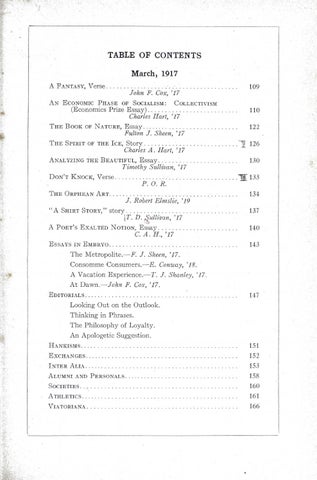
TABLE OF CONTENTS March, 1917 A F ANTASY, Verse . . . . . . . . ..... . ... .·, .· . .. . . . . . .. ...... . . John F. Cox, '17 AN ECONOMIC PHASE OF SOCIALISM: COLLECTIVISM (Economics Prize E ssay).. . . . . . . . . . . . . . . . . . . . . . . . .
[\'
109
110
Charles Hart, '17 THE BooK OF NATURE, Essay. . ... . .. . . . . . . . . . . . . . . . . . . . . Fulton J. Sheen, '17
122
THE SPIRIT OF THE IcE, Story . .. . . . ... . . ... .. .. . ........ ~ 126
Charles A. Hart, '17 ANALYZING TH1i BEAUTIFUL, E ssay. . .. ... . .. . .. . . . . ... ...
130
Timothy Sullivan, '17 DoN'T KNOCK, Verse ... . . .. . . . ..... . ... · ... ' . ... . ......... 'liL 133 P. 0. R. THE 0RPHEAN ART . .... .. . . . . . ... ... . ....... .. <· . .. . . .. J . Robert Elms lie, '19
134
"A SH;IRT STORY," story. . . . . . . . . . . . . . . . . . . . . . . . . . . . . . . .
137
·
(T . D. ,.ullivan, '17
A PoET's ExALTED NoTION, Essay... . . . . .. . ....... . . . ...
140
C. A. H ., '17 EssAYS IN EMBRYO . .... . . . ... .. ..... .... ...... . ..... . . .
143
The Metropolite.-F. J . Sheen, '17 . Consomme Consum ers.-E. Conway, '18. A Vacation Experience.- T. J. Shanley, '17 . At Dawn.- J ohn F. Cox, '17. EDITORIALS ..... . . . .. . .. . ..... . ... . .. . . ............. . . ·.
14 7
Looking Out on the Outlook. Thinking in Phrases. The Philosophy of Loyalty . An Apologetic Suggestion. HANKISMS .. . . . .. . ...... .... . ... . .. . . ... . ... .. ... . .... . EXCHANGES ... . . . ....... ... ...... . ....... . . . .......... .
151 152
ALUMNI AND PERSONALS .... . .. . .... . ...... .. ....... . . . . .
153 158
SOCIETIES .. .- ... . ·.... . ..... . . . . . ..... . .. . . .. .. . ....... .
160
ATHLETICS . . .... .. .............. . . . .. . .... .. . . ........ .
161 166
INTER ALIA . ... . ....... . ...... . ., ..... ·... . ..... . ... . ... .
VIATORIANA ....................... .. ........ . . . . . .... .
II
ADVERTISEMENTS
WEto earnestly request our readers consider our List of Adver.
• • •
ttsements
• • •
• • •
W. S. QUINBY COFF·EE CO. · Importers-Roasters- ] ob bers
HIGH GRADE COFFEES AND TEAS BOSTON Samples sent free on request
CHICAGO Correspondence respectfully solicited
42 East Kinzie St., CHICAGO, ILLINOIS
EINBECK'S PHOTO STUDIO KANKAKEE, ILLINOIS
I
GELINO BROS.
THE BIG STORE
Bell Telephone 407 . 143 North Schuyler Avenue
·J
Comer Schuyler Ave. and Court Kankakee, Illinois
J ~ :{t.
I.
·Jt:l)'·
. Dr. J. A. ZWISLER
ERZINGER BROS .
DENTIST
FANCY GROCERS
City National Bank Bldg. Kankakee, Illinois
Fresh Fruits, Confectionery and Bakery Goods of All Kinds a Specialty. 226-232 Court St.
Kankakee, Illinois
~~'1<'/. q~, :~
'
'拢'''
~.
ADVERTISEMENTS
III
D. J. O'LOUGHLIN, M. D. PRACTICE LiMITED TO
EYE 路, EAR, N 0 S E AND T H R 0 AT Independent Telephone 704 191 Court Street
DR. Z.
J.
Kankakee, Illinois
PAYAN
DENTIST
MAJESTIC The Clean, Clinkerless
COAL Mined and Sold by
Independent Telephone 48 123 Court Street
Kankakee, Illinois
- .OUR MOTTO-
"QUALITY FIRST" In all Our Lines of Goods
J.
LECOUR & SONS Kankakee, Illinois
F. E . LEGRIS, Pres.
T . A. LEGRIS, Cashier
LEGRIS BROTHERS' BANK
CRERAR CLINCH CO. The Rookery Chicago The Best is the Cheapest Independent Telephone 472 We Do Repairing
F. A. LOTTINVILLE SHOE DEALER All New Ideas in Fashionable Footwear
162 Court Street
Kankakee, Illinois
RIELY & RICHERT Electrical Con tractors Agents for Federal Washing Machines, Little Ben Vacuum Cleaner, Tuec Stationary Cleaner and Fostoria Mazda Lamps
4 % Paid 路on Time Deposits 159 S. Schuyler Kankakee
Ind. Telephone 923 Bell Telephone 995 370 E . Court St., Kankakee, Illinois
CHAS. WERTZ CO.
Always drink Pasteurized Milk. Our wagons pass your door every morning before you have breakfast~
Lumber, Cement, Brick, Lime, Sand, Sewer Pipe, Hardware, Plaster, Glass, Coal
BRADLEY
Milk-Cream-Cottage Cheese Kankakee Pure Milk Co. 396 South Schuyler Ave. Both Telephones 45 Drink Pure Milk
:
.
""'
IV
,)P
ADVERTISEMENTS
SPEICHER BROS.
LAMARRE'S
JEWELERS
CONFECTIONERY
Expert Watch and Jewelry Repairing A Most Complete Stock of Diamonds and Jewelry 127-132 Schuyler Avenue
Kankakee, Illinois
Amedee T. Betourne PHARMACY
Ice Cream, Luncheon and Cigars Bourbonnais, Illinois
Clothes for Collegians of Every Type- from the Lively Lads to the "Bookworms"
V ANDERWATER'S Both Telephones 88
119 E. Court St
KANKAKEE, ILLINOIS
DISTILLED WATER ICE The Family Ice
Absolutely Pure
F. D. RADEKE BRG. CO. Both Telephones 132
Mrs . D. H. Kamman
H . Handorf
D. H. Kamman & Co. Manufacturers of
High Life Ginger Ale and Grape and All Kinds of Soft Drinks KANKAKEE .
ILLINOIS
TelePhones: Bell 237-R; Independent 4
C. RUHLE . Manufacturer of Lime
Kankakee, Illinois.
Gas, Electricity and 路 Accessories STUDENT LAMPS OUR SPECIALTY
Public Service Company
Kanlrakee Book. Store 116 COURT STREET
Wholesale and Retail Cement, Brick, Sewer Pipe, Sand, Etc.
Fine Stationery, Popular Copyright Alger and Henty Books, Post Cards and Albums, Pennants and Pillow Covers , Sporting Goods .
Office and Warehouse ~ $03 West Avenue K!\NKAKEE, ILLINOIS
THE GIFT SHOP
,.
v
ADVERTISEME N T S
JOHN J.
DRURY
PLUMBING 路 Steam and Hot Water Heating, Hot Air Furnaces, Gas Stoves and Ranges, Coal Ranges, Hard and Soft Coal Heaters 276 Schuyler Avenue, KANKAKEE, ILLINOIS
Both Telephones 72
THE SCHUYLER McBROOM BROS . .
American State and Savings Bank
Proprietors
154 Schuyler Ave.
..
184 Court Street
Kankakee, Illinois
First Class Restaurant and Cafe
KANKAKEE, ILLINOIS
GEORGE ARSENEAU
D. M. Norris & Son Dealers in
BAKERY ,. I
'路
BOURBONNAIS , ILLINOIS Specialties : Pies and Cakes
Stoves, Ranges, Hardware and Paints. Galvanized and Tin Work T elephone Main 30 201-7 Court St., Kankakee
JOSEPH TURK MFG. COMPANY BRADLEY, ILLINOIS >
"'.,
MAKERS OF .
Columbia Iron and Brass Bedsteads Special attention to Furnishing Institution BEDS
Prices and Illustrations on Application
.., i
VI
ADVERTISEMENTS
Just "HELLO !" From
WUNDERLICH'S ·
STYLE SHOP
BARRON'S CONFECTIONERY
A Store For Young Men The Home of Styleplus Clothes $17
KANKAKEE
Schuyler Avenue
Kankakee
ICE CREAM CO.
Purity and ·Flavor Our Specialty 139 North West Ave.
Kankakee, Illinois
THE LAFAYETTE
Boston Shoe Repairing Co.
HOTEL CAFE
All Work Guaranteed . Shoes Repaired While You Wait. Best Work Neatly Done. ,
Kankakee's Best Restaurant The Proof of the Pudding is in the Eating J. O'KEEFE, Proprietor
JOE SHAPIRO, Prop.
Telephone Bell 1386-2
225 Schuyler Ave., Kankakee , Illinois
ILLINOIS PRINTING CO.
Printers, Lithographers, Stationers DANVILLE, ILLINOIS ~2
Automobile Distributor. 151 East Station Street
G. OSCAR H. BYRON G• A • FORTIN ) · Groceries, .Ice Cream, Cigars and Confectionery .
LUNCH R o' b M Bourbonnais
Illinois
All Standard Cars : -Buick-Hudson-Maxwell-Studebaker-Detroit Electric
AUTO LIVERY AND TAXIS Telephones 40
'
..
+---•-a.-•. -•.-.w-••- ••- n•- ••- ••- ••- n- •.-.w-au- Ba- a.-•. -••- ••- a•- n- •a-•+
i
.
I THE
i
VIAT·ORIAN
I
I
i
lfl'ar d .§ .p.rr a
Ii D
I·
+ u- ••----••- ••- •u- ••- •.-..- ••- ••- •a- au- •a-na- aa- •w- au- uu- ua- •a- au- au- na- •+
.ii
Volume 34
+ •-
•a-
March, 1917
Number 3
lll
ii •
o. a -a•-
•a-
aa-
aa-
aa-
a• -
•n-
ua-aa-
aa-
•a-
u.-a•-
aa-a•- aa-11- t la-
va-
•n-
DI-tl+
A FANTASY One time to me there came a dream of Life As I would live it, when to man's estate I came.
I saw myself in daily strife
With kings and lords of fortune , who would prate About their own successes ; how they rose From small beginnings to their present wealth. From all these m en the life of one I chose To follow, tho ' it lead m e soon to death. At first all things
ob~yed
my beck and call.
I prospered ; became famous; till one day
...
.!!j·
The men who called me friend- they, one and all, Tun1ed 'gainst me and took fame and wealth away. 1
Thus life does not fulfil our early dream, And oft we find t hings are not what t hey seem .
-john F . Cox, '17.
;
!.
110
THE VIATORIAN
+ a -au- a • - i i ii- D t - n n - n i i - D I I - 1 1 - I I D - D l l - l l f - 1 1 1 1 - I I - D i l - I U - D!I - n i i - D I I -1111-11_.111-Dil-DI I - D +
I
!
I
AN ECONOMIC PHASE OF COLLECTIVISM
SOCI~LISM:
CHARLES HART, '17
I !
I
+•-at~-n.t-un-11•t-IJD-aa-•.t-n••-•• u-nu-nJt-tla-nu-ttu-na-aa-au-as-•u-••a-n.-au-tla-D+
(Economics Prize Essay) I
That there is a very obvious and urgent need of far-reaching, and even radical reform in our economic syste1n seems almost like stating a truism. Indeed the dissatisfaction at our present system has b ecome so wide-spread that a large and growing portion of our p9pulat ion is making a powerful demand that it b e discarded entirely and a new economic regime take its place. All agree t hat our modern business activities, w.ith the consequent rise of large scale production, monopoly, and xploitation of labor, have brought u s face to face w.ith problems whose sinister aspect threaten the very foundations of presently organized society. Although the oft repeated assertion, that "while t he rich are grow.ing richer, the poor are 2rowingpoorer," is not in strict accordance with fact, yet t here can be no question that a 1nost inequitable method of distribution has n1ade t he conditions of millions of willing toilers in every quarter of t he civilized globe so wretched and so hopelessly miserable that any expectation of further non-resistance seems highly improbable. Indeed t he faint rumblings of such a resistance was heard in the cry t hat resounded throughout the world in 1848 when the Communist Manifesto sent out the edict, ''Working m en of the world unite. You have nothing to lose but your chains." It can no longer be taken as a light consideration t hat the evils of long hours of work for starvation wages, of unsanitary dwellings, of uncerta1n employment or no employn1ent at all, the abo·m ination ,of sweat shop:;, and the ever-present fear of pauperism, are daily realities to thousands of workers and t heir families in every large city. W e are all fa·m iliar w.ith t he picture painted by Henry George in his ' ' Progress and Poverty''; of the accompanying poverty which moves pari passu w.it h the increase of wealth and the march of material progress. Census reports of our own country but confinn the great social injustice that is everywhere only too apparent. According to the last report of the department of Commerce and Labor, the laborers of United States are contributing from 50 to 65 % to production by their bare labor and are receiving back in the form of wages but from 17 to 21 %. W e learn also from su ch reliable sources that 90% of t he total wealth of United States is concentrated in the hands of approximately one million men, or about 1% of t h e total popula-
~~
THE VIATORIAN
'
I
111
t ion. It is such astounding facts as these that place the grim reality .concretely before our eyes. A noted foreign authority, in reviewing our industrial systemJ sa·id some time ago, ''Your great industrial development has built up very large fortunes in few hands , and the conditions su ch fortunes produce must bring on a class conflict that cannot fail to make a test Df the stability of your institutions . The men who have those fortunes know only the law of greed; they have no respect for the rights of others, and they will surely make an effort to use the strong arm ·Of the government to enslave the people. I see a great conflict which must soon come in America between the few who have vast fortunes and the many reduced to a kind of industrial slavery." A very similar conclusion was reached by that eminent observer of the times, Hillaire Belloc, when he wrote his recent work, "The Servile State." Thus it is seen that any attempt to 1ninimize the urgent need of immediate econumic and social reform must not b e seriously con~id -ered. "All agree," says Pope Leo XIII in his famous encyclical on "The Conditions of Labor," "and ther.e can be no question what-ever, that some remedy must be found , and . quickly found , for the · misery and wretchedness which press so heavily .at this moment on t he large majority of the very poor. , By degrees it has come to pass that t he workingmen have been given over, isolated and defenseless, to the callousness of employers, and the greed of unrestrained competition . . . . so that a nu·m ber of very rich 1nen have ' been .able to lay upon the masses of the poor a yoke little better than slavery itself." The result of attempts to minimize the.n ecessity for social r eform has been seen in the case of despotic Russia, where such .a small amount of work on this line has led to the rise of some of the most dangerous movements ever launched by a depressed people; while in Switzerland, Socialism and kindred move·ments have found few advocates because the . state has recognized its duty in these .great problems and has instituted many economic and social changes. II The particular remedy which is most loudly advocated at the present time is known as Socialism. But what is Socialis1n? This must first be made clear, at least the Socialism discussed in this paper. By this term I do not mean Anarchists who would destroy .a ll government ; nor Co-mmunists who would have all things in common; nor E xtremists or Syndicalists who would u se violence to attain their end . These and a hundred other radical and unreasona ble offshoots about the parent trunk n eed no refutation since they confute th emselves. Modern Socialism as an organized movem ent .and a definite philosophy is a comparatively new move·ment and as su ch has passed through a number of evolutionary stages. Karl
"
112
THE VIATORIAN
Marx of Germany is generally recognized as the father of modern scientific Socialism . The main doctrines of this movement are expressed in the Communistic Manifesto of 1848, the joint work of lVIarx and his H ebrew co-worker, Frederick Engels . The Manifesto has taken a decidedly materialistic conception of history, and as su ch would be路 unalterably opposed to all forms of the Christian religion and morality, replacing these by an economic and philosophic det erminism and a materialistic philosophy. But many prominent Socialist s today are coming to disregard the religious. doctrines of the founders and early exponents of the movement ,. claiming that in the evolutionary process Socialism has thrown off what has been clearly and. absolutely demonstrated as unscientific and untenable. Thus Morris Hilquitt, probably the most promin ent student Socialist in America, in the course of his recent famous debate wit h Dr. John A. R yan of St . Paul Seminary, says as follows: ";It is unwarranted that Engel' s religious beliefs or Bebel' s views on in stit ution s of the family represent the Socialist conceptions on these subjects. Like t h e opinion of a judge on a subj ect not directly involved in t he matt~r submitted t o his decision, such extraneous views are obi ter dicta and not binding on anybody but t he author." Hilquitt himself reject ed t hese radical and unsound views on marriage, family life, and religion, as refuting themselves, and then proceeds t o define Socialism in an economic light as follows : ' ' As a practical movem ent Socialism stands primarily for industrial adjustment . It seeks to secure greater planfulness in the production of wealth and greater equity in distribution . Concret ely stated the Socialist program advocates a reorganization of the exis~ing industrial syst em on a basis of collective or national ownership of social t ools. It demands t hat t h e control of the machinery of wealth-creat ion be taken from t he individual capitalist and placed in the hands of the nation , to be organized and oper ated for the b enefit of the whole people. " This is t he expression of a rnember of the National Executive Committee of t he Socialist Party of United States, which is affiliated wit h International Socialist Bureau . It would proceed by way of t h e ballot box with law and order; it would contrive sooner or later t hat all capit al, or m ean s of production, or sources of income, should be t ransfer;red t o t he h ands of th e state, whether central or local. In other words, t h ere would be a syst e1n of collectivism as opposed to our present system of strict individualism. Now, I am thoroughly cognizant of th e fact t hat m any varieties of Socialism would go much farther and would destroy t h e Christian religion, the present form of family life, and married life, but t here could be no form that stands for less t han t hat expressed in Hilquit t's definition, or more concisely in t he terse definition of Dr. A. Schaffie, t h e eminent Austrain economist, in his "Quintessence of Socialism "- " The Alpha and
THE VIATORIAN
113
Omega of Socialism is the transformation of private and competing capitals into a united and collective capital"; or by Dr. Bliss, editor of the Encyclopedia of Social R eform, who calls himself a Christian Socialist, who defines it as "the collecti-xe ownership of the means of production by the community democratically organized and their operation cooperatively for t h e equitable good of all "-in a word, Collectivism. This is the form of Socialism which is making the greatest progress in our present day. It is the doctrine of the Fabian opportunists of England, the most influential of English Socialistic parties. It is the pract ical Socialism which the Catholic Church is fighting in Belgium today. It is this ~conomic phase of Socialism,. defined above, known as Collectivism, that is accepted by the International Soc~ali st Bureau, and it seems to me that refutation of this form is more valuable than refutations of t he radical forms, which, if they do not refute themselves, are not a fruitful sort of discussion . Dr. W. ]. Kerby, D .D., of the Catholic University, well says on this point: "It is beyond question that Socialism displays an affinity for atheism, for loose views on marriage, and distressing policies concerning the family, and for materialism in philosophy. These affinities alone should have slaughtered Socialism long since, but they have not done so. Atheism is in quite good form . Society at large n o longer believes in the homely, honest, old-fashioned Christian marriage. The views of Socialism on marriage at their worst are no worse than the views incorporated into our modern legislation. The materialism t hat asserts itself in Socialism, u gly as it is, is little worse t han the actual materialism which Matthew Arnold scourged as the curse of his time, ' ' H en ce to urge such arguments against a Socialist or against the greater number of people outside the Catholic Church is rat h er futile since they can n ever look at these points from a Catholic, or in many cases, a Christian viewpoint. Let us therefore attack t his proposed remedy for our desperate economic and social evils from an economic viewpoint, sin ce here at least every Socialist is in accord." On its face it would seem that this scheme of economic collectivism gives great promise as a rem edy for the crying evils in our present day economico-social order, evils which have grown up under our existin g system of individualism and for which we have agreed with P ope Leo XIII, in view of plain facts, that somethin g must be done. Economists have discussed at great length numerous arg uments upon which the Collectivists have based t h eir position, but these may all be summarized into three principal ones, as Prof. Charles D evas, the noted Catholic economist of Great Britain, has pointed out. The first is that known as the argument from justice. It maintains that it is just and fair for 路an men to start alike; and 路 that if a man is to be poor and fill a low station it is to be his own fault and own doing, n ot due to mere accident t hat h e was born of
..
j~
~'路
114
THE VIATORIAN
poor parents, while another is in high station from no personal merit but from m ere accident that he was born of rich parents. The second argument may b e called the argu·m ent fro-m economy and emphasizes t he enormous saviv.g to b e brought about by Collectivism, with its joint and orderly system of production. It claims it would be able to eliminate the incalculable waste which is brought about by competition , su ch as the fort unes sp ent on advertising, traveling sale:;men, etc., factors in every competitive business t hat are really not econo-mic since they are not strictly productive agents. Then there are wastes from over-production of undesirable articles , wast e in delivery of goods in t he competitive system, and ·m any others too numerous to mention. Collectivism claims to be able to end all this .and h olds itself up as t h e logical conclusion, as present large scale . business clearly demonstrates. Not necessarily standing for national collectivity, t his centralized unit need not be larger than the state 0r local government . H ence it would avoid the objection grounded jn economic truth, t hat b eyond a certain definite point, profit from growing large scale production ceases to rise pari passu with the extent of the plant. From this argument t h e Collectivists hold out t he glittering prospect of a vast fund goin g to the general public through avoidan ce of waste, which is estimated to be about 25 % of .all production. The t hird argument may be termed the argument from necessity . I t is supported by concrete facts, t he evils I .have already pointed out-starvation, unsanitary living conditions, overwork with underpay, unemployment, vicious environment which results from poverty, with consequent disruption of the 1noral and physical well being of the masses who now suffer under the regim e of individualism. Such conditions are really intolerable, hen ce t h e powerful appeal of the Collectivists who claim t h eir doctrine to be t he only possible way out of a ll such evil. On t heir face t hese three argu·m ents .are really powerful . It seem s to m.e that su ch arguments as these which t he Collectivists are launching forth really bring more neophytes to Socialis·m t han any doctrine of free love, materialism, loose marriage views, or any other arguments from doctrines for which Socialism seems to h ave an affinity.
III Before taking up a refutation of t hese three main arguments of this economic phase of Socjalism we may pause for a moment to ask t he Collectivists how their system will b e established. Behind is the bleak desert of Ind·ividualism and Capitalism; in front lies the fruitful and equitable garden of Collective Ownership. H. G. Wells in his delightful way tells of it as exchanging " New Worlds for Old, " but offers no practical m ethod by which the transition is to be brought about . Morris Hilquitt, differing from many others ,
THE VIATORIAN
115
admits the enormous difficulty involved in the passage from the old state to , the new. Spargo confesses that ''omniscience would be necessary," and complains of 路Marx's Utopian habit on this point. SchaJfie suggests that the Socialists "might begin by taking only those branches of industry which are already carried on on a large scale and consolidating them into uniform productiv~ public bodies under State regulation and inspection. '' Others claim the transition is inevitable and must come naturally, sooner or later , in the process of economic evolution. The government can help the evolution by smoothing the way. Ernest Untermann, the editor of the new American edition of Marx's Das Kapital, and mo.st pretentious of the exponents of Marxian Socialism in America, recognizes the requirement of saying something about the manner of transforma-路 tion from Individualism to Collectivism; this is his explanation: "Th e antagonism between exploiters and exploited b ecomes more and more intense. It is transferred from the economic to the political field. Organized by the requirements of capitalist production itself, the proletariat adapts its economic organizations to the form of modern centralized industries, transforms its craft unions into industrial unions, writes its economic and political organizations in a well-planned division of labor, conquers the political power, and enables its economic organizations to take hold of the great sources of production and distribution in the interest of the working class ,. which remains the sole essential in society. " As soon as the working class controls t h e nation , economically and politically, it inaugurates a system of collective production, in which the producers control their means of life, determine their own share in the cooperatively produced articles, and remove all obstacles to a full human development . 路 Capitalism leaves the field to Socialism.'' Some few Socialists ; Hilquitt included, incline towards compensation, but many boldly advocate, especially to the workinv.nen, open confiscation. Compensation would b e futile in that it would still leave a large monied class. H ere at the very outset t h e Collectivists encounter a practical difficulty,-the difficulty of transition,and from it they come much the worse for the wear. Not a single Socialist has ever explained this question with any degree of satisfaction. Utopian ideas on such a practical point can have no weight . Now, assuming for a moment, t hat t he Collectivist has established his state, a thing which h e could not do , let us examine his arguments from justice, economy, and necessity. The Collectivists who argue from justice ask why all1nen ~hquld not start on an equal plane. This is an old cr y which has been taken up as the essential doctrine of many movements . It was t he watchword of the French R evolution with its horrible and unequaled regime of crime and bloodshed . It has been exploded to atoms as
' ·'
116
·.,
~
q
•~
THE VIATORIAN
many times as it has been advanced. Science, in all its branches, demonstrates its absolute falsity, for everywhere in nature we see inequality, both mental and physical; we behold struggle, survival ·of the fittest as a common phenomenon. Especially in man are these inequalities most marked-inequalities of health, physical ·capacities, moral and intellectual qualities, temper, wits and memory. As long as these remain unequal in individuals, there will be inevitable inequality in fortunes. This, some Socialists do not seem to realize, in their attempt to give equal fortunes to all men at the start. To prevent inequality from arising they would be compelled to change human natur~ itself, which would be a rather large undertaking. Christianity, it is true, preaches, and has preached for nineteen centuries, ·e quality, but not Collectivist equality. There is one God for all, one redemption, the same sacraments for master and servant;. essential dignity and rights for all, but absolute equality, never. Rather it teaches that all inequalities of rights and authority are from God, that all obedience should have responsibility as its counterpart. The diversity of fortune is Providential and must not be rebelled against any more than we would think of r ebelling because a neighbor has an ear for music, which we have not. By ever upholding the integrity of the family life, Christianity has sanctioned inequality, since it is on this basis that the family is built, and to remove this basis would be to destroy the presently constructed family. As to difference in fortune, it must exist. "For those who possess not the gifts of fortune, they are taught by the Church that in God's sight poverty is no disgrace," says Pope Leo XIII in his encyclical on labor, "'and there is nothing to be ashamed of in seeking one's bread by labor. This is enforced by what we see in Christ himself, who, 'whereas He was rich, for our sakes became poor'. '' As to the equity of holding private property, the Christian doctrine, best stated in the words of St. Thomas Aquinas, is a powerful argument against the equity of Collectivism: " In regard to an external thing man has two powers; one is the power of managing and controlling the thing; and as to this it is lawful for man to possess private property. It is, moreover, necessary for human life for three reasons . First, because everyone is more zealous in looking after a thing that . belongs to him than a thing that is the common property of all or of many; because each person, trying to escape labor, leaves to another what is everybody's business, as it happens where there are. many servants. Secondly, because there is more order in the management of men's affairs if each has his own work of looking after definite things; whereas there would be confusion if everyone managed everything indiscriminately. Thirdly, because in this way the relations of men are kept more peaceful, since everyone is satisfied with his own possession, whence we see quarrels are commoner between those who jointly own a thing as a whole. The other power which man has over external things is the using of them, and as to this man
THE VIATORIAN
117
must not hold external things as his own property, but everyone's; so as to make no difficulty, I mean, in sharing when others are in need." It is further to be doubted whether the Collectivists themselves, if put to a test, would be willing to share their ten dollars a week in England with the same salary a year, which is the income of the low classes in India. If man has the right to control property, the state cannot give him that right nor take it away. It can merely protect it. IV. The second argument from economy- maintaining that Collectivism would avoid the waste of our present individualistic system .and consequently necessary competition-is full of economic heresy. In opposing this contention of the Collectivists we are not opposing .all collective ownership; but public ownership in moderation, such as general possession of the post, telegraph, supply of water, gas, electricity, the railways and the electric tractions, which seem in most cases to be best in public hands, is not, in any sense of the word, the omnivorous Collectivism that would swallow. up practically all kinds of capital. Devas puts it sensibly when he says, "You might as well say that to use 路 butter as part of our diet is a step towards 路e ating nothing else. Collective ownership as an ingredient of the :social diet is wholesome, but as the exclusive diet is fatal. " Father Cathrein, in his excellent work on "Socialism, Its Theoretical Basis and Practical Application," discusses at length some fatal difficulties in the way of this all-absorbing Collectivism. The .first great difficulty is that of economic organization. Either all the property in United States would be worked from one center as one business, keeping work and wages uniform, or else it would be operated from small local communities, the county, town, or city. The first, the Collectivists would discard themselves as impossible since this plan would break down instantly from mere size. The second, .although within manageable proportions, would have other difficul-: ties. Gradually the various localities would develop inequalities of wealth, if not through difference of character of the different communities of people, then inevitably through different natural and economic environments. Nor could it be allowed that labor flow where it would be best paid, since there must be some fixity in the number of people to provide for in each community. If this were not allowed, and it could not be, there would be a condition of serfdom arising. The second difficulty in the way of the argument from economy is that of difficulty of supply . There could be no catering to individual tastes since the providers, without the spur of competition, would be only eager to get through with their work. A sort of barrack room system must inevitably result.
..
路-..~
118
THE VIATORIAN
Then there would be the diffiq1lty 路of employment . We would have little or no freedom of choice. All would have to take turns at working at different occupations, in strict justice, and this would b ~ a most un-vvise waste of human energy, a disruption of the division of labor, and increase of annoyances far exceeding all losses in our present system. Coupled with this is the difficulty of wages. All must receive alike,-payment according to need,-or there must be discrimination according to sacrifice or efficiency. Obviously the first, which would class the skilled and unskilled together, is agajnst t he nature of things . Under the second 路 alternative the governm ent, with no standard to go by or outside wages with which to make comparison, must resort to arbitrary decisions handed down by government officials. This would be a resort to a poorer m ethod than the natural one of discounted marginal productivity now in vogue and would be retrogressive, not progressive. Finally Cathrein points out the difficulty of motives. If all men were naturally virtuous and all desired to work, a Collectivist state would be somewhat acceptable. But as' a matter of fact without the stimulus of reward, of fear of discharge (which would have no value in a Collectivist State, since all are guaranteed a living), of ambition ~ especially when ennobled by regard for parents, invalid brothers, wives and children, with the future taken out of the individual hand, it is not hard to imagine the positive paralysis and slackness t hat would result 路in the economic life. Again there would be another difficulty growing out of the last. This would be the difficulty of developing capital, which is not only accumulated by surplus savings, but largely througl1 invention of new machinery of production. With a particular financial stimulus . gone, the bulk of invention must go with it. Another problem is that of selection of the various men for thejr position in the Collectivist State. Even assuming we had secured competent judges, a very great assumption, competition is absolutely necessary to develop latent qualities of genius and talent. Thus. t hese would be deadened in ~uch a state. Imagine, also, the rampant dissatisfaction at the lists of appointment sent out by the judges .. It would seem impossible to dispose of the present natural selection of our present Indjvidualism. For these vital objections and scores of o.t her economic heresies which time will not permit even to enumerate, we must reject the Collectivist argument from ~conomy . V.
But there still r emains t he great prop of Collectivism, the argument from necessity. We agree with the Collectivist that our present desperate socio-economic order is in need of immediate betterment. We must be freed from the evils of the time at almost any cost. They say society is sick and Collectivism is its only remedy ;
THE VIATORIAN
119
but we, in rejecting Collectivism by breaking down the argument from justice and economy, must then take the only alternative, our present Individualism. In defending this, of course a mere negation of Collectivism would be of no avail. We shall maintain in this concluding part that the present system is fundamentally sound and that what is necessary is a vigorous and effective system of Social Refdrm. This alternative to 路 Collectivism involves no injury to the Church, no _injury to the state or family, and is free from the obstacles which beset the path of universal collective ownership. The road we will take will, then, be neither extreme individualism nor Collectivism but ~ that of Christian Social Reform, or modified Individualism. It will be along the lines pointed out by that great advocate of social reform in Germany, Bishop Ketteler. If we show the needlessness of Collectivism on account of the strength, actual, latent and potential of the existing socio-economic order, then we have shown the hopelessness of Socialism. Society in its evolution is purposeful, or to say it differently, is governed by self-conscious social action. Professor Ely well says, ''We are shaping society in order to accomplish ends which we have in view, and we do not change fundamental institutions which are even tolerably satisfactory. " 路 Perhaps the most important line of true social reform, and one which really includes many others, is that on which Leo XIII laid so much stress,-namely diffused ownership. The government should do all in its power to encourage small savings among the work- . ing class and thus develop the nucleus for a large number of small landowners. This will certainly bring about a more equitable distribution and will stimulate men >to work much harder when they work on that which belongs to them, as the venerable pontiff pointed out. This land should be greatly eased of local or state tax, as is the case in Belgium with such pleasing results. It would further solve the problem of exodus from country villages and would lessen the physical degeneration which results from over-crowding in large cities. Professor Richard T. Ely, of Wisconsin University, in his . "Studies in the Evolution of Industrial Society," has pointed out a number of forces which operate to diffuse wealth; and work along these lines will be powerful in promoting a general program of social reform. Among these forces mentioned, education takes first rank. The spread of technical education, especially, should be encouraged. We have done much along the lines of general education and in the free 路library movement. We are now ready for special education, since we are living in an age which is becoming more and more specialized as to occupations. Further, education requires large expenditure which must be taken out of the current income of society and it is, also, favorable to talent wherever found. Thus it works in .a double manner for wealth diffusion. The second force is control of public corporations, especially
120
THE VIATORIAN
railroad corporations. These are largely responsible for wealth con~ centration. · We have only just begun this work, and to be effective it must be carried much farther. A third item is change in taxation methods. Ourpresent method, as Professor Ely points out, has been, on the whole, favorable to a few rather than to the many. 'T his reform progr<:~-m should seek to extend the inheritance and income tax and should lessen· the burden of small property owners. The aim should be toward public appropriation of the unearned increment,. especially that arising on urban sites. · We should also extend the public ownership of public utilities . Private ownership of these utilities has been a great agent toward wealth concentration. Public ownership will, then, operate for its diffusion. This has been clearly demonstrated in every country where there has been serious reform in this respect. Professor Taussig of Harvard recognized the importance of this needed reform when he said, "It is not too much to say- that the future of democracy will depend on its success in dealing with problems of public ownership and regulation. To allow the great monopoly industries to remain ·without control in private hands is to allow an imperium in imperio,-nothing less then a plutocracy." Another very important reform for wealth diffusion is profitsharing and cooperation. While at the present time they are confined to narrow limits they should be encouraged and extended where practicable. Several notable successes in this field should prove a considerable stimulus. Dr. Stang, the Catholic Bishop of Fall River, in his .work on t< Socialism and Christianity," strongly advocates the spread of labor organizations as another important social reform. These enable the laborer to have an authoritative voice in bargaining for wages and will bring about a more equitable distribution of the articles of production. Christian labor unions in Germany and Belgium are today most powerful agents in combating the inroads of Socialism. The very able report of the Industrial Commission brings out clearly that labor organizations are already making for diffusion of wealth and hence their encouragement is in keeping with the movement for diffusion. ·It is well that the labor unions of American are strongly anti-Socialistic in their tendencies, as the words of Samuel Gomp2rs, President of the American Federation of Labor, testify: "I want to tell you Socialists, that . econqmically, you are unsound; socially, you are wrong; industrially, you are an impossibility." Lastly, we may mention the establishment of credit and savjng institutions and industrial insurance as a most necessary social reform. It is not within the scope of this paper to go fully into the details of this method of reform. These have all been demonstrated as remarkable successes. Their adoption makes for wealth diffusion and helps to remove the contingencies in life, which are the great
,'t
r·
THE VIATORIAN·
121
evil for - the economically-. weak -and -apward-struggling ·masses._· Building societies may also be mentioned. The indvstrial insurance should include old age pensiohs and sickness and accident insurance, an<J arrange for unemployinent. Work along all of these suggested lin~s will prove powerfulagents in remedying the . crying evils .of our. present order and mu·s t be undertaken with a determination that has heretofore not been in evidence in America. In conclusion, let us take to heart the warning of our Holy Father, Pope Leo XIII, who was· ever mindful of the suffering children under his spiritual care: " We approach the subject (of reform) with confidence, and in the exercise of the rights which manifestly appertain to us, for no practical solution of this question will be found apart from the intervention of religion and of the Church. '' , Recognizing the truth of the,se words the English social reformer, Devas, says, "There is a corrosive poison that ea~? away the value of all these social reforms . This poison is irreligion, whether instilled by godless schools, or godless homes, or godless professors. Thus the very Germany that among the great countries of the world leads the vanguard of social reform, is herself afflicted with the gravest social discontent; and Amerioa, w1th all her wonderful resources, is beginning at last to recognize, let up hope before it is too late, that for modem nations even t emporal welfare is bound up inseparably with Christian schools and Christian homes. '' If we plant a strong moral character in the breast of the individual we will have laid the foundation for a stron g moral society. With a brave heart, then, let us look to -the future and hope for the best. Let us work for the betterment of our present socio-economic life through a system of social reform, not through the general destruction of rights of private property.
'' He came and took me by the hand Up to a red rose tree ; He kept his r~eaning to Himself But gave the rose to me. I did not pray Him to lay bare The mystery to me, Enough the rose was Heaven to smell, And His own face to see." - Hodgson''s "The Mysterr."
122
THE VIATORIAN
+--••--•-••-••-••-••-~~•-..,-••-••----••-••-•u-aa-•.-••-••-a•-••-••-••-•--•+
i
j j
.
.
THE BOOK OF NATURE, Essay.
i j
FULTON J. SHEEN, '17. : .+•-••-•~~-••-••-••-..-•a-t~a-aN-•a-••-:--•u-•a-..-au-uu-••-••-••-••-••-t~•-•A-••+1
'' The spacious firmament on high With all the blue ethereal sky, A nd spangled heavens a shining frame, Their great original proclaim. The unwearied sun from day to day Does his Creator's power display }· A nd publishes to every land, The work of an Almighty hand." Examine every part of t he material universe, and find, if you can, a single department of it, from the mineral to the animal kingdom, which is not under the r eign of law and order . From the stately march of t he bright celestial bodies to the infusoria in their narrow homes, in which every want of t heir ephmeral life is provided ; in every corner of t he universe, in every form of matter, animate or inanimate, law and order publish the work of an Almighty hand. Not only the spiral of the vast nebula which covers half the heavens, but even t he curve of a tiny leaf that shelters the insect are r eflections cau ght from t his Intelligent Eternal Mind. Just as a piece of chiseled marble bespeaks the sculptor, nature by a thousand voices of its marvels, cries out to us, Ipse fecit me}· for "Nature is the glass reflecting God, As by the sea reflected is the sun .'' The great luminary, t he sun, which was called out of nothingness to preside over the day and hung in the immensity of space according to th e law of gravitation, and assigned a definite course wherein Phoebus might drive his cart round " N eptune's salt wash and Tellus orbed ground," is t he ver y personification of Harmony and Order. Not once during t he eons of ages has this luminary varied a fraction fr om its course. The comets also, apparently stray . visitors that come from the stellar region to pay their homage to the great monarch of the solar system , are under the sam e inexorable law and order. Countless is the number of stars; their paths are intricate and varied; many of them have three-fold and some even four-fold motion. Yet t hey follow their orbits and paths along courses, spiral, eliptic and hyperbolical,. with the utmost precision and regularity. What a wondrous and harmonious movement is observable in the myriads of worlds, each one contributing its share to the grandeur, unity and harmony of the whole! There is no
THE
TORI
12
haphazard collision. Each and e ery planet follows it paths at its prescribed rate of speed, never varying even a fraction of a econd: All is beauty and symmetry. "In reason's ear those orbs rejoice, And utter forth a glorious voice. Forever singing as they shine, The hand that made us is divine."
. The planets then are the time-piece of all nations. The immense clock always gives correct reckoning. It never runs down. It never requires the services of a jeweler to adjust its intricate jewels. Its dial is the sun, and its myriad hands indicating time are the earth, moon, stars and planets. Laplace has given us indisputable proof that the period of the earth's axial rotation has not changed the onehundredth part of a second of time in two thousand years. Man cannot make a clock that will tell the hours for a single day with the exactness that this vast globe has done for all recorded time. Since no one will deny intelligence to the crudest sundial wrought by the hand of man, then why should an intelligence of infinitely greater genius be denied to the maker of the world clock? Was not an intelligent being necessary to design this intricately jeweled time-piece? How absurd it would be to suppose that "there can be a clock without a clockmaker (Voltaire), or that a chronometer can keep the exact time without an intelligent artisan to regulate the movements of its mechanism." Unless man is to deny analogous reasoning altogether, and stultify himself, he cannot deny the exi$tence of God presiding over nature and its operations. "Wondrous truths , and manifold as wondrous God hath written in the stars above, But no less in the bright flow' rets under us Stands the revelation of His love."
I can imagine a St. Francis looking at a virgin lily and saying: . "Who made you, little one, and who made you so lovely and so frail?" What mind conceived the lines of wondrous beauty in thy graceful calix? What master hand blended thy exquisite colors which defy even the brush of a Raphael? Does blind nature know enough of beauty's ethereal essence to weave and paint by her unguided forces only such unparalleled loveliness? What place has the unconscious chemistry of Nature here ? Must we not here again admit that the lily is a shadow of God-and Oh, how bright and beautiful must be the face which casts such a shadow! No less wondrous is the beauty and symmetry and even excellent adaptation of means to an end to be found in animals. Every time the humble bee builds a hive he solves the problem of the maxima and minima-a problem mathematicians have wrestled with for centuries,
124
THE VIATORIAN
yet no one has ever approached its solution so closely as the bee. :Hardly are all the parts of the young bee dried, hardly are its wings in a state to be moved, when it knows all it will have to do during the rest of its life. Let us not be astonished that it is so soon well instructed; it has been so by Him who formed it. Ascending higher in the animal kingdom we find man the embodiment of the masterpiece of mechanics and architecture. Among all tp.e machines and inventions of man there is not to be discovered one single device that is not found in the human body. The arch, the lever, the inclined plane, the pump, .t he grist mill, the camera, the 9tringed instrument, hinges, pulleys, ball and socket joints-all these and a score of other man-made inventions are merely crude copies of the wonderful devices found in man's body. Yet we posit intelligence as a cause of these things. Why not admit an intelligent designer of man? While we admit purpose in the wigwam of the Indian, there isn't a man on . earth who stumbled on the rudest hut that would conclude it was built by an · intelligent agent for protection against the elements. .But when this same purpose is found in the palaces of kings, will any :one deny that it was designed by a much greater intelligence.? But a palace or a Gothic cathedral are poor and wretched things compared to the human body. If one supposes purpose or finality in the hut, wigwam, palace or Gothic cathedral will he be so rash as to deny it in the latter case? Is there not also a need of a wondrous architect .to design the materials of the human body? How grand, moreover, is the human intellect, in virtue· of wruch we are likened to the prototype. Could the blind, unguided forces of nature mould an intellect capable of the achievements enumerated by Abbe Causette [ "See man proudly marching along in the midst of the treasuries of the mind contained in the libraries and museums of Rome, Paris, Munich, London, or in the midst of the marvels of a Universal Exposition, all of them the products of his skill and intellect. Hear Him: ''I am the author of the Iliad and the Summa Theologica of St. Thomas Aquinas; I am called Plato, Augustin, Bossuet; I composed the music of Rossini and of Gluck; I have caused the old world and the new to thrill at the accents of Pindar, Euripides, Racine, · Corneille·; I built the Parthenon, and launched into the air the cupola of the Vatican; I weighed the stars in the balance; I have analyzed their elements and have followed the course of the sums in the depths ·of space.; I have discovered unknown continents and sailed as master on all the seas; I have brought into the light of day and studied a world of animalcules; and I have succeeded by the achievements of medical and surgical science in prolonging the averag:: life-time of my fellowmen; bending the forces of nature to my will, I have harnessed steam to my chariot, and spoken to my fellowmen from one end of ·the world to the other with the speed of the electric current; I have made the c1vilization of Babylon, of Athens, of Rome and of Christian Europe. '' · Chance or blind forces could not have created this great
THE VIATORIAN
125
intellect and power, for chance could not create the smallest atom. 路 Here again we must posit an intelligent cause of this wondrous piece of work, so "noble in reason" and 1 'infinite in faculties ." Yet as great as map.'s intellect is ,. it is amenable to a still higher Intellect~ God Almighty. Every particle of matter, animate or inanimate, then has stamped upon it the Intelligence of an Almighty, all Powerful God. The deeper we study the secrets of nature, the deeper shall be our reverence for this Intelligence by whose unfailing design all laws and all elements are moved. Wherever we find order we find intelligence as its cause; but we .find multiplied examples of finality and order in nature. Therefore Intelligence is the cause. Now this order., whose existence we have just established, is in the very nature and essence of things and consequently, absolutely inalienable from the things themselves.. Thus conformity to design is the essential mark of an organism, and as 路 Be, who determined the form, determined also the essence,-for we are speaking of essential forms,-then this same being must not be merely an Architect but the Creator of the World. If this regulating intelligence is not divine, whence and from what has it received its origin? To avoid following into an infinite series one must admit that this ordinating intelligence springs from a first and Sovereign Intelligence which is the Necessary Being-God. And with the poet we sing: '' Thou art, 0 God, the life and light Of all this wondrous world we see; Its glow by day, its smile by night, Are .but reflections caught from Thee.' '
,.
"Hope which comes to all, O}.ltwears the accidents of life, and reaches with tremulous fingers beyond the grave and death . Easy to say: yea but also, by God's mercy, both easy and grateful to believe!'' "God's in His h eaven, All's right with the world." .
126
THE VIATORIAN
+)..-.(·- · - ·---·--·--·-·---·-··-·--··-·---·-··-··-··-··-··-·-----·------•---;•+ i
I.
THE SPIRIT OF THE ICE. CHARLES HART, '17.
·~I
1.
.
+•-••-•a-t~a-ta-ta-ea-•a-at-h-111-'~1-att-a a-11-111-la-ta-aa-aa-•-ea-aa-aa-•+
It was while visiting in Alaska some years ,ago in the interests of a client that I first came upon J ean Dautoil, familiarly known throu ghout a goodly area of the Klondike as " The Frog." Jean was a tall, very thin, and very angular French-American who had been born and reared in a small village near New Orleans, in the States. H e had migrated along with the other thousands in the . days of t h e great rush to t h e frozen north, drawn by the lure of gold. Like many of these same t housands, J ean was sorely disappointed and found sickness, exposure, and famine in place of the fortune h e had expected when his "strike" would be fort hcoming . . Indeed he was one of the not very large number who had even lived through those awful first days when t h e t urmoil was at its h eight. The vilest of all passions which held the sordid mob tightly in its grip stifled any feeling of humanity t he lucre-mad souls might know. Around the mining camp of the Whitfield, far in the interior ; there was no exception to the general rule of lawlessness, debauchery and crime that ever shows itself in su ch communities. The law of the jungle reigned supreme here as in a hundred other centers of that great graveyard of dead hopes men are wont to call the Klondike. J ean was a young man in those days, he told me-young and full of the buoyant life that is youth's priceless possession. But that was almost thirty years ago. Now he was on the shady side of fifty, a life almost spent,-old age coming on, and only a cook in a mining camp. H e was one of the many dismal failures. How h e had survived the struggle, th e passions of men and t he worse, if possible, relentless warfare the terrible climate had waged against· his weak constitution, does not admit of an answer. H e was only another of those inexplicable anomalies one meets with everywhere in life,outstanding instances seemingly at varian ce with every rule that m en believe most rigid. During my stay in the vicinity of the camp I became much interested in Jean and prided myself in my ability to draw him outsomething few people were ever able to do if one is to believe the reports of him which his fellowmen readily gave. Notwithstanding all these I found his very sullenness attractive. H e was so different from the common run of Northerners who were generally only skindeep in character, mere gold-hunters, greedy in their su ccess, brutes in their failure. "Pretty dull, this frying bacon, making bread, and cooking coffee
THE VIATORIAN
127
in endless round, without variation, and all for a pack of snarling hungry wolves," I ventured one day when the ice had been broken. "Rather," was the laconic reply . But then in a burst of unaccus- tomed emotion he faced about, " Oh, yes, it's hellishly dull. I don't know how I stand it: but I guess the spell of the North is in my blood. I've often wanted to go back home, to the States, to my own home, but I can't. I can't leave. These mountains, the snow, and ice, the long nights and skits of day have got me tight. And they won't let me go." After this outburst he went into his shell again and attempts at conversation were useless-all the talk on my side with morose grunts from Jean to interpolate my sentences. I gave it up as an exceedingly bad job-chagrined indeed at this worst of failures when I thought I had captured him. It was not more than two days after this defeat that I was given another jolt. I was busily engaged in letter-writing when Jean rushed in upon me without notice and threw a legal-looking envelope ·o n my table. He was trembling with en;10tion , a tense, determined look in his face instead of the usual dull hopelessness. "Read," was the only word that came from his thin lips. I read-·an announcement from a law firm in New Orleans that a long search had ended in the discovery of J ean's whereabouts. H e was to come back to his native village to receive a comfortable sum from the estate of his father, just deceased. " I 'm goin' this time, by God, I'm goin'. I'm goin' to leave this -dog's life behind and hit the States where I was born." "Jean, old fellow, I'm glad," I said, "You've been down long ·enough, and kicked and beaten. 'It's time you got a rest. Good luck .and happiness . You've made a 'strike' at last." There was just the trace of a tear in his eyes as h e gathered his few belongings together next day and departed without much ado. With a small amount I loaned him, added to what was coming to him from the camp, he could get to Louisiana. As h e stood at the shed which served as a depot, awaiting the train that was to take him far ·off to the Southland, he gazed with a hungering look at the mountains, with the river winding at their feet. Snow and ice covered everything. It was chilly and uninviting. The sun wore a leaden hue, as always, here near the earth's end. The sky was white and pregnant with another snowstorm. What a place to live! And yet I could see from the rapid heaving of his breast that for this piece of humanity's riff~raff the parting from the place of thirty years' habitation was no easy matter. But h e did not say a word. With a tight, nervous grasp of the hand he bade me _good-by and boarded the train which had drawn up at the station. The last I saw of him (as I thought) was a long, gaunt , hungrylooking figure with eyes fastened on the hills; drinking in, as it were, the Spirit of the North, with a never-quenching thirst. ·
128
THE VIATORIAN
In my supposition that I should never see the "Frog" again, it happened, rather oddly, that I was quite mistaken. It came about in this wise. I have an inveterate habit of taking short mid-winter vacations and about a year after the events which I have already narrated, I decided upon a trip to the Mardi Gras of New Orleans. To this center of amusement I proceeded as swiftly as the lightning Seminole limited would carry me. All went urushingly" until we were within a half hour of the festival city. Then the porter went through and announced some sort of defect in the engine which would delay us for at least an hour. I quickly grasped the opportunity for a little walk through the quaint little Southern village where we happened to be stranded. It was a straggling, lazy town of a few streets in the midst of great fields of cotton that stretched away from its limits in fiat, level distances as far as the eye could reach. I wa$ proceeding leisurely to the south when I noticed ahead of me a very familiar form . I could not be mistaken. Hastening up I came upon no other than the ''Frog.'' 路 "Jean," I cried, "this is a great pleasure." His eyes lighted up and I could tell he was not less glad to see me. l\l[y, but .he had changed! He was thinner and more gaunt than when I saw him last, if that could be possible. " Down at the end of the street, I live with my widowed sister. who is keeping house for me. Do come over," he 路begged. I had nothing to do but consent and I was soon making the acquaintance of a stout, elderly lady of very good-natured appearance. Everything about the house, inside ?-nd out, was neat and inviting,-so home-like and comfortable. " My! Jean, you must be happy at last with such a fine place to live." He did not answer, nor did his sister say a word. There was something wrong, but I felt that I must not inquire. I explained my presence in their village and we had a pleasant chat together. The sist er was indeed a light-hearted, happy woman with a merry laugh that almost succeeded in bringing a smile to the sad countenance of Jean himself. Our visit ended with my solemn promise to run out from New Orleans for a stay of at least one afternoon and evening. Accordingly after I had been in the city 路a week and had fully enjoyed all the carnival, when the queen was ceremoniously crowned I betook me to the home of my friends quite unprepared for the announcement that was to greet me. The sister was sitting on the porch, eyes swollen with tears . '(He's gone," she sobbed. "Jean-left last night without .... a single good-bye. Gone and left me alone and only this scrap of paper to t ell anything about his going." She handed me the note that had every appearance of 1nuch reading and upon which many a tear must have been spilt. I could just barely decipher the cramped, scrawled hand:
.,
'
THE VIA TORIAN
129
''Dear Sister:-! leave you all that is mine here. I'm going away., up North to end my days.. I can't stand it here, this heat and the cotton-fields and路 all the rest. I got to get back to the North, to the snow and ice and the hungry pack. The days never end here ~nd they put no grip in your blooq. I'd die if I didn't go, and the longing has 'most killed me already. Your Brother.'' I left her sobbing as though her heart would break. no comfort, for the hand of fate had done its work.
I could give
". t
l
"I that on my familiar hill, Saw with uncomprehending eyes A hundred of Thy sunsets spill Their fresh and sanguine sacrifi~e, Ere the sun swings, his noonday sword Must say good-bye to all of this:By all delights that I shall miss Help me to die, 0 Lord." -Melbourne, from" Before Action."
130
THE VIATORIAN
-tft•-•--••-c•-••--•-••-••-••-.. -••-•~~-t~•-at-•11-••-••-aa~u.--a-••-••-••-••-•t
f j
.
ANALYZING .THE BEAUTIFUL. TIMOTHY SULLIVAN, '17.
t j
.
+.-..--a-••-••----•-•u-a.-.a-~~.-••-••-••-••-••-••-••-••-••-••-••-•a-~~~t-•+
::
The word beauty suggests at first glance something abstract and philosophical; it seems to carry us beyond the range of tangibility and transcend all things material. Yet in order to discern and appreciate the beautiful, where can one go but to something·material and tangible? In this instance, poetry is the thing in which the beautiful -is found in all its exquisite fineness. The poems are few in which there -is not found beauty of some sort. Even in the ugliest lines written in English, some critics will maintain there exists beauty. Due to t he inclusiveness of the term, they will contend that this line from Caliban : "Flat on his belly in the pit's much mire, With elbows wide, fists clenched to prop his chin," has beauty. The form cannot but provoke a repulsive thought, yet there is to be seen greatness of power in the poet's imagination, from which a certain pleasure is derived. Beauty is an essential elem,e nt then in all good poetry. When the artist tries to realize his conception on canvas he rejects everything ugly and paints only that which is beautiful. He will, with the power of his imagination, produce the beautiful as more beautiful still. So it is then with the poet, who by his brushes of imagination and fancy can paint a more beautiful picture in words. H e can carry his reader into realms which the painter ot sculptor cannot reach; into a field which seems celestial. Shelley for instance, wrote of the "Unbodied joy whose race is just begun." Keats intimates the immortality of the human soul with an exquisite beauty almost inconceivable and ends his "Ode to a Nightin_gale " with these words : ' ' Charmed magic casements opening on The foam of perilous seas, In faery lands forlorn," ·thought by many to be the finest bit of imaginative work in English poetry. Not only does the poet employ beauty as his subject matter and -reveal it more than actually perceived but he also uses beauty to affect his st yle and form. He will hesitate awhile in his writing t o adjust and rearrange his words and sentences so as to produce a beautiful effect. A stiff prose sentence may express the thought even more concisely, but it is the poet's delight to linger for a moment and to rewrite it in his poetic ~orm. He has at his disposal accent ,
~("' _· ,;~
·~I
•_
-' '
-~--
j
·~
.t·
THE VIATORIAN
·",.
131
rhythm, quantity and one quality to achieve his style and to create );lis beauty. With these external elements, he can realize the beauti.. fu1 in his piece, be it an exquisite little lyric like the "Hymn to Dianerne," or be it a tremendous poetic achievement such as Milton's ''Paradise Lost.'' ·The·poet can picture in delicate fashion the burst- ·. ing flower of springtime with his honeyed tongue and he can likewise follow in verse the course of a man's life, divulging all the secret passions o£ his sou1. Hamlet, with his highly sensitive nature~ struggles through life under the shadow of an unnatural circumstance, and all this is vividly and beautifully portrayed through the channel of poetry. Taking the element of the beautiful as applied to all those things conceded to be beautiful, it is just to conclude that it always awakens a noble emotion·in the reader. This emotion is not however understood in the philosophic sense, as an intrinsic attribute of beauty, ·but as co-extensive with it; that is, we find it wherever we find beauty. It is ever calculated to awaken a noble emotion. We certainly cannot admit that the beautiful gratifies only the senses and nothing more. · The painter, for instance, may spread his . canvas and daub it with many colors, but no matter how delicate each shade may be, unless they are all in harmony we cannot call the reE;u1t beauty. The pianist may strike a chord on the piano which is pleasing to the ear but which might not be called beautifu1. Undoubtedly we often do apply the term beautiful to sounds and colors which merely gratify the ear and eye. But is not this at least inaccurate. · If we consider how different is the effect produced upon us by a painting of the Madonna from the mere sense gratification produced by a particular shade or combination of colors, we can discover the truly beautiful. If we attempt to appreciate the difference between a Beethoven symphony and the meagre pleasure given by a few chords of music, we will see that they belong in different categories. The former is truly beautiful while the latter is not, in the strict sense of the term, beautiful. As mere sense enjoyment does not constitute the beautiful ~ neither do proportion and order manifest it. A geometric figure may contain all these; a piece of music, too, may have these· characteristics and yet leave one unimpressed. It is not merely the symmetry of the human face or form which realizes beauty even though it contribute partly to the completed whole. But what is it then that makes a thing beautiful? We must apprehend with these something else in the object. First it is the idea conveyed; our minds are con- . cerned in the process as well as our senses. In a beautiful painting some great idea is always evoked in thepainter'smind. In the painting of the Holy Family peace and contentment is suggested perfectly. A painting of a golden sunset may lead the reader to contemplate the unfathomable depths of eternity. In a poetic piece such as
132
· THE VIATO.R IAN
Gray's "Elegy," the r eader feels the quiet and peace which rest "where the rude forefathers of the hamlet sleep." These ideas may not be entertained immediately however by all who look on such scenes, but through the poet's idealization the read~r is able to receive a nd appreciate them . And the fact that we require such idealizatimi from the poet only proves that the idea must come to us, as well as t he form, shape, and proportion.· One might say that there are ideas, however, which may be evoked, but which are not by any means poetic or beautiful. A sunset might su ggest nothing more to some than a clear day on the morrow. There must, then, be an esthetic emotion awakened in the breast in order that we cari term the cause of it beautiful . This sort of emotion is as difficult to define as the original conception of beauty; Our emotions are by no means clear and simple; they are rather complex and int ricate. But when an emotion is awakened in us which is truly noble by the appreciation of a piece of work, we may call t hat work beautiful. When all the ugly aspects are removed from a poem and it is purged of all dross it then pleases the sense and st~rs a feel1ng of beauty. A noble emotion will spurn all that is base and vicious; it will rise above any sort of selfishness; it will not confine itself to the purely sensuous and it will not waste time on that which is trivial and m erely amusing. It springs from the heart and effuses from t he soul, which after all, must be the seat of all true sentiment. Let one read Elizabeth Barrett Browning's "Cry of the Children", and he i s excited to pity. We cannot however call the social condi..: tions described t herein as beautiful as is the skylark's flight, but there is the emotion of pity excited by the pain, horror and suffering of these English mill children. The poetess has presented the shocking circumstances of her theme in an appeal to our sympathy. It is the office of t he poet· and painter to idealize for us. ·In ordinary life our· noble emotions are often obstructed by baser influences, and he must not only picture the native thing but he must likewise separate the. beautiful and the non-beautiful, emphasizing the good and suppress ing t he evil.
"The poor of J esus Christ whom no man hears , Have waited on your vengeance much too long. Wipe out not tears with blood. Our eyes bleed tears. Come~ smite our damned sophistries so strong That Thy rude hammer battering this rude wrong, Ring down the abyss of twice ten thousand years. - Belloc.
•.'
THE VIA TORIAN
133
'
l
~·---•u-••-•u-a•-••-a•_,•-•n-uu~••-••-••-•••-aa-au-aa-••-•u-ua-••-1!•-t~+
i
f.
1
;l i•
DON'T KNOCK
i=
+~D-IIt-11-IU-IIl-tii~III-IU-b-IH-I:Ia-IM-Ili-IIU-au-na-111-UU-IID-IR-IU-nU-lll-1+
Now, what's the use of hammerin' , When a feller's down, and stammerin', All the things he did, and didn't do, and don't; Just take him by the hand and say, '-'Cheer up'·' old pal, what's wrong to-day? And meet him with a smile and pleasant front . There's enough to do the '' knocking '' And exclaim, 0 my, how " shocking," · Did you hear that Mr. So-and..:So fell through? 'Tis a friend of course who tells it , And another friend who swells it, It's a volume when the story reaches you . . ...
Just take this "tip "; the rifle Which aims at every trifle, May kick, " mon cher ami," and shoot your way; We all must taste earth's sorrow, But for each there comes a morrow, When the "under dog" will surely have his day .
P.O.R .
134
THE VIATORIAN
Ii
+ 1 -I I- I I . . . . . - . 1 1 - I I I - Q - I t t - 1 1 - 1 1 - t l l - t l l - l l l - l l l - e i i - 1 1 - I U - I I . . . . - r l - a l l - e i - 1 1 - I I - I I I -J: I I - I t +
I .
I
THE ORPHEAN ART.
J. ROBERT ELMSLIE, '19
+---•-••-•.--u-••-••-••-••-•u-••-••-••-•w-lla-IJI-t~l-••--et-ua-••-••-q-••-•+
''Orpheus could lead the savage race A nd trees uprooted, left their place, Sequacious of the lyre."
Music is simple, beautiful speech. It is the use of a power and an organism with which our Creator has endowed us, not for buying and selling, nor ·for the ordinary and necessary housel:10ld speech~ but for the higher speech of love, of sorrow, of joy and adoration. If ·it be fitting, that is, solemn and reverent,-if the sound and sense agr ee, t hen it is the most beautiful utterance of which we are capable, and has nowhere so appropriate a place as in the house and worship of Him who hath made everything beautiful in His season, and disdains not to paint with exquisite hues the flowers in the hedgerow and the spider on the wall. Music is the natural language' of the soul in its higher moods; eit her in the state of rhythm or poetry, or of melody and harmony . Joy sings, sorrow sings when it can, and its voice is a plaintive murmur-at least, when it is not a petulant whining, or a hardened defiance and rebellion. Now adoration and worship are the soul in its highest moods. There is no sorrow like the sorrow of a broken heart beseeching its God, and no joy like that of a man who joys in his Creator. In the history of the Universal Church it has unconciously shaped itself into poetry and song from the very beginning. The Psalms to which we fly in our various moods, as the means which will m ore fittingly than aught else give utterance to t.hese moods wer e originally hymns, written to be sung,-many of them addressed to t h e choirmaster of the temple service. The hymnology of the Church , which is now b ecom e so voluminous, have had an organic growth and development from the mere rhythmical and often doggeral translation of the H ebrew psalms into modern speech, which culminates finally in those richly varied and beautiful poems which make our channels of praise today. And this has been an obedience, not merely t he custom, blindly followed , nor to tradition slavishly obeyed, certainly not to any tendency on our part to copy the old Hebrew service ; but, as I b elieve, to an inward necessitating impulse, which has created this hymnology as the earth and spring covers its floor with flowers. But what are these hymns? Are they merely praise, t he utterance of the soul in its jubilant or thankful mood ? No! They comprise every variety of utterance that can flow from t he human soul, running, as they do , the whole gamut of feeling from t he violent passions Timotheus' lyre aroused at Alexander's feast
;'
......
,_,
路'
.. THE VIA TORIAN
135
to路the ennobling prayers which Cecelia's organ poured forth, of which it has been said: 路 " Bright Cecelia raised the wonder higher When to her organ vocal breath was given; An angel heard, and straight appeared, Mistaking earth for heaven!'' The song that is either descriptive of love, joy, happiness, loss, trouble, sadness, beauty, terror or any other human feeling or human sensation; the song that is pure and simple is the one composition that is becoming prominent as a great feature of active musical life. No other musical form speaks to us as the song; it represents human life better, more simply, more truthfully and more impressively than any other musical composition, however grand or important. To sing a song, a speaking, earnest, throbbing, tender song well, is the acme of music, the artistic height of all musical expression. Says John Dryden. . "And heaven had wanted one immortal song;" for one immortal song would satisfy even heaven. As Milton asserts in his "Paradise Lost,'' ''Song charms the sense.'' Aye, and does it not? Go the round of the real songs composed by Mozart, by Haydn, by Handel, by Beethoven, by that prince of song-writers, Mendelssohn, by Schubert, by Schumann, by Stendale, Bennett and numberless fine song writers; will some of these songs not satisfy your most .musical longings? Song writing, I fancy, has flagged for a time in this twentieth century, but it will come forth vigorously again, and many a composer, who will write an oratorio will be proud of that one song, which some great artist will sing as he wishes it to be sung. ''A song to drown your soul in,'' as one great writer says; ''A song to lose your love in,'' as another added; ''A song to bury your sorrow in,'' as another supplemented. The song is a direct inspiration from heaven; it is a language of heaven, it is the true divine blessing sent down on us. No people live that have not songs, for where there are no songs, \there is no national life. All national aspiration finds its highest expression in this form of music. At present we have many song composers, I mean songs that are composed for themselves, not in connection with . any other musical work. The English speaking people are coming nobly forward in songs. Whole concerts can now be made up of songs.
136
THE VIATORIAN
People will listen to them intently and find in them a response to their own feeling. Songs are becoming valuable musical property, for there are always songs which find a public, which will always be' listened to with delight and can never die. The study of the song should be encouraged among artists especially, for it will cultivate their tastes and keep them in that true artistic vein, that is the groundwork of all higher musical progress. To Madam Adelina Patti we are indebted for the following beautiful thought: "What a marvellous thing is music? And how little are we able to fathom its deep mysteries, and yet does it not live in the very heart of man: Does it not so imbue him with its grace and beauty that his mind is wholly engrossed by it; that another and purer life seems to raise him above the shallows and miseries here on earth.'' Yea, the very universe itself began with music if we may believe the poet whom Carlyle has proven to be also a seer:
"From Harmony, from heavenly harmony This universal frame began: When Nature undern路eath a heap Of jarring atoms lay And could not heave her head, The tuneful voice was heard from high, Arise ye more than dead, Then cold, and hot, and moist and dry In order to their stations leap, And Music's power obeys." Thus also is the end foretold:
"So when the last and dreadful hour This crumbling pageant shall devour, The trumpet shall be heard路on high, The dead shall live, the living die, And music shall untune the skies."
R eflect upon your present blessings- of which every man has many-not on your past misfortunes, of which alltnen have some." -Dickens.
137
THE VIATORIAN
+•-••-wu---aa-w....,..u-a.-.s-wa-wa-t~a-w.-aa-wa-au-aa-ea-au-a•-au-aq-ta-•u-o~a-a+
'j f •
A SHIRT STORY. T. D. S., '17. .
.
is ~ ·=
+u-a.-an-•a-au-nu-na-ea-a.-.n-ua-•~1111-n.-aa_.a-••~•n-an-•a-••-•n-na-uu-a+
. At 6:15 the front door of. the M~son home flew open and in rushed Mr. and .Mrs. Mason's only son. . Tall and straight }J.e was, with curly black hair; brown eyes and feet generous enough tote manly and yet welcome on the dan~e floor; dressed a-la-mode and responding to the name of Robert. Bob breezed through the living room with his peppery, "Hi, Sis! Hello, Dad!" · She replied, "Hello, what's the rush?" while his father glanced up from his paper onlyto see his son's flying coat-tails as Bob bounded up the stairs to his room~ "He ·must have something big on this eyening," remarked Helen Mason ·to her father. , "Wouldn't doubt that he has, judging. from the _excessive speed in going up those stairs," breathed John Mason as he adjusted the . daily sheet, for a look at the financial news, even though he was only the president of a struggling soap factory . "It's about time that fellow would get the social bug out of his bonnet and attend more strictly to business.'' · "Oh, Dad, he's perfectly all right now," put irt Helen; "he is just having a good time out of business hours; never does anything worse than dance and fuss the girls a bit.'' · At this juncture Mrs. Mason entered to announce the).t supper was ready. · A kind and motherly-looking woman, with her .fluffy white hair; glasses, dependent on her ears for their stability, and wearing a dainty white apron, all of which seemed to promise a wellfilled table somewhere else in the house. She was the typical wife of six and twenty years. . ."John! Helen! come now or the things will be cold," she said, "and where's Robert? I thought I heard him come in." "Qh, he's probably arranging himself for some festival this evening; he passed through here a few moments ago," offered her husband as he uncrossed his legs and arose from the comfortable depth of his favorite chair. "Helen, tell Robert to corhe down and let the dressing go, so that we may have supper now." . "Very well, mother," responded Helen as she sailed up stairs to get Bob and possibly pick .up a little gossip about the social world outside, for she was not yet seventeen and had had only one beau whom her Dad had ousted, just because the paternal instinct of John Mason was too pronounced to like the young Romeo's looks,-and furthermore Helen was too young.
138
THE VIA TORIAN
" Bob! " she called as she approached his room . " Y es!" answer ed h er big brother in a sort of half angry, and half disappointed tone. " " Supper is r eady and mother wants you to come down immediate!y . " " I 'll be down in a minute "-snapped Bob . H elen's big eyes widened in wonderment at h er brother 's ilnpatient answer . " Why, B ob , dear, what 's the matter ? you see!I! so surly. " sh e ventured t imidly, for every m ember of that household considered it almost a duty to r espect and be subservient t o the family Lares for his social standing. " W ell , cmne in h er e and y ou'll see." H elen enter ed eagerly, curious to know t he t rouble and a nxious to do anything that would bring her broth er back to a t ranquil state of mind: " Look at. t hat," h e said, using his forefinger to indicate the point in question. What H elen saw was a bundle of laundry wit h t he paper folded back ; laundry which has no place in a gentleman's dresser ; lace t hings, t iny 'k er chiefs and the like. Ther e they lay in all t heir dainty whiteness; but of no use to t his r epresentative m ember of t h e oth er sex. " What t he devil mn I to do with a date in forty-five minutes and not a clean shirt or collar to m y name. Some serv ice that buttoncrushing establishmen t gives a fellow." " H elen was anxious to lau gh , but smot h ered a titter during Bob 's denunciation of t h e shirt cleaners, for while h e was embracing Saturn sh e knew it was best to tak e sides wit h him. " Oh, B ob! t hat's a sh am e, but perhaps mot h er has a shirt done up for you somewh ere t hat will do for t his evening, " consoled H elen . "No, sh e hasn 't," growl ed Bob ; " I sen t them all out yesterday. But, anyway, why do these boobs get things bawled up t his way. They ought to be able to tell m ale and female l9-undry apart ." H e disgustingly drew on his coat t o go down first to the t elephone and t h en to supper with t he prospect s of a home-evening ahead of him. At the telephone h e rang h er up. " H ello, Marj ! I am very disappointed but I can't go t o t h e hop tonight, as t here is some important work that I must get out. " . " Oh ! you couldn' t go, eit h er ? W ell, t his is luck What ? your mother is sick ? W ell, that's t oo bad , Marj , but we'll make up for it later . Good-bye." H e hung up t h e r eceiver and sauntered int o the dining-room, wh er e t h e other m embers of the family wer e smiling over the evening meal. The joke was on Bob, and h e knew it; so after a few excuses and com plaints against t h e local laundry service, h e sat down t o make up for spent ener gy. The evening dragged along and h e turned in a t eleven , r evolving in his mind t he line of attack h e would u se the n ext mornin g wh en h e t ook t he package back .
I
i'
··;t
THE VIA TORIAN
139
At 8 :30 the following morning he swung open the glass door of t he Taylor Bros. Hand Laundry and dq,shed up to the desk ready t o open the argument. Whom did he spy but Marj standing at the counter listening to an apologetic clerk. She had heard the nois'e .at the door and turned around. Although sonewhat startled at the . presence of Bob, she smiled, spoke and even blushed a bit at her own · self-consciousness. He doffed his hat to her and then for his lady's benefit proceeded to tell the clerk a thing or two. The man behind the counter looked first at Bob, then at his unwanted package and finally at the one Marj had put on the counter. He changed the two, with a courteous smile, giving each party the proper bundle and all this was done before Bob had finished his torrent of anger. · Marj was laughing, however, and Bob finally had to give way, too . At length he saw the right tag put on the right package and after ordering them sent again,. he offered his arm and the victims of bad laundry service went out together. "Did you get the work finished, Bob?" sweetly inquired his sweetheart. · , "No, I didn't, because I was worrying about your mother's health. Marj, we surely missed a swell dance last night; but we'll .make up for it partly, today noon. Meet me at the Mandarin and · we'll have lunch." "Sure thing, Bobby," returned Marj as they parted. "Never to put one hand to anything on which I could throw my · whole self; and never to affect depreciation of my work, whatever it was, I find, now, to have been my golde'n rules." -Dickens.
''<
140
.THE VIATORIAN
+a-aa--.ua-••-•a-••~•a-q-ea~na-••-••-•-•-•u-ua-••~••-a•-••-•t-•1-•a-•u-n•-e+
1
i ~
1
II .
A POET'S EXALTED NOTION.
c.
A. H., '17.
..
+•-'ll.-•J-111-tu-aa-tt.-.IJ-tta-•a-nu-u•-••-••-•u-uu-au-u.,!-au-aa-au-aa~-uu-••--+
"To me I feel That an internal brightness is vouchsafed That must not die, that must not pass away." " What we have loved, Others will love, and we will teach them how. " It is such lines as t hese, taken at random from Wordsworth's . · " The R ecluse, " and from his autobiographical poem " The Prelude," that express the very lofty poetic aspiration of this great nature poet, - aims that were the highest ever conceived by a great poetic genius. They are the simple expression of the ever conscious mission which W ordsworth believed was his life's work to fulfil. No lines were ·ever penned , perhaps, t o express the. great importance of one's special vocation as those which occur so frequently in the works of the author of the above. Wordsworth, above all other things, wished to be considered as a great teacher of men . Everyone, he t ells us, has his mission in life, a serious duty, "Yet, 'tis not to enjoy that we exist For that end only; something must be done.''
His m ost clear calling is t o t each m en , to show them how their minds are a t h ousand t imes more beautiful than the earth on which t hey dwell. H e and his fellow poet s are the prophets who speak to t he people "a lasting inspiration sanctified by reason, blest by faith ," and like t he great teacher-prophet of old when the age shall " fall back to old idolatry" a:nd servit ude, " to ignominy and shame," the poets t hrough t heir knowledge will be " joint worker s in the work of t heir deliveran ce." Truly this is an exalted notion of the gr eatness of one's life work. It reminds us of the enthusiasm of Matthew Arnold concerning the mission of poetry , w]J.en in a kind of poetic rhapsody he declared, " Our religion has materialized itself in the fact, in t he supposed fact, and now the fact is failing it . But for poetry t he idea is everything. The strongest part of our religion today is its unconscious poetry ." High as is this notion of poetry it is not so pure and holy as Wordsworth's , for Wordsworth never m ade poetry an end in itself but kept it a means wher eby a man should be led t o God . H e did not u se it for itself alone as did the agnostic Arnold. N ow the 'q uestion which presented itself to Wordsworth's mind was how best to treat the poetic fact s which wer e to lead men from
I
~.
THE VIATORIAN
141
their old idolatry and shame. In his introductory remarks to a poem written at the time of the crisis of the French R evolution, "An Even"' ing Walk,'' he tells us of some of his ideas in this regard. As early as fourteen years of age he was conscious of ''the infinite variety of natural appearance$ which had been unnoticed by poets ~f any age or country" (so far as he was acquainted with them.) H e tells us that the country described in this evening walk was an idealization of the beauty of just such natural appearances. H ence he was not of the realistic school but of the idealistic. With him truth could best be taught to men by transcending nature with its flaws and imperfections, and showing only idealized perfection. Wordsworth tells us further how he attained his ideals in his "Lines Written Above Tintern Abbey." ' He did not write in the presence of the objects he describes, as we imagine Keats must have done in many of his highly sensuous descriptions, but jn the recollection of them. "These beauteous forms, Through long absence, have not been to me As is a landscape to a blind man's eye: But oft, in lonely rooms, and mid路 the din Of towns and cities, I have owed to .them In hours of weariness, sensations sweet, Felt in the blood, and felt along the heart,路 And passing' even into purer mind, With tranquil -restoration.'' By contemplation, by recollection, the objects became even more beautiful than in reality, and so to this degree will his purpose have fuller accomplishment. By such retrospection he finds: ''The breath of this corporeal frame, And even the motion of our human blood Almost suspended, we are laid asleep In body and become a living soul.'' 路 Thus does he" see into the life of things" and thus is he abundantly recompensed for the former actual pleasure, now no longer experienced in reality. In fact it is only through this recollection that he is able to hear "the still sad music of humanity." Here is the worshipper of nature, unwearied in t hat service, still in communion with God in nature even after the actual beauty has faded from his view: ''Rapt into still communion that transcends The imperfect offices of prayer and praise, His mind was q thanksgiving to the power That made him,路 it was blessedness and love.'' xl
This recollective beauty is always with him. demands utterance. Of it he tells us that it
It fills his mind and
142
THE VIATORIAN
"waits upon my steps, Pitches her tents before me as I move; A n hourly neighbor." Of su ch a tranquil, beautiful, meditative mind we can believe the stanza which occurs in " Lines Written In Early Spring," "To her fair works did Nature link The human soul that through me ran, A nd much i t grieved my heart to think W hat man has made of man.' ' We come to beli eve with him that an "internal brightness" is indeed vouchsafed him, ''that must not die, that must not pass away," which will truly instruct us, and, by leading us to the soul of . Nature help us to come closer to God.
;. ..
THE VIA TORIAN
143
+a--•-•a-na-ua-•u-•u-lra-••--•-•a-au-at-••-n•-na-an-alll-ll._.,_ru-uu-a·& -•n-n+
I
·
j
i
ESSAYS IN EMBRYO.
.
·
I j
i
·+•-~~•-•a-pa-n.-a.-.a-nn-na-•a-t.n-•t•-•u-lla-on-ua-a•~•n-llt-aJI-•ra-nr•-•J a-• 11 -n+
THE METROPOLITE. The average American metropolitc is a t y pical twentieth century product, a whimsical incarnation of the "st ep-lively " policy of this hour and day-and as completely disassociated from Fabian philosophy as music is from a musical comedy. " Boil it down" is his "in hoc signo vinces ." To his eyes the value and utility of all things are to be measured b y their value and utility .as time and labor saving appliances. The magazine with a bathing girl cover is his novel; the editorial which he swallows with his postt oasties at the restaurant while k eeping one eye on his coat and hat , -is his treatise. Th:; t en word t 2legram, address included , is hi s business epistle. The " scare head " which he st:;als b y a glanc:; from the n ewsboy's stand is his paragraph. The " Literary Digest," with its masticated n ews in a minimum space, is his favorite periodicaland there's a reason ' '-it' s ' ' boiled down .' ' The tonsorial parlor with " U . R . N ext" sign on the r evolving barber pole is the one graced with his near-bald pate . The m etropolite can't wait; t hat 's old-fashioned ; his grandfather did t hat. Seated in the chair wit h t he bib to his neck , t he barber applying a r em edy for dandruff, the m etropolite in order to save t ime, has t h e n egro shine his shoes, t h e. y oung lady wit h a polka-dot waist m anicure his nails, and the porter call up his wife t o tell h er he'll be h om e in an hour. That · evening the train t hat takes him to his suburban home, his n ew spring garden and his wife's n ew spring hat, is the .. limited- never t h e local. During t h e busy noon-hour t he next day th e m etropolite patronizes t he cafet eria, b cause t h ere h e can serve himself ; and in perfect k eeping wit h his ch aracter and what t h e Germ ans call Zeitgeist, h e h elps himself to boiled rice, condensed milk and bouillon cubes-th er e're all "boiled down. " E ven t h e ver y words h e uses have the t ime-saving, and "pressed-while-you-wait" quality. In every case but one he uses sesquipedalian words, which .go rattling off his tongue like express t rains, each expressive of a long t rain of ideas. It is only when h e r ealizes in the words of G. K . C . (in this twentieth cent ury even I must use abbreviations) th at "th ere is much m ore m etaphysical subtility in th e word ' damn ' th an in t h e word ' degen eration '," t hat h e makes an exception . Yes, n ecessarily t h e m etropolite dies at an early age, yet h e lives a lon g life. And isn 't it stran ge t hat t h e explanation of t his paradox is always t o b e fo und on his tombstone, on which is cut t he words of Scripture: " In a few days h e lived 1nan y years." F. ]. S heen, '17.
144
THE VIATORIAN · CONSOMME CONSUMERS
They were underneath the trestle, these two . "Sticky" Rhodes · and his side-wheeler, "Broken-arch" Marty, both knights of the thoroughfare and deadly enemies of the soap that floats, had encamped at the well-known Wall Street of the hoboes and were imagining the sweet nothings they would whisper into the ear of the brakeman who had so brazenly subtracted their presence from the bulk of a passing freight. " Let's cut the sob stuff and get down. to the grub. That can of soup wants a new covering and 'I 'm going to ditch the tin covering and get outside of half the contents, as 'twere." Marty evidently meant what he said, for no time was lost in opening the can and pouring the soup into a larger receptacle which hung over a freshlystarted fire. "Marty," said friend "Sticky," after much deliberation, "you know that word soup reminds me of the days when I knew something. You never knew that I once went to college and showed symptoms of some day being able to eat a four-forked dinner and tell the queen at my side that 'the Wagnerian opera was decidedly too much to the faux pas.' P erhaps you wonder what that word soup has to do with education so I 'll now explain, and then ask a favor of you. When I was in college I was greatly impressed with the possibility of writing a learned dissertation on that article of nourishment, soup, and so great was my enthusiasm that I stayed up two whole nights until. the work was completed. Then no one fell for my line, and because I still insisted that people either read it or hear me recite it, the college faculty gave n1e the can." "A can of soup ?" interrupted Marty. "No, the kind you tie to a dog's tail. "Now as a special favor I want you to let me recite it as I feel in the mood just now and promise not to pester you again.'' · "All right. I'll stay if the soup does. But make it snappyt because we're going to eat soon ," said Marty. "Sticky" ascended the proscenium. He began: "Ladies and gentlemen: The title of this piece is 'Soup.' "No one will deny that nutrition is necessary for the maintenance of life, but there is a wide divergence of opinion regarding .t he m ethods of consuming food, especially soup. The great fault seems to lie in the fact that we have no speed, sound, or safety regulations and as a result people guzzle their boullion just as their forefathers did when it was necessary to eat in a hurry because the soup would freeze if ·they didn't. Of course I m ean the soup would freeze, not the fore·· father; that would be silly. "Sometimes soupers tuck a small sheet under the chin, ·fastening it by minimizing the space between the neck and collar. This might lead one to believe that the person intends going to a barber ·
THE VIA TORIAN
145
shop, but all suspicions are cast aside when we observe the person get ready for the soup. ''As soon as a large receptacle is ,placed before the victim, a miniature shovel appears in one of the two hands. This, we learn, is to serve . as the go-between-the disinterested third party. The person signifies his intention of commencing operations, and the stuff is off, or on, as the case may be. "Zowie! What a noise! With each successive elevation of the spoon to the sipper's mouth a series of snorting, sneezing, zithern. z;ealous, Zululandish exhalations seem to permeate the ethereal nothingness and cause a wave of resonance to fill the room. "Now, respected listeners, what I wish to say is this: In this age of efficiency we should conserve all the energy that goes to waste in the process of drinking soup. A feasible scheme would be to utilize--" "Cut it short!" shouted Marty. "Do you know what's wrong with that speech? You stick too close to the end of the alphabet. Too many Z's! Here, put this to waist." And he handed Marty a can of soup. · E. Conway, '18. A VACATION EXPERIENCE . On account of the inability of the body to labor without ceasing, I thought a little relaxation from the strain of regular routine would not only refresh me, but would also supply new ener gy and vigor to start work again; so I took a vacation, but like all things earthly, it was only of short duration. It has now passed away; though·it has gone I cannot forget it. What I experienced one evening shall never fade from my memory. for it .was a thing of beauty, and a thing of beauty is a joy forever. . Thus will that glorious moonlight trip on the Hudson be to me a joy forever, because I saw nature-beautiful, silent nature-asleep, shrouded in the chaste light of a lovely silver moon. I had made the acquaintence of an old fisherman who resided in a small village on the banks of the Hudson. Having an affinity for old men and especially such as tell most romantic anecdotes ad infinitum I became a frequent visitor to his cabin. One afternoon h e asked me to take a row with him up the river at night. I promised to set . out t hat evening. At seven o'clock we were rowing vigorously u p stream, and soon all sight of the little fishjng village faded. from our VleW.
'o.:
~.
!•
. ~·~#i
It was the magic hour of sunset, when all things seemed turned into gold, and the sun himself, as if in a dying effort, showed himself more beautiful and calm than in his brilliant noon-day form. As the little waves rolled by, each one was streaked with gold; and they pranced along as if looking for some golden shore . Slowly the great
146
THE VIATORIAN
ball of :fire descended, and as it sank down·in the west its color changed . from a golden to a rich crirnson hue. The heavens reflected the splendor and the clouds -seemed transformed into richest gold. Before long the sun had set only to dawn more beautifully still in another land far away. Then came the wonderful hour when day merges into night, when the brilliant rays of the sun give place to the sweet, soft light of t he moon, when as ·if by the touch of some fairy wand the earth is changed from gold to silver. From the awful · grandeur of the Rockies to the beautiful garden plains of sunny Spain nothing is more lovely, nothing more enchanting, tha·n sleeping nature on the banks of the Hudson River, and as I observed the landscape so calm and so grand, the soft strains of music came stealing Dver the waters. It ·came from a party of young people homeward bound, who in the harmony of song gave vent to the joy they felt. Soon the music faded away, and except for the ripple of the oars throu gh the waters we were left alone in silence to drink in the beauty of the scene. Now and then t he clear light of the moon was obscured by some lonely cloud. Many hours had flown since we first started out and at last I suggested that we return. We had not proceeded very far before we wete face to face with the dawn of another day. The beauty of that scene is indescribable. To appreciate it one must see it, for no pen or brush can ever depict the beauty of the dawning of a summer~s morn . As the sun peeped up from the horizon, starting once more on his journey across the sky one could feel the freshness and vigor of life. Nature was awakening. The birds were singing their matiu song, the flowers lifted their drooping heads and exhaled a per~ fume which had been held in their closed petals the night through. It did not seem long before we were back again at the little pier from which we started, feeling none the worse for our nocturnal trip. -T., ]. Shanley, '1"1. AT DAWN. 0 friend, did' st ever wake at dawn And hear the birds a-singing? The joyous burden of their song; Did'st thou not feel it mingling With wh at, to thee, was as a glow All through your being stealing? It made your spirit wake and know That Nature was revealing Her wondrous glory to all those Who sleep through Night's dark frowning, And ope their eyes, just like the rose, To greet the day at dawning. - john F. Cox, '17.
....
\ 't
'.
~
,; '!: ':'.;,'
r"'
f
THE_VIATORIAN
147
THE VIA TORIAN Published -Bi-Monthly by St. Viator College, Bourbonnais, Illinois.
Publication Office, North and Walnut Streets, Danville, Illinois
EDITORIAL STAFF Editor-in-Chief-CHARLES A. HART, '17. Exchanges-THOMAS E. SHEA, '18. Inter Alia-FULTON J . SHEEN, '17. Athletics-TIMOTHY D. SULLIVAN, '17. Alumni-FRANCIS C. HANGSTERFER, '19. Viatoriana-EDMUND F. CONWAY, ' 18. Societies-CLAUDE M. GRANGER, '20. Business Manager-JOHN F. Cox, '17. Entered as second-class matter January 12, 1917 .. at the P ostoffice at Danville, Illinoi s, under the Act of March 3, 1879.
Subscription price One Dollar per year, payable in advance. Single copies twenty cents. All business communications should be addressed to "Business Manager, The Viatorian, Bourbonnais, Illinois."
Homo sum; humani nihil a me alienum puto. -TERENCE .
The calling of an extra session of Congress for April 16th portends momentous times ahead. What with the German crisis iri the balance and our, or rather the President's, decision Looking Out to arm merchant ships; with food still pouring out of the country and bread riots at our very On the Outlook front door; with the Mexican situation still in statu quo and destined to remain a "situation" for some time to come~ we are, optimistically speaking, likely to experience a little excite. ment. Mayhap our jaded nerves will not object, either, to the prospectivestimuli . As a nation we desire nothing more than to be let alone in matters intern-ational,路 and in a good many other matters
I
148
THE VIA TORIAN
which concern our o"wn immediate household. We like to sit i' the sun, and be as comfortable as possible- a sort of cabbage destiny, so to speak. However, after numerous Villa .bumps anc1 U -boat jolts we have discovered that we cannot live our own lives by ourselves. More and more intimately are our affairs being bound up with world affairs. Despite our peaceful inclinations, we have come t o armed n eutrality, and perhaps war, because the rest of the world is at war: When a wise man is in Rome he does as the Romans do . Then on t he same principle, in wartime it seems that we must be war-like whether we will or no . We are hanging by a hair over the boiling cauldron of strife and yet as .f ar as the individual is concerned we are not one whit better able to look out for ourselves than we were two years ago last August . Of course if we do not go to war t hose who oppose preparedness .will say, " I told you so," inane nonsense which ever echoes from mentally vacant regions . England has demonstrated beyond the shadow of a doubt the foolishness and futility of volunteer service . Very few do things, especia lly uncomfortable duties, voluntarily in these days. Why can we not profit from t heir sad n ecessity? Six million dead and thirty-five million mutilated is th e European toll up to the first of this year. Is not a nation t hat adopts a laissez faire policy in ev erything, openly courting att ack from a belliger ent like Germany? Would Gennany be so apt t o proceed as sh e has .proceeded with neutrals if the most powerful of th ose neutrals was really united, prepared, not aggressive, but ready t o enforce its rights on land and sea? We are not behind this Administration, because this Administration has not thought it worth while during the past four years to put us as a solid phalanx behind itself. Inst ead we talk and talk and then we filibuster. So we have t he admirable spectacle of twelve enlightened senators telling the world that the representatives of the people, and therefore supposedly the people them selves, are not with the President in what he feels is forced upon him. Why not make this cloture rule nation- 路 wide? W e migh t than have a little time for a little action. Finally as Cato migh t say, were he writing these lines, "Mor~over, military training should be compulsory and especially in college. Unpreparedness should be destroyed . " I t seem s odd with all the people who possess brains how few there are who really think. Physiologist s assure us that the craniums of all living m en are inhabited by cerebrums Thinking in et cet era which occupy more or less 路 of the space Phrases t herein. Yet this does not in any way disturb the original proposition that there are few who really t hink. Many think they think. These make up very dangerous species and one to be sedulously avoided whenever possible . . Most people are too lazy to think. They let other people, a small minority, do the work. Then these non-thinkers adopt a certain set
•,
.;
,
THE VIA TORIAN
,
' ~
. !
149
of . phrases which serve as a kind of mental playing-cards, to be shuffled out at the appropriate moment .. Accordingly when called upon for an opinion or a judgment they hand out a ready-made collection of words which they palm off as more or less original, according to the listener's degree of unsophistication. The process is really not essentially different from handing out a king or queen or a deuce from the deck. It is really surprising how long the little game of mental shuffling can continue. With a few set phrases your ordinary man of the street expresses his ideas (used for the sake of euphemism) about the war, about the joy or sorrow of living, about his taxes, the death of his mother-in-law and about this, that, and the other thing. Not a single, original thought on anything! Mere canned goods conventions ! The college man is very apt to fall ip.to this abominable rut of thinking in other men's ·phrases. By reason of his superior advantages he· is supposed to be a leader of thought, and yet the rank and file of college men follow cheerfully along wearing somebody else's cast-off intellectual clothes. On anything worth while they 'have no opinion, not an idea. If they express themselves at all it is · some rehashed, over-worked, underfed starvling sprung from another's brain that serves as the legitimate child of their mental householdpoor little emaciated adopted orphans sitting where the child of their own flesh and blood, or rather their own brain and spirit, should be ensconced. In this season of Lenten reflection a little invoice of one's mental state might not be at all bad. Et tu, Brute! It was the late philosopher Royce who wrote a book not long ago, which he chose to call "The Philosophy of Loyalty. " The title suggested good things, so we dipped· our mental The Philosophy oars into its vasty deep thinking to know what kind of sailing our. new found kiend afforded. To of Loyalty say we were pleasurably surprised is to put it mildly. Indeed we wished we might cry his doctrine from the · housetops that all who ran might hear. Loyalty to home, to friends, to institutions, to country, to religion, these were the things that counted, the things that Inade life worth living, declared our friend. It was a rather novel way of summing up the meaning and purpose of life in these days when materialistic irresponsibihty, heredity, force of environment and kindred doctrines fill the air. The present tendency is to escape from all bonds, to be entirely free, to let no irksome duty interfere with one's own egotistic happiness . Yes, this fellow Royce is quite too austere. The doctrine he preaches is a . harsh creed. It demands sacrifices. Things at home are not going just as well as th~y might. .The institution to .w.hich one belongs is .having a hard struggle. . It is not amongst the leaders. It is having a streak of bad luck The church one espouses is being made the center of a ruthless attack and its members
150
THE VIATORIAN '
are being subjected to unfairness, partiality, and bigoted prejudice. One's friends are sick and need help instead of being able to give iL All the.:;e things are facing t h e philosopher of loyalty and yet by the路 very fundamental tenet of his doctrine, he must stand by these institutions, these friends, through all kinds of adversity. Truly his is not an easy task How much pleasanter it would be to throw off all of these burdens, to forget t his disagreeable fossilized notion of loyalty and follow, rather , his own sweet will. In this we are but adhering to the spirit of the age . What a need we have for more Royces, more evangels of his message to turn us the other way. For they alone possess the secret of life worth living! We had hesitated for some time about mentioning this topic .. vVe feared a plea for a little more convent ionality here in our midst might be misunderstood. Any remarks which even An Apologetic savor of opposition to pure, unalloyed democracy are apt to be considered as priggish to the proleSuggestion tariat. When, however , we hear of others thinking similarly to ourselves, our stock of courage rises. We are an especially democratic institution , as free from formalities as the poet's " unbodied joy." Yet form is not a thing to be utterly contemned . Form makes up a great part of the normal existen ce . Class organization at St. Viator's was never better t han just at the present. Now is t he acceptable t ime to impose a ljttle more formality, which will no way injure that fine democratic home-like spirit which pervades the school. Class lines and seniority might be given more emphasis. Some have urged t hat these distinct ions might be shown at the various college celebrations. If it be true that "To feed were best at home, From thence the sauce to meat were ceremony,'' and an undisputed authority has proclaimed it as true, then form and ceremony may be good elsewhere. In H er great wisdom, H er keen knowledge of psychological principles, the Church recogn izes the many values of ceremony, not the least of which is its appeal to the eye and the esthetic taste of fitness of things. So in college life where many ages and kinds are represented it need not be that t h e lion and the lamb at all times lie down together. "It has always been in my observation of human nat ure, that a man who has any good reason to believe in himself never flourishes himself before the faces of other people jn order that they may believe in h1m."-Dickens.
.·,
)
THE VIA TORIAN
.If .
·-r: ,
151
+-ea-MI-111-11-II-II-ea-JJ-11_..11-In-•••-••-••-••-••-m•-•~•-••-•u-1111-PJ-1+
.
HANKISMS . F.: C. H., '19. '
I t
.
+•-n-u.-JJ-Me-111-IJ-III-~1-IJ~I-~1-:II~-··~··~·-111-IIU-nJ-151-II-11-II-11-I+
The eyes are the windows of the soul, and after a "big mght" they generally look as if they were made of stahied glass. · A man is a failure only ences.
whe~
he is unable t() cash in his
experi~
·
Anxious Moments-waiting for the commission of an ''overt act. ' ' '•·o~ It is pretty hard to keep a clean reputation while in pursuit of the filthy lucre.
If you would sing like a lark in the morning, keep away from the "swallows" at pight.
''Grand and Glorious Feelings''· when you find out that not one of those 17 594 ships sunk last night, was American. A retentive memory is a good thing, but ability to forget is a sign of nobility. -~'
A successful man is one who has coined his golden opportunities . Suggestion 1001-only one get mad at a time .
··•" ,. i
·Wonder if the "leak" in the Ship of State had been stopped up yet.
. ·- ~
Art is not something separate and apart-it is simply the best way of doing a thing. How many scents in a dollar's worth of perfume ? ,J-·_,
"' f .
•• 1
~
I
I
¥
Some men's tactics are mere tic-tacs. Being in love will make a fellow 's head go around, even though he has a 'stiff neck. Girls hate men who try to kiss them- and fail.
;
l.
~:.:.'
~\, ~
"":! !"'~:
·t~li
T
152
~·
'·
.j
i r
THE VIATORIAN
Among t he numerous magazines that have found entrance to the Chamber of E xchanges during the past month there is none m ore deserving of praise than The College Spokesman, and tne reason for t his well-deserved praise may be attributed chiefly to the ess·a y " An Unsolved Problem ." The Exman can truthfully say that he has not m et in any college journal an article more delightful to read than t his. The st yle of the author of this essay is indeed charming, and after all, style is an important fa ctor t o be con0idered in any article. The t herne of t his essay is a problem that is ever calling for solution by th e American people,-the perplexing problem of the n egro. The aut hor very forcibly points out the great indifference with which we of t oday regard th e solution of this momentous problem. He shows how embittered sentiment against the negro is being spread among a cultured class of Christian men by a stony-hearted group of negro haters. H e points out t he fact that it was not the fault of the negro that he is h ere, but rather the fault of our forefathers who brought him here by force t hree centuries ago. Finally he sets before us in unmistakable terms our duty as cultured Christians toward the negro . There is, indeed , much food for reflection in the sentiment this author expresses. If any h onest thinking man harbors a feeling of hatred for t he negro he would do well to read what this author says concerning t he justice of this hatred . "Grace of Shame " is a story , the triteness of the plot of which may be redeem ed by the careful manner in which the author develops it. In " A Final Victory" the author seem s to have been too solicitous for t h e denouem ent of his plot, much to the detriment of its development. The plot is novel and contains the material for a good story, bu t t he aut hor detract s from the m erit of his story by carelessness. The E xman looked in vain for something of interest in '' Mr. D ooley on the High Cost of Living. " Even upon attentive reading one fails to perceive t he point of this bit of prose. The lack 6£ inter-
·....
THE VIA TORIAN
153
est, perhaps, lies in the fact that "Mr. Dool(;)y" has gained a reputation in other cirCles to which the new autJ:w r can.add nothing. . There is 'one thing in which The Spokesman is fortunate and that is the contributions it ~eceives fr()m the college poet2. Poetry is quite necessary to -balance the contents of a college journal and it ~s a necessity that we often find lacking. On this score The Spokesman need never complain, for it always contains a goodly amount of poetry, and it is poetry, not verse. · On the whole The Spokesman is a well composed journal and. may well be regarded as the sta?dard college magazine. The alignment of the contents of a college magazine is of no little importance in determining its reception by . the reader. As in the arrangement of a feast the host makes certain that the first thing on the menu is something that will whet the appetite of his guests, something that will make them look forward to the enjoyment of the savory dishes that are to follow, so in the arrangement of a college journal-an intellectual feast-the staff should aim to .set before its readers an appetizer,-an article that will cause them to turn with pleasure to the articles that follow. The arrangement of the contents of the Niagara Index of March 2 was not, to say the least, such as would please any intellectual banqueter. Instead of our appetites being whetted at the outset, they are blunted by an incoherent, uninteresting essay on ''George Washington and American Liberty," and lest our appetites be able to withstand this first attack a second equally uninteresting essay immediately follows. Were it not the office of the Exman to peruse the entire magazine regardless of the interest , he, like others, would have relegated the Index to the / place "from whose bourne" no magazine returns,-the editorial waste-basket . · The first article begins with a eulogy ori ''The Father of Our Country" and ends with a review of America's attitude toward Germany, defending the severance of diplomatic relations with that country. The attthor makes in places a feeble attempt to embellish his style, which only results in the unpleasantness that such a forced attempt must bring. Not infrequently h e begins a sentence with "and", " but" , or "however". The frequent use of these words in introducing a sentence is avoided even by the best writers, and it is hardly probable that a young writer can use them often and correctly. The essay "The English Language" is likewise an incoherent , superficial treatment of the subject. If both of these articles, " The English Language'' and ''George Washington and American Liberty, '' had r eceived a little attention they would have been improved one hundred per cent. When h e chose these essays for this number of the Inde~, the editor, perhaps, was hard pressed for matter, a quandary in which every editor som etimes finds himself.
..
··.{
•, ... ,<';
'
: ~~·"'
'<'6\Y, 'i ~
154
t:\1:1' ~n /l.l~~ ~(N~;~'J"(t(:. '}:~1'·_.,.h,:··,~~~,if'!"~.t '
'
•
- . P"'
THE VIATORIAN
The sketch of Frederick Ozanam is not bad, nor is it, on the other hand, deserving of mucli praise. It belongs tQ_ flie mediocre type _,of daily class work. "Know Thyself," however, is an article that might well grace the opening pages of ariy mag~zirie - and the Exma:q. i~ surprised that it does not occupy this pos1t1on 1n--t:fle. 1ndex. It is _pf the editorial type, deep in meaning and full ofthought. The authqt; · seems to have exercised some care in writing his theme and the re-: sult is well worth the effort. · · · · ·· The various departments of the Index · are well handled although in all except the editorial department" excessiv~ l?!'evity is the on~ bad feature. _. · A more careful selection of articles than that found in this issue of the Index would add greatly to the interest of the magazine. We gratefully acknowledge the receipt of the following: The Dial, The Morning Star, St. Peter's College Journal, The Niagara Index, The Collegian, The Exponent, The Laurel, ·st. Vin-: cent College Journal, The Labarum, The Missionary, The Gonzaga, The Redwood, Duquesne Monthly, The Creighton Chronicle, The Rostrum, The Canisius Monthly, The Anselmian, Fleur de Lis, Patriculanian, The Columbiad, The Manhattan Quarterly, The Solanian, The Aurora, The Fordham Monthly, Loyola University Magazine, St. Mary's Sentinel, St. John's University Record, The Buff and Blue, Abbey Student, The Patrician, Lumina, Villa Sancta Scholastica, St. Angela's Echo, The Mountaineer, St. Mary's Chimes, The Academy, The Schoolman, The Pacific Star, The Laurel, The McMaster University Monthly, The Villanovan, St. Mary's Messenger, The Saint Francis, Echoes, The Lamp, Georgetown College Journal, The Blue and Gold,. The Morning Star, The Hesper~ ian, Lorettine, Franciscan Herald, Owaissa, The University Symposium, DePaul Minerva!, Purple and Gray Magazine, The Uruversity of Louisville Bulletin, The Nazarene, The Sacred Heart Review, The Prospector, The Creighton Courier.
THE VIA TORIAN
155
The Senior College Class recently entertained the Juniors, in a return of hospitality· with a theater party and luncheon.· May Irwin, the popular comedienne, in her farce '' 33 Washington Square'' .made the two . classes laugh Senior Junior Party away the eveni;ng hours and did much to restore equanimity after the heavy mid-year examinations . The luncheon served after the performance at the Schuyler Hotel had as its celui ci dernier a few entertaining toasts. Mr. Charles A. Hart, President of the .Graduating Class, acted as toastmaster. Washington's Birthday was celebrated with a novel and pleasant program arranged by the Senior Class. Rev. J W. R. Maguire, C.S.V., Professor of Sociology, delivered a very Washington entertaining and eloquent address on "Washington and Ideals." Music was furnished by the Cele l;>ra tion college orchestra, while several vocal numbers were rendered by the college students. Miss Jeanette Byron entertained with several beautiful vocal selections. Miss Isabella Legris proved very popular and entertaining ih a charming recitation of Mark Twain's "Death Disk." Miss Legris' voice modulation in her interpretation of the five characters, ranging in age from a baby girl to an old French General, was superb. The Academic Quintette, comprising Messrs. Sheen, ·McEnroe, Cahill, St. Amant, and Monks made their debut in several pleasing songs. Messrs.· McDonald, Elmslie, and St. Aubin rendered vocal solos in their usual popular manner. Master Harold McCormick showed himself to be quite an artist by his performance at the piano. The program marked the fourth of a series of entertainments given by the Senior ·Class.
1·,.
156
THE VIATORIAN
Mr. Thomas Welch of the Seminary department was recently taken ill by a sudden attack of appendicitis, and removed to the Barrett Hospital, where he underwent a successful Thomas Welch operation. He has now sufficiently convalesced to return to the college and resume his studies. Mr. Welch was captain of last year's foot-ball team and one of the most popular men in the college. · On January lOth the Academy of Notre Dame gave their annual play at the Majestic Theater, Kankakee, in the nature of a musical drama entitled "The First Knight." The drama is from the gifted pen of Rev. M. J. Marsile, C.S.V., The First who has already produced several plays with much ~rught success . The music was written by Rev. J. A. · Charlebois , C.S.V., paster of Maternity Church, ·Bourbonnais, IlL The presentations was well executed by the many young ladies who . 'took part in it, and was well received by a large and appreciative audience. The sisters of Notre Dame are to be congratulated on the successful management and direction of a mode of entertainment which necessitated so much care and ingenuity. The Freshman Class held their first annual banquet at the LaFayette Hotel; Kankakee, in the evening of January 17th. After the banquet the class enjoyed a theater party at Freshman Banquet one of the local theaters. The college was well represented for the Freshman Class is one of the largest in the history of St. Viator. Rev. F. A. Sheridan C.S.V., of the faculty, was welcomed back to St. Viators recently after a month spent in Father Sheridan Mercy Hospital, Chicago, where he underwent a serious operation.
.
R ev. J. P . Munday, D .D ., for the past five years Professor of Dogma in the Seminary department at St. Viators , was recently recalled by his Bishop and appointed pastor of ~e:~J~ PD. D. S~. Thomas Church, Newton, Ill. On the e~e of y, hts departure the students of theology gave him a · farewell reception and banquet, during which toasts were responded to by Very R ev. J. D. O'Mahoney, C.S.V., President of St. Viators; R ev. W.]. Bergin, C.S.V., Vice-President; and Mr. EdwardS. Dunn, Dean of Seminarians. Both the student body and the faculty feel very keenly the departure of Dr. Munday. His efficiency as a teacher and the willingness with which he devoted himself to the work of the class room made his influence in the Seminary Department very great. T emporary arrangements have been made for the handling ·
"'')'
THE VIATORIAN
157·
·at Dr. Munday's classes, pending negotiations for a permanent appointment. A valuable addition ·to the equipment of the Astronomy Depart.,. ment was recently made in the shape of a large telescope. The· instrument was presented to St. Viators by Rev. New Telescope N. N. Gosselin, an ,alumnus, who died in Ashland, , Ky., . November 7th, 1916. The telescope, a costly .one, was purchased in Europe a few years ago, and, as a gift to St. Viators, it is a mark of the interest which the Alumni take in the needs of the institution. Greater impetus was given the classes in Sacred Eloquence when
Rev. ]. p , O'Mahoney, C.S.V., recently opened a special class on public speaking. The theoretical part of the course deals with subjects under the general groupingsorganization and retention of ideas; mastery of language; technical control of voice and speech, body and gesture. A very practical turn is given to the course by requiring each student to deliver a sermon each month for which he is privately coached by the teacher. The fact that preaching is one of the principle functions of the priest makes evident the importance of such training. Sacred Eloquence Class
·On the evening of February 15th, at the Schuyler Hotel, the Sophomore Class tendered the Juniors a banquet, covers being laid for thirty-five. The dining room was artistically decorated in the colors of the two classes and the souvenir proSophomore-Junior grams were done in the college colors, purple Banquet and Old Gold, with a cut of Marsile Hall on th~ cover. The program of musical numbers and toasts was well arranged and the success of the evening's entertainment well repaid the class of '19 for the pains they took in preparing the affair. The Viatorian is indebted to Thomas E . Kekich, '12, for the artistic new column head cuts adorning the Editorial, Inter Alia, Athletics, and Viatoriana columns. Kek always was good at illustrating things. We consider Thanks, ourselves fortunate in obtaining his services and KEK. thank him for his generosity. We look for big · things from you, Kek, in the illustrating business.
:<'
.,
158' .
THE VIATORIAN
+.-..-••-q-a•-•a-u-a•-••-llil-••-•11.-u-••-••-••----•--..-aa-a.-a.-..a-t~.- + 1
I
'I 1
ALUMNI AND PERSONALS
+-~·~-ra-J~»-11•-••-u-••-••-u-e~•-•~:~-••-•
i 1 1
. -••-••-••-•u-q-.a-•u-•a--.-•a-•+
On the 27th of December, nineteen-sixteen, Mr. John P. D. Connolly of St. Viator Seminary, was raised to the dignity of the Holy Priesthood in the Cathedral at Lead, S. D., Ordination by the Rt. Rev. John Lawlor, Bishop of 'Lead. After his ordination, Father Connolly returned to Chicago, his home, and celebrated his First Solemn High Mass in Saint Kilian's Church. Father Connolly received his preparatory education at . St . . Meinrad's College, Evansville, · Ind., and Kendrick Seminary, St. Louis, Mo., and came to St. Viator in the Fall of ·1915. Upon entering St. Viator Seminary he continued the study of Theology and completed his course at Christmas 1916. As soon as his studies were finished he received the call from his Episcopal Superior and was honored with the reception of the sacrament of Holy Orders shortly after passingthe final examinations. We wish to express to the young Reverend Father through the columns of the Viatorian our sincere and earnest wishes for his long life, health and prosperity in the performance of his sacred duties. On Wednesday, January tenth, nineteen-seventeen, the Rev. P. H. McCarron, Pastor of St. John's Church of Radford, Ill., and faithful friend and loyal alumnus of St. Viator, celebrated Silver Jubilee the twenty-fifth anniversary of his ordination to the Holy Priesthood. Father McCarron was born in Boston, Mass., December 9th, 1862, and received his early education in the pubic schools of that city and pursued his classical course at the Boston .College, He also attended St. Joseph's College of New York City, where he made his philosophical course. Later he entered Mt. Saint Mary's Seminary at Cincinnati, where he started his study of Sacred Theology. After remaining at .l\tlt. Saint Mary's for some time he matriculated at St. Viator where he completed his Theological course and was ordained from here in 1892. Father McCarron has ever shown the true zeal and earnestness of purpose which is so necessary in a good priest, and it is with much · open-heartedness and frankness that the Viatorian extends to him best wishes that God may see fit to grant him a long and fruitful life, fraught with all of 1Heaven's choicest blessings. Hugh A. O'Donnell is now publisher of the New Orleans American, the leading newspaper of New Orleans. We are in receipt of a letter
THE VIA TORIAN 1 :.'
·
159
from him to the effect that everything in the literary world "newspaperically" speaking is rtl,shing. James Cook, '02-04 is at present engaged in the practice of law in Chicago. Ambrose Boylan is employed in the Chamber of Commerce at New Orleans, La., and reports everything moving along nicely.
•·':.
I
We are notified that Rev. Thomas G . Flynn, ordained from St. Viator in June, 1916, and until recently Chaplain of St. Anthony's Hospital at Rockford, Ill., has been transferred to the Chaplaincy ~f St. Joseph's Hospital at Elgin, Ill.
t.•
· Clarence Langan, '05-11, is now engaged in the capacity of bond salesman, and is connected with the Central Bond and Mortgage Co. , of Chicago. · · Emmett Trainor, H.S., '11, recently returned from an extended t rip in California, where he was looking alter Company business. Emmett is identified with the Legal . Department of the Santa Fe R. R .,. and has offices in the Railway Exchange Building, Chicago.
,:P' ~
'
During the past couple of months the College has had the pleasure · of entertaining the following friends and old students: Fatner L . G . Goulette, C.S.V., Chicago; Rev. Brother Lowney, C.S.V. , Columbus . College, Chamberlain, S.D . ; Rev. Jas. V. McKay of Kansas City, Mo. ; · Lawrence Ward, Otterbein, Ind.; Con Mahony of Chicago; Rev. R. P. Pugny, St. Louis' Church, Chicago; Rev. A. ]. Savary, St. John the Baptist Church, Chicago; Rev.]. M . Kiely of Reddick, Ill.; Rev. Jas. Daley of Joliet, Ill .; Rev. Z. P . Berard of St. Anne, Rev. A. L. Labrie of Momence; Ill.; Rev.]. P . Parker of Dwight, Ill.; Rev. A. Mainville of Chebanse, Ill. ; Rev . S. E. M crv1ahon of Chicago.
..
\ ,··
' ?:'~
t(j.j.
' . ~~·
. ·:f'
~·}'
' I I
.~
,.,.
···t.·
.
'
li-J'.
"'~·-;
{£t' ~
~
.'
,'
-~j ..<t''"• ' -~
..
'·
l
I
160
THE VIATORIAN
+a-••-uu-Mu-••-••-••-•u-ua_.u-ltJI-tl-aa-••-•a-u-••-••-••-•u-nu-•a-au-ua-11+
i.
J
f i=
socrnTrns
.
l
i
. =
+•-••-•a-ua-••-u-au-na-•u-na-ua-aa-ua-q-•a-ta-aa-t~a-aM-IM-UJ-aa-t~ta-lla-a+
THE CECILIAN CLUB. We are glad to welcome in the Cecilian Club, a· newcomer to t he fold of our societies. All the members of the Musical Department belong to this organization, whose purpose is to increase its members · interest in their music by rendering the study of it more diverting .. Mr. Robert]. Elmslie is the Moderator of the new society, and. Mr. · Michael Cleary is the President. The other officers are Alan Free- · bury, Vice-Presi¢J.ent, Thomas Sheen, Secretary, ·and Laurence St. Amant, Treasurer. AGRICULTURAL SOCIETY. At the first meeting of the "Aggies ", office:rs for the Second Semester were elected. For President, Frank Tobaka was chosen to succeed Charles Walker; for Vice-President, Daniel Ryan to succeed Pierre Carey; for Secretary and Treasurer, Pierre Carey to succeed Donald Christman, and for Athletic Manager, Charles Walker to succeed Emmett Freehill. The Animal Husbandry Class attended several live stock sales and exhibitions in Kankakee and Bourbonnais, among which were the: Second Annual Sale of Pedigreed Swine Breeders Association and The Kankakee County Cattleman's Association. During the Kankakee County Short Course held in Kankakee February 12-16, Prof. A. E. Anderson was called upon to deliver a. speech on Practical Science vs. Profitable Farming.
THE VIATORIAN
161
..... 路
,
On the evening of January 20, t he Varsity opened their 1917 basketball season with Illinois State Normal University. The game was played on the Bourbonnais court, and although the Viator five had to take the loser's end of the score, the game proved to be one of the fastest of the season. Five minutes overtime was required for the final decision of 27-25 . Viator was leading at the close of the .first period, but Normal overcame this lead and when the whistle for the second half blew the two teams stood 24-24. Normal offended and Haggerty permitted Murphy a free throw which he caged easily. . Jones, the visitor's center, then put a long one :in, giving his team the lead by one point. A foul was called on a local man and Courtright rimmed another by the foul route just before the final whistle. Dondanville, Gartland and Murphy pr-oved the 路scoring men for Schissler's crowd, while Roche played a brilliant game at guard. LINE-UP .
:r
'r;. l ~路
J, '~,('
.
'
Ill. State Normal. St. Viator . Courtright . . . . . . . R . F . . . . ...... . Flynn Wilson . . . . . . . . . . . L. F. . . .. ... . . Gartland Jones . . . . . . . . . . . . . . C. . Dondanville-Schlick Thompson ... . . .. R. G . . ... . ..... . Roche Hanson . . .. .. .. . . L . :G . . . . . . . . . . . Murphy , Ill. State Normal .. .. . . .. . ... . ... . . .. . .. .. .. . . . . . . ... . .. . . .. 27 Viator ... . . . .. . . . . .. .. . . . .. . . . 路.. . . . . . ... .... .. ... . . ... ..... 25 R eferee, Haggerty Field goals-Jones (6), Courtright (2), Wilson (3), Gartland (3) ~ Flynn, Murphy, Dondanville, Roche, (2) . Free throws-Courtright (5), Murphy (3) . LOMBARD-VIATOR.
Lombard proved an easy opponent for Schissler's warriors when
162
THE VIATORIAN
t hey took the Galesburg team into camp with a 21-6 count. Murphy put away four baskets and five fouls during the game, while Schli~k, who made his first appearance with the regulars, chalked up two and played the floor in wonderful style. Coach Casey's men did not seem able to get started, ,and the defense formation of St . Viator prevented their tallying more than six lone points . LINE-UP .
Lombard College St. Viator H edden .... . ..... R. F ........ ... Murphy French ............ L. F . Gartland-Vonachen Stokes ... . .... . .. .. C . .... . . . ... . . . Schlick Jackson . . . . . . . . . . R. G. . . . . ....... Roche N elson . . . .. ... ... L. G . ... .... . ... Kernan . St. Viat or .... ... ........ . ..... . .. .. . . .... . .. . .. . .. . .. . ..... 21 Lombard College . . . . . . . . . . . . . . . . . . . . . . . . . . . . . . . . . . . . . . . . . . . 6 Referee, Haggerty. Baskets-Viator 8, Lombard 1. Free Throws-Viator 5, Lombard 4. 路 E . I. S. N. vs. ST. VIATOR. Coach Lant z's men came up from the southern part of the state -on January 27 and were beaten by us . It ended as a 19-16 victory for Viator, and was perhaps the tightest game, with the exception of Creighton, played on the home floor. 路 At the end of the first half t he teams stood neck and neck with eleven points apiece. Kernan worked- at guard and won the approvc:Ll of the fans . This was the first real game in .which the big Nebraska man appeared, and h~s debut was looked forward to with much interest. He did not fail, e it her , for his guarding and floor work was exceptional. Roche covered the other back field position in his usual style, and his forward could score only by the foul route. Murphy and Schlick divided first honors with three baskets each. Turner and Schmalzle 路of E . I. S. N . starred for their school. LINE-UP.
E . I. S. N St. Viator. Turner ....... . .. R. F . . . . ... . . Murphy Cook ........... . L . F ... .. ..... Gartland Schmalzle .. . ...... . C . .. . . .... .... Schlick McCabe ... . ... .. . R. G ..... .. . . . ... Roche Hampton . .. ...... L . G . ........ ... Kernan St. Viat or . .... . ..... . . . . . .... ......... ... ......... . ........ 19 E . I. S. N ..... ....... . . ... ... . ............ . ......... . ....... 16 .Referee, Haggerty. Field goals-E . I. S. N . (6), Viator (8). Free Throws- E. I. S. N . ( 4), Viator (3).
I.
THE VIA TORIAN
163
vs. ST. VIATOR The· William and Vashti game was the second of the several airtight battles played on the home Court this season. Viator was ieading at the end of the first ·period, 18:..17 . But in the beginning of the second half, the Aledo five began to creep up on Viator, who had ge~:ined a lead of two points, by putting in one foul . A little later Vonachen made a basket, which put Viator on the score board with 22 ·to · her credit. Suman for Va$htt then hit the basket from mid-court for two more, putting his team just one · point behind.' They fought hard for five minutes without a tally for either team, until Kernan fouled. Suman shot his free throw and put the teams: at a tie. It was a furious battle until whistle time, when Fender got by the Viator guar~s and drQpped one in for t.h e final ·c;ount of 24. Although the team lost the game, Schissler's men displayed the abil- · ity of professionals and gave as much satisfaction to the fans as if they had come out on top. · Suman and Mallory must be mentioned as headliners for the visitors, and Vonachen scored 10 points against Bradbury, the close-playing guard of the W . and V ~ quintette. W. & V .... .... . . ....... . .... .. . . ..... . ..... ·.. .. . ·...... . .. 24 Viator ....... . ........... . . .. ... . . .. . ......... .. . . ... . ... .. 22 Referee, Freeling (Ill. Athletic Club) · · WILLIAM VASHTI
·,·
LINE-UP.
W. and V. l :..•
.·
St. Viator.
Fender ....... ... . L. F .. . . .... : .. Murphy Mallory . . . . . . . . .. R . F .. .. ... ... Vonachen Suman. . . . . . . . . . . . . C . . Dondanville-Schlick Ketchum-Anson . . ·.R. G . ... .. . .. . . . Roche Bradbury ... . .... . L. G ..... ..... . Kernan Field Goals-W. & V. (10), Viator (9) . Free Throws- W. & V .. (4), Viator (4). Referee, Freeling (Ill. Athletic Club) CREIGHTON UNIVERSITY vs. ST . VIATOR Our first tilt with Creighton University of Omaha was probably the most exciting seen here in several moons. The Nebraskans outweighed Schissler's men by a considerable margin, but the locals managed to make up for this handicap by speedy floor work and accurate passing. This game went somewhat like the ·other two already noted. A 20-19 score gave Creighton victory over Capt. Gartland and his crew, but since it furnished so many thrilling moments for the spectators, they chose to consider a defeat as good as a win. In the early stages the two teams took tums in caging baskets, which were made with no little amount of effort. In fact three apiece with one foul each was the most either team could make by the time scorer O'Connor fired the gun for the first half. With a sevenpoint tie they went to it in dead earnest at the beginning of the second
164
THE VIATORIAN
h alf. The fans were brought to their feet several times when the locals would move one point ahead of the opposition and then sit down when Coach Mill's m en would creep up and take the lead. When t ime was called the score stood 15-15 . Five minutes overtime was set and t he bat t.te started again. Nip and tuck they went unt il wit hin a few seconds of the end and Viator one point to th.e good , m ade on a free throw by Murphy, Lutz let fly from the middle ring an d hit the center of the rim for the winning tally . Murphy a nd Vonachen stand out as the point getter s in this battle, while R oche and K ernan m ade easy basket shooting for the Creighton forwar ds an impossibility. LINE - U P
Creighton. St . Viator. Plat z . . . . . ........ L. F . ..... . .... Murphy Kearney .. . ..... . . R . F ... .. ... . Vonachen Spittler .... 路.. . . . . . C . . . . .. . . .. .. Schlick Lutz. . . . . . . . . . . . L . G . . . . . . . .. . K ernan Vandever . . . . . . . . . R . G . . . .. ... . .... R oche C reighton Universit y ........ .. . . . ... . . . .... . ...... . ..... . . . ... . 20 St. 路v iator .... . ..... . ....... . . .. ... .. . . .. .. . . . . .. . . ........ . 19 Field Goals-Lutz (3), Platz, K earney, Spittler , Haley (1), Vonachen , Murphy (2), Schlick (1 ). Free Throws-Lut z (3), Vandever (3), M urphy (9) . R eferee, Young (Ill. Wesleyan University) . LO YO LA UNI VE RSITY
vs.
ST. VIATOR
The last of t he hom e games, wit h Loyola of Chicago, proved easy for t he Viator quintette. The old Gold and Purple crowd had t heir way t hrough t he entire garne, for the basket shooting, floorwork and passing was t oo much for the visitors . Vonachen and Schlick counted five baskets .__ach and Gartland, who played only a few minut es of t he game, put three away for good m easure. G . Lym an, th~ fast forward for Loyola, m ade t he t otal six points which his t eam managed to get. L I NE - UP .
Loyola. St. Viator. Lyman , G ... . . .L . F ... . . . . . Murphy Lyman , N ......... R . F Von achen-Gartland Coleman . . . . . . . . . . C : . . . . ..... . . Schlick Cavanagh . .... . ... R . G . . . . .. . . . . . . Conroy DeSmet .. .... . ... L . G . . . . . .. . .. . Kernan Field Goals-Loyola (3), Vjator (14) .
v iator (1).
路
Free Throws-Loyola (0) ,
- THE VIA TORIAN
165
THE TRIP . . The Varsity took a week's trip during the later part of January, with the res~lt that they wori but one Conference game against · H edding College. Only one day had intervened between the hard E. I. S. N . game and the beginning of the trip. This found Schissler's men in bad shape for a week's travel. The teams included were Hedding, William Vashti, Illinois State Normal, Illinois Wesleyan, Milliken and Notre Dame. The Varsity put u p a creditable battle against Milliken University in Decatur, and this gam e was probably the fastest played. THE TOURNAMENT. The ''Varsity'' made their first appearance in the annual ''Interscholastic Basketball Tournament" held in Decatur on March 1-3. With Murphy and Captain Gartland out, the varsity stayed the first day and encountered Charleston Normal and Eureka. The first game was won by Charleston, 25-22. Vonachen scored the majority of the Varsity's points in this game. The evening game with Eureka was a tight battle until the second half, when Coach Schissler was forced to change his line-up due to injuries of his m en . Viator then weakened and Eureka won out by a 10 point margin.
.( •' .
~·. '•.
HIGH SCHOOL BASKETBALL.
•. w.. ·!
.
....·~.
··~ It'
•
The high school basketball team have given a good account of themselves during the present season. They won four out of seven games played, and the games lost were on foreign floors by small scores. Berry and Ashe have played the regular forward positions for th2 high school m en , and their basket-shooting and floor work have been nothing short of varsity style. · Corbett. the pivot man, has worked like a veteran and seldom gave the jump to the opposing center. Meers has replaced Corbett in several gam es at center , and although he did not display the ability at basket-shooting that Corbett did, he nevertheless played the floor well, and was excellent at passing. Lynch, Smith ·and Leregir have alternated at guards, Lynch staying as a regular throughout the entire season. His · ability to prevent opposing forwards in shooting baskets was remarkable, and although playing the position of guard he has scored a goodly number of points for his team. Bushell , a recent addition to the line-up has been in only two gam es, but his eye for baskets is unequaled among the junior men. The high school team offers . bright prospects for Varsity material in 1918, for with a year's ex. perience together the younger m en ought to form an exceptional nucleus for a college quintette, and, in fact, Coach Shissler is depending on them for his squad next year.
r
f
,._,..,,_
f
"
I
I f
166
THE VIATORIAN SCORE OF GAMES.
Onarga Seminary. . . . . . . . . . . 8 V . H . S ... . . . .. .. . ... : . . . . . 12 St . Anne ............... . :...12 V. H . S.. . .. ... _. . ... : . _. . . 16 Northwestern Academy .... . . 19 . V . H. S . . ................. . . 16 V . H . S . . .... . . . . . . .. 路.... , .12 ,S t. Ignatius Academy . .... . .. 24 Mazon High School. ..... . ... 15 V. H . S .. . . .. . . ... .. .. ... . . . 13. Onarga (at Onarga) ...... ... 21 路 V. H. S .... _..... . .......... 25 Spalding Institute ........ . . 10 V. H. S . .. ....... . .. . . . ... . 28
~
I
!
I !
f
I r
' ..
, ..,
.-,;
THE VIATORIAN
. .•
•t"'!-!~'¥~ ...~~;.·•nt.~'' ·~r~·~·
";-... :1 "'
167
Pi pes were rusted Pump jus' busted. Caused great consternation We got a vacation. It ended all too soon Oi, Yoi! We're here till June. There was water, water,in the air, but not a drop to drink. We couldn't even wash our hair in the dear old kitchen sink. It surely was a touching sight to see boys homeward straggling; when some young men had served so well on the trusty water wagon. Fond mothers when they saw their sons, said "Heavens! I'm disgraced!" "No, mother! I did not get canned. I come home to wash my face." 'Twas kinda hard to look spruced on George's birthday when there weren't no water t' slicker up with. But then Finny looked so classy in his trick suit that no one noticed the others (of the student body of course). PARTING ODES. Here's a check for $100. Leave my sight for ever. Up speaks the pigeon, announcing that Brother Galvin will now sing ''Rackety Coo.'' Mac.-" Koke, what d' y~ mean by exercise?" Koke-" Exercise is work a fellow likes to do because it isn't work.''
f~
. ,.,,
168
THE VIATORIAN .
路OF A SUNDAY EVENING. T. Sullivan an,d F. Sheen; permission to leave grounds. hard on the street car company.) 路
(Rather
Babe-" Did you ever meet the Captain?" K ell-" Sure thing. I was in jail with him." SCENE SEEN IN LIBRARY. " What're you reading?" "OUR DUMB ANIMALS ." " I wouldn't talk about it if I wer e you." Everything had been arranged. It had been decided that t hese two young men should act as official paint slingers at the great theatrical production given by the girls. But when the aforementioned yo ung m en appeared to take up their duties, those in charge announced t hat the facial artists were too young and good looking. Hard lines, Prof. and T. D . Bolly picking u p a coverless periodical: " Where' d this Tiffany magazine come from?'' 路 WATSON, THE CARBON , PAPER! 0 did you see the menus for the Freshman feed? They were paregorically original. Newly discovered equation : Junior menu, plus a few words to the pr.inter, equals a Freshman creation. There are rumors afloat in R oy Hall. Those havjng t he dancing bug say that during Lent they (not the bug) may be seen mourning noon and night . "My good man : Have you any thumb tacks?" "No, but I h ave finger nails." And Tom goes fan-foot frolicktng in his n ew sh oes. before Lent wasn't h alf bad, was itT. P. ?
The week
Health and comfort hint : Never eat peanuts in the dark. Opus 64389256473892369 " TIN FOILED." Arnberg, Cross, and Connors devised a plan one day. Said Cross to both his comrades, " I h ave a scheme that pays. I saw a sign way down in Kank nailed up b efore a shoe store. The sign read 'Fifty cents a pair for shoes you have no u se for.' Now let us gather up our own and those that others give us,
.'
THE VIA TORIAN
169
We'll take them down and cash them in for the 50 per that's slipped us." . Now verily, they gathered up two grips full of old kickers; They waltzed into the store and said," We'd like our money, mister. We've twenty pajrs of shoes you see, at fifty cents a pair; That makes ten even dollars, which certainly is fair." "Just hold your breath," the dealer said, "put on the chains, you 're slippin' The plan you have is on the bum, though you think it's a pippin, My sign says 'Fifty cents a pair,' but bear in mind, you young 'uns ·That price is paid for shoes you leave when you have purchased new ones." The journey back to S. V. C. was tiresome and dreary. The grips seemed twice as heavy now, the fellows were quite weary. Up spake the three with gusto great: "It's never again for us. The dealer .couldn't hear our line; he surely was ungenerous.''
J.
STEALTH offers this one. RuRAL SPORTs-Red Marron. (Don't deny it John. You forked it over in English class while Prof. Kirby was reading "Brown-eyed Susan.") Last week the entire student body witnessed the burial of E. Stervay Kation. The ceremonies were extremely impressing, since the deceased was a very dear friend of all at St. Viator's. Father O'M·a honev in his address said that while all hated to think of our dear friend as ot;.e of tlie departed, it is almost a certainty that our beloved friend E. Stervay Kation wlll do a great deal of good in his present position. Do your Commencement shopping early . No five o'clock after Easter. GUMPO . And Ed Kelly says a periodic sentence is one that isn't finished until the end. \•
.,_" f·.,.
.,, tli '
'rAj~\;. '