~~ 'h!f~i,;,~.~~·~- ::.J'~/!:''1;:\,, .
~ ~-~
·'v
,~·
','i'
Co U'atrons of tb~ \Diatorian
We earnestly request our readers to
consider
our
list of advertisements. Those who advertise with
us deserve the patronage of every friend of St. Via tors. ~Our list comprises firms whose repu'tation for reliability, integ~lty and promptitude are unquestionable.
GOTTMAN & KRETCHMER MAKERS OF
"UPON HONOR"
and
"SURINAM"
CHOCOLATE~
310-31 6 South Peoria Street CHICAGO
Always Good
WHEN VIsiTING THE CoLLEGE REMEMBER TO CALL AT
-
THE COLLEGE STORE For All Kinds of Confectionery ·and College Souvenirs
PENNANTS
FOBS
POST CARDS \
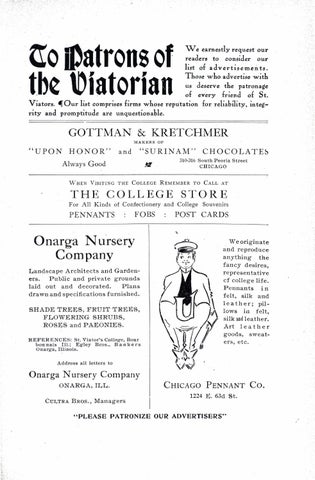
Onarga N u'rsery Company
. Weoriginate and reproduce anything the fancy desires, representative cf college life. Pennants in felt, silk and 1 e a t h e r ; pillows in felt, silk ~nd leather. Art 1 eat her goods, sweaters, etc.
Landscape Architects and Gardeners. Public and private grounds laid out and decorated. Plans drawn and specifications furnished. SHADE TREES, FRUIT TREES, FLOWERING SHRUBS, ROSES and PAEONIES. REFERENCES: St. Viator's College, Bour bon nais Ill.; Egley Bros., Bankers Onarga, Illinois. Address all letters to
()narga Nursery Company ONARGA; ILL. CULTRA
BROS., Managers
"PLEASE ·PATRONIZE
CJ:UCAGo PENNANT Co. 1224
E. 63d St.
OU~ ~ADVERTISBRS"'•
(
I
'
:c. '
.A D V E R T 1 S .E M E N T S
II
The Mc路L AUGHLIN-MATEER CO. PRODUCERS OF CRUSHED STONE AND GROUND LIMESTONE FOR AGRICULTURAL PURPOSES. CONTRACTORS FOR PUBLIC IMPROVEMENTS. North Schuyler Avenue and City Limits
Both Phones No. 277
KANKAKE)E, ILLINOIS
DR. Z. J. PAY AN
DENTIST Crown and Bridge Work Popular Prices
Excellent Work
Gold Filling a Specialty Prompt Execution
175 Court Street, KANKAKEE, ILLINOIS
H. H. TROUP & CO.
=LUMBER= KANKAKEE,
D.
ILLINOIS
J. O'LOUGHLIN, M. D. PRACTICE LIMITED TO
EYE, EAR, NOSE AND THROAT Independent Phone 704 191 Court Street, Kankakee, Illinois
"PLEASE PATRONIZE OUR ADVERTISERS"
ADVER"l"'ISEMENTS
III
ALL .M 路E ATS USED BY ST. VIATOR COLLEGE Are Supplied by
The Hotel Department
MORRIS & COMPANY CHICAGO Kansas City
E. St. Louis
Oklahoma City
St. Joseph .
South Omaha
P. H. HEFFRON, Pres. RICHELIEU WINE CO., Int .
PURE AL T ~R AND TABLE WINES HIGH GRADE CIGARS DIRECT IMPORTERS OF OLIVE OIL DANIEL J . SULLIVAN,
MANA G ER,
INSTITUTIONAL DEPARTMENT
Phones: Central 2420 ; Central 2287; Automatic 41,478 7 West Randolph St., Near State C HI C A G 0 A . M. ZERWECK
WALTER H. PROEGLER
PRO EGLER- ZER WECK
Jewelers 127-132 Schuyler Avenue KANKAKEE , ILLINOIS EXPERT WATCH REPAIRING
"PLEASE PATRONIZE OUR ADVERTISERS"
IV
ADVERTISEMENTS
路
J. C. ANDERSON Wholesale and Retail
Fresh Creamery Butter Churned Every Day
1
Pure Ice Cream in Bricks, enough for six 25c Special Flavors for Special Occasions-To Your Order Plant 309 Schuyler Ave
KANKAKEE, ILLINOIS
Both Phones 927
Independent Telephone 472
CHAS. WERTZ CO.
We do Repairing
F~
A. LOTTINVILLE
Coal-Lumber
Shoe Dealer All New Ideas in Fashionable Footwear 188 Court Street
BRADLEY
KANKAKEE
DISTILLED WATER ~~ICE~~ Absolu't ely Pure
The Family Ice F. D. RADEKE BRG. CO. Both Phones 132 KANKAKEE, ILLINOIS
LEGRIS BROS.
STITH BROS.
Bankers
Rest(lurant and Lunch Room
KANKAKEE, ILLINOIS
Telephones: Bell 237-R; Independent 4
..
C. RUHLE
182 Merchant St.
Kankakee, Ill.
W. J. Coghlan Bedding & Upholstering Comp'y MANUFACTURERS OF
Manufacturer of Lime Wholesale and retail Cement; Brick, Sewer Pipe, Sand, Etc. -Office and Warehouse 12路16 West Avenue
KANKAKEE, ILL.
MATTRESSES and COUCHES Also Specialties in Feather Renovating Special Prices to Institutions KANKAKEE, ILLINOIS
"PLEASE PATRONIZE OUR ADVERTISERS"
...
v
ADVERTISEMENTS
Metropolitan College of Music and Fine Arts . Formerly known as Drake School of Music 250 COURT STREET
Bell Phone 157
Independent 1498
KANKAKEE, ILLINOIS
Catalogue sent on application 路
ELEANOR C. SCHNEIDER, Director
KANKAKEE PURE MILK AND COLD STORAGE CO. Wholesale and Retail Dealers in I
Ice Cream and All Kinds of Dairy Products OUR DIAMOND BRAND EVAPORATED MILK SOLD BY ALL OF OUR DRIVERS AND GROCERY STORES . 184-309 Schuyler Avenue.
.
KANKAKEE, ILLINOIS
Both Phones No. 15
~NTAGRAPH
cl)__B!NTING ~TIONERY(O. r
J
ci3LOOMINGTON, LLINOIS.
"PLEASE PATRONIZE OUR ADVERTISERS"
.
i,
VI
' } j .•
'·'j
ADVERTISEMEN'l'S
Arr1erican · Packing & Provision Co. (INc.)
·
BEEF AND PORK PACKERS HAMS, BACON and SAUSAGES OUR SPECIALTY
Kankakee, Illinois
Phones: Bell 90; Independent 90
American State ·and Savings Bank
The Chicago Store SELLS IT
'
'
FOR LESS
184 Court Street
KANKAKEE, ILLINOIS
KANKAKEE. ILLINOIS
MUSIC TEACHERS AND PUPILS
:i~~KFb~P
OUR
Music,' Musical instruments Strings and Suppl~es Most Complete CARL FISCHER PIANOS VICTOR VICTROLAS AND RECORDS Intelligent and courteous clerks in attendance. Special attention given to mail orders. Catalogues sent to any address upon request.
LOUIS B. MALECKI & CO., THE BEST ROOMS IN THE CITY
The Schuyler McBROOM BROS., PROPRIETOR~ .
154 Schuyler Ave.
Kankakee, Ill.
-
337 S. Wabash Ave., Chicago, Ill.
JERRY RIVARD Grocery and Feed Store FARMING IMPLEMENTS Independent Phone 271
First-Class Restaurant and Cafe
BOURBONNAIS, ILLINOIS
FOR THE LATEST AND BEST IN ~~~PHOTOGRA.PHY~~~ Call on I . W . P 0 WE L L, Kankakee, Illinois "PLEASE PATRONIZE OUR ADVERTISERS"
....
·: . ····
"FROM MY MOTHER IN IRELAND FOR FIRST MASS, (Ed~tor's
Ndte: Selected from the Poems of Rev. Terrence
J.
MY
Shealy, S.
J.)
The joy .is come, Alanna, Now do not feel ·-alone today, That I wished for through the years, M a bo.uchal star machree, And my heart is full, of blessing, For Christ is more than mother But my eyes are full of tears: And son to you and me. Sure if I thought you'd shed a tear The joy is come, Ala.nna, It's o'er the seas I'd roam, But I am far away; With a little shamrock and a sod The mother will not see her boy To make you feel at home. Upon his first Mass day. Sweet days of all my longing, Sure, why should I complain? I'd bear, to have my boy a priest, A thousand years of pain! But oh! to see you with the cup, In vestments gold and while; Dear Lord 1 this would be heaven To a poor mother's sight.
' Tis true, asthore, I'm with you, And .tho' the world should part, My eyes would look into your eyes, My heart beat to your heart. I'm with you near the holy rail, Your kiss is on my cheek, I feel the blessing of your hand, I hear you laugh and speak.
To watch you at the altar, And hear you read the book, And when you turn around to pray, Observe your holy look. But oh, my child, to bow with you At 'that most solemn hour ~Vhen our dear Christ is present Unto your words of power.
Oh, darling, were I nearer I think my heart would break, Such blessedness starts o'er me now, And rap ture for your sake. Enough, enough to breathe my name When Christ is in your hand; 0 don't f orget your father's grave And poor old Ireland.
The morn is come, Alanna, Some say I would not know you now, And I'm kneeling where you knew Y au are so changed, asthore; Th e little shrine of Mary Och! I would know you darling, · If an angel's wings you wore. Used to smile on me and you. I've placed the flowers and candles Little they f eel a mother's love Who doub-t when face to fac e For the Mass that might have been, But my· eyes, agra, can't find their rest, That twenty . years of waiting My joy is all within. Can live in one embrace. I'll make my heart our altar, And my breast a house of prayer, And Jesus at your holy word Will tabernacle there. I'll wait for you at morn, And I'll pray with you till noon, And every eve I'll dream of you, My own Soggarth Aroon.
,
,:
' ~-'
THE VIATORIAN NOVEMBER, 1913 Volume 31
AUTUMN NUMBER Number 2
THE CONTRACT SOCIAL E. S. DUNN '14 ·
One of the problems that has always interested tnan is the origin o{ society. Many theories have been advanced concerning it and among the 1nen who have discussed this. problem and done much to· bring it before the public eye is. Jean Jacques Rousseau. The year 1750 marks his advent into the world of literature. D uring that year, the Academy of D·i jon, France, offered a prize for the best essay on "\iV hether the Progress of Arts. and Science Had Contributed to the Benefit of Mankind." Rousseau entered the competition, and the essay which he subm.i tted attracted inlmediate attention, owing to the radical views of society contained in it. 1-Ie avow:ed himself an ene1n.y of civilization, declared war upori it, and constituted hitnself censor of society. In the year' r 753, Rousseau w1ote an. article on the "Origin of Inequality Among Men." This. essay was the forerunner of his great work,. the Contract Social, published in 1762, which was to bring hin1 into prominence, upset existing ideas of society, and in. a large measure precipitate the French Revolution. The "Contract Social" attracts. by its. very name. At first, the theory seen1s plausible, but w4·en. subjected to the searching light of criticism., it fail1s. to show that it is either a fact, a right or even a possibility. Briefly outlined, the "Contract Social" states that man is a ,.'self contained" individual in 1nind and body; that by nature he is free · to exercisel his power as he chooses; that the rights of civil society are derived fro1n the rights of the individuals, who enter into ·con1pact, in order that greater benefits may accrue to
.r··
1
...
... ~
~
. THE VIATORIAN
3
\
these indivich:tals fronftheir ton1bin.ed eff6·rts. Ro·u sseau clain1ecl that the only natural state for tnan was to live as priniitive tnan had done, unhedged by any conventionalities, roving the woods and plains. at his will. Any other mode of living was opposed to .man's nature. Present society, he claimed, was but the outgrowth of a sitnple contract, in which two or more of these primitive men agreed to set certa.in. lin1itations on some of their actions, and to w,ork in concert, so that a surer means of livelihood might be assured. This first group developed in the course of time into sodety, which Rousseau claim·ed was. unnatural in its very essence, since the liberty of' man was curbed by the jurisdiction of the society which he had invented. These primitive men, who formed the first society, according to Rousseau, had free ·will; but not the use of reason. R·e ason only catne after a process of sentient development. The theory is erroneous in principle, in its. process, and in its conclusion. In principle, .Rousseau bases society on a convention. By an arbitrary hypothesis, he imagines prin1itive n1an leading a solitary, care-free life. History and the nature of n1an are brushed aside as of no consequence, but if anything is. to determine the principle of this theory, history and the nature of man must be studied. History shows no trace of n1an ever having been a solitary. Even the m.o st prilnitive men have had some kind of society; patriarchal or tribal, alw:ays governed by vested authority. Genesis lays down positively that the first man was not a barbarian, but was endowed with intelligence by God, with knowledge of his ow:n origin and destiny, of his own moral and teligioU;s duty, and recognized fully a higher authority. Igno- . ranee followed . as the penalty of sin. It is not man's original condition. If the first man recognized authority, then it cannot be foreign to his nature, and since society is united by the principle of authority, it is not far removed from n1an's nature. Ht11nan society is defined as. the "union of men for the attainn1ent of the san1e known or willed end through their united forces." It is evident that man by his own acts cannot attain his end without society. To attain this, tn.an must have the n1eans to conserve life. He needs to distinguish between what is useful and what is harn1ful to life; he requires 1neans to acquire intellectual and moral perfectio_n. But man can only attain these ends through society. He comes into this world unprepared by nature to care for himself, unprovided with food, with weapons of attack or defense such as animals have in their claws, teeth, horns, fangs,
4
THE VIATORIAN
etc. Reason alone is given him, and this he must develop in order to equip himself for the battle of life. For this one man does not suffice; he must be cared for until he is able to care for himself, and care requires the mutual. assistance of others to provide the·necessaries of life. Man has not the natural instinct, whereby an animal avoids what is harmJul and accepts what is good. His own experience testifies that he has. no natural knowledge of the harmful and the good, except in common with other n1en. Moreover, tnen have speech, the m.eans of expressing ideas to one another. But such a manifestation of ideas. is itl}poss.ible without association betvyeen men. By speech one n1an instructs · another, teaches hitn what he has learned, and thus aids his fellowman. Speech is ordained for no other purpose than con1tnunication betwle en men, which is proof itself that man was constituted to· be a m,e mber of so<:iety. Furthermore, no one will deny that the present state of society is higher than the state in which the man of Rousseau lived. If tnan has adopted a mode of living foreign to his nature, he is the only creature that has ever done so. Unaided, he has risen superior to himself. A supposition, absurd and unfounded. In process, Rousseau's theory is wrong, for he imagines n1en not to be men. Even though he claims that they are tnen, his supposition is contradictory, since he considers them destitute of reason. A brute is all we can admit the child of Rousseau's brain to be. He admits that this primitive ma~had free will, but he does not concede reason. This is absurd in the extretne, since the will is guided in all its operations by the intellect, without which we could not have freedom. of choice. The intellect tnust present the thing to the will, and the motives for action or non-action before choice can-be made. Unless reason· presents. the necessary inducements, the will is not free ·to act. Rousseau says that r·eason developed in the course of time through a process of s.entiency. This. is making the effect transcend the cause, because the operation of the senses is only that of sensation, while the property of reason is to go into the essence of the thing, an operation far superior and entirely foreign to the operation of sensation. Rousseau's man did not-differ from the brute in species but only accidentally, just as a horse differs fron1 a dog. Reason was needed for the contract-making of the first two men, yet freedom to tnake it is all that is conceded. Even though Rousseau were to admit primitive man had reason, man was giving up something which he had not, the right of government. No individual has in himself the right to govern
'
-
..
'
'
THE VIATORIAN
'i,·
·•;o
t
5
another. The law ·of nature grants men equal rights; but no individual has -the right in himself to govern an equal, nor has he the right to dispose of him.self as he please?. "Man is not God, independ~nt, self-existing, self-sufficing;" he is a dependent creature,. dependent both on God and society for his. well being, for _his existence, fOr his life. "But the right of society over n1an,'' says Brownson, "is neither absolute or unlimited, still he depends upon it, lives in it, and cannot liv:e without it." He can enter into no compact which it does. not permit. The rights- of society override the rights to hitnself and man can neither delegate nor surrender them. The compact cannot be formed as Rousseau pretended, "for the only rights individuals could surrender to society are her:s already," and those which are not hers, such as the rights of religion and property, which at~e held directly from God and nature, .cannot be delegated or surrendered. Rousseau affirn1s that a man has no right to alienate hitnself, yet he bases his as- _ sun1ptio111 on the wilful alienation of rights by man, which man did not possess, since man did not have the unrestricted right of government as. an individual. In its. conclusion, the "Contract Social" is false, for human society would be less in accordance with the nature of man thar1 the wild life which the theory pictures. If society is a contract, by what authority has the tnajority the right to say to the minority, "You mus.t act according to our goverrnnent,'' wh~n the minority is unwilling? This would not ·be a free contract, but coercion, pure and sitnple. When you say the state is merely a contract, you have m.en submitting to a compact which is invalid. The theory does not cover the fact of conquest and subjugation. It would be a violent use of the term to say or even inti_mate that a subjugated people had made a contra.ct with their conquerors~ though given full rights of citizenship. Neither are states made or untnade at will. Our own civil war was evidence enough for this. D,issolve society, as Rousseau advocated and universal anarchy would result. Each one could use or abuse his powers as he saw fit. Freedom would not result, bnt license in its most malignant form. The theory, while it contains some true reflections on slavery and the dignity of man, errs in its fundam.ental postulate, the absolute freedom and equality of all. Man is born free, but he is born with the duty to direct that freedon1. Liberty does not pertnit the abuse of power outside of authority, nor does it treat individuals as something separate from society or from one another. Men are equal in the sense that everyone has the right to
I/路'.\
<'
6
THE VIA TORIAN
attain the end for which .he was created, but to say that men are equal in all things is absurd. Absolute freeclotn and equality ln the sense the "Contract Social" advocates is false and unnatural. Psychology and history prove n1an a natural social being. The "Contract Social" fails in its three essential points, for the chief end of society and government is to protect each and every individual, and is- not set up for the individual to break clown at his will. Government is necessary to society~ and the right of goverrnnent con1es to society or the organized people from God through the natural law. Man .cannot live without government if he woulc;l, and therefor'e society and governn1ent were not and could not have been established by his will. Rousseau's theory is false, as is every theory that refuses to recognize God as the First Cause.
MINIMUM WAGE FOR WOMEN AND GIRLS (MEDAL ORATION)
GEORGE A. ROONEY '16
Probably no latter day movem.e nt il1! the United States has been n1ore widely discussed than that pertaining to the minimum wage law. Legislatures have taken up the question, the daily news journals. are filled w:ith discussions conc-erning it and the 111-o vement has been widely endorsed by n1any prominent men. There are 111any argun1ents in favor of this intensely interesting social proble111, and indeed many arguments m.i litating against it; among the fonner is the one based upon experience evidenced after a test of sixteen years in Victoria, Australia. This and sitnilar argUlnents, I will advance. in the course of my speech in favor 路of the minimum. wage law. That some reform is absolutely necessary . concerning the regulation of the wages of the working classes o;f today is a fact conceded by all fair-tnindecl' people. Unjust and even starvation wages in garment-making industries, and departn1erit stores cry to heaven for reforn1ation. Probably the best n1.e ans to rid our cities of this. gross injustice tow1a rds the working class, is the enactment of a mini1num wage law. The law tends not only to give every wo111an and child a decent living wage but al$0 is in1portant to improve the conditions under which they labor.
THE VIA TORIAN
7
路The purpGse .of . the tninirnum wage law is not to ren1ove the need for toil, or to wipe out poverty, for society den1ands n1an to toil and looks upon poverty as. no evil. But its. puq)ose is to prevent the proor frotn working for vvages that are insufficient and destructive to health and morals. That an irnprove1nent of the working conditions of women and children is absolutely necessary could not probably be: better brought out than by a brief description of some of the conditions under which they work. First of all let us deal with the garn1entn1,akir1g industries, where cloaks, suits, skirts, shirts and other wearing apparel are made; where are etnployecl designers, cutters, pressers, tailors and other help, both male and fen1ale. As tin1e will not p:ern1it me in the 路c ourse of tny speech to deal with each one separately, I will deal with the garn1ent-making industries in general. Here we have these shops located in ,lofty buildings, in converted tenen1ent houses, in rear houses, in stores, and in cellars. These buildings are nothing n1ore than tnere living ro01ns converted into shops., in which people are forced to work. The height of the ceilings: is scarcely eight feet; the air space less than two-hundred and fifty cubic feet per person, and having no device for changing the air of the ro01ns in the season of dosed windows the heat and odor is very bad. Lighted by gas or other artificial lights, which are often placed low to bring . them near the work, the result is the etnploye:e's eyes are: exposed to ~he full glare; with dirty walls, ceilings, and floors, having the pressing irons heated by gas, the a.i r in these shop.s is vitiated by the almost inevitable leakage of this gas. These and others are son1e of the conditions under which many wotnen and children have to labor. 路 The wages pajd at these places are generally poor, s01ne of these wornen and girls working for as low a wa,ge as three dollars a week. Many of these live a great distance fr01n their work, and have to walk to and fro every clay, and some with scarcely anything .on their stomachs since the n1orning breakfast; for, tell n1e how they are going to purchase any dinner on three dollars a week ? These gir Is do not live, they n1erely exist. These low wages, unreasonable night work, work in tenement houses, disregarding Sundays and hoEdays, the irregular pa)nn.e nt of wages. and many other conditions under which these wotnen and girls have to w.o rk is dangerous to morality. To remedy these grievances it is, in tn.y opinion, neces.say to establish a living standard of wage; to regulate the hours of labor; to elitninate night work; to prevent work on Sundays and holidays; to do away with tenen1ent-house work; and to pro~
8
\
THE VIATORIAN
vide for the regular payment of wages in cash by both manufacturers and outside contractors. Let us now take the department stores and see if a minimum wage would not help to better the conditions under which these wo1nen and girls have to work. O~f course we must here show the twiO distinct working classes.. In these stores we have girls. employed who are not working for a living, but only to obtain money to purchase a few extra ribbons, or to have a few nickels for the picture shows, which money they know their parents will . . not ·give them unless they earn it then'lselves. The second class of w~orking girls are those who have to work for a living. Now the former can afford to work for four dollars a week because they have a home and no board to pay. But how, in the name of comtnon sense·, are t[10se girls who have to board and clothe themselves going to live on four dollars. a week. These girls have to dress then1selves as neatly and have the same appearance as the former, otherwise they lose their position. Now here is the question: Bow ca:t1! these girls live under such adverse conditions and not fall into the evil that is. daily surrounding them·? The leaders of the Illinois Vice Commission give thes.e low1wages as the direct source of so much vice and wickedness. This comm.ission says, "that there are countless numbers of these girls living the lives of prostitutes from no other cause than low wages." To this I will say that I don't think there are as! many of these girls living such lives. as are pictured by this con1In-1ss1on. For what of our good Catholic girls who would rather die than sell their virginity. For the standard of morality is upheld more in the poorer class than in our supposed aristocracy. But there are some w·h o do fall under the spell of this ·evil, because the opportunity presents itself, and under no other fonn than low wages. A careful investigation led · to the conclusion that a young w01nan could supply herself with the necessaries of life so that she could live decently and have a fair margin of ordinary con1forts on an income of eight dollars a week. That she could do so on a less sum and be free fro1n the pitfalls and temptations which beset young women who are thrown into contact w<ith the world was not so obvious. Is it justifiable ·for employers to take advantage of supply and demand, and pay employees. wages that are insufficient and therefore destructive to health or morals? The chairman of the Illinois Vice Commission has reported that the profits of Marshall Field & Co. in Chicago are $r 7,ooo,ooo a year. . This vast estate has been left to the grandchildren
r~; 1
THE VIATORIAN
9
of Marshall Field. They are being trained in England as gentlemen, but not in the sense in which the word is used in America. This profit · of $r 7,ooo,ooo is being w;r ung annually from the women o·f Illinois. Why not use that money in establishing a minimmn wage for the employees. For $r7,ooo,ooo is too much money ·to run wild over to England for the purpose of supporting an aristocracy. Let the legislature pass a bill for a minimun1 wage, for we see the enormous amount of money used yearly as clear profits.. Why not use some of this: money to better the conditions of the poor? From time to ti1ne criticisms have been passed upon the working of the minimUln wage law, to the effect that it would be cruel to the aged worker, and that the old and inefficient would be refused employment and have no wages at all. · Now the only answer to these few objections is, fhat for sixteen years this minimum Wlage law has worked successfully in Victoria, Australia. In the five sweated trades to which this law was first applied the wages increased from twelve to thirty-five percent; the hours of labor have been reduced, and the number of persons employed have· incr·ea.sed rather than diminished. More conclusive proof · of the fact is this: When other trades saw· the success. of the minimum wage, they asked to be brought under the same lavv. Furthermore in Austria, France, and Germany this minimum wage pr:oj ect has been discussed in the legislatures for the past three or four years.. It has found its way into the statutes of Massachusetts; has l?·een introduced in the legislature of two other states, and will be one of the important bills discussed in the legislatures of several of our states this year. Investigations show that a 1nan can maintain physical, m·ental, and moral health in any city of the United States on between seven hundred and ·fifty and nine hundred dollars per year, and that the decent living wage for a woman is eight dollars a week. 'Y et what do we find? We find that three-fourths of the male workers: receive less than seven hundred and fifty dollars. yearly, and three-fifths of the female workers are paid weekly wages of less than eight dollars. Man is not 1nade for the state, but the state is made for man. Therefore, according to Reverend John A. Ryan, D·. D., "The establishment of a n1inimum wage is quite as much a proper func.tion of the state as the safeguarding of life, limb or property. To protect the health, morals and mind of the citizen against the injury resulting fro1n an insufficient livelihood is quite as important, both individually and socially, as to protect his life against the assassin, his body against the bully, or his money against the 1
10
TB:E VIATORIAN
thief. What we are seeking in our legislature today, is to establish a mini1TIU111- wage law. This la.w should provide for a wage that is sufficient in itself to keel) a n1an healthy in body, mind, and spirit. It must be enough to prov ide food, shelter and clothing for health and vitality. The notion con11TIOn throughout America, that the state may not touch the wa.ge contract "has neither political, 1noral, 'Or logical foundation," says Prof. Ryan. Labor 路 uni_ons fix n1inimu1n wages, why should not the legislature? Profits of successful employers should be shared in some way with labor. This is. a better and fairer way than contributions to charity. Since corporations are establishing pension and insurance funds, it is not too' extravagant to expect that they will turn their favorable attention to the n1inin1um wage. Now, glancing back to scrutinize the adverse working conditions of 1nany of our women and girls, we see them trudging \i\rearily hom.e after their clay's work, down the dim, narrow streets till they reach the tenen1ent house district. Here they climb the squeaky stairway and go to their clingy little rooms, where so1ne of them pine a.w ay the long hours of the evening while others are out enjoying the1nsdv-es. We see this vivid picture in reality in our every day life. Why cannot we do son1ething towards the bettennent of the conditions. of these poor working girls? For within the heart of every true A1nerican there burns a living hatred for tyranny, and what is this tyranny? Low wages.! Why cannot we help this burning desire for freedom, this unquenchable thirst for justice, this sp-irit of equality among men? A little over a year has passed since the entering upon of this 1nini1nU111 wage project, and let us hope that its 1nemory may still live on and that time will not change the lustre of its interest, that its 1nemory n1ay at one time sing sweetly its tt:"ibute, and t_h at nations may honor its glory, and flourish with success under its jurisdiction; Let us hope that in a sho1~t time we will be blessed with the passing of such a law as. will effect m1nunun1 wages. Fleeting time changes history and 1nakes us forget the vital questions that are brought before our eyes, but neither life nor death can ever efface the m.e mory of this minimtun wage bill. Let us then do all irt our power to further the passing of this bill, for it is up to each and every one of us to do our part in the improvement of these conditions of w:o men and girls. We say that it rests with the legislature. Yes.,. this is true. But does not the legislature act for us?' If so then let us all unite and do our utn1ost for the passing of such a bill. And with the enactment of
THE VIATORIAN
11
such a law the condition of the laborino- wotnen and children will become enhanced by the peace and pro perity of a ane livelihood. Humanity will become reimbursed by tronger and better citizen , the gentle breath of heaven hall be wafted over the hon1e heretofore stifled by the unju t labor of man's ervant . Then hall the guiding hand of the state be extended over the poor and de titute working girls, and an1id the warmth of God's light and truth no greater peace could rest over mankind than that which uch conditions will bring. For man will then be united with hi fellowman as co-laborer in this earthly kingdom.
II
A THANKSGIVING VICTORY
The last of November was at hand and the prevailing topic of discussion at Brentwood was football. The air was pervaded with it. Everywhere a group collected, the chances of the team in its final game were discussed. Dliscussion had been just as keen in former years, but this season there was an anxious tone to football conversation. To have a cha1npionship tean1 for the past five years and then to turl1J out the worst team in her history was enough to m.ake Brentwood's rooters tremble at the approach of her greatest battle. Brentwood had started the season with a victory over a strong opponent. A successful year had been predicted, but the following week the team had shown a complete reversal of form, losing to an inferior team. Out of the following four gam.es, she had only one victory to her credit. The last three of the games were veritable nightlnares to the rooters on the side lines. The line had been nipped to pieces, the backs downed in their tracks, and Brentwood's goal line crossed tin1e and ti1ne again. Coach J us tin was almost desperate. Never had he coached such a tea1n. Material was plenty. Five of last year's regulars wer e in the line-up; in practice the squad worked nicely ; the backs were speedy, the line fast, and every play worked perfectly. But when the team entered a gam,e, the players seen1ed de1noralized They just could not put up the necessary fight. Son1ething was wrong-radically wrong- but what, he couldn't tell. At times there seemed to be dissensions an1ong the players, but these had
12
THE VIATORIAN
been quickly and easily queUed. No! thought Coach Justin, that could not be the trouble; they were, he hated to say it, yet he truly felt they were "yellow.'' . ~ But there was something wrong, which even the players would not admit. Brentwood had 3J "Frat." . Such organizations. had always: been discouraged at Brentwood, but this one had gained a foothold, and from路 a modest beginning had become a power among the students. The members, for the most part, were gentlemanly fellows, but when it was a question of advancement for 路 one of its 1nen1bers., nothing was. left undone that he might realize his ambitions. Merits, were cast aside. He was a "Frat" man and that was sufficient. This sentiment was the real cause of Brentwood's football trouble. Nine of the "Frat" members hacl been regulars of the nineteen twelve team, and when the annual election for captain was held at the close of the season, "Sam" Bolen, one of their fraternity, was elected to lead the nineteen thirteen team. "San1" was a good football player, but even his best friend could not have truthfully stated that "S~m" was the 1nan to lead the team. Not that he was disliked, but he lacked the necessary qualifications for a lea-der. Surprise had been general in the college when his election had been announced, for it was generally conceded that "Fred" Thompson-one of the most popular fellows in the school, a born leader, and the best half back that ever wore a Brentwood uniform, was the logical man for the position. When the nineteen thirteen season had opened, "Fred" had appea~ed in unifonn with the candidates., had shown all his old time dash and skill, and in his first game, although he played only a quarter, had been a power both 0111 offense and defense. It was a source of wonder to the students why he had been replaced at a crucial period of the game, and this wonder developed into a genuine puzzle during the following week because he was scarcely used in practice, and in the following game had not been used at all. Coach Justin had seemed to give him the opportunity, but Captain "Sam," after "Fred" had practiced a short while, would go into "Fred's" position and send the star half to the side lines. Smnething was wrong, but the player refused to talk1 and spect1lation was rife, when "Fred" handed in his suit. Unquestionably he had been needed all season, yet seemingly unconcerned he had become 路 a mere spectator. When questioned about his not playing, he, always. had a sm:iling retort about being a quitter, or that he was of no account. He felt that it was not his place to say Captain Bolen was unfriendly to him and路 had . refus.ed to give
..
THE VIA TORIAN
13
him a chance. That would have to con1e from some oiher source. But how he did long to play, as he watched the teatn lose game after game. It was idle longing, there was no chance, and as the ti1ne for the Carlton game drew near, his. last hope had vanished. Only eight days remained for the football season. Brentwood's greatest rival-Carlton-had a fine teatn, their goal line yet uncrossed. All Brentwood was blue over the thought of what would happen on Thanksgiving da.y, for to cap the climax Captain Bolen had been injured in practice and sent to the infirmary with a badly sprained ankle. His presence in the final game was 路out of the question. The situation was desperate; the leader gone; the team, almost demoralized; the biggest ga1ne. of the season only eight days away. Something must be done .and .that quickly or Brentwood's nineteen thirteen season would pass as the most disastrous year in her football history. If she could only beat Carlton, an otherwise bad year might not be felt so much. Coach Justin was at his wit's end. If he had only someone to fall back upon. Why not Thompson, he thought. No, that could not be, "Fred" had resisted all attempts to lure him into a suit after the second game. Reasons for his. refusal, he gave in a laughing manner, but there was always a suspicion in the coach's rnind that Bolen was the cause of 1'hompson's refusal to play. Still he might talk with "Fred" and see what he could do-the stake was worth while, and he felt if anyone could save Brentwood it was "Fred." Coach Justin met "Fred" that evening after practice and linking arms with him strolled about the campus. Their conversation seemed earnest, and speculation was high as to the trend of their colloquy. When they parted the coach see1ned to have a lighter step, and "Fred's" face bore an air of expectancy. The next day at practice "Fred" turned out w'ith the players amid a general "I told you so'' from the sidelines. Thompson followed the players from a position behind the "back-field" and then took Captain Bolen's old place at left half. The whole team seen1ed to feel the presence of a leading spirit with "Fred" in the line-up, and the practice was the best in weeks. Coach Justin was elated. Brent, wood's hopes began to soar. A chance to beat Carlton was the best news in a long time. Thanksgiving day dawned bright and crisp. It was an ideal football day. All morning Brentwood was filling with visitors and at I o'clock the gates of the athletic field were thrown open
14
THE VIA TORIAN
to adn1it the monster crowd. The stands were quickly filled with the partisans of both schools; the supporters of each team easily recognized by their colors and the cheers that pealed forth in the crisp November air. Carlton's husky bunch were the first to appear on the gridiron, closely followed by the Brentwood tean1. The welc01ne shouts of a thousand . thrO:ats greeted thetn, and then a hush fell upon the crowd while the captains tossed for positions. All was eager expectancy. Carlton won the toss and chose to defend the south goal with a slight wind at her back. Quickly the teams took their places, the referee's whistle 路blew and with a mighty thud "Fred" Thon1psort sent the ball straight to the arms of Carlton's. left end, who carried it back fifteen yards. Carlton now started a n1arch up the field to Brentwood's thirty-yard line where Brentwood made a plucky stand and held Carlton for downs. Brentwood was held for two downs, and unable to gain kicked out of danger, Brentwood's 路e nds downing the Carlton quarter in his tracks. Then followed a battle royal with Thon1pson-in every play; that he could cover ~o n1uch ground was tnarve1ous. The ball see-sawed back and forth, neither side threatening to score during the first and second quarters, the half ending with the ball in the middle of the field. During the halves, the coaches of both teams stonned at their charges, and when the second half opened, both teams returned to the field with a do of\ die spirit. The whistle blew and the third quarter was on. The struggle that follow路e d was, if anything, more bitter than in the first two periods. The lines held firm路. End runs and forward passes .were of no avail. Each team opening up its play, brought ~very trick to bear, but their efforts seerned futile. The third quarter ended with the ball on Brentwood's forty-five yard line. The rooters_were almost speechless fron1 their encouraging cries. Cheer leaders were frantically urgi11g their hoarse followers to greater effort. Pennants were waving; feet stamping. All was animation. The Carlton crowd, form.e rly confident of a big score, were earnestly beseeching their team to put just one score across. Brentwoqd's supporters amazed at the magnificent stand of their tea1n, were pr:aying that they would not now fail. Even a scoreless game was better than a defeat. The whistle blows for the last quarter. The teams dash to the fray. Carlton fumbles and a Brentwood man falls on the ball. The ball is carried to Carlton's twenty-five yard line, where Brentwood's onslaughts are of no a:Vail. The Carlton line is like a stone wall. The ball goes over, but Brentwood holds and forces Carlton to
;-{'~--
!,
.,
路, .
~
r
THE VIATORIAN
15
kicK. The Brentwood center, by a desperate lunge blocks the kick and Thotilpson, who had dashed forward, falls on the ball. The time is short. Something tnust be done if Brentwood is to win. The second down and Carlton-fighting like fiends to hold. A _kick formation is the signal. Th01npson steps back for the kick. All depends on hin1. The center passes the bail-a perfect pass. Without a tremor the ba.ll drops from "Fred's" hands. His toe n1eets the ball the instant it touches the ground, and high over outstretched ha11Jds it soars. Every eye is upon it. The game hangs on the kick. Straight as an arrow it flys over the cross bar for the score that was to beat Carlton. "Goal" shouts the referee, while the Brentwood rooters go mad with joy. Thirty seconds to play. The gan1e resmnes, but Brentwood already with the taste of victory fights as she never fought before. The final whistle blows. 路 Brentwood has trimnphed. The crowd closes in on the field, and 1i 拢ted to the shoulders of the adm.i ring studel)ts, "Fred" Thon1pson is borne in triun1ph fron1 the field. At the club house, the first to greet him is Captain Bolen, supported by crutches. All anin1osity and ill-feeling is buried in the hand clasp that follows. The spirit of Alma Mater co1nes to the fore. The past is forgotten as "Sa.n1" hun1bly asks pardon fqr his jealousy, and an1id the shouts of victory, . " yes. " - JAR th e路 answer IS . . .
18
THE VIATORIAN
THE VIA TORIAN Published Monthly by the Students of St. Viator College, Bourbonnais, Illinois
PUBLICATION OFFICE. 219 WEST JEFFERSON ST., BLOOMINGTON. ILLINOIS EDITORIAL STAFF Editor-in-Chief-E. S. DUNN '14
Exchanges-T. LVNCH '14 Alumni-A. RABEDEAU '14 Personals-L. WARD '14 Viatoriana-W.
Athletics-J. DouGHERTY '16 Societies-G. ROONEY '16 lnter-Alia-T. SULLIVAN '17 MURRAY '14
Entered as second-class matter Fe~ruary 2~, 1913, at the Postoffice at Bloomington, Illinois, under the Act of March 3, 1879
All correspondence must be addressed" The Viatorian," Bloomington, Ill. Subscription price One Dollar per year, payable in advan,ce. Single copies, Fifteen Cents. All business comm!tnications sh'Juld be addressed to "Business Manager, The Viatorian, Bloomington, Illinois.''
The 1nonth of November is one of special significance in the Catholic Church. 'I'his is the n1onth she has set aside in ren1elnbrance of the Poor Souls in Purgatory. During All Souls this period, she is ever striving to recall to our 1ninds the pious practice of praying for the dead, a custom not only cmnn1on j~1 our day, but esteeni.ed by Christians of every age. "It is a holy" and wholesome thought to pray for the dead" says Holy Scripture, and no greater 1nark of affection and esteem can we show for our dear departed ones than to remember them in the manner Holy Church advocates. It should be a subject of heartfelt joy that we have the n1eans to help those who have gone before us; that we a.xe able to assist the1n to enjoy life everlasting. To pray for the faithful departed is not only an act of mercy, but is a duty incU1nbent on every Catholic. The consolation that we in turn shall be helped when the "great summons" con1es is the strengthening and consoling thought that the 1nonth of Noven1ber should foster .
<
·•;c. •·
:JW<'<fill'{l~~~~·',;'','l'ljLllS~Wi'i1W
~iiG~:~~r~loi lt.l>~ ~:~ · ·Fo/r<. 4?'.. .·
,;
..: '"', <.A•
•
~·
~
THE VIATORIAN
17
Thanksgiving day, one .of the oldest institutions of our country, draws near. The thought of pleasant things to eat-rich mince 1neat, pumpkins, roast turkey, dressing, Thanksgiving pi_ckles, and cranberries-co1nes . to mind. . To the epicure, all these things are enough to justify the nan1e ·T hanksgiving, still the feast is . only accidental. The original Thanksgiving day was one of gratitude; of heartfelt thanks to the Giver of all good, for having preserved men through the direful circumstances of the year. · Today we are not beset with the trials the Pilgrims endured. In contrast we' have every convenience. Our country is foremost among the nations ; our resources are unsurpassed; our government is excellent; we have freedo1n of religious belief; and many other things, yet the greatest thought for 1nany of us is to wonder how we will spend the day. Real thanksgiving is far fro1n our minds. · Under the influence of ti1ne, the excellent purposes of institutions are sorri.e times misused, and ·this seen1s to be the case with Thanksgiving day. We do not mean that pleasure is to be foregone on this day and that it should be observed in a sad manner, but its principal end is thanksgiving, and a part of the day should be observed in this fashion. Let us not forget that we have been the recipient of favors during the pa.st year, and like our forefathers hold true to the original purpose of this feast. W 'e have much to be thankful for; and gratitude for past favors is generally a passport for future ones. As a n1agnificent de1nonstration of the spirit of Catholicity, the second American Catholic Missionary Congress has gone The into history, ren1en1bered as one of the greatest events of its kind. The n1agnificent gathering Missionary of the hierarchy, clergy, and laity in Boston Congress during the week of October 19, was splendid and convincing proof that the n1issionary spirit enkindled by Christ on earth, has continued to our own tin1e. It has steadily grow:n in brightness and intensity, and will continue as long as the co1nmand, "Go preach to all nations," re1nains unfulfilled. The tremenduous in1petus, that the strong and eloquent · speakers at this second Congress gave to the n1ovement started five years ago in Chicago is signal and persuasive assurance that Catholic spirit. will keep on increasing until Catholicity shall spread throughout the length and breadth of the land. The wise counsels and careful - deliberations are notes of action and pro-
THE VIATORIAN
18
gress that cannot be denied. Every Catholic has reason for joy that the 1noven1ent is so full of glorious promise,. confident that the full realization of it is not beyond our grasp. It is a sign of advancen1ent, that these illustrious leaders of Catholic activities in this country gathered in Boston have planned the jncreas.ed extension of God's Church in the Western wodd. Catholicity is their joy and pride, and they are not found wanting in fulfilling the obligations placed upon them. Felicitations are due the leaders of the 1novement; their accomplishments speak nobly for themselves; the second Missionary Congress of America gives prmnise of greater things to come.
EXCHANGES -·
St. Michaet s Alma.n ac-For the first time· this exchange ha.s appeared on our table. It certainly aim.s to give its rea.ders the best short stories that can be procured. The Almanac is bright and informing. This is particularly true in the causerie under the title of "Catholic Happenings. of American Interest," where the questions passed under review are treated with a breadth and breeze which is quite refreshing. It contains n1uch that is interesting and instructing. Its pages are adorned with n1any poems and stories which should prove very pleasing to its readers. We turn with special interest to the article, "Opiun1 Smoking in China." It gives us a picture of the degrading effects which this pernicious drug has on its devotees, and vvhen once used there is no getting along without the treacherous poison. "Mary's D ecision" is a story which treats of the difficulties which a Catholic girl encounters in her rejection of a non-Catholic suitor and: her loyalty to the Catholic faith and its traditions. The author's style of treatment is worthy of much commendation. The article enjoyed 1n.ost was "Marynia's Dream.ing." It is treated in a clever style which shows the writer is well versed in English. To a nu1nber of other articles did space permit, we would like to refer at greater length. The stories are charmingly written, and are profusely and artistically illustrated. It should find a place in every Catholic home. The Exponent comes to us r~eplete with essays, but poetry is conspicuous in its absence. w ·e deplore the dearth of metrical 1
''f"
"'-~ .
·,·
' ·'
~
.
THE VIA TORIAN
19
contribution in the Exponent. Why not adorn the initial page at least w1th a tribute to the muses.? A few poems add much to the beauty of a college journal. The other departn1ents overcome this and place it in equality with the average college journal. "Daniel O,'Connell" is a worthy tribute to Ireland's uncrowi1ed king. The writer gives us a true picture of that di stressful country when the Liberator appeared on the stage. Justice was n1eted out to every n1an, save an Irishman and a Catholic. · The mighty eloquence of the "Emancipator" in gaining "Catholic En1ancipation" did more for Ireland than the combined efforts of United Ireland to burst the fetters that English tyranny imposed upon them'. "Child Labor" is an article w'ell worthy of com1nendation and one that reflects credit on the author. The instance which he cites of the various cruel fonns of child labor are undoubtedly true because they exist in every city throughout the country. We thoroughly agree with hi1n that there exist conditions which ca11 for la.ws governing child labor. The editorials and other departlnents ar_e well handled. TheM ountaineer in former nmnbers maintained a high standard, but the present number indicates that the tide is rising. One thing is to be regretted and that is the omission of an exchange departn1ent. · However, its choice prose articles, rare bits of poetry, and a few charn1ing short stories, tnake a very pleasing combination and come near our ideal of what a college journal ought to be. "A Row of Books" is an interesting and well written article. We are pleased to see the condemnation which the author bestows on Hall Caine's latest production, "The W 01nan Thou Gavest 1\!Ie." This is an a.rticle on the Catholic Church and marriage. ·It is a lurid, itnpossible, and baseless. piece of fiction and Caine seems to tnake a specialty of suggestive and 'bluntly. immoral stories. "The Garden of Roses" and "'Three Mondays" are we11 written stories and hold the interest of the reader to the end. On the whole the cohin1ns of theM ountain.eer are well conducted. The Loretto Magazine is alw·a ys a regular arrival, and a n1ost welc01ne one, at the editorial sanctum. "The Educational Value of Music" is a studious and careful piece of work in which the writer proves that music 1n.eets the double purpose of providing training for the inte11ect and, n1uch more for the affective tastes. The delicacy of style and the thought manifest in it are far superior to any article we have seen in the pages of other college magazines. "A Black Mural Tablet" exposes the infamy and
' .
20
THE VIATORIAN
treachery of Benedict Arnold. Although the essays have a high literary standard, there are still several things lacking, most noticeable being stories. The latter should, by all meatJ.s, be given n1ore atte!ltion. \V'e congratulate you on the choice bits of poetry in this issue which gives the magazine an excellent finishing touch. THE V1ATORIAN also gratefully acknowledges the receipt of the following: Villa Sancta Scholastica, St. John) s University Record, St. Mary) s Sentinel,. Notre Danie Scholastic, Georgetown C allege Journal, The Morning Star, Duquesne Monthty, The Creighton Chronicle, The Young Eagle, The College Spokes1nan, The Ca:tholic University B'ulletin, Gonzaga, and many others.
INTER
ALIA ·~
On October 13, the college was greatly honored by the visit of Rt. Rev. Shaw, D .D·., of San Antonio, Texas. The faculty · · and . student body united in tendering a happy Reception of reception: to His Grace. At eight o'clock a. m., Bishop Shaw all assembled in the chapel and assisted at the mass celebrated by the Bishop, himself ; after n1ass a light breakfast was served in the college refectory. At ten-thirty the formal reception took place in the tnain assembly hall. Edward Dunn, '14, c.lass president, read the address of welcome. After selections. by the Glee Club and the college quartette, the Rt. Rev. Bishop responded with a short talk to the students and setninarians. He spoke particularly to our seminary department, instructing then1 as to the conditions in the Lone .Star State and urged them to consider Texas as a field for their future labors, saying that opportunities were in abundance, and there was a great need of workers. He then praised St. Viator for its high standard and laid particular stress on the great den1and for good, upright well trained Catholic young men in the world today. After the reception His Grace was conducted about the grounds and expressed his interest in the college and ·was well pleased with its growth. Later in the day, His Lordship departed for Boston where he attended the Second Mission1
.; '!.
' .y:
THE VIATORIAN
21
aty Congress of America. It is the sincere wish of the faculty and · students that the Rt. Rev. Bishop Shaw, D·.D., will soon again visit ~-t. Viatc:>r's . . The faculty of St. Viator's wishes to congratulate the Rev. ]. P. McGuire upon his appointment as permanent rector of St. A· _- ointed Mary's Church, A:-urora, Illinois. . pp .. -. t· Father McGuire, formerly pastor of Holy P ermanen C . receive . d h'Is appOintment - . R _ ross Ch urc h , B. atavm, ector following an examination taken at St. James Pro~Cathedral rectory, Rockford, Illinois, during the latter part of September The Rt. Rev. ]. P. Muldoon, -D'.D'., had general charge of the examining board, which was cornposed of various pastors of the diocese. - The quiz was written and oral and embraced Moral and Dogmatic Theology, Canon Law, Scripture and Rubrics. Father McGuire received the highest average of the five priests who took the examination necessary for the appointment of irreinovable rector. He assun1ed charge of his new parish on O~ctober 14. Speaking of Father McGuire, theN ew World says: "Father McGuire received his early training at St. Viator's, near Kankakee, and after finishing there, he entered St. Mary's seminary at Baltiinore, where he received his degrees fourteen years ago. He was ordained by the late Archbishop Feehan in the Holy N a1ne Cathedral, Chicago, June 24, 1899. His first appointlnent was as assistant in St. Mary's church at Sterling, the pastor o·f which was the Rev. J. ]. Bennett, who he is now destined tQ succeed as pastor at Aurora. Later he served as assistant in Chicago- parishes, accepting the Batavia appointn1ent on _the organization of the Rockford diocese." The play lovers of K~ankakee and Bourbonnais were given a rare treat on Sunday evening, October 19, when "The Child," a play written and staged by Rev. F. A. Sheridan, C.S.V., was presented in the college auditoriun1. The Child It depicted in a Inost striking Inanner, one of the very difficult probleins confronting the world today, namely, the struggle betwen labor and capital, showing in the course of its plot the inevitable results that will follow from the present existing ,circu1nstances. Dra1natic action n1ingled itself with pathos, to evidence the cleverness of the writer. ·T . b. Sullivan, who took the role of the baron of wealth, did justice -io· his part. Dawson Byrnes, who on account of his wide stage
22
THE .VIATORIAN
experience, was chosen to act the difficult part of the servant,." was the star of the day, keeping the audience keyed up to a high pitch of attention, and in doubt as. to the outcome of the plot. J atnes Daly, the attorney-at-law, filled his ro1e to the best satisfaction and indeed bore the look and dignified manner of an experienced lawyer. J an1es Fitzgerald, who played the pa.rt of the Striker, represented in a most striking fashion, a n1an in desperation and took his part in his usual forceful manner. Katherine Kirley, who played the part of the child, was indeed the favorite of the day and won the audience by her sweet and childline interpretation of the part. Too n1uch praise cannot be given Father Sheridan for his splendid success in writing such a clever piece. We will now anticipate more entertainment from the Thespia.ns, and hope that during the course of the year Father w路ill have n1ore plays. to gtve us. The cast of characters were: Sylvester Radcliff .................... : ..... T. D. Sullivan Kelso, His Servant. ......................... Dawson Byrne Oliver Baldwin, Attorney-at-Law ................ James Daly The Child .................... ." . . . . . .... I(atherine l(i rley D ave Glending, The Striker ................ J an1es Fitzgerald 1
The feast of St. Viator wa.s celebrated on October 2 r in the usual pompous manner. Pont~ficial High Mass celebrated in Maternity Church, Bourbonnais, began the order of St. Viator the day. The Rt. Rev. Mgr. G. Legris, D'.D.,. Day was celebrant, assisted by Rev. J. F. Jones, of Dwight, Ill., Deacon, and Rev. J. I<:elly, Rantoul, as Sub-deacon. Bro. J. McGuire acted as master of ceremonies. Rev. J. McCarthy, 'or, of Precious Blood Church, Chicago, Ill., preached a very forceful sermon on the life and works of our patron and urged each and every student of St. Viator to follow the exatnple and copy the virtues of that saintly youth whose devotion to the Master was unexcelled and unequaled. The College Choristers sang very beautifu.Ily, Laesche's Mass, under the direction of Rev. F. A. Sheridan, C.S.V. The soloists were G. McDonald, ]. Dougherty, J. Hughes, Bro. A. N. St. Aubin,C.S.V. Imn1ediately after 1nass the reception of the visitors took place and lasted until eleven-thirty, when dinner for the student body was served in th~ . dining hall. At twelve-thirty the n1ain banquet was served for the visitors and relatives of the stu-
.
.
..
<
."
23
THE VIATORIAN
dents. The doors ·of the college auditorium were opened at one~ thirty and at two o'clock the musical program took place. It was opened with a selection by C.S.V . .Orchestra. This was followed by, "Just a Song at Twilight," sung by the Mozart Glee Club, under the direction of Rev. F. A. Sheridan, C.S.V., with Prof. C. Joehe£n at the piano. The Glee Club then rendered the beautiful "Kyrie" from Laesche's Mass. The College Oic tette next sang very ·sweetly that ever popular air, "When I D ream of 01d Erin," G. McDonald taking the solo part. The musical progratn was brought to a: close by the singing of "The Soldiers' Chorus" from Gounod's "Faust." After a short intermission and a selection by . the college orchestra the audience was greatly favored by Dawson Byrnes, one of the most famous impersonators of the characters of Dickens, who during his act, impersonated four of D~ ick ens 1nost noted character creations, namely "Bill Sikes" from "Oliver Twist," "Uriah Heap" frmn "David Copperfield," "The Grandfather'' from "The Old Curiosity Shop," and "Daniel Peg- · gotty" from "David Copperfield." During this act the audience was kept in the highest state of interest bv Mr. Byrnes, who by reason of his great dramatic powers, is excelled by few in this particular phase of histrionic art. · The Child, written and staged by Rev. F. A. Sheridan, was given as a closing number to the afternoon program. This second production of this strong play was given in the usual excellent manner, and each of the stellar cast performjng w·i th great credit both to then1selves and to their director. Many student-friends, relatives, alumni, both lay and clerical, were present to make the feast one long to be retnembered at St. Viator's. · 1
"Blessed are they who die in the Lord." On October I7, Leonard D·. O·'Hara, a protninent west side business 1nan of the finn of O·' Hara & Kehoe, undertakers, died after an illness of long duration at the family resiObituaries dence, 3 r 5 Central Park Boulevard, Chicago, Illinois. Mr. O'Hara was born in Chicago N ovetnber 6, r87o, and received his early educational training at St. Patrick's Acadetny, after which he enrolled as a student of St. Viator's, and finished 'h is studies several years later. For 1nany years Mr. O'Hara had been prominent in politics in Chicago; in 1910 being nominated county commissioner on the D·en1ocratic ticket. He: was. a Inember of the Chicago Council, IZllights of Columbus, Royal Ar-
24
THE VIATORIAN
canum and the Catholic Order of Foresters. In 1894 he was united in marriage to Agnes R . McCarthy. Mr. O'Hara leaves seven children, a brother, Mr. John D'. 0 1'Hiua, the actor, and a sister, Mrs. Edward Nerney. The obsequies w·e re held at the Church of Our Lady of Sorrows and interment was made at Calvary Cernetery. · The syrnpathy of the college faculty and of the many friends of the deceased is extended to the friends and relatives · who mourn the loss of a kind father, a loving brother and a sincere . friend. May he rest in peace.
ALUMNI Rev. M. J. Marsile, C.S.V., former president of St. Viator's, ·has resigned the pastorate of St. Mary's Church, Beaverville, Ill., on account of ailments due to old age. He has retired from active parish work, and will pass his declining years in retirement as chaplain of the Oak Park Hospital, Oak Park, Ill. Rev. ]. E. Belaire, assistant master of novices at St. Viator's Normal Institute, Chicago, has been given charge of St. Mary's and has · already assumed the duties of pastor. From the Lone Sta.r State we welcome the joyful tidings of the wonderful success which the Rt. Rev. Bishop Lynch is meeting in that state. At present Bishop Lynch is. building a I-Iome for destitute children in Dallas, Texas, the See of his diocese. I-Ie truly is a bishop of Apostolic zeal as has been proven by his untiring efforts. in the propagation of the faith in the extensive diocese of Dallas, Texas. Bishop Lynch is the third Alumnus of St. Viator's College to wear the purple, and the college faculty extends to him their sincerest wishes that this new undertaking will be crowned with success. l\!Ir. Joe Gordon, A.B. 'r2, has returned to St. Paul Seminary, and will enter Second Theology this year. Mr. Colurnbus Boyle, H.S. '09, is pursuing his philosophical studies at the same institution. Rev. Chas. Mugan, '89, of St. Bridget's Church, South .. Omaha, Nebraska, has fully recovered from his late illness., and has resumed his pastoral duties.
THE VIATO·R IAN
25
An1cmg the visitors of the past few w'eeks were Rev. E. P . Kelly,. 'ro, oJ \ 1 isitation Church, Chicago, and Rev. F. Tyrcha, 'ro, of St. Florian's Church, Hegewisch, Ill., who spent many happy hours with the President and with their old acquaintarices. ' The Very Rev. P. J. Fitzsimons, '89, Vicar General of the Archdiocese of Chicago, and also pastor of Holy Natne Cathedral, has returned from the Sacred Heart Sanitarium, after a thr~e months' illness. Father Fitzsimons is enjoying good health agatn. · At a recent election of officers held by St. Viator's Council, I(nights of Columbus, the following Alun1ni were atnong those elected to serve as officers during the ensuing year. D·e puty Grand Knight, A. E. lVIarcotte, A.B . 'or; Treasurer, H . J. Legris, A .B. '96; Chancellor, H. F. Ruel, A.B. 'o2; ~'\dvocate, J. Dougherty, A.B . 'o8; Inner Guard, Leonard Mortel, '09-'rr; Trustee for three years, L . Richet, 'o8-' r 2 . Mr. Emil Kekich, A.B. '13, Captain of last year's baseball team., as well as star first baseman for tw'o years, has accepted a position with the Pack~rd Automobile Company in Chicago. Mr. Wn1. Kennedy, H.S. '13, is at present connected with the Midland Lumber Company at Freeport, Ill. Father Morrissey, pastor of Blessed Sacrament Church, Chicago, Ill., is building a new rectory adjoining the church which he has also improved greatly during his first year as pastor. Father Morrissey has gained much favour among his people by his untiring zeal and .efforts in their behalf. We wish hin1 every success. After a five months' tour through Egypt, Palestine, the Balkans and Ireland, Hugh Or'Donnell, '93-'94, has returned, and will begin to prepare for a series of lectures to be given in fifteen of the largest cities of this country. The object of this trip was to obtain material for his travel-lectures. Mr. O·' Donnell is: a veritable genius as well as a prmninent journalist. For tnany years he has been connected with prominent newspapers of this country, being connected in a tnanagerial capacity with the St. PatH Pioneer-Press, The Minneapolis Tribune, The Chicago Record-Herald, and the Philadelphia Press. In this new under. · taking St. Viator's wishes Mr. O'Donnell every possible success, and hopes that in the near future she may have the extreme pleasure of hearing him deliver one of his interesting lectures.
';.
'·'
26
THE VIA TORIAN
Recently, Mr. Thos. Harrison, A.B. 'r3, President of last year's Senior Class., spent several pleasant hours at the college visiting old acquaintances. He was accompanied on this visit by Mr. LeRoy Warner, an old student of lafe years. The opening of the scholastic year was an event of special i1nportance for the parishioners of St. Mary's Church, DeKalb, Illinois, as it marked the forn1al opening of the new parochial 路school. Rev. J. A. Solon is pastor of St. Mary's and it was due to the untiring zeal and constant effort of the pastor that the beautiful school building was erected. The school is in charge 路 of Catholic sisters and the text books used are the sa1ne as those us.ed in the public schools of DeKalb. The Rev. J. A. Solon is to be congratulated on his wonderful success in St. Mary's Parish and his many friends at St. Viator sincerely wish that this success will but lead to路 many more of a like nature.
PERSONALS O'n Olc tober 12, Mr. John Warren and Mr. John A. Hogan were initiated into the !(nights of Columbus as 1nen1bers of the Council at Braidwood, Illinois. During October, the month dedicated to Our Lady of the Most I-Ioly R:o sary, special religious services were held in the College Chapel. Benediction of the Most Blessed Sacran1ent was given each evening, and also special prayers in honor of the Blessed Virgin and St. Joseph were recited. Many additions have been made to the faculty of St. Viator College this year. Rev. V{'. J. Surprenant, C.S.V., who was formerly D~irector of Studies here, and later president of Colmnbus College, Chamberlain, S.D'., has returned to the college, and will be professor of Latin and History. Mr. Elmer路 Kenyon, A.B., who received his degree at Harvard University, and specialized in English and Greek, has been appointed to the chair of English Literature and Greek. Mr. W. T. Quinlan, Bachelor of Accounts, from Valparaiso University and the Ferris Institute, Michigan, has -been given charge of the commercial departln.ent, which has thereby been much strengthened.
.
i
THE VIATORIAN
27
Mrs. C. Lachner, Baker City, Oregon, and Mr. T . J. Mullen, attorney-at-law, and Mrs. Mullen and son recently spent several the college as guests of Rev. Bro. E. J. Macpleasant hours Eachern. ·.
at
' '
. D· ~ring the latter part of O~ctober, Rev. J. P. Q·' Mahoney, C.S.V., president, preached the sermons in connection with a tridium in honor of the Holy Rosary at St. Mel's Church, Chicago, Illinois. Owing to the pressing need of assistance by the Viatorian Missionary Fathers, Rev. Patrick E. Brown, C.S.V., formerly of the college, has been recalled from the Apostolic Mission House, Washington, and added to the band. Together with Rev. A. L . Byrne, C.S.V., he will have charge of the missions to be given by the Viatorian in the states of Iowa and Wisconsin. Mr. William. Dee, 'o8-' ro, of Mecca, Indiana, is at present associated with his father in the Wm. F. D'ee Brick and Tile: Company of Chicago. Mr. James McCarthy, 'rr'-r2, is etn, ployed in the offices of this company. Several changes and additions have been made in the curriculum of studies. this year. The board of studies under the supervision of the Very Rev. President of St. Viator's, has introduced new features in the obtaining of credits. The systetn is similar to the method adopted by the Board of Regents. of New York State. The Rev. J. V . Rheams, C.S.V., director of studies, will furnish information regarding the program of studies to be pur· sued during the year. Mr. Eugene Leinen, 'r2-'r3, spent a few pleasant days visiting old friends at the college. "Red" is at present working for his father but expects to enter the Chicago College of Character Sketc;hing and Law . ."' .....,.. · ...~r. Draniel Kelliher, ' r r-'r2, recently visited over Saturday _- . · wtth his many friends. Mr. John Mulcrone, '12-'13, is now holding a pron1ising position in a bank at his hom.e town, St. Ignace, Michigan. We are glad to publish the fact that Charles Sherman, who was forced to discontinue his studies last year on account of poor health, has recovered and is holding a good position in Gage, Okla. Edward]. Curley, 'r r-'r2, is now engaged in the undertaking business in Chicago. His brother Peter, also an old student of
28
THE VIA TORIAN
St. Viator, has charge of the Catholic Church Extension office in Cincinnati. Mr. Charles McBride, '09,- 'ro, spent several pleasant days recently visiting his friends here. "Chuck" is. now an automobile salesman in Chicago. Recent visitors at the College were: Mr. and Mrs. M. W. Quinn, · Chicago, Ill.; Mrs. Thos. Hughes, Champaign, Ill.; Mr. J. ]. Butler, Bloomington, Ill.; Mrs J. Donahue, Cullom, Ill.; Miss Bessie Donahue, Cullom, Ill.; Mrs. James Ryan, Chicago, Ill.; Mrs. ]. B. Dougherty, Piper City, Ill.; Mrs. M. H. Liston, Chicago, Ill.; Mrs. Catharine Walsh, Chicago, Ill.; Miss Beatrice Bergeron, Chicago, Ill. ; Mr. John Denver, Chicago,. Ill. ; Mrs. E. Denver, Chicago, Ill.; Mr. and Mrs. Peter Kennedy, Chicago, Ill.; Raymond Kennedy, Chicago, Ill.; Mrs. Thomas O'Connor, Peoria, Ill.; Miss Marie O'Connor, Peoria, Ill.; Miss Emma Montier, Peoria, Ill.; Miss Lulu Cahill, Monticello, Ill.; Mr. Daniel Pembroke, Monticello, Ill.; Mr. Leo Fisher, Champaign, Ill.; Mrs. Th01nas D'. Fisher, Champaign, Ill.; Mr. Nicholas Kasp~ar, Danville; Mr. Richard Kennedy, LaFayette, Ind.; l\1r. William Cracknell, Chicago; Miss Margaret Cracknell, Chicago; Miss Rita Cracknell, Chicago, Ill.; Mr. and Mrs. M. D. Kissane, Chicago; Mr. Allen Kissane, Chicago; Mr. and l\1rs. M. w ·. D·illon, Chicago; Mr. ]. P. Houle, Chicago; Miss Louise Lyman, Chicago; Mr. T. M. Murray, Chicago; Mr. ]. P. Buckley, Chicago; Miss Nora McMahon, Chicago; Mr. Phillip Ca.rey, Chicago; Miss Elizabeth Roy, Chicago; Miss Bernadete Roy, Chicago; Mr. Ed. Bonelet, Chicago; Mrs. J aines McArdle, Chicago; 1\!Ir. and Mrs. J. B. McCann, Joliet; Mrs. J. w ·. D·e Pincier, Chicago; Mrs. S. A. Smoothers, Ivesdale, Ill.; Mrs. Wm. McGuire, Chicago; Mrs. ]. Landusky, Chicago; Mr. Rich. Kelly, Chicago; Mrs. F. Martin, Chica.go; Mrs. P. M. Lynch, Decatur, Ill.; Mrs. P. T. Ryan, Piper City, Ill. ; Miss Margaret Merna, Merna, Ill.; Mr. and Mrs. A. ]. W 'i rth, Chicago; Mrs. W. P. w :alsh, Evans~ ville, Ind.; Mrs. E. lJ delhofen, Chicago; Frank Joslyn, Chicago; Mrs. ]. P. McD·e;nnott, Kewariee, Ill.; Mr. and Mrs. C. E. Reading, Chicago, Ill.; Mrs. J. ]. Feigh, Chicago; Mr. Frank Murray, Chicago; Mrs. Max Glass, Chicago; Mrs. L. Grand, Chicago; Mrs. J. M. MacMurchy, Evanston, Ill.; Mr. Frank Boland, Ivesdale, Ill.; Miss Bessie McDonald, Chica.go; Misses F. and M. Lawson, Chicago; Miss Kate Rebecleau, Miss Aurelia McCullough, Chicago, Ill.
)
'
THE VIA TORIAN
29
SOCIETIES SENIOR CLASS. Friday evening, October 24, witnessed the initial1neeting of the Senior Class of I9I4. At this meeting, Mr. Lawrence Ward was elected to fill the office of treasurer, which was n1ade vacant by the absence of Mr. Sidney Dillon, who did not return to college. The Senior Class has planned many social functions to be given this year and with such able officers as Mr. Ed. Dtmn, Pres. ; 路 J. Griffen, Vice-Pres.; J. Farrell, Sec., and Lawrence Ward, Treas., the class will beyond doubt have a very success.ful social year. Information concerning the nature of the series of events could not be attained, but judging from. the general make~ up of the class and their extraordinary ability "to do" things we are sure that this year's class will easily outdo all forn1er classes as far as social functions are concerned. SoPI-IOMORE CLASS. The Sophomore Class recently held their first 1neeting of the scholastic year and elected of-ficers. J\rir. Geo. Rooney was cho:.sen President for the ensuing year and will be assisted by W路. Lawler, Vice-President, H. Kasper, Sec., and P. Buckley, Treas. Plans are under way to make the year a successful one in class organization, arid according to those "who know" the "Sophs" are going to be right "in it" this year. Success Sophs. SENIOR HIGH ScnooL. On Tuesday, Sept. 23, the 4th year I-Iigh School classes of the various courses, were organized into an association for the purpose of furthering the spirit of mutual assistance, fraternal relationship and harmonious intercourse which has always existed a1nong the members of the High School graduating classes. The idea of an organization of this sort is something new in the society w路o rld at St. Viator's and owes its inception to Mr. Charles Fischer who has alw路ays taken interest in various societies at St. Viator's. The society purposes to be permanent organization. To further the plans of this youngest society at the college
30
THE VIATORIAN
the following officers were chosen: Mr. C. Fischer, Pres.; J. Warren, Vice-Pres.; W. Walsh, S.ec., and M. Dillon, Treas. It is needless to say that under the leadership of such officers. the society will flourish. May success be yours! ALTAR SociETY.
The earlier part of the new year saw the reorganization of this splendid society. Under the able management of C. Marzan~)' C.S.V., the following officers were elected for the cmning year: l\!Iartin Lynch, Pres.; D. Wall, Vice-Pres., and Daniel Duschene, Sec. On the occasion the Moderator gave a practical talk on the subject, "The Ideal Acolyte," in which he dwelt upon the beauty of serving the Master in the various religious services and explained the various virtues which should adorn each and every . 1nember of the society whose sole purpose was to lend beauty and splendor to the cere1nonies of Catholic worship. LAJoiE SociETY.
The LaJoie Society which has for its object the attainment of culture through the medium of the cultivation of the French language, held its first meeting during the latter part of September. On that occasion the election of officers took place and lVIr. \"!. Roy was elected the President for the coming year. Mr. ~erard Picard, the retiring president, was elected Vice-President; Eugene Graveline was chosen secretary and Mr. Arthur Lanqroche will have charge of the finances of the organization. The LaJoie Society has been a very successful one ever since it was founded several years ago, and with the splendid corps of officers under the guidance of Rev. A. Gagnon, C.S.\l. , this year will not be an exception. HoLY N A~E SociETY.
' 路> J
Scarcely an edition of our Catholic papers appears that does not make some mention of the "Holy N arne" Societies. Each year their work is carried on upon a larger scale, and it is a common occurrence to read of the thousands that fearlessly proclaim their love and reverence for the "Holy N arne." Monster parades are the order of the day, and surely many a non-Catholic has wondered at this great fidelity o.f this growing Catholic Society. Not to be outdone, and wishing to keep in line with the good
THE VIA TORIAN
31
wo-rk that is going ·on, St. Viator's, true to tradition, is keeping up the organization that was instituted here several years ago. i \t her first regular meeting of the year, fifty new members were ·pledged to the already large society. Weekly meetings are being held, and the campaign against blasphemy is earnestly carried on by its m.embers. At the meeting of October 26, Mr. John Warren was elected treasurer to fill the vacancy of 1\tJr. Thon1as \Velsh, A.B., I9I3.
ATHLETICS October gone and the three hardest games before the1n, is the problem confronting the St. Viator football team at present. Thus far Coach St. Aubin's men are on the bright side of the percentage table, having won three and lost two of the five games played; .and if work and spirit are significant of success "Our Boys" are going to remain. Northwestern College, William and Vashti University and DePaul University are yet to .be reckoned with and according to "dope" none can be considered lightly. "Jimmy" Fitzgerald, football and basketball star of recent years, is back on the job, assisting Coach St. Aubin, with his knowledge of the game and wide experience. He has instilled his old fighting spirit into the teain of 'I 3 and they are now ·in perfect condition to meet all "comers." · Our light forwards have been causing the coaches some worry but what they lack in weight is made up in grit and determination. The backs and ends are steady and reliable and their speed in open field work has proved a most important factor in all our games. CHICAGO VETERINARY CoL. ,
7; ST.
VIATOR,
46.
I
We "came" back strong the Saturday following the Hamburg A . C. game and hung it on the Chicago Vets. 46 to 7· " Scoop" Pemberton and "Bill" Lawler were the chief offenders (according to.- the Vets.), the former annexing I 3 po ints and the latter quite content to add I8. The Viator squad did not get started until the second quarter. During the first period the playing for
32
THE VIATORIAN
the n1ost part took place in the middle of the field. In the second stanza the "Vets" by a series of end runs, carried the ball to our two-yard line, but could not put it across. After this danger was over Maguire called upon the backs., but the latter could not gain . very much through the heavy "Vet's" line; however, in this quarter Pemberton and F. Shea were sent over the line for touchdo\\Tns.. A. Shea kicked one of the goals. Between halves Coach St. Aubin said "a few words" and as a result we "touch-downed" with monotonous regularity in third · quarter, Magee and Lawler coJlecting a total of 26 points. in this period. In the last quarter all the "subs" were given a chance "and not to be outdone by their elders," added seven more points to the score. In the final session the visitors n1ade a last frantic effort and vicious line bucking enabled them to go over for their first, last and only touchdown. St. Viator (46). Magee, Houle • Carey, Raymond, Heeney :F[eeney, Hayden A. S. Dunn (Capt.) McCabe, Flaherty, Hogan A. Shea, Flaherty Lawler l\!Iaguire Hughes Pernberton, Sullivan F. Shea
R~E.
R.T. R.G. C. L.G. . L.T. L.E.
Q. L.H. R.H. F.B.
Chicago V. C. (7). Morgan, N orn1an Juneau Mahr Mathero Whirley, Biersdorf Baker, Painter Rowan, Senescal Lynn (Capt.) Wyland Benjamin, Foelshaw \Vilson
Touchdowns: Pemberton ( 2), Lawler 3, Magee, F. Shea, Rowan. Goals from touchdown, A~ Shea 2, Pemberton, Dunn, Foelshaw. Referee, Harmon, DePauw University. Un1pire, Fitzgerald, W·esleyan University. 'Timekeepers, Quin and Harper. Lengih of periods, I 5 minutes. · CARROLL CoLLEGE,
34; Sr. VIAToR, I l
On October I sth the 'Varsity squad received its second dr..:feat, Carroll College, from the Badger State, turning the trick. Outweighed by several pounds per man, the defenders of the gold and purple played at a great disadvantage. Carroll's line was a heavy one and hence very often their giant forwards broke through our line and broke up the plays before they were started.
..
\
-
·•
.,
. ~. \
~-~-
....
THE VIATORIAN
- 33
路 -._ The first quarter of the ga1ne brought forth so1ne excellent football a,.nd was inctica-ti-ve of a hard ga1ne between: two well matched tea1ns. Flaherty kicked off to K.eller, who came back to his 30-yard line. Carroll fmnbled on their play and Carey recovered the ball from S.t. Viator's. Pen1berton and F. Shea hit Carroll's heavy iine but could gain nothing. Magui1路e then tried a forward pass. Lawler received the ball behind his goal, but could not plant it between the posts. Dunn 1nissed goal fron1 a difficult angle. Carroll evened up iri the quarter. Johnson received the ball on his I 5-yard line and came back 30-yards and was dropped by "Red" Magee. Stabler, Keller and Kuhlen1an carried the ball to our 3-yard line. Here, however, our line held, but on the 4th down Mussehl got around end for a touchdown. In the second quarter our light linemen were beginning to show the effects of the severe attack of the opponents and it was comparatively easy for the Carrollites to hang out three 1nore touchdowns. St. Viator's team came back strong in the final period, and Carroll's only touchdown in this quarter can1e as a result of an intercepted forward pass. In this half Pen1berton shot a pass to Lawler on the 30-yard line for our last score. Pe1nberton kicked goal. Mussehl, Saunders and Stabler were stars for the Carroll aggregation, while Lawler, Pen1berton, Carey arid Hughes were the ''-/ ars.ity lun1inaries. Line-up: St. Viators ( I3). Lawler Flaherty, A. S.hea, Raymond A. Shea, Flaherty Dunn (Capt.), McCabe路 Heeney Carey Flaherty, Magee Maguire Pemberton, Sullivan Butler, Hughes, F. Shea
L.E. L.T. .L.G. C. R .G. R .T .
R.E.
路Q. L.H. R.H. F .B.
Carroll College ( 34). Orr, Newlon Shepard, Sanders Stabler Sanders, Hart Bill Kuhleman Smith, Moltke M ussehl, Johnson Johnsop (Capt.), K~uhleman Stabler Keller
Touchdowns.- Lawler 2, Mussehl 2, K~eller 2, Stabler. Goals from touchdown, Mussehl 4, Pe1nberton. Referee-Kittleman, Northwestern University. Un1pire-Hannan, DePauw. Timekeepers-Quin and Ross. Ti1ne of periods, I 5 and IO 1ninutes.
34
THE VIATORIAN
ST. VIATORJs, I4; EAsTERN ILLINOIS NoRMAL Coi,LEGE, 7· In the slowest gan1e of the season our pigskin artists defeated Eastern Illinois Normal College by the score of I4 to 7· The hon1e team was greatly demoralized owing to· the absence of F. Shea, Raymond, C. Fischer and Heeney. The former was confined to his roon1 owing to an abscess on his arm, whilst the others have given up the game on account of their studies. As a result Coach St. Aubin had only a few days to groom men to fill the vacancies. The ones chosen, however, acquitted thetnselves admirably well. St. Viator completely outclassed the opponents in all departments, even more than the score would indicate, but ftvn1bles at critical stages gave the "Teachers" undue advantage. St. Viator scored both touchdowns via the sky route. Pem:berton showed "class" as a forward "heaver," both of our touchdow·ns being gained as. a result of "Scoop's' accurate passing. The N ormalites threatened in the first quarter but after that were absolutely helpless. In the last quarter Hauser and Wilson worked the ball down the field and finally Hauser carried it to the IOI-yard line. Our first · score came in the 2nd quarter when Flaherty got Pemberton's pass. on the 4-yard line and ambled between the up~ rights. Just to make things sure Titn Sullivan (from Iowa), made a hairraising catch of Petnberton's second successful pass and raised the total to I3, D11nn kicking goal. Lawler played the n1ost spectacular game for St. Viator's, while Wilson was the only teacher noticeably brilliant. Line-up: St. Viators ( I4). Eastern Illinois. Normal College ( 7). Lawler, Sullivan L.E. Hawkins (Capt.) A. Shea · L. T. Cooper McCabe L.G. Fearherley Dunn (Capt.) C. Jones Flaherty, Clifford, Hogan . R.G. Hutton Carey, Ciifford R.T. ·T auhensck Magee, Flaherty R.E. Bigler, Houser Maguire Q. Wilson Hughes, Sullivan L.H. . Hauser, Schernekan Pemberton R.H. Schreyer Butler F.B. Belting Touchdowns- Sullivan, Flaherty, Hauser. Goals from touchdowns-Dunn ( 2), Belting. Referee-Harmon, D·e Pauw U niversity. · Umpire-Curzine, Eastern Illinois Normal College. Timekeepers-Quin and Eliot. Time of periods- I 5 minutes.
,·• ·
,
'
.
.
THE VIA TORIAN
35
GossiP.
A. 路 Shea-Fight+ Irish. Lest you forget, D路e Paul and St. Viator's, November 27th. Hard luck! Loyola disbanded just when we were getting ready to greet and also to beat them. "Bill" Lawler is playing the game of his life this year. He's so busy piling up scores he hasn't even time to crab. A little more spirit from the sidelines would help a whole lot when "our boys" are playing. Lots of noise, winning or losing. It sounds nice a~d costs nothing. A rooters' club will be organized for the Die Paul 路gatne. All wishing to join, should hand their na1nes to "Jimmy" Sullivan or Ed O'Connor.
VIATOR lANA We're out to do or die, boys We're out to do or die. We're going to win as sure as sin, Victory's our battle cry. Don't let your old hopes flutter, Don't let me hear you sigh; It is no shatne to lose a ga.m e When w路e 're out to do or die. Let him up, fellows, he's no deadhead, He was out to do-and died. "BUT". ANCIENT DISTURBER DISCOVERED.
Before the press was closed last evening the stealthy detective made the following statement: "After 1nany sleepless nights I have at last discovered the clew I was looking for. The disturber who so long baffled 1ne is "Uriah Heap." I have hi1n under n1.y thumb. I caught him in the act of raising the Dickens, and I'll heap it on hi1n sure this time."
36
THE VIATORIAN OvERHEARD AT THE AsYLUM DANCE.
Recently one of our Society Buds (D.Q.) went to the dance given for the benefit of the Asylum.. Unacquainted with the ordinary methods of procedure he asked (with jestures only) a young lady to dance with him. She, betraying a 路 sign of uneasiness, nodded assent. They waltzed about to the tune of the orchestra, and 'Yhen the 1nus.ic ceased he led her to a chair. He was just about to leave her when a gentleman approached, and said: "Miss ---,are you engaged for the next number?" Much to the aston.ishment of the student, she replied: "Yes, with this lunatic here." Curtain. You couldn't blan1e hi1n for beatin' it-could you?
~.
BOOKS READY FOR THE PRESS.
"Shaving Secret~/' by E. O路'Connor. "Manipulation of New Beds," by D路. Quinn. "Paddy's Surprise or the Missing Cake," by J. Griffin. "What Happened to Joe," by To1n and Clarence. "Elysium D:r eams of Bourbonnais.,'' by T. Lynch. "Fame Passed Me by as the Idle Winds," by J no. F. "The Popt.uation of Ireland,'' by J. Griffin. 路 "One Night in the Role of Prefect," by J eron1e. "I Love You Still ( 0 Singers) and Always Will." THE TRAGEDY.
He was just a little fellow, He 'came a month ago; He was neither green nor yellow, And believe 1ne, he could go. He would duck to Kank. and show 'en1 What a lad could do with nerve, And besides this, if they'd go him, He had lots n1ore in reserve. Now the boys thought they would try him, But they tried and tried in vain; They could beat and whip and tie him, But he'd soon be up again. At last a lad suggested A plan he knew would work, For the others that they tested This last resource would shirk.
"' I'
.,
'
'
•. THE VL TORIAN Then th bra e and daring fellow Who wa ne er kn wn to fear, Grew li111p and pal , then yellow From hi anlle to his ear. e f 11 dov n to the fl. or and gasped, The end wa drawing near. 11 this occurred 'cause he wa asked To take 'Lo als for a year.
· ike- 'That a bright star! ' Pat-"vVhich ?'' Mike· 'That one right o er the building." Pat-"Oh! JVIars ?' Mike-' No; Fatimas-you boob; I In peaking of Stars." Pat-' You re blinding me with moke.'' Say, have you seen a hat anywhere?
37
ADVERTISEMENTS
V II
A LIVE SCHOOL The Kankakee Business College has been purchased by
G. W. BROWN Founder of the Brown System of Business Colleges, who is giving it his personal Attention.
EVERYTHING NEW AND UP-TO-DATE Equipment
Course
Methods
Teachers
Management
路 Students Enrolled at Any Time HEADQUARTERS OF THE STENOTYPE. The wonderful shorthand w11iting machine you have heard about. Write or call for particulars ARCADE BUILDING,
Kankakee. Book Store
KANKAKEE, ILLINOIS
Geo. Arseneau
116 EAST COURT .ST.
BAKERY
Everything College Boys wish in the line of Pennants, Pillows, Etc.
Specialties: Pies and Cakes
GIVE US A CALL
BOURBONNAIS, ILLINOIS
"":
ST. VIATOR'S COLLEGE
USES MAJESTIC COAL WHY NOT YOU? DISTRIBUTED BY
CRERAR CLINCH & CO. CHICAGO
J. P. HICKEY Funeral Director and Embalmer DEALER IN ALL GRADES
C A S K E T S
ST. LOUIS
College Men -who desire to be in Style can be fitted with the Quality and Tailoring that will keep them stylish . at
Metallic, Copper, Bronze Cases a Specialty. A complete line of Couches, Divans and Davenports. All colors. Calls answered to any part of the country. Black, gray or white Hearse furnished. Auto service. Fine Amb~lance and Lady Assistant.
V ander-w-ater-. s
KANKAKEE, ILLINOIS
KANKAKEE, ILLINOIS
186 COURT STREET
"PLEASE PATRONIZE OUR ADVERTISERS"
...
ADVERTISEMENTS Mrs. D . 路H. Kammann
H. Handorf
MRS. -b. H. KAMMANN & CO.
VIII
Gas, Electricity and Accessories
Manufacturers of
MINERAL WATER, CHAMPAGNE CIDE.R; BELFAST GINGER ALE . KANKAKEE,
ILLINOIS
Alcide 路L 'Ecuyer Company MERCANTILE JOBBERS
STUDENT LAMPS OUR SPECIALTY
PUBLIC SERVICE COMPANY
NORRIS & FRITH
Confectionery and Cigars a Specialty Eastern Illinois Trust and Savings Bank Building Both Phones 60
HARDWARE and SPORTING GOODS
Kankakee, Illinois
KANKAKEE, ILLINOIS
AMEDEE T. BETOURNE DRUGGIST PRESCRIPTIONS FILLED CORRECTLY
Stationery, Perfumes, Pipes, Tobacco
Eastman Kodak Agency
119 E Court Street, KANKAKEE, ILLINOIS
JOHN ]. DRURY Plumbing Steam and Hot Water Heating, Hot Air Furnaces, Gas Stoves a~d Ranges, Coal Ranges, Hard and Soft Coal Heaters
Both Phones 72
276 Schuyler Avenue, KANKAKEE. ILLINOIS
RIELY & RICHERT . Electrical Contractors Independent Phone 923, C. U. Phone 270 R 222 Court Street, KANKAKEE. ILLINOIS " PLEASE PATRONIZE OUR ADVERTISERS"
ADVERTISEMENTS
JX
You will he accepted as the ·~right sort" if you wear one of our
YOUNG
MEN~S
SUITS
Clothes that fit your mind as well as your body~ clothes that tin. gle with strength and personality. and carry real weight with them .FIT AND. PERMANENT .SHAPELINESS ABSOLUTELY GUARANTEED
THE J. G. KNECHT CO .... Kankakee's Greatest Clothier~·· STRICTLY FIRST CLASS
OPEN DAY AND NIGHT
~·
•
O'Keefe ~estaurant · LEGRIS BUILDING
]. O'KEEFE. Proprietor
278 Schuyler Avenue
KANKAKEE. ILLINOIS JOSEPH TURK MFG. COMPANY , BRADLEY . ILLINOIS
• 1
Makers of
Columbia Iron and Brass Bedsteads Special attention to Furnishin~ Institution BEDS PRICES AND ILLUSTRATIONS ON APPLICATION.
W . S. QUINBY COFFEE CO. Importers
Roasters
Jobbers
"'!'
High Grade Coffees and Teas BOSTON Samples sent free on request.
\
CHICAGO
I
Correspondence respectfully solicited
.
42 East Kinzie St .• CHICAGO. ILLINOIS "' PLEASE PATR.ONIZE OUR. ADVER.TISER.S" ·l.
. l
'
ADVERTISEMENTS
X
Henry E. Volkmann &Son
GELINO BROS.
Diamonds, Watches and Jewelry
The Big Store .~
Corner Schuyler Ave. and Court
Watch Repairing and Engraving KANKAKEE, ILLINOIS
KANKAKEE, ILLINOIS
. BOSTON SHOE REPAIRING CO. SHOES REPAIRED WHILE YOU WAIT BEST WORK NEATLY DONE
Men's Half Soles Boys' and Ladies' Half Soles
45c 40c
ALL WORK GUARANTEED
JOE . SHAPIRO. Proprietor Phones: Belll386-2
225 Schuyler Ave., KANKAKEE. ILL.
ERZINGER BROS. Fancy Grocers Fresh Fruits, Confectionery and Bakery Goods of All Kinds a Specialty 226-232 Court Street., KANKAKEE, ILLINOIS
STANDARD QUALITY There is no quicksand more unstable than poverty in quality, and we avoid this quicksand by standard quality. TENNIS, GOLF, BASE BALL, CRICKET, FooT BALL, ATHLETIC EQUIPMENT. CATALOGUE FREE.
A. G. SPALDING &. BROS. 28路30 South VVabash Avenue
CHICAGO, ILLINOIS
"PLEASE PATRONIZE OUR ADVER.TISER.S"