r ,.; {
~\ fo,"
ii~路'路 '"''~'"\''''
\f!',
(
''
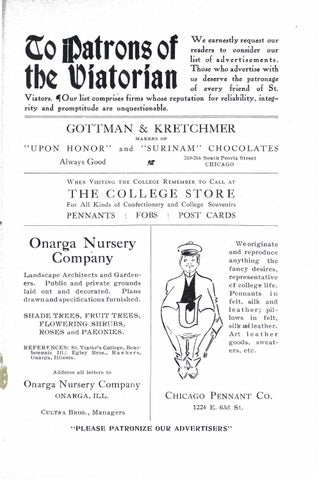
(to iDatrons of tb~ \Diatorian
We earnestly request our readers to consider our list of advertisements . Those W'ho advertis6 W'ith us deserve the patronage of every frien.d of St. Viators. ~Our list compris~s firms W'hose reputation for reliahility, integrity and promptitude are unque-s tionable.
GOTTMAN & KRETCHMER MAKERS OF
"U PON HONOR"
and
"SURINAM" CHOCOLATES 310-316 South Peoria Street
Always Good
CHICAGO
WHEN VIsiTING THE CoLLEGE REMEMBER TO CALL AT
THE COLLEGE STORE For All Kinds of Confectionery and College Souvenirs
PENNANTS
FOBS
POST CARDS
Onarga Nursery Company
We originate and reproduce anything the fancy desires, representative cf college life. Pennants in felt, silk and 1 eat her; pillows in felt , silk and leather. Art 1 eat her goods, sweaters, etc.
Landscape Architects and Gardeners . Public and private grounds laid out and decorated. Plans drawn and specifications furnished. SHADE TREES , FRUIT TREES, FLOWERING SHRUBS, ROSES and PAEONIES. REFER KNCES: St. Via1or's College, Bourbonnais III. ; Egley Bros., Bankers, Onarga, Illinois. Address all letters to
Onarga Nursery Company ONARGA, ILL. CULTRA BROS.,
Managers
CHICAGo PENNANT Co. 1224
E. 63d St.
"PLEASE PATRONIZE OUR ADVERTISERS ..
A D V E R T I S E M E N '1' S
II
The McLAUGHLIN-MATEER CO. CRUSHED STONE, CEMENT WALKS AND CURBS PORTLAND CEMENT AND ALL KINDS OF MASON'S SUPPLIES; and ROCK SPRINGS MINERAL WATERA COOL DRINK. . . . North Schuyler Avenue and l ity Limits
Both Phones No. 277
KANKAKEE, ILLINOIS
DR. Z. J. PAY AN
DENTIST Crown and Bridge Work . Popular Prices
Gold Filling a Specialty Excellent Work
Prompt Execution
175 Court Stree t, KANKAKEE, ILLINOIS
H. H. TROUP & CO.
=LUMBER= KANKAKEE,
D.
ILLINOIS
J. O'LOUGHLIN, M.路 D. PRACTICE LIMITED TO
EYE, EAR, NOSE AND THROAT Independent Phone 704 191 Court Street, Kankakee, Illinois
"PLEASE PATRONIZE OUR ADVERTISERS"
ADVERTISEMEN'l'S
III
ALL MEATS USED .BY ST. VIATOR COLLEGE 路 Are Supplied by
The Hotel Department
MORRIS & COMPANY CHICAGO Kansas City
E. St. Louis
Oklahoma City
St. Joseph
South Omaha
ORR & LOCKETT H A R D W A R E C 0. \
ESTABLISHED 1872 - - - - - - - The leading dealers in Manual Training Equipment. Everything necessary for Woodwork, Machine, Foundry or Forge Shops. Send for our "RED BOOK," the most complete catalogue of Manual Training Supplies ever compiled. GENERAL HARDWARE SUPPLIES OF ALL KINDS WRITE US WHEN IN NEED OF ANYTHING
Orr & Lockett Hardware Co. Established 1872
14-16 W. Randolph St.
CHICAGO, ILL.
''PLEASE PATRONIZE OUR ADVERTISERS"
A D V E R 'l' I S E M
IV
~;
N T S
BRIGGS HOUSE Randolph and Fifth Ave.
Chicago, Ill.
A hotel where the traveling public may secure first-class accommodations at popular prices. Located one block from the city hall, in the midst of all public building~" and theatres. The rooms ha ve the most modern conveniences and 'the majority are with private bath.
The Cafe is one of the most popular dining places in Chicago, where the cuisine is famous for its homelike individuality. One of the features of this restaurant is a Table d'Hote dinner served daily from 5 to 8 p. m., Sundays from U :OO m. to 8:00p.m. Price 60c. RATES: $1.00 and up; with bath $1 SO and up per day.
l ndependen t Phone
Hours : 8:30 to 12; 1 to 2
832
1\'T usic.
JERRY RIVARD '
Grocery and Feed路Store
DR. E. B. CRO.XEN Dentist Room 43 Bank Buildin g
Independent Phone 271
KANKAKEE, ILLINOIS
BOURBONNAIS, ILLINOIS
J. C. 路 ANDERSON
:f
Wholesale and Retail
Fresh Creamery 路Butter Churned Every Day
Pure Ice Cream in Bricks, enough for six 25c Special Flavors for Special Occasions- To Your Order Plant 309 Schuyler Ave
.
KANKAKEE, ILLINOIS
Both Phones 927
~NTAGRAPH
~____B!NTING ~TIONERY(o. ~
~LOOMINGTON, ILLINOIS.
"PLEASE PATRONIZE OUR ADVERTISERS"
~F: -~'t'f~~~~~~~~~t~~:':?":~·~~.~~}
~-'
'
A D V E R 'l' I S E M E N T Independent Telephone 472
v
Ind . Phone 1440
We do Repairing
F. A. LOTTINVILLE Shoe Dealer All New Ideas in Fashionable Footwear 188 Court Street
J. L.
Bell Phone
~03
l__~ECLAIRE
Real Estate, Windstorm, Fire and Life Insurance 273 Schuyler Ave.
KANKAKEE
Kankakee, Ill .
DISTILLED WATER
ROY'S PHARMACY
ICE
193 Court Street
The Family Ice
Absolutely Pure
F. D. RADEKE BRG. CO. Both Phones
Drugs, Stationery, Cigars, Paints, Oils and Varnishes
13~
PRESCRIPTIONS A SPECIALTY
KANKAKEE, IL L I NOIS
•.
~
LEGRIS BROS.
STITH BROS.
Bankers
Restaurant and Lunch Room
KANKAKEE, ILLINOIS
182 Merchant St.
Kankakee, Ill.
FIFTY MILES FROM STATE STREET· I dress yo un g men, and do it acceptably-to the young man and his friends. Suits, Overcoats o r Tr.users. From makers who know bow-Shirts, Necl{wear, G lo"\'es, Underwear, Hosier_v-all the accesso ries for correct dress. Satisfaction g uaranteed .
B. B. FERRIS, Distributer of Men's Wear. 194 Court Street, KANKAKEE, ILLINOIS
FARQUHAR & ALBRECHT CO. WHOLESALE
School Books 378-388 Wabash Avenue
CHICAGO
"PLEASE PATRONIZE OUR ADVERTISERS"
ADVERTISEMENTS
VI
Calumet Tea and Coffee Co. IMPORTERS OF TEAS AND COFFEES Proprietors of Ariston Coffee and Spice Mills Manufacturers of Arjston Extracts and Baking Powders NEW NOS. 161-163 NORTH FRANKLIN STREET
CHICAGO \
INTEREST IN FOREIGN MISSION REACTS STRONGLY ON OUR WORK FOR THE CHURCH AT HOME. American Catholics are beginning to realize this principle of christian life. Get in touch with the Acts of present day Apostles among heathen people.
READ
THEAFIEL.D AFAR Organ of the new Catholic Foreign Mission Seminary
Subscription; Fifty Cents per Year. Send in stamps if preferred. Associate Su~scri ption: ' One Dollar . Enclose a One Dollar Bill.
THE FIELD AFAR,
Hawthorne, New York
INSTITUTIONS JOHN A. TOLMAN & COMPANY The oldest Wholesale Grocery House in Chicago with the reputation for quality and honest weight. OUR FAMOUS
TOPMOST BRAND Absolutely as represented.
We guarantee the goods.
"Enough said."
The STANDARD GROCER, our large price list, is sent free to all Institutions who will
not~fy
JAMES J. MANION, Manager of the Institution Department. "PLEASE PATRONIZE OUR. ADVER.TISER.S"
·~./ . . I '
vrr
A D V E R T I S F. M E N 'l' S
CONTENTS PAGE
THE COMING OF ARTHUR, L. J .. Pon1mier ... ..... .. . . . ... . .. ...... . .. : . MATERIALISTIC EVOLUTION vs. PHYSICS AND BIOLOGY, Jerry P. H o lly . ..... . .. . . .... . .. .. ... .. ...... THE CROSS-S. M. A . .. ... ... .. .... .. .. REV. DR. RIVARD, C. S. V. Appointed Provincial ........ . . . . . . . . . . . .. . . . . ... WINT ER-S. E . D . .... ·... ... .. . .. . .. .. .. . A C HRISTMAS INCIDENT, E. Kekich
P AGE
1
10 14
16 18 19
EDITORIALS ..... ....... .......... .. 23 EXCHANGES.. .. . ..... ... ...... .. .. . . . INTER ALIA .... .. .... ... .. ...... ...... PER,<::ONALS .. ... ....... .. . ..... .... .. ALUMNI .... ... . ... . ..... . ......... .. .... · SOCI KTIES . . . . . . . . . . . . . . . . . . . . . . . . . . . . . . ATHLETICS ...................... . ... . VIATORIANA .... .... .. .. ... ......... .. ..
MUSIC TEA,C HERS AND PUPILS
;;~?KP~D
25 26 29 38 40 42 44 53
OUR
Music, Musica!Instru·ments Strings and Supplies Most Complete VICTOR VICTROLAS AND RECORDS CA RL FISCHER PIANOS Intelligent and courteous clerks in attendance. Special attention given to mail orders. Catalogues sent to any address upon request.
LOUIS B. MALECKI & CO.,
337 S. Wabash Ave., Chicago, Ill.
When in Kankakee c;;tll at the
. Ch lCagO J.
c an dY K' ltC ..· h. en
G. BEREOLOS,
FOR ICE CREAM, CANDY FRU!TS AND CIGARS
Cor. Schuyler Ave. and Court St.
FOR SANITARY PLUMB~NG AND ' STEAM. FITTING VISIT-
E. J. FORTIER 'The Plumber 212 Ch estnut Street
KANKAKEE , ILLINOIS
Arr1erican Packing & Provision Co. (IN c .)
BEEF AND PORK PACKE .RS HAMS, BACON and SAUSAGES OUR SPECIALTY Phones : Bell 90 ; Independent 90
Kankakee, Illinois
"PLEASE PATRONIZE OUR ADVERTISERS"
.
REV. E. L. RIVARD, C. S. V., Ph. D., D. D . . Recently Appointed Provincial of the American Province.
路'
THE VIATORIAN 111ar d t;p.rra VOLUME 30
DECEMBER, 1912
NUMBER 3
THE COMING OF ARTHUR A Study L. J. POMMIER
A
FTER one has 1nade a co1nprehensive study of Byron, and exa1nined the mind of this great English poet as 路 revealed in his "Childe Harold's Pilgrimage," which is truly considered the en1bodiment of man's noblest and lowest passions; of nature's sublimest aspects, of art's most precious relics-he seen1s to pass from the darkness of night to the roseate dawn of day when he undertake路s the study of Tennyson's n1aster-piece ~'Idylls of the King." After being confronted with Byron's stern and vivid realities of life, he see1ns to be fanned by angel's wings, or soothed by vernal zephyrs when he begins the study of Tennyson. Byron is like a stnntner storm. The thunder roars, the lightnings flash, the clouds pour forth their superabundance, while rivers foam in their flight through rock-bound caverns or plunge wildly over the precipice, in the cataracts leap, to reach the mournfully heavy bosom of the li1nitless ocean. - Tennyson is indeed typified by the springtime of the year. The earth is gay in living green, the air is redolent with nature's bloon1; the warbler's tune the children's merry voices. Bryon is sublimely superior, Tennyson superiorly sweeter; one is the poet of thrilling passions, the other that of softer sentiments. Tennyson is essentially lyrical, and as such, he is the acknowledged 1naster ''of his generation;'' still Tennyson's true worth was doubted, when he appeared in the poetic world. His first attempts at versefication were 路repudiated. Coleridge said that "he had begun to write verses without very well understanding what metre was." But when his 1nemorial poem dedicated to Arthur Halla1n appeared,
2
THE VIATORIAN
he was recognized as Wordsworth's. true successor, and deserving of a place a1nong England's peers. of the Muse dialect. Later on his "Idylls" were revealed, and these fonn the basis of his literary 111erit. Still we find critics. of no n1ean abilities, casting shadows on the Arthurian legend. They consider them as an unparalleled collection of airy, unsubstantial pen-pictures; a beautiful tableau, apparently in real life, but nothing more. They ask the question, "Are the Idylls. of the King what they are supposed to be, an epic?" Do they carry that i1nport, which the Iliad did to the Greeks, the Aeneid to the Romans, the Paradise Lost, to the world? Mr. Parsons. doubts whether the Arthurian legend should be classed as an epic, and says that it can "hardly be regarded as a monumental work." To decide this point is no easy task. It is true that the "Idylls" have no historical i1nport, nor has Paradise Lost, still the latter is. acknowledged the best epic in English. It is true that the Idylls bears no significance to mankind? Let us see. What is an epic? What are its characteristics.? Stating these, then comparing then1 to the Idylls. of the King the answer in question 1 is at hand. If we review the n1as.ter epics of the world, we perceive that 路they are "the recital of . son1e illustrious. enterprise in poetical form." . The epic like all other varieties of poetry has for end and purpose the giving of pleasure, by the exposition of "heroic qualities," strong feelings and striking characters. Therefore the characteristic . 1nark of the epic is ad1niration through moral and physical s.ublin1ity. After exainining Tennyson's Idylls of the King, we are forced to place it not in the hall of the epic fa.1ne, but in a niche by itself. In the first place it is an allegorical epic. If it is not, it is what Parsons says, "not .a 1nonumental work.'' There is n1ore in it than the mere O路utward expression of the Arthurian legend. This Albion tradition concerning an eminent 路 King of Britain, is simply the garb in which is couched a noble strife, a grand ideal, and this ideal 路is the Idylls import to mankind. The fable of the Round Table is to the: Idylls what the "Hind, panther and wolves are to D:ryden's unrivaled allegory. Many critics looking solely at the external, the bark of Tennyson's chefd)ou.v re, have disregarded it; but the searching eye of diligent and untiring study has seen an Eden of poetic luxuriance. You will not find undaunted heroes in quest of their country's cause, nor n1ail-clad knights shedding blood for honor's sake or the love of the fair; but a struggle old and new, which dates fr01n
l,
\
THE VIA TORIAN Adan1's banishn1ent from Paradise to this very day; a tourna. 1nent which n1anifests more than physical strength and artificial skill, it is_the noblest of combats, that of the Black Knight of Sense with the In1maculate Cavalier of the Spirit. That Tennyson tried to create an. ·epic is evident; that be gave the world an epic is not to be questioned; but how it cmnpares with real epics is not so clear. Certainly Tennyson's Idylls lack that stamp of epic peotry. He seen1ed incapable of those strong and sublime sentiments; those lofty aspirations, so necessary for that song which was sung by Hon1er, Virgil and D·ante. Another indispensable requisite which is found in the Iliad, Aeneid, and Paradise Lost is ·w anting, because Tennyson was not a painter of characters. His personages are often vague, ill-defi·ned and unappealing; they do ·not represent personalities demanding reverence and admiration. His characters are 1nyth-like and he leaves them such. Have we no excuse for this breach of poetic-law? Can we be allowed to say in his favor, that considering the subject 1n.atter, the itnport of his poem, nan1ely the spiritual, he thought best to leave his Arthur, the Lady of the Lake, Merlin, and n1any others in an airy, nebulous world? I think so. Therefore if we atten1pt to class the Idylls as an epic by the sitnple consideration of the Arthur ian legend, it is a con1.plete failure. For, what is there to enlist attention, interest and sentiment in a worthless legend, whose characters are myths, whose exploits arouse not passion? , But if we consider Tennyson as trying to paint the soul's combat with s,e nse and its infernal and worldly host, on the battlefield of Earth and at the tourna1nent of tin1e; if we consider the choice of a dubious tradition as the garb for the presentation of his ideal to be given to the world because it can suffer to be applied to suit the tmdercurrent of the poem, then I say it is an epic, and one occupying a new pedestal in the museu1n of literature. In order to insure a correct insight into Tennyson's "Idylls,'' a critique of the first idyll, "The Coming of Arthur," will be given. We must constantly keep before the mind's eye, the two currents of this flowing epic. The uppercurrent is a connected narrative, with its characters, places, and actions, which shadows the struggle of the spirit and its allies with the body and its n1orbid host. But we must not be searching a mystery in every pen-picture, "a riddle in every line," a sytnbol in every character or action, for this, would be driving interpretation" to the ridiculous. Guinevere as the
4
THE VIATORIAN
poetn says is l{ing Leodogran' s daughter "the fairest of all the flesh," whose father's reahn is devastated by petty princes, 111enacecl by wild beasts, and harried by heathens. Here Guinevere is the daughter, the product of matter, but the "fairest" product of rnatter, namely the human body. The kingd01n's frightful conditions manifest the body's state, when 路 besieged by passions, and evil inclinations both frotn within and without itself. At this titne a tnighty knight appears of unknown ori:.. gin and land, to whotn Leodogran . appeals for succor saying: " Arise, and help us thou! For here between the man and beast we die." 'l_'his is the picture of the awful conditions of things, if no spiritual power existed in the tnaterial world and their yearning for such a power is graphic from Leodogran's supplication. " Arthur had ~et done no deed of arms" but responding to the King's fervent call, he unites his bravest knights and takes the field. The heathens are driven away; the forests are cleared . of n1alicious beasts, and pathways made for knight and hunter. But now the great Lords and Barons of Leodogran's realtl)l, had been waiting for an heir of Uther the lawful king of the country, but when Arthur takes possession of the land they flash forth and into war saying: Who is he that he should rule us? Who hath proven hi1n l(ing U ther' s son? For lo! we look at him, and find nor face, nor bearing, lin1bs, nor voice are like to those of Uther whon1 we knew. These rebellious lords and barons typify the vices and passions upbraiding the soul's presence, and denying its kingship. Now Arthur, when going to war against these, n1eets Guinevere's eye, desires to be joined with her and thinks thus as he rode away. "};Ier father said That there between the n1an and beast they die. Shall I not lift her fron1 this land of beasts Up to tny throne, and side by side with me? What happiness to reign a lonely king, Vext-0 ye stars that shudder over me, 0 earth that soundest hollow under me, Vext with waste dreams? for, saving I be joined To her that is the fairest under heaven. I seetn as nothing in the tnighty world, And cannot will tny will, nor work my work Wholly, nor make n1yself in n1ine own realn1
t
.'
~p',_:i''路~~-:~?~'(" ~'
.
I
I'
'(. '
THE VIA TORIAN
5
Victor and lord. But were I joined with her, Then might we live together as one life, And reigning with one will in everything Have power on this dark land to lighten it, And power on this dead world to make it live." In these sweet accents of yearning is 1nanifested the soul's connatural aptitude and desire of being united to the human body. The soul tnust live with the body, it must regenerate, tnust save the body fron1 its enthralling foes; but for that end, it must be united to the body without lowering its nature. The soul must have full sway over the human organization, so as to raise it to the spiritual oTder. Arthur must take Guinevere to his stately court of Camelot. If that it does not do what is the world with all its po1np and glory to the soul? Nothing, mere show and dross. So Arthur plunging in the battle-field, a mighty struggle ensues. The lords and petty princes seen1 at first to overpower Arthur and his chosen knights, when heavenly forces stop the crt1shing tide of victory against the victors. Arthur leading his knighthood encouraged, overc01nes the bewildered rebels. When the fray has becmne a deep silence and pleasant cahn, Arthur sn1iles on his best loved knight, wh o exclaims: "Sir and 1ny liege, the fire of God. D路escends upon thee in the battlefield : I know thee for my I(ing.'' But what is this heavenly succor, this fire of God, the syn1-路 bol? This can best be answered by St. Paul,- "God will n1ake that grace issue w ith every te1nptation." 路T ennyson having thus far advanced in his theme, has to bring up a question, which the poem requires. The question belongs to the province of philosophy, but Tennyson's poetic 1nind, which cannot be hatnpered by s.yllogisn1s and principles, must follow its inclination. The problen1 is Arthur's or the soul's origin. When Arthur~ s victory is still quickening his pulse, he summons three of his sworn knights and dispatches them to Leodogran saying: "If I in aught have served thee well, (Leodogran) Giv;e 1ne thy daughter Guinevere to wife."
,.
'
/
6
THE VIATORIAN
Leodogran, having received the Arthurian knights, makes a grateful avowal of their leader's great assistance; but he, being a 路 king, cannot afford to give his knightly daughter except to a king's son, of which prerogative, he is not assured as regards Arthur. In Leodogran we have a picture of a character still en1neshed by strong threads of n1aterialism, and not thoroughly spiritualized, who doubts the soul's kingship. He desires evidence for Arthur's title: The king's chatnberlain informs hin1 that the secret of Arthur's birth lies in the mind of two sages, Merlin and Bleys. The latter the teacher; the fonner the pupil; but the disciple so far outstripped the n1aster, that Bleys "sat himself down" to write what Merlin revealed. And in that great book the secret of Arthur's birth is kept. Now Merlin typifies Wisdom, and B1eys, knowledge. Merlin at present is Arthur ~ Councillor and guide; building his cities, planning his exploits, and regenerating the kingdo1n. There is a nice point of distinction here to be inferred, between Knowledge and Wisdon1, which Tennyson again makes in "In Men1oriam: :'路' ) "Let She For But
knowledge know her place; is the second, not the first, she is earthly of the mind, wisdon1 heavenly of the soul.''
l-Ienee \!Visdon1 is to tell Leodogran whence is Arthur or the soul. It must be retnembered that Leodogran and his court wish to find out whether Arthur is Uther's son. If this is proved, Leodogran will cede. The three knights are then questioned. These answer "by faith, and not by knowledge," so that Leodogran is . still in doubt and unsatisfied. While debating with hin1self, Bellicent; Arthur's. reputed sister, the wife of Lot, a neighboring king, appears at court. Bedivere one of Arthur's deputed knights, had referred to Bellicent as knowing. the origin of Arthur. Therefore Leodogran, by way of leading to that issue, asks Bellicent, her opinion of the stability of Arthur's kingdo1n. She answers him by giving an account of the founding of the Round Table, of which she was an eye witness. Now the Round Table is the symbol of the spiritual organization in man; the breathing of a new spirit in the purely sensual man. Therefore we infer that Arthur's knights are but the soul's agencies. When the knights took their knightly
,'
.;~
THE VIATORIAN
7
vows, they becan1e transforn1ed like other Arthurs; they awoke as from a deep trance, dazed, bewildered and pallid, but when from Arthur's tongue came divinely encouraging words they were revived. And while he spoke three rays of red, green and blue darted fron1 the crucifix and rested on three fair queens present, who brightened the room and promised to be the knights.' abjding help in need. At this installation of the Round Table, Merlin and the Lady of the Lake, who gives to Arthur his famous sword the Excalibur, are present. This Lady of the Lake is said to possess a subtler magic than Merlin, ' and dwells "down in a deep cahn" and whatever turmoil overturns the world, "she hath power to walk the waters like our Lord." Now this account of Bellicent, who typifies . those to whon1 faith is sufficient, those who cannot see the Holy Grail unveiled, but those who receive Merlin or Wisdon1's word on faith, because it has sworn, "Though men n1ay wound hi1n (Arthur) that he will not die;" we adn1it that this account is 1nystical and hazy to those who do not grasp the under-current of the poe1n fron1 the beginning. By the thre~ fair queens is typified the theological virtues, which guide and fortify the spiritual organism. That famous Fairy of the Lake, who presents for a time a 1nightly sword to ~Arthur, is the symbol of Religion, which furnishes to the soul during its earthly reign the spiritual arn1s necessary to keep away strange and troublesome ravagers. Leodogran hearing this explanation of Arthur's i1n1nortality and kingdom rejoices greatly, but still he de1nands whence is Arthur. Bellicent although acknowledging him, her brother, though of a different complexion and 1nien says "These be secret things." But Leodogran's questioning forces her to relate what she had learned fro1n 1\ferlin. Merlin had described to her Arthur's coming on a night when earth and sky see1ned to n1eet, when in mid-air appeared a ship dragon-winged; and while the sea rolled and the waves dashed, an infant child was. washed to the shore at Merlin's feet. Merlin took hi1n in his arn1s 路and cried aloud, "The king." Who, then, is Arthur? Surely not Uther's son.. Bellicent's acconnt which she received fron1 Merlin is the- "soul's advent from that eternitv whence it con1es to human birth-to the shores of time. "It comes in :fla.mes of fire, the sy1nbol of life." He, Arthur, is king not because he is the /heir of tTther, but by virtue of the spiritual supremacy of the soul over the body.
8
THE VIATORIAN
It is the kingship of the higher over the lower nature. But Bellicent tells Leodogran that when she had questioned Merlin as to the truth of Arthur's spiritual advent, Merlin answered in "riddling triplets of old time." The import of the "riddling triplets," is that human curiosity should not pry into what is beyond its reach; still we tnay infer that Arthur's or the soul is that principle, that "rainbow" which passes through all the . vicissitudes of life and survives even after death. Hence the soul's immortality. Leodogran's mind is changed but not convinced. While meditating between the "yea" and "nay" to be sent to Arthur he falls into a deep sleep and dreatns. The ltD.port of the dream is the struggle of the lower against the higher nature and the survival of the latter. "Till with a winJ.< his dream was changed, the haze D'escended, and the solid earth became As nothing, but the King stood out in heaven, Crowned. And Leodogran awoke, and sent Ulfius, Brastias and Bedivere, Back to the court of Arthur answering yea. 11
Arthur received his deputies with joy and his chief knight Lancelot is sent for Guinevere, who is brought in Arthur's. realn1 at Camelot, the city built with the "sound of music, therefore not built at all, yet built forever." The marriage feast is echoed by the songs and shouts of the happy knighthood. It is the springtime of the year, the beginning of a new epoch. Arthur says to Roman Lords who were present demanding tribute: "路T he old order changeth, yielding place to new ; And we that fight for our fair father Christ, Seeing that ye be grown too weak and old 路 To drive the heathen fr01n your Roman wall, No tribute will we pay." "The reign of pagan Rome is now over ; a new era has come in, a new 路 law established." The 路 spiritual king n1nst reign, so Arthur and his knights.: "In twelve great battles overcame The heathen hordes and tnade a reahn and reigned." The Rotnan lords and heathen hordes represent the unlaw-. ful forn1alistn to which the n1an of yore was subject, but since
t~
路,..c
l"t_;J'路,
f.
''
THE VIA TORIAN
9
the apparition of the Lady of the Lake and her ward, Arthur, ancient custom have been abolished, heathen superstitions and base idolatry has been blasted. These are the chief points of symbolism to be gleaned from the first Idyll. Certainly, this work of Tennyson is a grand allegory. But the question arises, "Did he really mean, what modern critics have interpreted from the poem?" It is doubtful. The true meaning is so darkly hidden, there is such a distance and unconnection between the true and apparent subject-matter1 that it is almost impossible for one to arrive at the former fron1 the latter. Other interpretations of the "Idylls" can be given. It is an easy task to find appropriate characters of history to fill the myth-like personalities of a legend, when one has that bent of mind called association of ideas. Consid~ring but the first Idyll, could 'n ot Arthur be regarded as Christ 1n his work of reden1ption? Merlin the symbol of Scriptures.? Bellicent, St. John the Baptist? Could not Guinevere represent human nature? Lancelot, Judas? Would it be stretching fancy beyond its lirnits to consider the Lady of the Lake the Virgin l\1other, giving 路 to Arthur, Christ his Excalibur or human nature? Could not Leodogran's. doubt and perplexity as to Arthur's legitimacy, symbolize the Jewish HighPriest, who referred to scripture or Merlin through Bellicent or St. John de Baptist for the testimony of Arthur's coming. _Certainly I see no more incongruity in this interpretation than I do in Mr. Pallen's of which the greater part of this critique is the outgrowth, for the latter interpretation smacks not a little of Plato's unphilosophica1 theory of the soul's advent. As to the Idylls' literary merit we must say that the style lacks that tone which an epic requires. The style is soft and sweet, and is void of that sublime magnificence, and grandeur of heroism, which is found in Virgil and Milton. The inver- sions lend an air of mysteriousness to the them.e. The music is frequently broken by grating measures. The rhythm of the Idylls is totally unlike Tennyson's other works, whose particular chann are mellowness and smoothness. If the twenty years of work which the author has spent on the Idylls would have increased to thirty, 1nodern English literature might have an epic to compare to that of Milton. But as they stand one must not begin to con1pare the111 with Paradise Lost. The latter is the tuned voice of a n1aster; the forn1er the gasp of a striving apprentice.
MATERIALISTIC EVOLUTION VERSUS PHYSICS AND BIOLOG,Y JERRY P. HOLLY '14
A TERIALISTIC Evolution as a philosophic theory necessarily supposes the eternity of matter. If matter and force alone exist, then it follows as a necessary consequence that matter and force are eternal. The first fundcunental postulate of n1aterialistic evolution is thereby the eternity of matter. Many m1e taphysical reasons might be assigned to disprove such a theory, but we will disregard these and 1neet opponents o.f scholastic doctrine on their own favorite ground of Physics. and Biology. Everyone who iS at all interested in the facts. of scientific investigation must have heard of the "Nebular Hypothesis." That this is one of the basic principles of Materialism is also notorious to all. Let us for the sake of argmnent suppose this theory to be true. Let U:s suppose that in the beginning, 1the universe was a huge gaseous body, that the molecules of matter were at relatively enonnous distances frmn one another. The universe was a great tenuous cloud, a gas. or vapor. There was enormous intennole.cular sp,ace. If this be true, then the question naturally arises, How did the molecules get apart to such enormous distances? By the power of gravity the Inolecules have a tendency to come together. Since gravity, so far as we know it, is a force inherent in matter, we would be led to suppose that in the beginning the n1olecules were very close together. How then did the 1nolecules get apart? Materialism · answers,-Heat separated them. But what caused the heat? In order to answer the question, Materialisn1 refers us to a law of Physics~Heat is produced by the friction of the n1ole- . cules: But the explanation supposes .that the Inolecules came together of themselves. In the beginning they were apart and afterwards they can1e together: Evidently they 1nust have been in motion . But who put the1n in motion? This is the final question which we would put to the advocates of Materialism. This is the question which 1naterialisn1 cannot answer. "Who put the 1nolecules in motion?" Evidently we must ad1nit the existence of a force distinct from matter, a force that was responsible for the n1otion of the molecules. But Materialists
,, j
•·
THE VIA TORIAN
11
reject such a conclusion. They suppose not only that n1atter is eternal, but also that motion and force must also be eternal. Their solution of the problem resembles the ancient Hindu Explanation,'' "The elephant supports the universe, the turtle supports the elephant. But what supports the turtle?" Astronomers tell us that the original nebula, the great cloud of gas was 'i n the beginning in very rapid motion. Its centrifugal force was so great that it threw off into space, the great central sun. The central sun in . its rapid revolution threw off our sun. O路u r sun threw off its system of satellites, moon and stars, and in this manner our entire solar system 路 was evolved. Now this theory may be accepted or not. 路 There are facts in favor of it, there are facts again which deny it. i\ll the planets with the exception of Mars are revolving from west to east. The fact that all the planets of our Solar system are revolving in the same direction proves the existence of a parent body revolving in that direCtion, yet the fact that Mars revolves in the opposite direction contradicts the theory. But this is not ad rem. Consider how inconsistent with the facts of astronomy, is the theory of eternal tnatter. We know that this rotary tnotion of the planets is gradually slowing up. At the present titne the earth rotates on its axis once every twenty-four hours. There will come a time when the earth will rotate .only once a year. A day and a year will then be synonymous. This is true not only of the earth upon which we live but of all the other planets, Neptune, Mars, Jupiter, all of them are gradually slowing up. The universe is approaching the final completion of all these tnovements. I say it is approaching the completion for the retardation of this rotary motion is not yet c01npleted. Now if n1atter were eternal this slowing up process would have been cotnpleted not n1illions upon n1illions of years ago, but an eternity ago. As a matter of fact, we know that the problen1 is still under way of solution. It will take tin1e, not eternity, to solve it. So you see ho'"r absurd is the theory of eternal tnatter and a thorough study of our solar systen1 shows how miserably inconsistent is the doctrine. There is a law in Physics called the conservation of energy. In substance that law tneans that matter cannot be destroyed. We read of the existence of another law, a law which seetns to contradict the law of conservation . It is called the dissipation of energy. While it is true that matter cannot be de-
.. l,,•
12
f ......
THE VIATORIAN
strayed, that man has not the power to annihilate it, nevertheless it is also true that energy which was formerly in a state ¡ useful to man, may be reduced to a state wholly unserviceable to him. Whe~ the cottage of a poor laborer is reduced to ashes by fire, the law of conservation is not violated. Matter is not destroyed but it is changed into a state wholly unserviceable to the laborer. The law of dissipation is going on throughout the universe at all times. We learn in Physics that a machine will never give back the energy which is put into it. We have heard of machines which were 47 %, 6o% , even 99o/o efficient, but whoever heard of a machine that was roo o/a efficient? Some energy must be lost and it is generally transfonned into heat and dissipated 1n the atn1osphere. Let us apply this law to our solar system. \lV e know that the center of our solar system, the sun, is sending out into space waves upon waves of heat and that only a sn1all portion of this heat reaches the earth upon which we live. All the other planets are receiving smne of this heat and surely the sun cannot go- on in this way forever. It cannot) continue forever to send out into space its heat waves for . its supply is li1nited. What then is going to happen? See how the law of dissipation is working¡ in our solar system-the sun is slowly cooling, its temperature is gradually declining. All the other planets are also losing heat but not as rapidly as the sun. Scientists tell us that there will come a time when all the planets will be of an ,equal temperature and when that time comes there will no longer be vegetation upon the earth, since heat is an essential requisite for the preservation of life. When the cooling process in the universe is completed, man will no longer continue in existence. All these events must take place in the course of time. How long we do not know for it may require 1nillions of years. If n1atter were eternal, let me repeat the argun1ent, this problem must also have been solved in eternity. We know as a matter of fact, that the problem is still under way of solution. Hence matter cannot be eternal. lviaterialism explains the universe as it now exists by the theory of eternal matter. Yet we have seen from a study of our solar system that matter cannot be eternal. But even supposing the eternity of matter, then Materialism is brought fC!-ce to face with the question "Ho-vv do you account for life?" The -evidence both geological and paleontological points to the fact that there was a ti1ne when life did not exist upon the
. ,'
':tHE VIATORIAN
13
earth. ' In the beginning there was no life. Now life exists. Whence this life? In order to account for life Materialists are forced to n1ake one 1nore supposition-Spontaneous Generation. By this they mean the production of life from inert matter. Some time in the past, let it be countless ages. ago, if you will, a single cell was. produced out of the potentiality of matter. Just one little cell, a tiny speck of protoplasn1. This is all they would ask us to admit and then these advocates of Materialistic Evolution would stretch their in1agination to its widest limits and endeavor to explain every species of life now existing upon earth. Let us therefore exatnine this theory and see how it ranks with the facts of science. \l\1 e can accept it only in so far as it is supported by actual proof. There is not a single fact of science to substantiate it, for no scientist has ever succeeded in producing the tnost imperfect form of life fron1 inert n1atter. In fact the experiments have not been upon inert matter, but upon decayed anin1al organism. Yet even then science could not produce a living cell; so that the 1nost we 路can say in favor of Spontaneous Generation is that it may be so. Perhaps there are hidden forces. operating in -this universe producing life frmn inert matter. In fact this is the only argun1ent which the materialists bring forward to support their theory. Tyndall gives expression to the argument when he says "Abandoning all disguise, the confession that I feel bound to make before you is that I prolong the vision backward across the boundary of experimental evidence, and discern in that matter which we, in our ignorance and not withstanding our professed reverence for its Creator, have hitherto covered with opprobrium the promise and potency of every form and quality of life.:' I said that there was not a single fact to support the theory of abiogensis., rather all the facts s.een1 to point in the other direction. The fatnous experiment of Pasteur proved conclusively that life cannot spring from dead matter, and all subsequent researches in the field of chemistry and biology have only tended to widen the gulf between the living and the nonliving. Hence we will end the question of abiogenesis for the theory is no longer considered by the scientific world as worthy of our attention, and many prominent materialists have long since abandoned it because as a scientific hypothesis it fails con1pletely. The second fundamental postulate of n1aterialistic evolution is therefore necessarily erroneous.
14
'l'IIE VIATORIAl\
Before I conclude I wish to point to the fact that there is no controversy between Evolution, considered as a strictly scientific hypothesis and Christianity. The Church never has been in the past, neither is she to day, a路 barrier in the way of scientific investigation. Never was any staten1ent more untrue than the accusation that the Popes prohibited dissection, during the tniddle ages. The Popes on the contrary have always been liberal patrons of chemistry and a.nat01ny and tnany prominent members of the clergy were noted scientists. There is no controversy between religion and science. The Church today does not discourage investigation in the field of evolution and no discovery of science can ever undern1ine the foundation of Christianity. Let evolution be demonstrated by science and let us suppose that there is an evolution of species, this in no way will dispro~e the doctrines. of the Catholic Church. For to adtnit that there exists in the force of matter the wonderful power of self-development in no way contradicts the Otnnipotence of the Aln1ighty but rather it tnanifests His Infinite Wisdom and Power.
THE CROSS.
I--Iail Sacred Cross.! Ah! Who can paint The mystic strength and beauty found in thee? En1blen1 of truth; and wond'rous syn1phony Of each and every faithful soul and sa.int. The only gate of Heaven; the one restraint That keeps and guides the weary on their way, The n1ile post pointing to eternal day Encouraging the wayworn and the faint. In glorious Peter Hennit's holy hand It tnarshalled Christian forces to defense Against the crescent in that Holy Land, \Vhere . Saracen.ic hosts had shown offense. On Calvary's holy height where first it stood It e'er ren1ains our strength-路the holy rood. S.M. A.
'-l·· ~), ,'f·, ;, '· ' ',' \'- J,,
·- . , ....
~ ··~
REV.J. A. CHARLEBOIS, C. S. V., D. D. Retiring Provincial, Appointed Pastor of Maternity Church Bourbonnais, Illinois
REV. DR. RIVARD, C. S. V., APPOINTED PROVINCIAL Word has been received from the General D·i rection of. tht· Clerics of St. Viator in Brussels, Belgiun1, that t~e . Very Rev. E. L . Rivard, C.S.V ., has been appointed Provincial of the Chicago Province. He succeeds the Very Rev. J. A . Charlebois, C.S ,\ T. , who has filled the office during the last four years. During his incumbency Father Charlebois. formulated . and brought to successful issue important plans for the development of the American branch of the Viatorian Order. To foster vocations and prepare young m.en ·for the novitiate he established a Juniorate in con'hection with St. Viator College, and also opened up at Bourbonnais a house of studies. for professed members. He developed the missionary feature of the Order by es.- { tablishing a Missionary Band, with headquarters. in Chicago. Columbus College of Cha1nberlain, S. D·., owes its existence to · his energetic efforts. The strain which was. consequent upon his ceaseless labors began to tell upon Father Charlebois' health and' necessit.a ted a change of occupation. He has been assigned to the pastorate of Maternity Church, Bourbonnais. The anouncement of Father Rivard's promotion will . be hailed with joy by a large circle of friends, for he is widely known in the United States by both priests and laity, and it will be generally felt that no better appointment could have been ·made. Father Rivard has spent the last twenty-eight years in the active work of education, and therefore is well equipped to deal with the problems that con front a community engaged in the work of Catholic edu{:ation. He is also widely known as a scholar and literateur, being the author of a well-known work on Dante, as well as a constant contributor to Catholic periodicals. Father Rivard was born about fifty-four years ago at Bourbonnais, Ill., and reared in the very shadow of St. Viator College. He received his primary education in the district school, · which then, as now, was taught by two Brothers of the Clencs of St. Viator. He afterward proceeded to St. Viator College, where he completed his studies in philosophy. About that time the late la1nented Father Fournier, C.S.V., was appointed first
I•· ·.~.~
I I .,
'
THE VIA TORIAN
11
Provincial of the Chicago Province, and he straightway opened a novitiate for the new province. Father Rivard was the first novice to enter this novitiate, and has therefore the distinction of being the first novice of the Chicago Province. After the co1npletion of his novitiate he returned to the college to com.plete his studies in theology,. being ordained June 6, r885 . After his ordination his superiors, recognizing his fine talents, sent him to Rome to pursue further studies for the doctorate in philosophy and theology, both of which degrees he was successful in winning. When he returned from Ron1e he was appointed to the Chair of Philosophy at St. Viator College, which pos.i.t ion he filled with brilliant success until a year ago, when holy obedience called him to be Master of Novices. During the twenty-five years that Father Rivard taught philosophy, many rrien now distinguished in various walks of life passed under his care. He was the ideal teacher, and anyone who was ever in his class will gladly bear testimony to this fact. He had the great teacher's sy1n.pathy with his pupils' difficulties, and had the faculty of instilling a great love and desire for learning into the 1nen1bers of his classes. Father Rivard always loved philosophy and poetry, and some of the abundance of his love used to overflow into the souls of his students. It was no uncommon occurrence to find a pupil who had not been noted for his intellectual attainn1ents up to the time when he began philosophy, g1row and develop intellectually in a wonderful manner under Father Rivard's teaching. "Father Rivard was my intellectual parent,'' a priest now well known for his intellectual attain1nents was once heard to say, and it is no exaggeration to say that 1nany men in all walks of life can say the same thing. Father Rivard was a great teacher because he believed in the grandeur and nobility of the cause o·f Catholic education, to which he had devoted his life. Personal ambition and advancen1ent, ease and comfort, his whole being, in fact, were subordinated to the . advancement of this cause. In the councils of his community his advice was always given with this in view, and every new 1neasure that came up for adoption, and every new enterprise to be undertaken were always considered in the light of whether the cause of CathoHc education would thereby be advanced. In the course of his career as a professor Father Rivard taught a generation of n1en who are now teachers themselves, and he always fired then1 with so1ne of his own enthusi-
'i~:
--,,,
..,
~ 't'
~.
'路
18
THE VIATORIAN
asm for the great work they were about to engage in, and inflarned their hearts and son1e of his love for it. It cannot be doubted that Father Rivard 路 has been a potent factor in the - great work of Catholic Education in the Middle West. He has always been an enthusiastic supporter of the Catholic Educational Association, and when this splendid organization was in its infancy he was an1ong the tnost active foster~ ers of its growth. He understands intitnately the problems that confront the Catholic educators of today, both in the class ro6n1 and outside, and has always been an advocate of everything tending to the bettennent of education. Now that the Direction of the Province has been laid upon his shoulders, his sphere of usefulness had been widened, and it will be generally felt by those who know )lim that he is big enough to fill this wider sphere. No doubt, old students of St. Viator College will re~ . gret his absence fron1 the class roon1, but they wilt know that the direction of a teaching cotnrnunity is in safe hands, and that he will instill into the young educators whon1 he now directs, something of the spirit which anirnat~s him.
VVINTER.
The skies are drear, old earth is white Aeolus has set free his n1ight, And o'er the hills and through the vale Gritn \i\Tinter seeks his lonely trail. Like n1onarchs stand the rnaples brown. Each lone and still with frosted crown, The blossotns too, have fled away For rude l(ing Winter now holds sway. The days are bleak, the nights are long And silent now the warbler's song; Yet fancy kind paints visions bright Of Sun1mer scenes in colors light. S.
E. D.
A CHRISTMAS INCIDENT E. KEKICH '13
m
AWN was con1ing in a n1is.t of vivid red and white; tnorning, Christtnas n1orning, was beginning to unfold its soft and pinky fog into bright light of day. The big city seetned hushed, hushed unusually; as if in reverence to the sacred Yule, as though it were the vital part of Christendon1 soletnnly joining in adoration to the ne\v-born Lord. In one of the leading hotels of the big city, a certain Charley Bates, having finished his tn.orning toilet, stood at the window of his room, languidly gazing on the Christn1as dawn. He noticed, the thin flurry of snow descending slowly fron1 above, the reflection of the sun's dull, but happy light on the tiny white -flakes, the reign of caln1 and quiet over the city. Inadvertently and with a sigh he quoted that poetic heralding of the Yuletide: "'The halcyon builds its nest on the tranquil sea." Christmas! But none of the traditional joys were for hin1. Son1e tninutes later Bates rather nervously stalked up io the hotel office. After a few casual and cmntnonplace retnarks to the clerk, he turned n1.echanically to the register. Six seconds later he uttered a low exclan1ation of surprise. On the left hand page, in the bottotn space, he read, "Alexander T . Hamilton, 42 Maiden Lane, New York." In n1ingled wonder and anxiety, Bates quickly made his way to the little enclosure in which was installed the telephone apparatus and asked the hotel operator if he might speak to Hatnilton. Alexander T. Hamilton awoke with a start, the 'phone was clamoring wildly. Notwithstanding the tetnptation to throw a shoe at that tnodern annoyance and retnain in his downy bed, said party wearily arose, yawned, stretched, and hovered lazily to the phone. "Hello, ah, Oh, what? Yes, Who? . Oh my! Charlie! Sure I'll be down right soon. " H an1ilton, now pretty well awake, by way of tnorning exercise, approached the window of his rootn and noted the identical things noted by Bates a little before; the Christtnas dawn, the Christn1as sun, the Christn1as snow, and somehow was effected in the san1e way. None of the traditional joys
20
THE VI ATORIAN
of Christmas were for hin1 either. Then his thoughts turned to his one dear friend, the fellow who had just telephoned. Later fotmd an affectionate greeting taking place in the lobby of the hotel between Hatnilton and Bates. A.s this brotherly salutation was going 'on, the observer finds that Hamilton is a clean-faced young n1an, probably twenty-five years of age, of slender proportions, neatly dressed and very hands01ne. Bates is large sized, s.on1ewhat younger than his friend, of an attractive appearance and tnanner. The observer tnight read in the air of these young n1en, well-being in its every sense, fr uitful activity, success. But unfortunately the adage "Looks a.re son1ewhat deceiving," fits this case precisely. Charley and Alexander were veritable n1en1bers of the "down and out" club. In a very little n1easure they were conscious of this fact. "" Back yonder in the past they had both attended the same university. There, Alexander's sense of value developed in the football channel only. In football he had been willing to wear the badge of toil, but otherwise his attitude was nonchalant. His wann friend, Bates, was one of those gifted scholars who never opened a book and was accordingly much adm.ired, as if such abstinence were reason of 路 admiration. So these two creatures, very conspicuous in the doings of the large eastern university at one tim.e, graduated therefrmn, whether with honors or without, is not s~id . They parted ways, drifted aimlessly about for the period of a year or so and were finally ejected fron1 their respective households, by their respective "paters," who branded then1 as worthless parasites, (though probably, they were not so bad as that), unable to get fot: then1s.elves even a li ving. After their abrupt and disgraceful exit frotn home, more aimless wandering followed. Finally Charlie tnanaged t o n1anage "a j ob at bookkeeping." Alexander, in turn, was rapidly rising in the world by "stalling" eight hours a day in a newspaper office at a s1nall sum. Both happened to be in the same city but neither was aware of that fact until the Christmas 1norning of wh ich we speak. Thus Ha1nilton and Bates, boson1 friends, talented in their way, supposedly educated in their particular professions, and with every possibility of successful careers before them on leaving school, had nothing at present to look back upon save ill-spent years. So far their lives were comparative failures. Through it all, they had gro-vvn callous and indifferent.
路~
THE VIA TORIAN
21
As they, aln1ost si1nultaneously looked from their windows on this Christmas n1orning, before their m.e eting, the whole aspect of nature breathed a spirit of Christmas, joy and happiness, the spirit of the happy hmne, and-success, causing in their hearts a vague i1npression of the desolateness of their lives, of the something that seemed n1issing. Their deadened sensibilities were slightly awakened but that was all. Worldly contact and association had wound a chann about them so that such impressions wen~ but short-lived in their thoughts. But yet for the nonce, on this Christmas morning, these impres.sions left their influence dormant in the hearts of Bates and Hamilton. After the friendly en1brace, the hearty handshake, they strode with laughing sally and gay banter to the breakfast table. Together they went to the Christlnas Mass. Together they partook of the Christmas dinner. In a secluded corner of the small lounging room of the hotel, with its large windows overlooking one of the. principal streets of the city, the two young -n1en sat smoking, after the dinner, each in a comfortable wicker chair. They fell to recalling episodes and events of their college days, relating tales . of this one and of that, of one thing and another. A chance remark, in the course of their idle talk surged into the soul of each like an ocean-breaker and for the time a sense of real shame, of real understanding of the pretense and hypocrisy which they then1selves had played in their lives up to date, flooded their souls; each was aware of the feelings of the other, and as a result there ensued a profound and r~flective silence between them. The sun was shedding forth a bright and cheery light. The snow had stopped falling and gladness seemed to pervade all things. Already the streets were crowded. Throngs. flocked to and fro, bent to enjoy the afternoon at the -matinee or some other place of a1nusernent. "Merry Christlnas" was everywhere in evidence, in its cosn1opolitan fonn. The two of the wicker chairs, sat motionless lost in deep reverie gazing vacantly through the windows, wondering what it all 1neant, why it was success was not theirs, neither the consequent genuine Christn1as happiness; while everybody else seemed showered with all earthly blessings. Thus for the first time in their lives they began to weigh life's problen1s, seriously drean1ing of possible
22
THE VIATORIAN
explanation or excuse for their wasted years, years of carelessness, with no thought of decent provision for the 路future. The afternoon crowds had come and gone and only a few of the popi1lace found occasion to remain on the street the majority of these being professional loafers and loiterers. Time slid by. The sunshine did not pour so freely and the dusk that is early in winter was slowly and quietly casting its shadows. Han1ilton and Bates were still in their solitary corner now left in softer obscurity by the vanishing daylight. Both were wrapped in thought, eyes following somber dreams along the rugs in f~ont of then1. Though the scene lacked speech, they felt not the lack. Never before had they been in such near understanding, spirit and spirit alongside. 路 "Call for Mr. Jennings." Both n1en jum.ped up. Indeed they were quite scared _for the n1mnent and when again they faced each other, gave vent to hearty laughter, an inevitable consequence to such a circun1stance. The bell boy had been n1erely going about .doing his. duty so had quite unconsciously a,nd unceremoniously interrupted their sacred reverie and startled them by the suddenness . of his cry. The laughter quickly subsided and the scene seemed to become surcharged with stillness. Han1ilton broke the tension; with flushed face, decisive voice and motions buoyed up by the utmost confidence he said: "Charley, this is the most unforgetful Christmas. It is the turning point of our lives. From now, we are, going to n1ake good. We have spent the "Yule holily and now," here he broke down, "we 1nust say farewell, until we both succeed." 路 An inarticulate sob in their throats, a loving handclasp, and they parted.
THE VIA TORIAN Publfshed Monthly by the Students of St. Viator College, Bourbonnais, Illinois
PUBLICATION OFFICE, 219 WEST JEFFERSON ST., BLOOMINGTON, ILLINOIS EDITORIAL STAFF Editor-in-Chief-TIMOTHY A. ROW AN '13 Exchanges- JOHN O'BRIEN '13 Athletics-EMIL KEKICH '13 Alumni-GILBERT FLYNN '13 Societies-JAMES DALEY '13 · Personals-CLARENCE FISHER '13 Inter-Alia- EDWARD S. DUNN '14 Viatoriana~·THOMAS WELCH '13 Application for entry as second-class matter at th e Postoffice at Bloommgton, Illinois, pending.
All correspondence must be addressed "The Viatorian," Bloomington, Ill. Subscription price One Dollar per year, payable in advance. Single copies, Fifteen Cents. ·All business communications should be addressed to "Business Manager," The Viatorian, Bloomington, Illinois.
Two thousand years ago the angel choir burst forth in the heavenly canticle of "Peace on Earth to Men of Good Will," and the all-absorbing luster of God's love overshadowed the world. Today, again, with this Christmas holy season of Christlnastide the satne spirit pern1eates the air. The san1e "n1ultitude of heavenly army praising God," peal forth their joyous strains; the effulgence of God's love again envelopes. us; the hallowed spirit o·f Christn1as is everywhere. If we but pause a while in our haste we cannot but recognize it. It knocks at the fleshy · portals of our hearts and bids us open that it tnay enter and take possession. Let us not fail to · adn"}it it. Even Nature strives to do her part and with her fleecy mantle has clad the e:arth in its holiday costume. The Christ-like feelings of good will, charity and forgiveness are everywhere prevalent. The \vanderer, the wayfarer, the student and all the scattered ones, bearing with thetn at least the Christn1as smile, hasten t'~ th e family fireside to celebrate the day in the sacred precincb of hon1e. Of all great feast days, Christn1as is the one which is. dearest to the hearts of the fan1ily. Like a gentle breath of youthful spring the Christmas spirit caresses the land, and joy and gladness follow in its wake. Everyone forgets his cares
;, · ~t·F~~···\~:.. ,.
24
,.
~·
'\
,'
THE VIATORIAN
and troubles and the salutation which greets us on every side is an intimation of good w·ill. Let us accept and clothe ourselves in the true spirit of the season in order that our Christmas may be attended ·by all the joys which true friendship affords, and above all, a Christmas rich in the gracious smiles from Bethlehem's Babe. "He hath put down the mighty from their seat and hath exalted the humble." (Luke r :52.) Mighty Turkey has fallen before the fierce onThe Balkan · slaught of the loyal peoples of the Balkan states. Another crusade has been preached War and executed; another oppressor has been cru~hed by the oppressed; another foe of Christianity has been trampled in the dust. History truly re. peats itself. The defeat of Turkey is as momentous as any since the dawn of history. The Empire of the Sultan is now in its decline and the time is not far distant when Abdul Hamid will gather about hin1 his decimated hordes and bid farewell to Europe "unwept, unhonored and unsung.'' Nourishing in their br~asts, for generations, a spirit of resentment for the wrongs inflicted on themselves and their ancestors, by the relentless Turk, the people of the Balkan states fought with the courage that defied subjugation and now the· terror-stricken Turk on the one hand sees his throne tottering to the very dust, and on the other hand, his fon11er serfs arranging for the dissection of his European kingdon1. Truly, an injured and outraged Deity "hath put down the mighty from their seat and hath exalted the humble.'' December is truly the month that bids farewell to the golden autumn days and welcomes old King Winter to his throne. Already we have felt the hyperborean blasts sweep across the desolate fields, which,, a few Winter days since, were the scenes of abundance and frugality. The first indications of winter's apRecreation proach have sent all scurrying indoqrs for shel. ter, and open air sports are now almost entirely abandoned. The gymnasiutn and the recreation halls have resumed their popularity after a long period of desertion, and those college students, having hibernating tendencies, have sealed up their places of abode and are getting nicely settled ' .i
I
~,
,,
:,
THE VIATORIAN
25
for a long winter~s nap by the side of the hissing radiator. This is, of course, but a natural tendency, yet unfortunately we have other natural tendencies which prompt us to do evil things, or, at best, things which are not beneficial to us. Our tendency to avoid, as far as poss.ible, the icy blasts of winter, when yielded to, is certainly productive of little good. Investigations by en1inent physicians have shown that the great amount of illness from which hun1anitv suffers during the winter months,, has not, as is generally er{oneously supposed, been due to colds contracted in various portions of the body, but to the lack of fresh air. A large ann chair in a cozy room, the latest issue of your favorite periodical, and the curling wreaths of stnoke issuing from a pipe or clear Havana have, we will adtnit, magnetic 路attraction, but we n1ust ren1en1ber that it is not always ''better to be ori the inside looking out than on the outside looking in." On Thanksgiving day was celebrated, in St. Patrick's Church, Washington, D'. C., the annual Pan-An1erican Mass. At this ceren1ony were gathered together cabinet n1inisters, justices of the Supreme Court, The Panatnbassadors and tninisters frotn all the LatinAmerican An1erican nations, generals, adtnirals and .the Mass heads of the departments of the national capitol, including the President of the United States with his tnilitary and naval aides. A more befitting tnanner could not be devised for the celebration of this great American feast day. In this age of bigotry and prejudice it is, indeed, an inspiring sight to see the representatives of all the countries of the \Vestern \rV 9rld assetnbled in the house of God to honor and to thank Hin1 for I--Iis universal favors and blessings, especially to the nations of the \V estern Hen1.isphere. As long as such a bond unites the countries of the Americas we feel assured that peace and plenty will continue to reign. Let us hope that the Pan-Atnerican Mass will be 路a pern1anent institution, and be a means of more closely cementing the already strong ties that bind the hearts of the Atnerican Republics together.
. . •'
!" r"
Jf
EXCHANGES ((Hu1~nanu1·n
est errare
di~'inu111
est din1ittere.))
Christlnas has con1e again. To the child it brings the longlooked-for Christn1as tree, together with Santa Claus; to the · man it brings an atmosphere of peace and good cheer. It is on account of this happy spirit which pervades our exchanges at this season of the year that we are anxiously awaiting the arrival of all our Christn1as visitors from the invisible land of Ex-don1. They will increase our measure of Yuletide happiness and we hope that we, in turn, will add to theirs. Come, then, . friends, from all over .the great, broad land of Ex-dom and bring with you the bright and joyous spirit of Christmas. You · will be received with open anns, while we again rep,e at to you the words of the angels, "Glory to God on high and peace on earth to men of good will." St. l\!Iary' s Sentinel, fron1 St. Mary's College, I(entucky, comes to us replete with interesting reading 1natter. The first two essays on the subject of Hamlet's madness present so1ne interesting arguments in favor of their respective propositions. The first essay, "J-Ian1let's 1\!Iadness-Feigned," points out the fact that the apparently insane utterances of the young prince are intended to draw suspicion from his actions and to free him from the watchful eye of his uncle, Claudius, thus enabling Hamlet the n~ore easily to accon1plish the 1nission in1posed upon hin1 by the spirit of his dead father. To our n1ind this is a point w·ell taken. For, when free from the espionage of the king, Hamlet's actions and utterances are sane. It is only when Hamlet is subjected, or when he thinks he is subjected, to the surveillance of his uncle, that his actions appear abnormal. In the second essay, ' "Hamlet's Madness-Real," the author argues from the killing of Polonius that Ha1nlet's mind must have been deranged. To our mind this conclusion does not follow . . A person !night, upon the spur of the n101nent, under the overwhelming influence of a strong passion, slay a man whom he thinks is waiting for an opportunity to betray him. Yet we would not say that such a man . n1ust necessarily be insane. So it is in the case of Han1let. To us, the position of Mr. Thomas,
THE VIATORIAN
27
in support of the feigned character o{ Hamlet's rnadnes.s, appeals more strongly than the opposite view which, however, is not untenable. The topics, "In1migration," "The Church and Science" and "Evil Effects of Procrastination," form some instructive reading matter. The Editorials and the Exchange Department are well handled. The addition of a little fiction and more poetry would give a pleasing variety of subject matter to the Sentinel. As it is, however, it is well up to the standard of the average college journal and is always a welcome and awaited visitor to our sanctum. The Columbia, coming to us all the way from Switzerland, and carrying with it the erudite atlnosphere of Fribourg University, is one of our new acquaintances, whose hand we heartily shake, and to whom we extend a cordial welcome. The article, "Ephesus 'roday and Yesterday," is especially interesting and instructive; the editorial, "Our Tenth Anniversary," describes the trials and obstacles encountered and overc01ne by the Col mnbia Reading Circle in publishing an English periodical in a foreign land. The editorial on "Individuality" reveals a profundity of Thought, which is superior to that exhibited in 1nost college joun1als. Success to you, "Columbia," and to your editors for their devotion to their tnother-tongue, even though in a foreign country. "Modern Journalism'' in the Nove1nber nun1ber of the University of Ottawa Review is ti1nely and to the point; the bit of fiction, "Mr. Tulman of Ty Issa," affords son1e pleasant reading 1natter; the poem, "The Infidel's Dream," is far superior to the shallow rhyn1es found in n1an1y college 1nagazines. In fact, it evidences higher poetical genius than we have encountered in any of our Nove1nber exchanges. The University of Ottawa Review .is an attractive, well-balanced journal, whose arrival ts always awaited with pleasure.
I
The article in The Mountaineer, "J an1.es Rynder Randall," which consists of a critical estin1ate of his poen1s, evidences a thorough knowledge of the subject at hand, which has been The editorial, acquired through extensive research work. "Gatnbling Versus I-Iun1an Nature," is well -vvorth the reading.
28
THE VIATORIAN
The Noven1ber nun1ber of The Exponent from St. Mary's College, Dayton, contain.s an excellent po~m entitled " Autun1n Leaves." 1.'he sentiment embodied in this poen1 is beautiful and the con1parison is quite true to life. The article, "Son1e Curious Epitaphs," certainly lives up to its title· The would-be poet certainly must have been, in vulgar parlance, "hard up" for a rhyme when he wrote the following epitaph: "Under this sod lies John Round, Who was lost in the sea and never found.'' The punster who inscribed the following epitaph upon the tomb of a departed soul, seems to think death a fit subject for levity: "On Isaac Greentree: There is a ti1ne when these green trees shall fall And Isaac Greentree rise above them all.' ' Incomparably better judgment is manifested by the man who dictated . for his own tombstone the following sentence: "Ble~.s.ed are the dead who die in the Lord, for their works shall follow the1n." While the Exponent possesses probably the n1ost extensive Book Review D epartlnen.t found in any college jourhal, still we deprecate the omission of the Exchange column, as no college magazine can be complete without it. In the editorial "Classical Rubbish" the author, Mr. O'Brien, exposes the somewhat bulky ignorance of a certain "public library men-· tor" when he condemns, such masterpieces as the "Iliad,'' the "Odyssey" and the "D'ivine Comedy." The editorial is well written. No wonder-look as the editor's· name! The Exponent on the whole, is of a high literary standard, and ~lways contains good, substantial reading n1atter. 1
;
·•
INTER ALIA On the tnorning of N overnber 25th, Maternity Church, Bourbonnais, Illinois, was the insp,i ring scene of a High Mass 50th of Thanksgiving i,n honor of the fiftieth wedur JJ ding路 anniversary of Mr. and Mrs. Ambrose rreuuing A . . Granger. The Jubilarians, their sons with 路 nntversary their families, other relations and many friends attended the celebration of the Mass. Rev. A. D. Granger, pastor of St. Rose's Church, Kankakee, the son of the happy couple, celebrated Mass. He was assisted by his brother, Rev. Williatn Granger, and Rev. C. J. St. Atnant, C.S..V.,. of St. Viator's. Mr. and Mrs. An1brose Granger were among the earliest settlers of Bourbonnais, corning to this region from Canada in. r848. Thus they have seen St. Viator's grow frotn a struggling infant to a lusty youth of today, joyous: in its prosperity. All of their sons were educated at this institution. ~rhree of their children have answered the call of Christ-two becoming priests, and 11arie, the路i r only daughter, died several years ago, as a me1nber of the Congregation of Notre Dame of Montreal. The remaining' children are well known and prominent business 1nen of Illinois. On account of the recent death of their son, Peter, no celebration was held at the fan1ily residence. The College faculty and many friends of the Jubilarians vvish to extend felicitation and best wishes and hope that their lives in the years to con1e will be as cahn and peaceful as the past 50 years have been. :+
The news of the appointn1ent of the Rev. J. M~ Kangley of Pontiac, an alu1nnus of St. Viator, as chaplain in the U. S. Father Kangley arn1y, was received at the c?Uege dudng the A . 路t d 1nonth of November. Hav1ng been found C~po;n. e. worthy by the examining board at Washingup atn ton, and having the required physical educational and professional qualifications for the position of chaplain, he was con1n1iss ioned as such, and received the rank of
30
THE VIATORIAN
First Lieutenant. Father T(a.ngley received a percentage of ninety-five in examinations, and was highly complimented by the army officers and his religious superiors in his success . . Father K.an.gley is well known in the Chicago and Peoria dioceses; having attended St. Ignatius College, Chicago, and S.t. Viator's, Kankakee, Ill., at the latter place, receiving the degrees of · B.A. and M.A. After a post ·graduate course at . the University in Washington, Fr. Kangley was Cl. n1e1nber of the J\1iss.ion Band of the Peoria diocese until it was disbanded by the Right Rev. Bishop Dunne; since then he has been stationed at Pontiac, Ill. Father l{angley with his recognized ability as. an orator, and his congenial disposition is well fiHed for his new post. O·f the seventy-one Catholic priests in the service of the army and navy, as chaplains, Father Kangley is the youngest in the U. S. service. He will be stationed at Ft. Screven, Ga. Before taking up his new duties, Father l{angley spent a few pleasant hours at the college as the guest of the President and Faculty. On November 13th, the second anniversary Mass for the repose of the soul of the ·Rev. Cyril Fournier; C.S.V., was celebrated in the College chapel, the students receiving Holy Communion in a body, in tnemAnniversary ory of the man whose saintly career, still lives Mass in their memories and is an inspiration to his brethren. Father Fournier was the founder of the A1nerican Province of the Cleri'cs of St. Viator, and was it's first superior. Capable, not only as. a teacher of boys, but as a teacher of teachers, Fr. Fournier was the living fulfilln1ent of the Divine command, . "Suffer the little children to come unto Me," the motto of the Viatorian Comtnunity. He labored incessantly in the vineyard of the Lord and it was this zeal that endeared hitn ·to all with whotn he catne in contact. Father Fournier was one of the greatest forces in Catholic Education of the middle west, and · was especially esteemed by his hosts of friends among tpe clergy and laity, with whom he labored so long and fruitfully. May he rest in peace.
'
..
:_;-.
'
-.~
..
. '
'
.~... ·'
THE VIA TORIAN
31
·T he ideal guardian of the orphan is found 111 the Catholic Sister. Under her care the little ones find what was lost in the death of their ·parents.; under her care they receive the affections, the watchful solicitude Collection of a mother ; and under her care springs up For Sisters a devotion such as only can arise frotn the tender and watchful solicitude of a tnother. ' Every Catholic knows this and it is not surprising that \vhen the story of the heroic death of the six Sisters of Charity, mentioned in our last issue, wa:s told to the students by the Rev. President, it awakened the syn1pathetic admiration of St. Viator's Father O'Mahoney called to mind a lesson which the pleasure loving ·world might overlook :--the abandonment of self-love evinced by these Sisters, how that spirit of self-love had been put aside long ago for a greater one of self-sacrifice, a spirit which was inter-woven into their daily lives. The suggestion that each stude4J.t contribute his.. little tnite, p;;trticularly with a spirit of self-sacrifice, in order to send the survivors some substantial token of sympathy met with a ready response. Metnbers of the senior class were delegated to take the subscription, and the sum, though small, was a living manifestation of the faith that Christ taught, and of the spirit that keeps our Catholic Institutions on a firm basis. The feast of the Immaculate Conception was befittingly observed on Sunday, the 8th. Solemn Mass was s.ung by the r t o{ th e Rev. J. ·J. Corbett, C.S.V., assisted by Rev. . reas M. J. Breen, C.S..V., deacon, Nir. M. Ivlugan, I mmacul.at e su b -d eacon. c . M arzano, c . s .v ., ·Master of Conceptton Ceretnonies. Rev. D·r. J. P. Munday preached an eloquent sermon on the "Immaculate Conception." He portrayed the life of the Blessed Virgin; showed the great dignity to which she has been ele-vated as the Mother of God. He laid particular stress on the purity of the Bless.ed Virgin, not only in her In1maculate Conception but in her daily life; for she was the Mother of the Savior, and no unclean vessel could have held His blessed Body and Blood. The Rev. Preacher recalled to n1ind the dos..e union existing between Jesus and Mary on this earth and said that the same union was intensified between them in' heaven. In the evening Soletnn Benediction of the Most Blessed Sacrament was. given by Rev. J. P. Munday, assisted by Rev. M. J . Breen, C.S.V., and Mr. J. S.prenga, sub-deacon.
..
32
,,
I
!
I f
I I I
....,/
THE VIATORIAN
Sunday evening, Decen1ber I sth, was the occasion of the first of a series of lectures under the auspices of the Senior Class of St. Viator's. Dr. Thos. O'Hagan, Lecture of editor of the New World, was chosen to deDr. O'Hagan liver the first lecture. That the speaker was w-ell chosen was evidenced by the able manner in which he handled his subject, "The Catholic Element 路 in English Literature." Mr. Thos. Harrison, president of the Senior Class, introduced the speaker to the student body, outlining the policy of the Senior Class in giving these lectures. Dr. O'Hagan explained in his introduction, how literature was an expression of spirits co-operating with corporeal things and it was by its spiritual factor that literature was enabled to survive through the long ages. He showed how this expression of ideas was don1inant in the art of any country, whether it was in sculpture, painting or literature. As. an example, he illustrated how fata1is1n was the dominating note in Oriental art; Beauty in Grecian; and路 Majesty in Ron1an. He then showed how the san1e spirit of Catholicity which moved Dante to write his D路ivine Cotnedy, also m路oved St. Thomas, when he wrote the Sun11na and which later found its expression even in Gothic Architecture. Dr. O~ 'Hagan's introduction was lengthy but really worth while for so broad a subject. Beginning with Chaucer he led the audience through a n1aze of English poets contrasting one with another, explaining their poetry and proved that though there were only a few Catholics among thetn, how the Catholic spirit prevailed in n1any of their works, for Catholic truth con1es fron1 God, and in such n1o1nents of inspiration these n1en wrote better than was their wont. He then went on to show' how 1nany of these writers would have been tnuch better if they had only fallen under Catholic influence, and had possessed the fullness of faith to lead then1. How evident this. was, he explained, by showing that the best in their works was indeed Catholic, and it is certainly to be won- . dered at that these bards could have written such beautiful lines and still ren1ained outside of the Catholic Church. Dr. O'Hagan's treatn1ent of Shakespeare, Tennyson, . Francis Thompson, Wordsworth, Browning and other showed him to be an able s-c holar on the subject of English Literature: In conclusion he advised the students to strive by all means in their power to up-lift Catholic Truth, and even thou.gh it
THE VIA TORIAN
33
was itnpossible for thetn to be all Francis Thon1psons and write such beautiful poetry as flowed fron1 his pen, nevertheless they should ever do all in their power to be conversant with literary offerings of today at;.d 路should keep up with the teachings of otJr Faith . . The Very Rev. President Rev. J. P . O路' Mahoney began the class in Pastoral Theology on D ecetnber r 2th. This course which has recently been introduced will give Pastoral the setninarians an excellent opportunity to profit by the ripe experiences of priests caring Theology for souls, for Father O'Mahoney's work will be supplemented by lectures given by pastors, friends of St. Viator's . Already ten dates for January are filled for lectures to be given by pastors. Father O路' Mahoney's lectures are given to the class every Tuesday evening. His talks are fraught with practical advice and are as interesting as they are instructive. "Clerical Tact," fonned the subject of his last lecture. This elemept-tact said the Very Rev. President, is so priceless and should be cultivated by observing the actions, the life, the tnanners, speech and in a word observing the world about us. The seminarians are enthusiastic about the new class and hope to put into practice the valuable lessons imparted by the Very Rev. President. 1
The Very Rev. Father Charlebois, C.S.V., ex-provincial of the Viatorians, who has been appointed pastor of the Maternity Church, Bourbonnais, Ill., was the guest of Banquet in honor at a dinner given by the Very Rev. J. P. Honor of O 'lVIahoney, C.S.V., on December 12th. Rev. J. A. The dinner was given in honor of Father Charlebois Charlebois' return fron1 Europe, where he represented the Chicago Province at the Diamond Jubilee of .the Superior General, and incidentally to have Father Charlebois rneet the priests of the neighboring parishes. The dinner, elaborately served, was held in St. Joseph's Hall. After the repast, the Very Rev. President tnade an address and several of the guests responded to toasts. An1ong those present were: Very Rev. J. P. Q.'Mahoney, C.S.V., Very Rev. J. A. Charlebois, C.S.V., Right l~ev. lVIonsignor Legris, Rev. Fathers W.]. Bergin, A. Granger, W . Granger, ]. Pugny, A. Labrie, Z. P. Berard, L. Poissant, ]. L. Bourdeau, J. P. Munday, J. Bennett, ]. Danz, \V. J . Ren1illard, J. \ 1. Rhean1s, M. J. Breen, ]. J.
34
THE VIA TORIAN
Corbett, F. A. Sheridan, C. ]. St. An1ant, P. O'Leary, T. Rice.
J.
The public reading of averages for the first quarter of the present scholastic year was held in the College Auditoriun1 about the middle of D·ecember. After the Rev. Public J. V. Rhea1ns, Prefect of Studies, had read Reading of the notes of each student, Rev. T. J. Rice, the . Notes Prefect of Discipline, read the conduct notes. The Very R~v. President, Father O·'Ma.honey, made an address to the students in which, he . c01nplimented them on the work they had perforn1ed during the fi~rst quarteT of the year and urged upon all students who were in any way deficient in any branch of study to put forth renewed efforts during the · remainder of the school year. He also announced that he had n1ade arrangements which would enable all students who had failed to secure the required average in any branch of study at the last exa1nination, to make up the required notes before the next quarterly examinations. In consequence, Tuesday, Thursday and Sunday afternoons are devoted to special classes for these students who are deficient in their respective studies. When the deficient matter has been reviewed, exa1ninations will be held, and if these students fail in securing the required notes in ihe second exan1ination they will not be allowed to continue in that particular branch of study, and those wh<) receive the required note will be allowed to continue in the respective classes.
...
I, ~
' ·'
"The man that hath no music in hi1nself Nor· is not moved by concord of sweet sounds," could not be found at St. Viator'·s on the evenSt. Cecelia's ing of N ovetnber 22, for on this day, all withDay out exception, assen1bled in the gyn1nas.iun1 to enjoy the splendid entertainment given in honor of the patroness of music-St. Cecilia. Judging fr01n the generous applause extended the entertainers, all present enjoyed the recital as wen · as the sketch entitled "Circumstancial Evidence." When the curtain arose it revealed the largest Glee Club ever organized at St. Viator's. Then, under the direction of the Rev. F. A. Sheriden, C.S.V., the sweet harmony of 1nany voices and the dulcet notes fron1 violin, piano, and orchestra blended in one grand hymn of praise in honor of the Patroness of Music.
'·
-~.
i1-"
(,
THE VIATORIAN
35
The quartette composed of l\!lessrs. B. O'Leary, J. Hogan, w.· Shaffer, and G. Galvin, were n1uch applauded, especially the last narned singer who was exceedingly delightful whilst in1mitating the banjo accompanirnent for the number "Sing 1ne a song of the South." Mr. B.. O'Leary added new laurels to his recently acquired reputation as one of the best soloists we possess. . Prof. J ochen1 lived up to his reputation as a 111-as.ter of piano-forte; he was ably assisted by Mr. F. Stevens. The violin renditions of the young participants were also well received and the splendid work of the young artis~s n1ust be highly praised. All in all the entertain1nent of the evening proved that n1nsic partakes in a n1anner of the D·ivine and is a fit tribute to her whmn we are told could produce such as only the angels are capable of. The orchestra, also, reflected n1uch credit on its Director, in its pleasing renditions of popular 1nusic, including "St. Viator College March.'' The following n1usical number;; were rendered: · 1.
0 1rchestra
2.
Quartette
3·
Piano
4·
Violin
5·
Glee Club
6.
0Tchestra
7·
Vocal
8.
Violin trio
9·
Violin
"Broken Idol"
a. "Kentucky Babe" A. Gebel . . b. "Sing n1e a song of the South" c. Doan ye cry n1a Honey A. N. Noll G. Galvin, B. O'Leary, J. Hogan, W. Schaeffer. a. "Valse Brilliante" S chulhoff b. "Lustspiel Overture'' K ela B ela C. J ochen1, F. Stevens. "Old Folks at Home" E. _IZissane, R. Laplant. Holco -m b a. " Just a song at Twilight" b. "Silver Threads An1ong the Gold. H. Danks. "St. Viator College l\1arch" Jochem "Oh, Promise Me" "Goodbye, Sun1mer. B O'Leary. ''Lucia-de-Lan1mennoor'' F. Sheridan, F. Carter, A. Marcotte.
"Poet and Peasant"
Suppe F. Carter.
.,,
THE VIATORIAN
36 I
o.
I I.
I2.
I3.
..:.,;'
a. b.
Balfe A1 etcalfe J. Hogan.
"Absent" "I Drean1t I dwelt in Marble Halls"
Violin Quartette ''Lullaby'' F. Sheridan, F. Carter, E. I(issane, R. Laplant. . Violin
Sextet "Hope M·arch" F. Carter, F. Sheridan, .[ . lVIarcotte, R. Laplant, E. IZissane, R. Glenecki.
Orchestra ·
a. · Ragtime Soldier Man. b. Love's l\1irror Waltz.
"·
.
The Play: CIRCUNIST.t\NTIAL EVIDENCE, a touching one act play written by F. A. McClure and dealing with the n1uch n1ooted question, "Should a man be convicted on circumstantial evidence" was very cleverly perfonned. The star was Mr. E. S. Dunn in the principle role of J an1es \i\Tesley. The acting required in this part demanded unusual ability, as it was intensely tragic and pathetic. Its successful interpretation, hence, deserves much praise. Mr. E. C. McGann as W alter Hungerford,. also acquitted hin1self in a credible manner. But the little n1uch-desired hm110r in the sketch was furnished by lVIr. J. M. Griffen. His acting produced 1nuch hearty laughter, for his naturalness in this part was very noticeable. Ar:, a whole the evening's entertainn1ent vvas a success-fittingly celebrating the feast of St. Cecilia. The cast is as follows: CIRCUMSTANTIAL EVID·ENCE. Sketch by F. A. lVIcClure. CAST.
J as. vVesley ................................ E. S. Dunn vValter Hungerford . ....................... E. C. McGann Chas. 1-Iarris ........... ·..................... C. E. Fisher Wilber Johnson ............................... A. ]. Shea Raymond Marris ............... , .......... C. K. Shennan Dennis Finnegan ............................ T. M. McGee Percy Jones ................................. J. M. Griffin Albert Brennan ............. : ..... ~.......... B. J. O'Leary Hanse Nickel fritz .... . ...... . ............... E. T. Leinan I
•
THE VIATORIAN
37
Willia1n Lane ...... . ..................... .. W. J. Schafer Harry Bryan ................................ 0. H. Merz Paul Sommers ................................. L. C. Fey Jas. Cannon ............................... T. D. Sullivan Scene-. - J nry roon1. Tin1e- The present. On D'e cember 2d, Rev. Mois.e Mainville, chaplain of the Hospital of Providence, died at Coteau du Lac, Canada. The Rev. Father was well known an1ong the Canadian clergy, and was sixty-eight years of age Obituary at the ti1ne of his death. Funeral services were held on D;ecen1ber 4th at the parish church. Intet:_n1ent was n1ade in the cemetery- of Coteau du Lac. Besides relatives in Canada the deceased is survived by two brothers 'in the United States- one Rev. A. Mainville, pastor of St. Joseph's church, Brin1field, Ill., and Rev. Brother D. Mainville, C.S.V., of P1ankingion, So. Dak. May his soul rest in peace. The College facnlty extends its sincere co11._dolence to Mr. Leo Moynihan and to his fa1n.i ly in the loss of their son and 路 brother, Mr. Matthew J\!Ioynihan, who died during the early part of December. M:ay his soul rest in -peace.
'i'"
····-..
PERSONALS Mr. Will Phelan, student 'o8-o9, recently paid a short visit to the College lTiie eting old friends and acquaintances. Will is. at present comfortably located at Kinsn1an, Ill. Mr. Walter Clifford, 'o8-o9, of Valparaiso, spent a few pleasant hours at the College during the Thanksgiving Recess. J\1r. Dan Bergan, fan1ous football star, who captained the squad of 191 r, recently visited his 1nany friends. at the College. During the past season D an has found ti1ne, outside of class. hours at the University, to coach the High School team of Valparaiso, Ind. 1
Word recently received from Fob O·' Brien states that he is located in Denver, where he is working for an uncle who is in the aut01nobile business. Mr. Michael Crowley, who had the 1nis.fortune to break a bone in his ankle, during the latter part of the football season~ writes that he will be able to return after the holiday season. Dr. McGovern spent a few days. during the Thanksgiving vacation visiting friends and acqttaintances. at the College. Mr. Patrick Buckley, who has been taking treatment with a prominent O•c ulist of Chicago for son1e tin1e has resumed his studies in the Se1ninary. Dpring the week preceeding the holiday recess, the regular examinations were held in the Sen1·inary Depart1nent. Rev. Tancred Dugas, C.S.~., forn1erly pastor of the Church of the Divine l\1aternity, Bourbonnais, · Illinois, and who spent th.e past twenty years in the Am:e rican Province of the Clerics of St. Viator, has been recalled by the Privincial of the Canadian Province and is at present stationed at Joliette College, Joliette, Canada. · The Se1ninary library is being increased ahnost daily; some of recent donations are a fifteen volun1e set of the A1nerican
_;- ~-, o'
.-
' I,
THE VIA TORIAN
39
Encyclopedia from Very Rev. E. L . Rivard, C.S..V., Provincial, and a complete set of Canon Sheehan's works fron1 Rev. James Cregan, C.S.V., pastor of St. Edward's Chnrch, Chicago, Illinois. Recently two new billiard tables were installed in the Seminary Recreation Hall; this indeed is a pleasing acquisition and ·adds 1nuch to the enjoyment of the winter evenings. The Christlnas · engagetnents of the various priests were as follows: Rev. J . P . O 'Mahoney, Parnell, Iowa; Rev. W. J. Bergin, St. Ambrose Church, Chicago; Rev. M. J. Breen, Marsdlles, Ill.; Rev. C. J. St. Atnant, Beaverville, Ill.; Rev. J. E. Belaire, St. Rose Church, Kankakee, Ill.; Rev. F. A. Sheridan, Earl Park, Ind.; Rev. P. J. O'Leary, Otterbein, Ind.; Rev. J. J. Corbett, Odell, Ill.; Rev. J. V. Rheatns, Manteno, Ill.; Rev. T . · J. Rice, St. Edward Church, Chicago; Rev. J. P. Munday, D.D., Mon1ence, Ill., and Rev. W. J . Retnillard, St. Stanislaus Church, Kankakee, Ill. Professor vV. J. Roach fonnerly connected with the faculty of Notre Dame University, has been appointed to the Professorship of Biology and Chemistry at St. Viators. Recently Rev. J. A. Murray, pastor of St. Patricks Church, Clinton, Iowa, and Rev. P. • P. O'Dwyer, pastor of St. Patrick's Church, Joliet, Illinois, ·were the guest of the President and college faculty.
> '
•
ALUMNI Honorable Joseph Rafferty, '84-85 .of Chicago, was chosen judge of the Superior Court, f()f the tern1 of six years, at the recent election. The faculty, former classmates, and many friends unite in congratulating hin1 on his success in being chosen to such a responsible position in state affairs and hop·e that his ten11 of office will be marked by prosperity and continued success. Rev. P. C. Conway, pastor of St. Pius Church, accmnpanied by Rev. A. L. Bergeron, pastor of Notre Da1ne Church, both of Chicago, spent a few pleasant hours visiting the college recently. Rev. Thmnas O'Brien, pastor of St. · Catherine's Church, Genoa, Ill., spent several days as the guest o.f the faculty recently. Father O'Brien ha.s been exceedingly busy since he has taken charge of his parish; just recently he 'compkted his new chnrch in Genoa., and already he is 1naking plans for the erection of a. parochial residence. Father O'Brien's many friends at St. Viator's congratulate hin1 on the many successes which have crowned his labors since his ordination a few years ago, and wish hi1n all possible success in the future. Rev. A. Burns of Ste.rling, Ill., paid ·a hurried visit to his Alma J\1ater during the n1onth. We hope the Reverend Father will be able to spend a longer _tin1e when we have the happiness of entertaining hi111 again. \i\f ord was recently received fron1 Rev. John O'Connor, who is at present pastor of St. John's Church, Three Forks, Mont. Father O'Connor is well pleased with the west, and wishes to be remen1bered ·to all his friends at St. Viator.
Rev. C. A. Rayn1ond, former professor of the college, is at present located at McMinnville,. O·r egon, where he is pastor of St. James Church. Father Ray1nond will be remembered by the students of former years as the successful trainer of the choristers and dancers who took part in the operettas which
,..• l
\
0
THE YIATORIAK
41
were written by Rev. M. J. :1\Iars.ile, C.S.V., and which were presented on different occasions at the college and in Chicago. Rev. Joseph _Kelley, A.B., '04, A.M. 'IO of the Diocese o~ Alton, has. returned to the Catholic University at Washington, D. C. This is Father IZelley's second year of post-graduate work at that institution and we sincerely hope that his labors will be crowned with that success. which marked his efforts while at St. Viator. Rev. J. F. Moisant, C.S.V., who has been doing n1iss.ionary work in the Diocese of Oregon City for the past few years, was called to his hon1e recently on account of the serious illness of his mnther. Before returnjng to the n1issionary field Father Moisant spent ,a few days at the college. Mr. Jerry \i\/arren, H. S.. ' I2, is at present holding a lucrative position with Hibbard Spencer & Bartlett Co., Chicago, Ill. Mr. Bert Reilly, Con1. the college.
'II ,
recently spent a few hours at
路 Atnong the clerical visitors during the n1onth were Father 路 J . P. Parker, Chebanse, Ill. ; 路 Rev. H. Darche, Chicago, Ill.; Rev. P. O'Dwyer, Joliet, Ill.; Rev. M. Hennessy, Chicago, Ill.; Rev. J. Re1nn1els, Askum, Ill.; Rev. A. Labrie, Mo1nence~ Ill.; R,ev. J. 1\!Ioillard, Martinton, Ill.; Rev. J. A. Murray, Clinton, Iowa.
SOCIETIES
"As letters smne hand has invisibly traced, When held to the fia1ne will steal out of sight, So 111any a feeling that long s.eetned effaced, The warn1th of a tneeting like this brings to light." Moore. Probably on no other occasion during the scholastic year were these lines of the Irish .Bard more remarkably verified than in the banquet which powerful 'I 3 tendered to the undergraduates on Thursday evening, December I2. It was without doubt the tnost successful features presented at St. Viator's this year . .After a sumptuous . repast, served in professional style by the n1e1nbers of the class under the able direction of" Mr. Unruh, the intellectual repast began. Mr. Thomas Harrison, president of the class, welcomed the guests., and then, as toastmaster, proceeded to introduce the various numbers of the elaborate program. 1\tir. Edward Dunn gave a humorous description of the tyro scaling the philosophical heights, while Mr. 'T. Flytin recalled numerous happy anecdotes. of last year's philosophy class. Mr. W. Lawler strikingly depicted the humorous trials of the candidate for gridiron honors. Mr: O'Leary, who already has an enviable reputation as a vocalist, entertained the guests with a beautifully rendered selection. JVIr. \!\!. Roy ably represented the Freshtnen class in a sincere expression of loyalty to class organization. The star orator of the evening wq.s Mr. J. O'.B.rien, in his ' speech "The Banner Class." ') -le seen1ed to have exhausted every possible combination of the so-called unlucky I3, but he proved to the satisfaction of all present that "unlucky" is clearly a 1nisnon1er, when applied to I 3路 The Rev. W. Bergin, C.S.V., gave an interesting and instructive speech on "Strengthening the Weak," in which by clever argun1.ent, he conclusively proved that this title was a fallacy in this case. The Rev. President was. called upon to deliver the closing remarks, and as usual his ready wit caused
/.
'
路6.'
THE VIA TORIAN
43
much n1errin1ent. This banquet was truly a success in every sens~ of the word, and an honor to the largest graduating class in the history of the institution. 'The entertaintnent cotntnittee, consisting of Messrs. J . 0 'Brien, g, Leonard and T. Unruh, deserve no stnall atnount of credit for the success achieved. The progra.n1 was as follows: 'Toastn1as.ter, Thomas Harrison, 'I 3 ; Address of Welcome, Thomas Harrison, '·I 3; "Scaling the Heights,, " Edward Dunn, ' I4; "Philosophical Ren1iniscences," Gilbert Flynn, 'I 3; "Troubles on the Gridiron," Willian1 Lawler, 'I 5; Vocal Solo, Selected, Bernard O'Leary; "The First Rung," Willian1 Roy, 'I6; "The Banner Class," John O'Brien, 'I 3; "Strengthening the \i\T eak," Rev. W. Bergin,. C.S..V.; Closing Retnarks Rev. J. P. O'Mahoney, C.S.V. LAJOIE FRENCH SOCIETY. Under the · .able direction of their moderator; Rev. J . E. Belair, this society has reorganized for the scholastic year. Considering the fact that this was one of the n1ost active societies at St. Viators last year, we expect n1uch fron1 it this year. · Progress should be the distinguishing tnark of every thriving society for if a society fails to n1anifest this. characteristic, there is always son1ething a1niss. But we are certain that this" society is a model one, and, hence, we look for developnlent during the year. It's object is to encourage the study of the French language. \!Vith this view it gives it's men1bers various opportunities to becon1e proficient in this classical tongue by way of entertainment, debates, speeches and plays. The following officers were elected for the scholastic year: President, Gerard Picard; Vice President, \!Villiatn Roy; Secretary, Louis Rivard; Treasurer, Arthur Landroche. PHILOSO·P HERS ORATORY. Under the guiding hand of Rev. W. J. Bergin, C.S.V., the classes of 'I3 and 'I4 for the past two n10nths have been developing along the oratory line. And "l\1 irabile dictu," each week witnesses ten speeches on deep philosophical subjects. The twenty-eight 1nembers of the philosophy class have been· given the following list of subjects for their orations: (I) "Materialistic Evolution versus IntelUgent design;" ( 2) "Versus Biology Physics;'' ( 3) "Versus Anin1al Instinct;' ~ ( 4) "Versus ·Materialistic Principles."
ATHLETICS LOYOLA UNIV.
O~S1' .
VIATOR I3.
On November g, Loyola was the scene of great football. St. Viator, weighing far less than the average, was conceded hardly a chance with the heavy Loyola eleven. Judging fr.o m the ''volume" of the Loyola squad, and from the way they had torn up everything on their schedule, all the dope that had been woven against us seen1.ed hopelessly correct. But the heft of the university n1en eventually proved more of a handicap than an advantage, for St. \Tiator by speed alone, upset all dope and literally spanked the "upstaters" to the tune of I 3 to o. The n1aroon and gold was once more lowered to the ground and trampled on ·by her old rivals and made to hope again for the . dawn of her first gridiron victory over St. Viator. Welsh was the star. Loyola's quarterback, Daniel's,, work featured on offense. " Capt. Harrison and right end McGee were big heroes of the fray. w ·elsh scored both touchdowns. after thrilling the spectators many titnes during the game by circling end ·for long gains. In the final rninute of play, he dashed eighty-fiv.e yards, through the whole Loyola defense, to goal. Daniels kicked off to McGee, who shed half the defense, bringing the ball up. the field for thirty-five yards. After running the ball within scoring distance St. Viator was heavily penalized. This proces.s continued although · gaining consistently and monopolizing the possession of the ball the varsity was unable to score because of inflicted penalties.. After ten tninutes of play; Loyola secured the ball for the fi.r st time on a fumble. Before Loyola was fairly on its. feet tim.e was. called. Lawler opened the second period by running the ball fifty yards down the field after a pass by Harrison. VV elsh immediately sunnounted the goal line by an off tackle play. Ha.r rison kicked a difficult ·goal. Loyola again kicked off to St. Viator who fumbled on the first play. l\!IcGee's tackling did away with Loyola's chances. The . ren1.ainder of this. quarter was featured by St. Viator's interference and open field play. Loyola· was entirely at a disadvantage, but before the varsity
.. .~.-.
......(
..·, ·''~., '
).
"
...) ;;;jt . ,. _.
,.
..
N
rl
0\
......
.\
'
~!
THE VIA TORIAN
46
could cro5s. the line again the referee's whistle · sotlnded the end of the first half. · · The third quarter · was a repetition, of · tkhe first. Sullivan was substituted .at Shea's positipn who\va~ qforced to retire on account ·o£ injuries. Loyola r~~~0rted t'o th~~_old style game and gained r epeatedly but not ·;whe;~·~g~n_g, -t:W~r(i:-:neeQ.ed . . St Viator tnonop~olized the ball again,i.+ (t~i?~ys~.'~~i!Jing ·the ~''necessary yard-:age by the ··p ass. or end p·la.y. A.t11the:1 ~~ll ~ of:Jitne the ball was in possession of St. Viator in the '~j_~dle qJ{~, the., field. During the closing period, S.heat~14ose Ft:trni ~ple plj.kk would not permit him to star on .the sidelin@s?;i,o/e'n t ilb ack tb· his. position aqd Harrison once~~ rnore piloted 'the:. . ;sqptld. The tnaroons once n1ote tore througlt ~·,Qur lines for clotps·i?,t~'nt gains and finally .h~4 the · ball ·on: 'the 3 y~rd hn:,. b~t'~e},r ~;·weight did no; good 1n- ,'tpe face of the fig:httng ,s ptnt!<Qf"'~ ,t~,;~:f)ld gold and · .._.~, purpf~.J:·.-;,., Aft~r four ~ms~~<::.es~fpl attetnpts. to ,cross the hne, St. Vii~Q1t,pf('.,pulled out'· of'~" the · <:1apger6us ,'territory by punting. Loyo.Ja, ~' ~rked the ball · to th~ :,. fifteen ya~d line, where· Wlelsh ~ ·1 .... . intercepted a forward pass and '' scored the second touchdown by a sensational sprint of eighty-five y~rds. '·'
>
,
'
r?.: ~
'
;•..
• ' , ·'
'S
,.
•
. .,_ )1
r~
..
I
.•
<'!'
•
Lovola :· ; . . . . . . . . . . . . . . . . . ...... ·....... o . . . ,. . . \ t. , tator ........... . .................. o S ~
.I
.
0
0
(}-- 0
7
0
6--t3
Touchdowns-Welsh 2. Goals frotn touchdowns-. - Har ... rison. Umpire-D·o ugherty, University of Chicago. !· RefereeRoblee, Urtiversity of 1\!Iichigan. Head Lin·esn1an-·' Quilie, St. Viator. Time of periods-fifteen minutes.
'
;,
. ,··
I''
THE VIATORIAN COLLEGIANS 7-ST. VIATOR
34·
On N oven1ber I 7th on a slow field the Varsity defeated the Collegians, 36 to 7 at St. Viator. The Collegians were made up of old tin1e Viator stars, willing to give scrimmage practice to the squad preparatory to the annti.al DePaul University battle on ·Thanksgiving Day. Under the circumstances the Collegians put up a ·good argument against the regulars, having had only a week's training. lVI ugan, the veteran quarterback of '09 played his great ga1ne as of old. The work of Sullivan and Schaefer was up to form. Lineup: Collegians 7 St. Viator 34 l\1cGee R. E. Monaghan L. E. Fischer R. T. Donnelly L. T. R. G. A . Shea, Clifford L.G. Hicks C. Dunne C. Rebideau Shea, J\1cGann R. G. L. G. Carey Sherman L. T. R.T. Hogan Lawler R. E. L. E. Kelly Sullivan Q. B. Q. ·B. Mugan Harrison L. H. B. Pommier L.H. B. VI elsh R. H. B. R. H. B. Walsh F. B. Schaefer F. B. Cleary Touchdowns-vVelsh 3, Schaefer, Sullivan, McGee, Pomn11er. U1npire---McDonald. Referee-O'Brien. Head Linesman-~O'Connor. Time of periods-·rs n1inutes. DE PAUL I9-ST. VIATOR COLLEGE 12.
At De Paul field, St. Viator, on Thanksgiving Day once \Vith 1nore was cmnpelled to be the underdog to De Paul. D:e Paul at the coveted big end, the final count stood 19 to r 2. The gan1e was extremely sensational, both elevens resorting to open field play, formations and shifts and the forward pass, and little old style football. The field was in excellent tri1n and a hard and · good battle was expected by the some two thousand fans. · St. Viator had been greatly feared all the season by De Paul, while De Paul had up to this tin1e beaten the best of the college elevens and had b~·en reported very strong. Each squad was in perfect con-
48
THE VIA TORIAN
clition but De Paul had the decided advantage in weight. They were an.xious to settle the old score question with us and excit'ement both arnong the old gold and purple and the local rooters was raised to the highest string. Three P. M., Capt. Clinnin of De Paul kicked off. Before the ball had reached the varsity backs, it struck the ground 路 and began zizzagging over their heads thus disabling them to run the ball further then the I 5 yard line. On the second play St. Viator unluckily fumbled. De Paul fresh for good offense easily worked the ball towards our goal. Byrne slipped over for a touchdown. No goal. St. Viator catne back with .a good hard drive and took good care that nothing else n1ight be "slipped over then1." To add to the unlucky fumble, McGee after a brilliant run off en:d was put out of business when some "huge'' De Paul man downed him for good. Quille replaced him. During the remainder of the period St. Viator was practically always on defense, but De Paul did not threaten to score again in this period. Neither tean1 could do tnuch in the second period until St. Viator in the last few minutes disastrously invaded D'e Paul territory advancing the ball 4 yards from goal. At this june. ture, halfback Welsh had to retire because of injuries and Sullivan was substituted. Four time St. Viator attempted to scale the gap bet'w een then1 and seven points, but failed each time. The third period featured open field play. St. Viator was considerably handicapped by the loss of McGee and Welsh and were in for an uphill fight. St. Viator kicked off路 to D e Paul by a series of splendid plays advanced the ball to ~he 40 yard line. Buckley received a forward pass from Clinnin and sprinted down the field for another touchdown. Clinnin tnissed goal. The come back of the old gold and purple was good to see . After the kickoff they marched the ball off tackle to the ro yard line. Sullivan was playing wonderfully, shook off everything in his way and scored St. Viator's first touchdown by circling end. Harrison 1nissed goal. In the last period St. Viator threatened to score at all times but because of injured players they only succeeded once. De Paul used the old style gan1e and to good advantage: After five t:.n inutes work, Byrne crossed the line agam. Clinnin kicked goal. St. Viator se1
.
50
THE VIATORIAN
cured a fun1bled punt and brought it to the 5 yard)ine. F. Shea s1nashed the line for another touchdown. No goal. Darkness was fast settling on the field, 1n.a king playing difficult. But St. Viator still fought and brought the ball to the 4 yard line. Before St. Viator could bring matters to an even basis and escape defeat at least, the referee's whistle s.ounded the end of the game, De Paul the winner. Lineup: D·e Paul University 19 S.t. Viator 12 McGee, Quille Buckley L. E. R. E. L. T. Carey R. G. Strauss Sherman R. T. L. G. A . \Vard, Potts C. Dunne C. J. Ward R. G. Shea, A. Geiger L. G. R. T. Fischer L. T. 0'1\!Ialley R. E. Lawler Norgren L. E. Harris.on Q. B. McManus Q. B. ' L. H. B. \Velsh, Sullivan R. H. B. Byrne R. H. B. F. Shea L. H. B. Clinnin Schaefer F. B. F. B. Stanley Touchdowns-Byrne 2, Buckley, Sullivan, F. Shea. Goals frmn touchdowns-Clinnin. Umpire-Cerma.k, Illinois. Referee-Dougherty, Washington and Jefferson. Head Linesn1anCorrigan, Illinois. Titne of Periods- I 5 n1inutes. REGARDING THE FO·O·T BALL SEASON. The football season has been a success under the circumstanc.~s as every one knows. St. Viator was greatly handicapped we wqnt say by lacl< of n1aterial for the material cotnparatively i'is just as good as St. Viator ever had, however by lack of' weight in this material, by ill luck that has favored the eleven. all ·season and perhaps by not enough encouragement and suppqrt:. The three good battles were won and the rest lost by St._j Viator. Of the gatnes lost, . -St. Viator "should have won'! fr.<)ln Dixon and De Paul, the two hardest ga1nes of the . season. 7 Coach Kelly has worked hard with the eleven and has produced as. good results as possible.. In turn the players have play.ed thei l~.-~evel best, losing just as good-naturedly as winning. · So· we rightly conclude that the football season has been a success though not a grand one and we congratulate each in-
.,'l
THE VIA TORIAN
51
dividual n1en1ber of the squad, Coach IZelly and Captain Hatrison, for their good work on the gridiron for the season of 'I 2. IN THE LIMELIGHT.
.
"\Velsh beats Loyola." "A. G. Quille has been out with the squad for the final three weeks preparatory to the De Paul battle in which he played. We all say, fine work. McGee was injured in the game at St. Louis and as a result was handicapped in the D路e Paul garne. He retired shortly after the first quarter. This is one reason why we lost. "De Paul (beats Welsh." Another reason why we lost. One of the biggest surprises of the season was Tirn Sullivan's spectacular ground gaining in the last half. Every tin1e aforesaid hero carried the ball he was good for twelve yards. Notre Dan1e has forced herself into n1ore than recognition in the fool ball world this season. We are exceedingly glad of this! \A/ e are glad also that our erstwhile Coach, Coach Marks has achieved such great success with the Notre Datne team. Ye Gods l How the fates decreed against us in the De Paul game. W路e had the ball on the four yard line, we needed a touchdown to even up and we had four downs in which to do it, when the referee's whistle butts in-ending the garne. The football season has .been quite a success. Congratulations to each individual rnen1ber of the squad, to Captain Harrison and Coach Kelly. Basketball is "it" now. Captain Fischer is back on the job again. The recruits are "shooting" frorn all angles that are in1possible. In tirne they will wonder why it is that they become so rotten after their first dazzling brilliancy. Lawler is tied to the strings of his old job at guard. Frank Cleary is with us. Besides three veterans we have a few with reputations behind then1; Monaghan, star forward of the invincible St. Bede Five. All aboard for a good season.
'~·
J.l
'
;
--~:t-~'\"':-
1
52
THE VIATORIAN
1.'he Board of Athletic Control has not yet decided who the w'e arers of the "V." will be, but the na.m es of the 'winners will be announced in the next issue. Our coach .is going to stick with us the year 'round. BAS.I(ETBALL. Captain Fischer issued a call for candidates to which a · large number responded. Active practice began on Decem.ber 3rd. Hard practice will continue daily until material is weeded out and forn1ed. In the selection of the material, the coach, it seen1s., will have quite a job on his hands. \Vhile there are three veterans back, Fischer, Cleary and Lawler, there are numerous recruits showing up ·well. Manager Harrison announced that a good schedule is being prepared, so far Notre Dan1e, Lewis, P. and S. of Chicago, Wheaton, Decatur Y.M. C.A., St. Joseph, are contracted to play. The recruits that have reported are: l\fcGee, Sullivan, Gartland, Kekich. Kelly, Merz, Kelly J., McGann, Carter, Riordan, Shea, Monaghan, Leinen, Hogan, M ulcrone, I(ennedy and K.alt.
Cc}ach McDonald's little braves are the champions of the state in the I 2 5 pound class. 1.'he Academic team has passed through the season without a defeat and has played a brand of football that cannot be . equaled by any other team of their weight in the state. Coach McDonald has turned out chan1pionship teams for the last six years in the Minim deparhnent and his success with the Academics was rather expected because of his great ability and long experience and because of better material than that at which formerly at his disposal. · The youngsters had p~roficiently mastered the forward pass, punting, interference ·and tackling and above all,-team play. Indeed it was as interesting and exciting to watch thern as it was to watch the Varsity.
' l
-~
ACAD-EMIC BASKETBALL. Coach McDonald has excess material on his hands for basketball and has forn1ed two divisions, lightweight averaging ros and heavyweight I25 pounds. Of last year's five that
'·'}
THE VIATORIAN
53
tore up things with honors, 路 four n1en1bers are back, n1aking the old teat11 aln1ost intact. Basketball drill between the two divisions is going on daily. The schedule up to date is composed of gan1es with Hamilton Park, Ann6ur Sq., Hull House, Manteno, Kankakee Y.M.C.A., and Mark vVhite Square. The veterans are: Fitzpatrick, Pepin, Senesac, Dandurand; the recruits: J. and T. Cassidy, Shields, McMurchy, R. Brundage, J. Brundag1e, Cyrier, IZrebe, Flynn, P. Boyle, D. Boyle, J. O路'Connell, \V. Carrol, T. Carrol, McCarthy, Garrity and McMahon.
VIATORIANA Merry Christn1as.! Rare.:.bits0 you, Santa Claus. How I looked at the age of Ten (E. L.) News Item-The Piper City Journal published an extra edition on account of the Xn1as rush. Owing to our lin1ited space we are unable to give a detailed account of the reception, given by J . O'B-, in his room on Noven1ber 22. Hogan's lan1ent-"O those faces that have deceived n1e." Henceforth I an1 not responsible for lovelorn cries 1ssu1ng from No. 219-F. T. W. Have you heard the angry n1ob? Have vou seen Galvin's Rival? .I
Let ine take your stocking ! Teacher-Say boy are you Done (Dunn) George-No, I an1 Bacigalupo! If l\!Ionaghan pawned his overcoat, what would Holly hock?
54
THE VIATORIAN What tin1e ts it please ? Buns and J an1-in
222.
Donsr-I wonder why I--Iarrison is such a wanderer. Tin1-Unless he's following his Rornan. nose. Are you there ? Jno.-Say Prof. I'n1 all riled up this morning. Teacher-\i\T:ell, well, the best thing for you to do is to "settle." U ncler-What are your standings at college this year? Chuck (of the 4th Floor). Fine, I can't possibly get any higher. No one needs an ear trun1pet \vhen the cheer-leader is within a 1nile. Very Frequently-A noise-fest in Ro01n 317. Have you heard Bill Law lees new song? It begins thusly" A whole hog and a biscuit for only a nickel-Con1e on gents -don't all order at once!" Very heavy outgoing n1ail these days, all on account of Santa Claus. Here are a few samples. Dear St. Nick : I an1 a fat good natured little Genn.a n boy, 12 years old . \Vould you be so kind as to visit n1e before we go home for 路Christmas and bring ine the following :-A Can1era and . all the latest tnagazines., and say, I like to eat all the tin1e, so bring tne a whole lot of good things when tny big brother aint around. I roon1 in 220.
E. Dear Santa: I am a cute auburn haired My real nan1e is Eugene, but hobby is to tease other people, I also take particular delight
KAL'I'.
youth, and an1 nJy matnma' s pet. I am generally called Zizzy. My and I seetn to succeed very well. in smashing things. Would you
·-
I''•
55
THE VIA TORIAN
please bring 1ne a speedmobile with strong wheels,. a shovel with an unbreakable handle, a bottle of S1oane' s linament and a package of Bull Durhan1. As my sock has a big hole in it, you can put the things in n1y laundry bag. Roon1 216. EuGENE LEN1EN.
Dear Mr. Santy Claus: My nan1e is little Arthur. I live on the third floor-Roy I-Iall-j ust above the porch. I don't like to go to class very well but I do like to sleep. Could you bring me son1e pillows to make me rest easy at night, a box of sulphur 1natches that won't go out when the wind blows and son1e shaving soap. If you do I'll prmnise you never to bun1 classes again. If you can, also bring n1e a pony to Cicero-because I don't like to study Latin. A. SHEA. NEW
BO· OK~S.
Narrow Escapes fro111 Matrin1ony (a thrilling narrative) by C. G. Fischer. In the Social Whirl-By Leo Dougherty. D·o dging the Prefect-T. Grant. Thorough Course in Physical Development-E. l{ekich. Conjugal Disturbances in 218-T. Sheehan.
· ~·
The Ernrnigrant Question Solved-]. Mulcrone-F. Carter. How We Got Merz, etc.
Stung~Some
Good Jokes-By B. McGann ;
A Few New Card Tricks-L. Moynihan. My Sorority-By Blanche Aine.
I
·: .'•
1
A D V E R
VIII
·.r
'c.!~"Cf'~)l('').t·?·.'r.~·~
. ..
I S E M E N T S
Paulissen Manufacturing Company MANUFACTURERS OF
?ash, Doors and Mouldings Interior Finish a Specialty.
Plate. and Window Glass Always on Hand.
Bell Phone, Main 1021 ; Ind. Phone No. 160 I
143 Washington Ave., cor. Bourbonnais St..
Kankakee Book Store
KANKAKEE, ILLINOIS
The Chicago Store
176 COURT ST.
Fine Stationery Popular Copyright Alger a.nd Henty Books Post Cards and Albums Pennants and Pillow Covers, Sporting Goods
SELLS IT
THE GIFT STORE
KANKAKEE, ILLINOIS H . Hando rf
Mrs. D . H. Kammann
MRS. D. H. KAMMANN & CO.
FOR LESS
Gas, Electricity an·d Accessories
Manufacturers of
· STUDENT LAMPS OUR
MINERAL WA T£R, CHAMPAGNE CIDER, BELFAST GINGER ALE ILLINOIS
KANKAKEE ,
AI Cide L'Ecuyer Company MERCANTILE JOBBERS
SPECIA~TY
PUBLIC SERVICE COMPANY
NORRIS & FRITH--
Confectionery and Cigars a Specialty
HARDWARE and SPORTING GOODS
Eastern Illinois Trust and Savings Bank Building Both Phones 60
Kankakee, Illinois
KANKAKEE, ILLINOIS
AMEDEE T. BETOURNE DRUGGIST PRESCRIPTIONS FILLED CORRECTLY
Stationery, Perfumes, Pipes, Tobacco 175 Court Street,
KANKAKEE~
Eastman Kodak Agency ILLINOIS
" PLEASE PATRONIZE OUR ADVERTISERS"
ADVERTISEMENTS
IX
ERNEST T. GRAVELINE
W. J. Coghlan Bedding & Upholstering Comp'y
Proprietor
MANUFACTURERS OF
Fresh, Salt and Smoked Meats Home Made Lard a Specialty
MATTRESSES and COUCHES
CASH PAID FOR HIDES
Also Specialties in Feather Renovating Special Prices to Institutions
BOURBONNAIS, ILLINOIS
KANKAKEE, ILLINOIS
The Graveline 路Market
J. P. HICKEY Funeral Director and Embalmer DEALER IN ALL GRADES
C A S K E T S Metallic, Copper, Bronze Cases a Specialty. A complete line of Couches, Divans and Davenports. All colors. Calls answered to any part of the country. Black, gray or white Hearse furnished. Auto service. Fine Ambulance and Lady Assistant.
Geo. Arseneau
BAKERY Special ties: Pies and Cakes BOURBONNAIS, ILLINOIS 路
KANKAKEE, ILLINOIS
c
American State and Savings Bank
Voss for Photos 207 Court Street KANKAKEE, ILLINOIS
.Henry E. Volkmann &Son Diamonds, Watches and Jewelry 路 Watch Repairing and ~ngraving KANKAKEE, ILLINOIS
184 Court Street
KANKAKEE. ILLINOIS WHEN YOU ARE HUNGRY GO TO
McBroom Bros. Lunch Room and Restaurant KANKAKEE, ILLINOIS
u PLEASE PATRONIZE OUR ADVERTISERS"
ADVERTISEMENTS
X
JOHN ]. WHEELER, President
WILLIAM M. BYRNE, Secretary
The Standard Roofing Co. Established 1866
ROOFERS Phones: Monroe 430: Automatic 34-509
692 N. Halsted Street
CHICAGO. ILLINOIS
FOR THE LATEST AND BEST IN
PHOTOGRAPHY I w POWELL
Call on
•
•
For Quick and Excellent Service None Equals the
Eastern Illinois Independent Telephone Co. 204-2@6
~erchant
KANKAKEE ILLINOIS
College Men who desire to be in Style can be fitted with the Quality and Tailoring that will keep the~ · stylish" at
W . S. FISHER, Manager
V anderwater, s
Street
186 COURT STREET
KANKAKEE, ILLINOIS
KANKAKEE, ILLINOIS
"PLEASE PATRONIZE OUR ADVERTISERS"
I
'~I
i'
',i ,'路
.. ,.,
'!.路
il'
jl
I
I
11
r' .J1
A D V 1': R T I S E M E N 1' S
XI
W. S. QUINBY COFFEE CO. Importers
Roasters
Jobbers
HIGH GRADE COFFEES and TEAS BOSTON Samples sent free on request.
CHICAGO Correspondence respectfully solicited
42 East Kinzie St., CHICAGO, ILLINOIS
ALBERT PICK&COMPANY Factory, Warehouse and Offices, W. 35th St. and Center Ave. Display and Salesrooms, 208-220 W. Randolph St.
CHICAGO
-
------
Complete Equipments for School Kitchens and Dormitories Including China, Glasa and Silverware, Ranges, Utensils, Furniture, Bed and Table Linens. Janitor and Bath Room Supplies. Our new Institution Catalog, K-22, sent free by mail upon request.
Are YOU aware that you cannot buy any better goods than
NONESUCH
PURE FOOD PRODUCTS? Sure to Please the most Fastid路ious
McNEIL & HIGGINS COMPANY, Distributors CHICAGO
ERZINGER BROS. Fancy Grocers Fresh Fruits. Confectionery and Bakery Goods of All Kinds a Specialty 226-232 Court Street, KANKAKEE, ILLINOIS "PLEASE PATRONIZE OUR AOVBr<TISERS"
xrr
ADV!i:RTI S EMENTS
RIELY & RICHERT Electrical Contractors Independent Phone 923. C. U. Phone 270 R 222 Court Street.
KANKAKEE. ILLINOIS
Ecclesiastical Work a Specialty
Telephone, Main 536
.]OS. MOLITOR ARCHITEC'T 167 and 169 West Washington St.
You will he accepted as the
YOUNG
~~right
CHICAGO. ILLINOIS
sort" if you wear one of our
MEN~S
SUITS
Clothes that fit your mind as well as your body~ clothes that tingle with strength and personality, and carry real weight with them FIT AND PERMANENT SHAPELINESS ABSOLUTELY GUARANTEED
THE ]. G. KNECHT CO .• ""Kankakee's Greatest Clothiers" STRICTLY FIRST CLASS
OPEN DAY AND NIGHT
O'Keefe ·'.Restaurant LEGRIS BUILDING
]. O'KEEFE. Proprietor 278 Schuyler Avenue
KANKAKEE. ILLINOIS
"PLEASE PATRONIZE OUR ADVERTISERS"
,, J
r
ADVERTISEMENT~
XIII
JOSEPH TURK MFG. COMPANY BRADLEY ILLINOIS Makers of
Columbia Iron and Brass Bedsteads Special attention to Furnishing Institution BEDS PRICES AND ILLUSTRATIONS ON APPLICATION.
JOHN]. DRURY Plumbing Steam and Hot Water Heating, Hot Air Furnaces, Gas Stoves and Ranges, Coal Ranges, Hard and Soft Coal Heaters Both Phones 72
276 Schuyler Avenue, KANKAKEE. ILLINOIS
D. H. SULLIVAN
!7fltar Wines 406
South
Wabash
Avenue
BOSTON SHOE REPAIRING CO. SHOES REPAIRED WHILE YOU WAIT BEST WORK NEATLY DONE
Men's Half Soles Boys' and Ladies' Half Soles
45c 40c
ALL WORK GUARANTEED
JOE SHAPIRO, Proprietor Phones: Belll386-2
225 Schuyler Ave .. KANKA KEE . .ILL.
"PLEASE PATRONIZE OUR ADVERTISERS"