'~~,'~路路路路{-
..
... '
...\
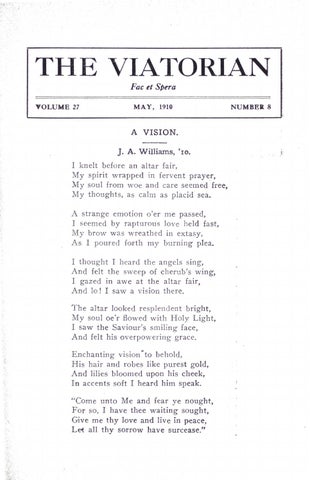
THE
VIAl~ORIAN Facet Spera
Y OLUME 27
N UMBER. 8
MAY , 1910
A VISION.
J. A. W illiams,
'10.
I knelt before an altar fair, My spirit wrapped in fervent prayer, My soul from woe and care seemed fr ee, My thoughts, as calm as placid sea. A strange emotion o'er me passed, I seemed by rapturous love held fa st, My brow was wreathed in extasy, As I poured forth my burning plea. I thought I heard the angels sing, And felt the sweep of cherub's wing, I gazed in awe at the altar fair, And lo! I saw a vision there. The altar looked resplendent bright, My soul oe'r flowed with Holy Light, I saw the Saviour's smiling face, And felt his overpowering grace. Enchanting vision " to behold, His hair and robes like purest gold, And lilies bloomed upon his cheek, In accents soft I heard him speak.
\
"Come unto Me and fear ye nought, For so, I have thee waiting sought, Give me thy love and live in peace, Let all thy sorrow have surcease."
.';
路~
THE VIATORIAN His gentle arm around me threw, My aching head to His bosom: drew, His lips pressed on my careworn face, Left sweetest joy in sorrow's place. I asked my Sacramental Lord, By men on earth below adored, To say what pleased his warm heart most, \Vhile he dwelt here within the Host, A look serene passed oe'r his face, The faintest smile his features graced, He said in sweetest accents then, "I love to dwell with Sons of Men.'' I looked in awe to where He stood, From out His side flowed Precious Blood, And then the Vision seemed to fade, And once again I was afraid.
I1heard once more the angel's psalm, The Celestial hymn ebbed into calm, The echo rang through vaulted choir, . Then died as notes upon the lyre. Again the angels came and went, Each low in adoration bent, And then once more I was alone, Before the altar's cold gray stone.
.
\
''
INTELLECTUAL DEVELOPMENT STEPHEN E. McMAHON
,.
_,, i
''
,,j;l
1'
HE fifteenth and sixteenth centuries were periods of re._ markable religious and intellectual agitation. In the I 5th century, scholastic philosophy, crystallized into solid and endurable form by the colossal mind of nas, began to dedineand to yield to the novelties of so-called modern philosophy. The sixteenth century witnessed the greatest religious trial w hich the 01urch w路a s destined to see since the Arian heresy, an upheaval 路which shook the Christian religion to its very foundation and threw Europe into a ferment, the outcome of which is the rank infidelity and deplorable religious indifference ' of today . . D路e spite the baneful infh.J ence of Protestantism on the religious and intellectual life of this sad epoch and the somber gloom it throws over this era of European hi story, the fifteenth and sixteenth centuries gave birth to historical events of vast consequence and of far-reaching importance to the true development and spread of civilization. This epoch s.aw the discovery of Am,e rica, the expulsion of the l\1oors hom \N estern Europe and of an invention of 路 tremendous influence on the social life of mankind-the practical art of printing. The invention of printing has wrought great things in the progress of civilization. Commercialism owes much to it; education of the masses was made practicable; literature has advanced in leaps and bounds through the easy and rapid multiplication of cop1es. The tedious practice of copying manuscript in vogue prior to this invention did not admit of very many copies, and at best only the most meritorious productions of the age received this treatm.ent. Today the publication of books and manuscripts and of those purveyors of current news~the daily newspapers, is practically unlimited. Nowhere is this fact realized more or appreciated better than in the United States, where books and
THE VIATORIAN pamphlets are flung off the press in an ever-increasing stream, contributing in no inconsiderable degree to the material prosperity of the country. But every great good, which helps mari onward and upward along the strenuous path of life, carries in its train more or less· disadvantages, abuses, springing from its use, which sometimes make us sceptical regarding its beneficial character. However, t)lis scepticism is at most momentary and vanishes as clouds before the clear light of the sun when the m1anifold conveniences and helps which have accrued to man from its use become apparent. So it is with printing in connection with the rnultiplication and dissemination of books. Who can measure the immense benefit mankind has derived from good books? Who can say how much good has been accomplished through these inanimat e agen- . cies of thought-the 'immortal echoes of the m,a ster minds who have shed a resplendent glory over their own age and will continue to exercise a sway over men's lives, potent for all that is· true, noble and right, until time ceases to be? "Till the future dare Forget the past, (their) fate and fame shall be An echo and a light unto eternity." Education has become well nigh universal, and knowledge, that wonderful prize which philosophers and sages esteemed so highly and in w·h ose pursuit they spent lives of profound contem·plation and study, is now at the command of the populace; ideas which engaged the attention of the wise men of this world for years and years in excogitating; problems which many of the keenest intellects wrestled with unsuccessfully may now be acquired in comparatively short time. To what must we ascribe this marv·e lous facility of our age in the acquisition of learning? It must be attributed to widespread diffusion of books, which are the keys that unlock the doors to the most precious treasures of the choicest minds. Literature is the sesame to the intellectual wealth of the centuries. All the great events which constitute a nation's history, a people's glory, are accessible to hjm who will open a book. Books reveal to man the revolutionizing discoverie's of science, the thoughts which have ennobled m,en and inspired splendid actions, the magnificent tournaments of manly valor and honor, the great intellectual battles, which tolled the knell of vanquished error, or settled questions which have tremendously affected national
THE VIATORIXN progress and have determ ined the destinies of races.
2$I
Literature is the personification of the life and action of humanity in language, the music and cadence, the ·ib eauty and charmt of which have entranced the heart and soul of man. The soul of man differentiates him from the brute creation and constitues him in his higher nature-that of an intellectual or rational being. It enables him to think, t o enjoy the suprasensible, to commune with his fellow-men and to profit by the lofty exam ples and experiences of past ages. Ma n was not created for a merely physical existence. He has a purpose in life and he was en dowed with reason that he m:ight ascertain the end of his being and the means to attain that end. T herefore he must use that intellect to learn his end. and the more effectually attain its fruition· Man, however, is able to do little of him:self and must learn much from his fellow-beings. Through communication w'ith them he co rr~ es to a fuller realization of life and its significance. For · this purpose has he bee1 given that wonderful gift, languag,e, that he may express his thoughts externally and receive those of others ; and by this means does he gradually learn those great immutable truths and laws which are s o necessary for his guidance. L ife is properly predicated of t he mind. L ife implies growth, development. It is the nature of earthly things to advance or recede; their being does not admit of sta gnation. Hence if the mind does not grow stronger and n obler, it will gradually weaken. ifhe exercise of th e intellect is as imperative as that of the body4'mens sana in corpore sano," and what means so efficacious and so replete with success in promoting the h ealthy development of the mind as the grand thoughts and ideas w hich have flashed from th€ mighty genius of the princes of intellect and kindled a blaze of glory which shall ever light up with unquenchable splendor in the literary hall of fame the names of t hose who conce'i ved them? The centuries which have wended their course into the eternal abyss have left us precious heritages, the accumulated wisdom of their sages and savants, adorned w ith t he ve'n erable hoar of age. Truth is indeed unchangeable, but as man progresses and the duties of civilized life become more complex and intricate, man's knowledge must expand, and the t ruth contained in general prin~iples m~ust be unfolded and the particular principles deducible from them brought to light. Progress is and ever has been an attribute of humanity. It is the one thing th~t philosophers have harped on insistently, that 1
:THE VIATORIAN poets have sung, and that mankind has acquiesced m. To quote the words of the poetic thinker of the nineteenth cenh.uy, Rober-t ·Browning: ''Progress, man's distinctive mark alone; Not God's and not the beasts; God is, they are; Man partly is and -vv;holly hopes to be." This has been the task of scholars from time immemorial and one who would lead the fuller and higher life must take cogniz·. ance of their labors and the results of their profound meditations · and must acquaint himself with the Jaws of development as evi, denced by the history and literature of past epochs. Edmund Burke says that "people will not look fnrward to posterity who never look back to their ancestors." One who does not take pricl e in the achievements of the men who have made his country great _in history, who have ·l eft immortal monuments of literature · and art to grace their time and to guide future generations, must be . selfish in the extreme or devoid of all sense . of nationality, and. hence the continuance of national greatness is to him of no moment; for no grander monument can be erected, nor can a more ' striking testim.ony of the genius and character of a people be given than the literature it has produced. Literature is a mirror which . catches and reflects all the beauty and nobility that is in national life and holds it up to man for admiration and imitation. It catches the flashes wih ich illuminate the mind of man; it is the spiritual fire, refined and separated from the material, which ele. vates and ennobles character, and at command gives us most beautiful reflections, the thoughts and aspirations of the purest and truest minds. Man's m:ental dtcvelopment is a postulate of his nature and is the truest unfolding of that nature. That develop-m ent m~ust tend · to his ultimate end; must be the means to place him in posse'Ssion of that end; should be the education of his faculties in accordance with the laws of religion and morality. The formation of charact·er is ml3.n's greatest duty, that is, true Christian character, and in the perfection of self is to be found the most exalted and purest human happiness. Virtue's security rests on knowledge, which broadens the mind and enables it to discern the true from the false; to accept what is good and turn it to profit and to reject evil because it entails a retrogression and leads from one's end.
THE VIATORIAN ·~
~ Plato
253
remarks that "the wise man will esteem above everything a:~d will cultivate those sciences which further the perfection (i)f -ltis ·soul." Schools or colleges cannot fully educate one or perfectly form character. They can impart principles and rules, they can teach -li>y example, they can outline paths of duty and courses of study; ip fine, they can assist in laying a solid foundation upon which the superstructure of life is to be built, but that edifice of education and conduct must be reared outside their walls. The great University of Life, intercourse with those who are accomplishing: things and acquaintance with the wisdom and learning of the world enshrined in the classics and literature of the race, wiH round out character and complete education. It remains with one's own self whether he will continue the work begun in school or college and grow. intellectually and morally or lose what little ; he may have acquired, through indifference or neglect. Life lies before us like the rough marble before the sculptor, who hews · from this material a beautiful statue. Man is his own sculptor and he .m ust decide whether he will use the materials life supplies to form a character of beauty and strength. Care, however, must be exercised in the selection of materials and caution employed in their use. The history of the world is a strange admixture of good and evil, and since it is only the true and the good, which make for real progress, diligence is required in separating the good from the bad. Evil always makes an impression, and its effects will appear sooner or later. The path of progress is strewn with wrecks, and the victims of evil are striking examples which dot the panorama of life and serve to remind us that there are shoals to be avoided. That keen mind, whose influence in philosophy has had much to do with modern religious: error and indifference, Emmanuel Kant, observes that "all good ·which is not based on the highest moral p·r inciples is but empty appearances and splendid misery." He recognized the power of truth and morality, and we cannot but regret that his teachings· have been the occasion, if not the cause, of so much doubt and scepticism. Bad books and false systems of philosophy and theology are the prolific parents of human misery and have perverted the aim of education and religion. You cannot plant a growing tree and then draw it forth without finding sorrie of the soil adhering to it; and if you should leave it in the ground for a considerable time
! 路路,
;路 I
THE VIATORIAN
I
I
I
' !
I
I
:what a change would be wrought in it! Even as the tree receives much from the soil in which it is planted, and the climatic conditions which affect it so also will the mind be influenced by t~e :seeds of thought which are engendered by reading books whi,c h advocate pernicious doctrines. Such works are often embellis~ed 路 by the most beautiful expressions of language, by an elegance of style and diction which captivates the imagination, charms the fancy, and in$idiously inoculates the mind with all the venom and poison of falsehood and error. Such publications add fuel to prejudice, which is like a ground in which only certain kinds of plants will flourish. They teach all that is harmful in religion and morality; they openly advocate infidelity, materialism and indifference. Especially is this true today when the trend of modern science is toward the negation of religion and truth , and the elimination of whatever does not conduce: to the pleasure of man. It tends fo destroy faith and induce scepticism, and thus is the high road to the miseries and evils it essays to abolish. Everyone's aim should be to turn the waste within himself not into a desert, desolate and unfruitful, but into an Eden, fair and beautiful, redolent of the fragrance of the choicest flowers of thought. Study and reflection, the companionship of the great minds . will do this. .It will broaden the mind and develop the powers of the soul arid bring about that forma tion of character all desire. By the cultivation of what is good in literature, what is ennobling and true, intellectual life progresses, and man moves along the path intended by the Maker towards His goal with a fuller realization of the awful significance of l-ife and a keener appreciation of the glory of the life to come.
"T AKE YOUR' TTMEL" 1
He once was a chau:ffer of trust and respect But he drove much too fast, and his auto was wreck'd. They picked him up gently and bore him away, And laid him to rest 'neath the tall uncut hay.
t
Dear reader the mora] of this short refrain Is ''Don't go too fast if you're health you'd retain." -Mong the chau:ffers who "chauf" and the drivers who drive, It's the man who goes slow that will safely arrive. P. J. Curley, 3rd. High.
TEA DBE TRICE
D
A NEW DR MA
liAH" (that's as near as I can render the French of it) was the answer of a Dante fancier to whom I had handed a copy of Sara K. \Viley's metrical drama entitled "Dante and Beatrice" just from the press of Macmillan nee 1.25.) The word, accompanied with a grimace and a significant turn of the head was expressive of profound disappointment and disgust. ,.W路ell, I said, why don't you like it?'' uoh," he replied, "read the marginal annotations and you'll know." This gloss, I find, reYeals the appreciati,路e singling out of many well turned verses labelled ''excellent te chnique" ascribable solely to the author of the drama. Apart fr om this her credit is scant and her faults are many. It is especially in the spiritual import and moral me~~age of the book that she offends. Not every part of the spiritual content of this drama, however, is reprehensible. The many noble thoughts and beautiful sentiments which she incorporates in the play are (as is carefully indicated by the _Dantean connoisseur), taken directly and almost verbatim from the Vita N uova and from the Divine Comedy (Kuhn's Edition of Carey's translation.) Both of these being avowedly autobiographical and acknowledged as reliable sources of information regarding the relations of Dante and Beatrice, so long as the writer adheres to their data, though she can claim no originality except in the selection and fanciful arrang-ement of parts. still can she well claim the merit of giving the Dantean scholar the satisfaction of viewing again a loved portraiture of two illustrious literary characters. However, when she begins to invent she becomes insufferably inconsistent and disgustingly vulgar. She forgets the precept of Horace that the dramatis personae must be consistent with themselves from the beginning to the end. Certainlv as the author of "\Vhah'' remarks, one could have boped from reading the beginning of the booklet that the writer .;
~>
'~
THE VIATORIAN would succeed, if not in presenting adequately the colossal proportions of Dante and Beatrice, at least in drawing two consistently beautiful and great characters; but this task was too large for her. She w·a s able only to lift them1 up to view for a moment, but could not hold them uplifted. Her weak hands dropped the m 1n the mire; hence the disillusionment. For instance in act second, after the marriage of Beatrice to Simone dei Bardi, there is a scene in the flowery bowers of Bea. trice wherein Dante protests against her marriage and insistently . pleads fot her love in spite of her orders that he "must go." T h is, while creditable to Beatrice for the nonce, is 'inconsistent w ith what she confesses a moment later; and, as for Dante, he appears swayed by nothing else than damnably brutish passion. The vio·lence done to truth here becomes the more outrageous with every . new step of the play.. It js certainly little short of Hhistorical sacrilege,'' as the interlinear comment marks, to make Dante. ap: peal for the love · of the married Beatrice in the name of th~ romantic sinners Paolo and Francesca, whom D1a nte in his In. ferno consigns . to the circle of the lustful · where they are mcessant1y hurled along _on the scorching blasts of hell. Still t he shameless plea is here in the play, page 97· uoiu t there across the border only last year Paolo and Francesca in Rimini Died-but died happy. We have not lived at all. Now let us live, and if needs be find death In some sweet way together. Come with me." Historical sacrilege indeed! the epithet perfectly fits the cr ime of the writer. Sara further on through many a tedious line makes Dan te. plead in lachrymose accents for sensual gratification even as a habitue of the dem,i-monde might ·supplicate such boon from some fleshy beauty. This is the kind of carnal love which Prof. Giddings of Columbia had the hardjhood to ascribe to Dante last year, saying, that Dante was one of the first distinguished teachers of free love. This conception and dramatic interpretation of D;a nte's love is false and wholly inconsistent with the pure and supersensual love of Beatrice which he professes both in the Vita Nuova and in the Divine Comedy, and which also is recalled in the first act of this play. It is inconsistent with the known sanctifying effect of
.
' I
·'
THE VIATORIAN the love of Beatrice; for it was said of her lovers: "He who loves her must thereby be ennohled ·or die," a sentiment which is also quoted in the earlier part of this drama. Strange it is that a woman , who is credited with keener spiritual insight than man, should fin? such difficulty in conceiving a love that is above sense, call it Platonic, love of friendship and benevolence, or chivalrous, unselfish devotion. It does not seem so inconceivable, that sentiment which, as Tennyson says, makes the Knight out of naked Knightlike purity worship no unmarried girl, but the great queen of his thought, his lady love, in whose name he fights and swears vows of angels that iri high heaven love most, but neither marry nor are given in marriage.. (Merlin & VivienJ Continuing to turn the pages of this interesting play T came upon a bold marginal comment that declared pithily: "A mud Beatrice," "Pure invention of Sara." In the passage thus adver. tized Beatrice whiningly regrets that Simone holds her body while he holds not her heart-poor mismated thing-and she moans because Dante, to whom her thought incessantly turns, shall never come to illuminate drudging hours of da.rkness and infelicity wast. ed in the company of Simone. This repining is surely inconsistent with her former order to Dante to quit her presence and go. Unfilially she upbraids her dear father for having fettered her to a dungeon, and invokes death to deliver her from days accursed and fetch her to her lover amid the stars. The gloss here says significantly "Hysterics" with a paling of exclamation points. Again Dante, who tells us in the Vita Nuova, that he found the limit of blessedness in the m·e re salutation of Beatrice, ,is here made to crave a kis s before parting. It is certainly violence to truth to represent D ante as ruler of a harem and Beatrice as a houri. There is as m uch difference b etween Dante's love and sensual love as t here is between the D·ivin e Comedy and the Rubayiat,. 'o r between Pilgrims P rogress and Leaves of Grass. In t he third act of this elrama Dante outpours delirious ravings w,h ich are marginally not ed with a big R that looks so fierce it m ight stand for "rubbish" or ''rot." While on e deligh tedly reIDiembers how the "imparadising smil e" of Beatr ice is chronicled! in Paradiso and how in the V ita Nuova that smile is said to have: made Dante "unendurably hap py ," one canno t be otherwise than rudely disenchanted when he hears D·a nte whimperingly r ecall how
!;
1~
~.
,~:~~.;:
THE VIATORIAN
her soft lip curled when she smiled at him, and when he hears 路D ante, that smile gone, impiously upbraid God for not letting him die. A line which is underlined and which the gloss calls "capital" is this of Simone, the husband of the now dead Beatrice, who says to Dante: "You are_ too contemptible to tread upon." It is the climax of Sara's inconsistent iconoclasm. After all this, Dante's prayer for grace to speak in her dear praise asuch things as never yet were said of any woman" is flat, stale and unprofitable. As each act of this little drama concludes v.rith a reference to the stars precisely as do the three parts of the Divine Cornedy, there appears on the marginal white a deliciously ironical note to the effect that Sara plagiarized this feature and that consequently iR ostand is not alone in his distinction of literary pilferer. Few have ever attempted with success the dramatic treatment of even the . episodes / of the D路ivin e Comedy, such as for instance the story of Paolo and Francesca. Baker's dramatic attempt of this story for Otis Skinner is only fair . . The great masters like Shakespeare through a sort of instinctive respect for kindred genius, carefully keep from the scene the great world characters. Caesar for 'i nstance is kept well in the background in the play that bears his name. These characters are too large for the stage, they belong to the world. It is doubtful if the life of Shakespeare could ever be successfully dramatized. Sardou, certes, a skilled playwright, attempted Dante dramatically and killed himself dramatically. Sara K. Wiley overestimated her pow路e r when she essayed the dramatic handling of Dante and Beatrice. She has produced a play of midgets and reduced world personages to the size of parlor marionettes. Her play would, by reason of its good versification, be marked "fair" if it were the effort of an immature school girl. Thus sayeth the author of "Whah." Jean Paul.
'
'路
~
.
~
'
THE VIA TORIAN FOREVE'R M O路R E.
The pleasure's rose That blooms today In gardens gay Must fade away. Youth's rapture glows, It ebbs and flows, But with the rose It dies away. The flame of strife, That leaps and glows, Will in its throes Dies with the rose. The Joy of life That beauty knows, Where'er it goes Fa.d es as the rose. T 'h e morning's dew that lingers on the flower, And sheds a subtle fragrance o'er lifes bower, .W ill flee the valley ere the twilight hour, Forevermore. At night's The 0' er And
approach wild wind's moan life is blown all alone.
The shades encroach, With startled fears O路ur tide of years Then seethes with tears Our work is done Night's black array With plaintive lay Frights day away.
>''!
~6o
)
THE VIA TORIAN
;
_)
And then the sun 0 '' er mountains flies To western skies Then sinks and dies. This cheering sun must greet another day, The one now ended is gone for-aye away, Gone in its fleetness as a noonday ray, . Forevermore. And such is life A smile-a tear A passing year We're gone from here. A mottal strife A clash of mace A fallen race Leaves not a trace. A ray of joy, But with a sigh The years glide by And lo! we die . .Farewell to friends and then God speed thy years, That clasp us in the vale of grief and tears, Till ended where fair joy dispels all fears, Forevermore.
J. c. J.
"In Medio." In this world's hopes however great or small, The greatest lies between, Seek not a kindom or a bondsman's thrall But seek the "Golden mean."
J. c. J.
;
路J路
.,, i'
i; •
.,·
~[~]LABOR UNIONS~~ W. J. STEPHENSON '10
·.J
T IS scarcely necessary to prove how essential it is , to the nation's progress, that proper and mutual considerations should always exist between the two interdependent forces of material progress, Capital and Labor. By capitalist w·e understand the person or persons who hold legal rights of ownership and management of any establishment, and to whom profits accruing from these establishments rightfully belong. By the word laborer is meant any person who enters into the employment of another and agrees to work for a certain number of hours every day, for a specified amount of money. It 1nay indeed seem at first sight that proper relations between Capitalist and Laborer have always existed and that mutual interests demanded their maintenance. But such certainly is not the case. History a~d personal observation reveal that there has been and that there is today a lamentable lack of due consideration for mutual rights of these two powers. From .an ethical standpoint the rights of tl?e Capitalist are sufficiently guarded in all that is prohibited by the seventh and tenth commandments, while the rights of the Laborer though not so clearly defined in the decalogue are yet obviously implied in the words '"'Love thy neighbor as thyself," and "Do unto others as you would have others do unto you." It is a patent fact that the rights of the laborer are often tral;npled upon; that for long hours of work he receives a mere pittance, that there is no proportion between the profits he makes for his employer and the wage he receives, that consequently the employer in a few years amasses great wealth whereas the workingman hardly meets his expenses, and in many cases is in want and low poverty. These are some of the reasons that prompted labor organizations, and let it be added that for' some such reasons alone, can they be legitimately formed. Amelioration of the work/
·'
I.
THE VIATO路R IAN ing man's condition must be the dominant note of such organizations. Like all other movements whose ultimate purpose is the betterment of society, labor unions had to struggle for years against the prejudice and selfishness of those who saw in such organizations an enemy to their own private interest. "Until 1824 combinations of workmen designed to raise wages and to shorten hours were not only condemned as conspiracies under the common law of Great Britain but were prohibited by statutes the last andi most general of which was passed in 1799-r8oo." We need not trace the principal events, and wonderful development of labor. organizations from their initial oppression to their present world wide influence. Their power as they exist today is such that no capitalist can ignor-e it; and the candidate for public offi1ce fears and solicits it with political deference. President Taft during the campaign preceding his election said: "Under existing conditions the blindest course that an employer of labor can pursue is to decline to recognize labor unions as the controlling influence in the labor market, and to insist upon dealing only with his particular employees. The labor union is a perm1anent condition in: the industrial world, it has come to stay. W. H. Sayward of Boston speaking from the side of the employer says: "My experience has convinced me that labor thoroughly organized and honestly recognized is even more important for the employer than for the workman, because it makes possible a working method between the two parties, which removes one by one the most dangerous elements of conflict and misunderstanding." It ma-y be argued by those who take an unfair view of unionism, that its record is marred with many crimes and much disorder detrimental not only to employers but equally pernicious to society in general. 0Tganizations should not be condemned for the rash acts of angry individuals. Individuf!Js must not be confounded with the organization itself. M 'r. Mitchell in defense of the union has this to say: "A great deal has been said about the outrages and deaths caused by union men. There have not been as many such deaths in thirty 路years as ordinarily occur in New York City in three months. No, the older of the unions, and indeed, all of the unions regret such actions. We claim' our right to persuade the non-union man not to work, and to argue with him by word of mouth not to force him in any way." And if organized labor may be charged with having caused many regrettable
TH.E VIATORIAN incidents, yet it cannot be denied that it has clone 路m uch towards procuripg a higher standard of living for the workingman and his fam~ly.
But in order that the proper relations should obtain, the rights of the employer must also be recognized and observed. Unionism has its limits defined both by justice and legal enactment. Justice. tells. the individual member of union, that he is bound to give his emp-loyer an honest day's work in accordance with th.e conditions expressed by his employer. It tells him that he should be faithful in the performance of every act which he agreed to perform' for a stipulated wage. And both justice and legal enactment tell organized labor that it must not endeavor to compel the retention or employment of incompetent employes. And that it shall not trespass on individual rights, either in making unreasonable de~ mands on employers, or in causing legislation which would give to unionism a dangerous monopoly in the various fields of skilled labor. There are many of the trade unions so well organized that they practically dictate the term of apprenticeship and determine the conditions under which an apprentcie can procure the certificate of an artisan. ~'In the United States there are both state and national laws that clir~ctly further the monopolistic ambitions of trade unions. The purpose of such statutes is of course, to insure a certain degree of proficiency on the part of the workm.e n who perform important services; but these statutes also assist trade unions in their efforts to control the supply of labor." In . this attempt to keep the number of tradesmen within a certa'in limit, there is grave danger of arousing the opposition of individuals who for one or another reason cannot comply with the laws of apprentic~ship and who believe themselves able and entitled to work at a particular trade, by reason of acquired skill. Again there are national laws prohibiting the importation of 'c ontracf labor; even though the contracting immigrant m ight be a man of 路e xemplary habits and a proficient workman. Yet the ordinary immigrant wanting perhaps both the brawn and brain of the contracting mechanic is allowed to enter provided he complies with the loose laws of immigration. This law against the importation of contract labor prevents the employers from being independent of the union. We do not say that this law is unj'ust or unnecessary, but very often it prevents the acquisition not only of compentent workmen, but of most desirable citizens. The~ power and' 1
;
'
I路
.,
.
i路,.,
,·
'
THE VIATORIAN
purpose of this law is most effectively realized during prolonged and heated strife in the industrial world; for the sources of labor supply are kept within the limits of this country. Organized labor must be careful in the selection of its leaders, and above all else in the admission of members. An organizat'ion is only what the sentiment, the intelligence, and the morals of its individual members make it, and those three elements of cha:i- . acter are more powerful for either good or evil than the physical . ·p rowess of greater numbers. Therefore it may be repeated, that if unionism is to survive, and achieve still greater results, let it establish a standard of morality to which every candidate for membership must conform; let it be the purpose of each individual to regard seriously, his obligation of acting his part in conformity with the wise laws of prudent and conservative leaders. And let -it be always the aim of labor leaders not to attain personal ambition or private ends at the expense of common honesty, but under .all circumstances to labor with nobility of purpose for the preser·v ation of the common good. Since all laws both human and D~ ·v ine recognize the right of individuals to ·organize for mutual sup·port and assistance in accomplishing purposes which in no way conflict with justice and public weal, let trade unionists beware of the pernicious doctrines of false prophets whose dismal how1ings for social equality serve only to foment discontent and dissatisfaction, thereby disturbing the good order and peace of society. Let the individual unionist show his appreciation of the good .:achieved by organ.t7.ed labor, bv endeavoring to lead a life c-"~ -sistent with ideals of 'Christian manhood; faithfully discharging his dutieB towards his employer, his home and his God; recognizing the principle that it is not the work that dignifies the man, but that it is the man who dignifies the work; let all discontent and grumbling ceas·e ; and if the individual be true to himself, strikes and disorders will be less frequent, and the em-b arrassing task of boards of arbitration will be rendered easier thus begetting in<lustrious, virtuous and happy people, capable of rightly enjoying the blessings· of prosperity and freedom.
t
···1
·.· 1·
~
WOMAN SUFFRAGE
~
N THE Garden of Paradise when Satan cunningly secured the downfall of the primitive man and woman by the· te1nptation of Eve, , who, succumbing to his · wily snares afterwards induced Adam to partake of her guilt stmlla·r action, woman was condemned ever to be second. to man and never to enjoy the privileges and advantages which :accrue to those of the masculine gender. In the early ages women were treated by men more as slaves than as equals, but with the dawning of a tardy but enlightening civilization, she has gradually been admitted to her rights until today, under the present near-perfect system1of civilization of the world she stands beside man as a thoroughly capable and decidedly useful helpmate. In fact it may be said that she has now arrived at an extreme limit of her advancement, and, that any further progress toward the rights and lib erties that are enjoyed by man would be an encroachment beyond the limits of her womanly dignity and would result in nothing less than the destruction of the sexual barriers and the loss of the consideration and esteem 1vhich is now so willingly 0:ffered by the members of the sterner sex. " There is a Destiny which shapes our ends" and 'i n shaping the ends for which we were created, the Creator has so fitted us physically and otherwise as to leave the power of reaching these ends within our grasp.. Woman , therefore being acknowledged physically incapable of attempting to enter the field with m1an in his unending routine of business and political affairs, has not be·e n fitted by the Creator for such things and therefore was never meant to engage with men in these affairs. This statement may be answered by some with the argument that it is not the physical capabilities which are necessary for participation in politics, but, that it is the mental qualifications which are to be considered. r.f'his. therefore, will bring up th e question, "Is woni.an mentally equal to man?" and its accompanying com:p lication of tiresome arguments and proofs. Woman ha.s, for centuries, been considered a frivolous, fickle cr-eature, whose thoughts have varied with the fashions and whose
,.;.
I
' f
~
·;
'
'
'
r··
'
THE VIATORIAN opinions are as unstable as her actions. It has always been the accepted prerogative of woman to change her mind and her de., sires at any and all times that would suit her convenience or please her fancy. What, therefore, is to be expected of a being whose thoughts alternate between the latest style in hair dressing and the cute expression in the eyes of her pet pug dog, or .w ho will one day attend a lecture on the "Attention and Care Necessary forthe Bringing up of Children" and will the next day attend a "D~g Show," a "Horse Show" or a "Whist Party," leaving her children to attend to, care for and bring up themselves as best they may. The idea of allowing such a one to have a hand in the governing of our country is absolutely ridiculous and unthinkable. Woman, as the mother and wife in the home , is a being at' whose shrine men have always an d always will wo rship. The love which we all feel for our mothers and sisters is due in a great deal to the fact of. their occupancy of a place in the household! which brings out in them all that is beautiful and lovable. But, what sensation isexP'erienced when we meet a woman in the rush and turmoil of the business world? Have we not th e feelin g that she has lowered herself from. her throne as "Oueen of the home'' where she has always held the fir st p lace in our affections? What advantages can she hope to gain by engaging in a work for which she is admittedly physically unfi t and mentally incapable of fulfilling? She but takes a work upon her tender shoulders w:hich she can have no hope of carrying successfully to the end and which will eventually be the cau se of the degradation of her sex. Let woman fulfill the end for which she was created. Let her attend to her duties as a lovin g wife and mother and if she necessarily must have som·e thing to do with the affairs which have a bearing upon our nation. what greater cause could she find for her assistance than that of the extermination of race suicide. If the women of the nation were to rise up and cry out · against the evils · of race suicide and would begin a movement, which is of vital importance to the nation, she would then be doing something which would be appreciated by all and the result of which would be a better state of affairs in society. Wom:a n would then be supporting and furthering the carrying out of the Divine Will and would thus be working toward the end for which she was created. Any attempt to engage in political and business affahs will naturally draw her farther away from· the cares and duties of the home, and she will be wandering from the path appointed her
,..
-'
'
..
)
•:_
TH'E VIATORifAN· by the Creator and venturingr upon a' stony untried road whicH may .lead her away from h appiness and love and carry her onward toward disappointme.n t a nd despair. Let us therefore, do all that w·e can to deter woman from her unlawful purpose, quench in h er heart the rising fire of that · ambition which will only t end to consume. in her all that is refined and loveable and will best develop all that is harsh and unwomanly. Let us keep our mothers, wives arid sisters in the highest place in our affections as t he most lovable and admirable o f Creatures, to care for whoml, it will always be our greates ~ pleasure and whose protection fro m the uncultured influences of a cold, harsh world will always b e our most important ca·re. P . J. Curl ey, 3rd. High School. 1
TH1E 1 CO!L LEOE\ CHAP.
Unde r a weeping willow tree The college student st ands; T he " stu," a classy k id is he, A n d w1ears such loud hat bands, And h is coat is decked w ith college pins Where his braw ny chest expands. His socks are red an d w hite and blue, His tie is brow n and gr een , Wh ile most of the rainbow's gaudy hues I n his sh ir t are plainly seen. H is clot hes are noisy as can be, But h e does not care a bean. We t hank thee, worthy college youth, For you've clothes red, g reen and brown; F or t he rousing sw·e lls of your colleg e y ells A re the noise they help to drown. "That an ill wind blows nobody goo d" Is indeed a saw of great renown. P.J. Curley.
",
THE VIATORIAN Published l?tonthly by the students cf St. Viateur's College, Bourbonnais, IlliNois. EDITOR IAL STAFF
Editor in Chief-1\L MUGAN, '10. Exchanges-T. WEDGE, '11 Alum ni-E. J. QUILLE, '11. Athletics-D. BOYLE, '10 . Locals-F. CLEARY, '11. Personals-W. SAMMON, '12. Societies-W. NOURIE, '10.
Entered at the Bourbonnais Post Offict as second-class matter All ctJrrespondenc-e must be addressed ''The Viatorian, '' Bourbonnais, Illinois. Subscription price One Dollar per year, payable in advance. All business communications should be addressed: Rev, J. F. Ryax, St. Vlateur' s College, Bourbonnais, Illinois.
With the closing of the sixth annual convention of the F ederation of Illinois Colleges, we are reminded once more of the1 increased interest which is being taken in educaEducational tional co-operation in Illinois. At this assembly there were present educators of various denomiCo-operation. nations who freely discussed topics tending to promote the good of education. Such an organization as the Federation, is surely productive of much good. It makes the members and creeds they represent, better understood by one another and thus creates a better feeling among men o拢 different persuasions. By exchanging ideas on educational matters much can be learned and hence methods of instruction will be im.proved.. While it may be generally true that each college has. its peculiar method of imparting knowledge still, it must be admitted that the .e ducational experience which finds utterance in these meetings is valuable for the 路 college president or teacher, and one attending such an assembly of educators returns to his col~ lege with a better insight into the difficult science of teaching. "In unity there is strength," and consequently education in Illinois in virtue of this adag~e should progress solidly and systematically under the <direction of such an able body of men as is comprised under the "Federation of Colleges."
.
•• ·, 1
. ·.
J
· ~ '.'
• ...,. _
! .·
THE ·VIATORIAN PE:RsO~NAL
MENTION.
The O-rdi nandi for this year are: F. C. Marcenek, J. B. Shiel~ ·F. X. Moisant C. S. V., C. J. St. Amant C. S. V., and F. X. Hazen C. S. V. O r dina tions w ill take place the last week of May at t he H oly Nam e Cat hedral, Chicago. Very Rev. ]. P . O'Mah oney, C. S. V., President of St. V iat eu r 's colleg e vJi11 delive r the address on t h e occas ion of Go lden Jubilee an d dedication of the New Notre Dame Conv ent, Bourbonnais, Ill. , on Jun e 2oth. Owing to failing h ealth Rev. C. Fournier C. S. V., ex-provincial of the Ch icago Ob edien ce, has been confined for some tim e to his room. It is t he hopeful p rayer of all that he may yet lon g dwell within our m:id st. Under the di rection of Very Rev. T. Dugas C. S. V ., R u ral Dean, a gath ering oi p riests from surrounding parishes, met in the President's Office to confer upon certain measures of mutual sup. port and hel p in the interest of their parishes. On April 2r Rev. A. N. St. Aubin C. S. V., underwent a successful operation for appendicitis at the Mercy Hospital, Chicago. He is now on t he h ighroad .t o recovery under the gentle care of t h e Sisters. Rt. Rev. Mg r. Legris D. D. , has sailed for Europe to at t end the Passion P lay at Ober amm1e rgau. H e will afterwards visit tilroug hout Europe, makin g some stay at Rome. Genuine merit an d executive ability have procured for R ev. J. J. Pratt promotion to t he pastorate of St. Patrick's Chu r ch, Kokomo, Indiana. Timothy Swegmann, 'go h as been recently made claim agent of the Pennsylv ania R ail ro ad lines. His office is in Chicago. The Federation of Illinois Coll eges represents a body of notable scholars a n d educators of Illinois whose object is to fu rther the interests of education in this state. At on election of o:ffice:-s held at Mon mouth, Ill., Very Rev. J. P. O)Mahoney C. S. V., was elected vice-presid ent. The next meeting of this distinguished bcdy of men will be held at St. Viateur's College. Bro. Sheridan C. S. V ., after undergoing an operation for appendicitis lay seriously ill at the Mercy hospital some ten days. His condition at present is much improved however, and is now speedily convalescing. One of our distinguished visitors of the month was the Rev..
T'H E VIATORIAN Louis Lalande S. ]. , of Ontario, Canada. Fr. Lalande is a former student of Rigaud College, Mtmtreal, Canada, conducted by the Viatorians. The Rev. Father was entertained by the different societies of the college and also lectured before them·.
SOICIEXY NO(fE& On Ap ril 2oth the Girard Scientific Society tendered its first formal entertainment. The Rev. J. V. Rheams devoted considerable time in prepar.:. ing Wednesday evening's heautiful degree work, and with tl).e assistance of a competent staff impressively conferred the degree . . A class of eight was initiated. After the conferring of the ! degree all repaired to the spacious rooms of the Science hall and ' listened to a most interesting program. Rev. ]. F. Moisant in a brief address congratulated the new members and bade them a hearty welcome to the society. Thougli the reverend gentiernan is at present occupied with many dutie$, nevertheless he takes an active interest in the welfar:e of the society. W. R. Ledoux favored the audience with a p-iano solo. . Brother Marzano, who · read the first pa{>er of the evening, had as his subject, "Observations on T 'u berculosis," and the manner in whkh this topic was developed manifested a preparat~n of remarkable thoroughness. ' William J. Lampman favored the appreciative audience with a vocal selection. Mr. Canavan's recitation was particularly praiseworthy. "The Nebular Hypothesis" was the subject of H. C. Tolbeft"s pap·er. Although a difficult theory to explain, Mr. Tolbert's ~x planation was a most intelligent one and he is deserving of mt~.ch praise for his effort. The 0Tigin of the World is certainly a weighty subject yet aJ most instructive paper treating of it was read by E. Riley. The applat1se which greeted his ·e fforts showed the appreciation of an interested audience. Fred Connor rendered a violin solo, accompanied on the piano ·by S. T. vVedge. Both gentlem;e n are to be congratulated for the
THB
,. "•
VIATORIAN
perfect harmony prevailing throughout its rendition manifested earnest and careful endeavor. Ralph Legris and A: Ledoux were at their best and surprised all previous efforts by the excellent piano duet which they rendered. Rev. W. J. Clifford's appearance at any gathering at St. Viateur's is hailed with outbursts of applause and in no case is the Rev. Father allowed to depart without delivering a speech. His appearance at last evening's ente rtainment was no exception and Father Clifford in his usual gracious manner addressed the audience. Rev. A. L. Girard's nam1e next appeared on the program and he favored his hearers with a most interesting address on science and touched upon the future of the society which bears his nam·e. During the entertainment refreshments were served and Havanas w·e re passed. The grand climax of the evening's entertainment was reached as the Very Rev. President J. P. Q:'11ahoney, C. S. V., arose and delivered the closing address. The applause w ith which his appearance was greeted was a testimonial of the love and respect in .:which the beloved president is. held by every member of St. Viateur's faculty and every student receiving instruction within St. Viateur's halls. When silence again took possession of the assemblage Father O'Mahoney began by complimenting those "who took part in the evening-'s entertainment. He has a wealth of language and warmth of expression that need no apology. He congratulated each and every member of the Girard society 'in: heing so signally honored to belong to a society that had such a noble purpos,e, generous efforts and lofty aim, and particularly bearing the name of Father Girard, yvho has brought the scien-ce course at St. Viateur's on an equal footin g with the great universities. The Rev. Father, continuing, said that the g-enerous and noble end of the society demanded and claimed the ear1fest support and hearty co-operation of every member of the society. He pointed out the many advantages and the many benefits accruing to its members. He touched upon the history of science and brought his scholarly address to a close by donating- a rare gift to the society. Mr. E. P. Kelly, 'Io acted as chairman and introduced the ;various speakers and the success of the evening's entertainme1rt was chie-fly due to his careful selecting an interesting program. T ·o
272
THE VIATORIAN
G. Bergan, S. T. Wedge, F. A. Cleary and F. C. Connor members of the entertainrnent comm,i tte e, is entrusted the social fe ature of the society. No better selection could have been made. J\1. Mu路 gan as general suP'ervisor of tlle financial department of t he societ:r, is deserving of special praise fo r invaluable services .. F rancis A. Gavin and B. Coss are working hard in the interest s of the museum. Both gentlemen are tireless workers and the society is 路 fortunate in claiming them as curators. B. A. l\lay 2. Igro is a day, which will long be remembered in the history of L. Circle Lajoie, for on that date it had the pleasure of entertaining the distinguished priest, philosopher and orator, Rev. L. A. LaLande, S. J. A short program, consisting of musical selections by the members of the society, was rendered in a most commendable manner. After this, in the absence of President Savary, Vice-President H. A. Darche read the address of welcome in which he paid a glowing tribute to the distinguished guest and thar.ked hi mfor having honored the society by his presence. The Reverend Father then addressed the society in a charming style and pleasing delivery held his audience spellbound throughout his discourse. He extended a few words of encouraging praise to the members of the society, complimenting them on the degree of pet,iot fection to which they have brought their society. He, moreover, urged them ti labor throughout life with unceasing effort, for he said: no matter what natural talents one may possess, the successful man is he who does not fear labor and industry. Rev. Father you will ever be welcomed by us, and, we trust thatt the Alm'ighty, in His Providence, will preserve your good health so that yo~1 may continue to labor at your m,i ssionary duties for the welfare of souls. Ad multos Annos. Among other distinguished visitors were the Right R~everend G. l\1. Leg-ris D. D., Very Reverend J. P. O'Mahoney C. S. V., E. L. Rivard C~ S. 路v., l\1. T. Dugas C. S. V.,路 J. E. Belair C. S. V., Dr. C. T. lVIorel and :Mr. 1-I. J. Legris. W. A. N. Sec'y.
The Patrician, from, Columbus, Ohio, is ever a most welcome visitor to our table, and the April number lacks none of the characteristic vigor and originality which are that journal's distinctive traits~ · ·A graceful tribute of respect to the "beautiful flower of the Church," St. Rose of Lima, first engages our attention. The tone th ro ughout the article is reverent and religious and worth much in didactic merit. The Catholic Church ;and America is a w ell chosen and well treated subject. The length of the composition compared to the magnitude and depth of the subject is woefully brief, covering but a page and a half. The only thing lacking in the Patrician, according to ·our taste, is the presence of a little verse. The reason you allege for not introducing poetry is hardly convincin;:r. '-' In the Notr·et Dame S.c holastic, we find an agreeable comb ination of poems, stories, and essays. Of the las t, Odysseus in the Iliad deserves much commendation fo r the able treatment and gracefulness of thought and expression. It is a worthy exposition of th e Grecian temperamte nt and characteristics of the r enown ed poet of Attica. An amusing and original short story is to be foun d in "The Spot-light Artist." The plot is novel in its conception and well developed in its execution. The St. Vincent College Journal contains an interesting- account of the elevation of St. Bed's College to the rank of an abbey,. with the Rev. Vincent Huber, 0 •. S. B., of St. Vincent's as its firs t abbot. Ad multos annos. The "S·c hoolman" is one of our regular visitors. The March nu mber contains a number of well written articles. Lady Macbeth's cha racter is well drawn out. Moore, the poet, is pictured as a man possessing a keen p hilosophic mind . Cannon Sheehan's "AJ. Prophecy" needs no eulogy. The "Soul of Youth" is an almost perfect poetic gem and is worthy of gracing the columns of the Catholic Record. For short stories, poems and essays the "Columbiad" of April is dese•r ving of a word of commendation. We enjoyed reading the
274
THE VIATORIAN
impressions of the ''Ruabiyatt of Omar Khayyam. Vve agree that Fitzger~ld's translation is both a fair translation from the Persian and also in regard to its English standing, a classic. The early University is an article which gives valuable information concerning the influence on Feudalism and the Church exercised by the University. Your first editorial is able and voices the sentiments of all right minded people. The writer of Eastertide in the "Univers:ity of Otttavta, Review" delved into ancient history, consulted Hebrew -Greek references as to the origin of the word Easter and says the word Easter is found only among the Germanic people; for all other branches of the hum.an family call the feast by some modification of the Hebrew-Greek term, pascha. The other articles in the Review are are well written but the poetic d ement is lacking and th e editorials could be improved. \TV e cannot say that the "Dial" lacks t he poetic elem.e:nt. It is literally cramm路e d with short poems and contains some remarkably good articles, sensible, solid and imparting much information. A Federal Income Tax is an instructive article. Romance, Rot and Reality, hits the nail on the head. The editorial is sensible and shows athletics in their true light. The Buff and Blue contains some car.e.fully written articles. The Passion Play is an interesting article, 拢hort but treats of the nature of the play, the characters of those taking part.
BOOlK RJEIVIEfW. Our Faith a Reasonable Truth. This litHe volume, which should more briefly be entitled "The Re~sonableness of Oru r Faith," is a neat and substantial handbook of Christian Apologetics for the laborer and mechanic. It discusses briefly but clearly and conclusively (such subjects as) the Fallacy of lV[aterialism, the immutability of -Species, falsity of Evolution, the Simian theory of' man's origin, Soul and Instinct, Immortality, Resurrection, Christianity and Mode rn Science, Law and Sin, the genuineness of the Old and New Testam1ents, the Cnurch, Confession. Prof. E. Huch rendered a distinct service to the busy artisans of the Fatherland in placing in their hands this clear and convincing exposition of the grounds of our faith and, needless to say that
THE VIATORIAN
275
F.athe[" Bachur performs a similarly appreciable service to our American workingmen by interpreting for them the contents of this book in English. It is regrettable however, that the English translation was not submitted to a more severe revision before being allowed to go to press. The German original is plain, blunt and direct, but its Englishing is so often clumsy and defective that one may, without being finical, hesitate to commend the translation unreservedly to those who ar路e: apt to think more of the truth when they see it correctly dressed. The standards of Catholic authorship are. ever rising higher and Catholic scholarship must strive to obtain and maintain these standards. 0 'n e could wish this translation had been done into easy, smooth and graceful English such as that of the "Faith of Our Fathers" where Cardinal Gibbons treats almost the same subjects in a charming style. Would it not be more dignified, for instanc-e, to refer to evolutionism as the S~mian theory . than to dub it the Monkey Theory? This term' is perhaps more contemptuous than the other, but it does not make the chapter one whit more convincing. On page 148 in the otherwis.e. satisfying discussion of LaW1 and . Sin we stumble upon the following careless sentence which is ungrammatical and lacks unity: "He who pretends to believe in God, but does not beli路eve in His words, His revelation, and H 'i s Church, to 路which He promised the Holy Spirit so that He might explain to us the word of God, he blasphemes God, and he callS! God a liar." In a seconld edition which we sincerely .wish this worthy book . care should be taken to eliminate mistakes which sometimes cre;e p into a hastily prepared first edition. Oft.lr Faith is a Reasonable Faith, by E. Huch, Techny, Ill.
J.
P.
ALBE:R'T
M'C'ART~HY.
Once more m.ust w e chronicle in the glories of our athletic an nals, the brill iant success attained by an-oth er one of our athletes. This t ime, it is no other than Albert J\1cCarthy, star infie lder of last year's 'Varsity baseball team, w ho has signed a contract with the Chicago N ationals. Al's success speaks great praise, not only fo r himself, but for the team w hich nourished his ath'l etic t raining. F or , it wa? at St. Viateur that his baseball career 路 opened, an d it was al so while here, that he was moulded into his present f-o rm of rare development. AI is perhaps the greatest infiel der of which St. Viateur can boast, and during the time he served as a 'Varsity man, was distinguished, as the peer 路of any college infielder in his position. H is skill attained, not only a hig h standard of brilliancy, but a state n othing short of marvelous. He is a natural born ball player and cleans up the hot 路f allers and fast liners with as muc;h relish and as little concern as 'if he w ere disposing of an appetizing n!eal. Great things are prophesied for his baseball future and his advancem ent in professional ball ought to plac.e him in as high a position, as when he defended the banner of old gold and purple. W e take this opportunity of congratulating him and hope as great a success will follow his major league career as it did his st ay at St. Viateur.
St. Viateur, 2; St. Ignatius, 4路 The local Varsity suffered its first defeat on Bergin Field since the famous Armour Institute game of 'o7, at the hands of St. Ignatius Co11eg.e by the score of 4 to 2. The game although not feat ured by hair raising plays, was interesting from the spectator's standpoint. Harrison, Coss, D. QlConnell and Fitzgerald served as our battery stars while Ryan received by Doyle and Stack, dished out the slants for the Windy City aggregation. In-
THE VIATORIAN
277
ability to hit Ryan at opportune times proved the locals undoing, as no less than 19 were left on bases. Aside from Ryan's gener- · osity" toward the "Weston" stunt he pitched fine ball, pulling himself out of many bad· holes. Coss pitched first class ball until the 10th inning when he w ~ akene d, and the visitors by bunching three hits scored three ru ns, while the -b.est we could do was draw a ·b lank. The work of the whole team was praiseworthy while Ryan :was the individual star for St. Ignatius. Lineup: S t . J.gn.a.ti us-
St . Viateur's-
.
R . H . P . A. .Herman, ISS' • • ••• • •• 1 2 0 0 Ry,an , p .. . . . . .. 0 1 1 1 P.echou.s, 3b . .0 1 1 1 K i llian , 1b ... 0 1 7 0 F u r lo ng, 2b .. . .. 0 0 1 2 Schuster, If .. .... 1 1 0 0 Doyle, c & cf .. ... 1 0 11 0 St·a ck, c & cf. . . . . 0 0 8 0 Shoup, rf . . . .. .. . 0 0 0 0 Zeli uski, rf .. . ... 1 1 1 0
.. ....
To.tals1
..
- --
-- --
.. . .. . 4
7 30
-
E. 0 0 0 0 0 0 0 0 0
u ---
0
o.
..
R. H. P . A . E.
.Scan1o n, ss ... 0 Shi el , lf.; ·c f . . . . 0 No urie, 3b .. . . . . 1 Ber ry, 2·b . . . . .0 B . O'Conn ~ ll . 1b.O ]\'J:.oi"se, cf . . . ... 0 Oonw a y, l'f. . .... 0 Lynch, rf.. . . . . 0 F itzgerald, •C • • . . 0 D . O''Gonnell, c .. . 1 C ·O•SS, p . .. . .. .. 0 Ha rris on , p .. .. . 0 +Golber.t . . . . . . 0 Tota ls
.. ..
0 0 0 1 0 0 0 4 1 10 0 0 0 1 0 0 0 0 1 13 2 1 0 0 1 0
.... 2
-
2 0
1
Q
1 0
0
2
0 0 0 0 0 2 9 2 0
--
5 30 17
0 0 0 ()
0 0 ' 0 0 g
-
z
*Colbert batted for Shiel ln roth. Two-base hits-Ryan and D·. 0 'Connell. Sacrifice h itsLynch and Killian. Struck out- by R yan 19 ; by Coss I 5 ; by 'H arrison r. Passed ball-Stack. Base on balls-off Ryan II. 1
The Old Gold and Purple downed Albion on B<ergin Field ~pril 29th, in a game featured by hitting at opportune times. The Saints showed much improvement and it looks as though the t eam this year will, in all probability live up to the high standard laid down by its predecessors. The w ork of "Ducky" O'Connell, the · 1ittle catcher was faultless. Scanlon, a new man at short gives promise of giving a good acco un t of him self while Lynch, Quille , and Morse the new outfielders are showing class. The hitfing of ·B . O'Connell who drove in four of the six runs was by far the feature while Capt. Berry, Nourie and Coss performed well for the.-
)
!I
'
,;, .
THE VIATORIAN Saints. The work of Emmons, the pitcher for the Michigan aggregation was clever. Lineup: Alb.ion-2.
St. Vi•a teur.s-6.
R. H. P. A. E. Brawn, 3·b . . . .0 Al,m an, ss . . ' .. 0 McHale, c . . . . . . . . 0 Funk, lib . . . . . . . . 0 Knickerbocker, 2b .. 0 Wilson, cf. . . . . . 0 ·L ee, r.f . • • • . • • •.. 0 Miller, If. . . . . .... 1 Emmons, p.. . .1
1 1 1 1 1 g, 1 11 2 1 0 0'
3 1 2 1 0
1 0 0 0
0
0
0 2 0
0·
0
0
1
4
0
0 2 0
0
R. Nuurie, 3b .. .. ·.1 Conway, lf .. .. .1 S:canlon, ss .. .. 1 B. O'Connell, lb .. 1 Berry, 2h .. . . . . 0 Colbert, rf.; ... 0 M'or.sa, cf.. .. .. 0 D. O'Oonnell, c .. 1 Cos·s , p .. . ... 1
.
Totals . . . .
. .2
8 24 11'
2
Totals• . . . . . . . 6·
H. P. A. E~ 1 1 6 0 0 1 0 0' 0 2 2 t' 2 10 () 0 1 3 1 o·
1 0 0 0 0 10 2 0
-
-
(}
0• 4· 3
0 0
or
1'
--
7 27 16·
~
Two-base hits--Coss, B. O'Connell. Sacrifice hit· Conway. '(2), Morse, No1.uie. Stolen base~-Conway (2), B. O'Connell, Colbert, Miller. Base on balls-Off Emmons 4; Coss o. Struck out--By Coss 12; by · Emmons 5· Umpi-res-Quille and Fitzgerald·. Time of Game I :56. As we go to press the games with Die Pauw and Knox have been called off by their management, but if games with the Kankakee Eagles" (meaning Northern Leaguers) ar~e all which the local ma.nagem-e nt can secure we will have to play them to get in trim for Notre Dame and others.
JU'N IORS. Thus far rain and other untoward circumstanc-es have robbed the 'J unior team of several occasions to show their skill in the hit and run game. No scheduled game has so far been played. In next month's issue we expect to SP'eak of many Junior victories. St. 1'hillips High Schooi, Chicago and the famous Tigers will face the Blne and O·range next week. Junior lineup: "Timr" Sullivan. c.: Wysoke and Brazeau, p.; Ledoux, 1st; · Tiffany, 2nd; Richert, ss.; Sol Doemling, 3rd; J., Boyle, lf.; D. K·e liher and Fahey, sf.; Betts and 0. Mie rz, rf. M~I:NIMS.
Defeat is still untasted by tpe Minims, and so far this season they have met and defeated. the sluggers from the village school, who fell before the heavy hitting youngsters; the Bradley Stars, by an overwhelm~ng score oho-o; and the Junior Midgets 3-Sandio3· The latter team was. defeated in two gam·es only after well-fought
.
THE VIATORIAN
279
and hotly contested battles. It is safe to say that this year's team will fight hard to uphold the high-standard set by their brilliant predecessors. The lineup is as follows : Pitcher, Dandurand; catchers, Nash and Senesac; first base, Curley and O'Connor; second base, Fitzgerald and Ingram ; shortstop, Pepin ; third base, Magruder; outfielders, Quinlan, O'N·eil, and Edgar.
LOCALS. -Chess und checkers! -And now we'll soon commence to graduate as well as graduate to commence-Watch your cue and commence right. -Perhaps too, the letters home from now on will be more to point i. e. speaking financially. -Alas! 1910 May baskets must be filled with snow-balls and dew drop·s instead of the usual spring display-Too much weather you know. -Volcano eruptions on the Su.n, the cause-· (I think.) -Oir perhaps Old Sol has lost his temper. -The Witching- hour is near-Will it come-t? -Too bad it can't stay a whil e it's b een so lon g co min g-Just 75 years, you know, on the way. Not so with Happy Ja ck our annual sp ring-d ancer-Two 1 Cints! Sure me friends hav.e all left-Hav en't ye a nickel in t he crowd? -I'll not be insulted, by lettin' anyone call me a tramp. -Edgar in baseball suit-Me no "Zealand Giant.'• -Elmer-Say will you get me th at bat-boy suit? Pete-No, I need mine. -The only solution of the weather problem-Chesg. -And still I love my strawberry shortcake. -Bob-How do you get along? Weary T ramp- O n my looks, kin d gentl eman . Bobbie- Hard lu ck old man, he re)s a qua rter. -In unity there is strength-For instance th e hash. -Pop in a cloud of dus t-Has anyo ne seen Brown? P a:ulie-Present! P op-That settles the dust. <J
I,
280
-Astronom路e rs b eware ! Th,e milky way is distinctly visible in this neighborhood in the morning. . -Elmer : Are you in the electroclution (elocution) contest? John: _ Y es, I'm the silent sp;e.aker. ~Matt has the double curve and jump ball under perfect control, all he needs now is the contract break. -Candy Man: Is there any thing I can do for you? The Embarrassed Oin e: Yes, he done.
The RJaving (JohinJ K. Once upon a dark riight dreary, Johnny Kissane, weak and weary, Stumbled, climbing on the stairway to his fourth floor cham~b e r door, Then he searched his 路pockets slowly ; found no key ; w h at w ords ! unholyIssued forth , disturbed the stillness of that silent clark fourth fl oor. "Johnny, why these words profanely, why dos t act, thu s in sa n ely?" A sked the prefect quite humanely of the student w ho was sor e. "I have lost my key dear Broth er, and I hav e no t any o th er (words that follow~ e,d we must smother) "Only this and nothing more!" 0. U . Kicld.
The McLaughlin Mateer Co. Crushed Stone, Cement Walks and Curbs,. 路Portland Cement and all Kinds of Mason's Supplies .. North S chuyler Avenue and City Limits, Kankak e e, IllintJis Both Phon es No. 277
FRANK J. KRUSE Dealer in
Lumber, Lath, Shingles, Posts. Sash Doors, Blinds, Etc. Phonelnd.407
No . 33 West Avenue, Corner of Hic k o r y St.