,i
:I
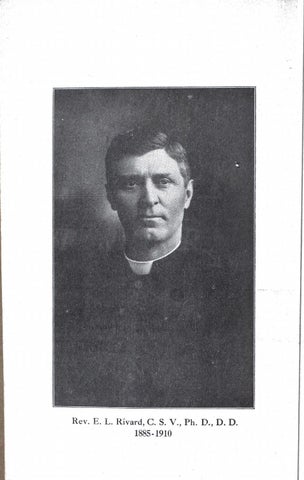
Rev. E. L. Rivard, C. S. V ., Ph. D., D. D.
1885-1910
•
, J"·
'~·;I;
~. ·~
f
'\ ,•_ ,
'
I
... ·)'. '·
FATtiER QUERBES Found~r of the Community of St. Viateur Born I793
Di~d
I859
Viatorian Community Archives Scanned 2015
Original page blank
THE VIATORIAN Facet Spera YOLUME 27
OCTOBER, 19()9
NUMBER. 1
FATHER QUERBES . ATHER Querbes was the pastor of Vourles, near Lyons, France and the founder of the Community of St. Viateur. It is but fifty years ago that he c.l osed his. lillliillilliilliiililll laborious and successful career in the midst of the flock which he had reclaimed from its religious indifference, and in. the mother house of the society of Christian educators which he' had just established. The fiftieth anniversary of his demise wa~r piously commemorated in all the houses of his now widespreadinstitute Sept. I, 1909· The personality of Father Querbes is, it is needless to say,. an object of filial veneration for the clerics of St. Viateur and for all the youth whom they educate. - But, as a man who has wrought valiantly in parish and school and has through his apos- · tolic activities projected his influence far beyond the narrow confines of his country and times, he can not fail to become an, object of ever increasing interest for the religious and educational world. If all men the world over spontaneously bow in· reverence and gratitude before the venerable Cure d' Ars and St. Jean Baptiste de ·la Salle, we must consistently applapd the life· o£ any one who has walked closely in the footsteps of these spiritual heroes. PASTOR OF V01U RLES. '
Born in Lyons during the Reign of Terror, 1793, when· minds upheaved, like hot lava, impr·e cations and blasphemies against the holiest institutions, ·a nd when the sky was lurid witrr exploding bombs, froillj o,ne of which he had narrowly escaped 4eath .in his infancy, the young Jean LOuis Querbes had been in· ~ed both by the ci.rc\ftnstances of the tim·e s and by parental'
2
!
! t
l !
''•
THE VIATO~RIAN
and sdiool training to the art of meeting difficult situations. H is early success in school, his solid piety as a youth, his brilliant' achievements in philosophy under private tutors and his remarkable record as a . model seminarist in the grand seminary of St. I renaeus are all matters upon which both his com;r ades and his superiors have borne abundant and eloquent testimony. Ordained priest December 17, 1816 he had not served long as assistant in the parish of St. N;iz-ier, when the diocese of Tours well nigh succeeded in securing the distinguished services of the young Lyonese priest ·for the presidency of its Missionary House. Providence had ordained otherwise and shortly after, Father Querbes was appointed pastor of Vourles, a village of r,2oo inhabitants, about 9 miles from Lyons. This beautiful hamlet, like m~ny other co~ntry villages in France, bore evident traces of the religious havoc wrought by the revolution. With the usual exception of a few fervent souls, indifferentism held undisputed sway. Religion had passed out of fashion. Sunday rest was ignored by many who · worked because it was Sunday, while others filled this weekly surcease from toil with such worldly pastimes as prevented their attendance at any churcp service. The chase, the dance, the excursion invariably dispersed this volatile flock on Sundays. The church' like a sorrowful mothe·r uselessly 1bewailed the waywardness of her ·c h1ildren; her bells in vain pealed forth their ever unheeded calls into most unwilling ears; Sunday after Sunday her aisles and naves remained untenanted save by a faithful f.e·w . Finally even the material edifice of the church, through long disuse had assumed the dilapidated appearance of some abandoned · fane, which pleasure seeking folk passed by rapidly or avoided carefully as a place of ill omen. The parish schools for boys and for girls were in an equally lamentable condition. In well nigh every case children were in charge of teachers tainted with irreligion. . Fortunately for these spiritually somnolent . Vourlesians their new pastor, the young Father Querbes, in coming among them brought to their service not only his rare gift of eloquence, his pro!ound knowledge of sacred books, his priestly piety, but also a r~ch' fund of. youthful energy, a religious gravity illumed by a spnghtly sunnmess of temper, a ready- power of genuine human ~ympathy, _an unshakable trust :in God and an abiding confidence Jn httman nature, an all embracing and all conquering love of- the
:I I
I
I
:I
'I
,J
!
';
, I
I
THE VIA TO,RIAN
3
people, rich and poor, high and lo~, good and bad, old and youngJ . As an eminent. spiritual strategist he had the precious gift of tact which taught him a skillful adaptation of his other gifts to the needs of the sitttation at the proper time and place. Thus he ac路complished really great work in a parish where the efforts of his devoted predecessors had failed and where success appeared hopeless. , It is a far call . from o;ctober I822, when Father Querbes' arriving at Vourles was looked upon as a man to guard against, to May 1909 when. in spite of the spiritual reverses coincident with the late religious persecution, officials of church and state in presence of a large gathering of the faithful of Vourles, piously exhumed the remains of Father Querbes, to certify them and preserve them in a new tomb in the hope that this proceeding may be the first step toward his ultimate canonization. This recent incident indicates clearly enough that the man who was once considered a menace and is now accounted the chief glory o.f the locality where he spent his life must have wrought excellently. Still it may be asked what precisely did he do? He went out among the people and induced them to come to church, he instructed them, he corrected their erroneous notions, gently yet firmly he condemned their worldliness. , The people came to church to see the beauty of religious truth revealed to them and to hear their own failings vigorously denounced. They went away spiritually fed~they grew strong enough to come again. Then he urged the restoration of religious practices, prayer and the reception of the sacraments, and they heeded his advice, su.rprised at their own docility. Further he told them that their poor old church was an un~ pleasant reminder and symbol of their former neglect, and re-1 quested them to build a new one. A handsome new church was built without delay in 1826. The poor, the sick, the afflicted, the erring were the loved objects of his 路constant solicitude. Among them did he make his daily rounds, dispensing aid, comfort, advice, correction and encouragement. Thus did he through the exercise of his indefatigable zeal rouse his people from their spiritual torpor and infuse 'i nto them the quickening pulse of a vigorous practical Christianity. Thus did he likewise resurrect from 路 its material decay the 路 parish church which became an attractive ~nd well frequented ' house , of prayer. It was in order to prosecute and complete his
4
THE VIATORIAN;
apostolic work at Vourles that several times during his pastorate of thirty-seven years he declined offers of positions, which, as they pr<Wed for others, would _have heen for him stepping stones to high ecclesiastical dignity. • It is not surprising that on their side his people were as ready now to stand by the priest as the:Y had been in the past to m:istrust him, misguided as they were by false prophets and blown like thistle-down by every wind o{ doctrine. They became so much attached to him that more than once they expressed their fears of losing him and would have protested against his removal from the pastorate of Vourles ' by ' any other agency than death. The voice of the people was apparerttly the voice of God, for Father Ouerbes remained p t:rstor of his beloved Vourles until his death which occurred September I, 1859.
Founder of the Community of St. Viateur. We have already intimated that the schools of the parish were in a deplorable condition when Father Querbes arrived at Vourles. The education of the young was really the work which was closest to the heart of this man of God, in which ,he was eager to spend his splendid energies. Q,f all those in need of help none appealed to him half as persuasively as the poor chit~ dren in their ignorance and helplessness. He had made his own by frequent meditation the beautiful words of the Master : "Suf~ fer the little children to come to me;" these he took from the be.; ginning as the inspiration of his educational efforts and later as the devise of the company of educators which he formed. Through the intelligent and generous co-operation of the wealthy Misses Comte he was enabled soon after his arrival to install the Sisters of St. Charles in the girls' school. But he w:as at a loss where to obtain religious teachers for the boys' schooL Although several great teaching brotherhoods existed, their membership was wholly inadequate for the needs of the country. Father Querbes, like m-any other clear-sighted, public-spirited and practical pastors of his day, was not s1ow to recognize the urgent need of other organized bodies of Christian educators. Committing his school temporarily to a pious layman, he meanwhile opened in his own house a free normal school for the _training of young Christian teachers, young laymen whom he equipped with secular learning that would enable them to obtain their state diplomas, while at the same time he thoroughly 1111-
t•·,,' I
I,·'
'
'
t'l·
THE VIATO,RIAN
5
sa~e These well trained · teachers he empoly~~
btled them with Christian · principles that would m,a ke them
.g :u id-es. qf the young. it\·· the. schools of .his parish and a1so dispatched them to the aid the pastors of the vidnity. Throughout the entire · country m.~ny other zealo~s priests had proceeded in this manner and their ~nitiative was the origin of a num·ber of relig;ious communities f)f teachers. Such also was to be the ultimlate result in the ca.se Qf · the indefatigable Father Querbes. Pursuing the story of the genesis of Father Querbes' association of teachers as we find it recorded in the archives of Vourles we observe that the beginnings of this society wer,e attended by the intermittent hardships and blessings which mark the works of God done by men~ To . carry out his e)Gpensive project Fathe·r Querhes lacked pecuniary resources; undaunted by obstacles and trust·ing ever in Providence he addressed himself valiantly to the ta.s·k of creating the needful resources out of the charity of the pious people whos,e interest his zeal had enlisted in this great and good work. Again the Misses Comte became the visible providence of this organization, giving almost their entire fortune to supply tpe necessary funds for the functioning of the normail mshtute of Vourles. . ·
of
•
•
I
.
'
.
Father Querbes made his undertaking known to his brbther priests, petitioning them to send him well qualified young men to carry on the wot'k of education. Pastors answered favorably and the membership of the · young society increased rapidly. Next, after considerable parleying, he obtained official approbation frotn both church and state for his diocesan . society of lay Christian teachers which was known as the "Charitable Society of the Schools of St. Viateur." The reason why St. Viateur was chosen as the patron of this society is because this young saint, one of the early glories of the diocese of L'yons, was himself a Chris:. tian teacher and · in this capacity the chief , aid of the illustrious Bishop St. Just in the 4th century. St. Viateur was a cleric and had received the order of Lector in the exercise of which his duties consisted in reading the sacred scriptures to the · people and in teaching Christian doctrine to the children. It was in the fullfilling of these holy offices that this young saint began his holy. life which ended in the solitude of Thebaide wh.ither he had gone with his bishop in quest of sanctification through penitential prac-
tices. Father Querbes provided for the develop,m ent of his normal
6' !
institute by organizing throughout the diocese committe~s ot promoters and . a bureau of directors with headquart~rs in Lyons under the presidency of the vicar general of the dtocese. The work progressed steadily, but not without trials ana sufferia.g s, real discomforts and well grounded apprehensions. Yet the courage of t he founder grew apace with the diffi'culties which seem~ed only to enflame his ardor the more. His own well whetted firmness of spirit he had the talent of communicating to others. For the needful material means to carry on a11; undertaking of such importance he knocked at .the hearts of men and at the doot. ~£ the tabernacle, and w.a s often rewarded by the timely arrival of succor. By means of the aid thus received he purchased a house near the church and adapted it to the purpose of the society. Until recently this house still existed in Vourles just as it · was in the days of Father Querbes. After his association ' had taken expansion under legal and e~clesiastical sanction the founder thought of further insuring its · stability by converting it into a religious community. Having prayed fervently for light in so gr<;tve a matter he finally made known his intentions to the members of the association, exhorting them to pray also in view of ascertaining the will of God i1,1 a question so 1mportant and personal.
During the vacation reunion of 1835 he instructed the young teachers upon the nature ' of religious engagem·e nts, upon the virtues and duties of the religious life, and the obli gations, the .advantages and rewards of religious vows. At the end of the retreat of that year, on Olctober 21, the feast of St. Viateur, Father Querbes finally declared that henceforth the association of lay teachers of St. Viateur would be a religious congre gation of priests and brothers 1 and that the members would bind themselves to the ·i nstitute by the three vows of poverty: chastity and obedience. Nearly a.ll the members present pronounced the vows, and from that moment' the association began to rank among religious communities. His next care w.a s the foundation of a novitiate; this he established in the ancient castle of Payet and placed it under the direction of Father Faure. In May 1838, he went to Rome in or-der to submH the constitution of his community to ' the Sacred Congregation of Bishops and Regulars and to obtain from the ,H oly Father approbation and blessing. Through the good offi·c es of the Jesuit Fathers in Rome, and in answ~r tq the ferven t
I
.....
·
"•
THE VIATORIAN
7.
prayers of the breth~en in France he, after several months of p!erplexing delays, at length ' obtained the Sacred Congregation's approbation .of the Statutes of the Congregatiort of St. Viateur. On the 21st of September 1838 His Holiness Pope Gregory XVI confirmed the decision of the Sacred Congregation, an,d imparting his special blessing to the new religious fam,ily which was just formed, he said to the venerab1e founder: HMay your ,young community increase and multiply." With joyous gratitude Father Querbes speedily dispatche~ the glad tidings to those at home enjoining them to sing the Te D1e um for the great favor which had just been obtained. "Let us, he wrote, be ever worthier of our vocation." 0 , The transfer of the novitiate from P/.yet castle to the mother house irt Vourles, the opening of a junio\ate, the rapid growth of the society in membership and in popularity, the menacing necessity of closing the novitiate on account of a suspension of charity which temporarily diverted its offerings to other channels in the Rhone disasters of 1840, the rescue of his community front peril at this trying juncture by som,e unknown benefactor, the subsequent spread of the parochial clerics through a number of dioceses in France, the sending of missionaries to St: Louis, Mo., the founding of a new province in the diocese of M'o ntreal upon tl}e urgent request of the. saintly bishop Bourget, the fusion o£ the teaching brotherhoods of St. Qidilon and of St. Jean into the com.m unity of St. Viateur betWJeen the years 1847 and 1854 at the request of the bishops of St. Flours and of Rodez· who hadl founded these brotherhoods of Christian teachers-all these events c~owded in the last years of Father Querbes' career and called forth . from this athlete of Christ the unceas,i ng display of his splendid executive powers. But he spent his vigor so unsparingly that even .his robust health gave way under · the strain , of such ceas·e less toil. Mter a brief illness, this sai~tly priest, this .great pastor and educator, died September I, 1859· The memory of his holy life, the power of his example, the quickening influence of his written works are still alive and active in inspiring his brotherhood with a love of their great work.. They strive to imitate his genuine humility, his untiring perseverance, his clinging trust in God, his zeal for the betterm'e nt of fellowmen and especially for the Christian education of the young. Before the suppression of th:e religious orders in France the
THE VJ:AT:ORrANt· Community of St. Via.teur had a: membership, oi ov~er one tho·u .. sa·n d religious : in Europe and America. There are· still· n~arlyr thr·ee hundred members of the Community in France who, as 1aicised brothers, are conducting free schools i. e. Ch_ristiaa· :schools. They are very successful and popular in spite of · the ·harrassm·e nts of the government. People now noticing the great , . <l.ifference between• the demeanor and intelligence o.f children. oi Christ ian and state schools demand more brothers. The •day· m~y soon dawn when awakened France will recall her dispersed sons ·a nd daughters and welcome them; back to their saving. w,o rk. ,and then the. comn1t~nities whose infancy was cradled in France :and fed at the breast of the eldest daughter of the church. will ·return to do good at home as well as abr.oad. May the pious ·intercession of the sq.intly founders before the Great White ' Throne hasten the day. A CLERIC. I
;~----------------·~1<~>1----------------UB
THE MAGNETISM OF THE CHURCH A. T. K.
T IS with great surprise that we behold the crowds of followers that flock around the leader of some new religion. Luther in days gone by sets up a new doctrine and immediately he attracts a host of followers. Calvin, Zwinglius, and Smith no sooner announce their novel creed than thousands ra·n ge themselves beneath their standards. In our day Dowie preaching a new cult gathers hordes who. beg admittance into his fold. A'n d when these leaders die the multitude raise fanes to theri r name and honor. Our surprise at such a numerous band of adherents is short lived when we consider the kind of religion dealt out to , these poor deluded persons.. Our inspection into the facts reveals, in such an assemblage nothing startling or phenomenal. Is it at all surprising that a religion which offers to men unbridled liberties, :a free indulgenc-e of passion, a religion which places no restraint ·upon men, should be embraced willingly by men? Who is so blindi ' ·who so ignorant of the facts of history as to fail to discern this as ·t he ·real cause why millions adhere to false religions.? Can: there be -aught aston~shing or even strange in such aciherence?
'· /
9
i
\~~
,But there ·is a phenomenon taking p1'ace · every day; i·t is b..et.. \fore our very eyes, many c~nturies have seen it; every: co'ttntfy '1i~s · witnessed it; it appeals to the most casual observer; it has·
i nfluenced the deep·e st minds; it has transfo,r med 'en;. tire nations; in a word; it has been felt from pole t0 '-pole·: the Magnetism of the Catholic Church, I that is, he.r power to dra:w ~nto her pale the greatest number of greatest n11inds notwithstanding the severity of her· moral and mental discipl·i ne. T:here exists then unquestionably this .great attractive force in the c:b·urch which has at all tim·es drawn multitudes of men to · her bOsom. N;o t only men in great numbers are drawn over to he1· fold but men representative of the highest sc>holarship, men em,in . . ent for profound learning, men of rare wisd.o m and highest cul·'lure are found among those who:m, the .church has counted among "ll:et loyal · sons. Now were this drawing power of the chur.cl~ peculiar to one age, or were it a property recently developed we might ·attempt to offer some natural explanation; but when the ().verwhelming fact is before us that this power has. been ope·r ating continually and lincr·e asingly since the very infancy of the church all our attempts to account for it as human skill must prove entirely . inadequate. Upon beholding great geniuses of opposite tastes and dispO'sitions sitting side by side in the large family circle of the great -church rec~iving all alike joyfully and contentedly her sublime dactrine, yielding a willing obedience to her behests and allowing themselves to be persuaded to unity in faith by her benign influ,.. ence, when we see them perfectly amenable to the stric,t discip""lirte which the church enforces can we ascribe such a fact to anythling merely earthly or human? Certainly not. Great philosophers and illustrious poets have always been looked upon and recognized as men of genius, they have been saluted as guides, the former lead men through the intricate n1azes -ef reason and help them to discover truth, the latter are chosen to show men the beauties and sublimities of the imaginative world. It is a common occurrence that among geniuses great differences of temperament and thought have existed still it is a iact warranted by history that men of genius although of wide difference in disposition have ever sat in perfect submission to the church's doctrine. Those who would deny to the church great talents, lofty gen~ ius have but to turn their. eye to the.- brilliant galaxy of talent em:.. I
THE VIATORIAN bodied in the Fathers o£ the church. Chrysostom, Jerome, Basil the learned Gregories present a group with Augustine as centra} figure which would grace and adorn the most magnificent assemrblage of intellectuality. Later on the whole array of medieval scholastics a body of men of vast erudition and univ:ersal knowledge all claim the church as their mother. In our present day we find illustrious m·e n within her pale. A N ewm·a n, Brownson, Spalding shed the ,brilliancy of their sterling · minds about the sacred precincts of the church and diffuse an atmosphere of learning that is felt the world over. In poetry the church is productive of many favored sons of the M'u ses who have written with brilliant success. Dante, Tasso, Petrarch, Calderon all most gifted Epic · and Dramatic writers stand forth as most convincing proofs .of the assertiot).. And so in every walk of science and art in every department of literature the church is widely represented by intel· ligence of the first order. Not only in the intellectual order is the church remarkable and unique there is st1ill another body of men found within her sacred circle that places the church on heights peculiarly her own which never have. nor never will be attained by the sects. These men have won the admiration of centuries, have been wor' shipped by Catholics; have been reverenced by, non-Catholics and have been recognized throughout all ages as sources of edifica.. tion, stimuli to virtue, quickeners of effort, shining examples of all that is noble and best in man in them was found every quality that makes them truly great-The Saints. And saints are truly great men for does not self restraint, abnegation heroic sacrifice of m.ind an~ body argue something more than what is merely ordinary and commonly human? Moreover the church boasts that she alone has been able to satisfy the cravings of great mtinds, that she alone has been able to quell the storms that often arise in master minds while in search of a true religion. Behold the years of unrest and impatience in Augustine's mind, note how he turns . from sect to sect to find quietude and see finaiiy where his , longings ceased, where tranquility reigned for him. in the fond embrace of the Catholic Church. In contemplaaing this extraordinary fact in the church, her undeniable magnetism., a more inquisitive mind is not satisfied ·with the bare fact, but seeks its cause and hence he casts about 'for the ~olution of this problem1. Among the most sear'ch~ng minds seekmg to find the cause is Guizot who in all respects is most en..
;:-'i' ·;
'.
; r·
THE' VIA TO,R IAN
,.
II
.th'ttsiastic over the phenomenon. The m;.e ntal keeness of this · writer and his great talent have placed him among the foremost writers of E:urope. Possessing as he did a clear and logical' mind we would expect him when speaking of this phenom:e non; to designate an adequate cause, still we are shocked to find him attempting to solve the fact by attributing it to human skill and power, and we at once lay his solution aside as whol~y unsatisfactory, either by reason of a blind prejudice or of his short sightedness in dealing with the Catholic church. Leaving aside then the testimof).y of Guizot as ~ntirely insufficient, we have to consider other reasons . suggested by other men. Some have assigned the talent of the popes as an explanation of the church's magnetism. This assertion, however, canNot be~ar the test; for although there has been illustrious talent at the helm of the church, yet there have been men of very ordinary ability upon the chair of Peter, whtile encircling them in, and out of the church great minds existed. Nnw if this phenomenon were due to extraordinary talent why is it not found in the sects for a:ssuredly they have had leaders of no mean repute in the world of mind and thought. It · appears at once that talent contributed nothing to influence great minds to flock around the . church as a mother. · Some have striven to untie 't he Gordian knot by mentioning the temporal power of the popes as the cause. A glance at hlistory reveals in an instant the comparative weakness of the pope's martial forces. In fact there is no comparison to be made between the Pope's arms and those of any fair sized nation. We find a last though best solution presented which nevertheless . must be cast aside. The very organism of the church exGlaim our adversaries, her efficiency in obtaining submission to authority, which is m1o st essential in a society admirably and sufficiently explain the wonder of which the church boasts~ An argument this, plausible and at first sight incontestable. It is the last stage tq , which Protestants resort it is their final struggle and it dies hard. In saying this our enemies prove ·nothing, but take . for granted what should J:> e demonstrat~d. We put them in an inextricable diffilculty by simply asking how the church has obtained this organism.? How she obtained perfect submission to authority? It is .in strict conformity with right reason to assign a cause proportionate with an effect. When we see in the church something recorded of no other institution, a fact which has· existed through eighteen centuries of storm and calm and which , still con-
I
, I
.f
12 .
..,,
THE VIATORIAN
-tinues in all its first freshness and vigor; when we stifl · see Vhe church attracting men of every clime to her shrine can we· say this is a result of human work, would we uot better say trtify. 'dte finger of God is here? After searching about this te-r restrial sphere for a solutiofi·. 6£ our problem prying into every corner of the globe to find · perchance the magic Sesame that may open the· door of this diffi-culty we are entirely disappointed for our search has been fruitless. Ohe place have we left unexplored, one place that perhaps holds tht secret. We are resolved to turn there, and so armed w-ith reason and faith we turn to the D ivine mind, and there at once the· hidden secret flashes ~n upon us in a flood of light. In attributing the phenom:enon to the Divine power we at last com·e to a certain adequate cause. For in showing that such' a stupendous fact is in no way capable of being accomplished merely py huma'tt means we · are forced to admit Divine interference. He who can do all thin.gs whom the winds and sea obey, to Whom nothing is hard ot imposs~ble can surely, and does account for the extraordinary magnetism of the Catholic church. Favored by a Divine protagonist all Catholics should exult and rejoice in their membership to this church. When on every sid:e we see about them se·c ts tossed by every w1ind of doctrine open to the attacks of error and fanaticism blindly following the doctrine of some ill guided leader an orison of thanks should ascend to acknowledge our gratefulness for the privilege of being sons of a true creed. What consolation ought not Catholics take in thinking that even though the storms of hell are unchained .ag~nst the church, and even though hosts of misguided men array their strong powers to destroy her, they need not be dismayed for He who has said; "Behold I am with you all days to the consum·m ation of tim·e " will continue to raise up men of talent and holiness who will honor and defend her until time is lost in eternity. 1
..
路
路l
THE VIAT0 RIAN
13
1
WH-E N 路TH;E EM.BE1RS LIE
Last night in a dream the From out the blue home A time when the flame of I parted to rest, for my
S~ M :OruLDECRING~
last rays were fading of the bright setting sun, life was decaying life's work was done. '
T thought it was eve, with camp fires dying The tide of my life's stream was now: ebbing low. And yet e'en this morning I basked in the sunbeams I saw but this morning the camp fire's glow. But O;h, for me now the night was fast robbing The glimmering light of the once brilliant day, The hopes of my life were blasted and hlighted I thought youth's ambitions were stealing away. For then, did it seem that fond aspirations, Were hopes of a morning, despairs of a night The seeds in the springtime that never would blossom The wishes of childhood killed by the blight. I woke from this trance w:hen morning was shining, When nature with' joy and with life was a-thrill Then I sought to prepare for the glorious sunset When the embers of life lie smouldering and still.
J. c. J.
\
't
'~t
.. ; '
'
..
JAMES CLARENCE MANGAN B. 0. T. "And melancholy marked him for her own."
HE literature of the nineteenth century was ushered in with m.uch intellectual activity, and was characterized by its spirit of 'research, freedom, and a certain eagerness to unravel all mysteries or lay aside what human reason could not readily elucidate. The artificial restraint of the previous century was 1ignored and "poetry sought inspiration in the freedom1 of nature." Wordsworth and Coleridge were the first to inaugurate this movement in their "Lyrical Ballads" and were followed by Byron, Shelley, K eats, Moore and Campbell. While we ' give due praise to the poets of this period we find one living m their midst who is not known so well to the Amedcan world. I allude to the genial but ill-fated poet James Clarence Mangan. Born in D'u blin in r8o3 Mangan had the misfortune of having a reckless and extravagant father who cared little for the home and its surroundings, so that the heritage of the child w.as that of perpetual adversity. Moreover the poet first saw the light of day when his country was lin its deepest sorrow, having lost its independence the year before his birth by the so-called act of Union. These incidents as well as many other unhappy events tinged the song of the poet with that melancholy pecLiliar to many of our Irish poets. Yet the songs of Mangan have always touched the ,h eart of the reader by their sweet pathos imagery and beauty. At the age of seven 1\!Iangan attended a school conduc,ted b y a ]e'Suit, named Father Austin. The Jesuit soon discovered in the youthful mind of the child, the genius of the poet and readily afforded him all the possible advantages suited to his age and ability. .After three years thus spept, M:a ngan went to a private school of languages opened by Father Graham, who had just returned from the Universities of Salamanca and Palermo. It was at this school 路 the poet first discovered, in the foreign languages, the delights and mysteries of European literature, for he acquireda good knowledge of French, Spanish, Italian and Latin. Here also he must have studied German, though his biographers have 1
!l ' I
1
t
I
...
THE VIAT'ORIAN , I
I5 I
not mentioned when or where he acquired his knowledge of this language. But M'a ngan like many a needy man of letters had to leave- school at an early age and work in a Scrivener's office to support his mother, brother and sister. In this office he found nothing but disappointment and rebuffs both from liis fellow employes, who were uncultured and immoral, and his employer who treated h.im with contempt and scorn. To make his lot mro re un;h appy still the room in which he worked w-as small, dark and badly ventilated so that his physical as well as moral nature suffered. This treatm·e nt so uncongenii al to the refined tastes of his sensitive nature was one of the bitterest recollections of his life .. · Seven years were thus spent in the Scrivener's office and the three following in that of a lawyer's, after which M'a ngan began his career as a po:;t and translator of Irish and German. His early productions were distinctly I11ish in sentiment and were read only l.>y those who sympathi sed w~ith their policy. As a result his poems had so small a circulation when first published that the poet could scarcely make out a decent livelihood. At this time, however, a vacancy was open for an assistant librarian to Dr. T :odd of Tninity College ·and Mangan gladly availed him\s elf of this opportunity, both to improve his knowledge of literature and secure a better financial ppsition temporarily. Here he had the good fortune of making the acquaintance of the eminent scholar and antiquanian Dr, Petri~ and the historian John Mitchell. His time at the col-Iege library was spent profitably in studying the old Oriental manuscripts and acquiring knowledge of many Eastern dialects. How long he . remaJined at this work we are unable to ascert.ain from his biographers, but when he left it the saddest part of his life began. He became a slave of drink and even, some say, of a more pernicious drug which soon impaired his splendid faculties and lessened the work he was now so successfully giving to the public. He continued working however, and even in I84.S contributed soul-~tirring verses on ":Leading Irishmen," to the ''D'u blin Nation" and other high class periodicals. Two years later the fatal symptoms were apparent, · his mind and body grew feeble, his once robust fram,e lost its wonted activity and the remaining years of the poet's life were as sad as human nature can endure. Poor M·a ngan was born a child of adversity and sorrow seemed to grow with his years or as he expressed it in one of his poems, "My soul was born for love and grief, these both were blended at my birth!' I
f,
I
16
THE VIATORIAN
Early in June, 1849 he was seized with cholera and on the 2oth of that month he died, at the early age of 46, probably realizing the wish he expressed in his poem the "Nameless One"; "A grave in the bosom of the pitying." . _. The praise accorded to the poetical works of M:a ngan would do honor to m'a ny an English poet-laureate.. Charles Gavan D1tffey says of him. "He has not and perhaps never had any rival in mastery of the metrical and rhythmical resources of the English tongue, his power over it is something wholly wonderful"; and "few poets, says Lional Johnson, more imperatively demand to have their lives considered in an estimate of their poems." Indeed the hopelessness and unhappiness of his life find expression in all his verses. His whole life was somewhat aimless and without any real am:bition. He lost sight of his beacon star and drifted through life, and through the poetic world with its · curious love, without finding anchorage in · any safe harbor. H is niuse was full of delightful harmony and roamed through many · lands with varying success. His translations from the German and Irish were wrought with such exquisite vividness and beauty that his critics are unanimous in stating that they ,a re unsurpassed and perhaps unequaled by any other translator. Those from the Spanish and Italian are equally meritoriou~, while his translations 1 of the oriental poets have been admired by all true lovers of metrical composition for their grand imagery. How Mangan in his short unhappy life could have mastered' so many languages has never been satisfactorily answered by his many biographers, and still all his works have been applauded for their originality and finish. His Qlr iental translations comparefavorably with "Lalla Rookh." To pass criticism: on his many poetical works would extend this essay beyond its intended limits, so I shall confine myself to mentioning a few only of his principal poems. "Lament for the Irish Princes" which is a. translation from the Irish of Word is one of Mangan's best short poems a:nd shows "the poet at his best" in literal translations. "Gone in the Wind" is perhaps the m·o st widely read of his -German versions, it is a short poem and is superior even to his "Anthology." Hut perhaps Mangan's fame r.ests on his beautiful apostrophe to Ireland in his poem· "My D 1ark Rosaleen." The true patriotic spirit of the "Child of Adversity" is here expressed in clear, terse language, and his firm conviction of Ireland's need for and claim to freedom is undeni1
•;
THE
~ VIATORIAN
17
a!Jle, which if once possessed she shall never lose. The Judgment hour must first be nigh, ere you can fade · e·r e you can die, My Dark Rosaleen.'' ust. Patrick's Hymn before Tara" is also very well known t0 readers of Irish literature. "The Nameless One" is undoubted·· ly the most pathetic of Mangan ;s poems and reveals in every line the unhappy lot of the writer, for the "Nameless One" is none other than the poet himself. The other poems of merit are "'Twenty Golden Years Ago," "My Women of three Cows," "Kin... kora/' "The time of the Barmecides" and "Kathleen-Ny-Houli~ 11
han."
·
The poetry of Mangan displays the master hand though some• ti.m~s executed wihout the finish of the master's art. "He wrote as the humor took him" and often squandered his power and ni:'a stery over vers·e upon matter unworthy of the dignity of true poetry. His works have the faults inseparable from the condi:O. tions ·and circumstances in which they were written, yet his poetry will ever be remembered for its graceful, elegant, transparent style, sweet pathos, flights of imagery and beauty .. ---~:~---
TO A VIOLEW. '
:
Pretty little viokt That in my garden grows, Why art thou so modest Thy beauty to disclose? Why hidest thDu thy purple hues With gold so finely wrought? The work of the great Artist To mortal never taught. Why not hold thy head on high, To meet the smiling gaze Of such as passing by thy way Who would thy beauty praise? Ah no, I fully understand For thou art called to be Though fairest of the garden's fair Emblem of Humility. F.
K..
'
l
.;~
THE MAID .OF ORLEANS
•
•
F. GAVIN, '10
S WE slowly turn over the pages of the world's history and ~tudy carefully the course of human events among many nations we find here and there illuminated in bold type the names and deeds of those whose lives ar·e held in reverence because of some great achievem1ent or act of sacrifice in their country's cause. · Their lives stand as monum·e nts of their country's greatness and their praises are sung and gloried in by succeeding generations. Here are portrayed warriors mighty and powerful , rulers and statesmen, men whose lives form an epoch in their country's making. But the subject of my eulogy 1s not a mighty conqueror ·o r a potent law-giver, I sing not the praises of the great master mind's world knowledge, or statecraft, I choose for my subject a weak innocent peasant girl, one whose name and deeds, neverthe. less stand out in history as the most unique and remarkable of all ages-Joan of Arc-the Maid of Otleans and the savior of France. In her career we see the mighty forces of a nation directed by a little child, but who directed the child? We have need but look at her life and her work and the question is answered. It was during that distressing period in French history known as the - hundred years war that the heroic maid appeared. The fair kingdom of France lay crushed and bleeding under the mailed feet of English warriors. All her principal towns were held by the enemy and the day of her passing freedom seemed near at hand when France must lie forever at the feet of England. But such was not to be her unhappy end. Though the sun of a once: powerful nation seemed to be setting on the blackened deathstrewn fields of a righteous people and the victorious arms of the invader were now ringing out the death knell of a vanquished foe, still the end was not in view. The time was ripe for a change. The· mighty arm of the conqueror was soon to be struck by an unseen foe. · France was to be given a redeemer who would lift her up and restore her to her place among the nations.
THE VIATO,R IAN
~.:; '·
''
And · now we come to a strange and most striking example , of the omnipotence of God in His manner of choosing as the instrument of His divine justice a weak peasant girl. There is nothing in the annals of history more remarkable and yet truer than the story of the life of the maiden through whose labors. France was to regain a place among the nations of the world. No • poet has spun from out his imagination a glorious tale or pictured in glowing words an epic of heroic love and transcendent valor, that can compare :v·ith the actual reality of the career of this simple maid of old France. ·Born in the little village of Domremy in the province of Lorraine of poor and lowly parents Joan gave little promise during her early years of the great work which she was to accomplish. Her childhood was passed in innocence and simplicity. She was ever dutiful to her parents and delighted to be always active. She loved to help her mother in the household work and tend the sheep. She loved to outstrip her companions in the race. Thus we ·c an see that the child from her earliest years was inured to toil and exertion. Later on if we wonder at the immense fatigue which _the girl underwent during her eventful career, we must call to mind the physical training of her early childhood, she was not the pampered c·h ild of a mansion whose every whim is satisfied by indulging parents. She the daughter of the working class of people whilst tending her flock had been bronzed by the sun and drenched by the rain, her hands w·e re hardened by toil, and when the season's harvest was poor and the decimated flock had made the family purse low she had often felt the pangs of hunger. . From her earliest years Joan was a very religious girl, and often when at play she would steal away from1 her companions and enter a nearby chapel or church where she placed her garlands of flowers around the statues of her beloved saints, while her constant prayer was that God m:i ght alleviate the suffering~ of poor France. ' Thus passed away the early years of the maiden's gentle life among her native fields. A great change how:ever was near at hand. At length when Joan had reached her thirteenth year as she was working in the g.a;rden dur.ing the heat of the day, she beheld a wonderful vision in which · God revealed to her that she was to save France from the English. The poor child was sorely perplexed at this strange mission from· heaven that she a weak
~0
THE VIATORIAN
girl should be chosen to drive out the enemy from the country~ t6 lead an army, and fight battles. The war at this period was at a serious crisis for the Fr; nch. Their last stronghold, Olfleans was besieged by the enemy and its fall meant the end of the struggle for liberty and the absolute· dominion of France by the English. Charles the Seventh, sorely realized his almost hopeless position, and regarded his chances of being able to hold out in the dis-· rupted kingdom as highly doubtful. Now that O-rleans was irt daily peril of falling into the hands of the English, and with Paris and Rouen already in their hold the wretched sovereign had serious thoughts of leaving his ever narrowing domain and s eeking refuge either in Spain or Scotland. , Bu t the news of this shepherd girl risen from the m1arshes of Lorraine and hailed as the savior of France spread throughout the stricken land and reached the ears ·of the people, who saw in it a gleam of hope for a scattered kingdom. l-Ie would test ~he powers of th e maid. Joan soon convinced Charl es of her divinely appointed mission to rescue France from the English and asked for troops to lead against the enemy at 0 1rleans. He fitted out the maiden in 1a suit of m GJ. il and plac ed her at the head of a small dishearted French army. Picture this fair young girl in pure white armor seated on a powerful war horse· lea<ding the army. Her presence an1ong the troops was really magical From weak and conquered m~ n expecting defeat in conflict with the English. th ey became strong and determined soldiers. They looked with awe and reverence on this heavenly sent child who was come to lead them to victory. The story of O·r leans never grows old. How the heroic maid led her now inspired soldiers against the hitherto invincible English army, sweeping it before her like a toy in the raging breakers, herself dashing forward unmindful of the clashing steel and pressing her lily banner to the very ramparts of her enemies works is J!lways read with renewed inter.est. Her courage was prodigious. The tale of that charge and retreat, the great victory of the maid over a victorious host stands \·v ithout a parallel in the pages of history. 1-Ier miemorable victory at Patay further attests her divine commission and Youches. for a genius of strategy that is unsurpassed in the annals of m~litary history. · · . In the few short days of her command the victories of the maid over the English changed the whole tide of the war. A.nd
THE
VIATOt~JAN
2r
·now indeed were Crecy, Poitiers, and Agincourt avenged. France saved and the task of, the maiden was done and she pniye,d that God would allow he·r to return home. But this was not to ·be. A gracious king would grant her any boon she desired, wealth, title, and position, but he would not listen to her simp~e request of being allowed to return to her parents and friends, to forsake a life at court and again tet1d the sheep at her own hum.ble village. And even though Joan shrank from fame and honor and wi,s bappy only at the thought of having done God's will in restoring France to the people, yet the renowned French generals who saw their own military reputation lost by the wonderful tactics of themaid only loriged for her downfall. The English enraged at their ignominous defeats at the hands ·o f a woman, yea, a mere child, cursed and swore vengeance against her. They chose to attribute her achievements -to the powers of darkness and sought to undo the effects of her victoriesby denouncing her as a witch and a sorceress. They longed for an opportunity to capture and destroy her. And ev.e n while Joan was yet with the army her enemlies were plotting her end. . It was while she was relieving the town of Compeigne that their treachery at length triumphed. The French commander of the town was bribed by the English for a base sum of money to betray the m1aiden into their hands. On an assault up-on the English by a ruse her troops were cut off from her and the gates of the city were closed in the retreat while Joan was left outside with but a few followers who w·e r·e soon overtaken and made prisoners by the English. Such was the unhappy fate of the heroic maid s.o ld by her countrymen to her enemies. And now we come to one of the blackest pages in all his- · ·tory. The crim~e of calvary is to be repeated. She who had been · sent by God to redeem a fallen nation was to seal her m.ission by ber martyrdom, to pay for its deliverance by a ransom of blood. In the hands of the English the glorious maid could expect no mercy. She was forthwith thrown into a dungeon to aw.a it the mock trial which would pronounc-e sentence of death upon her. Before a tribunal presided over by an apostate French bisho·p devoted to the English cause, Joan was denounced a witch and heretic and sentenced to be burned at the stake. She a witch? She a heretic, that pure child who followed God's instructions and did God's work whose heart had known only God's love? And
was
THE VIA TORIAN to this insidious charge the saintly maid had nothing to oppose but the simplicity and purity of her heart. . "I am sent by God, she said, I have nothing more to do here, send me back to God from whom I came." . Let us retrace the sorrowful journey of the innocem? Joan to the stake of Rouen. Consider this spotless child, this fairest flowe r of the age whose soul was as pure as crystal waters, go路i ng forth to a felon's death to be burned alive at the stake. I shall not dwell on the horror of that scene, on that flame and smoke wreathed face, lifted to heaven and the terrible agony of her torture, on the dastardly mob of English soldiers who applied the burning fagots to her funeral pyre and mocked her in her cries of appeal to heaven. But even as the flames consumed her quivering body, she extended pardon to her enemies and recomm路e nded her soul to God. All that remained of the noble peasant maid was a handful of ashes scattered on the wind. The stain of this fearful murder rests equally on France and England, the one should have ransomed her the other should Mave honored her though an enemy. Alas too late did the wretched Charles realize the awful crime, and as if to make what amends he could for his cowardly neglect and selfishness he annuled the iniquitous sentence made against the angelic martyr and declared her work sacred as performed under the guidance of God. But what words can be offered in excuse for her shameful death and_what words can we now add in justice to her sacred memo~y.
Every honor that this world can give :ts immortal dead has ~een bestow路e d in bountiful profusion on the maid of Orleans .. Surely the human mind can conceive of no character more glorious in patriotism and more sublime in devotion than this simple maid of France. But it remained for our own day to see the crowning act of honor paid to her sacred m~e路 mory. Although for . ages the angelic maid had been declared blessed by the church and her name held in reverence it was but recently that Holy Mother Church, ever solicitous but cautious in rewarding her divinely favored children has at length placed the crown of sanctity on the spotless brow of Joan. This momentous event as you are aware took place in the octave of last Easter when the Holy Father Pius X passed the solemn decree of canonization on the maid of 0'-:rleans and added a new name to the calendar of God's holy elect, Joan of Arc, the patroness o~ France.
·'
23 :And while France stands . today as a monument of her labors when it might have been a British dependency, how sad is its (:ondition resulting from an abuse of freedom. Faith has been supplanted by reason and God is denied a place in the nation's catalogue. But we can hope for the day in the not far distant future , when France will gain a~other greater victory over herself and the false goddess of reason who now sits ·e nthroned in the land. shall be cast down and the cross of true faith again exalted together with that other emblem of dyin,g faith, the state of Rouen. Then Wlll . the Works of the maid be complete then ~oan will be the patroness of a new France .
••
A
D~ISTINCTIQIN.
We claim to have great will power, But what we oft possess, Is not great strength of principle But common stubborness .
.,.
' II
,.
'
'
o'·":'·
:':0!':\
THE VIATORIAN Pt~!Jli'slted
mo11tltly !Jy the stude11ts of St. VZ:ateur's. Colleg-e, Bour!Jonnais, Iltiiuis. EDITORIAL STAFF
Editor in Chief-M. MUGAN, '10 . ]Exchanges, T . WEDGE, '11 Alumni-E. J. QUILLE, '1 1. .Athletics--D. BOYLE, '10. Locals--F. CLEARY, '11. Societies-W. NOURIE, '10 . . !!Fersonals-W. SAMMON, '12.
Entered tZt the Bourbonnais Post Office as second-class matter All correspondtnc-e must be addnssed "The Vt'att~rt'an," Bourbonnais, Illt'nois. Subscrip#on price One Dollar per year, payable in advance. All ousiness commun£catz'ons should be addressed: Rev, 7. F. Ryan, St. Vit~1'/Je-ur's Colleg-e, Bourbonn'ais, Il!t'nois .
..
E iD'l T'O R'IALS. I •' ''" i '
. Rome has displayed its usual wisdom and foresight 1n the -selection of a successor to the illustrious and scholarly John Lancaster Spalding, and the Viatorian congratulates Peo!"ia's Peoria upon its new bishop, the Rt. Rev. EdNew Bishop. mund M. Dunne. Bishop Dunne is a product of Chicago. As Archbishop Quigley remarked at the banquet given on the occasion of his consecration, "he is a typical Chicago boy," for he was born and reared in Chicago and is characterized by that aggressiveness and tireless energy which are distinguishing marks of Chicago's sons. He enters upo.n the administration of the Diocese of Peori'a thoroughly equipped for the work. The years spent in Europe in completing his ecclesiastical studies have given him a broad and deep knowledge of the customs and habits of the diverse people who have settled ino his diocese. During his stay abroad he acquired considerable fluency in speaking the more prominent of the European languages. His linguistic attainments will he of in-
f.,;;,)'." ~
'
f•
i.
"calculable benetit to him and to his people in the practical administration of the diocese. . Bisqop D·u nne acquired an intimate knowledge of the worklings of Catholic church, whilst a student at Rome which will he ,,of 'inestimable value to him in his new work. . His career as chan"'Celler of the archdiocese of Chicago with its manifold interests has ::given him. a keen insight into the business workings of a diocese. We refrain from speaking of his learning and his deep love ~and reverence for the Church; for these are too well-known to. re·,q,uire our mention. · That Rotne plac~d the episcopal mantle worn ~so long and with such distinction and honor by the venerable and ,erudite Spalding is a sufficient guarantee of this. The new bishop is in the prime of life, strong and robust physically as well as in mind and wilL l-Ie is admirably fitted for the exalted position to which he is called. We ar·e sure that he will earn and obtain the respect and esteem of the ·clergy and laity of Peoria as he has of Catholics and non-Catholics alike, in Chic·a go. The Viatorian wishes Bishop Dunne success and happiness in his new mission and trusts the D1iocese of Peoria m:ay long enjoy the a·b le yet mild direction of the new bishop . '
------~(~------
It is seasonable just now to ·i ndicate to the students what attitude . they should assum·e towards those· who advertise in the Viatorian. A .glance shows that most of the advertisements are of stores and firms in Kankakee. Now these men do not advertise merely to see their name in print nor simply to tdl what they are selling. They advertise because they want patronage, and they want the students especially, to trade at their stores. Now plainly if you cannot aid the paper directly .at least aid it indirectly, by calling o~ the advertisers and buying of them. Th~~ you will show that their advertisement is worth while and t_h ey. , in turn will always be glad to ins·e rt an "ad.'' When buying in Kankakee therefore be partial, and patronize those stores that are helping our paper by their advertisements. .... .•' ~
.. ~6
THE1 VIATORIAN
;,i"
INTEiR ALIA. The Rev. Provincial J. A. Charlebois C. S . . V., Rev. J. P. O'Mahoney, C. S. V., Rev. E. L. Rivard, C. S. V., Rev. J. D. Laplante, C. S. V., Rev. J. J. Cregan, C. S. V., and Rev. T. Dugas, C. S. V., have return,ed after an absence of two months in Europe attending a general chapter of the Order . . Rev. P. E . Brown has been sent to Kalamazoo, M'ichigan, to路 open and take 路 charge of a High School. Bro. J. Perdzock will be stationed there for the coming year, as assistant. Rev. J. D. Laplante, C. S. V., for five years connected with St. Viateurs Normal Institute, Chicago, will take up duties as professor at the college. Rev. T. J. McCormick, C. S. V., pastor of St. Viateur's Church, Chicago, has recently broken ground for a new school church building and parish house. T:he building will be located a mile or so north of the present site. Work is progressing rapidly on Father Cregan's new scho?l in St. Edward's parish. Within a month the school will be ready to rec.eive its anxious pupils. The dedication of a beautiful stone church which is being built by Rev. M. J. Marsile, C. S. V., at St. Mary's, Ill., was held on Sunday, August 29. Rt. Rev. Bishop McGavick presided at the ceremony assisted by Rev. J. F. Ryan, C. S. V., Rev. G. P. ;M.u lvaney, C. S. V. A host of priests and friends of Father Marsile assembled to extend their felicitations upon his sucee;;sful and happy undertaking. . News comes from Rome that John Flanagan who left here to pursue higher courses, will he ordained in June. He will labor in the diocese of Rockford. The attendance at the college at present is very large and is still increasing. Never before were the prospects of a large crowd so promising as this year. During the summer the college chapel has been greatly improved. The altars were painted and decorated, the sanctuary enlarged and the pews renovated and painted . . Two large recreation halls one for the Juniors and one for the Seniors have been partitioned off in the large base~nt of Roy
THE VIATO,R IAN 1
Hall. These will be fitted with billiard and pool tables., and other indoor games to help render the long months of winter as cheerful as ·possible. The confectionery store has heen moved to the basement also. The community rooms for the Brothers and Seminarians occupy the remaining space. Revs. J. Kelly, P. Parker. J. Bennett, J. Kangley, H. Kowa-· les·ki, and J. Shea were welcome visitors at . the college. ----.:~---
CHAMBERLAIN. Rev. W. J. Surprenant C. S. V., for the past four years Prefect of Studies at St. Viateur's, has been appointed Director of a new college to be opened in a few days at Chamberlain, South Dakota. Bro. Mulvaney, and Bro Burke, professors at St. · Viateur's have been sent as . assistant teachers. Bro. Boisvert has been stationed there temporarily to look after local improvements and changes.
-----::•---NJEWS FRQrM. KALAM~zo~o~ Gibbon Han. The college started out well. The attendance everythingthat could be expected. The students are delighted with the· new faculty and the Professors think that the students are clever. A splendid spirit existing, which is the harbinger of great work during the year. Reception. The College Society tendered a reception to the Faculty of Gibbon Hall on Sunday evening at Sodality Hall. Addresses of welcome were made by Mr. MrcGurrin, Dr. Welsh and Father Joseph, which were responded to in a fitting manner, by the President. All who were present were privileged to meet the professors. Everything starts out bright, and there is every indication of a prosperous college year.
Through the generosity of Mrs. · P. K. Ryan of Chicago, the library has an additional hundred volumes of select fiction to offer
its readers.
THE VIATORIAN OBITUARIY. "Have pity on me, have pity on me, at least you my frimds."-Job xix; 21:.
It was just a few days ago that we heard of the death of Arthur Pepin. Inquiring about him from hi's yottnger brother who has .e ntered the Minim departm1ent, we were surprised to bear of his untimely death caused by brain fever. Arthur spent two years here, and besides .e arning the reputation of a good stu-dent he was also esteemed as a boy of irreproachable character. We tender our sympathies to his bereaved parents. We deeply regret to chronicle the death ofl\tirs. Peter Surprenant which occurred suddenly at Lake Linden, Mich., Sunday, Qic tbber 3rd. The news of the demi~e of this estimable lady was received with sorrow by her many friends at the College and in Bourbonnais. The faculty and entire student body extend their sincerest sympathy to her son Rev. W. J. Surprenant, C. S. V., and the bereaved family~ Requiem High Mass was celebrated by Rev. E .. L. Rivard, C. S. V., in the college chapel Monday, Oct. 4th and a large number of students received Holy Communion for the repose of the soul of this model Christian mother. Requiescan t in Pace.
We are pleased to have before us at the beginning of this scholastic year, so many college journals that abound with good essays, debat.es, orations and poetry. Indeed, we are almost prone to express the desi~e that the summer numbers might be "double headers," as there s~ems to be a freshness and flavor of originality found in the productions of June and July which seldom nccur at other times. This is however not so surprising when we consider that man is influenced largely by nature. That the soft odor of the green grass, the flowers and biossons of summer sho~ld creep like the fragrance of in-cense into the literary productions of the students, is not to _be w.pndered at, but rather to he expected. For that which one 'fee-Is and experiences is sure to be reflected, sometimes strongly oiteri only slightly in what he writes or says.
',,
'THE VIA TORIAN In glancing back over the preceding year's work one should be able to judge whether or not it was successful. The student of literature, . as of other branches of learning, should profit by ,_ his former mistakes and resolve to better things in the future by the experience and knowledge he has acquired. This we believe ' is the r·e al reason why the summer "effusions'' of college journalisrt1 are so superior to those at other tim.es. Do not mJsunderstand us kind brothers of the ex-world and think that we would depreciate the value of the monthly contributions that~ · find their way into our sanctum. Nothing can give a y<_::mng writer more encouragement than the knowledge that he has madeprogress during the year and that he is capable of making still greater progress. Let us make our motto, "Onward and Upward,"aiming ever at perfection and striving to capture that pennant which is only taken by patient, and hard work and on wh~ch are written in large, bold !·e tters, '.'Success." Let us all keep up the good work begun by those of . our friends in "ex-dom" who have already made their appearance and then when we have com- pleted our next year's work we will be satisfied with the knowl- edge that we have done the best we were able in the best way · possible. With this purpose in view, w·e wish all our friends of· the sanctum a prosperous and successful new scholastic year. Among our sum1mer visitors is the Colle:ge Spokiesman from Dubuque, Ia. Attractiveness in appearance and a gerieral spirit of neatness manifested throughout, makes this exchange one-· which any college might envy. The various d.e partm·ents are well supplied with material and the va,riety of essays, stories, and verse gives a balance and equilibrium· to the Spokesman which it would be well for some of our other "ex's" to imitate. M!a ny college · pap~rs are prone to be fond of extremes. Some are more or less . given over to the idea that their paper must be .e ntirely devoted to intellectual essays. Others present the appearance of a short sto.ry book. These two extremes are to be avoided and a "happy medium" discovered. This is evidently the object of the Spokesman and so far they have been successful in their attempts. Especial attention must be given to the story, "In the Glow of Northern Lights .." The plot is exceptionally well developed and the descriptions are vivid enough even for the most .unimaginative. The climax occurs in the midst of the story and the reader·.i~ led up to it gradually and gently, as is in accordance with the···
.r "·!
JO
THE VIATORIAN
(.
laws of rhetoric, and then when the end is reached, the ilrtpression left upon the mind is one of peace and quietude rather than qne of "blood and thunder." A word of d.ppreciation on the commencement orations would not he out of place. Suffi·ce it to say however, that all are fully up to the standard and worthy of the high reputation · of St. Joseph's. Among the verse, "The Poet's Haunt," is worthy of com.m endation for the real, poetk, thought which is distinguishable throughout. The s.t . Ignatius C:ollegian is, as usual rep1ete with short stories and verse. Most of which are as readable and poetic as any found in the leading magazines of the day; but is woefully deplete in essays and orations. It appears to us, that the Senior Number of a college like St. Ignatius should certainly be able to gather some intellectuar matter for publication instead of an ·imitation of the Argosy . or something of the same style. Of. course we understand that, "A little nonsense now and then is relished ·e tc.," .but unless the object is to make the college paper a huge joke, we' fail to see the purpose of its existence. Please do not m.i stake our intentions in saying this, Collegian, for the.re is much in you that we esteem and admire. But take it in the '~spirit in which it is given." Merely as a fraternal suggestion for improv.e ment. We are in reeceipt this month of a new exchange from San Francisco, Cal., which comes under the euphonious nam·e of The S:choo1 Echo. It is a tY.pical convent paper and is a good , representative of its class. Welcome to our table! We gratefully appreciate all exchanges received during the summer months.
!·I l•
I
'' I
!
~. r
I.
t t
j!.~;:j.~./:t;:' .j.
1
·.~.A,
).'
.. '•:.,1 (
'
•.
r
~.
•
l~lB.tbletic moteslg Now that baseball has retired to his winter quarters, football is becoming the center of interest with Coach Eckersall's m.en in the limelight. Thirty-five candidates turned out for the first practice under the coach, and although we will not have as "beefy'; a team as 'last year, we will try to make up for it in speed. Graduation and other reasons have robbed us of B1erry, the fleet footed end of last year's h~am1, Legris the stellar full back, and the model of the Western College pig skin hooters, Carroll the daring end, ·M cClure and Shafer the powerful linemen, Williams the giant tackle, Shannon the plucky guard, Munson the clever end, Welsh the demon half back, and Morgan the daring tackle. With all the vacancies last year's freshmen, and scrubs, together with the new men, must help the regulars who remain to do the brunt of the work. The remaining regulars are A. Quille, T. Qf'Brien, J. O ·'.D onnell, M. Mugan, H. Karpen, W. Nourie, while the new faces whiCh will be seen in the scrimmages are E. J. Quille, H. Dia rche, R. Warner, F. Legris, W. Dia venport, F. Cleary, J. Phelan, W. Sammon, L. Sherman, J. K!ennedy, L. Dougherty, G. Lynch, F. Mang, W. Clifford, R. Heffernan, C. Sheehan, J. Ryan, F. Brown, G. Moulton, L:. D11lon, G, Welch, L. Jones, F. Hill, L. Regan, Ryerson, G. W >enig, A. McKenna, J. ~:rnst, and F. Kelly. With these men the coach will. spend most of his time, and the assistant coach will drill the old .m,en. The schedule is not complete a.s yet but the management hopes to have it ready for an early publication. Games are being arranged with Culver, St. Ignatius, DePaul, Carroll College, Racine College, Illinois Wesleyan, 0 narga Seminary, Illinois Normal, Sacred Heart, and possibly a couple of Chicago high schools. 1
Baseball. On September 2Ist the old students of the college lined up against the new arrivals in a past season game and what started out to be a pitcher~s battle ended up in a slaughter for the late to arrive. In the first five innings neither side scored, but in the sixth ·i nning the old timers put ten over on the novic-es, driving Regan, :and Ernst under cover, the seventh was almost a duplicate but the
t
.,.
'
'.•
. , THE VIATORIAN old ones were satisfied with seven runs. The final score was 22 to-· 2, . thu~ convincing the late arrivals that they were mastered . . Batteries: Moran-Stevens. (Regan, Ernst, Reitly, Smith.)
Juniors. The Juniors have been the big attraction for the last two·· .Sunday afternoons. Great crowds assembled to see them battle with an unusually fast team from Kankakee. So far the Juniors · , have lo~t and won to the Paramounts and will continue to play till the cold weather calls for football. Though many of last year's stars are missing from the baseball team yet there are good recruits from . the M~nim. team besides fine timber among the new ' students.. A husky crowd of new lads with the remains of last.· year, presage a winning football team.
Minims. The teams in the Minim department will be light this year .. All the larger boys have entered the Juniors and not a regular· player on last year's baseball team is left. W 'i th the light ma- terial on hand Coach McDonald expects to train a fast and snappy . little nine. Football is receiving m1uch attention, here too the Min- ims are handicapped in size but instead speed will be d.e veloped - and special practice given to trick plays. The military squad has been selected and practice has begun . . for the St. Viateur's D'a y exhibition. ------~~--------
PER'S:ON ALS. --Mr. Frank Mbody recently spent a few pleasant days with: his many friends at the college. - D!r. J?hillip Lesage while visiting his father in Bourbonnais. . called on the faculty and friends at the college. -Mr. P. C. Haley ex-m:ayor of Joliet, passed a pleasant day · at the college with his son Paul of the Senior department. -Eddie Stack and "Bert" O'Connell were welcome visitors at the college. They spent a f·e w days here and one might have di,s cerned a longing look in their eye as .they left to re-enter the" cruel · world." -We hearg a familiar refrain "Hail to Naught Eight" and sure;-
THE VIATORIAN
33
enough looking out of the window we saw James D'Ougherty. Wm. ,McGuire and Con Mahoney. The trio enjoyed a couple of days amidst old scenes and faces .. -John Walsh of '09 has entered the Se路m inary at Rochester, N.ew York. -Fred Shippy of the same class has also donned the cassock and biretta at N~iagara. -John Cosgrove, leader of the sturdy '09 Freshies is studying Philosophy at Rochester, N'e w York. 路-AI M:cCarthy, the brilliant third sacker will most probably p;et a monogram at Notre Dame next year. -Troy M'tmson can he seen wielding huge law books at M'i chigan U. this year. ~I mas Rice has elected to devote his talents to relieve suffering humanity. I-Ie is studying medicine at St. Loius U. -Adehmar Savary who carried the philosophy medal last year is pursuing legal_ studies at Northwestern. -Still another aspiring; Blackstone, Frank Welch has taken up law at K.e nt College, Chicago. -Joseph Legris of the class of 'o8 after mature deliberation has decided to follow the life of a relie-ious. He has entered the '-' Nov itiate of the Redemptorists in Montreal upon finishing which he will pursue his theological studies.
LOCALS. -OU1 joy!
We're back a gam.
~Student.
Have you joined the Arctic circle? New Arrival. Yes and they gave me a: cold reeeption.
- I love my warm weather, But oh you north pole. - I were it were tea, Yes-Sir Thomas. ~B'Gosh
you hain't Charlie's brother be you?
-Could you tell me where the refreshing store is? -Bill~Have
you met with many ivories? Jim-No, but I've found several blocks.
.,i '
...-
,'';1
"
'
THE VIATORIAN
34
___.Don't call m e kid, call me kiddo. -You aint got nothin' in the barn I can't ·ride. ____.Nig's Colts have reported for a fall' worko ut. -Pedro-T om., what's your first nam,e:? - -T h e o .c tober train is nearly due. --When baseball is on the hummer And ,fo othall's too rough a game Just becken the Junior Prefect And cricket he'll answer, by name. -New Boy. I tho ught you said our t eacher had a kind face. 0 ld Timer. I didn't say what kind, did I? 1
~The
homesick new student's first letter home. I don't think that I like college, The boys are awfully rude They say that I'm a baby A nd call me a little dude. Please take me home. Don't think me silly But send at once for your loving Willie.
-T11e old student's first letter home after arriving. D'e ar Dad: I'm back again A lso broke. Please send me ten ·With love to all. From your dear son Ben. - ·W ith pipes ablaze and scornful gaze They proudly walk along Their heads held high, no.r stoop to eye The lowly Junior throng. A t last into their own they've com:e .. No prefects do they fear . For now they smoke before them· all Those Juniors of last year. -Two new representatives of Piper City, the Kelly tw ins. relation to Pop, however.
No
-Have you joined the fire brigade? -1\d:attoon complains that the C?W pells awaken him every mor'ning. Will some one kindly serve an injunction on the cows ?· -Som e one played "Home Sweet Home" on the mouth organ and th e new fellow suddenly got something in his eye.