f '
' {
Ci
'
;~
.1
.y
;
THEVIA1~0RIAN I Facet Spera
VOLUME 25
JULY, 1908 ·
NUMBER 10
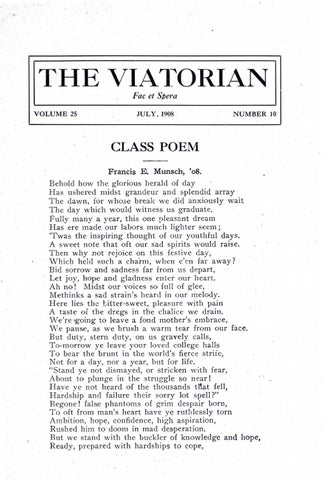
CLASS POEM Francis. El. Munsch~ 'o8. Behold how th~ glorious herald of day Has ushetJed midst gratideur and splendid array . The dawn, for whose break we did anxiously wait T,h e day which would witness us graduate. Fully ri1any a year, this one pleasant dream · Has ere made our labors much lighter seem; 'Twas the inspiring thought of our youthful days. A sweet note that oft our sad spirits would raise. Then why not rejoice on this festive day, . _Which held such a cha.rm, when e'en- far .away? Bid sorrorw and sadness -fa.r frori1 us depart, Let joy, hope and gladness enter our heart. Ah no! M idst our ·' voices so full of glee, M~ ethinks a sad strain's heard in our melody. Here lies the bitter-sweet, pleasure with pain A taste of the dregs in the chalice w1e drain. ·We're 'going to leave a fond mother's embrace, 'lvTe pause, as we brush a warm tear from our face. But duty, stern dnty, on us gravely calls, To-morrow ye leave your loved college halls To bear the brunt in the w,orld's fierce strife, Not £or a clay, nor a year, but for life. _"Stand ye not dismayed, or ·s tricken with fear, About to plunge in the struggle so 'near! Have ye not heard of the thousands trtat fell, Ha.rdship and failure their sorry lot spell?" Begone! false phantoms of grim despair born, To oft from man's heart have ye ruthlessly torn Ambition, hope, confidence; high aspiration, Rushed him to ·doom in mad d.e speration. · But we stand with the buckler of kno.:w ledge - and hope, Ready, prepared with hardships to cope, · · 1
I
.,
.
'
'
'I
'.
o
' \ ' ' ' \• .
"
r-o'
• 350
THE \ :IATORIAN
To beat them · down as they come in our path, To enjoy \vhen all's o'er, a sweet aftermath. Though we may not cut our way to bright fame, · Failure, surrender, shall ne'er tarnish our name. Thus we've vowed as a motto to take To allow no discouragement our purpose to shake; _ "Labor omnia vincit" is burned in our. soul . And choosing our end, we'll stri,:e fQr. th~ goa.l~ What has not labor done in y~ius gone by? It has erected monuments that never shall die. In the material world what has it . wr9·ught? Huge cathedrals, pyramids that for ages have . fought The warring-'"rincls, the beating storms That spent their force on these co1ossal forms. The life-like statue that fain would speak ., Could tell the seclusion · its master would seek To ply' the chisel with labor for days, .. Till from the rough marble ·a figure he'd raise; The marvels that come from Genius's mind Spring not spontaneous, fro111 \vhcre the'y 're confined, . But as jewels and gold with labor are sought, So the vvronclers of genitis with exertion are bought. Our native ignorance the fall's just need, Before laborious study mu st quickly recede; The g_assion that lies dePp , c1eep in our soul, By prayer and labor must yield its control. Let's keep then this motto with which we're inspired, Which in bygone clays our ambition fired. Let it_ever stand boldly bdore our mind's eye, V:anqui hing obstacles, making them fly; W h en heart sore, dejected, list for that call, A r ise, take cou rage, "Labor conquers all."
•
~="====~======~======~==========:===~ :{-),
,_
.
,•,
'
l
.r.
·'·
,-'
<.tommencement .'
-~rations
INDUS:T'RIAL VIE:W OF SOCIALISM . Jas. L. Dougherty, 'o8. HE st ud.~nt of. social conditions is ever and anon being confronted \vith seem.ingly insoluble problems of so... ciology. Fr~:m1 the formation of the very first society, there have · at various times occurred therein .volcanic · upheaval s which threatened to destroy and plunge into chaotic state all organize_cl society. No country has · be.e n free from1 these disturbanc es, probably none ever will be, for vv herevp· a number of men are living together, th ere -is bound to be m~1 e.. or I ss soc ial friction and di ssatisfaction. One would \ naturally b e- ,!ed to think that ip- thi s cou:ntry wher·e all have equal rights, and all ~enjoy the same fr eedom, th at we s hould be . singularly free fr om these disruptions of . society, but unfortunately such is .not the case. vV e an~ at this very instant standing perilously n car the crater. of a seething, smoking volcano, which threatens every moment to poison American so ciety with its sulphurous gases and poEr up o:n it the molten lava of destruction. The .-condition of the laboring man has long clamored for redress; rapacious capitalists, prompted by their insatiable greed for gain, and their excessive lust for gold, have so oppressed him that he has many Lmes r ::b cllecl. To this tLe num erous s trikes of recent years t estify. It is th e old subject of capital again-st labor, the c.ne tyrannizing, th~ other s nffering, but it is a subject which demands consideration ; and . the harmonizing of these two antago:nistic forces is a question that demands a solution. Mq.ny schem1es have been clevjsed in view . of · quelling this · strife and relieving I.abor troubles, all of them more or less satisfactory, ·but probably the most raclic2.l of them all is socialis:n, which would r eform the ·evils of capitalism by ,ab <D·lishing it, and w10ulcl introduce a nevv system · of political econo·my under ·w hich all . men would be absolutely eqnal, and hence all oppression of the laborer by the cap italist vvoulcl b e at an end. · In · order that this ·equality for ' ;v hich ·socialists· clamO.r be had, they say that it is liece ssctry ·£or the . ~tate to own and control all property; ·according to them the G@d-given right of private ownership must peri.;;l} and . he supplanted by common ownership~the joint · poss-es ~ ion · of all things 'by aJl. Now, let us not assmne t.hat socialism -is ·all bad; · arid let us not pretend .to settle definitely , in the:s e brief .w ?rds·, . tlie -fate .of ·socialism on its economic
35 2
THE VIA'l'UIUAN
si(le. A g reat Italian Cardinal r.e ccntly declared that economics.· is a new ant_\ a vc r v intric2.te sc ience, whic:h the Christian philoso... p her mu st study cl~eeply ii1 view of ?ringing an aidful solution t o the evils that afflict th e masses. P lal.1 sible,. however, as socialislJ1 may seem on its economic sid e, it is he dge d in b y difficulties which would r ender the theo ry im-practicable. The first question whiCh arises, and to ·w hie h the socali st s ca.n g ive no satisfactory an swer, is, how is th e sta te to- g·ain po ssession of all prop erty, and still leave all · men eqnal? It ca·nnot purchase it, -because socialists · themselves ackr1owtedge that compensation can find no place in: the socialistic prog~am; _it. · cannot expe ct a man who by dint of hard and honest labor· has accumulated large possessions, to, resigti his rights to these, and allow them to be swallowed up by the state, ai1d become the common p1<operty of the many who in ncr way deserve them. There remains but one method whereby the state can come into possession of all property and that is by confiscation. The exponents of socialism thems~lves acknowledge this, for they have expressly said, " \.Ve of the socialist la.bor party, with · a· lull knowledge of all that t~1e problem involves,. · declare for confiscation a s the only adequate solution, and therefore the only moral one." Could the principle that the end justifies the mean s be stated in mo re unmistakable terms tl;tan in this clear-cut expression of the socialists? Can anything more unjust be conceived than this taking over by the state of all land, of aU capital, and all means of. pro·d uction? The socialists know that their course is one of injustic·e, a.n d try to hide thems elves behind the filmy principle that this confiscation is expedient, therefore it must be right. Besides bein'g revolutiond.ry and unjust, this common distril>ut10n of lands and all productive 'industries is an iridescent dream. It involves a scheme of communis-m as broad as the nation, and fro:m the yet bleaching bones of sma.n · communistic organisms that lie a.long the road of the world's steady progress, " fe know how impracticable communism is, even on a small scale, and how utterly impo8sible it would be for th~ whole nation. How indeed conlrl that equality of goods be permanently maintained among individuals of naturally diverse talents · and temperaments, dispositions and tastes. Can socialism promise to cultivate in the comrapes those virtues which make possible the common life of r;eligioJtts orders? .. By ·no m-ean-s. . Again , the . greatest of the industrial arts, na.m..ely, agriculture, would languish under · , socialism; there would be a ·lack of incc~1tiv.e ·to personal ·effort on · the part of the state fat'mer, to make the hmcl allotted to him yield the largest and best' crops. Why? Because he would not ow:n' tne farm nor have the right to dispose of the crops. .He would .be a mere hireling, a mercenary, little better than a slave. The. scheme
•
•
'
I<
.
THE VIATORIAN
353
of Agrarian soci"alism is fraught _with these and with so many Dther difficulties that it will probably long remam a matter of mere acadeniic interest. The right that a man has to own individual property, the earth, :and the fruits thereof, is a natural right, sp rin gif1g from. one's ex. istence which is to be preserved and perfected. Since those things which are r,equired .for the preservation of Jife and for life's well being, are produced in great abundance by the ea:rth, is it not repel1ant to the very nature o f ·things both human and divine to pfest.tme that a man sh,.)uld forfeit his claim to these, or that they be unjustly snatched . from him? Moreover, when one individual spends the industry of his mind and the strength of his body in procuring the fruits of nature, he by that act makes his own that portio11' of natl.tre's field which he . cultivates, that porti ~n upon whiCh he has lavished all his care and -skill, that portion upon which he leaves as it were the impress of his own personality. Is it just then that the .state should desp oil h.im· of that w·h ich is th e rewGllrcl of his own honest and painful t oil? I s this confiscation of all private possessions by tfte state ·in keeping with its sacred mission, which is to aiel man, protect hiis ·rights, and assist him ii1 obtaining all la,w ful ends? Yet it is a cloclrine such as this, which would infrinrge on the most sacred rights of the individual, that the socialist pread1es. Any system of government or any inn ovation of the social order W 1hicb is unjust, stapds thereby cond em ned q,t the bar of the world's judgment. And thus socialism, like a culprit with the unjustly stolen goods of the brainy and industriou s workers of the natio~ in its guilty hands , stands convicted o f dastardly robbery by the supr eme court of human reason. But even if sociali m were not unjust, it would have to be r elegated to the garret of innocuous inutilities because its intrinsic principles are such as to render it infeasible artd utterly impractiCable; its abstract propositions attra-c t only th ose idealists whose picture-worlds are ep h emeral and fall into confusion l,ike block-hous es when the com.mon sense touch of the actua:l world is applieci to th em.. The socialistic theory of a state in which there woulrl oe the absolute equality of all in all things; in which there w'Xtld be no abject pov erty, but plenty for all ; in ·which the labo~r"r would r.eceive just compensation', and in which all men would be united in or::.e _univ ersal and all embracing brotherhood, is undoubtedly a theory the realization of which we all w;i sh to behold. But if it is a -s-c heme which is absolutely beyo nd accomplishment, infinitely removed · from the possibility of realization, in a word, if it is mer.e.ly utopian and altogether impracticahle, then I need 'no t say that s uch a theory m.ust be rejected. The social state, supposing it to be established, has possession of atl means of produc-tion, of all profit, of man's very existence, and his
•
354
'Ill E. V IATOUIA
means of ubsi ·tem.:e, hence it hecome. the duty of the tate to p"rovide for the individual. But how i it to do o? How i · the ' total produce of the united commonwealth to lYe di tributed, o that at the ~ arne time every one may receive hi ju t share, and yet remain equal to hi neighbc.'.· who may not in ju tice be entitled to a like portion? However, before the produce can be distributed the labo·r {rom which it re~ulted mu ~t be allot~d .to the different member of the ocial community. The tate m.u t determine w·h o is tn be employed in agriculture, who in mining, and who in the nnmL<::-ous other branche , of indu ~ try. Is the tate or nation capable of performing this Herculean task? Can~ it have at its di posal a permanent, unfluctuating populati<?n, each member of which is to receive every year his allotted po1"tion of work? At present it takes a nium •~r of years to complete a cen us, and even then it is nci\'er exact. Have the ocialists some pian whe·reby the e. act number of individ-ual · is to be a certained in a day or a week? It is highly improbable. Again ,this di:tribution of labor by ci il authority snatches from the individual that most a'-•-·ed, inviolable and heaven-hestowed right of per . . onal liberty. If any..one ha a religious calling and feels that he . honld devote hi life to the service of the Alm·i ghty, has the tate any right to de~ree that he should clean the street or that he hould vas his life within the walls of a factory? Again, all pecie f:>f ·work are not the same; some ta ks are tnuch more disaf,t:eeable than other ·. H.o w then can the tate appoint ome to one ort of employment, and oth~r to a different cla of work and still preserve that equality which i the key ' ton~ of the communi tic arch? It would evidently be impo sible for the ociali t commonwealth to divide and distribute labor in a atisfactory manner. But let u suppo ~ e that our ocialistic friend - did ucceed in such an equitable di tribution of labor a would plea e everybody, could they establi h a standard whereby there could be made a fair and ju t division of industrial profit? Tl1ey could not a ume a ~ a ~ tandard of cli -tribution the number of pe r on in a given ection or community, becaus~ it would be unfair, o manifestly un .. ju t that we wonder th~t such a plan could be seriou Iy propo ed by any m.an. To give the arne amount of produce to each individual whether he be d-ilige:1t or idle, kilful or un kilful, trong or weak, whether hi - '''ants be few or manv, would be to et a premium upon idlenes and incapacity which ·would bla tall indus..try in the bud, and ~ oon drain the nation of all it resource . There ar.e many who would propo -e ~ ~ a mea ~ nre '"·hereby each laborer's share of the social proceed i to be m~ted out to him, the length of time that each one ha _ worked; oth ers ay "Determine each man' hare by the amount of labor he ha performed," and till 1
·
A'
j
THE VIA TORIAN
.
\
:; ,.
,..
l;:<'
355
<O:thers cry "C<?·m pensate- each man according as h.e applies himself i1;<o his task with more or less diligen te"-yet none of these can be assum.e d as a criterion whereby each inqividual will receive · what ·1s jt1s.tly due him, because they make the sluggard s_h are equally with the industrious, the learned with the ign ora·nrt, the fast worker: with him that is s low, and the s hirker with him; who devotes ali his energy to his task. But Karl 1\fa.rx, who is one of the . beacon ·lights of soc ia lism, suggests .as a norm for the division of the profits which would accrue in the socialistic state, "The w~ ants of the individual," or as it has been more prudently put, ''Give to each one ~ccording ~o his r easonabl e demands." \iVhat are reasonabLe de:ti.1ands? Not all have the sanie wants, and evidently it would not be wise to leave to individuals them.s elves the decision concernng their wants, for no o·ne is an impartial judge in1 hi s own1 case, a.nd besides experie11ce teaches that de111'ands do not exactly coincide with _wa11!-t•. T 1he .onl y expediemt that would he left wo uld be to fippoint for each district a committee on wq.nts, w·hose task it would be to detennine the r ea l needs of the individual. But I ask you, could any ~ommittee decid~ how m.a.ny cigars, or refres.hit1.g beverages the w10-rkman of the future would actually tl.eed, or· how t;nany new gow ns and hats th e socialist lady w;ould require every year? A committee th at could determine theili .things wo uld necessari ly cons1ist of su1) erhuman indi-viduals, whose wisd0:n1 wot1ld far surpass that of Solomon.· Is it i1eedless. to argue further to show that socialism is impracticable, that it is btit a utopian dream, .from which all must sooner or later awra ken? It is based on unten. able, philosophic and economic principles, and far from leading to the glorious results held out by it s a.dvocate:s to the unl earn.ed ·· masses, it w1o uld prove disastrous t o that ct.dture which Christianity has produced, land wpuld reduce human sodety to a state of utter barbarism. Certain reforms are needed in society, but it is greatly to be feared that soci alist s would destroy more tha.n they · would reform. Their theory, which has been invented for the benefit of the w-orki11gman, CC!-·n: on ly turn~ out to his · grave disad·.vantage, for it is opposed to the n_atural rights of ev1ery individual human being, and if it were prac-ticable it w·o ulcl paralyze the pea.c eful development of social and industrial life. What good there is in . socialism. it has borrowed from Christianity, and that is its desire· to relieve the sufferings of th e mnltitude. If it had the power of multiplying loaves as the Divine Founder of Christianity who pitied the hun ~ry multitude,· ·th en we too might sit upon th e green sward a:Did li sten to its preachings. Rut socialisn1 cannot work miracles-and it makes the mistake of supposing men far more p.e rfect than they ever have been or ever w~ll be even with the elevating irl.fluences of the divinest religion thrown around them·.
all
'
.
THE VIATORIAN If socialism will abandon its wi ld dream of equa-lization, if it will study in the white light of n<ttural ju. tice he problem of economics that contfronts us all, if betimes itJ will hearken to the sage counsel -Of religion, it may yet hope to contribute a t~ny ray to the dawn of better day.
' . POLITICAL ~ND SOCIAL ASPECT O!F SOCIALIS-M'. J os.. L. Legris, 'o8. VEN if socialism were net unjust and industrially im- . practicable; even if it were righteous and perfectly workable as an e_c onomic scheme, it would utterly fail to . commend itself to the acceptance of that great majority of mankind Y:hose philosop.h y is common sen1se, to that imrnens·e majority which still . deems the love of country and home the most precious possession of the human race. Instead of being a panac·ea, socialism· is found in reality tp be but a cheap patent medicin'!', a rem edy which in 10rder to cu r e our economic ill s, will inflict evils far 111'0•re dire than these upon the social bodv. Let tts see then how socialism would affect our patriotism -and the state, which is the object af patriotic love; let us , ee how it would affect the home and the school, which are the tw.o nurseries of citizenship. Socialism cuts at the ve ry root oJ the .beautiful flower of patriotism when it suppresses all private property, for devotion to our country's welfare is based on the right of property. For what lov.e for his birthplace has the shiftles£ tramp or the professional beggar? H !is patriotis.m is limited to th~ place in which he seeks a temporary refuge and shelter. There can be no deep-rooted patriotism until a family has dwelt and carefully wrought in the same place, until this famil y has formed ties of friendship and kinship, until it has written its history upon the soil it calls its ow.nt. But all these elements that feed the sacred flame of patriotism, the ow~nership _ of ·private prop~ rt y, a heme or a dwelling place which ori:e may possess and call his own, are found wanting in th~ socialistic state, in which it is established that every foot of so'll belongs equally to each and every one of its careless ~nhabitants. And, ladies and gentlem,en, the fact is, that consistently with these very principles, the socialists characterize patriotism as "prejudice" and even as "folly!" Is not the boldness apd effrontery of socialists amazing? Are they not coolly asking us under the perfidious guise of a more universal and exalted citizenship to consider as narrow that devqtion to our national ideals, that reverenJCe for our patriotic ancestors, that high and noble
"
'
f:
,. j
'
I
THE VIATORlAN
<_
357
. national hope which thrills every genuine Ameriean to see our fair Columbia become the great white, throne of pe,a ce, the sacred shrine of liberty, and the home of happiness for · increasing mil' lions of the world's family? Seriously, they hid us abandon the · glorious · star-strewn banner and bow before what? before _a · ted ·flag, the ·symbol of blood, of violence, of injustice and perpetual disorder. The close affiiiation of socialism with anarchy is one of · the causes that increases its danger to our political institutions. Socialism is wedded to governm-ent, but though wedded, it seems disposed easily to part company with all stable government since it guiltily seeks union with anarchism as its affinity. It is known, of course, that anarchy considers as too slow the legitimate use of all politica.l m·eans for achieving its end; that it appea-ls to revolutionary and violent m·e ans, that its design is the ·a nln ihilation of the existing social and poJitical order. That; - political evils exist we admit, that political corruption and public peculation· are practised we grant. But these public wrongs will not be redressed by snapping asunder the great fihers of national force, as socialism proposes doing. No, but by cultivating a spirit of sturdy patriotism, a wide-awake public spirit, by rearing industrious men and by making the American citizen the synonym of honesty. If with generations of such men we cannot, with our constitutional facilities, right our political wrongs then the· task is hopeless; for socialism itself gives no promise of ability to render men incorruptible or to raise a nation of political saints. · Another and indeed a very serious reason why we object to socialism is its .a vowed intention to abolish the present monogam!O!Js ·fori11 of ma,rr'iage. Socialists compl_ain that woman has alwa.ys been denied her rights, and they demand her complete social and politica~l emancipation, her complete equality with m1a n. How false this is! Eve:ry d2-y facts furnish substantial proof that from a social and political standpoint woman stands today far in advance of the past; she has the right of controlling her own children, she has the right of managing her own prop;e rty. If she hav:e no rights how can they be more secure at the present time than in times past? under this socialistic order of marriage, no binding contract between' man and woma11 entering the . sacred relation of matrimony would be nec,essa.ry, for this union would be based upon sex fondness, a:111d, . instead of a marriage for life prevailing, the mutual inclinations alone wou1ld indicate its. t ermination at the will of either party.. We would have the twin abomi11'a;tions, free love and trial marriage. This soc.iaHstic SPie·c ulation which concedes a fre~ mar._ital relation betvveen m.en and women 1
-.,
,;;>,
,.':"
j
'
,.
THE VIA TORIAN and no interference of church or st ate would create .what socialis1n and anarc hism st yle a fr ee family. Fo.r, under socialism t?e perpetuity of th e· m.arriage ~ond \Voul d disappear, an_d under tts code there would b e no marnage w hatsoever. The umon betw:een the two parties wo uld last until tL·e sex fondne ss had consumed its force, for w h en' the sex fl am e is burned, a separation would be effected as an opportunity to gratify a n ew ly ·e nkindl ed appetite. Can we witho ut horror th ink of the frightful condition of d egeneracy :.t9 w hich the race of m·b rtal m en would sink if these pernicious princip les ever prevailed! Apd, ladi es and gentlemen, · at a tim e whe n th e evil of divorce is making s uch inroads into th e domestic sanct ua.r ies of our nation, is 'it not im:p,erati ve that we lift up our voice in veh ement p rot est against this outrage, this herding together of the lnn11an race in t h e p rom iscuity of socialistic pastur es. a con dition compar ed with w·hich legalized polygam,y would be the ·cream of social p erfecti on? According t o the most competent exponents of soc iali sm, monogamy is an artificial outgrm;v th of private ownership b acked by rdigion ; promiscuity _is natural, sin g le marriage unnatural. They plead fnr the comtmtu nity of wives as they do' for the common ownership of mere chattels. This assumption is ·v ery trivial, for it is at variance w1ith both the natural an'<l the r evealed law, and, to assert t hat monogam y is n ot t he natural form, of marriage is to contradict that perfect design of t he famil y which was constituted by th e A lmigh t y and to cast contempt on all revealed truth. If socialists were t o introduc e a lofti er id e.al it would he deserving of serious consideration, but th e fact is they offer no s ubst itute whatsoever; their only aim is th e destruction of monogamy, which is the natural a•nid nec ess ary fo rm of the family. Buf this perfect ideal form is r eflect ed in t he hearts of every honest man and v irtuous woma,n and cannot be destroyed by the vandal hand of utop ian' p hilosophy . It is a ve ry evident fact that ·economic conditions have played an important part in many ma·r riages but WJe deny the assertion that the monogamic family 9ri g inated from econom ic .and ambitious conditions as socialists affirm . Socialists declar·e that m'a n's d esire for children that are int encl ~d to be h eirs of his wealth, is an economic condition which has prompte d monogamy. Un.d oubt.edly this is what happens in many cases but that has nothing to do with the con spicuou s and natural fami ly of one man , one w"o man and their children. Right: philosophy o ffers many convincing reasons to establish the natural n ecessity of m·onogamy in view of m1an's ll''Ore perfect existence. Revelation confirms and sanctions these by its highest voi ce . Private owne·r ship is also by reason prov~d to be one of man's natural and necessary rights. Would not human existence
. l
·;'-
'
.i...t
• THE VIATORIAN
,. .i , .
'f,'
1>,
359
be a useless gift if man had not the. right to acquire~ th?sl~ thin~s that are . necessary for the preserva tw-n. and the penecbon. of hts being? As the individua l then mus.t have this right, so too must the fanrily which is a moral p erson and is still more dependent upon material g oods for its proper development. If S:Oci.alism were frank it w o'Ltld clearly b eho ld the hallowed influence which the church exercis es over the family. It would then be capable of appr e-c iating more the perfection of this union, (the monogamic family ) . But e¥ei1' with its perverted vision, socialis1D knows that . relig_ion is the protection of t!1e family and the family the fortification of the state. The family is the home, and the hon1Je is the ·es senti<d str ength of th e nation, . and if it should disappear th e nation itself would vanish. "Upon the home rests our moral character ; our civil and political liberties are grounded there, virtu e, manhood, citizenship grow there." What dQes this home 111-c all? It means a rnan and w o man united in the sacred bonds of n1arriage, residing uncle1- the shelter of their own roof with their children maturi1~g aro·uncl them. · Every G,hilcl with which this family is blessed according t o God's vvill , is born in a horne and it has a right t o a fath er's arms and a mother's heart. But according to socialism ::t. child fr om1 birth vvoulcl becom e the prop-erty of the sta1~ e~ and the ~ommunity would then become its parents. And what will b eco1i1e of these state nurslings when they becorne schoolable? W 'i ll they be returned to their natural parents? No. The state will educate. them in its own socialistic schools according to its own purely ma:t erialistie! ideals: The ~chool then· is another of the sacred institutions which socialism touches on ly to desecrate and defile. Until now the school has rightly been considered as an ext ension of the hom·e and the teacher as invested with quasi-parental authority and responsibility. The family is the source of the dis;nity and power of the schools, such as w.e ·have them. But socialis;.n would change all this. It would wrench the school from the parents as it has sacrilegiously robbed the family of its cra.dle. Purposely do I withhold from your gaz·e the contemp lation of the disorders that would prevail among the youth of these sodalistic schools, and it were idle to speculat-e ac; to what manner of citizens thes-e state students are doomed to become. In conClusion let me say it will not do for socialists to plead that we do not understand them. We pretend to at least average intellige:n ce and we judge them by their own words. Resolutely therefore· do we resist socialism because it viciously attacks those great and holy institutions which we have learned to reverc~the state, the home and the schooL So long as we take legitimate
• THE VIATORIAN pride in beholding our tate and national capitals surmounted by the glorious stars and stripe , so long a we delight to dwell in the love and peace of Ouistian homes and to feel a deep concern in the schools that fashion future citizen ·, thus long shall we in the united might of right resist the vandal inroads of socialism~
SOCIALISM AND RELIGION INCOMPATIBLE. Francis E. Munsch, 'o8. ......,.._...l"il HOlULD things conue to such a pa s that socialism . would get the ascendency, pursuing its mad and unre .. strained career it would not leave standing any work or institution that is a credit or honor to man. We already apprehend the destruction of our political institutions and government. vV ere this rabid monster unloosed on society, the most sacred rights of man would not be spared. wdu stries too would be. engulfed, and in ' tead of the comparative peace, order and tran·q uillity that prevail in the p·r esent state, strife, chaos and endle~s trouble would reig-n. Were socialism unchained in the industrial world wretched indeed would be our existence; surel y then would be realized the dictum of Hobbes that .. man is a v.rolf to man .. , Maddening is the bare idea of socialism ever obtaining sway. But wt>uld socialism stop here? Ah! No! It would rush into the yery sanctuary, t~ar down God from His altar and place in His tead a demon. Yes, socialism would inYacle the \'ery heart of man, ruthlessly tear religion from his sou l and leave him for a moment amazed in wonder, then in de pair, robbed of those noble instincts which the hand of God hath implanted in him. Thus would socialism complete its conque:t and with a satanic grin ascend its newly raised throne and there in diabolical glee glo!lt oYer the destruction and desolation which it had \.vrought on mankind. But happily we, a yet, need not be over-fearful that socialism, \:vill obtain sway and run riot on its ruinou mtsston. ''The destrncti\'e tenets of German socialism cannot become -contagious here because the food needed for the propagation of the germ is not supplied." That political and industrial conditions would suffer greatly fron1 ociali ~m ha ~ been hown with more difficulty perhaps, than that religion would be annihilated in the reign of ~ ociali:m. Tl1e fact are. however, that religion and socialism are altog-ether incompatible, and hence those people who believe that :ociali ~ m and religion travel .in different . pheres and do not touch each other are to be corrected of their false impression. It would be ea. y to quote eminent authorities to prove that so-
. p·
,T HE VIATORIAN
...
•!
•
,~-
.
.,_ .. . : ~
;'
(,
c.ialism and religion are diametrically opposed to ea.ch othcL O'nly a few weeks-· ago the far-seeing head of this greatl archdiocese, while presiding over the august function of dedicating the largest parochial school in the world, declared that "The absence of faith . 1n God is at the root of 2.11 socialistc beli efs," and if we look into the true i11wardness of both socialism1 and religion we shall not tail to grasp the full purport . of these words. For, both religion and social1sm concern themselves primarily with the orientation of life. But how widely different are their · views on the aims and purposes, the w.orth and . destiny of hum:an ·life. Religion tells . us vre are the . children. of . God, born to conquer thrones ·:in heaven by a life of virtuous striving here on earth. Sqcialism .accepts the_ worst conclusions of materialistic evolution and considers man as a mt:;re development of the pl"lysical forces of the material universe, born to . struggle for mere earthly existence, and to enjoy only such pleasur ~s as this life affords. Read their books, and judge them, too, from, the company they keep. The shibboleth .o f atheists and agn ostics is on the lips of the s-o cialists. No :;;.cml, no immortality,- no future life, no Providence, no God; these ·are deep-rooted and essential prin'c iples of social- · ism. What 1i1oreshocking, what more revolting than these principles '! do th ey not a.t once and for ever brand socialism as irreligious and anti~Christian? What furth er proof need be tadduced to show its ,utter hostility to religion when it wholly rejects the fundam ental p-rinciples of .Christianity? Since there is no God, no f~tture life, . then socialism has but a mere earthly conception of . human life; the grave ends all. Socialism says, "Seek ye first the goods of earth a1i.d you .shall need nothing else." Religion says; "Seek ye fir st the .kingdom of hea.v en and all thes e things shall be added unto you." · Socialis1~- tea~hes that the actions of this life reach .not beyond the grave, that h eroic virtue, great deeds, sacrifice and sufferings should look for ' no i-eward beyond the paltry gifts of men. Good and bad ali'ke are laid to rest with no, reward for the one, . '110 punishment for the o-ther. o~ur aspirations may' never soar above man, and in _tr9pblc we dare not lift a prayer to the Supreme Being; there is no ne, but when tl~e cold, cruel stare of the world · fix es itself on u s we shrink from it, and finding no . place ' of comfort in despair, we seek an early grave \vhere all alike sink _ into nothi11gness. A melancholy picture, but not o·verclrawn. Does thi s correspond to the picture of religion? Ah, no, when persecuted, reviled .by men, forsaken by the world, we know we can run to Him who said "Come unto me all you that labor and are heavily burdened and I will r efresh you." It is . especially in moments of ..distress that we love to recall those words wh.i spered ·
. ) ,.
THE, VIATORlAN i'.
'
•
into our ears by the vyh ite ang~l of re ligion '.'Blessed ~e you '*·ho suffer p ersecution fo·r jnstice ake. ·· . ow you lament and w eep but your tears shall be turn~d .into joy, ,and yo~ r joy none shall take ·a w ay.'' ·Spread h er e ahd there by . the m1uhtficent hand or .01ristia.nity ar~ oases and f~:~:ntai n s ' of coillfort in this weary waste wha.e repose arid ·'refr eshment may be fo.und. Socialism Would parch tb e~ e g reen', refre.s hfng Sp()tS, WOtt l d dry Up these inv igorating fountain s. I s th is Oi ri sti an spirit? I s this in harn1 on·y · · ' vitl1 th e teaching of r e li gi~n? · Auth ority has th e. 'san ction of ages.~ it · has grown old in respectan,d honor. Its inft tten ce , its good, its need ~re felt every'Yhere. We see autho·r ity in the hon);er in . t he city, in the state, in\l th e nation ' regulatin g all thin gs, making the great a nd i~t ri cate machli1ery of h'u m an existence run w ith a re g ula rity and Harmo ny that gives us ' social or der an d wi t ho ut w h ich order wo uld ·b e impossibl e. Day by day t his huge m ad1in ery operates; a.thou sand minor parts w ork i·n p erfe'ct acco·r d; t h'e knowing eye, th e directing mind that is at th e head of th is mac hi ne, is authnrity. Sociali sm wo tild d e~ troy thi s head, would · commit this splendid org ani sm to certa in destru ction, wou ld let this magnific-e-nt machinery ruri wi ld 'w itho ut an yone t o st eer it-:; course. The acti on ~ ; of soc ia lists a nd their affi liaton wit h anarchists amply f.emon stra te th eir con t empt. for au thority. For several consecuti ve clays dur ing th ~ rece nt conclave of social ists in Chicago, th e city . authori t ies were op enly jeered at and defied by the u n ruly throng whic h de li g hted in sending om inous challenges t o tl• e rulin g power of t he city. Ana rchistic demonstrations in Chi cae-o and New York have h ad the hearty sympathy of the sociali :: tic press of t he enti r e country. It is clear the:1 that in th e ::o:iali st ic d ream of libertv there would be left no room for a uth ori ty and o.beclience, but· the wildest sort of license would p revai l. At one fe fl stroke both parental and civil authority would b e· cu t clovv·n , a nd · so too divine authority would be swept away. T hi s position of the soci ;:dists is so palpably unreasonable that it is ~ ufficient to state it. It refutes itself. The stand o.f the socialists against privat e ownership, quite apart from its injustice , is manifestly at variance with 01ristian teaching-. Dicl not Christ teach that m en may acquire private property? Did he cry it down, did he assail it? Not at allf Nor ,.v as He one who feared to do ~o. fo r were it un iust, no human respect could pre,·ent him fronu condemning it. He fearl essly exoo. eel the hypocrisy of the Pharisee,· yet he never condemned the rich young man for having large po_ e .. sions; Zacheus ' ;v as not told to part with his riche becau . e it wa unlawful to have. them . 1\o, Christ recognized the right of private I
•
,.
THE VIA TORIAN·
ownership - ~nd the socialists, in condemning it, again show their anti-christain spirit. While n1any co·nsider socialism as a purely economtc tssue cut :' away from religion, the trt1th is, that accordit~g. to th e great leaders of . socialism, it is ih itself a cult, anq reltgwn with the sot ~alists is not a private. matter. Socialists make no secret of th·e ir hostile attitude to religion. No, they stalk un d~.sguise~dly abroad sending forth tirade after tirade, diatribe after diatnbe, against · Christ and his Christianity, openly professing their avowed intention of putting down religion. The explicit testimonies alone of the socialistic leaders ought to be s uffi cient to c-onv ince all ri g ht thinking m.en that socialism and Christianity ai7 t: irrecon:c ilably at variance with each other. Marx distinctly says, " Religion is an absurd and popular sentiment, ;t fantastic degradation of human nature."' '' lVtan -· make.s religi on, and not religion man." Debs calls Christ the "Tramp of Galilee." Harroyt says, " To take on Christianity would be for socialis m to take Judas to its b o·s om ." Bax tells t1 s, "The association of Christian· ism with any forn:. of Socialism is a mystery." Another clecla.r es that the triumph of the Galilean has lasted long enou gh, it is hi~ time t o die. Liebknecht a ffirms, " I am, an ath eist and I do not believe in God," and from the lips of L~o Frankie fall the se te·r ribl e words, "No priest shall attend my 'd eath b ed or my funeraJ in order to save my soul. I b eliev e neither in heaven nor in hell." Who can now assert that socialism is a m ere economic system that affects on ly th e counting house and not the church? , . At the socialistic convention lately l~elcl in Chicago the 1no,_ tlon to lend the church the moral support of the socialist party .w as uproariou sly r eject ed. One can gather from their com.n'1ents: that they cons ider religion at best as a negligible qua ntity, an op-ponent w hi ch th ey can politically ignore. And th ere are other .s tilLmore evident signs of th e anti-religious tendency of socialism; for instance its dema:nld for the forceful separation of Church and State, and seculari zati on of schools. In France thev have accomplished both. The E\rfurt program distinctly calls for th e entire exclu sion of religion from schools. The evil of this demand has been recognized by all right-thinking Protestants who are fast awaking t o the danger of mere s ecular education and are taking steps tow,a rds th e r em edy of this evil. Progress, th en, is being made in the solution of thi s question. I-Iow t errible to think that socialism would step in t o arrest, t o stop thi s progress, and to reenact here th e tragedy of France. From these brief considerations it is abundantly evident that socialism would be the fruitful sourc e of ma·ny evils to both Church and State. And though it has not assumed as yet
•
THE VIATORIAN
•
such alarming proportions as to render · wa-r ring against it in vain, still it will grow a:nd increase. The awful outbursts of anarchists that end in the martyrdom of some public official or Catholic priest warn us ; that socialism is not dormant, but is alive and active, struggling for the mastery. Indifference to its aggressiveness is the height of imprudc;1ce, ·n ot to b attle against it is to allow it to sp read. Filled with a dread and a horror of this system, Catholics shQuld take advantage of all opportunities and fight this monster thro ugh t he press and the pulpit, so that if the evil cannot be wholly eradicated, it may be repressed, held in check and prevented from engulfing both Church and State in - destruction and ruin. A CONTROVERSY.
EAD,ING in one of the local papers that the graduates of St. Viateur's had spoken on the evil of socialism and we re highly con11111ended for their able and masterly presentation of the subject, the ire of a nearby worthy socialist was worked up to the ebullition degree and here is \-v hat bubbled over fro-m his heated brain, carefully collected, cond ensed a;nd sent to the Kankakee D:emocrat:
St. V iateur Students' Crit icism. of Socialists. Editors Evening Democrat: I see through a late issue of your valnabl e paper that some of the students at St. Viateur College had undertaken ·a criticism of socialists and were commend ed for displaying superior and clear knowledge of their theme. I regret that a more detailed report of their arguments \vas not published, but judging from the titles given of their subjects, it seems that they have been following the u sual method of the opponents of socialism~that of building up a stra·vv man, labeling it ''socialism," and then proceeded to tear it to pieces. Nothing shows the strength of socialism more than the weakness of the arguments brought again . t it. Every socialist worker ca·n sit down and repeat the whofe list of objections. There i- the "breaking up the family," the "anti-religion" and the "divide up" arguments that rest simply on lying. There is the "destroy individuality" cry that depends partly upon misrepresentation and partly upon mi understanding. There L no bod}v of men and women on earth that are more strenuous in their demand for the right to assert and maintain their individuality than the ocialL ts. To a ~ snme that they are working
j
j
"';·~·,
<
·i
THE VIATORIAN ·::-·-:''
·~
..i.. :~;, ~.·f.
for the establishment of a condition that w:ould. restrict their in.:.. dividual freedon1J is to a.s sume that they · are all foois. Yet wt}en these have been :n amed nearly every objection that is brought against socialism has been nam.ed. They · sound silly when set forth in this simple, direct manner, yet they are all that ,·, the be~ t minds of the ruli:ng class of today. can offer. · If socialis1n is false and pernicious, why do you not reply to the real thing instead ot a1; imaginary socialism built up by yourselves? · Here a.r e schne questions awaiting an a:nswer, which I am certain have not been considered. by the students of St. Viateur. · Is it not tr,ue th-at there is land eenough to raise all the food that crun he ' eaten? Is there any lack of material with w~hich to make. aJl the houses that could be lived in? Cannot a sufficient supply of wopl and cottcm and linen be produced to make all the clothes that can be worn ? Are there not enou~h worker$ to prodf\l'c;e all these· thin.gsi? Are there not millions of m·e n and women and children who do not have enough to eo.t or to wear, or a d'e cent place in which to live? Are there not millions of unemployed persons who are willing and able to produce the things that men and women and children need? Would they not willingly produce these things if they could get the raw materials fn;>tn which they are produced and the niachinery with which to work? '< Ar·e these would-be workers not prevented from · getting to the raw material and the machines by the fact that these things · are privately owned? . lf the working·-class collectively owned the materials and the ·'.•, . machines, could they not use them to produce w·e alth until all wants were satisfied? . ' D'O not those who do the ~ork, combined with those who a.re · sliut optJrom the opportunity to work and to live, have a major.. ity of the 'v otes ? '!. : Cart they not use this majority to capture the government? ., . . Wh.en they have captured it, cannot they use it as their agent .' .tQ hold the titles to the things with which goods are produced? l: · , ·Islit not to the in.t erests of this. majority to do ~is? . · Are they not going to be fo.r ced to take such action by the in.evitable trend .o f social ·events? "' . . "i;· ;.. _T'l;lese are plain, simple questions. if they can be answered in •. 11, .. ~~e . negative then socialism can be prove:n false and foolish. Why . ,;· ~ .;· ·, dOc " not some 6f the wise students of St. Viateur College answer '.; ·;·:!: ;· c; , . .the.m and expos.e the evils and fallacies of socialist philosophy? i.
~t
... ;
: .. , ., l
~
SOCIALIST .
THE VIATORIAN
\AI e were amused, nay flattered, to think we could scare up a little commotion. We read the column and with infinite coolness and composure, though the ~eathcr was hot, sat down and put the following thoughts together: Cbllegian M akes Reply to the Socialist. "Socialist" is fighting shadows which is far worse than· fighting a straw man. From reading the mere title of the graduate's discourse he infers that they presented a weak, one-sided a;11d unfair treatment of socialism, and concludes that the students were fighting a straw man of their own making. I say that the "Socialist" is fighting a shadow, and that certainly is harder to hit thwn even a straw man. In order to afford the "Socialist" a fair opportunity of g.etting at the substance of the arguments urged by the students in, their graduation speeches, I would refe.r this gentleman to the mid:.summer issue pf the Viatorian to be published shortly. This jour.nal will contain the full text of the orations delivered on com": mencement day and which received commendation from the most scholarly prelates and' laymen who heard the discourses. I can assure your correspondent . that he will there find large a.nd juicy morsels of anti-socialistic philosophy, and that he wjll discover in the principles therein enunciated and developed Wll' answer to most of the s ubtle questions which he submits as nuts to crack. Allow me to say that socialism will rightly be considered a most pernicious doctrine so long as it remains wedded to its subversive domestic and religious tene~s, and that it will in so far paralyze what power there might be in its economic theories. For that straw man labeled "Socialism," which the graduates of St. Viateur are credited with having torn to tatters~ was really built by Karl :rvfarx, Liehnicht, Babel, Debs and other classic exponents of socialism. Is it unfair to charge socialism with free love . and irreligion when nearly all the great apostles of the cult clearly set these forth as ' fundamenrtal principles of socialism? I think that these men have spoken intelligently enough to be understood by people of average intelligence, such as college graduates may be fairly presumed to be. - Can you expect that thoughtful students could ig.note or wink at the onslaught of socialism against the home and the church, the two sacred institutions of mankind, because forsooth, it prom.ises to make us all gods living in an earthly Eden of plenty? Oh no, we mu~ t have the Chdstian familv and the Christian church if ·w e are to preserve and perfect our · ~ivilization. If ocialism is to be of any aid to the toiling million it must · . begin by rejecting these two plank in it platform , that i , it , donuestic and religion theorie .
..·;
THE VIA TORIAN ...,,
"~ -·' /.:·'f ·:'
.~ ~ '.
'·
.
' .
, E~onomic.ally socialism contains something good. It desires to relieve the condition of the toiling masses. So does Christainity. But socialism n1,ust learn to eschew revolutionary methods C!llnd impracticable measures. It must come out of tbe land of dr~ams and nightmares; it must .not assume in mah, ·especially without religion, those virtues., that altruism, that self-denial, that consecration to the interests of the community, which made common ownership of property among the early christians . possible . ~nd s.till does so among religious comm unities. But socialism does assum~ this and quite unwarn1ntedly, hence it is foredoomed to failure. ' O utsi·de of religious communities the mainspring of human action is self-1interest rather than the interest of the community. It has been thus l o:11g, long time and will thus continue long, because it is mere human nature. Christianity sueceeds in inoculati:ng .a sense of ~ommon brotherho,od in its mem1bers through supernatural considerations. Atheistic ·s·ocialism could never accomplish this, it could only make man more selfish and earthb<)tu'J.d, more savage and unfit to 'consort w1ith m.en. The unemployed? They a re a problem. Now they want to work, but is it right to assum e that they would want to work unrcter · socialism? Work appears alluring and dignifyi:ng when man 1s free, but when it becom~es the task of the bondsman, the labor of ti1e state slave,. will it not appear distasteful and repugnant? So.cialism must not lose sight of th e fact that ma:n is as fond of his personal independence q.s he is of his self-interest. Tru e, the forcibly unemployed are w·ith us, victims of vicious ·c ondit'i on s, hut their · case is not hopeless . Labor organizations; church influences, legislatures and the president of the country .are seeking remedies for this social ailment, and I think they wilt find one sooner than the socialists. As t o the wilfully idle and the denizens that huddle . in the cro·wded teneme:nts of our large ·cities, why do they not seek homesteads in the vast territories of the country still calli11g for hands and br_a ins to develop their resources? Perhaps this much will suffice as thought food for our mutual frie:nd, "Socialist," for you must remem ber that it's pretty hot, and I do not think it conducive to healthy intellectual digestion to swallow too many .of these deep draughts fron11 the ice cold Pierian .springs of philosophy. . Ice cream is hot compared with this. . . . .. ' If HSocialist" will attend the cotirs:e s given the Senior clas.~ next September he -will have the satisfaction of hearing his .questions answered in the philosophic manner he craves. Verbu.m sap.
a
•)'
L .I
1'.
)
.
CQiLLE.GIAN.
TH~
...! .
VIATORIAN
VALE:DICT'ORY. W. Emmett Conway, 'o8. HE future, with it拢. uncertain and 路unexpected events, its days of joy and sorrow, its moments of triumph and defeat, rises imposingly before us, on this day on which Alma Mater relinquishes her claims upon us as actual students and sends us forth to join that vast multitude now engaged in the struggle of the world . We know nothing o.f the uncertainties which the conuing years hold in -store for us; for some they may contain a life in the world with its hardships and temptations: for others they may allot a life of quietude, sacrifice and serious meditation, but for each of this little group of men who today issue forth as gra(uates, the future contains a definite destiny towards which w e look with anxious eyes and for which we have spent these years of preparation. True, we may not have known for long or with any degree of certainty the definiteness of our career, but each of us has been quietly and seriously absorbing those thoughts and ideas, those principles and convictions, which, no matter what calling in life we m.ay select, will bear us safely through the shoals of adversity and sweeten our joy in the mc路m ent of success. We cannot complain if, in later years, bur life's work is not as commendable and as praiseworthy as we would wish; we cannot glance hack at our )'outh and bemoan the hard fate which deprived us of opportunities of acquiring a thorough and competent education , for, who indeed should be better equipped to enter into the arena of life, to expound the beauty and dignity of truth,. to meet .and overwhelm temptation or to practice the most noble tenets of citizenship than the hundreds of yo ung men who, like the members of the present ~lass, are today iss uing from Catl:olic Colleges? For years we have drunk at this fountajn of knowledge, which has always been free from the contamination of error; a fountain whose crystal wave of pure truth has roi:ed coriously to slake our thirst; we have been permitted to mingle with those who are the living exponents of know ledge, strengthened and ' ennaced by a life of sacrifice and secl usion . And who will say that .routh, with its eyes ever open and directed .towarqs the gates of know.ledge, and its soul ever ready . to entfu.lse ' over the beautiful, ca路n live among such stimulating scenes and surroundings and fail to be inspired? The ground over which we trod, the won&8rs of science ana learning which were exposed to our yiew, aye, the very atmosphere we inhaled, all seemed to inspir~ us with the noblest sentiments of Christian manhood and cause us to resolve to be ever faithful to the instructions w~ received during our college career. I
THE VIATORIAN
'·•
'
;
.
•
E ducation, in our day, is not the rare privilege of a few, as it w as · a cent ury ago, nor is it as limited as it was in former . days. I:nstitutiorts of learning have sprung up with amazing rapidity in the last decade and thousands i1ow enjoy the pleasures of learning, w here fo rm erly there w ere but a few. hundreds. Seeking in-:to the causes of things , as becomes philosophers, we wish to ascertai:n the r eason of this widespread, this unlimted longing for learnin g. Is it due to the desire of appearing pedantic, of awing the multitud es with high sounding though mystifying phrases? No, these des ires may be found in a few, but, in the hearts of the greater .n umber ,· there .is but one desire which prompts them1 to undergo the· st eady and irksom e routine o·f the student's life; there is but on e lo-nging in their h earts which attracts them from the warmth and pleasure of home and leads them to the classroo m ; and that desire, that longing, is the one t o be found in the heart of every person, be h e refined and v irtuous or illiterate and debased; it is, my friends , the intense longing of the soul for the pure a nd untarnished truth. · Th ere is in this world nothing whi ch strikes a more · resonant c ord in t he heart of ma n, nothing w hich fill s his mind w:ith g reater o r m ore en joy abl e pl easure, nothing w hich soothes and comforts the soul to a great er degre e, than does the m~ere presence of the truth. Its beauty and dignity is supreme upon earth. B eautiful in aspect and di g nified in b earin g, she sweeps over the worfd unsulli ed by th e slime wh erein vile calun11my revels; eagle-like she soars above all error , gaining g reat er laur els with each conqu est an d command ing the respect of nation s. R eligiously do we des ire to deposit a votive offerin g of profound tha:nks at each of her sacred shrines, for w e feel indebted t o r eligious truth, to hist oric truth , to philosophic and scientific truth . . We are bound to love and .r esp ect th~ truth, not only on acc ou:nt of its beauty, but for the wo nders 1t has wrought for us. Fro m t he chaos and tumult of a pagan wo rld it has elevated us to the inspiri n g h eig hts of Christianity, where we m1ay witness and profit by th e ennobling ideals of Christian life; it has dispell ed th e mysticism a·nd supers't ition of the old ages, which 'Caused nat ions t o fall in v eneration befix e brazen images, and has n1ade known to · us the proper course in which to direct our hom·:. age an d thus ven erate our Creator; it has s hown us the h orrors of an unchristian life , with its treachery and avarice, its corruption and licentiousness; it has placed before us the means whereby we may lead othe rs from error and achieve our eter:nal happiness. Th ese are but a few of the many achievements which truth , in o ne guise or another, has accomplished ·for mankind. Through the rays of it s ow n dazzli ng light it has made p.Iain a;nd evid.ent
•
/
37°
THE VIATORIAN
the errors of all ages, so that · we. need have no hesitancy in th·e pursuit' of knowledge; we may indulge t o_ the full extent of our desire and with the utmost co.nfidence feel that we w ill not go a stray. · It would be a sad plight, my friend s, if we, who have had t he advantage of studying at this in stitution, where knowledge in abundance may be had for the asking, and where the lives of the instructors are the embodiment of the m ost noble tenets of Christianity--it would b e sad, I s3.y, if w e were to enter into the gr eat v1·orld and fail to appreciate the beauty, dig:nity and worth of truth. Then well might t he enemi es o·f m:ankind scoffingl y remark that religion, ecluc~tion, all that appeals t o th e sonl of n or111al man, are but hollow sham s that delude man a:nd unfit him for serious endeavors in life. But we would resent <1n y in?inuation that we are lacking in a fithng · appreciatiori of truth. For ye ars we have beheld th ~ win some charms of truth; in the class-room, on the campus, .and especially through the commingling of t eacher and student s, w e have seen th ~ beauty and wurth o f truth exemplified, so that today th e -resolution which is for em ost in our min cls is, that when we leave the protecting portals of Alma Mater and go forth into a n ew and wider life, we will ever remain worth y expon ents and loyal defend ers of the truth. Whe n one ha_s lived for a numb er of years in th e compa-ny of th ose whose virtuous _lives cannot but be ins piring, and w ho have admirabl y united th e offiK: es of adv ise r, di sciplinaria.n and friend, h e mu st ind eed ha-ve litt le ·gratitude vv ithin his heart if he fail s to · experience a deep r egr:: t w hen th e tim e arrives to say a last farewell. The partin g- of fri ends must ever be · a painful oper ation which strikes th e h eart to th -: core and le aves behit11Cl a feelin g of sadn ess ; and hard er still , is it, t o withdraw oneself from a spot h eld sac r ed by the presence of sweet re:::oll ections and r ea liz e that h enceforth one can be bnt an on locke r. It is with some such fee lin gs as these that tl1e class of 1908 ·m akes its fi·n al farewe ll t oclay, t o be r eco rd ed in colleg-e hi st ory, through which alone it can b e adively present. Th ere are m.any thoug-hts w hich recur to us today, as we app ear for th e last time as Se.niors , w hich ca use us t o feel r egr et at leav ing A lma 1\/[ater and draw fr om us profound expressioi1s of gratitude for the invaluabl e benefits we have received. As other classes \iV11o have preceded us h ave clone in the tnatter o{ stu dies,. so also h ave we directed our efforts , and liVe JOin w ith them in .. praisi.ng- th e admirable r es ult s w hi ch are each year accomplished at St. Viate ur's. Th e presentation of the beauties of ideals, of truth, of h onest y, of unfailin g· loyalt y to church and state- these are som e of the excellent principles which we as students · have
•
'\I
.r·.
371
THE VIATORIAN
,,. ...
,,_v~·
' :.: ·-~
',,
imbibed at1d which as alummi we hope to have ever before us; and if, in later years, our success in life is greater than that achieve{{ by our fellowmen, if the esteem in ,;vhich we a,re held by our. Citizens reverts to our honor, then we will truthft:1lly attribute the credit to the lofty and ennobling principles which formed such a large . part of our co ll ege education. · Among the many events which have made this past year a memorable one for us there is one wb'i ch is foren1ost in our m,ind·s and which will ever be cherished as a fond memory of our Senio;r year. To our class belongs the honor of being the first to enter into the . world bearing with it the blessings ariel good wishes of our young president, who today completes his first year in the chair. To every man in the class he appears not only as a man worthy of esteem, but as a personal friend; it will-be no smaH pleasure for us when he, . in later years, will he known far and ;. wide as .;the head o·f a great in·s titution, to reflect that we were the · 'first class'· ttp'on which· he lavished his youthful efforts, and whose success he anxiously awaited. But the allotted time draws to a close and I must hasten on my way. Even now I seem to see before me the path of life down which I mrc1st tread; the college life is over and the 'stern realities of the world are before me. But before we leave this hall, sacred by the m:e mories of y ears gone by, permit me, iH Lhe name of the class of 1908, to tender you a last farewell. To you, 'Reverend President a:nd your associates·, we say adieu, · with gratitude in our h earts for the precious lessons you have taught .us and the sa crifices you have undergone; to you, underclassm,e n, who are rapidly approaching the gates of the world, we say goodbye, with the hope that we may m eet again and that you will ever he loyal to Alma l\1ater; to all, whose friendly contact we have felt, irt the days gon e by, we say a fond farewell, and proceed toward the appointed goal , leaving behind us the dreams a.n d fan-ci es of college clays, to face the realities that await us beyond~ I
r,..,
. ...
'
.,
.
~
.
THE VIATORIAN
CLASS. PROPHE~C:Y. Clarence C:onw.ay, 'o8. EING a prophet is not what it is generally thought to be. In the first place, if you please one, all you get is "l\,1 uch obliged to you." In the second place, it is better not to be a prophet in the first place. However, the powers that be in the 'o8 class failed to view the matter in this light and unloaded upon my shoulders the task of procuring a life-j ob for eleven young buds who flatly refused to give me a hint as to their future stations in life. Being left entirely to my own efforts, I proceeded to n1rake a . very careful study of each individual, but at the end of a few .weeks' observation all I could positively conclude was, "Things are seldom what they seem." And I think the following account will bear out th ~ truth of my statement: Some ten un eventful years had passed since that auspicious day when the class of 'b8 was launched into the w·hirli.ng pool of activity. I had just boarded an ocean liner at New York bound for Liverpoo l, w.here I was going in the interest s of the Indoor Yacht Club of Cassopolis, l\1 ichiga:n. There were p-robably 200 passengers on board, and as I was alone I had p-l enty ·of opportunity to indulge my prosaic.al proclivties by observing the various types continually passihg befor e me. The second day out my attention vvas attracted by a large gathering on the promenade, .all of whom seemed to be straining their eyes to get a glimpse of what was going on in their midst. D-rawing nearer, I .was just in time to hear some one say, "ten-thirty this A. l\IL" There w as s'omething in the voice of th e spep.ker that brought back to memory the good b·ld days of "naughty-eight," ·but before I could push my w.ay to the center the sp eaker had disappeared. I was determined , however, to see the outcome of the controversy, so promptly at 10 :30· o'clock I took my stand where I could see all that was going on. I had waited but a few minutes when two men appeared, one a large, powerfully built man with a small dark moustache, elevated at the ends in the most approved Kaiser Wilhelm fashion. The second man, evidently a southerner, was of about the same height, but of a lighter build, a;nd carried a box which looked like one containing a ' dozen base balls. There was that in the first man's walk which struck me as familiar, although the reminder was rather vague, and I was not yet convinced. l\.1y guess concerning the box proved correct, and I immediately placed another wager and decided that they were gbing to play catch, and had the extra balls to replace those the ·ocean
.. \I' ~-~
'
THE VIATORIAN
J.'.'
:~!
} '
I
373
might claim.. But in this I 'Nas mistaken, for the men proceeded to measure off a distance not less than 200 feet, a:n,d, after · hanging a black derby hat on the rail, took a position with their sacks to Europe and their faces to the United States. It was now evidetlt to m,e that the contest would be one of marksmanship, ·f or · the se.c ond man opened the meet immediately. Two or three volleys had been delivered and the hat seemed to be perfectly safe, . when the southerner caught it on the rim, and sent it spinning · over the rail into the deep blue. It was replaced by another of about the same size, and the larger man, aroused by his opponent's success, prepared for the final attempt. It was evident that, he was going to 1:.n ake a supreme effort, by the length of time he stood carefully measuring the distance. Seemingly satisfied, he took one slow, deliberate step toward the target, raised his arm high above his head, and shot the ball like <l' bullet. It started on a li.ne about four feet from1 the deck, but as it drew nearer the mark it continued to rise. \!Vhen it reached the rail it was about fifteen feet above the hat and still rising, and, judging from its velocity, it must have reached New York at about ten minutes to one o'clock that afternoon. As soon as the ball was out of sight I rushed t oward the thrower, for I knew well that there was hut one man could throw the ball as he did, and that was Pat Legris, "na'u ghty-eight," centerfielder cf the Western Champions of that year. H e told me th ere was to be a second contest in long distance throwing, but his oppon ei1t d ecided to \Vithdraw when he saw th e last ball going out to sea. The next four days we spent together, talking over the gay life at Bourbonnais, and many a long forgotten incident was resurrected and heartily enjoyed. Pat was then on his way to Berlin to attend the N!atio:nal Convention of Physicians and Surgeons, where he was to address the assembly on dHow to Develop a Good V/ing." He had been practi. ing for six years and at this time resided in Henrietta, Penn., where he was head surgeon in a hospital, whose p:r imary end was the cultivation of the vocal ch ords. I left Pat at Liverpool with the promise to keep away from him , if ever . I decided upon vocal culture. Having finished my business in Liverpool, I boarded the train for London the next morning where I attended the annual horseshow that evening. I had been watching the proceedings w.ith more or less interest for an hour, comparing the magnificent steeds with old "Rock," when I was startled from my revery by · the stentorian voice of the judge who proclaimed as the winner in the tandem Shetland pony entr? "Billy" and "Betty," owned by James L. Dougherty, of Piper City, IiL, U. S. A . At this announrcement a deafening roar of 'applause arose from _the crowd •
THE VIA TORIAN
374
across the arena. Feeli~g that I · would know someone among them, I made my way over and fo:md myself being pumphandled by lVIu rphy and his R oy Hall ba seball team with whom he was touring the world, playing exhibition gam;es. Th~ next morning Jim inv1t ed me to take a cruise on his private yacht,. ''The Varsity," by which I observ ed his team was literally carried away, as in the olcleJ1 clays. Jim was then o.n1 his way to the Shetland Islands, which were his private property, where he raised fancy ponies an.cl t ook his ball t eam for spring training. He said he had about a dozen ponies of such wonderful intelligence and dexterity that th ey had actually succeeded in playing ball , and on several occasions had given his hall-roomers a very close game. He left the ball team in London, but took the pony team with him to th e I c:lancls where he intended to stay with them over the winter. T his trip, h owever, was destined to be a disappointment, for we had been out but a few hours when a hurricane arose · and the next morning found jin11 and I clin ging to ea ch other over a broken spar. . V{hi le the sun was still high in the heavens we wen~ washed tJ,J!Pll the sandy beach of a small cove. About half a mile up the b;each Jim spied an object which he thought was a sign of civi lization, so thither we went. Imagine our surprise on reaching it to find a magnificent n et-wo rk turret of straw and. rope of a rotund shape and about twenty-five feet in cliamre ter ~ Th~ turret was a paradise of the rarest and most beautifu l flowe rsand plants, and was enc ircled by a three foot balcony to . whic h it was joined at the bottom. The whole cm1struction was elevated upon massive pillars and stood about fourteen feet from the ground. \Ve unhesitatingly pro--nounced it the finest . roof-gard en we had ever seen. W 'h ile we were admiring this elegant' summer-hous.e, a procession had been 8low ly approach ing fr om the rear, unnotice~l by us until, with a yell, ·a hundred short, broad-shouldered, shaggy haired creatures po unced upo:n us. Their hair was long and course, an d parting in the mri ddle fell over their shoulders or fl ew in the breeze. Their beards were matted v,rith pine needles and cockfe-' burrs, and Jim declared that if it were not for their divi ded hoofs he would call them Shetland ponies of an inferior bre ed. Having· bound us securely t he y carried us ove r the hill into a cave , where after anothe r climb we arrived at a large, open rockboun d rotunda, lighted by an opening above . At th e far end of the room was a seat hew:n• out of the solid wall. A tall, lanky individual, with short, light-colored hair, reclined in a chair peacefully puffing at a long pipe, the bowl of ·which was supported by two attendants . similar in looks to our captors. The latter :now: approached the•
TU :•: Vli\TORii\N
,.
:·.
~
'
..
37$
t h:-cr:e, for such it W3.S, and prost rated themselv es befc.r e its occupan-t who looked on with su preme disda in. Remaini ng prostrated before bm, the r uffian s proc ::: eJecl t o deal out a lin e of gibberi£h t hat sou nded like a bu zz-saw t earin g throu g h a pin e knot .. At t his point I noticed a small quadrangular pin w it h mai·oon and whit e cc-lors en the lapel of the disdainful on e's coat , and w ith a sigh of relief that al most burst my bon ds, . I turn ed t o Jim a:nd shouted, . "It's B ill l\1cGuire. '' Hastily dismiss in g t he a t te ndant s~ Bill r eleased us, and afte r shakin g t hr ee hands r om1cl, solemnl y assured us t hat he was the ki ng of th e I slands, w hich he ha d discov ered some five yea rs previous. H e had not left t he isle since his arrival and was ve ry a nxio u s to hear w hat w as going on in the world. H is first questi on was, "Does the run t still r etain t he pom.pad our a:n·d donegals ?" a nd t he t~, " H.as . B illy l\1 ahon ey found hi s B.e tty yet?" Bi ll sa id he ha d a .Herculea n . t as k befo r e . him , a.s he intended to shave and tr im every nat ive b efore h e left, a nd h e expected to be busy for t hr ee or fou r years mo re, b ut he w as fortun ate in having t wo ve ry able as~is t a n ts, w hom h e sent an attendant to call. I ca.n not tell you of ou r gen u ine aston·ishment w h en li\re we re confronted by two more of our ciass mat ~, Sam Li ebe rt an d P. ]. Leary. We mad·e a ve ry joll y party a nd str oll ed aroun d th e island exc hanging bits of news unti l a lat e hour. S am , it se::m s, was the active agent in t he t onso-rial parlor, w hil e P. J. was Grand Vizier to the king and major dom.o· of t h e cot1rt. W hen as ked how he heard of the place, Sam sa id the-y read an ad. in the Demo:7rat, inserted by the natives, who were in dire n eed of a barber. For every ope rati on they w ~ r e paid in pearl s ~v hi c h were as common as gooseberries in Co lumb us. I ask ed Bill w hy he did not coll ect a ll he wa nted at once and l eav ~ t he island, but h e rep lied, "I do not wa.nt to rob the people , so I cha r ge them on ly a handful of pearls pe r trim." There sti ll remain -= cl one object for the presence of which we could not acco u nt , and when Jim asked how h e constructed the roof-ga rdeti e:n1 t he beach, Bill sm iled and answered, "That's a l\-1erry VViclow hat t he late qu een wore." vVe left the island shortly after in a boat mann ed by ~ ix n atives, loan ed to us by th e king, and were picked up by a wha ler t h e following day. There remains but one mo re of the class wi t h whom I have com.e in contact sin ce ,we . parted years befor e. Comm only known amon'g the boys as "Stubby," the Billy of t h e class, and answering to almost any nam e of a brief signification, he claims as his own, a diploma which I have seen hangi ng in his study, a;nd which bears the euphonious name, Guilielmus. I might mention in passi:ng that he has long since found his Betty. To see him presiding in court one would think that he never indulged in a
,
I'
THE VIATORIAN light or frivolous thought, but I who by virtue of my prophetic office have perfect memory a - well a fore ight, could ,tell you how he los t his raven locks, ·n ot gradually, but in bunche , . I might .confide to you the tragedy of his r ~ fu al to play fir ~ t base for"' the Boston Bloomers, or tell yon what a faithful n~ember of the travelling rooters' association he has been, but mor~ precious than these is a letter fro;)l the chairman of the National Peace Conference held at the Hague. It is the em bodim.e nt of the united congratulations of the powers, and contains much undisguised .a dmiration for the brilliant yet simple plan, subjected to them for approval by one, W. Emmett Conway, 'o8, viz: that of disarming the Boxers in China by invading their territory with a company of manicurists. Before leaving he told n11e that he had received an ·invitation from a well-known university to fill the chair of "History of Philosophy," and he had decided to <!_ccept. Before entering upon his duties. ho wever, he intended to tour the United States for a year, and give the multitude the benefit of his cele-brated theory on "vVoman anci her Education," and "How to Cut a \i\lisdom Tooth." It was due to the untiring efforts and ever increasing loyalty of our esteemed class mate, Francis A. ~heridan 1 that I am able to chronicle the achievements of the remainder of our class. ·That dignitary, who has since been elevated to the dignity of the priesthood, conceived the idea of establishing a dass po t-office at our college home where each member was bound b y promise io leave his address, and to exchange letters with every member at least once a year. Besides conferring this favor upon the class, he has be.nefited the world at larg~ by hi ability to expres the most simple as well as the most sublime emotions by the power ·o f harmony. The muse-inspired F. E. 1Iunsch has won great renown by delving into the earth in the interests of archaeology, while \Villiam J. Remillard is engaged in the conquest of soul in Asia Minor. Our versatile incandescent friend, Carl 11ahoney, another Billy, ha long ince usurped the place, once held by Frohman. Time has not changed his sunny disposition, nor has fame warped his ociability, for he confided in a bur ~ t of confidence that he made his littl e hit w.hen he re urrected "What Happened to Jone~ ," <!nd "The Hook from Holland." He is now preparing for publication a treati e on P _ychotherapeutics. A for your truly, after roaming the earth these many years,, burdened with thi. clas impo_ed duty, when my ta k is at last completed I find that it ha grown to be a part of my life, so I have decided to go \Ve ~ t and grow up with the country.
•1 ~·
'
"
•
.. THE VIATORIAN
377
C'LASS HISQ''O RY
<
Wm.. A. M'c Guire, 'o8. · HE history of the world, as you all know·, is chiefly a:. recit.a l of bloodshed and intrigue, but as the class of ...naught eight is only a very small portion of this wicked world, and a class· whose members are of the ri1ost peaceable · and loving dispositions, we will be compelled to omit the so~called r'blood-stained pages of history," a:nd confine ourselves solely to those . !:>loodless deeds of valor whic4. require the ingenuity, tact and skill of a master in the refined art of intrigue; and we will endeavor .to search into the past and expose the agreeable and disagreeable features in the college career of each member, for they all have a past. Yes, they have a history. _ The historian's task is indeed a most disagreeable one, bec,ause he mtust possess a nurpber of . requisites the fulfillment of whith 'dfa:ra!cterizes an. his.toria:n worthy of belie( apd admiration. The first requisite for a reliable · hi'storiari' is tnii.t ' he should be grave and sincere, and since I was selecteq on rpy merits, the class will vouch for m'y gravity an.d sincerity in this matter; the· second essential is love of truth; that is why I took the office,. for truth and I have always been affinities. In this borderland of mingled fable and realrty it is almost an impossibility to separate fact from fiction, but since a good story, whether pathetic or humorous, is alw·a ys appreciated for its own sake independent of its truth, I hope that you will overlook any harsh criticisms on my part and see only the sunny side· of this history, and that the class will receive it in the same spirit with which if is given. For the first part of this history I am indebted to our es-· teemed a:nd veteran class-mate, "Pat" Legris, whose versatile pen has equally merited with a fellow·- junior the editorship of "Pio. neer D~ays in Bourbonnais." · About six years ago , according to Pat, there came to Bourbonmi.is an unsophisticated a:nd verdant youth who rejoiced in the name Clarence Conway and w:a s proud of the fact that he hailed from the br.-distant, wild '- and -woolly . Sioux_City. Of course, likeall new students Clarence on account of his superabunda,nt bashfulness, a:n,~l .humility, p~rsisted inr~nia:ining in the .s hadow of the.. limdight for the first year;'· but ' af·· certain · intervaJs ~- he became v-ery confidential and secretly but eloquently related to his friend'· uPat" that he had a kid brother at home whom he called Stubby and that the followi:n g year would see the Conway duet doing thebrotherly love act at St. Viateur's College.
• 378
THE VIATORIAN
That ye:u was uneve ntful, but the following year saw the ·g-reatest agg-regati on of future greats both in athletics and in ver~ satility that t:1e Co11ege has ever kno-vvn. Clarence was as good a s his word, and on one bright September morn he was seen making his ~vay toward th.e college entrance, gently but firmly leading his littl e brother by tl?e ha;1d, but "P'a t," afler welconting the loving · pair, saw t9 his ~mazement that they were both of the same height. It is needless to state that from this tim e forward a careft.~ I. disti.nctior1 must be rnade betw.2cn the two, so Clarence was dubbed "Shorty" and his broth er ' 'E m.ri1ett received the soubriquet ~'Stubb y ." · . ·· · · A . fe\1\T da,ys later the number of students was increased (I may add g r eatly) by. the arrival o( a representative . from Piper City, Ill., in tb ~ person of Jam es L. Do ugherty, who was so persist en t it? his efforts at l:;>ooming his home town that at first he was thought to be a professional boost er, but when time wore on it becam e .evident ·that . J ~.m es was here for no other purpose ·than to ·collect gold medals w.h ich were later to be displayed for the admiration a tid ,edification of his t own peopl e. , Last but not least of that yea r 's production: was Cornelius J. Mahoney, who hailed from the west side of the great northern city and boasted ;of a luxuriaEt cro1; of erubescent hair. As w.as natural, Con received a. nar..1e to match his hair, but his was not long to linger for Con dearly loved flowers and every holiday would see him wenc}ing his way to.w ard the banks of the beautiful Kiankakee and every eve would see him return heavily laden witli <1. gorgeous bunch of fragrant violets, hence on account ,of his partiality toward this particular flower he was henceforward called ~'Violet" Mahoney. This -vvas the giddy quintet which successfully launched the ship of class organizaton on the troubled waters of college life at St. Viateur's, hut as they were only humble and · insignificant Freshies their fragile bark was subject to the cruel buffetings of the haughty and belligerent Sophomores. The clam-'like verbocity of the quintet, when speaking of the events of that year,_ leads me to believe that their path was not always strewn with roses or that · every day they revelled in the epicurean delights of milk a:nd boi1ey, so we will have to glide swiftly and silently over their ten months and be satisfied with the information that Jim Dougherty collected a fev.r ni.edals which were displayed in Piper City; that Mahoney and Legris ·g ave promise of future varsity materi:al; and that the Conway_ brothers, after spending their vacation hunting Indians in the snburbs of Sioux City, wOuld again return to their heloved Alma }/later. The fall of 1905, besides ~vitnessing the triump·hal · return o£
.<.,..;
y:• .~
•
1'.·
THE VIl\.TORIAK .
. {
.•
.-'i
L
t he unsepar·a ble five , also saw the ushering .in of two new· memb ers. The first to r espond t o this volunteer's call was the old and venerable cut-up and rough-ho us er ''Sam'' Liebert, a fonil.er school teacher who, although rather late in life, found out that it w as tnuc:h · easier to be tat<gilt tha:n be t eacher. ·· The next member t o undergo the trials and sufferings of college life of that year w.as a meek and humble youth from C hicago, who looked as if he we_re a lways trying to give an excuse for existing, but could not; . this · Wia s t he his torian and thus -:vvas . the class . completed. After initiating the new members into .all the intricacies of college life the wise and wicked Sophomores proceeded in their career of wicked- . nes s. · Here indeed w·e re seven hearts that' beat as one and seven . minds with but a singie .thought; and that thought one of eag~r- · ex pectation for a fav orable opportunity of having a demoi1stration w orthy of a university. The 8th of · . O;ctob er arrived' and s:o did , t he long-wished:..for opportunity, for . ,on that ,memorable clay the . co llege varsity won sach an overwhelming victory against the American lVIe:di·cs that, · t o th e mind of _the :<::o.ns:pirif1g S q-phs, the event would not be properly celebrated ·· unl ess the scene .· of the late victory was bedecked ·with the dan'cing fori11s of night-attired · Sophomores. Instructions were given ·- and that night even the · walls whispered the joyful tidi:n:gs, so after supplying ourselv-es with the necessary articles and a ·suit3:ble excuse . for the prefect, we arrived on the ·camp~ts. This '\,vJas a very . deli'c ate· venture and r.equired absolute silence, but everything - went well unti.l "Pat" · Legris came upon the s<;:ene. We knew th e range of "Pat ' s~ ' . voice and admonished him -to smother it as much as possibl{l; _this · he promised to. do; but · he p·ersistecl in playing his loudest on · a bugle and this being ·. somewhat .harsher than ''Pats" voice the · p roceedings were rudely interrupted by the a~rival o:F a . number of t he faculty who thought, however, it was such a good joke that· they w ished to call us in so we cot:tld all. laugh together. But the · precious Sophs, knowing full well that the joke would be .on them, w ere very unwilling to g~t in the clutches of the faculty, so the retreat was sounded by our bt.tgler, "Pat," and after .le;:tping a · n:umber of fences which unceremoniously berdt us of portions of our attire, we arrived at the college buildings with the Reverend Brothers running a close . second. The et1trance of the building . was soon gained, but we . ignominiously fell into the hat1ds of the waiting enemy, while sorne ran into the . always-open and ever- . w elcom,i ng arms of Rev. Fr. Marsile , who told us in very few words (without, the ,sernhla1nce of. a s,m ile) ·th'<lt the joke was on us; so after t r-king· our p unishment like brave _little men w e went to bed sadder but wiser Sophomores. It is needless to state that this was the last celebration of: the · .
,_.
379 :
.
THE VIATORIAN
,
kind that year, but the monotonous existence of the winter months was soon broken by the greate-s t event in the history of the college. This was the terrible C0nflagration which consumed all the college buildings. lVIore reliable and capable histprians have re~ord e d the heroic deeds 'of that sad and eventful night ·so· there is nothing left for me !o T"elate except a few peculiar happenings which, : althougl~ seen1.ingly inappropriate to the seriousness of that occasion, nevertheless have their merit on account of bringi:ng to, light · £tJ few characteristics of naught-eight men. At . the first report of the fire a number of students ran out in the road · in order to obtain a better view of the threatening fire-demon, and among this throng of anxious spectators were the two well-known woman-haters, Stubby Conway and Violet l'v:Iahoney. These two held a hurried consultation and deciued that the fire reporter at the college was on the wrong track, for surely the fire must be at the convent. Never did two knights journey faster in a worthier cause; a:nd with high hopes of heroic deeds and a mental picture of two · Carnegie hero medals they arrived at the convent. But to their surprise and dismay they found no fair dames in distress, . nor- buildings wrapped in devouring flames, but i:n peaceful slumber. So wit.h due haste, after murmuring softly in unison that pathe'itc little word "stung," they hurriedly _made for the real scene of disaster. T'he.y were both · in , tin?e to do heroic work on · the blaz·ing structure. Violet to . skillfully guide the nozzle of a hose which was disconnected, · and ·'Stubby to aid his brother in . -· carrying tq ~.afety. . a ~ trunk which heloh:ged· to ·someone else. The fire was now raging, so · was the excitement, and after many futile attempts at entering my room I succeeded; and gathering together · all my belongings I finally arrived at a safe distance from the fiery 'furnace and, makin•g a careful estimate o.f all my · effects, found I had to my credit a:n. old tooth . brush and an empty ink · bottle. This was not unusual on the night of that exciting occasion and our fellow-classmen will recall how Jim: Dougherty, after . saving his trusty pipe and a:n ·e·mpty · tobacco sack, made a daring and spectacular leap from the bottom step of the building, thus saving his own life and ·proving himself ·a hero. The remaining few months of that year· ·w ere devoid of any extraordiq<;1ry events, and were spent in anxious expectation for the coming fall when · we would no longer be the wise and wiCked Sophs, but respectable a;nd peaceful J ~miors. September, 1906; the .beautiful village of Bourbonnais wit- · :· .· · nessed the return of the _loyal band of Juniors who, regardless of i · the late lamentable disaster, were still imbued with the desire of' imbibing the crystal waters of knowledge at the fountain of St. · Viateur's. College. During the first few days of our Junior year· · i
•,
''
. ·-· --~ ~ ~ ;
.dl . ; . ':;;~l-· ..
THE VIA TORIAN
.~· $~
t~··
,!~
'!..' ~1
.~
~
·i;
r ~
~~:~ ··~:.
€) ;~ ""\
-~;
~t,
~~' 1
0~
) i
~~:·
..r ,.
'(~
out lips were parched and buri1ing with eagerness for the first refreshing daranght of knowledge, but we · vvere still . mote anxwus that ·it .$ hou ld be tried on the Seniors first. Our inordinate , cr~v ifig fo·r this ititellectual beverage was SO·On satisfied ' and in the cc)afs.e of a fe.w class es w e all received the long-desired cup overflcrwing with knowledge, although it v\nas perceptibly .flavored with :a slight mixture of extract of le·m on. On . account of the lack of rooming facilities at the college, tha_t year was princ~pa,lly spent in the hospitable homes of the villagers; and although the mem· bers of our class were somewhat scattered, we managed to come together a few nights each week in order to burn the mid-night -oil; some of us in heated discussions concerning the importance of certain philosophical problems, while others · grew eloquent in dis<cussing the respective events of an old plane or a newly acquired. ·s oul affinity . . There is ~n old adage which says tha~ "truth\ is str~nger than fiction," but s1:nce the truth very frequently hurts we will have to ·omit som·e of those disagreeable and hurtful incidents which are nevertheless the strangest. After returning from our Christmas vacl,ltion that year, we 'found to our surprise a:nd sorrow that preparations had been made ·a t the college for receiving all the students who were studying so bard w·hile ·in the village, that the _faculty, ever considerate for the wellbeing of the pupils, thought it advisable to have them al-ways under their loving care and watchful eyes. However, the Juniors, on account of their irreproachabl e conduct, received per·niission to remain_ in the town, a11d. the rest of that year we were the ·happy possessors of the now fam ous and historic "Frat Hotise." These were history-making days , indeed, and every day supplied sufficient material for the cl evelr,pment of a thrilling story of daring deeds or an interesting novel of love and adventure. Of course all the days were spent in hard study, and also th~ evenings, but · some of the nights were spent in studying how to get out and not unfrequently the lessons were well learned. 0 1ne night especially will ever be memorable to the men of naught-eight. On this particular evening a bazaar was held at the nearby convent and it necessarily followed that the "Frat 'boys" would b e in attendance . . So after a careful and studious ·preparation for the task before us we fi:nally studied a Wia y to get out. To relate all the events which happened at the bazaar would 'be to forsake the office of historian for that of biographer, but in passing it might be well to m ention that three of the "Fratties" thought they discovered their elusive affi1nities. Information co:n.. ·c erning this lucky trio w ill be cheerfully given by Shorty, Stubby ;and Violet, who enjoy more than a passing acquaintance with
·,
. THE VIATORIAN ...
.· -- : . :'l ~ -- ,.
these three young men. After gathering together ali our "booby" prizes and a few of the lem.ons w·hich had inadvertently wandered our way, we proceeded back to the "Frat bouse." V.J hen we ar.;. ' rived at the door we had to do. some mo-re hard studying, this time to get in, for the doors were locked. But our . utter disappointment and bewilderment was soon turned to joy when th'e ever thoughtful and designing Violet told us that he had prepared a means of entr.ance which consisted of a string let down fro·m an upper window, the mere jerking of which would bring to· view a rope ladder whereby we -m ight easily a se:end to our rooms in safety. The contrivance was simple and wo·r ked well until Stubby endeavored to make the ascent. The village was wrapp ed in slum~ her and the occupants of the bouse were peacefully enjoying their well earned repose which was rudely i:nterrupted by the climbing Conway, who made a misstep, and in his rapid descent endeavored to put his feet through a window and tried his barde·s t totear a few boards off the h ouse. The villagers were inst antly in arms for prospective burglars and the landlord of the house made· a flying leap for the cyclone cellar, while the naught-eight men, ever ready to take advantage of a mi stake of .this kind , flew in through the now open door and quickly but silently plunged intobed to sleep the sleep of the innocent. Of course, the following. n1orning when th e tow1n gossips were enjoying their u sual talk.. fest we were judiciously ignorant of the preceding night's wonderful occurence, and thus the unsuspecting villagers were made· the recipients of another basket of delicious citron fruit. ..
I do not wish to leave the impression that. all the nattghteight men are subject to such brainstorms, for we hav e in the class four worthy Brothers, F. lV1unsch, Vv. Remillard. · F. Sheri:.. dan and P. Leary, who have always b een models of piety and studiousness. Bros. Remilla1~d and Munsch have ever b eeif so.:. licitous for the well-being of the students and hav e work ed hard· in the int erest of the class-rooni, while · Bro. · Sheridan, our esteemed orchestra leader, is ever anxious to lend a helpin g hand for our enjoyment and has frequently volu.nteerecl his services for the Seeior hop. . Bro. Leary enjoys the enviable distinction of being the most considerate a.n d pati ent me rnber of the faculty. That is why h e rules supreme in the ·candy store. However, his pati.:. ence was severely tes ted on <;m e occasio'n when a precocious Junior call ed for two eggs, one· fried on one s ide · and one · on theother. This momentarily puzzled the i)h d osop hic md.nd of Bro~ Leary, who was just about to throw a ha·rq burger at the insolentstudent when · recalling his enviable Pepntation, rep ented and m.:..stead threw a kiss at the laughing joker.
,.'1 ,\
,.· '
'
THE VIA TORlAN . . ·•r . ~~.
.
In Septe1nber Vje again returned with ' the fo-llies of nau-ghtseven stili fre sh in oul: n1mds , ·but we were now staid and studiot1S: s :eniors ,who must forsake the jester's garh for ·one of serioust:i'ess ·and dignity. This year has been profitable to aU of us jn many ways. J t has by mea~1s of a . Senior play aw1akened the dormant talents of probable fiitu'r e g~niuses of the footl(~hts; and it ~.as; under the able captaincy of Clarence Co~1way developed <l!n aggregation of baseball stars second. to npne in the west. Finally,· it has, under' th e careful a:n'd judicious gl.lidance of our b~loved and reverend teachers, opened to us im:iume'rable fields of souliri_spiring thought and action and we; the men of uaught-eight, cari' say in all . truth and sincerity that this fountain of learning has riot only satiated our desire for the crystal waters of knowledge but it has instilled in · u s such . a c~a¥in-g for its refteshiti.g . sweet~ess that we will leave St. Via,teur's· only., to se~k at o:t her fount~~ns along life's COtJrSe those invigorating draughts of truth .that thrill' ,to activity the . men who make histo;r y. '
THE VIATORIAN !'>ublished monthly by the students of St. Viateur's College, Bourbonnais, ll!t'nois . Entered at the Bourbonnais Post O.ffia as second-class malter All correspondence must be addressed" The Viatorian," Bourbonnais, Illinois • .Subscription pric·e One Dollar per year, payable in advance. All bushtess communications should be addressed Rev. J. F. Ryan, S~. Via- . teur's College, Bourbonnr;zis, Illinois.
E!DIT'ORIAL.
.; ! .
• j
Qln ce ,more the scholastic year has come to a close and has taken 'its p11ace · on the slvdvcs of history with many of its kind. . Vacation has co1n~ to bring rest to the tired stuVacation. dent, respit e for the me:ntal workman. Vacation is '. ;: a boo n, and is w elcomed by the true student. But like all go6d things it is often r elished by those w·ho have no claim ·o n it. · ·There should be no vacation for the student who has ':riot done . h1s work dur in g the scholastic year, who remorsel es sly Jet time slip through his fingers, who, w hile he should have sown, allowed the · field to overrun with briars and weeds. Such a student does not deserve a vacation; nay, vacation should · b e a silent reproach · to' him, reminding him that it comes to erase those carew:orn Jines, that tired look on the fac e of the true student. Would . . ' that the nominal student' were s ::nsitive enough to catch this mes-:sage of vacation and improve himself. Vacation is what you make it. The genuine student will rightly conceive it a time of cessation of studies and will consequei1tly put aside rigorous studies. He will enjoy himself in honorable p leasure seeking, excursions and outings. lVloderation in these is his watchword. Shall he wholly disregard books? By no means. Wholesome, not heavy, but good literature, wiU take up some of his time. He will always .have a select volume near him to spend a few hours with things of the mind. Thus his mind will be kept keen, besides being stocked with best materials at very small expense. A sane vacation is such that while all nec essary rest is taken, the extreme of laziness and supmene~s is avoided. The student who has ai~ ' I.
'
r'
THE VIArf'ORIAN , 1:ogetb"~·r . ~ha·n<,lone· d things of the mind during vacation, finds it
...
ha:nl to get irtto the "run of thi·n gs" in September, and is so put at a disadvantage. The student who has not eschewed the company of b_o oks will not experience this diffiJculty. The true studel11t will not on the 18th of June surrender hiniself with ~ wild abandon to pleasure seeking, fill himself day after day with play' and at night, exhausted, fall intO: a slumber which is not brokell' till close to the noon hour. Such a studerit surfeited with pleasure, fi:nds. study nauseous, distasteful, and another poor year is in: store for him. The real student is the contrary. He has had eno•gh of recreation, he feels the desire to know coming ba·ck on him, he can't be satisfied with mere p•l ay, he seeks somethingmore substantial; he comes back to school, rested, jolly, in good spirits, ready 'to take up with a w ,ill the task of te:n months, with good, earnest and hard study. ·These months are for him the time· of stock taking and he go·es at it with a will, a determination that warrants fair success.
.;--·-
~r-·
~
N
&i;·
t II .,
·~t
~,.·,. '(
.
\
.
f
~--· Ji~
~-ir 1'
r:;..
t·
;
,.. t
_
,....
VIATORIAN CLUB. ~·.
:1 ~.
)
•.
I
,, f,
.;
'
;.~·
'
c
'-'/ f
'i
A more enthusiastic meeting was never . held within the wallsof St. Viateur's than that held by the three organized classes 'o6,. '07 and 'o8, on the morning of June 17, 1908. The committee appointed a year ago, consisting of the th~ee class pesidents, W. McKenna 'o6, L. Oi' Connor '07, and Vv. E. Cot1way 'o8, and whose object it was to adopt measures whereby there could be had a · inore perfect and close union of the members of this trefoil of classes, reported and was discharged. _Mr. M'c Kenna, ever a great organizer, and the founder of class organization at St. Viateur~ s, in r~ading the report of the committee made every one see the· need of firm union , undying loyalty and good-fellowship·. In part, M:r. M·c Kenna said: "I know ·you have all these qualities; therewas i1ever an alumnus of St. Viateur's who did riot possess them in the highest degree. But fe1Jows, we are drifting apart> even our own classmates are being lost sight of; we must keep in touch with them; we must have firmer and closer organization." · In order that this close bond of friendship and 11110·r e perfect union be had, it was decided by · the three classes to form w:h at will be k:nown as the "Viatorian Club." Its sole object is to p"ro-
'fHE VIATORIAN mote good-fellowship and bind together more closely and firmly the later students of St. V iateur's. The officers of the newly organized club are as follows: Wm. C. TvlcKenna, Plainf1eld, Ill., president; Jas. A. Hayden, \Vilmington, Ill., vice president; L. l\1. O'Connor, Arlingto~, Ill., secretary; W. E. Conway, Sioux City, Iowa, treasurer; F. J. ~iois颅 ant, C. S. V., Bourbonnais, Ill., Sargeant-at-arms. Directors, B. J. Shiel, Chicago Ill.; ]. P. Hickey, .Kankak!:e, Ill.; J. L. Dougherty, Piper City, Ill.; honorary dir ectors, Rev. P. C. Conway, Chicago, Ill.; T. B. CosgroYe, Danville, Ill.; A. L. Girard, C. S. V., Bourbonnais, Ill. Although the officers of this c1 ub are at present all graduates, n1embership is not limited to gralluates, but any person who has studied a y ear or more at St. \'iateur's in the senior department and has honorably left the institution, intending to remain away from it, can upon application, become a m~Cmber of this .c lub. Rev. P. C. Conway, who was present at the meeting, vojced the sentiments of the older members of the alumni in regard to the new society, and in their name he bid it God-speed. He said in part: "In Goers name go on: J ' OU of 'o6, 'o7 and 'o8 have undertaken a giant's work . but my earnest wish~ my sit>1cere hope, is that yon v.路ill accomplish it. And you will. Yon haYe been bound together \vhile here at college by the strongest ties of friendship and by the firm bond of class organization. The Viatorian Club is but yonr class organization maturing, and with ~Ii-. M'c Kenna as your leader! I arn certain that the class organization started by him in 1906 will find its fit completion in the fully matured Viatorian Cl ub.' ' Again Father Conway said : "The organization that you propose is necessary for the old alumni as well as for yourseh路es. \ Ve all know ho':v generous and loyal they are, how their aiel both financially and morally is at the command of Alma 1\fater. But still there is something- lacking-; they have not that fellowship. that social intercourse that characterize the alumni of a great institution. They need a moving- principle, something that will draw路 togeth~r and unite them, socially, something that will animate them as the oul does the body. You men of 'o6. '07 and 'o8 have already behind you the force of organization, you will supply what we, the older alumni have not, but need; your Viatorian Club will be that animating-, uniting principle. Again I say, 'In God'- name go on.'" \Nith such a man as Fr. Conway econding the effort. of rvfr. l\1.cKenna and his collaborator,, and giving hi support in every possible way. the Viatorian Club i nre to be a gloriou and brilliant succes . Rev. \V. J. Bergin, C. . V., '99. in a few W!Or_d submitted . his sentiment and those of the faculty in regard to the newly-
launched organization. He was highly in favor of the formation of the club· because, he said, it must prove of bel:1efit to . every member for it w o ul~ be a means of bringing together educated , Catholic men whose in fluei1ce upon each other could not fail to be most beneficial. The first meeting of the officers and directors has been held a.:n1d the constitutio n is- ."Yell under way, and will probably be completed at the next meeting which j s to be held in Chicago about ·t h e middle of July . Information con ce rning the Club can b e obtained from any of t he o fficers upon applicatioH.
\ I
I
/
On Tve3day, ]ui1e ,16th ~ the third annual Class Day of new a n d gr e·-:-~tet St. V iateur's was cekbratecl with unusual grandeur. A la~ge concourse of people fr on1 Chi cago a.ncl the surrounding ~-:.mtry was in atte J~\fance.- . $olemn pontifical hig-h mass was simg at 9:30 by Rt. Rev. ,G. l\IL Legri s, D. D. Rev. Fr. Ryan, C. S . V., assisted •as deacon, a.ncl Rev. Fr. Bergin, C. S. V., as subdeacon. Fr. M·oriss ey, pastor of St. Finbar's Church, Chicago, delivered the baccalaureate address. He spok e of the great need there was in the world of tn1e, honest and upright men, saying that in the graduates of the Catholic college alo:ne could we look fo r su~h. The American Catholic graduate, like the apostles of old, should go forth a\H;l teach the sublim1e doctrine of Christ by his example. He should do all in ,h is power to .e levate the moral s tandard C)f his country, which is rapidly drifting into materialism, atheism and rationalism. He should beware of pitfalls which surround him on all sides and bear always in mind that not all the criminals that fill our jails were hatched in the slums or byways, but unfortunately, many w1th a greater and higher education have allowed themselves to drift away from th e paths of righteousness and fall most miserably. . At one o'clock the class banquet was tendered to the visitors and friends of the graduates, at the end of which the following toasts were spoken: Toastmaster, W. E. Conway; " O,ur President," C. Mahoney; "His· First ·Class," W. ]. Remil!ard; "A Voice From '8~," James Maher; "Our A. M . 's," ]. Hayden; "The Erstwhile Se:nior/' L. M. Q1'Connor; "The Viatorian," Rev. M'. ]. Breen, C. S. V.; "The To-Becomes," F. Shiopy; "The Trefoil," Very Rev. J. P. O''M'a honey, C~ V.; "O!t1r l Jncler Grads," R. F . · Shanaon; "Our Professors," F . A. Sheridan. · At the end Fr. Con-
s:
.~ • .,
'/t'.,.,.,Y_·
'
r:··>t'·~-~:t_..,::-~·
.
•\'11~"_..~-,f"
THE VIAT'O RIAN way of St. Pius' Church, Chicago, was called upon tp say a few words, and in his usual humorous style kept the crowd in a hilari· ous mood. At ·seven-thirty in the evening, the Juniors were initiated the secrets and responsibilities of seniorship. The program was as follows: "Class Poem," F. E. 11unsch ;. " Class History," W. l\1cGuire; "Class Prophecy," C. Conway; "Our Athletes." Rev .. W. J. Bergin, C. S. V. Then took place the ceremony of investiture of the Junior Class, after which refreshrnents were served. The College Otrche tra, under the able direction of A. A. Sheridan, rendered the music. At 2:30 \¥ ednesday afternoon, June 17th, the 40th annual commencement exercises of St. Viateur's College were given in the College theatre. Most Rev. J. E. Quigley presided. The speeches, on the various phases of socialism, were delivered by three of the graduates: "Industrial Socialism~ " J. L. Dougherty; "Social and Political Features of Socialism," J. F. Legris; "Socialism and Religion," F. E. Munsch. W. E. Conway, . president of the class, delivered the Valedictory. The 11_ . ~ s degrees were then conferred upon W. lV1cKenna, PlainJie1d, Ill.; J. Hay.. den, Symerton, Ill.; F. l\1ueller, Chicago, Ill.; J. Hickey, Bradley, Ill.; J-R._~Shi.eJ "Chicago; ]. Rheams, Chicago; P. E. Brown; Chicago; .]. D·. Kirley, Lawler, Iowa. The B 9r's degrees were given to ]. D..Qll.gherty, Piper City; F. B. l\1unsch, 01icago; W. E. G.gnway and C. Conway, Sioux City, Iowa';Ll-egris, Bourbonnais; C Libert, Canton; C. M<;thoney and \V. iv1cGuire, Chicago; P. Lea~, lVIahonoy Plaines, Pen.n .; '1\T. Remilhird~Lake Lin...,.__ den, Mich., F. A. SJ]eridan, Lafayette, Ind. Rev. Fr. K'elley, president of the Church Extension Society, then addressed the g_raduates. After beginning by an appropriate story, he told the students that they were going into the world to fight a battle, not the fight of bloodshed, but a fight against spirit.ual enemies. He admonished them to put on the breastplate of honor which consists not in power nor glory, nor popularity, but as he appropriately liiinted in th e story of the ermme, in being ready to die rather than soil its white feet. The rrold medals were then awarded as follow : Philosophy medal, J. L. Dougherty, Piper City, IlL'; classical excellence, J. Lareau; English composition, F. Cleary, 1\1omence; mathematics, Vl. Nonrie; Greek, D. Boyle; general history, E. Souligne, Bradley; politene , R. Cunningham, Helena, Ark.; U. S. history, L. Sherman, l\{utual, Okla.; enior deportm~nt, F. Cleary; junior deportment, W. Purtell, .Chicago; minim deportment, Cyrus Campe, Chicago; pelling, G. Julian, Chicago; Latin, W. Nourie, Beaverville, III.; JUniOr excellence, P. Curley, Olicago;
in
~
THE VIA TORIA.N Frellleh, J. Lareau, Kankakee, Ill.; stenography, George Lyons, ·Chicago; ·musk, L. Swane, . Kat~kakee, Ill.; penmanship, J. Hansman, ·Chicago; minifn excellence, Charles Parker, Chicago; .chemistry, W. Nourie; christian. doctrine, J..William?,; minim. politeness, ' M·. Legris, Bourbonnais;. physics, E. Souligne, Bradley. The Most Rev. Archbishop concluded the . program by a sliort itnd appropriate addrress to the students. He corigratulated the first three speakers on the able manner in which .t hey had treated -£o vital' a subject as socialism, for _they showed themselves able to grapple with the . great question of the day. He concluded by ·speaking words of prais,e an·d encouragement to the parents of the ·students in making the sacrifice of sending their children to -the college. He al~o expressed his admiration of the work done by the ·college. Some of th e cl.ergy present were as follows: Rev. J. F .. Hayden · of St. Lawrence Church; Chicago; Rev. ;M. Lenna·rtz, Chica·:go; . Rev. P. ]. Geraghty, St. Bernard's Church, Chicago; Rev. P. 0 1'Dwyer, Wilmington, Ill.; . Rev. E. Kowalewski, St. Stanislaus, Kankakee; Rev. ]. H. Hemlock, St. Patrick, Lemont, Ill.; Rev. J. J. Fiaherty, Nativity, Chicago; Rev. T. J. 1~kD1evitt, Ascension, :oak Park; Rev. ]. P. Parker, Chebanse; P. H. Dlurkin, Rantoul; '0 . R. Bourdeau, Ma:nteno; A. L. Labrie, M'o mence; F. Caraher, ' Reddick; C. ]. Quille, . Mission of l\1ercy, Chicago; A. ]. Tardiff, St. George; C. A. Poissant, Chicago; W ·. A. Granger, Kankakee; -Rev. ]. T. Bennett, St. Patrick's Church, Kankakee; M. T. Dugas, _ Beaverville; F. C. Kte lley, Chicagq ;' Rev. A. Mainville, Brimfield; E. lVI-. D·unne, Chancellor; P. C. Conway; A. D. Granger; A . Mar1:.in, ·Pullman; Rev. A. ]. Burns, Oregon, Ill.; Rev. J. · P. Berard, ) St. Anne; Fz. Griffy; F ; Lentz, Piper City~ J. V. R.
,If··
1"',
.,·' 1
•
!
.. THE VIAT
IA
.
..
LOCALS, -Belter.
,
-Itny. -Medzie. -Cushaber. - Bazookus. -Burn is a hot name. · -Korn Kinks and a ·leepover.
\
-Sunny Jim came gown to ee the lad , begin to commence. -Say, Bud, did he hanJ you ~ lemon? • Taw, he threw me a chance book. · -Did you ever know that today was tomorrow yesterday, or that the day after tomorrow, tomorrow will be yesterday. -Teacher-X'ow Charlie can you tell me who are supposed to have inhabited America before the Indians? Charlie (who was ab.ent the day before)-! don't know teacher, I wasn't here. -The Ginnies were the perlite t bunch That eYer I Jid spy, They often would side step To let a freight go by. -Johnnie \vas engaged in a game of ba ·eball and had reached third in ·afety; Jimmy had been sent .by his mother to tell John-. nie .he wanted him. A Jim drew near to deliYer hi message, the latter clouted a long foul. At the. arne in tant Jimmie ex... claimed, "0·, John, m.a ay to come home." John (in disgu t)-Aw gwan, what does know about ba eball. You can't come home on a foul.
..
A DAY CAMPING.
It \vas on a l\Iundy. \ 'Ve were all at the Campe. The day · wa Rainey and we were forced to tay in ide. C- was about to write to hi 'Bride to vVarn 'er again t the financial cri i which was indeed becoming alam1ing. From Iii two Rheam of paper he procured a few . . . heetz, took out a Ql.tille and began. Joe, a
\;Jr'r.
'·•
'r.f'
.·f' . ··r::
•
THE V-IA TORIAN .
391
Curley head~d Iris.h lad, did the cooking and was . preparing to Boyle some Rice for dinner while Tom, our Brown faced friend, was peacefully smokin.g the But~ of a cigar and sewing a· patch vn his large basebal D·e cker, when a loud bark was heard without._ In .a11 instant the house was empty. Mio narch, the br<~;vest o£ Lyo·n s, was -chasing 'a Fox. He drove him into a Hayes-Stack~ where he soon becan1e wedge-d between two logs. we all to.ok up the chase · and before we were near enough to prevent him, C-' - . raises his rifle and with a report as loud as a Canna;n Shuetz the Fox. We ' start~d to Pile-on him and were going to Lynch him at first, but Joe Shiel-ded him and pacified us- bx telling us that we · were to have · D'r ake, Rice, · l\1:urphy-'s Graham bread and Berry-s for dinner; to keep cool Tom Munsch-s ice and Downs ice water ·all the way back, for he B tirns _,.lvith a Long .unshtked thirst. We aFrived at noon and prepared for d.inner. Everything was of Sterling quality q.nd quite Savary. The Curran-t pie was all .Wright. In the afternoon we took a boat ride to old Mill,e~,. the black-Smith. A~ we had only o'ne 1\tast we did not laqd' T5dore three. While Mar-cotte a Salmon, Joe killed a Crane and a Bea:t,; 'On the v9:yage after eight shots. It was fun to see him Moffit the other seven times. After enjoying a few hours with the old Swain we started ba.ck Carroll-ing all the old college songs. "The Weafherby:..ing fine, Wyland so soon," said Joe. "Hansmen to the oars!" After · a pleasant trip we returned to· .the Gampe, ate a hearty supper afld rolled into bed, · to dream of more Joy-ce to come., 0 '. U. C. Melaf.
•
)
!';\
.
. .
•
·,
~~im·;.''whe~·le~~ :Pres1de~h ~·r. '?
; 11i h
~ -~~")~h William M. Byrne, S:cr~1:-ry-
.The·. s,an(lard:. ~. ~Qofing . . . Estal;lljsf1ed "1~~()
·
,.
-
co.
ROOFERS 290~294
N. HALSTED STREET CHICAGO, ILLINOIS Phon_e Monroe 430 ·
Medal and Diplomas at World's Columbian Exposition, Chicago, I893 _. American Imtitute of Architects' Exhibit, Chir.:a.go, I894 '
EST ABI.~R·ifD 1884
JOHN CARETTI & CO. JOHN n•AMBROSIO, Proprietor
Roman and Venetian
~osa
ics
Marble and Terrazzo
Ceramic and Tile Work
Brtfstfc lrulork for <Iburcb <Ion\'?ent 1Suil~ings
an~
172 Michigan ·s treet, Chicago, Illinois Telephone: Randolph 1499