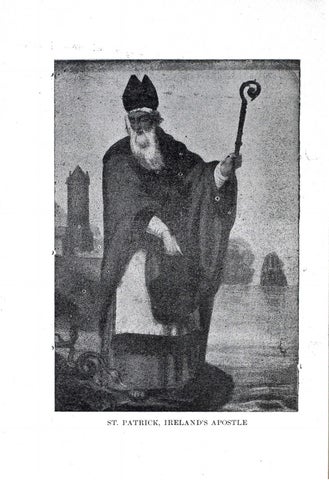
ST. PATRICK, IRELAND'S APOSTLE
..
THE VIA'TORIAN Facet Spera ·' VOLUME 25
MARCH 1908
NUMBER 6
Ireland's National Songs Thomas O'Brien, '08 N . all ages and in all nations the m oral, social and political <fSpirations of a peop le are to be found mirrored in : the character and type of their great men. Thei r many ~: services deserve the gratitu de of th e nation to which · _,_ they belong and their names arc worthy of being enshrined forever in the annals of her illus trious past . Such men' belong not to one age or to one particular country, but to all nations :;tnd 'all ti}11e. 'To them undying hono r vvill be always given, be'Cause their ste,rHng worth. has earned for them im.m ortal glory. N'o w Ireland has been singularly gifted with such greut m en, both i.n the ii1 d_11stria-l as well a_s the politi cal arena, w hile her int ell ectual abilities a.re acknowledged all over th e world. · Speaking on this point Father Fielding says: "Erin was for centuries the lamp· from v\rhich Europe too k its light , Erin that• brought the first knowledge of letters' to the Britons and other barbarou s nations, Erin that cirried the torch •of faith throug h Gau l, Switzerland, Scotland , Ger-' rnany, Aus tria and Italy, yea! up to th e very gates of Rome itself. ~' Eut it is t1ot of' the m en who achieved such glorious deeds and e·a rned · for Ireland · the · g rand title of " Island of 'Saints and Scholars" that I intend to write within the compass of this short essay; bt..it it is of the mei1 whose genius has been given to · build up Irela-nd's national songs. '· No 1'11or'e fitting, mpre beautiful and no more ancient title can histG<ry give to Ireland than the singnla.r .title the . " Isla,ncl of Song," for she stands alo:ne among the nations of the earth. in this respect that she has for her national emblem a .musical instrument, the '',Golden Harp of E~i~." .- Nq .do'ubt .Ireland is surpassed by Germany, Italy and Fran<;:e as regards purity of s tyLe~ <;Iepth of expression and the lighter and more pJeasing touches of music; )Jet great as are the musical attainments of .these people, £tiJ1 none of these nations car\ point back to such a national melody, to"' such a body .of national music as the Irish. The Irish music is s tkh as dwells
--
THE VIATORIAN in the heart and voices of all the people. It i the true on o- of the nation, the true national melody that i handed down thro~~h the "avenues of time" from the earlie t clays of pre-chri tian civilization. Looking bac~ t~rough the v ista of the la t century a lone 1 we see the n~agniticent account that lrel~u1d 11-as- g!ve n of her e1f in tlie' realm of dramatic, ly ric; ..-ancl :ballad 1 p · etry: , l_"''h e 0)1g of. Ire1and __ were the most potent ~"fact q:. in ~k e~p iJ1 ~ alive ~- the :h ati<i nal _pirit,: when everything aro ~md · seemed threat en ed J ith·~ extinction, and when mighty force s were endea ,·oring to dep.r,i v~ h er of her bard and minstrels. And in _ spite of H enry VIII, w h o e na ct~d a law that " every harper and . every min strel irf Ireland shoul d be put to death," in spite of Queen Elizabeth, w ho pa sed a law t hat they were all to be hanged, kno"wing well" as sh e did that IreLa nd could never be conquE:red as long as the min strels w ere there; in ptte of all these measures, these gloriou· '" and imm ortat bard .-and minstrels sang of " Ireland incarnate," its b eautie , its joys and it sorrows. Their voices w ere still h eard resounding through the hall of " Cashel of tht: Kings" and Royal Tara. And so w hen our Iri h poet, Thomas l\lh) ore, carri e and found th e g lor y of Ireland eclip ej by that of the past , he had only to stud y t he an cient melodie which had been hand ed clown by tradition and int erpret t he Celti·c in which they were found into the language of t oday, or a - he more beautifu lly express ed it, "Dear Harp of my country iti darkness I found thee, The cold chain of silence had hun g o'er thee long When proudly my' own I sland Harp I unbound th ee And gav e all th y chord s t o li g ht , fr eedom an d song ." \/Vho has not felt th e swe et strain of l\fo01·e's m elo.d ies b reathing in the songs, " Let Erin R ememb er th e D·ays of 0 1ld," "BelieYe Me of All Those Endearing Young- Charm /' " Ri ch and: R a re \ Vere the Gems She vVore." "Rem emb er th e Glories of Brian t li e Brave," Etc. Th e old , melodi es w hich h e rev ived " age only ' varm with color and perfum e 1ike old v intag-e." This i w hat induced an other poet to say of him , " O,b Tara' -hills ma v \v aste a w ay,
The Shannon 's ource ma y fail, The ming-led waters cea e t o play Throu o-h fair A voc a ' ~ vale ; Loved Arranm ore ma y fa de from igh t But y ou will still endure In Iri h heart , fre h , w.arm an d bright, Ench~ntinrfl" on ()' of l\~oo re. "
'·
k:
r~'·
/
r
~·
1;>
,.'·'
f. if' (. t '> 'r· f
\
,.
~
f; ·T;I
...' h
;
..!;., .
THEr VIATORIAN "Yet even if our ancient race In tim:e s hould cease to be, A ncl' if our dear old native place Should sink into th e sea, · The world would sa·v e from out the wave And hold th~ prize secure The Harp yo u strun g·, the songs you sung, O ur own immortal Moo re."
E .v en in th e gold en age of pre-christian Ir·e land the princes were passionately attached to music and song, and at all public assemblies and parliam.ents, -the bards ranked n ext to the king. Ml:lsic was always an ''institution " and power in Erin. "Let me write the songs of a nation," said O'Connell, " and I care not who makes· its law s." The splendid defen se of the Bardi c race by St. Co lumb cille at the g reat conve ntion of D·r umceat in 573 , has been the subject of many a poetic theme. In defending th e minstrel race he de fended patrioti sm, r eligion , literature, music and son;g, and resented the propos•ed annihilation of one of the most trea s ured institutions of a nation. As A . M. · S ulli van says: " St. Columbcille discerned cle.arly that by purifying and conserving, rather th an by destroying, th e .Hardie race, it would become a potent 1nf.luence for good, and wo ul d entw in e itse lf g ratefully around the s hrine, within which at such a crisis it found shelter. " Time has v in;dicated the farsighted poli cy of the statesman saint. The national poetry and songs of Ireland thu s purifi ed and consecrated t o the s•e rvi ce of religion and cou ntry, have ever since, throu gh ages of dire pers_ectttion , been tru e to t h e holy missio n ass igned them b y the "exi_led saint." In th e ly ri c of love, w·ar , or fan cy, the celtic singer g ives expression t o thou g hts and fe elings that appeal t o all men. . M·~ ny 111oods fii1d an echo in then'l-m ystical and simple, lofty and hun~b!e , passionat e and tender-but every mood g ives expression to the fe elin gs of th e peop le. T he moth er soothes her little chi ld to rest with the lullin g m elodies of th e Irish lullaby·. OJid age grows young ·w h en l6•v ed on es minister to its pleasu11e by pourin g forth the purity o f th eir soul s i11T song. Again, our songs melt the hea;rt of the strongest to compass ion; ·o f the unm erciful to mercy and love. . Th e thrill of our martial songs insp i11es us. Their wild fire urged ancestors on to great and glorious deeds. They filled the ·h eart of t h e weakest w ith the most courageous bravery and b ernism. The soldier i11arched t o the battle field-a ye, perhap:S for ·all he k.new to death, wi t!~ a .ligh_ter tep, w he n he heard the soul stirri,ng songs .of his native land . "They made their hearts like fire and - thei r nerves like steeL" ·
THE VIATORIAN
"~
.. .r~
-~
"0, Glorious songs! That rouse the brave 'gainst tyrant wrongs, Resounding near and far Mingled with trumpet and w ith drum Your spirit-stirring summons come, To urge the hero from his home And arm him for the war." We admire our songs a ll the more for their clash and energy; for ~xan1ple, such songs a those of· Thomas Davis, which throb with action and in which every line r eads rebellion. This is especially notic eable ·in such songs as ''Native Song.s " and "Oit'tr Own Again," when he says, "We've be nt t oo long to bragga rt wrong \ 1\Thil e force our praye rs derided." And agam , " L et th e coward shrink aside vVe 'll have our own again. ') Aga in , virtu es or ·v ices that are dee p-s eated and w ieldy prac· tisecl 01.mong· peopl e are certain to make them selves felt in th e peopl,e 's literature. Thus th e de ep r eligious character of the Iri sh is unmi s tak~bl y refl ect ed in their songs. The spirit of religion is specially enshrii1 ecl in the sa cr ed, lyri cs and political songs ofT. G. Sullivan. From th e songs of O ss ian clown to those of the present day, we find the "ame national strain; the same truth and beai1ty is depicted which h elps to keep them fr esh in the minds of the people. Hence o u~ songs are always appreciabl e, b ecause "truth ancl beauty n ever grow old. " From ;~ h e earli er part of the eighteenth century elate man y b eautiful Celtic poems, like th e ''Fair Hills of Ireland," the "B lackbird ," "Garryown," "The V.Tearing of the 'G reen," Etc. , after v.rhich appeared the songs of }..foore, Griffin1,_ 'V\Taller and Banim, 1vhil·e at a more recent period app eared the .delightful songs of "Fath er Prout," Edmond Q?Rourke, Thomas Davis, Denis Florence 1\l[cCarthy, · Gav an D't1:ffey and Charles J. K~i ck ham. " Killarney," O,'R ourke' masterpie ce, is on e of the most delightful and best kno~n of Irish songs, w hil e Ki ckham's " Peasamt Girl" and " Patrick Sh eehan from the Glen of A herlow," w·ill ever hold a high place among the people of his native Tipperary . Many~ of the national songs of America can be traced back to old Irish airs. "No enemy . speaks slightingly of the Iri sh music," w rote D 1avis, "an:d no friend need fear to boast of it." Giraldus Cambren~is, who w rote books of calu mnie on the Irish race, paid a high tribute to
THE VIATORIAN the Irish music. ''It . is in musical instruments alone," .·s aid Cambrensis, "that the industry of the nation has attained a laudable degree of refinement, surpassing immeasurably the skill of all other ) nations I have ever seen. They delight with so m.uch delicacy and soothe so softly that the exceUence of their art s.eems; to lie in concealing· it." It is the duty then of every Irishman to proclaim the beauty of his country's son;gs; it is the duty of every Irish-American to strive to acquire at leas~ a partial . know.ledg<e of them, so that he may truly realize and appreciate · the genuine worth of his ances'f. tors in the Emerald Isle. It may be said of our songs th-.t though 1~ , oft doomed to death they are "fated not to die." Ireland, after centuri~s of suffering and sacrifice such as have tried no other na.¥:~ in the world, has successfully and proudly defended and re;i::~,··.· .- tion tain~d hehr faith, hder fnatio na lity. and her songs. She is hdedstine~ to ~ rece1ve t e rewar o sue 11 11ero1sm, sue 11 constancy, sue evotwn. When she will have received that reward, tb·c bright~sr jewel in her .,/ crown will be her songs-the heritage of her ancient glory.
r.
j
~)~t
·w
·l ~~· ,,,
~----------[QJ
__________ [QJ
~
1i,~T
THE SONGS OF OSSIAN JAS. L. DOUGHERTY '08 @----------------[§]---------------------~ EW things are more interesting to the average student than the study of the curious manners and quaint customs of ancient races and peoples. We arrive at a know ledge of these, and judge of the enlightenment of :·" former g<enerations in various ways. The engraved ~· ., obelisks and . towering pyramids .. of . Egypt loudly proclaim the ingenuity at1~ mechanical adv'ancerri'e'nt of the children of the Nile. The unsurpassed architecture , the. exquisite chiseling, the artistic produc,tions of the brush, and their pre-eminence in oratory,. all annou·nce to the world that the Greek and Roman masters are stiB teachers. Bt1t of all th~ monurrients remaining of the anc~ent state of nations, few are mote ·valuable than their poems or songs. The piling of huge stone upon stone informs us that the Egyptians must have invent.e d and used powerful ma~hines; the unique de:;~ signs upon gig~ntic stone columns, and .the delicate tracery upon ·:~!{..- the . marble b'etrays the deftness of the ancient's hand; the beau til ful canvasses of antiquity show us. the fertility of the pre-Christian 1
ll
.,,
186
THE VIA TORIAN
mind and the genius of men' who had not the sublime ideals of Christianity. History tells us of the rise ancf' fall of these ancient domains, acquaint's us with their forms of government, the feats of ancient arms, and hundreds of other things that affected these nati ons o.f the past. Blut the poems of ancient nations give us a deeper insight into their manners and enable tlS to form. a clearer judgment of these remote people than any of these material wonders, because these poems present to us the history of human imagination, of human passion, o.f the human heart. "They make us acquainted with the notions and feelings of our fellow creatures in the most artless age's, discovering w·hat objects they admired, what pleasures they pursued , before those refinements of society had taken place which enlarge, indeed, and diversify the transactions, but disgUlse the mann ers of mankind," and moreqver, they unfold to us~ the high est beauties of poe tical writing. Poetry is the language of the heart, but it is also, D·r. Blair says, "A child of the imagination," h ence in the early ages, when men 's passions had nothing to subdue them , and their imaginations were unch ecked , it is but natural that they feel strongly, and their lan g uage of itself assumes a poetical turn. Uhpolished and irregular we may expect the productions of these uncultivated ages to be, and s uch, to a great extent they are, but. at th e same time they abound with that enthusiasm, that ve h emence and fire, which are the essence, the very soul of poetry. Among the nations of antiquity, power and military. prowess were characteristic of the Romans, and we award the laurel to Greece for her architecture and her superiority in the arts, but we cannot, say that poetry belonged especially to any of the ancient peoples; it is characteristic of an age rather than of a country, and belongs, in some m easure, to all nations at a certain period. I will confin·e myself to the poetry and song of one naton which we all love and pity-to the poetry of ancient Ireland, and particularly to th e productions of Oss ian, whose heautiful s.ong has marked an epoch in Celtic literature, and who very justly deserves the title of "The Homer of Hibernia." The 'life of o ·s sian, like that of most eminent -m.en of bygone ages,. is veiled in mystery, but it is almost certain that he lived during the latter part of the third century. Jam es M·acpherson, who\ translated the poems of O'Ssian, has g iven the impression that this great bard was a 11·ative of Scotland, but the true OISsian belonged to Ireland . onl y ; he fought the battles <Of Ireland, and sang the praises of her early heroes. It is indeed a lamentable fact that t11e art of writing was unknown to Ossian; for his poems, although · beautiful as we now have them, would undoubtedly be enhanced a hn1ndred fold could we read them as they came from the tuneful 1
THE VIA TORIAN
r
)'
.~
lips of this bard. The poetry of this ancient bard of Erin has e~ 'Cit·ed the attenti£m of the world's greatest critics, who have thoroughly analyzed his works, and have left little to be -s.aid of them in the way of comment. But there are .certain features in his pro'·ductions which would attract the attention of the most casual reader. : Seemingly unlimited power of description, exalted sublimity, pathetic tenderness, delicacy of S•e ntiment and strength of expression, are features which, in thi s poet, we find exquisitely 'Combined. An eminent critic has said, "A ·poet of original genius is always distinguished by his talent for description." The men of ·Ossian's age lived, as did those in th e infancy of all nations, scattered in the · midst of solitary rural scenes, where the beauties . of lflature were th eir chief entertainment, and that this poet pos~esse~ in a high degree the · power of describing these scenes, and the actions of th ese m en as w,-:11 as their characters, is easily .discenned from the effect which his descriptions produce upon the imagina'ti<;ms oJ his readers. \!Ve elwell among his characters and scenes as if they were all real. We distinctly see his h eroes fight, and conqu er, o-r if they fall, we see th em di·e hravely as becomes their valor. We see his bards touch the h arp, and instantly we hear its answering c'h ord; their so ngs, if they are a s ummons to battle, are s.o fr aught .with enth u siasm and so v itally patriotic that th ey arouse the martial sp irit in every breast; but if it is th e hymn of peace that the poet puts' in the mouth of his singer, the din of battle is hushed, and yields to the sweet pipings of purest joy and amity. We have an examp le of his descriptive power in his poem, "Cartbon," w h en he very poetically paints the deserted castle of Balclu tha . He says: " I have seen the walls of Balclutha, but they were desolate. T he fir e had resound ed in the hall s, and the voice of the p-eop le is heard no more. The str eam of Clutha was removed from its place by the fall of the walls. The thistle~ shook there its lon ely head; the moss whistled to the wind. The fox looked out froni the w indows , the r ank grass of the wall waved round its head. Desolate is the dwelling of Moina, si lence is in the hous·e of her fathers." Wbile Homer is most s ublim e in actions and battles, it is here that Qls sian excells, in descriptions and in se ntim ent. B lair says, "He is even ahead of the polite and refined Virgil." But while he ever paints for the reader i11 g lowing and vivid colors the heath by the seashore, the mountain shaded with mist, the torrent in the valley, the oaks and the mossy tombs of warriors, his talent is not wholly expended on these word pictures. He shows lfi.S human character, w.ith as much facility as he does battles and scenery . . Fro·m their very introduction we love . his heroes and despise his villains. He very artfully contrasts his characters so that they illustrate .each other. Id no other ancient yrodt~c~ion can there be found heroes of s uch bravery, or of such mtreptchty, an~
. ..
'
r88
THE VIATORIAN
at the same time so mag11animous and merciful, as those of which O ssian sang. Fingal, his most im:portant character, is depicted ap. blessed with all the virtues of war and peace: He is known as " Fingal of the mildest look." He is full of humanity, gen erosity,. mercy, tenderness and solicitude. ".My arm ," he boast s, "was the support of the injured; and the weak rested behind the lightning of my steel." Do w e fi.n cl any s uch h eroes as this. in the writings of other ancient poets? Homer's Hector, fearle ss though h e w as,. and . although he possesse d several amiable qualities, canno t com..pare with th e tender buf· valiant Fingal. Virgil 's hero, A eneas, perfect as h e is , is an unanimated person, whom we all admire, but we can never love him a s we do O~s s ian 's " Fingal of the mildest look." As s ublimity coincides in a gr eat m easure with m agnanimity, heroi s m, and g enerosity of sentim ent, we may justly expect Oss ian t o ex cel in this m ost diffi cult fe at, introdu cin g the sublime into his poems . Nor are .w e di sappo inted ; in his wo rks are t o b e found th e m ost sublim e passages in all literat ure. H e e ntirely c o nqui'~ :r th e: h eart , a nd th e sublimity of his pat hos is w ell cal culated t o b r in g t ears t o the eyes of th e r eader. But let us consid er a n oth er feature that presents itself in t his po et, and n ot onl y is it t o b e found in him. but it is characteristic of all Ireland 's :::ons , a nd w ill b e 8S lon g as God gr an ts them exist enc e- ·a ncl th at is pat riotis m . Th e fir e of pat ri otism b u rns in every lin e that ever cam e fr om th e g·emm ecl li ns of O ,;s ian . Like m ost an cient w arriors h e did n ot s•e ek qu arr els , bu t h e and t h e heroes :wh ose de.ed , h e celebrat es always fou g-ht for th e \ve lfare of th eir nati on, for the prot ection of th eir lov ely and b eloved I sle. Can we wond er , the n, that O ssian g row most g randly s ublim e when speaking of thi s pa trioti s m ? No : .for h e sp eaks of Irish .patriotis m , the sublim est subject that eve r qui c k em~ d th e poet's · lyre. Can w e w onder th at Ireland has produc ed such m en as th e bold Bri a n. the O'Niel s , Sarsfi·elcl. Rob ert Emm ett, (}'Conn ell and hundreds of oth er renowned patriot s ? Nb; it is but th e n atura! succession of eff ect t o cau se , for w e see h er children schooled in patriotism fro m the earliest ages, and learning its inspirin g lessons from the mouths of her pre-Chri stian pagan bards. o, Ireland , th ou needst n ever fear for the l oy a~t y of thy son s, as long as they are in spired by the lines o f this peerle ss· barcl. A s lqng. as the blood of O ssian flows in th e v ein s of th y children , thou n eed ' 'j: fear no enemy .. for th e loy alty and patriotis m of th y children· w ilJ protect thee. But though h1s lines are patrioti c, though the sentiments l1e expresses are lofty . ancl his descr-iptions sublim e. th~ reader feels that there is a blank in his po etry. Although his poetry , m or e than · that of any other writer, is the " poetry of the heart," the Christi?}' heart i not wholJy satisfied after reading it. This is because a Supreme Being never enters into the verses of
• 'Iii' •
THE 'VIATORIAN
~\
·'
' ttf
i_: ;.
'Os.Sian. Having rio knowl-edg·e of a Suprem.e Being, he ·very skillfully introduces ghosts, and the spirits ·of departed friends ati.d -reiati\ies, as the machinery of his epic.s, but we must acknowledge .that his compo-sitions would have· been much more bea:utiful at1d perfect had· he a conception of the Lord of hosts, the -God of battles, whch he so graphically describes. The fate of geniu.s is in the hands of Time, and that m1erciles.s destroyer spares it not. Often, indeed, it ha.s tried to dim the -lustre of Shakespeare, that sun that illumines the firn1ament of -English literature; it has cast doubt upon the existence of Homer, :and has attempted to ta.rnish and even destroy the crown .o f Virgil. .Can we expect then that O-s sian's fame 1vill remain intact? There are many who would clo violence to literature, and they say that he .nevet lived, but we have proof to the contrary in some . of th·e ·g randest lines ever penned by man-. · In his last liiTes he soliloquizes·, "Shalt thou then remain, thou ancient bard, when the mighty have failed? But my fame shall remain, and grow like the oak of J\/[or:.. veri; which Efts its broad head to the storm· and rejoices in the· couts e of the wii1d." Yes, may the fame of Qlssian remain forever; niay his lines ever comfort his people, may hi~ l;eroe.s evei- be emulated by them, and may that patriotism which ariimat•e d hiril neve r srnolder in the· breasts of his countrymen!
HERE are and hav·e been men whose eloquence ;md pen have swayed nations to de ~d;-; of heroism, there are others· whose personal magD·~tistn 11as gathered around ·them hundreds; aye thousands, of staunch . {ollovvcrs; there are more still who through the glQfY. of. their .arms_, have acquired a -following as numerous as the .s o.ncls of the seashore. Yet above these are ranked men whose unrelenting · perse·verance in the paths of. truth and justice will · ever keep thdr 1.n-emory gre,en. in the . hearts -of · m1a nkind. · The _C hurch points with pride to her army of saints and scholars; America elevates.
,
her Washington and ,Hale to the .. highest pinnacle .of fa me; Ireland s igh s and longs for another Emm:ett. .· · .. Robert Emmett, the heroic Iri h patript, was born in the city of D'ltblin, 1arch 4, 1778. He was the sdn of D~. Thomas Addis Emmett, court physician in Dublin Castle. Like all Insh youth of good family he entered Trinity College, D·ublin, from which he wa dismissed, charged with treasonable practices. Before hi s di mi ssal he srec ured several t>rizes through the eminent brlliancy of his intellect. Although these were secured through his proficiency in mathematics and the exact sciences, popular tradition reprc.. s~ents hit:n as extremely eloquent, and -an ardent advocate of Irish self-rul e. While at T·rinity College hi character created such an impression on Thomas Moore, the Irish . bard, that he wrote: "Were I to number, i;n'deed, the men among all I have ever know-n-, who appea·r ed to m e to combine in the greatest degree pure moraJ worth with the greatest intellectual power, I hould among the highest of the few, place RDbert Emmett." In the time intervening between his exp ulsion and the insurrection of 1803, he vi. ited France. \ i\T hil e here, it is said, that he entered into negotiations with the hero of Austerlitz for French aid. It is certain that he did not desire a French prot,ectorate. His dying words justify this s tatement. He said: " I am charged with being an emissary of France. An emissary of France! and for what end? Was this the object of m y ambition?. And is this the mode by which a tribunal of justice reconciles contradictions? No .. I am no emissary. My ambition was to hold a place among the deliverers of my countrynot in power, not in profit, but in the glory of achievement. Sell my country's independence to France! and for what? A change of masters. No." His plan was to quietly arouse a revolt, storm· Dublin Castle, organize the oppressed people, and form a prov isional governm~nt. The people were g roaning un:der the iron heel of despotism and the tim e for rebellion was ripe. They were well aware of the revolution in France and the revolutionary spirit permeated the air. \Vas it trange then that Emmett, seeing hi s UtTk>rttmate conntrymen goaded by heavy taxation , their efforts for right overwhelmingly oppo eel, should have incited the people to rebellion? Wa it out of place that he, debarred from the professions, houlcl feel that to him. belonged the ta . k of freeing Ireland? o! No ane person ·would ay or do otherwi e. In v iew of these things he entrusted hi plan to a few ubordinates w ho were to organ ize the revolt throughout the unfortunate country. He began collecting arm and placed them' in two depot in Francis Street and 1arshalsea Lane. But the fate were again· t him. On July 16, 18o3, an explo ion occ1.1rred in the Franci Street arsenal, killing a workman and laying bare the ·upply of arm and
·""-.
~- ·~
<·.: ~
~~
:
\
\
~
,..
. ·. ,. ·.
' ..., J
r ·~·/!
t>.
I
~.
•
t
~
•
•
~·
'.
~
•• ·;
!' ·,
., J9I
C· ?
.'
stores.,- 'wp,ich ·was confi scated. In · spite of this th~· ·rising ·sun of . July 23, 1803,· displayed a placard· inviting all true ·Irishmen to )oirt in an attack on the hated oppressors. · With eighty noble hearts Emmett rapturously started out, his brain fiHed with gloriou·s visions of a free Ireland, and though the English garrison numbered· 3;000, he fought them· for the space of two hours. Realizing · that the attempt was a failure, Elminett retreated into the blue mountains of Wicklow, famous for secreting Irish patriots. From his mountain hiding place he wrote to his li<eutenants advising them to disperse unfil happier tim1es would arise. On the urgent advice of his friends, he resolved to flee from the country, but he could not depart without bidding farewell to his betrothed. Sarah Curran. Returning to D'ub lin in this hope, he was arrested on the 25th of August and placed in confinement · until the 19th of September, 1803, when he appeared before an instructed jury, to answer to the accusation of high treason. After a 'mockery of d.{ trial, which lasted only twelve hours, he was declared guilty, the too well instructed jury not leaving their stall to decide' his fate ,. ·-vyh,ich was hanging and afterwards decapitation. When the judge asked the questio'n : "What have you now to say tJ1at j\,1clgment should not be passed on you?". Emmett made ·r.eply in his .deathles·s speech which is a marvel of extemporaneous eloquence. The next clay, September 2oth, Elmmett was led to the scaffold, . where he was hanged and then decapitated. That Emmett was wrapu hody and soul in the dream of a free . Ireland, no one will dare dispute. His entire life was spent in that . one purpose and his death wc:..s due to his unconcealed devotion to the cause of liberty. In the time of Robert Emmett, Ireland was the most pitiful of nations; no nation was ever more afflicted with inhuman despotism; no nation's -vv,elfare wa~ ever darker than Ireland's at the close of the eighteenth century. Cruel oppression and inhuman persecution by the reigning _Hanoverian dyqasty made the lot of am· Irishman .worse than that of the galley slaves, hence no man will dare dispute the justice of the uprising. But some have -said and others will say that E:mmett's motives were those of self-interest. To this I ~ill ans.w er that never was viler falsehood ever invented·. If Emmett had soi desired, if he had been base enough to subsist on the earnings of starving fan1ilie?; if he had so lost human respect as to see his countrymen treated like - dogs; if he _was low enough to occupy an hereditary position~ which he could easily have <done, E mmett had only to say the word. , No better proof of his integrity can be cited than his own words: HO my country! was it personal ambition that inflttenced me? Had it been the soul of my actions, could I not by my education and fortune, by the rank and consideration of my family, have 1
·,
I
THE VIATORIAN .' r • placed myself among the proudest of your oppressors? My couptry was my idol. To it I sacrificed· every selfish, every end~aring · ·sentiment, and for· it I n9w offer ti1yself, 0 God! .N'o ! my :lords·; I .ilcted as an Irishman, determined on delivering my country from the yoke of a for~ign and unr~l·enVng tyranny." His co:ncludif1g words, words whtch are filled w1th pathos and heart rendmg sympathy for a · lost cause, will ever be remember·e d by all true Irish~ 1.nen .. , "When my country takes her place among the nations of ·the earth, then and not till then, let my epitaph be written. I have .{fo n e."
·
.
.
· When Emmett perisbed so ~10bly on the scaffold, there pass·e d .a way one of the grandest . and greatest characters that illuminate the pages of hi story. There have be en men of greater learning than Emmett, but none of broader views, none more patriotic and none 1.110re h eroic. vVhen W·e consid er what he had to contend with, what he had to StJpp ort him in his futile attack on far-famed Brittania, we _find that there are few who would evein . have spoken nf such· a praiseworthy attempt, an_d still fewe1.- who would have made any effort to realize it .. The bono!r w hich h e r eceives and m·e rits from the Irish p~o.ple, although g reat, is little less than his due. 'The _example v\rhich h e set is o n e worthy of many followers. In accordance with his last wishes his epitaph has not yet been written, his last resting place is twknown, yet his memory will ever be l :ept green 'w hi le Ireland exist s. Thomas . M;oore, his life-long f'r iend, alone has tried to commemorate hi s memory with the following verses: Oli! -Breathe not i1{s name, let it, sleep in the shade · · Where cold and unhonored his relics are laid . Sad silent and clark be the tea.r s that we shed As the night clew that faJls on the g rass o'er his head. But the night dew that falls, though in silem:c e it ·weeps Shall br!ghten with verdure the grass ..where he sleeps, .And the t·e ar that we shed, tho ugh in secret it rolls Shall long keep his memory green in our souls.
J, .
THE VIATORIAN
POLONIUS 1'. Wedge 'rr. HE coaract er of Poloniu , in hal-e peare' trao-edy of Hamlet, •e mbraces all the qualifications nece ar to · make a good cou.rtier. Shrewd, cunning and ever ..ready to curry favor by choice bit of flattery, he i at the same time practical and sen ible, yet n:arro·w minded and garrulou . a political leader he could rival the bo seb of Tam1nany Hall, arid guide the stat,e t hrough all the troublesom·e and turbulent seas of civil discord that might arise. But when h~ tries his hand at settling lovers' quarrels,· he meet with failure and defeat. Niow Poloniu is quite sure that the cau e of Hamlet's insa:nity is the refusal of Olphelia of his offer of marriage; so sure in fact that he bases his argument for thinking thi upon a fact that i ess.e ntially wrong in the beginning. He supposes Hamlet to follow the natural course of events that a repulsed lover wo·ulcl be apt to pursue. First, he was sad and despondent and grieved over the general fickle111ess and inconstancy of woman, then he refu eel all food an'cl rest, a foolish thing to do, and, as a consequence of fasting and watching, grew weak from hunger, and as most people do when in such a state ,. he grew light headed and finally developed "into the madness wherein he now raves." Could the question have a more simple solution? Polonius merely follows out a deduction that would do credit to a philosopher more gifted than he. What knowledge Polonius has, he has acquired right there at court. That has been his school where he has se en human character and human veakness under the forrns of glory .and power. He has seen the king intrigue and steal another's wife as successfully as could the meane t citizen of the state, and he has obs.erv;ed "vile deeds sugared over with the trappings of wealth and rega.l splendor.'" He looks upon everything with the eye of a business man, always looking for a bargain. He fawns and flatters becaus·e he knows that that is the on ly way to obtain favors, and boasts because he sees his sup eriors boast. Polonius was quick at observin_g the actions and motives of those with whom he came in contact, but was so anxiou to show· off his philosbphy and learning that he could not keep his impressions to himseH, but being once convinced that he was in the right, all he'aven and earth could not change his mind. For wise saws and ma)Cims of worldly wisdon1 one could not find a better teacher. His parting advice to his son, Laertes, as the latter is about to leave for Paris, is rich in precepts as to character and morals. It is such advice as any father might impart to his son to guide him safely from the pit-
194
THE VIATORIAN
falls and gay, alluring dissipations of city life. To make s ure that Laertes is heeding these parental admonitions Polonius sends his servant, Reynaldo, to spy upon his s.on and r epo rt to him what kind of a life he is leading. This act alo ne s hould be suffici ent to bring out his double or t wo. . faced nature, for a man certain'ly mus t be a deceitful villain to doubt his son ,before he ·has, any proof o f the other's misconduct. We ge nerally find men believin g in th eir sons in spite oL the g reatest conviction pos ible and only giving in on the confession of th e latter. A nd then agaia he is great for trying to overhear conversations, but is easily fool ed by Hamlet, w ho makes him. look so clownish t hat we are t empted to lau gh at his discomfiture. He is like a weath er vane that chan ges w ith eve ry w ind that blows. This is s hown in the sce·ne w hePe Haml et question him abo ut the cloud a nd makes a fool of him. Polonius' gr eat fault · was his readiness to jump at conclu sions wit hout grvmg the matter suffi;ci.ent thoug ht to find the real cause fro m t h e eff·ect. Thus he puts Jlamlet's loss of mind and mela:n'choly disposition and Ophelia's refusal together thus , to h is mind, joinin g two and two and discovers that he has four. H e is so absolut ely certain of this that he becomes offended and a little angry when the king has t}1e audacit y to doubt hi s th eory ever so li ttle, as w hen h e asks the qu een, "Do yo u think 'tis t his t' Poloni us everywhere wants to show t h at Ophelia gave him Fiamlet's letters solely from a se nse of duty ancl obedience, and wants to call attentio n to th e fa ct that hi s children are models of v irtue and parenta l re ve rence, and that his house hold is governed in a stri ct and order ly way, for h e says: "Thi s hath my daughter shown me and more above, h ath his solicitings, as they fell out by time, by means and place, all given to mine ea.r." But this i simply an example of hi s b oastful and self-satisfied spirit. Fi nall y hi s inquisitiv·eness leads him into trouble and ends in his downfall. H e hid es b ehind a curtain to · h ear w hat the irate Hamlet ha s to say to his mother in o rd er that he might report all that occurred between the two to the king. Hamlet gives the queen such a t ongu e lashin g that she b ecom es frightened at his increasin g wrath a·nd calls fo r h elp. Here Polonit\S h etray himself by echoing the queen's crys. Haml et quickly makes a pass through the arras and kills the old spy ing Polonius. Thus the garrulous , treacherou s,· cunning old fox died, caught i11 a sneaking, dis rep utable act, ending- his life in the sam e state by which he made . his living; that of a deceitful and double-dealing old wiseman. 101
>I
...· ..
'{ ~.l'-,1 THE VIATORIAN ~c•f:-.:
... ·~'
J ·~ ~-~-·~ ·~/ ·;-~: .:. -~:.~.:.~
1
•
1 95
OPHELIA P . J. McAvoy ':p. N THE play of Hamlet Ophelia seems to serve as the connecting link betw.e en the central figure, Hamlet, and the secondary group of the king, queen and others. A lthough not m.u ch seen in the play, O'p helia is an int eresting ' character, ·and in her absence she 1s virtually present by reaso n of what - others say about her. Shakespeare s'eeri1s to have portrayed her as the counterpart of Hamlet, e~cept in th e fact that Hamlet has diffi'cttlty in expessing him.s elf in action, while Op helia has difficulty in ·expressing herself even in language . Simplicity is the keynote of he r character. This trait, along with her submiss ion t o paternal command, is shown ·when in reply to her father's question as to whether sh e he!-4 · g:iy;en ~f:Iamle~ apy hard wor:ds of lat~e, she r epli ed:
C{No my good lord; _but as you- did
~ com:mr'....;d,
I did rep.el his letters a.il'd denied His access to me." ·
..·'
These few words of Op helia mak~ us pity . her becaus·e they are an apparent b e ~raya l of Hamlet to h r::r father ·when her help and love might hav·e s.aved him. Oph elia appears am:idst the co1-r~1ptions of a wicked court unhurt. bec au se her simplicity of character makes her susceptive of only th a t w llich is s imp le. . Add ed t o thi s · she had a silent ~ and -sweet di spos ition, an 1 in spite of her unwilling treachery to Hamlet w - mu st excu se h er because her son gs . w'hil e sh e was insane prov ed th e depth 9f her love for bim. H ·e r father and broth er filled her mind with the thought that Hamlet's love was not true and ir1 her simplicity sh e beli eved them. Although sh e loved Hamlet, in ob edience to h er father, she did 11ot sh ow it. After becommg insane h er ow n words,"vVh ere is the beauteous majesty o:f D·enmark? . ·H ow should I, his true love, know From another one? By his cockle hat and staff, A nd his sandal shoon ?" I
'r
"·
~'.
prove the depth of her love for H~mlet and .her repentance for n~t returnin g it. The injury her feehngs s usta.m e~ when repul sed ~y her lover . her g-6ei in supp_o:s in~ tl!_at h e was msane and the vlolent shock caus.e d by her father's d.e.a:th at the _hands of the person
~· •
·~· 1
~·r'.-!i:~. '
f
f
'''1:· ''t! 'I
THE VIATORIAN
196
she loved, caused her to become insane. While her 1nind was in this state she used to wander around singing old ballads 'which'· · bore on the death of her father . or the loss of her lover. ·While wandering thus Ophelia accidentally fell into a brook. Seeniingly unconscious of her position' she continu.e d her song, until her clothes, which at first bore her up, became saturated and thus we1ghtecl, puHecl her clown to a watery grave. It is t<) be regretted that in her innocence and simplicity she could not have received Hamlet's love as becomes a woman. Eventually her help and love would hav·e strengthened HaJi1let, and a_fter his mission had been accomplished , she might have become quee11 of D~enmark instead of meeting so untimely and sad a death. ,
.
.
I
,,'
i
, •
C:O:U RAGE.
·
D. McAuliffe 'og. . Don't give the enemy the field, Because h e beats his drum; Don't shirk the fight or ever yield, But clare the worst to come. The bleakest Before the The darkest Before the
I'
clays they ever come, flowery l'day; honrs precede the sun break of day.
If winds adverse shall blovy thy w ay, And all is black and drear, Keep up the fight for there's a clay When all is bright an1cl clear.
An earnest pray.er thou art aware, Will evei· ease the pain; Denart desJ)ai.r, for w:eighty Care Is never borne in vai.n.
,_. -:\.
.
(
THE V I AT O RI A N
CON-G REGATIONAL SINGIN:G.
,.
F . Welch ' ro. Congregational singing, like most subjects of_ a debatable nature, has its p ros an;d cons; but I think the ·arguments in favor of . it far outweigh thos-e against it. w :h erever the practice has been_ instituted one result invariably foll ows- it always1fosters a healthy religious enthusiasm. H ow soul-stirring it is to enter a church in early m.o rn and there hear the priest pronouncing the solemn words of the Mia ss, but m<C5 r~ m.o ving and sweeter still is it to hear him r es ponded to in that religio us melody, coming from the lips of the mine r, the eng ineer, broker and soldier. Now I ask, do not _these public manifestation s of faith do mo r e to touch the heart of a w ayward soul or kindle the dormant piety in th e lukewarm than . for each in hi s own inidiffer ent mani1 er to offer up som.e sort of ,c old prayer? The great and in evitabl e advantages that fl ow from .c ongregational singing stand out so prominently that no thinking 111an can pass them by unnoticed. M an is a frail bein1g eve r sub-· . j ect to cl istractiQns and inte rruption s, e.ven when in the best of mood , atYl attended by tb e b est surroundin gs. Now, considering . him subj ect to these, s hould 'We not place him in cir cumstances that would counteract these imp erfections? Singing t ends to elevate and draw the soul from the trammels of thin gs material and _place it in higher r ealms. A national hym n bas an ·e lectric influence in .a rous ing a s pirit of enthu siasm . O n h earing a national ballad , a ~roop , even tho' dejected and discouraged, b ecom.es suddenly aroused, and every sinew v~brat es w.ith patriotism. "M'usic hath charms to soothe the sava ge h eart." Its stirring notes spread a ·wholesome atmosphere around th e passions of man 's h eart, which 1nay be used fo r the uplifting of hi s soul. M usic is t o pi ety what medicine is to our anatomy; it stimulates a'nd strengthen s the weakened organs. Piety .is enlivened with mu sic and when the spe ll ' has passed the so ul is m'o r e active and nearer t o God than · befo re. To prove th e pow er of song we have but t o go ba ck to the early, ages of the Church ·when sects made 1J S~ of hymns as m eans for disseminating their doctrines and gaining followers. Arius ·e mbodied his doctrines against th e Divinity of Christ in attractive song. Li1ther d-id as much by hi s hym ns as by hi s tran slations of the bibl e. A larmed by the rapid spread of A rianism, St. John Chrysostom, in order t o counteract his adve rsary's efforts, wrote captivating verses and ordered processional singing to be held in the street s. I-Iis.tory tdls ns that the early Christians, while on their way to death , sang sacred hy mn s to the God they were so -soon to m·e et: If congregational singing ·w as indulged in by men
'. 'll1E VlATOlUAN and wom.en who had the grace to suffer martyrdom; if it is sanc!io~1ed by th: in sp ired writers of both t he 01d and New 'T e tament, If It has th e apprcval of Incarnate Wisdom Himself, who immediate ly after the institution of the Sacram·e nt ·of the Eucharist,. chant ed t ogether with Hi s disciples a sacred canticle; surely if all this is true we, the w'eake~d sons of Adam, sHould approv·e ·of it~ By joining in sac red song the people are preachii1g God's word. It is related in the " Life of Bishop Cheverus" · that· once while traveling throu g h Main e, he accidentally came upon a tribe of Penobscot Indians. It was Sunday morning, after a long w~ari some journey on foot, that h e approached the haunts of th ese savage r eel men, and as h e drew· nea:r he was startled as well .a s pleased~ to h ear ringing in harm onious concert, from the depths of the fore st , the words of a familiar Mass. Upon investigation he learned ·that they had not se~e n a Catholic priest in fift y years, but their faith had been k ept alive by chanting in unison every!. Sunday the sacred liturgy which they and their fathers had been; taught by the early mi ssionaries. Surely the children of the forest are not · gifted by nature or education with richer or more melodious voi.~es than the averao-e Catholic American. I ventu. r e •to say and With b . • . confidence that a ge neral and a h earty partiCipation 111 congr egational singing will result in bringing about a closer union betwx:e;r the sanctuary and the nave; that it will augment a be~ter spint of piety among the parishioners, the attendance will be m creasecf, and spiritual exultation enliv;e ned. . . . __ . . To sum up the advanta ges of congregational smgm g;. It IS a prayer, it is a magnificent prof,e ssion of fa~th, it is a glov:mg example to O UlJ neighbo r, it is a strong incentive tG fervent ptety and a sermon felt by all.
. )
il
. ...., '
.
·~
. '
THE . VIA TORIA N Published 11wnthly by the students of St. Viateur' s College, Bourbonnais, Illinois EDITOR I AL STAFF
. Editor i n Ch ief-J. DOUGHE RTY, '08. Alumni-C . MAHONEY, '08. · Exchanges- · EMMETT CONWAY, '08 Societies- A . SAVARY, '09. Athletics- B. J. MORGAN, '09. Person,a ls-D. BOYLE, '10. Loca ls- D. McAULIFFE, '09.
Entered at tJte Bourbonnais Post Office as second-class 7Jtatter All correspondenct? must be addressed" The Via!o'rian;'l Bourbonnais, Illinois. Subsc.rip.tion Price One Dollar,. p er year, payable in advance. All business crlJmmunications should be addressed. Rev, J. F. Ryan, St. Vialeur's College, Bourbonnais, Illinois.
EDITORIALS. Few topics have called forth more comnrent, or excited more ge ~1· eral interest tha:n the present subject of . local optiori. Local option does not me<:m prohibition, but such is the The Attack meaning that prohibition fanatics are trying to give of a it. B)ecause Cardinal Gibhon.s has said that he does Poltroon. not favor prohibition, and because he very clearly and ably stated his view on this subject, he has been malicious ly assailed 'by Drr. J. ~· Cranfill, a fanatical prohibi-.tionist. His Eminence said m: a sermon some time ago, "The Church is not fanatical on the subject of liquor, but she t'eachesmoderation. Her path ·is · not :one of rigor, nor yet one of laxity~ but the middle cour&e-the golden m!eam The use of liquor in moderation is not to be cE>ndernnecl, but if there is danger of abusethen it should not be us.~d a~ ,~11." Is this not a perfectly sane,_ just and broad-minded view of the subject? Ca·n any person with! a healthy mind infe·r from_ the above quoted lines that the Cardi:-nal ·"announces his alignment with the liquor traffic," or• that his: ''t1tteranc,e is the result of monetary consideration," as DL Cranfill does? Assured ly not. This calumnious attack is so vile,. con.-
200
TH'E: VIA TORIAN
temptible, narrow-minded, and at . the sam~ time s_o ridiculqus and absurd, that on its face it bears the brand of bigot~d . fan!ati~ism. D·r. Cranfill ends his scurrilous letter with the following: "When a man a11.nounces such views as Gibbons enunciates, he ought to exchange his surplice for a white apron, his prayer · book for an ice pick, and go to ke1eping bar." These are nothing but the ravings of the maliciously inclined and diabolically direct.ed brain of an unmitigated fanatic, and are to be resented by Catholics as an outrageous ins ult, and by all as most disgusting, and as an example of extreme fanatici sm.
Hardly had the tragic scene enac ted in D'enver been hidden from\ our horrified gaze, when a n~thl·e.ss attempt wa.E> made on the life of Chief Shippy of Chicago, in w·h ich his son, .Anarchy; our former school-fellow, was seriously injured . There is in these lawless deeds a 1esson for this its Cure:. country and one that must be learned, if it would escape the disasters which will inevitably come from the p ropagation of anarchy. The obnoxious weed of anarchy must be plucked out by the very roots and so be entirely destroyeel. This can be done, not by punishing those w.h o actually com111.i t crin:ites, but only by taking adior1: ·against such agitators ·as Emma Goldman and the rest of her type, who ·excite the minds of those who co·m mit tbe crimes against religion and authority; and against such societies as the Giordano Bruno club, which, since it ·· :is anti-clerical and anti-religious, must of ,necessity be revolutionary and anarchistic, and as · s uch s hould not -only be •eliminat-e d from this country, but from the face of the entire earth. But how _a re to get riel of these clange-rOtlS people and their pernicious doctrines? Legislaticin: can never do away with this evil. Rigorous laws !nay restrain anarchy and anarchists, but they will never reach the vitals · of this threatening monster and kill it. The only way that ana-rchism a:n'd socialism cat: be removed is by removing the cause, which is atheiS111. Authority C:Om·es from God; apd since these individuals acknowl·e dge no God, they acknowLedge no aut'hority, and regard all those who govern a.s tyrants . . ·They respect no G:ocl, and they ,openly attack the Church because it as w~p . · .... , as the state; must go bef?·re anarchy a,nd socialism ·c an triumph.
we
THE VIA TORIAN
201
.
'
To eliminate anarchy we must eliminate atheism, and to do away with atheism, W!e must t each profoundest respect for God, wbo so providenti~lly goveri1s all men and all nations, and we must vigilantly guard against any atheistic tendencies in government, education or society, and by so doing we will inculcate a high regard and respect for authority and an int•e nse hatred for all that savors of ~narchy.
ST. PATRICK'S
~·
. ~·
• f~
•
D~AY.
March r7tl-: of 1908 gave anoth.er opportunity to St. Viateur's to exhibit its love and loyalty foi· Erin and St. Patrick. The sun rose to find R oy H all decked in national colors and festal green. Solemn high mass was celebrated at 9:30 by the Rev . .]. F. Ryan, C. S. V., as cel ~ brant; Rev. J. P. O'Mahoney, deac 01n; Rev. W. J. Bergin, . sub-deacon, and 1\tlr. \V. Irish as master of ceremonies. A n instructiv e panegyric was preached by Rev. Griffy of Odell. A. ft er the hig h noon banquet the visitors ass em bled i111 the college ball where tbey were enh:rtained . with the elrama, ''Arrah Na Pogue." .~ To say that the production of "A rrah Na Pogue," was a brillian t triumph, is a staten"Lent confined in the limits of unva.rnishcd trutb. The play was und er the able direction of Rev. M. ]. Breen, C. S. V., t o wbose unti'ring efforts much of the credit must be given. All who t ook part in the play acquitted themselves splendidly and in a manner befitting the Thespian Club of the college. M:r. F. Rainey, as Shaun , the Post, gave a true rendition of the whole-souled, God-feari1ng Irish peasant; Mr. D. ]. McAuliffe, as 1\!Iicha·el Feeney, faithfully exhibited the flinty heart of a grasping, miserly landlord; M:r. A. Savary, sustained the title role with exceptional grau~ ; Mr. R. Shannon was the quintessence of Irish maidenhood vn the difficult part of Fanny Powers; M1r. T. E. Kotzenberg, as Beami sh McCoul, Mr. F. Ryan, as Col. O'Grady and Mr. ]. Farrell, as Major Coffin, distinguished th emselves in their very difficult rol es as was evid enced by the salvos of applause which they frequently received; M•r. F. A. Welsh displayed tlrle dignity of the Secretary of State with exactn,:ss; while the troops, t11nder the command of J\l[r. F. Cleary, took the _house by storm. The minor roles Wiere well taken car·e of, the jigging of C. Mag-ee and W. Tinan being truly Iri sh. Mr. F. Rainey and Mr. A. Savary gave as perfect an exhibition ()·f pathos in the fourth sc·e ne of the first act as was ev er seen on th e college stage.
..
THE
I T
I
The e cape from pri on, which occurred in the la t ene of the play, wa executed with a zest and peed wbieh wo uld have tonished a prison guard. AU in all. the ·pbly, which was under the au pice of the cia of 1909, will alway be remembered one .of the really classic theatrical of the scholastic year of I'P/ and 1go8. · Between the curtain fall the audience heard some choice e... lection and dulcet train from the leading opera , by the cotl e orchestra, the member of which are to be complimented on the cellence with which they rendered the Leharian strain~ .
•
of Characters.
ol. B. O'Grady. . . . . . . . . . . ... . . . . . . . . . . . . . . ....... . F. Ryan Beami h Me Coni. . . . . . . . . . . . ..... - . . . . . ... T. E. K'otzenberg Major Coffiln.. . . . . . . . . . . ... . . . . . . . . . . . . . . . .... J. A. Farrell .:ecretary of tate .............................. F. A. Wei h Sergeant. . . . . . . . . . . . . . . . . . . . . . . . . . . . . . ... . . . ..... F. Oeary Michael Feeney.. . . . . . . . .. . . . . .. .. .. . . . .... D. J. McAuliffe haun the Po t. . . . . . . . . . . . . . . . . . . . . ... . . . . . . . . .F. Rainey . . . . . . ... F. Cunninghaan Oiny Farrell .. ....... . ......... D. J. Boyle ndy ·Regan .. ....... . . .... .... ,. R. Delihant . . . . . . . . . . . ~iorgan Lana · ........... . Pea ant . . . . . . . .. F. lattery Pat ey. . . . . . . . . . . . . . . ........ G. Lockwood Tim Cogan ........ . . . . . . ....,... A . . av ry rrah Meelish ..... , ....... . Fa~nny Power. . . . . . . . . .. . . . . . . . . . . . . ... . . ...... R hannon I<aty ................................................ \V. Tinan
nes. CT I-.._ ene 1. Roadway in County Wicklow. 2. Arrah' · Cottage. 3· Armory. 4. \Vedding cene before Arrah•s cabin. ACT II-Scene 1. Sa~ as cene I. Act I. 2. Lawn before Col. O'Grady' Man ~ ion. 3· Interior of Engli h Prison~ Engli h Court Room. T III- cene 1. Room in ecretary's Office. 2 . Same ct II. 3. Exterior of Pri on. ~-·cal
Programme. Conclave ~fl:uch. . . . . . . . ... . . . . ........... . . ......... F. " ... ,. . . F. Donnybrook-0\'ertnre. ... . .. . . . . . . . . ... .
·,
. THE VIATORINN·
203
Iola- Intet;"mez~o ...... . .... ,...... . ... ,... ,. :_. r.\•• : • • C. Johnston · . Merry Widow Waltzes .... , .. ... ...... , . . . . . . ... .... Frank Lehar Fea,st of Ros-e s-·O·vertl.'lffle. · I · • • • • • , . · • • • , . • • • • • • • • • • • M!unkelt The Red Mrill- Selections '. . . ... . . : -~ . + ·.... . ·I·. Victor Herbert · Old Faithful Two-Step ...... . Abe Halzma.n When the Winter Days Are Orv·er ... ~ - ... , .. ,...... ~Jos. Nathan Triumph of Liberty l\Tarch. ... . . . ., ....... ,. . . . . . .. Ellis Brooks Irish Airs-Selection. . . . . . . . . . . . . .... . . · I · • • ·. , • • • · • • • • • Alhert S. M;organ 'og. · I·
• • • • , •• .
••••••••••
.
'
MUS.INGS, 0 F DAD'DrY DAN. 1
- That grief which never speaks is real. -The more a student r;ests the more he rusts. - Wise is the student who prefers censur.e to praise . . - · The backbone of success is concentration of purpose. - The moon affects not only the tide, but ·a lso the untied. -Ambition is born of dreams, amd on ambition rests Jhe world. - Be in every way a man, then y"ou will not fear for your gentility. -· \t\lhen riches come in at the window friends flock in at the door.
.,_ ..,.
THE VIATORIAN'
204
@].....-- - - - - - - --lc:::>l·- ------____,..-@j
THE 17th WITH JULIUS '
'
Se,e:ne-Rome. Banq~et-roomof Kaiserho'f RoteL Tfm,e-Afternoon of March17th, many· moons ag.o. Distinguished guests: J. ·Caesar Murphy, Decius Mc-F adden, M. An-tld0ny O'-Grady, Cassius .F lanagan, P inch back O'Toole and "Kid''' Brutus. · J . Caesar Murphy, Toastmaster.
The tables have
be~n ~leared
and the trophies passed around. ~
..
• r
J. Caesar Murphy Garrsi.ng). :.. Hail! Mie.rry men 0f Rome and senators bold, Trusty guardians. of the natio,a's gold, I salute tl)JeeJ On this the glorious 17th of March! (When I wars. yourt~g 'tw,a.s kno·w n as Ides of Mardi) Then let lilO sorrow· ma.r thi& .pleasant day! Forget the trials of state, cast them away! Ho! D'e-c"ius, get th.e.e on the quest, Find thou a shamrock for my kingly breast!
·.:!,
Decius McFadden: Aye! Aye! my lord; no sooner said than diet . · But n1ay I ask, "Why don't you send the K!id ?"
'.
I
Kid Brutus (warmly): Nix on that noise! My flunkey clays are o'er! Decius! on the job ! beat it! th ere's the door. The old scout Jules hands lemons rare today, Percha11ce h·e'll giV'e thee car-fare. Qln thy way! (Exit D·ecius ).
'.
J.
C. Murphy: And now white keen-eyed .Decius scours · the nath Of nature's gardens', seeking what sbe ha;th To deck my brea.st today, let us rejoice, And with loud cheers and lusty voice And sounds of mirth and dago brogue display O ur loyal spirits on St. Patrick's' day. '
~-----------------r,l<~>11-------~-------~
THE V I ATO RI A r;u : ~
~. ~
-
.
-
;
nthony Q'Grady (a~nxiou ly): Did :t . thou ay pirit ? Ah! thou do t but je t, For th rough the e w.eek of Lent ha · not my que t For pirit led me near and far From here to there where'er I thought a bar P.erchance might brave the furie of a jar ith the police? No u e. "\Vhat' your' · ?'' "Gimme cigar.' Thu ha my withered tongue in grief replied When all my1inner man with fury cried For trong~r tuff. But enough. Thou hast aid pirit . Aye! then fwere well said. This local option let us fight till dead. M.
J. C.
Murphy: Enough! Desist! Thy talk indeed. Thou knowest little of our countrv's need. 'Twas· at my biddin g they put on ""the lid, Thou must obey. \IVhat now, pugnaciou kid?
1
punk
Kid Brutus: I wottlcl a word to Tony in reply To hi lament, hi plea for pretzels and for rye. Had t read 1\Jc uliffe, Tony, thou wouldst know Intemperance is a mon ter, apt to grow And cause eli tress ancP many a weary sigh, Ta.ke thou a tip! 'Twill ruin thy batting eye. And would t thou have a samplej of a man , Who ne'er ha gone the rounds, then thou may scan My noble $elf~whom none surpa s, Behold the champion of the bantam cia s!
I' i
1
I I·
.,
t
I
Ca siu Flamagan:
1\:fy friends! my fellows! countrym.e n! loan me your eaL ! (Tho e are the words which 1n the future years Will b€ a cribed to Tony). I would a word About the peeru:J·es which we just have heard. All .,:were wt;ll--p'ttt but if 'twere up to me I'd end them to the timber . I'd label 23 The eli putation of my fellow·-men. For on the invitation which I did receive J
I
t§J::§ =========-=--=-..:::---:-11~(=~~>1.-----------·· IQ] =-
r ,.,
' : '.. ~ :
) lwr.~'ll·, :f!i i'·' A
206
~HE
VIATORIAN
~----~-----------rlr<~51---~----------~
Were writ some symbols, w hi ch led me to believe This gath ering was a nobl e one ; a celebration that W •a s meant to clear' o-ut homage to St. · Pat. The n wh y disput~ ? the argum.e nts are thro ugh 'Tw ere b ett er 'thus th em t o . discuss " to brew or not t o brew." (Applause fr om inn-kee pers and ice-men) . ]. C. Murphy: Your pardon , Cass, the blame 1s all on rn e, The •e rror of m y w ays I pla inly see. A nd now1 let me announce for your delight The rioble P inchback who: for niany a night Has labored on the sp ee::b, w ith e-lowing pate, "Ode t o th e S nake." 'Tis m ost appropriate. ~·
..
·
·'
1
I
'
.
~
;' : I'
[§]============
THE V I ATORIAN
2QJ
~------------==---~l(~~>~i---------~-------- @ ]. C. Murphy: It p1ea es much to ~e with what a cinch Y our praise was won by worthy peaker Pinch. 'Twas but the starter of a program rar ~ Which, ' ti our hope, you'll find is passing fair. With your kind leave w'e 'll onward with th e noise. Prepare for yo ur applause b y on e of the boysD 1ecius M1cFacklen (ent~ rin g hurri edly) : Your honor ? Jul e ! Old Scout, a word! Hear my tale! 'tis one you'ye n eve r heard. ]. C. Murphy: \ V hat now? vVh y breathl ess and forlorn? Thou s houldst pursue gymnastics in the mo rn. D. lVl cFadden: 'T-vvere often . ai~l a·{ yo u most _worthy soak, In spite of all, you~d have your little joke. . But list! An hour ago you sent me on a trip To scour the woods returning with a s lip Of shamrock. W bich I fulfilled Thd ugh in the act I thought I wo·uld be killed. For in the woods which grow outside the town I plucked the flower and then I lay me down · (I hope, my lord, you'll say that was ali right M'y brain was tired, the sun it shQne so bright) Alas! There hove in sight a mon ster huge ancli green Unpushed, unpulled , that s melled o f gasoline. It groan~cl and stopped; I , on my knees, Prayed to this thing, its an ger to appease. It ceased to moa'n! a nell I then plucked up heart, Sped for the town , lik e a fl y ing dart. It saw and followed; it sent me on m y head. "M,ercy !" I cri·~d: " H vnk! Honk!'' the mon ster saidKid Brutus: Ht.1sh! 'Tis sad, that on this fe stive clay 0)t.tr friend s hould from the water-wagon stray, And hand to us thi s most unlikelv talk That in our woods th ese frightful monsters walk.
·[§] _ _ _ _ _ _ _ _ _ . i~l-
[Q]
'
208
THE VIATORIAN
I,
E8~------~----~---1' >!------------------ ~ I move that DeciusJ story be laid away U ntil we meet on next St. Patrick's clay. And, D:ecius , wh en next ~h ou goe t to the wood , Empty thy pockets; take not" too tnuch wet good .
J.
I
C. l\11urphy: · ·--And now Lets o n-vvarcl with the day's events, No more de lays to hear th ese ad lam ents. K;icl Brutus has a story he woul d sing, Have you the wis h to listen to his fling.
The bunch :
0 u i ! 0 u i ! ( Tb u m b s up) .
Kid Brutus (to the orche, t ra leader): All right, Profe ssor. blow me to th e tune, lVIy son g w ill ge.t their goats, not yet but soon. (Con expression•::) It was a clark and storm y night The moon it w as not s hining· brigh t, No stars we re twinkli ng h igh above As Nero staggered from t he club. "W h y is it thus?'' he .th en comm un ed " I pay t o hav·e the~e st r eets illumed. A h! I've a thoug ht, '' he softl y c.riecl, Then stru ck a match which he applie<;l .. To th e> city hall, t h en sped along· To his palac e h ome and · humm ed this song As th e city fe ll and t he fir e burned on:. "
'
Every littl e h ack added to w hat's afire, helps make a mig hty bright town, That's th e story your un cle ero fi ddled as Rome was b u rnin g clown. If you have troubl e in comin' honi·e at night _T ust set a h ouse a fir e, it beat electric li ght, For every little shack added to vvhat's afire, helps make ·a mighty bri g ht tow n. (Sh riek , of silenc e) .
J.
C. M urphy: l'viy fri·e nd s, I wt h to offcn P. Thi s latest numb er urely wa tmmen e.
av
without
~--------~----·---~(~>1----------------~~
..
THE VIATORI AN
~===============~i<~>l·===============~ Kid Brut~1s s howed us through the lines h e poke That Nre ro longed t o be th e ·e ntire smoke. Thpugh how his son g this banquet doc concern Su~pa.sse my poor nood le to discern. But it i getting late; we dine at six I 'll \lave t o hurry hon'le or el e I-'ll mix W ·ith Calpurnia ; but lets give a parting cheer For this g r.eat day: O h waiter! fetch some-coca-cola. (All rise and sing) Cheer! Cheer ! The gan g's all here, Rah! for the 17th! Rah! fo·r th e 17th! Cneer! Cheer! the gan g's all h er e Rah! for th e Id es of l\!Iarch! (EX!eU'ntf: all). W 1• El\1II'v 1ETT' CCI'N1WAY 'o8.
@=:=z======~===[ls~~1==============~
.
"~路
R
0 H 0
0
~ 0
U1
q
z<1
~ 0
p:;
p
~ 0
.
.,
THE VIATORIAN
2II
PERSONALS. A year ago nothing was known of the parish of - the Most Precious Blood, but through the zeal and labors o_f ·R ·ev. V\T. L. Kearney, there stands today, in the city of •Chicago: a structure of which the parishioners may well feel _·-proud. The building ·embraces the parish hall, which occupies the . first floor and seats . over a thousand persons; the church which is on the second floor, and a school of sixteen spacious -rooms, which tak1e up the two floor s above. The dedication cere-
l
Il
REV. W. L. KEA l'{NEY Pastor/of Cltztrch of tlze /J.fost Precious Blood
-
111onies of the new edifice were held on Sunday morning, March 15th. At the ma~~' Rt . ..R.ev. P, J: p~l[-~dch;:>pn,.. was ~elebr;ant; Rev. Edward Kelley, de9-con; · R.ev. J. J. Jcn11ingS: sub-deacon and Rev. B. E. ·Naughton, master of ceremoni es. In the evening solemn vespers were said, with Rev. Jo s" ph ·Kearney as celebrant; Rev. J. F. Ryan, C. S. V., deacc n, and R eY. H. Cough!1n, sub-deacon . . An eloquent sermon was -preacl;ecl at the evening services.· by
..
~
.'
·' ., •' ~
~
'
>'
.212
'I J I J·~ V 1/\'! <J J~lAN
Bishop .l\1 uldoon. \ V hen Father K·earney w as app ointed to forn1. the new parish th er.e was great wo rk to be done; but re olute and courageous in spirit he set about th e wo rk and in a s hort t ime had his p eople united and labo ring earnestly w ith him. Thos·e acqua.i nted with Father Kearney kn ow l1im to be a whole-souled ~ self-sacrificing pri·e st , and th e marvelous work done in a parish only a year old attest s · hi s cl evQ1jqn to hi s . cause. · It i a source 'of much felicitati on and sati sfacti on· to his :hlm.a M.a.ier, to see his work progr,ess so s uccessfull y ·ancl · she e~tends to . hini .li.e~· choicest benedictions and to hi s p eopl e sincere: congratulations. 11any leaders may have devoted mor.e time, but none have given more sacrifice and earnestness · to the cause of t otal abstinence than Mr. Joh'i1 Cuneen. Workers against the evils of
· MR. JOHN F. CUN EEN
saloons have found him an invaluable aiel. Besides laborin g for the abolition of the drink evil he is interested in every move ment that tends to th e uplifting of yo uth. While on a .v isit to the college ree.ently he addressed the students on the place and the duty of the college graduate in the world. At present he is engaged for a series of lectur.es under th e auspices of the Anti-Saloon League. W.e wish him succe s in his 1 work ..· . A very successful mission w as closed ·at the .l\tlat•ef'nity church M:arch 15th, by Rev. Father Fortier, C. S. S. R., and Father Lemiere, C. S. S. R.
THE .VIATORIAN :.·\ ,· '
'
213 .
All that · s~~ie11ce has done to better dairy products and ma·k~) thetn · whol'eso-me and nourishing can be seen in the depots . of M.r ~ John Andersa:n; An interesting featu·re in the depot's equip~~$7At
.
MR. JOHN ANDERSON
is th e pasteurizing systein which is complete in every detail. Mr. Anderson is ·a tireless worker. His b>u~iness integrity and . ad4erence .to the principles of merca_n tile ethics have wnn for him the r e.spect and patronage of the people of Kankakee.
I,
.. ' ......
•,.
r ., '
•.
'
.J•
.'• o
~
•
o
I
A..
' '·, .
• ~·
·· ··· -·At St~ P atrick's church, K·ai1kak ee, Ill. ,· Sunday eveni.n g, Marclf ov·er five hundred people listened for an hour · to Very Rev_.: '! J. P. 0'1\!Iahon·ey, C. S.. V. , president of · St. Viateur's college,.. . · ,... w ho delivered hi s l ~ ct ur e on the patron . aint of Ireland. Father ·,. ... , ._, . O'Mahon-e y is a son of th e "old od" an d th e theme was for this ·reason an additional inspirati on. \1\i ith a well modulated voice,_ enri ch ed by a pure Iri sh acce nt h e told t h e story of St. Patrick · and w hat it m eant to Ireland and the Irish in ·w ords of enthusias- t ic eloquence. 22,
.
.
The visitors r egister e4 St. Patri ck's clay were: 1\!I r. and Mrs . . McA ncltews of Chi cago, M r. an d 1\lhs. vVa.rner of Chicago, 11rs. F lav in and son of Chicago, 1\!I r. an d :M r s. D. Boy'le of Chicago,.. Mrs . Tinan of Chi cago, 1iss D ecker and lVhs. Shannon of Chicago, l'vir. and 1\!Ir . S.avary of Kankakee, Tom D owdle of 01ica- · go, 1\!I rs. Galli g·an, l\1 r. J. Hick ey of Kankakee, Mr. and Mr-s . . " J\1[ ullan ey of Bradley, · Doctor Mcl\1ahon of K'ankak·ee, Dr. Payan ..of Kankakee , J\/[r. J. A nde rso n of Kankakee, M rs. J ohn Anderson and l\1 rs. 1-!ugh M·cMahon.
~· Btbletic motes ~I Doings in th e A thletic line have ~: assnmed 'their for.mer condition sinc e the mid-year exams and from now till June, gym and . camp us w ill g raduall y assume a n:autral hue, (not due to Spring.) The athl1e tic affairs of th e month might be · summ ed in a few lin es, . b ut a detailed account doubtless would convey the state of things better. The basketb all fi ve, after a mediocre season, disbanded im. · m-ed iatel y after the disastrous Spalding gam e. H owever , although d.ef~ at e d in this contest. the circumstances and .floor, w hich will be · desc ribed in anotl-i er column, made basketball impossibl e. The quint wo n a maj ority of it s gam'es. Of those ]b~t, all but one were · anybody's m eat. · ·· Onarga, rs ; St. :Viateur's; r2.
On the evening of February I sth, .tJ-te Gran d Prairie Seminary~ team journeyed . from Qin arga and, in a garr~e r eplete w ith sens.a- ~ tional plays, defeated t he 'Varsity i-ri th·e last minute of play. Thegame was hard foug ht on both sides, but the superior size of th~ Methodists told against the Saints. The 'Varsity's team play w as -
·
I
; .. I
1.. 1' · RI
21
. n~ JiY ·and · t~ indi idual ork o-0()(1 but it did not pr· ·ail auain t .th i it r e ce1lent defen e. The feature of th ame · ~ra theguarding of both team . The core : Onarga. t. · Via teu r ·. . taehling. . . . . . . . . . . . . . . . ... LF. .. . ... lVfahony, arrol Clark .................... ., .. RF .... . ......... Rainey, Berryutchin on . . . . . . , .... ........ C ..................... ·~ hi~I ger ..................... I~G... . . ... . . ... . . . . . . . . lattery and. . . . . . . ... . . . . . . . . .. ., : R G. . . . . . . . . . . ... . . . ... 1\1organ• Ba ket from field- taehlin'g , 2; Rogers·. 3; Oark. 1 : :\[abony ·3; lattery, 2; hiel. I. Free throw -- taehling,J. Referee:· Ranne, Onarga. Umpire, Conway, t. Viateur· ~ . Time of halve. : :20 minute, .
Spaldiing, 79 ; S Viateur's, 8. Om thel 22d, the quint left for Peoria to tn"'et the Spalding five · of that town. In a game be t uited for the padded arena, they were defeated 79 to 8. The score, although overwhelming-. gives no impres ion of the difficultie encountered by the College five .. ccu to~ed to a large floor, they were forced to play on a floor who e pace i little larg-er than our students' rooms. In addition to the mallne of the floor. which made basketball impos. ible, two w 11 cloi:~e~tl _ ~ - stood prominently in the center. and a cowcrete wall u urped the place of tlte outsid-e lines. fter arri,·ingand practicing for a few minute • the player, realized they were tung, yet they put up an exhibition of the famous St. Viateur bull-dog grit which amazed the down-state team's supporters. s the Peoria paper tatf'd, "Spalding \;v a. invincible on its own floor."· an.d we returned home badly beaten. but not disgraced. The summary: PC!lding. St. Viateur·s. Fitzgerald.... . . . . .. . . . . . . ...... RF .. ,. . . . . . . . . . . . . .... Shier cherer. . . . . . . . . . . . . . ...... , .. RG. . . . . . . . . . Slattery, nlahony CI>eary ....., .................. C .. .............. Carey, ~ tack cFadden ... ,. . . . . . . . . ... .......LF. . . . . . . . . .l\{organ. Rainey ]9rdan .....................LG ............... Carroll, Berry
I
f,
4;
··!1
Ba kets-:Mahony, I: Cleary. 16: Fitzgerald. 9; Scherer. :Jordan, 4; ~f'cFadden. 4· Free throw -Rainey, 5: Fitzgerald. S: Referee-Conway, t. Viateur' . Umpire-Kelly, Spalding. Time of halve -20 minute~:
._ The Junior ha ~ ketba'tl league i nearing the fini h of the sea·
son and three team are in a dead lock for the flag. The games are.· ell played, intere ting an:d u ually clo e. · At present Gor.:r man team i in tht lead for the .honor which · are offered to the-
J
~. '
'
...
. .;
. ' ·: ~
I·
'
l
•
THE VIATORIA·N winner. · A rectar~ gular purple and gold pennant five feet · in ·length .is to be given to .Jthe captain of the winning aggregation, a;nd ·' a smaller flag of the same description to the individual members. G, Boyle is th e official referee. The standing: Captain. Played. Woh'. ~Lbst..: Pet. Gor111an. . . . . . . ... . . . .. ,..... ·'· .,-_: .' .. ~3 · · .18 5 ..... ·.783 Cunningham.' . . . ... . .. . . .. . . .., .. ,. : . .. .. .. 24 14 ro .. 583 · Warner . ....... ...... · ... : .. ..... : .' ...... 19 8 II -421 :Dw:a ne .... .: . . . ." ....· ........ , ... . . . . 24 II 13 .413 Boyle .... ·. . - . " .... . . . 20 7 J3 ·350 DeliJ1ant. ·'· .. , . ...... .,.. .... · I .' · ' · ; · • • . • • 2o 7 13 .350 r • •• ,
.
. . . . . . - ••••• ·'·
',,
T he Minim fi ve closed another of its s uccessful seasons; retiring th e undefeated champions of th e county. Their s uccess is -due in a great measur·e to th e effo-rts of their athletic director, Rev. A. N. St. Aubin, C. S. V., \vho spent m·uch tinie in developing the basket throwing proclivities c),f the futur e greats.
BASE.B ALL. Baseball continues to be the center of in1t eriest, w ith Conway's -men in the lim elight. Olu t of seventy-one candidates only ei'g ht een have survived . Capt. Conway has order·e d each player t o r,eport for daily practi ce from now, 0111, and the fini shed sw ing with ' whi t li _.;. th ey meet . the marbl e on th e nose, presa.g;es dire happenings for al·l op posi!1g tw irlers, be they dorsal _finn ed or sou ' paws. The ·nucl eus from _w hich the te?-m will be picked is _as follows: Capt. C. Conway, Berry, S~ack, 1\!Iahoney, Shi el, 1\ticCarthy, O~ Co nnell , Legris, Coss, Hayes, Savary, Quille, L ynch , Farrell, Kelly, S.Icit~ tery, E. Conway, N ourie. ]'he squad will be reduced to thirteen m en on th e 20th , and .this number w ill compose the team for 1908. F()r the catchin g position Nourie a nd Hayes are fighting it out 11os.e to nose. · The pitching staff will be composed of Stack, Shiel and lVIahoney, and is probably the best staff in W .e stern College circles. O'Connell and L egris loom np as candidates for the 'initial sack. Indications point to Berry, the speedy lad from Ohio, fo r the keystone position. He is speedy on , his feet and is sure of speedy grounders, and possesses the necess ary batting eye. He is looked· .t~_po·n as the man for t}le.. position. AI J\1:cCarthy will prob.:. ably look '<i'fter the short fidel with-al l t~ e vim ·which he develo{)ed in his Freshman year. The third sack is.. th~ ,~J?osition for which m.ost of the candidates are striving-, and it promises · to be· well taken care · of. Capt. C. Conway, the stellar ou.t-fie-l~~r. will probably be seen again in his old stamping ground in left field, w-here ne·is ·confidentlY:" ·expecting · to 'gobble up the · "sky" high-balls~
<
/,
T HE
I T RI
Co · , lattery and E onway are runmno- a lo e ra for the other arden and at thi date there i little choi e between them: · The other andidate are likely men who are all able f - break up the game at any time through the power of their wagon' tono-ue .. Tl,.l.~. chedule which Manager Kelly i working on, i alf110 t completed and he hope to be able to is tte it in a few day . · Gime arearranged with the lec>.ding team of caliber in thi ~ ectim:}. of thecotmtry . . . fter the fir t c ut , r ejected candidate to the number of forty met and organi'z<:tl the Re erve . The squad b~ ing unable t ecure the servic of the 'Var ity coach, divided into three quad and a hard daily drill i given each bunch by the 'Var ity men, who have the squads in charge. A. G. Quille,. 'Jerry" Lynch and "Peggy" Conway have been elected temporary captains, and at th~ final election, one of these will be chosen field captain. The bowling alleys ar-e enjoying a good share of student pat·ronage these clays. and in the pomp of their proficiency the "rol_ler " have organized a 'Varsity five. A eries of games is to be played with teams fom I..:ankak ee. Kelly and Stack are rolling in good .form and h old the individual and two-man records. K1elly r ecent ly averaged 234 I -3 in a match ganv~. The cro s-country m en are daily enjoying a jaunt along Bourbonrnais venn,e and are rapidly rounding into form. The ob- tacles, hedges and ditch~~s. are being well taken, and Capt. :M cGuire ~redicts the dmvnfall of the local six-mil e record. McGuire, olleton, Lockwood, Carey and J. Dougherty, wi ll represent the'V ar ity in the spring runs. - . ... . .... . . I
-
_.
~
~ ·~·
The J u.n~or baseball team is being organized and Mgr. P. F. Brown, C. S. V .. is arrang-ing: a suitable schedu le for the sq uad. Harri8on anct Warner will do the heavy work in the twirling lineand Legri . Iarcotte and Tynan are developing a furore through their ¥.'Drk in the reception of the marble. A cia , league i being organized for the spring baseball sea. on .. The 1909 cia. s has already met and elected "D,,e nnie Mculiffe. the ~ t. Louis twirler, captain and manager. 19o8, 1910 and' 1911 will soon get into line, and as ·Freshmen are barred from 'Var ity competition, the teams will be well balanced.
.
. The· February exchanges, as a whole, did justice to the two great Americans whose na.1111es we celebrated iru the month just ·passed. In prose and verse the noble traits of these patriots were eulogjzed most appropriately by a large number of college journals- which action· vve can only co1nmend, for though the subjects are ~rather ain!cient and have been the inspirations to literary, efforts . for yeats, nevertheless thes;e names must be presented to us at least annu.aJ.ly,, in order that they may be fresh in our m1emories and that we . may be .morvecl to ·emulation. And now w.e _may- ex:.. pe ct , with . the approach of the M:arch excha:n ges, to depart for a time from the realm of political heroes and enthuse over the merits of the saintly Patrick-·r egarclless. of our nationality; and we confi·dently hope the saintly idol of the Emerald Isle will receive justice at the hands of the juvenile rhymsters. His feast day com.es at a most propitious time-at the beginning of that season when the early poets emerge from their winter quarters and realize with e ver increasing delight the joys of courting· the elusive rnuse. l-Ienee, we anticipate with pleasure the arrival of the M:arch publi·c ations. Elspecially interesting, just at present, when our country is sending a magnificent fleet around to the Pacific coast for the admrratiO:n of foreign nation:s, is. the article, ." The Need of 9- Large ·Navy," in the S1t. Mary's S.e:n:t inel. The authbr is a strong advo~ cate 0f the principle, "In tim·e s of peaae, prepare for war." The ?-rticle consists in a n1oteworthy collection_ of facts, strengthened lJy good _reasoning and sound judgrrient. "The Base1i.ess of In·gratitucLe,"! ~s an old theme w:h ich has been the recipiei1t of new · ~reatment , enlivened. by solemn illustrat~ons: Washington's c~ar acter is fittingly treated, but we hardly agree with- the editorial in w.h ich present clay gJenerals are compared, with sad results; to . the "father of his country." W .i th all due re.s'pect and reverence for W.ashing~ton we · may still ask, "Did he endure the discomforts and sufferings of the war fro·m choice or because he was unahle to hetter his conditiori ?" . The generals ·of today · ap.pear to lead a very comfortable an·d eas:y-" life, but in tim1e o·f ·act bar' war they rnay be re·lied upon , with but few ·exceptions, · to p·e!-form · their duties· thor:.. -oughly ar~d unselfishly. True, they do not lead the Spartan-like
THE VIATORIAN
219
existence as did the revolutiona1-y h eroes , neither do w e as. citizen s undergo the many trials w;hich fell to the lot of our am!c•e stors in the ~truggle for fr.e.edom. But we s hould exercise great caution in . censuring th,e protectors of our nation, for though, to the uninitia:~ ed their chief duties may appear to be assisting at social functwns , neverth eless they sternly realiz·e their respo n s.ibilities and are a true to the times a& wer1e our early and illustrious leaders. " Firs t Thoughts of the New Year," in the University of Ottawa Review·, is Wiell worthy of the opening pages of this ex cellent journal. The time devoted to these " first thought " w;as indeed w.ell spent, as the r es ult show.s . Th e a uthor emphatically p oints out the 1nece s ity of happiness as an incentive for man 's prop 1er conduct in life and as a strong argum ent again st suici de, w hich deprives man of that s ublim e happiness w hich follo ws as the reward of a v irtuou s life. ~!Ian , his . opportuniti es an d th e u e of tim·-- , r eceive wo rth y t r eatm ent in thi s seri es of t hou g hts, w hil e the autho r s ays r egardin g th e nece'ss ity of mo rality : "Sc ientific dis ·c overi es and in vention s, intell ectual prodig ies a nd :,tandin g armies can not m ak eJ, a coun t ry prosp er ou s; a t th e basis th e.r·e must be mo rality . a nd· we hav e this onl y w h en m a n h as for med him self, knows himself, knows hi s duties t o him self, t o hi s neighb or , to o6 et y, an d . ab ove a ll , t o hi God. ' ' Cha r ac t er , in " Th e Mo r a l l\fark of M a1n," is treate d in a n ovel mann er and proves m u ch m or e int er estin g t l1an the titl e wo uld · imply.
The Mianhattan Quarterly op ens its J anu a ry n um be r w it h a leng thy an d int·er es tin g a rticle on "S u m m er Ecl u cati01n a n d t h e Summer Schoo l," by R ev. J ohn T albot Sm it h. It posse s es a peculiar charm a nd int e r e ~ t , coming as it does from th e pen of the president or th e Cath olic Summe r Sch ool. Th e Q u a rte rl y m ay well cong ratul at e itself upurn its goo d fortun e in see n rin g this articl e by the famou s cl er gyman. In " Li g hts and Shadows of Hawth orn e," th e t ende ncy of th e g r eat auth or t o inclin e t ow,arcls fatali s m is sh own by extracts from hi s writings, whi ch, w h en ex pla~necl , leave Hawthorne op en t o the a ccns ati on. \ Ve we r e glaj to see that the hero w on out in ':A Corn er in Stee l," although w e think he had quite an easy time in prov in g his wo rth t o " h er" fath er. Th e auth or might have d escrib ed him as " poor , but honest," and. then s ee w.h.at he could acco.mplish. " H onest J oe," in "The Tunn• of the TiCle," had a much m or e exc iting time in claiming his prize , but was fortunatel y a~s is ~e cl by a b rav.e and well-e ducated burglar. Both st o ri es are cr.e dtt abl e produ ctiOn s. The Patrician for February giv es a very r eadabl e account of the "Cat holics in the A merican R evolution ."· Th e writer brings
.r
..
THE V IATORIAN
220
to mind the fact that the part played by Catho·l ics in this war was of great assistance, and yet a true account .of their achievments has never been written nor do they receiv,e credit for the ~id they; so genero usly offered. You su ggest, 1\1r. ex-man, athat the papeT (Viatorian) could he imP'rovecl by the addition of a few articles." Very true. The sam.e may b e said of . any journal. You would have done us a serv ice had you in your criticism suggested the kind of articles wh ich The Viatorian needs.
"KEEP OFF T IHE: GRASS. "' . Some there ar.e who say he's Dutch, and this w·e must deny; Some will sti ll remain . in doubt and these we · just pa s by; Some w ill say, and boldly too, and thir1k it quite good reason T hat Patrick's bl ood was mostly Fre111ch and hence m Lenten S~eason
vVhen we pluck the shamrocks green to ornarnent Otlr breast \ lV e're payin g homage to a saint who: never was our guest. 'Tis awful thus to contemp late the things that might hav,e been Had Pat ri ck really passed us by and we were 'not his kin; \iVhy then you mi ght expect in Cork, to see a sight that's new Should yo u but chance to m~~ t a friend, he'd bow and say, · "Saleau !" · : You 'd h ear the mist ress' silv' ry voic e whi le teaching lads m school Instead of "Pat" or "Tim '' she'd call, " apoleon O'Toole!" We've owned him all these many years; we've ahvays bee111 quite · fair In lettin g men of different land s our joy and pleasure share; \ lV e'll ask th em all to join the throng in s howing their elation By singin g out his saimtly prais,e in joyous cel·e bration. B ut never shall we yield ot1r claim or permit anyone To place the saint ly Patri ck w here h e wouldn't feel at home. Ttemme Yawnoc 'o8.
."
(
.
.
THE VI T RI
-
LOCALS.
.-
221
Our Athlete. Among the tudent tron and brave That live within the college wall, T her e' one of whom we all doth rave A Junior, hand orne, tately, tall. t
.
.
.. h! w,ell we mark hL manly form nd well we mark the pace W 1hen Mora-an run with plendid tride The da h with ea y grace.
-路路 Bill: "Do you feel a draft? Harris: HNot unles it i drawn on me."
-Is it warmer in the country than it i in the ummer time? - - vVi 路 e Percy: Grandfather: Wise Percy: you croak."
"Grandpa, will you make a noise like a frog?" "W hat for, mv bov?'' "vV hy, pa . ays '~e'll get ten thousand when
!. Waiting. F. J. Lynch '11. Their pictures now adorn each page And baseball players are the rage. The new phenoms are trotted out. Old players who hav.e grown too stout Are training down; and the small boy Filled with the thought of coming joy Long since ha gladly ambled hence To the ball park; and in the fence The knot hole found and put hi brand Upon the same with steady hand. Forgotten is the pudgy runt \\Tho er twhile did the football stunt; Forgotten is the hor e race too; Forgotten is the shell and crew ; Forgotten everything and all The world awaits the cry: Play Ball!
,,l
THE
I TORI
'
0
-Dan: "In what cour e d Frank expect to graduate?" Edgar: "In the cour e of time of cour e.'' ~I'm
flunking, flunking a - I go While graduate I'll never, For boy . may come and boy may But I tay here forever.
o
-Prof.: "How many_beat in a mea~ ure ?' R u tic Pupil: "Do you mean a bu hel or a peck mea ure ?' ~Bill
]\t1•emphis: "I want to get some bird eed." .. D ick (clerking in July): Quit your kiddin.' Bird · from eggs, not ·cecls.
gro
Dinnie's. I'm signin' men for Dinnie, I'm busy all the day, I ··m workin' for the team, boy~, 1\ow li~ t~n what I say: \Ve 'er goin' clown the ri\'er, And play in' all the way; Just winnin' games for fair boys, I tell yon 'twill be gay; So practice in the cage boy , And wield the mighty tools, Ancl then the gloriou springtime For Dinnie's artful mnlcs.
F. C. A Violater of the Local O'ption Law. When Anthony entered the forum he rai ' ed the cover from : the bier-For ~ale-Basketball ~ nit , almost new, dirt good rea~on for elling. Apply to the manager.
cheap;
Ech<}es of the P lay. Arrah! What am I going out for, ain't I got an ardher? Opened by mi take. Oh, Father Adam, why didn't you die with all your your bod .. ! Feeney! . nd he wa ttik. rder in the court there. O'rder.
ve •
ribs io :
THE VIATORIAN
223
A halibi? I'll strike you ba.ck you villain; Shaun! Hark ye boys ! More power, sir. , , . .., '·: ,,,. Halt! . Forward ugh, U1Jl~ ·ugh t' ' .,f. T11en hold your own whis-t . ~ ·_ }·' .. .. ' What do you know about" 'B1ake? _ .Preserve your dignify boys till ·, ye .g:et outsi,d~. Fanny I am yours. · · · , · Do you think there's no one here hut y()ttrseff. His washing is .done for the rest of his life. And haven't I refus.e d you ~since? Well? To the point, to the point. you indeed sleep in a' cav·e or up a tree? Isn't there a pair of brogues under a petticoat to stood up aga-i nst K~lda.r·e? She doesn't speak l A very prudent re olution. I regret you have not adhered to it. Step this way, Mr. Feeney! Guilty! poor Shau·n ! Oh bles.s,ed day! Shall I wait up Massa? This is very irrelevant. _ Me insides are all fiddlestrings and me blood 1s turnin' to buttermilk. 1 Good morning. :- : ~1 .. ..
t'·
,,.;
Do
A. G. SPALDING ®. BROS. Largest Manufacturers in the World of Official Athletic Supplies Cricket~ LaJ1Jn Tennis , Roque, Lacrosse, Football, Quoits, Crgquet, Golf IMPLEMENTS FOR ALL 5PORTS
Baseball, Archery,
Spalding's Official Baseball Guide for 1907. Edited by Henry ' Chadwick. 'l'he most complete and up-to-date book every published vn the subject. Fully illustrated. Price 10 Cents.
' Spalding's Official League Ball is the adopted ball of the National League, and must be used in all match games. 'Every requisite for Lawn Tennis and Golf.
over a quarter of a century Spalding's TradeMark on Baseball implements has marked the advancement of this particular sport. : : : : : ~For
SPALDING'S TRADE-MARK On your A thlet£c Implement gives you an advantage over the other player, as you have a b~tter article.,j_hat lasts longer and gives more satisfactlon. ·
•·
.
1•
GROCERIES For the Clergy, Colleges, Convents, Acad- · emies, School Missions, Hospitals, Monasteries and Asylums ·
At Actual
Wholesal~ ·Pric~s
MR ..JO.S EPH F. KELLEY, Manager,
McNeil ® Higgins
c·o.
Wholes ale Grocers Importers and 1\lanufa..;turer s
3 to 1~ State Street, Co rn er Sout h Water Street Chicago, Illinois L o n g Dista nce T e le ph o n e, Ran d olph 172.
P r ivate Exc h a n ges All Depa rtments
Supreme Table ·Delicacies Say Supreme Distinctly
~ ~
Hams
Bacon Lard · Butterine Canned Meats Beef Extract, etc., etc ..
Sup Supremely-Supreme Canned Meats
· , ~oftls & Company i
Chicago
Kansas City
St. Louis
St. JQseph
i
I .
l j
:j
L---------------------------.1!1